







In our grasp today is the GTX 260 AMP²! Edition. We put it up against the HD 4870 and see where you are best putting your money!
Everyone likes to indulge in a session of gaming now and then. In today’s era with the highly demanding games that are on the shelves it requires you to own a graphics card that can sustain the enormous data processing that occurs behind the scenes. We’ve all experienced having a graphics card or system that struggles to handle the great demands of 3D gaming, with the jerky gameplay and stutters and in order to play the latest titles with smooth gameplay you very much need to have the latest graphics card on the market.Today we have the Zotac GTX 260 AMP² edition in our hands. A few words from the Zotac website say:

ZOTAC International (MCO) Limited was established in 2006 with a mission to deliver superb quality of NVIDIA graphic solutions to the industry. It has strong backup from parent group, PC Partner Ltd. Headquartered in Hong Kong, factory in Mainland China and regional sales offices in Europe, Asia Pacific and North America. The support ZOTAC provides is currently the largest of its kind around the world.
With 40 SMT lines, 6,000 workers and 100,000 square-feet meter, ZOTAC features a full array of state-of-the-art facilities and machineries. In addition, ZOTAC has over 130 R&D professionals in Hong Kong, China and warranty and service center in strategic countries to enable effective and efficient worldwide as well as localized sales and marketing supports.
So Zotac are a relatively new company in comparison to the other graphic card giants out there. It will be interesting to see what we get when we open up the GTX 260 AMP²! edition.
Packaging and Features
The GTX 260 AMP²! Edition comes as any other graphics card, in a nicely designed box with details about the features on the front, rear and sides.This card comes acommpanied with the hugely popular driving game – RACEDRIVER GRID. Inside the box you will also find the usual adaptors such as 2x Molex-to-PCI-e and 1x DVI-to-HDMI. Apart from this there is not much else to say on the packaging side of things.


Features
It features a new core along with some interesting improvements over the standard stock GTX 260 card. Below is a comparison table of the GTX 260, GTX 260 AMP²! and the ATI alternative the HD 4870.
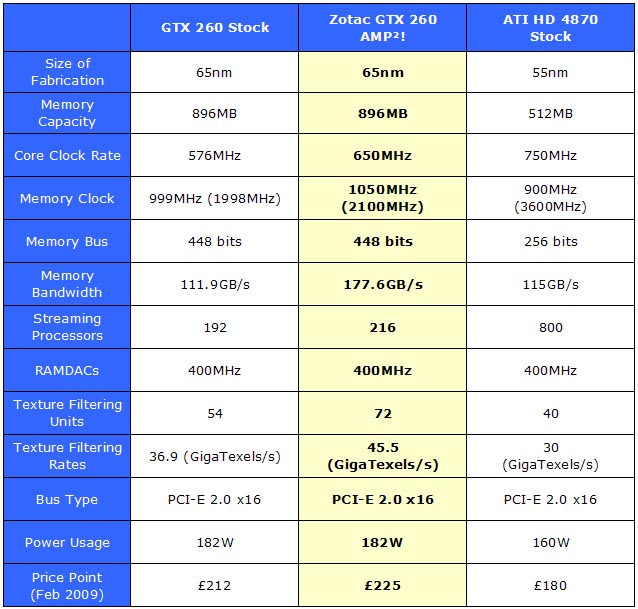
The GTX 260 AMP²! card features many improvements, such as the stream processors – 216 feature on the AMP²! whereas only 192 on the stock GTX 260 card. This is where Nvidia have sought to make things difficult for ATI, the 4870 has many pleasing features but it lacks greatly in the stream processing abilities. This gives the Geforce slight performance advantage over the ATI competitor. But benefits are not only in this department but the huge 898MB memory capacity along with the 448 bit memory interface would seek to offer greater performance at higher resolutions during gaming.


Whilst there are some definite feature improvements in the AMP²! edition, the most noticeable element that gamers will pick up on is the fact that the card comes pre-clocked. The Core Clocks on the GTX 260 AMP²! are up by 70MHz over the stock GTX 260, whereas the Memory Clocks are set at an additional 50MHz.
When comparing against the ATI opponent the GTX 260 AMP²! is a few centremetres bigger, so be sure to check whether you have the room to harbour such a big graphics card. In the images below, the card is installed inside an Antec 1200 case.


Testing
For the testing stage of this review, we installed the Zotac GTX 260 AMP²! inside the following system.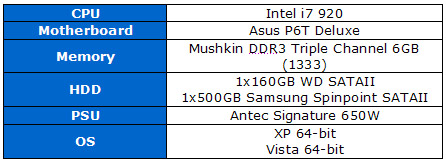
Installing the card inside such a high-spec machine will allow the card to really perform. There will be nothing holding it back.
Throughout this section of testing, we will be seeing how hot the card gets when under full operation, establishing just how many watts are used up during idle and load operations, putting the card through its paces on the latest benchmarking tools both in DX9 and DX10 and finally unleashing the card in It’s favourite environment the games. We will be testing on the latest titles including the all important Crysis test to establish how well the card performs whilst under one of the most demanding games on the shelves.
Over the page and we will start with the Temperature and Power Consumption tests.
Temperature and Power Consumption
For this test, we observed the temperature recordings after 15 minutes following a cold boot up, and for the maximum load we took the temperature recording after 30 minutes of intense gaming. This would give us a good indication of how hot the card got whilst under normal operation and whilst being under stress and full operation. The results for this test are below.
From the results, It’s quite clear that the Zotac GTX 260 AMP²! is markably cooler than the stock Powercolor HD 4870. Notice I say “stock” despite the fact the HD 4870 is not overclocked it exceeds the GTX 260 by a wide margin. Both fans where at default speeds during these tests (40% fan speed). So in this first test I am very impressed with the temperatures I am seeing from an overclocked GTX 260 compared to a standard HD 4870.
Power Consumption
Similar to the temperature test, the recordings were given after a cold boot up of 15 minutes and then for the load recording, 30 minutes of intense gaming to allow the statistics to peak and give the closest representation to the truth. Below are the findings.

Here the HD 4870 has the advantage over the GTX 260 AMP²!. The difference between idle and the load being just 84W for the HD 4870 whilst the GTX 260 AMP²! has a range of 156W during it’s operation. This is likely to be due to the higher frequencies the AMP²! edition has been adjusted to. The difference is quite big, having such a big draw will mean you will need a decent PSU, we recommend something in the region of 550-600W+.
Performance
On the performance side of things we will be testing the card by putting it through its paces on a series of games and applications. The benchmarking tools chosen will be 3DMark06 and 3DMark Vantage. The reason for using both of these programs is because 3DMark Vantage is DX10 only so we will be running 3DMark06 under XP to compare It’s DX9 capabilities. This gives us a good comparison check between the DX9 and DX10 platforms.For both the GTX 260 AMP² and HD 4870 the below drivers are going to be used. To ensure that the system is clean we will be using Driver Sweeper between installations.

Over the page we will be starting the performance tests with Futuremark’s 3DMark06.
3DMark06 DX9
3DMark06 is a popular tool amongst hardcore benchmarkers. It is used to ascertain system performance and more importantly graphics performance. 3DMark06 is running under Windows XP, this is DX9 only. The following test was performed using the default settings (no AA 1680x). The results were as follows: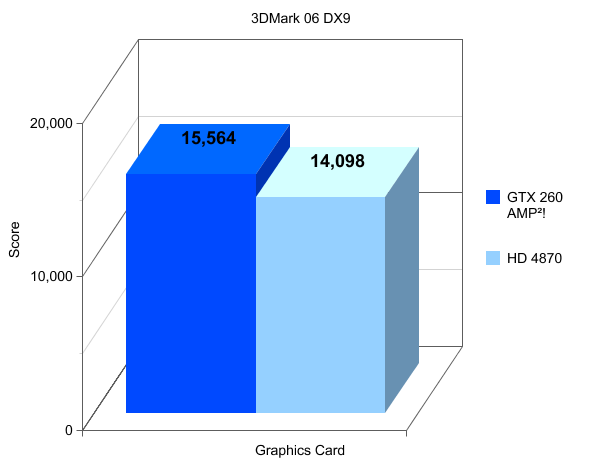
The GTX 260 AMP²! quite obviously races ahead in this test. It clears the HD 4870’s score by over 1000 points which is very impressive indeed. That’s the DX9 capabilities over and done with, but how well does it cope with on DX10? Over the page we will discover It’s performance in 3DMark Vantage.
3DMark Vantage DX10
3DMark Vantage is the latest benchmarking tool for your system. Released by futuremark this edition is DX10 specific, and so will only work under Vista. For this test “Performance” mode was selected and both GPU test 1 and test 2.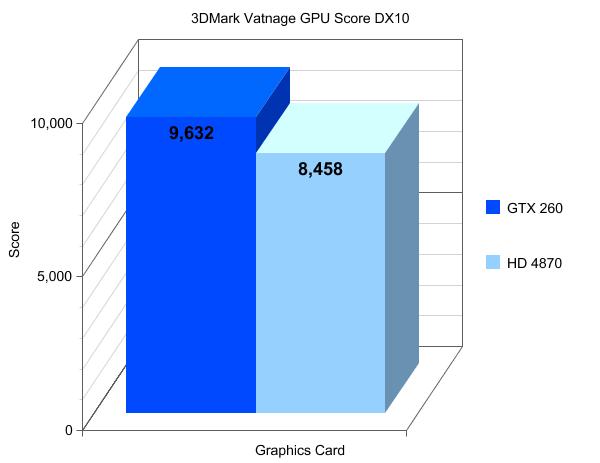
The GTX 260 AMP²! easily accelerates past the HD 4870 in the 3DMark Vantage benchmark test. It clears the HD 4870 results by over 1000 points again. Whilst these scores are definately something to respect and acknowledge, the real tests become apparent in the games we are to test as this is what gamer’s really care about, what performance they will recieve from having such a card installed in their system.
So far so good, the GTX 260 AMP²! has impressed turn over the page and we can begin looking at how it shapes up in the gaming environment!
Crysis

Everyone knows that Crysis is easily one of the most demanding games out there on the shelves. It requires a very fast CPU and GPU to run even moderately well. Our test features the latest version of Crysis using the latest patch and each resolution test included high and very high detail mode settings along with generous amounts of AA. Below are the results.
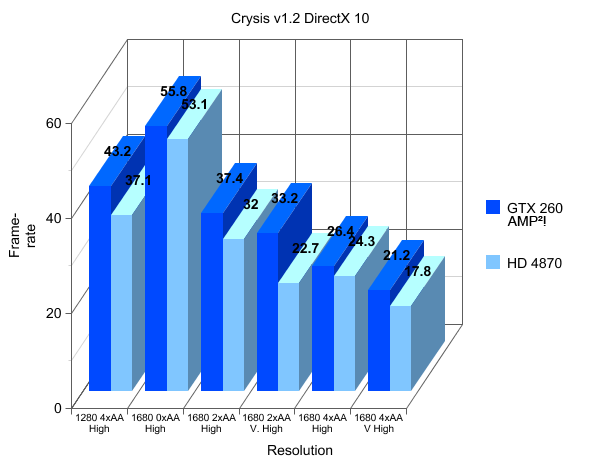
The results very much speak for themselves. Applying 4xAA and very high detail settings causes both cards to struggle to find playable FPS. When we say playable 25-30FPS is playable, anything lower is deemed unplayable and generally unacceptable because of the stutters and jerkiness. 4xAA along with just the high detail settings gives us FPS on the very edge of playable and most of the game can be played under this setting. 2xAA is going to offer the most playability as this under very high and high detail settings give comfortable FPS.
The important thing to note though, is that the GTX 260 AMP²! manages to win at every level when against the HD 4870.
Unreal Tournament 3
Unreal Tournament 3 is the latest instalment in the Unreal series by Epic Games. It’s hugely popular in gaming circles, it features a stunning graphics engine and is visually very impressive. Along with other first person shooters this game is challenging on the complete system and will require a decent GPU to render the complex levels you find yourself in. The Warfare game type will be a definate endurance test with the huge open worlds you can explore. Below are the results of the UT3 test.
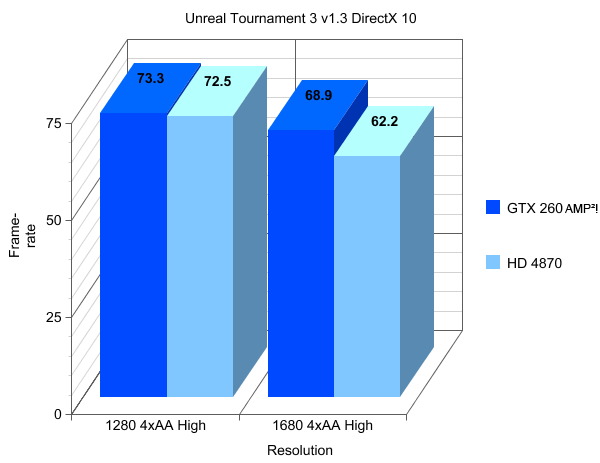
From the results you can clearly see that this is indeed a close race. The Unreal Tournament 3 test causes both cards to be very competitive. The advantage is with the GTX 260 AMP²! though. It starts pulling away from the HD 4870 as the resolution is increased. Another win for the NVidia card.
Call of Duty 4: Modern Warfare
Call of Duty 4 is another first person shooter that is very popular both online and offline. The single player missions are very atmospheric, this game does again test the system and puts it through its paces. Although this game isn’t as demanding as other games in this review It’s important for us to benchmark this game as It’s widely known and commonly found on the gamer’s system with it being a multi-award winning title.
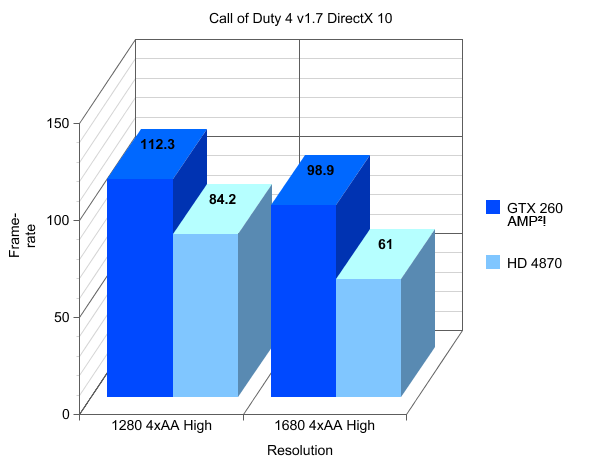
For our COD4 test the GTX 260 AMP²! quite comfortably crushes the HD 4870 at both resolutions tested and with ample AA applied. It’s important to note that at the highest resolution tested the FPS results barely altered from the lower resolution. Gaming with such high FPS enables super smooth gameplay whilst enjoying everything on high detail with plenty of eye candy. Again the GTX 260 AMP²! comes out as the victor here.
Assassin's Creed

Now for a different style of gaming all together. The multi-award winning Assassin’s Creed is a significant test for us to throw both cards into. It has a unique gaming engine and is a game which like the others, demands raw power to give smooth gameplay. The destinations you are taken to in Assassin’s Creed are truly phenomenal for their rendering. The sceneries and interactions are both breath-taking and stunning.
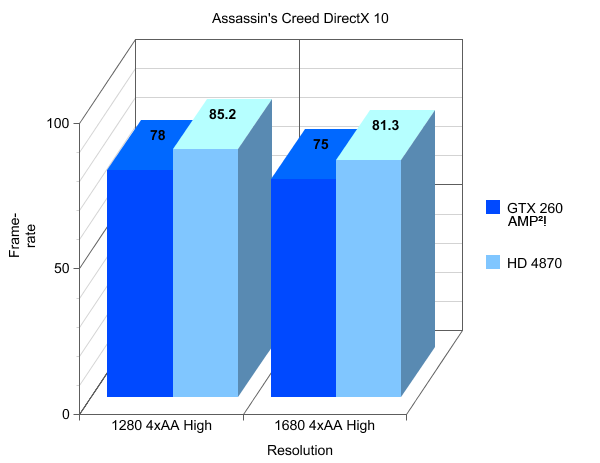
A reversal of performance altogether now, the results above show us that the HD 4870 provides better performance albeit very small, this is a win for the HD 4870 card. Assassin’s Creed utilises the GDDR5 the ATI card features along with the increased number of streaming processors give it the slight advantage over the GTX 260 card.
Overclocking
You do not expect a pre-clocked graphics card to allow much overclocking potential, but here I as pleasantly surprised. For this test I used the latest version of RivaTuner. RivaTuner v2.22. I was able to increase the following attributes:Core Clock – 650MHz to 689MHz
Shader Clock – 1400MHz to 1480MHz
Memory Clock – 1050MHz to 1095MHz
This has a great bearing on 3DMark points. Here are the results before and after the overclock. This makes for a very interesting set of records, I’m sure the card can probably be pushed further too.
Before Overclock – 15564
After Overclock – 16507
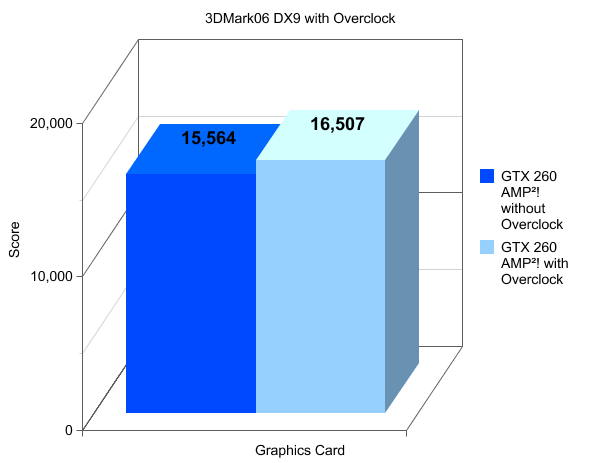
Almost a whole 1000 points can be had from these small tweaks. This will of course increase your FPS in games too. This additional functionality can only make the AMP²! even more favourable.
Conclusion
As the Nvidia and ATI battle continues, things have changed slightly since the release of both the GTX 260 and the HD 4870 offerings. Back at the beginning of winter the HD 4870 would have been an easy recommendation for the price per performance it offered. Now pricing has dropped, the GTX 260 is now more favourable with it being more closely priced to the HD 4870. What’s more is the Zotac GTX 260 AMP²! edition offers even more performance than the standard GTX 260 giving it even more merit for a sensible upgrade. Not only this but the performance the AMP² delivers is not far behind the GTX 280. The increased shaders and clock speeds, along with overclocking potential of being able to nudge those clock speeds up slightly make the AMP² make the Zotac GTX 260 AMP²! edition a very desirable graphics card. It has some great potential and is an obvious choice if you are looking yo upgrade you graphics card and look to spend anywhere between £180-220.Coupled with the low temperatures, free game, blistering performance and overclockability – you will appreciate that from this review the Zotac GTX 260 AMP²! is an obvious no brainer and we recommend you go and pick one up!
Vortez Hardware would like to thank Zotac for providing us with the GTX 260 AMP²! edition.
To discuss this review please go to: Vortez Hardware Forum – Zotac GeForce GTX 260 AMP²! Edition Review.
