



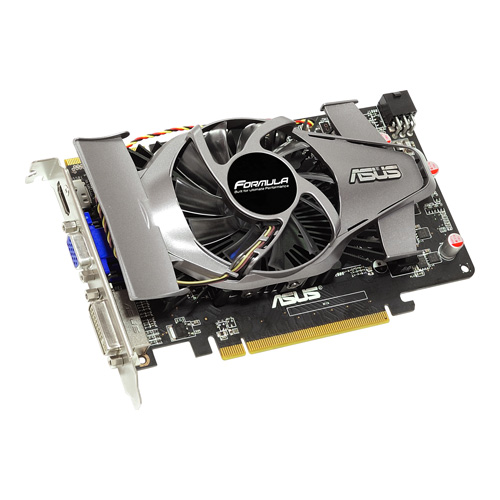
ASUS have given us the opportunity today to have an exclusive look at their improved HD5750 design.
Product on Review: EAH5750 FORMULA/2DI/1GD5Manufacturer and Sponsor: ASUS
MSRP: Not mentioned on site
Street Price: £100.

ATI have been on a roll lately, entering the Direct X 11 era full guns blazing. They have conquered the enthusiasts\’ heart with their Hemlock HD5970, the high end market with their HD58XX series and the mainstream segment with the HD57XX series. We as consumers are now spoilt for choice, although saying this, ATI still need to work on their supply problems. Choosing a high end ATI card is quite easy as a result because you always go for whatever is in stock. However in the mainstream market, you are still left the daunting task of having a range of cards to choose from. This is where ASUS have come yet again to differentiate themselves from the rest with their all new custom “EHA5750 Formula”.
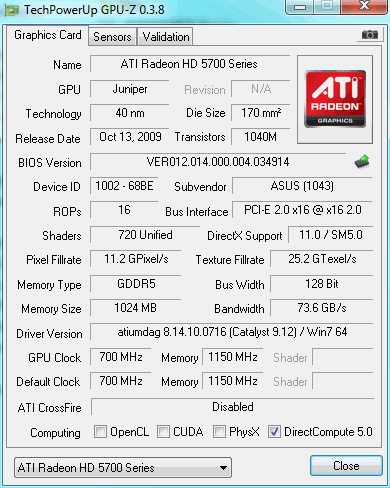
Before we go into the details of the new card, it’s important to understand ATI’s current line-up. As mentioned briefly, ATI are targeting the ultra high end with their dual GPU HD5970 at a fairly steep price of £500-£550. Stepping down we have the HD5870 and the HD5850 at £300-£350 and £200-£250 respectively. Those are targeting the high end market and as previously seen in our very own review, the HD5870 has hit the sweet spot in terms of performance. The current slowest DX 11 cards are in the form of the Juniper core, set to replace the HD4870, and as such are priced similarly. Specification wise, the Juniper core not a whole lot different from the very familiar HD4870, sporting the same 800 shader cores but higher clock speeds. The Juniper LE core found in today’s HD5750 is a slightly cut down GPU sporting lower clock speeds and only 720 shader cores. The main disadvantage facing this series is the limited 128bit memory bus. Hopefully, optimizations of the core along with its high speed GDDR5 memory can nullify this weakness.
Onto what ASUS is actually providing us with today. The EAH5750 Formula is built on ASUS’s accustomed innovative cooling solutions and engineering. With an improved fan design and unique overclocking tools, ASUS promise to deliver highly improved cooling, whilst arming their user with the arsenal to create a blistering card at an affordable price.
A bit about ASUS:
ASUS comes from the last four letters of Pegasus, the winged horse in Greek mythology that represents the inspiration of art and learning. ASUS embodies the strength, creative spirit and purity symbolized by this regal and agile mythical creature, soaring to new heights of quality and innovation with each product it introduces to the market.
ASUS pursues technological and aesthetic perfection through continuous innovation. We place ourselves in our customers’ shoes to develop a deep understanding of, and genuine empathy for, their needs—enabling us to create user experiences that transcend the norm.
ASUS Design Philosophy
ASUS Design develops high-quality solutions our customers will enjoy.
Our design process is built on thorough research, early anticipation and well-planned execution.
We act with a global vision and a focus on local strengths, conditions and heritage.
Let’s look at the card in more detail. Next page please.
Feature and Specifications
ASUS’s description of the card:ASUS EAH5750 FORMULA and EAH5770: Highly Efficient Cooling Solutions for up to 13% Better Heat Dissipation
Heat is the bane of all graphics cards, and the new ASUS EAH5750 FORMULA and EAH5770 are designed specifically to deliver highly efficient cooling without compromising performance. The design of the ASUS EAH5750 FORMULA incorporates the aerodynamic properties of a Formula One racing car, increasing airflow volume by 7% and also diverting heat away from the GPU and other critical components. A heatsink boasting ASUS’ proprietary Micro Surface Treatment improves heat dissipation by up to 14%, while a fan sporting a unique dust-proof design provides cooling for up to 10,000 hours longer than conventional fans. The result is an improvement in heat dissipation by 13% compared to other reference design boards.
Features
•1GB GDDR5 video memory
•HDCP compliant
•ATI CrossfireXTM Technology with multi-GPU support
•ATI PowerPlayTM Technology
•Variety Connectivity: Dual DVI /D-Sub/HDMI/HDCP Compliant
•More than 2 teraflops!
•ATI Stream Technology for parallel processing tasks
•Microsoft Direct X 11 & OpenGL 3.1 compliant
•PCI Express 2.0 support
•ASUS Exclusive innovations
•Size: The card size is 7.18 inches x 4.65 inches
ASUS Exclusive innovations
•ASUS Splendid: Watching video on PCs is now as good as on the best TVs
•ASUS GamerOSD: Real-time overclocking, benchmarking and video capturing in any PC game!
•ASUS SmartDoctor: Intelligent hardware protection and overclocking tool for your graphics card
•Xtreme Design/Formula Series
ASUS Exclusive Formula Fansink
•13% Cooler than generic Radeon HD5750
•Aerodynamic Cover Design: Adopted from the aerodynamic design of a race car, the streamline cover enables two heat dissipation cycles, which effectively increases the airflow volume by 7%, racing the Formula series to the forefront of cooling performance.
•Micro Surface Treatment Technology: The saw tooth texture produces significantly more heat dissipating surface areas and results in a 14% improvement in heat dissipation compared to normal heatsinks.
In its specifications, the HD5750 1GB falls short of the HD4870 in many ways but this new generation of card has moved on from the old DX10.1 cards. These cards are for the performance/mainstream market where power consumption has to be taken into account and ATI lists it as only consuming a maximum of 86 Watts of power under maximum load while idling at 16 Watts. This can be achieved by the 40nm process on the Juniper core. Despite the low power consumption, the HD5750 can deliver tremendous performance, demonstrating ATI’s growing intention into making efficient cards. Consequently only 1 6pin PCI-E connector is required to power this card.
Packaging and Content
The front of the box with its cool blue look
The packaging ASUS chose is very attractive and fitting to what their message is. Using blue to encapsulate the fact that it runs cool, and an F1 car to show the speed that this card aims to deliver. The F1 car also represents the shape of the cooler. Some of the key features are shown on the box, such as the 1GB GDDR5 memory, HDMI, Direct X 11 and the card’s extreme design that is advertised as “13% cooler”.

Th back of the box
The back contains the “small print”, mostly giving information about ASUS’s exclusive innovation that’s bundled with the card, such as the Gamer OSD, SmartDoctor and Slendid. The former two features aid in hardware tweaking aiming at gamers while Splendid is for watching videos in high quality.
Opening the front flap
The front of the box has a handy flap that when opened reveals a lot more about the unique features of this card as well the card itself through the clear plastic cover. The box illustrates the advantage of the new cooler over the standard “egg shaped” ones that tends to get hotter. The card is also advertised as being No.1 for performance, safety and reliability based on design features such as Fuse protection technologies, EMI shielding and GPU guard. All this allows for risk-free computing.
ASUS Xtreme design
A closer look at the lid shows the Micro-surface treatment technology and aerodynamic cover as well as the durable dust proof fan design that helps differentiates this card from generic cards
The card and cables
The card and bundle is neatly and securely packaged in foam although the card itself isn’t wrapped in an anti-static bag. The manual and driver CDs are below the foam cover. The packaging is professionally constructed and robust so you can be ensured that the card will stay safe.
The bundle
Apart from the card itself, ASUS provides a manual, the driver and utilities disc, a DVI-HDMI converter, a molex to 6pin cable and a crossfire cable. Unlike the 5870 variant, this card does not come bundled with the Colin McRae DIRT 2 game.
Closer Look
The ASUS EAH 5750 Formula
This card is not very subtle at all. As with other HD5750 designs, the card is short meaning it’ll fit easily into any case with plenty of room to spare. The most striking feature is the F1 shaped cooler. Although it takes up two PCI-E slots in the computer, the i/o backplate only takes up one slot meaning air can vent out more freely from where the backplate would have extended. The black PCB is standard for most HD5750 boards.
The back of the card
On the back are 4 128MB memory chips and the screws holding the fan securely. The memory chips aren’t cooled but they must sufficiently cool for ASUS to leave out a back plate to dissipate excess heat.
The Formula 1 fan
The fan itself is what differentiates the graphics cards from generic designs. The F1 shape is more apparent from this angle. The card makes use of a fairly large heatsink spreading laterally with a fan on top to help dissipate heat. The H5750 is a cool running chip so this design makes sure that all the heat gets transferred efficiently. Rather than opting for the red fan of other ATI designs, ASUS settle for a translucent bladed cooler. One complaint is that the fan wire is not braided and thus clashes with the rest of the cooler, if that sort of thing annoys you…
The I/O ports
Unlike the EAH5870, the EAH5750 only has 3 ports: 1xHDMI, 1xVGA and 1xDVI-D. This emphasizes the fact that the card is aimed at the mainstream market rather than the high end, where VGA is non-existent these days. It still allows for multiple monitor outputs although without a DisplayPort connection, Eyefinity is not support. Since the card is not likely to support gaming at these high resolutions, it’s not surprising to see the card lacking this feature.
The crossfire connector allows for cheap dual card action
On the side of the card are the crossfire connectors should you want to run two cards for some extra performance. You can also notice here that the plastic cooler cover is screwed onto the heatsink.
Only one 6-pin PCI-E cable is required
The card requires a 6 pin PCI-E connector which goes to show that it does not require a lot of power at all and the 6 pin connector alone should be able to deal with high power draw from an overclocked card.
Test Setup
CPU – Intel Core i7 920 – 4ghzRAM – 6GB (3x2GB) OCZ platinum DDR3 1333mhz
Motherboard – Biostar T-Power x58
Power Supply – Enermax Revolution 85+ 850W
Cooling – Tuniq Tower 120 Extreme
Hard Drive – Samsung F1 320GB
Western Digital Caviar WD3200AAKS 320GB
Graphics cards
ATI HD 4870 1024MB – ATI Catalyst 9.9 Vista x64
ASUS EAH5870 1024MB – ATI Catalyst 9.10 Win 7 x64
ASUS EAH57501GB FORMULA – ATI Catalyst 9.12 Win 7 x64
Benchmark Suite
Crysis Warhead using the FRAMEBUFFER Crysis benchmark tool
Far Cry 2
Resident Evil 5
Street Fighter IV
Unreal Tournament 3 using the HOC Bench tool
Enemy Territories Quake Wars using the HOC Bench tool
GTA IV
Colin McRae DIRT 2
3DMark 06
3DMark Vantage
Unigine DX 11 Benchmark
Temperature and Overclocking
To overclock the GPU, the ASUS SmartDoctor tool and MSI afterburner 1.3 application were used. For some reason ATI CCC wouldn’t install so I resorted to those alternatives. The ASUS SmartDoctor was quite limited in the headroom available allowing a maximum core speed of 780MHz and a memory speed of 5200MHz. Since the MSI Afterburner application had no such limits, I managed to overclock the EAH5750 from 700/4600 to 830/5200. That’s an increase of 18/13% respectively, showing the potential that this card holds. This was stable throughout Furmark as well as the benchmarks. Unlike the EAH5870, this card lacks the voltage tweaking feature so it couldn’t be pushed any further.
ASUS SmartDoctor
Temperature wise, the card idles in the lower 50 degrees and while gaming, it ramps up to mid 70s. These are very reasonable temperatures and certainly does the card justice, even when overclocked. The card remained stable even during an intense Furmark stress test, despite temperatures rising to mid 90s. The fan control works well, increasing incrementally with rise in temperatures. Should the temperatures get out of hand, you can also manually speed it up. Thankfully the fan remains silent making it ideal for HTPC use. When in 2d mode, the card downclocks to 157/4000 MHz to reduce power consumption. ATI PowerPlay certainly works wonders to reduce your electricity bills. Unlike with the EAH5870, no flickering was experienced during the enhanced PowerPlay mode.
Crysis Warhead
Following the success of Crysis, the stand alone expansion “Warhead” was hotly anticipated to bring more game play, more weapons, improved visuals whilst maintaining better performance, the latter being what gamers wanted most. After all how many people upgraded their rigs just to play this game… In the game, you play as the upbeat Brit Sergeant “Psycho” Sykes, chasing down a Korean nuclear warhead. Throw in some ice shooting aliens and we’re bound to have a great game. It sure delivered.
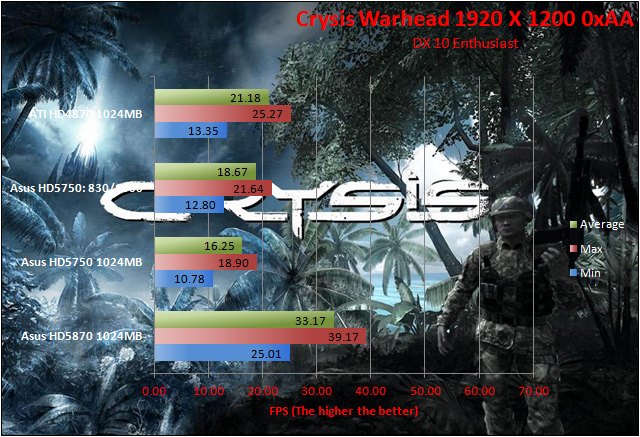
The HD5750 is about half the power of the HD5870, which considering the lower than half the specifications, is not bad going at all for the little card. It lags behind the HD4870 by a few frames but then again, it is priced slightly lower as well. Overclocking does reduce the gap by increasing performance by up to 20%. For the most part however, I would not recommend playing Crysis Warhead on the enthusiast setting using this card but choosing the gamer setting definitely makes the game much more playable without sacrificing too much on the visuals.
Far Cry 2
One of the most hyped game of 2008, Far Cry 2 had some big shoes to fill. It was built to be the next best thing since well.. Far Cry I suppose. Combining an open world game play with highly detailed graphics, physics and AI, what more could we possibly want? The game puts in the body of a malaria inflicted mercenary hunting down the Jackal in the heart of Africa, in a bid to stop an ongoing conflict between two rival factions. The storyline can be hard to follow sometime but I’m no game reviewer, so let’s concentrate on the graphics and performance. After all, we all need to know if our hardware will be able to handle the scorching savannah burning at the hands of our flamethrowers.
Far Cry 2 is far more playable on the 5750 than Crysis Warhead. For the most part, it is only a few FPS behind the previous flagship HD4870, and overclocking goes a long way to rectifying this, netting up to 24% boosts in performance. The maximum playable setting is using the ultra high settings at 1920 x 1200, thereby bringing HD gameplay to the mainstream.
Resident Evil 5
Resident Evil 5 is the sequel to the Resident Evil series, exploring the life of main protagonist, Chris Redfield. You play as either Chris Redfield or Sheva Alomar in an African desert area in Kijuju. In true Resident Evil fashion, your main objective is to investigate a terrorist bio-organic weapon threat whilst killing infected “Majinis” on your way.
The ASUS EAH 5750 provides blistering performance in this game even with 8xAA. This goes to show that the 128 bit bus isn’t a major limitation with the GDDR5 memory at hand. Although performance is still below the HD4870, even when overclocked, the difference is not major. Considering the price and features of this card, we can see why it’s tremendous value for money.
Street Fighter IV
The ASUS EAH 5750 provides blistering performance in this game even with 8xAA. This goes to show that the 128 bit bus isn’t a major limitation with the GDDR5 memory. Although performance is still below the HD4870, even when overclocked, the difference is not major. Considering the price and features of this card, we can see why it’s tremendous value for money.
The EAH5750 replicates the same performance anomaly noticed on the HD5870, being that it performed better at the native resolution of the screen 1920×1200 than at 1680×1050. Apart from that, the story is very much the same as Resident Evil 5 with the card providing excellent performance despite the high settings. Overclocking adds another 10 FPS to the performance which isn’t bad at all for free. The performance “glitch” means that at 1920×1200, the card’s performance comes closer to matching that of the HD4870, when overclocked.
Unreal Tournament 3
Built around the unreal 3 engine, Unreal Tournament is all about mindless fast paced shooting, decapitation with a plethora of game modes to so in. Not much else can be said really except that it promises hours of enjoyment on multiplier whether it be against bots, your friends at a LAN or online. It was one of the more popular games out there to adopt PhysX in the form of partially destructible maps, tornadoes and hail.
Unreal Tournament might be an ageing game but it still provides some stunning visuals and being the engine of choice for many new games, it gives an idea of how versatile it can be. The HD5750 performs excellently in the benchmark, even surpassing the HD4870 at 1920×1200. Overclocking provides some significant improvement, although you will most likely not notice it. Priced at a fraction of the HD5870, the performance does not reflect that at all, churning out a significant proportion of what the flagship card can achieve.
Enemy Territories Quake Wars
Earth is struck once again by Extra-Terrestrials, this time in the form of the Strogg. In the game you play as either the humans, defending the their beloved planets, or the Stroggs, attempting to invade with their arsenal of futuristic weapons. The games has vast open battlefields with an enormous array of vehicles and weapons at your disposable promising fast paced strategic battles.
Performance is generally very good on the HD5750 but adding anti-aliasing does take its toll on the card, although the same thing is noticed on the HD5870. This means that the performance hit is probably not due to the 128 bit bus alone. Performance is up to 25% less than the HD4870, and in this case overclocking doesn’t yield much at all. As in the previous EAH5870 review, the overclocked results seem to look the FPS at around 40. The game is still very playable.
Grand Theft Auto 4
GTA IV follows a whole series of highly successful predecessors and this one is no exception. You play as Nico Bellic, fresh off the boat from Russia, seeking to live the American dream. But Liberty has far more sinister plans for you as you delve quickly into the criminal underworld to make a living and survive. Hours of game play later, it still retains its flare to guarantee that you go back to it at every opportunity.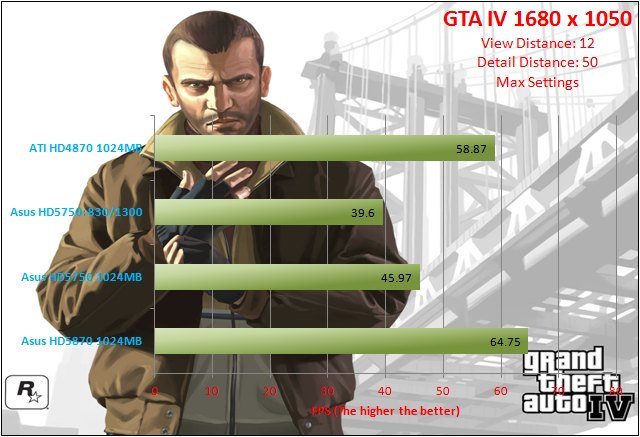
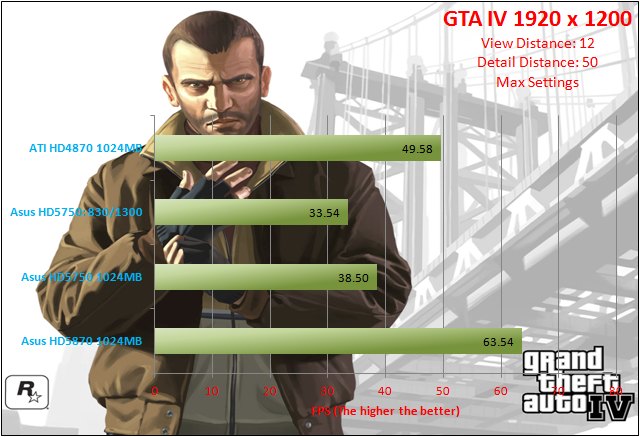
The performance of the EAH5750 is around 20% less than the HD4870 and overclocking only seems to reduce the performance. However, the game is still playable and seeing as this is one of the most demanding games out there, it is very impressive indeed. 1920×1200 does experience some stuttering but as long as the view distance is well within the memory limit, the card won’t have too much of an issue playing the game smoothly.
Colin McRae DIRT 2
DIRT is back and it’s bigger than ever. With an onslaught of famous X-Games competitors such as Ken Block and Dave Mirra, extreme is being brought back to rally. The game not only delivers outstanding gameplay in lush environments but also stunning visuals in the form of Direct X 11 implementation. If you want some fast paced, arcade style racing, then look no further than Colin McRae DIRT 2.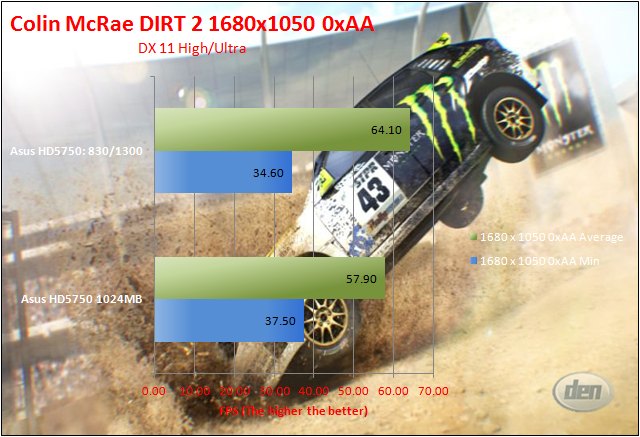
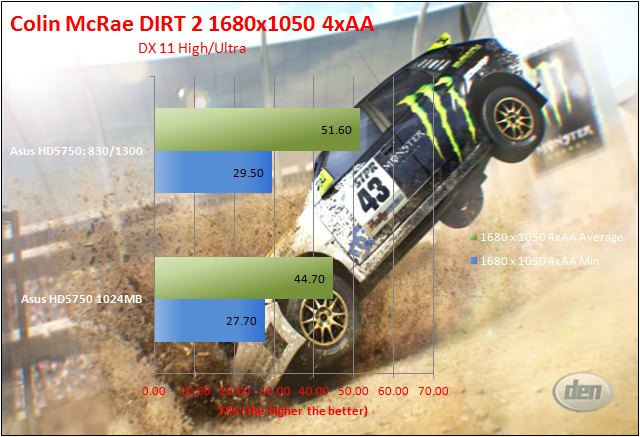
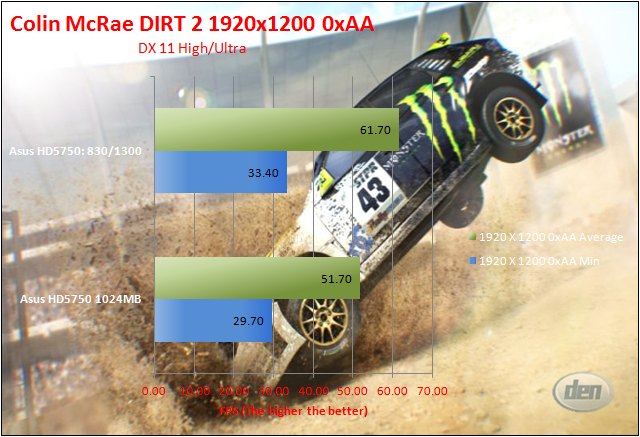
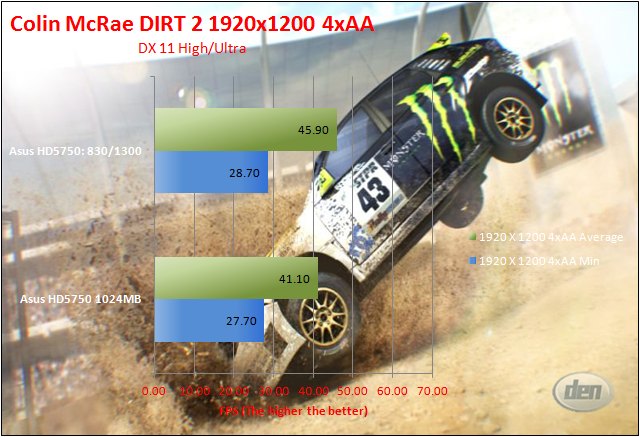
The card really shines through in this game, and demonstrates that Direct X 11 is not something just thrown in to tick all the feature boxes. The HD5750 actually performs brilliantly under Dx11 at all resolutions with up to 4xAA. Playing at 1680×1050 makes the jagged edges appear more significant but if you want the best frame rate and visuals, playing at 1920×1200 even without anti-aliasing is an excellent mix of both. Overclocking does give a small boost on top.
3DMark 06 & Vantage
3DMark 06Futuremark has been the testing ground for enthusiasts ever since their first release in 1999! While 2006 is long gone, it’s still very popular amongst benchers.
The HD5750 falls behind the HD4870 but once overclocked, is able to outperform it. This is a repeated pattern in most of the benchmarks
3DMark Vantage
This latest benchmark suite from Futuremark introduces DX 10 & PhysX support. Despite being on the verge of DX 11 games arriving, Vantage is still the chosen benchmark amongst enthusiasts these days.
Again the HD5750 falls short of the HD4870 and in this more GPU intense benchmark, even overclocking does not allow it to overtake the HD4870. However, considering its target market, it becomes apparent that this card will bring excellent gaming performance at very low costs.
Unigine DX 11 Benchmark
Unigine’s benchmark is to showcase the benefits of DX 11 and the use of tessellation as opposed to normal rendering techniques. The demo has impressive visuals that give an insight into what we can expect from gaming in the future.
The HD5750 struggled on this highly demanding benchmark but when compared to its bigger brother, this is expected. It delivers roughly half the performance for less than half the price. DX 11 takes a 29% performance drop, which isn’t too bad for the addition of tessellation. Tessellation adds new depths and a high level of realism over the DX10 API hence the performance drop.
Tessellation
DX 10
DX 11 Tessellation off
DX 11 Tessellation off – wireframe mode
DX 11 Tessellation on
DX 11 Tessellation on – wireframe mode
Let’s focus on a few characteristics of tessellations in this one image. Firstly, when we compare the wireframe mode, it is clear that tessellation is adding a lot more features and details, which may at first not be recognisable. The surfaces are divided in many more shapes. The ground for example is one of the features that benefits from it. To make it as efficient as possible, tessellation becomes a function of distance, generating more shapes closer to the viewer.
Now let’s look at the application of this. If we gaze at the rock pillar closest to us, we can immediately notcie that with tessellation, they are not just mere square blocks but that they in fact looked chipped, as a natural rock would be. Now, let’s move on to the stairs, which again is a notable improvement on the past. Rather than being flat, they have depth and look like proper stairs, and not a slide. The same applies for the cobbled road although the compressed/downsized pictures make it hard to judge. The last thing I’ll point out are the tiled roofs. With tessellation, they do not appear flat at all, and actually resemble a real roof. You’ll have to take my word for it if you don’t notice them or try the demo for yourself!
Power Consumption
To measure the power consumption of the cards, I will be using a plug in power meter for the idle and load results.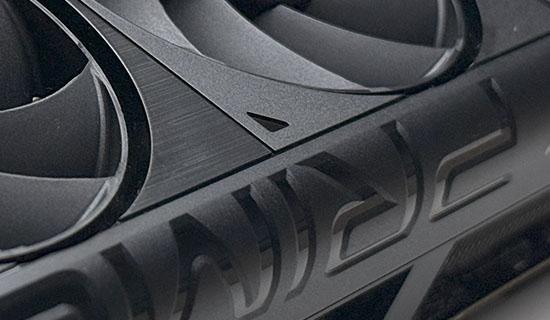
As mentioned earlier, this card only requires one single 6 pin PCI-E cable suggesting its low power requirements. Looking at the chart, we see exactly how it translates to real world power consumption. The EAH5750 consumes 114W less than the HD4870, a 30% drop that doesn’t translate into the HD4870’s performance benefit over it. Overclocking increases power consumption but the idle power draw actually drops, possibly due to the enhanced PowerPlay coming into effect. This card is a gem for HTPC users wanting a lower power mainstream card that still delivers enough performance for gaming and general usage.
Conclusion
The ASUS EAH5750 is an excellent mainstream card that will be a worthy successor to the HD4850. There used to be a time when new generation mainstream card would outperform previous generation flagship cards but recently, we stopped seeing this and mainstream cards were frowned upon by people. However, ATI have done a tremendous job reviving the old trend. Not only does this card give excellent performance, even at high resolutions of 1920×1200, but it does so without consuming a lot of power, demonstrating the focus that ATI have taken with their 5xxx series of cards. Thus the HD5750 is ideal for HTPC users and budget gaming PCs.ASUS adds their own touch to the Formula. By upgrading the cooler, ASUS goes further to ensure that the card runs cool and quiet and our own tests demonstrate this. The result is that overclocking is a breeze despite the absence of the voltage tweak feature. It also doesn\\\’t come at a significant premium over the generic cards so opting for this card instead is highly recommended. With plenty of memory, and bundles of features, ASUS are onto another winner.
There are a few limitations though, in that it lacks a DisplayPort connector for those wishing to use an Eyefinity setup. However, it can be assumed that people wanting this feature are most likely going to buy the HD5850/5870 anyway, so it\\\’s not much of a loss. With their 3 years warranty and low price, the HD5750 is a clear choice for the budget minded gamer and if performance seems lacking, there\\\’s always the option of crossfire.
Pros
[+]Good performance at all resolution and settings
[+]Direct X 11 compatibility and associated technological feature sets
[+]Design may be pleasing to some
[+]Well priced
[+]Quiet and efficient
[+]Excellent cooler and overclocking headroom
[+]Low power consumption
[+]Short
Cons
[-]Lack of DisplayPort support
[-]The HD4870 can be bought for similar prices
For its outstanding commitment to performance, low power consumption and high efficiency, I award the ASUS EAH5750 FORMULA 1024MB the Vortez Hardware Gold Award
I would like to thank ASUS yet again for their patience and support in providing the sample for this review.
To further discuss this product, please visit out forums.
To further discuss this product, please visit out forums.

