Looking for a high end graphics card that is both powerful and quiet? We try the HIS HD6970 IceQ Turbo on for size.
Product on Review: HIS HD6970 IceQ TurboManufacturer and Sponsor: HIS
Street Price: £299 inc. VAT (GBP)
Established in 1987 and based in Hong Kong, HIS (Hightech Information Services) have produced a wealth of high quality graphics cards, often proving to be superior, especially in terms of cooling than their leading rivals. Being a 1st Tier partner to AMD it should come as no surprise then that HIS have released their own incarnation of the AMD 6970, both overclocked and custom cooled in the guise of the IceQ Turbo.
We at Vortez look forward to any manufacturer that manages to produce a custom cooled GPU, especially when the offering is also pre-overclocked. We recently tested the Gigabyte GTX560 with its own custom ‘Windforce’ cooler which thoroughly impressed the guys in the office with its silent performance. So when I was asked if I’d like to take a look at the HIS Radeon HD6970 IceQ Turbo edition, a faster, more powerful card with its own custom cooling design, I wasn’t going to say no!
IceQ cooling technology is among the best out there for AMD Graphics cards and has evolved over the years to the high performing, efficient state we find today. HIS claim the new design enables the HD6970 to run over 23c cooler than the reference AMD version, a very bold statement indeed! This is done by means of 4 copper heatpipes and a ‘Black Hole Impeller’ which we will look at later in the review.

Great cooling is not the only key feature HIS boast though. The card we have on test today is the ‘Turbo’ edition, meaning it is overclocked at the factory and while Radeon cards are generally overclock friendly, any preset overclock is a bonus, especially when you consider HIS offer a satisfying 2 year warranty.
About HIS
HIS is proud to be AMD’s Authorized 1st Tier AIB Partner, Certified Partner and Launching Partner. Long term and favourable relationship with AMD, enable HIS to work closely with AMD to promote the HIS AMD Graphics Board; and to strive for best value on the marketing and sales of HIS AMD Product Line. In Sept 2003, HIS incorporated the state-of-the art Supreme Cooling Technology in the award winning HIS 9800Pro IceQ, which caught the attention of worldwide media. Since then, HIS IceQ series and the latest IceQ X series has been the limelight in the market for its outstanding performance and features over the other rivals. Today, HIS continues its avid commitment to quality product and service. HIS is certain to be Your Choice of Graphics Board Supplier.
HIS is proud to be AMD’s Authorized 1st Tier AIB Partner, Certified Partner and Launching Partner. Long term and favourable relationship with AMD, enable HIS to work closely with AMD to promote the HIS AMD Graphics Board; and to strive for best value on the marketing and sales of HIS AMD Product Line. In Sept 2003, HIS incorporated the state-of-the art Supreme Cooling Technology in the award winning HIS 9800Pro IceQ, which caught the attention of worldwide media. Since then, HIS IceQ series and the latest IceQ X series has been the limelight in the market for its outstanding performance and features over the other rivals. Today, HIS continues its avid commitment to quality product and service. HIS is certain to be Your Choice of Graphics Board Supplier.
Let’s take a look at what HIS has to offer…
Specification
Cayman is the rightful heir to the successful Cypress core. For the most part, the architecture is much the same with some tweaks to increase efficiency and performance per die size. The GPU comes in two variants, Cayman Pro and Cayman XT, the former found on board the HD6950 and the latter on the HD6970. Originally, the Cayman core was poised to be manufactured on the 32nm manufacturing process which would have brought along many new features and possibly better performance in the same package. However, TSMC cancelled the process so Cayman had to resort to the more mature 40nm process, sacrificing many of the new features promised.The biggest change to the architecture is the use of the VLIW4 design instead of the VLIW5 design used since DX9 graphics cards were first introduced. The main reason was to increase efficiency in newer DX10/11 titles and to put more emphasis on GPGPU computing. The VLIW4 architecture introduces a narrower Stream Processing Unit, in which the 5th stream processor named the “t-unit” has been removed leaving just 4. Despite the Unit only being able to process 4 operations instead of 5, the advantage is that the space saved allows the core to have more SIMD clusters. The end result is that Cayman can have up to 24 SIMD clusters (24 on the HD6970 and 22 on the HD6950) whereas Cypress only had up to 20 SIMDs (20 on the HD5870 and 18 on the HD5850), giving Cayman a 10% improvement per mm squared compared to previous VLIW5 architecture (as used on Barts also). The architecture is now more catered towards GPU Compute than before and the higher SIMD count also gives additional texturing performance. Each SIMD from both architectures contains 4 texture units so Cayman now benefits from up to 96 units rather than the 80 available on Cypress.
Cayman: VLIW4, 24 SIMD clusters, 96 texture units
Cypress: VLIW5, 20 SIMD clusters, 80 texture units
Another benefit of the new core is its improved dual 8th generation tessellator that bring up to 3 times the tessellation performance of the HD5870.
As mentioned, Cayman comes in two variants as found on the HD6950 and HD6970. The key difference is that the HD6950 has 22 SIMD clusters instead of 24 on the HD6970, leading to fewer texture units (88 vs. 96) and fewer stream processors (1408 vs. 1536). The GPU boasts an impressive 2.64 billion transistors on a die size 389mm squared. For reference, the mainstream Barts core sports 1.7 billion transistors on a 255mm squared package. A 256-bit GDDR5 memory bus is still supported but this time 2GB of VRAM is provided to compete with Nvidia’s offerings.
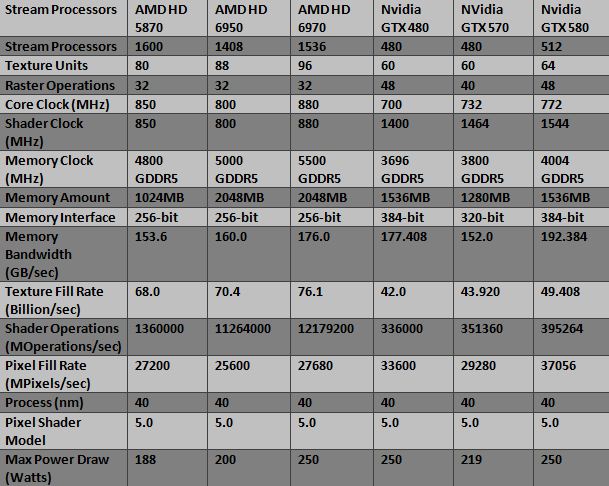
Above you can see what the card is stacked up against in terms of specifications. The card we have on test today has a slightly higher GPU clock speed of 900MHz vs. 880MHz stock along with a slight increase on the memory clock speed from 5.5GB/s to 5.6GB/s. Perhaps the main talking point though is the IceQ cooler which as you will see, is something special.
Product Specification
Product Code: H697QT2G2M
EAN Code: 4895139005820
Cooler: IceQ
GPU: HD6970
Core Clock: 900 MHz
Memory Clock: 5600 MHz
Memory Size: 2048 MB
Memory Type: GDDR5
Memory Interface: 256 bit
Interface: PCI Express x16 (PCI Express 2.1)
Let’s take a look at the card features…
Features
Get Immersed with AMD Eyefinity Technology
•Enable ultra-high resolution multi-monitor gaming with 2GB of high speed GDDR5 memory.
•Expand your favourite games across up to 4 displays with AMD Eyefinity technology for an expansive field of view.
•See more of the battle than ever before with up to 4 simultaneous displays.
•Get the freedom and flexibility to upgrade. This modular solution enables you to add additional displays.
•Put your productivity into overdrive and let up to 4 displays put all the information you need right before your eyes.
•Don’t choose between play and work. Let up to 4 displays help you enjoy games, movies and the web at the same time.
Get Amazing EyeDefinition Graphics with DirectX 11 Technology
•New and advanced architecture featuring full DirectX® 11 support and scalable geometry processing.
•Featuring a new and advanced architecture with scalable geometry processing, the AMD Radeon HD™ 6900 Series is purpose-built to dominate your games.
•Maximum efficiency & performance. AMD PowerTune technology puts exceptionally intelligent power management under your control.
•Raise the bar for beautifully smooth image quality with Enhanced Quality Anti-Aliasing (EQAA).
•Dual advanced programmable tessellation engines for twice the geometry processing performance of previous generations.
•Play your favourite games in full stereo 3D, and get incredibly rich and interactive gameplay with AMD HD3D technology.
Speed Up Applications and Enjoy Brilliant Video with AMD EyeSpeed Technology
•Unleash the most demanding applications with AMD Accelerated Parallel Processing (APP) technology.
•Supports double precision floating point arithmetic to handle computationally intense workloads.
•Smooth visual quality with AMD EyeSpeed visual acceleration technology.
•Experience Blu-ray 3D as it was intended with AMD HD3D technology.
•Take advantage of AMD Radeon™ HD 6900 Series graphics’ Dolby TrueHD and 3D HDTV support.
Put out Stunning Visual and Unrivalled Audio Experience with HD3D Technology
•Stereo 3D display/glasses support
•Stereo 3D gaming
•Blu-ray™ 3D support
•3rd Party stereo 3D middleware software support
•Launching with AMD Radeon™ 6900 Series GPUs
Microsoft® DirectX® 11 Support
Get intense gaming performance and unrivalled image quality with stunning 3D visual effects, realistic lighting and lifelike imagery, driven by a new and advanced DirectX® 11-capable architecture with scalable geometry processing.
AMD Eyefinity Technology
Enjoy the ultimate immersive gaming experience with AMD’s Eyefinity multi-display capabilities.
AMD Advanced Parallel Processing technology
Accelerate the most demanding applications for improved performance.
Advanced GDDR5 Memory Technology
Delivers more speed and higher bandwidth.
AMD CrossFireX™ Technology
Increase your gaming performance with AMD CrossFireX™ Technology.
3rd Generation TeraScale Engine
Provides increased processing power for the latest games and accelerated applications.
40nm Process Technology
Provides enhanced processor performance while using less power and better transistor efficiency than previous generation technology.
Accelerated Video Transcoding
Helps improve video transcoding performance.
Display Flexibility
More flexibility with maximum connectivity for the latest display technologies.
HDMI 1.4
Helps ensure you get the full Blu-ray and PVR experience from your PC.
Dolly®TrueHD and DTS-HD Master Audio Support
Get a fully immersive high-definition audio experience with the latest Blu-ray movies.
AMD PowerPlay™ Technology
Power draw scales according to activity so when GPU activity is low, the power draw is minimal.
Enhanced Unified Video Decoder (UVD) 3Watch the hottest Blu-ray movies, online video and other HD content beyond 1080p with low power and low noise with GPU acceleration and enhanced Unified Video Decoder (UVD) 3 features.
HIS exclusive features
Faster – Make your overclocking dreams come true! The HIS IceQ Turbo Models are BIOS-overclocked out of the box.
Cooler – HIS HD6970 IceQ is 23c cooler than reference cooler.
Quieter – HIS HD 6970 IceQ is quieter than reference cooler.
Black Hole Impeller – Cool air is drawn from both sides of the fan to enhance the cooling efficiency.
Four Heatpipes– Optimize cooling performance by removing heat from the core area.
Solid State Choke – Durable Iron that can maximize current capacity, power efficiency and stability.
Full Solid State Capacitors – Extend the lifespan and storage capabilities.
Dynamic Phase Control PWM IC – A significant energy saving technique for reducing power consumption.
Faster – Make your overclocking dreams come true! The HIS IceQ Turbo Models are BIOS-overclocked out of the box.
Cooler – HIS HD6970 IceQ is 23c cooler than reference cooler.
Quieter – HIS HD 6970 IceQ is quieter than reference cooler.
Black Hole Impeller – Cool air is drawn from both sides of the fan to enhance the cooling efficiency.
Four Heatpipes– Optimize cooling performance by removing heat from the core area.
Solid State Choke – Durable Iron that can maximize current capacity, power efficiency and stability.
Full Solid State Capacitors – Extend the lifespan and storage capabilities.
Dynamic Phase Control PWM IC – A significant energy saving technique for reducing power consumption.
Packaging & Contents
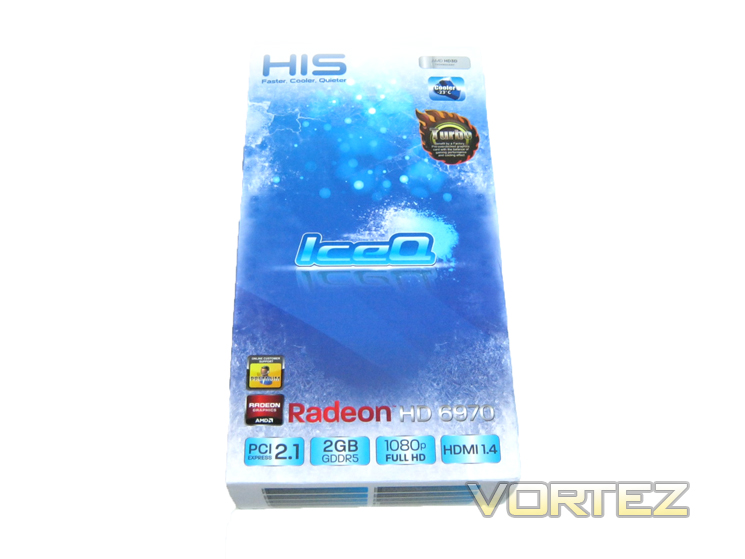
The HIS package is presented in a very stylish box taking up the ice theme of its cooling solution. The front of the box is dominated with the IceQ emblem, glossy embossed on a matt background complete with embossed snowflakes. The attractive theme is joined with product features displayed once again with raised, glossy emblems along with an additional sticker signifying that this product falls under the Turbo umbrella.
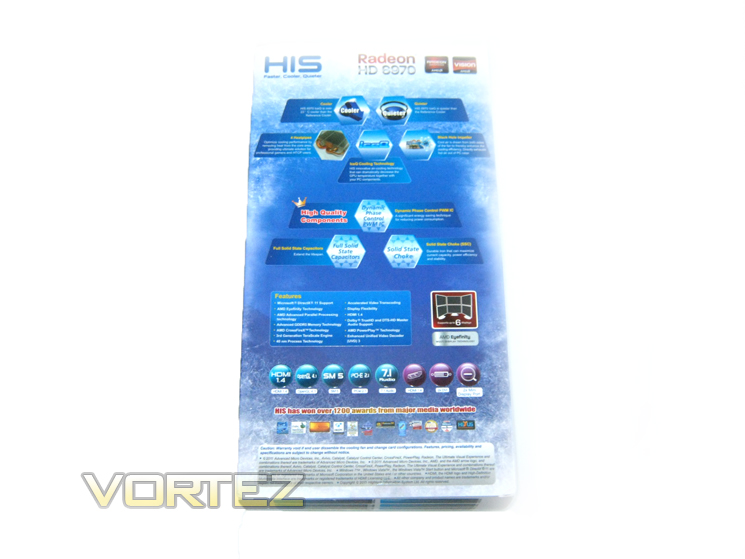
The rear of the box goes into greater details regarding the features of the graphics card highlighting that it is both cooler (up to 23c) and quieter than a reference cooled card. Unlike the HD6950 we reviewed recently, the HIS HD6970 supports up to 6 display panels at once as opposed to the 4 panel setup support.
High quality components are also a bragging right of HIS with the company using All round solid state capacitors and enhance the lifespan of the card. Along with dynamic phase control (PWM IC), the HIS HD6970 IceQ Turbo also features Solid State Chokes (SSC) that maximise power efficiency, cooling capacity and stability, especially important for those wishing to push the card beyond its factory overclock.
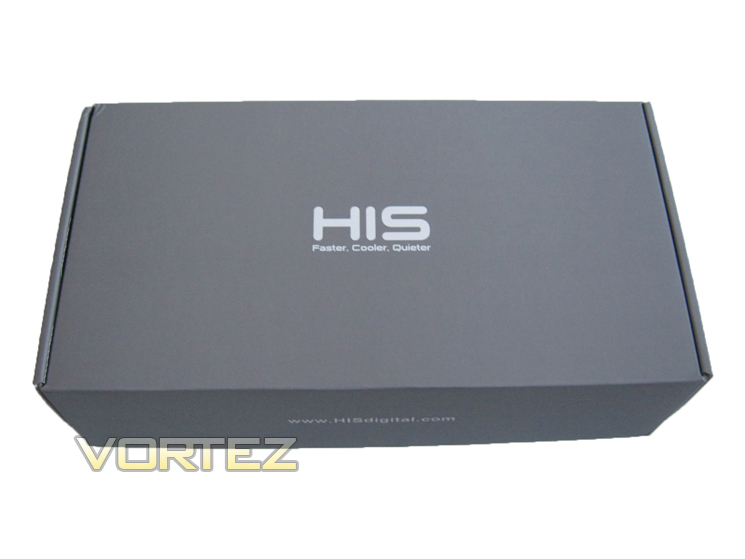
With the colourful outer sleeve removed we are greeted with the much more sturdy yet bland inner box which houses the graphics card and the accessories.
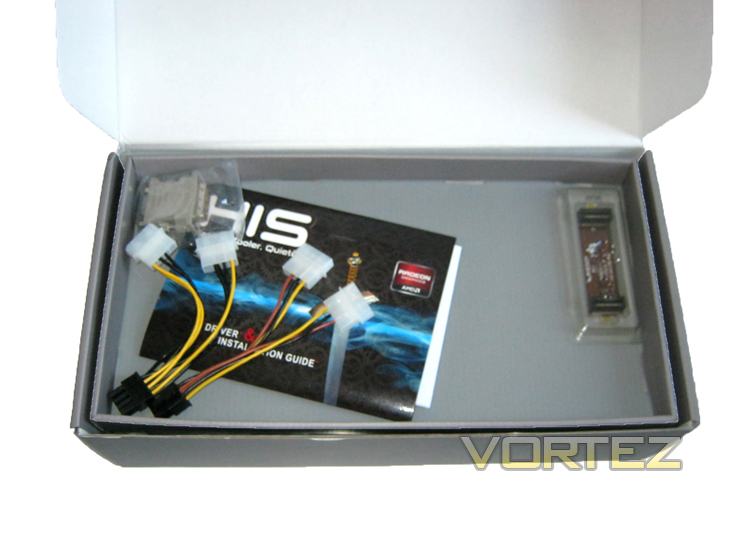
A removable compartment separates the accessories from the GPU and holds the following:
– 1 x Dual MOLEX to 6 pin PCIe power cable
– 1 x Dual MOLEX to 8 pin PCIe power cable
– 1 x Crossfire Bridge
– 1 x DVI-to-VGA adaptor
– 1 x Multi-lingual quick-installation guide
– Driver disc
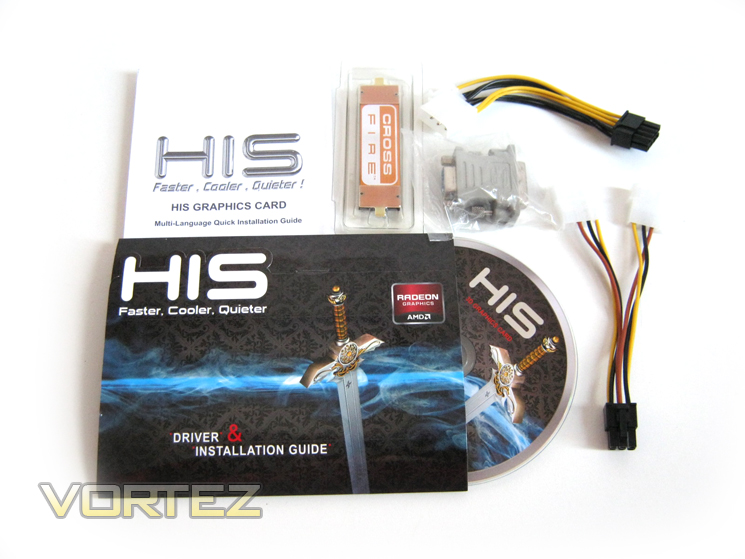
I liked the glossy CD wallet, certainly more appealing that the standard white paper affairs often used to bundle software and drivers. I would have liked the cables to have been braided, possibly to match the blue theme of the card which would serve to promote this package as a premium offering but in all honesty, it is very unlikely that both cables would be used to power the card given that most modern PSU’s have at least a single 6 pin PCIe power cable. Disappointingly, there were no included games in the product package I received but HIS are including free copies of Dirt 3 with retail versions (subject to availability).
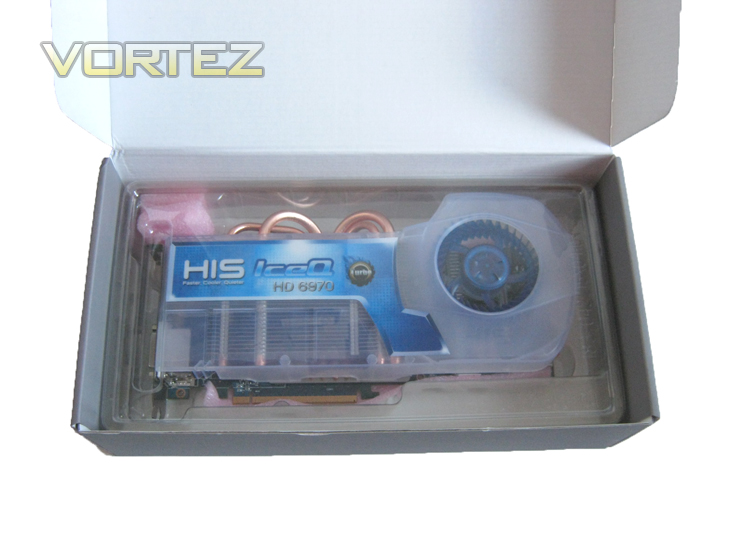
Finally we reach the card itself. The sturdy cardboard box it appears was not sufficient for HIS so they cradled the card in a plastic case, itself padded with Styrofoam to ensure the package reaches you in perfect condition.
Aside from the missing game and bundled software, the overall package is very well designed. The additional plastic casing should protect both from physical damage and static electricity and there was no movement (apart from the accessories) from within the box when doing the ‘shake’ test, testament to HIS’ packing quality.
Let’s take a closer look at the card itself…
Closer Look
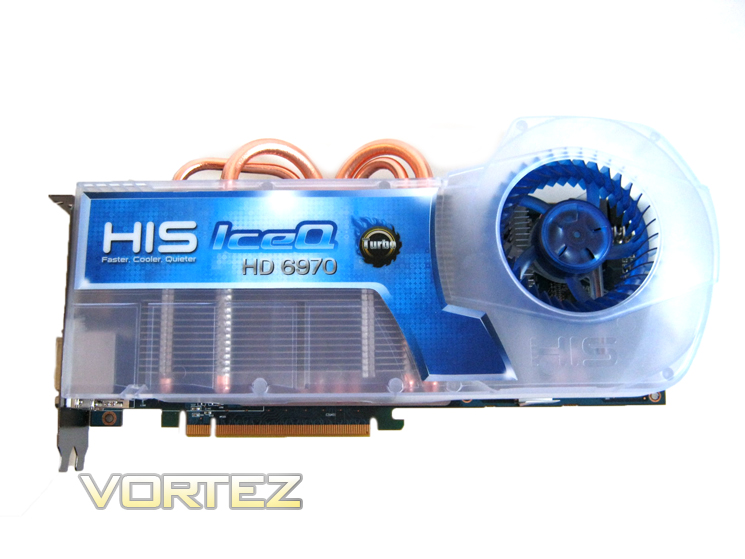
The first thing that strikes you when you first see the card is the mammoth IceQ custom cooler. Hidden beneath the opaque shroud is the main aluminium finned heatsink skewered by four copper heatipies. Following on from the ice themed packaged, the gloss sticker on top of the cooler was well lined up with the heatsink with no signs of peeling. Aside from the sheer size of the cooler, perhaps the most striking aspect of the card was the blue fan, houses traditionally towards the end of the card.
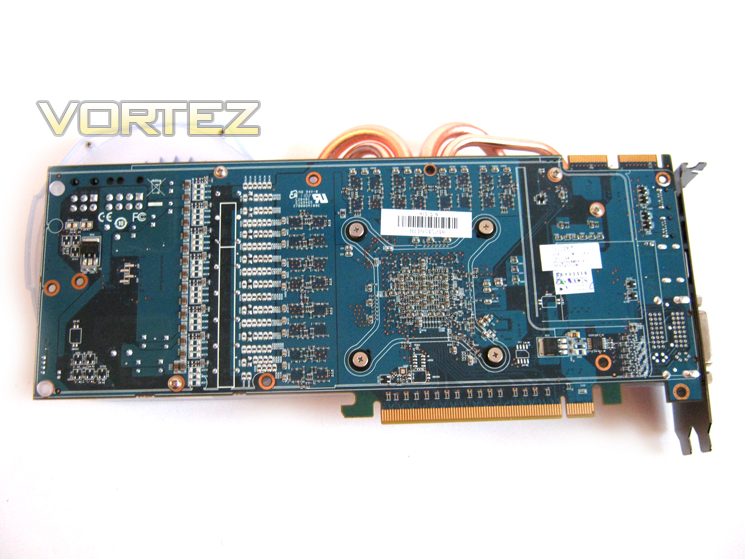
Flipping the card over we see that HIS have used a blue power circuit board to match the colour scheme of the card which enhances the overall aesthetics. While all of those bare transistors on display may hint at the power of the graphics cards, they are susceptible to damage and because of this I tend to prefer graphics cards with a protective backplate. Sadly, the HIS HD6970 IceQ Turbo does not have such a luxury which is a shame given the thought that has gone in to designing the card.
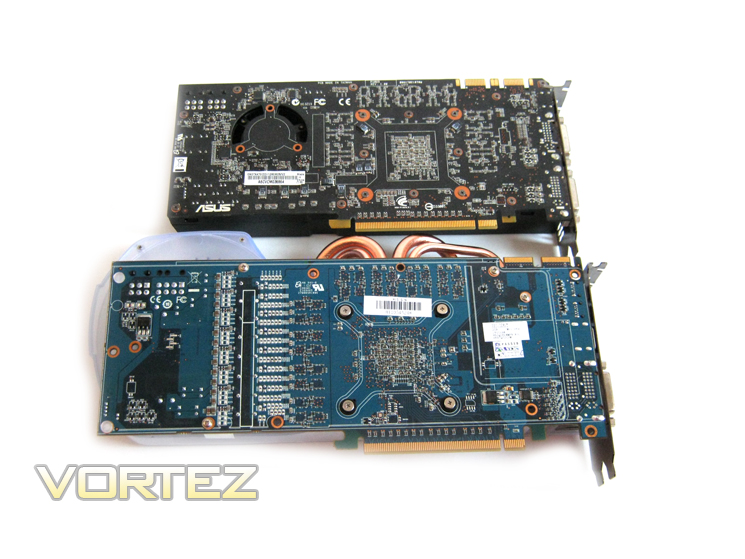
Above you can see the size difference from a GTX470 perspective. The card is certainly at the ‘full fat’ end of the spectrum, measuring a total 28.5cm (PCB 26.5cm) long and 12.5cm wide (PCB 10cm).
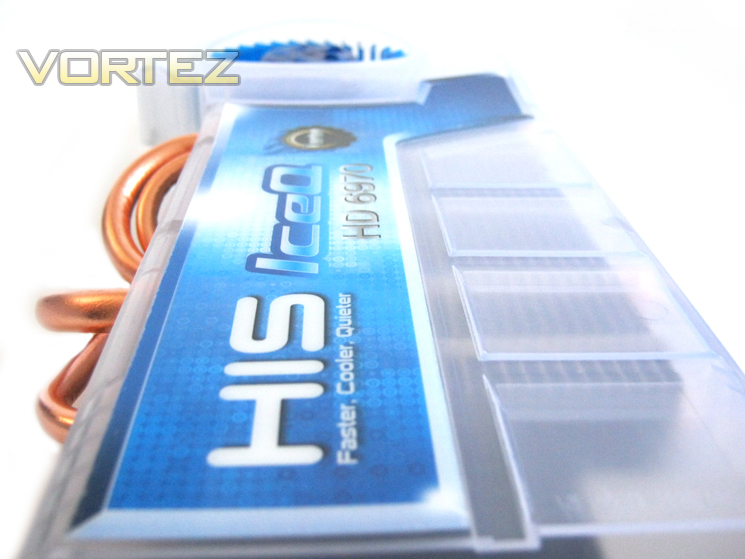
Back to the cooler, as you can see above, the unit is very attractive and covers the full length of the card. I most stress however that while the plastic shroud covers the majority of the aluminium heatsink, it is not a sealed unit and therefore has the potential to vent some of the exhausted air back into the case.
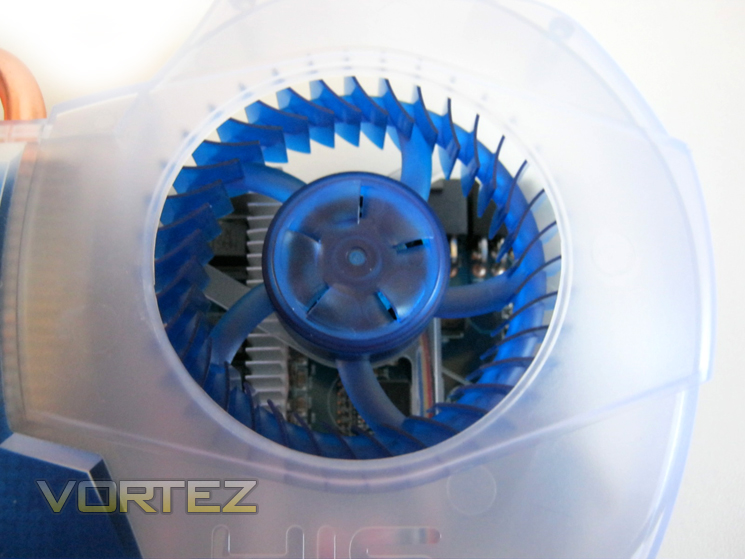
The large blue impeller appears at first glance to be similar to both ATI and NVidia reference fans but HIS are keen to state that their fan features ‘Black Hole’ technology. This design allows the fan blades to draw air from both sides of the fan making for a more efficient cooling solution. The air is then channelled through the heatsink towards the backplate vents and exhausted at the rear of the card.
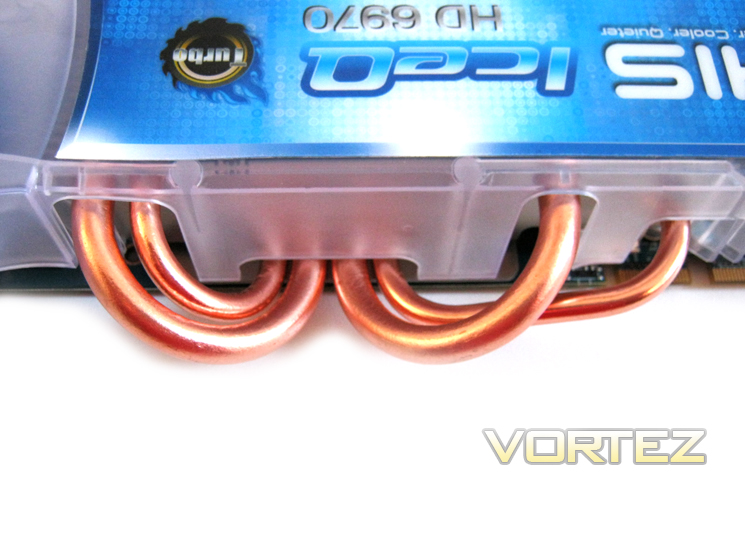
The GPU heatsink is aided by the use of four copper heatpipes in a 2x 6mm and 2 x 8mm configuration. The heatpipes work by drawing heat directly from the GPU core and spreading the heat along the heatsink surface. This makes for a dramatic increase in cooling efficiency and ensures the core is kept under the coolest, most efficient operating conditions throughout its usage.
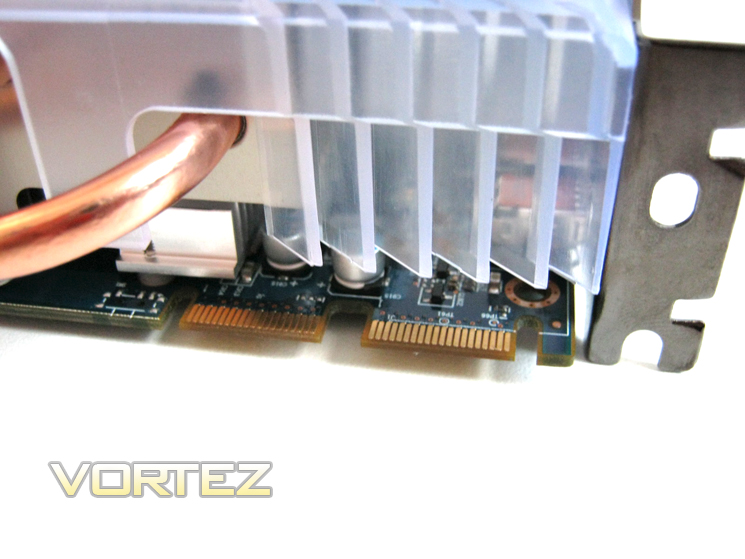
Hidden beneath the finned shroud we find not one but two CrossFire connectors allowing the HD6970 to be used in CrossfireX configuration. Unfortunately because of the sheer size of the GPU cooler adding more than one card to the setup will be extremely difficult as the cards depth almost fills 3 PCI slots! So unless you have a high end motherboard with well spaced out PCIe ports, it is unlikely you will make use of the additional CrossFire tab.
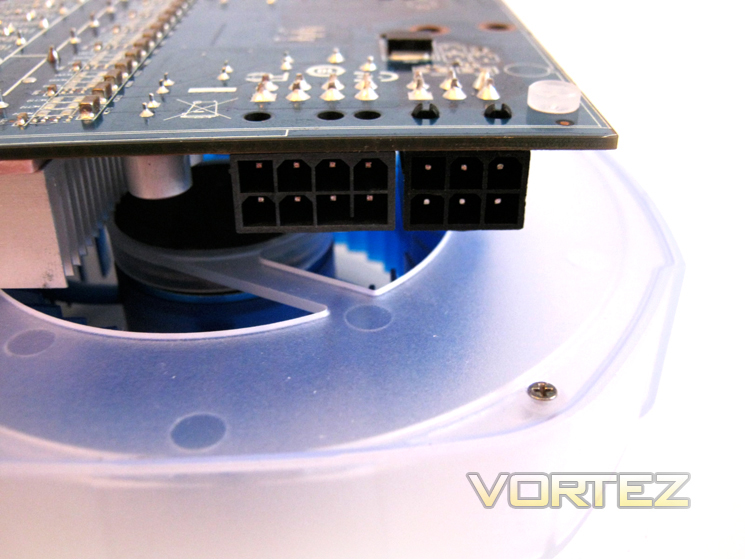
As you can see from the picture above, the cards cooler overhands the PCB by a fair amount (2.9cm) and because the PCIe power ports are below this overhang, adding the cable width and the cooler overhang together (apx 15cm depending on cable type) may present some fitment issues to those with a case that is not very wide.
The card requires 250W maximum to operate under the highest stress so with this in mind HIS have recommended a PSU of at least a 550w power rating. This power will be delivered by the PCIe port along with both 8pin and 6pin PCIe power connectors. Thankfully the included MOLEX adapters should ensure this is possible even if your PSU does not have the available PCIe plugs as standard.
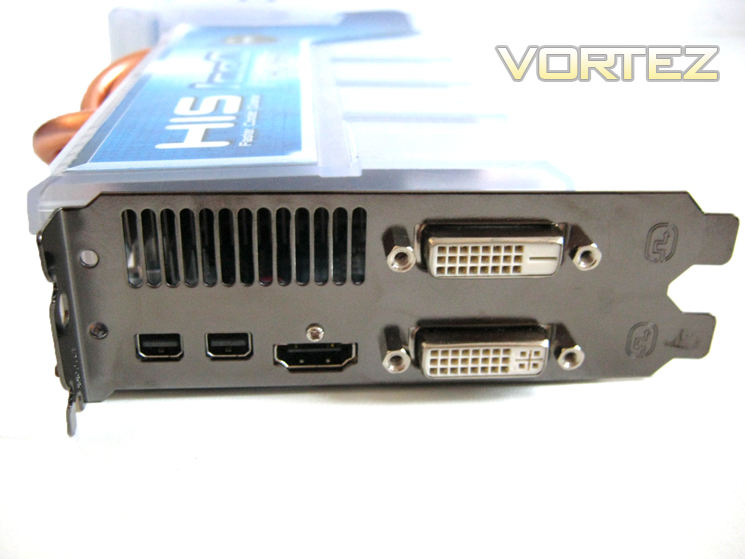
The I/O backplate features a varied selection of connections. To the right there are two Dual Link DVI-I ports capable of displaying up to 2560×1600 on a single display. As stated on the packaging, the HD6970 is also capable of utilising up to 6 displays taking advantage of AMDs Eyefinty multi-display technology. Moving slightly to the left we see the single HDMI 1.4a socket coupled with two mini display ports sporting the latest 1.2 standard. Finally we see that there is a vent allowing hot air to be expelled from the rear of the GPU.
Closer Look (Continued)
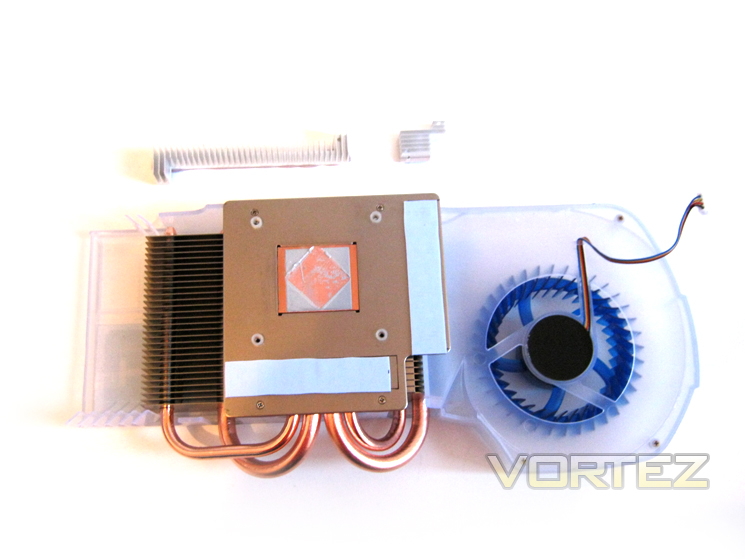
The cooler was very simple to remove with just four spring loaded screws holding the cooler to the card. Despite its bulk, the actual heatsink is relatively small in comparison so it is clear the HIS IceQ technology relies heavily on airflow. Further aluminium heatsinks are hidden beneath the mean cooler to provide direct cooling to the voltage regulators, each attached by two separate sets of screws.
I found the GPU contact to be very good and the paste appeared to be of high quality, most likely by Shinetsu which had the familiar ‘peanut butter’ consistency rather than the dreadful concrete-esque type TIM often applied by some manufacturers. The memory modules were also cooled directly with adhesive thermal strips provided contact to the heatsink base.
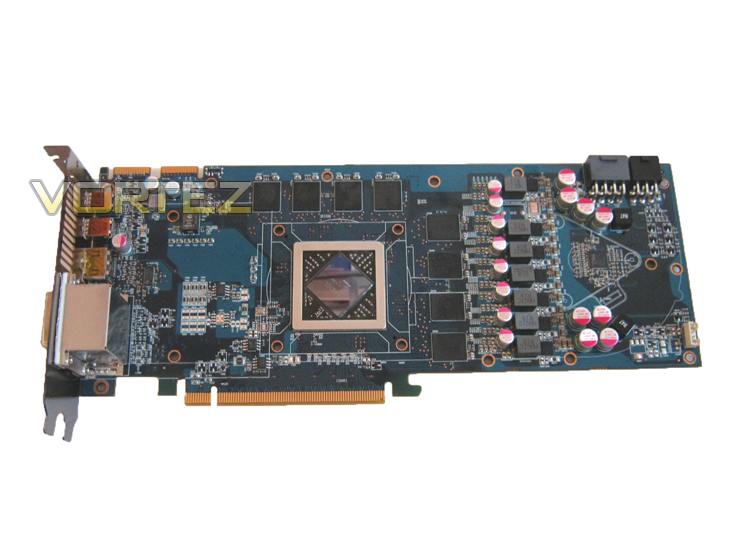
The card has very good layout yet traditional layout with the GPU core being centralised surrounded by 8 memory modules. Quality solid state capacitors are used throughout which are coupled with solid state chokes.
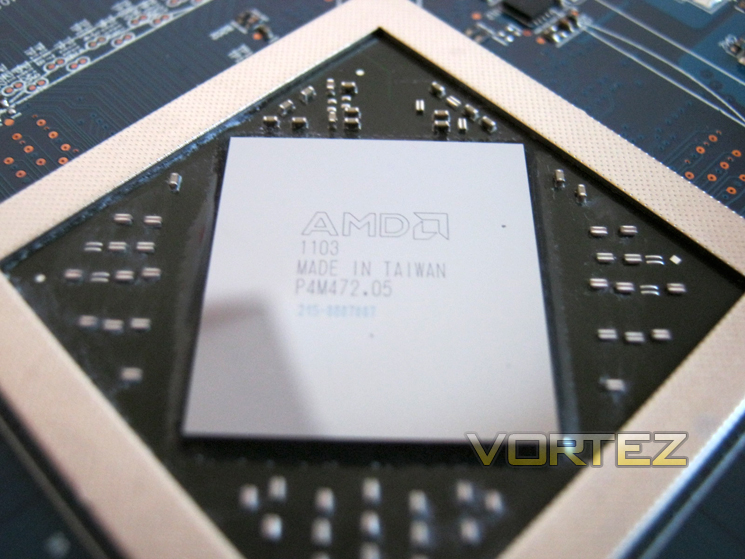
The core itself, as per the norm on AMD GPUs, is exposed rather than having its own integrated heatspreader. The advantage of having an exposed core is more efficient cooling due to direct heat transfer to the heatsink. This advantage however can occasionally result in disaster for those clumsy enough to ‘nibble’ the core when replacing the thermal interface material themselves due to their being no protection. The surrounding metal frame on the GPU should however ease any mishaps, providing great stability and offsetting an potential instable mounts.
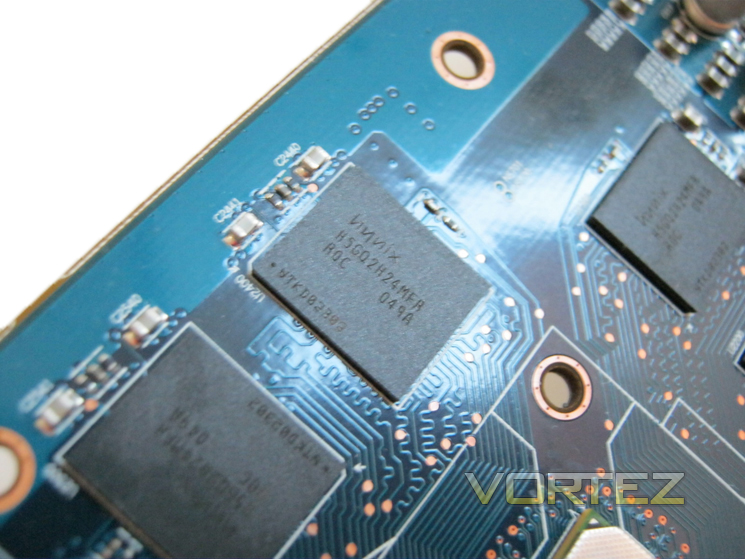
The HIS HD6970 IceQ Turbo makes use of eight 256MB modules making up a very satisfying 2GB of GDDR5, perfect for high resolution gaming. The Hyundai (Hynix) H5GQ2H24MFR-ROC memory modules hail from the ROC stable meaning they are much more capable than the T2C variants found in the HD6950 we reviewed previously. The memory is rated to run up to 6.0Gbps with 1.6v so this cards memory speed of 5.6 appears very conservative. We therefore have high hopes of overclocking the memory as this type of module is among the very best GDDR5 available to date.
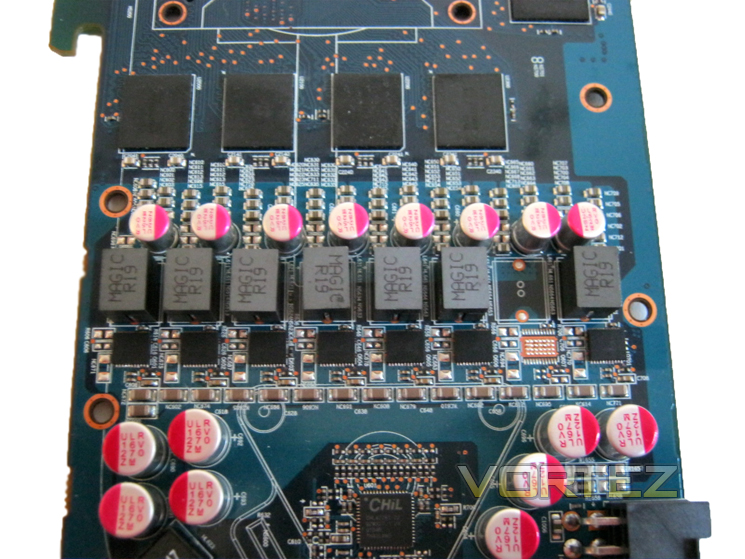
As stated previously, this card using solid state chokes which will provide excellent power efficiency and hopefully ensure our overclocks remain ultra stable. The card will idle using just 0.9v and when placed under stress, the voltage will jump to 1.175v thanks to the dynamic phase control PWM IC system. Using MSI afterburner this voltage can be increased further to enhance stability and/or increase potential overclocks, something I am very keen to look at later in the review…
Test Setup
We have made a slight difference in our selection of hardware and our test setup. The reason for this is that we felt the current crop of resolutions were not stressing the latest generation of graphics cards enough. With this in mind, we have added a Dell 3007 WFP-HC to our system, allowing us to stress the cards by utilising a 2560×1600 resolution. We will however, still include 1920×1200 results as this is one of the most popular resolutions used by gamers.Display – Dell 3007 WFP-HC
Case – Lian Li PC-P80
CPU Cooler – Prolimatech Super Mega (2xProlimatech 140mm Vortex)
CPU – Intel Core i7 920 @ 4GHz
RAM – 6GB (3x2GB) OCZ Blade DDR3 1600mhz 7-8-7-20 C1
Motherboard – ASUS Rampage III Extreme
Power Supply – Enermax Revolution 85+ 850W
Hard Drive – GSkill Falcon 128GB & Hitachi 250GB
Case – Lian Li PC-P80
CPU Cooler – Prolimatech Super Mega (2xProlimatech 140mm Vortex)
CPU – Intel Core i7 920 @ 4GHz
RAM – 6GB (3x2GB) OCZ Blade DDR3 1600mhz 7-8-7-20 C1
Motherboard – ASUS Rampage III Extreme
Power Supply – Enermax Revolution 85+ 850W
Hard Drive – GSkill Falcon 128GB & Hitachi 250GB
Graphics Cards:
HIS HD6970 2048MB IceQ Turbo @ 900/5600MHz Pre-overclocked & 1000/6000MHz Overclocked – ATI Catalyst 11.5
Gigabyte GTX560 1024MB @ 830/4008MHz & 841/5016MHz Overclocked – Forceware 275.27
MSI R6970 2048MB Lightning @ 940/5500MHz Pre-overclocked & 1010/6000MHz Overclocked – ATI Catalyst 11.4 (8.840.3.0)
Inno3D GTX560Ti 1024MB @ 820/4008MHz & 950/4300MHz Pre-overclocked –Forceware 266.66
Inno3D GTX570 1280MB @ 732/3800MHz, 800/4000MHz Pre-overclocked & 901/4220MHz Overclocked – Forceware 263.09
ASUS GTX580 1536MB @ 782/4000MHz & 903/4220MHz Overclocked – Forceware 262.99
ASUS HD6970 2048MB @ 890/5500MHz & 949/5896MHz Overclocked – ATI Catalyst 11.4 (8.840.3.0)
HIS HD6950 2048MB @ 800/5000MHz & 865/5500MHz Overclocked – ATI Catalyst 10.11 (8.790.6.0, 8.790.6.2 & 8.800)
Nvidia GTX480 1536MB @ 700/3696MHz & 799/3906MHz Overclocked – Forceware 260.99
MSI R6870 2PM2D1GD5 1024MB @ 900/4200MHz – ATI Catalyst 10.10
XFX HD5870 1024MB @ 850/4800MHz & 942/5200MHz Overclocked – ATI Catalyst 10.10
Driver versions are extremely important when comparing a graphics card. It is however often important to update a driver version, especially when a new GPU is released and thus any change in driver will be clearly stated.
Overclocking
We will use MSI Afterburner tool for overclocking our GPUs and adjusting voltages which is consistent with the vast majority of end users.
Games:
Crysis Warhead
Metro 2033
Dirt 3
Mafia II
BF:BC2
Farcry 2
AvP
The games above represent equal bias toward both AMD and NVidia and are among the most demanding games available at present. Future releases will be evaluated for consistency and accuracy and then potentially added to the list when they become available
Synthetic benchmarks:
3DMark 11
Unigine Heaven 2.5
Tessmark 0.2.2
Furmark 1.9.0
Synthetic benchmarks are used to stress each feature of a GPU which may not be present in today’s games. While nothing is certain, the benchmarks above do at least give us an insight into the possible future performance of the graphics card on test, invaluable when evaluating the potential lifespan of a graphics card.
Temperature, power consumption and acoustics:
Furmark 1.9.0
The above application is feared by most manufacturers as it has been known to destroy GPU’s. While it is not indicative of ‘real world’ performance, it does represent the maximum possible stress your GPU could be placed under making it the hardest test to pass. For that reason alone, it is worthy of inclusion in our suite of benchmarks. Power consumption will be evaluated from the wall and will be a total system draw of the specification above.
Sound will be measured from a distance of 20 cm from the actual GPU with the case open. All system fans will be set to their lowest settings. Readings will be taken at both idle and 100% load.
Bundled Software
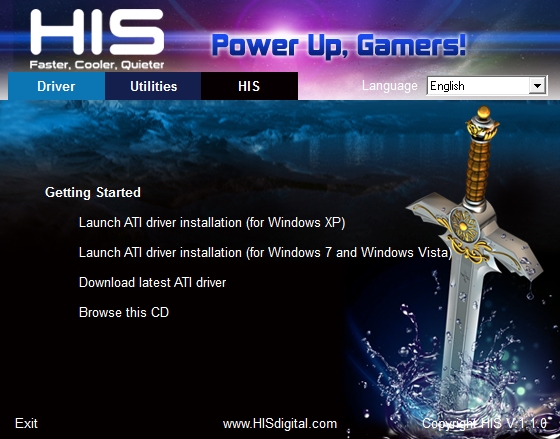
The included utility disc is nothing out of the ordinary with out of date (as expected) GPU drivers for Windows XP, Vista and the latest Windows 7 incarnations. Thankfully, there is also a link which will take you to the AMD support site rather than HIS’ own, ensuring that you have the latest driver available for download.
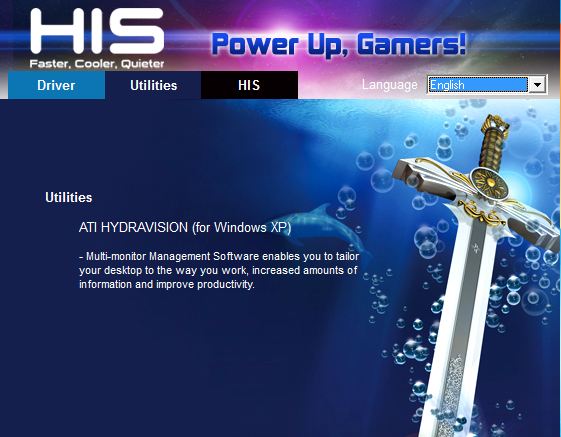
In terms of utilities, HIS bundle a multi-monitor management software known as Hydra-vision. These are already implemented in the Catalyst Control Centre so there is no need to install the utility separately. Sadly there are no overclocking or monitoring utilities included on the CD other than an outdated Catalyst control centre which you would be wise to update along with the included driver. This is a real shame given the graphics card on test and its potential.
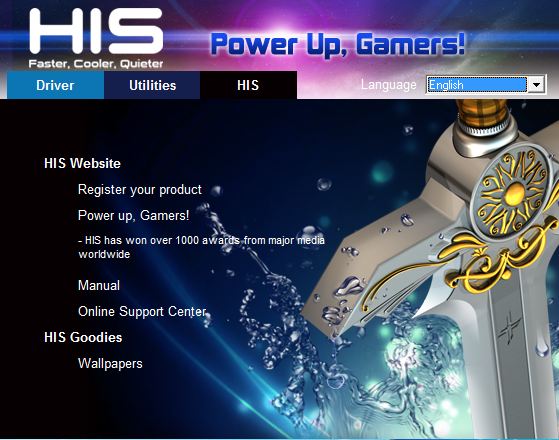
Navigating to the final tab allows you to register the product (Member registration also required). Clicking on the next title down takes you to the HIS awards and Reviews section of their website where they link to reviews of previous hardware which has won critical acclaim.
An area where the HIS does excel is the detailed instruction manual. A downloadable .pdf file describes basic installation and backplate removal in good detail. Below this we find a link to the online support centre, assuming you have taken the time to register both yourself as a member and the product previously.
Lastly, we arrive at the included wallpapers which are of good quality and cater for various resolutions. All of the included wallpapers feature the Excalibur sword, a familiar trademark of HIS digital.
Overall, I was somewhat disappointed there there wasn’t an included overclocking utility other than AMD’s own Overdrive utility included with the Catalyst control centre. I have however been assured that there will be an included game (Codemasters Dirt 3) which should make the package a little more appealing to the masses.
Let’s see how far we can push this card in the overclocking section…
Overclocking & Temperature Analysis
Overclocking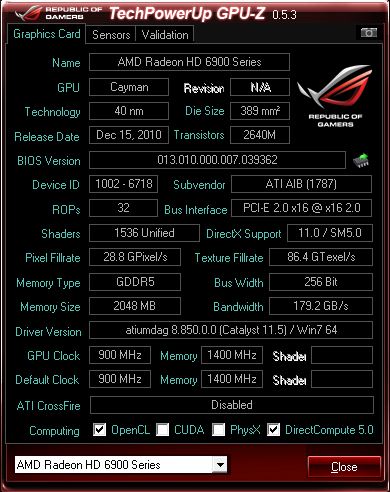
As you can see above, the stock card weighs in at 900MHz on the core and 1400MHz on the memory. This is attained with a VCC of 1.175. Using the Afterburner tool from MSI I began by going for broke, raising the Core Clock and Memory clock options to their maximum values (1000/1500). Unfortunately, this made the setup lock up almost instantly as soon as any 3D application was started.
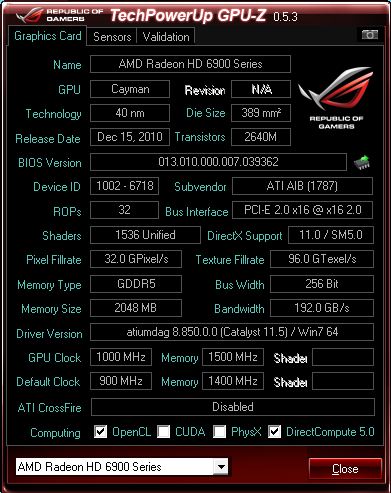
Being a little tamer on the overclocks and spending more time with the overclock settings, I achieved a respectable extra 50MHz on the Core and 58Mhz on the memory. This wasn’t a bad result but I still felt the card had more to offer so I raised the VCC from 1.175 to 1.290 which allowed the maximum overclocks of 1000Mhz on the Core and 1500 (6000MHz effective) on the memory, an altogether astounding result!
Temperature
To measure the temperature of the card we first measure the ambient temperature. Our review station resides in an air conditioned room with the temperature set to a comfortable 23c.
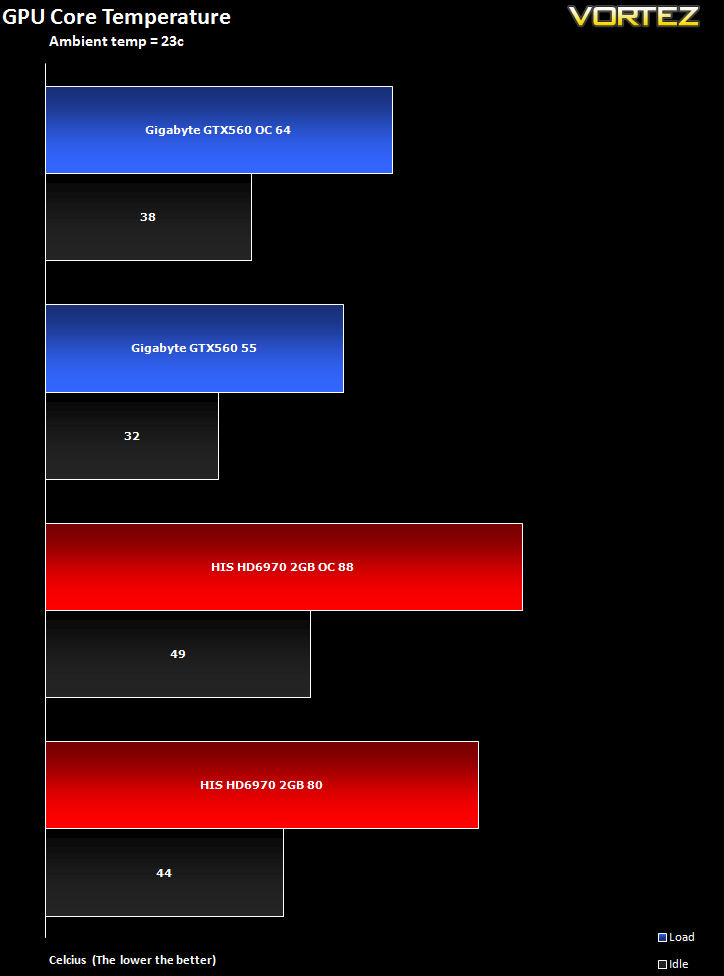
In stock, idle state, the GPU temperature is a hovers at 44-45c. Not a great results given the size of the cooler but at idle, the GPU is silent. This is with the GPU in its power saving state running @ core:249mhz, memory:150Mhz with a power draw of 4W (0.900v).
Placing the GPU under load and running at its factory overclocked settings of 900/1400 (Core/Memory) we see the temperature steadily rise along with the fan speed. The highest temperature after 5 minutes reached a plateau at 80c. This was with the fan running automatically (66%) at 2121 rpm.
With the card fully overclocked using the optimised settings found in the overclocking above, the temperatures were slightly higher as expected, settling at a sizzling maximum 88c after 5 minutes using the ‘Burn-in test’ of Furmark, returning to an idle 50c in a matter of seconds once the test was complete. In the interests of completeness, I let the Burn-in test run for a further hour and I am happy to report that the temp did not budge from the same 87-88c although the air conditioning in the room was working a little harder that before!
As Furmark was used for this series of tests it is unlikely that your GPU will exceed these temperatures under normal gaming conditions. As such, these results should be interpreted as a ‘worst case’ scenario and are testament that whatever your game, if the card can cope under the immense stresses that Furmark has to offer, it will be able to compete with any gaming scenario.
Acoustics & Power Consumption Analysis
AcousticsOften overlooked when purchasing a graphics card is the noise that it emits. We all hear (no pun intended) of graphics cards that run like a jet engine which can have a detrimental effect on a gaming session, regardless of the FPS it churns out. It is therefore extremely important that a graphics card should operate as quietly as possible.
To test for this we will be using a sound meter and microphone setup which will be placed 20cm away from the GPU. The test will take place in a quiet (not sound proof) room with the results for the GPU fan at low (30%) Medium (60%) and highest (100%) settings.
Results
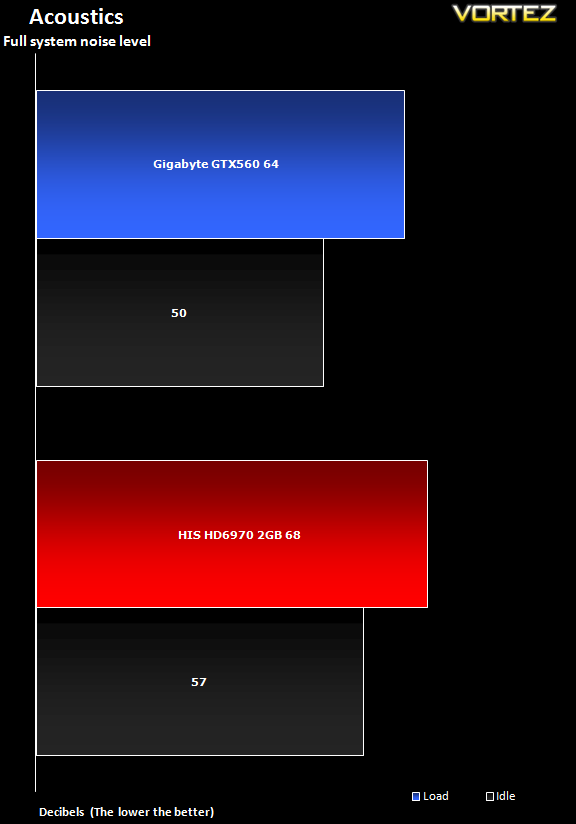
The fan cannot be heard above the system fans at their lowest setting, reaching a peak of 57dB during the 5 minute test. With the fan set to maximum it was certainly more noticeable but it has to be said, much quieter than reference hitting a maximum 67dB and while it would definitely be intrusive using a speaker setup, I could not hear it while using an enclosed headset.
Power Consumption
For this test, we will be using a wall meter with the test setup plugged in minus the Monitor. Readings were taken at both stock and overclocked conditions each having readings also taken in idle and 100% load (Furmark).
Results
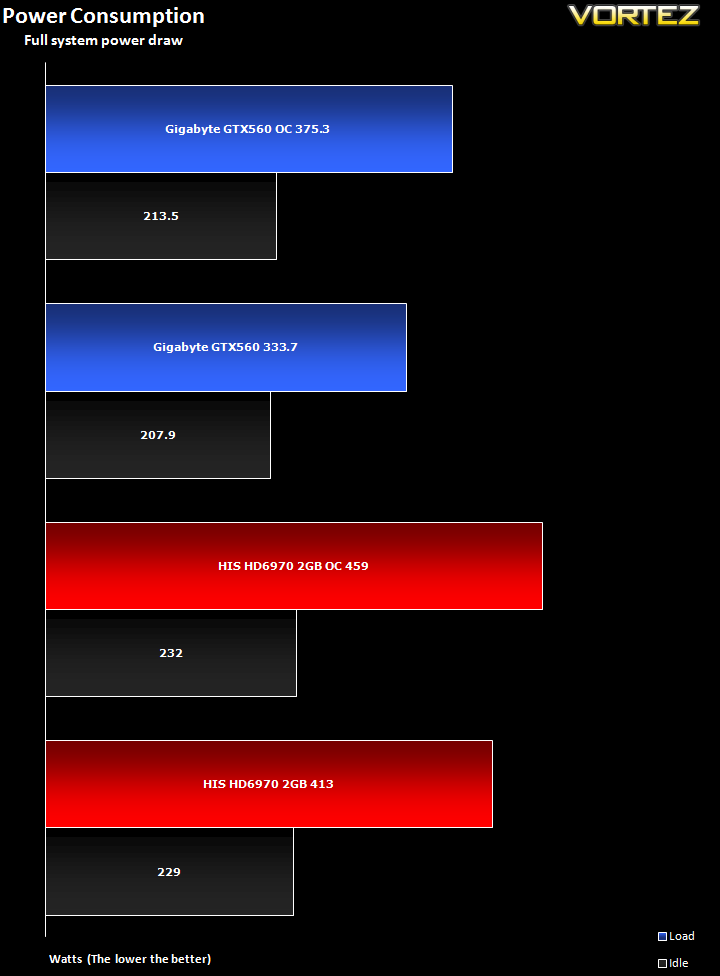
Despite consuming more power than the much less hungry GTX560, the HIS HD6970 IceQ Turbo was still surprisingly frugal, even when placed under load. Our test setup is certainly not low end by any stretch of the imagination so with HIS recommending a 550w PSU as a minimum, I believe we have shown that should you not heavily overclock your setup you could perhaps get away with a PSU slightly less powerful and still have a little headroom.
Let’s move on with the review and get to the bread and butter; the synthetic and gaming benchmarks…
Crysis Warhead
Following the success of Crysis, the stand alone expansion “Warhead” was hotly anticipated to bring more game play, more weapons, improved visuals whilst maintaining better performance, the latter being what gamers wanted most. After all how many people upgraded their rigs just to play this game… In the game, you play as the upbeat Brit Sergeant “Psycho” Sykes, chasing down a Korean nuclear warhead. Throw in some ice shooting aliens and we’re bound to have a great game. It sure delivered.
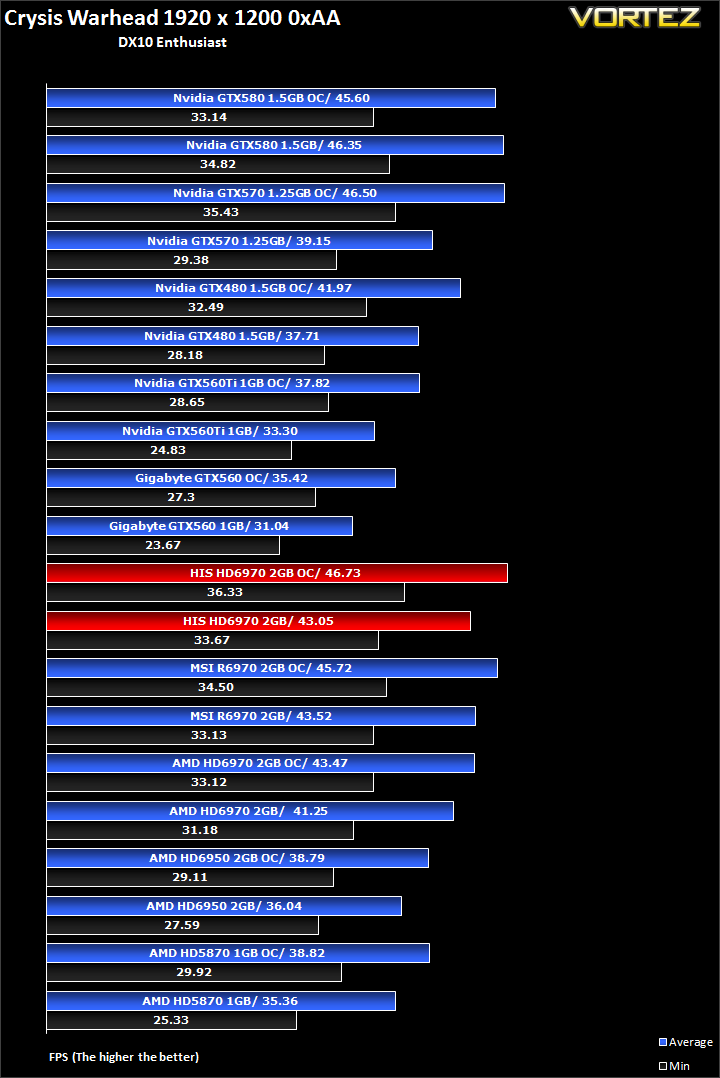
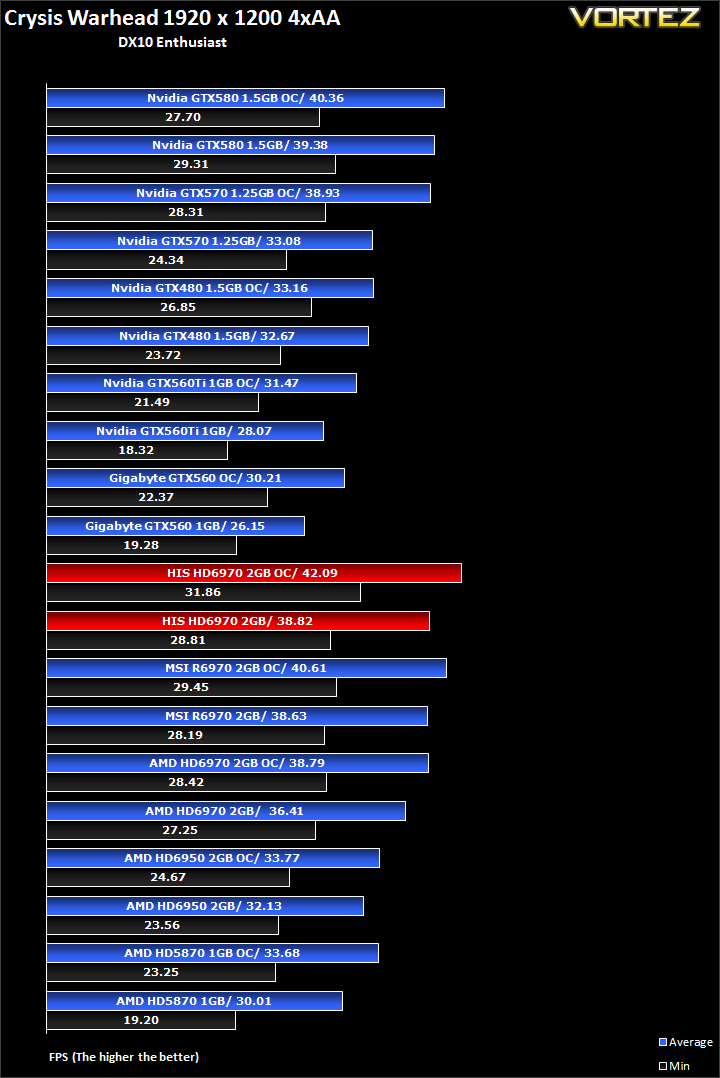
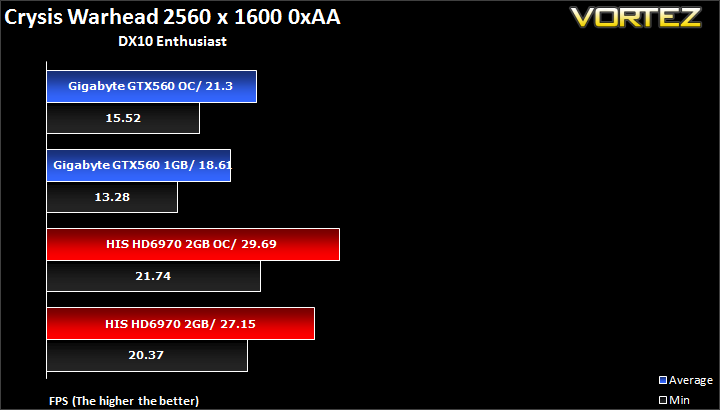
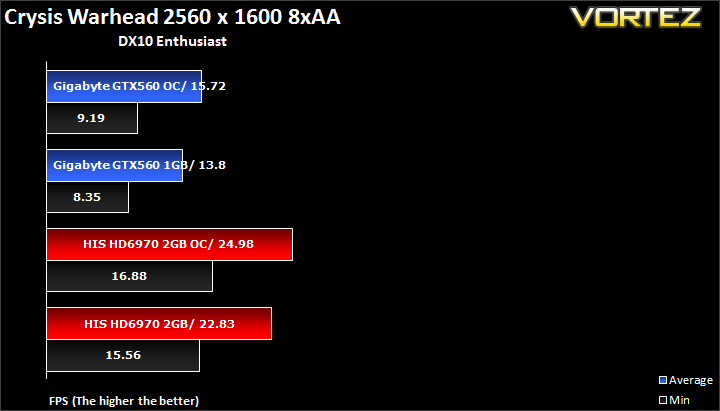
Testing was done using Framebuffer’s Crysis Warhead benchmarking tool. The tests were configured to DirectX 10 at Enthusiast levels. Each test on the Ambush map was looped three times from which the average FPS was recorded.
Performance Analysis
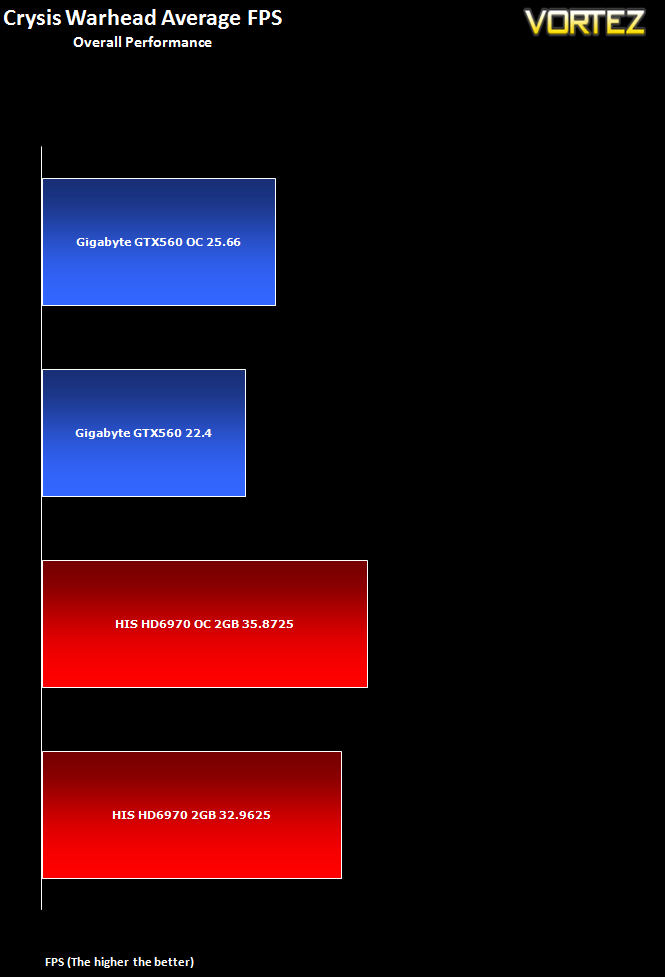
The overall performance analysis looks at the relative performance between all the cards on test across all the settings and resolutions used in-game.
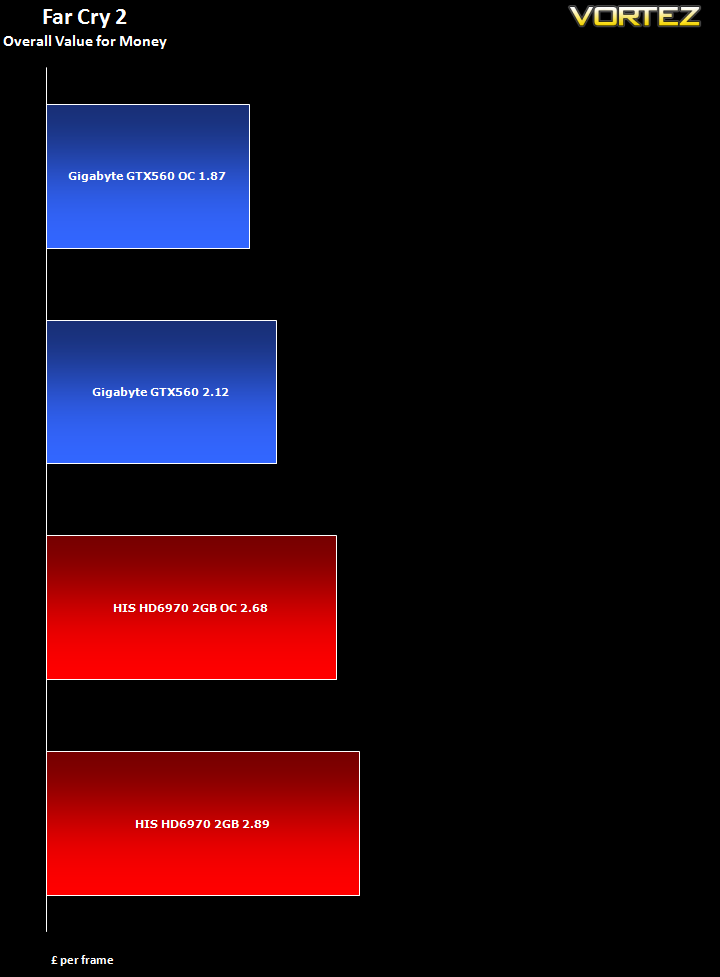
Value for Money
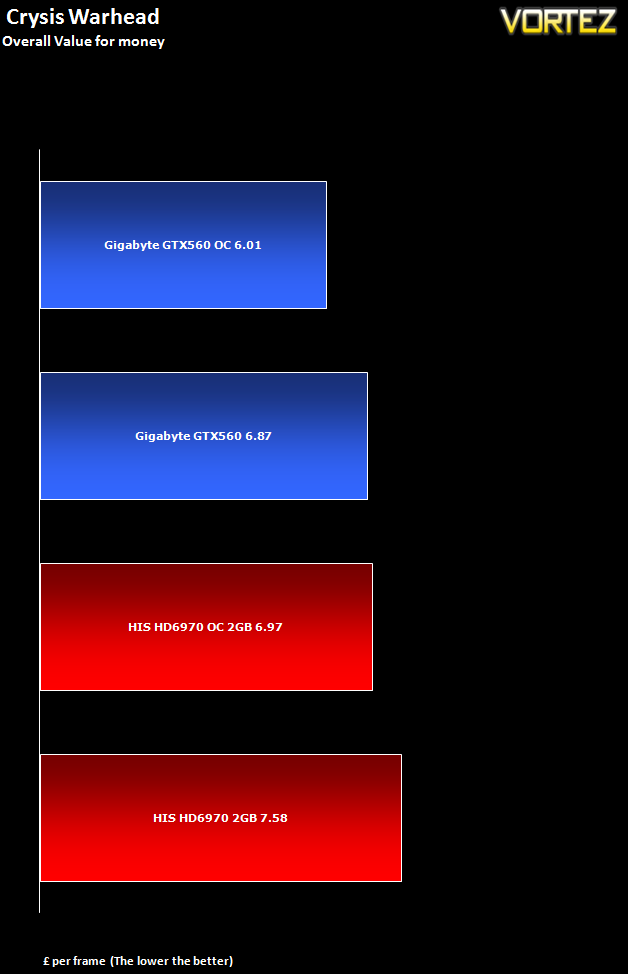
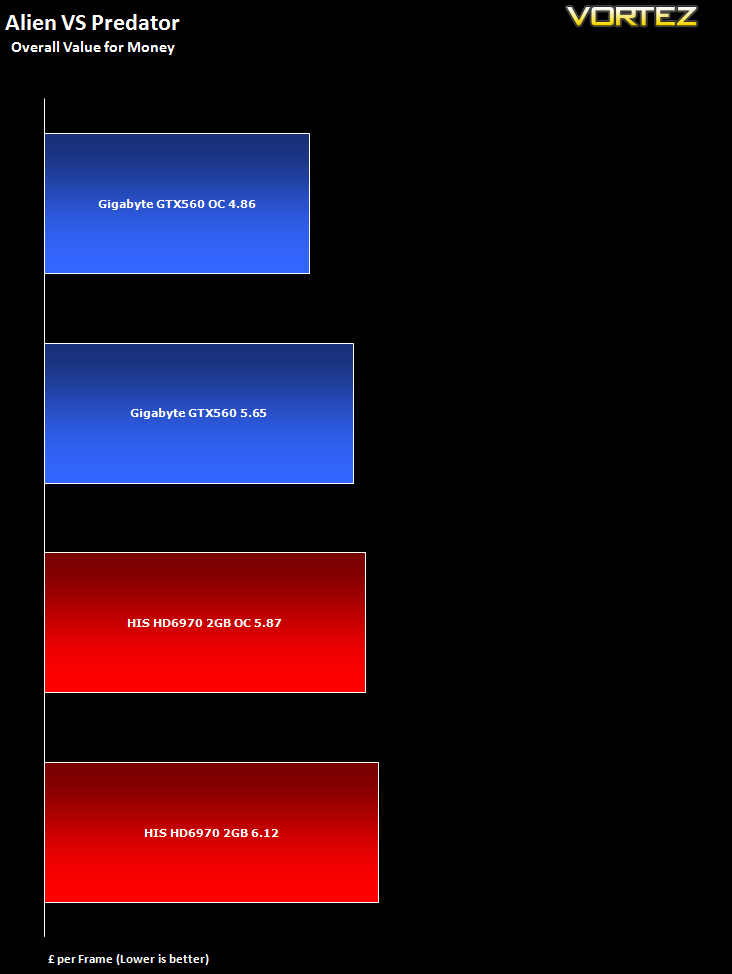
How much are you really paying for your performance? Value for Money analysis uses the results shown in Overall performance and takes into consideration the retail price (at the time of review) to work at a cost per frame value.
Far Cry 2
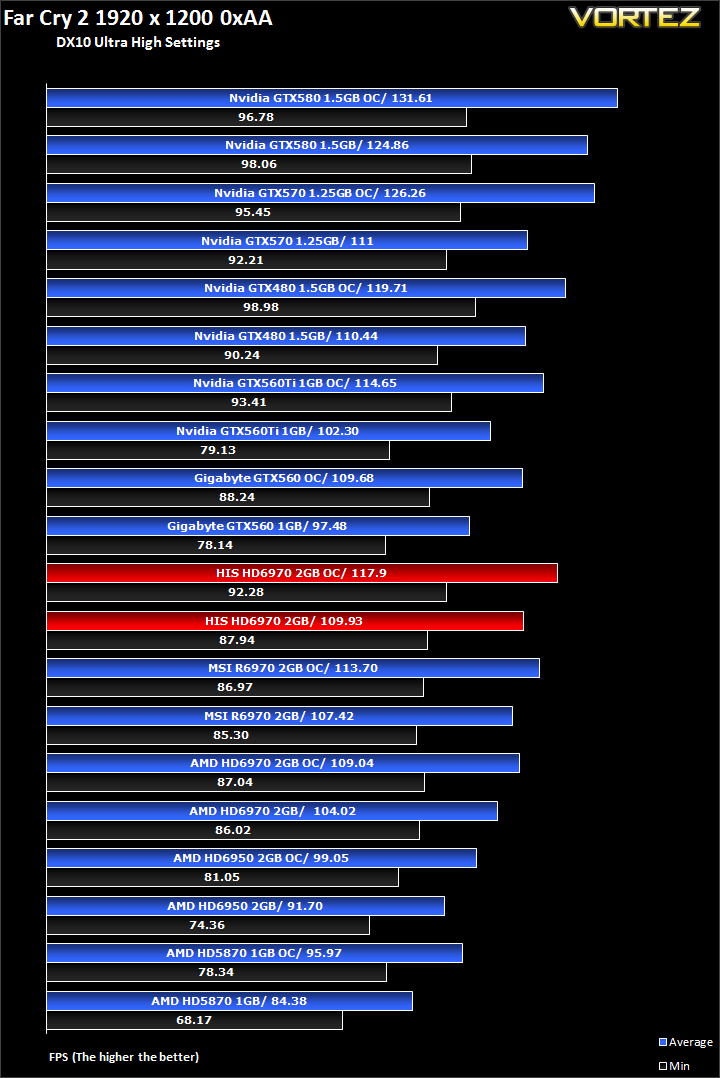
One of the most hyped games of 2008, Far Cry 2 had some big shoes to fill. It was built to be the next best thing since well… Far Cry I suppose. Combining an open-world game play with highly detailed graphics, physics and AI, what more could we possibly want? The game puts us in the body of a malaria inflicted mercenary hunting down the “Jackal” in the heart of Africa, in a bid to stop an on-going conflict between two rival factions. The storyline can be hard to follow sometimes but I’m no game reviewer, so let’s concentrate on the graphics and performance. After all, we all need to know if our hardware will be able to handle the scorching savannah burning at the hands of our flamethrowers.The bundled benchmarking tool was used on Far Cry 2, configuring the settings to Ultra and DX10. The small ranch level was chosen and each configuration was looped three times from which the average FPS was recorded.
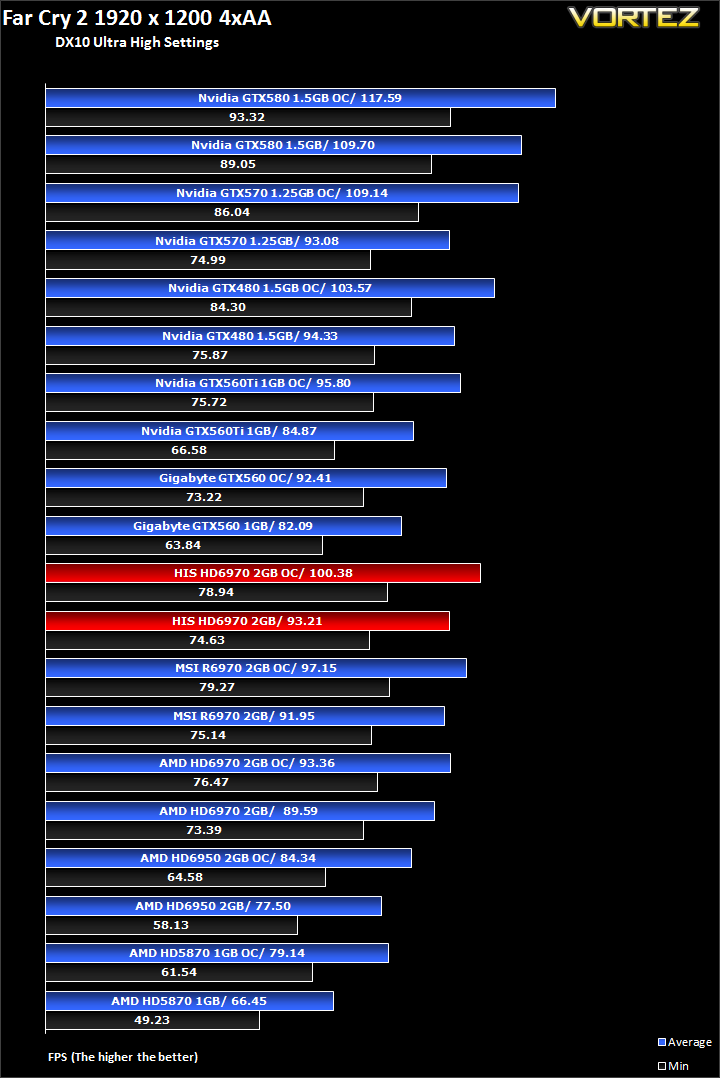
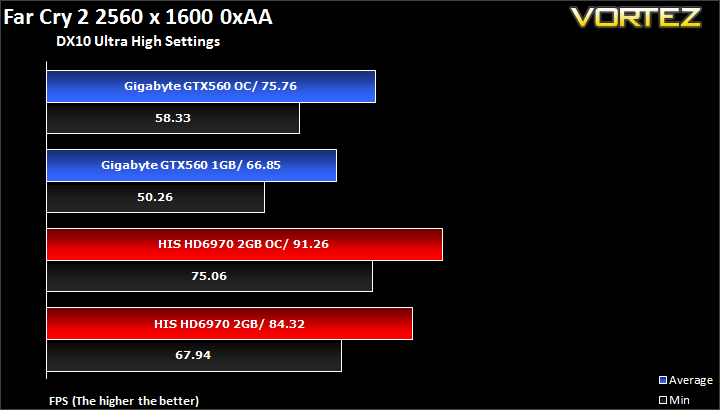
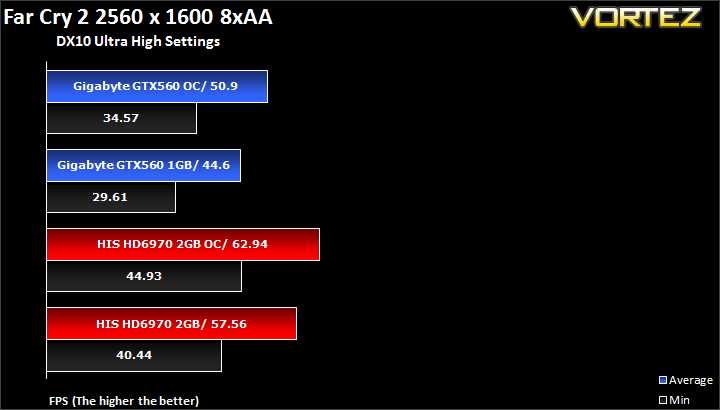
Performance Analysis
The overall performance analysis looks at the relative performance between all the cards on test across all the settings and resolutions used in-game.
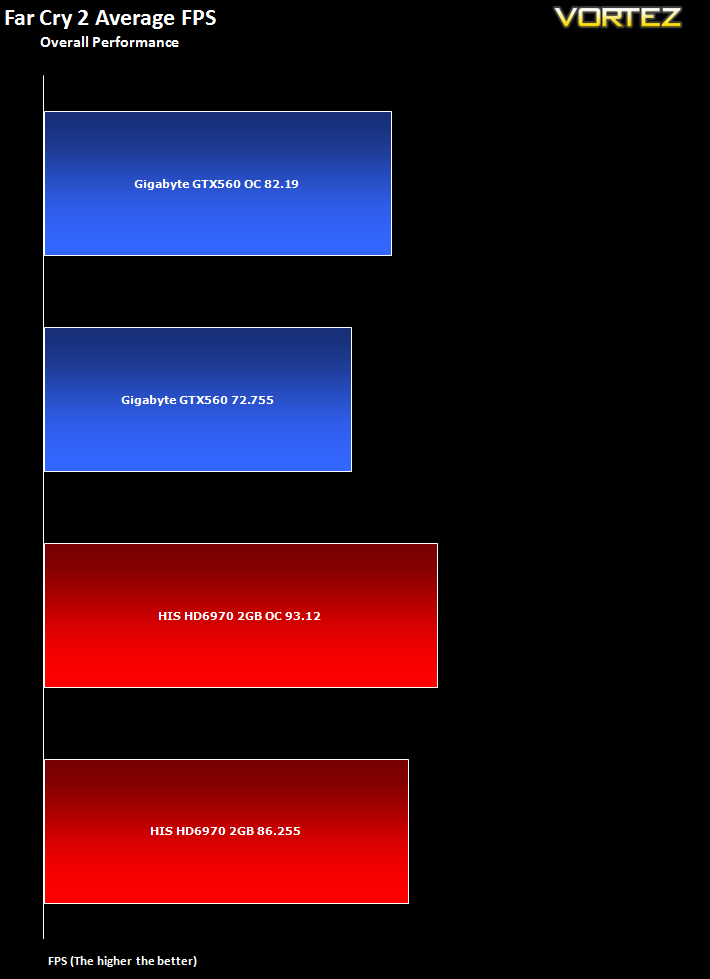
Value for Money
How much are you really paying for your performance? Value for Money analysis uses the results shown in Overall performance and takes into consideration the retail price (at the time of review) to work at a cost per frame value.
Metro 2033
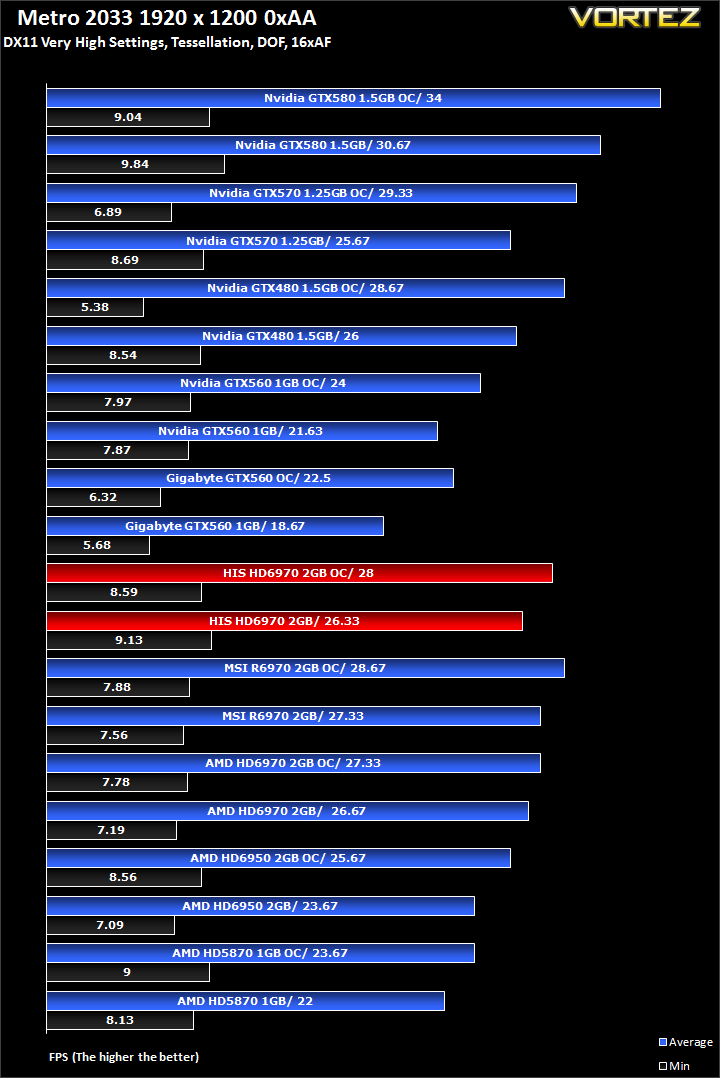
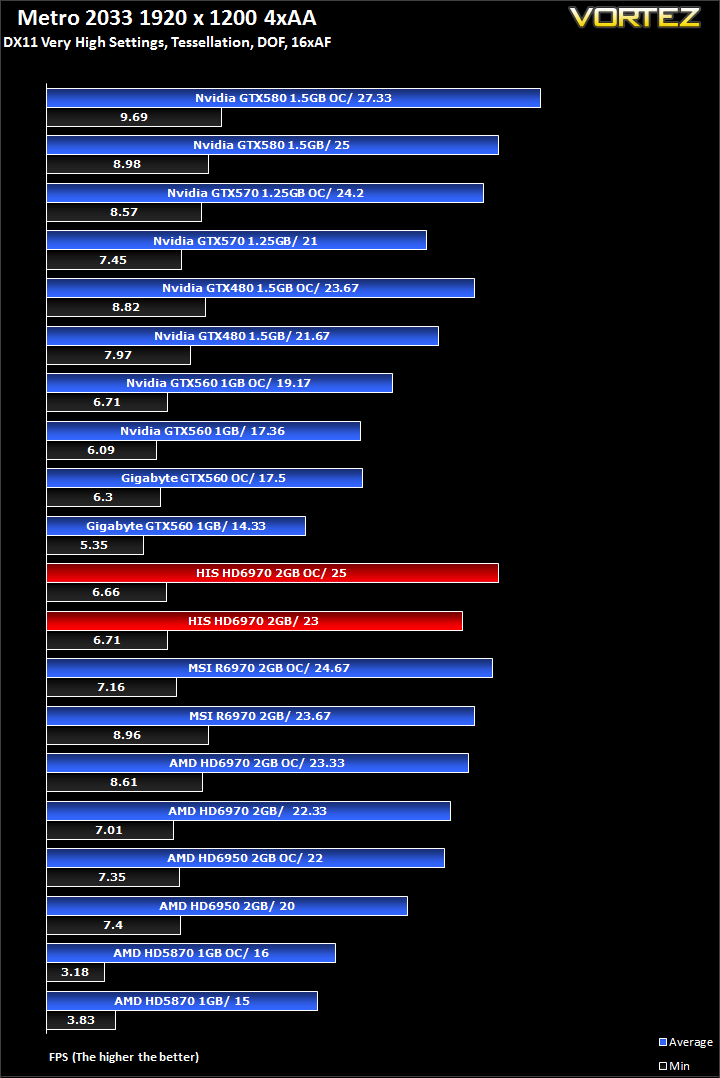
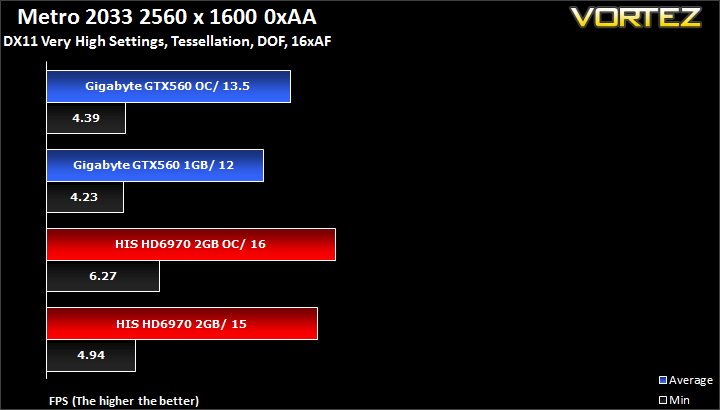
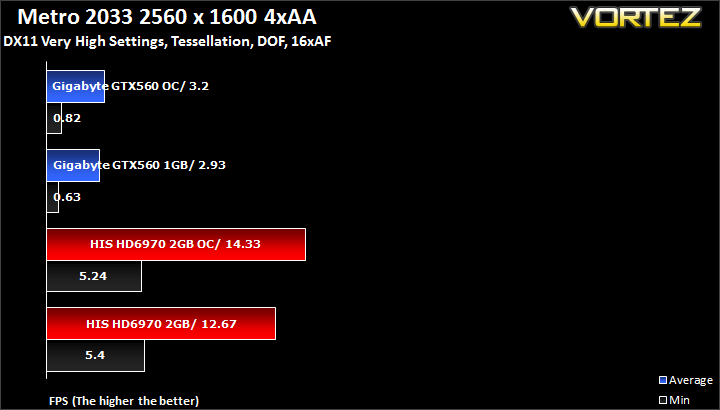
Based on Novel by the same name, Metro 2033 is a first person shooter with elements of survival horror. As Artyom, you trawl through the mutant infested metro systems of post-apocalyptic Moscow. The game delivers presents a grim ambience that reflects on the overall atmosphere of the underground setting. Metro 2033 uses the setting as a back drop to showcase some of the best visuals of any games out now, making it the ideal benchmark for those looking for the best graphics card.The bundled benchmarking tool was used on Metro 2033, configuring the settings to Very High and making use of DirectX 11. The frontline scene was looped 3 times for each configuration. The average FPS was recorded at the end.
Performance Analysis
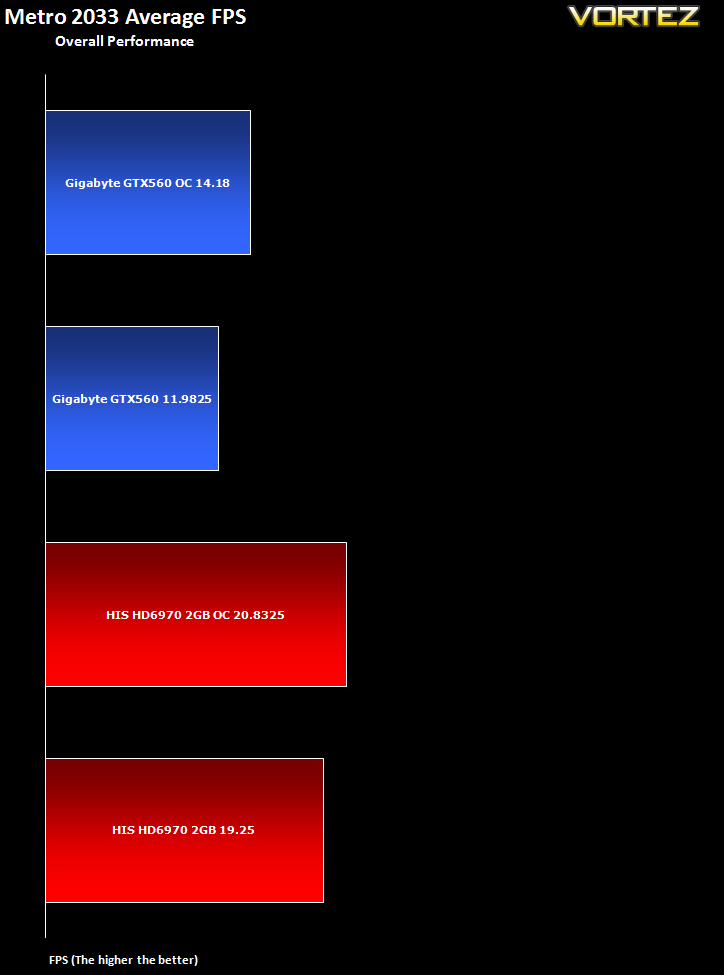
The overall performance analysis looks at the relative performance between all the cards on test across all the settings and resolutions used in-game.
Value for Money
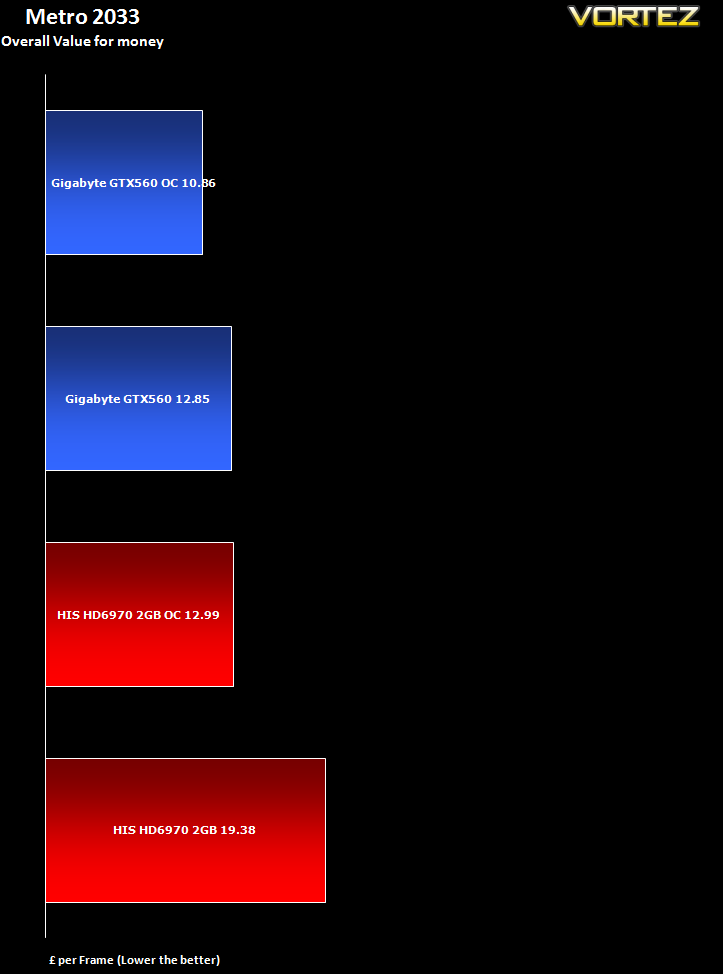
How much are you really paying for your performance? Value for Money analysis uses the results shown in Overall performance and takes into consideration the retail price (at the time of review) to work at a cost per frame value.
Alien vs. Predator
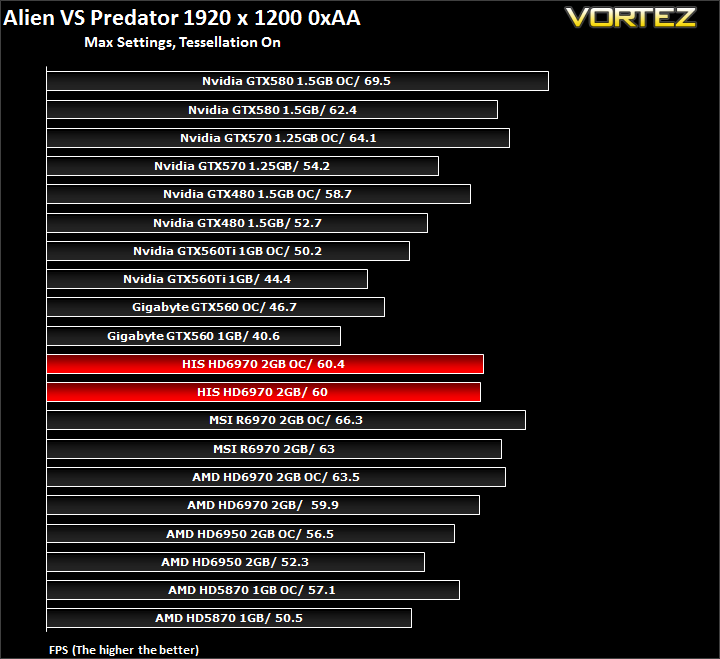
Spawned from the popular Alien and Predator franchises, Rebellion have collaborated to bring the legendary war to us through the medium of a first-person shooter. The game forces you to hunt, prey and most importantly survive in the swamp colony of Freya’s prospect as a Predator, Alien or Marine. The stunning visuals add to the sense of dread and terror that we have become so accustomed to seeing with the series.The stand-alone Alien VS Predator benchmark tool was used for testing here. All the settings were set to very high and Tessellation was applied. The average FPS was recorded at the end
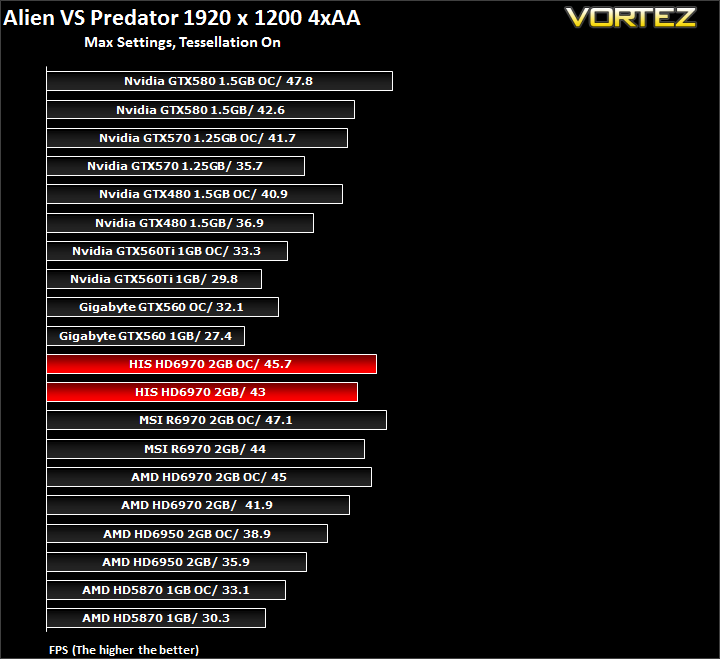
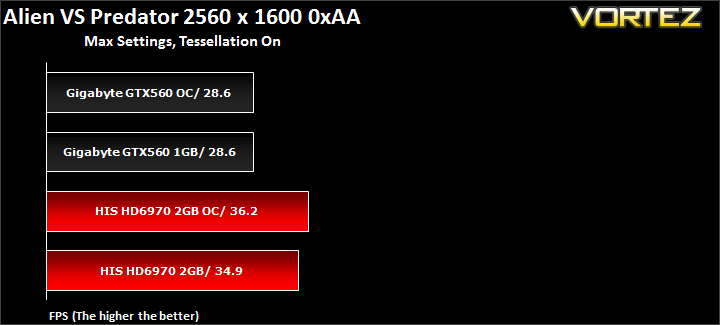
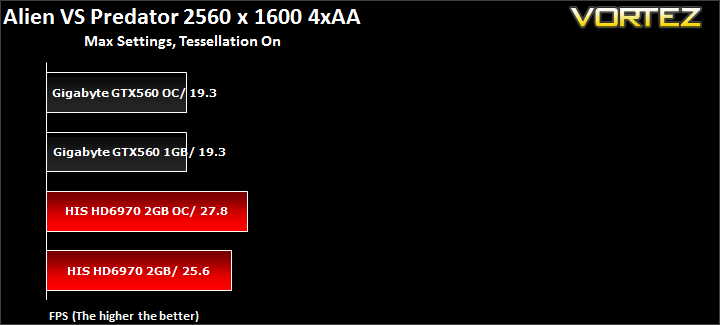
Performance Analysis
The overall performance analysis looks at the relative performance between all the cards on test across all the settings and resolutions used in-game.
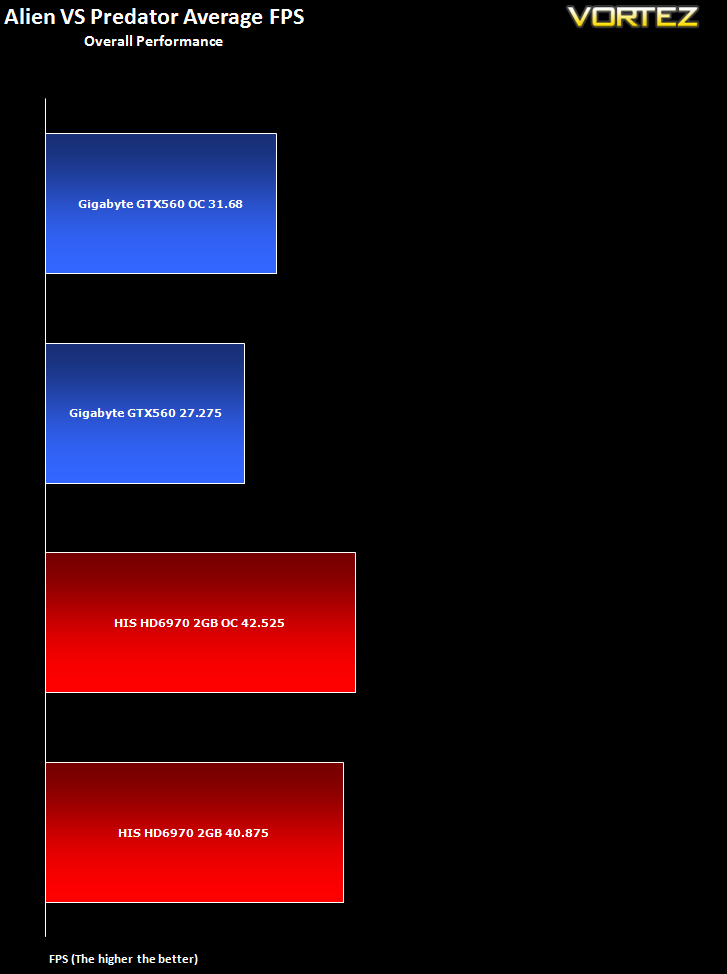
Value for Money
How much are you really paying for your performance? Value for Money analysis uses the results shown in Overall performance and takes into consideration the retail price (at the time of review) to work at a cost per frame value.
Battlefield: Bad Company 2
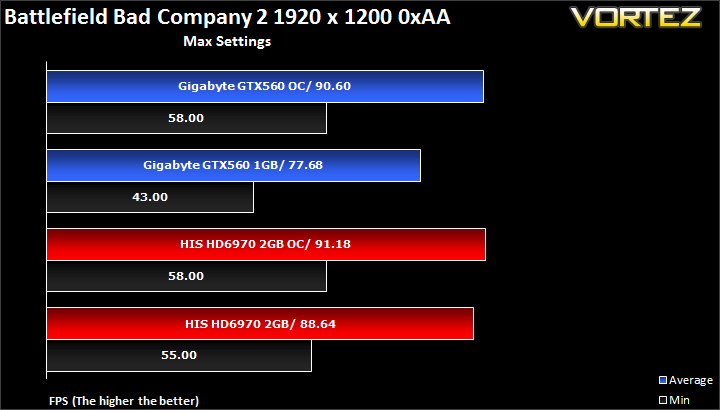
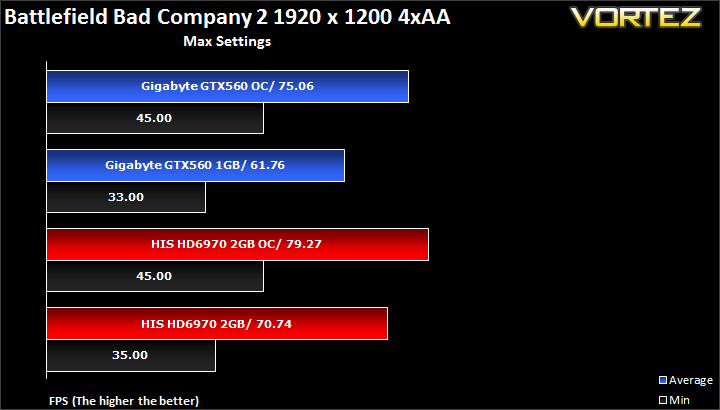
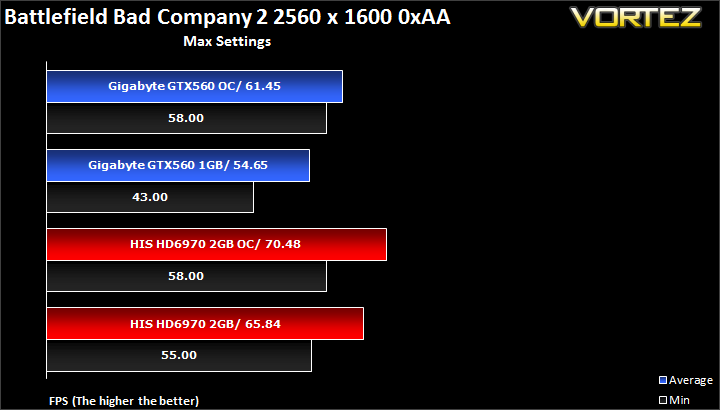
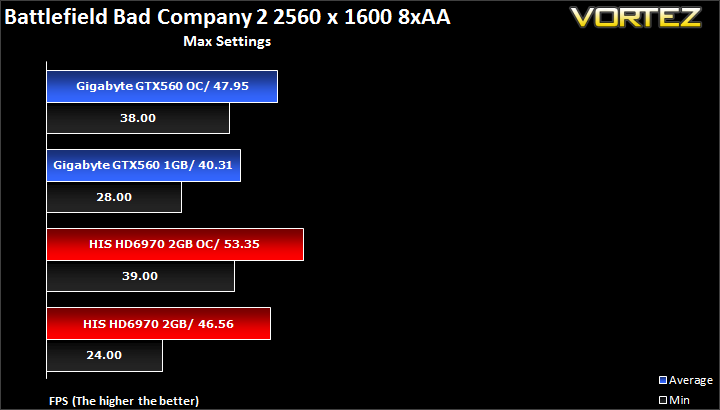
Battlefield Bad Company 2 is the new rendition of the widely successful Battlefield series of game. Having more in common with the console release of Bad Company, the sequel hopes to inject the DNA of the timeless Battlefield 2 online experience with the witty action packed single player shooting adventure of the original. As Private Preston Marlowe, your goal as a member of Bad Company is to once again save the world by securing a scalar weapon device.Fraps was used to test performance. Each test was conducted at the start of the ‘Cold War’ level ensuring that the same actions and paths were taken during the 2 minute sample. All settings were set to the highest available in game with AF set to 16x and HBAO turned on. The average FPS was recorded by FRAPS at the end of each walk through.
Performance Analysis
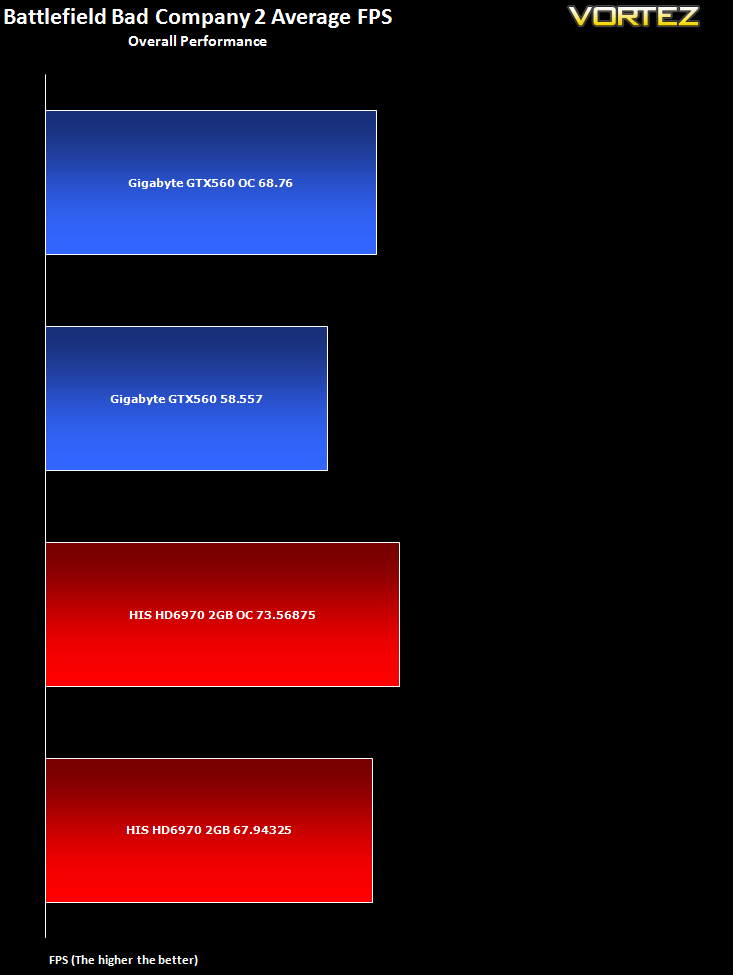
The overall performance analysis looks at the relative performance between all the cards on test across all the settings and resolutions used in-game.
Value for Money
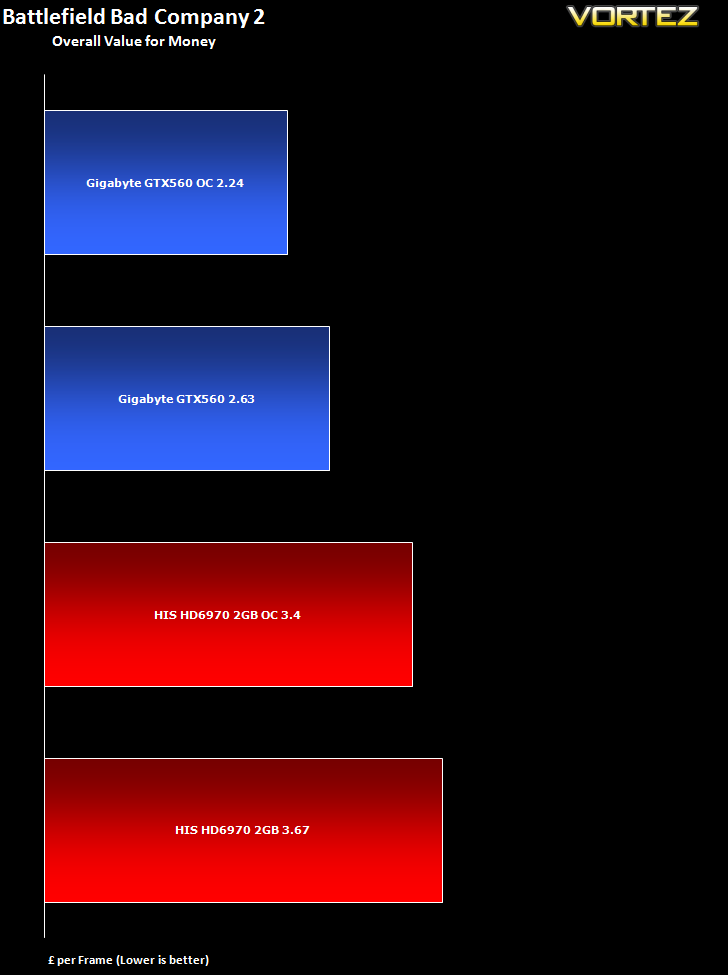
How much are you really paying for your performance? Value for Money analysis uses the results shown in Overall performance and takes into consideration the retail price (at the time of review) to work at a cost per frame value.
Dirt 3
As players race to elevate their global standing, DiRT 3 is back delivering mud, sweat and gears world over: from the intense weather-beaten rally stages of Europe, Africa and the US, to executing performance driving showcases and career challenges where car control is pushed to spectacular limits.
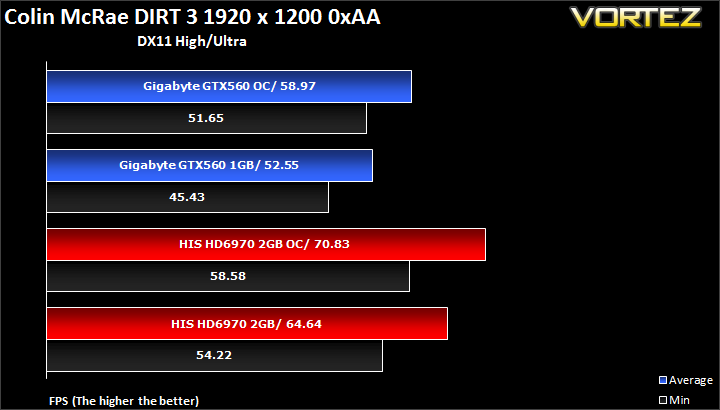
The in-game benchmarking tool was used to test performance. All the display settings were set to the maximum available and DirectX 11 was applied. The average FPS was recorded at the end.
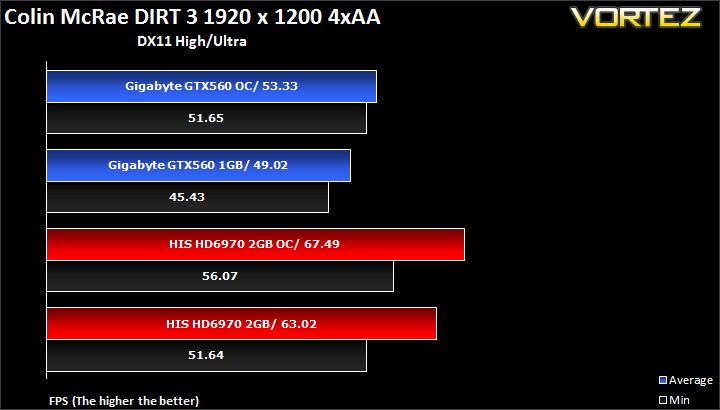
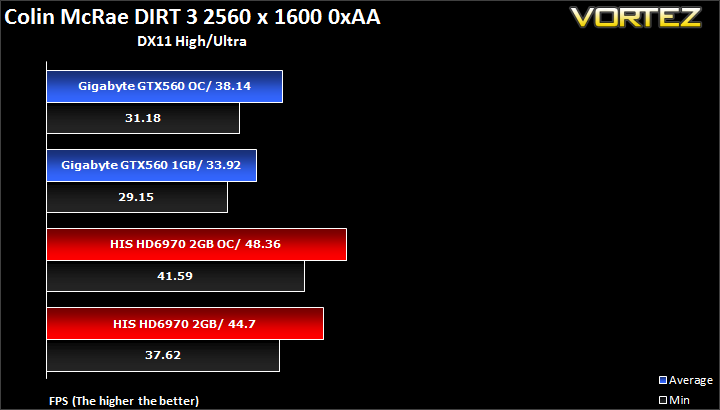
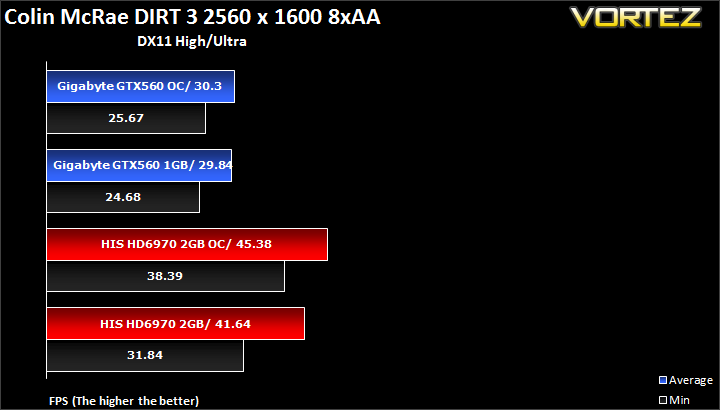
Performance Analysis
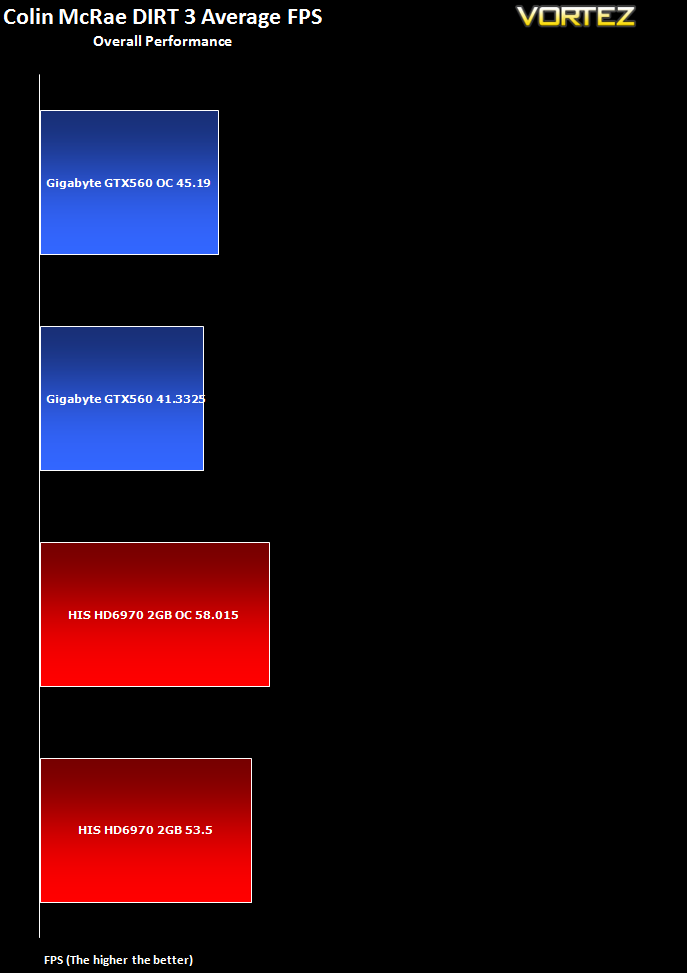
The overall performance analysis looks at the relative performance between all the cards on test across all the settings and resolutions used in-game.
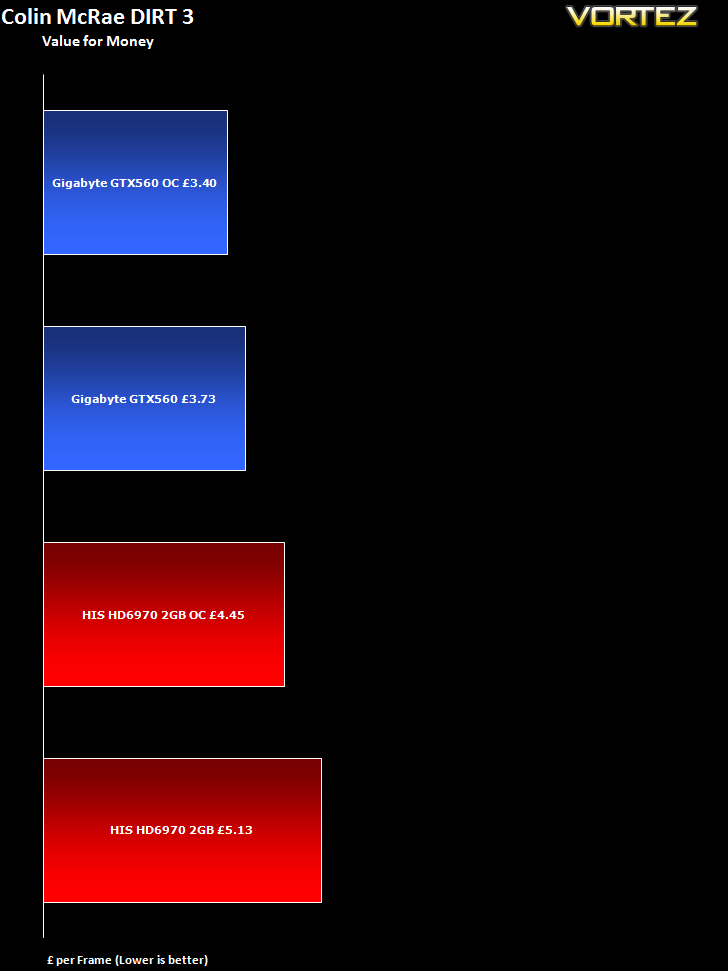
Value for Money
How much are you really paying for your performance? Value for Money analysis uses the results shown in Overall performance and takes into consideration the retail price (at the time of review) to work at a cost per frame value.
Mafia II
Following the success of Mafia back in 2002, the third person action adventure game is back with a new grittier and darker world. As Vito Scaletta, an aspiring made man, your job is to work through the twist and turns of Mafia lifestyle. The more blood spilt, the more you get in return but the lifestyle was never meant to be an ideal one. Set in the visually stunning Empire City, the wartime references provide the ever present back drop to a rife period in America’s history, in which potential for exploitation becomes Vito’s key focus.The in-game benchmarking tool was used to test performance. All the display settings were set to the maximum available in-game. PhsyX was only enabled if specified in the charts. The average FPS was recorded at the end.
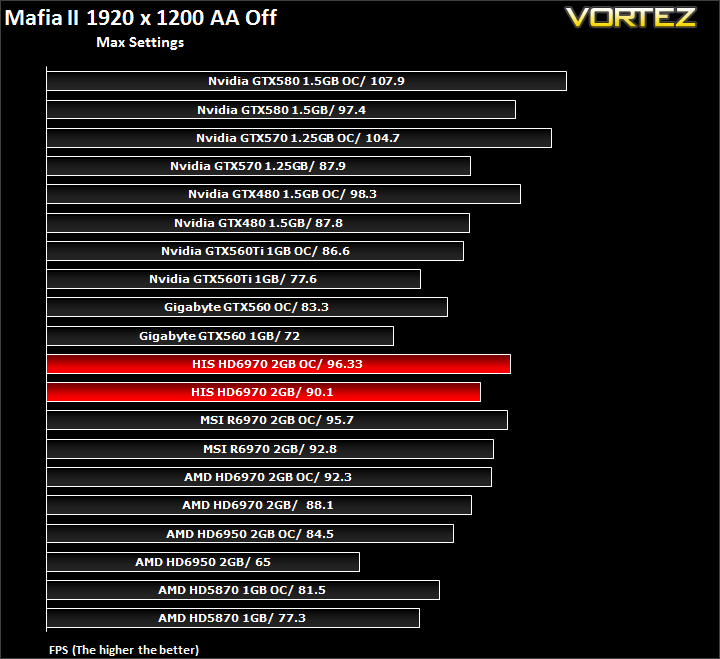
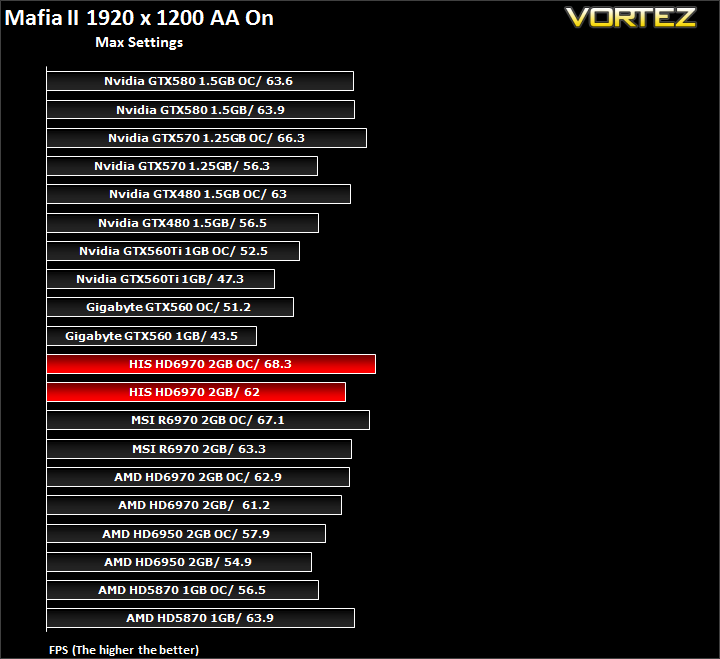
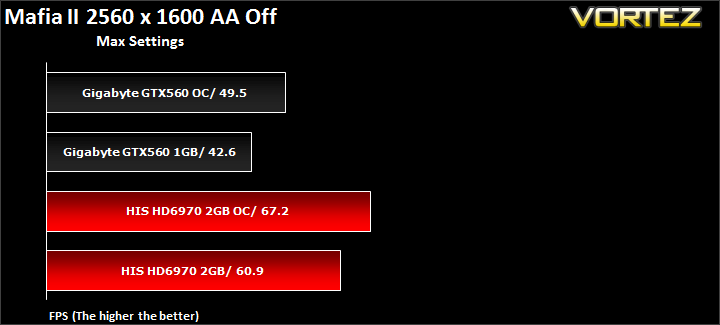
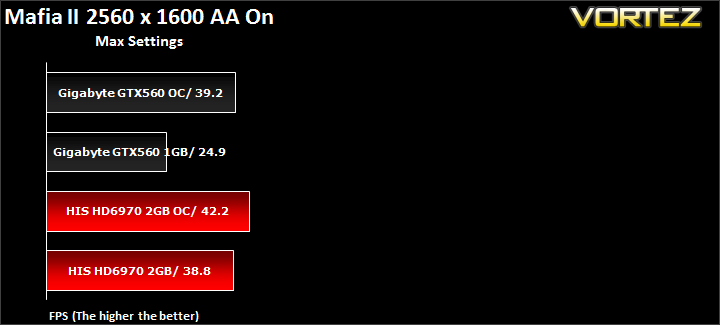
Performance Analysis
The overall performance analysis looks at the relative performance between all the cards on test across all the settings and resolutions used in-game.
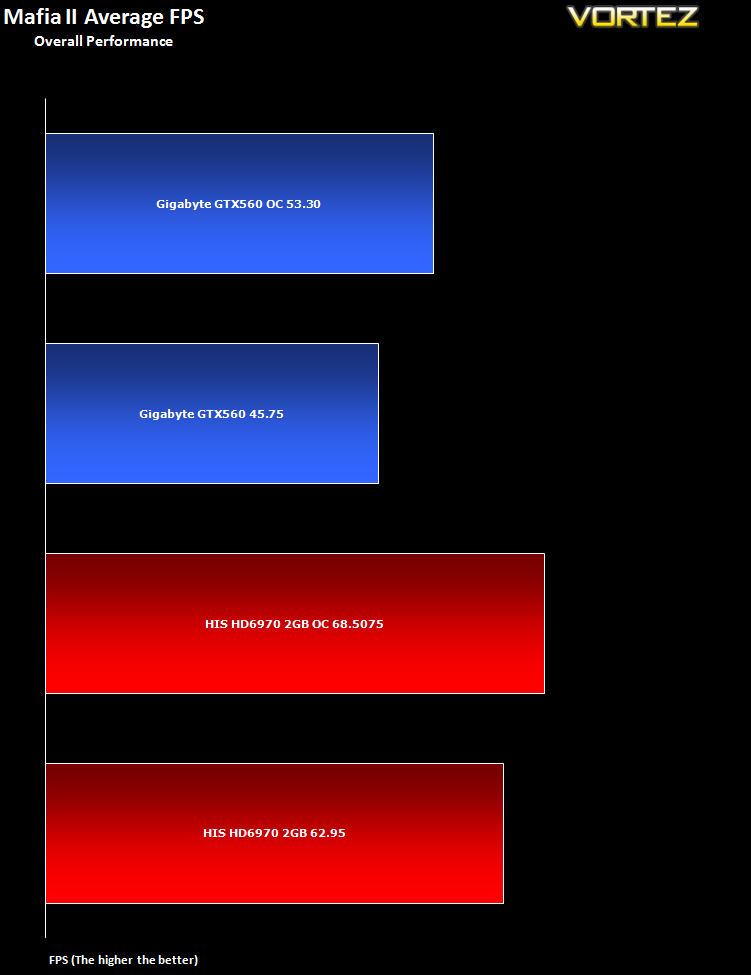
Value for Money
How much are you really paying for your performance? Value for Money analysis uses the results shown in Overall performance and takes into consideration the retail price (at the time of review) to work at a cost per frame value.
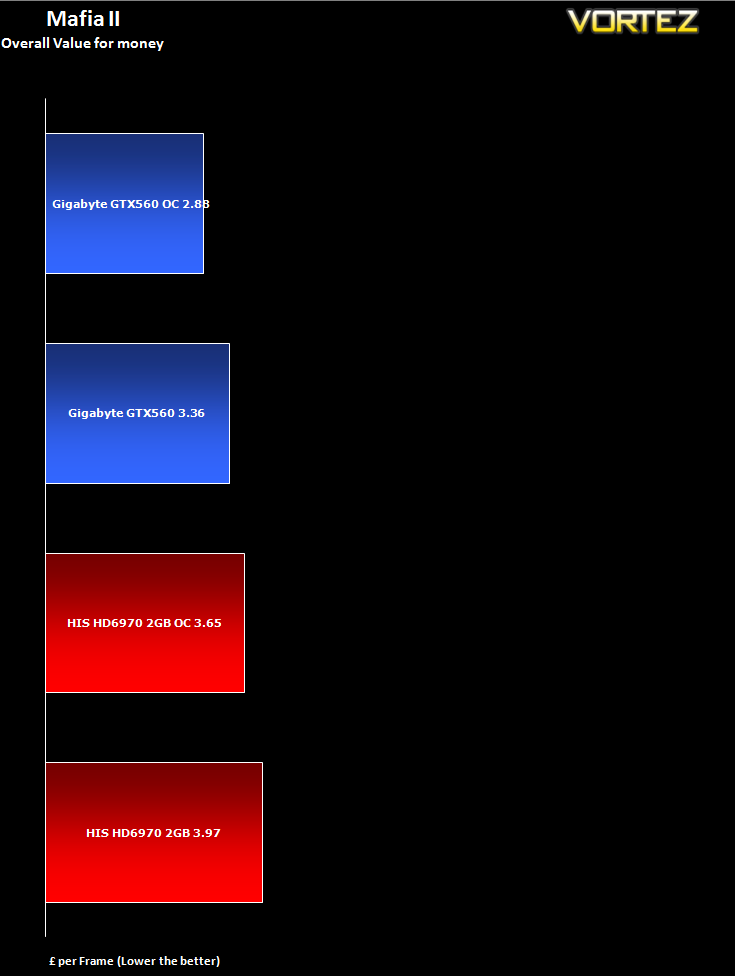
Tessmark 0.2.2
TessMark 0.2.2 is an OpenGL benchmark and tech demo that uses the new hardware tessellation (or GPU tessellation) features exposed by the OpenGL 4 API. Hardware tessellation makes it possible to divide a polygon into smaller ones (according to the tessellation level factor) in order to increase polygons density: the higher the tessellation level, the higher the polygon density. A high tessellation level requires much GPU processing power.TessMark was run in fullscreen, benchmark mode using map set 1 and configured to use OpenGL 4.
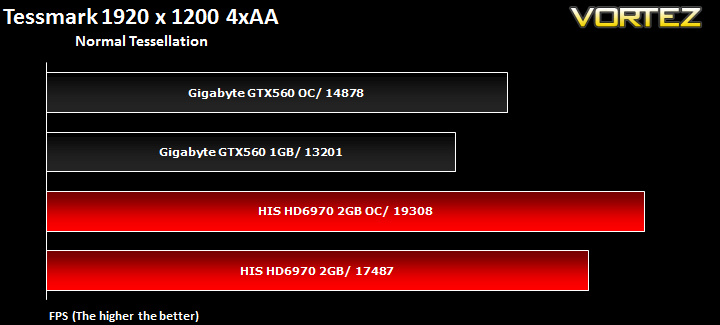
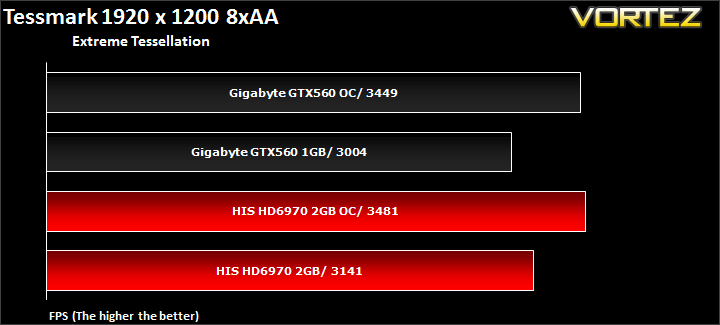
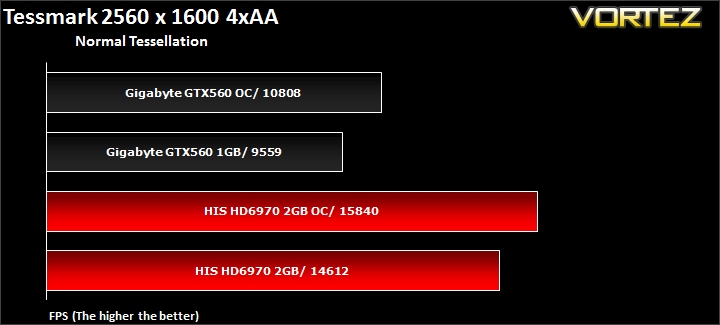
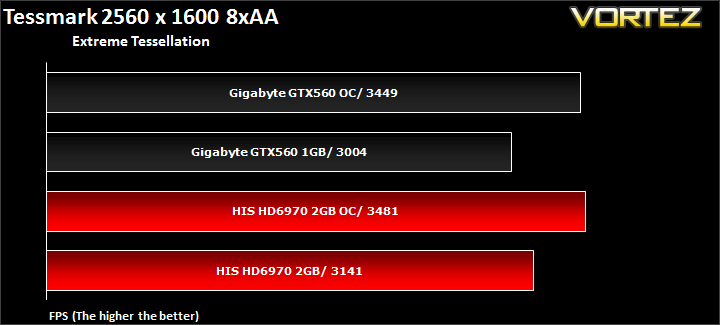
3DMark 11 & Unigine Heaven Benchmarks
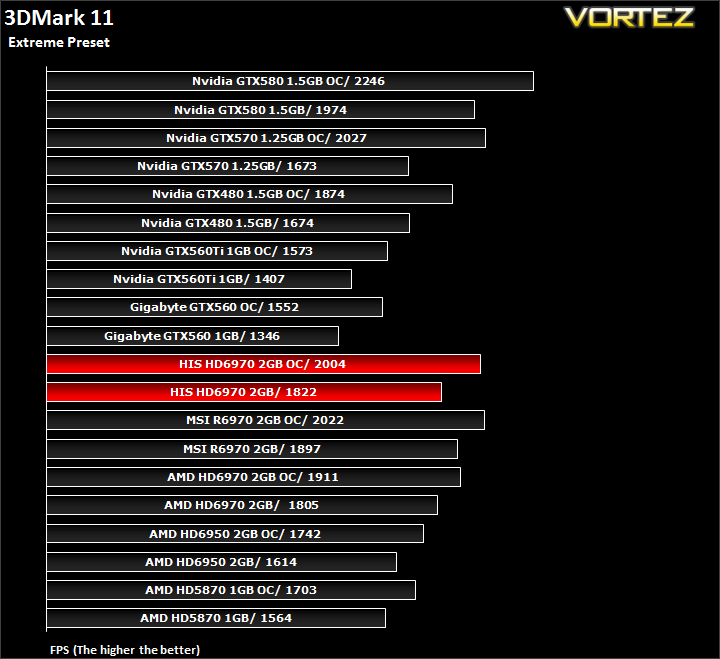
3DMark 11 is the latest version of the world’s most popular benchmark. Designed to measure your PC’s gaming performance 3DMark 11 makes extensive use of all the new features in DirectX 11 including tessellation, compute shaders and multi-threading.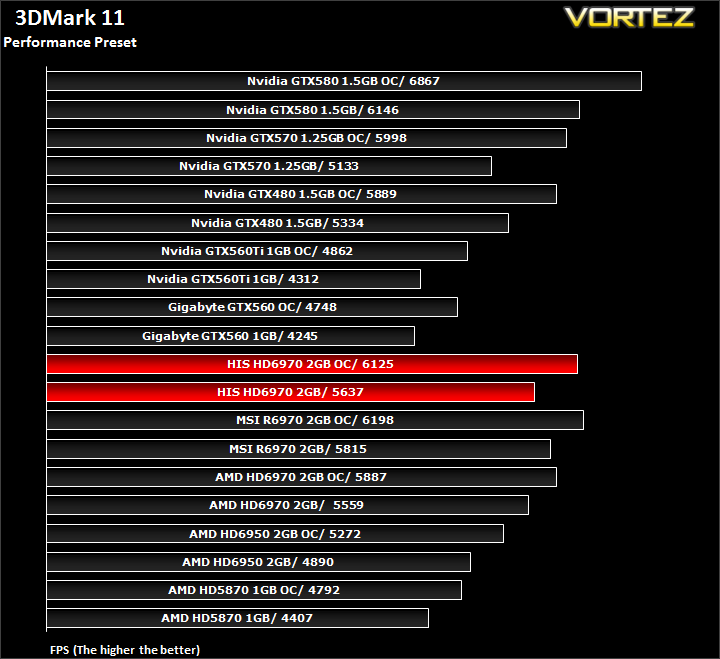
Unigine Heaven 2.5
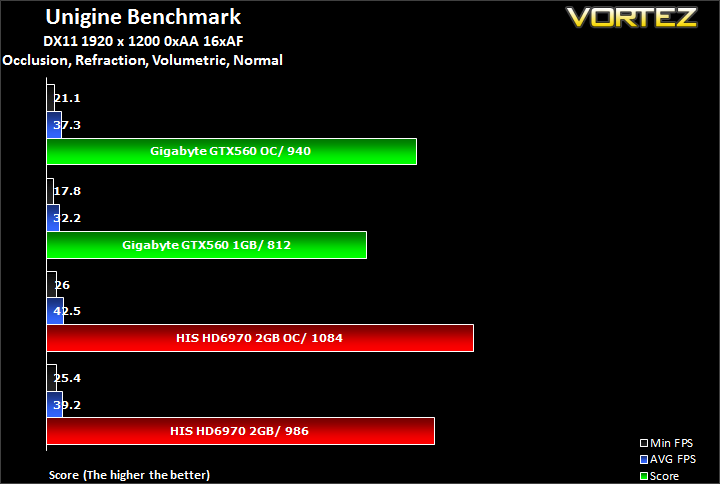
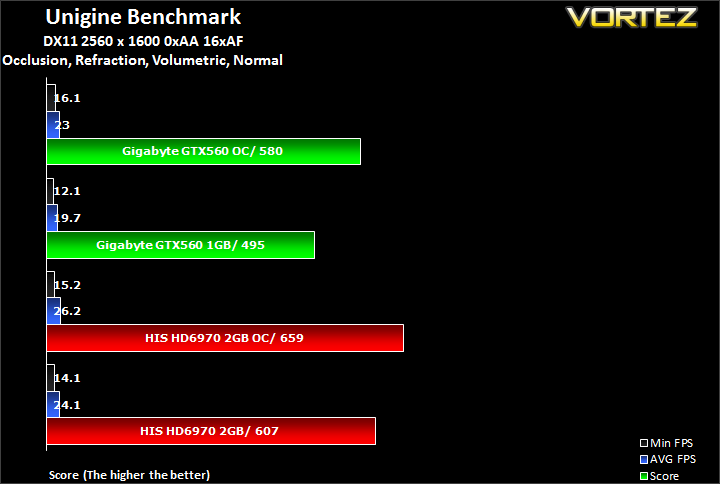
Heaven Benchmark is a DirectX 11 GPU benchmark based on advanced Unigine™ engine from Unigine Corp. It reveals the enchanting magic of floating islands with a tiny village hidden in the cloudy skies. Interactive mode provides emerging experience of exploring the intricate world of steampunk.
Conclusion
Every once in a while a graphics card comes along that bucks the trend. We have been inundated at Vortez with monolith styled, reference cooled GPUs that have little to differentiate them other than the product sticker so it was certainly a refreshing change to see a card with a different cooler. There can be no doubting the HIS HD6970 IceQ Turbo is certainly eye catching. The massive cooler, sprouting 4 thick copper heatpipes with a contrasting blue power circuit board is enough to draw any enthusiasts attention so it was with great enthusiasm I began testing this card, hoping for some equally interesting results.HIS make a very bold claim that the IceQ cooler affords a 23c reduction in temperatures. Unfortunately, during our testing we were unable to replicate these rather optimistic claims. While the card was certainly quieter than a reference cooled card, the temperatures were nothing to write home about being average at best which was not what I expected. Fearing the card had taken a knock in transit, I re-seated the card myself but the results were sadly the same. There is however a caveat to this in that because the noise level is lower than a reference cooled card , the fan speed on the HIS 6970 IceQ Turbo can be raised much higher before it becomes intrusive. The same fan speed on a reference card would make a great deal more noise at the same level.
Aesthetically, the card is what I lovingly refer to as ‘Marmite’. For those in the UK will know this Yeast extract has a love it or hate it taste. The same can be said for this GPUs looks, you either love it or you hate it. Personally I love it. When I first cast eyes on it, I didn’t know whether to be shocked or laugh out loud, the cooler really is that large, almost verging on the ridiculous. It’s brash looks will be appealing to performance junkies but would certainly make the style council cringe.
Throughout the benchmarks I was very impressed with this HIS HD6970 IceQ Turbo as the graphics card cut through the games like a hot knife through butter. The card performed exceptionally well at high resolutions thanks to the 2GB of GDDR5, even before the fantastic overclocking performance. I was particularly aghast at the performance of Dirt 3 which was sublime, even with all of the settings set to maximum and at the highest resolution. No wonder HIS are keen to throw in a free copy of the game with the retail release of this product!
Perhaps my only disappointment was Metro 2033, which being the highly demanding game that it is, brought the HIS 6970 IceQ Turbo to its knees with a slideshow 12fps. I expected more than that given the 2GB of GDDR5 which in other games proved very useful. That said, there are few graphics systems that would be able to handle this game with all the settings at their maximum so we will be better suited to evaluate the cards performance in this game when we have more basis for comparison.
Despite the card arriving pre-overclocked from the factory, there was plenty left in the tank to allow an extra 100MHz on the core and 400MHz on the memory. Voltages had to be increased to attain this overclock but the massive cooler coped well under the increased heat output, remaining relatively quiet throughout.
Overall, if you are looking for a card in the very highly contested £200-£250 market segment than you should certainly give the HIS HD6970 IceQ Turbo some serious consideration, especially if you are a gamer who likes to play at extreme settings.
Pros:
-Good Performance
-Great Overclocking ability
-Solid capacitors and chokes for durable, efficient performance
-Very quiet operation
-Eyefinity support
-Great packaging
-Free Game (Dirt 3)
Cons:
-Love it or hate it looks
-Bulky cooler
-No protective backplate
-No HDMI adapter
-Good Performance
-Great Overclocking ability
-Solid capacitors and chokes for durable, efficient performance
-Very quiet operation
-Eyefinity support
-Great packaging
-Free Game (Dirt 3)
Cons:
-Love it or hate it looks
-Bulky cooler
-No protective backplate
-No HDMI adapter