







The first ASUS TUF motherboard for the AMD AM3+ platform and 990FX chipset has arrived. But is it tough enough? There’s only one way to find out.
Product on review: SABERTOOTH 990FX
Manufacturer: ASUS
Street Price: £155 inc. VAT

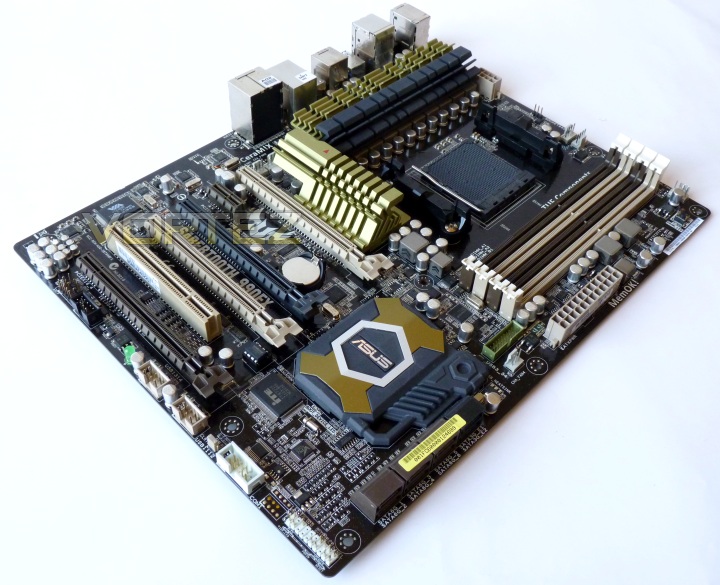
The SABERTOOTH is the first ASUS 990FX board that we have had the pleasure to test, so we’ll also be highlighting some ASUS-specific features for a good comparison to some of the other great 990FX boards out there.
ASUS on the TUF series
The TUF series delivers a “tough” image. With the unique design & high quality components (military-standard), TUF series is born for pursuing the preeminent stability, all-round compatibility, and extreme durability.
Features & Specifications
Technical Specifications: Full Details
AMD AM3+ FX™/Phenom™ II/Athlon™ II/Sempron™ 100 Series Processors
Supports AM3+ 32 nm CPU
Supports CPU up to 8 cores
Supports CPU up to 140 W
AMD Cool ‘n’ Quiet™ Technology
Chipset AMD 990FX/SB950
Memory
4 x DIMM, Max. 32GB, DDR3 1866/1600/1333/1066 Hz ECC, Non-ECC, Un-buffered Memory
Dual Channel Memory Architecture
* Refer to www.asus.com or user manual for the Memory QVL (Qualified Vendors Lists).
* Due to OS limitation, when installing total memory of 4GB capacity or more, Windows® 32-bit operation system may only recognize less than 3GB. Install a 64-bit Windows® OS when you want to install 4GB or more memory on the motherboard.
* Due to CPU spec., AMD 100 series CPUs support up to DDR3 1066MHz. With ASUS design, this motherboard can support up to DDR3 1333MHz.
Multi-GPU Support
Supports NVIDIA® Quad-GPU SLI™ Technology
Supports AMD Quad-GPU CrossFireX™ Technology
Expansion Slots
3 x PCIe 2.0 x16 (dual x16 or x16, x8, x8) *1
1 x PCIe 2.0 x16 (x4 mode, black)
1 x PCIe 2.0 x1
1 x PCI
Storage
AMD SB950 controller :
6 x SATA 6Gb/s port(s), brown
Support Raid 0, 1, 5, 10
JMicron® JMB362 controller :
2 x SATA 3Gb/s port(s), black
1 x Power eSATA 3Gb/s port(s), green
1 x eSATA 3Gb/s port(s), red
LAN
Realtek® 8111E , 1 x Gigabit LAN Controller(s)
Audio
Realtek® ALC 892 8-Channel High Definition Audio CODEC
– Supports : Jack-detection, Multi-streaming, Front Panel Jack-retasking
Audio Feature :
– Absolute Pitch 192kHz/ 24-bit True BD Lossless Sound
– Blu-ray audio layer Content Protection
– ASUS Noise Filter
– Optical S/PDIF out port(s) at back panel
IEEE 1394
VIA® 6308P controller
2 x IEEE 1394a port(s)
(1 at mid-board, 1 at back panel)
USB Ports
ASMedia® USB 3.0 controller :
4 x USB 3.0 port(s) (2 at back panel, blue, 2 at mid-board)
AMD SB950 controller :
14 x USB 2.0 port(s) (10 at back panel, black+red, 4 at mid-board)
Special Features
ASUS Dual Intelligent Processors 2 with DIGI+ VRM :
TUF ENGINE! Power Design :
– 8 +2 Digital Phase Power Design
– TUF Components (Alloy choke, Cap. & MOSFET; certified by military-standard)
– ASUS DIGI+ VRM Utility
– E.S.P. : Efficient Switching Power Design
Ultimate COOL! Thermal Solution :
– TUF CeraM!X Heatsink Coating Tech.
– TUF Thermal Radar
ASUS Exclusive Features
– MemOK!
– AI Suite II
– Anti-Surge
– ESD Guards
– Front Panel USB 3.0 Support
– ASUS UEFI BIOS EZ Mode featuring friendly graphics user interface
ASUS EZ DIY :
– ASUS Q-Shield
– ASUS O.C. Profile
– ASUS EZ Flash 2
– ASUS MyLogo 2
– Multi-language BIOS
ASUS Q-Design :
– ASUS Q-LED (CPU, DRAM, VGA, Boot Device LED)
– ASUS Q-Slot
– ASUS Q-DIMM
– ASUS Q-Connector
Back I/O Ports
1 x PS/2 keyboard/mouse combo port(s)
1 x eSATA 3Gb/s
1 x Power eSATA 3Gb/s
1 x IEEE 1394a
1 x LAN (RJ45) port(s)
2 x USB 3.0
10 x USB 2.0
1 x Optical S/PDIF out
6 x Audio jack(s)
Internal I/O Ports
1 x USB 3.0 connector(s) support(s) additional 2 USB 3.0 port(s) (19-pin, moss green)
2 x USB 2.0 connector(s) support(s) additional 4 USB 2.0 port(s)
1 x COM port(s) connector(s)
6 x SATA 6Gb/s connector(s)
2 x SATA 3Gb/s connector(s)
1 x IEEE 1394a connector(s)
1 x CPU Fan connector(s) (4 -pin)
4 x Chassis Fan connector(s) (3 x 4 -pin, 1 x 3 -pin)
1 x Optional Fan connector(s) (4 -pin)
1 x S/PDIF out header(s)
1 x 24-pin EATX Power connector(s)
1 x 8-pin ATX 12V Power connector(s)
1 x Front panel audio connector(s) (AAFP)
1 x System panel(s) (Q-Connector)
1 x MemOK! button(s)
1 x Clear CMOS jumper(s)
Accessories
User’s manual
ASUS Q-Shield
4 x SATA 6Gb/s cable(s)
1 x SLI bridge(s)
1 x Q-connector(s) (2 in 1)
1 x TUF Certification card(s)
1 x TUF 5 Year Warranty manual(s) (by region)
BIOS
32 Mb Flash ROM, UEFI BIOS, PnP, DMI2.0, WfM2.0, SM BIOS 2.5, ACPI 2.0a, Multi-language BIOS, ASUS EZ Flash 2,
Manageability WfM 2.0, DMI 2.0, WOL by PME, WOR by PME, PXE
Support Disc Drivers
Anti-virus software (OEM version)
ASUS Update
ASUS Utilities
Form Factor
ATX Form Factor
12 inch x 9.6 inch ( 30.5 cm x 24.4 cm )
Note *1: When running dual graphics cards, be sure to insert the card in the first and third PCIex16 slot to get the best performance.
Features
• CeraM!X heatsink cooling technology
• TUF Thermal Radar
• DIGI+ VRM
• UEFI BIOS
• E.S.P Efficient power switching design
• TUF Components (Alloy Choke, Cap & MOSFET; Military standard)
• MemOK!
• ESD Guards
• AI Suite II
• Front Panel USB3.0
Packaging and first look
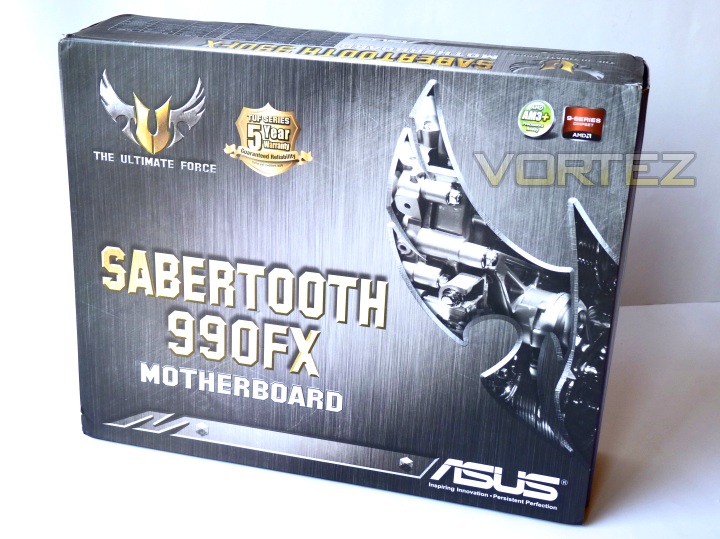
The SABERTOOTH comes in a much smaller box than the other 990FX boards we have looked at, but it still packs much of the same contents and offers sufficient protection. It’s likely ASUS are keeping down the excessive packaging to keep it in line with the understated nature of this board to attract the right potential buyers. Advertised on the front is the generous 5 year warranty and the top panel lifts up to reveal a list of features, but no window to see the actual product.
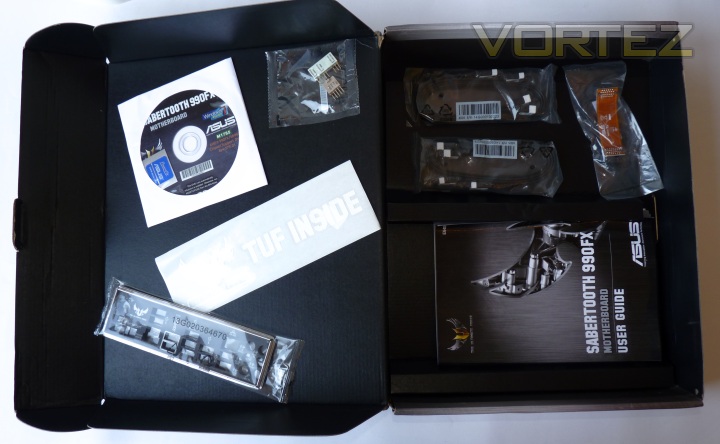
Inside the box there is another box below the motherboard that contains the accessories. The bundle includes:
• Users manual and warranty information
• ASUS Q-Shield (IO shield)
• Technologies brochure
• Driver and software CD
• 4x black SATA cables
• 1x SLI bridge
• ASUS Q-connector (for front panel)
• TUF Certification card
• TUF Sticker
The motherboard uses an original colour scheme, with a dark brown PCB and black/grey and green highlights on the heatsinks, with brown and beige plastics. So many colours on paper shouldn’t look good together, but the design of the SABERTOOTH is actually quite pleasing in real life. The colours are generally quite subtle and it has a very solid look and feel. The styling might not be to everyone’s taste but it does give off the right impression for the type of user ASUS aim this at. It’s designed to be tough, reliable and understated, and I think it conveys this before it’s even installed with an almost camouflage type look.
Closer Look
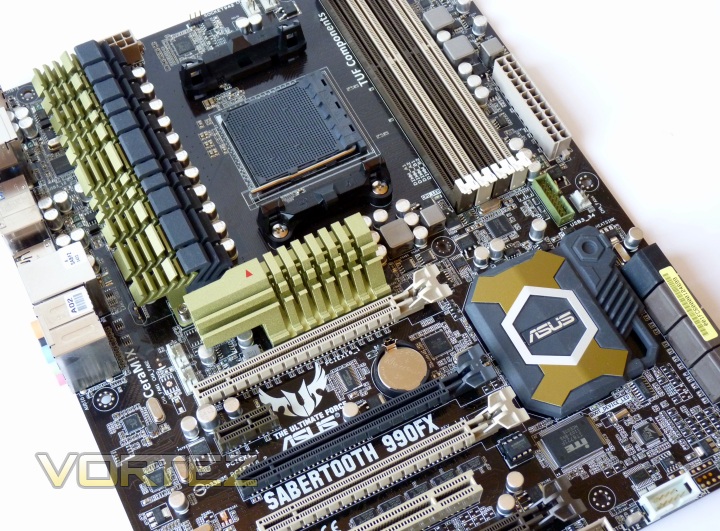
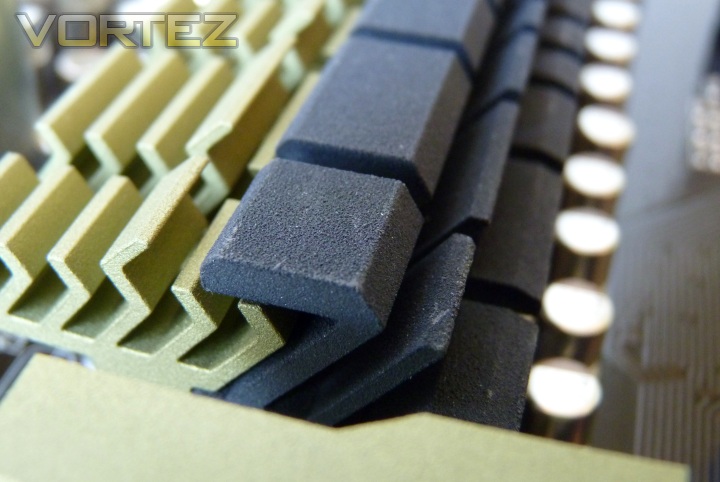
Looking at the top section of the board, you can see the AM3+ CPU socket has plenty of clearance so there shouldn’t be any problems with CPU coolers fitting. There is a digital 8+2 power phase design and a CeraM!X coating on part of the VRM heatsink. This is to aid heat dissipation as it gives a larger surface area.
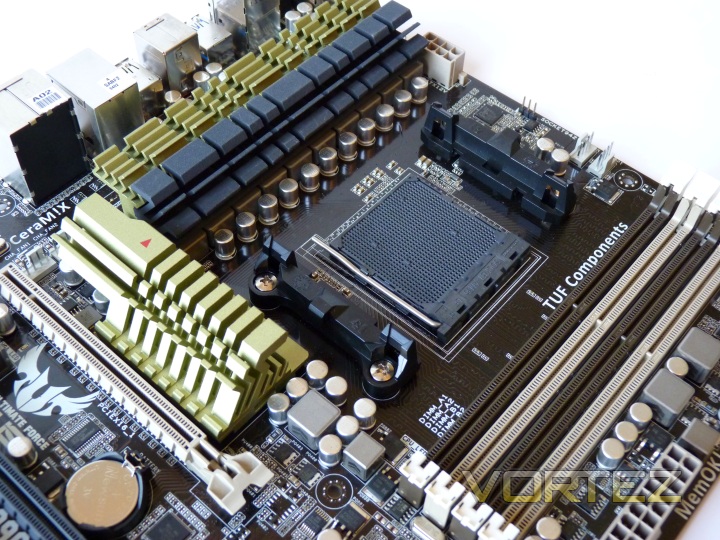
The CPU socket itself is a normal AM3+ design and there is also plenty of clearance for the PCI-E slots with no interference from the memory slots.
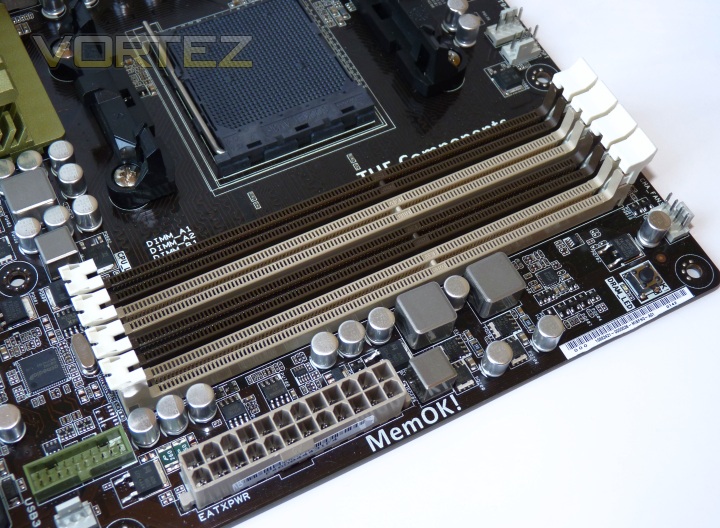
Similar to all other 990FX boards, the SABERTOOTH sports 4x DDR3 DIMM slots but it does have 3×4-pin fan connectors and one 3-pin connector in this area. This is useful in cases that have a lot of exhaust fans near the top. There is also a MemOK! button that assists in memory compatibility as seen on the ASUS Crosshair line of motherboards. This board differs to the new Crosshair V, but offers the same basic functions. We’ll see how they compare on performance soon.
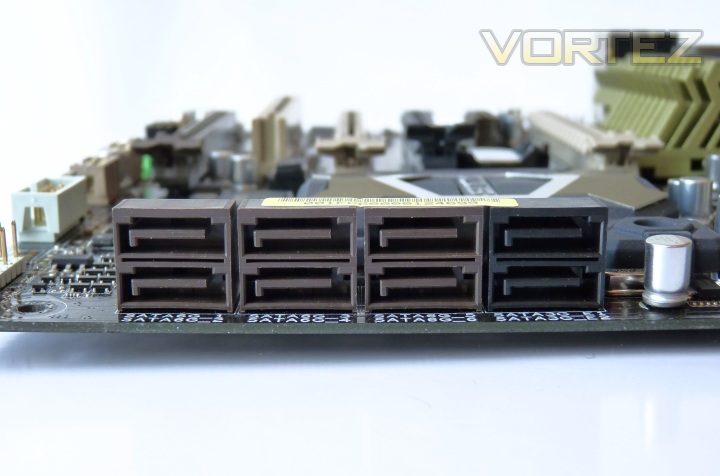
The board comes with 6x SATA III ports, all provided by the AMD SB950 southbridge, which are capable of RAID 0, 1, 0+1, JBOD, and RAID 5. There is also an additional SATA controller provided by JMicron (JMB362) that gives two more SATA ports (SATA II, 3Gbps) and one power eSATA, and one eSATA on the rear IO panel.
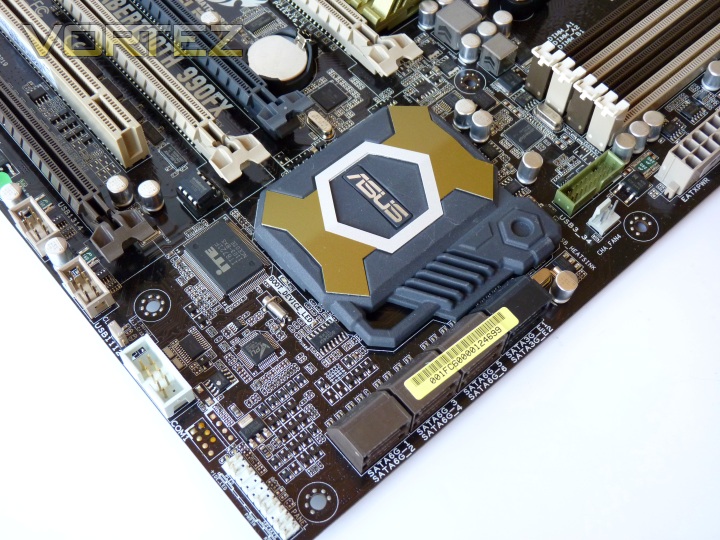
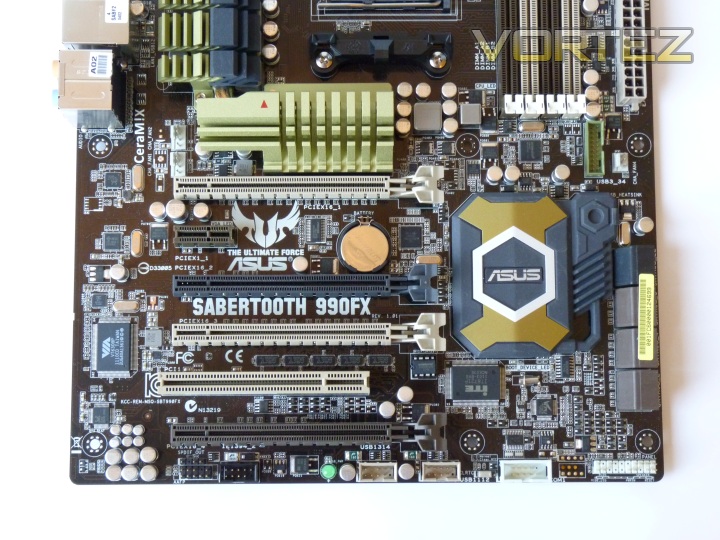
Moving down towards the bottom of the board, we can see the AMD southbridge and front panel connectors. There is a USB3.0 front connector for new cases that support nice (a nice addition), and you can also see the usual array of front panel connectors along the bottom, such as USB2.0 ports. There is also a large green, fairly old style LED that illuminates when the board is receiving power from the ATX connectors. Useful to see whether it’s on or not and possibly troubleshoot power supply issues. There is no LED/LCD POST code system as seen on the ASRock 990FX Professional or Gigabyte 990FXA-UD7, but it would seem against the ethic of this design, as well as adding to the cost. There are however, red LEDs placed across the board that light when the machine is POSTing that can give some information should there be an issue.
The whole bottom of the board can be seen below. One omission that was immediately noticed, especially when using the board on a test bench, is the option to power the board up and reset with onboard buttons. Instead you’ll have to connect the power switch as usual, as you would in a normal case. This adds to the evidence that ASUS is marketing this board to a different type of user compared to their traditional high end boards, such as the Crosshair series. This is for someone who wants a solid but functional motherboard that will last a long time. It’s not for extreme overclockers and people who enjoy benchmarking regularly. Will this hamper the performance? Read on to find out.
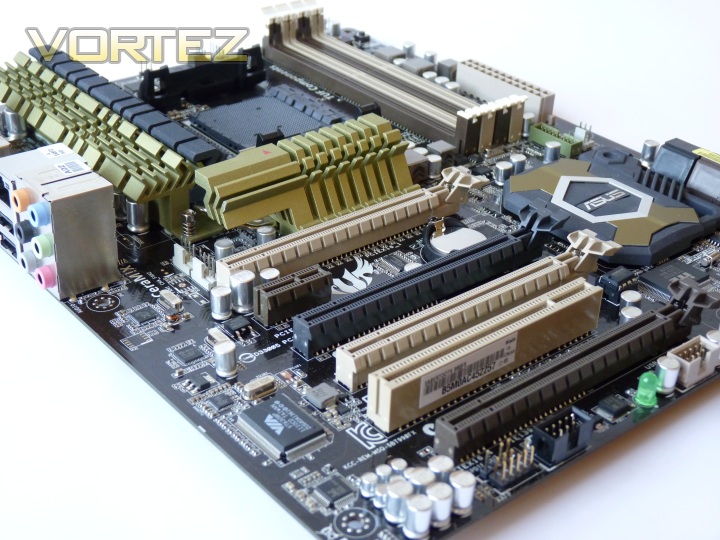
There are plenty of options for multi-GPU configurations with both quad-GPU SLI and Crossfire being supported. There are 3x PCI-E 16x ports that support dual 16x/16x if you use two, and 16x/8x/8x if you’re using all three. In addition to this, there is also a PCI-E 16x length port that is wired for 4x speeds (black) and a small PCI-E x1 port. There is also a legacy PCI port, which is useful for devices such as sound cards and TV tuners that a user may want to keep when changing their motherboard. You’ll also notice another two 4-pin fan headers near the top most PCI-E slot.
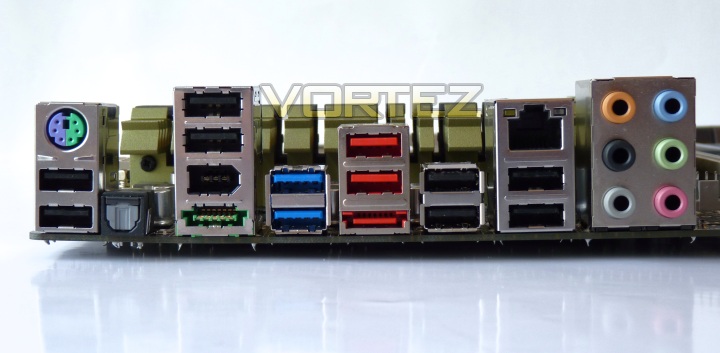
The IO panel connectivity is not likely to let you down either. A good amount of ports cater, again, for almost any user. From top left to bottom right:
• PS/2 mouse/keyboard
• 2x USB2.0
• SPDIF digital audio
• 2x USB2.0
• Firewire
• Powered eSATA
• 2x USB3.0
• 2x USB2.0
• eSATA
• 2x USB2.0
• Gigabit Ethernet (Realtek 8111E)
• 2x USB2.0
• 7.1 analogue audio (Realtek ALC892)
Technologies & Software
ASUS has put to use a lot of technologies and software in the SABERTOOTH 990FX. This section attempts to break them down tell you what they’re all about.
CeraM!X
This is the name for ASUS’ new heatsink cooling technology that provides a 50% larger surface area using ceramics by creating an uneven surface on the heatsink. Less heat means better stability and longer component life, though whether this has much impact in the expected life of a 990FX motherboard is unclear.
TUF Thermal Radar
This technology consists of numerous temperature monitoring points on the mainboard at vital areas, and software that can control fan RPM and profiles based on the temperatures reported for optimum cooling and stability. This software is impressive, and provides an unprecedented overview of the temperature across all important parts of the mainboard.
DIGI+ VRM
ASUS’ digital power phase allows user control over the levels of power delivery and stability to optimise performance and energy saving. It also provides greater efficiency and stability than traditional designs to prolong lifespan and maximise performance.
UEFI BIOS
The new UEFI BIOS is a first for the AMD platform. This replaces the traditional BIOS interface with a full GUI. There are basic and advanced modes for different user abilities, and support for 2TB+ boot drives. The use of a mouse is also possible in this interface.
Efficient Switching Power Design (E.S.P.)
This technology is unique to the SABERTOOTH and allows the mainboard to dynamically lower power input based on demand to reduce resistance and efficiency, not just CPU and memory, but also graphics cards, LAN and USB3.0.
TUF Components
This consist of Alloy Chokes, Capacitors and MOSFETs certified by military standard meaning it has been put through 3rd party military testing. Marketing gimmick? Not entirely, it should provide better quality components.
MemOK!
MemOK! Is a feature seen on high end ASUS boards for some time now. It improves memory compatibility and boot success at the press of a button.
ESD Guards
ASUS provides an Anti-static chip and cicuit design, and coupled with the IO shield it provides four times more protection from accidental electrostatic discharge.
If anyone reading would like any of the other technologies or software explained, follow the link at the end of this review and let us know on the forums and we’ll do our best to explain and maybe even include it in the review.
Test setup and overclocking
Let’s finally take a look at how the board was tested and our initial results. The test setup is made up from an array of modern parts from some top manufacturers:
CPU AMD Phenom II X6 1100T (3.3GHz, 3.7GHz Turbo)
Motherboards
–ASUS SABERTOOTH 990FX
–ASRock 990FX Professional
–Gigabyte 990FXA-UD7
Memory Corsair Vengeance 8GB (2x4GB Dual Channel), 1866MHz @ 9-10-9-24
CPU Cooler Corsair Hydro Series H70
Graphics ZOTAC GeForce GTX 570 AMP! Edition
PSU Corsair HX650W
Storage
Corsair Force Series F120 120GB SSD (Sandforce 1200)
LG GGC-H20L Blu-ray and HD-DVD ROM Drive
Case Cooler Master Lab Test Bench V1.0
Overclocking
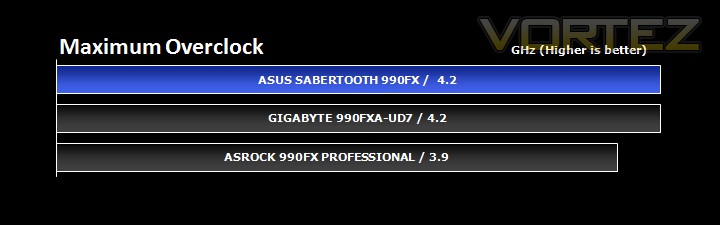
The AMD 1100T has an unlocked multiplier, which makes overclocking the CPU as easy as increasing the multiplier and voltage and seeing how far you can go. Overclocking with the SABERTOOTH 990FX was a pleasure with the new UEFI BIOS, which we found to be immediately more user friendly and responsive than that of the ASRock 990FX Professional. There was also an absolute wealth of options to tweak every aspect of the motherboard and its power delivery, which made finding a stable overclock very easy indeed. Using 1.45V and loadline calibration on high, the maximum clock for the 1100T was found at 210 x 20, i.e. bus speed of 210Mhz and CPU multiplier of 20. This is an overall CPU clock of 4.2GHz and matches the maximum found using the GIGABYTE 990FXA-UD7 and is most likely the most this particular CPU is capable of, suggesting the SABERTOOTH has yet more performance to give with the upcoming AMD FX CPUs. The overclocks were tested with LinX and had to be stable throughout the entire suite of benchmarks.
Synthetic benchmarks – AIDA64
CPU Queen
CPU Photoworrx
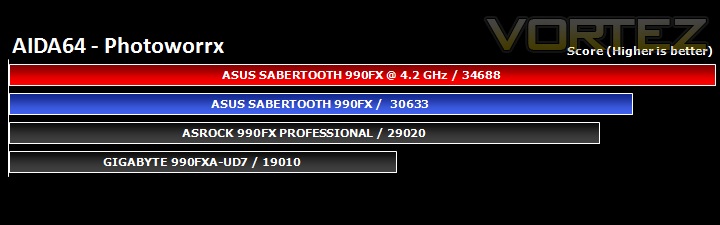
Strangely, the SABERTOOTH 990FX and 990FX Professional outperform the GIGABYTE UD7 by a huge margin in this test, despite the tests run being identical. This may be an anomaly, and we will monitor the scores of other motherboards to try and explain this as well as running these tests again with AMD FX CPUs.
CPU AES
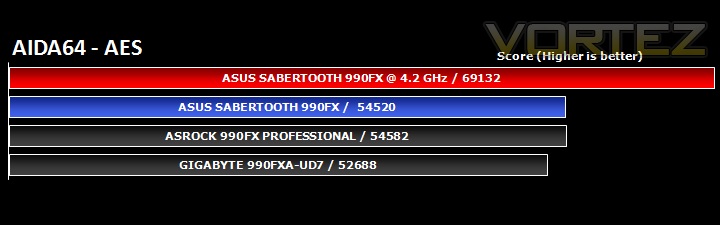
CPU AES test uses only the basic x86 instructions, and it’s hardware accelerated on VIA PadLock Security Engine capable VIA C3, VIA C7 and VIA Nano processors; and on Intel AES-NI instruction set extension capable processors. The test is HyperThreading, multi-processor (SMP) and multi-core (CMP) aware.
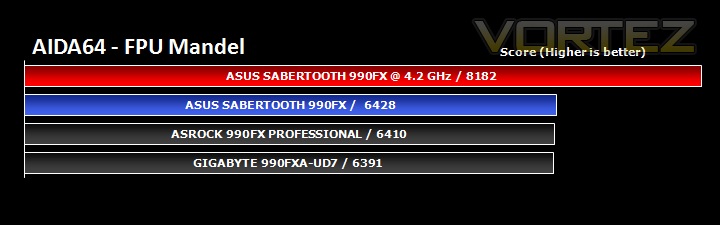
FPU Mandel
Synthetic benchmarks – x264HD
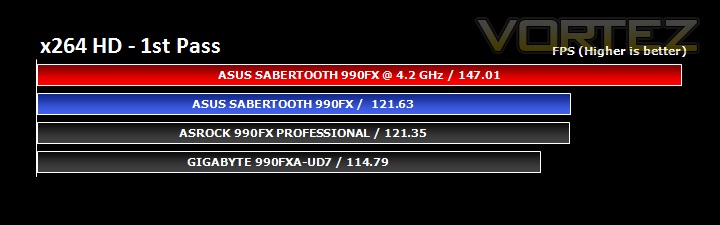
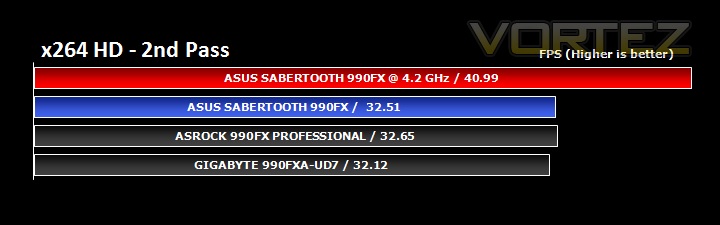
x264 HD gives results for 2 passes when compressing an MPEG-2 clip into x264. It presents 4 separate results for each pass giving a total of 8 – all results are given in FPS. The results are averaged for each pass and presented below.
Synthetic benchmarks – Cinebench 11.5
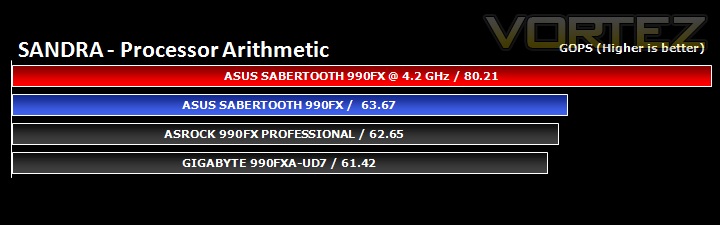
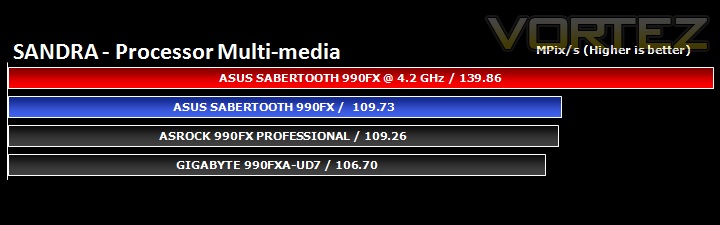
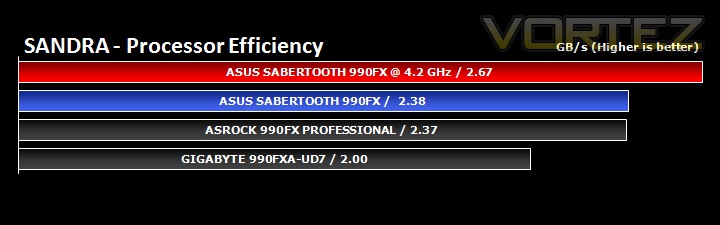
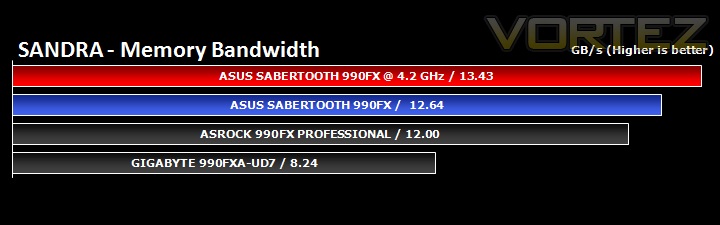
Synthetic benchmarks – SiSoftware SANDRA 2011
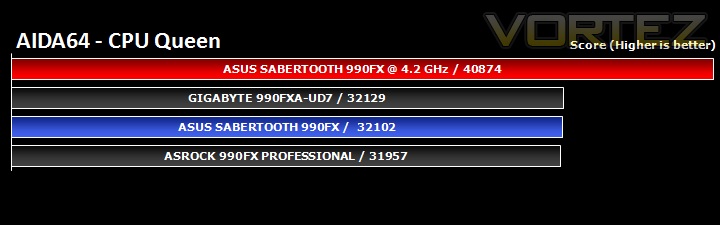
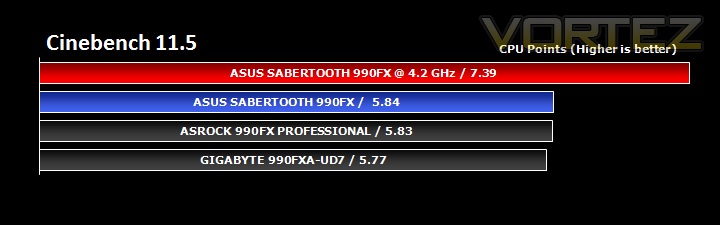
Processor tests – The SABERTOOTH wins out on all the CPU tests at stock settings, and overclocking provides a nice boost.
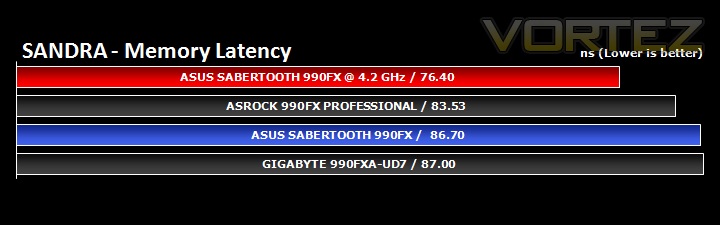
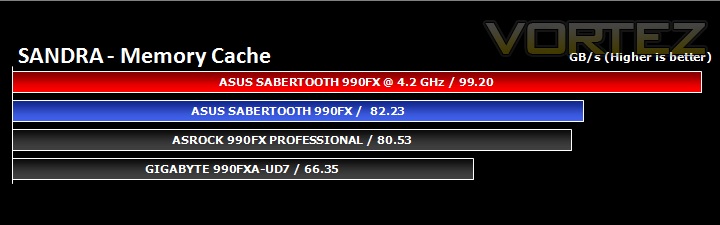
Memory tests – Again, the SABERTOOTH puts in a stellar performance, matching the best in all tests except memory latency.
Synthetic Benchmarks – PCMark 7
Synthetic benchmarks – 3DMark 11
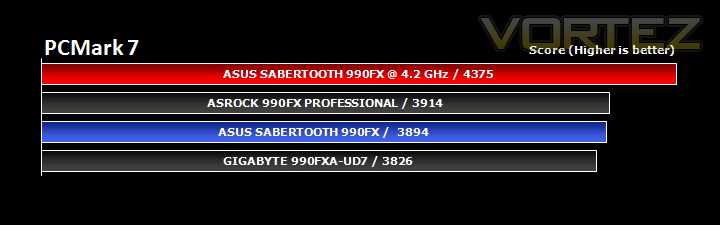
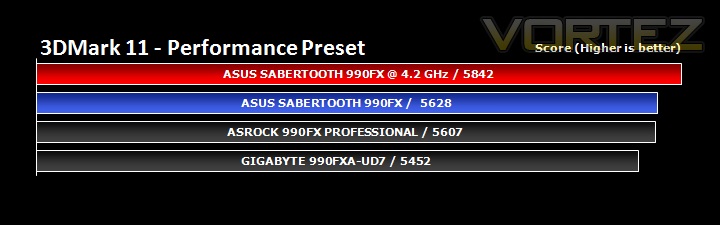
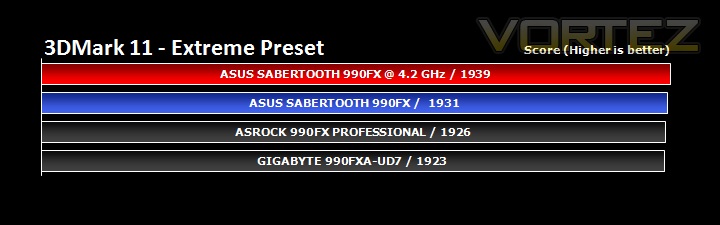
The latest version of 3DMark was run on both Performance and Extreme presets with only the benchmarking runs being performed. Each run was performed 3 times and the average results are presented below.
Overclocking the 1100T CPU provides a small boost when the graphics card is not bottlenecked, but on the extreme preset where the GPU is being tested, we see little or no improvement in overall score.
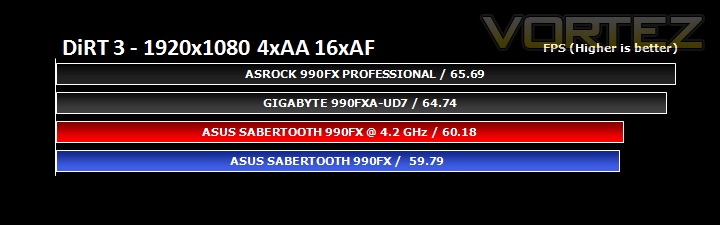
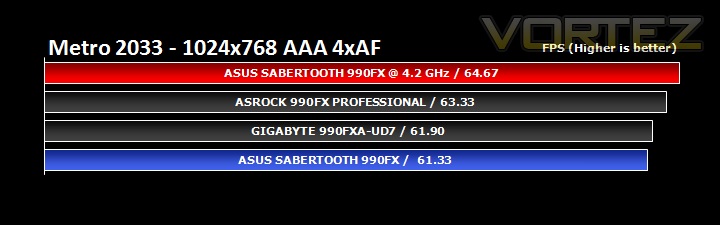
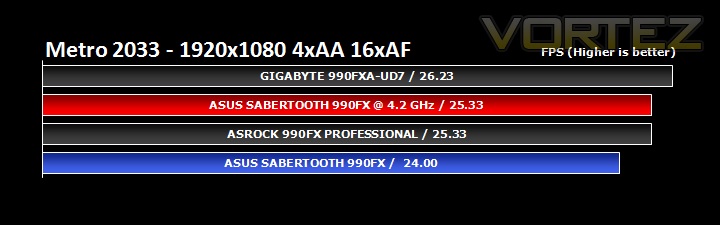
Gaming Benchmarks – Far Cry 2, DiRT 3, Metro 2033
Far Cry 2
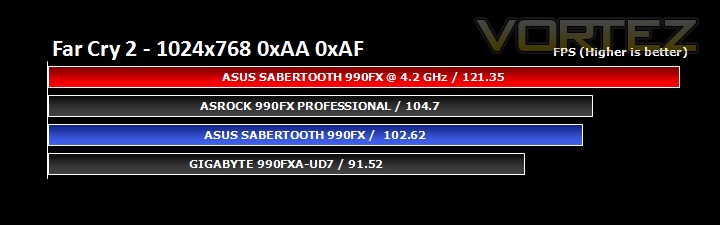
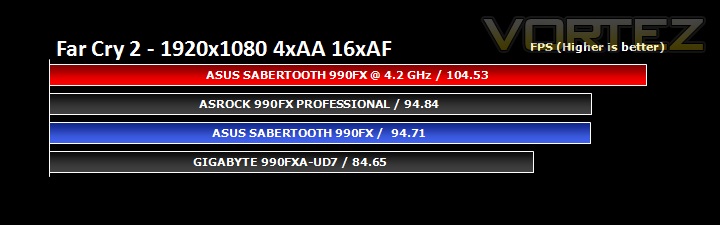
Far Cry 2 is bundled with a benchmark tool that allows the user to customise the graphical details as well as type of area and events to measure the FPS of. In this situation, the gaming benchmarks were run at two sets of resolutions with varying AA and AF settings. All benchmarks used the highest level of detail possible otherwise (including DirectX10), and consisted of a flyover of Ranch (long).
DiRT 3
Metro 2033
Benchmarks were run using the bundled benchmark tool (using DirectX 11) and set to the highest details possible.
Conclusion
It is clear from the benchmarks then that ASUS’ pursuit of reliability and stability in this motherboard was not at the cost of performance. The SABERTOOTH was consistently fast and provided the best overclock we’ve seen from our Phenom II 1100T CPU. The board also boasts plenty of connectivity using the IO panel and front panel connectors as well as many options for multi-GPU setups being catered for. 8 SATA ports (and two eSATA) are ideal for this type of motherboard and the temperature monitoring is the best ever seen on the AMD platform, along with a massive 5 4-pin fan connectors and one 3-pin connector to cater for any cooling requirements. The styling is unique, and the raft of additions such as CeraM!X cooling technology and high quality chokes and caps just add to the high quality performance and finish of the SABERTOOTH.
Like almost any product though, the SABERTOOTH does have some shortcomings, but they are minor. The lack of motherboard mounted power and reset buttons and no clear CMOS button on the IO panel seem like steps backwards in terms of functionality. There is no dual LAN as one might be accustomed to on a high end motherboard, though how useful that is in today’s market is debateable, and there is only a combined PS/2 keyboard and mouse connector. Again however, this really isn’t that important when we consider the potential users for a motherboard such as this. ASUS have also included only a moderate bundle (hardware and software) with the SABERTOOTH, most likely to offset the cost of the extra reliability-orientated features, but also in line with the entire design ethic of this product. In fact, it’s really difficult to find any significant problems with the SABERTOOTH at all.
ASUS have created the perfect high-end companion to the classic Crosshair line. The SABERTOOTH provides a rock-solid, top performing and reliable base to any AM3+ system and is ideal for users looking for a no-frills but still incredibly capable motherboard. This is the perfect motherboard for those looking for the highest performance, but who don’t need features for extreme overclocking (i.e. LN2 etc) or all the bells and whistles of the ASUS Crosshair V, but still have high demands for connectivity, reliability and design.
+ Top-notch performance
+ Solid construction
+ Excellent overclocking ability
+ Unique and original design
+ Fantastic thermal management
+ Generous 5 year warranty
+ Competitive price
Cons
– Lacks internal power buttons/external Clr CMOS
– Colour scheme may not be to everyone’s taste
– Moderate hardware and software bundle


Click here for an explanation of our awards at Vortez.net.


