







After years of anticipation, AMD’s new FX ‘Bulldozer’ CPU line is here. We test the flagship FX-8150 to see how good they really are.
Product on review: AMD FX-8150
Manufacturer: AMD
Street Price: £194.99

This launch completes what AMD describe as the Scorpius platform, which comprises of the 9-series chipset motherboards, Radeon HD 6xxx GPUs and finally the FX CPUs, which AMD say gives top end performance at a reasonable price.
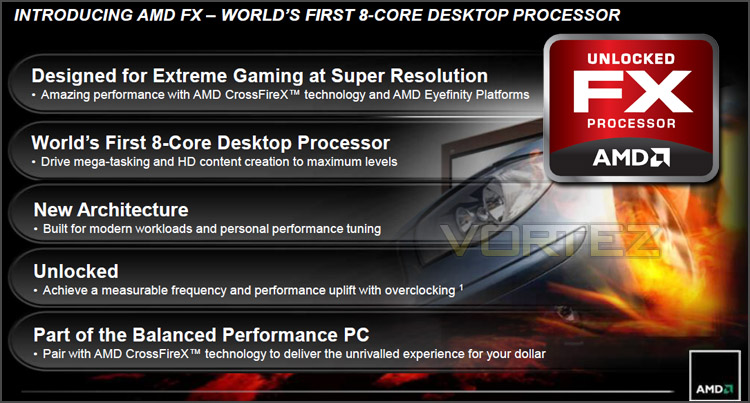
Here at Vortez we have sampled the AMD FX-8150 and put it through its paces for you. We have compared it to AMD’s previous generation flagship, the Phenom II 1100T, and in select tests, Intel’s i5 2500K, 990x and i7 920 at stock and overclocked settings.
We will also be covering some of the technology behind the new ‘Bulldozer’ architecture for those who are interested to see how it all works. Read on to see how the new AMD flagship CPU performs.
AMD’s take on Bulldozer
Bulldozer” was designed to balance performance, cost and power consumption on multi-threaded applications. The architecture focuses on high-frequency and resource sharing to achieve optimal throughput and blistering speed in next generation applications. AMD FX Processors offer up to eight high-performance, power-efficient cores. These represent the First generation of a new execution-core family from AMD (Family 15h). Other specs include:
– 128 KB of Level1 Cache, 16 KB/Core, 64-byte cacheline, 4-way associative, write-through
– 8 MB of Level2 Cache, 2 MB/”Bulldozer” module, 64-byte cacheline, 16-way associative
Integrated Northbridge which controls:
– 8 MB of Level3 Cache, 64-byte cacheline, 16-way associative, MOESI
– Two 72-bit wide DDR3 memory channels
– Four 16-bit receive/16-bit transmit HyperTransport™ links
– 128 KB of Level1 Cache, 16 KB/Core, 64-byte cacheline, 4-way associative, write-through
– 8 MB of Level2 Cache, 2 MB/”Bulldozer” module, 64-byte cacheline, 16-way associative
Integrated Northbridge which controls:
– 8 MB of Level3 Cache, 64-byte cacheline, 16-way associative, MOESI
– Two 72-bit wide DDR3 memory channels
– Four 16-bit receive/16-bit transmit HyperTransport™ links
Features and Specifications
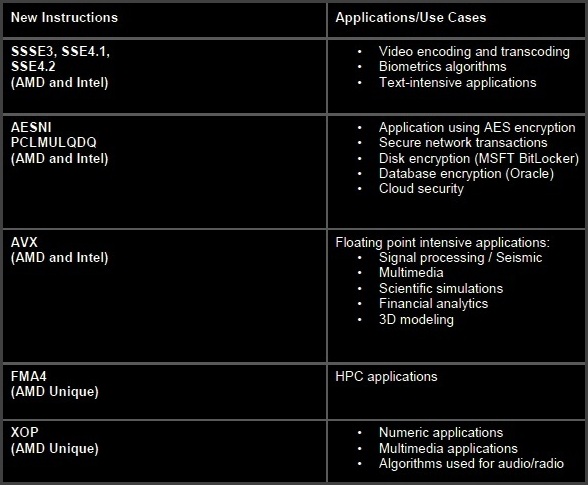
This new generation of CPUs is very different from previous models. The core architecture has been completely redesigned from scratch to optimise the multi-core and high end experience. AMD is focussing very much on multi-threaded applications and optimising their processors towards this. The new AMD FX processers are the World’s first 8-core desktop processors and support various new instruction sets to optimise performance with next-generation applications. The new instructions include support for FMA4, XOP, AES, AVX and SSE 4.2. All the AMD FX parts are also unlocked for the greatest customisation and overclocking potential. Thus, they are geared towards the high end user.
Today, there are four new AMD FX processors being launched:
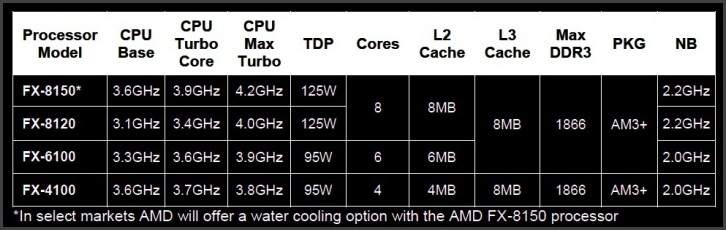
As mentioned, we will be testing the FX-8150 in this review. Also, we can consider what is available in the 9-series chipset market at this point, and Vortez has already looked at several of these motherboards using Phenom II processors.
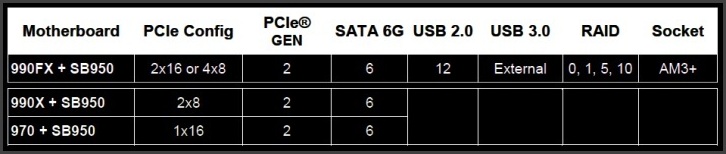
This gives plenty of flexibility on specification, but also the option to create a very high end gaming PC with multiple graphics cards and a high end FX CPU for a fairly reasonable price.
The actual technology behind this redesign is complex, and we will spare you all the tiny details as generally we’re not so much interested in how it reaches its performance levels, but what those levels are. AMD do have plenty to say however, so here’s a little info on the CPU architecture:
AMD FX Processor
”Bulldozer” was designed to balance performance, cost and power consumption on multi-threaded applications. The architecture focuses on high-frequency and resource sharing to achieve optimal throughput and blistering speed in next generation applications. AMD FX Processors offer up to eight high-performance, power-efficient cores. These represent the First generation of a new execution-core family from AMD (Family 15h). Other specs include:
– 128 KB of Level1 Cache, 16 KB/Core, 64-byte cacheline, 4-way associative, write-through
– 8 MB of Level2 Cache, 2 MB/”Bulldozer” module, 64-byte cacheline, 16-way associative
Integrated Northbridge which controls:
– 8 MB of Level3 Cache, 64-byte cacheline, 16-way associative, MOESI
– Two 72-bit wide DDR3 memory channels
– Four 16-bit receive/16-bit transmit HyperTransport™ links
”Bulldozer” was designed to balance performance, cost and power consumption on multi-threaded applications. The architecture focuses on high-frequency and resource sharing to achieve optimal throughput and blistering speed in next generation applications. AMD FX Processors offer up to eight high-performance, power-efficient cores. These represent the First generation of a new execution-core family from AMD (Family 15h). Other specs include:
– 128 KB of Level1 Cache, 16 KB/Core, 64-byte cacheline, 4-way associative, write-through
– 8 MB of Level2 Cache, 2 MB/”Bulldozer” module, 64-byte cacheline, 16-way associative
Integrated Northbridge which controls:
– 8 MB of Level3 Cache, 64-byte cacheline, 16-way associative, MOESI
– Two 72-bit wide DDR3 memory channels
– Four 16-bit receive/16-bit transmit HyperTransport™ links
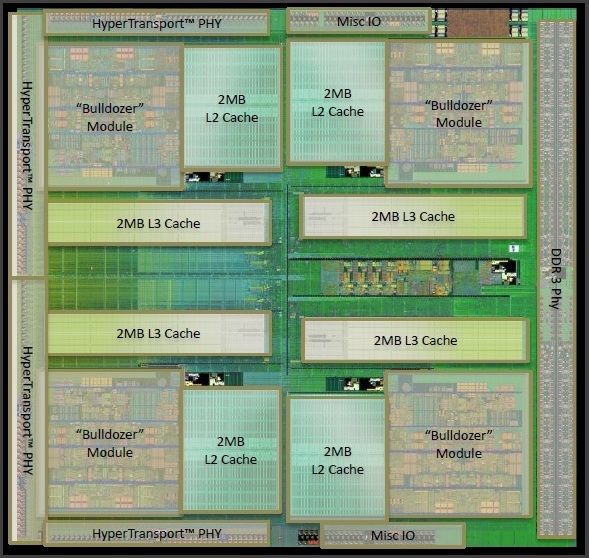
Dual Core Building Blocks
When evaluating design ideas for the next generation x86 processor core, AMD engineers looked at ways of optimizing core power and area. Analyzing the bursty nature of today’s PC applications led engineers to look for a way to maximize peak bandwidth across the different cores, and maximize the use of silicon area through the use of shared modules.
The result was to design dual core building blocks that would effectively optimize the resources within the processor. Functions with high utilization (such things as Integer pipelines, Level1 data caches) are dedicated in each core.
The other units are now effectively shared between two cores and include: Fetch, Decode, Floating point pipelines, and the Level2 cache
This design allows two Cores to each use a larger, higher-performance function unit (ex: floating point unit) as they need it with less total die area than having separate, smaller function units for each Core
The result was to design dual core building blocks that would effectively optimize the resources within the processor. Functions with high utilization (such things as Integer pipelines, Level1 data caches) are dedicated in each core.
The other units are now effectively shared between two cores and include: Fetch, Decode, Floating point pipelines, and the Level2 cache
This design allows two Cores to each use a larger, higher-performance function unit (ex: floating point unit) as they need it with less total die area than having separate, smaller function units for each Core
Floating Point
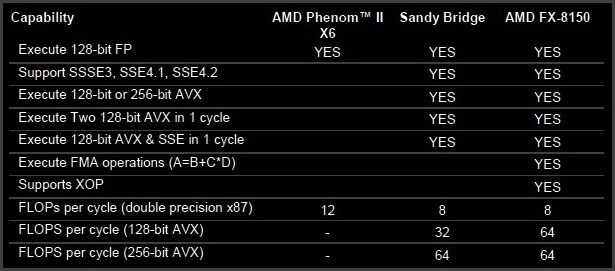
The floating point unit in “Bulldozer” has also undergone a complete re-design. It has been improved to support many new instructions and has been redesigned to allow resource sharing between Cores. There are two 128-bit FMACs shared per module, allowing for two 128-bit instructions per Core or one 256-bit instruction per dual Core module.
On forward looking benchmarks, the new floating point unit is at its best, able to perform quick 128bit instructions, as well as support acceleration of FMA and XOP operations. Applications using older floating-point instructions are typically unable to take advantage of the full performance of the floating-point unit, which is optimized for the newer FMAC instructions.
On forward looking benchmarks, the new floating point unit is at its best, able to perform quick 128bit instructions, as well as support acceleration of FMA and XOP operations. Applications using older floating-point instructions are typically unable to take advantage of the full performance of the floating-point unit, which is optimized for the newer FMAC instructions.
’Bulldozer’ Front End
The front-end unit is responsible for driving the processing pipeline, and was designed to make sure that the Cores are constantly fed with information. It has been designed to work with each dual core unit, and allocate threads to individual cores themselves. AMD has made heavy changes that include decoupled predict and fetch pipelines, as well as prediction-directed instruction prefetchers. A Prediction Queue can manage direct and indirect branches that are now fed with a L1 and L2 Branch Target Buffer, which stores destination addresses.
“Bulldozer” modules can decode up to 4 instructions per cycle, (vs 3 on AMD Phenom™ II processors).
The prediction pipeline produces a sequence of fetch addresses. The Fetch pipeline does a look up in the instruction cache, and pulls 32 bytes per cycle into the fetch queue which feeds the decoders.
“Bulldozer” uses a physical register file (PRF) which is a single location that holds the register results of executed instructions. This reduces power by eliminating unnecessary data movement and data replication (keeps one copy instead of broadcasting the data).
“Bulldozer” modules can decode up to 4 instructions per cycle, (vs 3 on AMD Phenom™ II processors).
The prediction pipeline produces a sequence of fetch addresses. The Fetch pipeline does a look up in the instruction cache, and pulls 32 bytes per cycle into the fetch queue which feeds the decoders.
“Bulldozer” uses a physical register file (PRF) which is a single location that holds the register results of executed instructions. This reduces power by eliminating unnecessary data movement and data replication (keeps one copy instead of broadcasting the data).
Caches
Each Core is equipped with a 16 KB Level 1 Data cache, a 32-entry fully associative DATA TLB, and a fully out of order load/store – capable of two 128-bit loads per cycle or one 128-bit store per cycle. Each dual Core module includes a 2 MB 16-way unified L2 cache with an L2 TLB capable of 124 entry, 8 way that services both instruction and data requests. “Bulldozer” supports up to 23 outstanding L2 cache misses for memory system concurrency.
Finally AMD has designed a shared 8 MB L3 cache with 64 way associativity for both cores in a “Bulldozer” module.
Finally AMD has designed a shared 8 MB L3 cache with 64 way associativity for both cores in a “Bulldozer” module.
AMD Turbo Core Technology
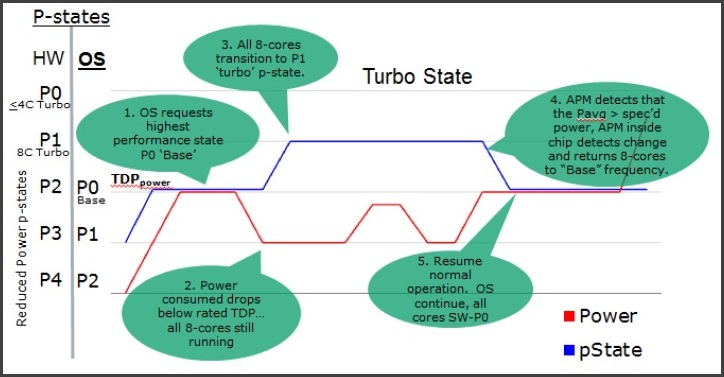
The FX CPUs continue the inclusion of Turbo Core Technology, but take it much further.
Max Core
All the cores of the processor can go into a ‘P1’ Turbo state simultaneously. In the case of the FX-8150 this means a boost from 3.6 GHz to 3.9 GHz. This is achieved by adjusting the CPU multiplier and VID (1.30V to 1.4125V). This state occurs only when highly threaded applications are being used and there is sufficient TDP headroom, i.e. the processor remains within the normal TDP limits.
Max Frequency
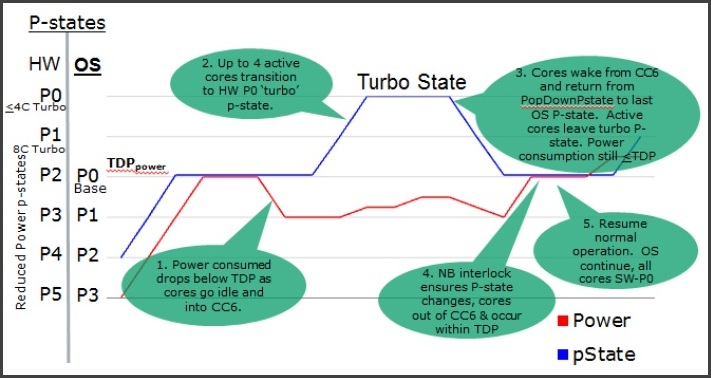
This mode is for lightly threaded applications, and the CPU increases the frequency of half the cores and puts the others into a C6 low power state. With the FX-8150, this means essentially you get a quad core at 4.2 Ghz in lightly threaded applications, and hence, better performance in these scenarios.
Closer Look
We received a bundle that included the FX CPU for testing and a retail box, but no official cooling solution yet. In some of these shots there is an AMD Phenom II 1100T for comparison.
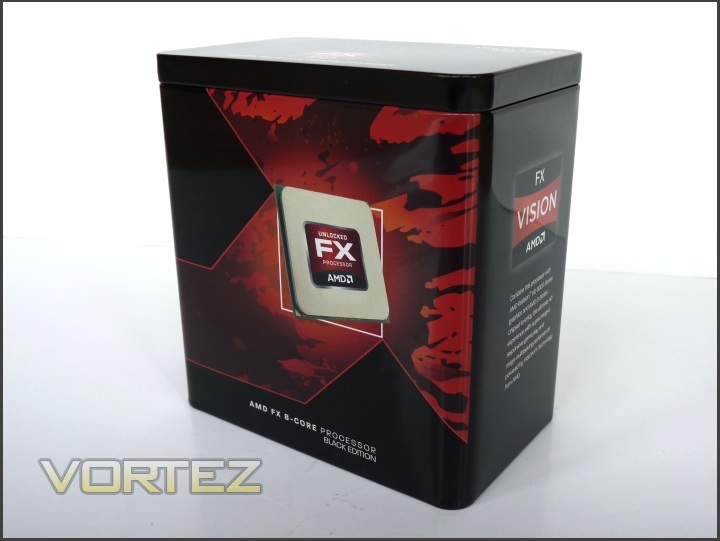
The retail packaging for the FX-8150. A good looking tin.
The FX-8150 is shipped in an attractive metal tin with a view of the CPU from one side. Also in the tin will be a stock air cooler. AMD are going to make available a water cooling solution for the FX CPUs, keep your eyes peeled for that.
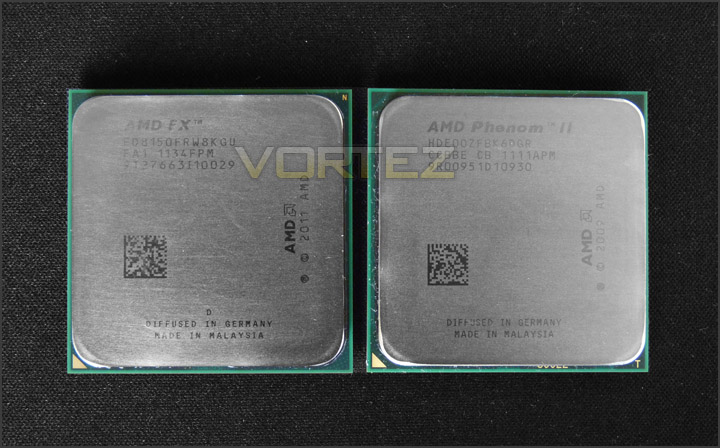
The old flagshsip and the new. Left – AMD FX-8150, right – AMD Phenom II 1100T.
As you can see, on the face of it there’s very little difference between the appearance of the Phenom II and the new FX chip as they are both using an almost identical packaging solution (i.e. AM3 and AM3+). This also means that all CPU coolers that were compatible with AM3 should also be compatible with AM3+, providing the cooler is efficient enough to deal with the TDP of your chosen processor.
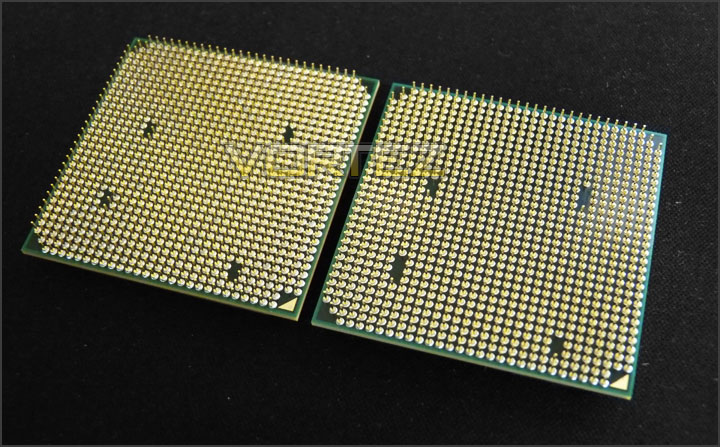
The underside of the CPUs. Left – AMD FX-8150, right – AMD Phenom II 1100T.
The underside of the processor is again very similar to the existing AM3 CPUs as you can see. The AM3+ CPU appears to have 2 extra pins, bringing the count up to 940. They are in such a place that allows the FX CPU to be installed into an AM3 socket, but only motherboards that have a compatible BIOS will be able to recognise it correctly. Even in this circumstance, it seems as though an AM3 board will not make full use of some of the energy saving features of the FX CPU nor will thermal management work correctly (including thermal fan control). This still needs to be verified.
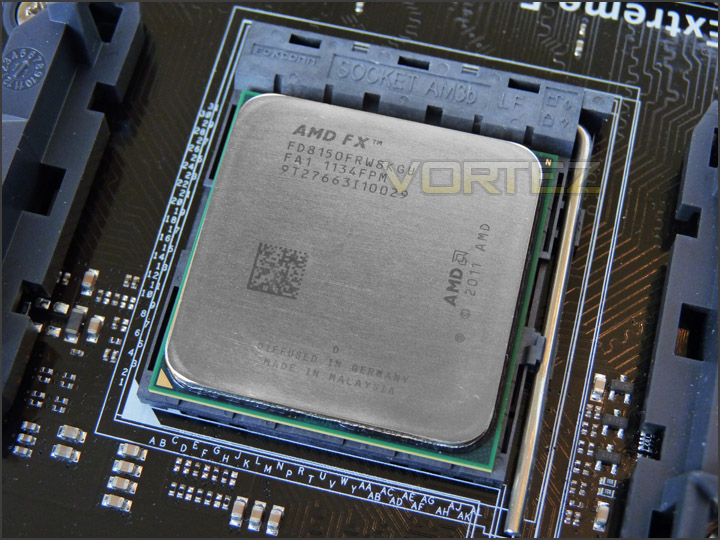
The AMD FX-8150 in the AM3+ socket of an ASUS Crosshair V Formula.
Test Setup
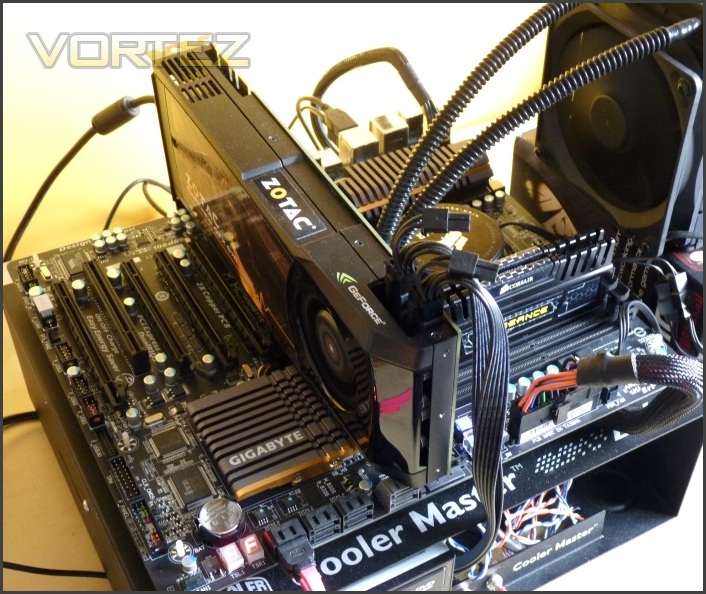
To make the most of this new processor we have assembled a dedicated high end test rig on which we’ve got a selection of 990FX boards to choose from. We used two in this review, but will be updating all 990FX reviews with new performance data for the AMD FX processors.
CPU
AMD FX-8150 (3.6 GHz, 3.9 GHz/4.2 GHz Turbo)
AMD Phenom II X6 1100T (3.3GHz, 3.7GHz Turbo)
Motherboards
–Gigabyte 990FXA-UD7
–ASRock 990FX Professional
Memory
Corsair Vengeance 8GB (2x4GB Dual Channel), 1866MHz @ 9-10-9-24
CPU Cooler
Corsair Hydro Series H70
Graphics
ZOTAC GeForce GTX 570 AMP! Edition
PSU
Corsair HX650W
Storage
Corsair Force Series F120 120GB SSD (Sandforce 1200)
LG GGC-H20L Blu-ray and HD-DVD ROM Drive
Case
Cooler Master Lab Test Bench V1.0
Some Intel test setups are also used in this review for comparison. They are as follows;
Sandy Bridge
– Intel i5 2500K
– ASRock Z68 Extreme4 Gen3
– 4GB Kingston HyperX Genesis CL9 1600MHz @ 9-9-9-24
– Noctua NH-D14
– ZOTAC GTX 460
– OCZ Fatal1ty 750W
– Intel i5 2500K
– ASRock Z68 Extreme4 Gen3
– 4GB Kingston HyperX Genesis CL9 1600MHz @ 9-9-9-24
– Noctua NH-D14
– ZOTAC GTX 460
– OCZ Fatal1ty 750W
Westmere-EP/Bloomfield
– Intel 990x/Intel i7 920
– 6GB (3x2GB) OCZ Platinum DDR3 1333MHz @ 1600 MHz 8-8-8-24
– ASUS Rampage III Extreme
– Inno3D GTX570 1GB @ 800/4000MHz – ForceWare 275.33
– Enermax Revolution 85+ 850W
– OCZ Vertex 2E 120GB
– Phanteks PH-TC14PE
– Intel 990x/Intel i7 920
– 6GB (3x2GB) OCZ Platinum DDR3 1333MHz @ 1600 MHz 8-8-8-24
– ASUS Rampage III Extreme
– Inno3D GTX570 1GB @ 800/4000MHz – ForceWare 275.33
– Enermax Revolution 85+ 850W
– OCZ Vertex 2E 120GB
– Phanteks PH-TC14PE
Overclocking
We recently saw that the same model chip we’re testing today broke the world record for the highest overclock at a staggering 8.4 GHz. We here at Vortez also had the pleasure of attending an event hosted by AMD where they overclocked the FX-8150 using LN2 before our very eyes. We should therefore expect good things from the FX-8150.
The stock clockspeed of the FX-8150 is 3.6 GHz, with a Turbo mode that allows an 8 core boost to 3.9 GHz or a 4 core boost to 4.2 GHz, whilst keeping within TDP limits. This optimises the performance in light multi-threaded applications and demanding low-threaded applications. For our stock benchmarks we ran our memory at 1333 MHz and used timings of 9-9-9-24 2T.
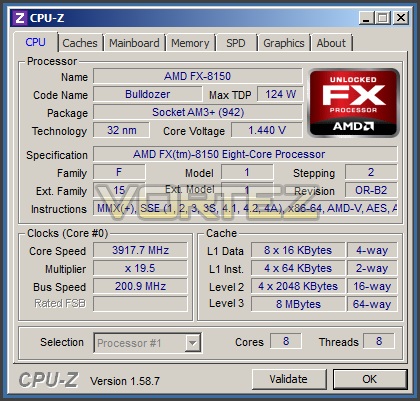
Factory settings, showing Turbo mode ‘P1’ state enabled.
Overclocking the FX-8150 is very much like overclocking a Phenom II processor, despite the different architecture. All FX CPUs have unlocked multipliers, so going for a max OC is quite straightforward. You simply increase the CPU multiplier and CPU core voltage as far as you can whilst keeping the CPU temperatures in check. We worked to keep the load temperatures at around 65 deg C under stress using the Corsair H70 cooler. AMD have not indicated what the maximum safe temperature is, but generally it is not heat that will damage a processor, it is excess volts. There is a 1.55V maximum unless your motherboard has extreme overvolting capabilities (e.g. ASUS Crosshair V), and this should be more than enough if you’re using air or water cooling, as temperatures are likely to rise too high above this value to the point of thermal throttling or shut down. Once you’ve found the highest stable multiplier, you can increase the base clock incrementally to max out the OC. This will also affect the DRAM, CPU-NB, and HT Link frequencies, so increasing volts for RAM may be applicable. CPU-NB and HT Link seemed OK with the default voltage on all of our overclocks. We used a combination of the BIOS of our GIGABYTE 990FXA-UD7 and AMD Overdrive to modify the voltages and multipliers. Memory was clocked to 1600 MHz for the overclocked tests with timings of 9-10-9-27 2T.
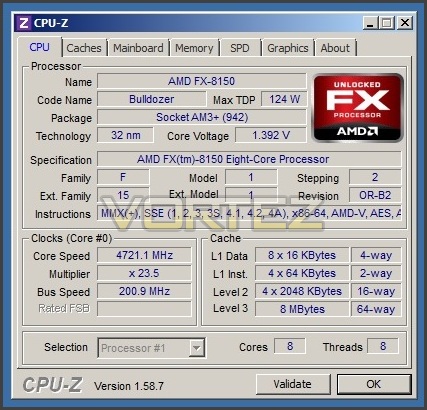
A quick OC to 4.72 GHz was possible with the H70.
We managed to find a stable overclock of 4.723 GHz quite easily and quickly, and proceeded to benchmark our processor at that very level. All Turbo Core features were turned off and all 8 threads remained active, with a multiplier of 23.5 and a base clock of 201 MHz. The volts required were 1.40V and temperatures were maxing out under the H70 at around 65 degrees C. There’s no doubt the chip has more to give with better cooling than the H70 and more time to tweak to find the absolute maximum.
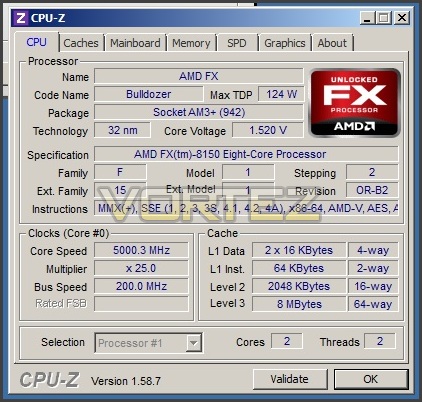
5Ghz was attainable when set to a dual core.
After finding a good overclock over 8 cores, we set about finding the maximum overclock over just two. The first step was to install the FX-8150 in our ASRock 990FX Professional, a highly capable board that we recently reviewed in full. It has the capability to disable cores selectively, so we disabled all but two, leaving one core enabled in two of the four modules. We then looked for the maximum stable CPU multiplier value, which was 25, and the bus speed could not be increased from this value whilst keeping the system stable. 1.50V setting in the BIOS was needed to allow this clock to stabilise when using the H70, once again temperatures were hitting 65 degrees C over just two cores this time. There is no doubt that the chip is capable of more with better cooling and more time to tweak. As with any system, overclocking takes a long time to perfect and find the right clock for your setup.
AMD suggest that under air or closed loop water cooling, a 4.6 GHz overclock on all 8 cores should be possible, and a 5.0 GHz overclock on two cores should be possible. As you can see, our results are very close to these values. AMD also suggest that there is up to a 300 MHz delta between chips, so some will be better and some worse. Should you have access to LN2, breaking the 7 GHz barrier should be fairly easy!
Synthetic benchmarks – wPrime
wPrime uses a recursive call of Newton’s method for estimating functions, with f(x)=x2-k, where k is the number we’re sqrting, until Sgn(f(x)/f'(x)) does not equal that of the previous iteration, starting with an estimation of k/2. It then uses an iterative calling of the estimation method a set amount of times to increase the accuracy of the results. It then confirms that n(k)2=k to ensure the calculation was correct. It repeats this for all numbers from 1 to the requested maximum.
Each thread is designed to do 1/n of the work, where n is the number of threads. For example, if you’re calculating 16 roots on 4 CPU’s, each CPU will calculate 4 roots. Some might argue that this style of threading is unrealistic in real-time performance, but in fact is quite indicative of performance in several real world tasks such as F@H which allows you to run several instances of the work at any one time.
Each thread is designed to do 1/n of the work, where n is the number of threads. For example, if you’re calculating 16 roots on 4 CPU’s, each CPU will calculate 4 roots. Some might argue that this style of threading is unrealistic in real-time performance, but in fact is quite indicative of performance in several real world tasks such as F@H which allows you to run several instances of the work at any one time.
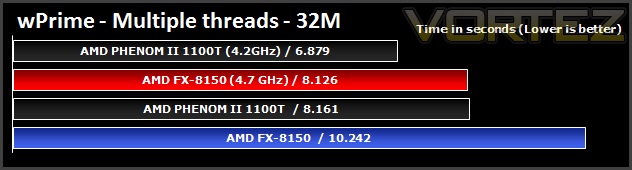
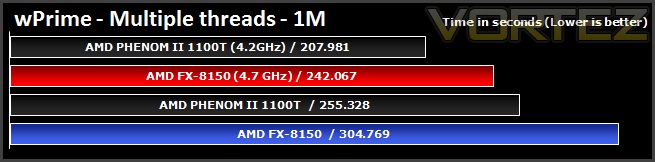
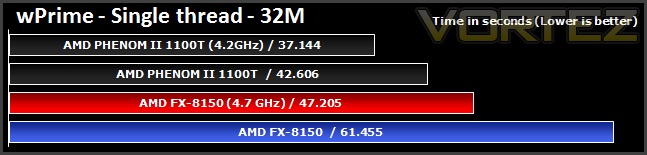
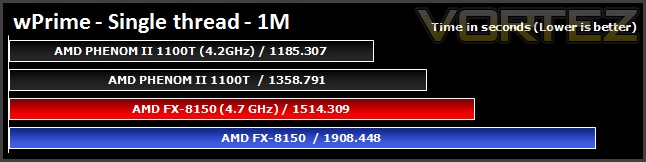
The FX-8150 is comprehensively outperformed by the Phenom II 1100T in all of these tests, despite the extra cores and clockspeed. The single threaded tests show each thread is weaker than a Phenom II in wPrime. This isn’t a good start, though this is just a synthetic test and not necessarily representative of day-to-day performance.
Synthetic benchmarks – AIDA64
CPU Queen
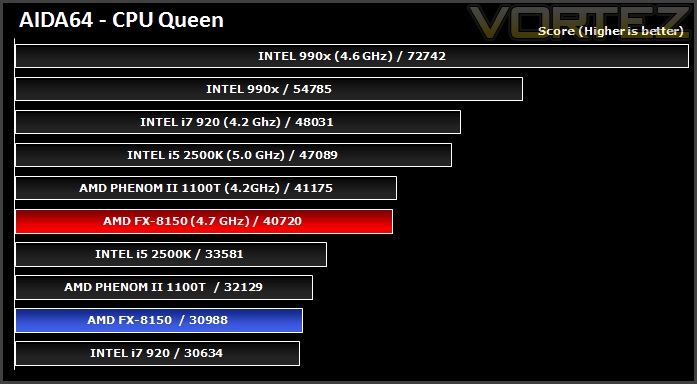
This simple integer benchmark focuses on the branch prediction capabilities and the misprediction penalties of the CPU. It finds the solutions for the classic “Queens problem” on a 10 by 10 sized chessboard. At the same clock speed theoretically the processor with the shorter pipeline and smaller misprediction penalties will attain higher benchmark scores. For example — with HyperThreading disabled — the Intel Northwood core processors get higher scores than the Intel Prescott core based ones due to the 20-step vs 31-step long pipeline. CPU Queen test uses integer MMX, SSE2 and SSSE3 optimizations.
CPU Photoworrx
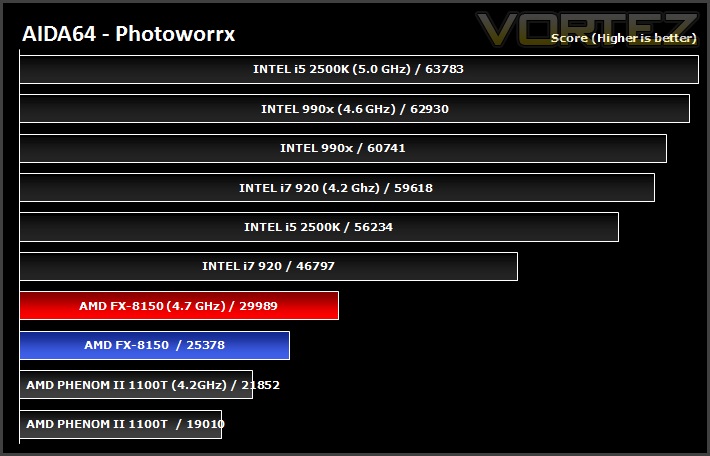
This benchmark stresses the integer arithmetic and multiplication execution units of the CPU and also the memory subsystem. Due to the fact that this test performs high memory read/write traffic, it cannot effectively scale in situations where more than 2 processing threads used. For example, on a 8-way Pentium III Xeon system the 8 processing threads will be “fighting” over the memory, creating a serious bottleneck that would lead to as low scores as a 2-way or 4-way similar processor based system could achieve. CPU PhotoWorxx test uses only the basic x86 instructions, and it is HyperThreading, multi-processor (SMP) and multi-core (CMP) aware.
CPU AES
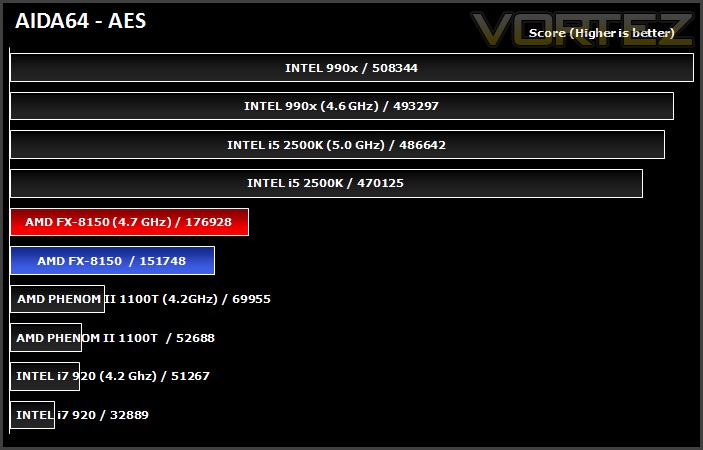
This benchmark measures CPU performance using AES (Advanced Encryption Standard) data encryption. In cryptography AES is a symmetric-key encryption standard. AES is used in several compression tools today, like 7z, RAR, WinZip, and also in disk encryption solutions like BitLocker, FileVault (Mac OS X), TrueCrypt.
CPU AES test uses only the basic x86 instructions, and it’s hardware accelerated on VIA PadLock Security Engine capable VIA C3, VIA C7 and VIA Nano processors; and on Intel AES-NI instruction set extension capable processors. The test is HyperThreading, multi-processor (SMP) and multi-core (CMP) aware.
CPU AES test uses only the basic x86 instructions, and it’s hardware accelerated on VIA PadLock Security Engine capable VIA C3, VIA C7 and VIA Nano processors; and on Intel AES-NI instruction set extension capable processors. The test is HyperThreading, multi-processor (SMP) and multi-core (CMP) aware.
FPU Mandel
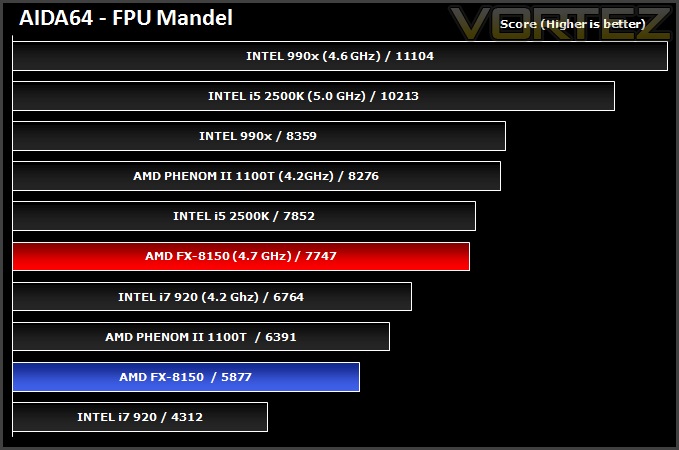
This benchmark measures the double precision (also known as 64-bit) floating-point performance through the computation of several frames of the popular “Mandelbrot” fractal. The code behind this benchmark method is written in Assembly, and it is extremely optimized for every popular AMD, Intel and VIA processor core variants by utilizing the appropriate MMX, MMX+/SSE, SSE2, SSSE3, or AVX instruction set extension. FPU Mandel test is HyperThreading, multi-processor (SMP) and multi-core (CMP) aware.
Synthetic benchmarks – x264HD
Simply put, this test measures how fast your machine can encode a short, DVD quality MPEG-2 video clip into a high-quality x264 video clip. What’s x264, you ask? It’s more or less the next-generation Xvid/DivX codec. I think it’s ideal for a benchmark because the application (x264.exe) reports fairly accurate compression results (in frames per second) for each pass of the video encoding process, and it uses multi-core processors very efficiently.
x264 HD gives results for 2 passes when compressing an MPEG-2 clip into x264. It presents 4 separate results for each pass giving a total of 8 – all results are given in FPS. The results are averaged for each pass and presented below.
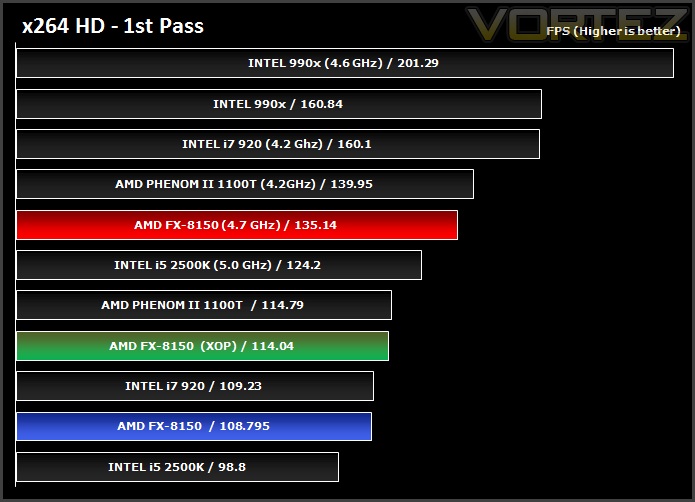
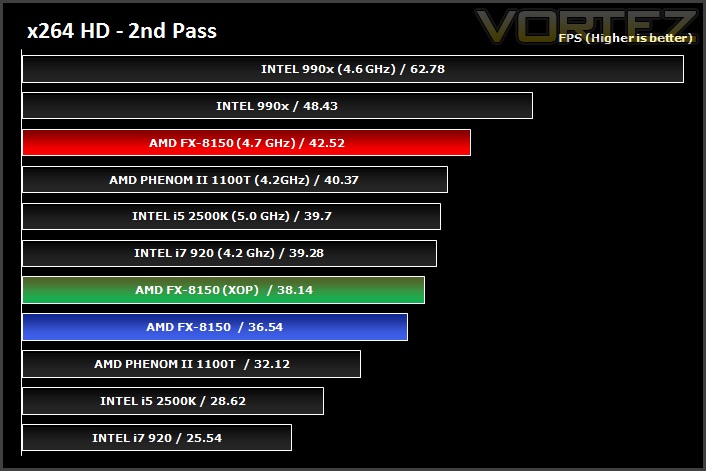
It’s worth noting that this benchmark, like most, does not make use of the new instruction sets that the FX-8150 has. However, AMD have provided us with an XOP-enabled benchmark that makes use of the AMD-specific instruction set. Results at stock with the FX-8150 are shown in green.
The FX-8150 performs well in comparison to the i5 2500K in these tests, and trades places with the i7 920 and Phenom 1100T, and the XOP results show a small boost in performance once more.
Synthetic benchmarks – Cinebench 11.5
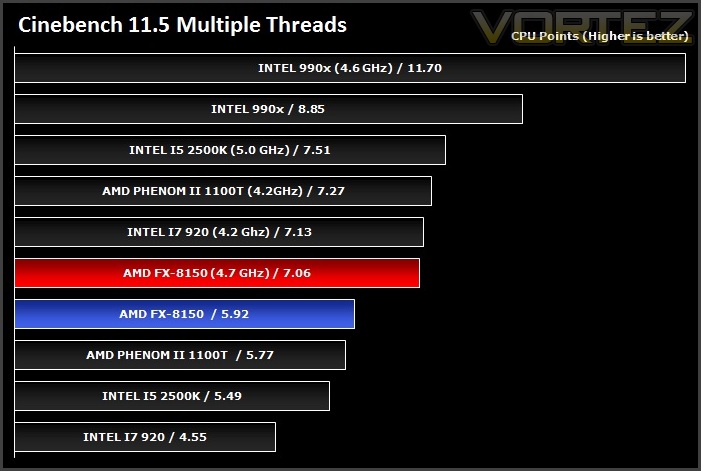
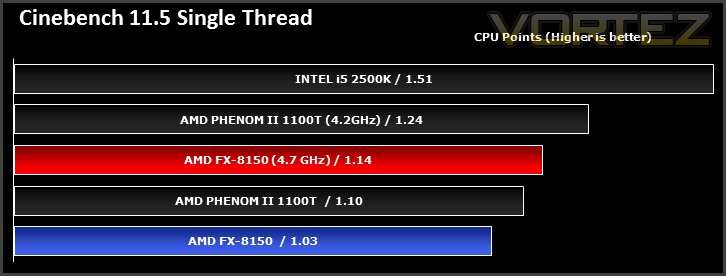
CINEBENCH can measure systems with up to 64 processor threads. This test scene contains approximately 2,000 objects which in turn contain more than 300,000 polygons in total, and uses sharp and blurred reflections, area lights, shadows, procedural shaders, antialiasing, and much more. The result is displayed in points (pts). The higher the number, the faster your processor.
Synthetic Benchmarks – PCMark 7
PCMark 7 is a tool provided by FutureMark that tests the PCs ability in general office and everyday use. It produces a number that reflects the all round performance of the PC and is useful to compare between differing setups. For more information, visit the FutureMark website.
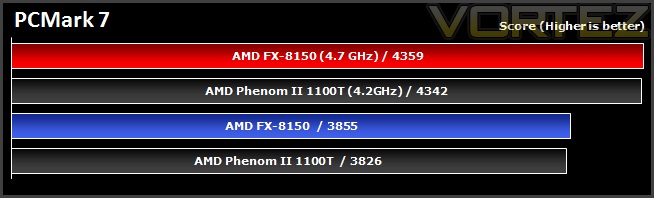
The FX-8150 outperforms the 1100T here, but only by a tiny margin over the whole range of PCMark 7 tests.
Synthetic benchmarks – 3DMark 11
Designed to measure your PC’s gaming performance 3DMark 11 makes extensive use of all the new features in DirectX 11 including tessellation, compute shaders and multi-threading. Trusted by gamers worldwide to give accurate and unbiased results, 3DMark 11 is the best way to consistently and reliably test DirectX 11 under game-like loads.
The latest version of 3DMark was run on both Performance and Extreme presets with only the benchmarking runs being performed. Each run was performed 3 times and the average results are presented below.
Overclocking the CPUs provides a small boost when the graphics card is not bottlenecked, but on the extreme preset where the GPU is being tested, we see little or no improvement in overall score.
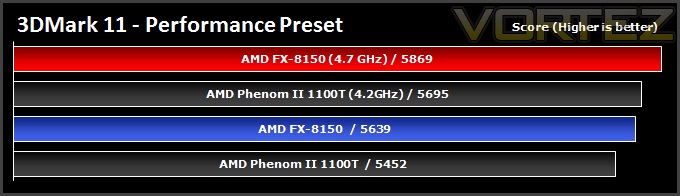
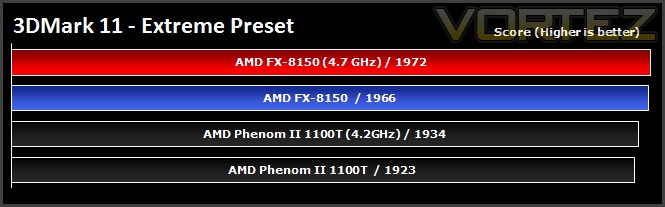
3DMark 11 is about as close to real world performance as a synthetic benchmark can be, and although it primarily focuses on graphics performance, the FX-8150 slightly outperforms the 1100T here in the overall scores.
Gaming Benchmarks – Far Cry 2, DiRT 3, Metro 2033
It’s important for us to perform a number of game benchmarks as well as the synthetic tests because many of our systems on the test bench have features which market them directly at gamers. So here we have a selection of popular gaming titles, critically acclaimed and action-packed.
Far Cry 2
Far Cry 2 is bundled with a benchmark tool that allows the user to customise the graphical details as well as type of area and events to measure the FPS of. In this situation, the gaming benchmarks were run at two sets of resolutions with varying AA and AF settings. All benchmarks used the highest level of detail possible otherwise (including DirectX10), and consisted of a flyover of Ranch (long).
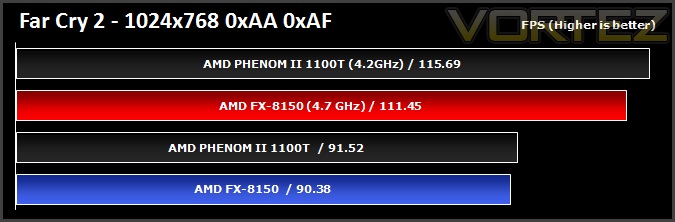
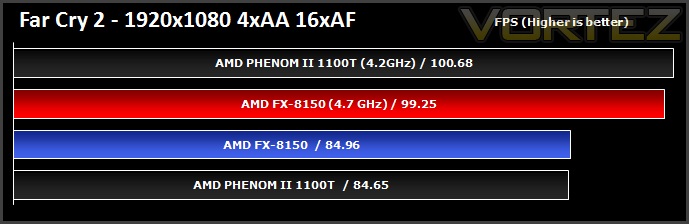
At low resolutions the FX-8150 is outperformed by the 1100T, a disappointing result but not a good indication of real world performance. At higher resolutions and settings, the FX-8150 more or less matches the 1100T in Far Cry 2.
DiRT 3
DiRT 3 is the latest in Codemasters exciting rally series that throws you into a graphically detailed world of off road events. It makes use of DirectX 11 features such as tessellation to improve the visual experience. Benchmarks here are run at the highest details possible using the in-game benchmark tool.
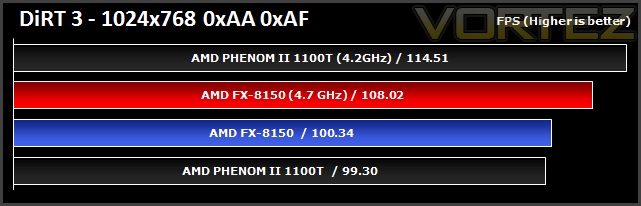
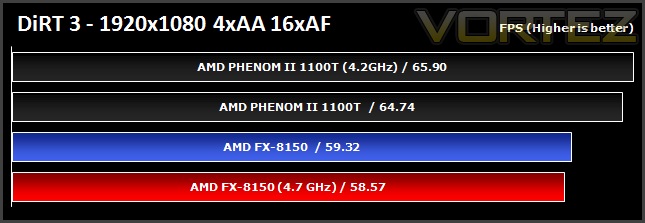
DiRT 3 is a much newer game than Far Cry 2, and we should expect the FX-8150 to take full advantage of this, but in reality it can’t. At higher resolutions the overclocked results were repeatably poorer than those at stock at stock settings. There’s not much margin as we’re mainly GPU limited, but this does seem the case.
Metro 2033
Based on the novel by the same name, Metro 2033 is a first person shooter with elements of survival horror. As Artyom, you trawl through the mutant infested metro systems of post-apocalyptic Moscow. The game delivers presents a grim ambience that reflects on the overall atmosphere of the underground setting. Metro 2033 uses the setting as a back drop to showcase some of the best visuals of any game currently available, making it ideal for testing the highest end systems.
Benchmarks were run using the bundled benchmark tool (using DirectX 11) and set to the highest details possible.
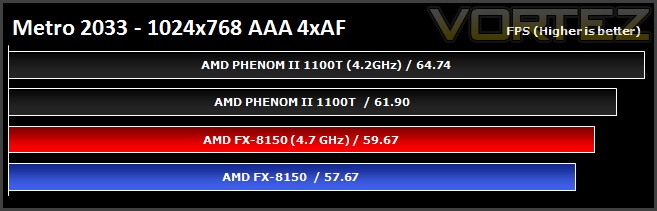
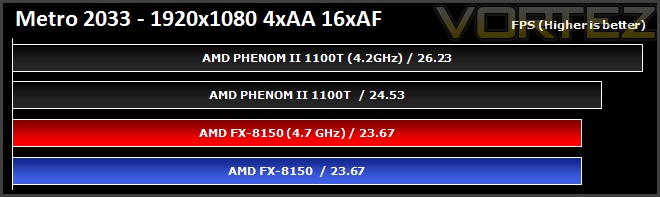
Metro 2033 is a modern and very demanding game, and therefore we should expect the FX-8150 to shine here, but as you can see, it fails to even beat a stock 1100T when overclocked to 4.7 GHz across eight cores. Perhaps Metro 2033 isn’t the most efficient multi-threaded game, but this is a measurable step backwards in performance at a HD resolution with lots of eye candy!
Conclusion
It’s clear now that AMD have taken a different approach to making an enthusiast CPU than ever before. AMD FX concentrates on delivering performance in highly threaded applications, games and content creation. Coupled with new and AMD-specific instruction sets it has the potential to offer great performance in select scenarios. This departure from the norm however, is also the problem. The current AMD FX processors are the first in a new breed for AMD, and as such, the architecture is immature, the process design is young and it finds itself landing in a world that just isn’t completely ready for it yet. That is, not enough applications are currently multi-threaded enough to make full use of this new architecture, and nor do many applications currently make use of the new instruction sets. Hopefully this can only improve with time, and AMD are investing into this design for the future, which will include inevitably making further tweaks, shrinking the process and adding cores. There’s no doubt that the new ‘Bulldozer’ design is much more compatible with multiple cores and the prospect to increase this number. The ‘Interlagos’ server processors already sport 16 cores in one chip. Perhaps this is the future of enthusiast desktop computing, AMD certainly thinks so.Is the FX-8150 up to scratch? Maybe. A big maybe.
However, this isn’t the only problem. Most consumers looking to upgrade their PC are looking for more performance today. It’s very difficult to argue that the FX CPU lineup offers that, not just over the extremely strong competition at Intel, but amazingly, also over the previous AMD CPUs, the Phenom II range in certain scenarios. We’ve seen that in some situations, the AMD FX-8150 was outperformed by the previous AMD flagship, the Phenom II 1100T. AMD have warned of this, and have been very clear to point out that the FX CPUs have a ‘competitive disadvantage’ over the older Phenom IIs in old and low-threaded benchmarks and performs better in ‘real world scenarios’. Most of the synthetic benchmarks we run have fundamentally been around for a while, in one form or another, and so may be classed as ‘old’ due to the fact that they mostly have no support for the new instruction sets that the ‘Bulldozer’ design brings with it. Unfortunately, this is also the case with the majority of the games tested, and although we don’t use eyefinity or super-high resolutions (where we understand the FX CPUs do pull back some performance against even more expensive Intel offerings), neither will a lot of the prospective buyers of these new chips.
Current pricing makes it more expensive than the Intel i5 2500K but cheaper than the Intel i7 2600K, which in the best-case scenarios is a good deal. If you need hardware virtualisation support for virtual machines, the FX line may be a good option as Intel’s Sandy Bridge CPUs do not sport Vt-d. In most scenarios though, it isn’t that OK. In fact, it can get worse depending on what you’re doing with it. You’ll also need to consider the price of motherboards on both sides of the fence has come down dramatically to the point where around £100-£150 will buy a decent board for either Intel or AMD, and they both use the same type of memory, making either platform highly accessible to enthusiasts.
AMD FX certainly has great potential for the future, not just when more applications make use of the new technologies and cores, but also with the inevitable improvements in this fledgling architecture. This is good for competition, but the fact is that Intel are showing no signs of slowing down, and with their much larger resources it will be easy to keep their nose ahead for the ultimate performance crown and increasingly in the bang-for-buck stakes. Innovation is great to see in this market, especially from AMD who’ve kept a fairly similar design over the last 10 years, but innovation at the cost of performance isn’t looking quite as smart today. Perhaps in the future this will pay big dividends, but at this moment in time the bulldozer is looking more like 8 shovels.
Pros
+ Innovative architecture design
+ Very overclockable
+ Power efficient using Cool ‘n’ Quiet
+ Improved Turbo modes
Cons
– Weak single thread performance
– Often outperformed by Phenom II
– Only fast in ideal scenarios
+ Innovative architecture design
+ Very overclockable
+ Power efficient using Cool ‘n’ Quiet
+ Improved Turbo modes
Cons
– Weak single thread performance
– Often outperformed by Phenom II
– Only fast in ideal scenarios


Click here for an explanation of our awards at Vortez.net.


