With 448 cores, the MSI N560GTX-448 Power Edition attempts to fill the void between the GTX560 Ti and GTX570.
Product on Review: MSI GTX560Ti-448 Twin Frozr III Power Edition

Manufacturer and Sponsor: MSI
Street Price: £227 inc. VAT (GBP)
NVIDIA have long had a marketing strategy to release cut-down versions of their high end products. The product we have today is one such item. Based on the GF110 core, the same GPU that’s used in both the GTX570 and flagship GTX580 graphics cards, you would be forgiven for believing you have a GTX570/580 in disguise. There are however some inherent differences between the three cards. You may ask why have NVIDIA released yet another graphics card, especially one which bears the same family name as a card that has a different GPU as its core. Quite honestly I am baffled too. We can speculate all we want as to whether NVIDIA are clearing surplus ‘faulty’ GPU’s that never made the GTX580 grade or they are bowing to consumer demands. Personally I believe it is a case of clearing the parts bins before the new GPU’s arrive next year and what better time to release than a month or so before Christmas? Another question you may ask is do we really need this GPU? A valid question indeed however, the gap in performance between the GTX570 and GTX560 is enough to present a void that NVIDIA are only too willing to fill.
So then, what does this new card have to offer? Well the main attraction is of course the extra 64 shader cores. With 448 cores on the new GTX560Ti vs the 384 on the older model the performance should increase sufficiently to attract buyers. Priced at around £230 though, the card will have to be very close to GTX570 performance which costs just £35 more. Choice is never a bad thing though, especially where performance is concerned and further editions to the GPU segment can only be a good thing. More choice, more competition, more value for the consumer. It’s simple economics really. Nobody will be putting a gun to anyone’s head forcing them to buy this card but if it offers exceptional performance for the money it costs then it will be a popular addition to an already crowded NVIDIA line-up.
To test the new card, we will be pitching it up against its closest NVIDIA competitors, the GTX560Ti 384 core and the GTX570. The 384 core has more memory whereas the GTX570 has more cores. Both GTX560’s hail from MSI and as we will see, look almost identical. How this will affect performance is anyone’s guess so it will certainly be interesting to see if the card does indeed slot in between the GTX560Ti and GTX570 cards.
About MSI
Since its founding in 1986, MSI has been demonstrating continued success in digital age. To achieve the best user experience, every component is essential. In the past 25 years, MSI always strives to provide digital products based on its core values –“Innovation” and “Style”. The results are products with superior performance, trusted reliability, excellent user experience and expressive style. MSI has won the world-renowned product design awards and nearly 8,000 award recognitions from 350 media in 50 countries worldwide. With the brand slogan of “Innovation with Style”, MSI will continue to pioneer in global market as a principal brand in digital era, as well as lead the world in innovation in the field of global fashion technology with the needs of consumers at its core.
Let’s take a look at the specifications…
Specification
The GF110 chip shares a lot of its roots with the GF100 core. The GPU still packs an impressive 3.2 billion transistors in a die seize 520mm squared. Its default internal configuration has been ported from GF100 in that the GPU features 512 CUDA cores or shader processors as we are more accustomed to. There are organised in a 4x16x32 block where 16 denotes the number of stream multi-processors (SM) and 32 being the number of cores on each SM. Each SM has its own L1 Cache and a common L2 Cache is shared by all 16. The GPU is still manufactured on the 40nm process.
The GTX560Ti-448 we have for review today has 14 out of the total 16 SM enabled for a final 448 CUDA core count. Comparing it to a GTX570 means it has one less SM (480 CUDA cores) and two less than a GTX580, itself having the maximum having 512 CUDA cores enabled. So in effect it is a trimmed down GTX570 rather than an enhanced GTX560 which is based on the GF114 silicon containing a maximum 384 CUDA cores.
The memory subsystem on the GTX560Ti is more akin to the GTX570 as well with its 5 memory controllers each sporting a 256MB GDDR5 framebuffer to give 1280MB of available memory. The memory interface is composed of ten 32-bit channels for a 320-bit interface.
GTX570: 15 SMs x 32 = 480 Core, 15 SMs x 4 = 60 texture units
32-bit channel x 10 = 320-bit interface, 256MB x 5 memory controllers = 1280MB memory
GTX560: 14 SMs x 32 = 448 Core, 14 SMs x 4 = 56 texture units
32-bit channel x 10 = 320-bit interface, 256MB x 5 memory controllers = 1280MB memory
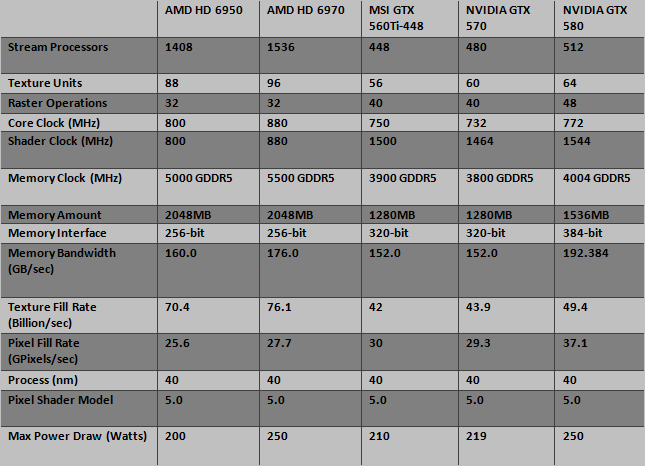
The GTX560Ti 448 then looks to be very competitive against the GTX570 in that it is clocked higher, although the missing core might affect its ability to compete. We will be testing the new GTX560Ti-448 against both its smaller sibling, the 384 core GTX560Ti based on the GF114 core along with a stocked clocked GTX570 to see which card comes out on top.
Product Specifications
Product Code: N560GTX Ti 448 Twin Frozr III Power Edition/OC
Cooler: Twin Frozr III
GPU: GTX560Ti
Core Clock: 750MHz
Memory Clock: 3900MHz
Memory Size: 1280 MB
Memory Type: GDDR5
Memory Interface: 320 bit
Interface: PCI Express x16 (PCI Express 2.1)
Output: Dual DVI-I + mini HDMI
TDP: 210W
Dimensions:243 x 115 x 42mm
Product Code: N560GTX Ti 448 Twin Frozr III Power Edition/OC
Cooler: Twin Frozr III
GPU: GTX560Ti
Core Clock: 750MHz
Memory Clock: 3900MHz
Memory Size: 1280 MB
Memory Type: GDDR5
Memory Interface: 320 bit
Interface: PCI Express x16 (PCI Express 2.1)
Output: Dual DVI-I + mini HDMI
TDP: 210W
Dimensions:243 x 115 x 42mm
Let’s take a look at the cards feature set…
Features
DirectX 11
The first fully Microsoft DirectX® 11-compatible GPUs in their class, the ATI Radeon™ HD 5000 Series are designed to deliver unbelievable HD gaming performance for the latest games and DirectX® 11 applications so you can dominate the competition.
HDMI Support
MSI graphics cards offer the HDMI functionality to provide access to premium digital content. HDMI enables gaming enthusiasts to seamlessly connect to their LCD monitor to bring the ultimate multimedia experience. (Only 1 single HDMI cable is required while streaming audio/video data to flat-panel display devices, such as Plasma/LCD TVs, or projector.)
PCI Express 2.0 Support
PCI Express 2.0 doubles the bandwidth of previous generations of PCI express up to an astonishing 16Gb/s. This maximizes the performance of current graphics cards in today’s most demanding games and applications. PCI Express 2.0 products are fully compatible with mainboards with other versions of PCI Express
RoSH Regulations
MSI products are the first to be in conformity of the EU’s RoHS(Restriction of Hazardous Substances) regulations, reducing heavy metals and toxic materials in the products. This is an effort made for the Earth, and essentially for a clean future.
NVIDIA 3D Vision
NVIDIA® 3D Vision™ technology is a combination of Graphics Processor Units (GPU), specialized 3D glasses, software, and certified displays and projectors that deliver an immersive 3D experience on your PC or workstation. For a complete list of system requirements for NVIDIA 3D Vision Technology
Live Update 5
MSI Live Update 5 is a single utility software that automatically checks BIOS, driver and utility updates and installs for you , which can save your time for searching and lower the risk while updating.
NVIDIA PureVideo
Blu-ray and HD DVD movies are bringing a new level of movie-viewing experience; with high-definition image quality far surpassing standard-definition DVDs. NVIDIA PureVideo™ HD2 technology provides unsurpassed Blu-ray and HD DVD movie picture quality.
Dual Link DVI
Dual-link DVI convertible output supports Video/Audio signal integration through DVI to HDMI interface, which drivers resolution of a digital display up to 1920×1200 or higher.
PhysiX
PhysX™ is designed specifically for hardware acceleration by powerful processors with hundreds of cores. Combined with the tremendous parallel processing capability of the GPU, PhysX™ will provide an exponential increase in physics processing power and will take gaming to a new level delivering rich, immersive physical gaming environments
The first fully Microsoft DirectX® 11-compatible GPUs in their class, the ATI Radeon™ HD 5000 Series are designed to deliver unbelievable HD gaming performance for the latest games and DirectX® 11 applications so you can dominate the competition.
HDMI Support
MSI graphics cards offer the HDMI functionality to provide access to premium digital content. HDMI enables gaming enthusiasts to seamlessly connect to their LCD monitor to bring the ultimate multimedia experience. (Only 1 single HDMI cable is required while streaming audio/video data to flat-panel display devices, such as Plasma/LCD TVs, or projector.)
PCI Express 2.0 Support
PCI Express 2.0 doubles the bandwidth of previous generations of PCI express up to an astonishing 16Gb/s. This maximizes the performance of current graphics cards in today’s most demanding games and applications. PCI Express 2.0 products are fully compatible with mainboards with other versions of PCI Express
RoSH Regulations
MSI products are the first to be in conformity of the EU’s RoHS(Restriction of Hazardous Substances) regulations, reducing heavy metals and toxic materials in the products. This is an effort made for the Earth, and essentially for a clean future.
NVIDIA 3D Vision
NVIDIA® 3D Vision™ technology is a combination of Graphics Processor Units (GPU), specialized 3D glasses, software, and certified displays and projectors that deliver an immersive 3D experience on your PC or workstation. For a complete list of system requirements for NVIDIA 3D Vision Technology
Live Update 5
MSI Live Update 5 is a single utility software that automatically checks BIOS, driver and utility updates and installs for you , which can save your time for searching and lower the risk while updating.
NVIDIA PureVideo
Blu-ray and HD DVD movies are bringing a new level of movie-viewing experience; with high-definition image quality far surpassing standard-definition DVDs. NVIDIA PureVideo™ HD2 technology provides unsurpassed Blu-ray and HD DVD movie picture quality.
Dual Link DVI
Dual-link DVI convertible output supports Video/Audio signal integration through DVI to HDMI interface, which drivers resolution of a digital display up to 1920×1200 or higher.
PhysiX
PhysX™ is designed specifically for hardware acceleration by powerful processors with hundreds of cores. Combined with the tremendous parallel processing capability of the GPU, PhysX™ will provide an exponential increase in physics processing power and will take gaming to a new level delivering rich, immersive physical gaming environments
Packaging & Accessories
Box Front
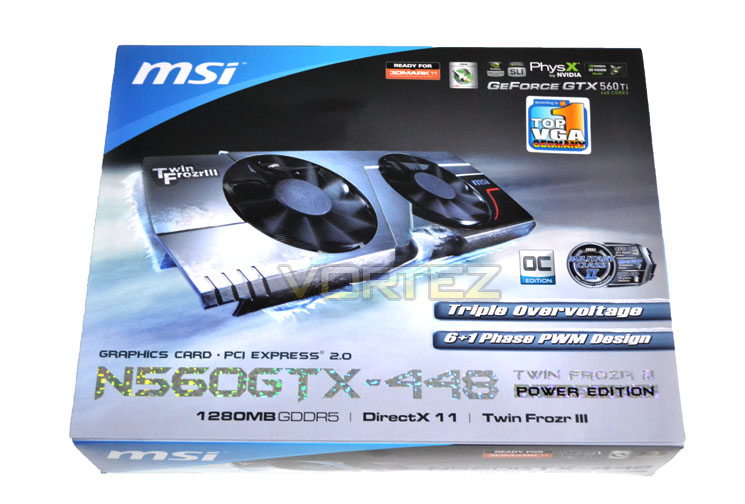
The front of the package is typical MSI, in fact its almost identical to the N560GTX-384 save for the product title. There are a few subtle differences though in that this card has the new Twin Frozr III cooler attached and along with being a Power Edition, it is also an Overclock Edition.
Box Rear
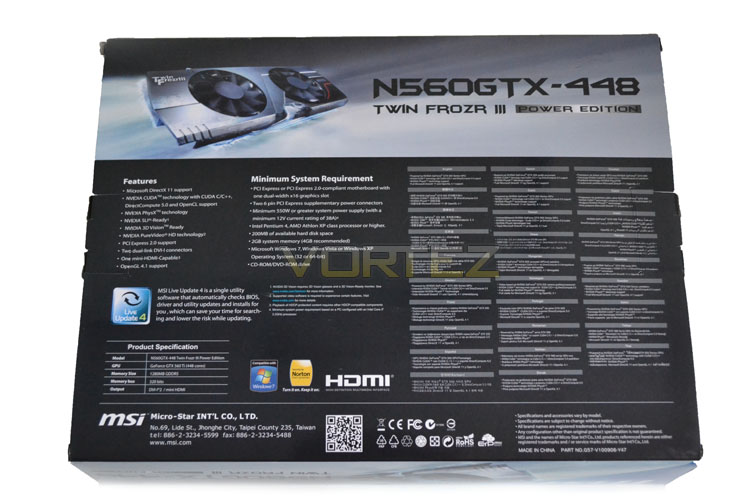
Flipping the box over we see that the package displays the main product features along with the minimum system requirements. Couple this with the product specification and a brief features list presented in the world’s most popular languages and there is little other information you would require.
Box Lid
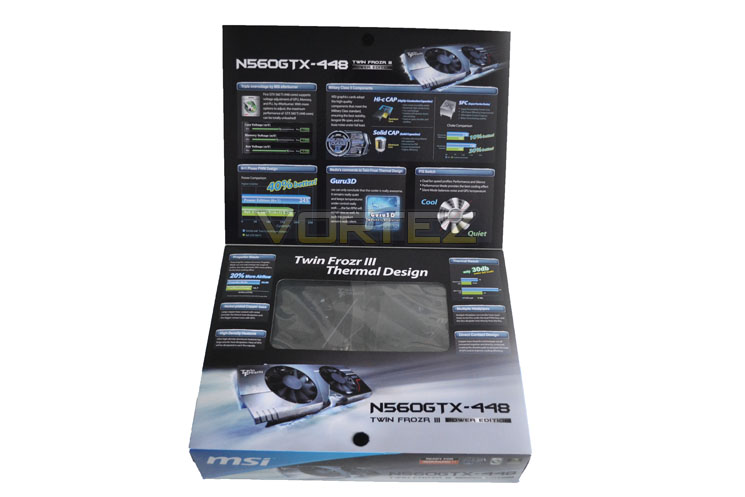
The outer sleeve has a pop-up lid which goes into great detail describing the main attractions of the GTX560Ti-448. These include Triple Voltage via MSI’s Afterburner Utility, Military Class II Components, Fan switch and 6+1 Phase design. There is also a window allowing you to see the graphics card itself.
Inner Box
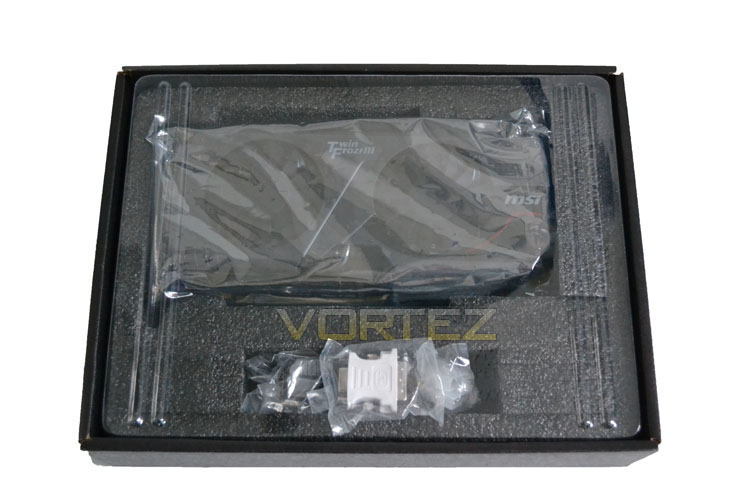
Removing the outer sleeve we see that MSI have packaged the graphics card very well with it being held firmly in place thanks to the foam frame. The adaptors are stored in a side compartment with the product manuals and utility CD contained in a hidden compartment beneath the graphics card.
Accessories
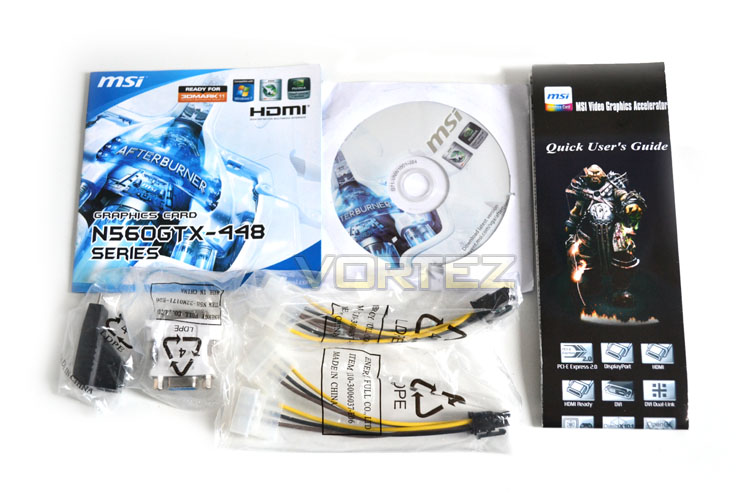
the accessory list is well provided for. A product manual and user guide are joined by a driver/utility CD, 2x twin Molex to 6pin PCIe power plugs, VGA/DVI adaptor and an mini-HDMI adaptor.
First Look
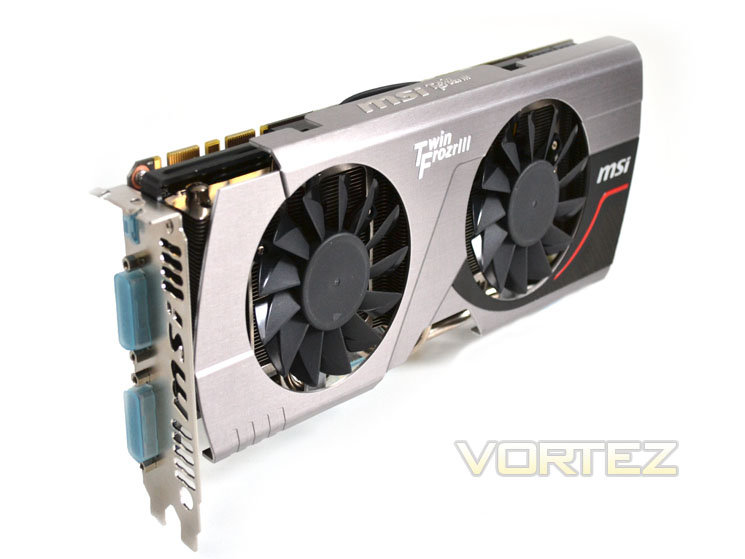
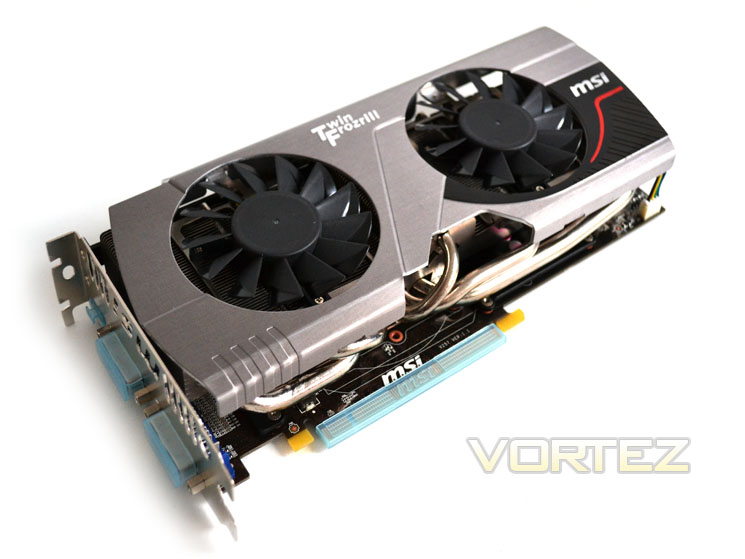
Here we get a first glimpse of the card itself featuring the new Twin Frozr III heatsink/cooling assembly. The card looks very attractive with a silver/gun metal grey effect on the aluminium frame shrouding the two black fans.
Let’s take a closer look at the product…
Closer Look
Card Front
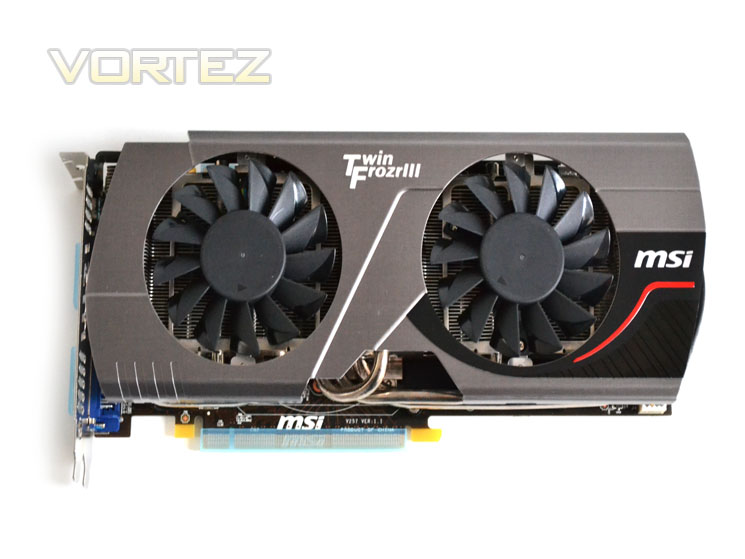
The card appears to be very menacing from the top down with its dual fans and heatpipes partially hidden from view. The card measures 243 x 115 x 42mm which is slightly longer than a standard GTX560 yet compact enough to fit in all but the smallest of enclosures.
Card Rear
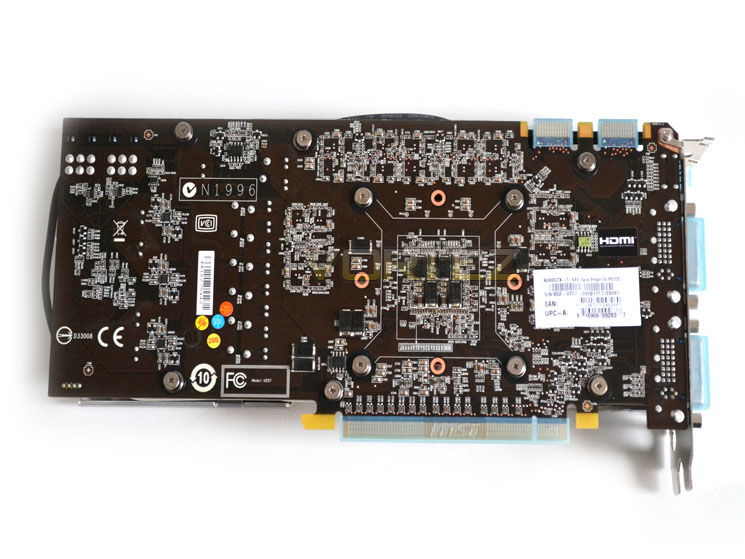
Oh dear. A dark brown PCB would not be my choice of colour and looks almost like a throwback to a 1990’s PCB which is a shame as the overall aesthetics of the card thus far were pretty good. Admittedly, the brown would be indistinguishable in all but the brightest lit cases but when compared to their competitors use of PCBs who tend to favour either black or blue, brown is certainly an odd choice.
I/O area
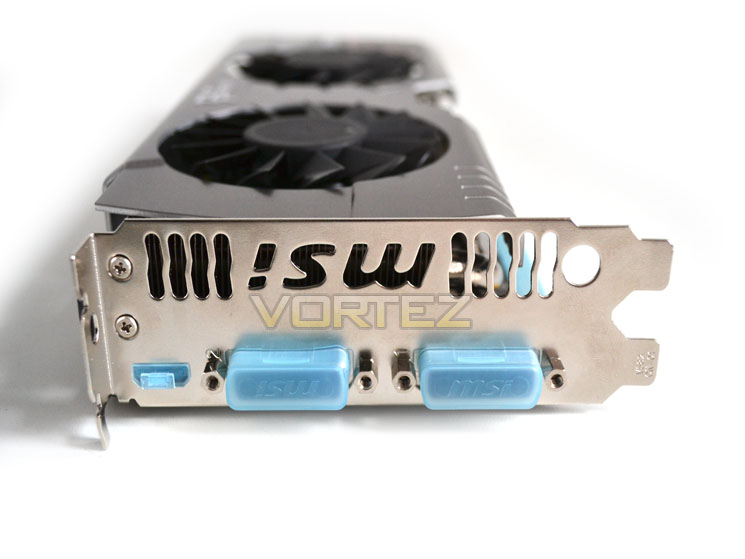
The connectivity of the GTX560Ti is lacking in comparison to its ATI equivalent in that it only has a mini-HDMI port along with twin DVI ports. The backplate is however customised with an MSI cut-out that serves both visual appeal and function as the card vents hot air at both ends of the card.
SLI
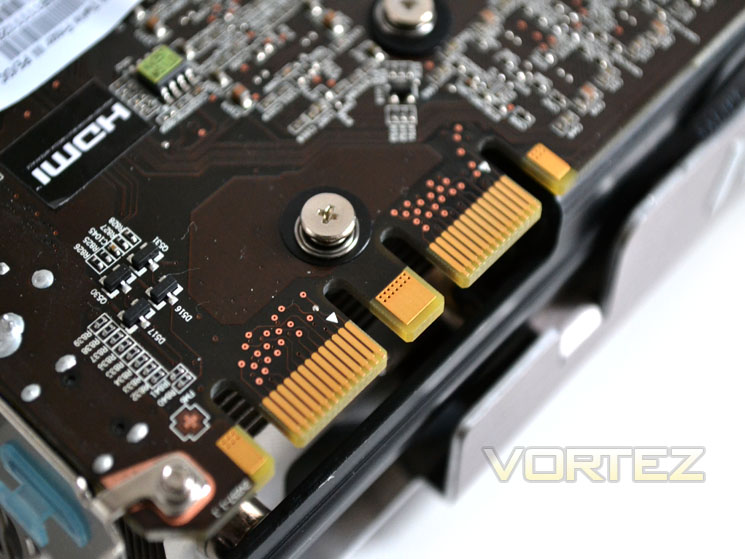
Unlike the GTX560Ti-384, the GTX560Ti-448 features twin SLI tabs allowing multiple cards to be setup in SLI rather than simply twinned assuming your motherboard supports this feature.
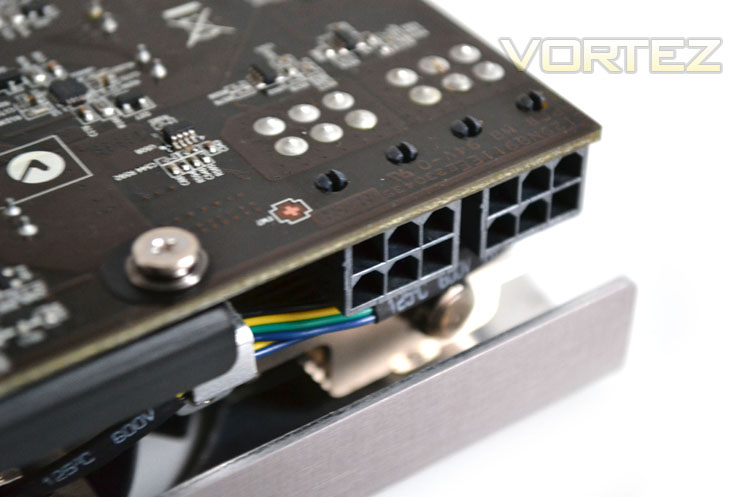
Like the GTX570, the GTX560Ti-448 makes use of twin 6pin PCIe power ports. MSI recommend a PSU capable of delivering 550w with 38A on the 12v rail along with a motherboard that is PCI Express 2.0 compliant.
Comparison
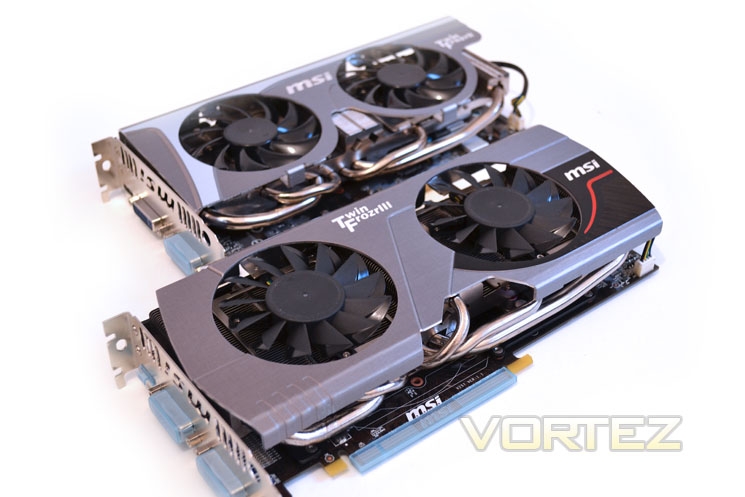
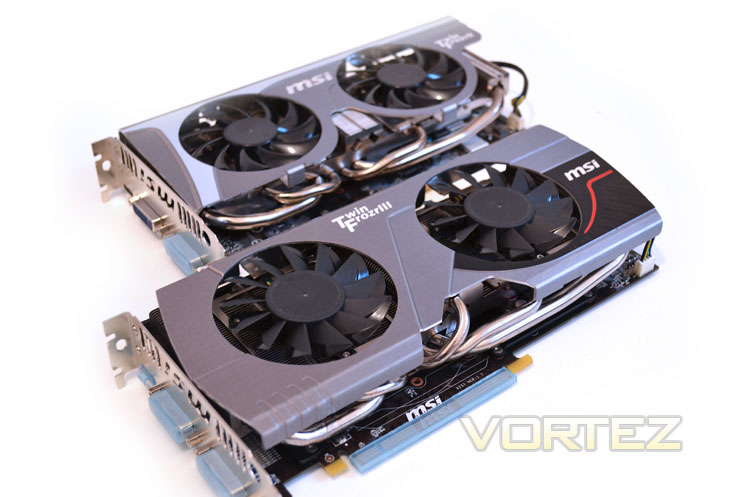
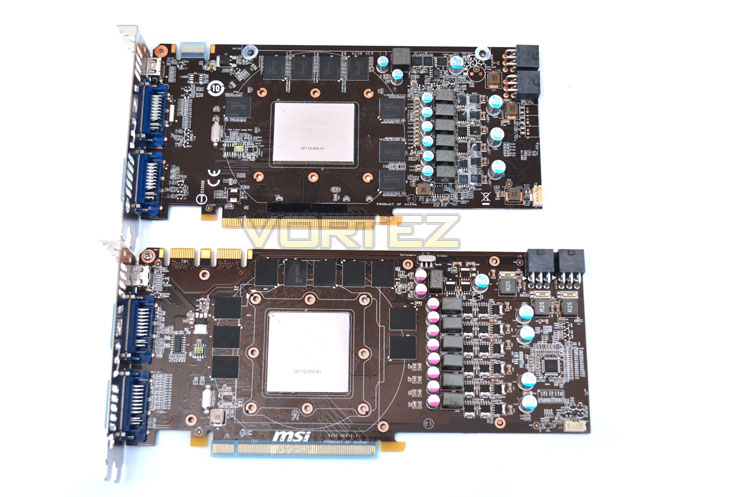
Here we see the GTX560Ti cards side by side. The GTX560Ti-448 (pictured bottom)is slightly longer and, as we will see on the next page, has a redesigned cooler. I prefer the look of the new cooler with its heatpipes slightly hidden making for a neater, more streamlined product. Looks are not the only aspect of the new cooler though so let’s strip the products down to see how else they differ…
Closer Look Pt.2
Cooler Comparison
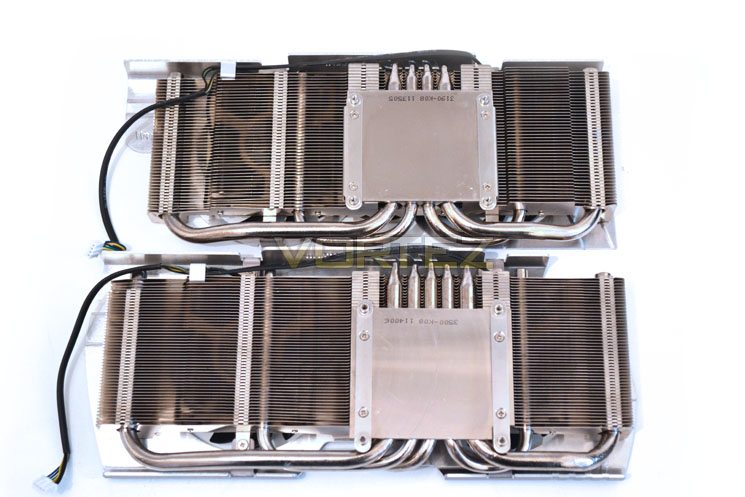
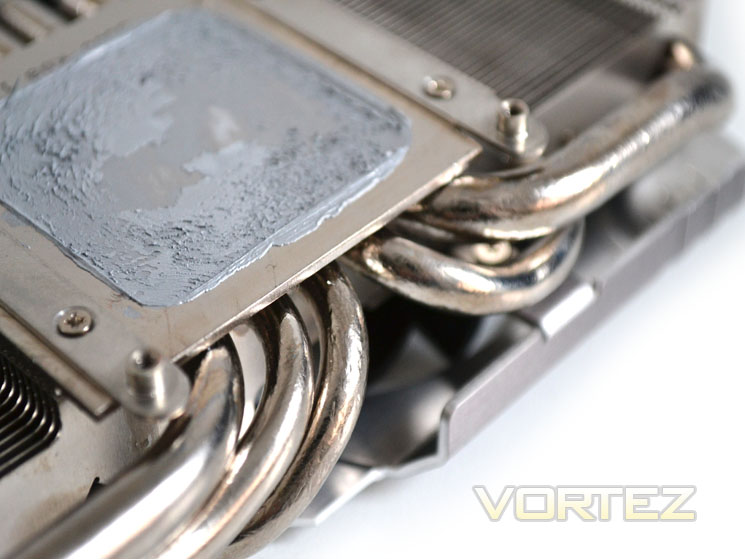
The heatsinks of the MSI GTX560Ti’s are very similar in design however the 448 core Twin Frozr III is slightly longer and instead of having a rough base, it’s a lot smoother in comparison.
GTX560Ti-448 Heatsink
Another advantage the Twin Frozr III has over the previous incarnation is that it has an extra heatpipe. This should increase the heat dissipation of the Twin Frozr III, spreading the heat dump across the aluminium finned heatsink array.
Naked Comparison
Comparing the two cards with the heatsink removed it becomes clear that these two cards are very different beasts. The 448 core obviously is based around the GF110 core as opposed to the GF104. This means the whole card layout is more akin to the GTX570 than the GTX560. There are ten 128mb IC’s rather than the 8 256 IC’s on the 384 core. Both cards use a 6+1 VRM design however the 448 core has a third more MOSFET’s and also has a voltage controller allowing fine voltage adjustment on the core, aux power and memory. The power delivery method is located towards the front of the card rather than the end although both designs make use of twin 6pin sockets.

Voltage Controller
The voltage regulation comes courtesy of the uP1981A regulator and allows fine adjustments of Core, memory and auxiliary voltages in 1mV increments.
VRM
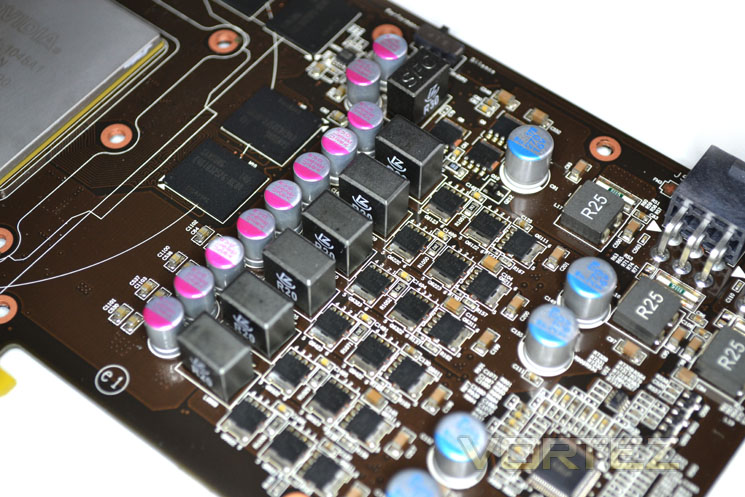
The VRM is an improved design and features Military Class II Components. The SFC (Super Ferrite Choke) has higher current for better overclocking ability. Hi-C CAP for GPU provides more precise voltage and all Solid CAPs provide a longer lifespan.
Memory
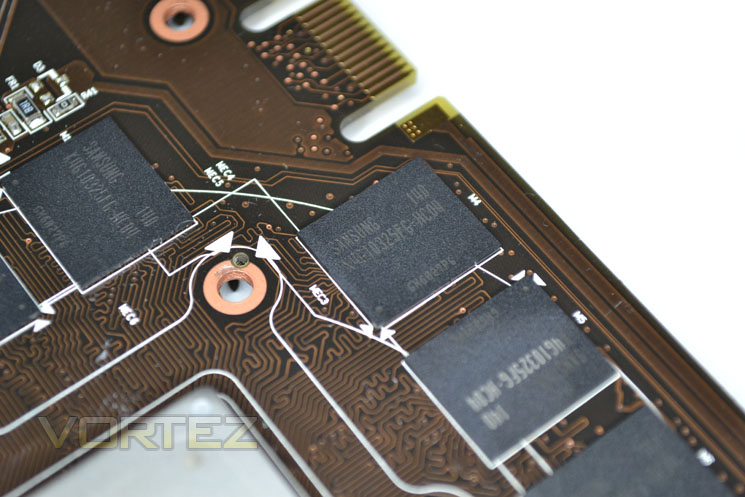
The memory IC’s used are K4G10325FG-HC04 from Samsung which doesn’t bode well as we have seen in the past that the Hynix type tend to be much better overclockers. We will as always test the overclocking ability of both the core and memory later in the review.
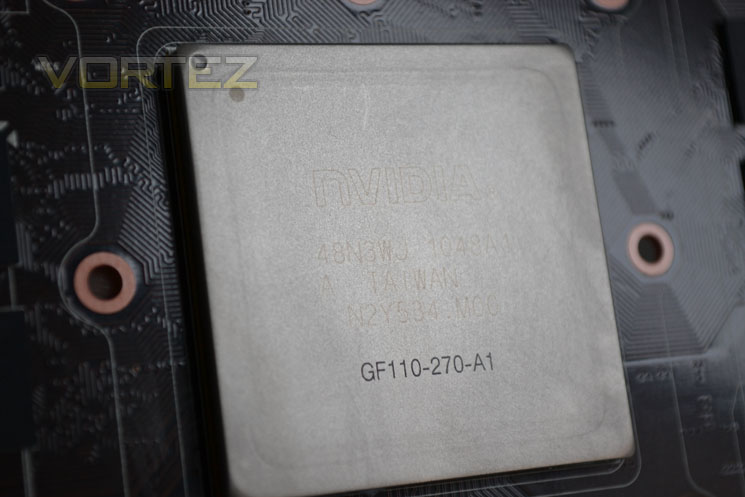
GPU Core
Finally we reach the core (pun intended) of the MSI GTX560Ti-448 Power Edition. The GF110 is the same core used on both the GTX570 and flagship 580 only with less CUDA core than the GTX570 and two less than the much more expensive GTX580. It is still based upon the 40nm process though which should equate to decent temperatures and with less cores to keep cool, this should only serve to reduce temps even further.
With the visuals wrapped up it’s time to take a look at the all new test setup and revised suite of benchmarks we will be using…
Test Setup
With the latest Intel chipset release we decided to update our ageing X58 setup to the new X79 chipset. Not only that but we will be using the flagship Core i7-3960X Extreme Edition processor clocked to 4.5GHz to ensure we have no CPU bottlenecks. With 16GB of ram on board there should be minimal paging so the benchmarks we run today will hopefully give a true reflection of the graphics card’s performance.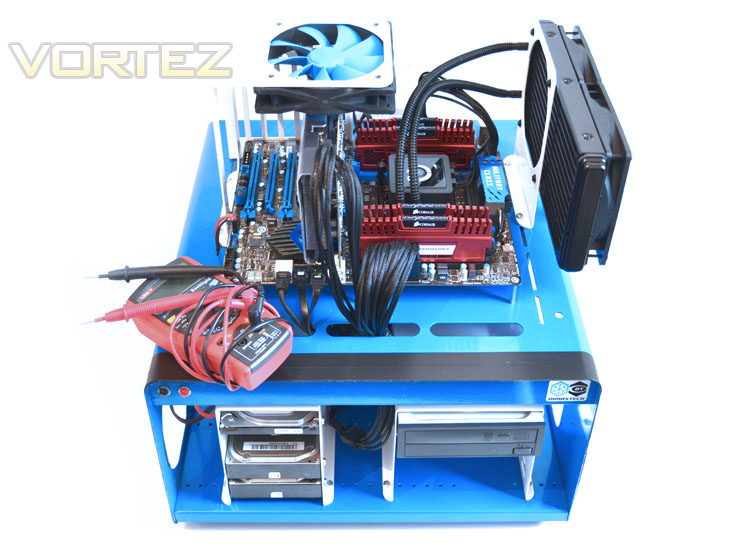
Some of the components for our test bench were kindly donated by CORSAIR who provided the majority of components without whom we would not have been able to bring you this review so a big thanks to them.
Graphics cards on test:
MSI GTX560Ti-448 Twin Frozr III 1280MB GDDR5
NVIDIA GTX570 1280MB GDDR5
MSI GTX560Ti-384 Twin Frozr III 2GB GDDR5
The latest NVIDIA and AMD drivers were used at the time of the review.
Motherboard: ASRock X79 Extreme4-M
CPU: Intel Core i7-3960X Extreme Edition
RAM – 16GB (4x4GB) Corsair Vengeance (Red) DDR3 @ 1866MHz 9-10-9-27
Power Supply – Corsair TX750M 750W
Hard Drive – Hitachi SATA II 250GB
Samsung F3 1TB
Cooler – Corsair H100
Benchmarks
We have also updated our range of benchmarks to include the following games which will give the graphics cards a challenge and sort the wheat from the chaff. Each benchmark will be run at both stock and maximum overclock settings and utilise 1920×1080 and 2560×1600 resolutions along with AA at various levels (application dependent):
Battlefield 3
Crysis 2
Crysis Warhead
Metro 2033
Batman: Arkham City
Elder Scrolls: Skyrim
DiRT 3
Futuremark 3DMark 2011
Unigine: Heaven 2.5
Crysis 2
Crysis Warhead
Metro 2033
Batman: Arkham City
Elder Scrolls: Skyrim
DiRT 3
Futuremark 3DMark 2011
Unigine: Heaven 2.5
Let’s see how today’s test sample performed…
Bundled Software
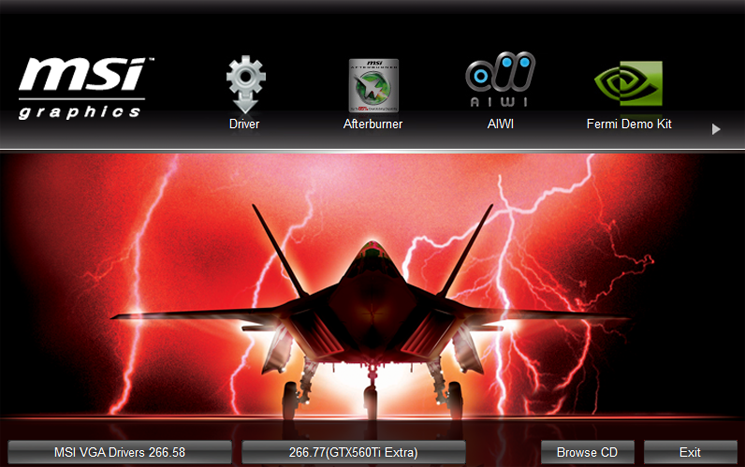
The bundled driver CD contains a wealth of utilities either directly contained on the CD or via download links. As with all driver CDs, it is certainly worthwhile using the most up-to-date driver obtained from the manufacturer website which will likely have more fixes and updated performance than the outdated (Forceware 266.58) ones found on the CD itself. For testing we used the latest beta driver from NVIDA, Forceware 290.36.
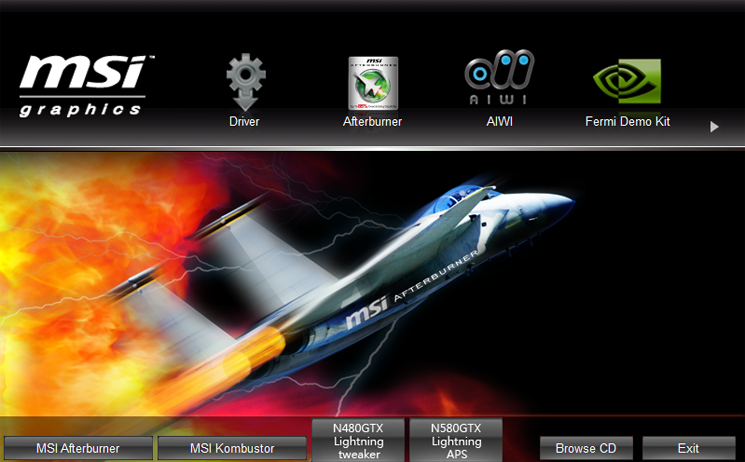
First up we see that MSI have included there very popular Afterburner Overclocking and monitoring software. I would however recommend downloading the latest Beta version, (beta 5 at the time of writing this review). Afterburner is perhaps the best overclocking tool on the market at present and the latest version available on the MSI website caters for most popular NVIDIA and AMD graphics cards.
Kombuster is also included which is a tool that will stress a GPU to its absolute limits. Based on FurMark technology and created by Ozone3D, this utility synthesizes the maximum stress a GPU will be placed under. While no games are currently able to put a GPU under so much pressure, utilities such as this are a good benchmark to assess a ‘worst case’ scenario and are therefore invaluable when overclocking to judge for stability as they will pick up artifects much quicker than a game, cutting the amount of time it takes to find a maximum, stable overclock.

AIWI is a unique software that connects your PC to your iPhone/iPod touch. Once they are connected, you can use your iPhone/iPod touch as a wireless keyboard or touchpad, assist you in a presentation or anytime you wish to remote control your PC.

Included in the bundle is a trial version of Cyberlinks DVD solution; an all-in-one package allowing the user to play back, edit, burn, store and copy DVD content.
There’s also a 60 day trial of the popular Norton Internet security software should you find your own Internet security not up to the task.
There’s a free copy of TMPGEnc included too which allows the user to encode and compress video files to your chosen file format.
Finally there is the MSI Live Update utility which can either manually or automatically search, download and update your graphics cards BIOS and drivers.
Overall the bundled software is of good quality. The Afterburner tool is essential in my opinion when overclocking, such is the polished operation of this utility. My one major gripe is that there is no headlining game included with the graphics card nor is there an copy of Futuremarks 3DMark 2011 benchmark despite the packaging saying it is 3DMark 11 ready which was a shame.
Enough of me talking, it’s time to put the card to the test…
Overclocking
Considering the card is based loosely on the GTX570, itself not renown to be a huge base for overclocking, we didn’t expect a great deal from this card however as you will see, the results tell quite a different story.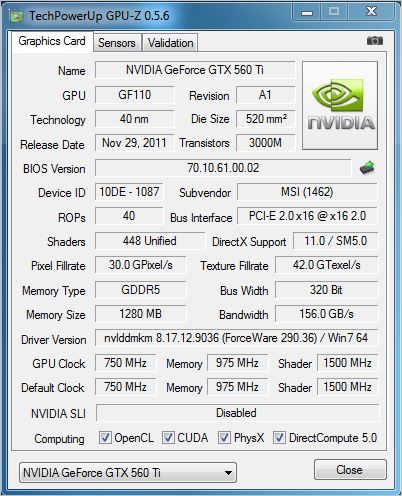
As you can see above, the MSI GTX560Ti-448 Power Edition/OC weighs in at an already overclocked speed of 750MHz on the core and 3900MHz (effective) on the 1280MB of GDDR5 so it will certainly be interesting to see how far the graphics card can be pushed.
As with all of our NVIDIA based GPU’s and for the most part, AMD too, we use MSI’s own Afterburner tool which has an intuitive, easy to navigate GUI allowing for simple, yet effective tweaks of both the memory, shader and of course the core clockspeeds. Voltages can also be adjusted and like today’s review sample, both the auxiliary and memory voltages can be tweaked too in the latest beta edition of this handy little overclocking tool.
We set off on our overclocking journey by giving the card a 10% boost in GPU clockspeeds which the card easily coped with. Any more than this and the card began to show signs of instability. Not the best of starts then. Undeterred, we increased the voltage on the core, sliding it to its maximum +150mv which allowed quite a formidable increase in clockspeed.
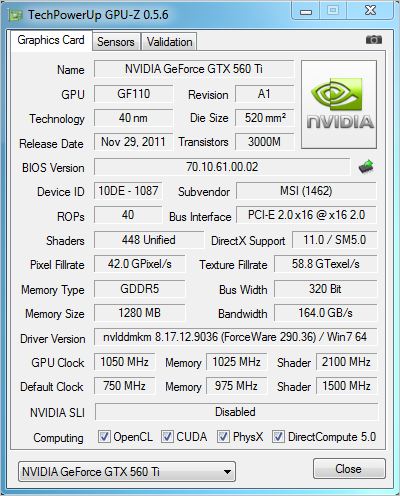
Reaching a truly amazing 1050Mhz on the core was some achievement. At this clockspeed it passed a 2 hour Furmark test without issue. Moreover temperatures were still very much in the comfort zone, never exceeding 68c which is a great achievement, especially when you consider the same cooler was used on the GPU which has less cores but had to combat much higher temperatures.
Not all of the benchmarks proved stable at this clockspeed though so we were forced to lower it slightly to a rock solid stable 1000MHz which cut through every one of our tests with ease. While the GPU gave us massive overclocks, the same couldn’t be said of the memory. Sadly, any meaningful increase to the memory clockspeed meant the benchmark locked up, forcing windows to lose the device driver. Memory clockspeeds don’t however have such a huge affect on the benchmark scores so while we would have liked a little overclocking headroom, MSI seem to have already done the ground work for us on this occasion.
Temperature & Power Consumption
The temperature of the card was measured using MSI’s afterburner utility.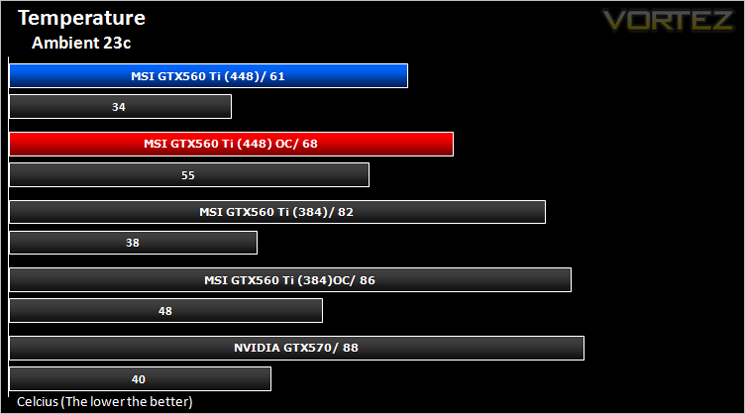
The results were quite astonishing as you can see. Not only was the MSI a lot cooler than its smaller sibling, it was also much cooler than the (on paper at least) more powerful GTX570 – even with the huge overclock and voltages maxed out! Testament then to both NVIDIA and perhaps more appropriately MSI’s Twin Frozr III cooler.
It has to be said though that the cooler is not quiet when running at full tilt but during the benchmarks it did not rise to this level thankfully.
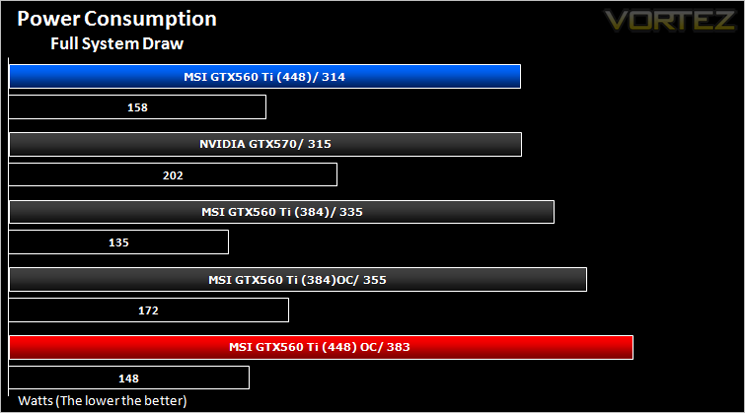
The power consumption of the card was pretty much par for the course consuming almost the same as the GTX570 at stock. Due to the additional voltage, the story was quite different under overclocked conditions consuming 383 Watts at full load.
Battlefield 3
Battlefield 3 leaps ahead of its time with the power of Frostbite™ 2, the next instalment of DICE’s cutting-edge game engine. This state-of-the-art technology is the foundation on which Battlefield 3 is built, delivering enhanced visual quality, a grand sense of scale, massive destruction, dynamic audio and incredibly lifelike character animations. As bullets whiz by, walls crumble, and explosions throw you to the ground, the battlefield feels more alive and interactive than ever before. In Battlefield 3, players step into the role of the elite U.S. Marines where they will experience heart-pounding missions across diverse locations including Paris, Tehran and New York.
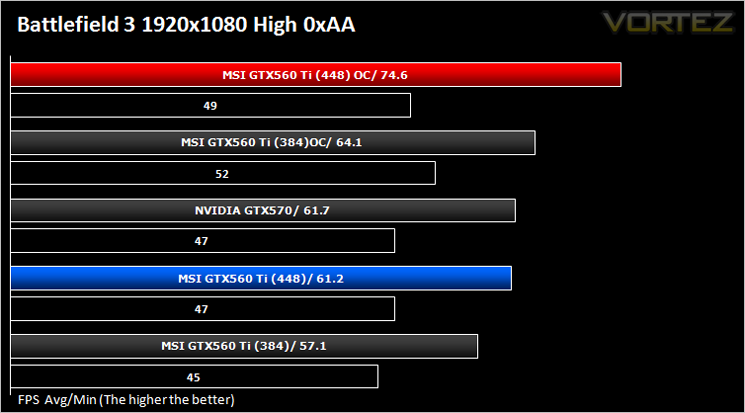
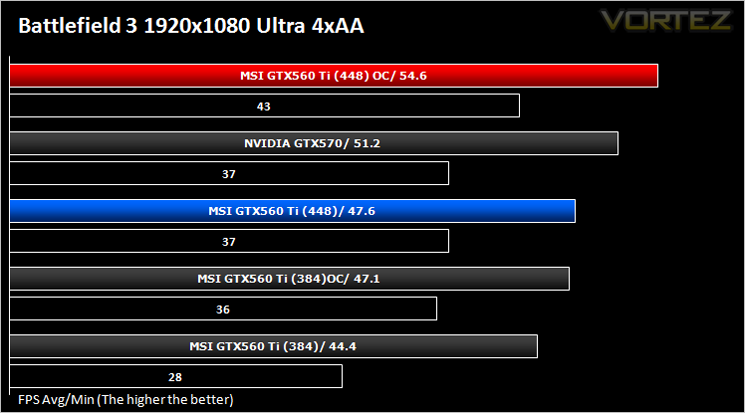
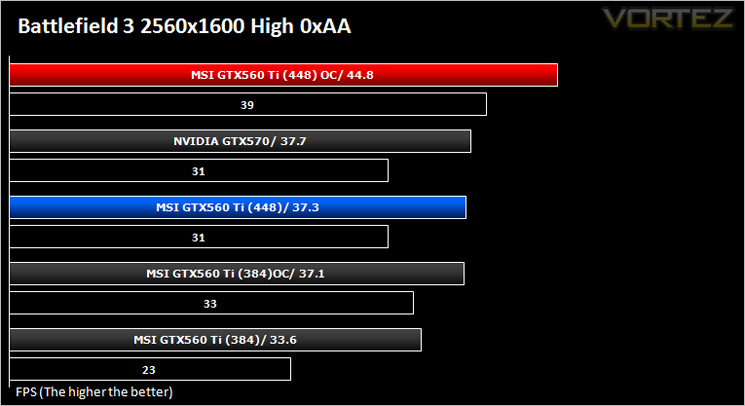
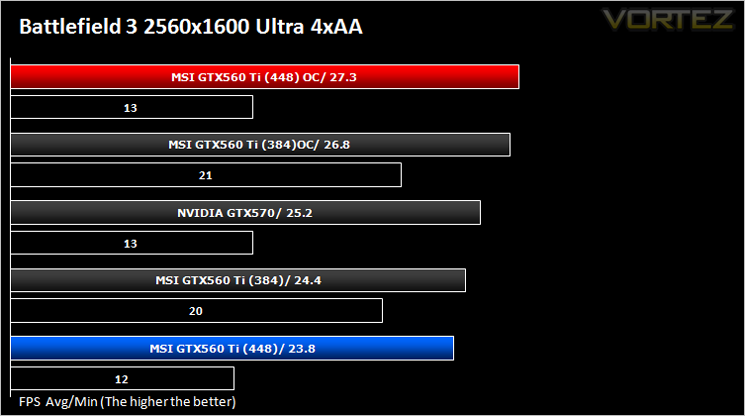
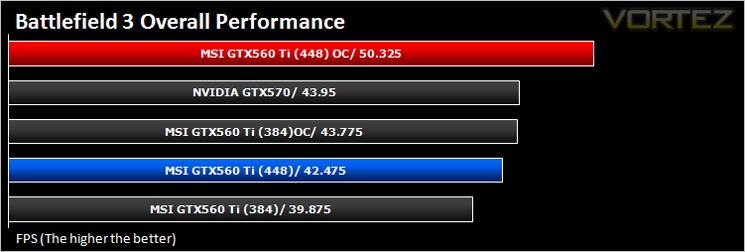
Average and minimum frames per second were measured using Fraps during the parking lot scene on Operation Sword Breaker. High and Ultra presets were loaded at both resolutions.
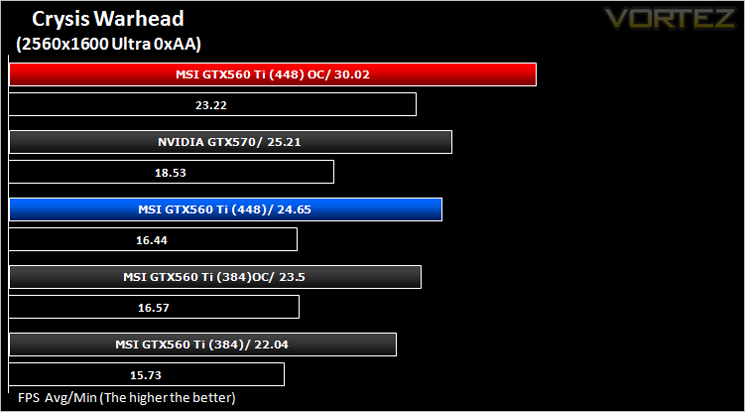
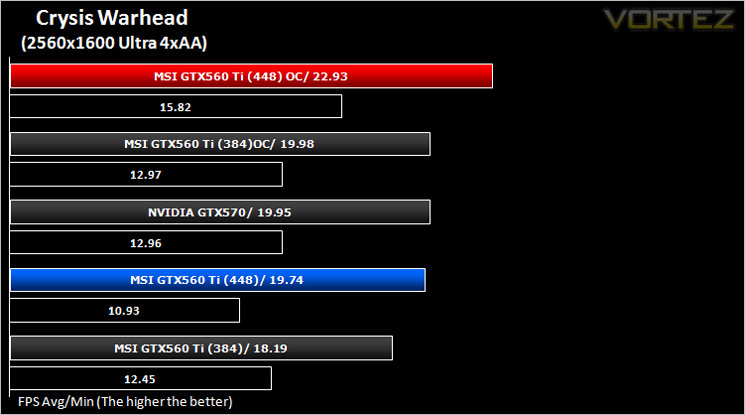
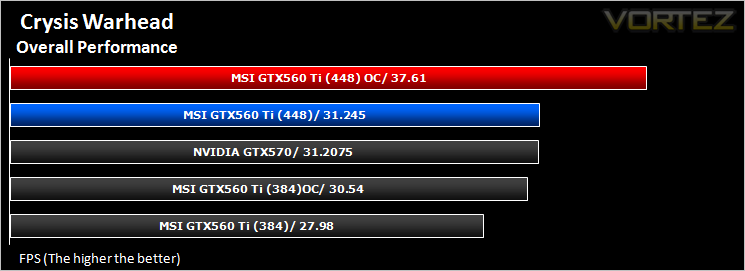
Crysis Warhead
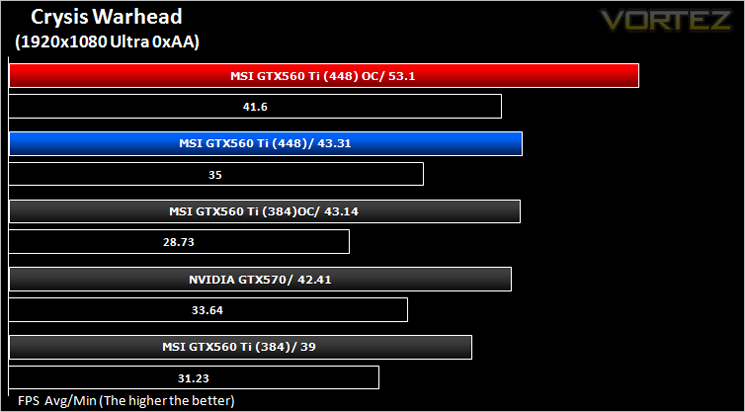
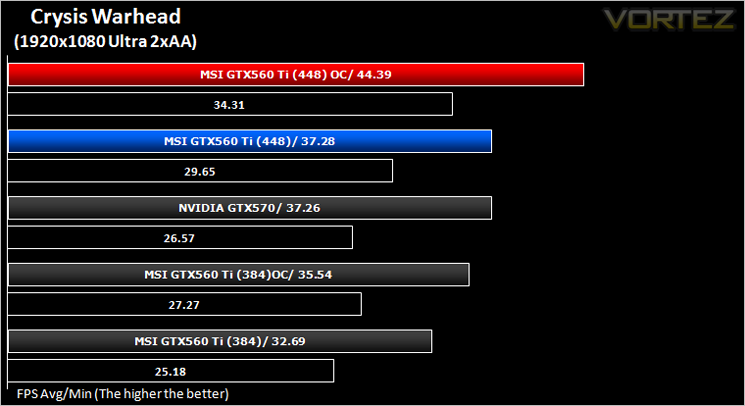
Following the success of Crysis, the stand alone expansion “Warhead” was hotly anticipated to bring more game play, more weapons, improved visuals whilst maintaining better performance, the latter being what gamers wanted most. After all how many people upgraded their rigs just to play this game… In the game, you play as the upbeat Brit Sergeant “Psycho” Sykes, chasing down a Korean nuclear warhead. Throw in some ice shooting aliens and we’re bound to have a great game. It sure delivered.Testing was done using Framebuffer’s Crysis Warhead benchmarking tool. The tests were configured to DirectX 10 at Enthusiast levels. Each test on the Ambush map was looped three times from which the average FPS was recorded.
Crysis 2
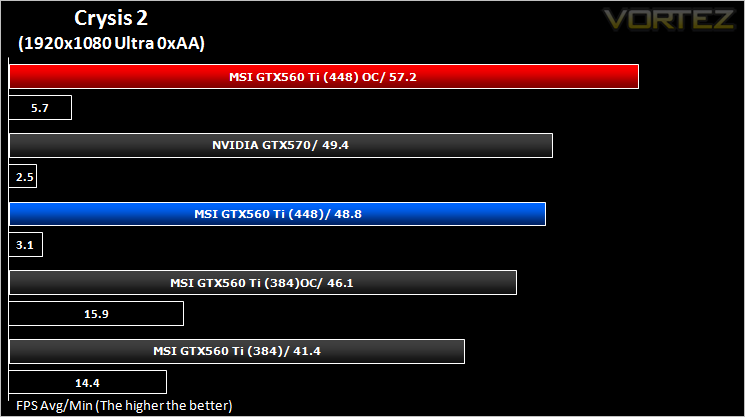
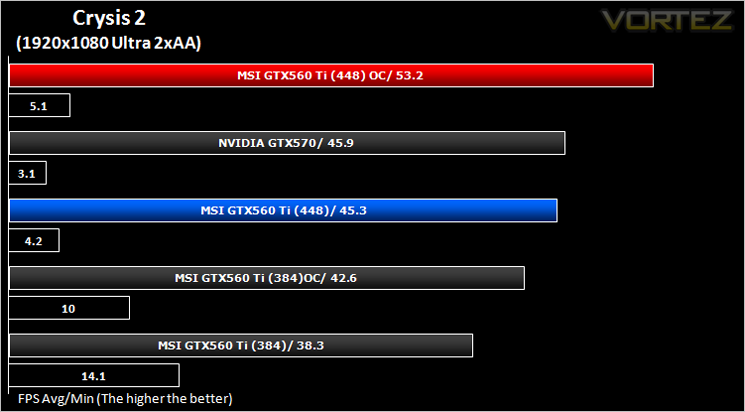
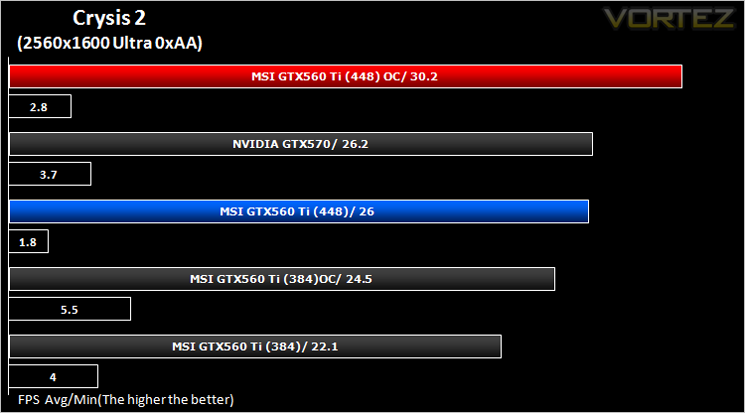
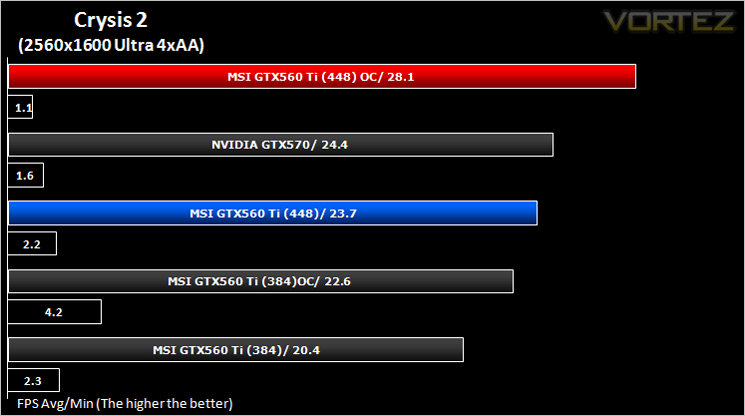
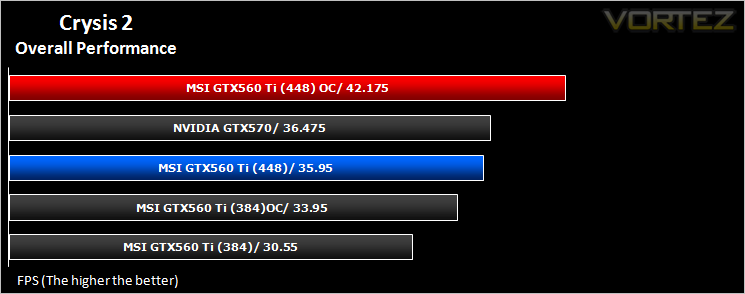
Crytek took an internet beating from its loyal fans due to the fact that they pandered to the console masses and dumbed down the graphics to DirectX 9. Fortunately, fans of the PC version of Crysis managed to force Cryteks hand and they have since developed a DX11 patch and have also enhanced the textures with added tesselation. It is for this reason that we have decided to include it in our suite of benchmarks.To test the cards we used the Crysis 2 benchmark courtesy of Adrenaline with both the 1.9 patch, DX11 update and Hi-res texture pack. Settings were manually placed to Ultra, DX11 and tessellation enabled with the Times Square map being run 3 times per resolution benchmark test.
Metro 2033
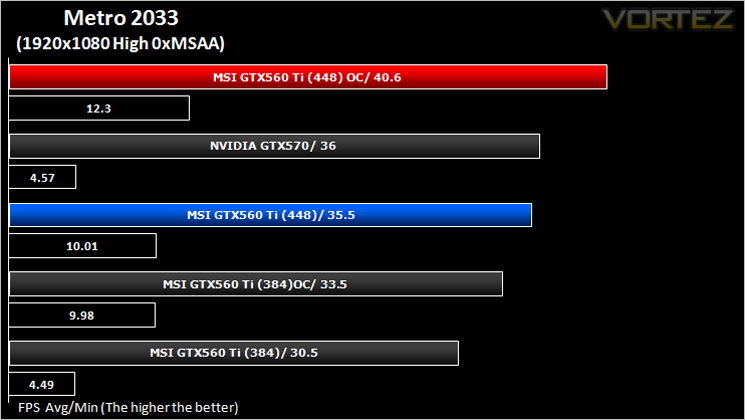
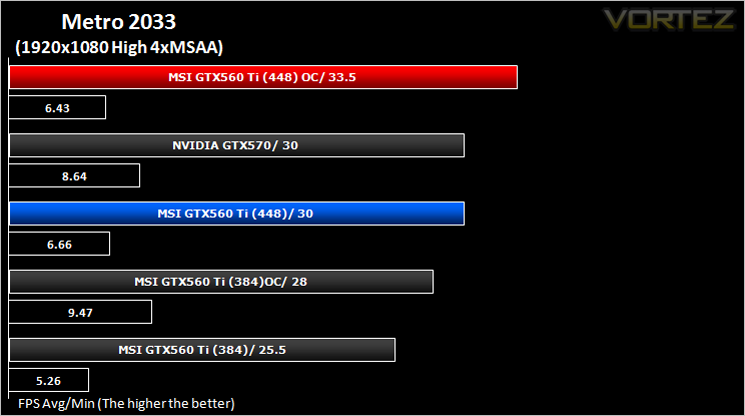
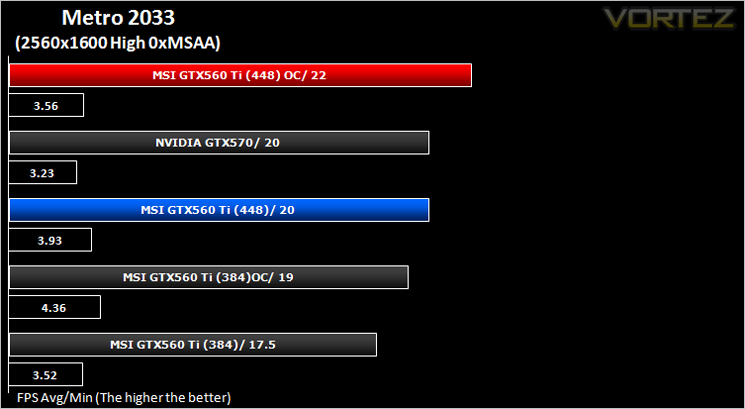
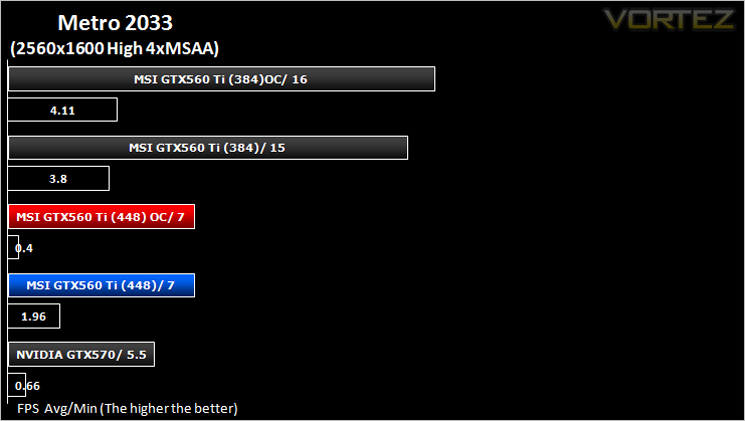
Based on the novel by the same name, Metro 2033 is a first person shooter with elements of survival horror. As Artyom, you trawl through the mutant infested metro systems of post-apocalyptic Moscow. The game delivers presents a grim ambience that reflects on the overall atmosphere of the underground setting. Metro 2033 uses the setting as a back drop to showcase some of the best visuals of any games out now, making it the ideal benchmark for those looking for the best graphics card.The bundled benchmarking tool was used on Metro 2033, configuring the settings to High and making use of DirectX 11. The frontline scene was looped 3 times for each configuration. The average FPS was recorded at the end.
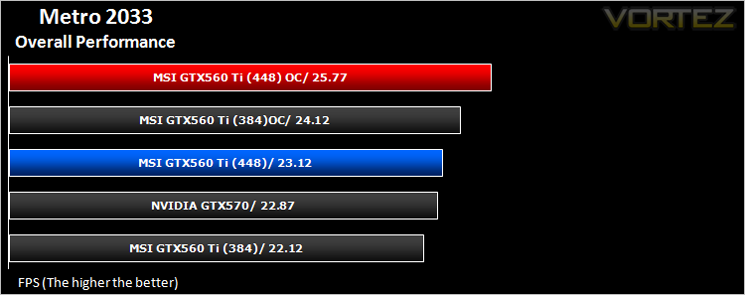
The Elder Scrolls V: Skyrim
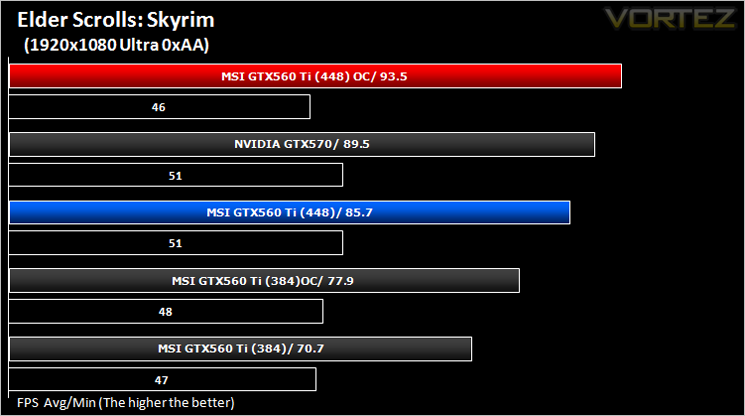
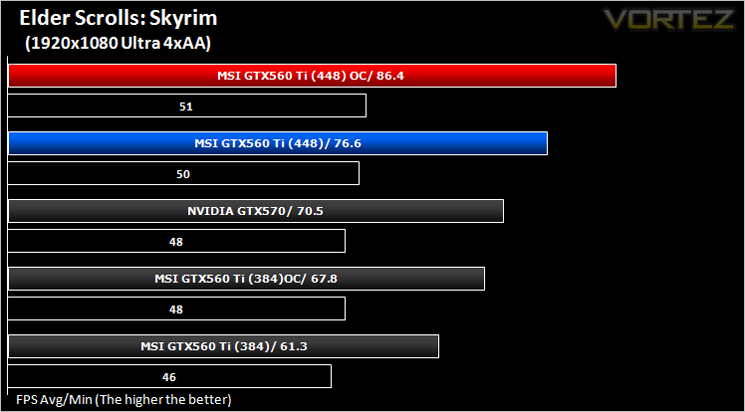
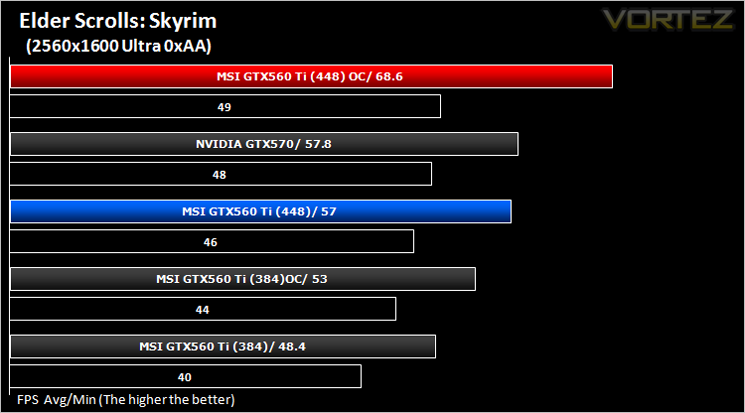
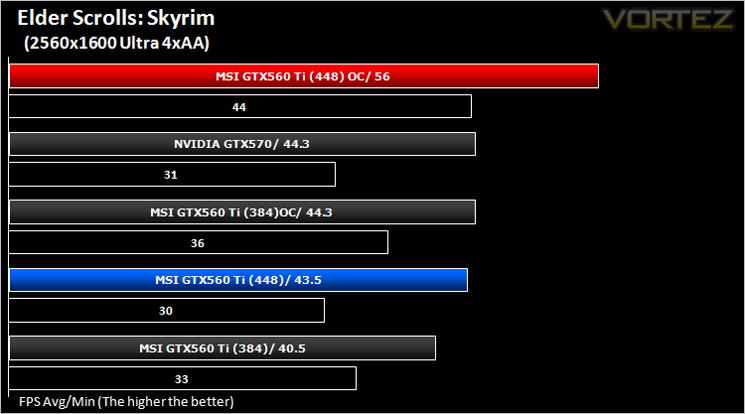
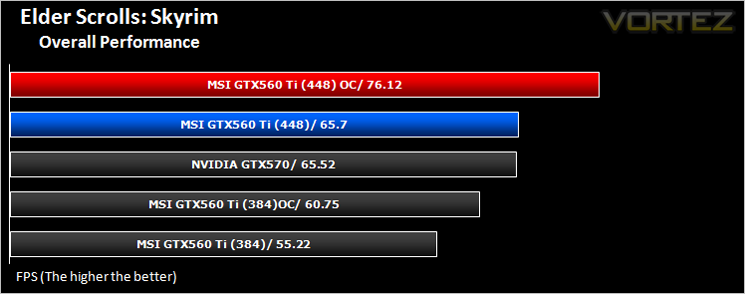
Skyrim is not a direct successor to the very popular Oblivion. Instead it takes place 200 years after the events of Oblivion. The non-linear playing that made the Elder Scrolls such a popular series does however make a return along with the beautiful scenery the encompasses the world of Skyrim.
Average and minimum frames per second were measured using Fraps during the drop down passage to Riverwood. V-sync was disabled to allow fluctuating (higher the 60) FPS for these runs. It is however recommended that v-sync is left enabled during normal gameplay due to the games dynamics.
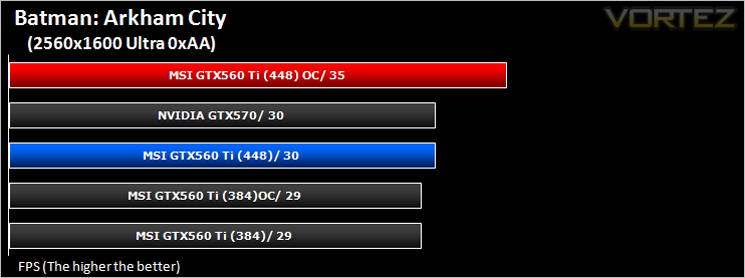
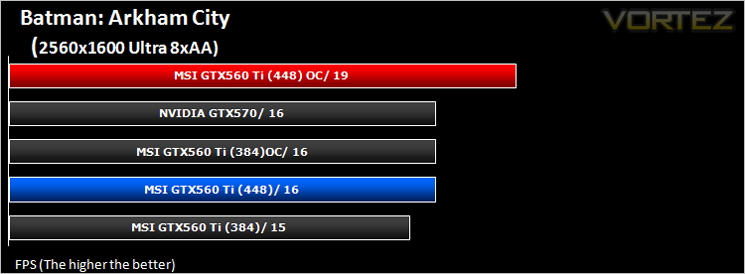
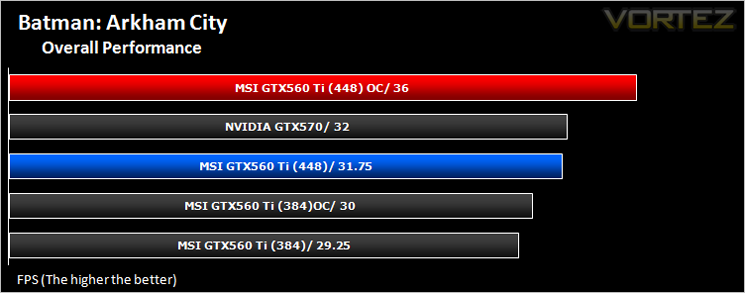
Batman: Arkham City
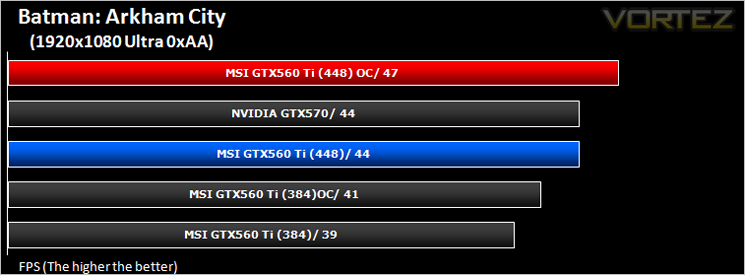
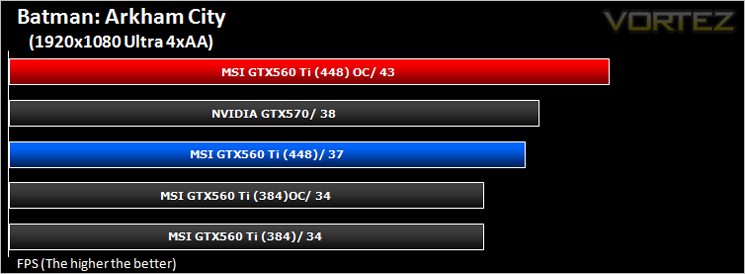
Batman: Arkham City builds upon the intense, atmospheric foundation of Batman: Arkham Asylum, sending players soaring into Arkham City, the new maximum security “home” for all of Gotham City’s thugs, gangsters and insane criminal masterminds. Set inside the heavily fortified walls of a sprawling district in the heart of Gotham City, this highly anticipated sequel introduces a brand-new story that draws together a new all-star cast of classic characters and murderous villains from the Batman universe, as well as a vast range of new and enhanced gameplay features to deliver the ultimate experience as the Dark Knight.
The results below were obtained from the builtin benchmark utility from the game. All the settings were set to
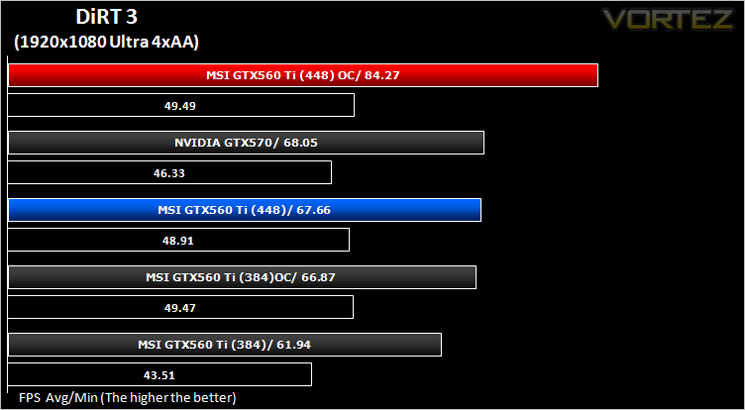
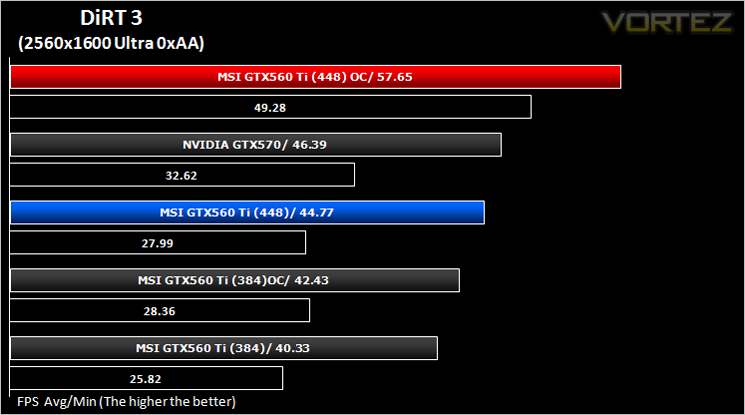
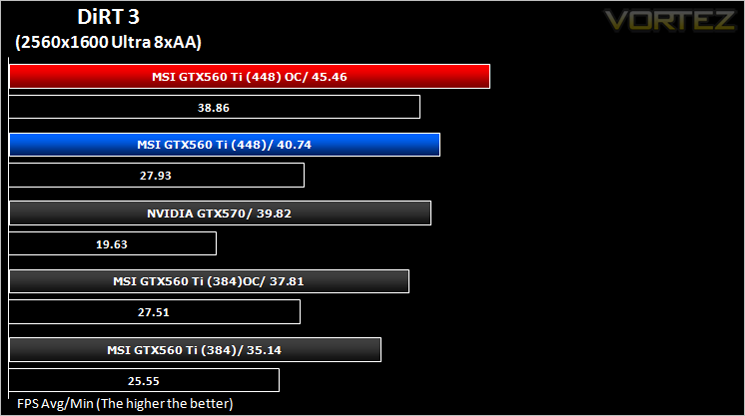
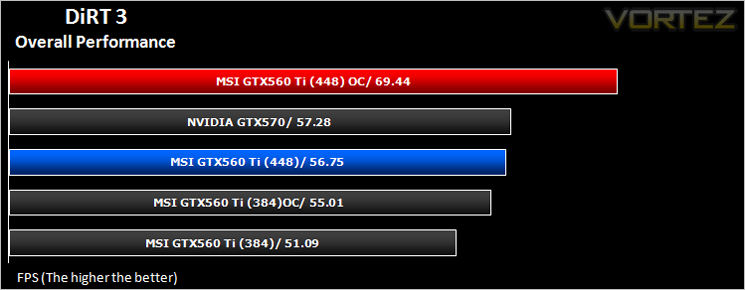
DiRT 3
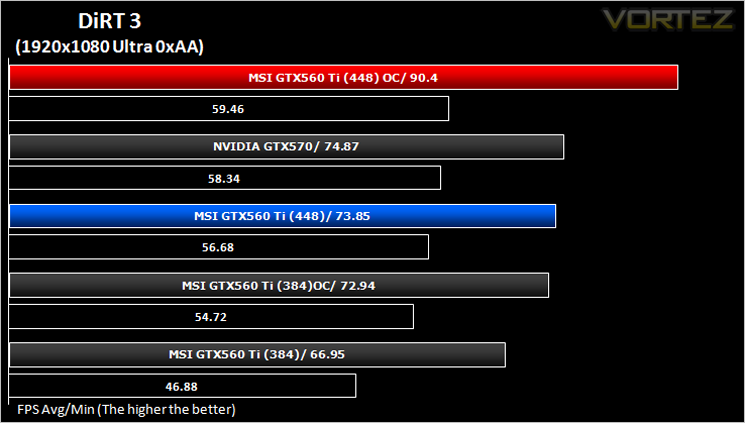
As players race to elevate their global standing, DiRT 3 is back delivering mud, sweat and gears world over: from the intense weather-beaten rally stages of Europe, Africa and the US, to executing performance driving showcases and career challenges where car control is pushed to spectacular limits.The in-game benchmarking tool was used to test performance. All the display settings were set to the maximum available and DirectX 11 was applied. The average FPS was recorded at the end.
Futuremark: 3DMark 2011
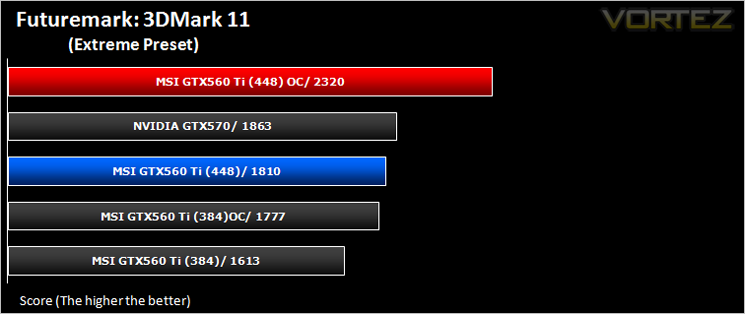
3DMark 11 is the latest version of the world’s most popular benchmark. Designed to measure your PC’s gaming performance 3DMark 11 makes extensive use of all the new features in DirectX 11 including tessellation, compute shaders and multi-threading. The benchmark was run in both Performance and Extreme presets.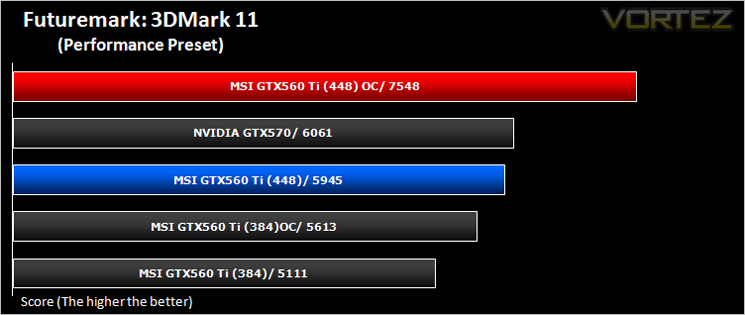
Unigine: Heaven 2.5
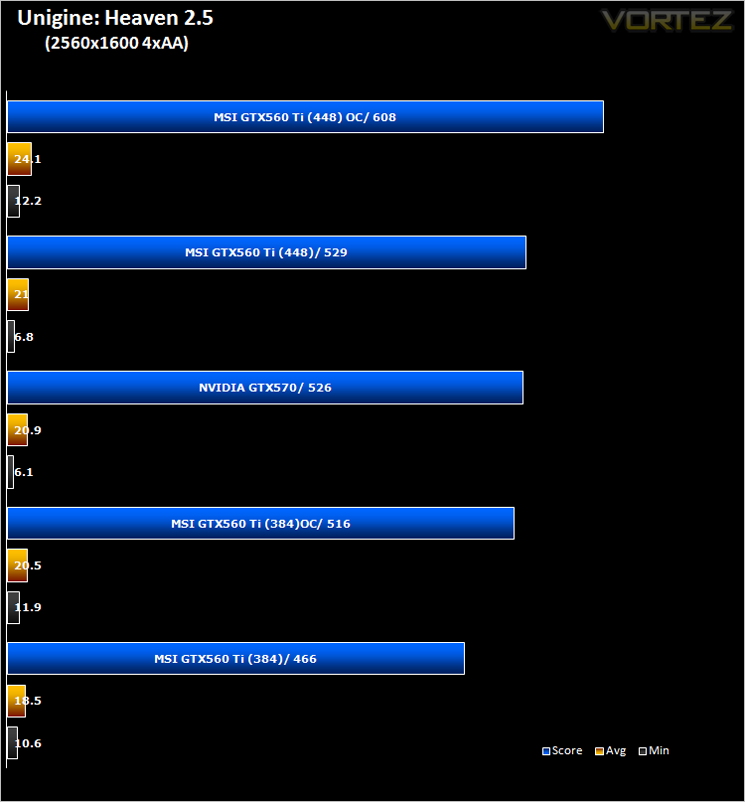
Heaven Benchmark is a DirectX 11 GPU benchmark based on advanced Unigine™ engine from Unigine Corp. It reveals the enchanting magic of floating islands with a tiny village hidden in the cloudy skies. Interactive mode provides emerging experience of exploring the intricate world of steampunk.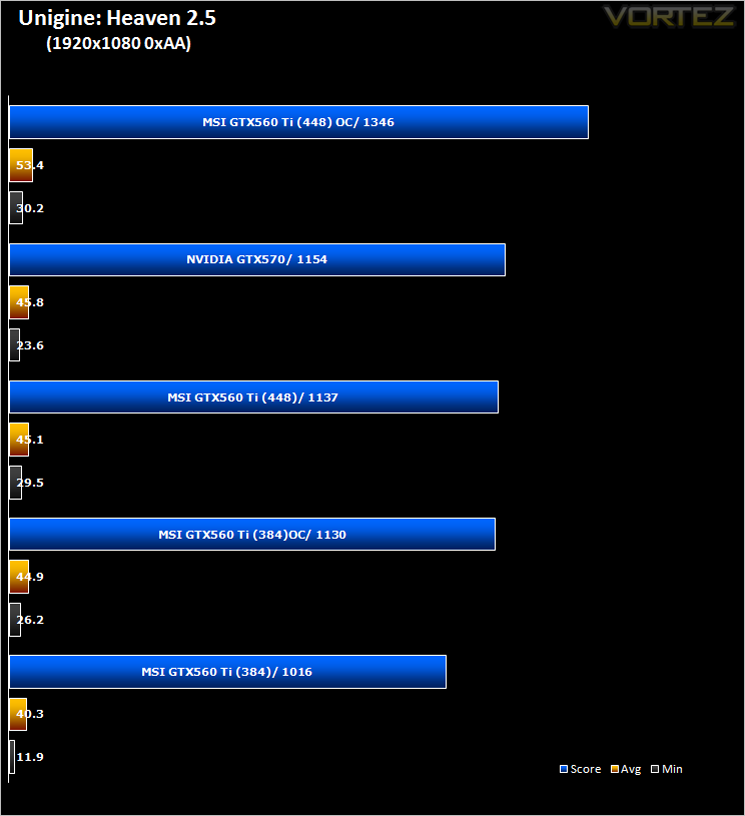
Conclusion
I won’t lie to you in that when I first heard about this card I thought ‘Oh no not another re-hash’. With NVIDIA notoriously re-hashing their product line, I was surprised this card didn’t receive a different name, something along the line of GTX565 which would set it apart from the 384 CUDA core versions. Perhaps more so after evaluating the performance. Adding a card that is quite clearly not identical under the same GTX560 umbrella may not have been the best marketing strategy by NVIDIA but MSI cannot be held responsible for this. What MSI should really consider though is changing the packaging of the 448 version. While there is nothing wrong with the GTX560 packaging there is again, very little to differentiate between the two cards because at a glance, both the packaging and the indeed cards themselves look identical.The graphics cards are however different beasts. The 384 core version of the GTX560 we tested today seemed to have the upper hand as it wielded 2GB of GDDR5 and this extra memory proved invaluable at high resolutions with filters added as the 448 core and the GTX570 it is based upon ran into VRAM limitations. Most people will not however have the same problem as the VRAM limitation only reared its ugly head at the highest settings available and only then in Battlefield 3 and Metro 2033. At more popular resolutions and settings, the 448 core GTX560 cut through our suite of benchmarks like a hot knife through butter. I say hot but the card was anything but hot in terms of temperatures. The MSI Twin Frozr III design coupled with NVIDIAs GF110 core simply meant that temps were never a problem and were kept at comfortable levels throughout the testing. As a bonus this meant the fans on the cooler were rarely required to spin up to audible levels, even when overclocked. Overclocking is where the card really showed its worth though.
At stock speeds the card performed adequately but not exactly what I would describe as groundbreaking or even so much as raising an eyebrow. It’s good, predictable but in all honesty I wouldn’t be happy paying the price for the card for what is in effect, a crippled GTX570 at its default ‘overclocked’ speeds. If however you like to dip your toes into overclocking then my opinion of this card is turned completely on its head. because a 33% overclock is an amazing feat. Sure the memory overclocking was disappointing but who cares when you can get a rock solid stable 1000MHz from an NVIDIA GPU? I was wary that this card may have just been a cherry picked sample so I raised the question with the MSI rep who assured me there are other reports of the cards reaching the same clockspeeds. Obviously not every card will clock the same, some will clock higher, some will clock lower but unless you are extremely unlucky, what you will get with the MSI GTX560-448 Power Edition are some very tasty overclocks indeed.
The argument has to be posed as to whether the GTX560-448 is a better card than the GTX570 or indeed the GTX560 with 2GB of GDDR5. It is a tough one to answer because on the one hand you would do well to future proof with 2GB of GDDR5 for future games, ruling out both the GTX570 and GTX560-448. On the other hand, in the games we have tested today both the GTX560-448 and GTX570 outperform the card and do so with the less memory. Were you to run the GTX570 and GTX560-448 cards at stock speeds, I would perhaps be tempted to pay that little bit extra and get the GTX570, not least as it performs better and will perhaps hold a higher re-sale value come the NVIDIA refresh of cards due next year. If however you like to dabble in the dark arts of overclocking then the GTX560-448 could well be described as a GTX570 killer, at least with it running at its stock speeds because running the MSI card at its maximum clockspeed, it simply stomped all over the GTX570. Obviously, should the GTX570 be overclocked too, the performance of the GTX560Ti-448 could well be matched but the GTX560Ti-448 still weighs in cheaper so would make more financial sense.
Whichever your preference, there can be no denying that the MSI GTX560Ti-448, at least when overclocked, makes for a formidable, mid-range graphics card if a somewhat expensive proposition. Were the GTX560Ti-448 priced closer to the standard GTX560Ti rather than knocking on the GTX570’s door, I would be telling every man and his dog to buy one. However, because of its high price in comparison to the GTX570 it is hard to recommend it to everyone unless you are an avid overclocker. If however you do like to tweak, this card has some excellent performance just waiting to be unleashed.
Pros:
+ Excellent packaging
+ Astounding GPU core overclocking
+ Good voltage adjustment option
+ Excellent cooling
+ Great performance (overclocked)
+ Quiet fan
Cons:
– Brown PCB
– Poor memory overclocking
– Too close to GTX570 prices
+ Excellent packaging
+ Astounding GPU core overclocking
+ Good voltage adjustment option
+ Excellent cooling
+ Great performance (overclocked)
+ Quiet fan
Cons:
– Brown PCB
– Poor memory overclocking
– Too close to GTX570 prices


Click here for an explanation of our awards at Vortez.net. Thanks to MSI for providing today’s review sample.