







Take a look at AMD’s last Hurrah of the Richland APUs, the A10-6790K, competing directly against the Intel Haswell i5-4430 and its HD 4600 iGPU.

Product on Review: AMD A10-6790K APU
Manufacturer and Sponsor: AMD
Street Price: £90 inc. VAT (GBP)
Once we have seen the performance from the series of AMD processors, it is fairly safe to say, there will not be much deviation in the scale until we see the new architecture. The A10-6790K comes in to offer very similar specs to the A10-6800K, just 100MHz lower than the base/turbo clock frequency of the 6800K and a lower rated memory frequency of 1866MHz as opposed to 2133MHz, is all that separate them. What this means is, you can save a fair bit of money (£5-15) over the A10-6800K and get very close to the same performance when used at stock. If you overclock, however, you will be glad to hear that this is a K unlocked black edition, and we are likely to see par top results.
So to be a little more objective, we place the A10-6790K APU against the Haswell i5-4430 CPU that comes with the HD 4600 iGPU. Costing up to £46 more than the APU we can expect a lot of CPU horses, but how well does it do when considering the complete system?
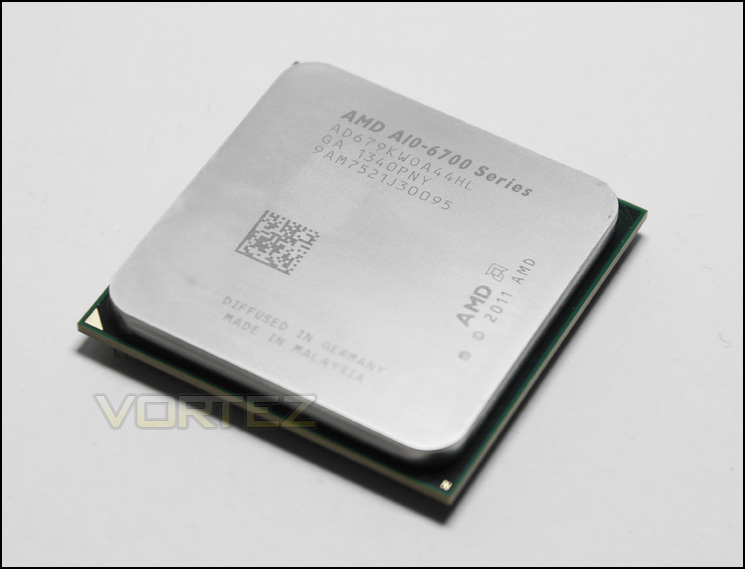
AMD’s Overview of the APU
Do more in less time with energy-efficient desktops. With AMD’s APU, a multicore CPU and discrete-level GPU on a single power-efficient chip, you get the visual performance you need for the best choice for digital entertainment and gaming. With even more compute performance, graphics are crisp, bright and smooth, and content is easy to share.
Specifications & Features
Model Name: A10-6790K
Radeon™ Brand: HD 8670D
CPU Clock Speed: 4.0/4.3 GHz
CPU Cores on Die: 4 cores
TDP: 100W
Total L2 Cache: 4MB
Radeon™ Cores on Die: 384
GPU Clock Speed: 844 MHz
DDR3 Speed: 1866 MHz
Instruction Set Extensions MMX(+) SSE (1,2,3,3S,4.1,4.2,4A) x86-64, AMD-V, AES, AVX, XOP, FMA4/3
Lithography 32nm
Max Temps (C): 74
Socket: FM2
DirectX: Version 11
Radeon™ Brand: HD 8670D
CPU Clock Speed: 4.0/4.3 GHz
CPU Cores on Die: 4 cores
TDP: 100W
Total L2 Cache: 4MB
Radeon™ Cores on Die: 384
GPU Clock Speed: 844 MHz
DDR3 Speed: 1866 MHz
Instruction Set Extensions MMX(+) SSE (1,2,3,3S,4.1,4.2,4A) x86-64, AMD-V, AES, AVX, XOP, FMA4/3
Lithography 32nm
Max Temps (C): 74
Socket: FM2
DirectX: Version 11
Test Setup
A88X Setup
Motherboard – GIGABYTE G1 Sniper A88X
RAM – Xtreem LV PC3 19200 DDR3 LV 2400
SSD – Kingston Hyper X 120GB
Power Supply – NZXT Hale82 650W
Cooler – Noctua U12S
Motherboard – GIGABYTE G1 Sniper A88X
RAM – Xtreem LV PC3 19200 DDR3 LV 2400
SSD – Kingston Hyper X 120GB
Power Supply – NZXT Hale82 650W
Cooler – Noctua U12S
APU Configurations
A10-6790K @ 4.0 GHz/4.3 GHz (100MHz x 41/44, 1866 MHz 9-9-9-24), OC @ 4.71 GHz (112 MHz x 42, 2400 MHz 11-11-11-28)
HD 8670D integrated graphics @ 844 MHz (OC @ 950 MHz, 2400 MHz 11-11-11-28)
Intel Z87 Setup
Motherboard – GIGABYTE Z87X-OC
RAM – 16GB Corsair Vengeance Pro 1866MHz
SSD – Kingston HyperX 240GB
Power Supply – Corsair HX1200i
Cooler – Noctua NH-U12S
Motherboard – GIGABYTE Z87X-OC
RAM – 16GB Corsair Vengeance Pro 1866MHz
SSD – Kingston HyperX 240GB
Power Supply – Corsair HX1200i
Cooler – Noctua NH-U12S
CPU Configurations
Intel Core i5-4430 @ 3.0 GHz/3.2 GHz, 1866 MHz memory
HD 4600 Dynamic Frequency 350 MHz – 1.1 GHz
Overclocking
Overclocking the APU is very similar to other black edition Trinity/Richland APUs and we could get around 4.7-4.8 GHz stable with around 1.48V, and 950MHz stable on the GPU. GPU gains should be substantial, unlike the CPU gains, which are marginal at best. This is why we suggest that when overclocking an APU, it is best to balance performance by using high performance memory and overclock the GPU only, as seen in the review for the A10-6800K, this way you can get a good chunk of performance that does not require beyond stock cooling, as well as saving you a little on your energy bill.
For these tests however, every little helps so we pump up the CPU and GPU frequencies to see how much difference it can make.
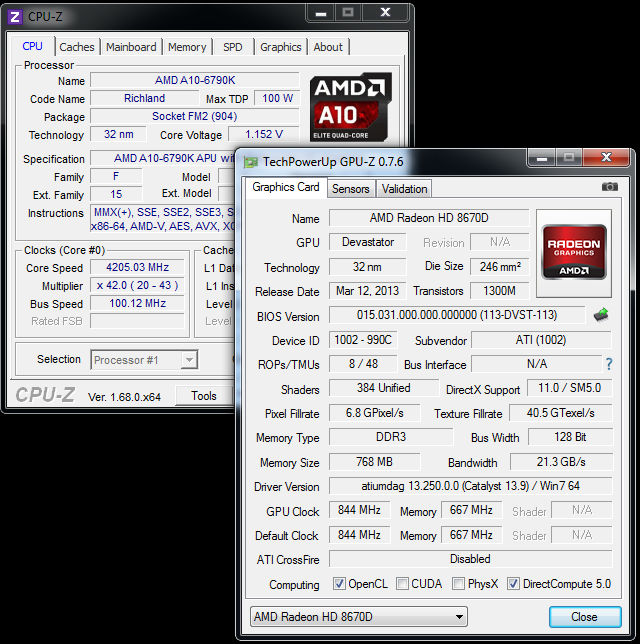
Stock settings
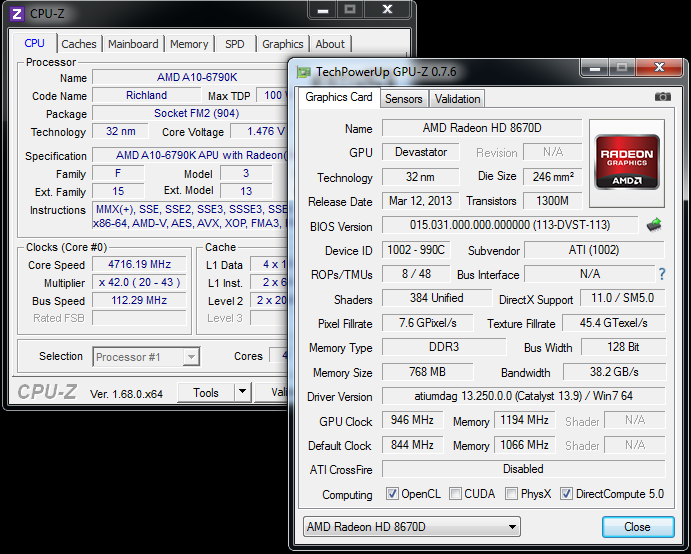
Final Overclock values
Synthetic Benchmarks: AIDA64
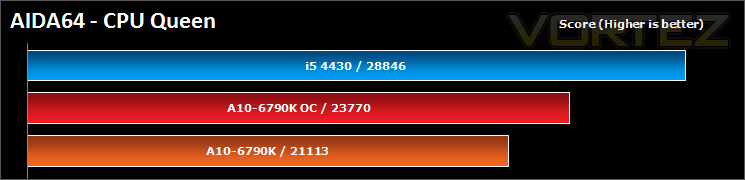
CPU Queen BenchmarkThis simple integer benchmark focuses on the branch prediction capabilities and the misprediction penalties of the CPU. It finds the solutions for the classic “Queens problem” on a 10 by 10 sized chessboard. At the same clock speed theoretically the processor with the shorter pipeline and smaller misprediction penalties will attain higher benchmark scores. For example — with HyperThreading disabled — the Intel Northwood core processors get higher scores than the Intel Prescott core based ones due to the 20-step vs 31-step long pipeline. CPU Queen test uses integer MMX, SSE2 and SSSE3 optimizations.
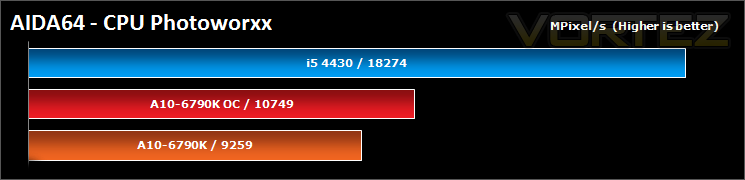
CPU Photoworxx Benchmark
This benchmark stresses the integer arithmetic and multiplication execution units of the CPU and also the memory subsystem. Due to the fact that this test performs high memory read/write traffic, it cannot effectively scale in situations where more than 2 processing threads used. For example, on a 8-way Pentium III Xeon system the 8 processing threads will be “fighting” over the memory, creating a serious bottleneck that would lead to as low scores as a 2-way or 4-way similar processor based system could achieve. CPU PhotoWorxx test uses only the basic x86 instructions, and it is HyperThreading, multi-processor (SMP) and multi-core (CMP) aware.
FPU Mandel Benchmark
This benchmark measures the double precision (also known as 64-bit) floating-point performance through the computation of several frames of the popular “Mandelbrot” fractal. The code behind this benchmark method is written in Assembly, and it is extremely optimized for every popular AMD, Intel and VIA processor core variants by utilizing the appropriate x87, SSE2, AVX or FMA4 instruction set extension. FPU Mandel test is HyperThreading, multi-processor (SMP) and multi-core (CMP) aware.
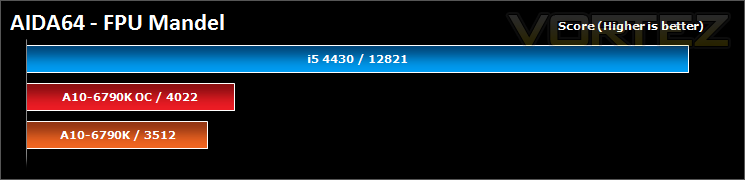
In these CPU tests we find the huge advantage Intel core architecture has.
Synthetic Benchmarks: x264 HD
Simply put, this test measures how fast your machine can encode a short, DVD quality MPEG-2 video clip into a high-quality x264 video clip. What’s x264, you ask? It’s more or less the next-generation Xvid/DivX codec. I think it’s ideal for a benchmark because the application (x264.exe) reports fairly accurate compression results (in frames per second) for each pass of the video encoding process, and it uses multi-core processors very efficiently.
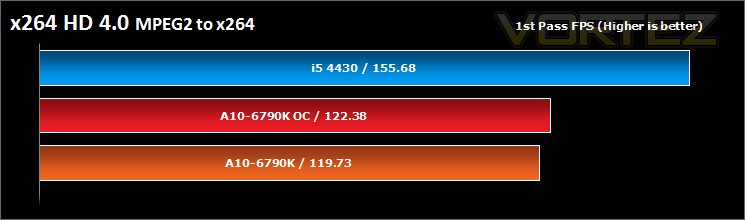
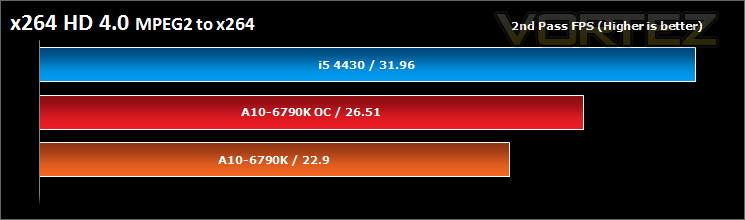
The fast CPU from Intel lends itself to encode well.
Synthetic Benchmarks: Cinebench 11.5
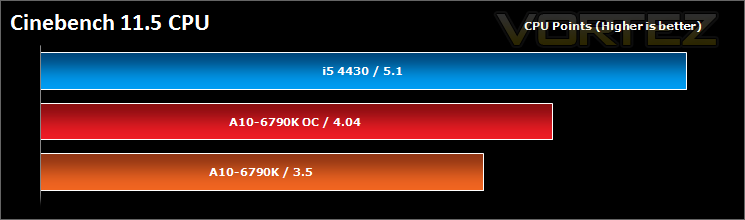
CPU Rendering
CINEBENCH can measure systems with up to 64 processor threads. This test scene contains approximately 2,000 objects which in turn contain more than 300,000 polygons in total, and uses sharp and blurred reflections, area lights, shadows, procedural shaders, antialiasing, and much more. The result is displayed in points (pts). The higher the number, the faster your processor.
Open GL Graphics Rendering
This procedure uses a complex 3D scene depicting a car chase (by renderbaron) which measures the performance of your graphics card in OpenGL mode. The performance depends on various factors, such as the GPU processor on your hardware, but also on the drivers used. The graphics card has to display a huge amount of geometry (nearly 1 million polygons) and textures, as well as a variety of effects, such as environments, bump maps, transparency, lighting and more to evaluate the performance across different disciplines and give a good average overview of the capabilities of your graphics hardware.
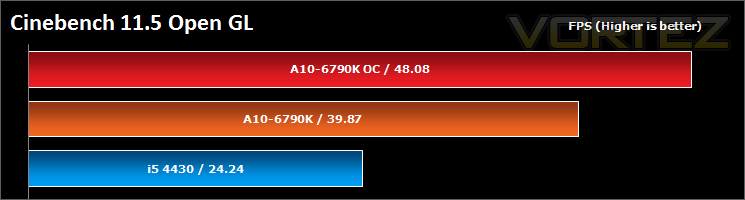
In Cinebench 11.5 we find the turning point, in CPU rendering the APU falls short by just over 1pt, but in openGL rendering it beats the Intel iGPU by nearly double!
Synthetic Benchmarks: SiSoftware SANDRA
SANDRA isn’t always a benchmark that is included in hardware reviews but I believe it shouldn’t be ignored. SANDRA provides a vigorous package that tests your system in a rather large array of benchmarks. There are many aspects of benchmark that can be executed. We will be considering – CPU, memory and GPGPU tests.
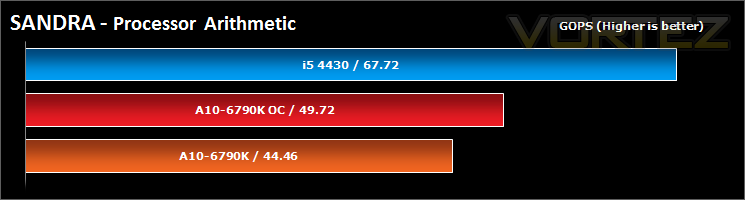
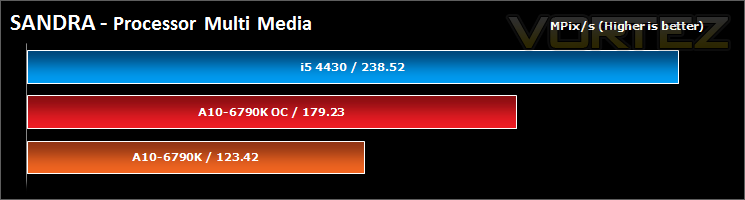
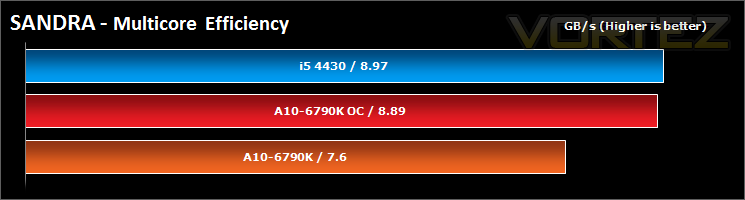
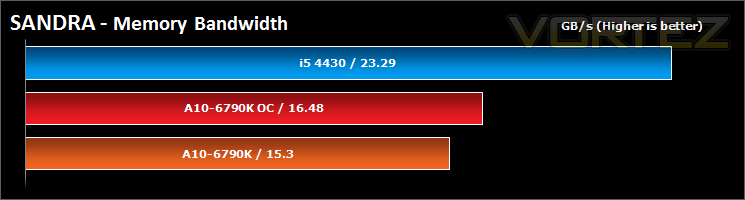
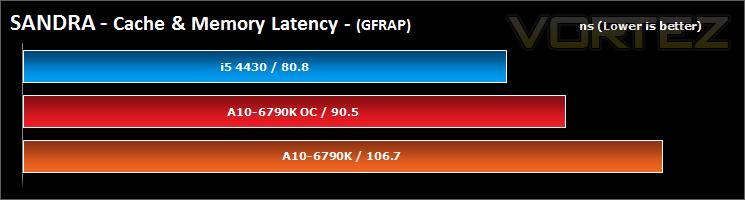
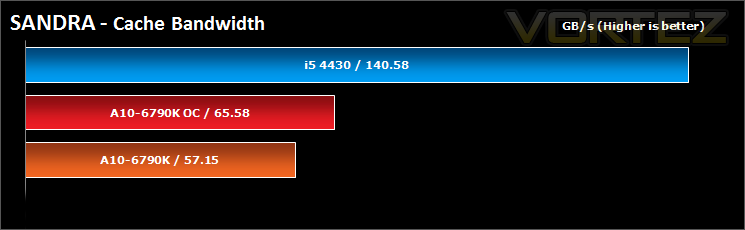
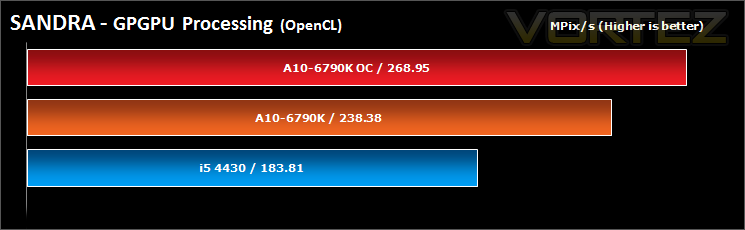
In aggregate CPU operations we find that the A10-6790K is around 25% slower than the Intel Core i5-4430, however, when it comes to floating point operations, measured by the processor multi media, the Intel CPU is nearly twice as fast. AMD have nearly caught up in Multicore efficiency, however, the APU still lags significantly in memory bandwidth, the Cache bandwidth makes sense considering the APU does not have any L3 cache.
Synthetic Benchmarks: 3DMark 11 & 3DMark – Fire Strike
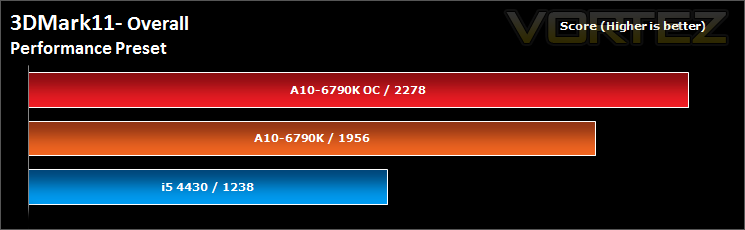
3DMark 11
Designed to measure your PC’s gaming performance 3DMark 11 makes extensive use of all the new features in DirectX 11 including tessellation, compute shaders and multi-threading. Trusted by gamers worldwide to give accurate and unbiased results, 3DMark 11 is the best way to consistently and reliably test DirectX 11 under game-like loads.
3DMark – Fire Strike
Fire Strike is our new showcase DirectX 11 benchmark designed for high-performance gaming PCs. It is our most ambitious and technical benchmark ever, featuring real-time graphics rendered with detail and complexity far beyond what is found in other benchmarks and games today. Fire Strike will only be available in the Windows editions of 3DMark initially.
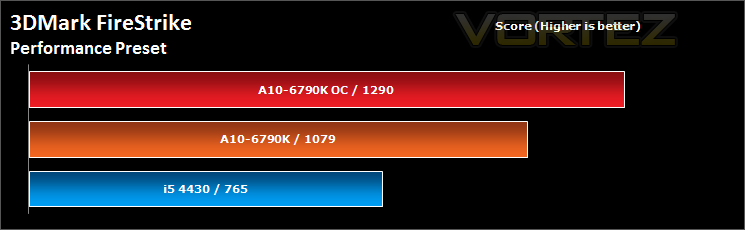
In these benchmarks, AMD dominate, much owed to the superior graphics core.
Basemark CL and PCMark 8
Basemark CL
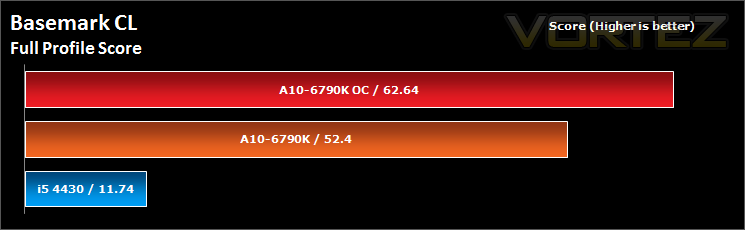
Basemark CL by Rightware is a comprehensive benchmark tool designed to measure the performance of OpenCL 1.1 implementations on various devices ranging from desktops to embedded systems. Basemark CL uses OpenGL ES 2.0 or OpenGL 2.1 for rendering, depending on the platform.
PCMark 8
PCMark 8 is the latest version in our series of popular PC benchmarking tools. It is designed to test the performance of all types of PC, from tablets to desktops. With five separate benchmark tests plus battery life testing, PCMark 8 helps you find the devices that offer the perfect combination of efficiency and performance. PCMark 8 is the complete PC benchmark for home and business.
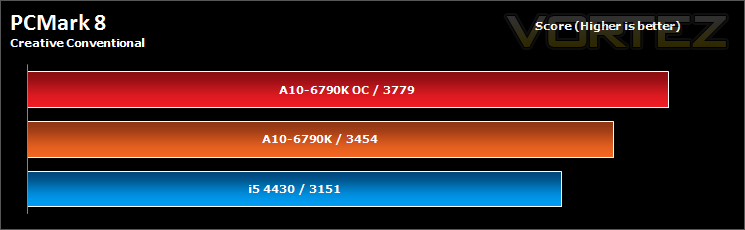
Again we see AMD dominate with superior OpenCL and OpenGL rendering, and in PCMark 8, the APU edges the i5 out.
Game Benchmarks: Tomb Raider, Battlefield 4, DiRT SD, DOTA 2
Tomb Raider
Tomb Raider explores the intense and gritty origin story of Lara Croft and her ascent from a frightened young woman to a hardened survivor. Armed only with raw instincts and the ability to push beyond the limits of human endurance, Lara must fight to unravel the dark history of a forgotten island to escape its relentless hold.
Battlefield 4
Battlefield 4™ is coming to PC, powered by the advanced technology of DICE’s proprietary Frostbite™ 3 engine. Blur the line between game and glory in Battlefield 4. With dynamic destructable environments, vehicular combat, and the chaos of all-out-war with 64 players, Battlefield 4 on PC will be an unmatched interactive experience.
In addition to its hallmark multiplayer, Battlefield 4 features an intense, dramatic character-driven campaign that starts with the evacuation of American VIPs from Shanghai and follows your squad’s struggle to find its way home.
There is no comparison. Immerse yourself in the glorious chaos of all-out war, found only in Battlefield.
In addition to its hallmark multiplayer, Battlefield 4 features an intense, dramatic character-driven campaign that starts with the evacuation of American VIPs from Shanghai and follows your squad’s struggle to find its way home.
There is no comparison. Immerse yourself in the glorious chaos of all-out war, found only in Battlefield.
DiRT Showdown
DiRT Showdown is the new arcade racing game from the team that brought you the award-winning DiRT series, uncaged in 2012. Pick up and play controls combine with electrifying events, frenzied crowds and stunning graphics to deliver high octane, dive in and drive thrills from event one. DiRT Showdown comes with phenomenal graphical performance, bone-jarring damage, and social online and split-screen multiplayer as standard. Welcome to DiRT Showdown – a new world of driving delirium.
DOTA 2
Dota is a competitive game of action and strategy, played both professionally and casually by millions of passionate fans worldwide. Players pick from a pool of over a hundred heroes, forming two teams of five players. Radiant heroes then battle their Dire counterparts to control a gorgeous fantasy landscape, waging campaigns of cunning, stealth, and outright warfare.
Irresistably colorful on the surface, Dota is a game of infinite depth and complexity. Every hero has an array of skills and abilities that combine with the skills of their allies in unexpected ways, to ensure that no game is ever remotely alike. This is one of the reasons that the Dota phenomenon has continued to grow.
Irresistably colorful on the surface, Dota is a game of infinite depth and complexity. Every hero has an array of skills and abilities that combine with the skills of their allies in unexpected ways, to ensure that no game is ever remotely alike. This is one of the reasons that the Dota phenomenon has continued to grow.
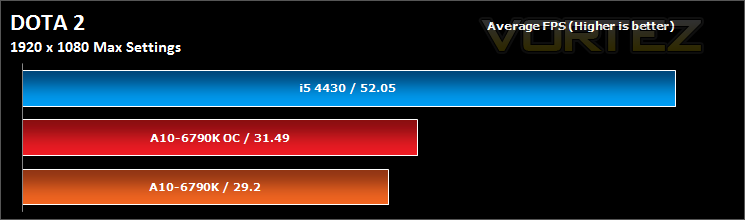
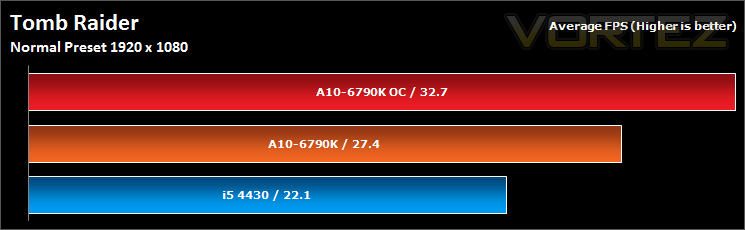
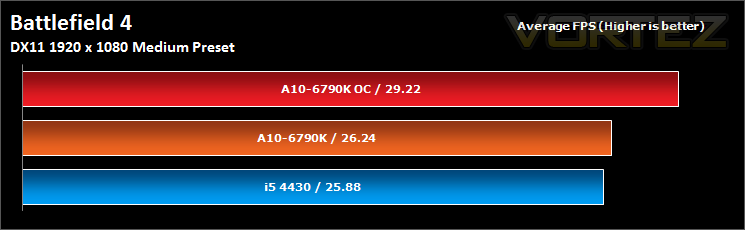
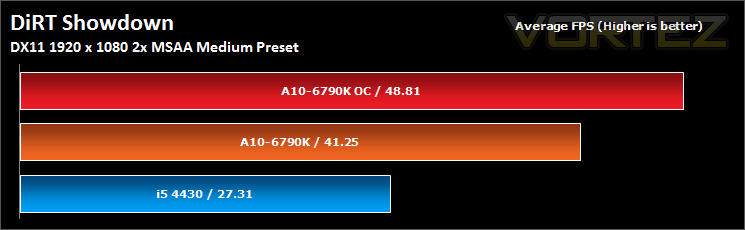
Generally speaking, both chips do reasonably well in our gaming benchmarks, even though AMD have the advantage, it does prove that some games still rely on fast CPU processing for good performance such as Battlefield 4 and most notably in the CPU friendly DOTA 2.
Conclusion
At a glance, it becomes overwhelmingly obvious that Intel have a huge lead in the CPU department. Memory bandwidth and outright CPU performance is very quick, some areas we see several factors of what the APU can give. Flipping to the opposite extreme, the Radeon HD 8670D is powerful and the utilisation of openGL, openCL and its parallel processing ability stomps all over the HD 4600, which appears competent in some real world gaming scenarios. So how do we levy an opinion on two extremes? The answer is circumstance and use. The Intel technologies certainly throw up impressive numbers, but when considered as a platform, you can get the APU and a supporting motherboard for around the same price as the Intel chip alone and the competitive balance offered by the APU makes an attractive proposition. The question worth asking yourself is, will you ever have the need for a discrete GPU? If the answer is ‘yes’, then you are most likely going to benefit from the power of the Intel CPUs, if the answer is NO, then the APU alone is likely to offer the best balance for your money.
Traditionally, the CPU was the centre of attention in regards to computer performance, then the GPU rose. As of now we have both on one chip (SOCs) and we could state the arguement ‘Why would one need so much GPU performance on a chip?’. The answer is still around the corner, for the time being we are in an age where the software we use is still playing catch-up, a good example would be the result in DOTA 2, Valve’s Source engine is nearly 10 years old and is heavily CPU dependent, which makes for a win for Intel. Though with Source 2 up and coming, could we see a more greatly GPU optimised engine? These examples ring true for many real world applications still using legacy software, though due to the frantic nature of modern mobile devices as well as games consoles, developers are pushing for more tools to enable an easier process to optimise their applications on various platforms so they can keep pace with changes in hardware. One such result of this is AMD’s Mantle. So we could counter argue and say ‘Who needs all that CPU performance anymore?’.
AMDs A10-6790K will give you the same balanced platform as the A10-6800K and cost a little less. Smiles all round, Amazing Value.
Pros.
+ Little need to overclock CPU due to high Turbo Core speeds out the box
+ Discrete level integrated graphics
+ Price
Cons.
– Lagging CPU performance
– Still using 32nm fab
+ Little need to overclock CPU due to high Turbo Core speeds out the box
+ Discrete level integrated graphics
+ Price
Cons.
– Lagging CPU performance
– Still using 32nm fab

Click here for an explanation of our awards at Vortez.net. Thanks to AMD for providing today’s review sample.


