







This year Noctua have released a collection of thirteen "redux" fans and eight accessory kits. Will we like them? Let’s find out!

Product on Review: redux Series
Manufacturer and Sponsor: Noctua
Street Price: £8.99-£13 GBP / $12.99-17.99 USD
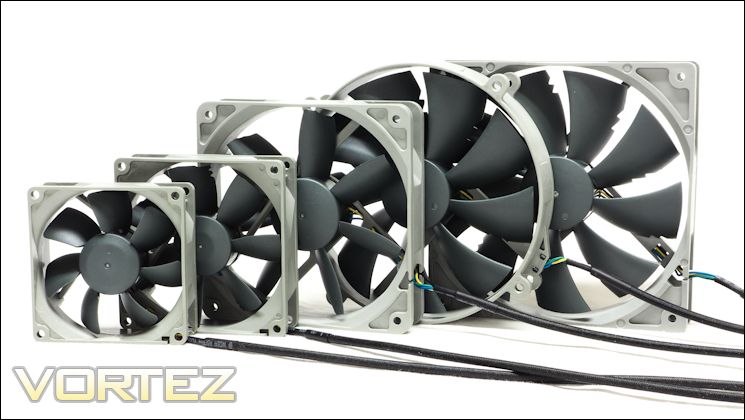
In 2012 and 2013, Noctua released A-series fans based on their new silent PWM circuit, new impeller designs and lots of little nuances that added up to new levels of performance. But then, what did Noctua do with their old fans? Now we have an answer. In May of this year Noctua have released their redux series of fans. There are 13 fans in this series. Each fan is a clone of an earlier retail Noctua fan, or a variation on one of the earlier fans, with three changes: they come with almost no accessories, they are packed in cardboard boxes that are easily recyclable, and they have swapped their old tan-and-brown color scheme for shades of gray. Oh yes – Noctua now offers their accessories as separate items. This review will cover most of those fans, and all the accessories.
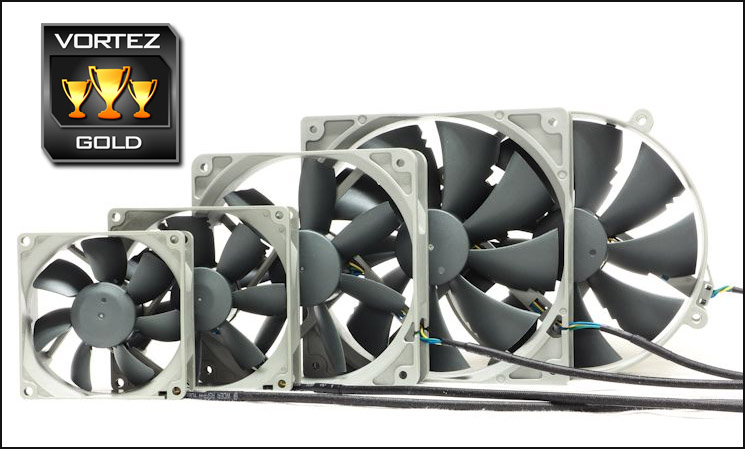
The Noctua redux fans come in four sizes and five form factors – the NF-R8 redux, the NF-B9 redux, the NF-S12A redux, the NF-P14r redux and the NF-P14s redux. Each of the redux fans has an SSO bearing, and as we shall see, except for their colors they are identical to their non-redux predecessors. All of the redux fans come with 40 cm (8 inch) power cords.
About Noctua
Noctua is a “cooperation” of the Austrian firm Rascom Computerdistribution with the Taiwanese cooling specialist Kolink International Corporation. According to information in Wikipedia (take this with a grain of salt), Noctua is a company, a joint venture between Rascom and Kolink. Whatever the legal niceties, Noctua has been delighting computer enthusiasts since 2005 with their high quality products.
Noctua has this to say about their redux fans
The redux line addresses price-conscious users by reissuing some of Noctua’s most popular, award-winning models and presenting them in streamlined, more affordable packages.
Noctua Redux Series Packaging and Accessories
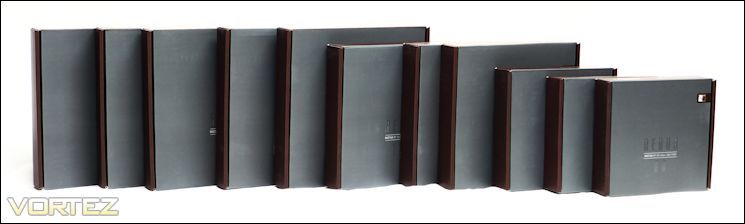
Noctua has packed all of their redux fans completely in cardboard. You can recycle every bit of their boxes, and yet the fans are properly cushioned inside. The size of the fan is imprinted on the front of the boxes. On the obverse we find a table of specifications, and on the back we have the model of the fan.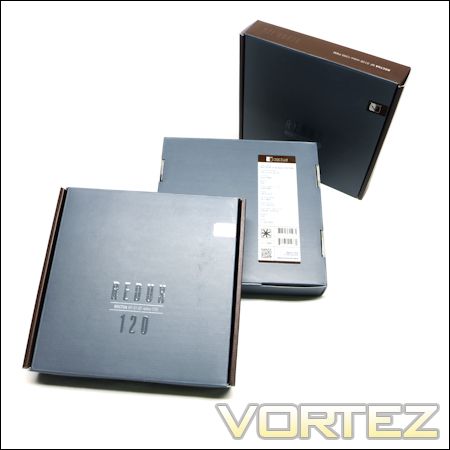
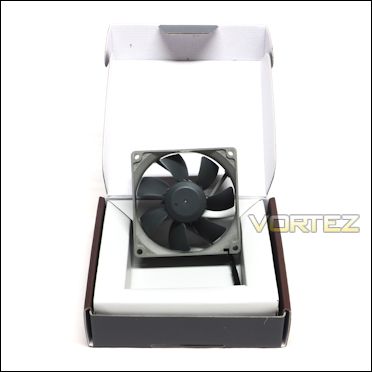
Opening an NF-R8 redux box, we find the fan ensconced in a cardboard cushion. Pull it apart and you see how you can recycle it.
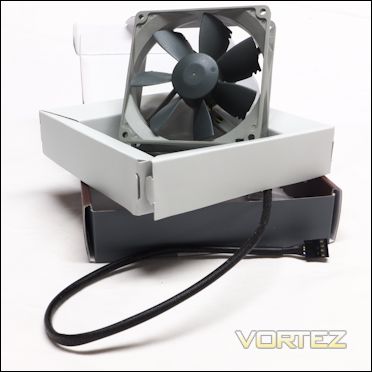
Repeating the process with an NF-S12B redux shows us how the fan fits inside the box. The second picture also shows the sole accessory that comes with redux fans: a set of four fan screws. And since all the redux fan cables are 400mm long (16 inches), an extension cable is usually not needed.
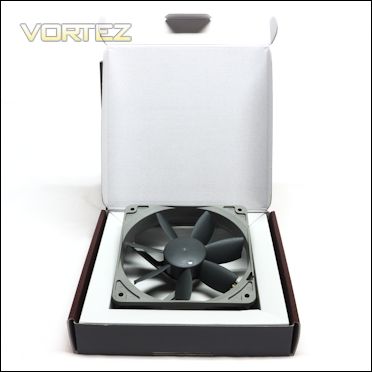
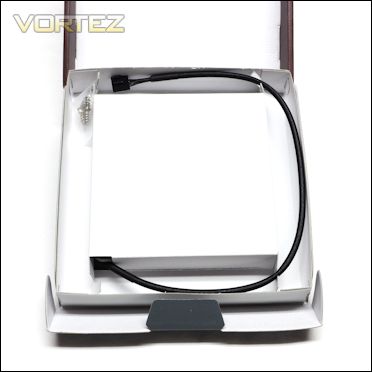
Every single redux fan looks like this. Noctua has clearly taken pains to keep the cost of this fan low. You can recycle all the packing, but these boxes store the fans damage-free, and don’t take up much room. They are definitely worth keeping around.
NF-R8 redux fans
Noctua’s NF-R8 redux series is an expansion of their 80mm offerings. Where you can get two varieties of regular NF-R8 fans, you can now get three varieties of 80mm redux fans – PWM and Voltage-controlled 1800 rpm fans and a 1200 rpm Voltage-controlled fan.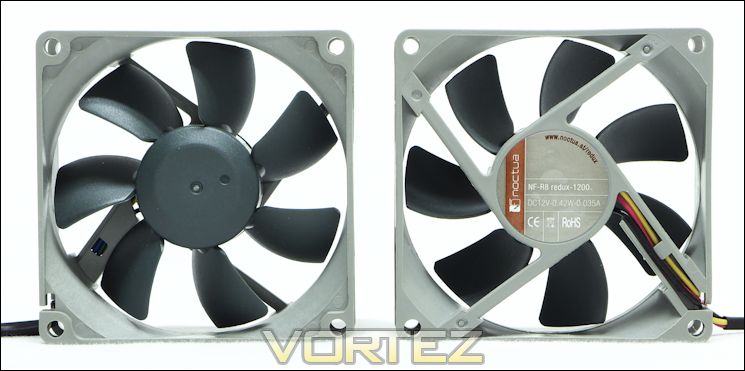
Noctua has a lot to say about this little fan:
The Noctua Raised-Blade-Design of the NF-R8 series was developed by the Austrian Institute for Heat-Transmission and Fan Technology . . . and specifically tailored to 80mm fans with extremely low rotation speeds. The result is a performance improvement of up to 10% compared to conventional blade geometries.
Both the angle of attack and the design of the blade area of the NF-R8 rotor are optimised for maximum airflow and minimum noise emission at speed ranges below 1800RPM. Raising the leading edge above the rotor hub and lowering the trailing edge below the bottom of the rotor hub results in an extended profile chord length, which compensates for the reduction in blade surface caused by the steeper angle of attack and hence increases the overall blade force. The continuous radial increase of the blade curvature towards the blade tips ensures sufficient static pressure despite of the slow rotation speeds. A significant reduction in noise emission is achieved through the rounding of the fan blades towards the rotor hub as well as the rounding of the rotor hub itself. This way, the NF-R8 is significantly more quiet than other high end silent fans at the same performance thanks to its specific optimisations for ultra low noise application.
Both the angle of attack and the design of the blade area of the NF-R8 rotor are optimised for maximum airflow and minimum noise emission at speed ranges below 1800RPM. Raising the leading edge above the rotor hub and lowering the trailing edge below the bottom of the rotor hub results in an extended profile chord length, which compensates for the reduction in blade surface caused by the steeper angle of attack and hence increases the overall blade force. The continuous radial increase of the blade curvature towards the blade tips ensures sufficient static pressure despite of the slow rotation speeds. A significant reduction in noise emission is achieved through the rounding of the fan blades towards the rotor hub as well as the rounding of the rotor hub itself. This way, the NF-R8 is significantly more quiet than other high end silent fans at the same performance thanks to its specific optimisations for ultra low noise application.
They aren’t kidding about the “extremely low rotation speeds.” All the other 80mm fans I have hanging around are 2400 rpm and higher, optimized for pushing air to cool crowded electronics. These Noctua fans clearly have another mission: quietly cooling things that computer enthusiasts have built.
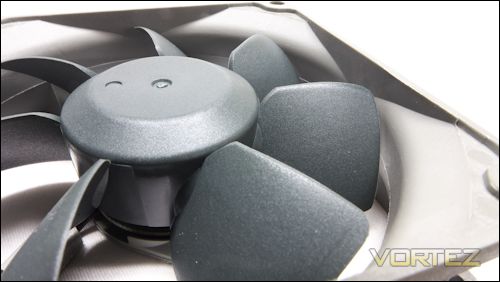
As best I can tell, these redux units are identical to the originals, except for their color.
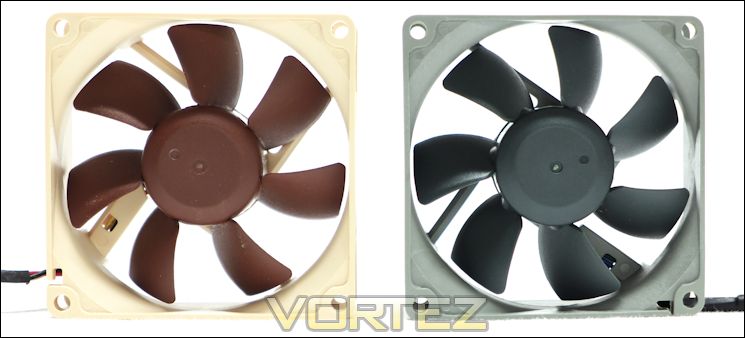
You will find most NF-R8 redux fan specifications portrayed graphically in the Results section of this review. Static pressure specs are 1.41 mm H2O at 1800 rpm, and 0.67 mm H2O at 1200 rpm.
One last bit before we move on: Noctua did not see fit to change the blade shapes on this fan. One could argue that they don’t sell enough to make it worth their while. On the other hand, Noctua has been very picky about their fans. The S12A, for example, is their third variation on that fan. This leads us to suspect that there is not much performance that could be gleaned from enhancing this fan.
Noctua NF-B9 redux fans
NF-B9 redux fans look similar to their larger brethren, the NF-S12B redux. But there are differences. While the notches can be found on a number of fans, the beveled ends hold a certain fascination.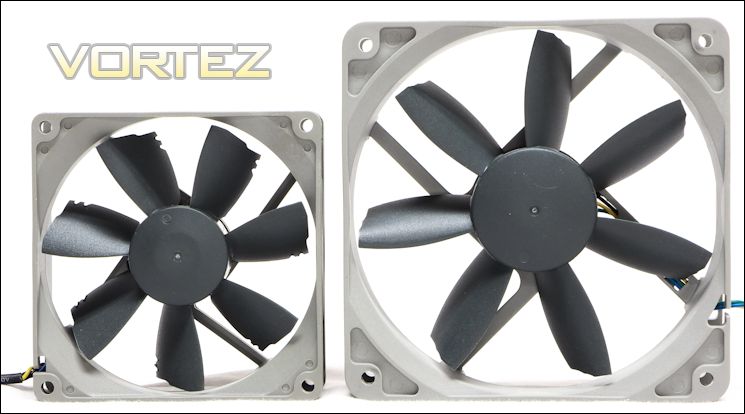
Noctua sold the 1600 rpm NF-B9 for a long time before they upgraded to a PWM fan. Even after they began selling the NF-A9x14, the shape of the NF-B9 has remained unchanged.
Noctua says this about their NF-B9:
The NF-B9’s highly-optimised blade design achieves an exceptional level of airflow and static pressure that most other fans can only reach at much higher speeds. Bevelled blade tips, Vortex-Control Notches as well as Noctua’s SCD drive system and premium-grade SSO-Bearing ensure outstanding quietness and long-term stability.
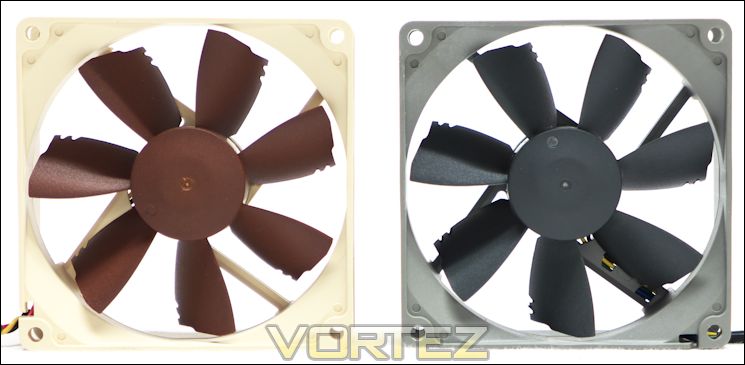
For their redux editions, Noctua adds this:
The classic NF-B9 is a long-standing favourite among enthusiast users around the world . . . The new redux edition reissues this award-winning model in a streamlined, accessibly priced package that has been reduced to the essential core: the NF-B9 premium fan.
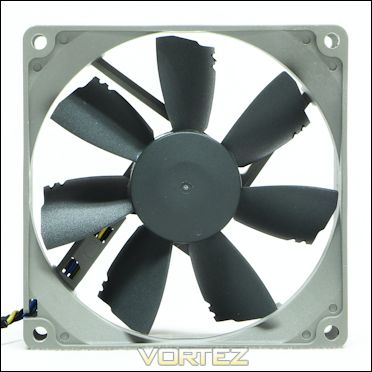
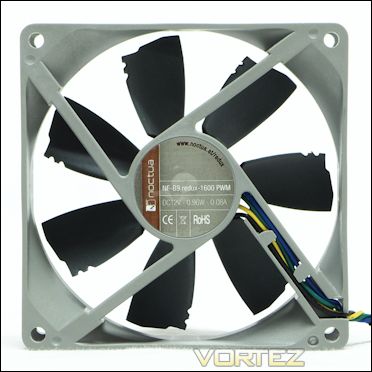
The NF-B9, PWM or Voltage-controlled, standard retail or redux, has a static pressure of 1.61 mm H2O at 1600 rpm. Other specs are to be found in the Results graph later in this review.
Noctua NF-S12B redux fans
OK. You may be reading this section out of duty. You may have no interest in the NF-S12B. It may seem like a wimpy-looking thing with skinny blades. The static pressure must be low. Why would Noctua improve such a paltry thing, going from the NF-S12 to the NF-S12B? Although they changed the colors, they changed nothing else.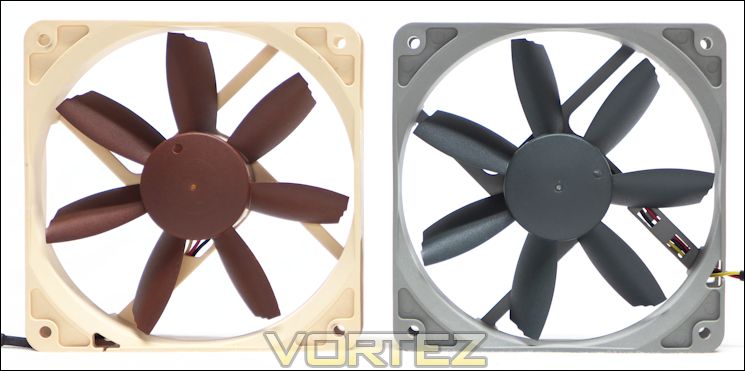
Well, for one thing, after looking at the Results graphs you will revisit this section. Or maybe this is the first time you read this section. Important note: this fan performs a lot better than you expect it to. This is a really good fan.
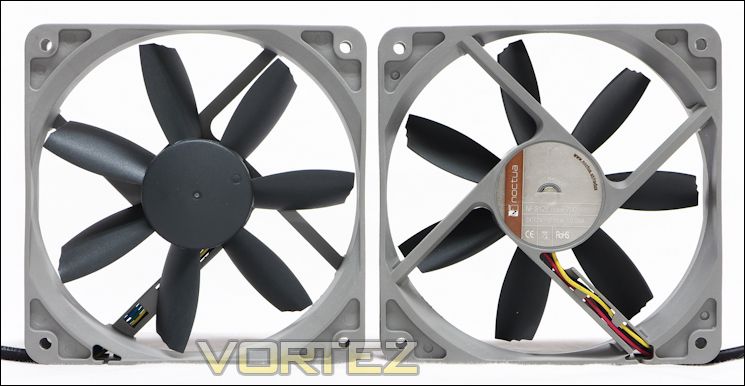
Noctua on the NF-S12B:
Specifically designed for low impedance case cooling applications . . . Typical PC case ventilation applications require high airflow but only medium static pressure. The NF-S12B has been specifically designed for high airflow efficiency and low noise in order to provide best results in these so called low impedance applications.
And they say this about their beveled blade tips:
Reducing critical rotor stator interaction, Bevelled Blade Tips permit to combine extended leading edges and a higher blade surface area with quieter operation . . .
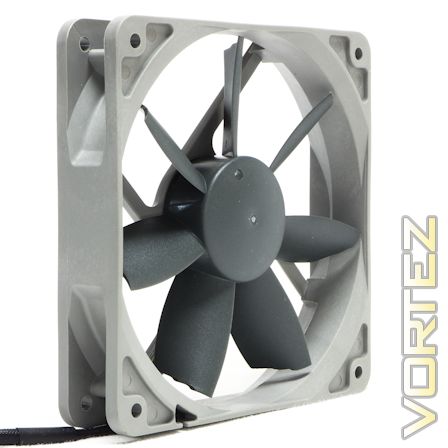
The NF-S12B redux-1200 has a static pressure of 1.31 mm H2O for both PWM and Voltage versions. The NF-S12B redux-700 has a static pressure of 0.44 mm H2O. But the bottom line on any fan is how well it pushes air, and how quietly it does so. Check out the Results section to see the bottom line on this fan. In emphasizing “low impedance” situations, Noctua may be selling this fan short.
Noctua NF-P14 redux fan series
The NF-P14 FLX has exploded into five models in its redux avatar. Four are square frame models: the NF-P14s redux-1500 PWM, the NF-P14s redux-1200 PWM, the NF-P14s redux-1200, and the NF-P14s redux-900. With the square frame P14’s Noctua has fulfilled the dreams of many enthusiasts: an NF-P14 perfectly fitted to be a case fan.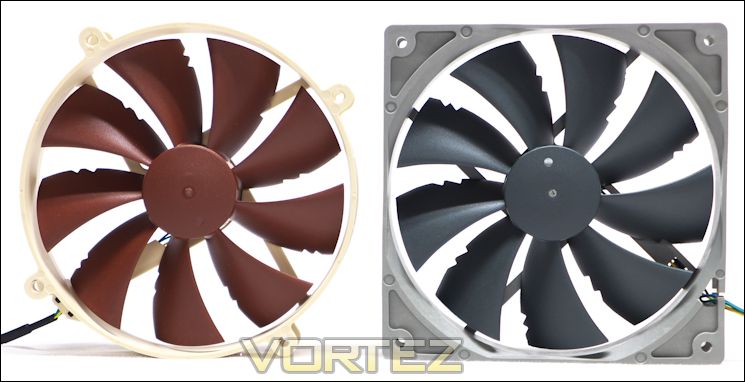
Not only did Noctua put its NF-P14 into a square frame, they continued to produce the NF-P14 in the classic round frame – the NF-P14r redux-1500 PWM. True, it is faster than its 1300 rpm predecessor, but it has PWM control to allow it to range up and down the speed spectrum.
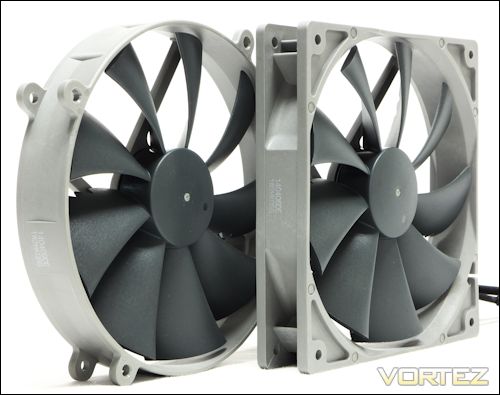
Noctua has this to say about their NF-P14:
Many 140x140x25mm axial fans tend to suffer from low static pressure, making them less suitable for use on CPU coolers or watercooling radiators with tight fin spacing. The NF-P14 on the other hand features a highly optimised nine blade impeller design that’s following in the footsteps of Noctua’s successful NF-P12 and has been carefully fine-tuned for both airflow/noise efficiency and outstanding static pressure. As a result, the NF-P14 lends itself not only to use as a case fan but also to high-impedance applications like CPU cooling. . . . Thanks to its psycho-acoustically optimised nine blade impeller with staggered Vortex-Control Notches, the NF-P14 combines superb quietness with exceptional airflow and static pressure.
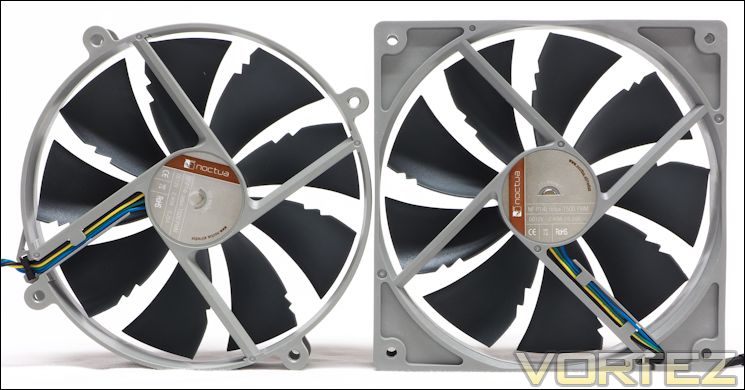
The staggered acoustic notches are evident in face-on pictures of the impellers. The 1500 rpm NF-P14 fans have a static pressure of 1.91 mm H2O. The 1200 rpm NF-P14 fans have a static pressure of 1.29 mm H2O. And the 900 rpm NF-P14 fans have a static pressure of 0.77 mm H2O.
Noctua Accessory Kits
At the same time Noctua announced their industrialPPC and redux fan product lines they also announced “a wide range of accessory kits.” And that is about all Noctua says about their accessory kits. However, we note that traditionally Noctua’s full price fans come with several accessories. But the redux fans, with their focus on providing a lower cost option, come without any accessories. You buy only what you need, and Noctua provides the kits to fill those needs.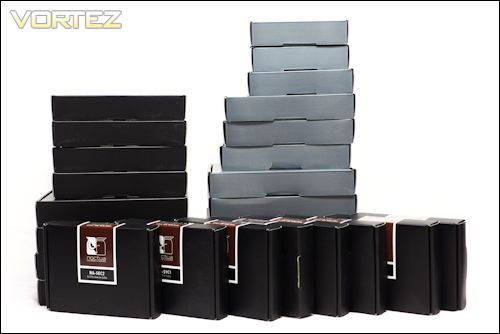
There are eight accessory kits. All but one of the accessory boxes come with two or three items.
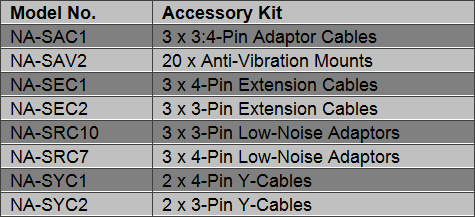
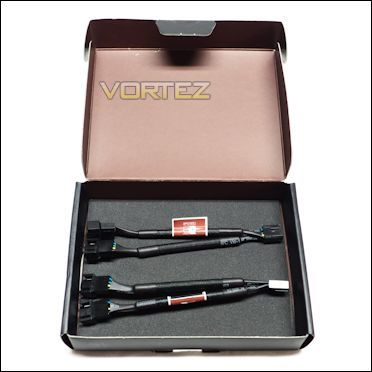
Noctua tightly sleeved all the accessories. They labeled the parts individually. The “3:4-Pin Adaptor Cables” are adapters that link 4-pin “Molex” connectors with 3-pin fan sockets. The 3-pin and 4-pin Y-cables skip the RPM lines on one arm – this keeps a motherboard from getting confused by two RPM signals.
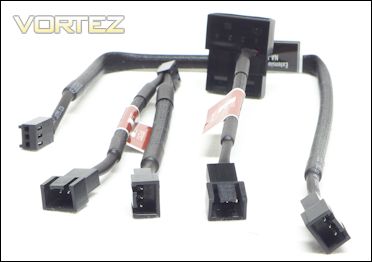
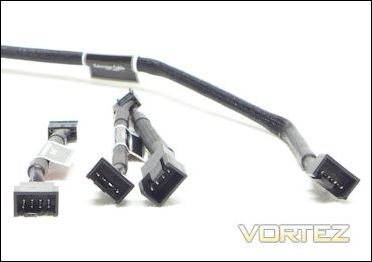
Captions: 3-pin Accessories 4-pin Accessories
Inside their boxes the accessories lie on foam beds. The “Anti-Vibration Mounts” have a little instruction sheet.
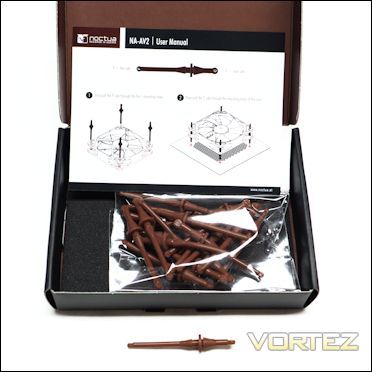
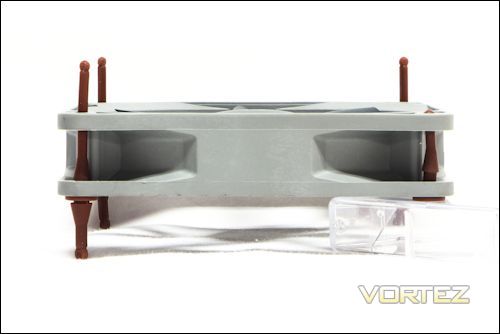
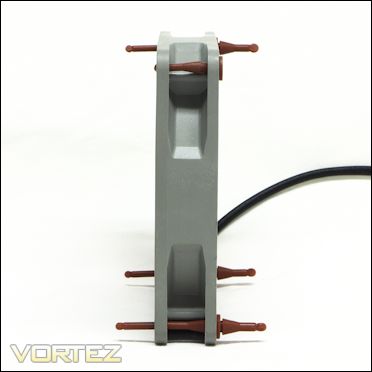
The vibration isolators are a bit special. For one thing, they are double-ended isolators. You pull one end through the screw hole in the fan, and pull the other through the screw hole in the grill the fan attaches to. This makes the anti-vibration mounts perfect for installing into blind corners. The other special aspect of these isolators is their length – finally Noctua has fan mounts that reach all the way through a fan, so you can grip them on as they come out the other side and pull them through.
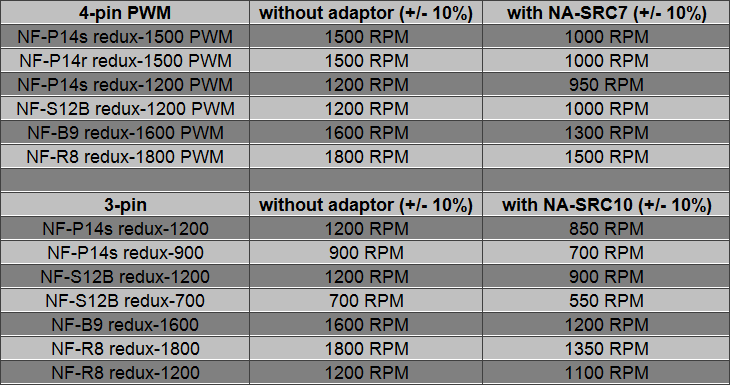
Noctua also makes Low Noise Adaptors (LNA) for their fans. A variety of these adapters come packaged with their full-priced fans. In this case, the 4-pin NA-SRC7 (for PWM fans) and the 3-pin NA-RC10 are, according to Noctua, “ideal for slowing down Noctua’s redux edition fans.”
Testing Setup
Fans have four performance aspects that can be measured: their speed (usually measured in revolutions per minute, or RPM), the noise they produce (usually approximated by measuring sound pressure level in dBA), the amount of air they transfer (usually measured in CFM) and the pressure they produce when they cannot move air (static pressure, often measured in mm H2O). Since Noctua fans report their RPM’s, the speed can be obtained directly from software. dBA and CFM must be measured. The measurement tools used in this review are the Tenma 72-942 SPL meter and the Extech AN100 Anemometer.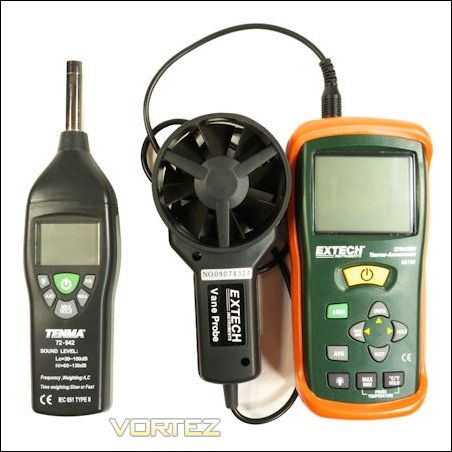
The Tenma is advertised as measuring sound pressure levels accurately down to 30 dBA. Not coincidentally, 30 dB is the SPL when you are in what sounds to you like a silent room. The SPL meter is accurate down to 30 dB, but it will measure quieter sounds. So a large cardboard box was lined with carpet and covered with a moving blanket. But instead of a making a quiet box, the carpet-lined container actually had a SPL inside that was 1 – 2 dB higher than the quiet basement it was in. And then the air blowing back carried the fan’s noise to the SPL meter, increasing the fan’s perceived noise by another 2 – 3 dBA. So, in the end, an open basement with an ambient SPL of 30.5 – 31 dBA was the quietest environment in which to measure a fan’s noise.
These Noctua fans had their SPL measured at 10 cm. A correction was applied to give the equivalent of the industry-standard 1 meter. While this is not a perfect system, it does give you a practical measure of how loud each fan is.
Fans have hubs, so the airflow is annular. The airflow also changes as you get further from the center of the fan. To get a single measurement of the airflow from a fan you must mix the air before you measure that flow. Special testing boxes were made to test these fans, with inlet and outlet holes fitted to each size class. The boxes were large enough to allow enough air-mixing that the outlets had an even airflow. The 80mm and 92mm fan airflow-testing boxes were 6x6x6-inch boxes. The 120mm fans were tested in 6x7x7-inch boxes, and the 140mm fans were in 8x8x8-inch boxes. The fans were all tested with ducts in these boxes. But the ducts distorted the airflow measurements, so the ducts were removed and the outputs of all the fans were measured again. Basically, the theory is that what goes in must come out. You measure what comes out.
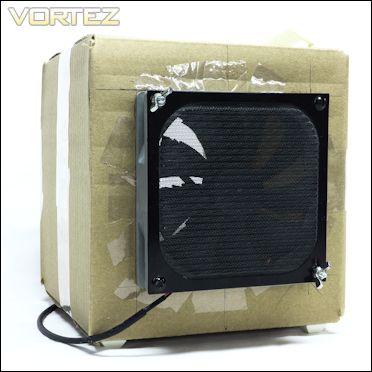
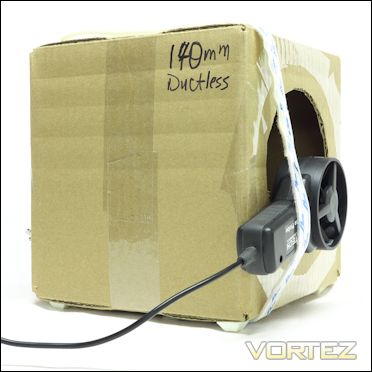
Captions: Anemometer Box with Filter, Anemometer Measurement Head
In addition to open-outlet measurements, the 140mm and the 120mm fans were also measured with dust filters made from the same metal mesh. The outputs of the 120mm fans were additionally measured as they blew through a radiator with 30 fins per inch (Hardware Labs Black Ice GT Stealth). So we will be able to see how well the larger fans pulled through dust filters, and how well the 120mm fans did that and pushed through a restrictive radiator as well. The results of these comparisons were, shall we say, interesting, and may be surprising.
Noctua provided all of the redux fans and accessories tested for this review. They provided the NF-F12, NF-P12 PWM and NF-P14 PWM fans as well. The NF-R8, NF-B9, NF-S12B, NF-P12 FLX, and NF-P14 FLX fans were all purchased retail in early 2010. The NF-P12 FLX and the NF-P14 FLX have seen considerable use.
Results of Testing Noctua redux Fans – 80mm and 92mm
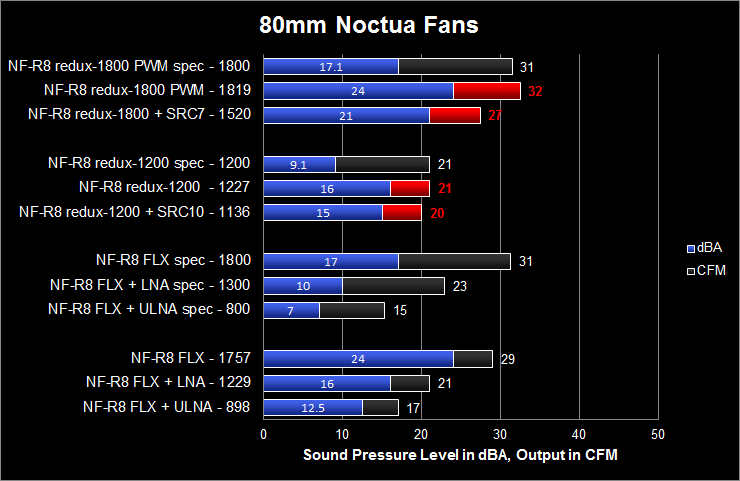
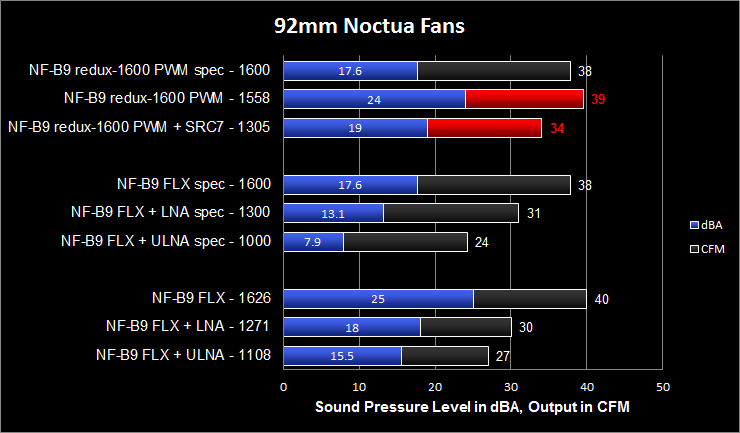
In the charts below, you can read the name of the fan, the nominal or the actual RPM in free air, the sound pressure level in free air (in dBA), and the output of the fan in CFM. The charts have the same scale. What is readily apparent is that these fans meet their published specifications, and that the redux really do seem to be identical in all but color to their tan and brown predecessors.What you can’t see if the sound – or lack of it – that these fans made. Even less than a meter away you can hardly hear the 12.5 dBA and the 16 dBA specimens. Another thing you can’t see in these charts: you can put your ear right up to these fans and you won’t hear any bearing noise or any clicking. These are indeed quiet fans. Finally, the versions with higher sound pressure levels do not sound as loud as their SPL numbers would suggest. Noctua has done a great job in transforming the sound so there is less noise.
Results of Testing Noctua redux Fans –120mm
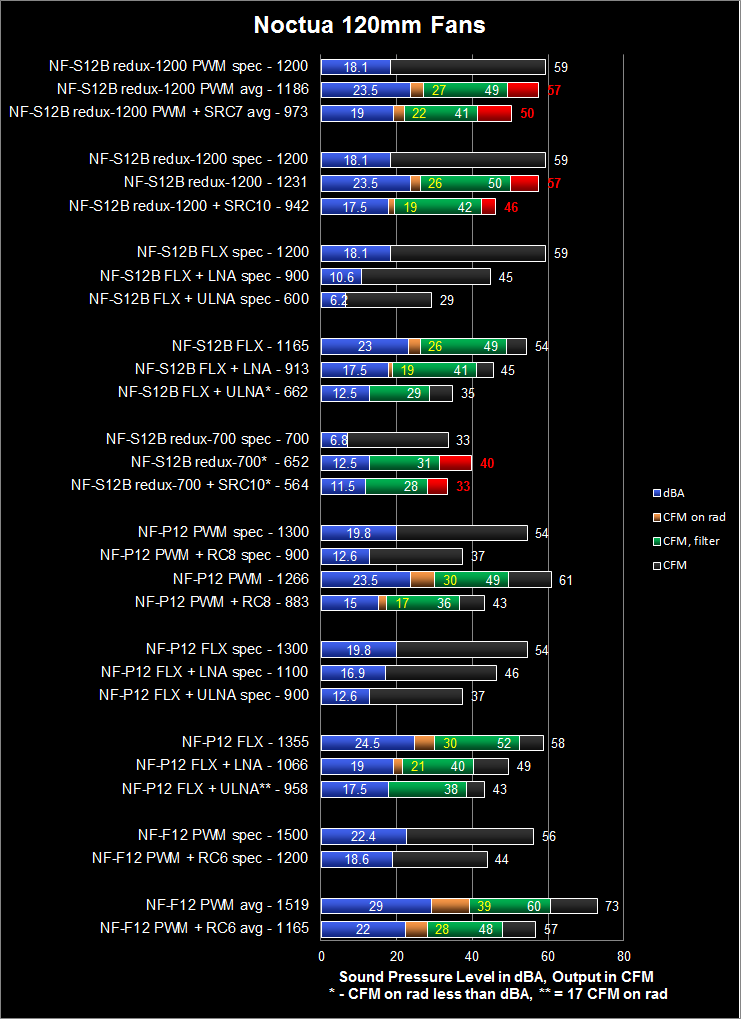
Listening to the Noctua fans, one is struck by how quiet they sound. Remember that we can only approximate the noise a fan makes by measuring its sound pressure level. Comparing these to fans with similar SPL’s, they just sound quieter. Also, as you would expect from Noctua, there is no clicking and no bearing noise. To re-emphasize: no clicking, not even from the PWM fans.The chart below compares a number of Noctua 120mm fans. The redux fans have red results, both plain and on their resistor wires. Where you see “avg” next to a fan’s name, the results are an average of two fans. The surprising results are these: the NF-S12B results stand up to those of the NF-P12! They push air through a 30 FPI rad and pull air through a metal mesh filter as well as the NF-P12’s do. The NF-S12B is one fine fan. It is also quiet – quieter than its SPL numbers would have you believe.
Results of Testing Noctua redux Fans –140mm
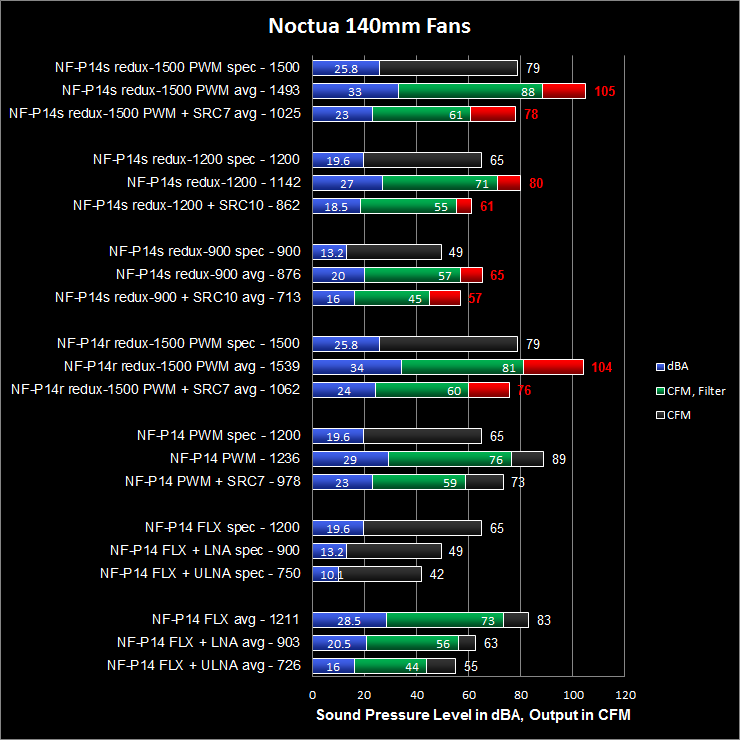
140mm fans push more air than their smaller brethren, and they hardly make more noise doing it. Even though the fans may show up as having an adjusted sound pressure level in the 20’s, they make less noise than fans with similar SPL: they sound quieter. These Noctua fans again make no bearing noise; there is no clicking from any of them. Clicks don’t show up on SPL meters, BTW. You can only listen and report what you hear.The chart shows us that these fans match their specs and they are the same as their full priced predecessors. They also pull a lot of air through dust filters. Where you see “avg” next to a fan’s name, the results are an average of two fans.
SSO Bearing
Noctua was proud of their SSO bearings. They allowed some users to put Noctua fans where they would blow upward – something a sleeve bearing fan cannot do. They also allowed Noctua to offer a six-year guarantee on their fans. That was something you didn’t have from other OEM’s.Noctua SSO bearings have magnets. With redux fans, you can actually see the magnet peeking out from under its label. You can also see it holding up a screw.
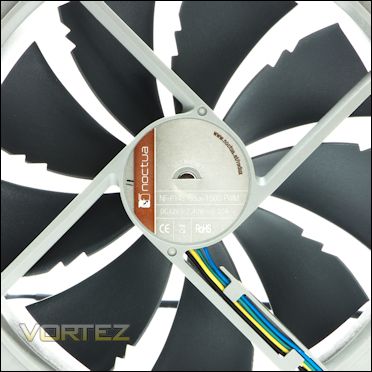
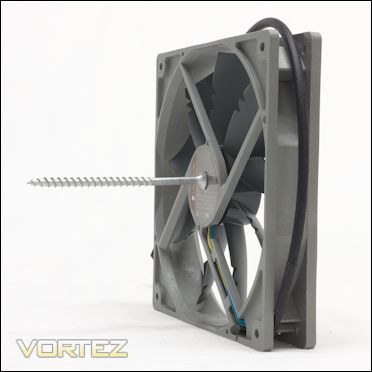
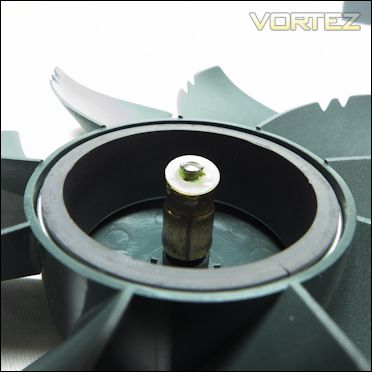
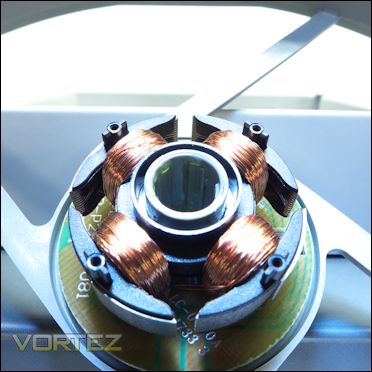
But what is really inside an SSO bearing? Well, if you carefully apply gentle pressure, the impeller pops off and reveals its core – a copper cylinder with a steel cap. Doubtless the magnet pulls on the cap and keeps it in the frame, no matter what its orientation. The core fits nicely inside the motor assembly, which has grooves for recirculating lubricant. Such a simple thing to work so well. BTW – don’t do this to your own fan; When it was popped back together, the fan only ran at 90% of its old speed.
Availability, Pricing, and Conclusions
First of all, the availability and prices of Noctua’s redux fans and accessories: as of this writing, at Amazon one can get the NF-P14s redux-1500 PWM for $18.95, the Noctua NF-P14s redux-1200 PWM for $15.95, the NF-P14r redux-1500 PWM for $18.95, down to the NF-R8 redux-1200 for $13.95. You can also pay up to $24.95 for redux fans, so be careful. They do seem to have the whole redux collection in stock. Accessory kits are $14.99. Newegg does not show the redux fans or the accessory kits.Overclockers UK seem to have a more regular set of prices, running from £13.49 (incl VAT) for 140mm redux down to £8.99 (incl VAT) for 80mm redux. Accessories are £4.99 (incl VAT).
Conclusions
This was a big release. Thirteen redux fans, eight accessory kits – and we haven’t even touched on their industrialPPC fans yet (that review is coming; watch this space). Was it worth it?
Noctua has knocked down the prices of their classic fans, changed their colors, and moved from a full course meal to an a la carte menu for their accessories. The price reduction should open up a new part of the market, the new colors will stop turning off purchasers who hate the old colors, and having the accessories available separately will allow people to buy what they need.
These are good fans. That NF-S12B is a surprisingly good fan. It was right up with the NF-P12 in pushing through the radiator. It helps that these fans are now not only price-competitive with comparable fans, they beat most of them with their reasonable prices. And let us not forget: all of the packaging is easy on the environment. It is all completely recyclable. If you have bought a heatsink from Noctua, you know it is a tradition for them. Now we see it in their fans. Good job!
The biggest pent-up demand is probably in the NF-P14s redux. The NF-P14s redux is just what many users have been asking for: a square-framed 140mm Noctua fan that can really blow through a case, do it quietly, and look great so you can show it off.
Noctua redux Pros
+ Well-proven designs
+ Quiet
+ Muted colors in shades of gray
+ Reasonable, competitive pricing
+ The NF-P14 is finally available in a square frame
+ PWM versions available for all redux fans
+ Both PWM and Voltage-controlled circuitry are free of clicking
+ Six-year manufacturer’s warranty
+ Packaging does a good job of protecting the fans inside
+ Packaging is environmentally friendly
+ Each accessory is labeled so you know exactly what it is
+ Long power cables so that extensions are usually not needed
Noctua redux Cons
– Long power cables might get in the way for some applications
A new styling theme, excellent performance and a refined accessories kit allows the Noctua redux series to pick up our prestigious gold award.

Click here for an explanation of our awards at Vortez.net.


