







Expanding on possibilities, we take a look at the successor to the highly acclaimed Xonar Essence STX. Audio enthusiasts hold your cans tightly!

Product on review: ASUS Xonar Essence STX II 7.1
Manufacturer & Sponsor: ASUS
Street Price:
£175 GBP – Without Daughter Board
£215 GBP With 7.1 Daughter Board
ASUS Xonar have made a mighty stamp in the discrete audio market and the Essence STX has long been an audiophile favourite since its release. This was due to its great performance and is easy to modify. Since then, high end audio has been pressed by the ever expanding needs of the tech savvy generation, wanting the best from whatever they put their PC to. Whether it is gaming, audio creation, HD movie playback or simply rocking out to their music library. Creative have encompassed this need fairly well with their Z-Series of Sound Blasters. Making the Xonars, such as the Essence Series, limited to just stereo channels or the majority of the entertainment series featuring 5.1/7.1 surround, but no headphone amp, look relatively disparate and too specific. Then came the ROG Phoebus, providing excellent 7.1 surround sound with a dedicated headphone amp that gave gamers a serious look into what is available in the discrete sound card segment. The Phoebus, loosely based on the Essence layout, loses some audiophile appeal when they needed to drop the Op-amp sockets in order to cram in the extra audio channels. Operational amplifiers, as they are more formally referred to, can change the characteristics of the audio either physically and/or subjectively improving the output signal. So the use of socketed Op-amps can give great appeal to audio enthusiasts who enjoy changing, swapping, and testing the latest Op-amps available or simply allowing the use of a known preference.
Following suit with the Creative ZxR, ASUS has opted to expand the PCB real estate with use of an optional daughter board, providing 7.1 surround functionality while retaining space for the relatively large Op-amp sockets. Though the design layout is almost identical to the older generation STX, there are various changes including an improved TCXO (temperature controlled crystal oscillator) clock source, new low-dropout regulators, professional level WIMA capacitors as well as coming equipped with the latest MUSES Op-amps that aims to provide the best out the box audio experience from a discrete consumer sound card. Let’s move on.
Overview by ASUS
Keeping the audiophile spirit and philosophy alive
Four years after the debut of Essence STX — the long-term holder of the number-one position in Head-Fi’s Sound Cards segment, as voted by highly-satisfied users globally — ASUS remains committed to delivering ever better high-end sound cards to delight the most demanding audiophiles. Drawing on years of experience in developing Essence One, Essence STU and Essence III, Essence STX II delivers meticulous design, quintessential performance and profound musicality — elements that shape the spirit of the whole Essence Hi-Fi series.
Four years after the debut of Essence STX — the long-term holder of the number-one position in Head-Fi’s Sound Cards segment, as voted by highly-satisfied users globally — ASUS remains committed to delivering ever better high-end sound cards to delight the most demanding audiophiles. Drawing on years of experience in developing Essence One, Essence STU and Essence III, Essence STX II delivers meticulous design, quintessential performance and profound musicality — elements that shape the spirit of the whole Essence Hi-Fi series.
Specifications & Features
Industry-leading 124dB SNR
Essence STX II delivers industry-leading 124dB SNR audio clarity, a much-envied quality inherited from the revolutionary and widely-acclaimed Essence STX sound card — and up to 64 times (64X) better than typical onboard audio hardware. Headphone output reaches a fantastic 120dB SNR.
Ultra-low jitter
A high-precision clock is crucial to audiophiles. Integrated circuits are susceptible to heat and temperature changes, which is why Essence STX II includes a premium temperature-compensated crystal oscillator (TCXO) clock source. It is an ultra-accurate timing technology that ensures ultra-low jitter.
Clean and consistent power supply
Essence STX II uses a dedicated four-pin Molex power connection rather than drawing power from the expansion slot like other cards, and that means a cleaner supply of electricity. Optimized power delivery is further assured with high-fidelity low-dropout (LDO) regulators — unprecedented in the audio-card industry. As well, audiophile-appreciated WIMA® capacitors deliver balanced sound.
Celebrated MUSES op-amps
The profound musicality that Essence listeners expect is encapsulated by celebrated MUSES 8920 and MUSES 8820 op-amps, which deliver true-to-life tonality and spacious sound imaging.
True 7.1-channel surround sound that’s easy to fit and great to customize
Exclusive to Essence STX II 7.1 is a multichannel daughterboard that delivers true 7.1-channel surround with high-fidelity 120dB SNR outputs. This easy-to-fit daughterboard slides into a slot adjacent to Essence STX II 7.1, so installation couldn’t be more convenient.
Each channel is fully customizable with nine swappable op-amp sockets — giving audiophiles complete freedom to create the perfect surround-sound experience for their ears and listening environment.
Top-notch headphone amplifier supports
The built-in headphone amplifier supports up to 600ohm impedance — so audiophiles can plug in the finest high-impedance headphones to enjoy the pure quality delivered by Essence STX II.
Exquisite headphone gain control
ASUS engineers have furnished Essence STX II with an additional gain control designed especially for high-sensitivity IEM headphones, allowing musicians and audio purists to use earpieces that channel audio output straight to the ear canal — isolating ambient noise for listening that requires undisturbed concentration.
Three swappable op-amp sockets
Essence STX II benefits from swappable op-amp sockets that allow users to create different timbres and tonal combinations.
Additional op-amp swap kit
Essence STX II even comes with a swap kit that includes three additional op-amps — two Texas Instruments LME49720s and one MUSES 8820 — and a clamp tool that makes it easy to remove the op-amp microchips.
Advanced surround sound with instant encoding
Essence STX II benefits from Dolby® Home Theater technologies that turn your PC into a true home-theater system — boosting all your entertainment audio.
Dolby® Digital Live
Reproduces Dolby® Digital 5.1-channel surround sound, immersing players in exciting and realistic entertainment experiences with high-quality surround that puts you at the center of the action.
Dolby® Virtual Speaker
Reshapes two-channel and 5.1-channel stereo content into virtual surround sound even with just two speakers, reproducing the dynamic, enveloping environment of a 5.1-speaker home theater system.
Dolby® Pro Logic II
Transforms high-quality stereo sound into rich and realistic 5.1-channel surround that completely changes your audio perception.
Dolby® Headphone
Simulates spectacular surround for personal audio by using powerful digital signal processing. It delivers up to 7.1-channel surround over any headphones for more vibrant and spacious listening.
Packaging & Accessories
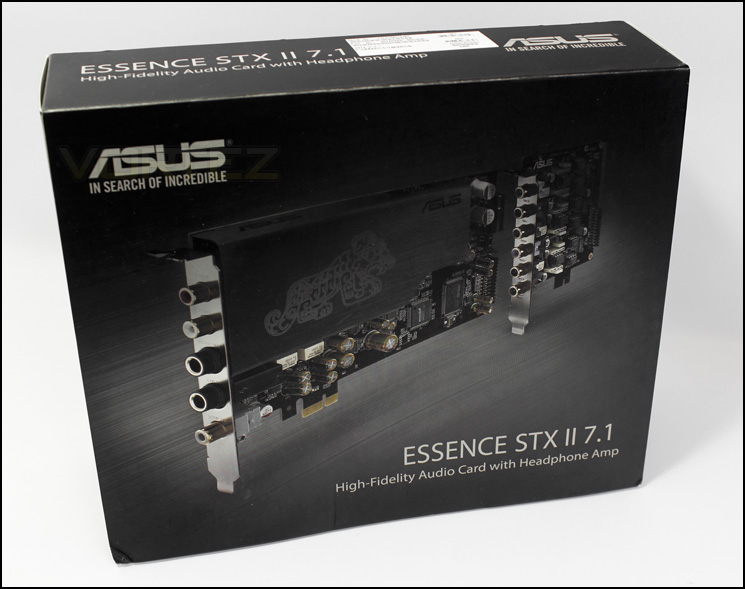
Box Front
The box packaging features a large image of the product in a sleek and stylish gunmetal style background.
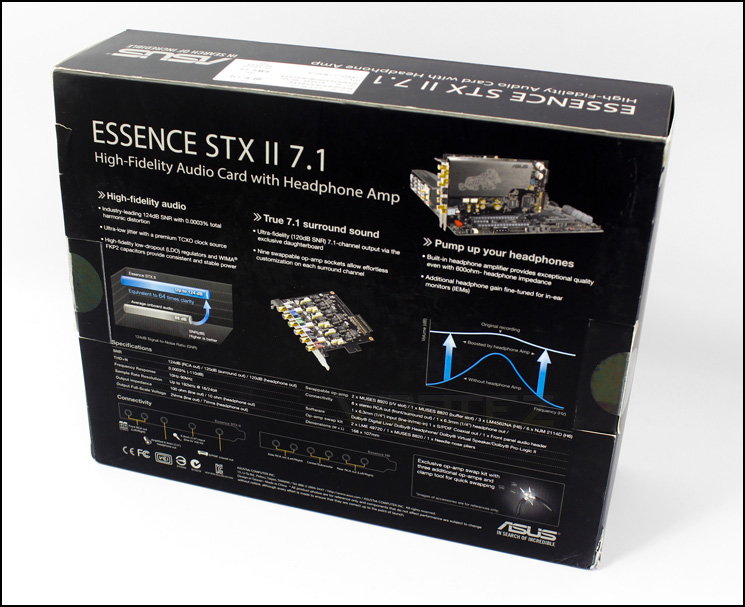
Reverse side of packaging
At the back there is details of the features and specifications of the unit.
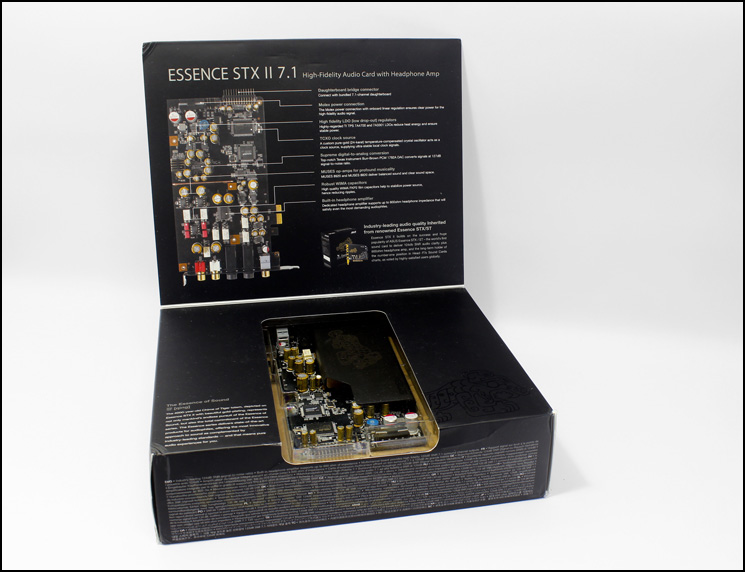
Opened up for more information
The packaging features a large flap that opens to reveal the product itself while giving a breakdown of the sound cards onboard components.
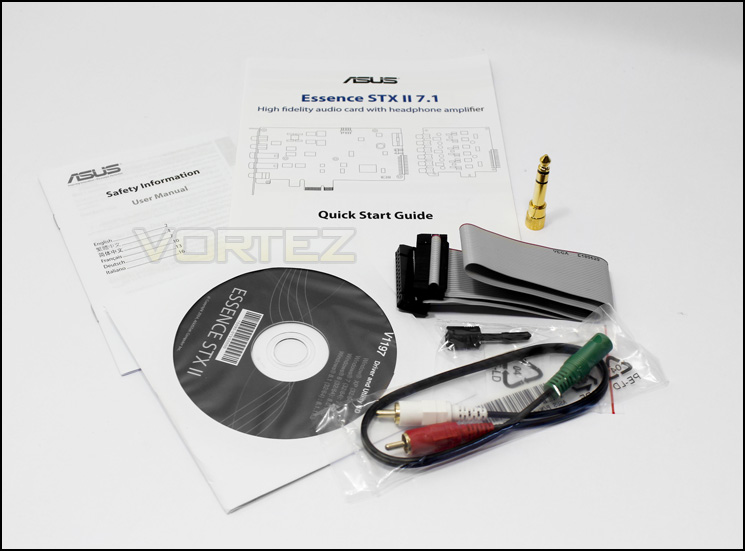
Included accesories
Included in the box there is a 6.3mm-3.5mm jack converter, driver disc, quick start guide, optical adaptor, 2x RCA-3.5mm jack adaptor and the daughter board link cable.
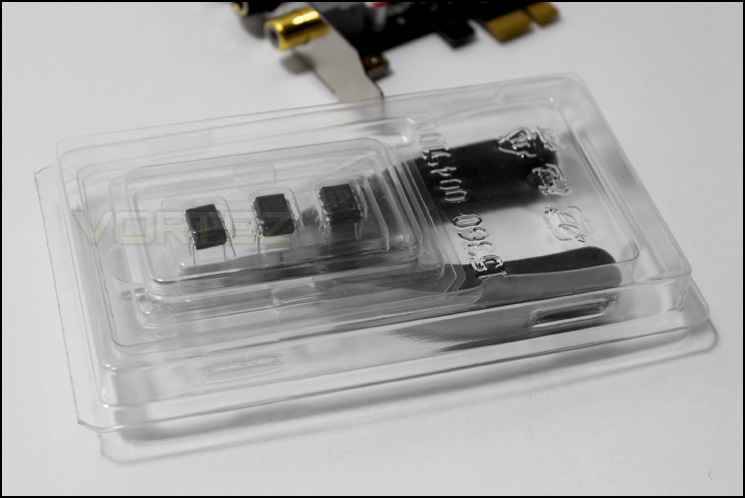
Included Op-amp kit
Included in the package we find an Op-amp kit featuring 2x Ti LME49720s and one MUSES 8820. There is also a tool to help remove the Op-amps from the sockets.
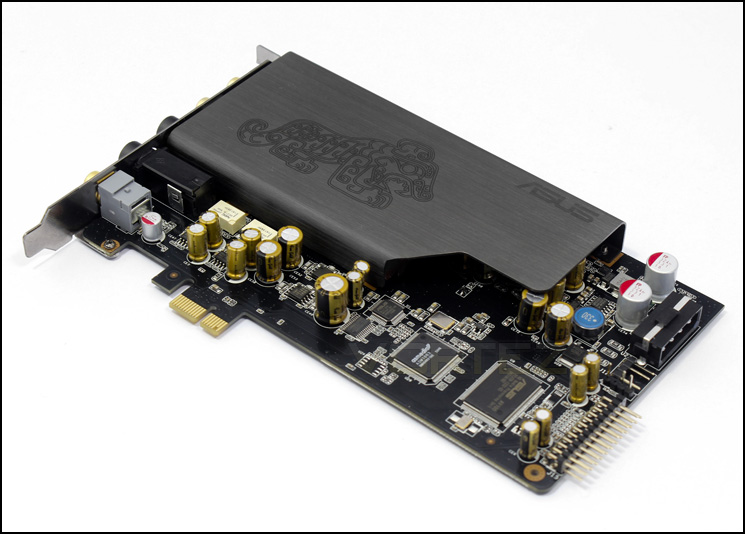
The Essence STX II
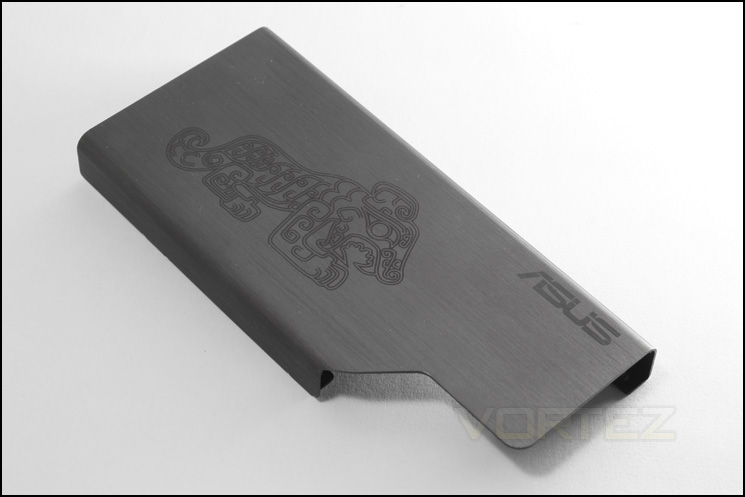
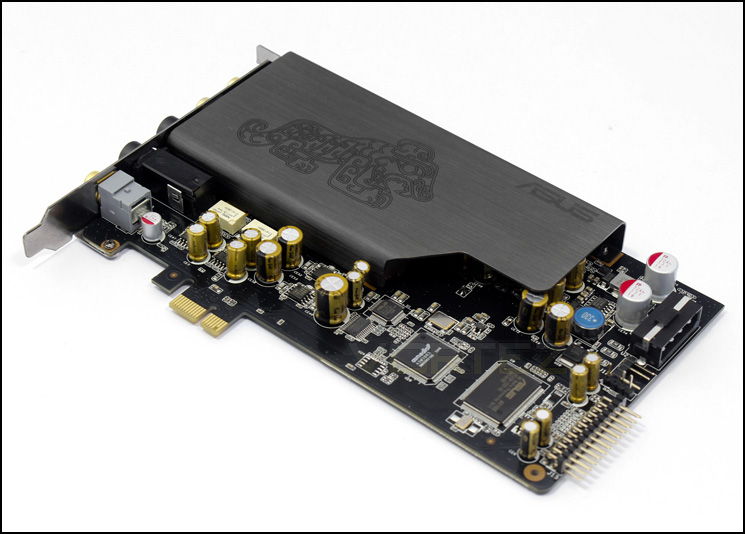
Fancy EMI shield
Tiger Tiger burning bright…
Closer Look
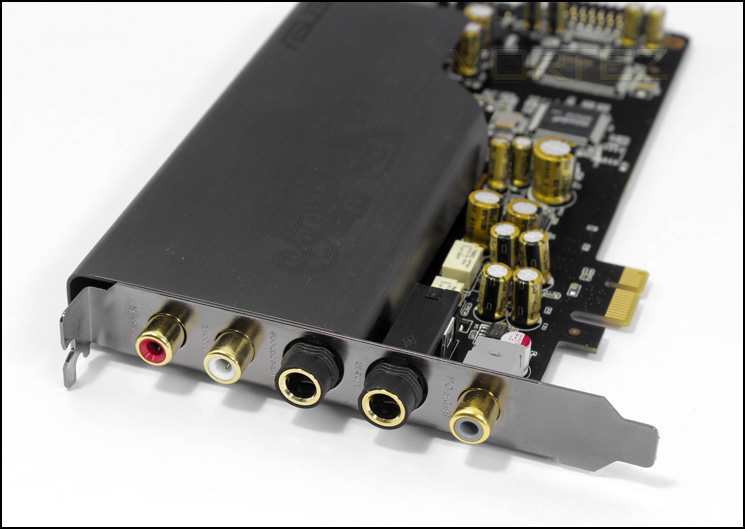
Essence STX II I/O
The Essence STX II features 2x RCA for stereo speakers, 6.3mm headphone, 6.3mm microphone/line in and S/PDIF/coaxial out.
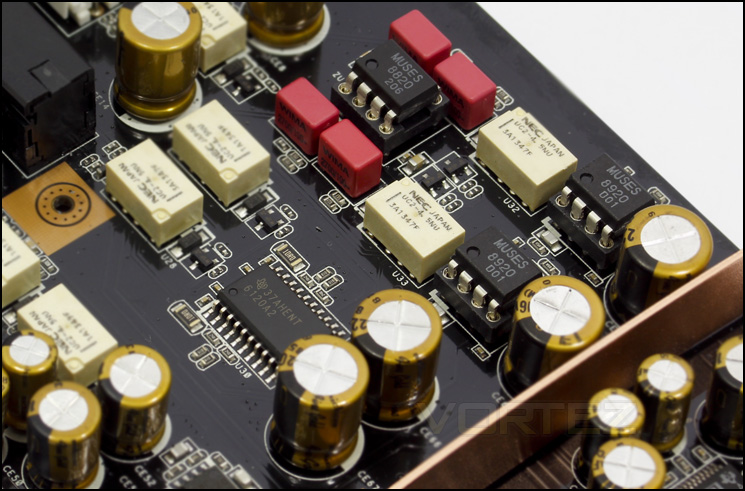
OPamp sockets
As standard, we get a trio of Op-amps preinstalled all by MUSES, the low pass filter in use is a 8820 which is surrounded by four WIMA capacitors. The right/left I/V converters are using a MUSES 8920. Just south of the Op-amps is the Ti 6120A2 headphone amplifier which is a common choice on discrete soundcards.
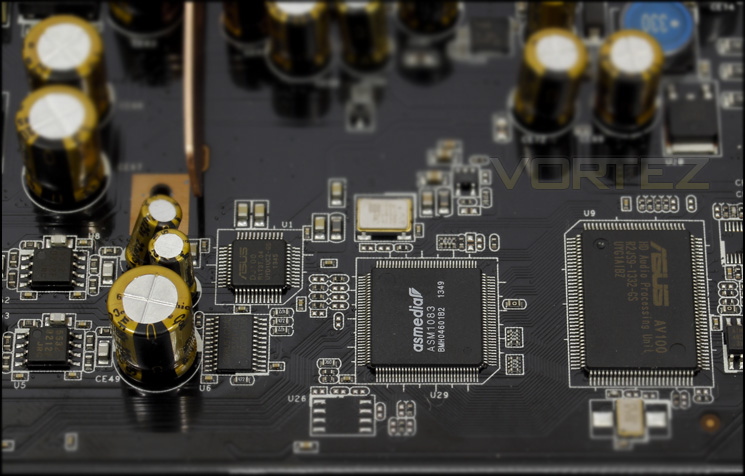
ASUS AV100 audio processor
Under the AV100 audio processor is the crystal oscillator and to the left is the new 32bit asmedia PCIe controller. In the bottom left you can just make out the CS5381 120dB Analogue-to-Digital converter (ADC).
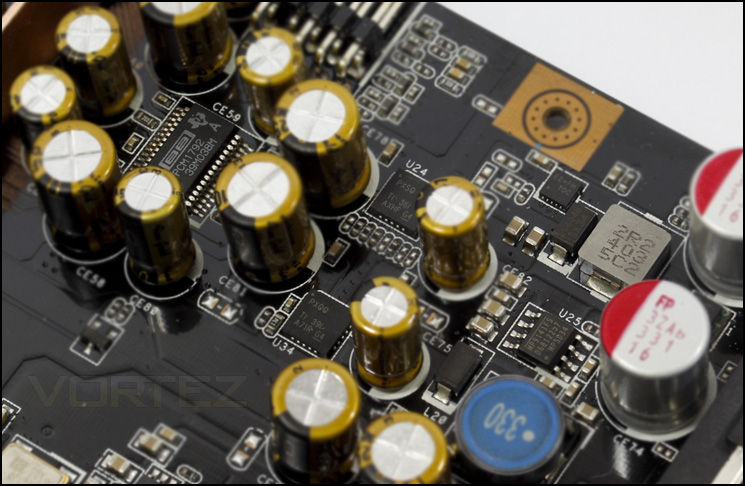
The Texas Instruments PCM1792A 132dB DAC
Just right of the Ti DAC you will see the TI TPS 7A4700 and 7A3301 LDO regulators.
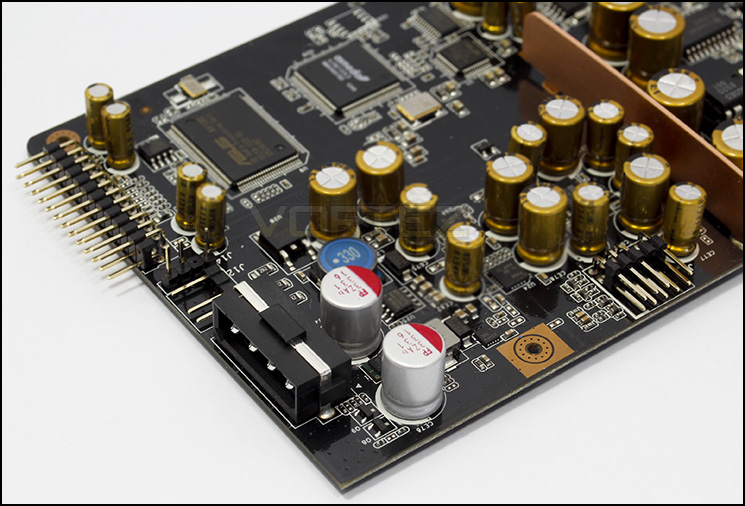
Internal I/O
The header to connect to the daughter board is one of the most noticeable differences in design layout over the original STX. There is also a front panel header, which can be an important feature for some, and for those PC enthusiasts who thought they were able to do away with those 4 pin molex cables, no such luck here. It is a shame that ASUS didn’t choose to use a 6pin PCIe connector instead as they did with the ROG Phoebus.
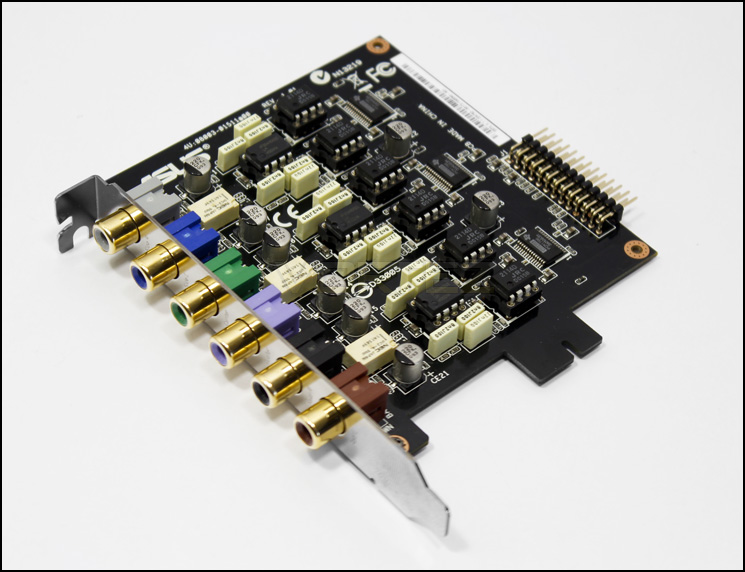
The daughter board
The addition of the daughter board allows the STX II to expand to allow high quality 7.1 surround channels with each channel individually assigned their own RCA connection.
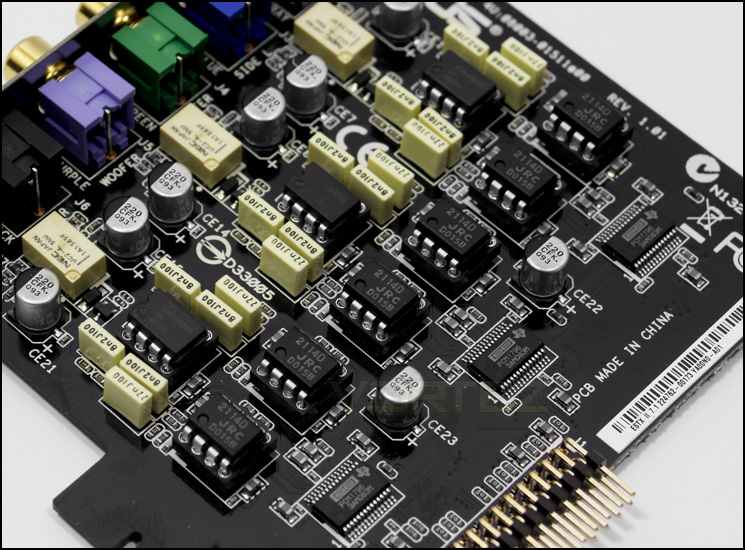
Replaceable Op-amp sockets galore, here we find good quality, albeit, more mainstream Op-amps rather than the acclaimed MUSES found on the stereo channels, though the use of sockets allow easy customisation and modification for those inclined that way.
Software
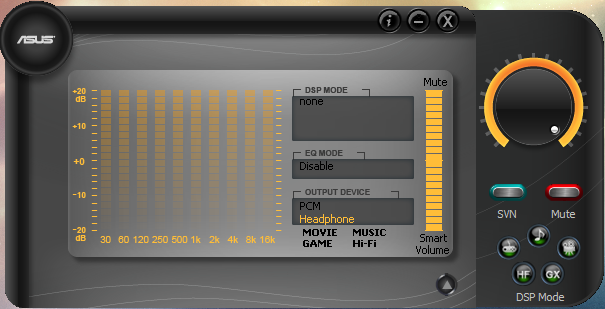
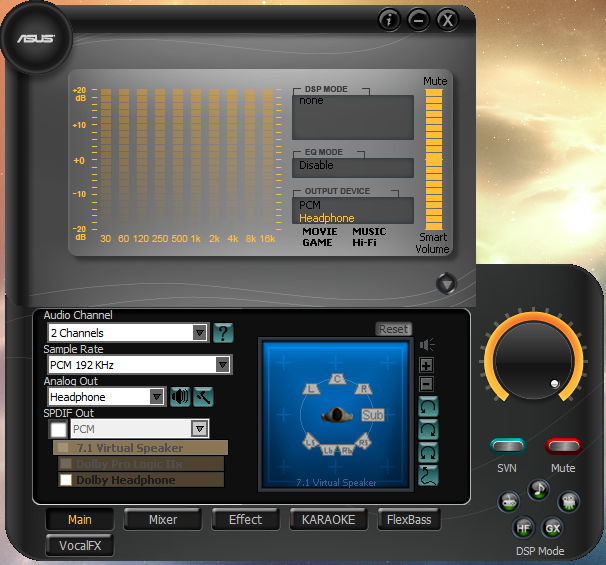
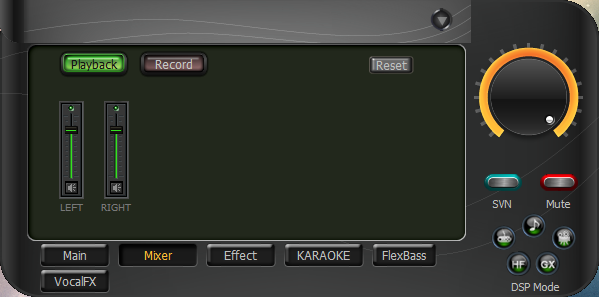
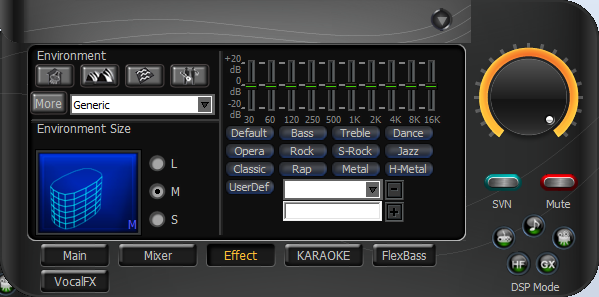
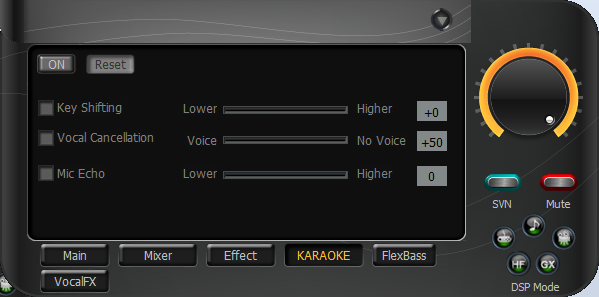
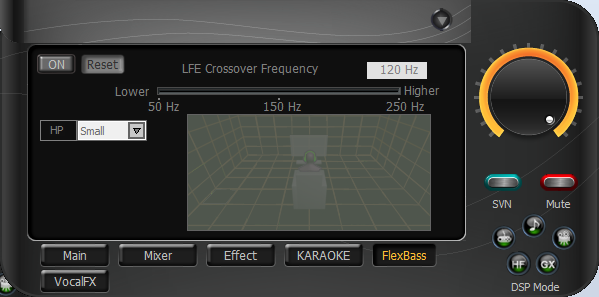
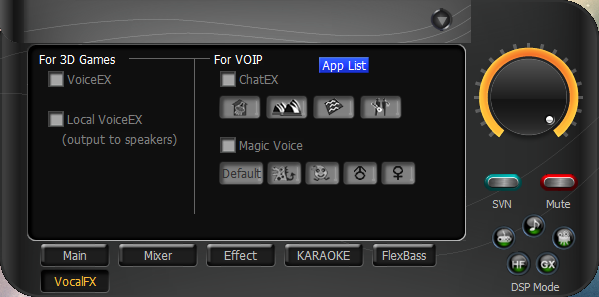
The included software is similar to the original STX, which unifies all of the functions of the sound card. It is well laid out and easy to understand and features various audio channel controls, an equaliser and easy button functions for music, movie and gaming modes. There are various Dolby technologies, including headphones, Dolby Digital Live, Virtual speaker and Pro Logic II which with the right gear, make for a powerful multimedia system. We also get controls for voice effects, crossover, tonal, crosstalk, environmental effects. Visually, it seems lacking in refinement by contemporary HD standards but it works well and is certainly more pleasing than using multiple applications.
Performance Testing
Right Mark Audio AnalyzerRMAA suite is designed for testing quality of analog and digital paths of any audio devices, be it a sound card, an MP3 player, a consumer CD/DVD player or an acoustic set. The results are obtained by playing and recording test signals passed through the tested audio path by means of frequency analysis algorithms. A more common mark is also provided for those unfamiliar with measured technical parameters.
Understanding the limitations of a test is something that should be addressed in regards to giving an accurate portrayal. RMAA is a useful tool but testing has many variables thus results are only comparable under similar set standards and parameters and shouldn’t be compared directly to other results that may have been obtained under different testing conditions. Remember that audio preference too is subjective and numbers do not tell the full story.
In this test, I compare the STX II both by back looping (connecting stereo out to mic/line in), and by Stereomix, this way we can see a general trend in ‘real world’ performance and in ‘best case’ scenario performances.
Frequency response: Closer to 0 = Better
Noise: Lower = Better
Dynamic Range: Higher = Better
Total Harmonic Distortion (THD): lower = Better
Intermodular distortion (IMD): Lower = Better
Stereo Crosstalk: Lower = Better
16/44 backlooped
24/96 back looped
24/192 back looped
STXII vs ZxR via Stereomix
In the back looped tests the ASUS Essence STX II proved to be surprisingly exceptional, particularly in the 16/44 tests, this is again proven in the Stereomix test vs the Creative SoundBlaster ZxR, this is worth noting because most, particularly older, game audio is made at this bitdepth/sample rate, while modern gaming audio is moving into the 24bit audio realm as memory permits, it is nice to know that the STX II handles every range well. The ZxR manages to even things out in the 24/96 and 24/192 areas but the STX II manages to just edge it out a little.
Below shows the graphs of the STX II handling 16/44 vs the ZxR.
Frequency Response gets a little wobbly on the ZxR after 2KHz.
The STX is clearly keeping the noise down.
Harmonic Distortion gets a little spiky over 2KHz on the ZxR
Intermodular Distortion kept tight under control by the STX
Performance Testing: Continued…
Setup, Design & Observations
Set up was fairly simple, the same as plugging in any PCIe device, it is recommended to use a spare PCIe x1 lane for the daughter board to provide stability (not electronically needed). The large, ugly, grey ribbon cable that connects to the daughter board could have been more discrete as it gives reminiscent feels of IDE days of past, if that wasn’t bad enough you will have to throw in an ugly old molex power cable to power the Essence STX II too. Regardless of orientation of the daughter board (whether you choose to mount it above or below the STX II), it would have been nice to have a matching EMI shield, this may be a matter of form over function, but appearances can make a difference.
Another interesting observation is about the included Op-amps and Op-amp kit, firstly, the kit includes needle nose pliers rather a correct IC removal tool, so be careful when using it. The included pair of Ti LME49720 Op-amps are also very good quality to which one could argue whether the inclusion of the ‘mainstream’ versions of the MUSES Op-amps and the Ti LME49720 is worth it over simply including the flagship MUSES 01/02? Regardless, it is an interesting approach to the STX II and not many will complain about it considering the possible combinations available.
Multi-Media
Headphones
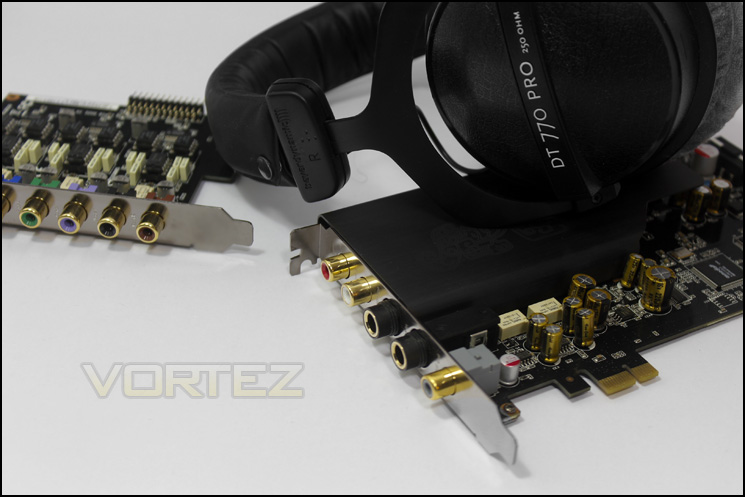
Using the Beyerdynamic DT770 PRO headphones, I listened through a selection of music to which I am familiar with in Flac format as a way to determine output performance subjectively. Being used to the output performance of the Creative ZxR, which uses the same headphone amplifier, I could determine that there was a fair improvement in accuracy and brightness but I also noticed a flatter and less refined bass. Swapping out the two MUSES 8920 Op-amps for the Ti LME49720, I found the bass to be noticeably tight and impressive, resulting in a much more enjoyable music playback experience. Having set the gain level up to 300 Ohm for the 250 Ohm Beyers, the STX II seemed a little less capable of driving the DT770 than the ZxR, though this was not a major concern as the max volume was perfectly adequate regardless. For sake of mentioning as it could be significant to some, I have not experienced noise, hiss, or background interference in any sound card setup I have used (except in some USB headsets) even while idling at max volume. Static hiss can be introduced by various sources such as poor EMI insulation, faulty circuitry, ‘dirty’ power or interrupted power supply, or simply poor quality headphones.
In gaming, the Dolby Headphone, simulating multichannel through stereo, was surprisingly very good. The virtual surround channel created an incredible sense of immersion and directional audio, significantly better than what I had experienced before from such a feature (notably with the Corsair Vengeance 2100 which too was pretty decent). Though the STX II is aimed at audiophiles, it would be unfair to rule it out for high end gaming audio, to highlight this further, the STX II also features DS3D GX and DSP Modes to take advantage of EAX and 3D environmental sounds which can be enabled in the software.
Speakers
For the first part of this test I used the Microlab SOLO9C speaker system, in absolute fairness, the tightness and precision of the STX II over the Creative ZxR was apparent, mostly noticeable at higher volumes. Producing less noise resulted in an almost flawless performance, so much so, if I didn’t have neighbours to consider, I would have been blasting music all night. In this test it has become clear that the STX II is highly capable and wouldn’t be too out of place when used with audio systems of significant worth.
To loosely test out the daughter board, I created a makeshift 7.1 surround system by adding the Logitech X540 5.1 speaker system to the SOLO9Cs, with the help of a few adaptors, I was able to fill up the centre, sub, side and rear channels on the daughter board. Watching Dredd in Blu-ray became quite epic, and while I was impressed, firstly from how well the setup I created worked, but on Muting the SOLO9C speakers, the sound output from the satellites was sharp and impressive. The fact that the daughter board can be customised is a pretty impressive addition to the STX II also.
Input Options
The Essence STX II isn’t just about quality output, but also input and creation, Supporting 24/96 recording and ASIO 2.0. However, this is where the Creative ZxR has an advantage due to having a 6.3mm input and 2xRCA input, allowing greater flexibility where audio creation is concerned. Regardless it is more down to individual requirements. Using my current ‘standard’ headset, the impressive Bitfenix FLO, a friend noted that my voice in a Skype conversation sounded Awesome, with a captial A! Stating that it was the clearest, best sounding conversation he had experienced online. Coming from a relatively cheap headset, that has to count for something!
Conclusion
The Xonar Essence STX II 7.1 comes in as a very powerful audio unit that arguably provides the some of the highest quality audio you will get from a discrete sound card out-the-box. The daughter board expands the STX II to a top class multimedia device, allowing for 7.1 cinematic surround sound, while the included drivers and software can create an outstanding gaming experience.
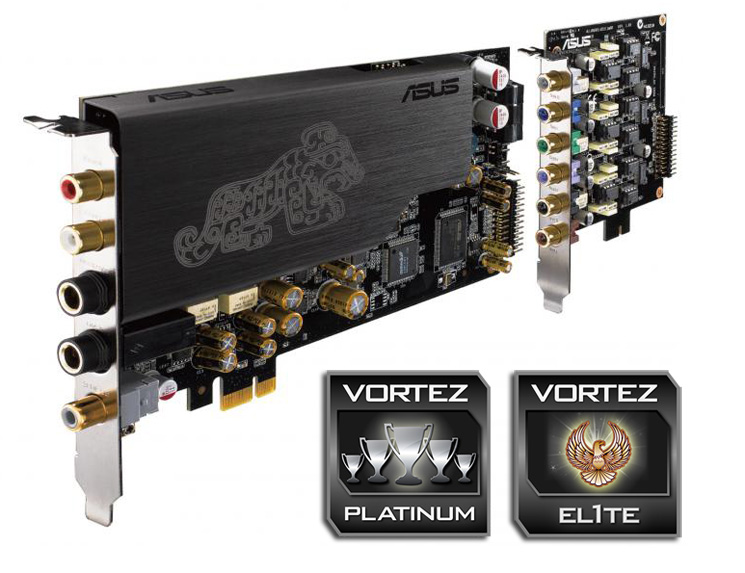
The negatives are merely a matter of cosmetics, a horrible grey ribbon cable and the use of a 4 pin molex power connection are not great things to see inside a carefully laid out PC, however there are always workarounds or modding options available. It would have been nice to see premium/ high end Op-amps in use as the stock options, rather than opting for mainstream versions + extra in a kit too. Many audio enthusiasts may already own a selection of Op-amps and the price jump over their current discrete card (likely STX owners) may make it seem like they are paying a huge premium (at £215 over the current asking price of the STX at £125) for a bundle of Op-amps they may not necessarily want or need. Regardless there are many other improvements over the predecessor, and the STX II has handled all our tests exceptionally well. Considering the competitor’s flagship is currently available for under £170 (I.E the Creative ZxR), some may find that the performance difference, especially when you could throw in some customisation money, may not be worth the extra cost, or upgrade (could even ring true for current STX owners). Regardless, that should not dampen the fact that the STX II comes out on top and takes the crown in this market sector. Remember, if you do not require the surround package that the daughter board provides, you can simply get the STX II alone for around £175. As a product, it is exceptional and provides a lot of agility in regards to audio output that, in time, will win the hearts of audiophiles. For these reasons it gains the double whammy of our highest accolades, the Vortez Platinum and El1te awards.
ASUS and the Xonar team have refreshed and expanded upon the formidable STX design, that will give top class sound quality in your music, movies and games.
Pros.
+ Top class music performance
+ Powerful Multimedia and gaming performance
+ Customisable Op-amp sockets
+ Excellent functionality
+ Comprehensive supporting software and drivers
+ Front panel header
+ Headphone amp
+ Comprehensive bundle
+ Audio enthusiasts will like
Medicore
+- Op-amp kit + tool
Cons.
– Horrible grey ribbon cable for daughter board
– Molex power needed
+ Top class music performance
+ Powerful Multimedia and gaming performance
+ Customisable Op-amp sockets
+ Excellent functionality
+ Comprehensive supporting software and drivers
+ Front panel header
+ Headphone amp
+ Comprehensive bundle
+ Audio enthusiasts will like
Medicore
+- Op-amp kit + tool
Cons.
– Horrible grey ribbon cable for daughter board
– Molex power needed

Click here for an explanation of our awards at Vortez.net. Thanks to ASUS for providing today’s review sample.


