Intel has released their next-generation of Core i7 High End Desktop processors codenamed Broadwell-E. We check out the 6900K and 6950X Extreme Edition.

Product on Review: Core i7-6900K & Core i7-6950X
Manufacturer: Intel
Street Price:
6900K – £834 GBP / $999
6950X – £1310 GBP / $1569
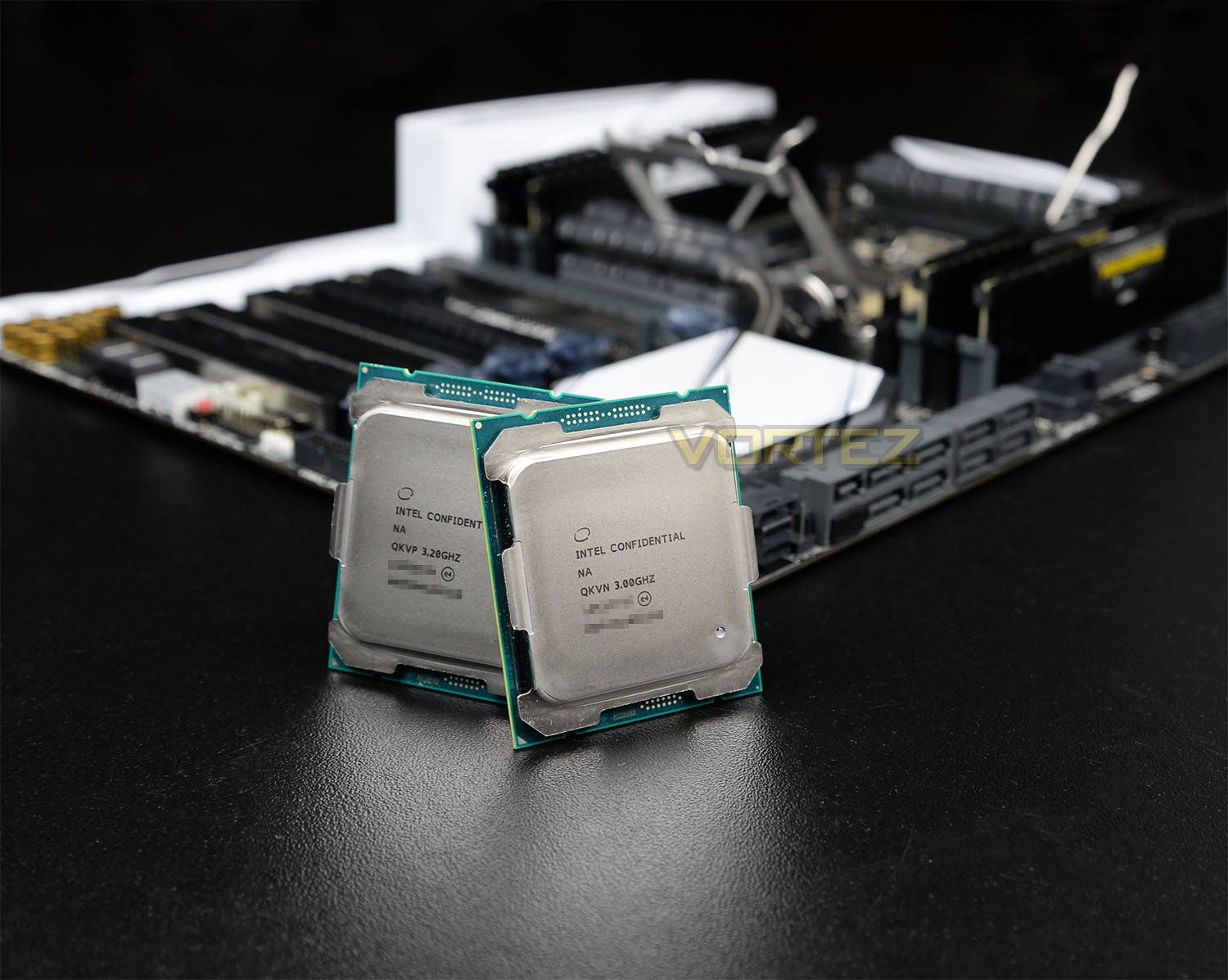
Intel’s High End Desktop (HEDT) platform has long been the last bastion of the enthusiast in Intel’s lineup. Dominating performance, flexible overclocking, and more cores than you can shake a stick at have drawn a stark contrast between it and mainstream or performance-class platform, a status quo which came into effect in 2011 when Sandybridge vastly simplified overclocking on a mainstream CPU. Haswell-E’s launch in 2014 solidified that stranglehold on the enthusiast as the first generation to support DDR4 and as many as eight physical CPU cores and sixteen threads. Broadwell-E, launched today at Computex2016, takes new steps to feature yet more cores, and sees the debut of a new price bracket for the flagship Extreme Edition CPU.
Broadwell-E is the follow-up to Haswell-E, and forms the basis of the latest generation of HEDT systems. Developmentally classed as a ‘tick’ in Intel’s nomenclature, the CPU makes use of the 14nm process node rather than 22nm seen on Haswell-E and Ivybridge-E. In common with other ‘tick’ developments Broadwell-E has key architectural similarities to Haswell-E, rather than amounting to a substantial change in underlying CPU design. Expectations therefore are tempered by realism, although it’s hoped that the die shrink will be enough to offer something new to consumers.
The headline for Broadwell-E’s release is certainly the introduction of Core i7-6950X Extreme Edition, the first CPU outside of Intel’s Xeon Enterprise-class products to incorporate ten physical cores and 20 threads. That’s a substantial evolution over 2014’s Core i7-5960X, itself a halo product with eight cores as opposed to the usual six for the HEDT platform. Compared to its predecessor it boasts a theoretical performance advantage of 25%, and continues to be a fully unlocked overclockable design in both memory and multiplier.
It’s a testament to the impact of Intel’s 14nm process that, despite the 25% increase in number of cores and very similar Base and Turbo clocks, the Core i7-6950X remains within the same 140W TDP envelope as the Haswell-E parts. The demands of an overclocked system may be higher – that remains to be seen of course – but out the box no additional cooling requirements are evident over the already established platform Haswell-E/X99.
As with Ivybridge-E before it, Broadwell-E re-uses the same motherboard platform as its previous generation. The X99-Express chipset is a well-explored design now, with dozens of different models available from a host of motherboard partners. Coinciding with the Broadwell-E launch however is a range of refreshed X99 motherboards, offering new features (functional as well as aesthetic) as well as building on lessons learned through the previous 18 months of manufacturing and user feedback. Whilst compatible, older X99 motherboards will require a UEFI BIOS update to support the new CPUs.
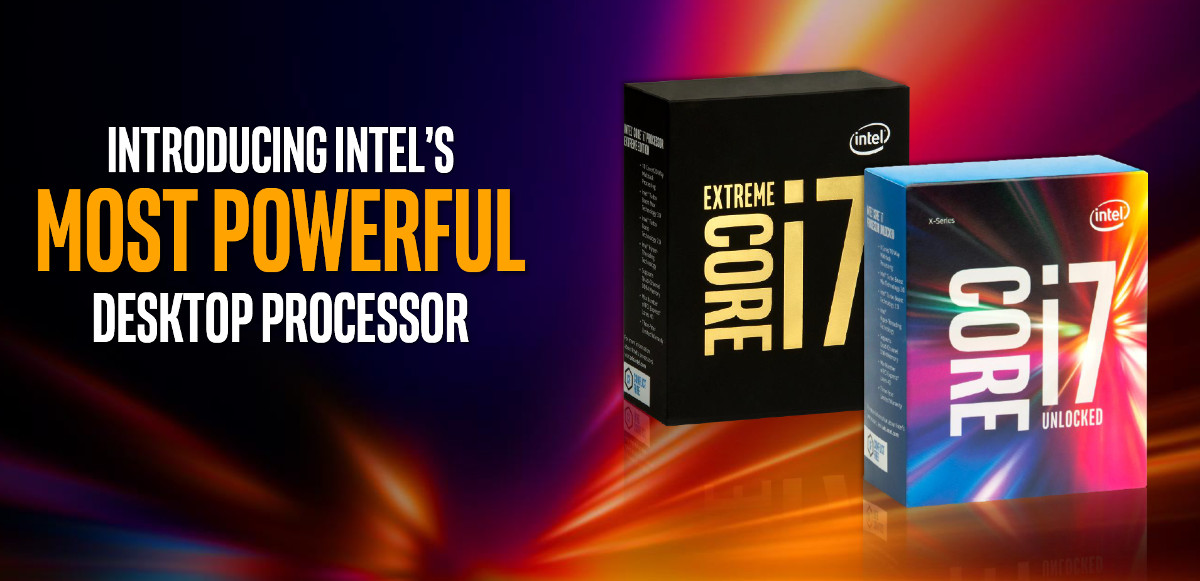
Intel’s Core i7-6950X isn’t the only CPU to launch today. Also released are the 8-core Core i7-6900K, 6-core i7-6850K and 6-core i7-6800K. Each broadly replaces an equivalent Haswell-E SKU and, whilst not the sort of major performance leap seen in the transition from Ivybridge-E to Haswell-E, a slight up-tic in multiplier and out-the-box support for DDR4-2400 should see not-inconsequential improvements in demanding tasks.
So, with three CPUs debuting to replace the current Haswell-E lineup, where does that leave pricing for the new Extreme Edition flagship? This time around Intel are debuting a new pricing bracket for their Extreme Edition design, which previously topped out at an MSRP of $999. At launch Core i7-6950X will retail for $1569 in the US, alongside a commensurate ~£1300 MSRP in the UK, which will be a bitter pill to swallow for enthusiasts looking to upgrade to the cream of the crop.
In this review we’re putting Intel’s flagship Core i7-6950X Extreme edition through its paces alongside the next best Broadwell-E model, the Core i7-6900K. Although not ‘Extreme’ in name, the i7-6900K also features an unlocked multiplier and BCLK for the enthusiast to get their teeth into.
Features & Specifications
Core Features
Intel Core i7 6900K
– 8 Physical Haswell-E cores, 16 threads, supporting Hyperthreading.
– 3.2 GHz Base Clock, 3.7 GHz Turbo Mode
– 20 MB L3 cache
– Socket LGA2011-v3
– Fully Unlocked Multiplier
– DDR4 support
– 40 PCI-Express 3.0 lanes
– 140W TDP
Intel Core i5 6950X
– 10 Physical Haswell-E cores, 20 threads, supporting Hyperthreading.
– 3.0 GHz Base Clock, 3.5 GHz Turbo Mode
– 25 MB L3 cache
– Socket LGA2011-v3
– Fully Unlocked Multiplier
– DDR4 support
– 40 PCI-Express 3.0 lanes
– 140W TDP
– 8 Physical Haswell-E cores, 16 threads, supporting Hyperthreading.
– 3.2 GHz Base Clock, 3.7 GHz Turbo Mode
– 20 MB L3 cache
– Socket LGA2011-v3
– Fully Unlocked Multiplier
– DDR4 support
– 40 PCI-Express 3.0 lanes
– 140W TDP
Intel Core i5 6950X
– 10 Physical Haswell-E cores, 20 threads, supporting Hyperthreading.
– 3.0 GHz Base Clock, 3.5 GHz Turbo Mode
– 25 MB L3 cache
– Socket LGA2011-v3
– Fully Unlocked Multiplier
– DDR4 support
– 40 PCI-Express 3.0 lanes
– 140W TDP
To reiterate, Broadwell-E is a ‘Tick’ revision in Intel’s CPU roadmap, meaning that it’s essentially a die-shrink of the previous architecture. Like Skylake therefore it is built on Intel’s 14nm Tri-Gate Transistor process, but shouldn’t see major IPC improvements over Haswell-E. It remains to be seen if the release will be a repeat of Ivybridge-E – something greeted with a relative lack of enthusiasm from the enthusiast community – or welcomed with glee by those on the cutting edge of requirements.
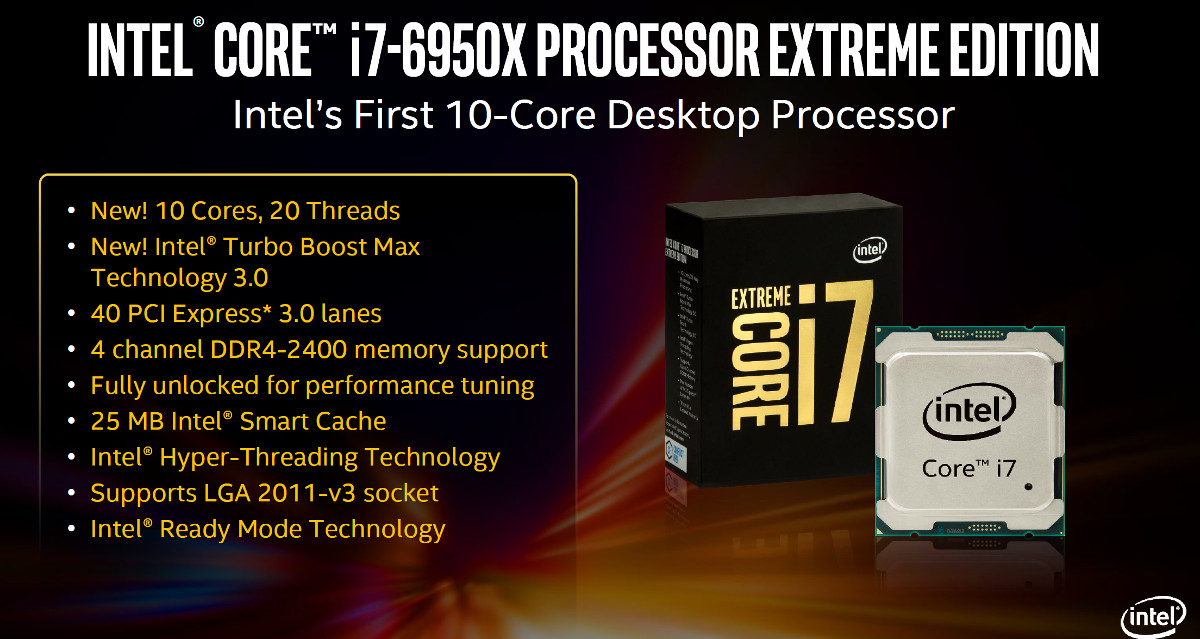
The Core i7-6950X is a 10-core CPU with 25MB L3 Cache, a steep step up over the i7-5960X’s 8-cores and 20MB L3 Cache. In common with all CPUs on this platform the 6950X supports Hyperthreading, doubling the number of supported threads per core from one to two (up to a maximum of 20 on the 6950X). The cores are clocked at a base clock speed of 3.0GHz, matching the i7-5960X, and will boost to 3.5GHz through the use of Intel Turbo Boost Technology 2.0, once again matching the 5960X.
Physically, the Broadwell-E CPU is a relatively large one with particularly dense transistor arrangement thanks to the use of 14nm Tri-Gate Transistor technology. It’s believed that the CPU shares all the hallmarks of the entry-level Broadwell-EP model, which has a 246mm^2 die and total of 3.4bn transistors compared with 356mm^2 and 2.6nb respectively on Haswell-E. As a result it’s likely to get distinctly hot under the collar, cramming more into a smaller surface area. This may have a knock-on effect on temperatures, and will mean that Intel’s choice of TIM and headspreader will be critical to successful overclocking.
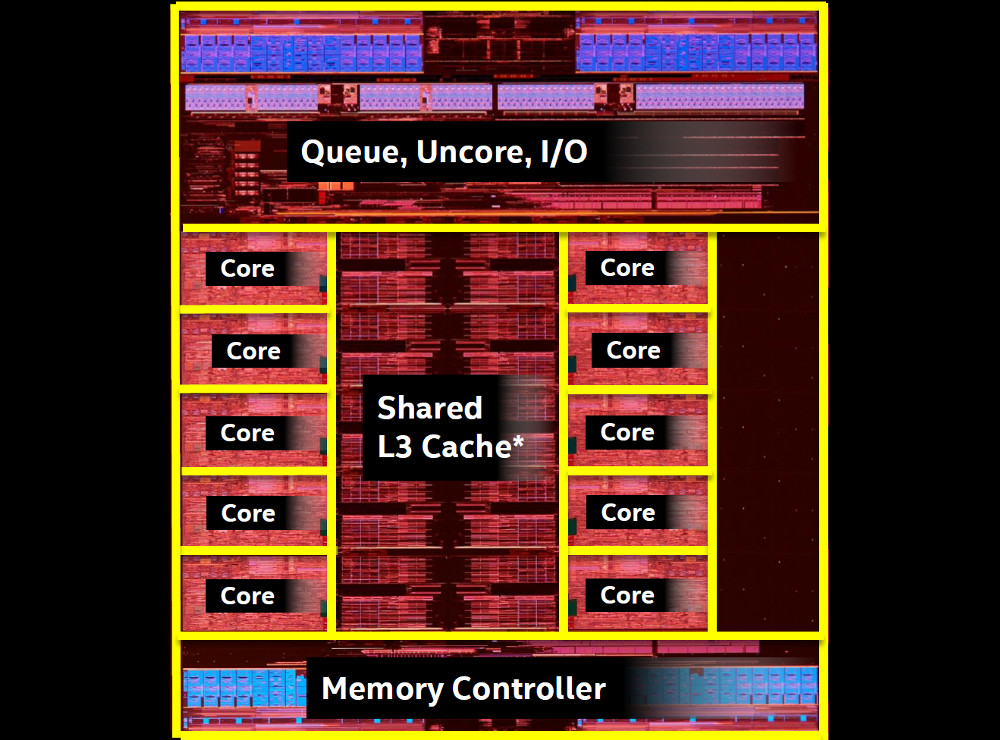
For the first time on the HEDT platform Broadwell-E will have native support for quad-channel DDR4-2400. This speaks to a slightly more robust memory controller on the new CPUs, which will hopefully have the knock-on effect of higher stable overclocks. DDR4 itself has become distinctly more affordable in the past 20 months, and one can hope that additional flexibility in compatible memory types brings with it both higher performance and more consumer choice.
Fully equipped CPUs in the family are kitted out with 40 PCI-E 3.0 lanes supported in 2 * 16x + 1 * 8x configuration, allowing the platform to natively support quad-GPU configurations without the need for PCE-E bridge chips. Only the Core i7-6800K is restricted in this aspect, limited to 28 lanes from the CPU but nonetheless still well suited to multi-GPU setups.
All Broadwell-E CPUs are compatible with the LGA 2011v3 socket, and are hence supported by X99 motherboards currently on the market (although a BIOS update might be required in some instances).
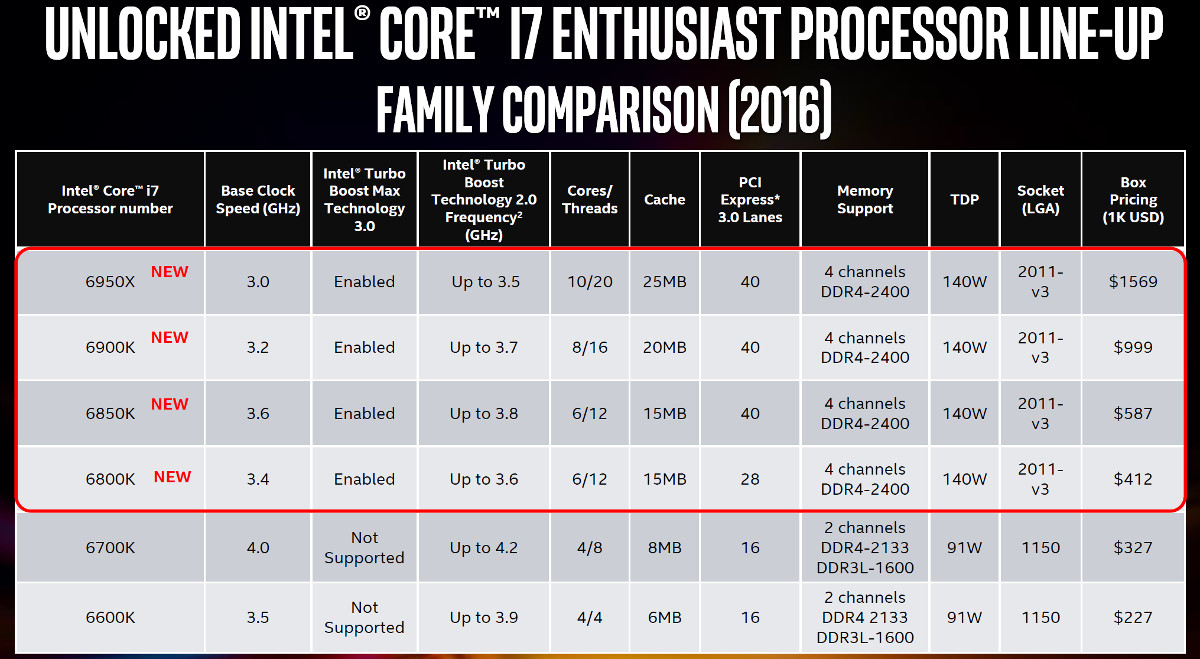
Three additional SKUs will be launching alongside the flagship Extreme Edition – the Core i7-6900K, i7-6850K and i7-6800K. Chief differentiating factors between these SKUs are the number of cores (either 8 or 6) and number of PCI-Express lanes (40 or 28). In this they mirror the Haswell-E release, offering distinct performance levels and features suitable for a fairly wide range of use cases.
Compared with Haswell-E, Broadwell-E increases both the base clock speed and Turbo mode by one or two bins, i.e. 100-200MHz. In itself this won’t make a major difference – even on paper it’s only between 3 and 7% boost over the previous generation – but assuming a zero IPC change over Haswell-E we would still expect to see a slight performance improvement for the new generation. Of course, at the top end and with ten fully unlocked cores, the Extreme Edition part bucks the trend.
Naturally the most intriguing part remains the ‘low-end’ Core i7-6800K. Priced relatively attractively at $412 MSRP, it encroaches slightly on the Skylake i7-6700K and could certainly appear to be a ‘bang for your buck’ winner depending on out-the-box and overclocked performance. That’s especially the case given the maturity of the X99 platform and quality of even ‘affordable’ models in that range, with feature specs that rival more expensive Z170 designs.
We should also note that Intel are gradually reducing the complexity of their desktop CPU naming scheme. Whilst more confusion is typically associated with the mobile PC CPU landscape, the more straightforward conventions in the 6000-series of CPUs should be to everyone’s benefit, especially if new models are released in the range during (for instance) a Skylake refresh later this year.
Turbo Boost Max Technology 3.0
Turbo Boost Technology has been a fixture of Intel CPUs since the Nehelem days, allowing a CPU to dynamically overclock beyond a ‘base’ frequency based on a number of factors including core temperatures, power draw and the number of cores in operation. Turbo Boost Tech. 2.0, introduced with Sandybridge in 2011, smoothed out the overclocking curve and let the CPU draw more power than its theoretical peak TDP so long as temperatures remained within specified limits.
Turbo Boost Max Technology 3.0 is exclusive to Broadwell-E, offering per-core Turbo Ratio settings rather than a blanket guidance. The exact magnitude of the Turbo scaling will differ from part to part as the core is monitored according to internal limits for power draw and consumption. Whilst taking advantage of this additional headroom Turbo Boost Max Technology 3.0 brings to the table is optional, its worth noting that doing so doesn’t void the warranty.
The Intel Turbo Boost Max Technology 3.0 application also allows the user to assign an applicaton to specific cores such that the most demanding applications are assigned to the fastest cores. Although a small thing, this level of control is another aspect of Broadwell-E which sets it apart from Haswell-E and could be a major boon in ‘Mega Tasking’.
Turbo Boost Max Technology 3.0 requires both a specific driver and application to support it, but will eventually be integrated into Windows-based OS as standard. The tech should be supported by all X99 motherboards updated to the latest BIOS, but that may depend on the whims of your motherboard vendor.
Mega Tasking
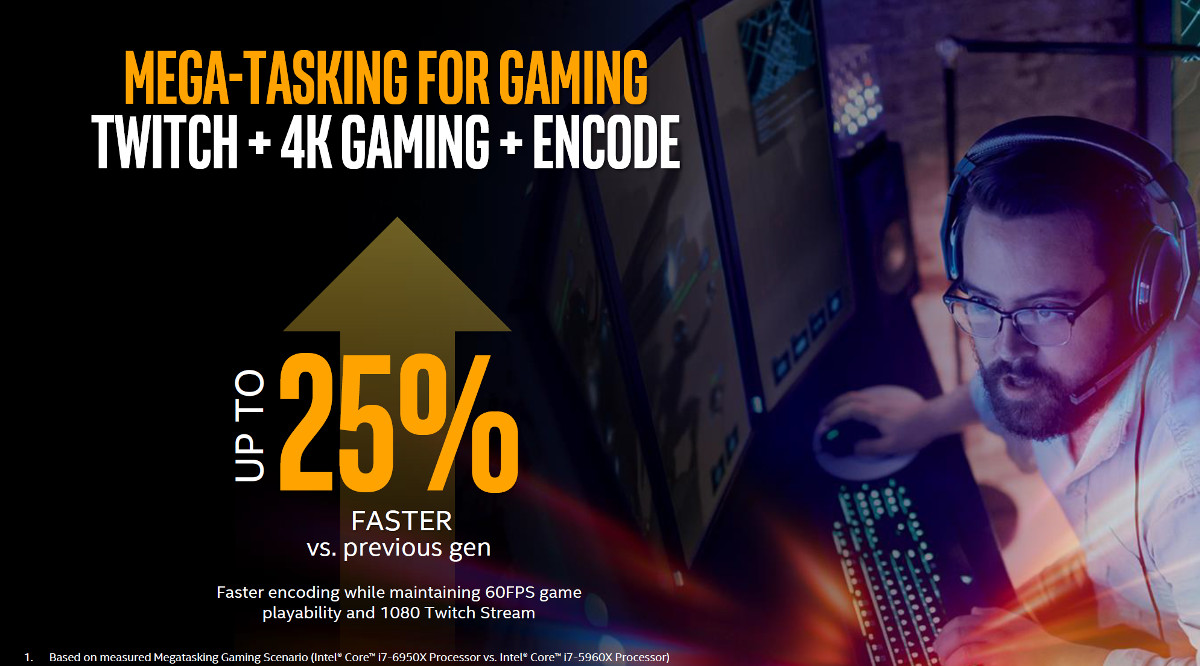
Greater control over thread allocation to specific cores, alongside an increase in the number of cores exposed to the operating system, will also have a complementary affect on performance in so-called mega-tasking workloads. Defined as a group of demanding tasks which are performed simultaneously, a core aspect of Broadwell-E is reducing the waiting time between workloads to optimise the use of resources.
A classic ‘Mega-Task’ example is online game streaming, where the user may be running a game at a high resolution, streaming the game via Twitch, and encoding the video for later editing as a standalone video. Intel estimates that with the Core i7-6950X encoding times are reduced by up to 25% whilst simultaneously gaming in 4K and streaming in 1080, but in all fairness this may be down to an increased core count and improved scheduling/resource allocation.
New Overclocking Features
Finally, Broadwell-E brings with it a trio of overclocking features which weren’t a part of the Haswell-E lineup.
Turbo Ratio’s – Now applied on a per-core basis, and is a logical extension of Turbo Boost Max 3.0 into the enthusiast overclocking arena.
AVX Ratio – Preserves performance headroom for SSE instructions when also running AVX instructions
VccU Voltage Control – Broadwell-E also explicitly exposes VccU voltage control for the first time. This is in addition to the additional control and monitoring 3rd parties have implemented on their own designs with custom LGA2011v3 sockets (such as the ASUS OC Socket)
AVX Ratio – Preserves performance headroom for SSE instructions when also running AVX instructions
VccU Voltage Control – Broadwell-E also explicitly exposes VccU voltage control for the first time. This is in addition to the additional control and monitoring 3rd parties have implemented on their own designs with custom LGA2011v3 sockets (such as the ASUS OC Socket)
Closer Look
Here’s our first look at the two Broadwell-E CPU’s we’re analysing today, alongside the previous generation’s flagship.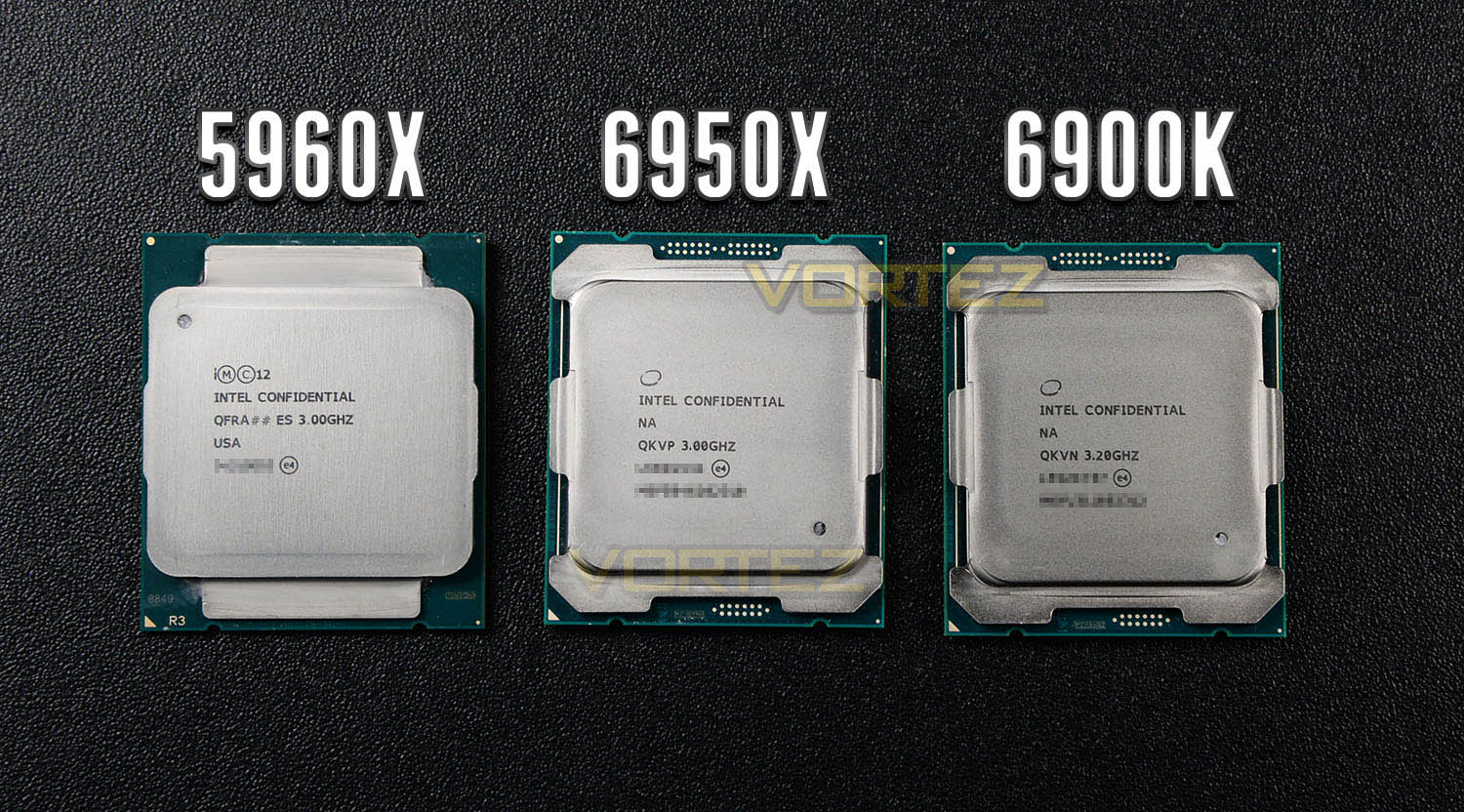
From left to right: Core i7-5960X, Core i7-6950X, Core i7-6900K
Outwardly, the sole change for Broadwell-E has been the heatspreader. The updated design – made necessary by a change in die size – increases the contact are between heatspreader and retention mechanism in a manner which could serve to equalise stress on the CPU PCB. The mounting system specifications haven’t changed however, so existing LGA 2011v3 coolers will not have compatibility issues with the new chips.
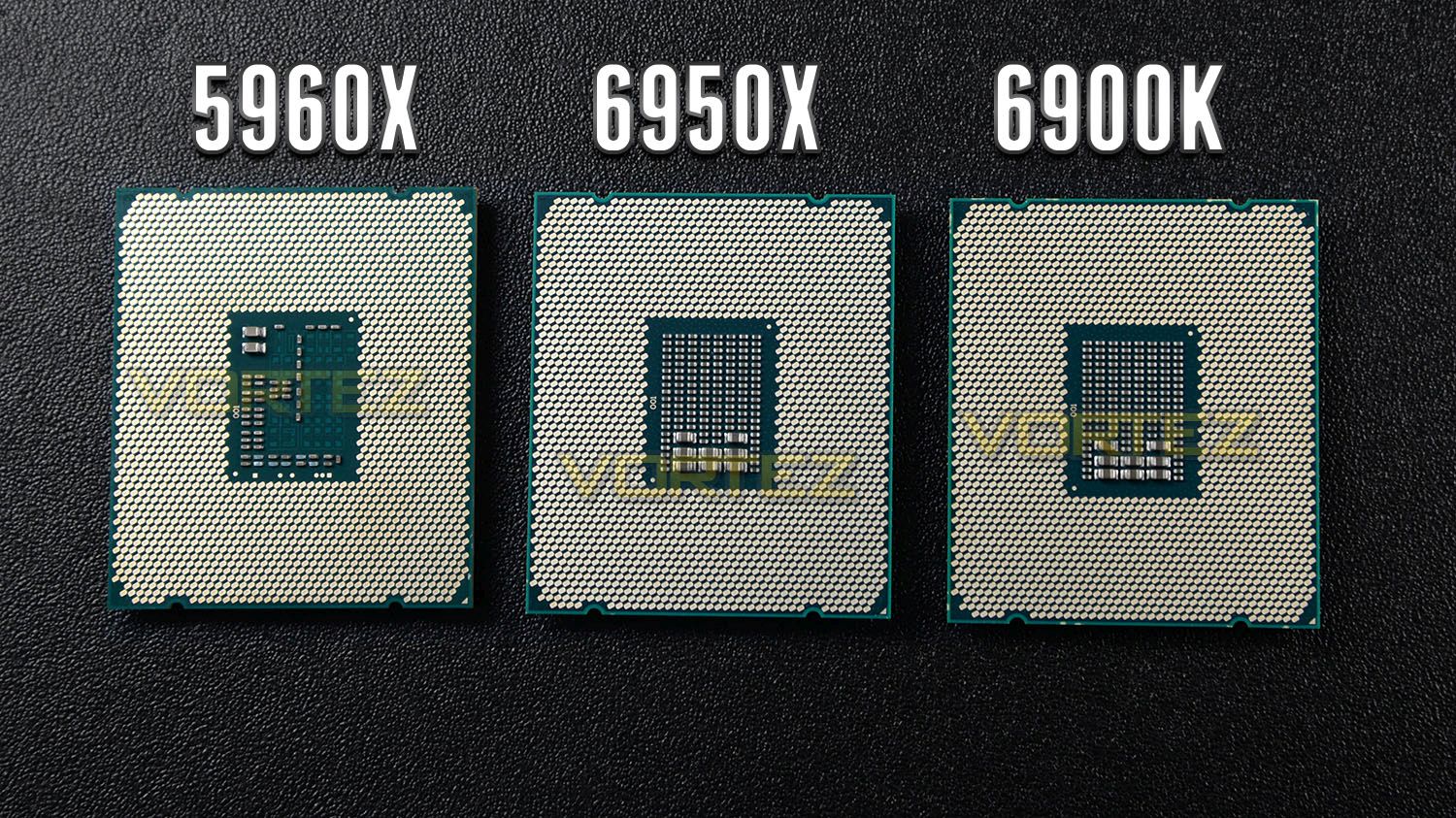
From left to right: Core i7-5960X, Core i7-6950X, Core i7-6900K
The underside of the Broadwell-E CPUs indicate an identical pin layout and key placement to Haswell-E, unsurprising given that the CPU family reuses Intel’s LGA 2011v3 socket specification. However it’s also true to say that Broadwell-E incorporates far more surface mounted components on the underside of the PCB, speaking to the relative complexity of the CPU design.
You might recall the proprietary ASUS OC Socket technology unveiled during our initial look at Haswell-E and X99 in 2014. This design exploited pads exposed on Haswell-E, pads which didn’t have a counterpart on the LGA 2011v3 reference socket pin layout, to monitor and control certain voltages critical to system stability and overclocking. As you can see these pads remain exposed on Broadwell-E, and so it remains to be seen if OC Socket or similar features on competing motherboards can continue to exploit this curious oversight in the pursuit of greater performance.
Test Setup & Testing
Test Bench
CPUs
Intel Core i7-6950X (3.0GHz) Broadwell-E
Intel Core 7-6900K (3.2GHz) Broadwell-E
Intel Core i7-5960X (3.0GHz) Haswell-E
Intel Core i7-6700K (4GHz) Skylake
Cooling Corsair Hydro Series H100i GTX
Motherboard ASUS X99 Deluxe-II
Memory 16GB Corsair Vengeance LPX 3200MHz DDR4
Graphics ASUS GTX 950-2G
Storage Samsung 840 EVO 750GB
PSU Corsair HX1050 (GOLD)
Intel Core i7-6950X (3.0GHz) Broadwell-E
Intel Core 7-6900K (3.2GHz) Broadwell-E
Intel Core i7-5960X (3.0GHz) Haswell-E
Intel Core i7-6700K (4GHz) Skylake
Cooling Corsair Hydro Series H100i GTX
Motherboard ASUS X99 Deluxe-II
Memory 16GB Corsair Vengeance LPX 3200MHz DDR4
Graphics ASUS GTX 950-2G
Storage Samsung 840 EVO 750GB
PSU Corsair HX1050 (GOLD)
Benchmarks
POV-Ray 3.7 – Ray Tracing
TrueCrypt 7.1a – AES Encryption
Cinebench R15 – CPU/OpenGL Score
x264 HD 4.0 – 1st and 2nd pass encoding
SiSoftware SANDRA 2016 – CPU & Memory benchmarks
AIDA64 – CPU benchmarks
PCMark 8 – Creative Suite
PCMark 8 with Photoshop – Light/Heavy Load
3DMark FireStrike – DX11 3D Benchmark
Games – DOOM & BF4
Other Software
Temperature Analysis: Real Temp
Stress Testing Software: AIDA64 Stability Test
CPU Specification Monitoring: CPU-Z
Stress Testing Software: AIDA64 Stability Test
CPU Specification Monitoring: CPU-Z
Temperatures & Overclocking
Below are the temperatures measured for each of our Broadwell-E CPUs at stock settings – without any overclock applied. We’ve also compared the 6900K and 6950X to their Skylake counterparts (which we’ve also benchmarked against on the subsequent pages too):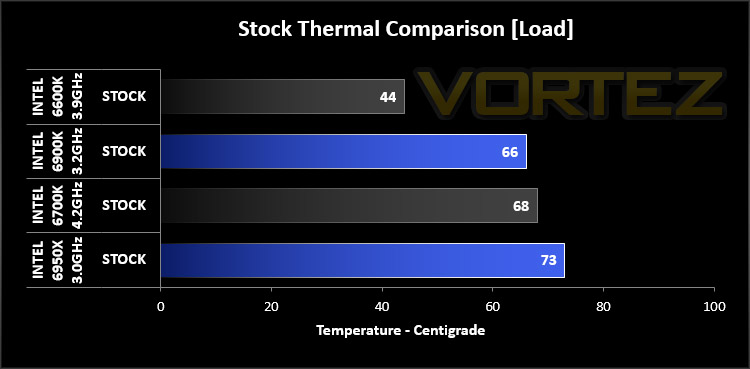
Overclocking
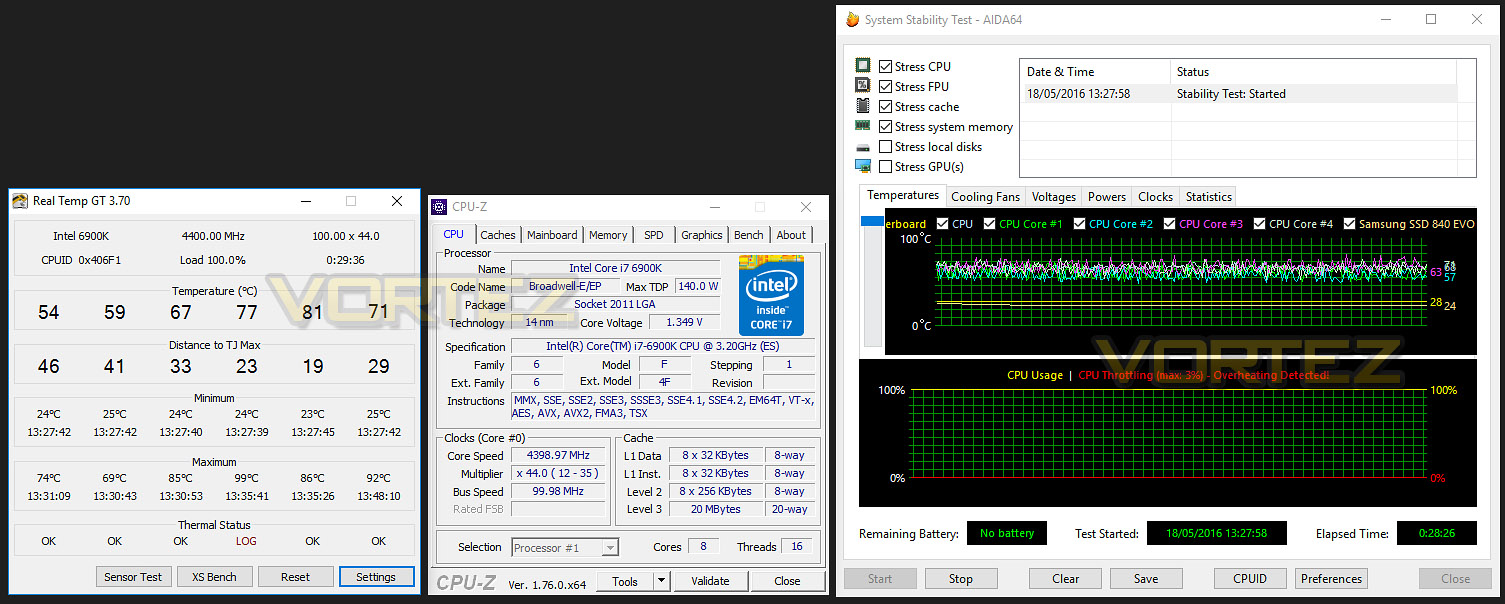
Intel Core i7-6900K
We managed to overclock the i7-6900K from its base clock of 3.2GHz to 4.4GHz by adjusting the ratio/multiplier to 44 – a 37% overclock. This is an admirable achievement and should present us with a significant boost in performance compared to the stock settings. To reach this point, our chip required a substantial voltage increase – 1.34v.
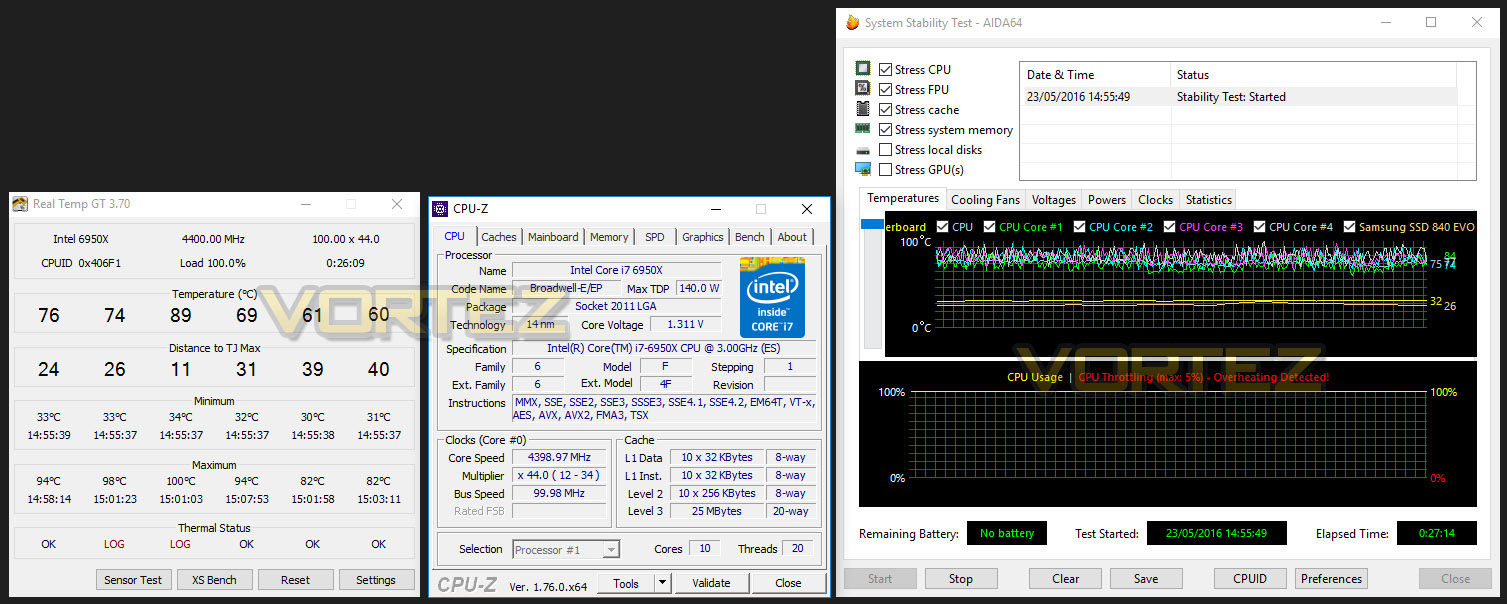
Intel Core i7-6950X
Turning to the Extreme – Core i7-6950X, which has a total of 10 cores, we were able to hit the same result of 4.4GHz for our maximum overclock. Since the Extreme CPU sits at a lower base clock, this represents an impressive 46% increase over stock settings. The lowest possible voltage required for this overclock was 1.31v. As you can see the temperatures were quite high, so increasing the voltage to accommodate a higher frequency wasn’t an option.
On the subsequent pages we’ll be benchmarking both CPUs at stock and overclocked settings, showing you what you can expect out of the box and what can be assumed with a substantial overclock applied.
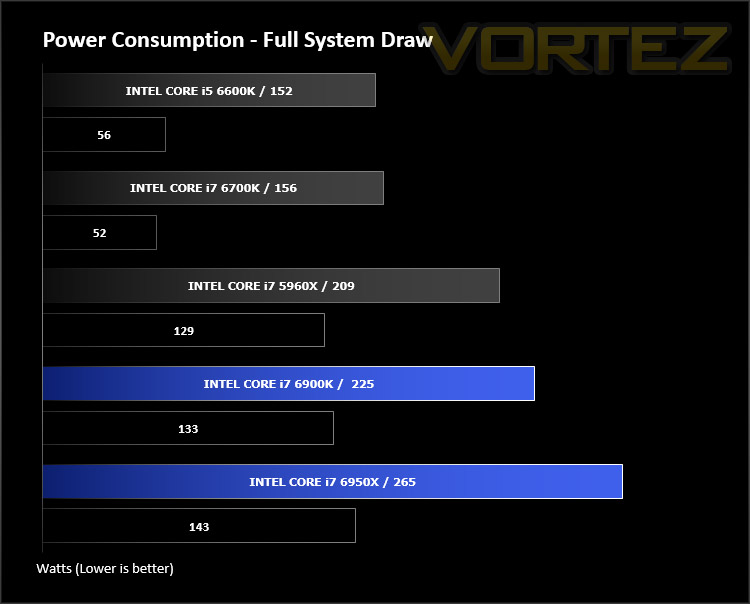
Power Consumption
It’s interesting to note the power consumption across all processors. Although they are using a combination of different motherboard chipsets, energy results can fluctuate between manufacturers due to the features and specifications that are integrated. First of all, for the idle tests the system is cold booted into Windows and no additional applications are executed – the watts are noted on the external energy monitor we use and then the system is loaded with 3DMark FireStrike – watts are again monitored for the duration of the test and the highest rated wattage result is then noted down. Below are the results of this energy test.
It’s worth mentioning that the Broadwell-E CPUs idle at 1200MHz and then boost in frequency/clock speed. Compared to Skylake, users should expect to consume another 100W at the plug at stock settings.
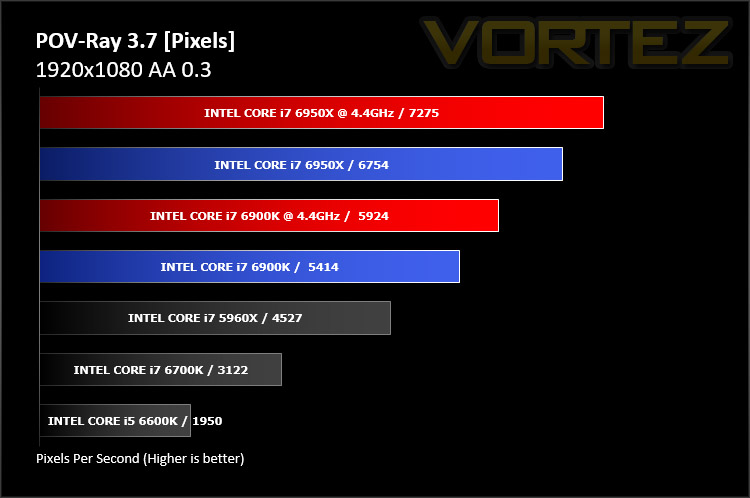
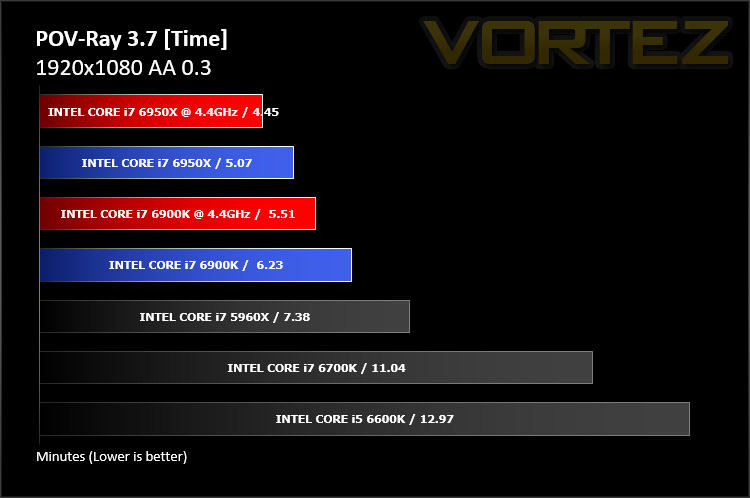
Ray Tracing Performance – POV-Ray 3.7
Persistence of Vision Raytracer’s PovRay is a free and open source 3D animator application with versions for computers with different operating systems.
This product allows users to build their custom 3D worlds with excellent quality despite their computer’s hardware. It has adjustable options for levels of radiance, refraction, and reflection. Calculation time may vary depending on the computer model, but PovRay can adapt to many computer builds, and is supported by the open source community.
This product allows users to build their custom 3D worlds with excellent quality despite their computer’s hardware. It has adjustable options for levels of radiance, refraction, and reflection. Calculation time may vary depending on the computer model, but PovRay can adapt to many computer builds, and is supported by the open source community.
AES Encryption Performance – TrueCrypt 7.1a
TrueCrypt is a discontinued source-available freeware utility used for on-the-fly encryption (OTFE). It can create a virtual encrypted disk within a file or encrypt a partition or (under Microsoft Windows except Windows 8 with GPT) the entire storage device (pre-boot authentication).
Encoding Performance – X264 HD
Simply put, this test measures how fast your machine can encode a short, DVD quality MPEG-2 video clip into a high-quality x264 video clip. What’s x264, you ask? It’s more or less the next-generation Xvid/DivX codec. I think it’s ideal for a benchmark because the application (x264.exe) reports fairly accurate compression results (in frames per second) for each pass of the video encoding process, and it uses multi-core processors very efficiently.
x264 HD gives results for 2 passes when compressing an MPEG-2 clip into x264. It presents 4 separate results for each pass giving a total of 8 – all results are given in FPS. For each pass we have averaged out the results.
Both Broadwell-E CPUs improve on the previous generation by yielding better encoding performance.
Processing Features Performance – AIDA64
AIDA64 Product PageThis simple integer benchmark focuses on the branch prediction capabilities and the misprediction penalties of the CPU. It finds the solutions for the classic “Queens problem” on a 10 by 10 sized chessboard. At the same clock speed theoretically the processor with the shorter pipeline and smaller misprediction penalties will attain higher benchmark scores. For example — with HyperThreading disabled — the Intel Northwood core processors get higher scores than the Intel Prescott core based ones due to the 20-step vs 31-step long pipeline. CPU Queen test uses integer MMX, SSE2 and SSSE3 optimizations.
Memory Transfer Performance – AIDA64
AIDA64 Product PageThis simple integer benchmark focuses on the branch prediction capabilities and the misprediction penalties of the CPU. It finds the solutions for the classic “Queens problem” on a 10 by 10 sized chessboard. At the same clock speed theoretically the processor with the shorter pipeline and smaller misprediction penalties will attain higher benchmark scores. For example — with HyperThreading disabled — the Intel Northwood core processors get higher scores than the Intel Prescott core based ones due to the 20-step vs 31-step long pipeline. CPU Queen test uses integer MMX, SSE2 and SSSE3 optimizations.
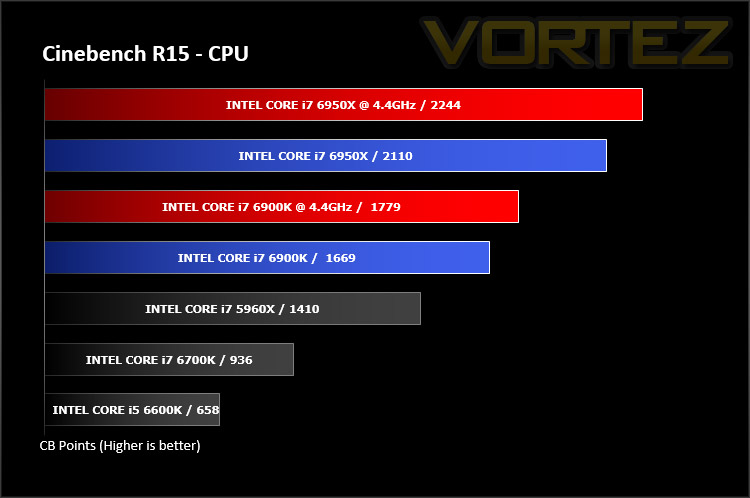
Processing Power Performance – Cinebench R15
CINEBENCH can measure systems with up to 64 processor threads. This test scene contains approximately 2,000 objects which in turn contain more than 300,000 polygons in total, and uses sharp and blurred reflections, area lights, shadows, procedural shaders, antialiasing, and much more. The result is displayed in points (pts). The higher the number, the faster your processor.
Again, there are marginal advantages for the processing power within Cinebench too. Here it’s somewhat surprising to note the margin by which the Core i7-6900K outpaces the i7-5960X, far greater than one would expect if the only differences between the two were marginal clock speed increases; naturally the 10-core i7-6950X dominates the heavily multi-threaded CPU task.
Applying an overclock will increase performance and achieve better results, but the improvement isn’t directly proportional to the magnitude of the overclock.
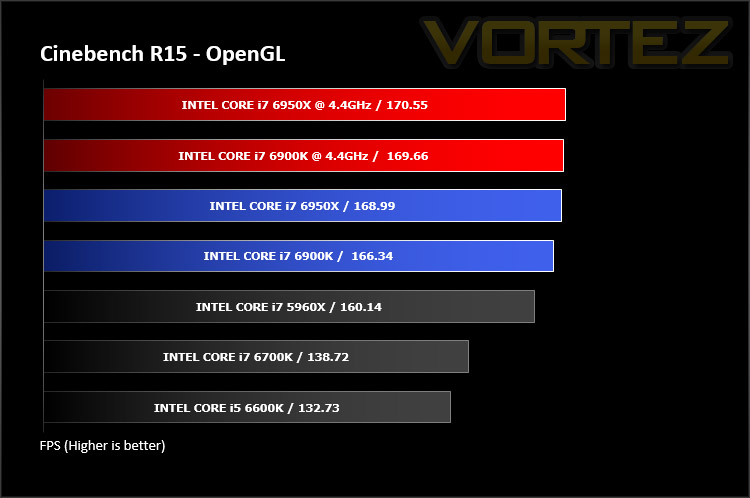
As you would expect, utilising the GPU to render in OpenGL results in relatively small difference between each of the CPUs, although there remains some benefit to the Broadwell-E designs.
Bandwidth Performance – SiSoftware SANDRA
3DMark 11 Product PageSANDRA isn’t always a benchmark that is included in hardware reviews but I believe it shouldn’t be ignored. SANDRA provides a vigorous package that tests your system in a rather large array of benchmarks. There are many aspects of benchmark that can be executed. We will be considering – CPU and memory tests.
Processor tests – In this series of tests both CPUs perform very well, the 6950X with its 10-cores responds by offering up substantially strong CPU results.
Memory tests – Using the same DDR4 kit across both Skylake and Broadwell-E platforms, it’s clear to see the 6900K and 6950X maximise on memory bandwidth. Where Skylake is held back Broadwell-E takes full advantage, despite the additional memory latency incurred by a more complex quad-channel controller; differences between Broadwell-E and Haswell-E are minor.
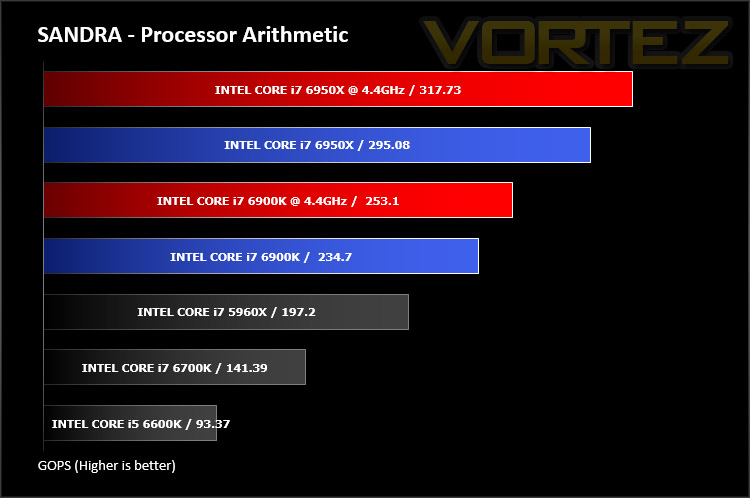
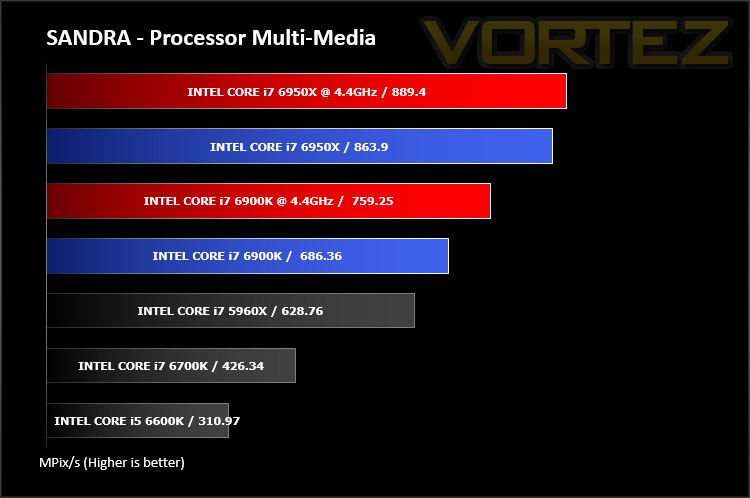
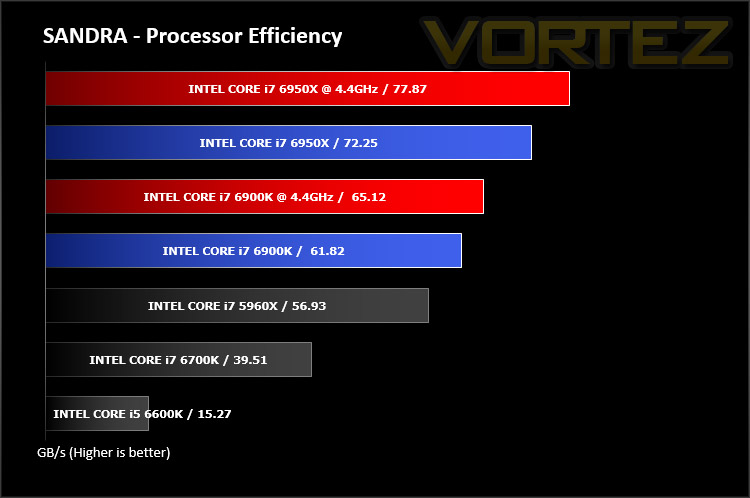
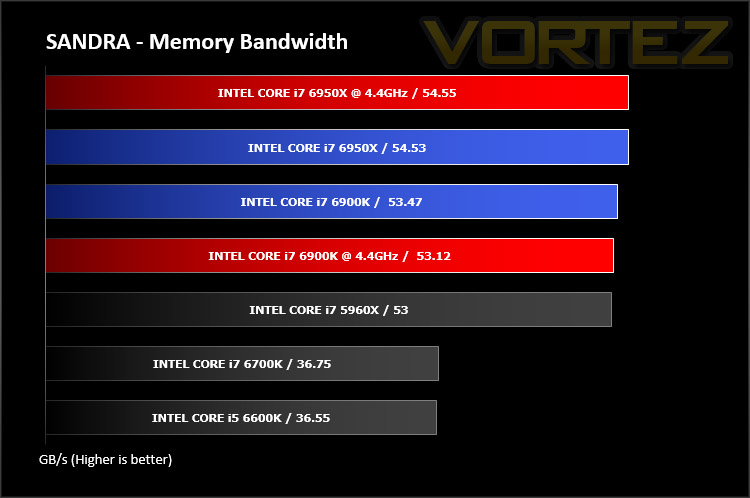
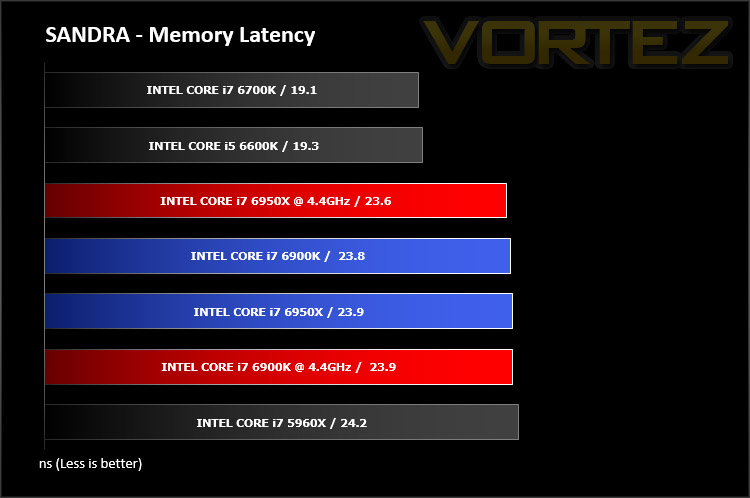
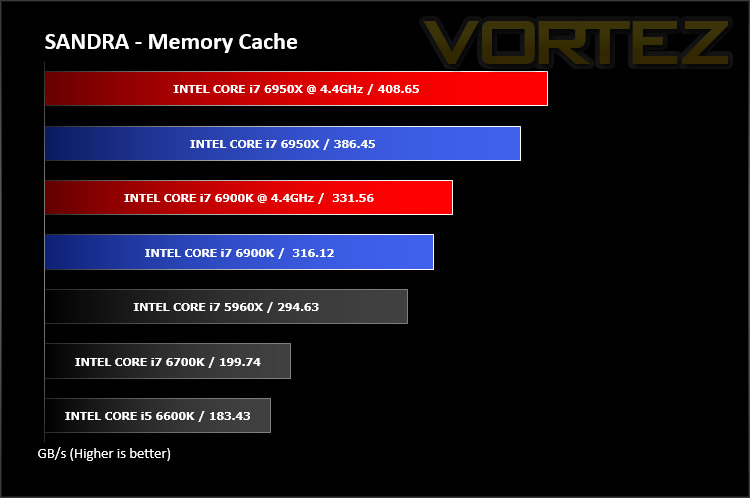
Image Editing Performance – PCMark 8 Photoshop
PCMark 8 Product Page Developed in partnership with Benchmark Development Program members Acer, AMD, Condusiv Technologies, Dell, HGST, HP, Intel, Microsoft, NVIDIA, Samsung, SanDisk, Seagate and Western Digital, PCMark 8 is the latest version in FutureMark’s popular series of PC benchmarking tools. Improving on previous releases, PCMark 8 includes new tests using popular applications from Adobe and Microsoft.
Overall System Performance – PCMark 8
PCMark 8 Product Page Developed in partnership with Benchmark Development Program members Acer, AMD, Condusiv Technologies, Dell, HGST, HP, Intel, Microsoft, NVIDIA, Samsung, SanDisk, Seagate and Western Digital, PCMark 8 is the latest version in FutureMark’s popular series of PC benchmarking tools. Improving on previous releases, PCMark 8 includes new tests using popular applications from Adobe and Microsoft.
3D Performance – 3DMARK FireStrike
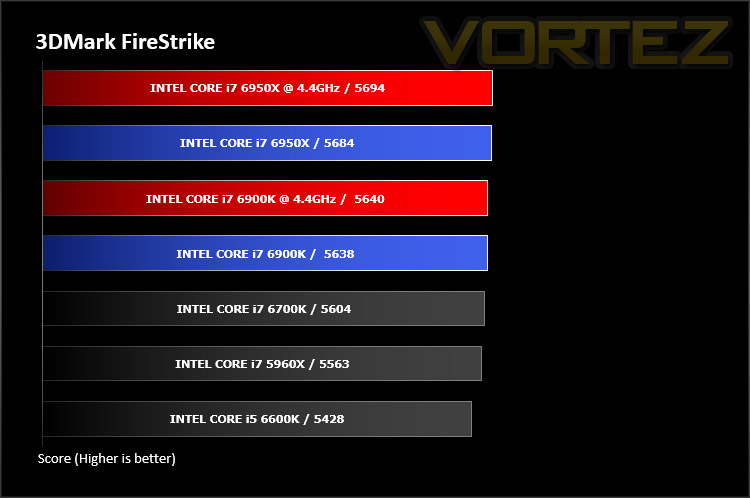
3DMark FireStrike Product PageFire Strike is our new showcase DirectX 11 benchmark designed for high-performance gaming PCs. It is our most ambitious and technical benchmark ever, featuring real-time graphics rendered with detail and complexity far beyond what is found in other benchmarks and games today. Fire Strike will only be available in the Windows editions of 3DMark initially.
Haswell-E, Broadwell-E and Skylake handle 3DMark FireStrike with equal aplomb, but the gulf between the CPUs in the graphics test in particular shows how GPU performance dominates this test. The overall score highlights only marginal gains over previous generations, although physics results (the aspect handled by the CPU) are improved.
Gaming Performance – DOOM & BF4
It’s important for us to perform a number of game benchmarks as well as the synthetic tests because gamers will want to know if there are any significant benefits. So here we have two popular gaming titles for consideraion.
Settings
DOOM
– 1920×1080 High Quality *FRAPS*
BF4
– 1920×1080 High Quality *FRAPS*
The gaming titles selected demand GPU power over CPU power – in each test the difference is rather marginal. VSync is disabled in all titles.
Conclusion
Almost two years ago we were struck by the awesome performance of Intel’s flagship Haswell-E CPU. Featuring eight cores clocked at 3 GHz, it ploughed through meaty tasks such as video rendering with aplomb, greatly outpacing both Haswell ‘Devil’s Canyon’ performance CPUs and, as we would later discover, the rest of the Haswell-E lineup. It’s perhaps unsurprisingly that we see a similar picture emerge with the new Broadwell-E CPUs, but one where a different conclusion is warranted.
The Core i7-6950X is without any shadow of a doubt the highest performing CPU currently on the market, blitzing even the blisteringly fast i7-5960X. Improvements of 25% were not unrealistic across a wide range of benchmarks including valuable real-world examples such as video rendering, where minimising time spent has tangible worth to professionals and enthusiasts. Although not quite so pronounced, there was also a measurable benefit to the i7-6900K over the i7-5960X; this was not a result we had expected, even factoring in the disparities in reference clock speeds.
By the same token gaming performance differences were relatively minor, and with low-level APIs such as DirectX 12 slowly entering the market powerful CPUs may well diminish in importance. This emphasises the need to base purchasing decisions on your specific use case: a $1500 CPU is likely wasted on simply gaming, even at high resolution; factor in heavy rendering workloads however and the payoff may well be worth it.
It’s clear that Intel want to draw direct comparisons between the new and previous Extreme Edition CPUs, but we wonder whether that this appropriate in this context. The i7-6950X sits in a price bracket 50% higher than the i7-5960X did at launch, and at $1500 is at the extreme end of an already narrow market segment. In many respects the 6950X is a class apart, and that’s reflected in the CPU’s performance.
The Broadwell-E Core i7-6950X is not a CPU for the average consumer, nor even the exceptional one. Instead it’s firmly in the ballpark for gamers and content creators who make a living through streaming, editing and rendering for later monetised upload to video sharing sites. With this sort of use case it’s more justifiable, simply because rendering time is a key bottleneck in workflow.
Other users will find more value from models lower down in the Broadwell-E range. The Core i7-6900K is a meaningful enough boost over the i7-5960X to justify its existence, if not upgrading to it from the older platform. We’re looking forward to putting the lower-specced CPUs through their paces, especially comparing the six-core Core i7-6800K to the quad-core ‘Skylake’ i7-6700K
One other aspect that surprised us was in power consumption, and not in a positive way. We found that comparable Broadwell-E parts had higher idle and load values than the Haswell-E counterpart, something that we wouldn’t expect considering that in moving to a 14nm process node we should be seeing greater efficiencies. Some workloads will see an improved performance/watt, but not as meaningful a change and might have expected given the transition.
Despite relatively modest reference frequencies, and Haswell-E’s towering reputation for being a great overclocking chip, we found that Broadwell-E excelled in overclocking. We were able to push both the i7-6950X and i7-6900K to 4.4Ghz using only simple multiplier tweak, exceeding a 1GHz overclock over reference frequencies that, although it doesn’t touch the 4.9GHz of our Core i7-5960X, is more than sufficient to interest enthusiasts. Power draw and temperatures do ramp up significantly with only small alterations in CPU voltage however, so pushing Broadwell-E to its 24/7 stable limit may well require more complex cooling solutions than our already very robust Corsair H100i GTX.
That’s a lot to take in, so let’s break it down into a key takeaway: with the exception of the 10-Core flagship model, Broadwell-E doesn’t present an enticing draw over the previous generation, but will nonetheless be a significant boost to anyone running systems over two years old. Whether you’re in the market for the best upgrade over your aging Ivybridge/Ivybridge-E system, or your personal/small business requirements have changed to include workloads that scale with CPU performance, Broadwell-E as a platform should be something you consider. Even so, you should ensure that the sorts of workloads you’ll be putting the CPU through – simply gaming; workhorse tasks; or more taxing jobs – match the capabilities of the CPU to ensure it’s worth additional investment over Skylake.
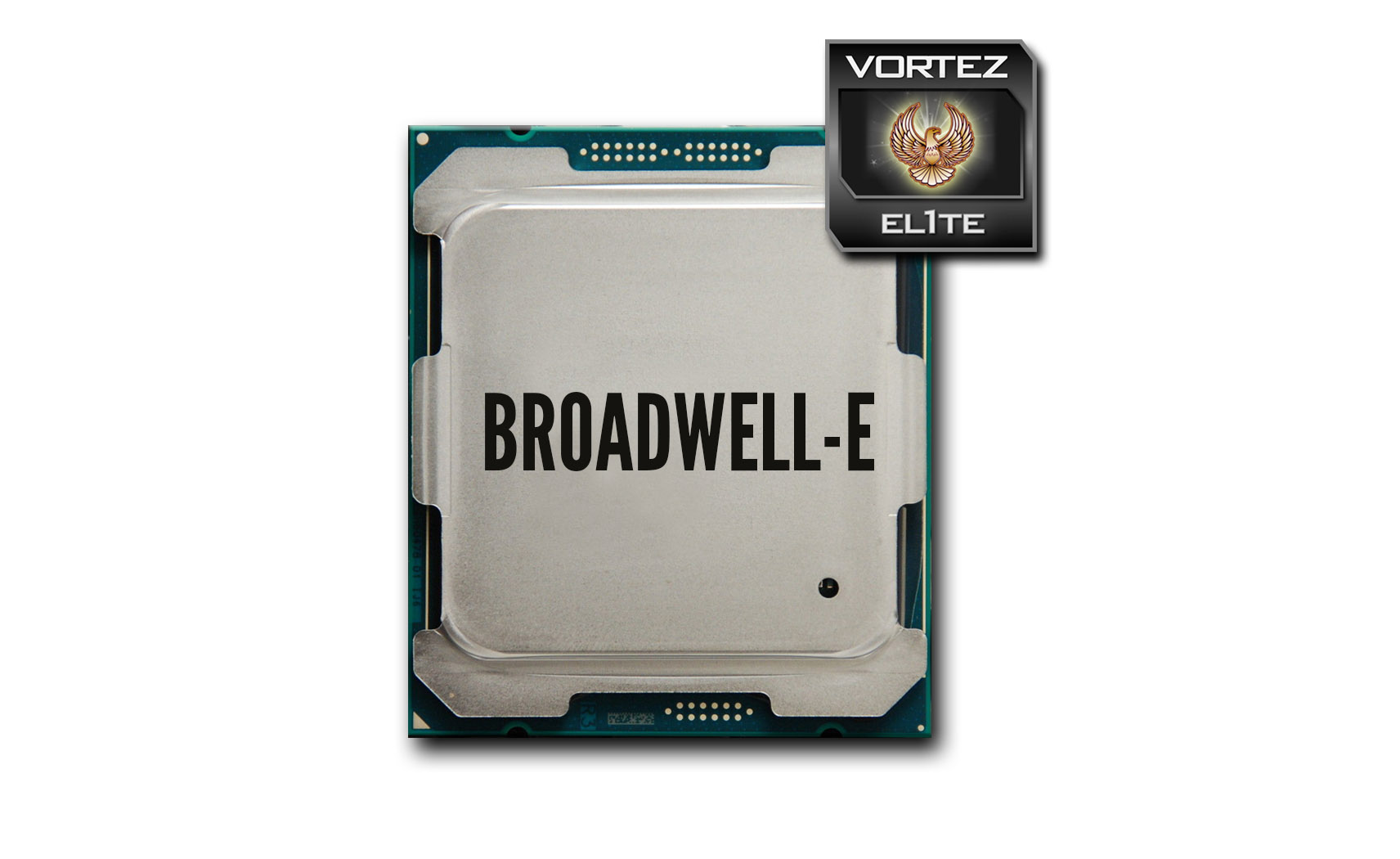
The exception is the Core i7-6950X Extreme Edition, which stands alone in almost every aspect. It’s a 10-core, 20-thread part that is unmatched outside of the workstation/enterprise space, and in performance exceed its meagre competition. This justifies the Elite label we’re happy to affix to the Broadwell-E series, but anyone looking to invest almost $2000 in a CPU and motherboard combination should be absolutely sure it’s the best option for them that represents worth beyond bragging rights.
Pros
– Extreme Performance
– Mature Motherboard Platform
– DDR4 is now a mainstream memory standard
– Simple, flexible overclocking via BCLK and/or Multiplier
– Will reward enthusiast overclockers
– Flagship model pushes the boundaries of the High End Desktop capabilities
Cons
– Non-flagship models are only small improvements over Haswell-E
– More expensive than Haswell-E at launch
– >$1500 Flagship breaks new ground in consumer CPU pricing.
– Extreme Performance
– Mature Motherboard Platform
– DDR4 is now a mainstream memory standard
– Simple, flexible overclocking via BCLK and/or Multiplier
– Will reward enthusiast overclockers
– Flagship model pushes the boundaries of the High End Desktop capabilities
Cons
– Non-flagship models are only small improvements over Haswell-E
– More expensive than Haswell-E at launch
– >$1500 Flagship breaks new ground in consumer CPU pricing.