The ASUS PRIME design ethos centres around giving system builders a cost effective platform by cutting down on unnecessary features while delivering the maximum user experience.

Product on Review: ASUS PRIME X370 PRO
Manufacturer & Sponsor: ASUS
Street Price: £159.99 GBP / $179 USD
ASUS have worked tirelessly on R & D, ensuring that each step they take is always forward in innovation. Now, with decades of development and experience under their belt, the PRIME range of motherboards has come to share the spoils of war. That means, raw performance and advanced controls with minimal fluff.
The PRIME X370 PRO comes in as amongst the cheapest X370 motherboards available and misses out some of the perks of the platform, such as SATA express, or an NVMe port, which aren’t yet commonly used standards, but it does feature an M.2 socket and a front panel USB 3.1 Gen 2 header, technology that is undoubtedly becoming much more mainstream. It does away with overly fancy shrouds and excessive cooling heatsinks, but features capable cooling, ASUS 5X Protection III (ASUS SafeSlot Core, LanGuard, ASUS Over-voltage protection, ASUS Enhanced DRAM Over-current Protection, ASUS ESD Guards, and ASUS DIGI+ VRM). As it isn’t just about outright processing performance, but home and media performance, so it also features Intel LAN and the Realtek A1220 high definition audio Codec. As the cherry on the cake, the PRIME still considers the aesthetic design important and so uses a neutral base colour design, but includes RGB LED lighting and an additional RGB LED strip header which can be programmed via the AURA lighting control.
To ensure that people can get the very best from the motherboard with ease, ASUS have also unified their various proprietary hardware and software technologies to create 5-Way Optimization by Dual Intelligent Processors 5. So at the click of a button, your system will optimise CPU performance, cooling, and power efficiency all at once.
ASUS on PRIME
ASUS Prime is the next evolution of the ASUS motherboard, born of a pedigree that stretches back to 1989. Our team of world-class engineers are passionate about empowering everyone to enjoy the benefits of customisation and tuning, and the driving force behind the development of Prime is to make advanced enthusiast controls easily accessible — maximising performance, stability and compatibility for the very best DIY PC experiences. Simply stated: it’s time for Prime.
Technical Specifications
CPU
AMD AM4 Socket for AMD Ryzen™/7th Generation A-series/Athlon™ Processors
Supports AM4 Socket 14 nm CPU
Supports CPU up to 8 cores
* Refer to www.asus.com for CPU support list
Chipset
AMD X370
Memory
AMD Ryzen™ Processors
4 x DIMM, Max. 64GB, DDR4 3200(O.C.)/2933(O.C.)/2666/2400/2133 MHz ECC and non-ECC, Un-buffered Memory
AMD 7th Generation A-series/Athlon™ Processors
4 x DIMM, Max. 64GB, DDR4 2400/2133 MHz Non-ECC, Un-buffered Memory
Dual Channel Memory Architecture
* Refer to www.asus.com for the Memory QVL (Qualified Vendors Lists).
Graphic
Integrated AMD Radeon™ R Series Graphics in the 7th Generation A-Series APU
Multi-VGA output support : HDMI/DisplayPort ports
– Supports HDMI 1.4b with max. resolution 4096 x 2160 @ 24 Hz / 2560 x 1600 @ 60 Hz
– Supports DisplayPort 1.2 with max. resolution 4096 x 2160 @ 60 Hz
Maximum shared memory of 2048 MB
Multi-GPU Support
Supports NVIDIA® 2-Way SLI™ Technology *1
Supports AMD CrossFireX™ Technology
Expansion Slots
AMD Ryzen™ Processors: 2 x PCIe 3.0/2.0 x16 (x16 or dual x8)
AMD 7th Generation A-series/Athlon™ Processors: 1 x PCIe 3.0/2.0 x16 (x8 mode)
AMD X370 chipset: 1 x PCIe 2.0 x16 (max at x4 mode) *2
AMD X370 chipset: 3 x PCIe 2.0 x1
Storage
AMD Ryzen™ Processors :
1 x M.2 Socket 3, with M key, type 2242/2260/2280/22110 storage devices support (SATA & PCIE 3.0 x 4 mode)
AMD 7th Generation A-series/Athlon™ Processors :
1 x M.2 Socket 3, with M key, type 2242/2260/2280/22110 storage devices support (SATA & PCIE 3.0 x 2 mode)
AMD X370 chipset :
8 x SATA 6Gb/s port(s), gray,
Support Raid 0, 1, 10
LAN
Intel® I211-AT, 1 x Gigabit LAN Controller(s)
ASUS Turbo LAN Utility
ASUS LAN Guard
Audio
Realtek® ALC S1220A 8-Channel High Definition Audio CODEC
– Impedance sense for front and rear headphone outputs
– Supports : Jack-detection, Multi-streaming, Front Panel Jack-retasking
– High quality 120 dB SNR stereo playback output and 113 dB SNR recording input (Line-in)
– Front panel audio connector (AAFP)
Audio Feature :
– Audio Shielding: Ensures precision analog/digital separation and greatly reduced multi-lateral interference
– Dedicated audio PCB layers: Separate layers for left and right channels to guard the quality of the sensitive audio signals
– Premium Japanese-made audio capacitors: Provide warm, natural and immersive sound with exceptional clarity and fidelity
USB Ports
AMD Ryzen™/7th Generation A-series/Athlon™ Processors : 4 x USB 3.0 port(s) (4 at back panel, blue, Type-A)
AMD X370 chipset : 1 x USB 3.1 front panel connector port(s)
AMD X370 chipset : 4 x USB 3.0 port(s) (2 at back panel, blue, Type-A + Type-C, 2 at mid-board)
AMD X370 chipset : 4 x USB 2.0 port(s) (4 at mid-board)
ASMedia® USB 3.1 controller : 2 x USB 3.1 port(s) (2 at back panel, teal blue, Type-A)
Special Features
5-Way Optimization by Dual Intelligent Processors 5
– Whole system optimization with a single click! 5-Way Optimization tuning key perfectly consolidates TPU, EPU, DIGI+ VRM, Fan Xpert 4, and Turbo App together, providing better CPU performance, efficient power saving, precise digital power control, whole system cooling and even tailor your own app usages.
ASUS 5X Protection III :
– ASUS SafeSlot Core: Fortified PCIe Slot prevents damage
– ASUS LANGuard: Protects against LAN surges, lightning strikes and static-electricity discharges!
– ASUS Overvoltage Protection: World-class circuit-protecting power design
– ASUS Stainless-Steel Back I/O: 3X corrosion-resistance for greater durability!
– ASUS DIGI+ VRM: 10 Phase digital power design
– ASUS Enhanced DRAM Overcurrent Protection – Short circuit damage prevention
– ASUS ESD Guards – Enhanced ESD protection
ASUS TPU :
– Auto Tuning
ASUS EPU :
– EPU
AURA :
– Aura Lighting Control
– Aura RGB Strip Headers
– Aura Lighting Effects Synchronization with compatible ASUS ROG devices
ASUS Exclusive Features :
– AI Suite 3
– Ai Charger
– Turbo LAN
– PC Cleaner
ASUS Quiet Thermal Solution :
– Stylish Fanless Design Heat-sink solution & MOS Heatsink
– ASUS Fan Xpert 4
ASUS EZ DIY :
– ASUS O.C. Profile
– ASUS CrashFree BIOS 3
– ASUS EZ Flash 3
– ASUS UEFI BIOS EZ Mode
– Multi-language BIOS
ASUS Q-Design :
– ASUS Q-Shield
– ASUS Q-Slot
– ASUS Q-DIMM
– ASUS Q-Connector
Overclocking Protection :
– ASUS C.P.R.(CPU Parameter Recall)
Turbo App
Back I/O Ports
1 x PS/2 keyboard/mouse combo port(s)
1 x DisplayPort
1 x HDMI
1 x LAN (RJ45) port(s)
2 x USB 3.1 (teal blue)Type-A
1 x USB 3.0 Type-C
5 x USB 3.0
1 x Optical S/PDIF out
5 x Audio jack(s)
Internal I/O
1 x Aura RGB Strip Header
1 x USB 3.0 connector(s) support(s) additional 2 USB 3.0 port(s) (19-pin)
2 x USB 2.0 connector(s) support(s) additional 4 USB 2.0 port(s)
1 x M.2 Socket 3 with M Key, type 2242/2260/2280/22110 storage devices support (SATA mode & PCIE mode)
8 x SATA 6Gb/s connector(s)
1 x CPU Fan connector(s) (1 x 4 -pin)
1 x CPU OPT Fan connector(s) (1 x 4 -pin)
2 x Chassis Fan connector(s) (2 x 4 -pin)
1 x AIO_PUMP connector (1 x 4 -pin)
1 x W_PUMP+ connector (1 x 4 -pin)
1 x 24-pin EATX Power connector(s)
1 x 8-pin ATX 12V Power connector(s)
1 x Front panel audio connector(s) (AAFP)
1 x System panel(s) (Q-Connector) (Chassis intrusion header is inbuilt)
1 x Clear CMOS jumper(s)
1 x 14-1 pin TPM connector
1 x COM port header
1 x USB 3.1 front panel connector
Accessories
User’s manual
ASUS Q-Shield
4 x SATA 6Gb/s cable(s)
1 x M.2 Screw Package
1 x Supporting DVD
1 x SLI HB BRIDGE(2-WAY-M)
1 x Q-connector(s) (1 in 1)
BIOS
128 Mb Flash ROM, UEFI AMI BIOS, PnP, WfM2.0, SM BIOS 3.0, ACPI 6.1, Multi-language BIOS, ASUS EZ Flash 3, CrashFree BIOS 3, F11 EZ Tuning Wizard, F6 Qfan Control, F3 My Favorites, Last Modified log, F12 PrintScreen, and ASUS DRAM SPD (Serial Presence Detect) memory information
Manageability
WfM 2.0, DMI 3.0, WOL by PME, PXE
Operating system
Windows 10 64bit
Form Factor
ATX Form Factor: 12.0 inch x 9.6 inch ( 30.5 cm x 24.4 cm )
AMD AM4 Socket for AMD Ryzen™/7th Generation A-series/Athlon™ Processors
Supports AM4 Socket 14 nm CPU
Supports CPU up to 8 cores
* Refer to www.asus.com for CPU support list
Chipset
AMD X370
Memory
AMD Ryzen™ Processors
4 x DIMM, Max. 64GB, DDR4 3200(O.C.)/2933(O.C.)/2666/2400/2133 MHz ECC and non-ECC, Un-buffered Memory
AMD 7th Generation A-series/Athlon™ Processors
4 x DIMM, Max. 64GB, DDR4 2400/2133 MHz Non-ECC, Un-buffered Memory
Dual Channel Memory Architecture
* Refer to www.asus.com for the Memory QVL (Qualified Vendors Lists).
Graphic
Integrated AMD Radeon™ R Series Graphics in the 7th Generation A-Series APU
Multi-VGA output support : HDMI/DisplayPort ports
– Supports HDMI 1.4b with max. resolution 4096 x 2160 @ 24 Hz / 2560 x 1600 @ 60 Hz
– Supports DisplayPort 1.2 with max. resolution 4096 x 2160 @ 60 Hz
Maximum shared memory of 2048 MB
Multi-GPU Support
Supports NVIDIA® 2-Way SLI™ Technology *1
Supports AMD CrossFireX™ Technology
Expansion Slots
AMD Ryzen™ Processors: 2 x PCIe 3.0/2.0 x16 (x16 or dual x8)
AMD 7th Generation A-series/Athlon™ Processors: 1 x PCIe 3.0/2.0 x16 (x8 mode)
AMD X370 chipset: 1 x PCIe 2.0 x16 (max at x4 mode) *2
AMD X370 chipset: 3 x PCIe 2.0 x1
Storage
AMD Ryzen™ Processors :
1 x M.2 Socket 3, with M key, type 2242/2260/2280/22110 storage devices support (SATA & PCIE 3.0 x 4 mode)
AMD 7th Generation A-series/Athlon™ Processors :
1 x M.2 Socket 3, with M key, type 2242/2260/2280/22110 storage devices support (SATA & PCIE 3.0 x 2 mode)
AMD X370 chipset :
8 x SATA 6Gb/s port(s), gray,
Support Raid 0, 1, 10
LAN
Intel® I211-AT, 1 x Gigabit LAN Controller(s)
ASUS Turbo LAN Utility
ASUS LAN Guard
Audio
Realtek® ALC S1220A 8-Channel High Definition Audio CODEC
– Impedance sense for front and rear headphone outputs
– Supports : Jack-detection, Multi-streaming, Front Panel Jack-retasking
– High quality 120 dB SNR stereo playback output and 113 dB SNR recording input (Line-in)
– Front panel audio connector (AAFP)
Audio Feature :
– Audio Shielding: Ensures precision analog/digital separation and greatly reduced multi-lateral interference
– Dedicated audio PCB layers: Separate layers for left and right channels to guard the quality of the sensitive audio signals
– Premium Japanese-made audio capacitors: Provide warm, natural and immersive sound with exceptional clarity and fidelity
USB Ports
AMD Ryzen™/7th Generation A-series/Athlon™ Processors : 4 x USB 3.0 port(s) (4 at back panel, blue, Type-A)
AMD X370 chipset : 1 x USB 3.1 front panel connector port(s)
AMD X370 chipset : 4 x USB 3.0 port(s) (2 at back panel, blue, Type-A + Type-C, 2 at mid-board)
AMD X370 chipset : 4 x USB 2.0 port(s) (4 at mid-board)
ASMedia® USB 3.1 controller : 2 x USB 3.1 port(s) (2 at back panel, teal blue, Type-A)
Special Features
5-Way Optimization by Dual Intelligent Processors 5
– Whole system optimization with a single click! 5-Way Optimization tuning key perfectly consolidates TPU, EPU, DIGI+ VRM, Fan Xpert 4, and Turbo App together, providing better CPU performance, efficient power saving, precise digital power control, whole system cooling and even tailor your own app usages.
ASUS 5X Protection III :
– ASUS SafeSlot Core: Fortified PCIe Slot prevents damage
– ASUS LANGuard: Protects against LAN surges, lightning strikes and static-electricity discharges!
– ASUS Overvoltage Protection: World-class circuit-protecting power design
– ASUS Stainless-Steel Back I/O: 3X corrosion-resistance for greater durability!
– ASUS DIGI+ VRM: 10 Phase digital power design
– ASUS Enhanced DRAM Overcurrent Protection – Short circuit damage prevention
– ASUS ESD Guards – Enhanced ESD protection
ASUS TPU :
– Auto Tuning
ASUS EPU :
– EPU
AURA :
– Aura Lighting Control
– Aura RGB Strip Headers
– Aura Lighting Effects Synchronization with compatible ASUS ROG devices
ASUS Exclusive Features :
– AI Suite 3
– Ai Charger
– Turbo LAN
– PC Cleaner
ASUS Quiet Thermal Solution :
– Stylish Fanless Design Heat-sink solution & MOS Heatsink
– ASUS Fan Xpert 4
ASUS EZ DIY :
– ASUS O.C. Profile
– ASUS CrashFree BIOS 3
– ASUS EZ Flash 3
– ASUS UEFI BIOS EZ Mode
– Multi-language BIOS
ASUS Q-Design :
– ASUS Q-Shield
– ASUS Q-Slot
– ASUS Q-DIMM
– ASUS Q-Connector
Overclocking Protection :
– ASUS C.P.R.(CPU Parameter Recall)
Turbo App
Back I/O Ports
1 x PS/2 keyboard/mouse combo port(s)
1 x DisplayPort
1 x HDMI
1 x LAN (RJ45) port(s)
2 x USB 3.1 (teal blue)Type-A
1 x USB 3.0 Type-C
5 x USB 3.0
1 x Optical S/PDIF out
5 x Audio jack(s)
Internal I/O
1 x Aura RGB Strip Header
1 x USB 3.0 connector(s) support(s) additional 2 USB 3.0 port(s) (19-pin)
2 x USB 2.0 connector(s) support(s) additional 4 USB 2.0 port(s)
1 x M.2 Socket 3 with M Key, type 2242/2260/2280/22110 storage devices support (SATA mode & PCIE mode)
8 x SATA 6Gb/s connector(s)
1 x CPU Fan connector(s) (1 x 4 -pin)
1 x CPU OPT Fan connector(s) (1 x 4 -pin)
2 x Chassis Fan connector(s) (2 x 4 -pin)
1 x AIO_PUMP connector (1 x 4 -pin)
1 x W_PUMP+ connector (1 x 4 -pin)
1 x 24-pin EATX Power connector(s)
1 x 8-pin ATX 12V Power connector(s)
1 x Front panel audio connector(s) (AAFP)
1 x System panel(s) (Q-Connector) (Chassis intrusion header is inbuilt)
1 x Clear CMOS jumper(s)
1 x 14-1 pin TPM connector
1 x COM port header
1 x USB 3.1 front panel connector
Accessories
User’s manual
ASUS Q-Shield
4 x SATA 6Gb/s cable(s)
1 x M.2 Screw Package
1 x Supporting DVD
1 x SLI HB BRIDGE(2-WAY-M)
1 x Q-connector(s) (1 in 1)
BIOS
128 Mb Flash ROM, UEFI AMI BIOS, PnP, WfM2.0, SM BIOS 3.0, ACPI 6.1, Multi-language BIOS, ASUS EZ Flash 3, CrashFree BIOS 3, F11 EZ Tuning Wizard, F6 Qfan Control, F3 My Favorites, Last Modified log, F12 PrintScreen, and ASUS DRAM SPD (Serial Presence Detect) memory information
Manageability
WfM 2.0, DMI 3.0, WOL by PME, PXE
Operating system
Windows 10 64bit
Form Factor
ATX Form Factor: 12.0 inch x 9.6 inch ( 30.5 cm x 24.4 cm )
Packaging, Bundle & First Look
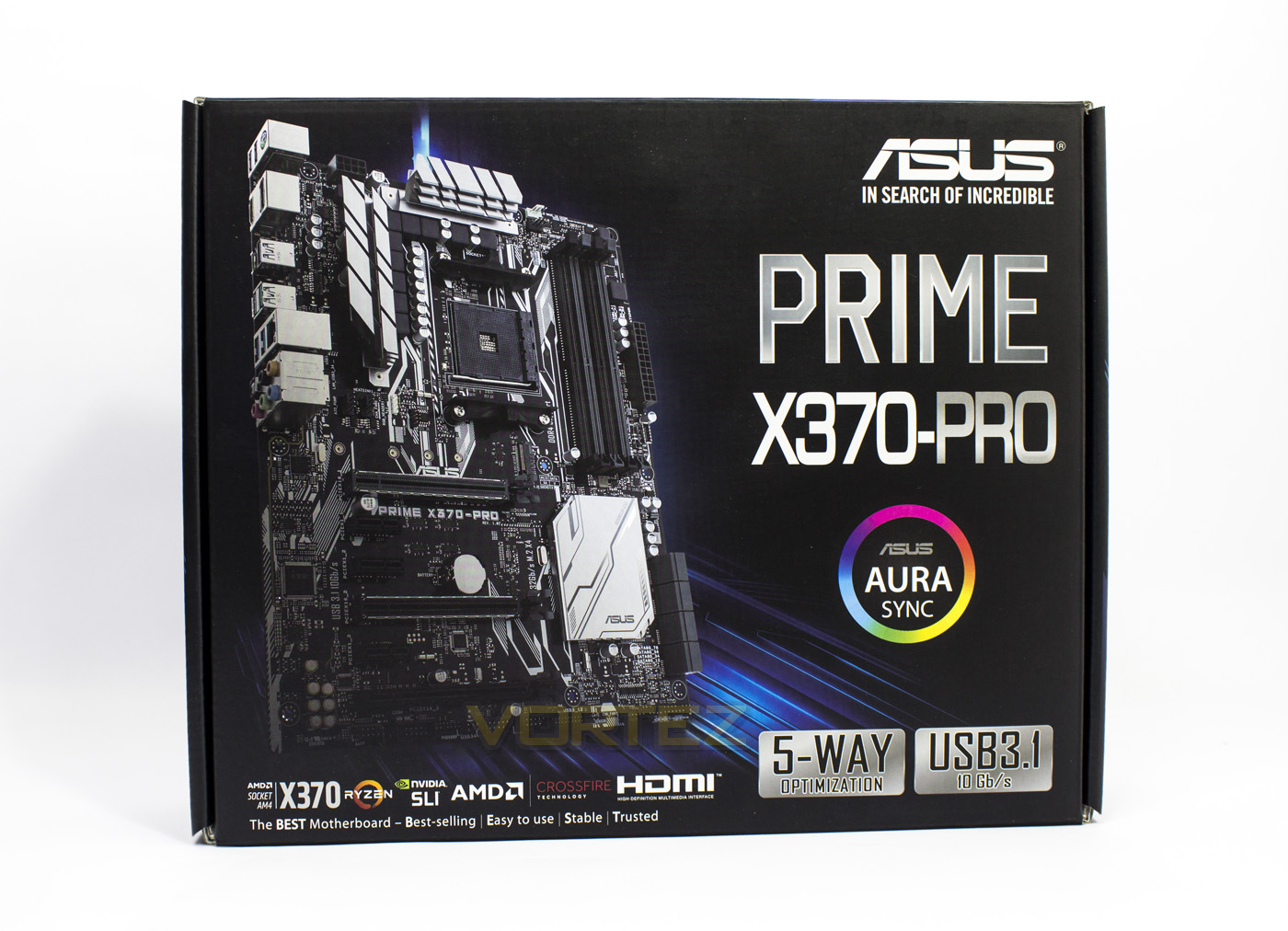
The packaging is bold and to the point, featuring a large image of the product and various branding aspects flanked by various informative thumbnails about technologies, the socket and platform supported.
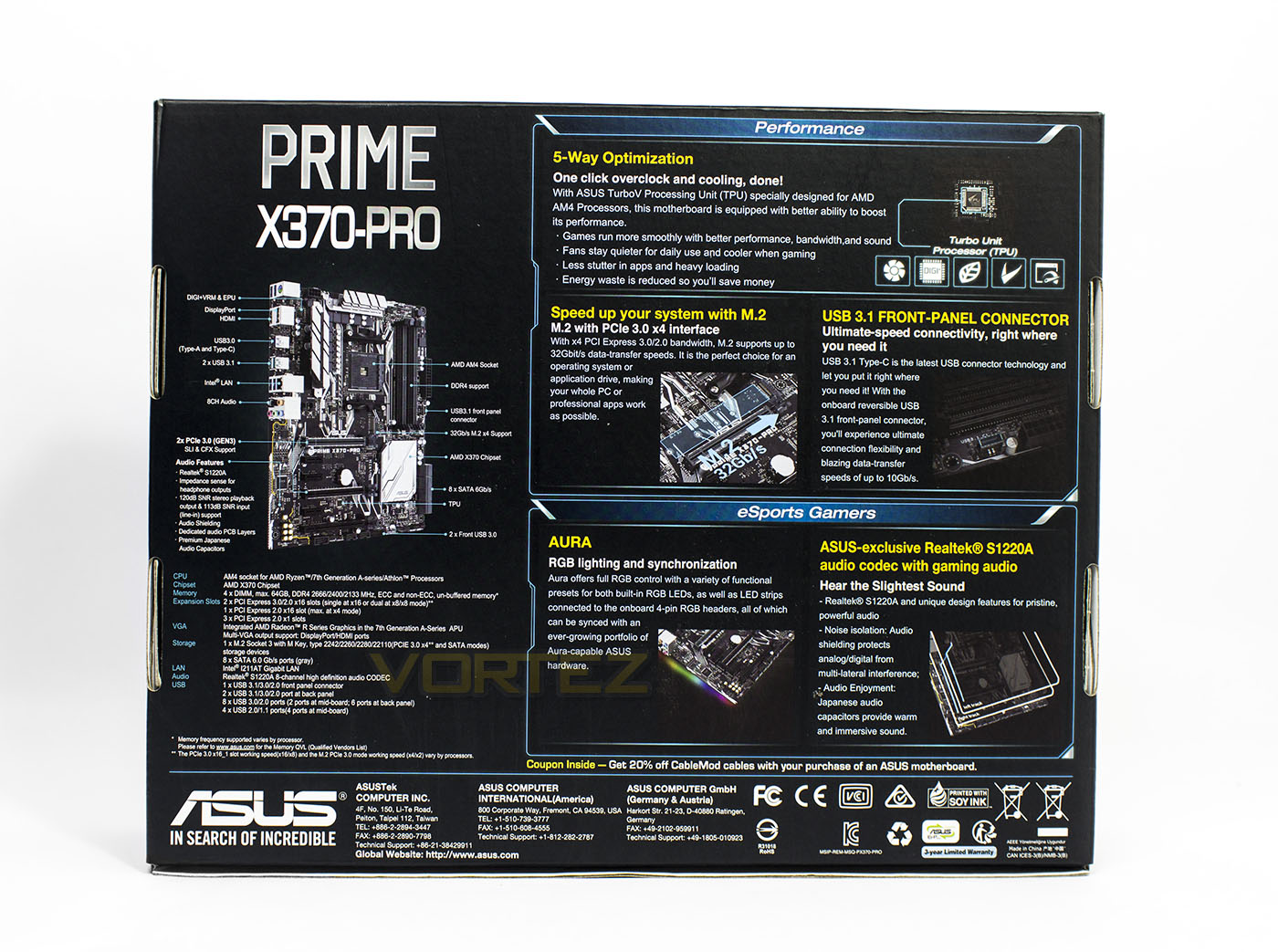
On the reverse side of the board there are various details including the technical specifications and the ASUS exclusive technologies.
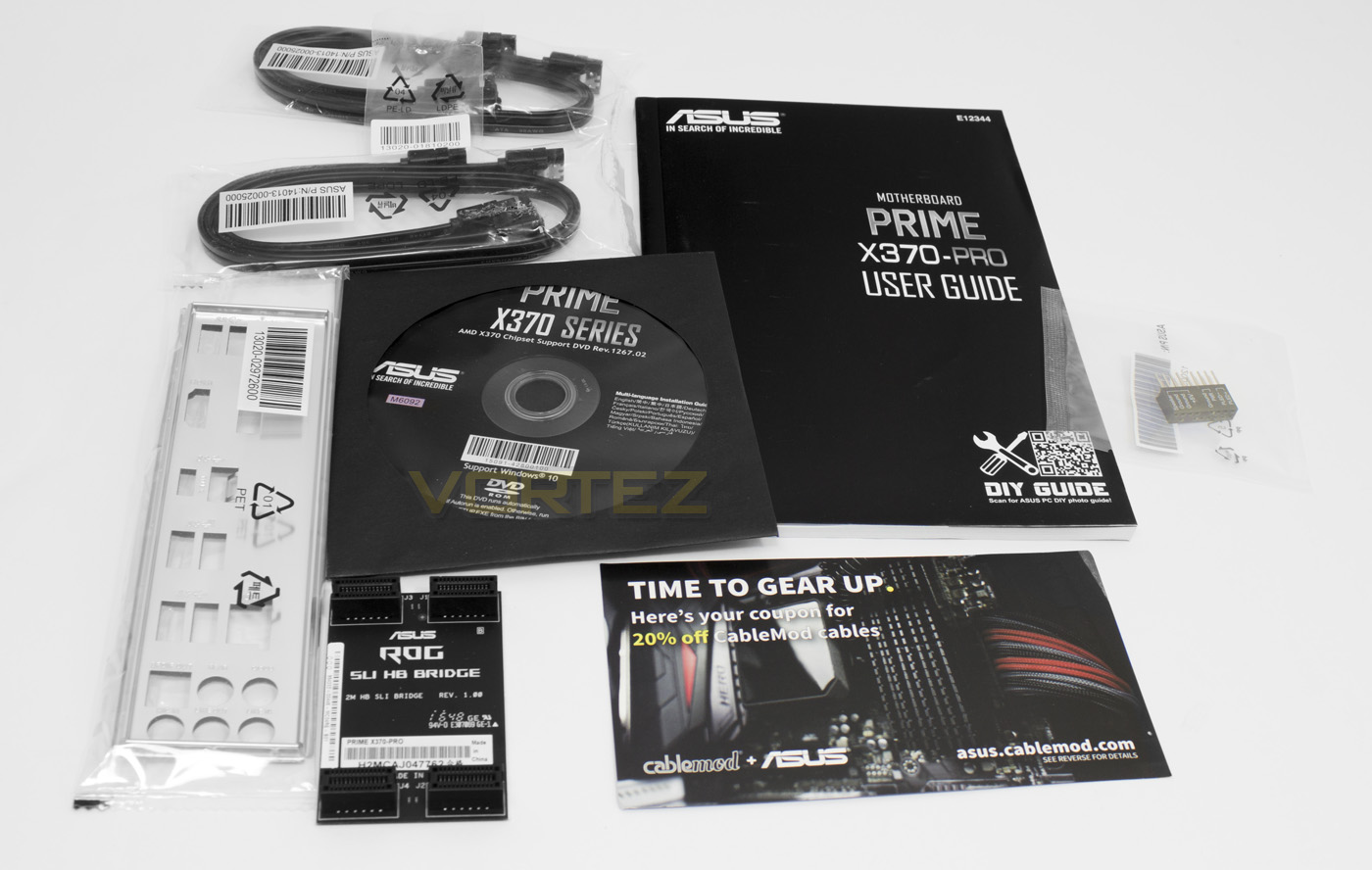
Along with the motherboard, ASUS provides users with the User’s manual, ASUS Q-Shield, 4 x SATA cable, 1 x M.2 Screw Package, a driver DVD, a two way SLI Bridge, 1 x Q-connector.
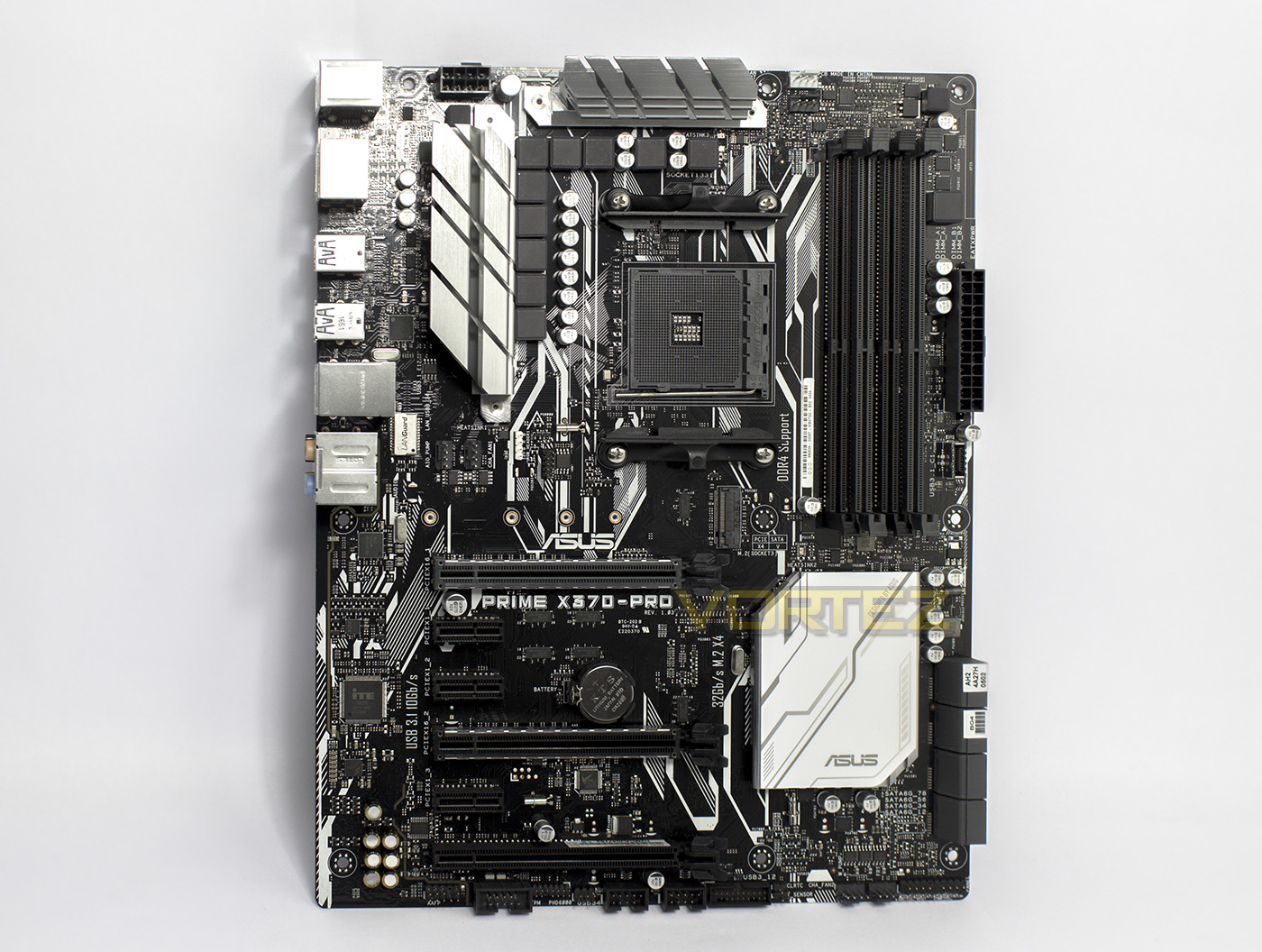
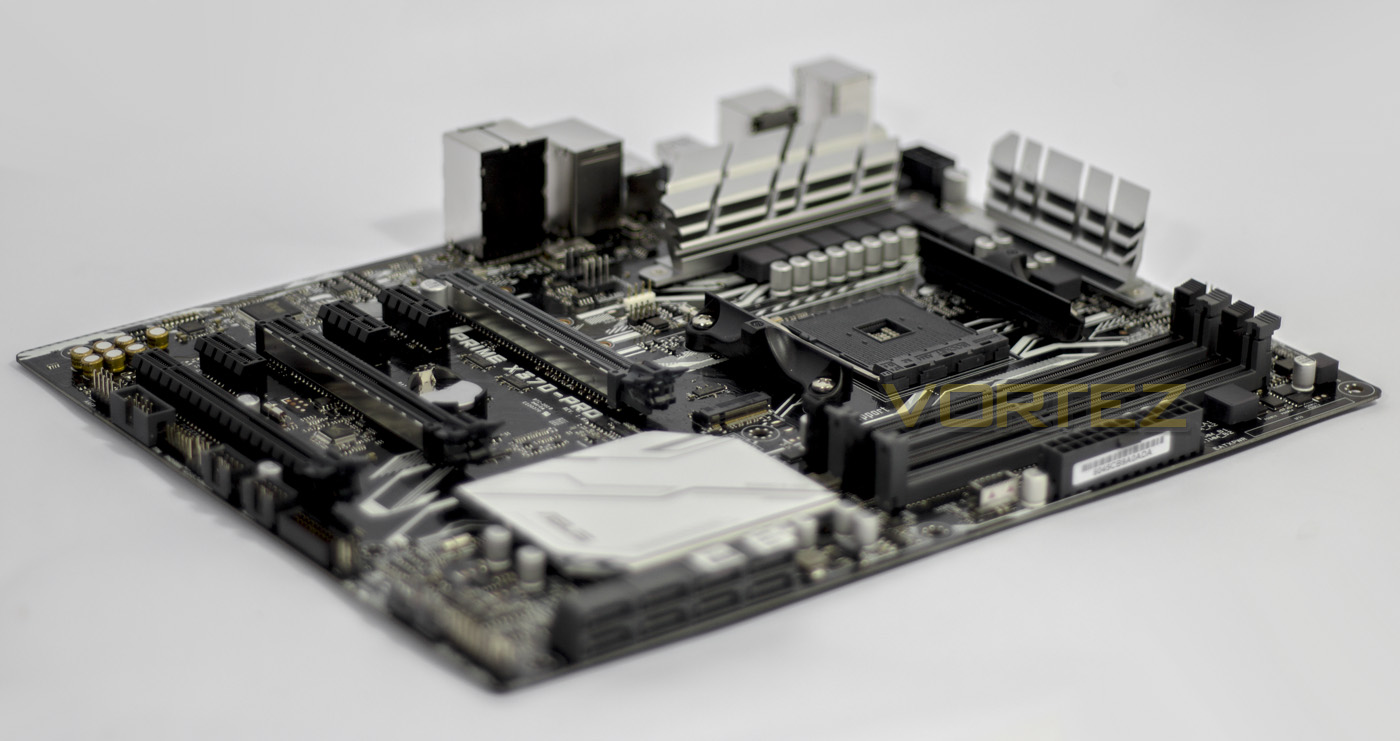
The PRIME X370 PRO is neatly laid out, though unfortunately doesn’t feature any internal right angle USB headers. There is also a noticeable lack of onboard switches and buttons.
Closer Look
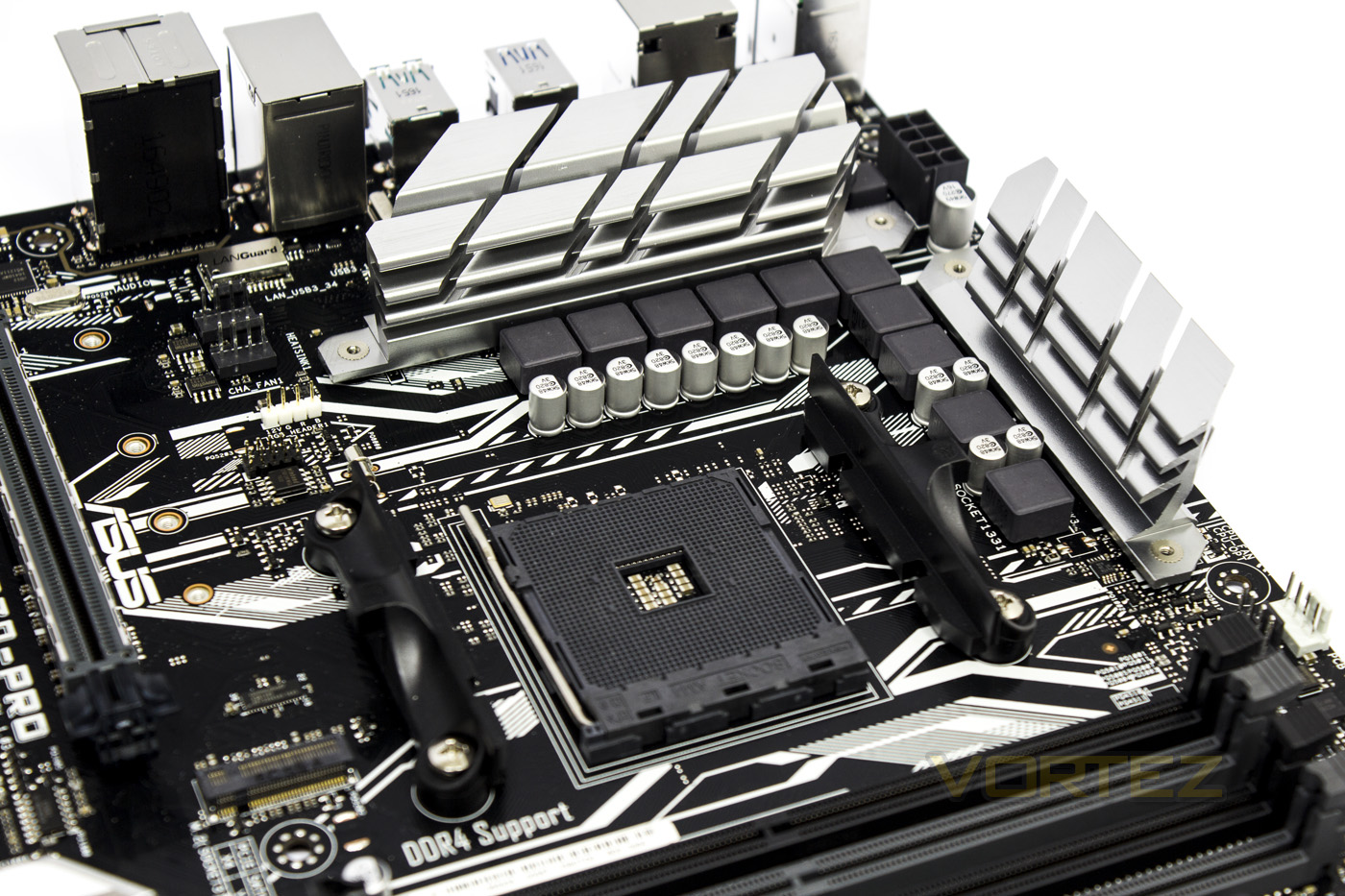
The PRIME X370 PRO features a 6+4 phase power supply to the CPU and features large aluminium heatsinks to help keep things cool. To the right of the top headsink there is a pair of 4pin fan headers for the CPU. Beneath the rear heatsink, there is another pair of 4pin headers, of which one is dedicated for AIO pumps. Towards the rear there is the LanGuard surge protection, while just in front of the 4pin headers, there is the RGB LED header for the Ryzen Wraith RGB cooler.
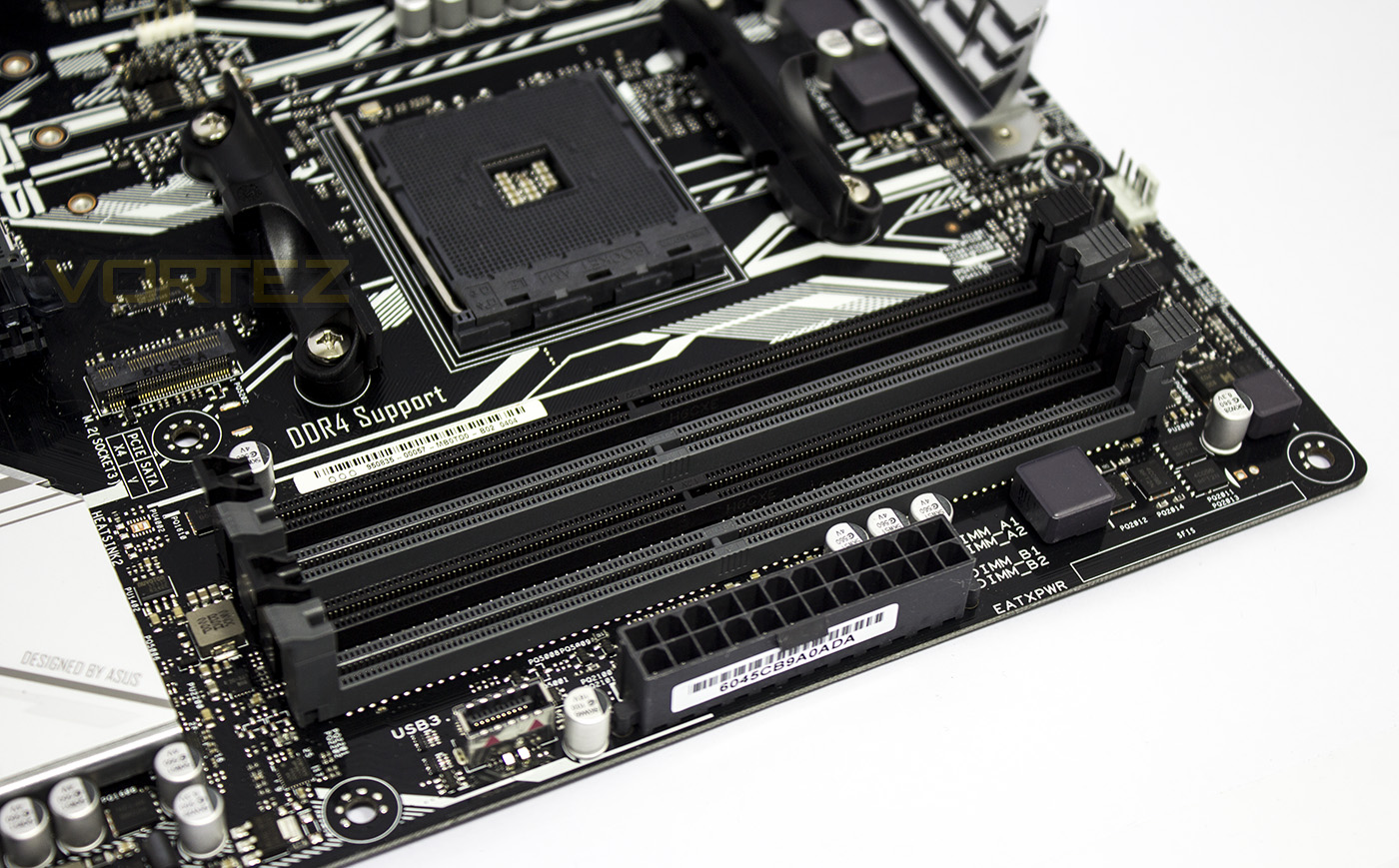
The DIMMs are fairly standard and have not featured additional LED lighting or attention other than what is required for holding the memory in place, towards the edge of the motherboard there is the latest header for a front panel USB 3.1 Gen 2 port, while just in the rear you will see the M.2 socket 3 mount to facilitate high-speed storage.
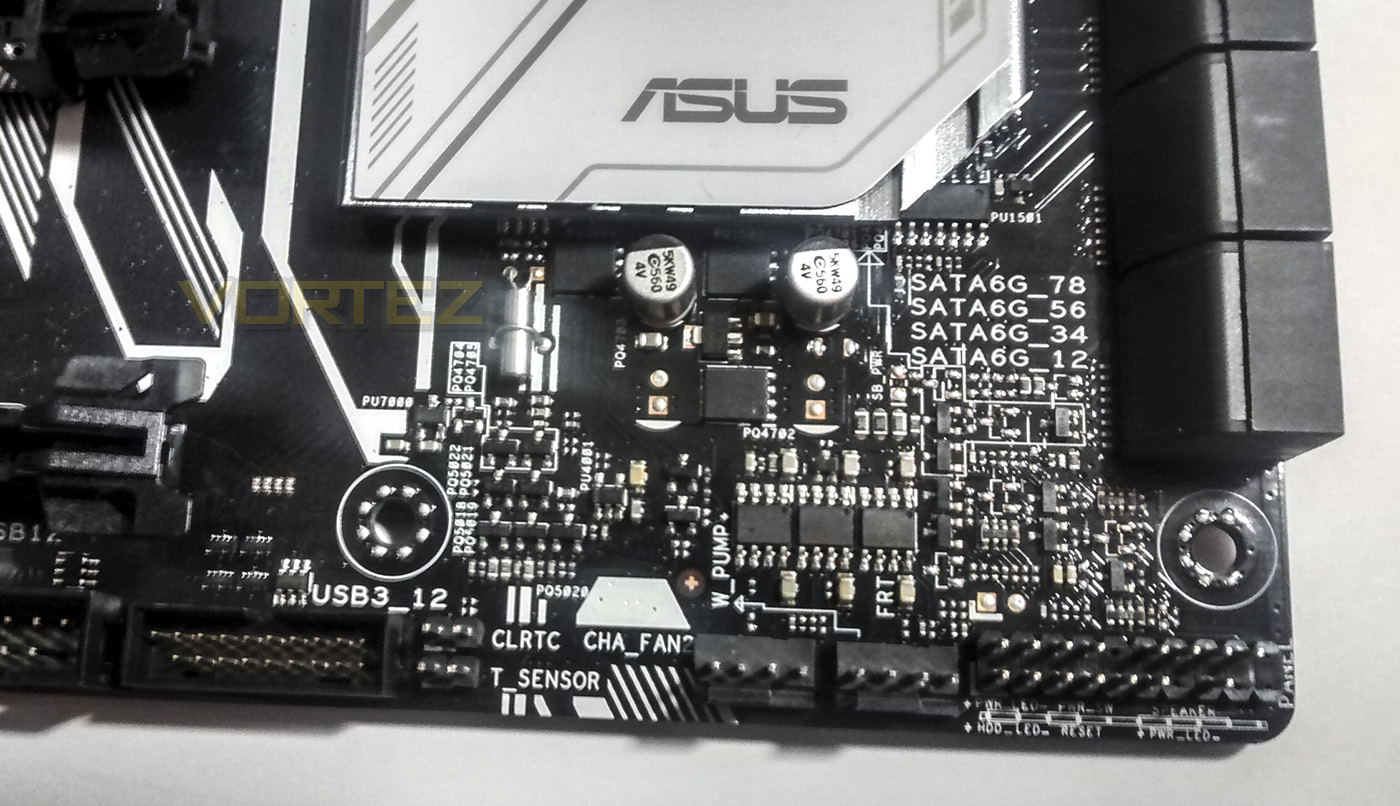
The bottom right corner of most motherboards feature a Front panel connection block, a bunch of pins that connects to your chassis to enable power/reset and activity LEDs. There are headers for a thermistor, and for Clear CMOS, as well as an additional pair of 4pin fan headers, one of which has dedicated overcurrent protection as it can output 3amp for water pumps of up to 36W.
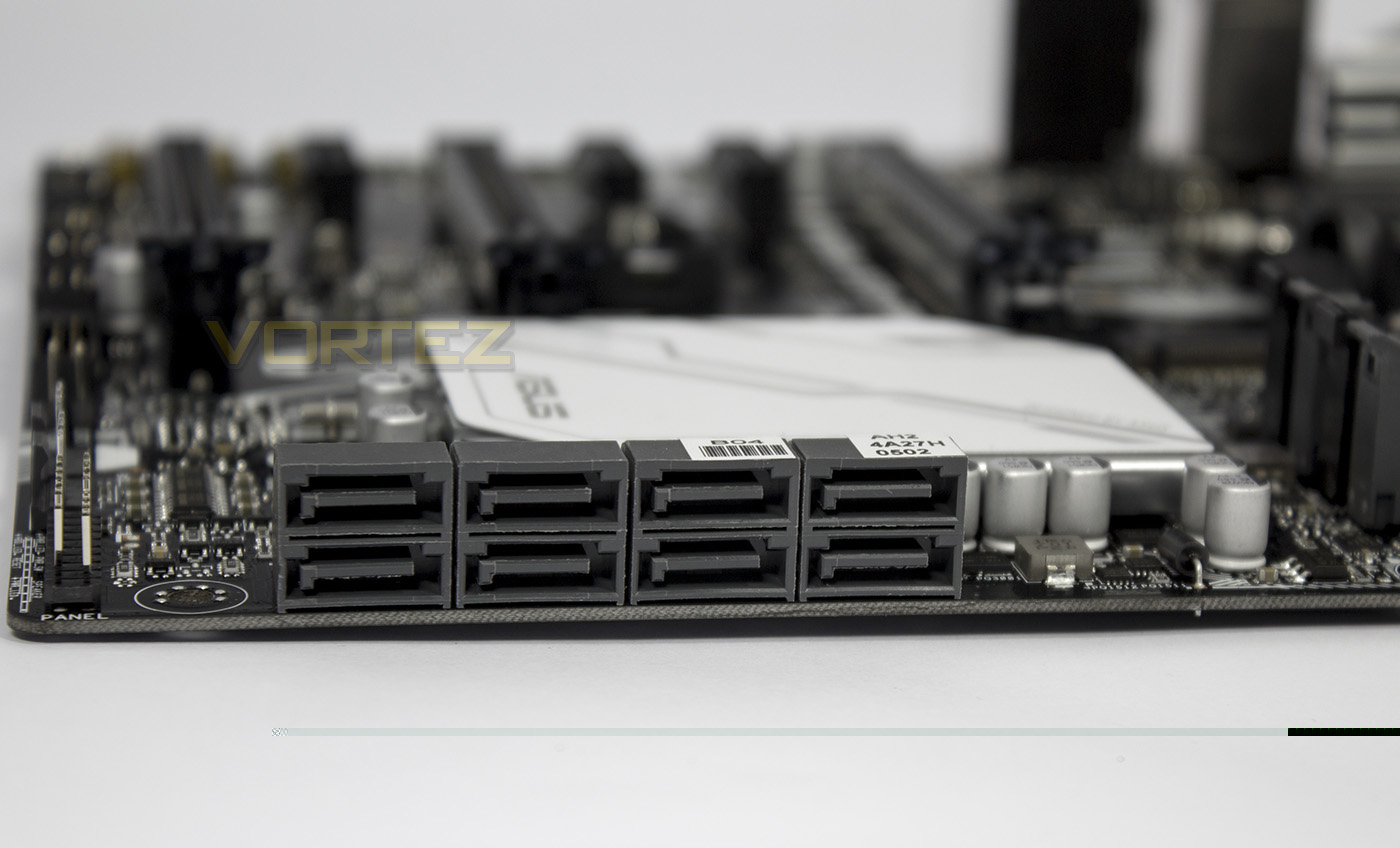
Though there is no SATA Express/NVMe U.2 ports, there are is 8 right angle SATA 6Gb/s ports, allowing for plenty of mainstream storage options.
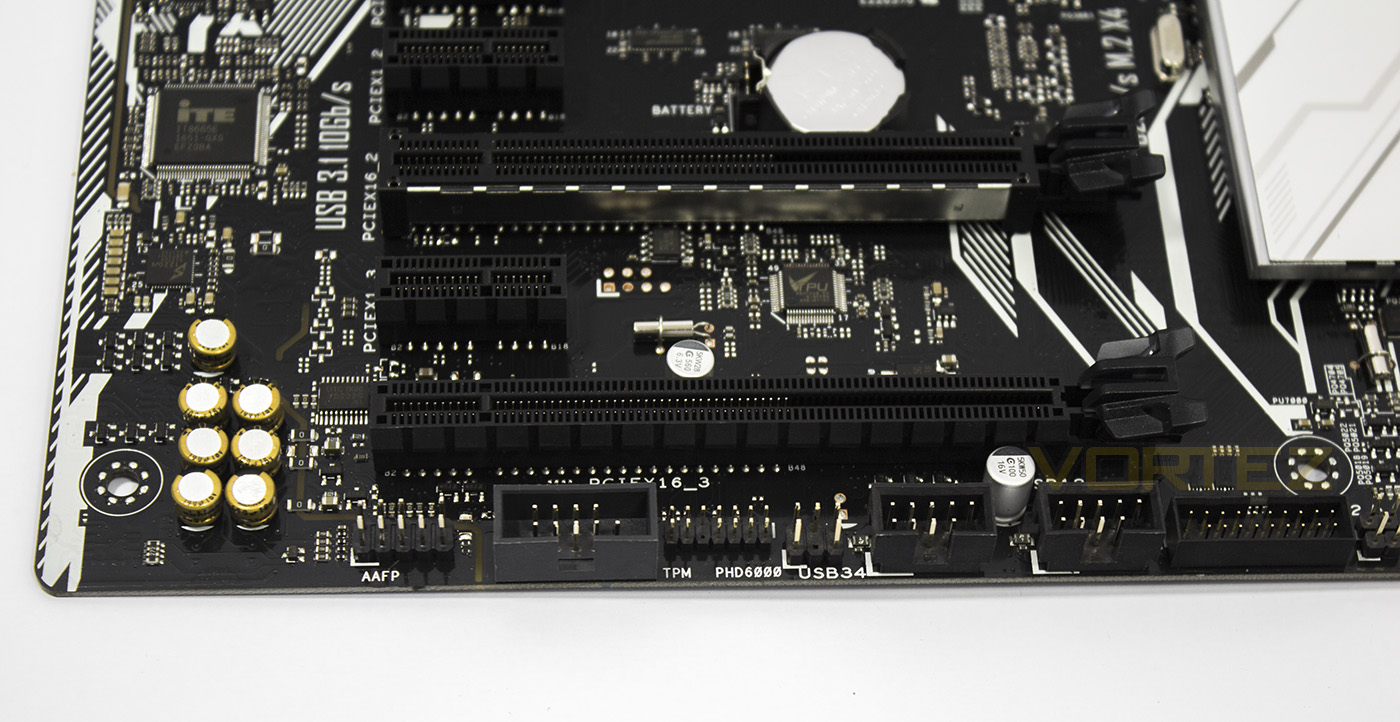
Moving towards the rear left, there are pins for the front panel audio, COM, TPM, 2x USB 2.0 and an additional USB 3.0 header.
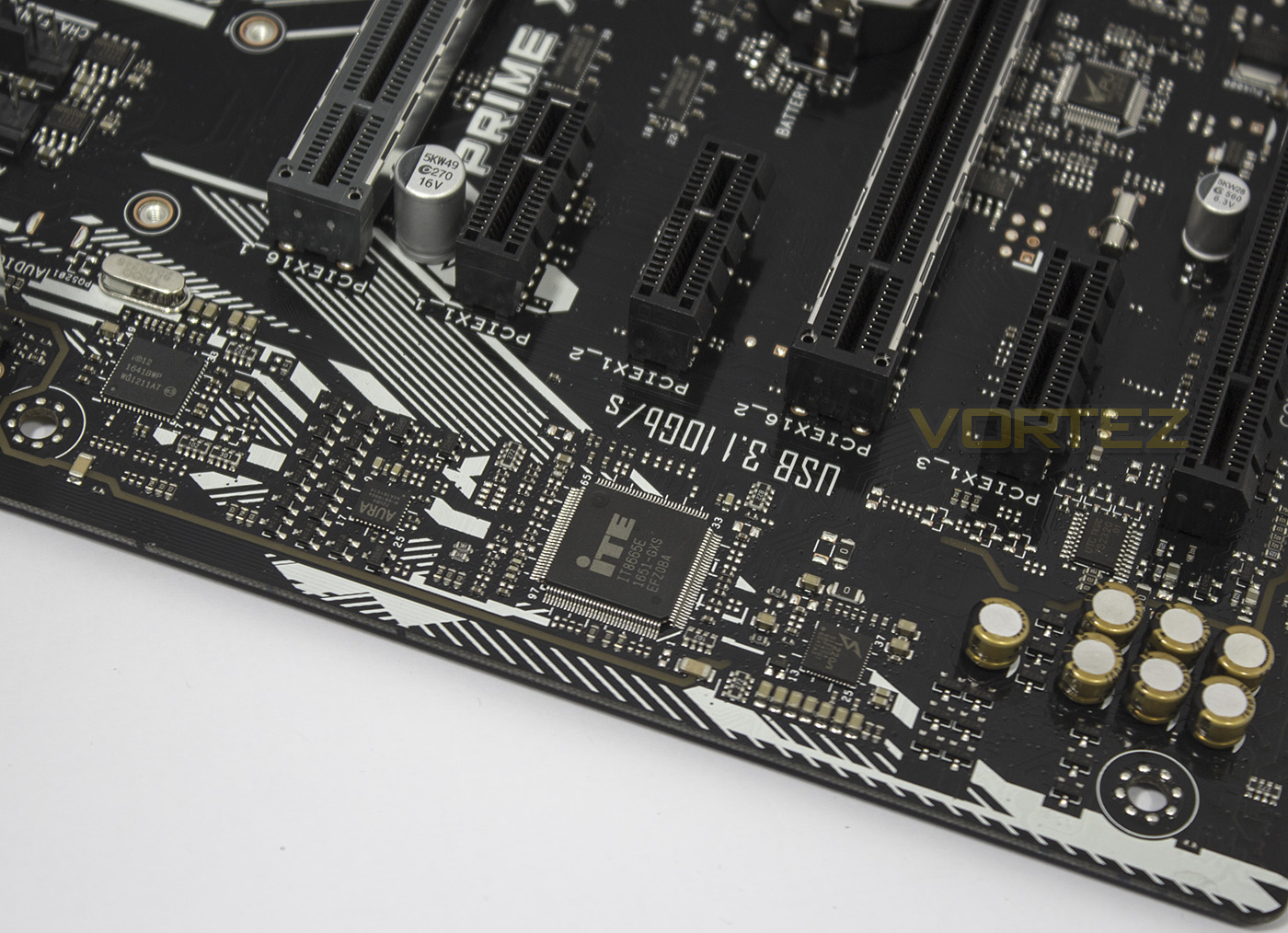
ASUS have included the Intel 1211AT Intel LAN, a dedicated processor for the AURA lighting, as well as the Realtek ALC 1220 codec.
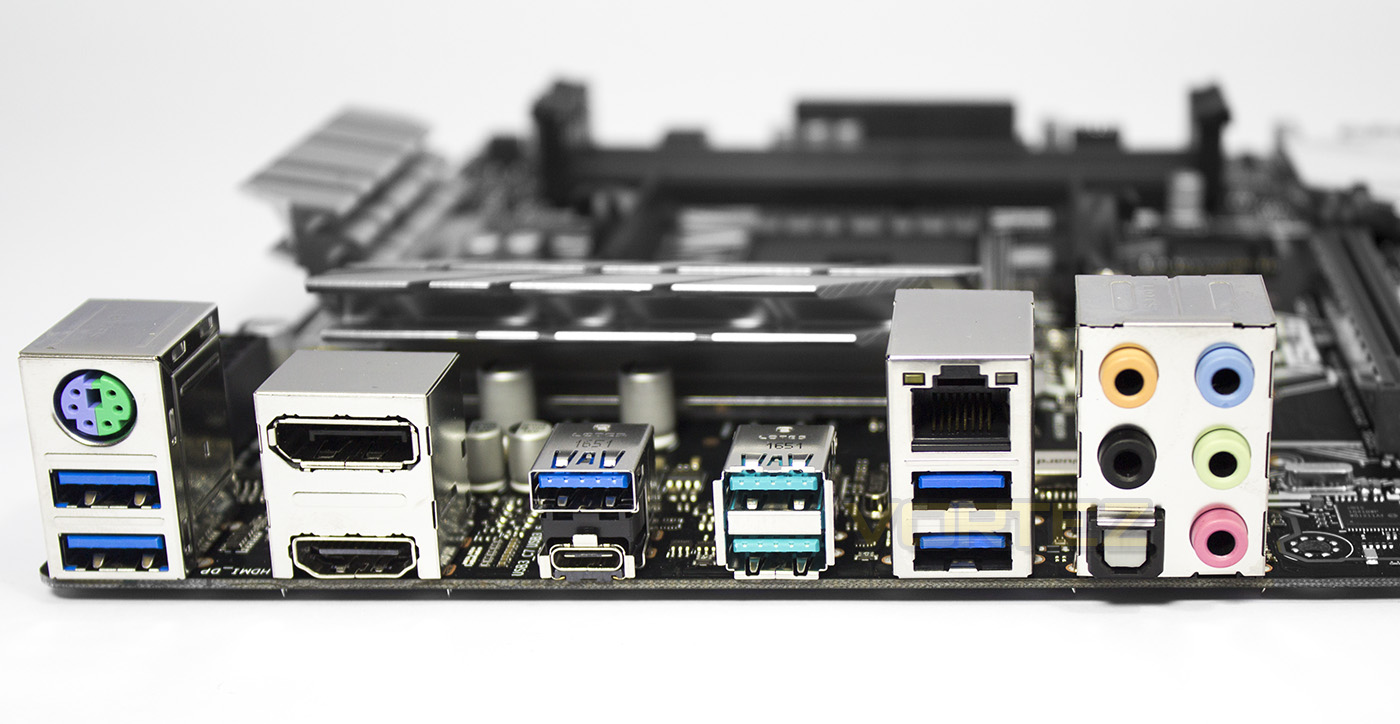
A close look at the rear IO reveals a universal PS/2, 1 x DisplayPort ,1 x HDMI, 1 x LAN (RJ45) port(s), 2 x USB 3.1 (teal blue)Type-A, 1 x USB 3.0 Type-C, 5 x USB 3.0, 1 x Optical S/PDIF out, 5 x Audio jacks.
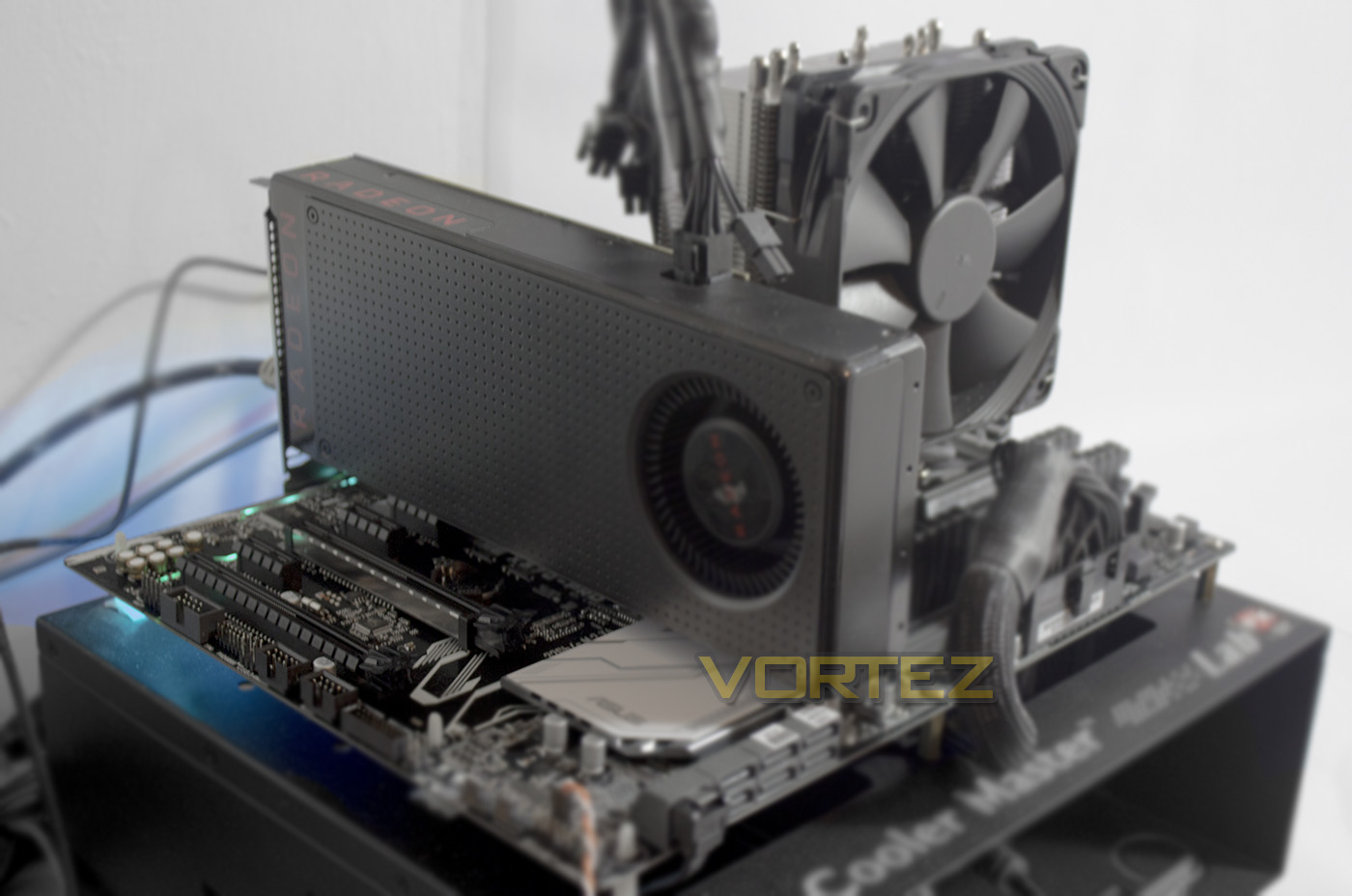
Though limited to just the PCB divide between the main part of the motherboard and the isolated audio PCB, there is a row of RGB LEDs that on powering up with start up in a default wave pattern. The LEDs do a nice job of adding ambient/custom colours.
Test Setup & Overclocking
Test SetupCPU AMD Ryzen 7 1800X
Cooling Noctua U12S
Motherboard ASUS PRIME X370 PRO
Memory 16GB Corsair Vengeance LPX 3000MHz @ 2133MHz
Graphics AMD Radeon RX 480 8GB
Storage Corsair Force LE 480GB
PSU Corsair RM750X 80 Plus Gold Certified PSU
Cooling Noctua U12S
Motherboard ASUS PRIME X370 PRO
Memory 16GB Corsair Vengeance LPX 3000MHz @ 2133MHz
Graphics AMD Radeon RX 480 8GB
Storage Corsair Force LE 480GB
PSU Corsair RM750X 80 Plus Gold Certified PSU
Benchmarks
Cinebench R15 – CPU/OpenGL Score
x264 HD 4.0 – 1st and 2nd pass encoding
SiSoftware SANDRA – CPU & Memory benchmarks
POV-RAY – CPU benchmarks
TrueCrypt – CPU benchmarks
AIDA64 – CPU benchmarks & Memory
PCMark 8 – Home Suite & Photoshop
3DMark FireStrike – 3D Benchmark
Games – Rise of the Tomb Raider & Total War: WARHAMMER
x264 HD 4.0 – 1st and 2nd pass encoding
SiSoftware SANDRA – CPU & Memory benchmarks
POV-RAY – CPU benchmarks
TrueCrypt – CPU benchmarks
AIDA64 – CPU benchmarks & Memory
PCMark 8 – Home Suite & Photoshop
3DMark FireStrike – 3D Benchmark
Games – Rise of the Tomb Raider & Total War: WARHAMMER
Other Software
Temperature Analysis: Aida64 & Ryzen Master
Stress Testing Software: AIDA64 Stability Test
CPU Specification Monitoring: CPU-Z
Stress Testing Software: AIDA64 Stability Test
CPU Specification Monitoring: CPU-Z
Overclocking
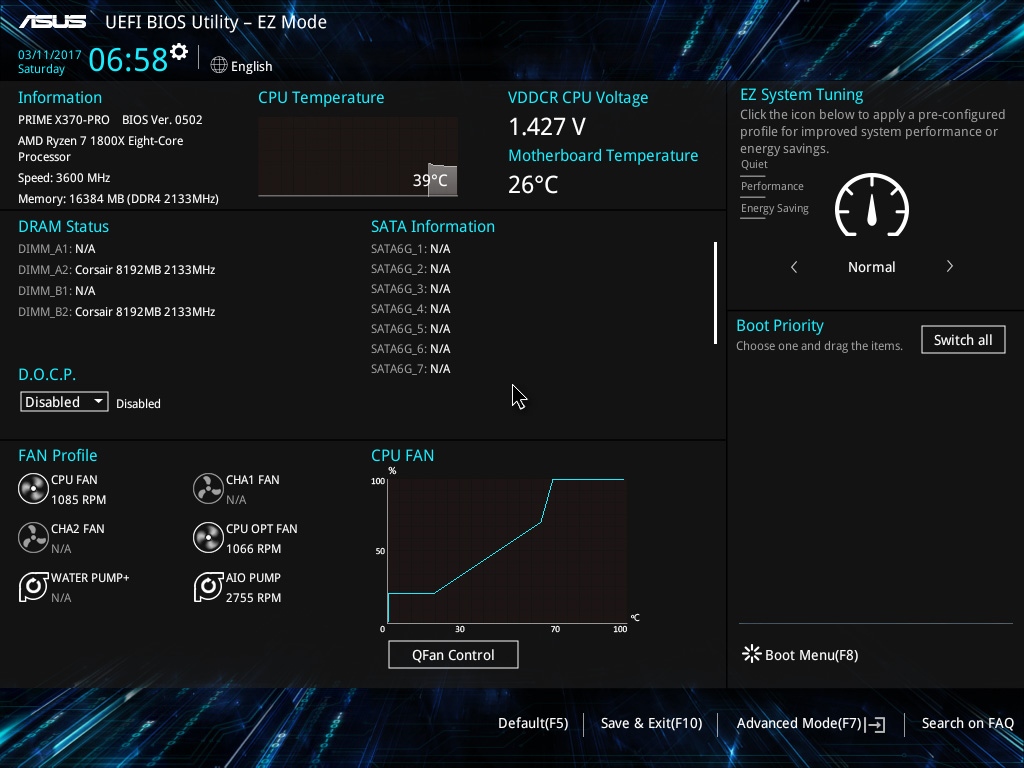
The ASUS board was rather fragile at first and didn’t play nice without our memory and so we had to sit tight for a BIOS update. This is a fairly widespread issue effecting the various AM4 motherboards. Once we had updated things were more stable, but we couldn’t really get our memory kit much over 2400MHz.
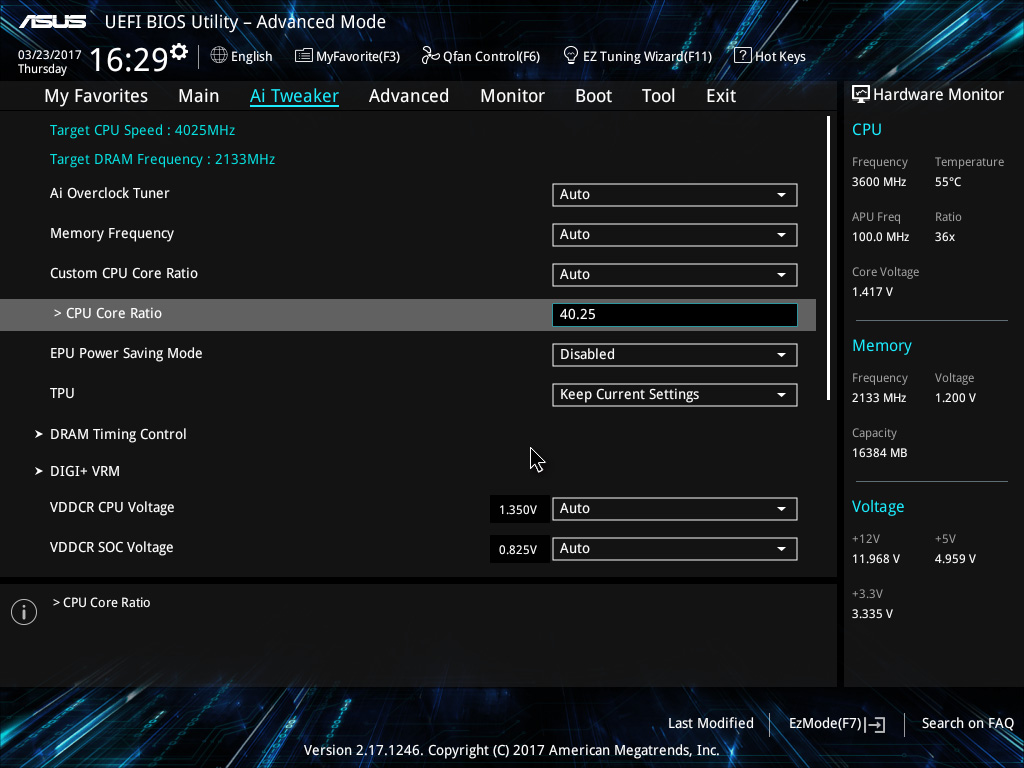
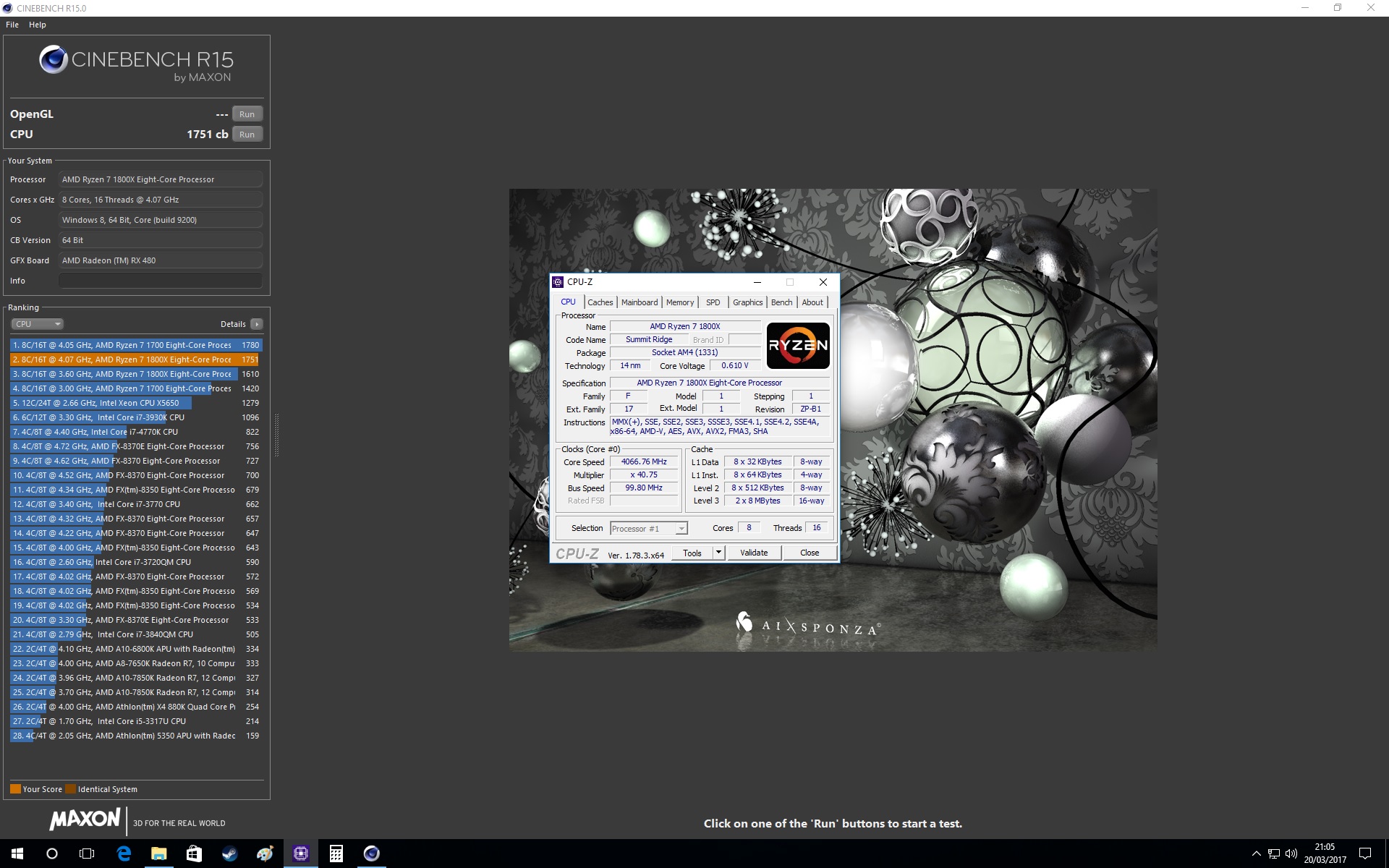
Overclocking the CPU however is much more simple and we managed to overclock the Ryzen 7 1800X to 4.075GHz within the BIOS, this provides a nice jump in performance as demonstrated in Cinebench R15. ASUS have provided access to a manual CPU ratio control using the FID/DID that allows for finer control over the final target clock frequency.
Benchmarks: Power Consumption
It’s interesting to note the power consumption across all motherboards. Although they are using the Z270 chipset, energy results can fluctuate between manufacturers due to the features and specifications that are integrated. First of all, for the idle tests the system is cold booted into Windows and no additional applications are executed – the watts are noted on the external energy monitor we use and then the system is loaded with 3DMark FireStrike – watts are again monitored for the duration of the test and the highest rated wattage result is then noted down. Below are the results of this energy test.
Benchmarks: Cinebench R15
CINEBENCH is a real-world cross platform test suite that evaluates your computer’s performance capabilities. CINEBENCH is based on MAXON’s award-winning animation software CINEMA 4D, which is used extensively by studios and production houses worldwide for 3D content creation. MAXON software has been used in blockbuster movies such as Iron Man 3, Oblivion, Life of Pi or Prometheus and many more.
Benchmarks: X264 HD
Simply put, this test measures how fast your machine can encode a short, DVD quality MPEG-2 video clip into a high-quality x264 video clip. What’s x264, you ask? It’s more or less the next-generation Xvid/DivX codec. I think it’s ideal for a benchmark because the application (x264.exe) reports fairly accurate compression results (in frames per second) for each pass of the video encoding process, and it uses multi-core processors very efficiently.
Benchmarks: SiSoftware SANDRA
SANDRA isn’t always a benchmark that is included in hardware reviews but we believe it shouldn’t be ignored. SANDRA provides a vigorous package that tests your system in a rather large array of benchmarks. There are many aspects of benchmark that can be executed. We will be considering – CPU and memory tests.
Benchmarks: POV-RAY
Persistence of Vision Raytracer’s PovRay is a free and open source 3D animator application with versions for computers with different operating systems.
This product allows users to build their custom 3D worlds with excellent quality despite their computer’s hardware. It has adjustable options for levels of radiance, refraction, and reflection. Calculation time may vary depending on the computer model, but PovRay can adapt to many computer builds, and is supported by the open source community.
This product allows users to build their custom 3D worlds with excellent quality despite their computer’s hardware. It has adjustable options for levels of radiance, refraction, and reflection. Calculation time may vary depending on the computer model, but PovRay can adapt to many computer builds, and is supported by the open source community.
Benchmarks: TrueCrypt
TrueCrypt is a discontinued source-available freeware utility used for on-the-fly encryption (OTFE). It can create a virtual encrypted disk within a file or encrypt a partition or (under Microsoft Windows except Windows 8 with GPT) the entire storage device (pre-boot authentication).
Benchmarks: AIDA64
AIDA64 Product PageThis simple integer benchmark focuses on the branch prediction capabilities and the misprediction penalties of the CPU. It finds the solutions for the classic “Queens problem” on a 10 by 10 sized chessboard. At the same clock speed theoretically the processor with the shorter pipeline and smaller misprediction penalties will attain higher benchmark scores. For example — with HyperThreading disabled — the Intel Northwood core processors get higher scores than the Intel Prescott core based ones due to the 20-step vs 31-step long pipeline. CPU Queen test uses integer MMX, SSE2 and SSSE3 optimizations.
Benchmarks: PCMark 8
PCMark 8 combines performance benchmarking with battery life measurement and includes tests based on popular Adobe and Microsoft applications. Whether you are looking for long battery life, or maximum power, PCMark 8 will help you find the devices that offer the perfect combination of efficiency and performance for your needs. It’s the complete PC performance benchmark for home and business.
Benchmarks: PCMark 8 Photoshop
The PCMark 8 Applications benchmark measures system performance using popular applications from the Adobe Creative Suite and Microsoft Office. You can choose which tests to run based on the applications installed on your system. Each test automatically steps through a series of actions such as opening, editing and saving a file. The results are used to calculate the PCMark 8 Applications scores for the system.
Benchmarks: 3DMark
3DMark FireStrike Product PageFire Strike is our new showcase DirectX 11 benchmark designed for high-performance gaming PCs. It is our most ambitious and technical benchmark ever, featuring real-time graphics rendered with detail and complexity far beyond what is found in other benchmarks and games today. Fire Strike will only be available in the Windows editions of 3DMark initially.
VR Performance – VRMark
VRMark Product PageVRMark includes two VR benchmark tests that run on your monitor, no headset required, or on a connected HMD. At the end of each test, you’ll see whether your PC is VR ready, and if not, how far it falls short.
Gaming Performance – Rise of the Tomb Raider & Total War: WARHAMMER
It’s important for us to perform a number of game benchmarks as well as the synthetic tests because gamers will want to know if there are any significant benefits. So here we have two recent gaming titles.
Conclusion
Despite initial set-backs, the PRIME X370 PRO pumps out solid performance with the 1800X and features a whole load of ASUS exclusive technologies and content, from the latest AI suite, Aura lighting, and the 5way optimisation, there is enough support to help any system builder to get the best out of their system.
Though it does miss out on some features that many would have liked to see, including SATA Express or even an NVMe U.2 port, we can argue that these are non-essential standards that aren’t yet widely used. However, it does include other cutting edge standards such as a front panel USB 3.1 Gen 2 USB header which is likely to see a much faster adoption.
We did have some issues getting our memory to run at its rated speed on an older BIOS, we have tested the latest BIOS and found that it had improved some stability for us. As this is an issue that is platform wide, not exclusive to the PRIME X370, it isn’t really right to penalise this motherboard for not quite having the desire stability that will only be there once it matures a little through various updates. One major gripe we did have though, is that we noticed that the entire motherboard is, literally, very bendy and weak, so we recommend caution when installing memory, graphics cards and CPU coolers. Also, despite featuring the Crashfree BIOS 3, there were many failed OC attempts that caused a continuous power loop, defeating the point of ‘Crashfree BIOS’, it was at this point we missed the convenience of an onboard ‘Clear CMOS’ button, debug LEDs or even the ASUS MemOK! feature.
The PRIME X370 PRO sits around the £150 price point and is significantly lower priced than many other X370 motherboards. Despite the concessions made to reduce the overall cost, it still provides users with a well balanced product that provides competitive features and performance. We nearly overlooked the fact that it features two video output methods (HDMI and Display Port), something that will be more important once the APUs are made available. The inclusion of contemporary features including RGB lighting and a 3a output watercooling pump header (with over current protection) means that there is appeal new and experienced system builders alike.
The PRIME X370 PRO gives users a chance to maximise their bang for buck without missing out on the latest essential features.
Pros
+ Attractive design
+ Solid performance
+ M.2 socket
+ SLI and CrossFire support
+ RGB lighting + RGB LED strip header
+ Two display outputs (HDMI/DP)
+ Good overclocking options including manual FID/DID for custom ratio
+ Features a USB 3.1 Gen 2 front panel header
+ ASUS exclusive technologies (5-way Optimisation, 5x Protection III)
+ Price
Cons
– Immature BIOS (might give some a bumpy start)
– Bendy/flexible PCB (requires a delicate touch)
– No BIOS debug/LED
+ Attractive design
+ Solid performance
+ M.2 socket
+ SLI and CrossFire support
+ RGB lighting + RGB LED strip header
+ Two display outputs (HDMI/DP)
+ Good overclocking options including manual FID/DID for custom ratio
+ Features a USB 3.1 Gen 2 front panel header
+ ASUS exclusive technologies (5-way Optimisation, 5x Protection III)
+ Price
Cons
– Immature BIOS (might give some a bumpy start)
– Bendy/flexible PCB (requires a delicate touch)
– No BIOS debug/LED
Click here for an explanation of our awards at Vortez.net.