Designed for the new X399 chipset, we take a look at AMD’s new 16 Core processor which features 32 threads of simultaneous multi-processing power. Is this the fastest multi-threaded processor consumers can get their hands on?

Product on Review: Ryzen Threadripper 1950X
Manufacturer: AMD
Street: £980 GBP (Inc. V.A.T.) / $999 USD
Ever considered that there’s not enough choice in the High End Desktop Market? Thought to yourself that ten CPU cores just isn’t enough for your home video rendering rig? Need more high-speed PCI-Express lanes than you’ll see this side of a server environment? Well then rejoice, for AMD Ryzen Threadripper is finally here.
Ryzen Threadripper is Intel’s first true competition for High End Desktop (HEDT) market share, and is a subtle evolution of AMD’s Ryzen mainstream desktop platform. The Threadripper range straddles the vast gulf between 8-core performance-class Ryzen and 32-core server-class EYPC CPUs, exploiting a considerable number of CPU cores at prices which make them highly competitive on a cores/dollar metric.
However, before we get into the review properly we need to lay a little bit of groundwork. As you might be aware Vortez.net was not one of the sites supported by AMD for this launch, to the extent that we were not provided with an NDA to sign or embargo time for reviews. This is one of the reasons why we have not published teasers or videos of the exceptionally well appointed review kit. We have however been able to secure the flagship Ryzen Threadripper X1950 from unofficial sources, and similarly have been provided with an Intel Core i9 7900X to test it against. These circumstances will not affect our conclusions, but providing context for transparency’s sake is appropriate.
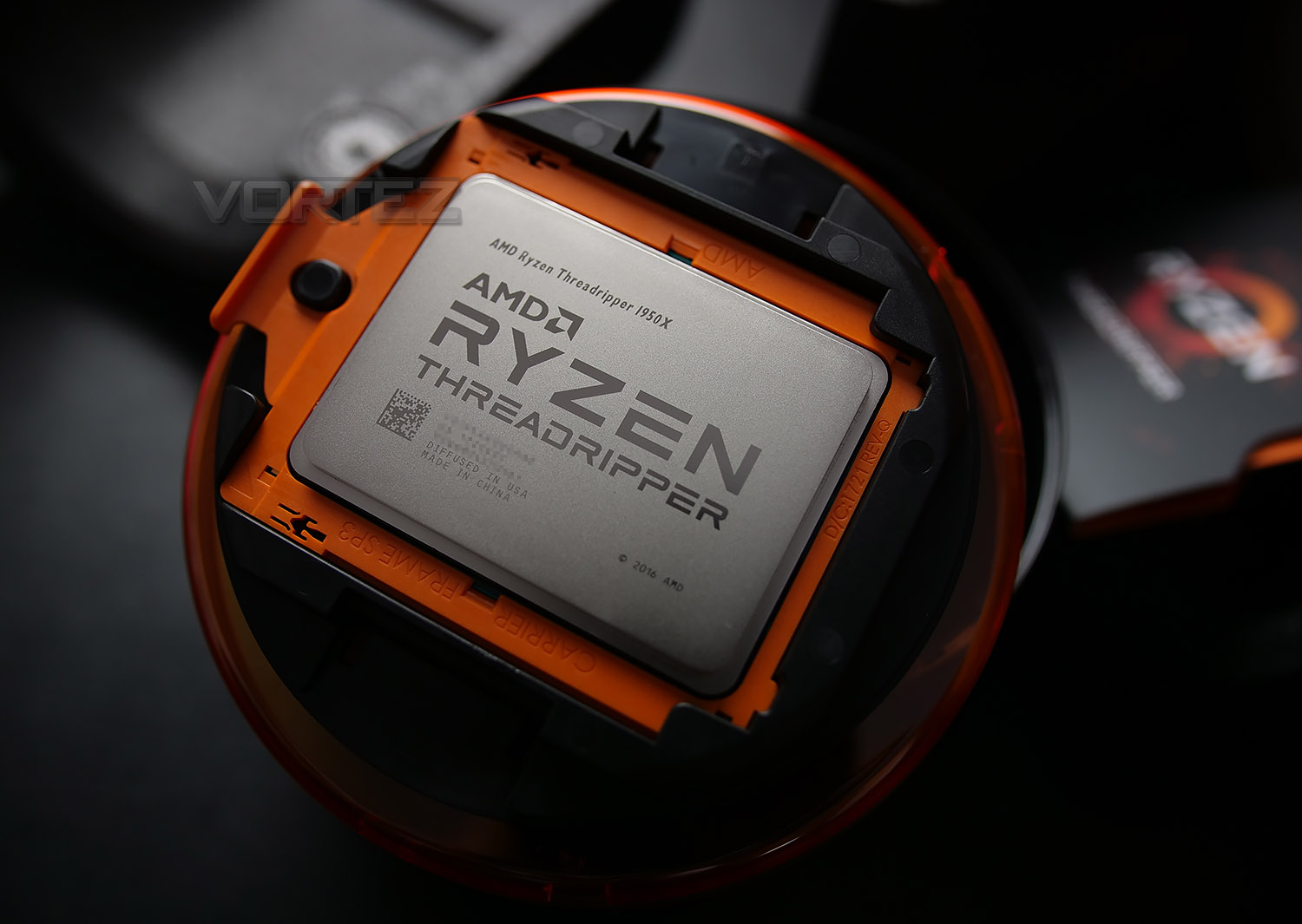
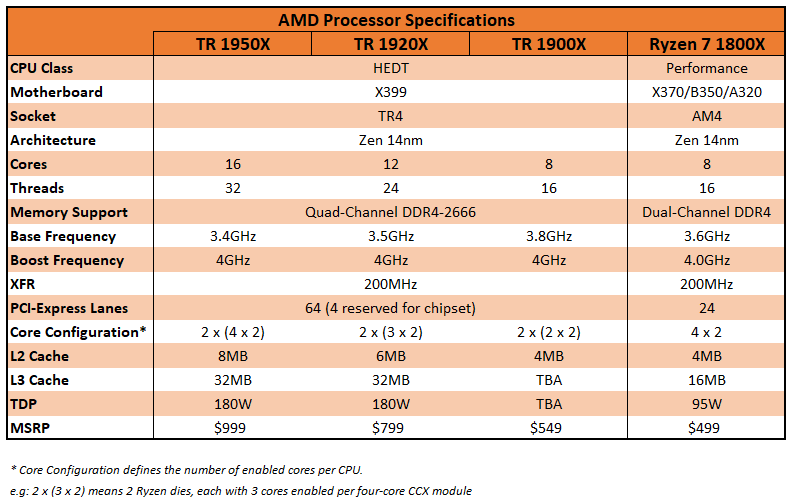
AMD are launching Ryzen Threadripper today with two premium models, and have announced a further SKU with fewer cores which will be available at the end of this month (August 2017). These three CPUs are equipped with eight, twelve or sixteen cores, and further differentiate themselves from mainstream Ryzen models by making additional PCI-Express lanes available from the CPU and supporting quad-channel memory, clearly marking themselves out as HEDT chips.
Alongside Threadripper CPUs come their complementary X399 motherboard platform, exclusive to these new chips. Partners such as ASUS, MSI, GIGABYTE and ASRock will have at least one model available on launch ready to exploit the potential of Threadripper. Much like Intel’s X299 motherboards, launch models have proved to be premium in both price and features list, starting at around $350 in the US (excl. Tax); as the platform matures more affordable options may become available, especially to pair with the platform entry-point X1900 CPU.
By naming their chipset X399 AMD are repurposing Intel’s naming scheme for HEDT motherboards, which is just a touch exasperating and may make for interesting times when Intel update their HEDT motherboards.
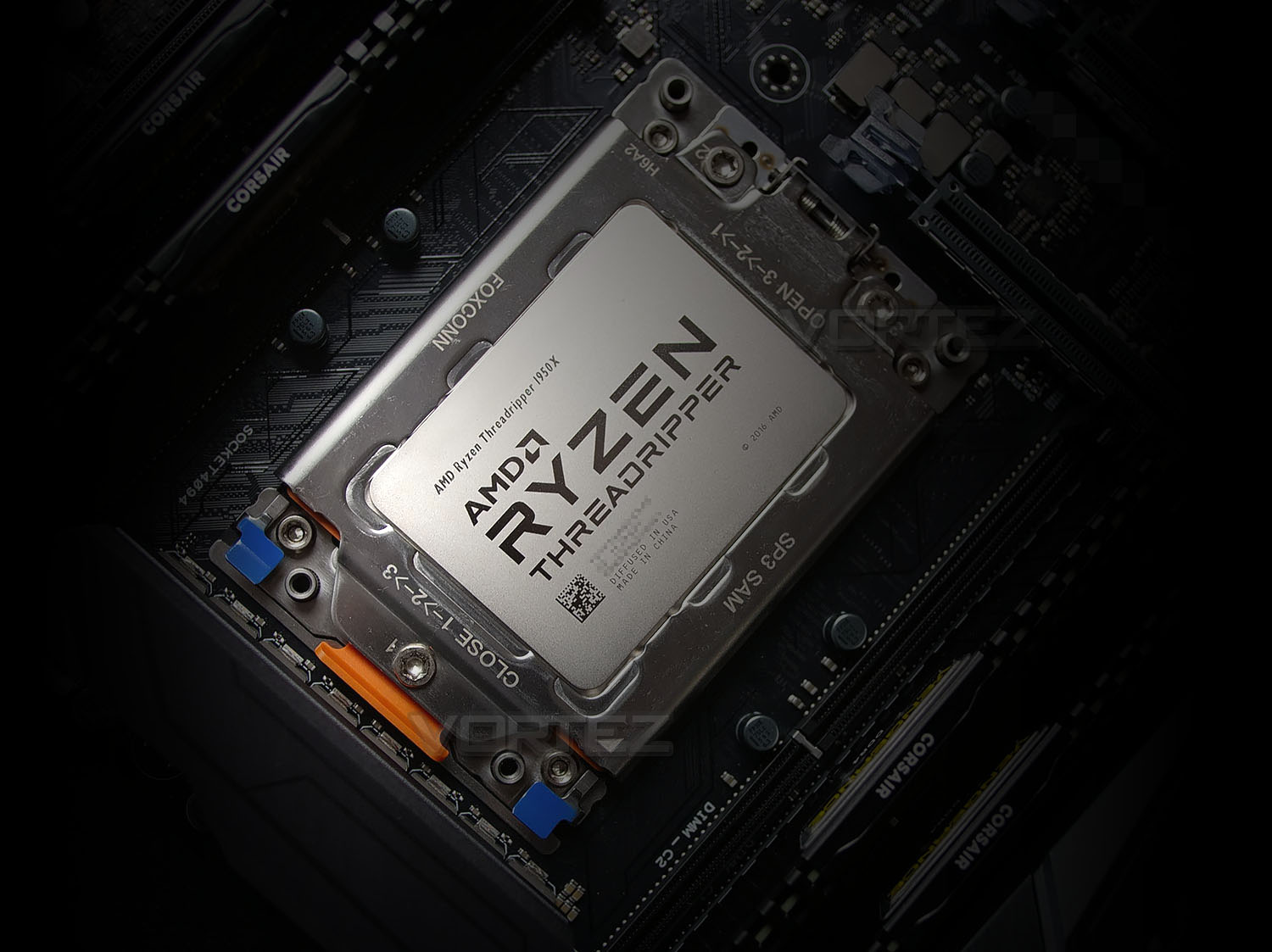
Today we’re reviewing the Ryzen Threadripper 1950X, a 16-core behemoth which supports Simultaneous Multithreading for up to 32 independent threads and is priced at $999. Its MSRP is identical to that of Intel’s 10-core, 20-thread Core i9-7900X, making them ideal sparring partners in our tests. The price point will put the platform out of reach of mainstream and enthusiast gamers whose sole requirement is raw FPS, but all those additional cores would likely go unused regardless. Heavy mixed workloads including video rendering and other prosumer use cases will be where both Threadripper and Core X are likely to thrive, and its this burgeoning Prosumer market which will relish the new options now available.
Were we to be judging the two CPUs blind AMD would have the win based on core and thread count alone, but differing architectures rarely behave in a way which would make such elementary conclusions reliable.
Zen Architecture Recap
Before we discuss Threadripper specifically, let’s recap what we already know about the Zen microarchitecture as it applies to AMD’s new processor lineup.
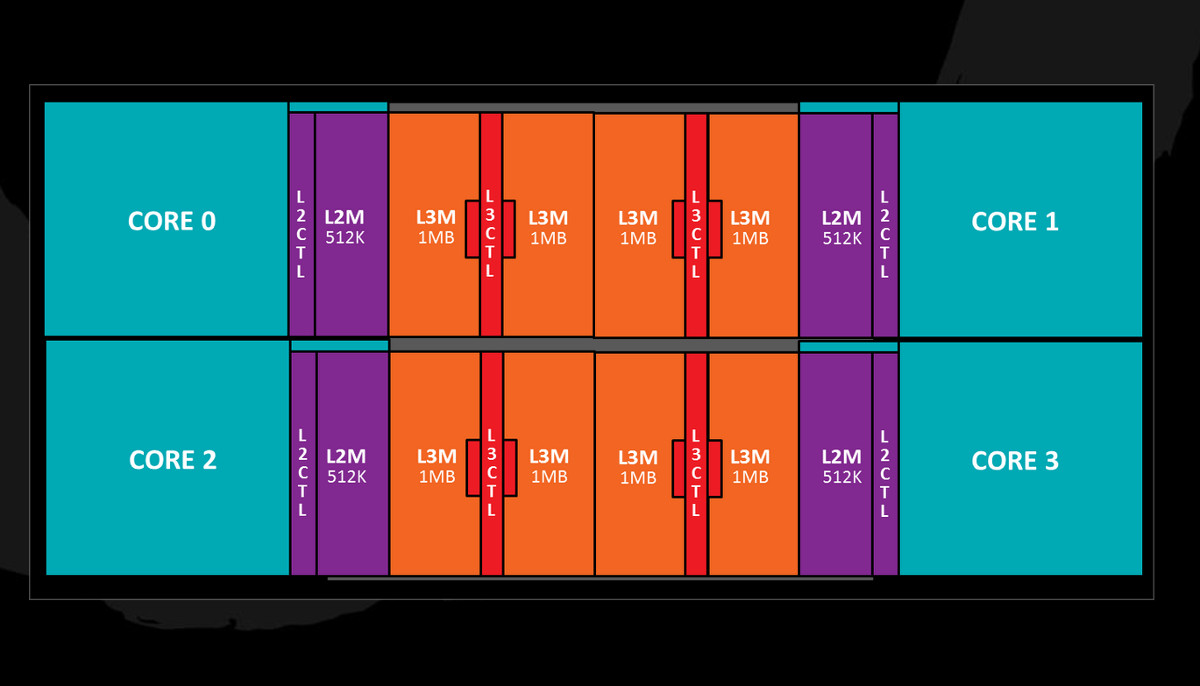
The most fundamental building block of Zen is the Core Complex, or CCX for short. Each CCX incorporates 4 CPU cores with exclusive L1 and L2 cache as well as a shared pool of L3 cache. Typically each core has 512KB of L2 Cache, whilst the CCX as a whole has 8MB of L3 Cache (2MB per core). Communication between CCX is via a protocol AMD are calling Infinity Fabric, allowing L3 cache to be addressed and accessed by other CCX modules in proximity at a speed proportional to DRAM.
A striking aspect of this architectural design is its inherent scalability. Desktop Ryzen CPUs incorporate two CCX modules on the die (Ryzen dies are individually codenamed Zepplin) for a total of up to 8 CPU cores, and by selectively disabling cores scales down to as few as four active cores, with optional access to the full 16MB L3 cache pool of the whole chip. Later this year Raven Ridge APUs will likely feature just one CCX alongside a graphics module, communicating via Infinity Fabric. But Zen scalability can go beyond this.
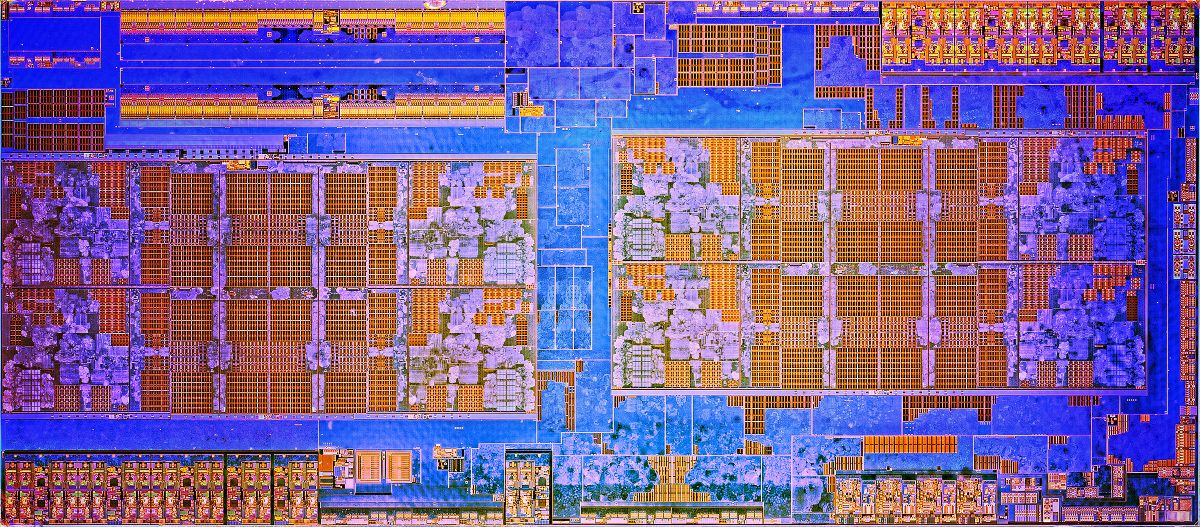
Zen CPU cores also support Simultaneous Multithreading. A technique similar to Intel’s Hyperthreading, SMT allows one core to work on two quasi-independent tasks or threads of execution at the same time, garnering time savings by sharing resources and efficient scheduling so workload isn’t duplicated. Each Zepplin die can support up to 16 threads, a far cry from the maximum of eight on Intel’s Core i7-7700K.
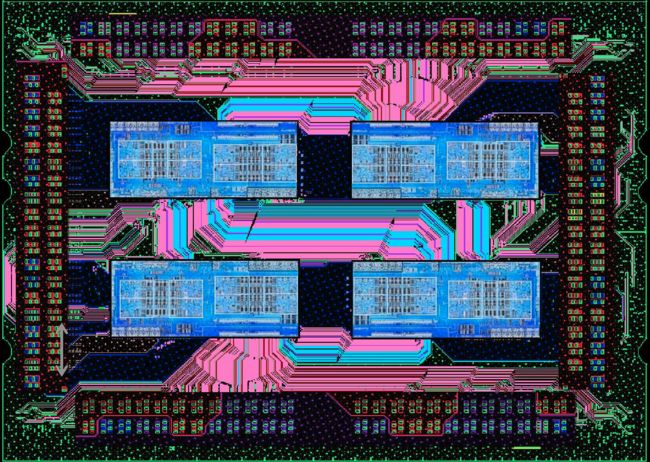
AMD’s EPYC server CPUs incorporate four Zepplin dies per CPU package, for a total of 32 CPU cores. Communication between dies is once again via Infinity Fabric, allowing a die can access system memory normally only directly addressable by another die. Each die acts as a NUMA (non-uniform memory access) node addressing memory through two DDR4 memory channels, and as a consequence single-socket EPYC solutions support up to eight DDR4 memory channels.
Intel by contrast utilise single monolithic cores for their CPU designs. These have a number of practical benefits, the most obvious of which is that cross-core communication isn’t limited in speed in the same way that Infinity Fabric limits Ryzen. There is a trade-off however: Die Size.
Rather than using two or more discrete CPU dies Intel’s designs are ‘monolithic’ – they manufacture a single die, and then disable cores to determine SKU. The larger the die, the lower the manufacturing yield (effective number of usable CPUs printed per wafer) and higher costs of production will be. Intel Xeon CPUs utilising the Skylake X architecture may feature more than 20 cores (the HEDT Core i9-7950X tops out at 18 cores, but is derived from those Xeon parts) but on one die alone. By using a modular approach to manufacture and creating only smaller 8-core Zepplin dies, it’s theorised that AMD is reducing production costs on EPYC and Threadripper significantly.
SenseMI Technology
Modern CPUs are extremely complex structures which dynamically respond to the workloads placed upon them. That’s not a simple process – sensor data for temperatures, voltages and more is continually analysed in parallel to workloads, and algorithms have been designed which balances the load and overclocks cores beyond a base where headroom allows.
The sensor structures and back-end required for this has become complex in its own right, and AMD are using SenseMI Technology as an umbrella term for this on-CPU functionality. AMD break it down into five distinct facets:
Pure Power
The monitoring of CPU temperature, resource usage, and power draw, and adaptive control which optimizes power draw for any workload. Power draw is minimised when possible, balancing for long-term efficiency.
Precision Boost
Fine-tuned processor performance adjusted in real time to meet the performance application demands. Precision Boost can adjust processor speed in increments of 25MHz.
Extended Frequency Range (XFR)
Automatic extra performance boost for enthusiasts with premium systems and processor cooling. Permits CPU speeds above and beyond ordinary Precision Boost limits, where cooling and power draw headroom allows. XFR range depends on processor SKU.
Neural Net Prediction
Built-in artificial intelligence that primes your processor to tackle your app workload more efficiently.
– A true neural network inside every AMD Ryzen processor
– Builds a temporary map of how your programs use the CPU
– Prepares the fastest processor pathways for your app’s behaviors
Smart Prefetch
Learning algorithms that predict and pre-load needed data for fast and responsive computing.
Learns how your applications access their own data
Sophisticated algorithms anticipate and pre-load that data into the AMD Ryzen processor
Vital data is ready when you are, enabling peak performance
A deeper discussion of AMD’s Zen architecture beyond the scope of this review is available at Wikichip.
Technical Specifications
Although there has been plenty of hype surrounding Ryzen Threadripper, AMD kept many of the technical details surrounding the CPUs secret until the launch was imminent. One such titbit of information was discovered by professional overclocker deb8auer: Threadripper CPUs are in fact repurposed EPYC server chips, contained four Ryzen CPU (i.e. Zepplin) dies of which two had been fused off. That’s quite a revelation, and in of itself has intriguing implications for the future, but for now we’ll focus on the practicalities.
Each Ryzen Threadripper CPU has only two of four Zepplin dies active, for a maximum of up to 16 active CPU cores (the actual number of active cores depends on SKU). These dies are always a diagonal pair, to some extent equalising the heat distribution from the CPU under its heatspreader whilst under load.
With two cores fused off the package supports quad-channel DDR4 memory, a first for an AMD desktop product. Motherboards using the X399 chipset will typically be kitted out with 8 DIMM slots for DDR4 memory, and can support up to 1TB of LR-DIMMs (128GB per slot). Most customer configurations will likely top out at 64 (4 x 16GB or 8 x 8GB) or 128GB (8 x 16GB) DDR4 memory, depending on application.
CPU Cache
CPU Cache levels for Threadripper CPUs is derived from the Ryzen dies present in its configuration. Each core features 512KB of dedicated L2 cache, not shared between the cores. Also present on a 4-core CCX is a total pool of up to 8MB L3 cache, accessible by all the cores on the die (not just those enabled in its CCX). In total therefore the Threadripper 1950X is equipped with 8MB L2 cache and 32MB L3 cache – frankly a gargantuan amount.
Level 3 cache in the Zen architecture is what’s known as a victim cache. Usually at least as large as the higher level cache, a victim cache stores blocks of data as they are evicted from the higher level. Should a miss occur on L2 cache for instance, L3 cache will then be looked up for the block, reducing the number of cycles needed to otherwise find the data in system memory.
PCI Express
One critical capability of Threadripper is the across-the-board availability of 64 PCI-Express 3.0 lanes, no matter the number of cores enabled on the chip. This compares extremely favourably with Intel’s maximum of 44 on the Core i9 7900X, and more general access to 28 on 8-core and 6-core parts on their HEDT platform. We should of course note that AMD’s figure includes lanes reserved by the chipset (a total of 4), but nonetheless that’s quite a competitive advantage.
The value and versitalitity of more PCI-Express lanes is not something we’ll be able to capture in this launch review. Previous generations often leveraged the additional bandwidth by making use of multiple GPU SLI/CrossFire configurations, but support for n-way graphics on discrete GPUs is in the process of being depreciated by AMD and NVIDIA. Currently only 2-way SLI is officially approved by NVIDIA for consumers, whilst recently AMD place no emphasis on CrossFire for Vega (although the GPU is technically capable of this feature).
A more recent development has been use of NVMe storage. High speed SSDs utilising M.2 or U.2 with PCI-Express signalling are easily capable of surpassing the limitations of SATA III, pushing read rates that exceed 2GB/s. It’s scenarios which utilise this vast quantities of this storage (in a RAID array or similar) that can really take advantage of additional PCI-Express lanes.
Users who combine high bandwidth storage and graphics in one system – for use with gaming, streaming and video editing (potentially in real time) for example – could thrive on the Threadripper platform. However if all you’re doing is a spot of gaming and streaming, Rysen might be the AMD platform for you.
It should be noted that Threadripper X399 isn’t currently capable of booting from NVMe Raid Arrays.
Socket TR4
A new CPU architecture often means that the CPU socket needs to be updated, and such is the case with Threadripper. AMD’s gargantuan new CPU utilises a variant of their SR4 EYPC server socket they’re calling TR4, sporting 4096 contact points, but SR4 and TR4 solutions are currently incompatible. That’s a major increase over the 1331 contacts of Socket AM4, and accounts for the higher level of signalling complexity required by the new CPU.
TR4 is a Land Grid Array (LGA) type socket, meaning that pins are located on the motherboard side with contact pads printed on the underside of the CPU. As a result the CPU package is far less fragile, reducing the chances you’ll incur damage when handling it, but the installation process can be a little bit more complex.
Due to the size of the Threadripper CPU package TR4 has a massive footprint compared to existing desktop sockets. That has posed a unique challenge to motherboard manufacturers working within the confines of existing motherboard standards, and cooling solutions will also require a update to the new mounting system. We don’t yet know whether mATX and other small form factor motherboard designs will be possible using the TR4 socket, but currently EATX appears to be the standard of choice. Ensure that your chassis can accommodate it before you buy.
Installation & Cooling
AMD have clearly put a lot of thought into the challenges of both a larger CPU footprint and moving away from familiar PGA sockets. Ensuring firm and equal pressure across the CPU contacts is key, and in this vein they’ve created a novel solution in the form of a series of retention brackets that are deceptively simple to operate.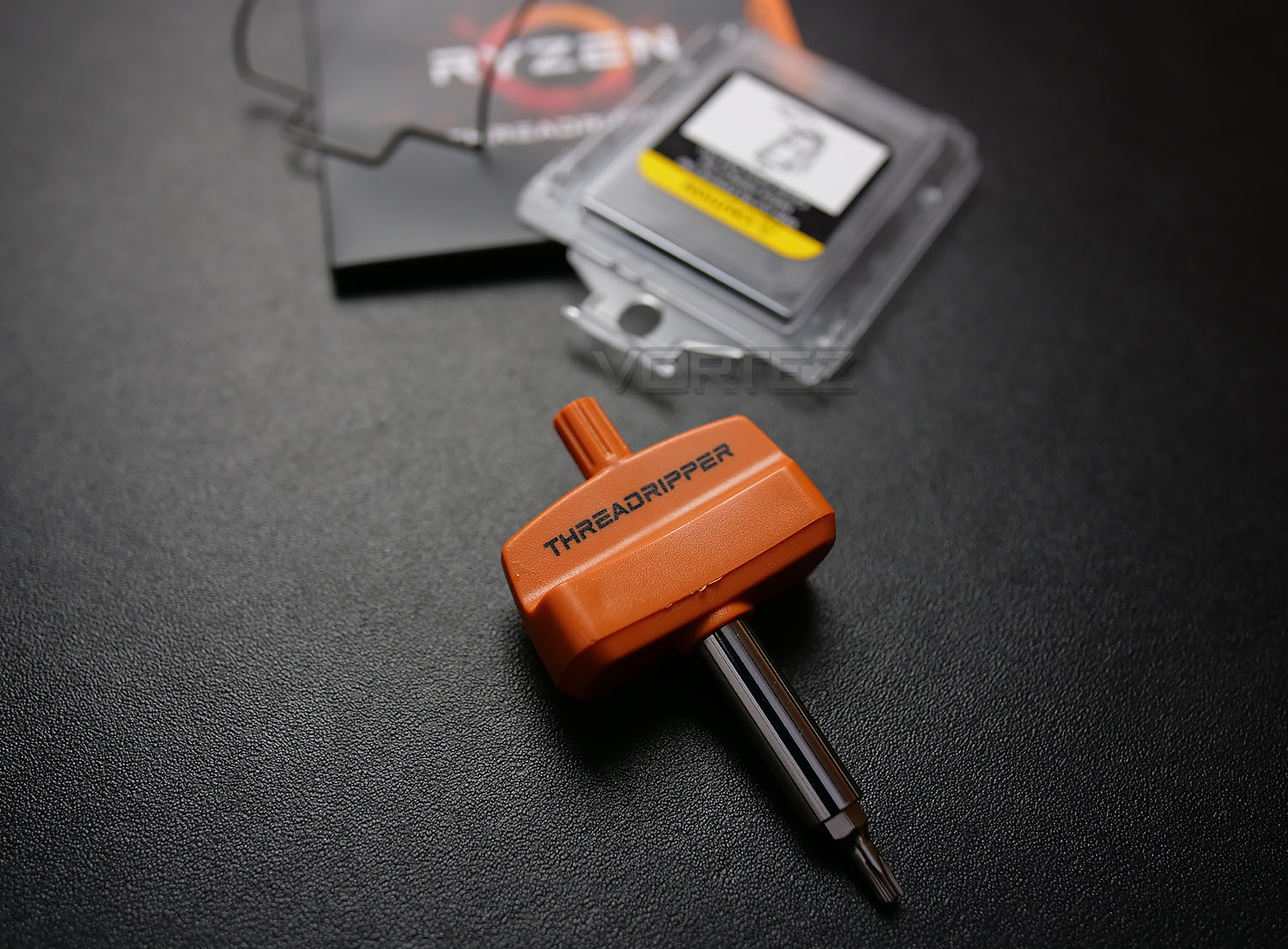
Retail packs of Ryzen Threadripper come with all you need to install the CPU into your motherboard. Included is the CPU itself in a handy bracket, and TR20 1.5Nm torx-head wrench tool. Note the orange bracket around the Treadripper CPU is not for show, you’ll be installing that into your system as part of the process.
Installation into the motherboard is via these simple steps:
1. Unscrew points 3, 2 and 1 (in that order) on the CPU socket retention plate using the supplied TR20 torque wrench.
2. Lift up the retention plate and slide out the clear plastic cover. Gently slide in the CPU + Orange Bracket, using the rails as a guide.
3. Remove the black socket cover by lifting the two blue tabs at the top. Be careful, the pins underneath are fragile.
4. Let the CPU in its orange bracket settle over the pins. Push the two blue tabs on the orange bracket down to keep it in place.
5. Move the metal retention bracket down and over the CPU. Tighten the screws using the TR20 torque wrench starting with screw 1, and finishing with screw 3. The wrench is set to the required torque of 1.5Nm, so fully tighten until it clicks.
2. Lift up the retention plate and slide out the clear plastic cover. Gently slide in the CPU + Orange Bracket, using the rails as a guide.
3. Remove the black socket cover by lifting the two blue tabs at the top. Be careful, the pins underneath are fragile.
4. Let the CPU in its orange bracket settle over the pins. Push the two blue tabs on the orange bracket down to keep it in place.
5. Move the metal retention bracket down and over the CPU. Tighten the screws using the TR20 torque wrench starting with screw 1, and finishing with screw 3. The wrench is set to the required torque of 1.5Nm, so fully tighten until it clicks.
Once all three screws are tightened you’re good to go.
MSI’s How-To Guide for installing Ryzen Threadripper
Cooling
Performance aside, cooling the mammoth Ryzen Threadripper CPU is likely to prove the most contentious part of the platform. AMD have taken the step of including an adapter which will make AIO liquid coolers based on Asetek’s OEM design compatible with TR4, and manufacturers have begun to roll out both air and water coolers which support Threadripper natively. There is however the thorny question of coverage.
The main role of a CPU heatspreader is to aid in the conduction of heat from CPU die to the base of the cooler’s heatsink or water block, and ideally the cooler would be located directly over the CPU and cover it completely.
Threadripper’s 2×2 die layout and physical dimensions mean that most waterblocks and heatsink base plates will not fully cover the portion of the heatspreader directly above these dies. This could easily mean the formation of hot spots, a factor which may not be reflected in sensor readings from commonly used temperature monitoring programs. Core Temp for example will only output a single aggregated value, whereas per-core data would be ideal.
Ryzen Threadripper 1950X is a 180W TDP CPU, and as a result meaty liquid cooling or premium air cooling is recommended. A full list of recommended air coolers is available.
Test Setup & Software
For the purpose of testing the AMD Ryzen Threadripper 1950X we used a flagship X399 motherboard which will remain unknown to avoid any upset. For this review we haven’t signed an NDA and therefore are unaware of specific launch details. However, this motherboard can be regarded as one of the most feature-rich offerings and should offer great performance for 1950X.
CPU being tested
AMD Ryzen Threadripper (3.4GHz) Zen
TEST SETUP
Cooling Corsair Hydro Series H115i
Motherboard X399 Motherboard
Memory 32GB Corsair Vengeance LPX 3000MHz
Graphics Radeon RX 480 8GB
Storage Corsair LX 512GB SSD
PSU Corsair RM 1000 80 Plus Gold Certified PSU
Monitor AOC U2879VF
Capture Device Epiphan AV.iO 4K
COMPARED AGAINST
AMD Ryzen 7 1800X 3.6GHz) Summit Ridge
AMD FX-8350 (4.0GHz) PileDriver
Intel Core i7-7900X (3.3GHz) Skylake-X
Intel Core i7-7800X (3.5GHz) Skylake-X
Intel Core i5-7700K (4.2GHz) Kaby Lake
Intel Core i7-6950X (3.0GHz) Broadwell-E
Intel Core 7-6900K (3.2GHz) Broadwell-E
BENCHMARKS
Cinebench R15 – CPU/OpenGL Score
x264 HD 4.0 – 1st and 2nd pass encoding
SiSoftware SANDRA – CPU & Memory benchmarks
POV-RAY – CPU benchmarks
TrueCrypt – CPU benchmarks
AIDA64 – CPU benchmarks & Memory
PCMark 8 – Creative & Photoshop
PCMark 10 – Extended
3DMark FireStrike – 3D Benchmark
3DMark TimeSpy – 3D Benchmark
Games – Rise of the Tomb Raider & Total War: WARHAMMER
OTHER SOFTWARE
Temperature Analysis: Core Temp
Stress Testing Software: AIDA64 Stability Test
CPU Specification Monitoring: CPU-Z
Temperatures & Overclocking
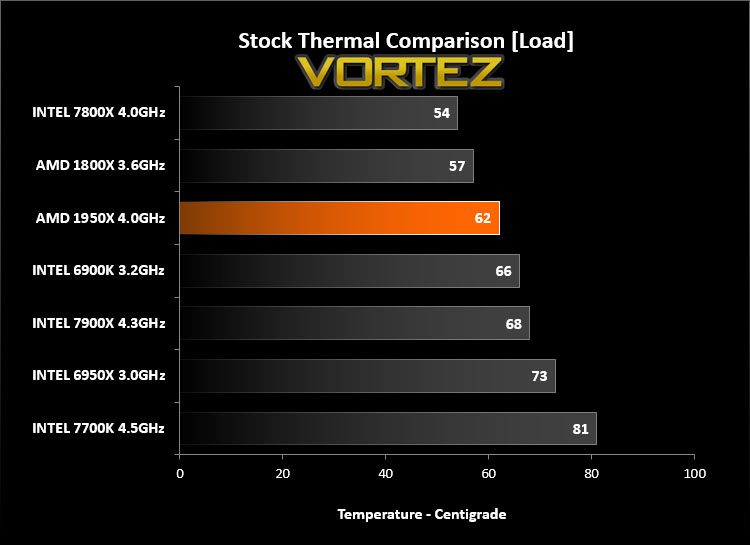
Above are the temperatures for each of the CPUs being tested – all at their stock frequencies but fully loaded. Along with Threadripper we’ve included some other HEDT processors and the current mainstream chips from Intel and AMD by way of the Core i7-7700K and Ryzen 7 1800X.
AMD has done an excellent job with the thermal design for the 1950X – against other HEDT processors, this Threadripper model is able to achieve lower temperatures while operating at a higher clock speed and being populated by more cores/threads.
OVERCLOCKING
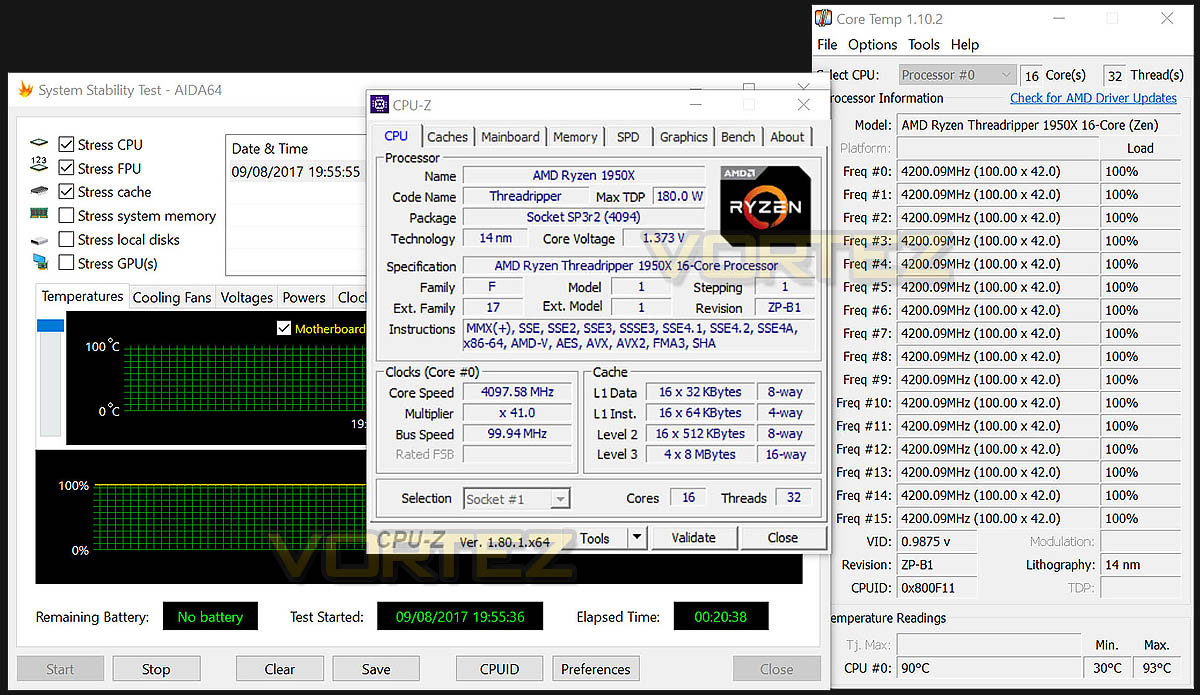
It’s critical to note that our testing was performed with a premier X399 motherboard, allowing us to fine-tune settings which would otherwise not be available in a mainstream design. Our best achievement saw us reach 4.2GHz with the 1950X – impressively up from the 3.4GHz base clock – using 1.33v. Boosting the CPU to this frequency and voltage meant that the temperature shot up to 90C after a substantial system load of 20 minutes.
In this review we have benchmarked the 1950X at stock settings and overclocked – giving you a good indication as to the benefits of using this sort of overclock in synthetic benchmarks and day-to-day tasks.
Power Consumption
It’s interesting to note the power consumption across all processors. Although they are using a combination of different motherboard chipsets, energy results can fluctuate between manufacturers due to the features and specifications that are integrated. First of all, for the idle tests the system is cold booted into Windows and no additional applications are executed – the watts are noted on the external energy monitor we use and then the system is loaded with 3DMark FireStrike – watts are again monitored for the duration of the test and the highest rated wattage result is then noted down. Below are the results of this energy test.
Ray Tracing Performance – POV-Ray 3.7
Persistence of Vision Raytracer’s PovRay is a free and open source 3D animator application with versions for computers with different operating systems.
This product allows users to build their custom 3D worlds with excellent quality despite their computer’s hardware. It has adjustable options for levels of radiance, refraction, and reflection. Calculation time may vary depending on the computer model, but PovRay can adapt to many computer builds, and is supported by the open source community.
This product allows users to build their custom 3D worlds with excellent quality despite their computer’s hardware. It has adjustable options for levels of radiance, refraction, and reflection. Calculation time may vary depending on the computer model, but PovRay can adapt to many computer builds, and is supported by the open source community.
AES Encryption Performance – TrueCrypt 7.1a
TrueCrypt is a discontinued source-available freeware utility used for on-the-fly encryption (OTFE). It can create a virtual encrypted disk within a file or encrypt a partition or (under Microsoft Windows except Windows 8 with GPT) the entire storage device (pre-boot authentication).
Encoding Performance – X264 HD
Simply put, this test measures how fast your machine can encode a short, DVD quality MPEG-2 video clip into a high-quality x264 video clip. What’s x264, you ask? It’s more or less the next-generation Xvid/DivX codec. I think it’s ideal for a benchmark because the application (x264.exe) reports fairly accurate compression results (in frames per second) for each pass of the video encoding process, and it uses multi-core processors very efficiently.
x264 HD gives results for 2 passes when compressing an MPEG-2 clip into x264. It presents 4 separate results for each pass giving a total of 8 – all results are given in FPS. For each pass I have averaged out the results.
Processing Features Performance – AIDA64
AIDA64 Product PageThis simple integer benchmark focuses on the branch prediction capabilities and the misprediction penalties of the CPU. It finds the solutions for the classic “Queens problem” on a 10 by 10 sized chessboard. At the same clock speed theoretically the processor with the shorter pipeline and smaller misprediction penalties will attain higher benchmark scores. For example — with HyperThreading disabled — the Intel Northwood core processors get higher scores than the Intel Prescott core based ones due to the 20-step vs 31-step long pipeline. CPU Queen test uses integer MMX, SSE2 and SSSE3 optimizations.
Memory Transfer Performance – AIDA64
AIDA64 Product PageThis simple integer benchmark focuses on the branch prediction capabilities and the misprediction penalties of the CPU. It finds the solutions for the classic “Queens problem” on a 10 by 10 sized chessboard. At the same clock speed theoretically the processor with the shorter pipeline and smaller misprediction penalties will attain higher benchmark scores. For example — with HyperThreading disabled — the Intel Northwood core processors get higher scores than the Intel Prescott core based ones due to the 20-step vs 31-step long pipeline. CPU Queen test uses integer MMX, SSE2 and SSSE3 optimizations.
Processing Power Performance – Cinebench R15
CINEBENCH can measure systems with up to 64 processor threads. This test scene contains approximately 2,000 objects which in turn contain more than 300,000 polygons in total, and uses sharp and blurred reflections, area lights, shadows, procedural shaders, antialiasing, and much more. The result is displayed in points (pts). The higher the number, the faster your processor.
Bandwidth Performance – SiSoftware SANDRA
SANDRA isn’t always a benchmark that is included in hardware reviews but I believe it shouldn’t be ignored. SANDRA provides a vigorous package that tests your system in a rather large array of benchmarks. There are many aspects of benchmark that can be executed. We will be considering – CPU and memory tests.
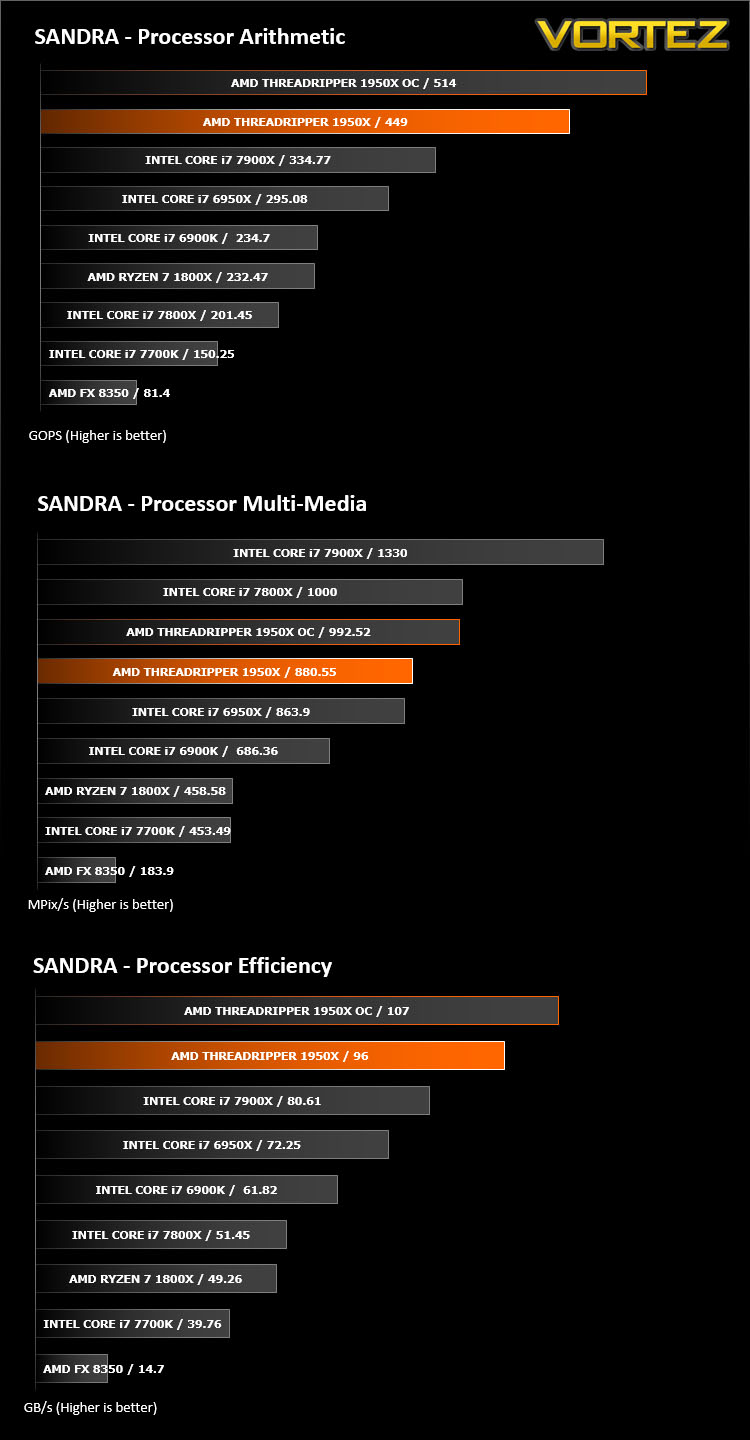
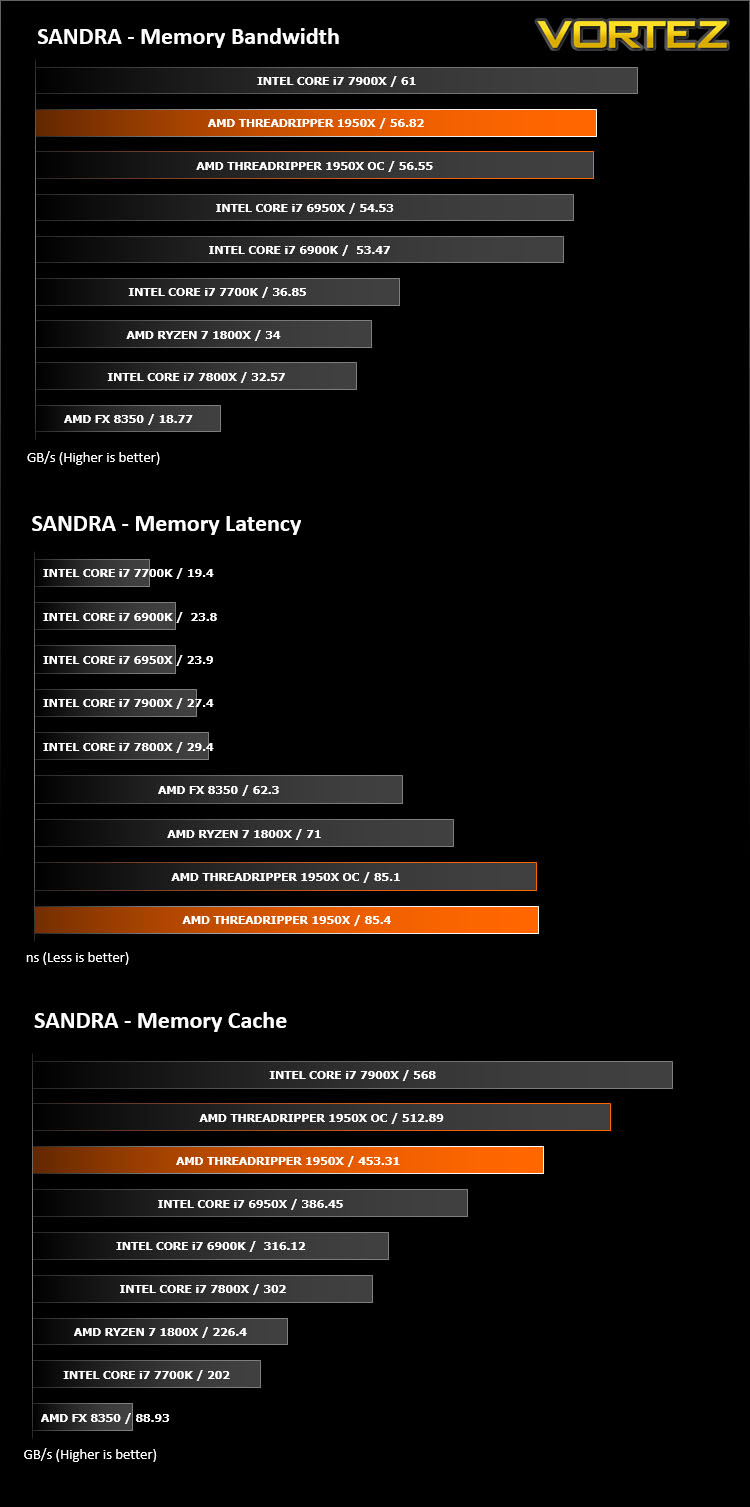
Image Editing Performance – PCMark 8 Photoshop
PCMark 8 Product Page Developed in partnership with Benchmark Development Program members Acer, AMD, Condusiv Technologies, Dell, HGST, HP, Intel, Microsoft, NVIDIA, Samsung, SanDisk, Seagate and Western Digital, PCMark 8 is the latest version in FutureMark’s popular series of PC benchmarking tools. Improving on previous releases, PCMark 8 includes new tests using popular applications from Adobe and Microsoft.
Overall System Performance – PCMark 8 & PCMark 10
PCMark 8 Product Page Developed in partnership with Benchmark Development Program members Acer, AMD, Condusiv Technologies, Dell, HGST, HP, Intel, Microsoft, NVIDIA, Samsung, SanDisk, Seagate and Western Digital, PCMark 8 is the latest version in FutureMark’s popular series of PC benchmarking tools. Improving on previous releases, PCMark 8 includes new tests using popular applications from Adobe and Microsoft.
VR Performance – VRMark
VRMark Product PageVRMark includes two VR benchmark tests that run on your monitor, no headset required, or on a connected HMD. At the end of each test, you’ll see whether your PC is VR ready, and if not, how far it falls short.
3D Performance – 3DMARK FireStrike & TimeSpy
3DMark FireStrike Product PageFire Strike is our new showcase DirectX 11 benchmark designed for high-performance gaming PCs. It is our most ambitious and technical benchmark ever, featuring real-time graphics rendered with detail and complexity far beyond what is found in other benchmarks and games today. Fire Strike will only be available in the Windows editions of 3DMark initially.
Gaming Performance – Tomb Raider & Total War: WARHAMMER
It’s important for us to perform a number of game benchmarks as well as the synthetic tests because gamers will want to know if there are any significant benefits. So here we have two recent gaming titles benchmarked with a Radeon RX 480 installed.
Conclusion
The last 6 months has been a clear warning to manufacturers that being complacent can be rather unwise. AMD has really ignited the desktop CPU market with the release of their Ryzen CPUs and it really goes without saying that for all those involved, never has there been such an exciting period of time for this industry.
With Ryzen, AMD has risen from the ashes as it were and Threadripper only serves to further fortify their campaign. There are obvious benefits to choosing the new 1950X with its 16 cores and 32 threads – those handling large, intensive workloads will be able to perform tasks more efficiently than they would with a processor featuring inferior attributes. Working hand-in-hand with this is the newly embraced quad-channel DDR4 which amplifies on memory bandwidth and throughput.
Up to now certain features have either been absent from AMD’s platforms or they’ve been severely limited. The Threadripper/X399 chipset combo serves up access to up to 66 PCI Express Gen 3.0 lanes and support for up to 16 USB 3.1 ports. There are however a few restrictions still present, no NVMe RAID support and just two of those USB 3.1 ports are Gen2.
An aspect that AMD has really monopolized on is the entire unboxing and installation procedure. With the retail packaging, customers are indulged by a completely new experience and something which is quite exciting. AMD includes a Torx tool that is required for installing the CPU and they also include a TR4 mounting bracket for use with NZXT/Corsair liquid coolers (Asetek) so you won’t need to hunt around for upgrade kits from manufacturers for TR4 compatibility nor will you need to decommission an existing all-in-one cooler.
So far as performance is concerned, the 1950X offers great results in a range of different tests. When up against Intel’s current flagship Core i9-7900X, the victor is inconclusive. For some scenarios the 1950X offers more favourable performance, while in others the 7900X is the better choice. What we can say is that when the task is chiefly concerned with multi-threaded activity then 1950X excels and this is further enhanced by applying a conservative overclock. For the moment we were only able to hit 4.2GHz for our best overclock but with such a modification in place we saw significant improvements to overall results and scores in the tests we ran.
The most obvious dilemma for most enthusiasts is going to be the decision to go with Intel X299 and Skylake-X or AMD X399 and Threadripper. Consumers would automatically assume the latter would be the more affordable route but this sadly isn’t the case with the first wave of X399 motherboards ranging from £329-500 GBP or $350-550 USD, combine that with the 1950X, which is priced at a jaw-dropping £980 GBP or $999 USD and you’re likely to need rather deep pockets.
The behemoth Threadripper is finally here and is a great representation of why AMD should not be underestimated. The 1950X delivers superb performance for avid enthusiasts looking to bolster their creative workflow.
Pros
+ Brilliant unboxing/installation experience
+ Performs well in multi-threaded scenarios
+ Decent thermal performance
+ Supplies up to 66 PCI Express Gen3 lanes
Cons
– Expensive
– No support for NVMe RAID
+ Brilliant unboxing/installation experience
+ Performs well in multi-threaded scenarios
+ Decent thermal performance
+ Supplies up to 66 PCI Express Gen3 lanes
Cons
– Expensive
– No support for NVMe RAID
Click here for an explanation of our awards at Vortez.net.