



Four and a half years is a long time, especially to focus your efforts onto one fan, but that’s how long Noctua have spent researching and developing their latest NF-A12x25, but was it worth it?

Product on Review: Noctua NF-A12x25
Manufacturer: Noctua
Street Price: £26.99
Beige and brown, not exactly the colour of choice for many system builders in 2018, but that doesn’t deter Noctua from using this colour scheme which many regard as ugly. However, regardless of the colours used, Noctua are very well known within the cooling industry for incredible performance and no-compromise research and development ethics; it could be argued that no other company goes to such lengths to design cooling fans.
At the start of May, Noctua unveiled four and a half years’ worth of design, testing and development, amounting to the release of a single 120mm fan. That’s an awful lot of time and money invested into something as simple as a motor and some blades; but the Noctua isn’t just that. The NF-F12 and NF-S12A fans set an incredibly high benchmark for Noctua to beat, receiving hundreds of awards and recommendations. So Noctua set about beating their previous attempts with the goal of creating their greatest fan to date.
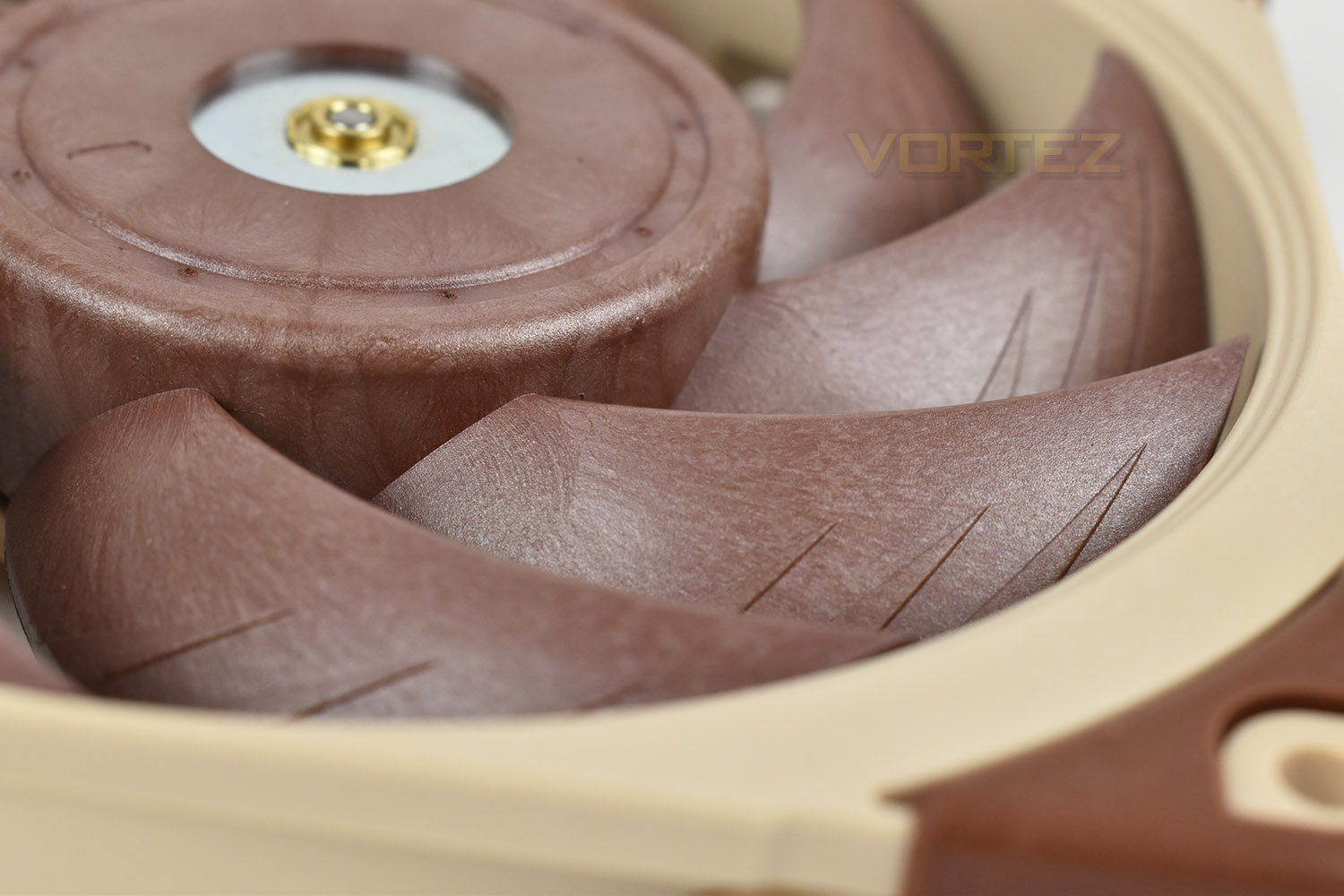
The FN-A12x25 uses an ultra-tight tip clearance on the edge of the blades, running only 0.5mm from the inside of the frame, requiring new engineering techniques to be employed. This helps to reduce back pressure by allowing the air nowhere to go other than forwards, affording a more efficient fan. There’s also flow acceleration channels, a solid steel and brass hub structure, stepped inlet design and loads of other technologies employed to ensure this fan is as good as currently possible.
The 120mm fan operates between 450RPM and 2000RPM via 3 different connectors, depending on the model you choose, with a supposed maximum noise of 22.6 dB (A) @ 2000RPM. The three models available are the PWM (Pulse Width Modulation), FLX (with 3 different hard-wired speed options) and ULN (An ultra low noise adaptor is included when acoustics are the priority).
There’s no questioning whether or not Noctua have presented to us a fan with significant investment so let’s find out how it performs in our tests. If you can get past the colour scheme and accept it for what it is, perhaps the Noctua can help reduce your temperatures and noise at the same time.
Noctua on the NF-A12x25:
Noctua’s 120mm fans such as the NF-F12 and NF-S12A are renowned as being among the best on the market and have received more than 400 awards and recommendations from the international press. With its further improved efficiency and novel, state-of-the-art engineering, the NF-A12x25 represents another step up in performance and manufacturing.
Technical Specifications
PWM Specification
Size: 120x120x25 mm
Mounting hole spacing: 105×105 mm
Connector: 4-pin PWM
Bearing: SSO2
Blade Geometry: A-Series with Flow Acceleration Channels
Frame Technology: AAO (Advanced Acoustic Optimisation)
Material: Sterrox® LCP
Rotational Speed: (+/- 10%) 2000 RPM
Rotational Speed with L.N.A.: (+/- 10%) 1700 RPM
Min. Rotational Speed: (PWM, +/-20%) 450 RPM
Airflow: 102,1 m³/h
Airflow with L.N.A.: 84,5 m³/h
Acoustical Noise: 22,6 dB(A)
Acoustical Noise with L.N.A.: 18,8 dB(A)
Static Pressure: 2,34 mm H₂O
Static Pressure with L.N.A.: 1,65 mm H₂O
Max. Input Power: 1,68 W
Max. Input Current: 0,14 A
Voltage: 12 V
Voltage PWM signal: 5 V
MTTF: > 150.000 h
Scope of delivery:
Low-Noise Adaptor (L.N.A.)
4-pin y-cable
30cm extension cable
NA-AV2 anti-vibration mounts
Anti-vibration gasket for water cooling radiators
Fan screws
Warranty: 6 years
Size: 120x120x25 mm
Mounting hole spacing: 105×105 mm
Connector: 4-pin PWM
Bearing: SSO2
Blade Geometry: A-Series with Flow Acceleration Channels
Frame Technology: AAO (Advanced Acoustic Optimisation)
Material: Sterrox® LCP
Rotational Speed: (+/- 10%) 2000 RPM
Rotational Speed with L.N.A.: (+/- 10%) 1700 RPM
Min. Rotational Speed: (PWM, +/-20%) 450 RPM
Airflow: 102,1 m³/h
Airflow with L.N.A.: 84,5 m³/h
Acoustical Noise: 22,6 dB(A)
Acoustical Noise with L.N.A.: 18,8 dB(A)
Static Pressure: 2,34 mm H₂O
Static Pressure with L.N.A.: 1,65 mm H₂O
Max. Input Power: 1,68 W
Max. Input Current: 0,14 A
Voltage: 12 V
Voltage PWM signal: 5 V
MTTF: > 150.000 h
Scope of delivery:
Low-Noise Adaptor (L.N.A.)
4-pin y-cable
30cm extension cable
NA-AV2 anti-vibration mounts
Anti-vibration gasket for water cooling radiators
Fan screws
Warranty: 6 years
FLX Specification
Size: 120x120x25 mm
Mounting hole spacing: 105×105 mm
Connector: 3-pin
Bearing: SSO2
Blade Geometry: A-Series with Flow Acceleration Channels
Frame Technology: AAO (Advanced Acoustic Optimisation)
Material: Sterrox® LCP
Rotational Speed: (+/- 10%) 2000 RPM
Rotational Speed with L.N.A.: (+/- 10%) 1700 RPM
Rotational Speed with U.L.N.A.: (+/- 10%) 1350 RPM
Airflow: 102,1 m³/h
Airflow with L.N.A.: 84,5 m³/h
Airflow with U.L.N.A.: 64,5 m³/h
Acoustical Noise: 22,6 dB(A)
Acoustical Noise with L.N.A.: 18,8 dB(A)
Acoustical Noise with U.L.N.A.: 14,2 dB(A)
Static Pressure: 2,34 mm H₂O
Static Pressure with L.N.A.: 1,65 mm H₂O
Static Pressure with U.L.N.A.: 1,05 mm H₂O
Max. Input Power: 1,68 W
Max. Input Current: 0,14 A
Voltage: 12 V
MTTF: > 150.000 h
Scope of delivery:
Low-Noise Adaptor (L.N.A.)
Ultra-Low-Noise Adaptor (U.L.N.A.)
3:4-pin power supply adaptor
30cm extension cable
NA-AV2 anti-vibration mounts
Anti-vibration gasket for water cooling radiators
Fan screws
Warranty: 6 years
Size: 120x120x25 mm
Mounting hole spacing: 105×105 mm
Connector: 3-pin
Bearing: SSO2
Blade Geometry: A-Series with Flow Acceleration Channels
Frame Technology: AAO (Advanced Acoustic Optimisation)
Material: Sterrox® LCP
Rotational Speed: (+/- 10%) 2000 RPM
Rotational Speed with L.N.A.: (+/- 10%) 1700 RPM
Rotational Speed with U.L.N.A.: (+/- 10%) 1350 RPM
Airflow: 102,1 m³/h
Airflow with L.N.A.: 84,5 m³/h
Airflow with U.L.N.A.: 64,5 m³/h
Acoustical Noise: 22,6 dB(A)
Acoustical Noise with L.N.A.: 18,8 dB(A)
Acoustical Noise with U.L.N.A.: 14,2 dB(A)
Static Pressure: 2,34 mm H₂O
Static Pressure with L.N.A.: 1,65 mm H₂O
Static Pressure with U.L.N.A.: 1,05 mm H₂O
Max. Input Power: 1,68 W
Max. Input Current: 0,14 A
Voltage: 12 V
MTTF: > 150.000 h
Scope of delivery:
Low-Noise Adaptor (L.N.A.)
Ultra-Low-Noise Adaptor (U.L.N.A.)
3:4-pin power supply adaptor
30cm extension cable
NA-AV2 anti-vibration mounts
Anti-vibration gasket for water cooling radiators
Fan screws
Warranty: 6 years
ULN Specification
Siz:e 120x120x25 mm
Mounting hole spacing: 105×105 mm
Connector: 3-pin
Bearing: SSO2
Blade Geometry: A-Series with Flow Acceleration Channels
Frame Technology: AAO (Advanced Acoustic Optimisation)
Material: Sterrox® LCP
Rotational Speed: (+/- 10%) 1200 RPM
Rotational Speed with U.L.N.A.: (+/- 10%) 900 RPM
Airflow: 55,7 m³/h
Airflow with U.L.N.A.: 39,4 m³/h
Acoustical Noise: 12,1 dB(A)
Acoustical Noise with U.L.N.A.: 7,6 dB(A)
Static Pressure: 0,82 mm H₂O
Static Pressure with U.L.N.A.: 0,41 mm H₂O
Max. Input Power: 0,6 W
Max. Input Current: 0,05 A
Voltage: 12 V
MTTF: > 150.000 h
Scope of delivery:
Ultra-Low-Noise Adaptor (U.L.N.A.)
3:4-pin power supply adaptor
30cm extension cable
NA-AV2 anti-vibration mounts
Anti-vibration gasket for water cooling radiators
Fan screws
Warranty: 6 years
Siz:e 120x120x25 mm
Mounting hole spacing: 105×105 mm
Connector: 3-pin
Bearing: SSO2
Blade Geometry: A-Series with Flow Acceleration Channels
Frame Technology: AAO (Advanced Acoustic Optimisation)
Material: Sterrox® LCP
Rotational Speed: (+/- 10%) 1200 RPM
Rotational Speed with U.L.N.A.: (+/- 10%) 900 RPM
Airflow: 55,7 m³/h
Airflow with U.L.N.A.: 39,4 m³/h
Acoustical Noise: 12,1 dB(A)
Acoustical Noise with U.L.N.A.: 7,6 dB(A)
Static Pressure: 0,82 mm H₂O
Static Pressure with U.L.N.A.: 0,41 mm H₂O
Max. Input Power: 0,6 W
Max. Input Current: 0,05 A
Voltage: 12 V
MTTF: > 150.000 h
Scope of delivery:
Ultra-Low-Noise Adaptor (U.L.N.A.)
3:4-pin power supply adaptor
30cm extension cable
NA-AV2 anti-vibration mounts
Anti-vibration gasket for water cooling radiators
Fan screws
Warranty: 6 years
Packaging & Bundle
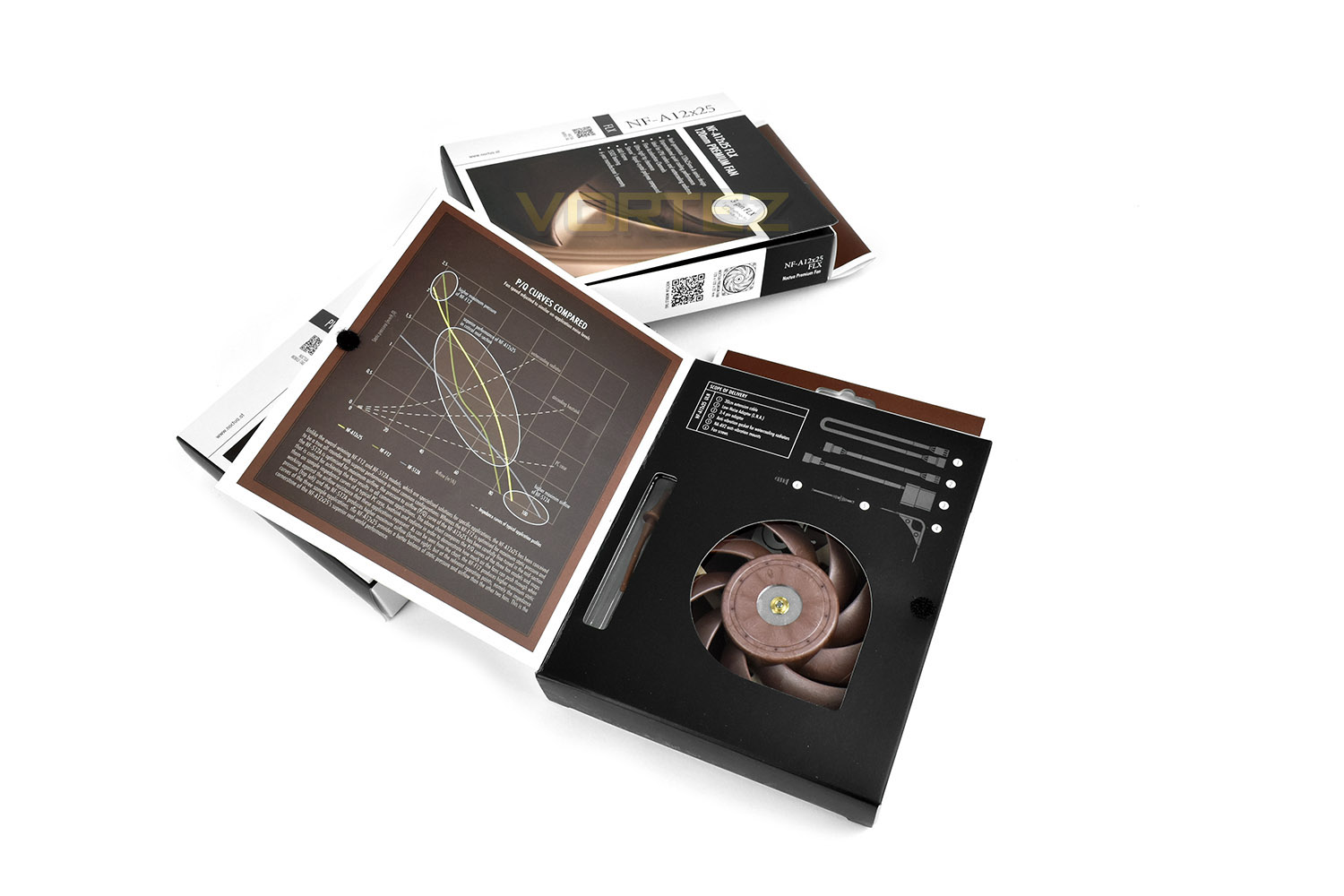
In true Noctua style, the packaging is distinctively brown, with white and dark accents. There’s more information than you can ever digest, with a flap that opens on the front and back being necessary to thoroughly explain some of the developments and technologies employed on these fans.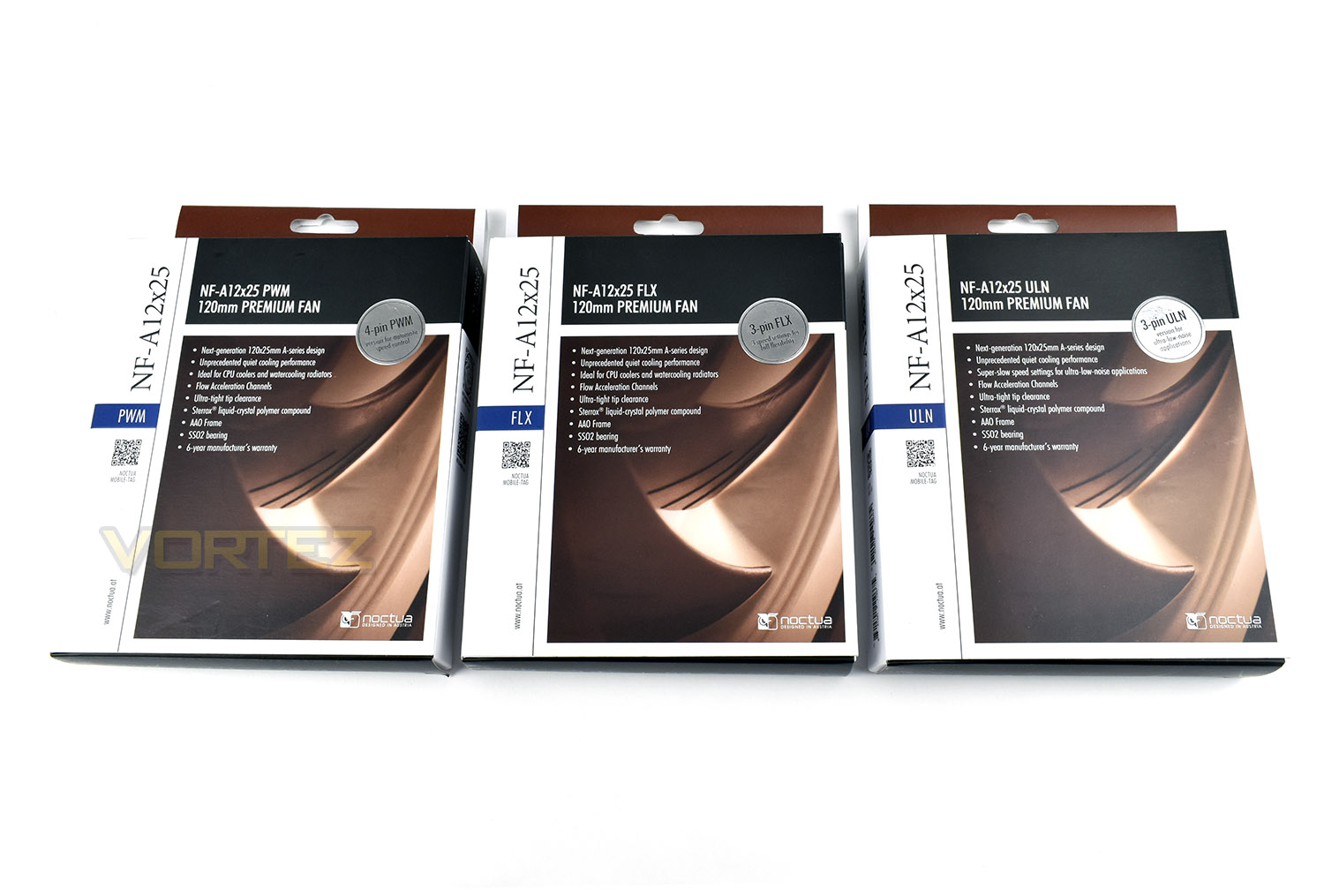
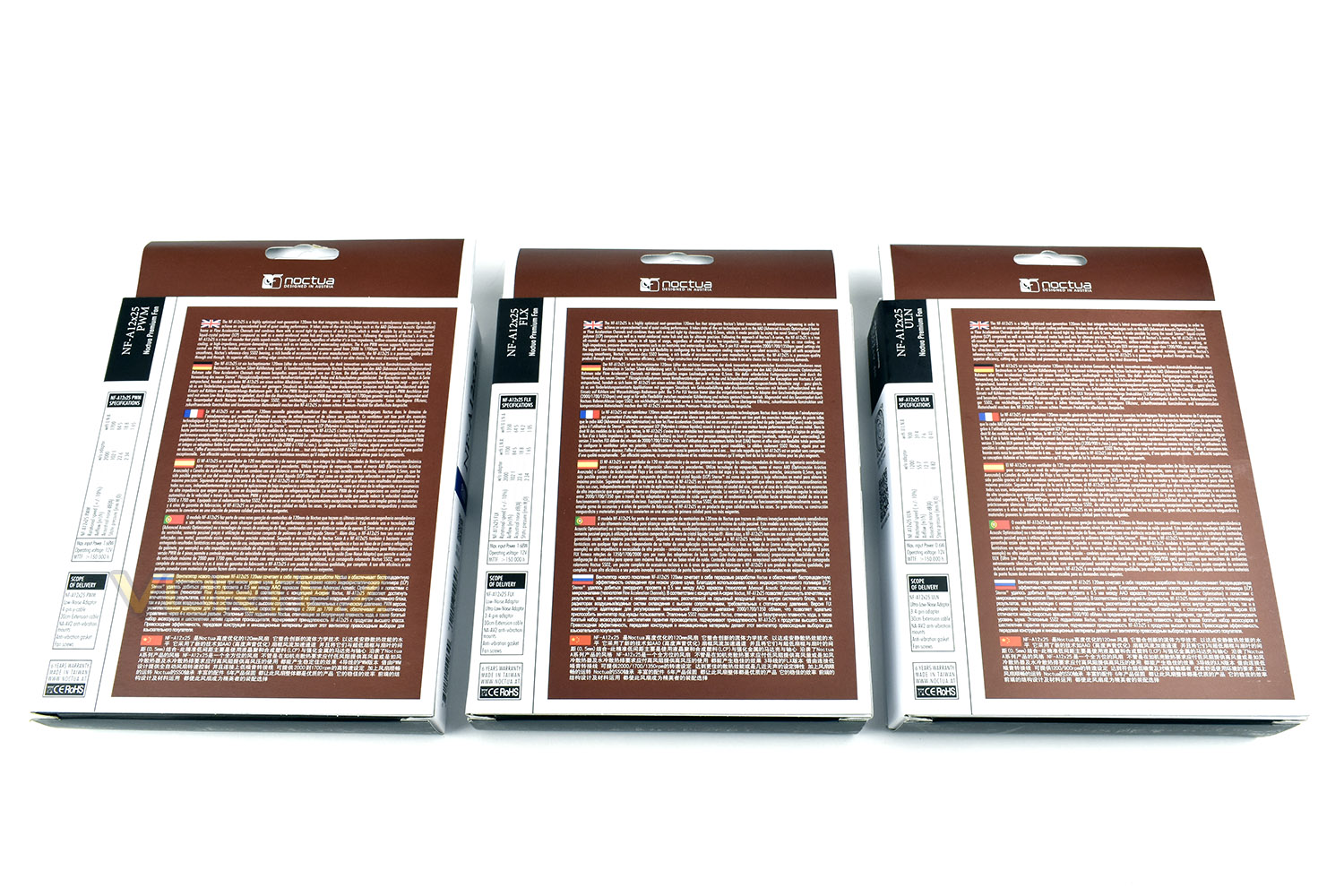
The rear is the same. Brown with loads of information.
Each packet allows you a glimpse at the fan and shows what you receive in each box.
Bundles
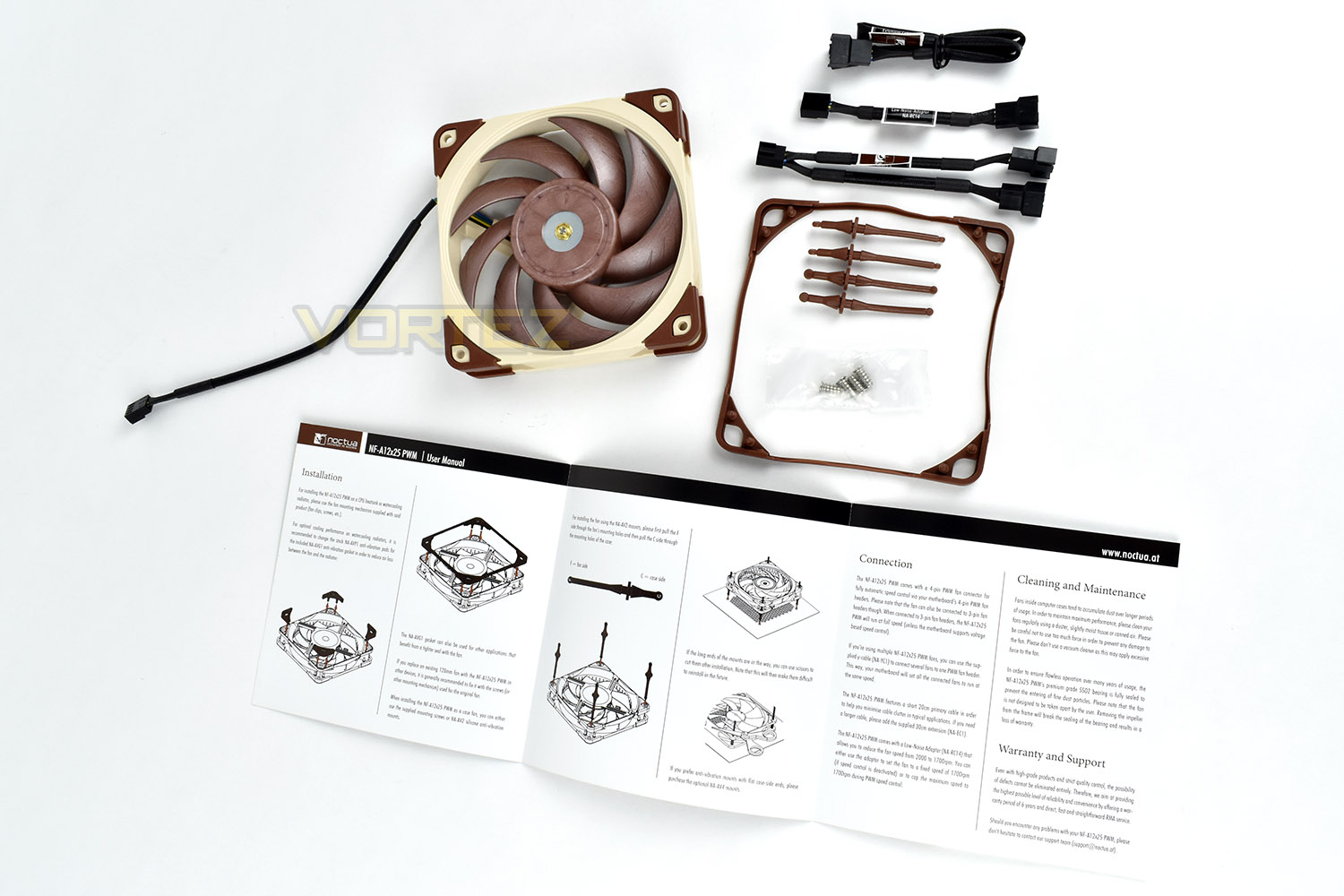
Bundled with the PWM fan is the following:
• Low-Noise Adaptor (L.N.A.)
• 4-pin y-cable
• 30cm extension cable
• NA-AV2 anti-vibration mounts
• Anti-vibration gasket for water cooling radiators
• Fan screws
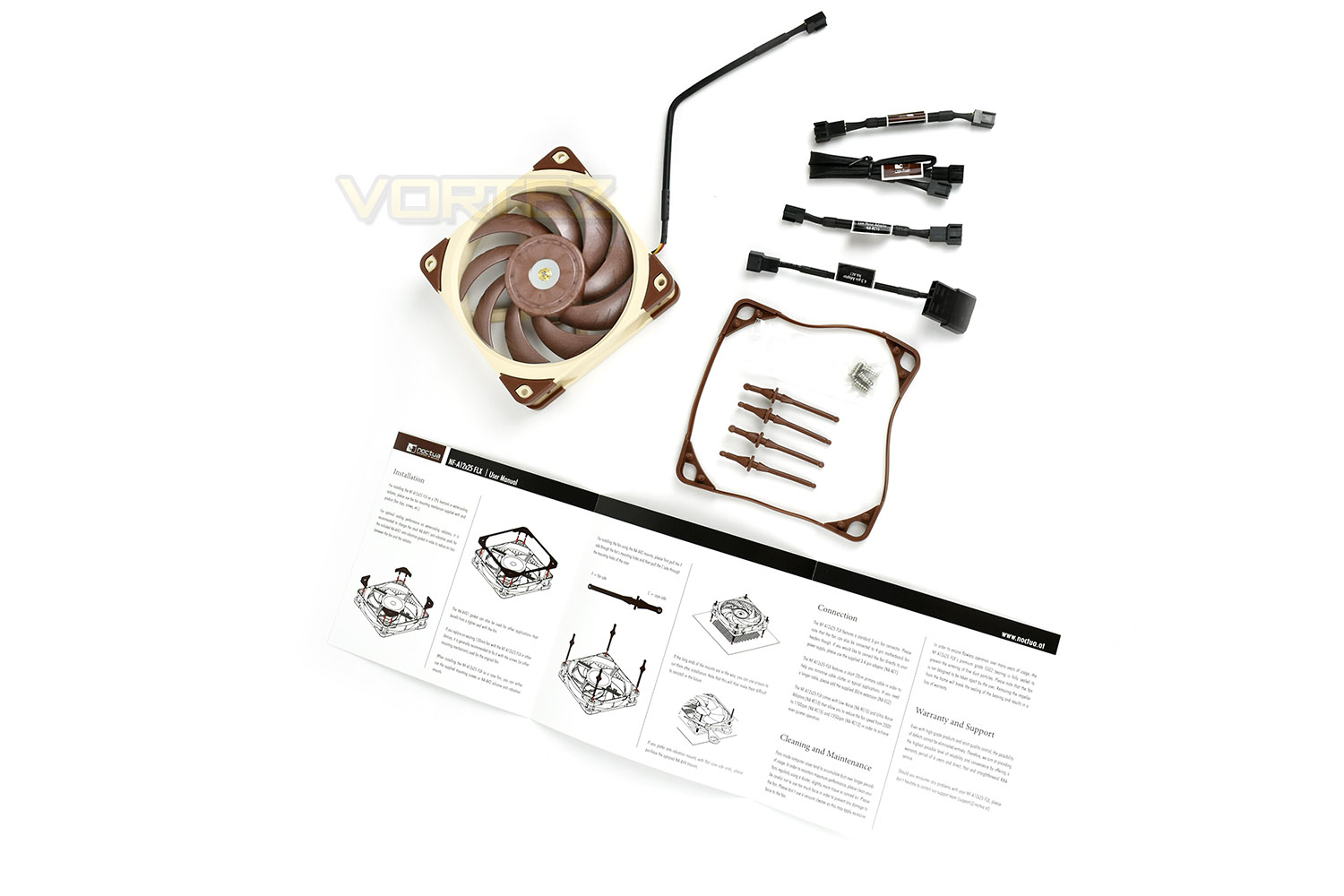
Bundled with the FLX fan is the following:
• Low-Noise Adaptor (L.N.A.)
• Ultra-Low-Noise Adaptor (U.L.N.A.)
• 3:4-pin power supply adaptor
• 30cm extension cable
• NA-AV2 anti-vibration mounts
• Anti-vibration gasket for water cooling radiators
• Fan screws
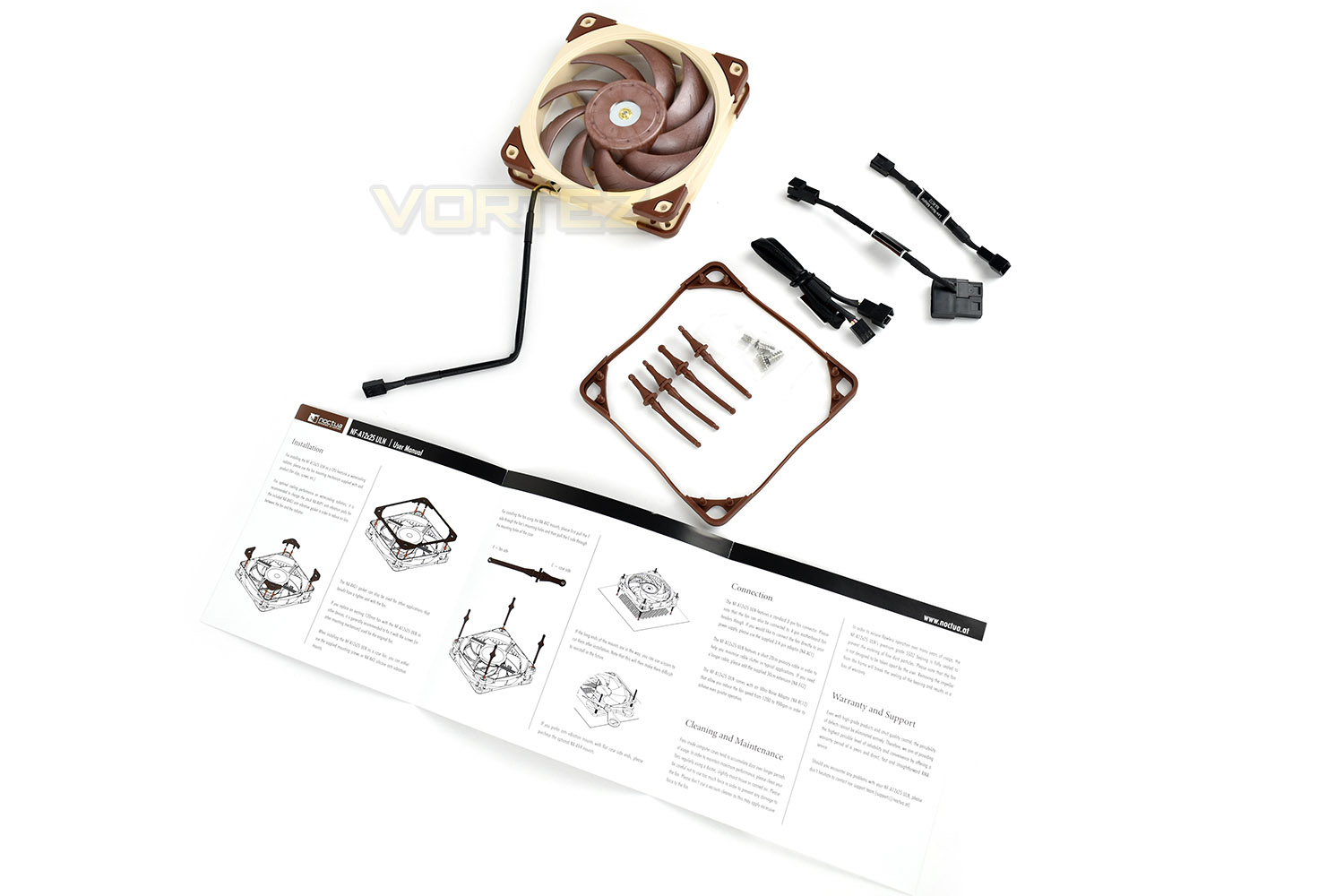
Bundled with the ULN fan is the following:
• Ultra-Low-Noise Adaptor (U.L.N.A.)
• 3:4-pin power supply adaptor
• 30cm extension cable
• NA-AV2 anti-vibration mounts
• Anti-vibration gasket for water cooling radiators
• Fan screws
Closer Look (PWM, FLX, ULN)
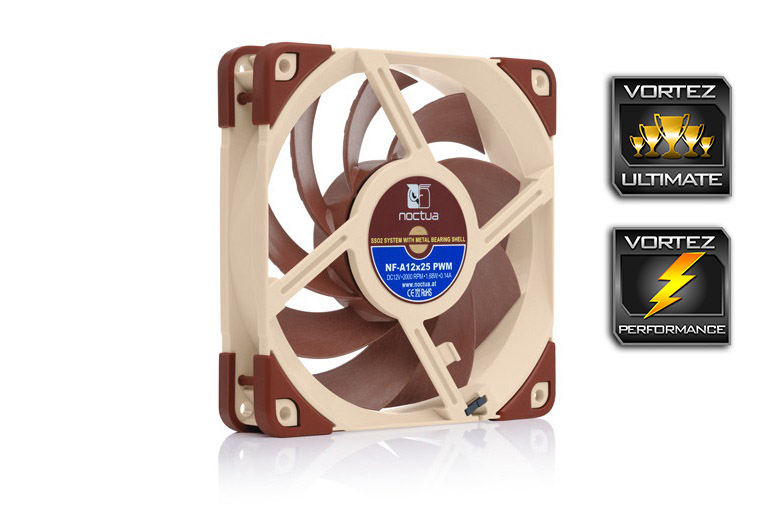
Noctua have decided on a 9-blade arrangement to their fan, with small Flow-Acceleration Channels on the blades to help improve airflow and reduce noise. You may notice the odd, textured look to the blades, which is a result of the Sterrox Liquid-Crystal Polymer compound that Noctua use. This material presents many desirable properties, such as extreme tensile strength, low thermal expansion coefficient and damping characteristics that reduce resonance and vibration, therefore reducing noise.The tensile strength and low thermal expansion are both incredibly important, allowing Noctua to run the outer tip of the blades within 0.5mm of the inside wall of the housing.
Typically, a fan would run a tolerance of around 1.5mm and up to 4mm in some budget fans. Running the blades this close to the inner edge helps the fan work against back pressure by reducing leaking between the impeller and frame.
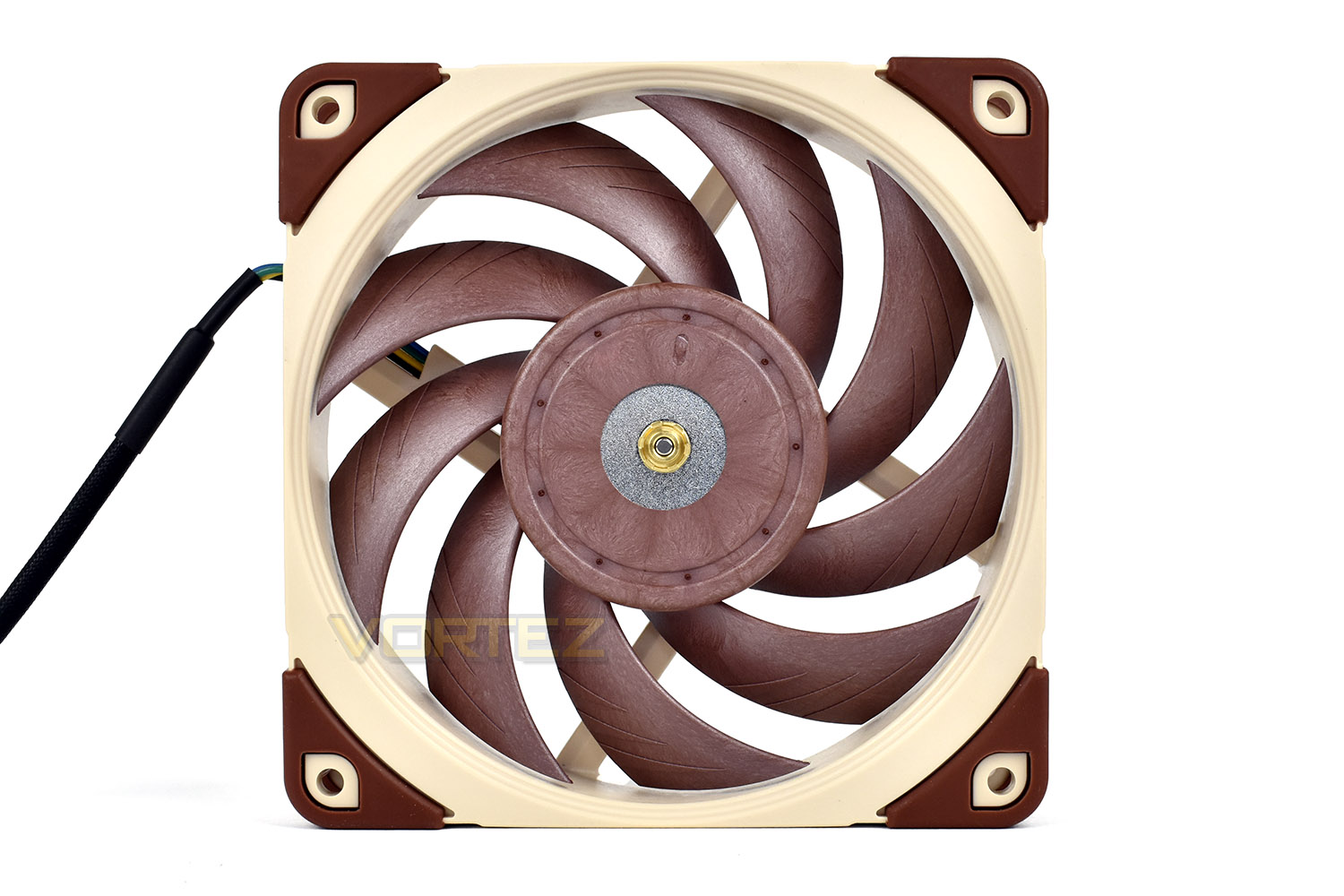
The frame is also cleverly designed, which Noctua call AAO (Advanced Acoustic Optimisation). This plastic is chosen for its ability to absorb sound and vibration effectively. Other proprietary techniques are involved here, with a stepped inlet and inner surface design choices which help to further refine the fans noise and performance.
The central hub of the fan is made from a solid piece of steel, with a CNC milled brass shell in the centre. The hub runs on an SSO2 bearing, an evolution of the tried and tested SSO bearing used in previous fans. The rear magnet is placed closer to the axis to provide better stability, precision and durability over time.
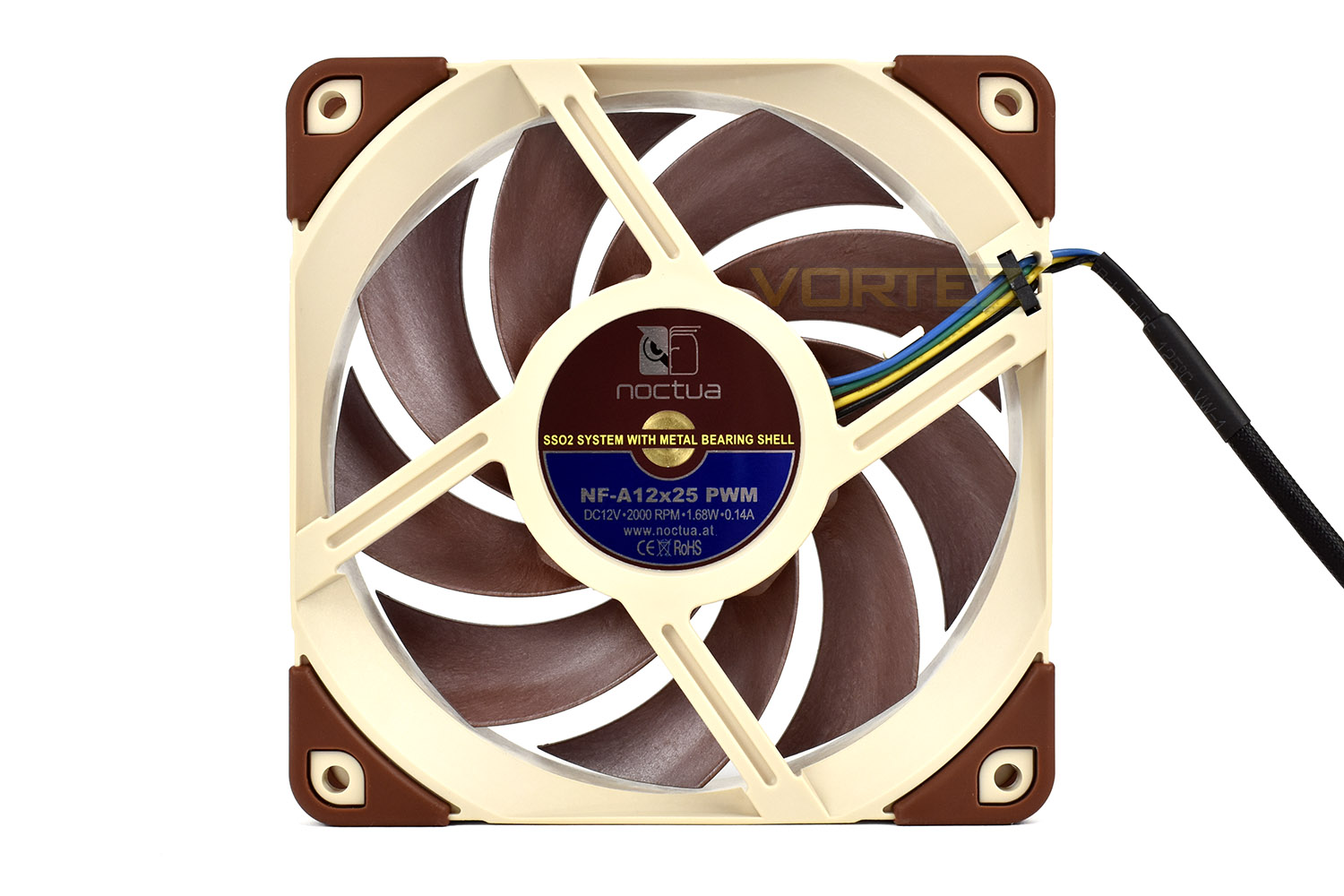
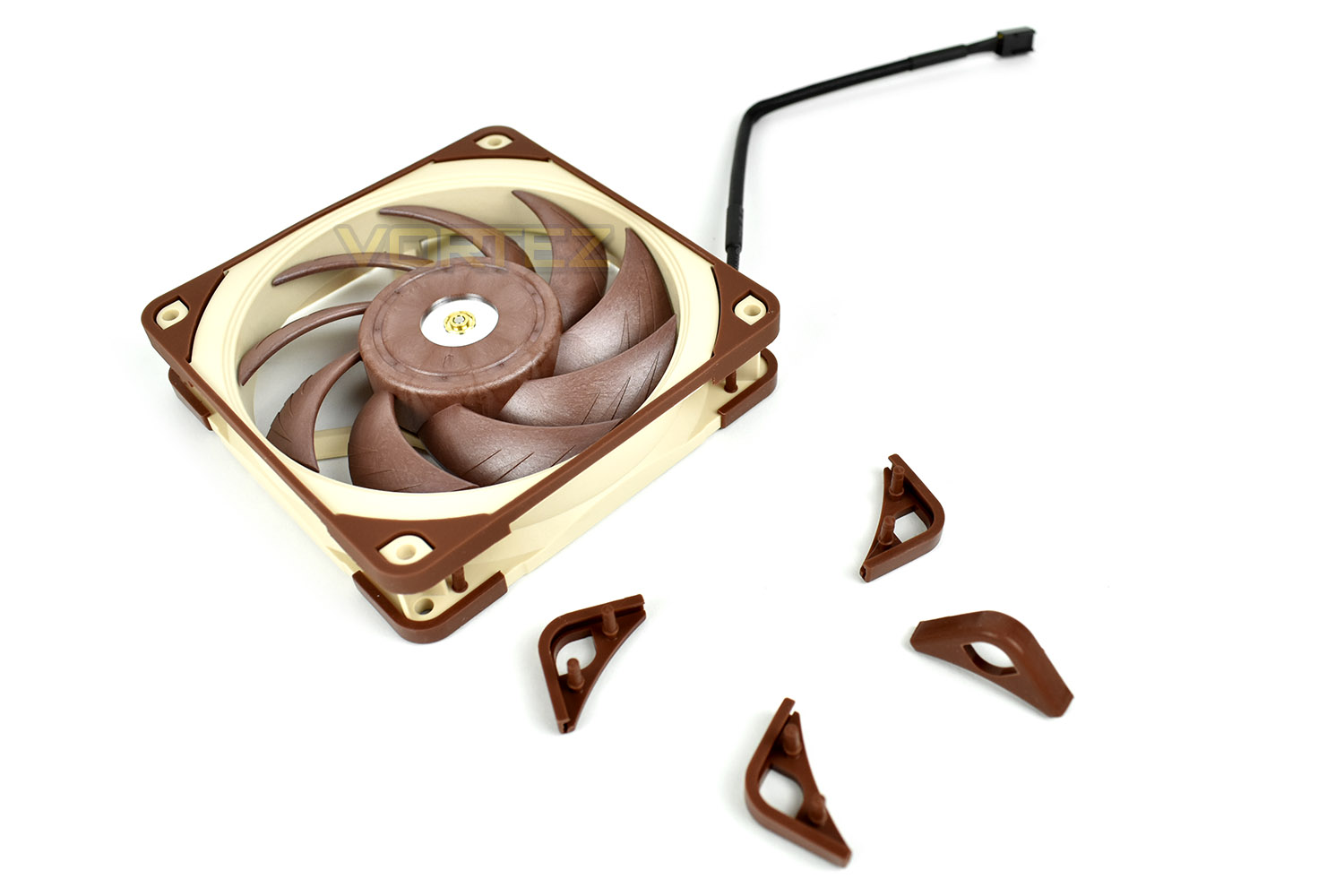
Anti-vibration pads are included on all corners, which can be removed if you so wish, however we would obviously recommend these remain in place. If the fan is in direct contact with your case, the fan can transmit vibrations and therefore noise into the metal structure of your system chassis. When using the fans on a radiator, it’s important that all of the air is pushed through the fins, and not around the outside, therefore Noctua have included a gasket, which replaces the 4 anti-vibration pads and creates a seal against the radiator, thus improving airflow which in turn can reduce temperatures and noise.
Test Setup & Methodology
We have recently made changes to our cooling department and the associated testing methodology, so please note that the number of results shown will increase over time as we add additional products. We hope that these results will appear clearer to the majority of our readership and look forward to building upon the baselines that we currently have.Processor – Intel Core i7-3930K
CPU Cooler – Corsair H100i Pro RGB
Motherboard – Gigabyte X79-UP4
Memory – 16GB Corsair Vengeance LP 1600MHz CL9
Video Card – Sapphire Radeon HD 6850 1GB
Power Supply – NZXT Hale90 650W
Storage Drive – Kingston HyperX 240GB SATA III SSD
Case – Corsair Carbide 760T
CPU Cooler – Corsair H100i Pro RGB
Motherboard – Gigabyte X79-UP4
Memory – 16GB Corsair Vengeance LP 1600MHz CL9
Video Card – Sapphire Radeon HD 6850 1GB
Power Supply – NZXT Hale90 650W
Storage Drive – Kingston HyperX 240GB SATA III SSD
Case – Corsair Carbide 760T
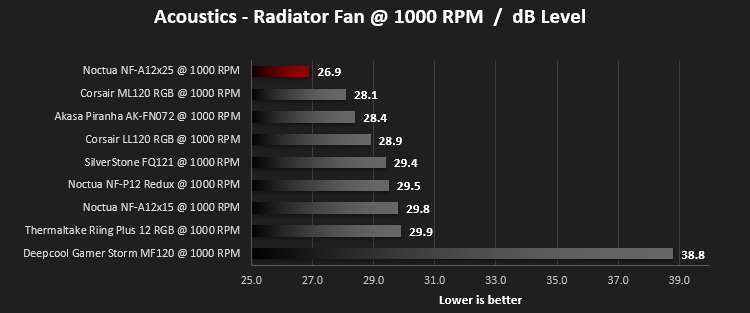
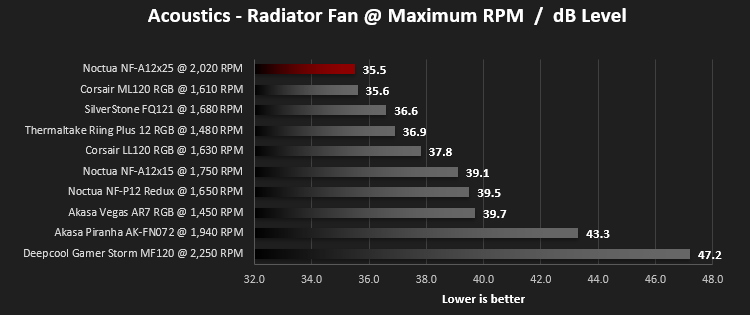
We test our fans at both 1000 RPM and maximum RPM, or if the fan only has one setting, it’s only included in the maximum RPM graphs.
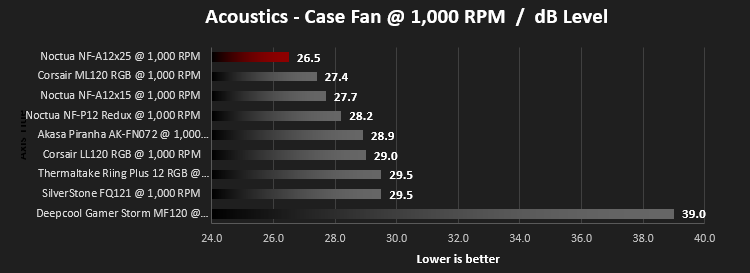
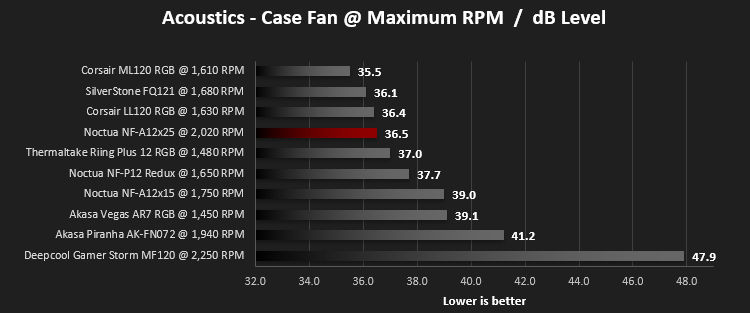
Firstly, we’ll test acoustics, both as a case fan, mounted on the rear of our Corsair Graphite 760T chassis, and as a radiator fan on the Corsair H100i Pro RGB. (with the pump turned down to 1,100 RPM and all other case fans disabled). We measure the average dB(A) noise levels over 60 seconds in a quiet room with an ambient noise level of around 24dB(A). Acoustics are measured from the same point within the case (20cm from the fan), with every effort taken to ensure test parameters are as close as possible during every test.
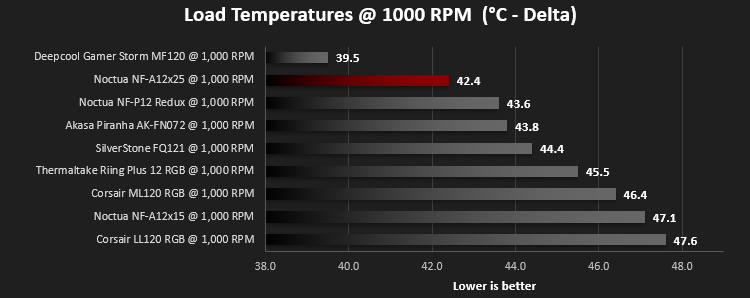
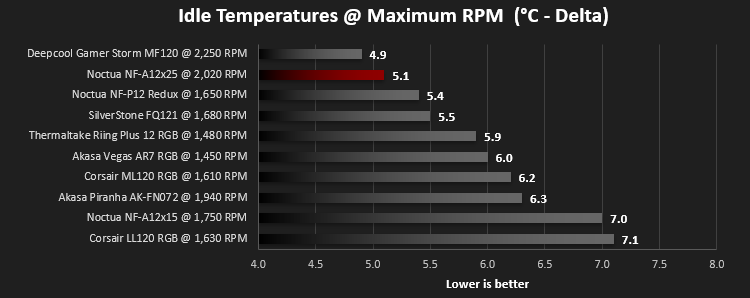
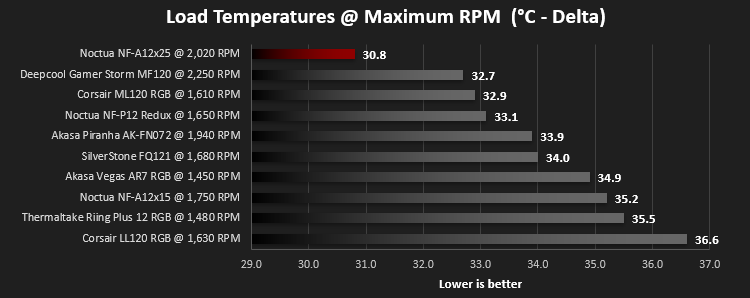
We then test the fan’s performance both at 1000 RPM and maximum RPM by running an AIDA64 20-minute stress test while running only a single 120mm fan on the 240mm radiator of the Corsair H100i Pro RGB. This allows us to test single fans as well as multi packs by only relying on a single 120mm fan. We mount the fan under the radiator, inside the case, blowing through the radiator. We measure the average core temperature over a 60-second period and minus the ambient room temperature from this. That leaves us with a Delta °C measurement which is applied to the graphs. Our average room temperature is kept as close to 21°C as possible, roughly the room temperature of most homes and offices. Obviously, if you live in a warmer climate with warmer room temperatures, you can expect higher temperatures.
To ensure the fans RPM are measured consistently, we use the Noctua NA-FC1 fan control unit, allowing the speed of our fans to be infinitely adjusted and monitored via a nearby header on the motherboard.
Benchmarks – Thermal Results
Firstly, we test the Noctua NF-A12x25 at 1000 RPM, both at idle and load.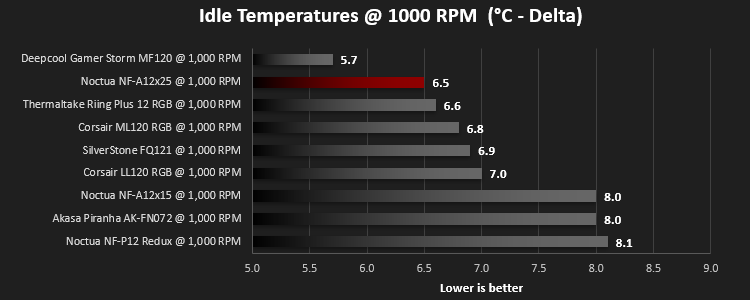
We then turn the fans up to maximum RPM, which is 2,020 RPM according to our Noctua NA-FC1
Benchmarks – Acoustic Results
For testing, we only connected a single LL120 fan to the Noctua NA-FC1 fan control unit to make the results relevant.Due to different characteristics, we feel it’s important to test fans as both case fans and radiator fans, giving you, the reader, a good idea of what to expect in both scenarios. We also test at 1000 RPM and Maximum RPM to see just how loud things can get.
We begin by testing the fans on the rear of our Corsair 760T chassis
We then mount the fan to the Corsair H100i Pro RGB and re-run the tests.
Conclusion
Four and a half years of investment into research and development, for any product, would almost certainly yield impressive results, but when all of that effort is focussed onto one fan, available in one colour and one size, the results are amazing.Our testing showed this fan blows everything else out of the water, including the Corsair ML-120, a fan known for its excellent performance.
The construction of the fan is “no compromise” in every single way, going to unbelievable lengths to ensure optimal performance and minimal noise in the process. The fan is easily the heaviest we’ve encountered, tipping the scales at a mighty 201g. A Corsair ML Series 120mm fan, for example, weighs 148g. Noctua believe in their product so much, they tag it with a 6-year warranty; not shabby at all!
To round up, if you’re after the best performance or silent operation, this is the only fan we can recommend, full stop. Yeah, it’s pricey at £26, but that is absolutely warranted in our opinion.
Noctua’s design team have definitely earned their bonus this year; the NF-A12x25 is incredible in every way, but can we get a black one please?
Pros
+ Stupidly quiet
+ Incredible built quality
+ Strong airflow
+ 6-year warranty
Cons
– None
+ Stupidly quiet
+ Incredible built quality
+ Strong airflow
+ 6-year warranty
Cons
– None
Click here for an explanation of our awards at Vortez.net.
Stay connected with the Vortez Social Media pages: