With the rise of AMD’s 3rd Generation Ryzen processors, G.SKILL have been quick out the blocks to bring an X570-specific kit to market. Today we’re looking at the 3600MHz modules.

Product on Review: G.SKILL Trident Z Neo 3600 C16
Manufacturer: G.SKILL
Street Price: GBP £169.99 / USD $179.99 / AUS $319.99
G.SKILL have gone from strength to strength within the enthusiast DRAM sector, particularly with their premium Trident Z RGB range, promising cherry picked ICs that offered overclocking prowess that was difficult to match. Now, with the launch of AMD’s latest Ryzen processors, G.SKILL have been quick off the mark to make full use of their new and improved memory controller.
We looked at the Trident Z a couple of years back, and today we see G.SKILL breathe some new life into that with the Trident Z Neo, a kit designed specifically for the AMD X570 chipset. As you’d expect from the Trident Z family, the Neo has been crafted with hand-screened ICs attached to a 10-layer PCB and has undergone extensive testing across a multitude of different motherboards to ensure the utmost reliability, stability and compatibility.
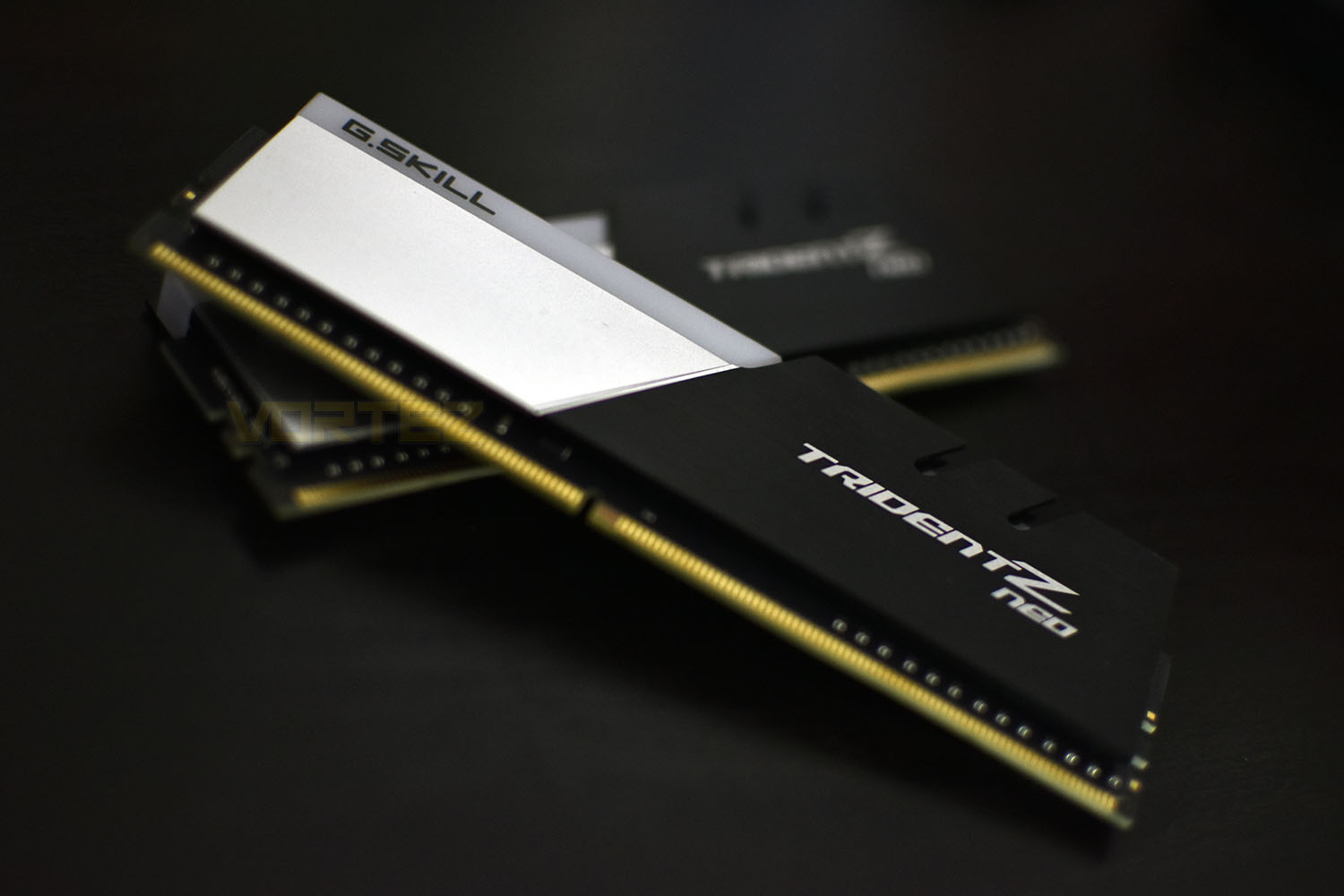
As is typical for G.SKILL, the Neo range is available in a wide variety of frequencies, starting at 2666MHz and moving all the way up to 4000MHz, capacities, with 8GB and 16GB modules making kits up to 64GB, and latency options as low as CL14 through CL18. Something for every budget, you’d imagine. Today we’re going to look at the 3600MHz 16GTZNC kit, sporting timings of 16-19-19-39 @ 1.35v, available at £170 in the UK, $180 in the US and $320 in Australia.
Unlike the original Trident Z release, RGB support is now much more extensive, with ASUS Aura Sync, Gigabyte RGB Fusion, MSI Mystic Light Sync and ASRock Polychrome Sync, or if you prefer, G.SKILL offer their own utility for RGB lighting control across the multitude of diffused LEDs on the top light bar.
G.SKILL on the Trident Z Neo:
Engineered and optimized for full compatibility on the latest AMD Ryzen 3000 series processors on AMD X570 chipset motherboards, Trident Z Neo brings unparalleled memory performance and vibrant RGB lighting to any gaming PC or workstation with AMD Ryzen 3000 CPUs and AMD X570 motherboards.
Technical Specifications
Memory Type: DDR4
Capacity: 16GB (8GBx2)
Multi-Channel Kit: Dual Channel Kit
Tested Speed: 3600MHz
Tested Latency: 16-19-19-39
Tested Voltage: 1.35V
Registered/Unbuffered: Unbuffered
Error Checking: Non-ECC
SPD Speed: 2133MHz
SPD Voltage: 1.20V
Fan Included: No
Warranty: Limited Lifetime
Features: Intel XMP 2.0 (Extreme Memory Profile) Ready
Additional Notes: Rated XMP frequency & stability depends on MB & CPU capability.
Capacity: 16GB (8GBx2)
Multi-Channel Kit: Dual Channel Kit
Tested Speed: 3600MHz
Tested Latency: 16-19-19-39
Tested Voltage: 1.35V
Registered/Unbuffered: Unbuffered
Error Checking: Non-ECC
SPD Speed: 2133MHz
SPD Voltage: 1.20V
Fan Included: No
Warranty: Limited Lifetime
Features: Intel XMP 2.0 (Extreme Memory Profile) Ready
Additional Notes: Rated XMP frequency & stability depends on MB & CPU capability.
Packaging & Product
As far as packaging goes, the Trident Z Neo’s box is as basic as they come. There’s obviously an image of the DRAM modules and the name of the product on the front but absolutely nothing aside from that. The RAM looks nice though, right?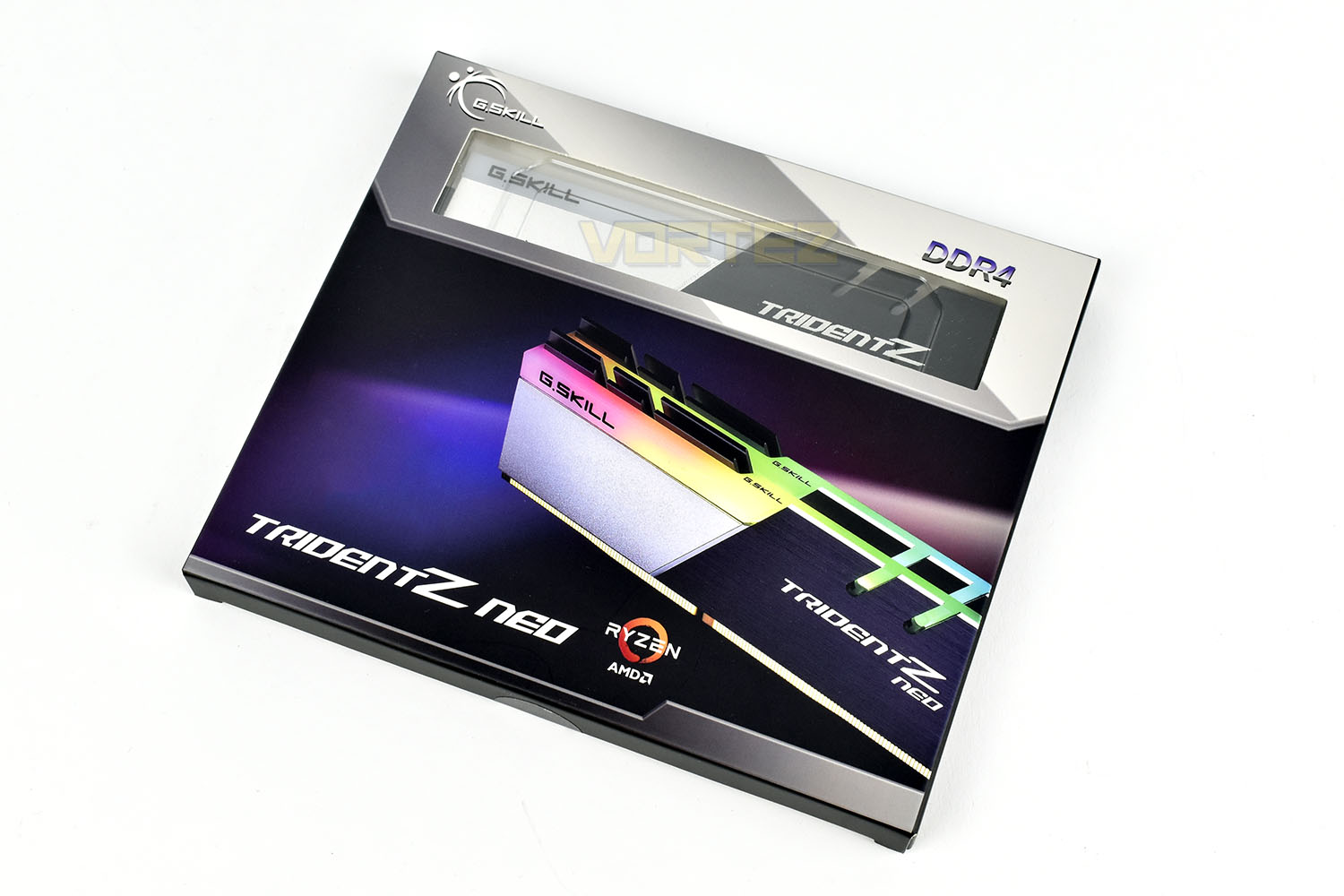
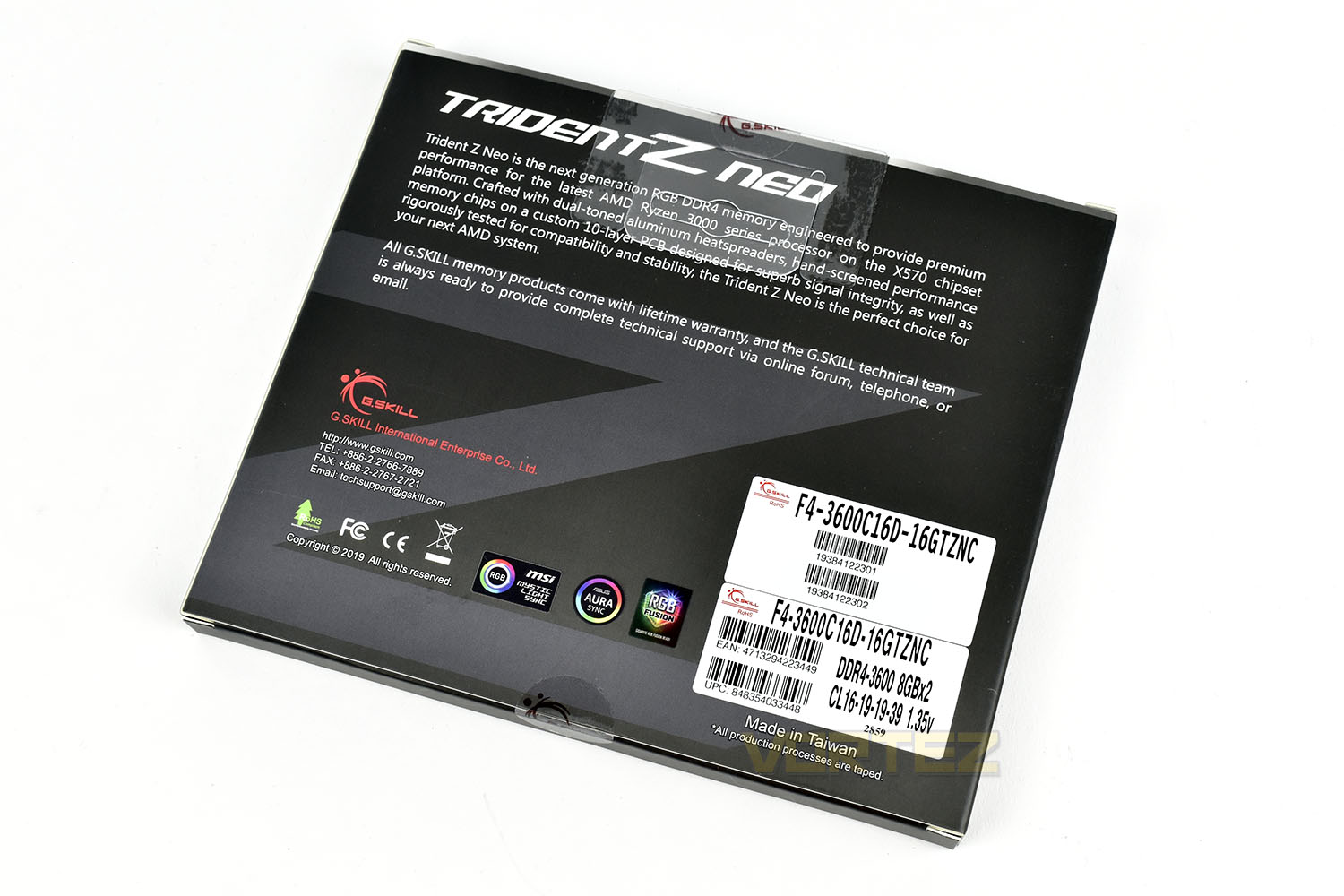
Turning the box over, there’s a brief summary of the products features with the frequency, latencies and capacity listed on the label. There’s no ASRock Polychrome Sync logo here, which is a shame, as their website shows it as being supported and the modules were only manufactured in September.
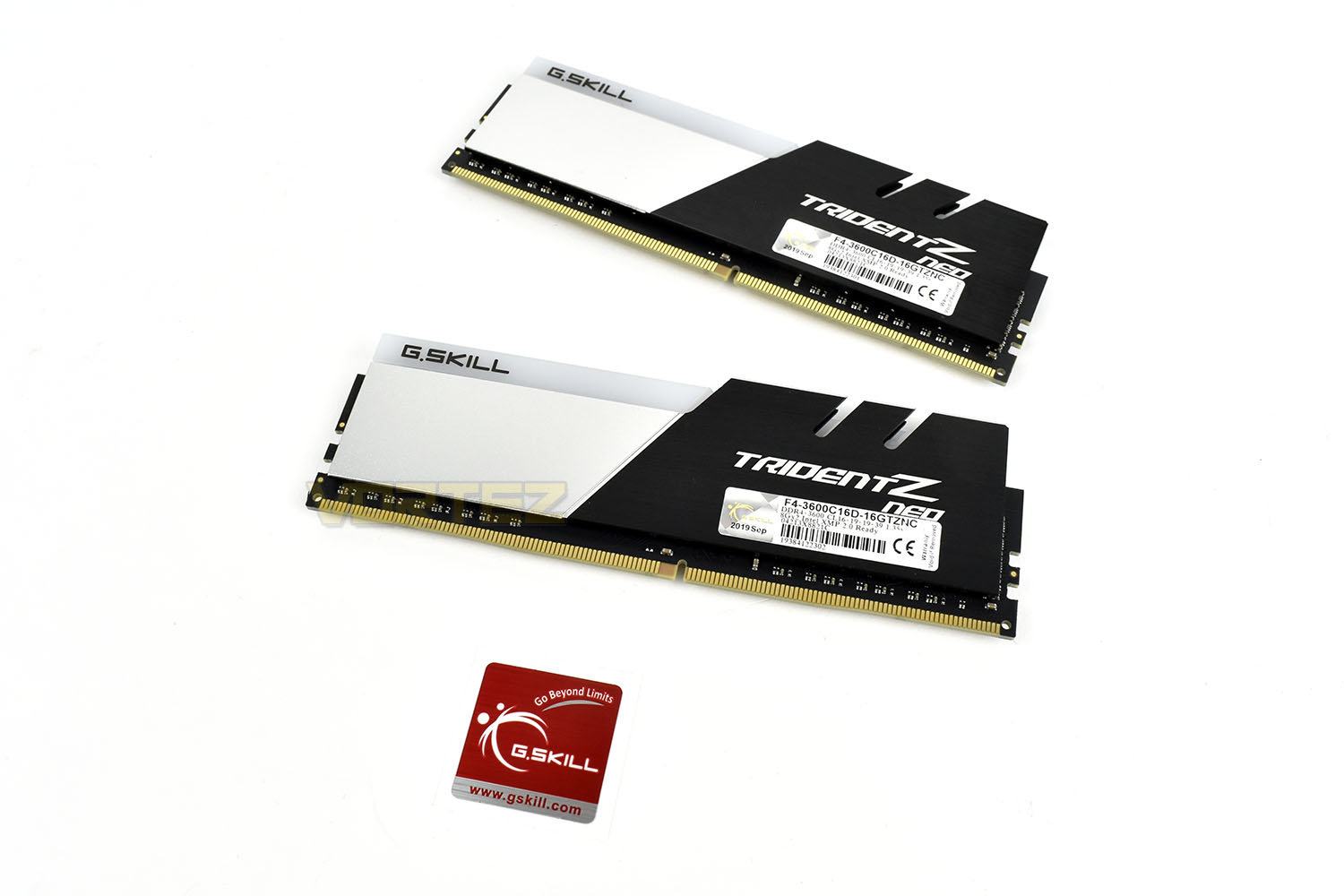
G.SKILL haven’t felt the need to change the contrasting panels design that has proven so popular, and have thrown in a small metallic case sticker.
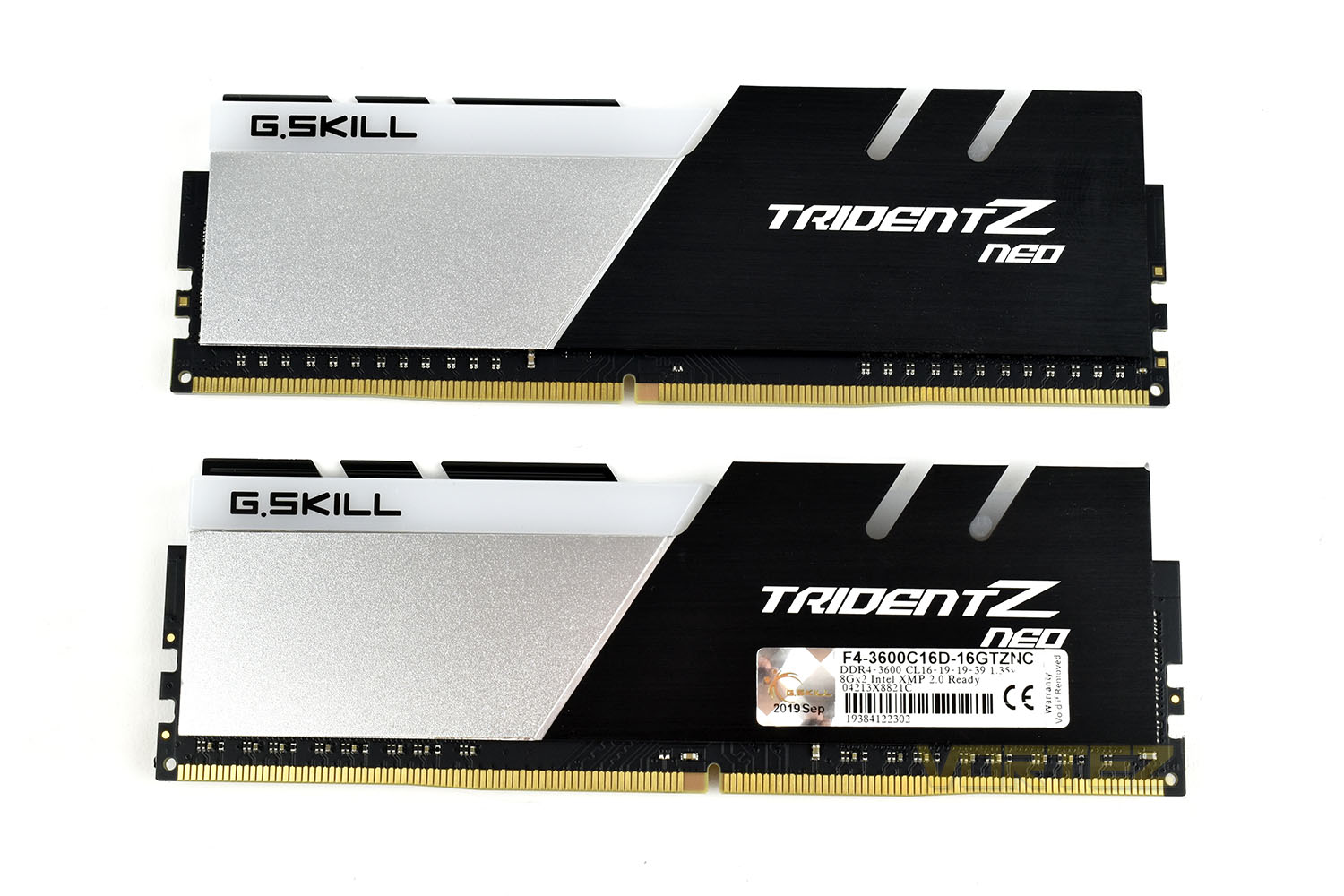
Front and back, the modules are identical, apart from the warranty label. Thankfully, they’ve placed this low down on the module and on the left-edge so it’s less visible when they’re installed into your case. These measure 44mm in height so shouldn’t pose much of a clearance issue in most instances but do check your specific requirements.
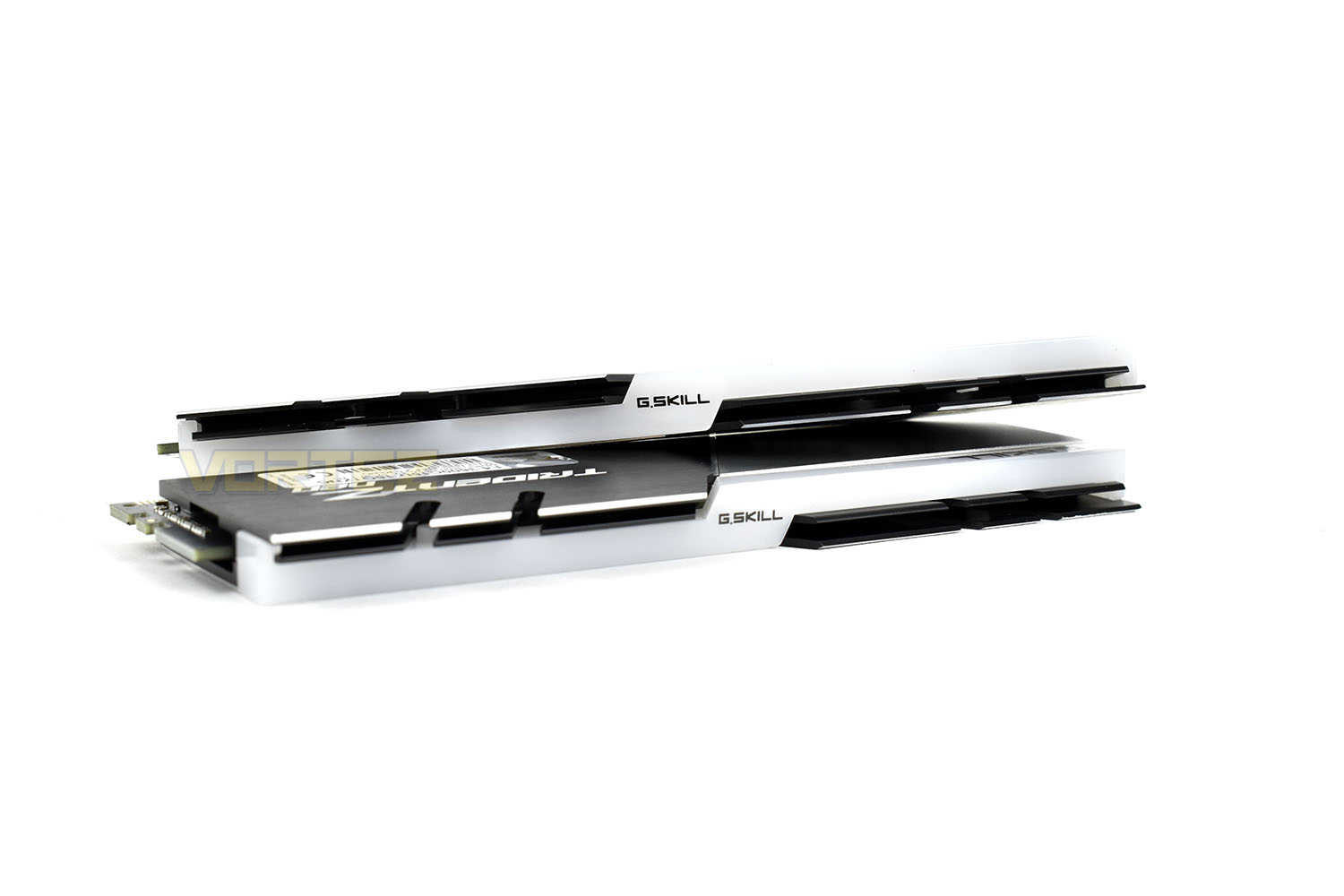
The white plastic strip along the top of each module is the RGB lighting diffuser which serves the purpose of dispersing the light more evenly throughout the case, instead of having bare LEDs glaring at you. There’s a small G.SKILL logo in the centre but it certainly doesn’t dominate the area.
RGB Lighting
Using the G.SKILL Lighting Control Software, we were able to configure the lighting in a powerful manner to bring you the following short clip: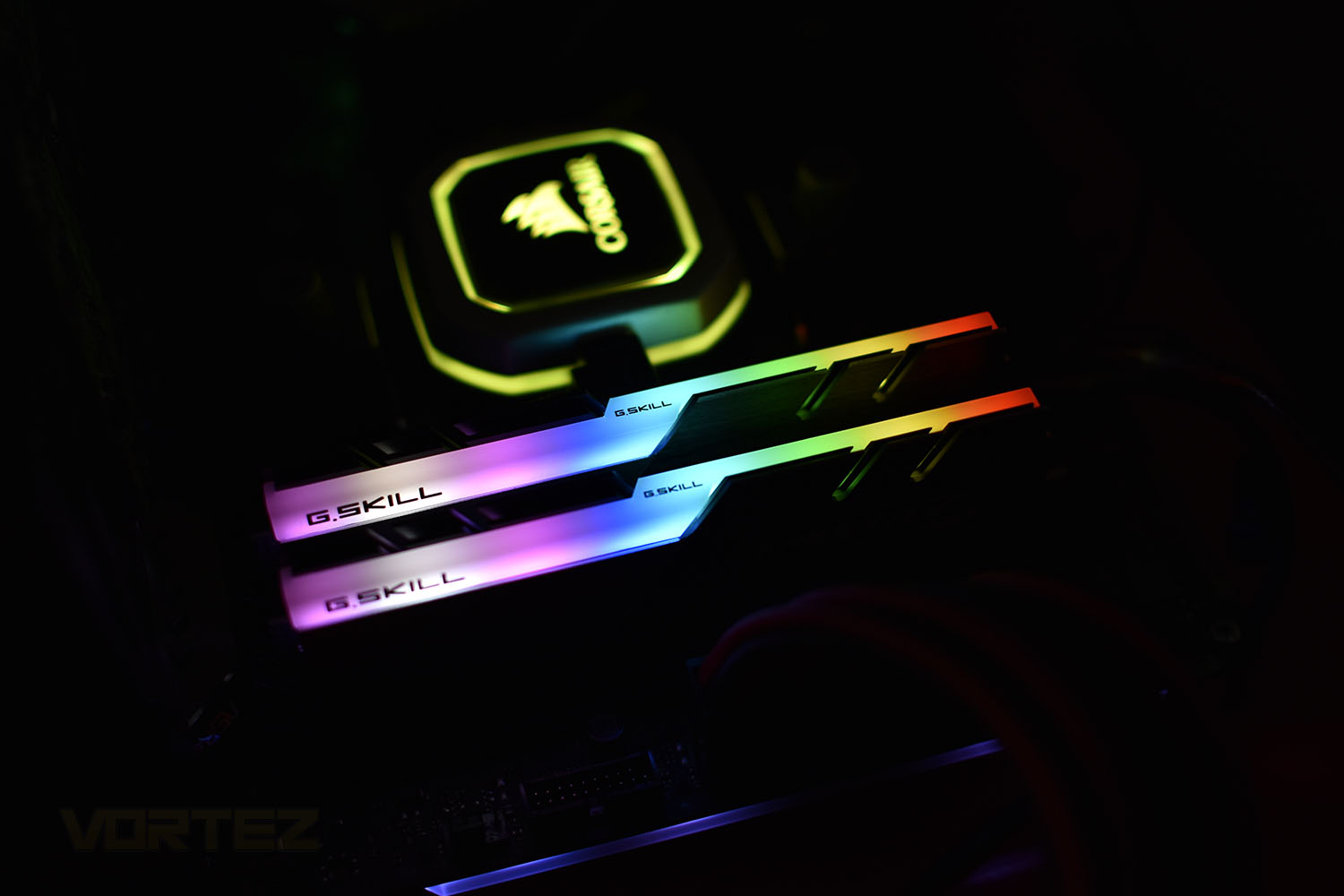
Test Setup & Software
Our test system is formatted and a fresh version of Windows is installed with just drives in place – no additional applications. Windows is then updated to the latest release and the drivers are installed.Included in the list of benchmarks are the following applications:
Benchmarks:
AIDA64
SiSoftware SANDRA
Cinebench R20
PCMark 8 Photoshop
Rise of the Tomb Raider
War Thunder
SiSoftware SANDRA
Cinebench R20
PCMark 8 Photoshop
Rise of the Tomb Raider
War Thunder
Test system:
CPU: AMD Ryzen 7 3800X
Motherboard: MSI Prestige X570 Creation
Graphics: AMD Radeon RX480
Memory:
PSU: Corsair RM750x
OS: Microsoft Windows 10 Pro 64-Bit
Monitor: ASUS ROG PG279Q
Motherboard: MSI Prestige X570 Creation
Graphics: AMD Radeon RX480
Memory:
PSU: Corsair RM750x
OS: Microsoft Windows 10 Pro 64-Bit
Monitor: ASUS ROG PG279Q
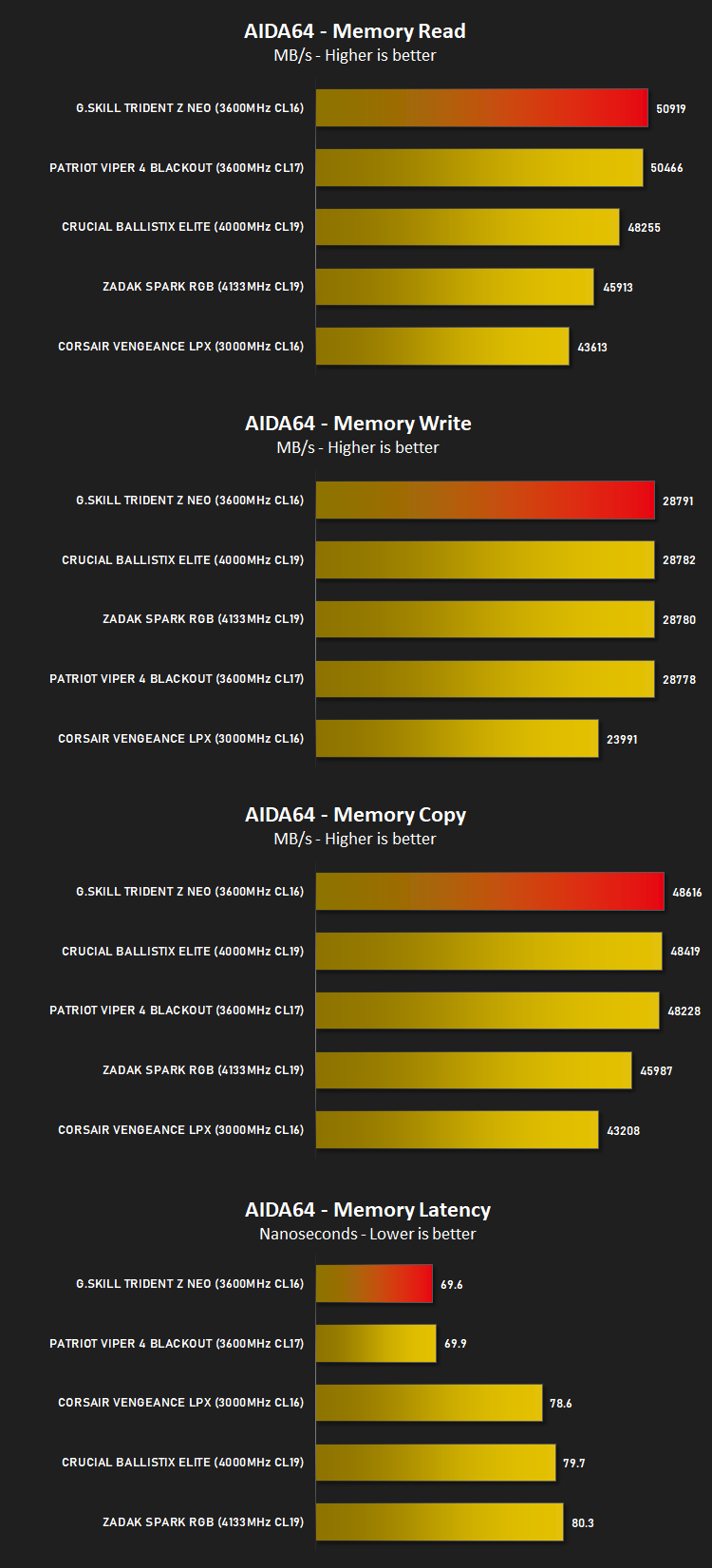
Memory Transfer Performance – AIDA64
AIDA64 Product PageMemory bandwidth benchmarks (Memory Read, Memory Write, Memory Copy) measure the maximum achiveable memory data transfer bandwidth. The code behind these benchmark methods are written in Assembly and they are extremely optimized for every popular AMD, Intel and VIA processor core variants by utilizing the appropriate x86/x64, x87, MMX, MMX+, 3DNow!, SSE, SSE2, SSE4.1, AVX, and AVX2 instruction set extension.
The Memory Latency benchmark measures the typical delay when the CPU reads data from system memory. Memory latency time means the penalty measured from the issuing of the read command until the data arrives to the integer registers of the CPU.
The Memory Latency benchmark measures the typical delay when the CPU reads data from system memory. Memory latency time means the penalty measured from the issuing of the read command until the data arrives to the integer registers of the CPU.
Bandwidth Performance – SiSoftware SANDRA
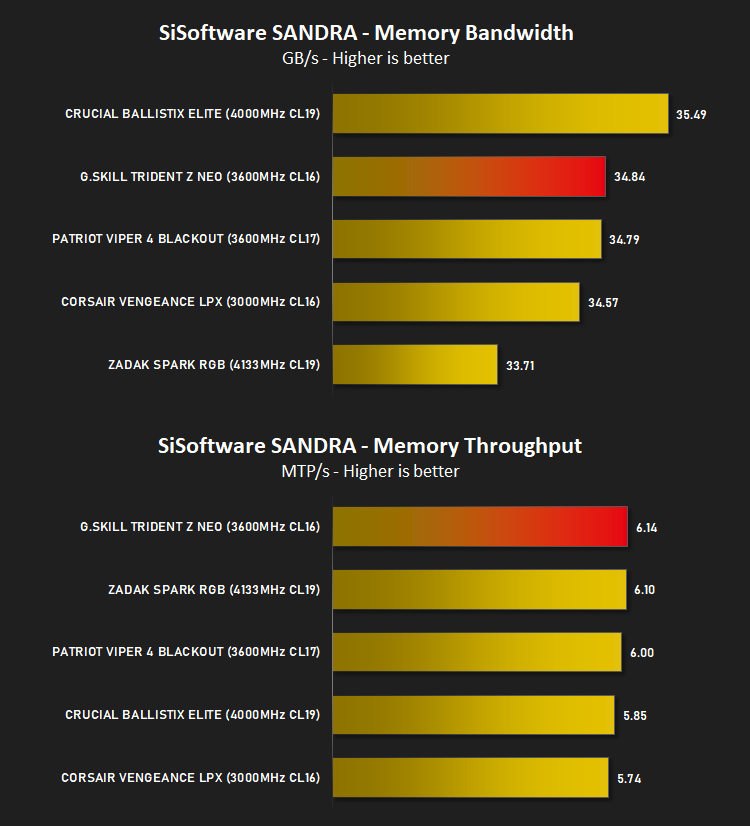
SANDRA isn’t always a benchmark that is included in hardware reviews but I believe it shouldn’t be ignored. SANDRA provides a vigorous package that tests your system in a rather large array of benchmarks. There are many aspects of benchmark that can be executed.
Processing Power Performance – Cinebench R20
Cinebench is a real-world cross-platform test suite that evaluates your computer’s hardware capabilities. Improvements to Cinebench Release 20 reflect the overall advancements to CPU and rendering technology in recent years, providing a more accurate measurement of Cinema 4D’s ability to take advantage of multiple CPU cores and modern processor features available to the average user.
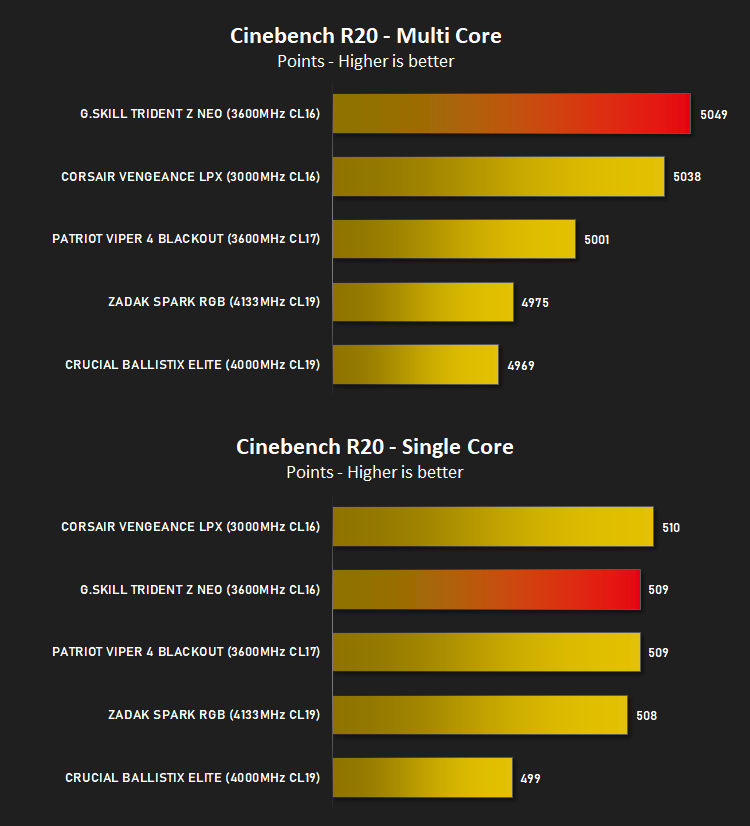
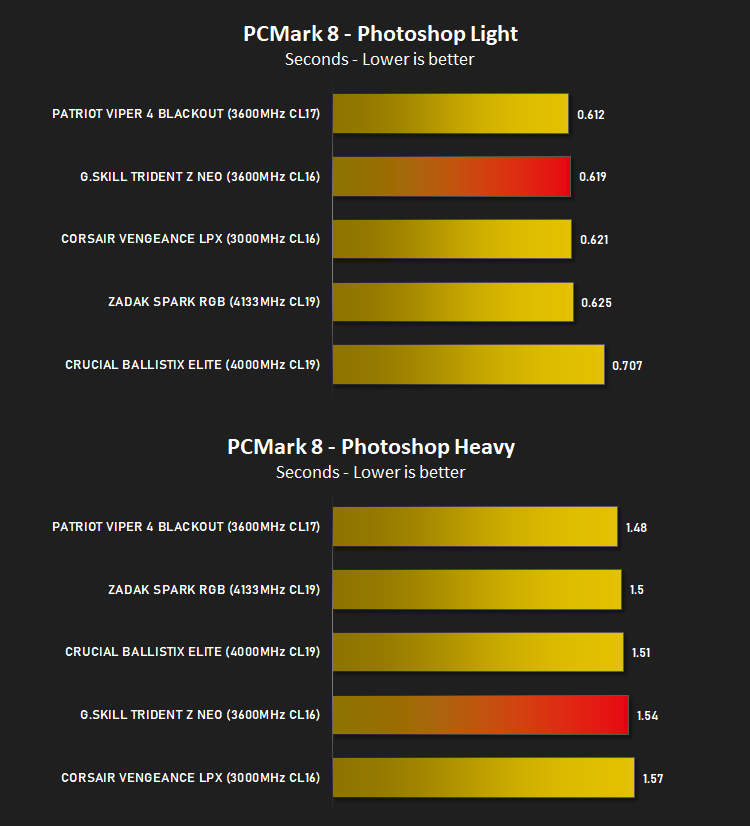
Image Editing Performance – PC Mark 8 Photoshop
PCMark 8 Product Page Developed in partnership with Benchmark Development Program members Acer, AMD, Condusiv Technologies, Dell, HGST, HP, Intel, Microsoft, NVIDIA, Samsung, SanDisk, Seagate and Western Digital, PCMark 8 is the latest version in FutureMark’s popular series of PC benchmarking tools. Improving on previous releases, PCMark 8 includes new tests using popular applications from Adobe and Microsoft.
Gaming Performance – Rise of the Tomb Raider & War Thunder
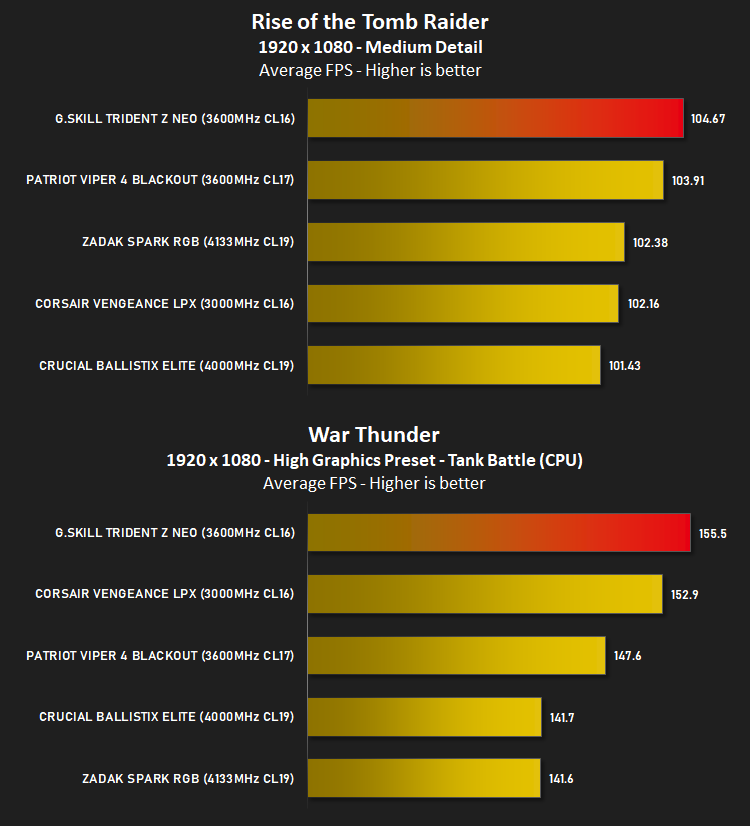
To test out the benefit of faster memory in a real world scenario, we have taken a recent game and created a CPU limited scenario by reducing the resolution and graphics settings to minimum, while setting the CPU dependent settings at their highest.
Conclusion
Well it’s easy to see that the numbers definitely speak for themselves, with the Trident Z Neo topping way more charts than any other kit, despite being technically slower than most of the graph, testament to what can be achieved by producing a kit that boasts both a high frequency and tight timings, something that the AMD X570 platform clearly enjoys.Bolstering that performance is the way that AMD’s Infinity Fabric is woven into the CPU, operating at a 1:1 ratio with the underlying DRAM frequency at anything up to 1866MHz (3733MHz DDR), so the 3600MHz kits being released by manufacturers at the moment are a perfect fit for the 3800X we test with, in terms of extracting everything from the IF.
The RGB lighting is excellent and definitely a key selling point for those who like their systems to shine. The diffuser strips along the top do their jobs remarkably well and thanks to built-in RGB sync, our motherboard paired up perfectly from the outset.
Build quality is also well up there, with a premium look and feel that can genuinely add to the appearance of your system, and thanks to its neutral colour scheme, it shouldn’t be difficult to marry these modules into any theme.
Pricing is a bit of a sticking point unless you’re heart-set on the RGB lighting and heatspreaders, with competing 3600MHz kits from the likes of Corsair and Team Group available for considerably less, if you forego the RGB of course.
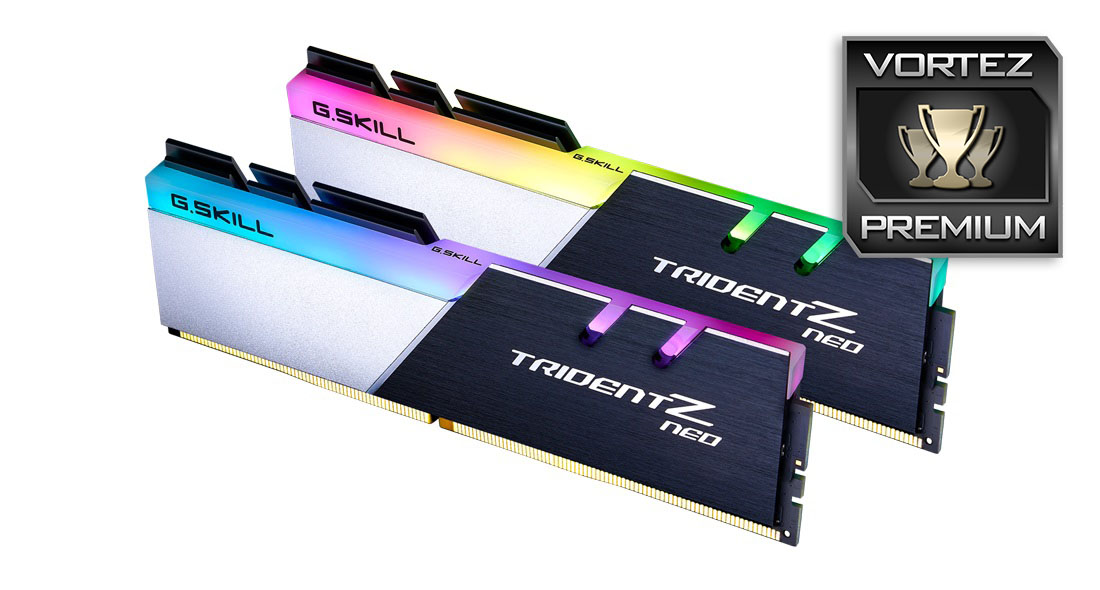
If you’re an enthusiast looking for excellent performance with beautiful RGB to match, we can definitely recommend the Trident Z Neo kit but if it’s just speed you’re after, better deals are available.
Pros
+ Solid build quality
+ Gorgeous RGB lighting
+ Neutral design blends into any build with ease
+ Fantastic performance
Cons
– Expensive, but arguably worth it
+ Solid build quality
+ Gorgeous RGB lighting
+ Neutral design blends into any build with ease
+ Fantastic performance
Cons
– Expensive, but arguably worth it
Click here for an explanation of our awards at Vortez.net.
Stay connected with the Vortez Social Media pages:
Join in with the discussions on Discord