Intel’s 10th Generation Desktop Processors, codenamed Comet Lake are finally here. Are they able to take on AMD Ryzen Gen 3? We take a look at the 10900K and 10600K CPUs.

Product on Review: Core-i9 10900K & Core i5-10600K
Street Price: 10900K: £529 / $490 | 10600K: £273 / $262
Intel’s 10th Gen. arrived back in Q3 2019 and debuted under the mobile-class, arming laptops and other portable products with the introduction of new technology. Fast forward to the middle of 2020 and Intel is only now presenting the mainstream Desktop variants, along with a new chipset.
Delivering more cores and faster clock speeds than before, Intel are keen to emphasise that both attributes are what gamers need, and want. With no serious rival, Intel has for many years provided consumers with mere incremental improvements to architecture. They dominated the market and yet at the same time strayed from delivering ground-breaking milestones, which allowed AMD to make the biggest comeback the industry has seen. AMD’s resurgence in the Desktop Processor division has brought back excitement and competition is most definitely back – something which is a positive thing for all concerned.
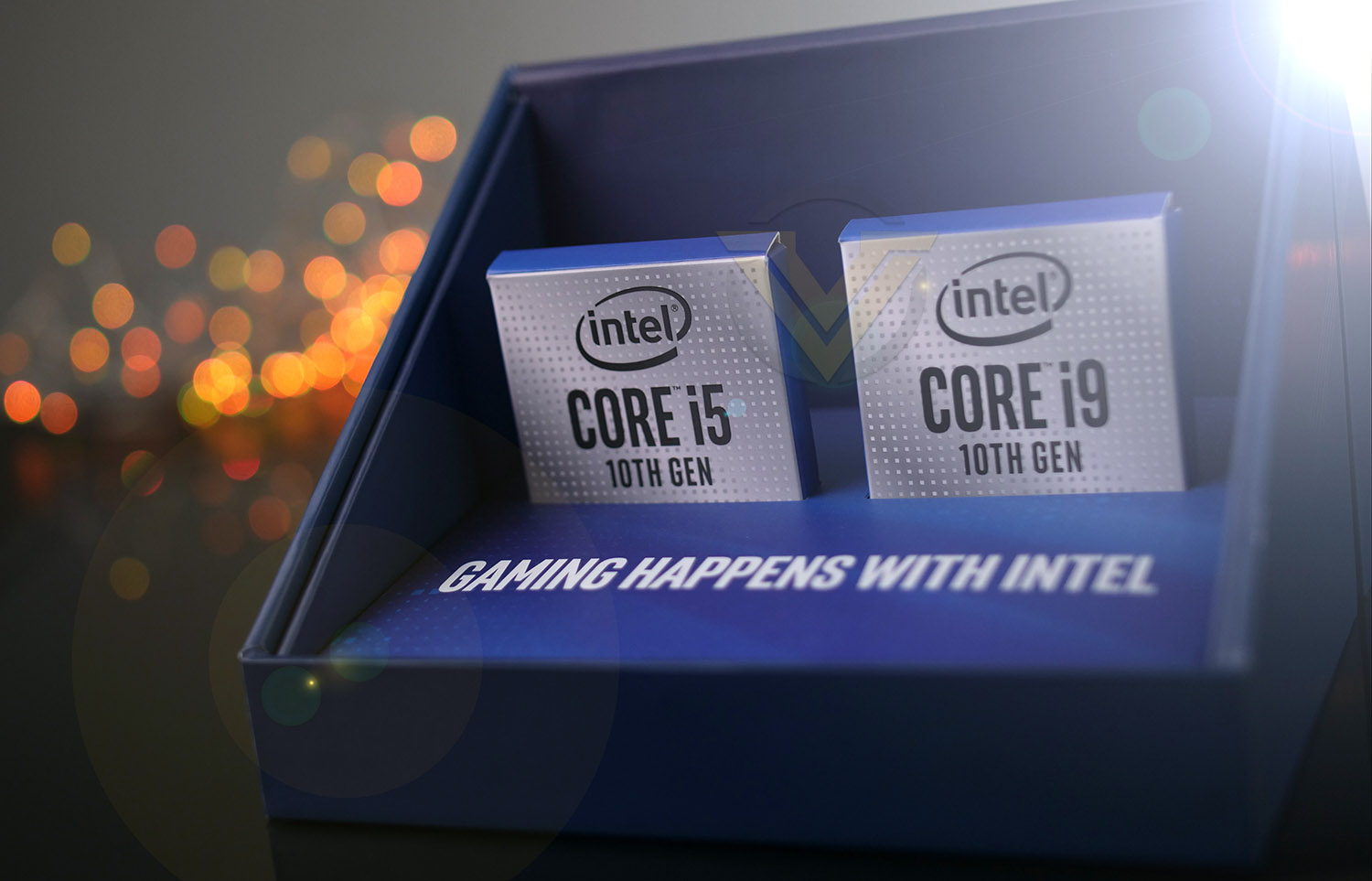
The big question today is, has the rise of AMD lit the fire underneath Intel?
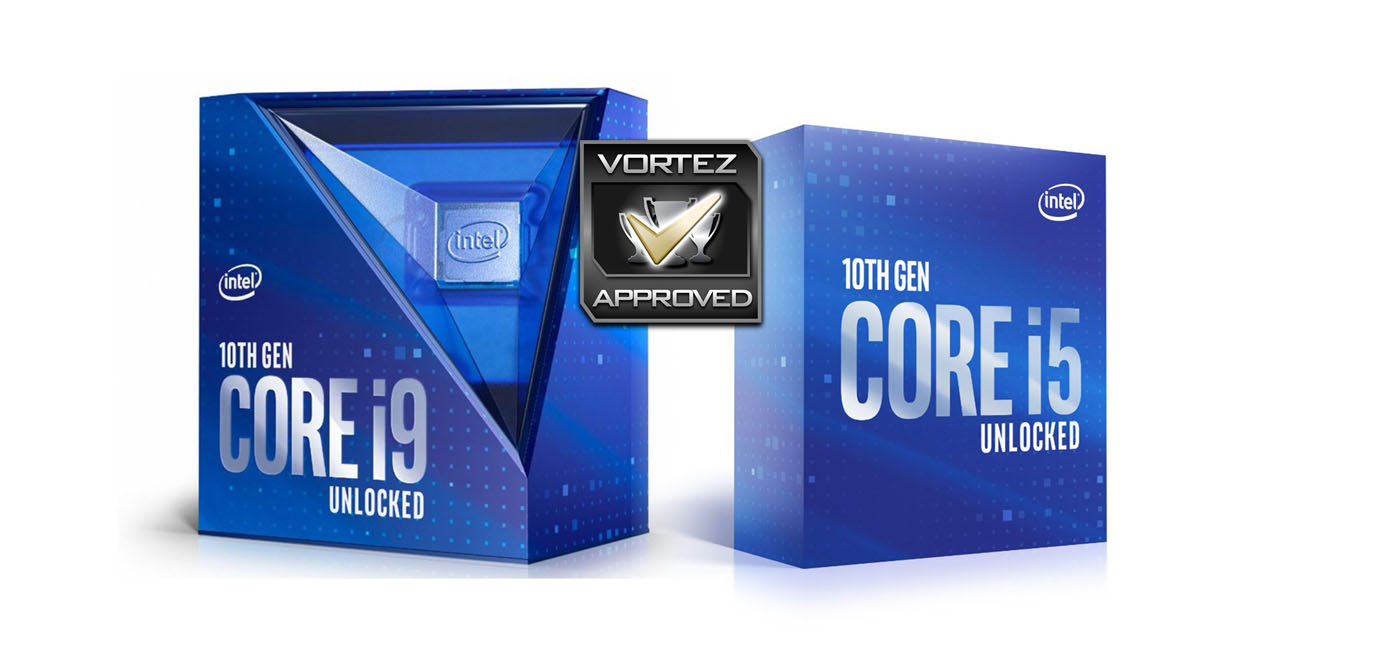
In the spotlight today we have two CPUs from the new Comet Lake lineup. The Core i9-10900K which is currently regarded as the flagship of the family – bringing 10 cores, 20 threads and a blistering 5.3GHz Max. Turbo Boost. The other model we have in for review is the Core i5-10600K carrying 6 cores, 12 threads and up to 4.8GHz Turbo Boost.
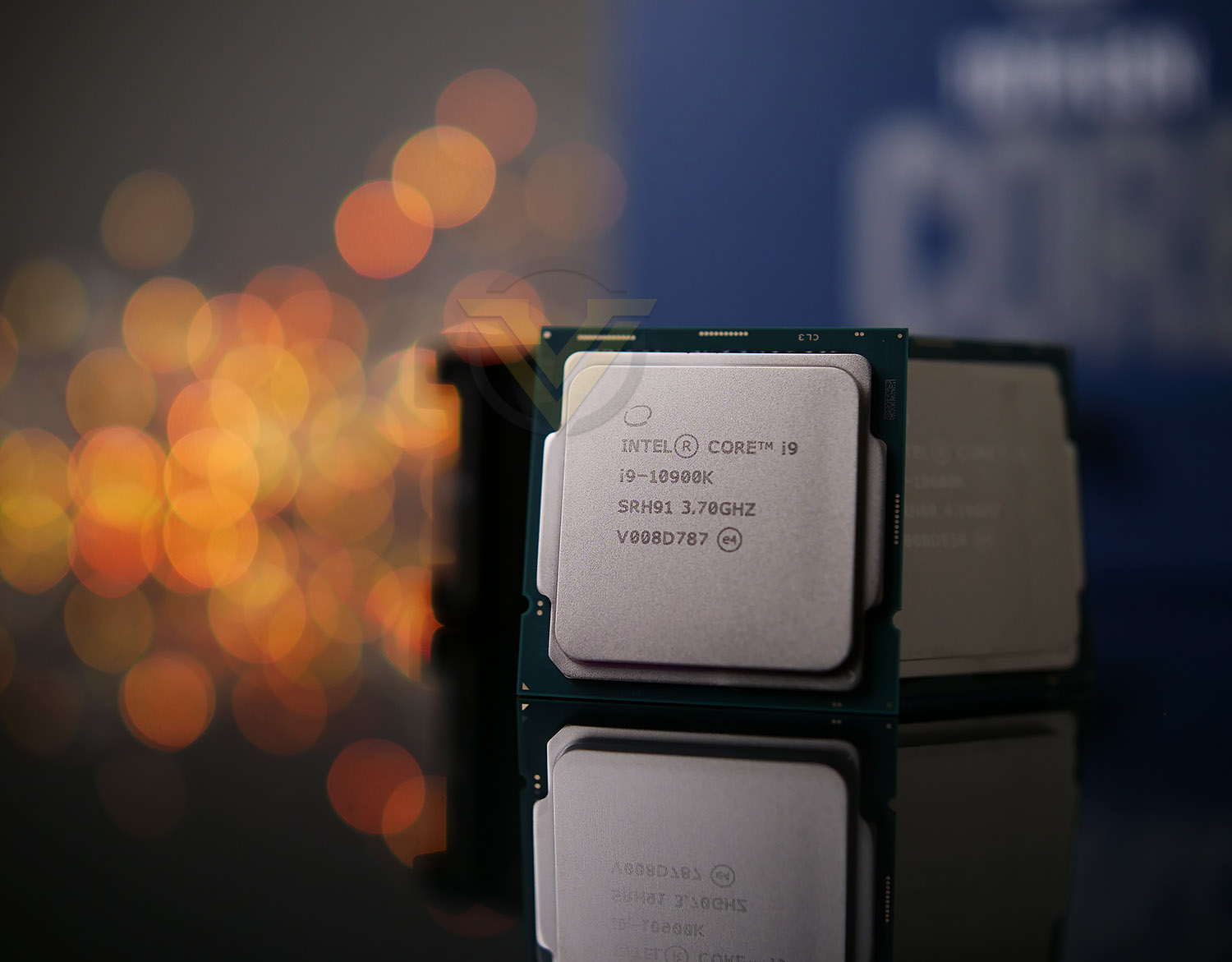
The multi-core battle may currently swing in AMD’s favour, but Intel have shifted their clock speeds up considerably and this is where Intel believe the importance lies for gamers.
It should be noted that 10th Gen Processors also introduce higher frequency DDR4 support, 2.5G ethernet and WiFi 6 (802.11AX). All of these features are presented on the new Intel 400 Series Chipset motherboards which we’ll be testing/reviewing over the coming weeks/months.
Intel on their 10th Gen. Desktop Processors:
With an optimal balance of frequency, cores and threads, advanced tuning support, and blazing connectivity, new 10th Generation Intel® Core™ processors help supercharge desktop PCs and enable incredible experiences and productivity for gamers, content creators, and mainstream users. Shatter the performance barrier and enter the realm of immersive 4K entertainment experiences and play the latest gaming titles like never before. Or simply get work done in less time by supercharging the latest business productivity applications for a higher level of collaboration and productivity. Whether you’re seeking great performance out of the box, or just want to take advantage of overclocking, there’s a new 10th Generation Intel® Core™ processor for you.
Features & Specifications
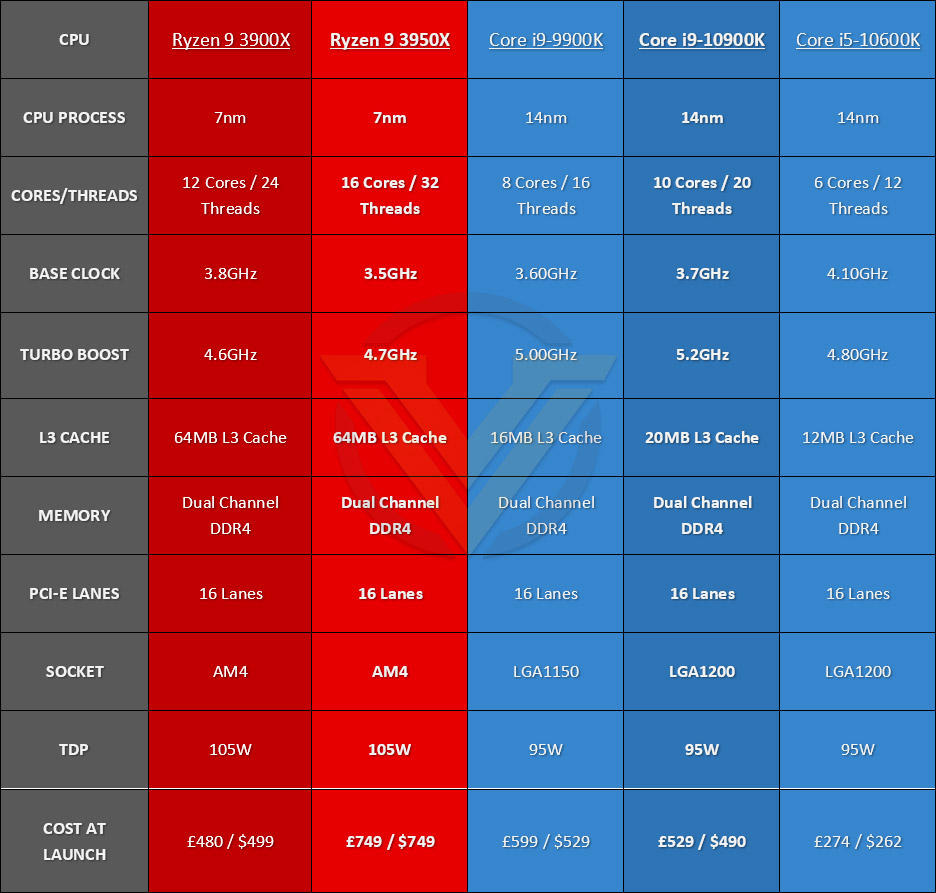
Below are the basic technical specifications for both CPUs under analysis today:
Intel Core i5-10600K
– 6 Physical Comet Lake cores, 12 threads, supporting Hyperthreading.
– 4.10GHz GHz Base Clock, 4.8 GHz Turbo Mode
– 12 MB SmartCache
– Socket LGA1200
– Fully Unlocked Multiplier
– 128GB DDR4 support
– 16 PCI-Express 3.0 lanes – Up to 1×16, 2×8 + 2×4
– 95W TDP
Intel Core i9-10900K
– 10 Physical Comet Lake cores, 20 threads, supporting Hyperthreading.
– 3.7GHz GHz Base Clock, 5.2 GHz Turbo Mode
– 20 MB SmartCache
– Socket LGA1200
– Fully Unlocked Multiplier
– 128GB DDR4 support
– 16 PCI-Express 3.0 lanes – Up to 1×16, 2×8 + 2×4
– 95W TDP
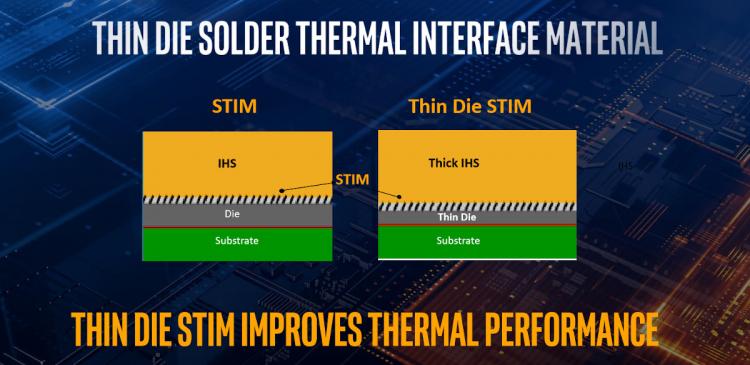
THINNER DIE, THICKER HIS
On the manufacturing side, a Comet Lake processor die is thinner than its Coffee Lake counterpart. This will in turn aid in heat transfer to the integrated copper heat spreader (IHS) and hence overall thermal performance. Comet Lake will also incorporate the use of solder TIM rather than the paste which was, until recently, utilised throughout the range.HYPERTHREADING AS STANDARD
Since the Sandybridge era Hyperthreading – the technology that allowed Intel’s CPU cores to handle two independent threads simultaneously – has been a performance feature exclusive to flagship SKUs on the mainstream desktop platform. With the 10th generation that all changes.With the launch of the 10th Generation on desktop Hyperthreading becomes a feature present on nearly every model, from entry-level i3 up to enthusiast i9. It even makes an appearance on budget dual-core Pentium Gold models.
Multi-threaded applications and desktop use cases where multiple applications are run concurrently are increasingly common. Users of all stripes will appreciate the performance improvement this can offer.
Intel’s change in ethos for Hyperthreading mirrors AMD’s approach to Simultaneous Multithreading in Ryzen. Ryzen SMT has always been the rule rather than the exception, and has lead to a multi-threaded performance lead even when the number of cores on comparable CPUs has been identical.
Test Setup & Testing
For the purpose of testing both Comet Lake CPUs we used the MSI MEG Z490 UNIFY since it is placed as a high-end motherboard, this should give us the capabilities of showing the true potential for both models.
CPUs being tested
Intel Core i9-10900K (5.2GHz) Comet Lake-SIntel Core i5-10600K (4.80GHz) Comet Lake-S
TEST SETUP
Cooling Corsair Hydro Series H110iMotherboard MSI MEG Z490 UNIFY
Memory 32GB Corsair Vengeance LPX 3000MHz
Graphics Radeon RX 480 8GB
Storage Intel S3500 128GB
PSU Corsair RM 1000 80 Plus Gold Certified PSU
Monitor AOC U2879VF
BENCHMARKS
Cinebench R15/R20 – CPU/OpenGL Scorex264 HD 4.0 – 1st and 2nd pass encoding
SiSoftware SANDRA – CPU & Memory benchmarks
POV-RAY – CPU benchmarks
TrueCrypt – CPU benchmarks
AIDA64 – CPU benchmarks & Memory
PCMark 8 – Home Suite & Photoshop
3DMark FireStrike – 3D Benchmark
Games – Rise of the Tomb Raider & Total War: WARHAMMER
OTHER SOFTWARE
Temperature Analysis: CoreTempStress Testing Software: AIDA64 Stability Test
CPU Specification Monitoring: CPU-Z
Temperatures & Overclocking
Below are the temperatures for each of the CPUs – without any overclock applied. We’ve also compared to previously released AMD and Intel counterparts (which we’ve also benchmarked against on the subsequent pages too):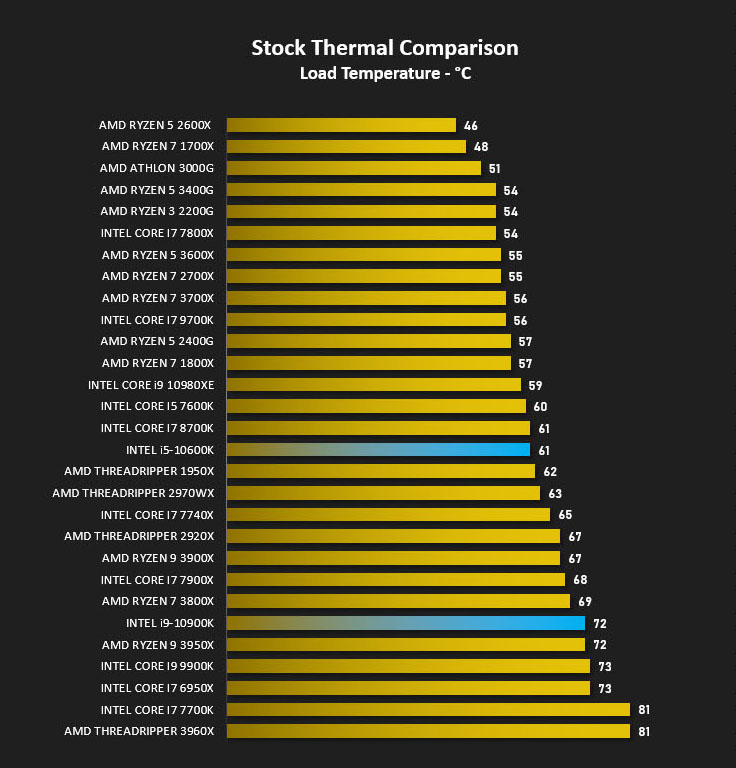
OVERCLOCKING
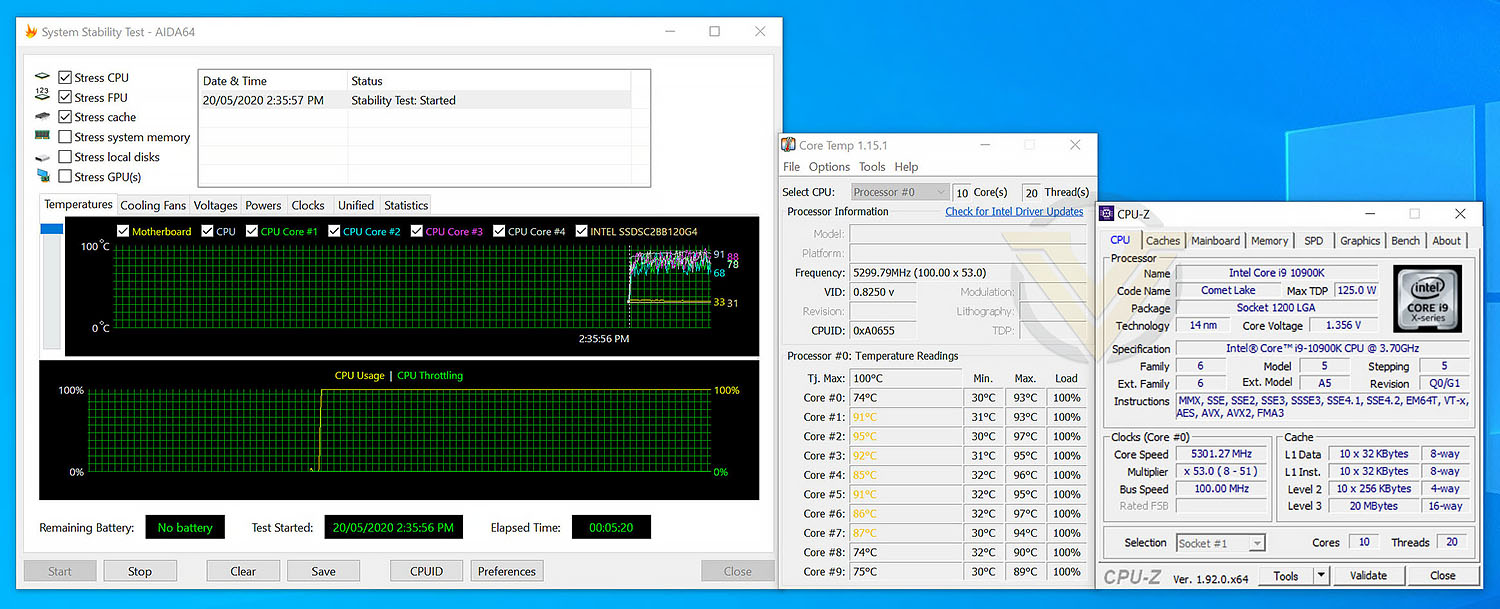
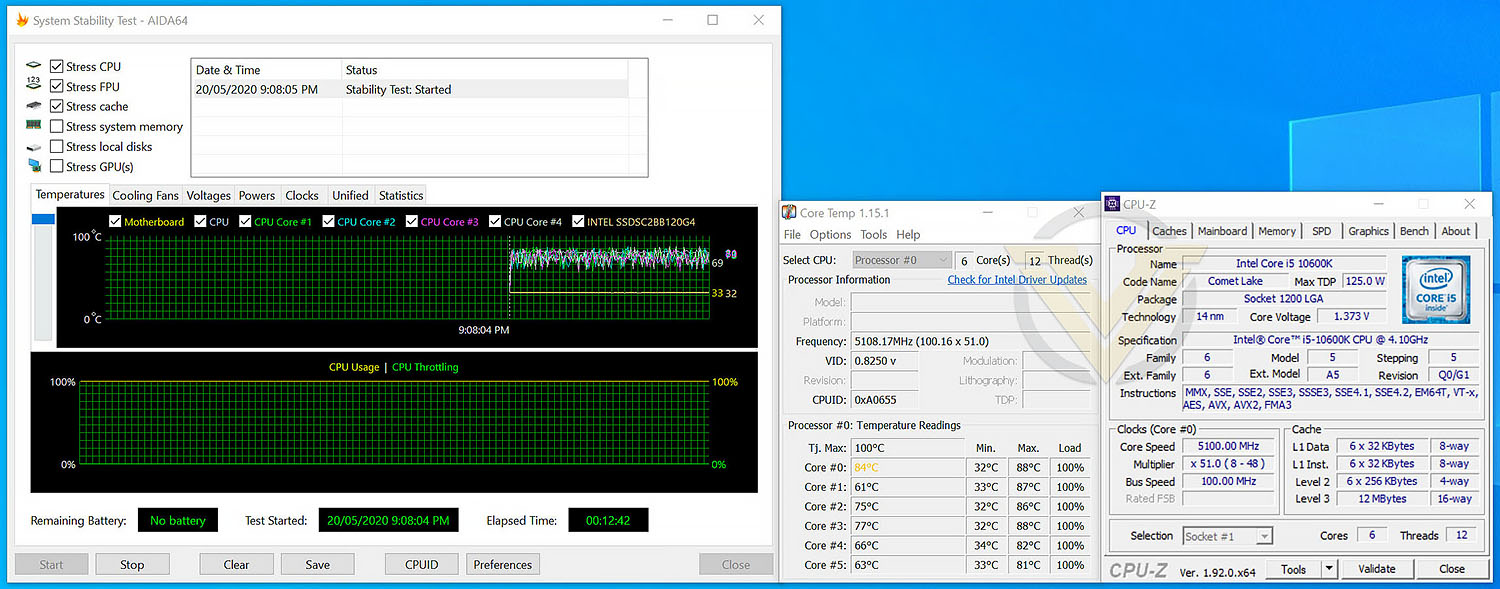
Moving to the overclocking phase of our review the above result further highlights the overclocking prowess of the 10th Gen. CPUs.The 10900K in particular is designed to jump over the 5GHz barrier when the CPU encounters certain load values, Turbo boost doesn’t always guarantee the clock speed will always remain over 5GHz – however with our overclock applied, the processor operates at that precise clockspeed.
So, for the i9-10900K our best result saw us hit 5.3GHz with 1.35v applied to the CPU voltage. The CPU would boot and bench beyond 5.3GHz but additional voltage was required and thus, temperatures hit the high 90s mark which we set as the safe-zone parameter.
For the i5-10600K we managed to reach 5.1GHz but required more voltage – at 1.37v.
These are both great results when we consider that all cores were operating at such a high frequency!
Power Consumption
It’s interesting to note the power consumption across all processors. Although they are using a combination of different motherboard chipsets, energy results can fluctuate between manufacturers due to the features and specifications that are integrated. First of all, for the idle tests the system is cold booted into Windows and no additional applications are executed – the watts are noted on the external energy monitor we use and then the system is loaded with 3DMark FireStrike – watts are again monitored for the duration of the test and the highest rated wattage result is then noted down. Below are the results of this energy test.
Ray Tracing Performance – POV-Ray 3.7
Persistence of Vision Raytracer’s PovRay is a free and open source 3D animator application with versions for computers with different operating systems.
This product allows users to build their custom 3D worlds with excellent quality despite their computer’s hardware. It has adjustable options for levels of radiance, refraction, and reflection. Calculation time may vary depending on the computer model, but PovRay can adapt to many computer builds, and is supported by the open source community.
This product allows users to build their custom 3D worlds with excellent quality despite their computer’s hardware. It has adjustable options for levels of radiance, refraction, and reflection. Calculation time may vary depending on the computer model, but PovRay can adapt to many computer builds, and is supported by the open source community.
AES Encryption Performance – TrueCrypt 7.1a
TrueCrypt is a discontinued source-available freeware utility used for on-the-fly encryption (OTFE). It can create a virtual encrypted disk within a file or encrypt a partition or (under Microsoft Windows except Windows 8 with GPT) the entire storage device (pre-boot authentication).
Encoding Performance – X264 HD
Simply put, this test measures how fast your machine can encode a short, DVD quality MPEG-2 video clip into a high-quality x264 video clip. What’s x264, you ask? It’s more or less the next-generation Xvid/DivX codec. I think it’s ideal for a benchmark because the application (x264.exe) reports fairly accurate compression results (in frames per second) for each pass of the video encoding process, and it uses multi-core processors very efficiently.
x264 HD gives results for 2 passes when compressing an MPEG-2 clip into x264. It presents 4 separate results for each pass giving a total of 8 – all results are given in FPS. For each pass I have averaged out the results.
Processing Features Performance – AIDA64
AIDA64 Product Page
This simple integer benchmark focuses on the branch prediction capabilities and the misprediction penalties of the CPU. It finds the solutions for the classic “Queens problem” on a 10 by 10 sized chessboard. At the same clock speed theoretically the processor with the shorter pipeline and smaller misprediction penalties will attain higher benchmark scores. For example — with HyperThreading disabled — the Intel Northwood core processors get higher scores than the Intel Prescott core based ones due to the 20-step vs 31-step long pipeline. CPU Queen test uses integer MMX, SSE2 and SSSE3 optimizations.
Memory Transfer Performance – AIDA64
AIDA64 Product Page
This simple integer benchmark focuses on the branch prediction capabilities and the misprediction penalties of the CPU. It finds the solutions for the classic “Queens problem” on a 10 by 10 sized chessboard. At the same clock speed theoretically the processor with the shorter pipeline and smaller misprediction penalties will attain higher benchmark scores. For example — with HyperThreading disabled — the Intel Northwood core processors get higher scores than the Intel Prescott core based ones due to the 20-step vs 31-step long pipeline. CPU Queen test uses integer MMX, SSE2 and SSSE3 optimizations.
Processing Power Performance – Cinebench R15 & R20
CINEBENCH can measure systems with up to 64 processor threads. This test scene contains approximately 2,000 objects which in turn contain more than 300,000 polygons in total, and uses sharp and blurred reflections, area lights, shadows, procedural shaders, antialiasing, and much more. The result is displayed in points (pts). The higher the number, the faster your processor.
Again, there are marginal advantages for the processing power within Cinebench too. Applying an overclock will increase performance and achieve better results.
Bandwidth Performance – SiSoftware SANDRA
3DMark 11 Product PageSANDRA isn’t always a benchmark that is included in hardware reviews but I believe it shouldn’t be ignored. SANDRA provides a vigorous package that tests your system in a rather large array of benchmarks. There are many aspects of benchmark that can be executed. We will be considering – CPU and memory tests.
Image Editing Performance – PCMark 8 Photoshop
PCMark 8 Product Page Developed in partnership with Benchmark Development Program members Acer, AMD, Condusiv Technologies, Dell, HGST, HP, Intel, Microsoft, NVIDIA, Samsung, SanDisk, Seagate and Western Digital, PCMark 8 is the latest version in FutureMark’s popular series of PC benchmarking tools. Improving on previous releases, PCMark 8 includes new tests using popular applications from Adobe and Microsoft.
Overall System Performance – PCMark 10
PCMark 10 Product Page Developed in partnership with Benchmark Development Program members Acer, AMD, Condusiv Technologies, Dell, HGST, HP, Intel, Microsoft, NVIDIA, Samsung, SanDisk, Seagate and Western Digital, PCMark 10 is the latest version in FutureMark’s popular series of PC benchmarking tools. Improving on previous releases, PCMark 10 includes new tests using popular applications from Adobe and Microsoft.
VR Performance – VRMark
VRMark Product PageVRMark includes two VR benchmark tests that run on your monitor, no headset required, or on a connected HMD. At the end of each test, you’ll see whether your PC is VR ready, and if not, how far it falls short.
3D Performance – 3DMARK FireStrike & TimeSpy
3DMark FireStrike Product PageFire Strike is our new showcase DirectX 11 benchmark designed for high-performance gaming PCs. It is our most ambitious and technical benchmark ever, featuring real-time graphics rendered with detail and complexity far beyond what is found in other benchmarks and games today. Fire Strike will only be available in the Windows editions of 3DMark initially.
Gaming Performance – Tomb Raider & Total War: WARHAMMER
It’s important for us to perform a number of game benchmarks as well as the synthetic tests because gamers will want to know if there are any significant benefits. So here we have two recent gaming titles benchmarked with a Radeon RX 480 installed.
Conclusion
It’s hard to believe that Intel’s 9th Gen arrived in Q4 2018. Some would argue the 9th Gen. platform with its Z390 chipset was short-lived, we just hope that Z490 and LGA1200 has more longevity.
As with other releases, upgrading to Intel’s 10th Gen. makes more sense if you’re moving up from a 3-year-old platform. Enthusiasts/gamers using 9th Gen will see few benefits, but shifting up from 7th Gen. (7700K) is really the intended pathway.
On the table are two very capable processors in the Core i9-10900K and Core i5-10600K. The former boasts 10 cores and 20 threads; a first for Intel on the mainstream platform. While AMD may take the crown for multi-core prowess, Intel are at the top of the clockspeed leaderboard and this certainly has its benefits. Encoding, certain multimedia uses and scenarios which demand single thread operation are all strengths for the 10900K.
Power consumption and temperatures aren’t usually areas for tech enthusiasts to be overly concerned about but effort has been ploughed into the latter. Although Intel has made a concerted effort to improving the soldered TIM, die size, and thicker IHS, it doesn’t appear to translate to a real-world benefit. However, if you plan to marry a 10th Gen CPU up with a high-performance closed loop solution and have decent airflow within your chassis, figures aren’t likely to breach the 70C mark.
The ability to hit 5.3GHz Turbo Boost on a single-core via Turbo Boost 3.0 is an astounding feat but we were even more impressed in our overclocking session – we were able to hit that 5.3GHz on all cores with 1.35v. While this milestone did have a trade-off courtesy of rising temperatures which soared to 90C, with additional tinkering we’re confident it is possible to nudge down that value and maximise on such a potential.
In many regards with the 10900K, we are entering HEDT territory with an abundance of cores, threads and Smart Cache. Performance is indicative of this and yet we were pleasantly surprised to see that pricing is somewhat lower for this release compared to last season’s Coffee Lake launch. Pricing for the 10900K is: £529 / $490 while the 10600K is just £273 / $262. Based on pricing alone, the 10900K will match up as a competitor to the AMD Ryzen 9 3900X. AMD’s CPU is slightly cheaper but both models aren’t very similar in terms of performance.
Intel’s 10th Gen. 10900K and 10600K achieve some excellent results, but with fierce competition from AMD, the option to side with Intel isn’t as clear-cut as it use to be!
Pros
+ Excellent Turbo Boost Frequency
+ Offers excellent overall performance
+ Cheaper than Coffee Lake counterparts
+ Supports up to 128GB DDR4
+ Responds well to overclocking
Cons
– Thermals still above the competition
– Does not support PCIe 4.0 specification
– Less cores/threads than the competition
+ Excellent Turbo Boost Frequency
+ Offers excellent overall performance
+ Cheaper than Coffee Lake counterparts
+ Supports up to 128GB DDR4
+ Responds well to overclocking
Cons
– Thermals still above the competition
– Does not support PCIe 4.0 specification
– Less cores/threads than the competition
Click here for an explanation of our awards at Vortez.net.
Stay connected with the Vortez Social Media pages:
Join in with the discussions on Discord