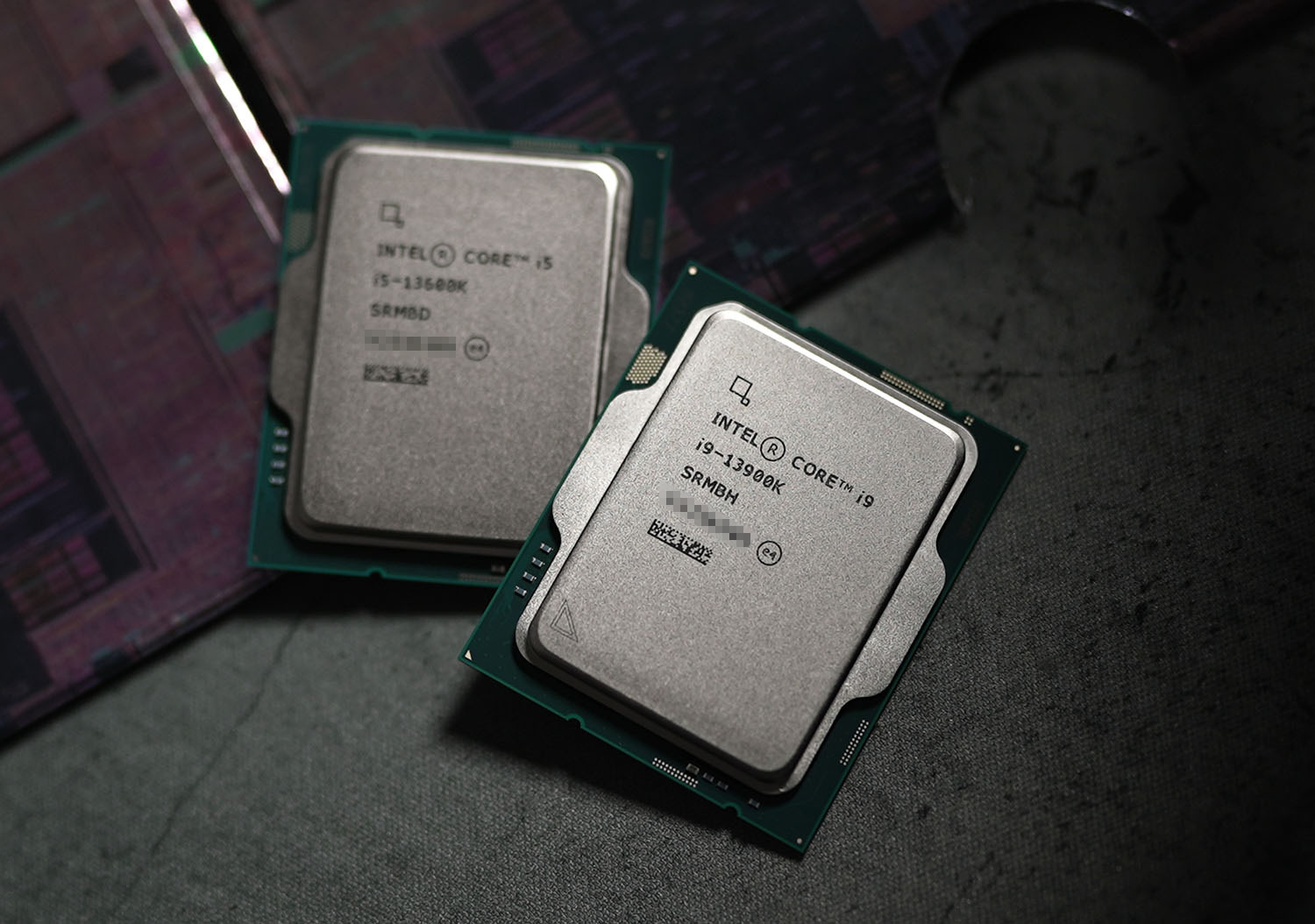
In the final quarter of 2022, Intel releases their Raptor Lake CPUs aka 13th Generator Processors. We take the 13600K and 13900K chips and see how they perform against previous generations.
Product on Review:

Core i9-13900K & i5-13600K
Manufacturer: Intel
Street Price:
Core i9-13900K: AUD 1099 | USD 589 | GBP 699
Core i5-13600K: AUD 569 | USD 319| GBP 339
Co-editor: Tim Harmer
Scarcely one year ago Intel released the 12th Generation Core processor series, led by the Core i9-12900K. A radical departure in design from the prior eleven desktop CPU architecture generations, and a substantially different approach from the competition’s chiplet designs, Alder Lake introduced a hybrid core approach with large performance cores and smaller efficient cores dubbed ‘P’ and ‘E’ cores. Now Intel are rolling out 13th Generation ‘Raptor Lake’ processors, the first revision of this architecture that arrives complete with updated performance cores and new core configurations down the product stack.
Claiming pride of place among the latest series is the Core i9-13900K, a processor which follows the same naming conventions as the 12900K before it. This 24-core, multiplier unlocked chip is designed for full-throttle high performance gaming and content creation, while also being able to take advantage of overclocking when paired with a suitable motherboard and cooling solution. It features eight revised Raptor Cove ‘P’ performance cores and doubles the number of Gracemont ‘E’ efficiency cores to sixteen, allowing it to more easily fulfil a ‘megatasking’ role of running multiple demanding and lower priority tasks at once. Streamers and full-time creators, this is the processor for you.
One potential benefit of the 13th Generation’s place in Intel’s roadmap is its reuse of the LGA1700 socket for 700-series motherboards. This has allowed them to also leverage the wide array of 600-series motherboard designs as affordable alternatives to the slightly more feature-complete 700-series models, and the similarity in chipsets should see launch-ready Z790 motherboards exhibit greater reliability than might otherwise have been the case. The affordability benefits extend to the 13th Generation’s compatibility with DDR4 as well as DDR5 memory, making your selection of motherboard all the more important.
Stepping down the product stack to the i7-13700K sees a reduction in the number of E-cores from 16 to 8 while maintaining the number of P-Cores at 8. That’s four more E-Cores and four more independent thread support than the i7-12700K, which in of itself is nothing to be sniffed at from a generational transition. Combine it with the underlying improvements in P-core architecture, IPC and operating frequency, and you can see why passionate gamers might have their eye on this enthusiast-level SKU.
The current entry-point into the 13th Generation platform is the Core i5-13600K. Intel’s i5-x600K CPUs have often been seen as an ideal tier for gaming due to their ‘bang for your buck’, and this Gen. sees the addition of four more E-cores (up to eight) operating alongside six P-Cores. The impact will vary by scenario – certain games and applications in tandem will better leverage these increased resources – but overall it will add significant potential processing power to the chip as a whole. It’s perhaps the most exciting model for gamers looking to modernise their PC with an Intel CPU this holiday season.
Intel’s 13th Generation processors launch alongside the Z790 motherboard series, which hasn’t changed much from the prior platform. More downstream PCIe 4.0 lanes are offered compared to Z690 (up from 12 to 20) and an additional 20Gbps USB 3.0 port is available as standard, but realistically the improvements will represent only a minor perk to the vast majority of end users. The chief selling points will be platform and UEFI BIOS maturity, in addition to flashy new proprietary features added by Intel’s motherboard partners.
As a result end-users searching to save a few bucks can instead opt for a B660 or Z690 motherboard with updated BIOS to ensure CPU compatibility. Partnering a 13th Gen processor with these older ‘boards could see the money put towards a new GPU upgrade, higher processor tier, or simply saved for a rainy day. Savings can get even more significant if paired with DDR4 memory DIMMS, which remains much more affordable than DDR5 (even if the latter has come down in price in recent months). Bear in mind however that K SKU overclocking is only supported on Z690 and Z790 motherboards.
All the 13th Generation K-series processors feature an integrated graphics processor capable of display out, minor gaming and efficient QuickSync video encode/decode functionality. They are however designed to be paired with a discrete GPU, preferably one that can take advantage of the new PCIe Gen 5 standard supported by the platform. It’s possible to shave a few pounds by choosing a ‘KF’-series processor without integrated graphics, but the troubleshooting benefits may overrule the savings.
Today we’re reviewing the mid-tier Core i5-13600K and flagship Core i9-13900K. AUD 569 and AUD 1099 in Australia. Starting at an MSRP of $319 and UK street price from £339 inc. V.A.T. at time of writing, it’s $30 more expensive than the 12600K was last year and in the UK about £20 more to buy than the 12600K is today. The Core i9-13900K meanwhile is priced at $589 MSRP, or a very hefty £699.95 (inc. V.A.T.) at UK etailers. That’s the same as the 12900KS today or £130 more than the 12900K.
They will compete with AMD’s new Ryzen 7000-series, specifically the Ryzen 5 7600X and Ryzen 9 7950X. The former comes in at £319 today ($299 MSRP), whereas the latter is a more challenging £749 ($699 MSRP); however that doesn’t reflect the true cost of the whole platform, which currently requires both pricey DDR5 RAM and expensive X670 motherboards that can’t be salvaged from systems based around the prior Ryzen platforms.
Test Setup & Testing
For the purpose of testing Intel Alder Lake we used the MSI Z790 CARBON WiFi since it is placed as a high-end motherboard, this should give us the capabilities of showing the true potential of this chip.
CPU being tested
Intel Core i5-13600KIntel Core i9-13900K
TEST SETUP
Cooling CORSAIR H150i ELITE LCDMotherboard MSI Z790 CARBON WIFI
Memory 64GB CORSAIR Dominator Platinum RGB 5200MHz DDR5
Graphics ZOTAC RTX 3070 Ti HOLO Extreme
Storage CORSAIR Force LX 512GB SSD
PSU Corsair RM 1000 80 Plus Gold Certified PSU
Monitor AOC U2879VF
BENCHMARKS
Cinebench R23 – Single/Multi-core CPU Renderingx264 HD 4.0 – 1st and 2nd pass encoding
SiSoftware SANDRA – CPU & Memory benchmarks
POV-RAY – CPU Ray Tracing
TrueCrypt – CPU Encryption Read/Write
AIDA64 – CPU benchmarks & Memory
PCMARK 10 – CPU Productivity
Davinci Resolve – Puget Benchmark
Blender – Classroom Benchmark
Games – Assassin’s Creed Odyssey & Total War: WARHAMMER II
OTHER SOFTWARE
Temperature Analysis: CoreTempStress Testing Software: AIDA64 Stability Test
CPU Specification Monitoring: CPU-Z
Temperatures
Below are the temperatures for each of the CPUs – without any overclock applied. We’ve also compared to previously released AMD and Intel counterparts (which we’ve also benchmarked against on the subsequent pages too):
Power Consumption
It’s interesting to note the power consumption across all processors. Although they are using a combination of different motherboard chipsets, energy results can fluctuate between manufacturers due to the features and specifications that are integrated. First of all, for the idle tests the system is cold booted into Windows and no additional applications are executed – the watts are noted on the external energy monitor we use and then the system is loaded with 3DMark FireStrike – watts are again monitored for the duration of the test and the highest rated wattage result is then noted down. Below are the results of this energy test.
Ray Tracing Performance – POV-Ray 3.7
Persistence of Vision Raytracer’s PovRay is a free and open source 3D animator application with versions for computers with different operating systems.
This product allows users to build their custom 3D worlds with excellent quality despite their computer’s hardware. It has adjustable options for levels of radiance, refraction, and reflection. Calculation time may vary depending on the computer model, but PovRay can adapt to many computer builds, and is supported by the open source community.
This product allows users to build their custom 3D worlds with excellent quality despite their computer’s hardware. It has adjustable options for levels of radiance, refraction, and reflection. Calculation time may vary depending on the computer model, but PovRay can adapt to many computer builds, and is supported by the open source community.
AES Encryption Performance – TrueCrypt 7.1a
TrueCrypt is a discontinued source-available freeware utility used for on-the-fly encryption (OTFE). It can create a virtual encrypted disk within a file or encrypt a partition or (under Microsoft Windows except Windows 8 with GPT) the entire storage device (pre-boot authentication).
Encoding Performance – X264 HD
Simply put, this test measures how fast your machine can encode a short, DVD quality MPEG-2 video clip into a high-quality x264 video clip. What’s x264, you ask? It’s more or less the next-generation Xvid/DivX codec. I think it’s ideal for a benchmark because the application (x264.exe) reports fairly accurate compression results (in frames per second) for each pass of the video encoding process, and it uses multi-core processors very efficiently.
x264 HD gives results for 2 passes when compressing an MPEG-2 clip into x264. It presents 4 separate results for each pass giving a total of 8 – all results are given in FPS. For each pass I have averaged out the results.
Processing Features Performance – AIDA64
AIDA64 Product PageThis simple integer benchmark focuses on the branch prediction capabilities and the misprediction penalties of the CPU. It finds the solutions for the classic “Queens problem” on a 10 by 10 sized chessboard. At the same clock speed theoretically the processor with the shorter pipeline and smaller misprediction penalties will attain higher benchmark scores. For example — with HyperThreading disabled — the Intel Northwood core processors get higher scores than the Intel Prescott core based ones due to the 20-step vs 31-step long pipeline. CPU Queen test uses integer MMX, SSE2 and SSSE3 optimizations.
Memory Transfer Performance – AIDA64
AIDA64 Product PageThis simple integer benchmark focuses on the branch prediction capabilities and the misprediction penalties of the CPU. It finds the solutions for the classic “Queens problem” on a 10 by 10 sized chessboard. At the same clock speed theoretically the processor with the shorter pipeline and smaller misprediction penalties will attain higher benchmark scores. For example — with HyperThreading disabled — the Intel Northwood core processors get higher scores than the Intel Prescott core based ones due to the 20-step vs 31-step long pipeline. CPU Queen test uses integer MMX, SSE2 and SSSE3 optimizations.
Processing Power Performance – Cinebench R23
CINEBENCH can measure systems with up to 64 processor threads. This test scene contains approximately 2,000 objects which in turn contain more than 300,000 polygons in total, and uses sharp and blurred reflections, area lights, shadows, procedural shaders, antialiasing, and much more. The result is displayed in points (pts). The higher the number, the faster your processor.
Bandwidth Performance – SiSoftware SANDRA
SiSoftware Product PageSANDRA isn’t always a benchmark that is included in hardware reviews but I believe it shouldn’t be ignored. SANDRA provides a vigorous package that tests your system in a rather large array of benchmarks. There are many aspects of benchmark that can be executed. We will be considering – CPU and memory tests.
Overall System Performance – PCMark 10
PCMark 10 Product Page Developed in partnership with Benchmark Development Program members Acer, AMD, Condusiv Technologies, Dell, HGST, HP, Intel, Microsoft, NVIDIA, Samsung, SanDisk, Seagate and Western Digital, PCMark 10 is the latest version in FutureMark’s popular series of PC benchmarking tools. Improving on previous releases, PCMark 10 includes new tests using popular applications from Adobe and Microsoft.
4K Editing Performance – DaVinci Resolve PugetBench
DaVinci Resolve is not only an industry-standard coloring tool, but also includes features for video editing, VFX, and more. While we also have benchmarks for Premiere Pro, After Effects, and other creative applications, every application will utilize the hardware in a computer in very different and unique ways which can make it extremely difficult to determine exactly what hardware will give the end user the best possible performance.
Rendering Performance – Blender
Blender is a free and open-source 3D computer graphics software toolset used for creating animated films, visual effects, art, 3D printed models, motion graphics, interactive 3D applications, virtual reality, and computer games. Blender’s features include 3D modeling, UV unwrapping, texturing, raster graphics editing, rigging and skinning, fluid and smoke simulation, particle simulation, soft body simulation, sculpting, animating, match moving, rendering, motion graphics, video editing, and compositing.
Please note: Blender has recently been updated and the metric for results has changed with the new update, rendering our historical benchmarks void – hence why we have less results for this benchmark, taking on the new samples per minute metric.
Gaming Performance – AC: Odyssey & Total War: WARHAMMER II
It’s important for us to perform a number of game benchmarks as well as the synthetic tests because gamers will want to know if there are any significant benefits. So here we have two recent gaming titles benchmarked with the RTX 3070 Ti. Both gaming titles are CPU-intensive – AC Odyssey is the last AC title in the series to be CPU-bound. Valhalla uses DX12 API.
Conclusion
It’s remarkable that, despite two very different designs and on-paper performance metrics, both Intel and AMD have created a flagship that can be so nip and tuck in determining the lead in different applications. But let’s start by comparing the 13th Gen. to its predecessor.
In almost all respects the new Core i9-13900K and i5-13600K pull out a resounding lead over their 12th Gen. counterparts. Whether it be single-threaded or multi-threaded performance, the 13th Gen. CPUs either leap ahead or wipe the floor with last year’s offering, and would clearly utterly dominate AMD’s own Ryzen 5000-series (non-X3D) were that today’s competition. If we were just talking generational improvement the 13th Gen would get an A* and go to the top of the class.
The close proximity of the Ryzen 9 7950X in almost all the test, sometimes besting the i9 and other times ceding a little ground to it,
Some aspects of the platform however remain a little more controversial, chiefly power draw and heat generation. The i9-13900K system practically guzzles 400 Watts when going full-bore with a heavy synthetic CPU load, and isn’t particularly restrained at idle as it is the most thirsty of those its arrayed against. The i5-13600K is similarly unrestrained, and significantly more demanding than its 12th Gen adversary under load. That’s reflective of benchmark results, but may give pause to ITX system owners and those restricted in PSU power output.
Furthermore, if you’re pairing any of the latest CPUs with NVIDIA’s new gargantuan GeForce RTX 4090 we advise that you overspec your PSU significantly beyond the 850W minimum advised by the green team.
Temperatures similarly are high across the board for each of the new CPUs. We’re not hitting Raptor Lake’s 100C TJMax at this point but both processors are pushing the limits hard. While this is a safe operating temperature, investing a little more into your cooling solution (both CPU cooler and case) may yield dividends if you can push the processor into a higher dynamic boost band.
In this respect Intel are able to take advantage of a design oversight in the Ryzen 7000-series that has left it with a thicker IHS than it strictly needs, which in turn meaningfully slows the rate of heat transfer to the CPU cooler’s coldplate. It’s something of an own-goal from AMD that is currently being discussed in professional overclocking circles, leading to debates over lapping and delidding the red team’s new flagship for optimal performance. But that’s not really a concern for most users, even those at the enthusiast price tier.
We’d also love to see the impact of undervolting all of these new processors. Their performance is outstanding even compared to the landscape just a few years ago and it’s debatable that software demands have as-yet caught up. It’s not unfeasible that undervolting would lead to significantly less power consumption (and heat generation) with little or no impact on the end-user experience.
So with performance results so tight, how can we split the two flagships? Perhaps the biggest aspect is total’s platform adoption costs. There’s no beating around the bush here, AMD’s X670 motherboards are expensive and you have no option but to opt for DDR5 memory, whereas Intel’s option are a little bit more broad and encompass lower price tiers. Intel’s is also the more mature chipset and processor architecture, and so users may expect fewer teething problems investing in Raptor Lake over Zen 4. On the other hand Intel are expected to refresh their socket again in the next generation, whereas AM5 should be around for a couple more Ryzen generations yet (with X670 this being forwards-compatible to future processors). It’s all very muddy.
The argument is far more clear-cut for Intel’s Core i5-13600K. Power draw and thermals aside, this is an astounding CPU for the mid-tier predominantly gaming user, and can be paired with an affordable B660 or low-end Z690 and DDR4 RAM from the get-to. That’s a significant benefit over AMD’s competitor given that their B650 boards are at least £50 more expensive and only compatible with DDR5 memory; if Intel released an official B660/B670 board with overclocking support it’s difficult to see how AMD could compete. Furthermore, at only £20 more than the already very tempting 12600K, the 13600K makes the older chip almost entirely obsolete at a stroke.
So to conclude, Intel’s Core i9-13900K offers exceptional performance for gamers and prosumer content creators at a premium price while demanding high performance cooling and ample power delivery. It’s a solution that is unlikely to disappoint as it more than matches AMD’s best in a host of practical applications. The Core i5-13600K meanwhile is a gamers dream, with leading performance in its tier and a host of configuration options that can allow potential owners the opportunity to flaunt or protect their wallet in a way that the competition cannot offer.
Thirteen is a number that is unlucky for some, but it may be AMD who receives a dose of bad fortune with this round of releases. Intel’s flagship performance is brutal with a large generational improvement, and savvy gamers in need of an upgrade would do well to take a long look at the options presented by Intel’s mid-tier powerhouse. Just don’t skimp on cooling and PSU or the 13th generation might live up to its name.
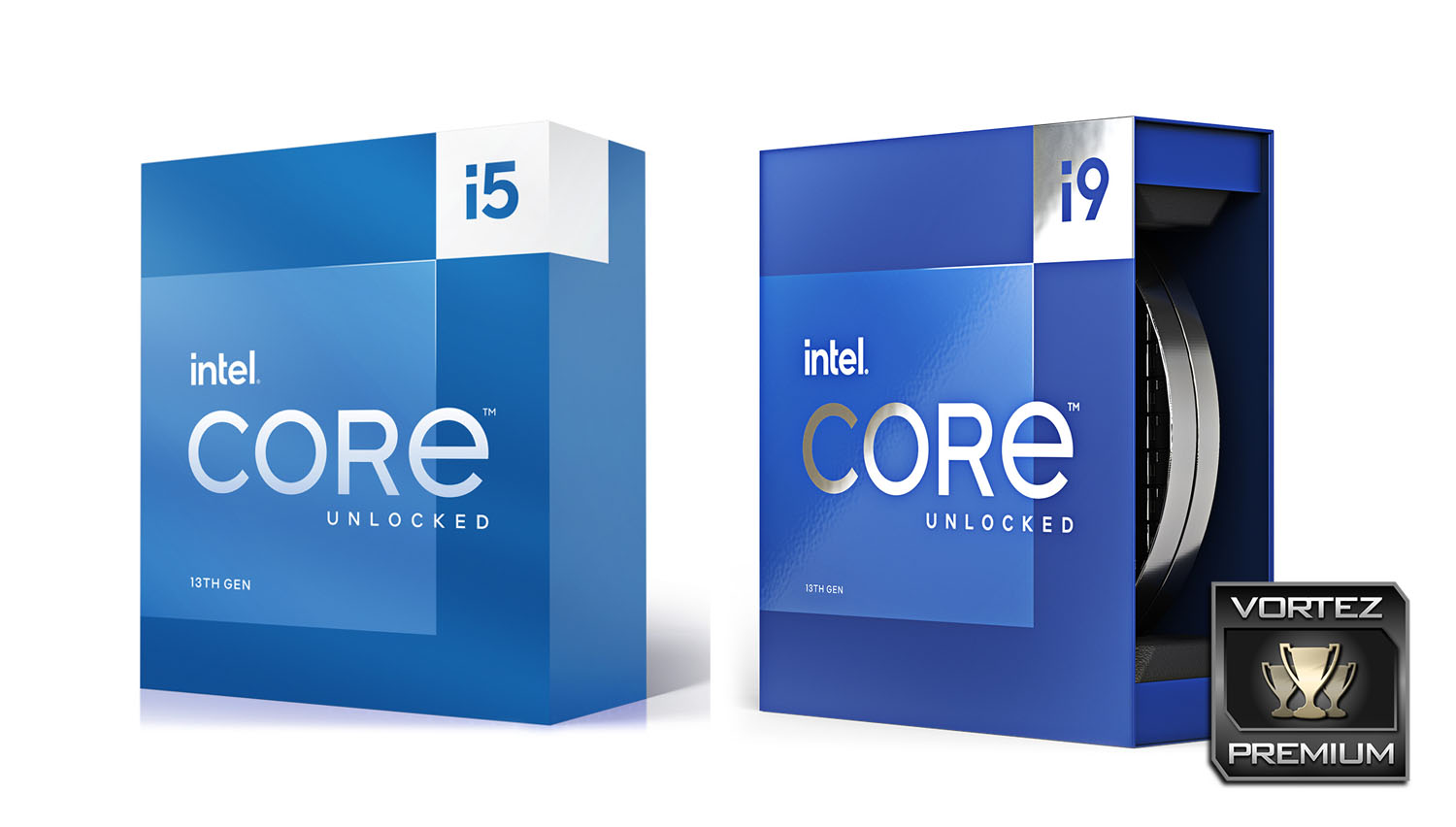
Click here for an explanation of our awards at Vortez.net.
Stay connected with the Vortez Social Media pages:
Join in with the discussions on Discord