The fully unleashed Zen 5 CPUs have arrived, but can the new Ryzen 16-core flagship and its 12-core sibling usurp the crown held by their 7000-series antecedents?

Product On Review: Ryzen 9 9950X & Ryzen 9 9900X
Manufacturer: AMD
MSRP (Ryzen 9 9950X):
– US: $649 excl. Sales Tax
– AUS: TBC
– UK: ~$610 inc. V.A.T.
MSRP (Ryzen 9 9900X):
– US: $499 excl. Sales Tax
– AUS: TBC
– UK: ~£470 inc. V.A.T.
We’re scarcely a week on from the delayed launch of AMD’s debut Ryzen 9000-series processors and the next two models are ready to be tested ahead of general availability. Arriving this week are the Ryzen 9 9900X and flagship Ryzen 9 9950X, the larger 12 and 16-core counterparts of the first two Zen 5-based designs.
Both of the previous CPUs drew muted praise for their power efficiency but criticism for performance that wasn’t the leap over the 7000-series many were hoping for. In part this would have been down to the decisions to constrain the 9600X and 9700X with tighter power limits than the chips they supplant, but that reasoning didn’t overcome disapproval of pricing that was at odds with this performance level. The 9600X could potentially make a case for itself, particularly to OEMs and SIs; the 9700X will be a much harder sell.
Without wishing to pre-empt our conclusions, clearly this will be a challenging launch for the larger 9000-series chips. The new chips will however potentially benefit from less restrictive power limitations, matching their 7000-series counterpart’s TDP.
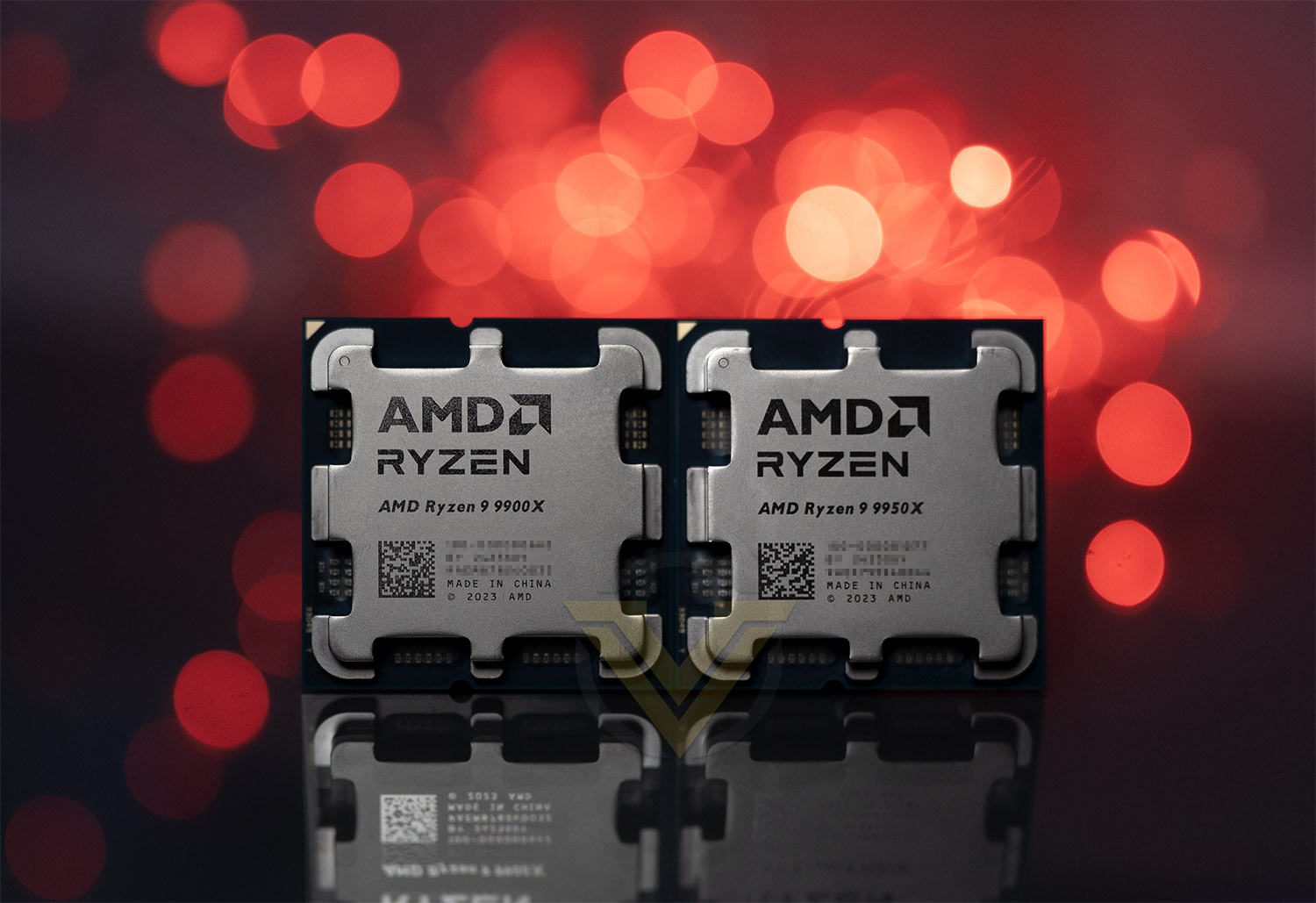
The Ryzen 9 9900X is the 12-core/24-thread member of AMD’s 9000-series, clocking at up-to 5.6GHz from a base clock of 4.4GHz. It’s equipped with 64MB L3 Cache and has a TDP of 120W. An MSRP of $499 is $50 less than the 7900X’s original guidance but almost $150 more than the older chip’s current Newegg listing.
The Ryzen 9 9950X meanwhile is Zen 5’s full-fat consumer chip, boasting 16-cores and supporting 32-threads with operating frequencies up-to 5.7GHz from a 4.3GHz base clock. It too has 64MB of L3 cache to rely on, but a higher TDP of 170W. It has an MSRP of $649, also $50 less than the 7950X’s original guidance yet almost $150 more than its current Newegg listing. Critically for gaming, both 9000-series chips are also significantly more expensive than their 7000X3D-series counterparts.
These two new CPUs are therefore oriented squarely towards productivity workloads that can leverage plentiful compute cores and Zen 5’s higher projected IPC alongside to pull ahead of their generational competition. It’s notable that the 9900X boosts a littler lower than the 7900X, and both the 9000-series chips have a lower base clock than the 7000-series equivalents. Dynamic clock frequency adjustments likely mean that there’s little stock to be placed in these exact figures figures.
All Ryzen 9000-series CPUs support the AM5 socket platform, i.e. AMD 600-series and upcoming 800-series motherboards. They’re compatible with DDR5 memory and PCIe 5.0 signalling for both GPU and (optionally) high-speed NVMe storage. Each is also equipped with an iGPU for basic video-out and other limited (see: non-gaming) capabilities including AV1 audio/video decode.
Prior Ryzen generations aside, the Ryzen 9 9900X and 9950X’s primary competition will be Intel’s Core i9 and high-end i7 parts from the 13th and 14th Generation. Raptor Lake architecture has strong single and multi-threaded performance at the expense of extreme power draw and generated heat. They are excellent options so long as you have the power delivery and cooling support to match.
Or, at least, they were. Significant stability and longevity flaws have recently been uncovered by investigators looking for the root cause of an increasing number of partial and total CPU failures. Intel have just pushed a microcode fix (ref: 0x129) for their i9 and i7 CPUs to combat the problems but it remains to be seen whether they will totally or only partially ameliorate the chip degradation experienced by client and enterprise users alike.
Technical Specifications and Features
Model: Ryzen 9 9950X
Core Topology: 2 CCD, 1 IOD
Cores/Threads: 16/32
Max Boost: 5.7GHz
Base Clock: 4.3GHz
L2 Cache: 16MB (16 x 1MB)
L3 Cache: 64MB
Max Memory Speed (non-OC): DDR5-5600 (2 x 16GB)
TDP: 170W
Model: Ryzen 9 9900X
Core Topology: 2 CCD, 1 IOD
Cores/Threads: 12/24, 6 active cores per CCD
Max Boost: 5.6GHz
Base Clock: 4.4GHz
L2 Cache: 12MB (12 x 1MB)
L3 Cache: 64MB
Max Memory Speed (non-OC): DDR5-5600 (2 x 16GB)
TDP: 120W
CCD Size: 2 x 70.6mm^2
CCD Transistor Count: 8.6bn (17.2bn Total)
IOD Size: 122mm^2
IOD Transistor Count: 3.4bn
Note: To support 9000-series processors a motherboard needs to be updated to AEGSA 1.1.7.0 or newer
Core Topology: 2 CCD, 1 IOD
Cores/Threads: 16/32
Max Boost: 5.7GHz
Base Clock: 4.3GHz
L2 Cache: 16MB (16 x 1MB)
L3 Cache: 64MB
Max Memory Speed (non-OC): DDR5-5600 (2 x 16GB)
TDP: 170W
Model: Ryzen 9 9900X
Core Topology: 2 CCD, 1 IOD
Cores/Threads: 12/24, 6 active cores per CCD
Max Boost: 5.6GHz
Base Clock: 4.4GHz
L2 Cache: 12MB (12 x 1MB)
L3 Cache: 64MB
Max Memory Speed (non-OC): DDR5-5600 (2 x 16GB)
TDP: 120W
CCD Size: 2 x 70.6mm^2
CCD Transistor Count: 8.6bn (17.2bn Total)
IOD Size: 122mm^2
IOD Transistor Count: 3.4bn
Note: To support 9000-series processors a motherboard needs to be updated to AEGSA 1.1.7.0 or newer
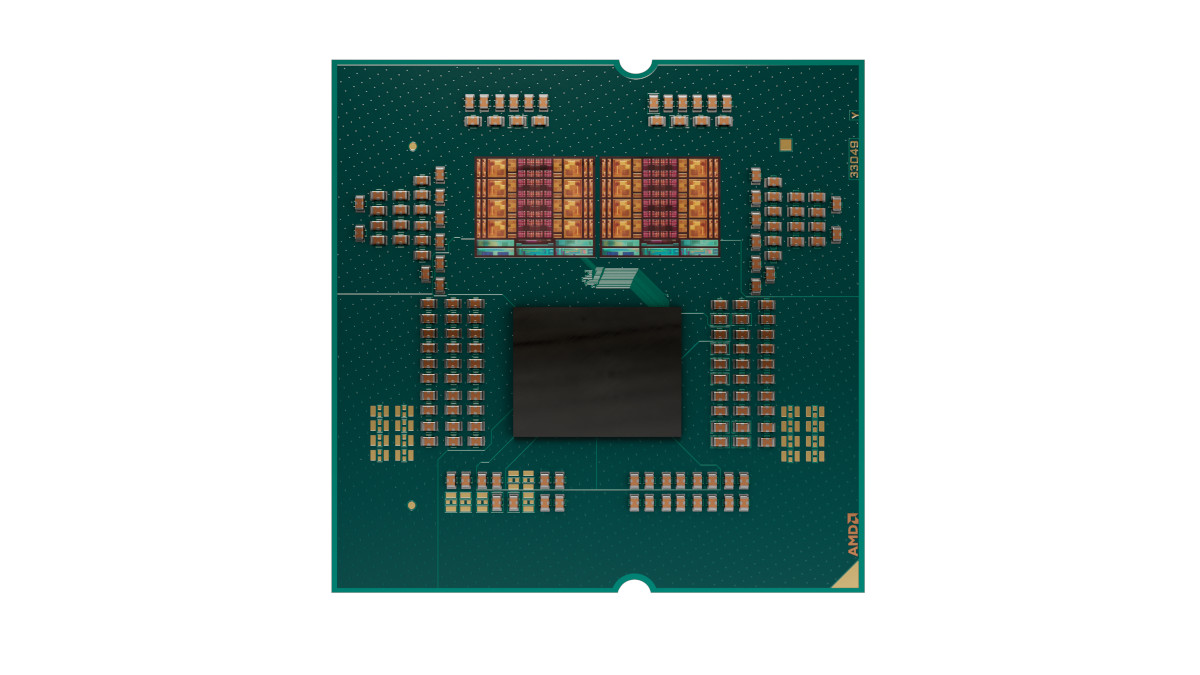
Delidded Ryzen 9000-series CPU exposing two CCDs and one cIOD
AMD’s “Granite Ridge” Ryzen 9000-series CPUs are manufactured by TSMC utilising their latest 4nm 4NX process for CCDs and well-established 6nm process for the larger IOD. Setting aside architectural improvements, a die shrink should allow the silicon to operate with lower voltages and at higher frequencies, meaningfully improving power efficiency at key performance bands. AMD has chosen to reuse the cIOD from the 7000-series as the underlying platform technologies supported are largely unchanged.
The Zen 5 architecture incorporates key improvements over Zen 4 while adhering to the same CCD + IOD chiplet layout that has proved so successful since its debut in 2019’s 3000-series. Each 9000-series CPU can feature up-to 2 CCDs for compute and a single large IOD which houses functionality that benefits less from the cutting-edge process node. These include PCIe 5.0 signalling, the DDR5 memory controller and other aspects of the SoC.
Ryzen 9000-series CPUs conform to the AM5 socket standard and are thus backwards compatible with AMD 600-series motherboards. AM5-compatible CPU coolers remain compatible with the new processors as there are no mechanical differences to be accounted for. TDP for the 16 and 12-core classes of processor hasn’t changed – 170W for the top-end 16-core model, 120W for the 12-core model – but any revisions to dynamic frequency boosting algorithms will affect thermal profiles. None of the 9000X-series processors are bundled with a cooler, irrespective of whether it’s a PIB or OEM shipped unit.
Internal AMD testing indicates that Zen 5 can boast up-to double-digit percentage IPC improvement over Zen 4 averaged across selected workloads, continuing Ryzen’s impressive track record of generational performance uplift. To achieve these IPC improvements Zen 5 incorporated a swathe of tweaks, changes and additions over Zen 4. Chiefly, AMD focussed on increasing data bandwidth and L1 per-core Cache structures, but a complete list of changes touches on most aspects of the CPUs function.
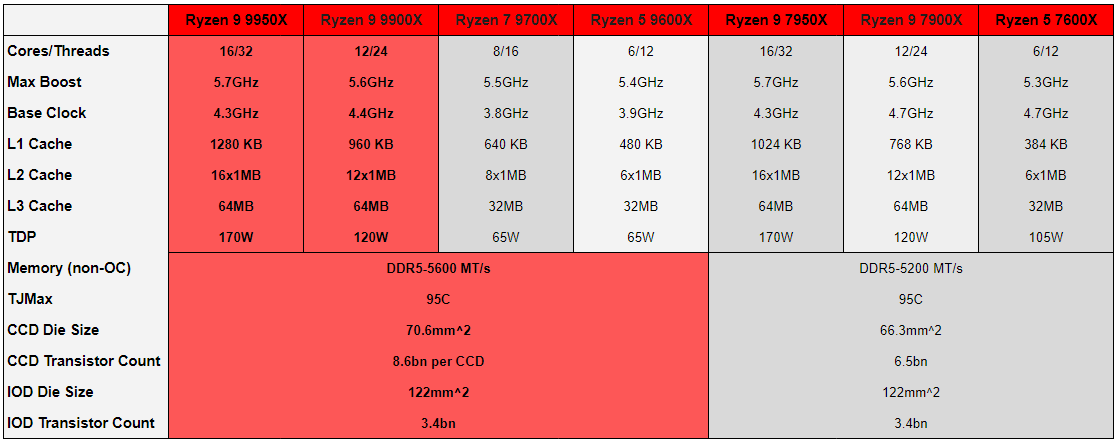
At-a-glance Ryzen Zen 4/5 CPU comparison
Particular emphasis was placed on the AVX-512 datapath for this update, which was doubled to 512-bit, and more support for the bfloat16 floating point data structure, both of which enable greater acceleration of workloads closely aligned with machine learning. More conventional workloads will benefit from a revised Branch Prediction that performs two predictions per cycle, leveraging the larger L1 data cache and improved L2 bandwidth.
The launch 9000-series CPUs are all equipped with a nominal integrated 2 Compute Unit GPU built on the RDNA 2 architecture. Although they offer hardware audio and video encode/decode (including AV1 hardware decode), the desktop processors are designed to be paired with a discrete GPU when gaming. Integrated graphics are however excellent troubleshooting features and in some cases can be leveraged to accelerate relevant workloads that might ordinally be offloaded to the dGPU.
The Granite Ridge SoC also has the following features:
128b DDR5 5600 MT/s memory controller
28 PCIe Gen5 lanes (4 reserved to the high-speed link to the chipset)
5 USB Ports
– 3 USB 3.2 Gen2x2 Type-C
– 1 USB 3.2 Gen2 Type-A
– 1 USB 2
4 Simultaneous display streams when using the integrated GPU
28 PCIe Gen5 lanes (4 reserved to the high-speed link to the chipset)
5 USB Ports
– 3 USB 3.2 Gen2x2 Type-C
– 1 USB 3.2 Gen2 Type-A
– 1 USB 2
4 Simultaneous display streams when using the integrated GPU
Additional I/O functionality in the form of ancillary PCIe lanes, peripheral expansion and storage (SATA and M.2) is offered by the motherboard chipset with configuration determined by the vendor.
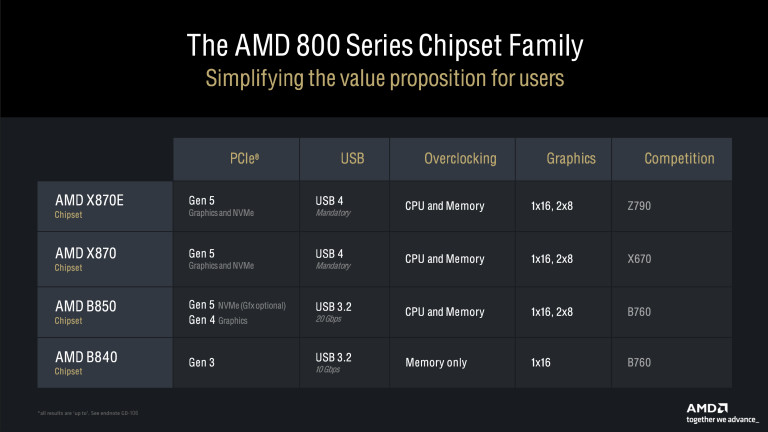
800-series chipset overview. Motherboards will be available later this summer or early autumn
Overclocking
Overclocking as a test is beyond the scope of this review but we would be remiss to not mention that the old Curve Optimiser tool which allowed Ryzen 7000-series users to undervolt the CPU in a manner that was PMFW/PBO aware has been depreciated. Instead, the 9000-series utilises a ‘Curve Shaper’ tool to assign voltage margins in up-to 15 different frequency-temperature bands, allowing for finer control for voltage adjustment in bands that are stable and unstable. Curve Shaper tables apply across all cores, and can also be shifted as a group by Curve Optimiser.
These revised overclocking tools will only be available alongside 800-series motherboards.
Test Setup & Testing
For the purpose of testing the Ryzen 5 9600X we used GIGABYTE’s X670E AORUS MASTER as it placed highly in our motherboard assessments and should help unlock the true potential of this chip. The motherboard UEFI BIOS was updated to provide support for the new processor generation.
Note that Intel i9 and i7 results are not reflective of the 0x129 microcode update.
CPU being tested
AMD Ryzen 5 9600XTEST SETUP
Cooling CORSAIR H150i ELITE LCDMotherboard X670E AORUS MASTER
Memory 64GB CORSAIR Dominator Platinum RGB 5200MHz DDR5
Graphics ZOTAC RTX 3070 Ti HOLO Extreme
Storage CORSAIR Force LX 512GB SSD
PSU Corsair RM 1000 80 Plus Gold Certified PSU
Monitor AOC U2879VF
BENCHMARKS
Cinebench R23 – Single/Multi-core CPU Renderingx264 HD 4.0 – 1st and 2nd pass encoding
SiSoftware SANDRA – CPU & Memory benchmarks
POV-RAY – CPU Ray Tracing
TrueCrypt – CPU Encryption Read/Write
AIDA64 – CPU benchmarks & Memory
PCMARK 10 – CPU Productivity
Davinci Resolve – Puget Benchmark
Blender – Classroom Benchmark
Games – Assassin’s Creed Odyssey & Total War: WARHAMMER II
OTHER SOFTWARE
Temperature Analysis: CoreTempStress Testing Software: AIDA64 Stability Test
CPU Specification Monitoring: CPU-Z
Temperatures
Below are the temperatures for each of the CPUs – without any overclock applied. We’ve also compared to previously released AMD and Intel counterparts (which we’ve also benchmarked against on the subsequent pages too):
The Ryzen 9 9950X is a hot CPU even at stock, in part due to the thickness IHS which was also an issue for the 7000-series but also potentially due to the density transistors on the core. True enthusiasts comfortable with delidding the chip and lapping the heatspreader will be eager to start modding but hitting TJmax on stock frequencies under fairly conventional loads will be a concern for all.
The Ryzen 9 9900X is a little more restrained, not hitting TJmax but nonetheless being quite toasty.
Both CPUs will benefit significantly from very robust cooling solutions as temperature is a factor in underlying algorithms determining dynamically achievable frequencies.
Power Consumption
It’s interesting to note the power consumption across all processors. Although they are using a combination of different motherboard chipsets, energy results can fluctuate between manufacturers due to the features and specifications that are integrated. First of all, for the idle tests the system is cold booted into Windows and no additional applications are executed – the watts are noted on the external energy monitor we use and then the system is loaded with 3DMark FireStrike – watts are again monitored for the duration of the test and the highest rated wattage result is then noted down. Below are the results of this energy test.
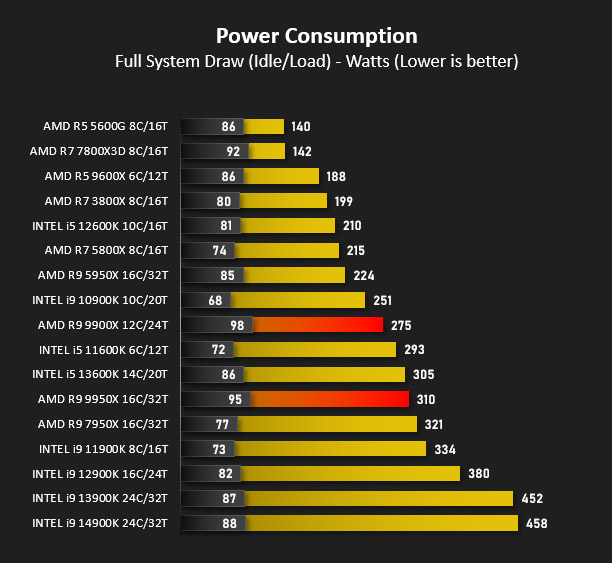
The Ryzen 9 9950X consistently draws less power than the 7950X but not so much less that it’s a significant draw to the platform. In fact the figures are close enough that the two processors could easily flip positions under different workloads.
Ray Tracing Performance – POV-Ray 3.7
Persistence of Vision Raytracer’s PovRay is a free and open source 3D animator application with versions for computers with different operating systems.
This product allows users to build their custom 3D worlds with excellent quality despite their computer’s hardware. It has adjustable options for levels of radiance, refraction, and reflection. Calculation time may vary depending on the computer model, but PovRay can adapt to many computer builds, and is supported by the open source community.
This product allows users to build their custom 3D worlds with excellent quality despite their computer’s hardware. It has adjustable options for levels of radiance, refraction, and reflection. Calculation time may vary depending on the computer model, but PovRay can adapt to many computer builds, and is supported by the open source community.
AES Encryption Performance – TrueCrypt 7.1a
TrueCrypt is a discontinued source-available freeware utility used for on-the-fly encryption (OTFE). It can create a virtual encrypted disk within a file or encrypt a partition or (under Microsoft Windows except Windows 8 with GPT) the entire storage device (pre-boot authentication).
Encoding Performance – X264 HD
Simply put, this test measures how fast your machine can encode a short, DVD quality MPEG-2 video clip into a high-quality x264 video clip. What’s x264, you ask? It’s more or less the next-generation Xvid/DivX codec. I think it’s ideal for a benchmark because the application (x264.exe) reports fairly accurate compression results (in frames per second) for each pass of the video encoding process, and it uses multi-core processors very efficiently.
x264 HD gives results for 2 passes when compressing an MPEG-2 clip into x264. It presents 4 separate results for each pass giving a total of 8 – all results are given in FPS. For each pass I have averaged out the results.
Processing Features Performance – AIDA64
AIDA64 Product Page
This simple integer benchmark focuses on the branch prediction capabilities and the misprediction penalties of the CPU. It finds the solutions for the classic “Queens problem” on a 10 by 10 sized chessboard. At the same clock speed theoretically the processor with the shorter pipeline and smaller misprediction penalties will attain higher benchmark scores. For example — with HyperThreading disabled — the Intel Northwood core processors get higher scores than the Intel Prescott core based ones due to the 20-step vs 31-step long pipeline.
Memory Transfer Performance – AIDA64
AIDA64 Product PageThis simple integer benchmark focuses on the branch prediction capabilities and the misprediction penalties of the CPU. It finds the solutions for the classic “Queens problem” on a 10 by 10 sized chessboard. At the same clock speed theoretically the processor with the shorter pipeline and smaller misprediction penalties will attain higher benchmark scores. For example — with HyperThreading disabled — the Intel Northwood core processors get higher scores than the Intel Prescott core based ones due to the 20-step vs 31-step long pipeline. CPU Queen test uses integer MMX, SSE2 and SSSE3 optimizations.
Processing Power Performance – Cinebench R23
CINEBENCH can measure systems with up to 64 processor threads. This test scene contains approximately 2,000 objects which in turn contain more than 300,000 polygons in total, and uses sharp and blurred reflections, area lights, shadows, procedural shaders, antialiasing, and much more. The result is displayed in points (pts). The higher the number, the faster your processor.
CINEBENCH R23 is more aware of architectural innovations over previous iterations, including Intel’s P-core and E-core designs, as well as AMD’s more homogeneous CCD style.
Bandwidth Performance – SiSoftware SANDRA
SiSoftware Product Page
SANDRA isn’t always a benchmark that is included in hardware reviews but I believe it shouldn’t be ignored. SANDRA provides a vigorous package that tests your system in a rather large array of benchmarks. There are many aspects of benchmark that can be executed. We will be considering – CPU and memory tests.
SiSoft’s SANDRA synthetic processor tests are the clearest indicators of where the Ryzen 9000-series can pull ahead of its competitors, but even here there is the odd anomaly.
Overall System Performance – PCMark 10
PCMark 10 Product Page
Developed in partnership with Benchmark Development Program members Acer, AMD, Condusiv Technologies, Dell, HGST, HP, Intel, Microsoft, NVIDIA, Samsung, SanDisk, Seagate and Western Digital, PCMark 10 is the latest version in FutureMark’s popular series of PC benchmarking tools. Improving on previous releases, PCMark 10 includes new tests using popular applications from Adobe and Microsoft.
4K Editing Performance – DaVinci Resolve PugetBench
DaVinci Resolve is not only an industry-standard coloring tool, but also includes features for video editing, VFX, and more. While we also have benchmarks for Premiere Pro, After Effects, and other creative applications, every application will utilize the hardware in a computer in very different and unique ways which can make it extremely difficult to determine exactly what hardware will give the end user the best possible performance.
Rendering Performance – Blender
Blender is a free and open-source 3D computer graphics software toolset used for creating animated films, visual effects, art, 3D printed models, motion graphics, interactive 3D applications, virtual reality, and computer games. Blender’s features include 3D modeling, UV unwrapping, texturing, raster graphics editing, rigging and skinning, fluid and smoke simulation, particle simulation, soft body simulation, sculpting, animating, match moving, rendering, motion graphics, video editing, and compositing.
Please note: Blender has recently been updated and the metric for results has changed with the new update, rendering our historical benchmarks void – hence why we have less results for this benchmark, taking on the new samples per minute metric.
Gaming Performance – AC: Odyssey & Total War: WARHAMMER II
It’s important for us to perform a number of game benchmarks as well as the synthetic tests because gamers will want to know if there are any significant benefits. So here we have two recent gaming titles benchmarked with the RTX 3070 Ti. Both gaming titles are CPU-intensive – AC Odyssey is the last AC title in the series to be CPU-bound. Valhalla uses DX12 API.
Conclusion
Putting clear water between the 9000-series and its predecessor was always going to be a tough job for AMD. From our testing they really haven’t been able to do so at this time.
In advance of this release AMD were claiming up-to double-digit percentage improvements over the 7000-series in IPC. While this would not necessarily be directly reflected in benchmarks, you would expect the Ryzen 9 9950X to somewhat convincingly pull ahead of the 7950X across a broad range of tasks. Instead results are nip and tuck, with the latter sometimes ahead of the former in key metrics.
A clue as to why might be in the thermal tests, where the 9950X hits a high of 97C that would likely cause frequency throttling. Higher operating frequencies, poor cooler performance due to the thick AM5 IHS, or losing out of the ‘silicon lottery’ meaning we have a poor sample, could each be a contributing factor to this shortfall in expected performance. Either way, it’s disappointing that the 9950X apparently couldn’t bring the full power of its 16 cores to bear.
It should be noted however that testing was performed on AMD’s 600-series motherboard platform. It’s possible that a combination of BIOS teething issues and un-optimised voltage/boost tables could be aspects that might be fixed once the 800-series is launched later this year. We wouldn’t base any recommendations on this assumption however.
Where the Ryzen 9000-series might be able to pull convincingly ahead is in AVX-512 workloads. AMD have invested significantly in making Zen 5 a welcoming place for tasks that can utilise this technology, notably many in the AI domain but also simulation and 3D modelling, and that’s sure to see some traction in the enterprise sector with EPYC in particular. The new chips would be well placed to take advantage in a world where consumer-level applications take advantage of this instruction set more widely.
That’s particularly true when there is such a large price disparity between the 9950X and 7950X (as well as the 9900X and 7900X). While the MSRP of the previous generation was higher at launch, you’re buying today and not September 2022.
If (despite reservations) we were to opt for the Ryzen 9 9950X, we would place it under an even more advanced cooling solution than a mainstream 360mm radiator AIO. Thicker radiator, better thermal conduction between IHS and coldplate, and other factors would help to mitigate against the high temperatures we’re seeing.
Against Intel’s best the 9950X and 9900X perform well in the most heavily threaded workloads while also bringing some of their single-core improvements to bear elsewhere, but for the time being the comparison is moot. Microcode 0x129 fixes for Raptor Lake have just been pushed and their impact on longevity remains unknown. Recommending those processors at this time would also be unwise, but for quite different reasons from the 99x0X range.
Unfortunately the Ryzen 9 9950X and to a lesser extent 9900X have fallen at the first hurdle: bringing significant performance improvements over the prior generation. It is all too often nip/tuck with the 7950X, and extreme load temperatures speak to a chip hampered somewhere in its design. Workloads which consistently leverage AVX-512 instructions may tip the balance towards the Zen 5 chips but outside of that scenario the much cheaper 7950X is hard to beat. Intel’s Core i9 CPUs also remain in contention presupposing that recent fixes prove to be a long-term solution to that platform’s woes.
Pros
+ Excellent multi-core workload results
+ Good power efficiency
+ Great single-threaded performance
+ Long-term support for the AM5 platform
Cons
– Significantly more expensive than the equivalent Ryzen 7000X-series CPUs
– Fails to achieve a clear lead over previous generation CPUs
– Ryzen 7000X3D processors are still a compelling alternative for mixed productivity and gaming
+ Excellent multi-core workload results
+ Good power efficiency
+ Great single-threaded performance
+ Long-term support for the AM5 platform
Cons
– Significantly more expensive than the equivalent Ryzen 7000X-series CPUs
– Fails to achieve a clear lead over previous generation CPUs
– Ryzen 7000X3D processors are still a compelling alternative for mixed productivity and gaming
Click here for an explanation of our awards at Vortez.net.
Stay connected with the Vortez Social Media pages:
Join in with the discussions on Discord