

Can the flagship launch X870E model from GIGABYTE stand up to the competition in the early adopter market?

Product on Review: X870 AORUS MASTER
Manufacturer: GIGABYTE
Street Price:
– US: $499.99 excl. Tax
– UK: £479.99 inc. V.A.T.
– AUS: AUD$999 inc. Tax
Introduction
We’re deep into the second post-launch week for AMD’s X870 and X870E-series motherboards and, while most launch models are now available worldwide, some of the primary partners designs are still filtering slowly through regionally. One such model is GIGABYTE’s X870E AORUS MASTER, which will join a diverse lineup of performance-oriented designs in most locations this autumn. Starting with a selection of high performance designs and eventually extending down to mainstream and affordable product segments, the X870/E-series will be a broad top-to-bottom replacement for the X670-series beginning from as low as $200 and reaching the heights of truly premium pricing as we head into 2025.
AMD’s B850 and B840 designs – mainstream and budget chipsets for AM5 motherboards – are scheduled for a later launch and will fully round out the 800-series. Each will down-step the platform’s capabilities, typically through a reduction in available I/O and PCIe Lanes.
The 800-series continues AMD’s commitment to the AM5 platform, offering compatibility not only with ‘Zen 5’ Ryzen 9000-series processors but also 8000-series APUs and ‘Zen 4’ 7000-series chips. AM5 is expected to be a fixture in the market until at least 2027, indicating that these new designs will be compatible with processors launched at least three years from now. That’s in stark contrast to Intel, who will be sunsetting LGA1700 later this month after just two discrete processor architectural generations.
X870E is AMD’s high-end desktop 800-series chipset and it takes cues from its predecessor in featureset and targeted market segments. It utilises a dual-PCH solution for its chipset to layer on additional I/O capabilities compared to the single-controller X870 and B850, and thus is tailored for those who demand more peripheral support and accessible PCI-Express lanes for expansion cards. X870E is the only AMD chipset that can offer the full gamut of I/O support the 800-series has to offer, at least unless AMD choose to reverse course and also offer dual-PCH B850E designs.
The chipset has full PCIe 5.0 support for x16 and x8/x8 modes on the GPU alongside a single PCIe Gen5 x4 M.2 NVMe slot. Additional peripheral support is offered through the chipset’s general purpose PCIe lanes, typically through a plethora of M.2 NVMe storage and additional integrated I/O.
Clear improvements over X670 include baked-in memory support up to DDR5-8200 (OC) (GIGABYTE claim DDR5-8600(OC) support in the first BIOS revisions through additional board updates), two USB4 40 Gbps port as standard rather than optional extras, and a more comprehensive toolkit that augments software-based overclocking.
800-series motherboards are also some of the first to support WiFi 7 networking as standard. This allows combination of multiple 2.4GHz, 5GHz and 6GHz bands into continuous data streams for higher realised bandwidth and better management of IoT environments.
Today we’re reviewing the X870E AORUS MASTER, GIGABYTE’s flagship X870E motherboard and premium tier member of the wider X870E ecosystem. The model is a striking continuation of an AORUS MASTER lineup that are typically the top-end variants of a given chipset, featuring almost every platform improvement they can bring to bear within its footprint.
The design boasts a relatively modest 16+2+2 DigiPhase power delivery system – plenty for CPUs operating within reference spec – and extended heatsink/heatspreader coverage for surface-mounted components. GIGABYTE have spent a little more time refining the aesthetic aspects of the board compared to the X870 AORUS ELITE by adding more integrated lighting and hiding more of the PCB and surface-mounted components behind heatsinks.
In common with a few other manufacturers, GIGABYTE equipped the X870E AORUS MASTER features that improve ease of use during installation and post-purchase system upgrades. They’ve leapt on the ‘EZ’ moniker to denote them, and this model includes Wifi EZ-Plug for antenna installation, EZ Latch to help with GPU/M.2 removal, EZ Match magnetic attachment for headspreaders, and EZ Debug to aid troubleshooting. In this specific aspect it has the most comprehensive selection we’ve seen thus far.
Both WiFi 7 and Bluetooth 5.3 technologies are integrated into this model, but in this instance not Bluetooth 5.4. Audio is provided by Realtek ALC1220 Codec and audiophile grade capacitors with additional support for DTS:X Ultra. GIGABYTE’s proprietary RGB Fusion 2.0 LED lighting system controls the on-board LED illumination and any generated by the five supplementary RGB LED headers.
An additional feature which we believe is currently unique to GIGABYTE is an internal HDMI display-output header dubbed Sensor Panel Link. While its use is flexible, GIGABYTE envision that it would be used by an internal screen (not included) to display real-time sensor readouts.
At $499.99 the X870E AORUS MASTER is firmly in flagship territory without quite straying into the most extravagant ‘halo product’ bracket. Cheaper X870E models shouldn’t be quite so well-appointed but might lean towards niche aspects of desktop computing, particularly hardcore overclocking. To justify its price tag the X870E AORUS MASTER needs to be an exceptional all rounder, which is not exactly a trivial task.
Technical Specifications & Features
Socket:- AMD Socket AM5
CPU Support:- AMD Ryzen™ 9000/8000/7000 Series Processors
Chipset:- AMD X870E
Form Factor:- ATX
Dimensions:- 30.5cm x 24.4cm
Memory:
– Support for up-to DDR5 8600(OC) / 5200 (JEDEC) MT/s memory modules
– 4 x DDR5 DIMM sockets supporting up to 256 GB (64 GB single DIMM capacity) of system memory
– Dual channel memory architecture
– Support for EEC & non-ECC Un-buffered DIMM 1Rx8/2Rx8/1Rx16 memory modules
– Support for AMD EXtended Profiles for Overclocking (AMD EXPO™) and Extreme Memory Profile (XMP) memory modules
Onboard Graphics:
Integrated Graphics Processor with AMD Radeon Graphics support+ASMedia USB4 Controller:
– 2 x USB4 USB Type-C ports, supporting USB4 and DisplayPort video outputs and a maximum resolution of 3840×2160@240 Hz (DP 1.4 & HDR)
Integrated Graphics Processor with AMD Radeon™ Graphics support:
– 1 x HDMI port, supporting a maximum resolution of 4096×2160@60 Hz
* Support for HDMI 2.1 version, HDCP 2.3, and HDR.
** Support native HDMI 2.1 TMDS compatible ports.
– 1 x front HDMI port, supporting a maximum resolution of 1920×1080@30 Hz
Audio:
– Realtek® ALC1220 CODEC
– Support for DTS:X® Ultra; 2/4/5.1/7.1-channel (software controlled)
– Support for S/PDIF Out
Networking
– Realtek 5GbE LAN chip (5Gbps/2.5 Gbps/1 Gbps/100 Mbps)
Wireless Communication module
Qualcomm Wi-Fi 7 QCNCM865
– 802.11a, b, g, n, ac, ax, be, supporting 2.4/5/6 GHz carrier frequency bands
– BLUETOOTH 5.3
– Support for 11be 320MHz wireless standard
* Wi-Fi 7 features require Windows 11 SV3 to function properly. (There is no support driver for Windows 10.)
** Wi-Fi 7 channels on 6 GHz band availability depends on individual country’s regulations.
Expansion Slots
Off-CPU:
– 1 x PCI Express x16 slot (PCIEX16), integrated in the CPU:
– AMD Ryzen™ 9000/7000 Series Processors support PCIe 5.0 x16 mode
Chipset:
– 1 x PCI Express x16 slot, supporting PCIe 4.0 and running at x4 (PCIEX4)
– 1 x PCI Express x16 slot, supporting PCIe 3.0 and running at x4 (PCIEX2)
Storage Interface
– 1 x M.2 connector (M2A_CPU), integrated in the CPU, supporting Socket 3, M key, type 25110/22110/2580/2280 SSDs:
– 2 x M.2 connectors (M2B_CPU, M2C_CPU), integrated in the CPU, supporting Socket 3, M key, type 22110/2280 SSDs:
– 1 x M.2 connector (M2D_SB), integrated in the Chipset, supporting Socket 3, M key, type 22110/2280 PCIe 4.0 x4/x2 SSDs
– 4 x SATA 6Gb/s connectors RAID 0, RAID 1, RAID 5 (9000-series only), and RAID 10 support for NVMe SSD storage devices
USB:
– 2 x USB4 USB Type-C ports on the back panel
– 1 x USB 3.2 Gen 2 Type-A port on the back panel (off CPU)
– 4 x USB 3.2 Gen 1 ports on the back panel
– 4 x USB 2.0/1.1 ports on the back panel
– 1 x USB Type-C port with USB 3.2 Gen 2×2 support, available through the internal USB header
– 3 x USB 3.2 Gen 2 Type-A ports on the back panel (off Chipset)
– 4 x USB 3.2 Gen 1 ports available through the internal USB header
– 6 x USB 2.0/1.1 ports (2 ports on the back panel, 4 ports available through the internal USB headers)
Internal I/O Connectors:
1 x 24-pin ATX main power connector
2 x 8-pin ATX 12V power connectors
1 x CPU fan header
1 x CPU fan/water cooling pump header
4 x system fan headers
2 x system fan/water cooling pump headers
4 x addressable RGB Gen2 LED strip headers
1 x RGB LED strip header
4 x M.2 Socket 3 connectors
4 x SATA 6Gb/s connectors
1 x front panel header
1 x front panel audio header
1 x USB Type-C® header, with USB 3.2 Gen 2×2 support
2 x USB 3.2 Gen 1 headers
2 x USB 2.0/1.1 headers
1 x noise detection header
1 x Trusted Platform Module header (For the GC-TPM2.0 SPI/GC-TPM2.0 SPI 2.0/GC-TPM2.0 SPI V2 module only)
1 x HDMI port (Note)
1 x power button
1 x reset button
1 x reset jumper
1 x Clear CMOS jumper
2 x temperature sensor headers
Voltage Measurement Points
Back Panel Connectors
1 x Q-Flash Plus button
1 x Clear CMOS button
1 x HDMI port (Note)
2 x USB4® USB Type-C® ports (DisplayPorts (Note))
4 x USB 3.2 Gen 2 Type-A ports (red)
4 x USB 3.2 Gen 1 ports
2 x USB 2.0/1.1 ports
1 x RJ-45 port
2 x antenna connectors (2T2R)
2 x audio jacks
1 x optical S/PDIF Out connector
I/O Controller
– iTE® I/O Controller Chip
H/W Monitoring
– Voltage detection
– Temperature detection
– Fan speed detection
– Water cooling flow rate detection
– Fan fail warning
– Fan speed control
– Noise detection
BIOS
– 1 x 256 Mbit flash
Unique Features
– Support for Q-Flash
– Support for Q-Flash Plus
– Support Smart Backup
– Bundled Software
– Norton® Internet Security (OEM version)
– LAN bandwidth management software
CPU Support:- AMD Ryzen™ 9000/8000/7000 Series Processors
Chipset:- AMD X870E
Form Factor:- ATX
Dimensions:- 30.5cm x 24.4cm
Memory:
– Support for up-to DDR5 8600(OC) / 5200 (JEDEC) MT/s memory modules
– 4 x DDR5 DIMM sockets supporting up to 256 GB (64 GB single DIMM capacity) of system memory
– Dual channel memory architecture
– Support for EEC & non-ECC Un-buffered DIMM 1Rx8/2Rx8/1Rx16 memory modules
– Support for AMD EXtended Profiles for Overclocking (AMD EXPO™) and Extreme Memory Profile (XMP) memory modules
Onboard Graphics:
Integrated Graphics Processor with AMD Radeon Graphics support+ASMedia USB4 Controller:
– 2 x USB4 USB Type-C ports, supporting USB4 and DisplayPort video outputs and a maximum resolution of 3840×2160@240 Hz (DP 1.4 & HDR)
Integrated Graphics Processor with AMD Radeon™ Graphics support:
– 1 x HDMI port, supporting a maximum resolution of 4096×2160@60 Hz
* Support for HDMI 2.1 version, HDCP 2.3, and HDR.
** Support native HDMI 2.1 TMDS compatible ports.
– 1 x front HDMI port, supporting a maximum resolution of 1920×1080@30 Hz
Audio:
– Realtek® ALC1220 CODEC
– Support for DTS:X® Ultra; 2/4/5.1/7.1-channel (software controlled)
– Support for S/PDIF Out
Networking
– Realtek 5GbE LAN chip (5Gbps/2.5 Gbps/1 Gbps/100 Mbps)
Wireless Communication module
Qualcomm Wi-Fi 7 QCNCM865
– 802.11a, b, g, n, ac, ax, be, supporting 2.4/5/6 GHz carrier frequency bands
– BLUETOOTH 5.3
– Support for 11be 320MHz wireless standard
* Wi-Fi 7 features require Windows 11 SV3 to function properly. (There is no support driver for Windows 10.)
** Wi-Fi 7 channels on 6 GHz band availability depends on individual country’s regulations.
Expansion Slots
Off-CPU:
– 1 x PCI Express x16 slot (PCIEX16), integrated in the CPU:
– AMD Ryzen™ 9000/7000 Series Processors support PCIe 5.0 x16 mode
Chipset:
– 1 x PCI Express x16 slot, supporting PCIe 4.0 and running at x4 (PCIEX4)
– 1 x PCI Express x16 slot, supporting PCIe 3.0 and running at x4 (PCIEX2)
Storage Interface
– 1 x M.2 connector (M2A_CPU), integrated in the CPU, supporting Socket 3, M key, type 25110/22110/2580/2280 SSDs:
– 2 x M.2 connectors (M2B_CPU, M2C_CPU), integrated in the CPU, supporting Socket 3, M key, type 22110/2280 SSDs:
– 1 x M.2 connector (M2D_SB), integrated in the Chipset, supporting Socket 3, M key, type 22110/2280 PCIe 4.0 x4/x2 SSDs
– 4 x SATA 6Gb/s connectors RAID 0, RAID 1, RAID 5 (9000-series only), and RAID 10 support for NVMe SSD storage devices
USB:
– 2 x USB4 USB Type-C ports on the back panel
– 1 x USB 3.2 Gen 2 Type-A port on the back panel (off CPU)
– 4 x USB 3.2 Gen 1 ports on the back panel
– 4 x USB 2.0/1.1 ports on the back panel
– 1 x USB Type-C port with USB 3.2 Gen 2×2 support, available through the internal USB header
– 3 x USB 3.2 Gen 2 Type-A ports on the back panel (off Chipset)
– 4 x USB 3.2 Gen 1 ports available through the internal USB header
– 6 x USB 2.0/1.1 ports (2 ports on the back panel, 4 ports available through the internal USB headers)
Internal I/O Connectors:
1 x 24-pin ATX main power connector
2 x 8-pin ATX 12V power connectors
1 x CPU fan header
1 x CPU fan/water cooling pump header
4 x system fan headers
2 x system fan/water cooling pump headers
4 x addressable RGB Gen2 LED strip headers
1 x RGB LED strip header
4 x M.2 Socket 3 connectors
4 x SATA 6Gb/s connectors
1 x front panel header
1 x front panel audio header
1 x USB Type-C® header, with USB 3.2 Gen 2×2 support
2 x USB 3.2 Gen 1 headers
2 x USB 2.0/1.1 headers
1 x noise detection header
1 x Trusted Platform Module header (For the GC-TPM2.0 SPI/GC-TPM2.0 SPI 2.0/GC-TPM2.0 SPI V2 module only)
1 x HDMI port (Note)
1 x power button
1 x reset button
1 x reset jumper
1 x Clear CMOS jumper
2 x temperature sensor headers
Voltage Measurement Points
Back Panel Connectors
1 x Q-Flash Plus button
1 x Clear CMOS button
1 x HDMI port (Note)
2 x USB4® USB Type-C® ports (DisplayPorts (Note))
4 x USB 3.2 Gen 2 Type-A ports (red)
4 x USB 3.2 Gen 1 ports
2 x USB 2.0/1.1 ports
1 x RJ-45 port
2 x antenna connectors (2T2R)
2 x audio jacks
1 x optical S/PDIF Out connector
I/O Controller
– iTE® I/O Controller Chip
H/W Monitoring
– Voltage detection
– Temperature detection
– Fan speed detection
– Water cooling flow rate detection
– Fan fail warning
– Fan speed control
– Noise detection
BIOS
– 1 x 256 Mbit flash
Unique Features
– Support for Q-Flash
– Support for Q-Flash Plus
– Support Smart Backup
– Bundled Software
– Norton® Internet Security (OEM version)
– LAN bandwidth management software
The GIGABYTE X870E AORUS MASTER utilises a PCIe lane sharing system similar to other 800-series motherboards that juggles lane distribution between GPU and NVMe storage devices:
The secondary and tertiary M.2 slots (labelled M2B_CPU and M2C_CPU) share PCIe lanes with the x16 slot. Populating either or both of these two M.2 slots limits the main PCIe slot (and thus the GPU) to x8 operation.
AMD’s Ryzen 8000-series APUs offer significantly reduced PCIe support from the CPU. Ryzen 8000 Series-Phoenix 1 Processors are limited to PCIe 4.0 x8 mode; Ryzen 8000 Series-Phoenix 2 Processors support PCIe 4.0 x4 mode.
AMD’s Ryzen 8000-series APUs offer significantly reduced PCIe support from the CPU. Ryzen 8000 Series-Phoenix 1 Processors are limited to PCIe 4.0 x8 mode; Ryzen 8000 Series-Phoenix 2 Processors support PCIe 4.0 x4 mode.
Note that in contrast to the X870 AORUS ELITE, the AORUS MASTER supports PCIe 3.0 x4 in the 3rd PCIe slot, and neither it not the four PCIe 4.0 lanes of the 2nd shot are shared with M.2 storage. This makes them excellent candidates for additional storage or expansion cards with high bandwidth requirements such as video capture, networking or storage.
It’s curious that GIGABYTE aren’t supporting Bluetooth 5.4 on this motherboard despite its presence on the X870 AORUS ELITE. Clearly it speaks to their preference for the WiFi 7 (802.11be) implementation of Qualcomm’s QCNCM865 controller.
GIGABYTE 800-series motherboards support Q-FLASH BIOS updates as well as Q-FLASH PLUS, a means of updating the BIOS without CPU installed or when both main and backup BIOSes are partially corrupted. These are essential troubleshooting tools which will also prime you for future CPU updates should you fall behind BIOS revisions.
The X870E AORUS MASTER joins the X870 AORUS ELITE in offering the internal HDMI header that’s a variant of GIGABYTE’s Sensor-Panel Link seen on Intel 700-series motherboards. This display output supports 1920×1080 displays (1080p) at 30fps through HDMI rather than USB-C, and is intended for real-time sensor readouts. It requires a CPU with integrated graphics and is helped by 3rd party software that supports skins and overlays to discrete monitors.
Small 1080p30Hz panels cost around $40 and would also require supplementary power, likely via an internal USB header.
Lastly, the AORUS MASTER provides a noise sensor and header interface that allows internal system fan noise to be a criteria by which fan speed is controlled. This functionality is technically present on the X870 AORUS ELITE but the sensor was not provided.
AMD 800-series At-A-Glance
AMD’s 800-series is divided into four distinct chipsets for different market segments and use cases. It’s not as obtuse as the 600-series but there are still nuances to account for, thus ensuring that a system isn’t needlessly overspecced.
Members of the 800-series are built around the AM5 socket platform and support Ryzen 7000 and 9000 CPUs as well as 8000-series APUs. PCIe 5.0 lane allocation and supplementary I/O are the main factors delineating the four 800-series chipsets.
X870E is the full-fat configuration that utilises two Platform Controller Hubs (PCHs) in concert for the platform ‘chipset’. It offers up-to 16 PCIe 5.0 lanes for the GPU (or, optionally, a 2×8 mode), four for the primary M.2 slot, and the final four reserved for the communication link between CPU and chipset. From the chipset an additional 20 general purpose PCIe lanes are available, putting the total (off-CPU + off-chipset) to 44.
X870 ‘non-E’ meanwhile still offers the same config PCIe 5.0 options for GPU and primary M.2, but fewer PCIe lanes are offered off-chipset due to having only one PCH.
As a dual-PCH chipset, X870E has the full gamut of platform I/O capabilities including two USB4 40Gbps ports, USB 3.2 Gen2x2 ports and as many as 8 SATA ports. The single-PCH X870 has up-to exactly half available in its base configuration, which nonetheless will still be plenty for most users. Motherboard manufacturers may offer additional I/O capabilities through auxiliary on-board controllers.
So, X870 if you really want PCIe 5.0 graphics and NVMe SSD support, X870E if you also want additional I/O options at a higher price. All X870 and X870E-series motherboards should support WiFi 7 (802.11be) as standard too.
B850 motherboards will be available at a later date and take the platform capabilities down a step. PCIe 5.0 graphics are now optional but PCIe Gen5 NVMe SSD support is still assured. The exact makeup of advanced I/O is yet to be confirmed but we hope that both USB4 and WiFi 7 are regularly present on these designs.
There is no ‘E’ variant of the B850, eliminating a repeat of the somewhat muddled 600-series lineup caused by the presence of the B650E chipset. That also means there will be no ‘affordable’ 800-series variants with the full range of I/O options for those who don’t need PCIe 5.0 GPU support.
B850 series motherboards will be stiff competition for X870 once released, particularly if their de facto PCIe 5.0 support extend beyond just M.2 NVMe storage. Until then X870’s main competition are more affordable X870E boards and older 600-series designs.
B840 meanwhile is a cut-down budget board analogous to the older A-series design with support for only PCIe 3.0 graphics and NVMe SSD. It should generally be avoided except in very specific circumstances and will typically be a chipset exploited by OEMs and cheap System Integrator options.
We would be remiss to not mention that the old Curve Optimiser tool, which allowed Ryzen 7000-series processors to undervolt the CPU in a manner that was PMFW/PBO aware, has been depreciated. Instead, the 9000-series CPUs have access to a ‘Curve Shaper’ tool on 800-series motherboards to assign voltage margins in up-to 15 different frequency-temperature bands, allowing for finer control for voltage adjustment in bands that are stable and usable. Curve Shaper tables apply across all cores, and can also be shifted as a group by Curve Optimiser.
Packaging, Accessories and First Look
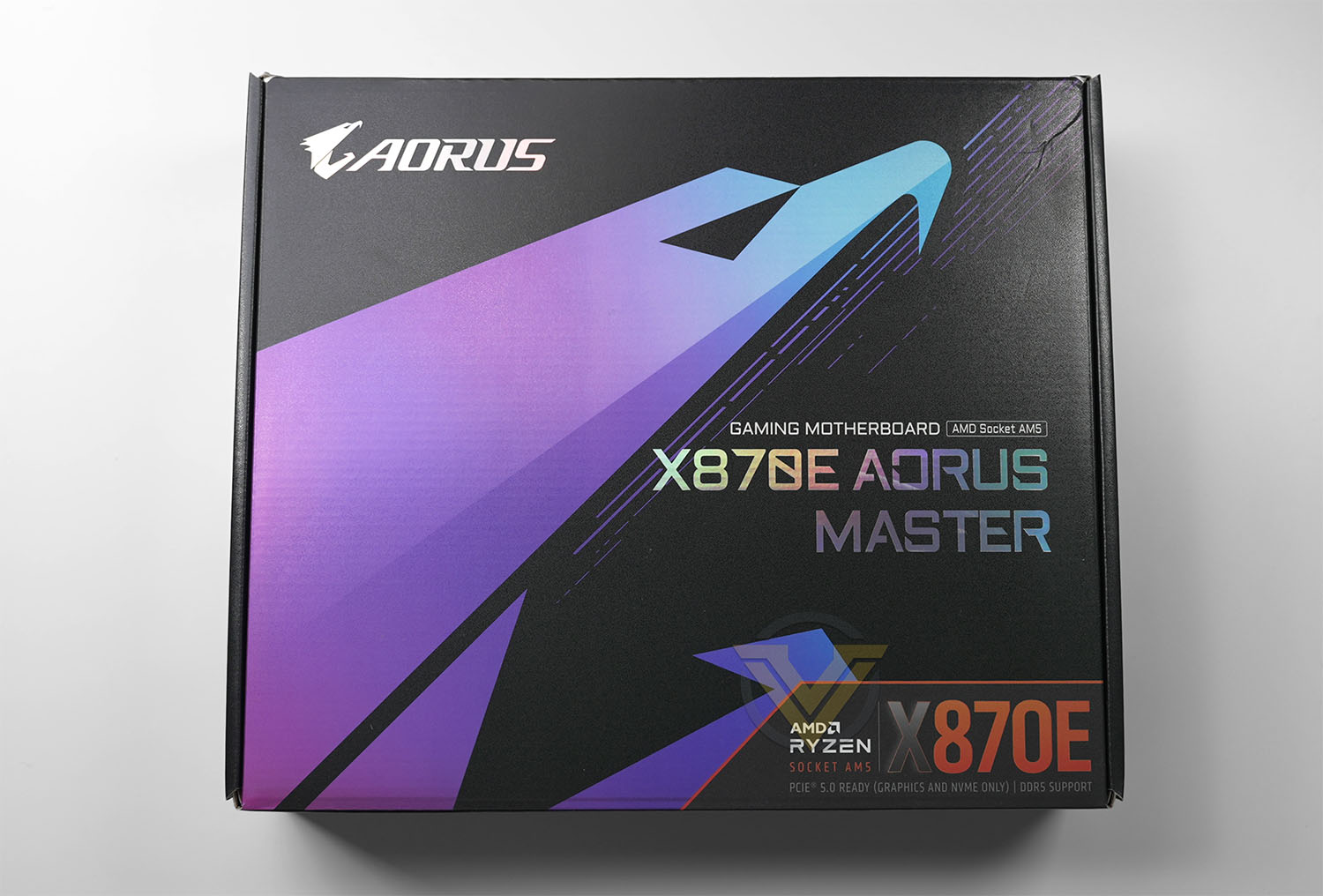
The X870E AORUS MASTER’s packaging is not safe from the scourge of purple ‘Cyberpunk’ colour schemes, in this instance highlighting the large AORUS bird-head logo. This streamlined style is echoed by the minimal information on the front being strictly what you need to know: AMD Socket AM5, DDR5 memory and PCI-Express 5.0 compatibility, as well as the Chipset designation.
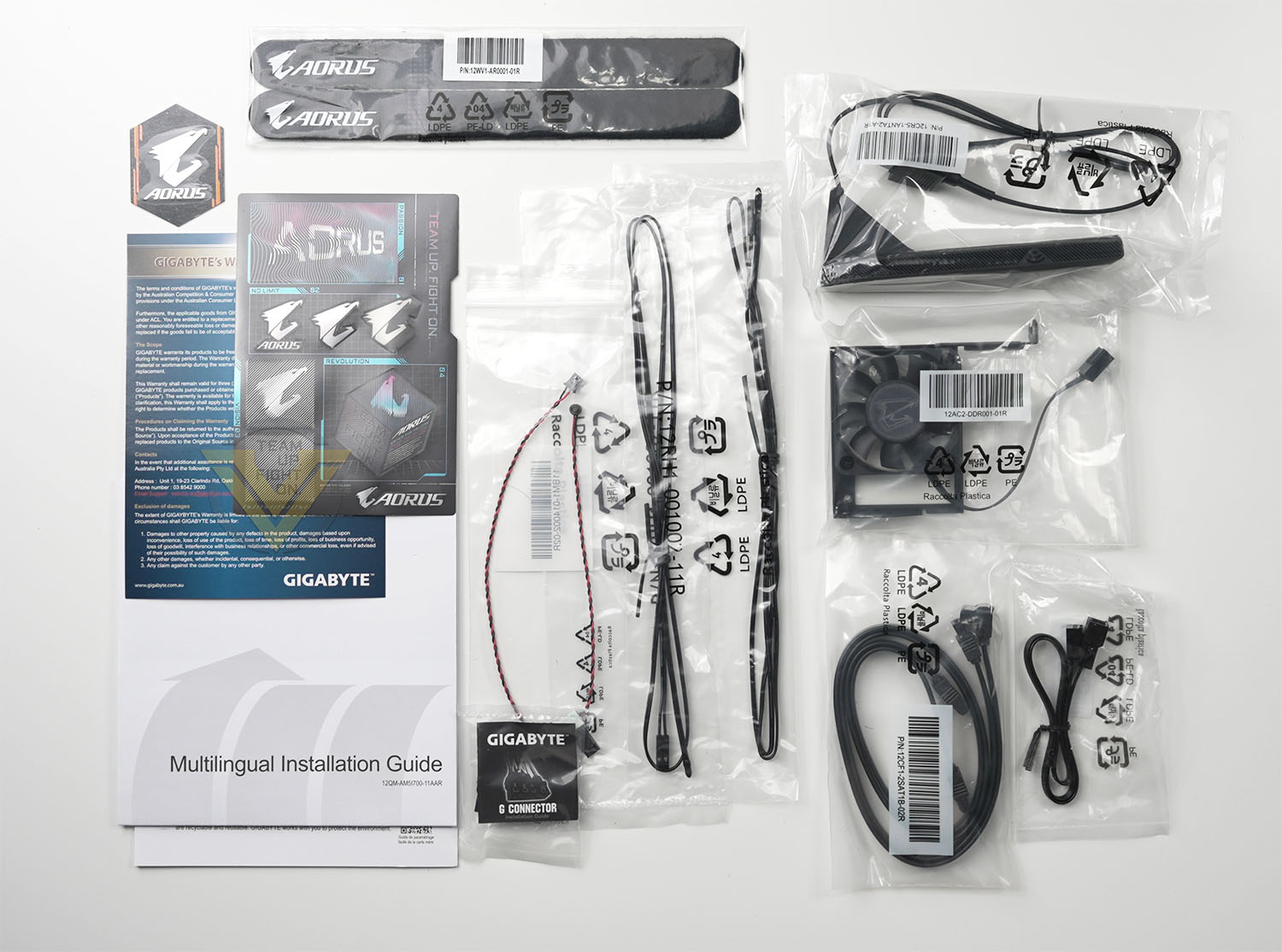
GIGABYTE’s included accessories are much more generous and varied than other X870E designs we’ve looked at (as well as the X870 AORUS ELITE), touching on most core aspects of the ‘board. Included are:
– One antenna with WiFi EZ Plug connector
– DDR Wind Blade fan
– 1x DDR Wind Blade fan extension cable
– 2x SATA cables
– 1x noise detection cable
– 2x thermistor cables
– 2x (AORUS branded) Velcro cable ties
– 1x G Connector
– User’s Manual
– Quick Installation Guide
– DDR Wind Blade fan
– 1x DDR Wind Blade fan extension cable
– 2x SATA cables
– 1x noise detection cable
– 2x thermistor cables
– 2x (AORUS branded) Velcro cable ties
– 1x G Connector
– User’s Manual
– Quick Installation Guide
They’re pushing the boat out a little more than usual here. Cable tidy accessories and thermistors are relatively common at this tier, but a dedicated fan for system memory cooling is a new one. As noted, the 802.11be antenna features their proprietary WiFi EZ Plug connector, and we finally have a noise detection sensor cable for the header that was so confusing on the X870E AORUS MASTER.
The AORUS UEFI allows users to set up and control the DDR Wind Blade fan through a selectable fan header. Fan RPM can be controlled automatically using DIMM temperature sensors on supporting memory.
As before, we very much welcome the G-Connector’s inclusion too. This handy little jumper block lets you attach the individual front panel cables (for power switch, reset switch, LED indicators etc.) to it first and then plug the whole block into the jumper array on the motherboard. At a stroke it eliminates a lot of frustration associated with putting a PC together.
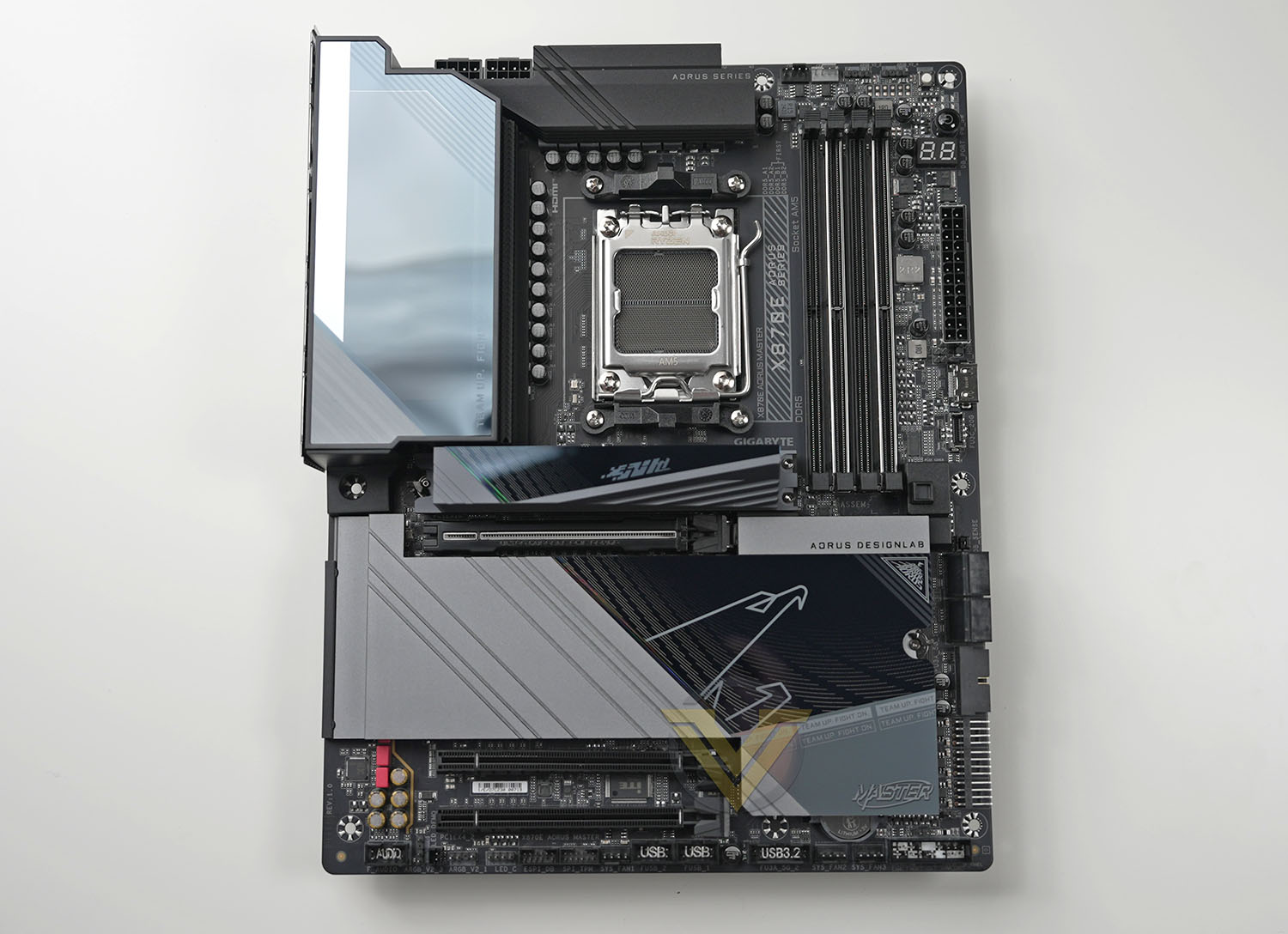
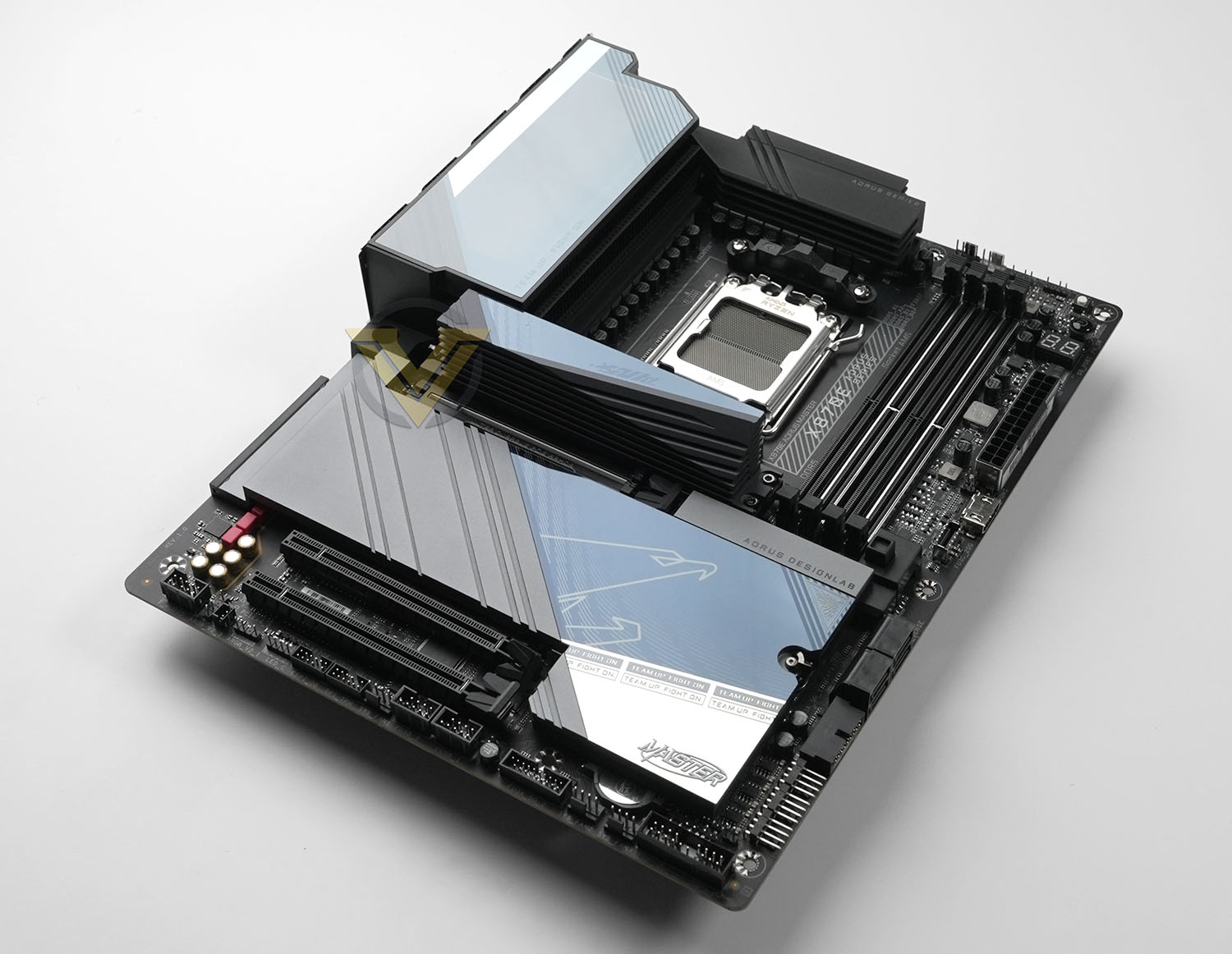
Here’s our first look at the X870E AORUS MASTER gaming motherboard. It’s immediately noticeable that the design is a lot more ‘busy’ than the ELITE thanks in part to a strong angular highlighting and small touches such as the ‘echoing’ AORUS triangle to the top-right of the chipset cooler. We’re not convinced that the ‘Team Up, Fight On’ tagline resonates particularly well but GIGABYTE sure won’t give it up without a fight.
The AORUS MASTER gets a little more integrated RGB than mainstream competition, adding some configurable illumination to the VRM heatsink as well as the bottom edge of the chipset cooler. The latter is a pleasant edge glow around the components but the former is much more of an acquired taste. Each, of course, can be disabled.
A straightforward ATX footprint should mean that the motherboard is compatible with almost every ATX PC case on the market. It does however feature more than the usual number of edge-aligned headers on the bottom-right of the board so the chosen case will need to be appropriate to take full advantage of them. There should be no compatibility issues with the plethora of modern AM5 coolers; in extreme cases older air coolers with a wide and low base or fin stack could foul on the VRM or top-most M.2 heatsink.
Closer Look
The X870E AORUS MASTER’s AM5 socket takes a standard position in the top-centre of the motherboard, surrounded on two sides by VRM heatsinks. The heatsinks channel air through them and the rear I/O shield is perforated to allow air to escape. VRM temps will benefit from air flow directed by the CPU cooler, but it’s possible that the left-most heatsink and the area behind the I/O shield will become something of a dust trap.
A 16+2+2 phase power delivery circuit (16-phase CPU, 2 SOC, 2 Misc) is fed by two 8-pin EPS 12V connectors in their standard locations. Opposite them and above the DDR5 memory slots are two 4-pin fan headers for the CPU fan and AIO pump. Next to them are two 3-pin (5v) ARGB headers and a flat reset button, while below them are twelve exposed pads that serve as voltage probe points. GIGABYTE also printed the recommended memory slot population guide on the PCB, so no need to go digging in the manual for that information.
Coming down the right edge of the motherboard alongside the DIMM slots we start a bank of four POST status indicator LEDs for troubleshooting purposes, illuminated Power button, 2-digit debug display (for which GIGABYTE include error codes in the mobo. manual), 24-pin ATX power connector, internal ‘Sensor-Panel Link’ HDMI port for small case-mounted displays, and a USB Type-C header (USB 3.2 Gen2x2 20Gbps). To the left at this point is the GIGABYTE EZ Latch for the main PCIe x16 slot, which releases the card latch for no-fuss GPU removal.
Hidden away next to the SATA ports is a 2-pin sensor header labelled ‘DB_Sense’, which the manual indicates can be used to generate and additional dependent variable for fan control. The AORUS MASTER includes a Noise Sensor which, when inserted, can measure internal chassis noise and serve as an input for fan control software.
Next to the sensor header are four SATA III 6Gbps ports, a USB 3 internal header and three 4-pin PWM fan/pump headers, edge-mounted for tidier cable management.
Just next to the SATA ports is the M.2 EZ Latch which can unhook for toolless removal of the M.2 and chipset heatspreader.
Continuing around the bottom edge, from right to left, there is the front-panel header block. The supplied G-Connector plugs directly into this, or individual front-panel cables can be hooked up on a piecemeal basis. Just above this block is an independent reset jumper; users can optionally plug their case reset switch cable into this header to be remapped to another function. Configuration for this is located in the system BIOS.
Next up are a pair of 4-pin PWM fan headers just below the CMOS battery followed by a second USB 3.2 header, two USB 2.0 headers and a single 4-pin PWM fan header.
The TPM module header sits next to an eSPI debugging header (not really for consumer use), followed by a 4-pin RGB LED (12v) header, two 3-pin (5v) ARGB headers and finally a front panel audio header. Between the two 3-pin ARGB headers is a LED Demo jumper for activating lighting when no CPU is present.
With the heatspreaders removed the M.2 slots are exposed. The top-most slot is wired for PCIe Gen5 x4 operation with four dedicated lanes off-CPU, supporting up-to 110mm-long and 25mm wide 25110 form factor M.2 NVMe SSDs. GIGABYTE are the only manufacturer we have come across thus far that supports up-to this larger M.2 drive footprint. A long thermal pad is installed between the drive and motherboard PCB to improve heat dissipation on dual-sided drives.
This slot’s M.2 heatspreader is also composed of stacked layers with an air-gap in between, allowing it to dissipate heat more readily and cool the hot high-performance PCIe Gen5 SSDs. As a side-note, GIGABYTE recommend using 1.25mm-thick thermal pads if you need to replace those already installed for the M.2 drives.
Below is the ‘PCIe UD Slot X’, a PCIe x16 slot supporting sixteen PCIe 5.0 lanes from the CPU that has been reinforced and surrounded in rubber to prevent PCB scratches. It shares eight of these PCIe lanes with the 3rd and 4th M.2 slot, dropping down to x8 operation when either or both are populated.
The main PCIe slot is connected up to the EZ PCIe Latch system and strengthened to handle heavier graphics cards. The heaviest cards should still be supported by a brace or bracket to keep it level and not mechanically overload the slot with weight.
Of the bank of M.2 3 slots only the top-most is off the chipset. Each of these three M.2 slots has a heatspreader with compressible thermal pads to draw heat away from the NAND chips. The PCIe 4.0 slot below them is wired for four lanes of operation and can be used for high performance storage, networking or video capture cards.
The bottom slot supports PCIe 3.0 x4 signalling, making it ideal for an additional network card, storage or other peripheral device.
GIGABYTE have preinstalled the I/O shield, removing yet another system assembly pinch-point. Located on the rear I/O panel are:
– Q-FLASH PLUS Button: Updates the system BIOS without CPU, GPU or DRAM installed
– Clear CMOS Button
– Two USB 2.0 Ports
– HDMI Port (HDMI 1.4 | HDCP 2.3 | 4K@60fps) for Ryzen iGPU
– Four USB 3.2 Gen 1 (5Gbps) Ports
– Two USB 3.2 Gen1 (10Gbps) Ports (red), the left supporting Q-FLASH Plus function
– Two USB4 Type-C Ports (White) (supports Displayport over USB signalling)
– RJ45 5Gbps Ethernet Port (5GbE)
– Two USB 3.2 Gen 2 (10Gbps) Ports
– Antenna Connector (WiFi EZ Plus)
– Audio Line Out/Mic In (Can be used combined with front audio ports for up-to 7.1 sound)
– SPDIF Out
– Clear CMOS Button
– Two USB 2.0 Ports
– HDMI Port (HDMI 1.4 | HDCP 2.3 | 4K@60fps) for Ryzen iGPU
– Four USB 3.2 Gen 1 (5Gbps) Ports
– Two USB 3.2 Gen1 (10Gbps) Ports (red), the left supporting Q-FLASH Plus function
– Two USB4 Type-C Ports (White) (supports Displayport over USB signalling)
– RJ45 5Gbps Ethernet Port (5GbE)
– Two USB 3.2 Gen 2 (10Gbps) Ports
– Antenna Connector (WiFi EZ Plus)
– Audio Line Out/Mic In (Can be used combined with front audio ports for up-to 7.1 sound)
– SPDIF Out
This motherboard’s WiFi EZ Plug antenna sockets are non-standard and may not be compatible with standard high gain 802.11be antenna. Such is sometimes the trade-off for the easy to install features.
GIGABYTE have opted to equip the AORUS MASTER with 5GbE, a fair step up from the 2.5GbE present on cheaper models. It’s not 10Gbps Ethernet, the current fast consumer spec, but it’s a very useful addition in a world where Gigabit Fibre is becoming more common and home networks are starting to situationally push a lot of data too.
While not being ‘tricked out’, there’s a lot packed into this model’s ATX footprint. You get a lot of fan headers – seven in total – even if some are located less than optimally, and lighting headers are relatively plentiful too. The debugging features – from DeBug Display to voltage measurement points, are pleasant additions too on the off-chance an error occurs or the board spends a significant amount of time installed on a test bench. These same tools will also help enthusiasts overclock their CPUs safely and to appropriate limits within the engineering scope of effective power delivery and cooling.
Test Setup & Methodology
Notes: We’ve revamped our benchmark regime by removing a number of tests which reveal little, to no difference between each motherboard model. Gaming performance is one such area which has been removed due to the inability for each motherboard to offer any advantage over another. Instead, we have focussed on meaningful/tangible analysis which examines the VRM/chipset design, and the storage performance which will be far more informative to the end user.
TEST SETUP
CPU AMD Ryzen 9 9900XCooling: Corsair Hydro Series H110i
Memory: 32GB Kingston FURY Renegade 7600 MHz
Storage: XPGX950 SATA SSD + Silicon Power XPower XS70
PSU: Corsair HX1050 80 Plus Gold Certified PSU
Monitor: AOC U2879VF
BENCHMARKS
PCMark 10 – Overall Extended ScoreSiSoftware SANDRA – SATA/PCIe Storage Tests
SiSoftware SANDRA – Overall System Score
OTHER SOFTWARE
Temperature Analysis: HWMonitorStress Testing Software: AIDA64 Stability Test
CPU Specification Monitoring: CPU-Z
Benchmarks: Power Consumption
In this first test we analyse the power efficiency from the wall for each motherboard (Minus the GPU). While each model uses the same chipset/platform, energy results can fluctuate between manufacturers due to the features and specifications that are integrated. First of all, for the idle tests the system is cold booted into Windows and no additional applications are executed – wattage is noted on the external energy monitor we use and then we open Aida64 stability test and execute a stress test, noting the highest reading on the monitor. Below are the results of this energy test.
Benchmarks: VRM & PCH Cooling
Each motherboard manufacturer designs their board with a unique set of heatsinks to cover key areas like the VRM/mosfets and the chipset itself. We load up Aida64 stability test again and perform a 20 minute run, recording the maximum value for both attributes.
Benchmarks: PCMark 10
PCMark 10 features a comprehensive set of tests that cover the wide variety of tasks performed in the modern workplace. With a range of performance tests, custom run options, and the new Battery Life Profile, PCMark 10 is the complete PC benchmark for the modern office.
Benchmarks: SATA Performance
In order to ascertain the SATA performance for our motherboards we use SiSoftware SANDRA and the File System Bandwidth performance test. This allows us to obtain the sequential read/write transfer rates for the drive being tested – Crucial MX300 SSD.
Benchmarks: PCIe M.2 Performance
In order to ascertain the PCIe M.2 performance for our motherboards we use SiSoftware SANDRA and the File System Bandwidth performance test. This allows us to obtain the sequential read/write transfer rates for the drive being tested – Kingston KC2500.
Benchmarks: Overall Computer Score
In our last test we observe the Overall Computer Score supplied by SANDRA. This test is exhaustive, and is specifically designed for measuring a comprehensive score for the system, measured in kPT.
Conclusion
GIGABYTE continue to pursue a consumer-focussed approach to motherboard design with the X870E AORUS MASTER, much like its junior sibling the X870 AORUS ELITE. It is perhaps most surprising that they’re quite restrained, remaining very conventional and in so doing belying the flagship status the board enjoys. There are significant benefits to this approach, but a least a few potential owners might lament the lack of some ineffable quality that would make this a deeply aspirational model more than the sum of its parts. That being said… just being pretty great at everything should be plenty.
AMD X870E motherboards are supposed to be feature-rich, that is after all the very point of the dual-PCH approach, and the AORUS MASTER exemplifies that ethos. While it may be surpassed by competition in individual aspects such as the storage provision, or number of USB ports etc., the approach it does take means it’s weak in no particular aspect.
That very much extends to usability, where GIGABYTE is arguably a cut above the competition. Innovations, no matter how insignificant, add up to quite a large difference that PC building veterans will notice instantly. Installing hardware is trivial, to the extent that even gently guided novice users will be comfortable getting to grips with it.
It’s not all plain sailing for the AORUS MASTER however. While WiFi 7 (802.11be) and USB 4 support gives the AORUS a measure of future-proofing, other manufacturers offer more connectivity for the same price or less. It will complement the extended life-span expected from AMD’s AM5 platform but competitors will provide more room to grow through more USB Type-C Gen2x2 ports, or Bluetooth 5.4 support, or other aspect that becomes inexplicably useful in the future.
We’re increasingly pleased to see manufacturers roll out proprietary ease-of-use features that help with component installation, removal and eventual upgrades. GIGABYTE have done a great job with EZ Latch for PCIe and M.2, and we’re starting to side-eye premium motherboards that don’t have such features. The jury is out on WiFi EZ Plug however as it breaks compatibility with antenna socket standards, something that could be a concern long-term if the supplied antenna is prone to failure.
The X870E AORUS MASTER performed well in tests, keeping up with the other X870E boards as expected. Chipset Temperatures were also the best of the X870E’s we’ve seen thus far, but VRM temperatures might indicate that the perforated rear I/O shield to encourage air flow across the VRM heatsink was more necessary than originally assumed.
Like the X870 AORUS ELITE, this design isn’t a model for extreme overclockers. Sixteen phases are unexceptional in a world with 22-phase power delivery, even if other features have made this design more suited to test bench installations than its lower tier running mate. Consumers and hobbyists with a penchant for modest overclocks should nonetheless be quite happy with the tools available as well as memory auto-OC features. Ample air flow around the CPU socket to cool those toasty VRM will be needed however, particularly if pushing 12- and 16-core Ryzen chips.
Easing users through any issues as they crop up are troubleshooting tools that should be go-to standard on consumer designs. DeBug codes and CPU-less BIOS Flashing are valuable to end-users with some knowledge and eagerness to fix any problems they have, and should boost the platform’s longevity well past warranty deadlines. End users are also increasingly advised to perform their own BIOS updates over the course of a system’s life span, making recovery tools essential. We wish that manufacturers hadn’t increasingly placed these potentially critical tools in the ‘premium feature’ bracket and thus pricing them out of more mainstream and budget designs.
A final feature we’d like to explicitly call out is the internal HDMI header for a mini sensor-display. We’re not quite sure exactly who is catered to by it apart from the statistically obsessed or eternally anxious, but we appreciate that it exists to help owners marshal their sensor data or simply have a dynamic and attractive display just a glance away.
While the AORUS MASTER isn’t quite as toned-down as its sibling, it is notably less busy than the other X870E motherboards we’ve seen thus far. It strikes a balance between branding and sleek lines that doesn’t take away from other components when installed in a complete system. The VRM lighting borders on unnecessary, but chipset heatsink edge illumination is surprisingly effective in just accentuating the design.
Finally, we come to the price. At an MSRP of $499 it is the highest tier design released by GIGABYTE and tied for the most expensive of the X870E boards we’ve looked at thus far. At this price we expect more, and we get more on other boards (that incidentally are less expensive in some regions). In a vacuum we wouldn’t be disappointed, indeed we’d be rather happy to discover so many useful or novel proprietary features. With the benefit of wider knowledge however it wouldn’t be our first pick.
Still, with excellent usability characteristics, innovative features not seen elsewhere and an aura of premium design, GIGABYTE’s X870E AORUS MASTER attains both the Vortez Creative and Premium Awards.
GIGABYTE’s X870 AORUS MASTER is a premium motherboard for the content creating gamer who appreciates the full featureset the X870E chipset and their engineers can provide, while also valuing the easiest system assembly experience. More demanding veteran users with a laser focus on I/O and platform longevity should carefully weigh additional options, particularly at a price tier where every purchase is a considered one.
Pros
+ Great proprietary features
+ Forward-looking chipset
+ GIGABYTE’s ‘EZ’ adaptations live up to the billing
+ up-to 3 PCIe Gen 5 M.2 slots (if you’re willing to sacrifice x16 GPU operation)
+ Q-FLASH PLUS CPU-less BIOS update functionality
+ Plenty of troubleshooting tools
= Cleaner aesthetic than competing designs
Cons
– Expensive at $499 / £479 / AUD$999
– less I/O than some competing models at the same price tier.
– Not sold on a proprietary back panel plug for WiFi antenna
+ Great proprietary features
+ Forward-looking chipset
+ GIGABYTE’s ‘EZ’ adaptations live up to the billing
+ up-to 3 PCIe Gen 5 M.2 slots (if you’re willing to sacrifice x16 GPU operation)
+ Q-FLASH PLUS CPU-less BIOS update functionality
+ Plenty of troubleshooting tools
= Cleaner aesthetic than competing designs
Cons
– Expensive at $499 / £479 / AUD$999
– less I/O than some competing models at the same price tier.
– Not sold on a proprietary back panel plug for WiFi antenna