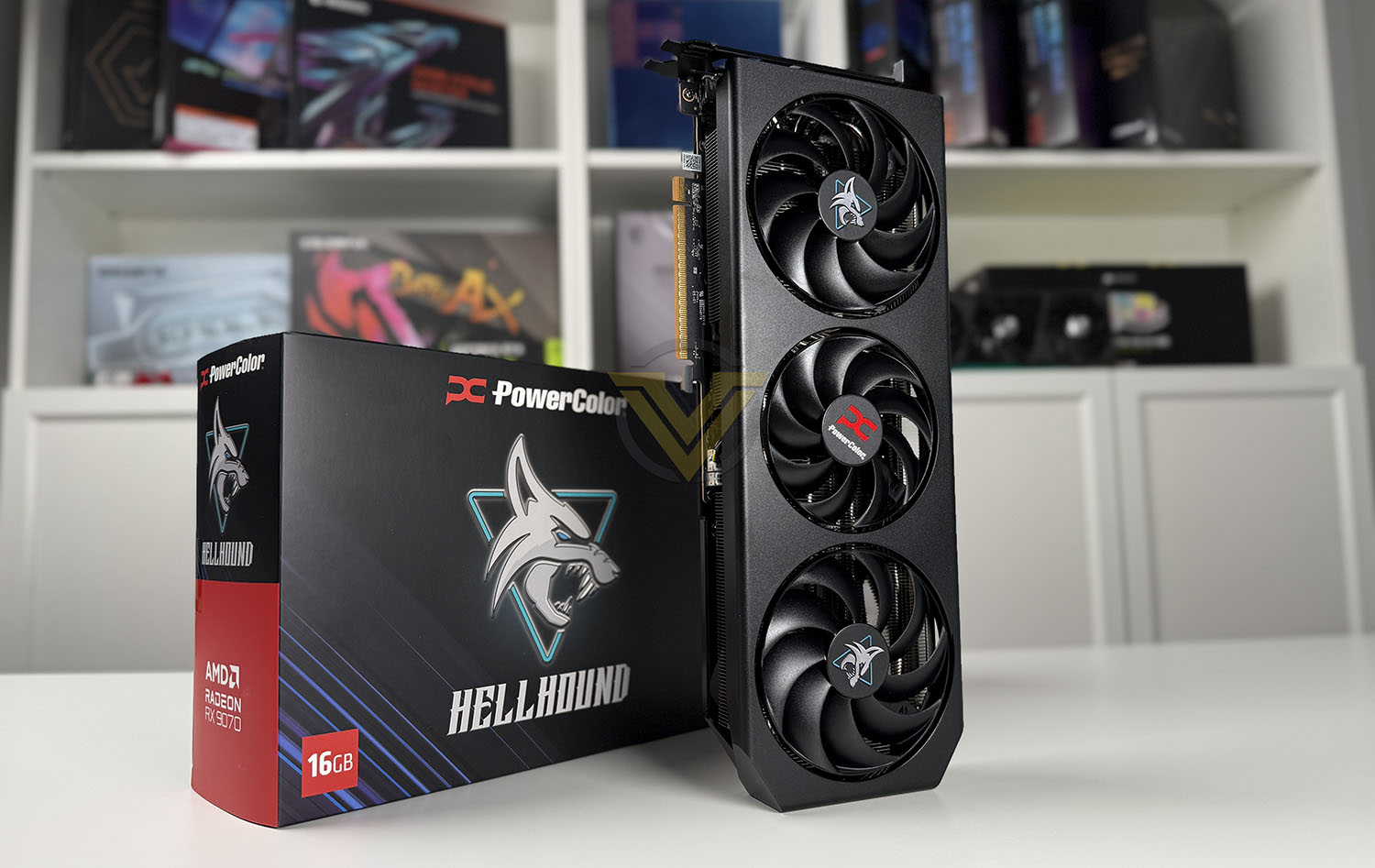
AMD’s first RDNA 4 graphics card is finally here, under the guise of PowerColor Hellhound Radeon RX 9070. How will it shape up against NVIDIA’s lineup?

Product on Review: Hellhound Radeon RX 9070
Manufacturer: Powercolor
MSRP:
– Radeon RX 9070 (USD): $549 excl Tax
– Hellhound Radeon RX 9070: TBC
The first quarter of 2025 has been the most significant in years for the GPU market, with no less than six major launches conducted or planned by the end of March that encompass a wide arc of the PC gaming space. For a while it looked like one side might have things all their own way; plucky AMD however may be set to upend the market through the release of their keenly-priced Radeon RX 9070-series GPUs.
The Radeon RX 9070-series is the first RDNA4 GPU and angles for the ‘bang for your buck’ segment that has long been dominated by ‘xx70’-series GPUs from their rivals. A realignment of their naming scheme for this generation to proximate the main competition shows their intentions, but could so very easily blow up in their face should performance fail to compare favourably.
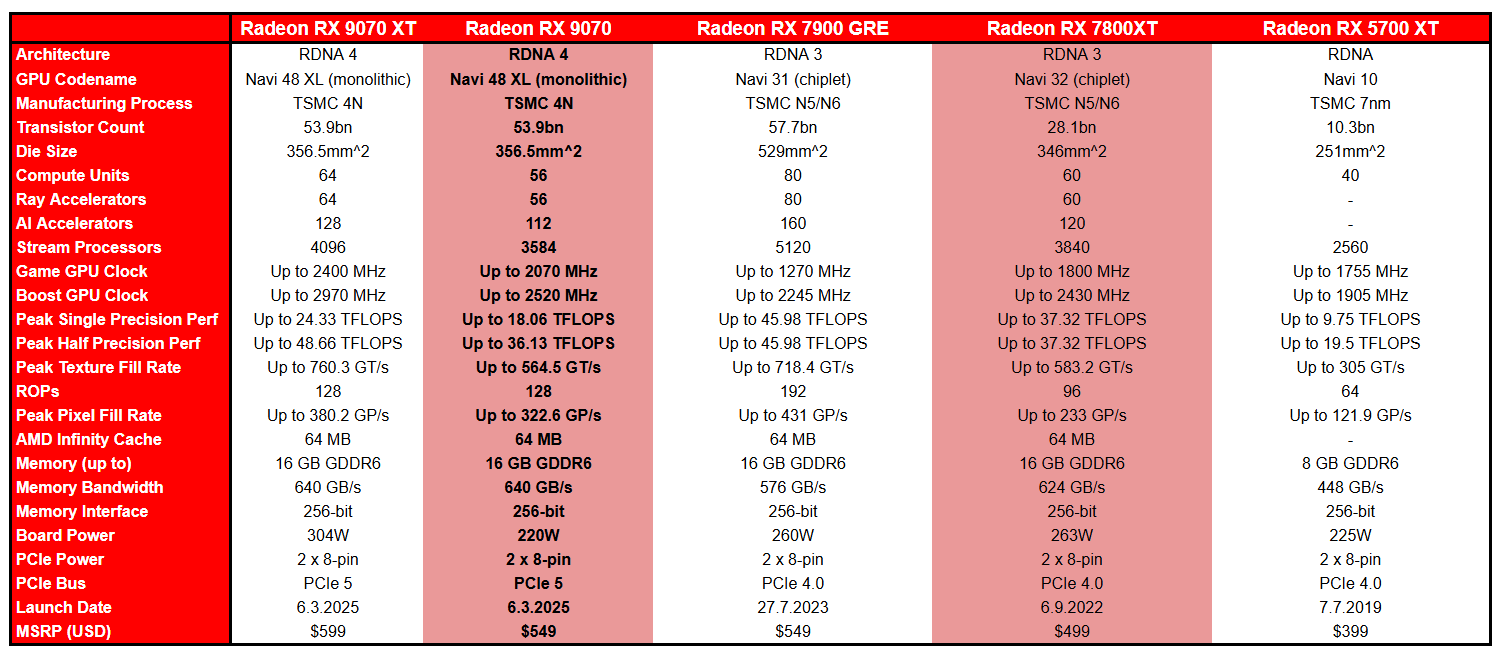
AMD’s flagship Radeon RX 9070 XT slots in below NVIDIA’s RTX 5070 Ti in price, aggressively so in fact. In undercutting by $150 at MSRP, even before factoring in low availability and inflated pricing for NVIDIA’s card, they set their stall out as the putative ‘smart buy’ of this generation. Internal testing puts the two cards on a part, but that’s still to be confirmed by independent assessment.
The competitiveness of the RX 9070 is less clear. It’s just $50 less than its bigger brother according to current pricing guidance, but on paper is a significantly lower performing part than the 8% price difference would indicate. We expect it to still compare favourably with the RX 7900 GRE, one of their ‘sweet spot’ cards from the last generation, but pressure from above and alongside it – in the form of NVIDIA RTX 5070 – could easily stymie the launch.
Each Radeon RX 9070 is equipped with 56 Compute Units compared with 64 on 9070 XT, and as a result proportionally fewer Ray Accelerators, AI Accelerators and TMUs. Nonetheless, it still boasts 16GB of GDDR6 memory and a 256-bit memory bus for the same 640 GB/s memory bandwidth, as well as the significantly improved raytracing and AI performance unlocked by RDNA4 (compared to RDNA3).
Powercolor’s Hellhound Radeon RX 9070 OC Edition arrives with a 70MHz factory overclock to 2.59 GHz, as well as augmented cooling in the form of a dual-slot triple-fan solution with long heatsink and Honeywell PTM7950 phase-change thermal pads. A secondary vBIOS also allows the card to run quieter with lower default stocks and a less aggressive fan profile.
Powercolor have also opted to utilise two tried-and-tested 8-pin PCIe power connectors rather than the 12V-2×6 / 12VHPWR connector option. This, coupled with a relatively modest 220W TBP, will make the card relatively easy to accommodate in systems powered by older PSUs not certified for ATX 3.0/3.1 operation.
Technical Specifications
Graphics Engine:- AMD Radeon RX 9070
Model Name:- RX9070 16G-L/OC
Series:- Hellhound
Stream Processor:- 3584 Units
Video Memory:- 16GB GDDR6
Memory Speed:- 20.0 Gbps
Memory Interface:- 256-bit
Engine Clock(OC):
– up to 2120MHz(Game)
– up to 2590MHz(Boost)
Engine Clock(STD/Silent)
– up to 2070MHz(Game)
– up to 2520MHz(Boost)
Bus Standard – PCIE 5.0 x16
Standard Display Connectors:- 1 x HDMI 2.1,3 x DisplayPort 2.1a (only 2x simultaneous DP2.1 connections can be supported)
DirectX® Support:- 12
OpenGL:- 4.6
Supported Features: AMD Stream Technology, AMD Eyefinity Technology, AMD Smart Access Memory
Maximum Resolution:
DisplayPort:- 7680×4320
HDMI:- 7680×4320
Board Dimensions:
– 327mm*128mm*41mm
– 340mm*142mm*42mm(with bracket)
Slot(s):- 2
Minimum System Power requirement (W):- 700W
Extension Power Connector:- Two 8-pin PCI Express Power connectors
Model Name:- RX9070 16G-L/OC
Series:- Hellhound
Stream Processor:- 3584 Units
Video Memory:- 16GB GDDR6
Memory Speed:- 20.0 Gbps
Memory Interface:- 256-bit
Engine Clock(OC):
– up to 2120MHz(Game)
– up to 2590MHz(Boost)
Engine Clock(STD/Silent)
– up to 2070MHz(Game)
– up to 2520MHz(Boost)
Bus Standard – PCIE 5.0 x16
Standard Display Connectors:- 1 x HDMI 2.1,3 x DisplayPort 2.1a (only 2x simultaneous DP2.1 connections can be supported)
DirectX® Support:- 12
OpenGL:- 4.6
Supported Features: AMD Stream Technology, AMD Eyefinity Technology, AMD Smart Access Memory
Maximum Resolution:
DisplayPort:- 7680×4320
HDMI:- 7680×4320
Board Dimensions:
– 327mm*128mm*41mm
– 340mm*142mm*42mm(with bracket)
Slot(s):- 2
Minimum System Power requirement (W):- 700W
Extension Power Connector:- Two 8-pin PCI Express Power connectors
Comparative Specifications (Reference)
Features
Features
The Radeon RX 9000-series is the first RDNA 4 GPU, a microarchitecture design that incorporates multiple improvements over the prior generation. Key among these are large augmentations to hardware acceleration of both Raytracing and Machine Learning/AI workloads, two areas where RDNA 3 was broadly trailing the competition in the consumer space. Each RDNA4 Compute Unit incorporate purpose-built hardware components for these workloads, allowing performance to scale directly with number of CUs; in that respect it is similar to conventional rasterization workloads.
A ‘full-fat’ Navi48 GPU is equipped with 64 Compute Units and is present on the RX 9070 XT. Cut-down Navi48 GPUs with 56 CUs are present on RX 9070 GPUs. While there is scope for Navi48-based SKUs with fewer CUs in the future, larger RDNA4 GPUs with more CUs would need to be based on a new core.
Lithography and Topology
The RX 9070’s Navi48 core is manufactured by TSMC on their 4N process, a more dense lithography than the combination of 5N and 6N utilised for the RX 7000-series GPUs. While not a significant revision to the process compared to prior steps down, it should allow the RX 9000-series GPUs to clock higher at lower operating voltages than previous generations and thus improve overall efficiency. Alternatively, it could allow AMD to push the core further, getting more performance than comparatively complex older GPUs at the highest stable TDP.
AMD have also returned to a monolithic core design for Navi48 rather than the separated chiplet style utilised by the desktop RX 7000-series GPUs. This avenue significantly simplifies GPU packaging despite a relatively large die size but would be hard to scale up in a cost-effective manner. It is strongly indicative of a GPU generation with a ‘one-size fits all’ approach to the performance segment.
Memory
The RX 9070 and 9070 XT both utilises 16GB of GDDR6 VRAM, the same memory standard present on the RX 5000-series from 2019. This memory is clocked at 20Gb/s and communicates over a 256-bit bus for 640GB/s of total bandwidth. It’s notable that, unlike NVIDIA’s RTX 5070, AMD have neither reduced the frame buffer size nor the bus width when stepping down the half-tier from XT/Ti to non-XT/non-Ti.
AMD opted for GDDR6 over GDDR7 primarily due to cost and the targeted performance window of the 9070-series. Indeed, given the issues AAA titles have had hitting frame buffer limits on 8GB-10GB GPUs in recent years, it could be the design choice that has the largest impact on long-term performance. Certainly, moving down to 8 or even 12GB looks unwise for even a mid-tier part today.
More deeply, RDNA4 also incorporates additional out-of-order queues for memory requests and returns. Raytracing workloads are in AMD’s judgement highly sensitive to memory latency, particularly traversal through bounding volume hierarchy (BVH) structures. Fast memory retrieval and return requested by a simple shader could be delayed by the memory requests of slower shader operations ahead in the queue, leading to unnecessary latency; the new approach allows them to be fully satisfied out-of-order, returning the faster request when ready rather than needing to wait in the queue.
Raytracing
RDNA4 marks the debut of AMD’s 3rd Generation raytracing accelerators, a technology upgrade which aims to double the throughput of this aspect of the rendering pipeline through a handful of key underlying improvements:
Enhanced Ray Accelerators with computation units featuring eight rays/box and two rays/triangle, increasing base computation capability by approx. 2-fold. This is further augmented by acceleration of the Ray Hardware Stack Management system to allow faster and more efficient allocation of resources.
Adoption of a BVH8 Structure reduces traversal steps and latency while primitive node compression reduces BVH sizes.
Meanwhile AMDs use of Orienting Bounding Boxes allows each BVH to be independently oriented rather than aligned identically, with rays transformed to match their rotation as they enter the box. This reduces the rate of false intersections and hence traversal steps, improving traversal performance by an average of 10%.
Accelerated Shading through dynamic VGPR (vector general purpose registers) management leading to better register occupancy, while the previously mentioned out-of-order memory returns will in general improve latency.
Adoption of a BVH8 Structure reduces traversal steps and latency while primitive node compression reduces BVH sizes.
Meanwhile AMDs use of Orienting Bounding Boxes allows each BVH to be independently oriented rather than aligned identically, with rays transformed to match their rotation as they enter the box. This reduces the rate of false intersections and hence traversal steps, improving traversal performance by an average of 10%.
Accelerated Shading through dynamic VGPR (vector general purpose registers) management leading to better register occupancy, while the previously mentioned out-of-order memory returns will in general improve latency.
This net result should be that RDNA4 hardware will significantly outpace RDNA3 in raytraced workloads on hardware with equivalent rasterization capabilities, potentially allowing the RX 9070 XT to rival higher GPU tiers of the previous generation. While overall raytracing throughput should be increased roughly 2x, you’re unlikely to see quite that level of uplift in the render process as a whole given that raytracing workloads are only a portion of what goes into the construction of a whole frame.
AI Acceleration
‘AI’ is something of a nebulous term at present; however, in the realm of computer graphics it now generally refers to the process of ‘training’ and ‘inferencing’, i.e. processing relevant data to train a model or neural network to perform a particular task, or processing data through the trained model/NN to do that task. It’s on this paradigm that proprietary ‘deep learning’ upscaling technologies such as NVIDIA DLSS are based, but this burgeoning field is swiftly becoming a key tool to keep pace with multifaceted demands of modern gaming workloads.
AI data structures, known as ‘tensors’, can be formed as 16-bit inputs that are commonly used in graphics rendering and GPGPU workloads; increasingly however they’ve become optimised by utilising more narrow structures such as 8-bit and even 4-bit types. Natively processing those workloads to more efficiently leverage hardware resources is key to accelerating their performance on a GPU.
In contrast to RDNA3, RDNA4 supports 8-bit floating point formats (FP8) as well as 16 and 4-bit equivalents, which in turn unlocks support for data encoded in both E4M3 and E5M2 8-bit formats. These two formats are important in modern deep learning for both training and inferencing techniques, particularly in the processing of data batches with mixed data types.
A further concept that RDNA4 leverages is that of sparsity, i.e. processing incomplete datasets through a trained model. This allows more efficient use of hardware resources and reduces latency, which is exceptionally important to time-critical outputs such as generated frames.
FidelityFX Super Resolution 4
The RX 9000-series will be the first hardware to support AMD FSR4, a new upscaling process that leverages machine learning rather than algorithmic techniques. Similar in scope to NVIDIA’s DLSS 2.0, it utilises an AMD-trained ‘Model for Super Resolution’ to upscale low-resolution frames to near-native quality, boosting frame rates and improving experiences. AMD are touting FSR4 as a pathway to 4K gaming on RDNA4, particularly if also using Frame Interpolation (i.e. Frame Generation) akin to the feature widely advertised in NVIDIA’s RTX 50-series launch.
MLSR-based frames are generated from low-resolution frame data, including colour and depth, as well as motion vector data. The latter was critical in NVIDIA’s development of DLSS into a workable technology through its 2.0 revision, and should mean that FSR4 is a complete experience out of the box.
AMD’s Model for Super Resolution makes extensive use of the FP8 capabilities of RDNA4. Due to this limitation the model is not suitable for RDNA3 hardware in its current form, hence FSR4’s RX 9000-series exclusivity.
In narrow circumstances, use of AI upscaling can improve certain aspects of image quality, even over frames rendered at full resolution. Typically this will be because of post-processing anti-aliasing and pixel-binning not quite showing particularly jagged and spiky objects properly; as such, we’d probably describe it as an infrequent up-side rather than a core aspect of the technology.
FSR 4 can be utilised in the 30+ games that support FSR 3.1 at the time of writing, with 75+ expected by the end of 2025. As an extension of the FSR 3.1 API, it can be enabled with a simple driver-level toggle; however it requires support at the game-engine level just as FSR 3.1 does.
PCI-Express 5 Support
The RX 9000-series is AMD’s first to support the PCIe 5.0 standard, doubling the per-lane data transfer rate from 16 to 32 GT/s. A 16-lane GPU will therefore have access to a total bandwidth of up-to 63.015 GB/s, should it need it.
Despite being an impressive technology, increased I/O bandwidth will struggle to be of use to current generation GPUs. Ancillary technologies such as Direct Storage, which itself could leverage the fast read speeds of PCIe Gen5 NVMe SSDs, has the potential make use of it in the future if and when videogames take advantage of it. Currently it’s not a feature that will sway purchasing decisions.
Closer Look
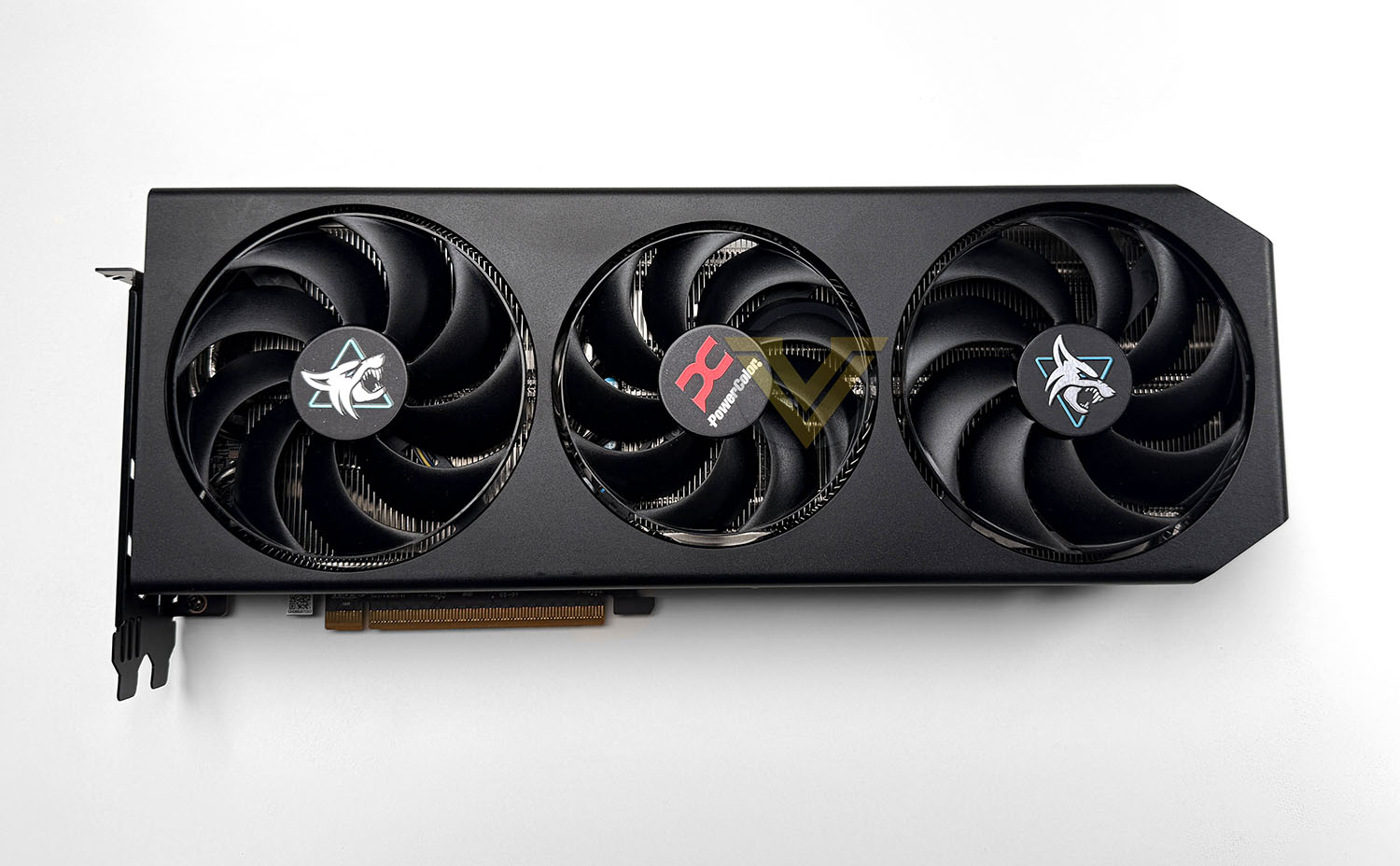
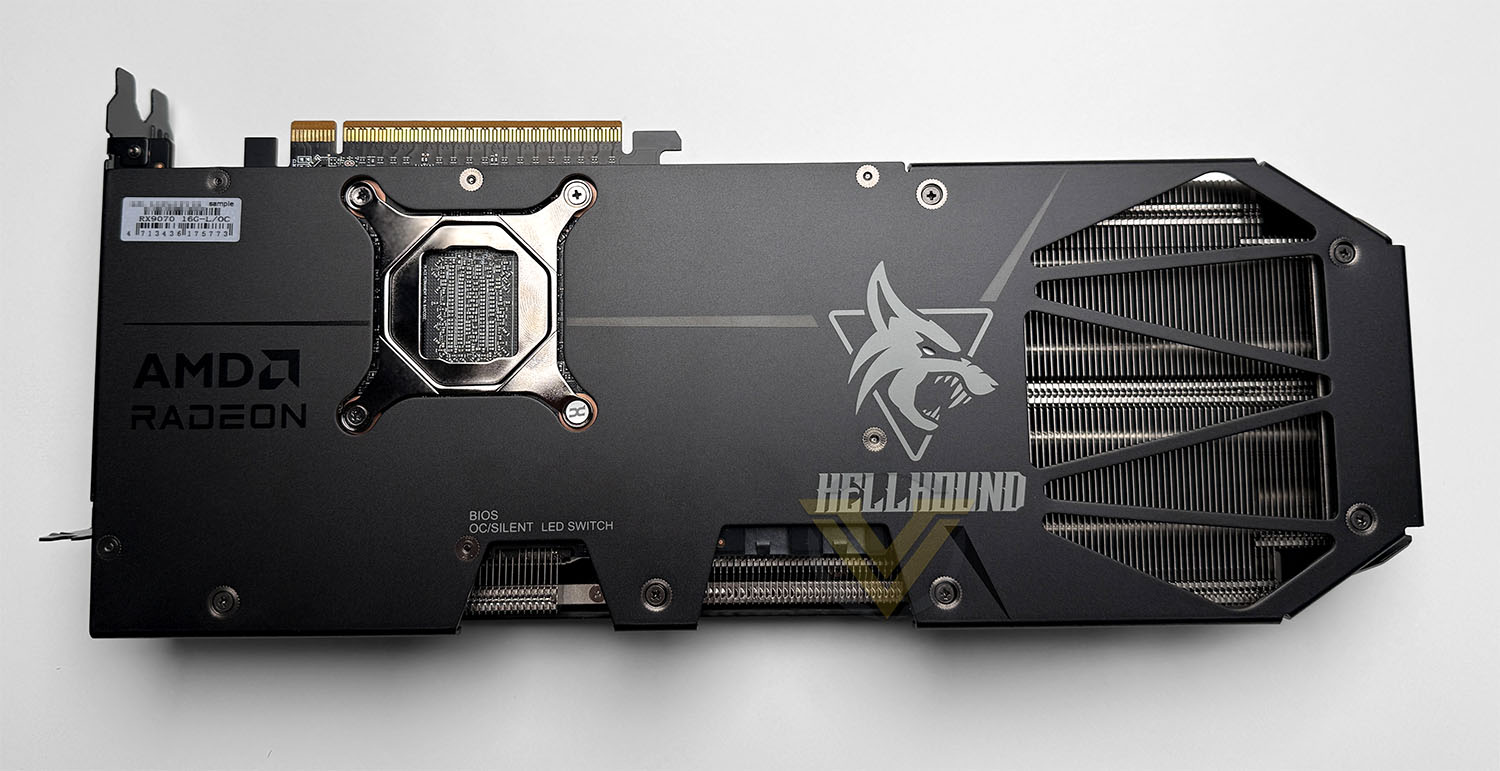
The graphics card in front of us is fairly simple in its design. It adopts a sleek aesthetic, and we appreciate the footprint. Hellhound is somewhat “thin” and retains that double slot height for its cooler/shroud. As such, this graphics card will be easily housed within most computer cases. Dimensions are: 327mm*128mm*41mm.
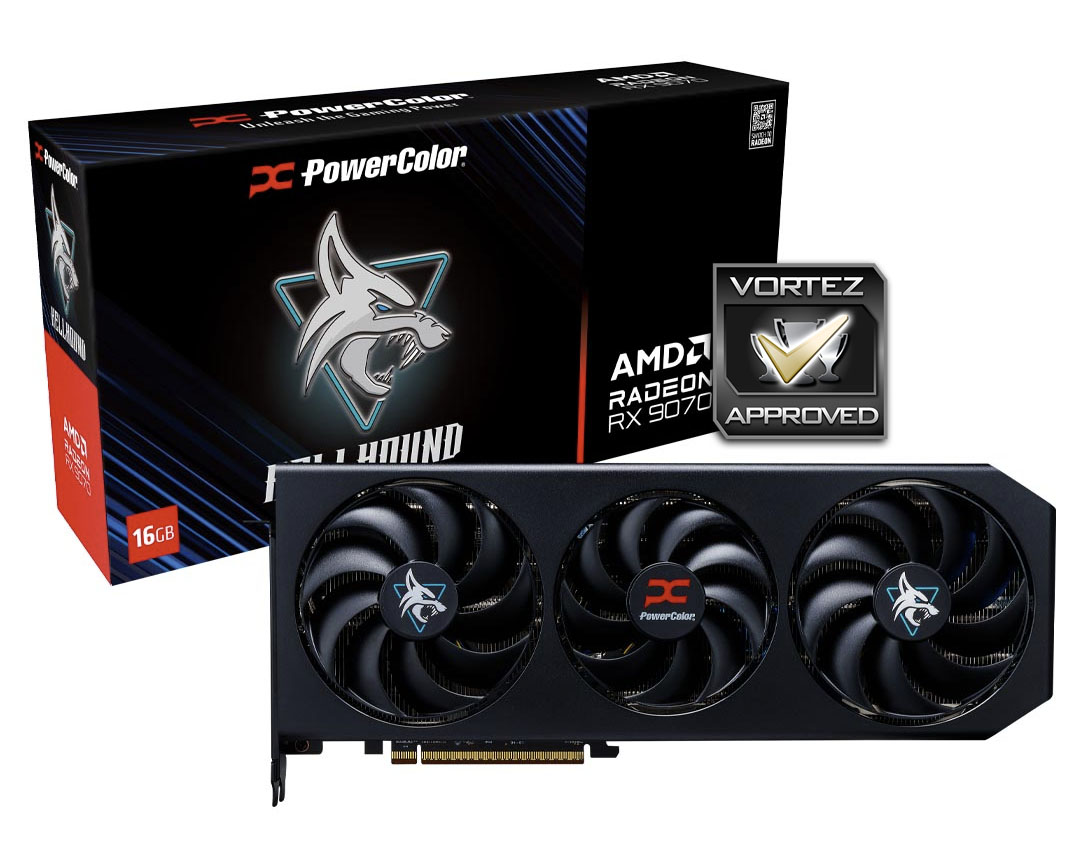
Hellhound uses a triple fan cooler which feature a 9-blade design. The middle fan spinning clockwise, while the two outer fans spinning anti-clockwise to reduce turbulence. The heatsink underneath uses a direct-contact copper plate and twin heatsinks with 4x nickel plated copper heatpipe.
The backside of Hellhound features a metal backplate which helps with rigidity and also has cut-outs for airflow.
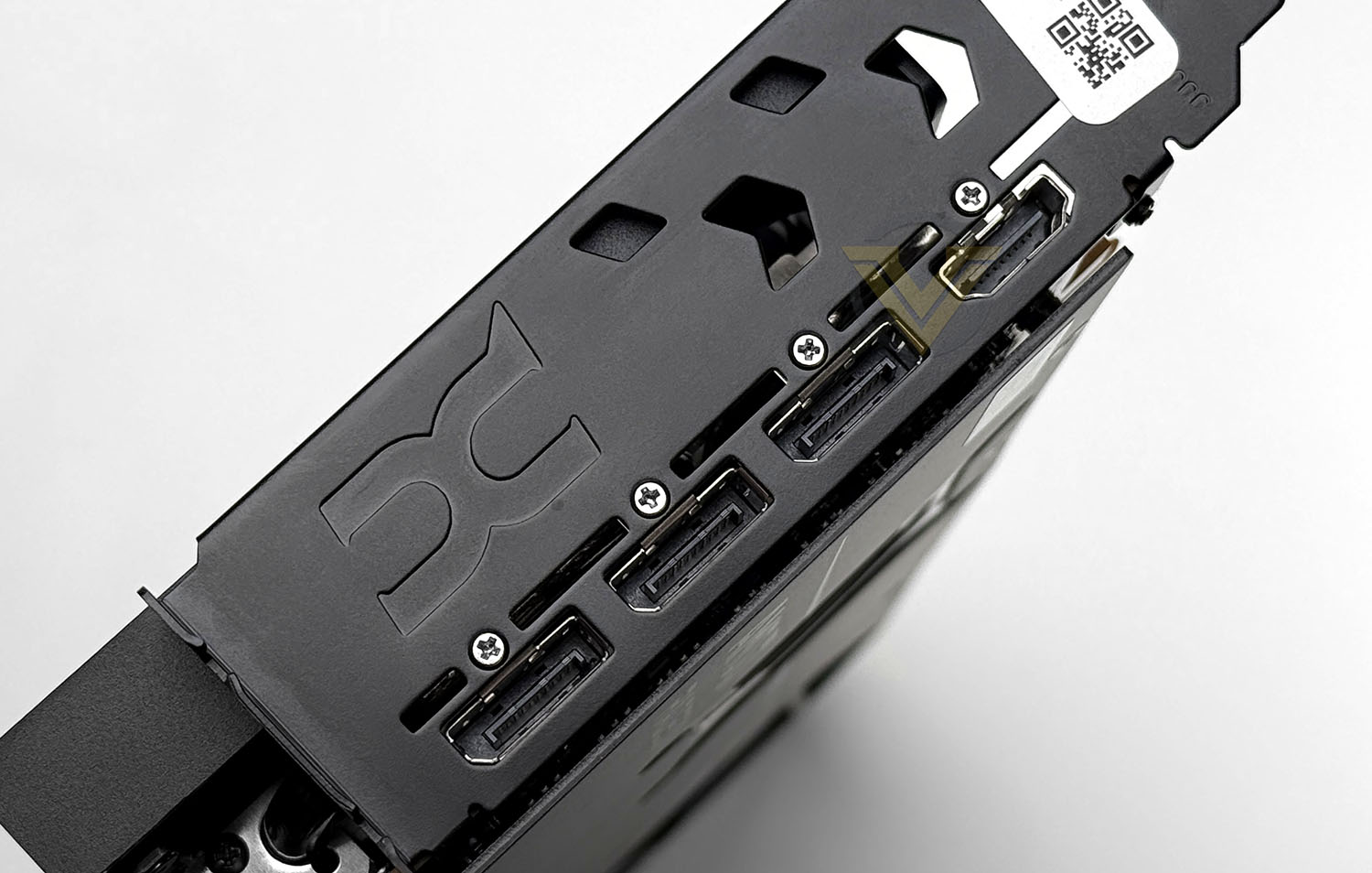
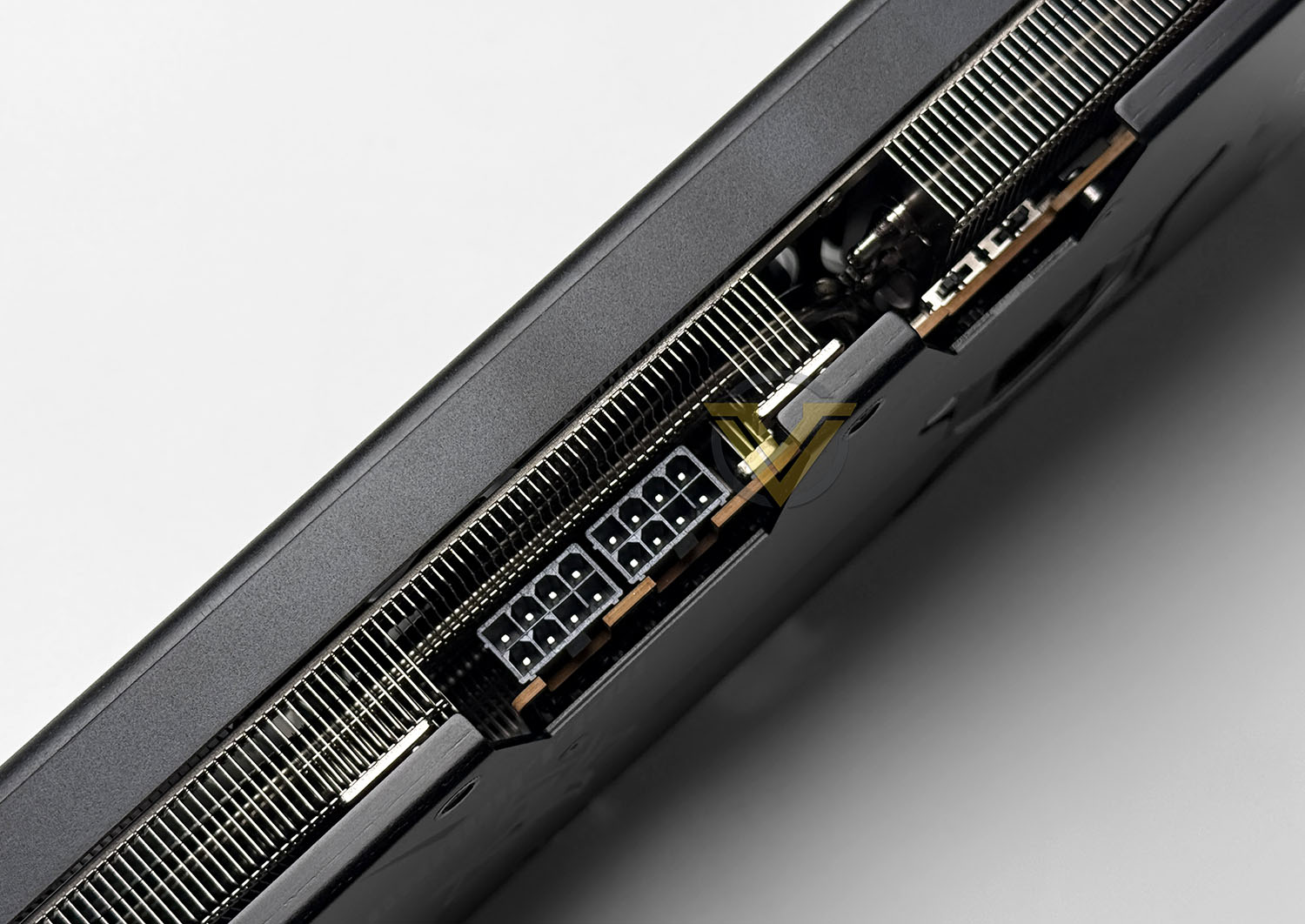
This card features dual 8-pin PCI Express and has a recommended wattage of 700W. On this edge of the card we also have two switches. One which allows control over the RGB lighting (Which is very simple in its implementation) and a silent/OC switch which allows the card to operate in quiet mode or with the factory overclock applied.
Test Setup & Methodology
HOW WE TEST GRAPHICS CARDS
Testing a graphics card is an extremely lengthy process. We sometimes see reviews where a graphics card has been tested using out of date equipment, out of date games and even out of date drivers. While the latter can be excused due to the sheer amount of driver updates making a thorough review impossible we will however notify the reader when we have used a different driver to the normal for example a pre-release driver. For the most part however we will always use the same hardware and latest drivers so this does certainly need to be taken into consideration when viewing our testing results. Each game and benchmark is tested times with the lowest and highest scores omitted out of the 5 results and the average then taken from the three remaining to give us our final result for each resolution and setting used.HARDWARE
In Q1 2025 we decided to upgrade our test system to the very latest AMD X870E platform with the renowned AMD Ryzen 7 9800X3D – currently regarded as one of the best gaming CPUs to date. AMD’s platform is one of the most popular choices for gamers and by using such a configuration, we can hopefully showcase to our readership what they can expect.This new platform provides us with the very latest technology and standards to be able to accurately report back on performance of modern graphics cards.
Graphics Cards on test:
MSI VENTUS 2X OC RTX 4060 TI
ASUS PRIME RTX 4070 SUPER
INNO3D RTX 4080 SUPER X3
PNY RTX 4090 XLR8 VERTO EPIC-X
GIGABYTE RTX 5070 TI EAGLE OC ICE
GIGABYTE RX 7700 XT GAMING OC
POWERCOLOR RED DEVIL RX 7800 XT
POWERCOLOR HELLHOUND RX 7900 GRE
XFX MERC 310 RX 7900 XTX
POWERCOLOR HELLHOUND RX 9070
Special thanks go to MSI and Corsair for providing the hardware configuration for our graphics card reviews:
Motherboard: MSI X870E CARBON WIFI
CPU: AMD Ryzen 7 9800X3D
RAM – 32GB HyperX FURY Renegade 7600MHz
Power Supply – Corsair RM1000X
Hard Drive – Samsung 990 PRO
Cooler – Corsair iCue Link Titan 360 RX LCD
CPU: AMD Ryzen 7 9800X3D
RAM – 32GB HyperX FURY Renegade 7600MHz
Power Supply – Corsair RM1000X
Hard Drive – Samsung 990 PRO
Cooler – Corsair iCue Link Titan 360 RX LCD
BENCHMARKS
If you are a regular reader of our reviews you will know we like to test the latest hardware with the latest games and benchmarks on the market. Here are the games we’ve chosen:S.T.A.L.K.E.R. 2
Indiana Jones and the Great Circle
Black Myth: Wukong
Silent Hill 2 Remake
TEKKEN 8
Horizon Forbidden West
Indiana Jones and the Great Circle
Black Myth: Wukong
Silent Hill 2 Remake
TEKKEN 8
Horizon Forbidden West
To capture framerates we use CapFrameX.
Other benchmark tools have been included to give a broad overview of performance and these include:
PugetBench for Davinci Resolve
ProCyon AI Image Generation
ProCyon Video Editing
3DMark SpeedWay
3DMark Nomad
Let’s see how today’s graphics card performed…
Power, Temperatures, Acoustics
To test for power consumption, we take a measurement from the plug socket. It is important to note that the figures below represent total system power use and not just the GPU. The CPU was always in a fixed state so did not affect the additional power load when the GPU was placed under 100% load using AIDA64 stability test (GPU Only) which was ran for 20 minutes at which point a load reading was taken. Idle readings were taken 5 minutes after system boot to ensure any background services and applications had loaded.
TEMPERATURE
To test temperatures we measured idle temperatures after booting windows, letting all applications finish loading and ran a few benchmarks. Once the benchmarks were complete we left the card to reach a cooling plateau where we then took the idle temperatures. For the load tests we use GPU-Z and have this running throughout all of our benchmarks, and then report back on the maximum temperatures at the end of this exhaustive session.ACOUSTICS
For the purpose of testing audio levels we have the NDI KC-3300 sound level meter. During the temperature recording above, while in Black Myth Wukong benchmark we monitored the audio and the results are found below. All graphics cards are tested in their out of the box state (auto).PugetBench for Davinci Resolve
PugetBench for DaVinci Resolve runs on top of your installed copy of Resolve, providing benchmark data directly from the application. Our benchmarks are designed in partnership with hardware and software industry leaders, as well as end users and influencers who use DaVinci Resolve daily, to ensure that they are representative of real-world workflows.
Procyon AI Image Generation
The Procyon AI Image Generation Benchmark provides a consistent, accurate, and understandable workload for measuring the inference performance of on-device AI accelerators. This benchmark was developed in partnership with multiple key industry members to ensure it produces fair and comparable results across all supported hardware.
Procyon Video Editing Benchmark
Procyon benchmarks use real applications to test performance whenever possible. The Procyon Video Editing Benchmark uses Adobe Premiere Pro in a typical video editing workflow.3DMark Speed Way
3DMark Speed Way is a DirectX 12 Ultimate benchmark for gaming PCs running Windows 10 and 11. Speed Way’s engine is assembled to demonstrate the new features DirectX 12 Ultimate brings to raytraced gaming. Speed Way uses DirectX Raytracing tier 1.1 for real-time global illumination and real-time raytraced reflections, coupled with new DirectX 12 Ultimate performance optimizations like Mesh Shaders.
3DMark Steel Nomad
Steel Nomad uses graphics technologies just like your favorite new game titles to give you a good idea of how your system will run the latest heavy PC games without ray tracing. Succeeding the massively popular 3DMark Time Spy benchmark, Steel Nomad runs at a 4k resolution and adds new graphics technologies like volumetric skies and procedural grass.
S.T.A.L.K.E.R 2
S.T.A.L.K.E.R. 2: Heart of Chornobyl is a 2024 first-person shooter, survival horror video game developed and published by GSC Game World. It is the fourth main game released in the S.T.A.L.K.E.R. video game series, as well as the first S.T.A.L.K.E.R. game in 15 years since the release of Call of Pripyat in 2009.
Silent Hill 2 Remake
Silent Hill 2 is a 2024 survival horror game developed by Bloober Team and published by Konami Digital Entertainment. It is a remake of the 2001 video game Silent Hill 2, originally developed by Team Silent, a group within Konami Computer Entertainment Tokyo.
Indiana Jones and the Great Circle
Indiana Jones and the Great Circle is a 2024 action-adventure game developed by MachineGames and published by Bethesda Softworks. It is based on the Indiana Jones franchise and features an original narrative that draws from the film series.
Black Myth: Wukong
Black Myth: Wukong is a 2024 action role-playing game developed and published by Game Science. The game is inspired by the classical Chinese novel Journey to the West.
TEKKEN 8
Tekken 8 is a 2024 fighting game developed by Bandai Namco Studios and Arika and published by Bandai Namco Entertainment. It is the eighth main installment in the Tekken series and the first one to debut on home systems instead of arcades.
Horizon Forbidden West
Horizon Forbidden West is a 2022 action role-playing game developed by Guerrilla Games and published by Sony Interactive Entertainment.
Conclusion
The release of a new GPU generation always tends to leave us with more questions than answers; releasing generations from both NVIDIA and AMD doubles the uncertainty, and often takes weeks or months to fully shake out. Strained stock levels and unrealistic MSRPs leading to inflated pricing, as well as externalities such as US tariffs, have all served to jumble a picture that was very stable just a few months ago. Adding AMD’s Radeon RX 9070-series to the mix hasn’t made much clearer, at least not yet.
RDNA4, particularly in this incarnation as the RX 9070, is undeniably a significant technological improvement over RDNA3. The GPU does much more with less while adding sorely needed new features, and if anything leaves us disappointed that this generations of AMD cards will apparently skip the premium end of the market. It is, to some extent, a repeat of 2019’s RX 5000-series; this time however the hardware looks set to be much more competitive.
One slightly concerning aspect is power draw. AMD GPUs have a reputation for being power hungry compared to competition in the same performance class and the RX 9070 is no different, to the extent that our experience with the card underscores the need for a relatively robust PSU. Core temperatures meanwhile aren’t so much of an issue, at least not with this specific example, but VRAM sensor temperatures are much higher than expected.
Where the RX 9070 might struggle is on price. It performs roughly on par with RTX 4070 Super, and is generally better than the RX 7900 GRE, but the former was itself only $599 at launch. Generationally, price/performance wise, the RX 9070 doesn’t really represent a huge step up in value.
Adding the RX 9070 XT to the mix doesn’t help. The flagship RDNA4 GPU is on-paper and according to AMD’s own pre-release briefing significantly superior to the non-XT variant. Why therefore is the cut-down card only $50 cheaper? Why are some OC models encroaching on the reference XT’s base price? This only makes sense if your priority is to sell 9070 XT’s.
The RX 9070 would ideally be ~$100 less than the 9070 XT, opening the gap between the two and making it a solid proposition in its own right. AMD’s strategy of using it as a price anchor for the 9070 XT means that some consumers overdue for an upgrade will miss out on an exceptional up-to-date 1080p GPU for the time being.
In terms of the Powercolor Hellhound RX 9070 OC, we could barely be more happy with this partner model. Its aesthetics are restrained, core temperatures are excellent, noise is not a problem and dual-BIOS capability with OC and Silent modes is very nice to have (and will probably be even more appreciated on the XT variant). It sets a very high benchmark for competing models from other partners to overcome. The only reservation is memory temperature, and that’s something Powercolor need to get to the bottom of.
AMD’s Radeon RX 9070 series is available worldwide on March 6th.
AMD’s Radeon RX 9070-series is a compelling new release from the red team, featuring long-awaited updates that start to rival the capabilities of their main competitor at the $500-700 MSRP segment. However, price anchoring the RX 9070 to make the XT model more appealing may prove to be a mistake, as even Powercolor’s great Hellhound RX 9070 needs some space to compete with AMD’s new flagship. Subject to confirmation on retail pricing, Powercolor’s implementation receives the Vortez Approved Award.
Pros
+ Significant technological update for AMD
+ Cool and quiet gaming GPU
+ New features strongly shake up the market in AMDs favour
Cons
– Price is too close to the RX 9070 XT
– High VRAM temps.
+ Significant technological update for AMD
+ Cool and quiet gaming GPU
+ New features strongly shake up the market in AMDs favour
Cons
– Price is too close to the RX 9070 XT
– High VRAM temps.
Click here for an explanation of our awards at Vortez.net.
Stay connected with the Vortez Social Media pages:
Join in with the discussions on Discord