




The AMD Ryzen 7 7700X3D promises exceptional gaming performance with 3D V-Cache technology. Is it the new value king for PC gaming?
Product on Review: AMD Ryzen 7 7700X3D
Manufacturer: AMD
MSRP: US: $329
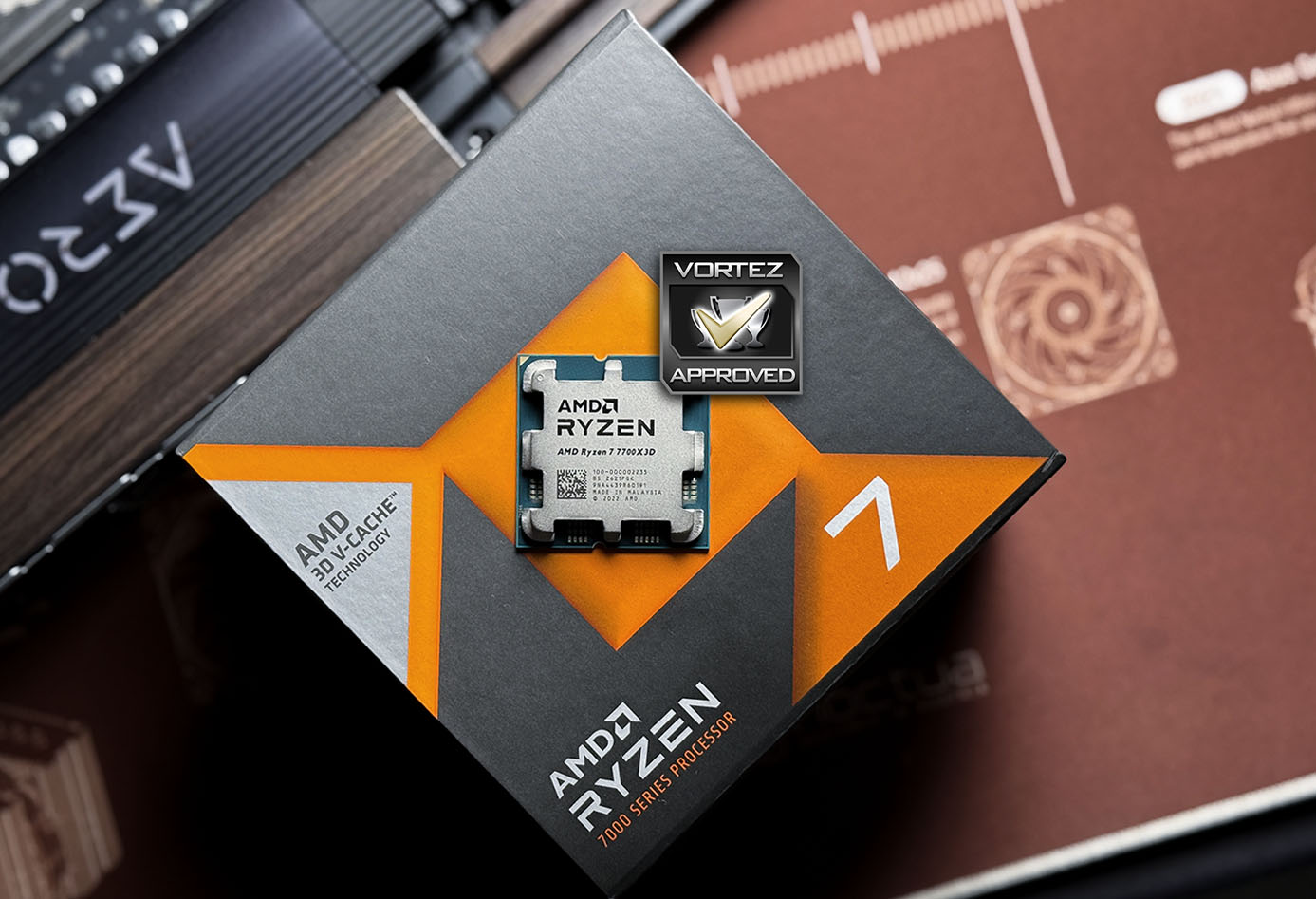
The AMD Ryzen 7 7700X3D arrives with a fairly straightforward mission: bring the magic of AMD’s 3D V-Cache technology to a wider audience without sending your wallet into hiding. Priced at just $329 USD, it offers a more affordable gateway into one of the most successful gaming processor line-ups in recent memory. It joins AMD’s trio of 8-core X3D processors alongside the Ryzen 7 7800X3D, Ryzen 7 9800X3D and Ryzen 7 9850X3D, giving gamers plenty of choice depending on how much performance they want—and how much they’re prepared to spend. Sometimes having too many options can be confusing, but it’s certainly a better problem to have than none at all.
At its core, the 7700X3D is built on AMD’s proven Zen 4 architecture, packing 8 cores, 16 threads and a healthy 96MB of L3 cache thanks to the company’s signature 3D V-Cache technology. While it may not boast the highest clock speeds in AMD’s gaming arsenal, history has shown that raw frequency isn’t everything. The extra cache has consistently proven its worth where it matters most, helping deliver excellent gaming performance across a wide range of modern titles. Throw in support for DDR5 memory, PCIe 5.0, Precision Boost Overdrive and AMD EXPO memory profiles, and you’ve got a processor that ticks all the right boxes for a modern gaming build.
Of course, buying into the 7700X3D is about more than just the processor itself. The AM5 platform continues to mature nicely, and pairing the chip with an X870 or X870E motherboard unlocks some genuinely useful features, including native USB4 support and the ability to run both a PCIe Gen5 x16 graphics card and PCIe Gen5 x4 NVMe SSD at full speed simultaneously. It’s also worth remembering that the Ryzen 7 7800X3D is still widely regarded as one of the best-value gaming CPUs ever released, so the 7700X3D has some rather large shoes to fill. Fortunately, if AMD has learned anything over the past few generations, it’s that gamers tend to appreciate big cache almost as much as they appreciate bigger frame rates.
In this review, we’ll be finding out whether the 7700X3D deserves a place on your shortlist. We’ll be putting it through our usual suite of productivity benchmarks before seeing how it performs with some CPU dominant games, comparing it against a range of previously reviewed processors to discover whether this new budget-friendly X3D chip can punch above its weight—or if it’s simply the sensible sibling in AMD’s ever-growing gaming family.
Test Setup & Testing
For the purpose of testing the 7700X3D we used the GIGABYTE X870E AERO X3D DARK WOOD since it is placed as a high-end X870E motherboard, this should give us the capabilities of showing the true potential of this chip.
CPU being tested
AMD Ryzen 7 7700X3DTEST SETUP
Cooling CORSAIR H150i ELITE LCDMotherboard GIGABYTE X870E AERO X3D DARK WOOD
Memory 64GB CORSAIR Dominator Platinum RGB 5200MHz DDR5
Graphics ZOTAC RTX 3070 Ti HOLO Extreme
Storage CORSAIR Force LX 512GB SSD
PSU Corsair RM 1000 80 Plus Gold Certified PSU
Monitor AOC U2879VF
BENCHMARKS
Cinebench R23 – Single/Multi-core CPU Renderingx264 HD 4.0 – 1st and 2nd pass encoding
SiSoftware SANDRA – CPU & Memory benchmarks (Now discontinued)
POV-RAY – CPU Ray Tracing
TrueCrypt – CPU Encryption Read/Write
AIDA64 – CPU benchmarks & Memory
PCMARK 10 – CPU Productivity
Davinci Resolve – Puget Benchmark
Blender – Classroom Benchmark
Games – Assassin’s Creed Odyssey & Total War: WARHAMMER II
OTHER SOFTWARE
Temperature Analysis: CoreTempStress Testing Software: AIDA64 Stability Test
CPU Specification Monitoring: CPU-Z
Temperatures
Below are the temperatures for each of the CPUs – without any overclock applied. We’ve also compared to previously released AMD and Intel counterparts (which we’ve also benchmarked against on the subsequent pages too):
Power Consumption
It’s interesting to note the power consumption across all processors. Although they are using a combination of different motherboard chipsets, energy results can fluctuate between manufacturers due to the features and specifications that are integrated. First of all, for the idle tests the system is cold booted into Windows and no additional applications are executed – the watts are noted on the external energy monitor we use and then the system is loaded with 3DMark FireStrike – watts are again monitored for the duration of the test and the highest rated wattage result is then noted down. Below are the results of this energy test.
Ray Tracing Performance – POV-Ray 3.7
Persistence of Vision Raytracer’s PovRay is a free and open source 3D animator application with versions for computers with different operating systems.
This product allows users to build their custom 3D worlds with excellent quality despite their computer’s hardware. It has adjustable options for levels of radiance, refraction, and reflection. Calculation time may vary depending on the computer model, but PovRay can adapt to many computer builds, and is supported by the open source community.
This product allows users to build their custom 3D worlds with excellent quality despite their computer’s hardware. It has adjustable options for levels of radiance, refraction, and reflection. Calculation time may vary depending on the computer model, but PovRay can adapt to many computer builds, and is supported by the open source community.
AES Encryption Performance – TrueCrypt 7.1a
TrueCrypt is a discontinued source-available freeware utility used for on-the-fly encryption (OTFE). It can create a virtual encrypted disk within a file or encrypt a partition or (under Microsoft Windows except Windows 8 with GPT) the entire storage device (pre-boot authentication).
Encoding Performance – X264 HD
Simply put, this test measures how fast your machine can encode a short, DVD quality MPEG-2 video clip into a high-quality x264 video clip. What’s x264, you ask? It’s more or less the next-generation Xvid/DivX codec. I think it’s ideal for a benchmark because the application (x264.exe) reports fairly accurate compression results (in frames per second) for each pass of the video encoding process, and it uses multi-core processors very efficiently.
x264 HD gives results for 2 passes when compressing an MPEG-2 clip into x264. It presents 4 separate results for each pass giving a total of 8 – all results are given in FPS. For each pass I have averaged out the results.
Processing Features Performance – AIDA64
AIDA64 Product Page
This simple integer benchmark focuses on the branch prediction capabilities and the misprediction penalties of the CPU. It finds the solutions for the classic “Queens problem” on a 10 by 10 sized chessboard. At the same clock speed theoretically the processor with the shorter pipeline and smaller misprediction penalties will attain higher benchmark scores. For example — with HyperThreading disabled — the Intel Northwood core processors get higher scores than the Intel Prescott core based ones due to the 20-step vs 31-step long pipeline. CPU Queen test uses integer MMX, SSE2 and SSSE3 optimizations.
Memory Transfer Performance – AIDA64
AIDA64 Product Page
This simple integer benchmark focuses on the branch prediction capabilities and the misprediction penalties of the CPU. It finds the solutions for the classic “Queens problem” on a 10 by 10 sized chessboard. At the same clock speed theoretically the processor with the shorter pipeline and smaller misprediction penalties will attain higher benchmark scores. For example — with HyperThreading disabled — the Intel Northwood core processors get higher scores than the Intel Prescott core based ones due to the 20-step vs 31-step long pipeline. CPU Queen test uses integer MMX, SSE2 and SSSE3 optimizations.
Processing Power Performance – Cinebench R23
CINEBENCH can measure systems with up to 64 processor threads. This test scene contains approximately 2,000 objects which in turn contain more than 300,000 polygons in total, and uses sharp and blurred reflections, area lights, shadows, procedural shaders, antialiasing, and much more. The result is displayed in points (pts). The higher the number, the faster your processor.
Overall System Performance – PCMark 10
PCMark 10 Product Page Developed in partnership with Benchmark Development Program members Acer, AMD, Condusiv Technologies, Dell, HGST, HP, Intel, Microsoft, NVIDIA, Samsung, SanDisk, Seagate and Western Digital, PCMark 10 is the latest version in FutureMark’s popular series of PC benchmarking tools. Improving on previous releases, PCMark 10 includes new tests using popular applications from Adobe and Microsoft.
4K Editing Performance – DaVinci Resolve PugetBench
DaVinci Resolve is not only an industry-standard coloring tool, but also includes features for video editing, VFX, and more. While we also have benchmarks for Premiere Pro, After Effects, and other creative applications, every application will utilize the hardware in a computer in very different and unique ways which can make it extremely difficult to determine exactly what hardware will give the end user the best possible performance.
Rendering Performance – Blender
Blender is a free and open-source 3D computer graphics software toolset used for creating animated films, visual effects, art, 3D printed models, motion graphics, interactive 3D applications, virtual reality, and computer games. Blender’s features include 3D modeling, UV unwrapping, texturing, raster graphics editing, rigging and skinning, fluid and smoke simulation, particle simulation, soft body simulation, sculpting, animating, match moving, rendering, motion graphics, video editing, and compositing.
Please note: Blender has recently been updated and the metric for results has changed with the new update, rendering our historical benchmarks void – hence why we have less results for this benchmark, taking on the new samples per minute metric.
Gaming Performance – AC: Odyssey & Total War: WARHAMMER II
It’s important for us to perform a number of game benchmarks as well as the synthetic tests because gamers will want to know if there are any significant benefits. So here we have two recent gaming titles benchmarked with the RTX 3070 Ti. Both gaming titles are CPU-intensive – AC Odyssey is the last AC title in the series to be CPU-bound. Valhalla uses DX12 API.
Conclusion
The Ryzen 7 7700X3D proves that you don’t need to spend flagship money to enjoy flagship-level gaming performance. AMD has taken everything that made its X3D processors so successful and packaged it into a much more accessible price point, making this one of the easiest recommendations for anyone building a gaming-focused PC today. At just $329 USD, it’s difficult to argue with what AMD is offering here, especially when many competing processors require significantly more investment for comparable gaming results.
Gaming is, without question, where the 7700X3D shines brightest. Across our testing it consistently delivered excellent frame rates, and when paired with GIGABYTE’s X3D Mode, performance climbed another notch in supported titles. It’s one of those rare situations where enabling a BIOS feature genuinely makes you smile rather than wonder if it actually did anything. If your primary objective is squeezing every last frame from your graphics card, the 7700X3D has all the ingredients to keep it fed for years to come.
While gaming is clearly its speciality, the 7700X3D isn’t a one-trick pony. Its 8-core, 16-thread design provides good performance in everyday productivity workloads, content creation and general multitasking, making it more than capable of handling life outside of gaming. Combined with the advantages of AMD’s AM5 platform and the feature-rich X870E chipset—including USB4 support, PCIe Gen5 graphics and storage connectivity, and a platform with plenty of life ahead—it offers far more than just fast gaming numbers.
Another pleasant surprise is how efficient the processor is. The 7700X3D maintains impressively low power consumption while also producing relatively little heat, making it easier to cool than many higher-end desktop CPUs. That’s good news whether you’re building a compact gaming system or simply prefer your PC to sound like a computer rather than a jet preparing for take-off. The only real drawback is the cost of entry into the AM5 ecosystem itself, as DDR5 memory and compatible motherboards still command a noticeable premium compared to older platforms.
Overall, the Ryzen 7 7700X3D successfully delivers exactly what it set out to achieve: affordable access to AMD’s outstanding 3D V-Cache technology. It may not replace the higher-end X3D chips at the top of the performance charts, but it doesn’t really need to. Instead, it fills an important gap by offering exceptional gaming performance, strong all-round capability, impressive efficiency and a price that’s genuinely difficult to ignore. If you’re building a new gaming PC and can accommodate the cost of the AM5 platform, the 7700X3D is arguably one of the smartest CPU purchases currently available—and your graphics card will certainly appreciate the company.
Pros
+ Excellent gaming performance
+ GIGABYTE X3D Mode takes gaming perf to another level
+ Good overall results for non-gaming related tasks
+ Access to 3D V-Cache on AM5 platform
+ Benefits of X870E chipset
+ Low thermal output
+ Low power draw
+ Priced at just $329
Cons
– AMD 5 motherboard and DDR5 costs
+ Excellent gaming performance
+ GIGABYTE X3D Mode takes gaming perf to another level
+ Good overall results for non-gaming related tasks
+ Access to 3D V-Cache on AM5 platform
+ Benefits of X870E chipset
+ Low thermal output
+ Low power draw
+ Priced at just $329
Cons
– AMD 5 motherboard and DDR5 costs
Click here for an explanation of our awards at Vortez.net.
Stay connected with the Vortez Social Media pages:
Join in with the discussions on Discord