







Alpenföhn have entered the cooling market with a range of new mid-high end products and today we will be looking at its flagship Nordwand offering.
Product on Review: Alpenföhn Nordwand Tower CPU CoolerManufacturer and Sponsor: Alpenföhn
MSRP: Not mentioned on website
Street Price: £42.95
Alpenföhn may not be a name you have heard before and yet they have been in the cooling business for a long time under the EKL brand, focussing mostly on manufacturing OEM thermal solutions. Their products have been mostly for the European market since its establishment in 1995. With the Alpenföhn brand, they are targetting the enthusiast and consumer market. With an extensive history in thermal applications, it would be very wrong to discard them as just another “wannabe” brand.
Today, we have with us the Alpenföhn Nordwand. “Alpenföhn” refers to a cool wind that affects the Alps, and the Nordwand, translated to North Face, is commonly linked to one of the most notable mountains in the Alps, the Eiger. The name of the towering heatsink is reminiscent of its formidably cold origins and therefore, if its performance can be judged from the name alone, we will be in for a very chilly blast…in a good way. On initial looks the Nordwand sports very impressive specifications, using a direct contact heat pipe design, 5 thick heat pipes and a cool blue high performance LED fan.

Let’s see what Alpenföhn say about their Nordwand Cooler (Translated from their site):
Alpenföhn have manufactured a premium cooler with the Nordwand. The heatsink is based on the proven HDC technology, allowing for very good efficient cooling. Further aiding cooling are 5 U-shaped heat pipes, responsible for quickly transferring heat from the heatsink base.
The heatsink itself, has a completely new technology. By edging the individual fins at the ends, the cooler has a closed surface. This means that all the airflow has to go one way: Over the Fins!
This is a real eye-catcher of a heatsink at every LAN party. Following the motto “Black is beautiful”, the manufacturer has opted for an elegant black plated finish on all the fins.
The engineers have settled for a quiet running 120mm fan with a 4 pin PWM connector for excellent airflow and “Crystal Blue” LED lighting. The fan itself was kept transparent including the polished blades and the frame.
In a market seemingly saturated by high end heatsinks, can Alpenföhn bring something new to the table with the Nordwand? Let’s find out.
Features and Specifications
Features
•Optimized snapped fins
•120mm crystal blue LED fan
•De-vibration rubber fan mounting
•Compatibility with AM2(+)/AM3, AMD s-754/939/940, Intel LGA775, Intel LGA1366
(Note: Earlier versions do not come with Intel LGA1156 support but Alpenföhn assures me that they will have support for it. Those who purchase it now will be able to contact them for a free LGA1156 installation kit.)
Specifications
•Dimensions: 131 x 96 x 155mm (W/D/H)
•Net weight: 625g
•Heat pipe: 5 x 8mm
•Material: coppery aluminium (base), nickel plated aluminium (fins), nickel plated copper (heatpipes)
•Bearing type: Hydraulic bearing
•Rated voltage@ 12VDC
•Rated current: 0.08±10%A (Max)
•Air flow: 92m3/h (Max)
•Noise: 21dB(A) Max
•Speed: 850-1500 R.P.M
•Life: 30,000 Hours
Packaging
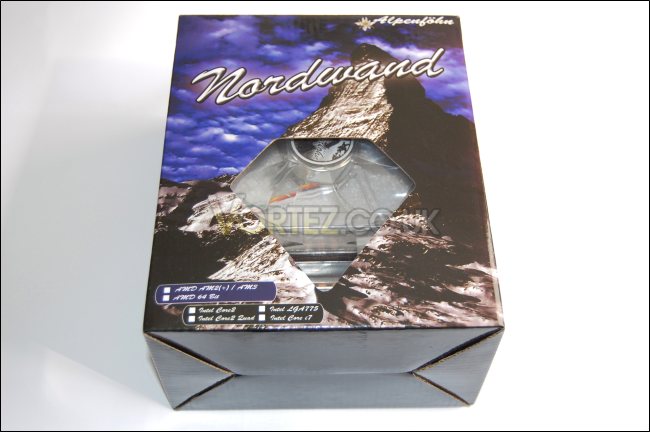
The front of the box
The front of the box has a sense of mystery and power to it with the picture of the brooding clouds over the mountains. Alpenföhn immediately conveys the idea that the Nordwand is a brutal cooler, what with the Superman emblem shaped cutting at the front and the somewhat omniscient logo across the top. Apart from that, the box itself is fairly standard but large cardboard packaging to accommodate the tower heatsink.

The back with a picture of the heatsink
The back cover portrays the heatsink itself, giving you an idea of the sheer size and the innovative design associated with the Nordwand. it has an almost godlike stature over the mountains in the background. A list of compatible sockets and CPUs is listed at the bottom.
The side listing all the specifications
On the side are listed all the specifications and compatible sockets/CPUs. Their choice of font does make it somewhat hard to read but let’s just say the specifications are impressive, the results speaking for themselves later on.
The interior packaging
As we open the box, we are greeted with a white cardboard box holding all the installation kit, and the actual heatsink in a clear hard plastic heat shrink package. A 120mm fan is also supplied in the bundle.

The bundle including the 850-1500 R.P.M 120mm PWM fan
The bundle consists of the heatsink and fan, and the installation kit for all sockets dating back to socket 754 for AMD. This particular sample did not have the LGA1156 mounting kit but future ones will have it included.
Closer Look
The towering heatsink
The heatsink is nickel plated aluminium using a tried and tested tower design. Measuring 131 x 96 x 155mm, it is much deeper than the Thermolab Baram but slightly smaller in width and height. The cooler has a nice black finish giving it a professional and tidy look. Merely looking at it, you can tell that the Alpine related advertising is doing a very faithful job.
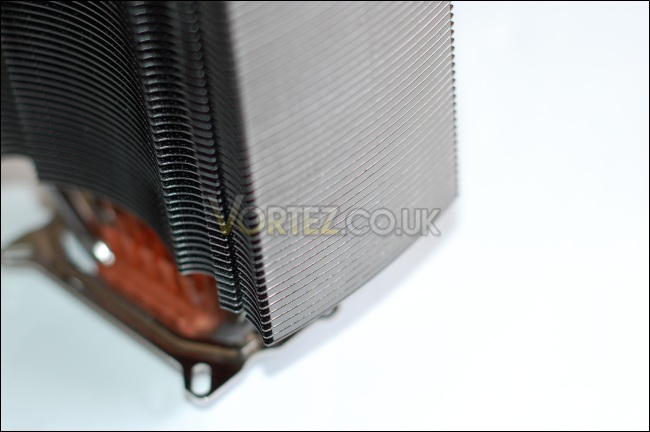
The closed design helps direct airflow where it should go
Closer, there is a very interesting feature, not seen in other heatsinks. The fins are such that the ends are bent such that there are no gaps in the side profile. This innovation prevents air from leaking out, thus focussing the entire airflow over the fans and towards the exhaust fan on your computer.

The copper heatsink on top of the base
Assimilated to the base is a small copper heatsink, aiding in dissipation of extra heat that is not carried by the heat pipes. This technique works very effectively. The heat pipes themselves are 8mm in thickness for optimum heat transfer to the fins.
5 thick U-shaped heat pipes for excellent heat transfer
Here we have a better view of those 5 thick heat pipes. Notice how the bend in different directions to spread themselves on the fins rather than being next to each other. This allows the heat to be transferred over a bigger surface area.
An almost weapon like look to seemingly tear apart its competitors. Take notice of the 4 circular grooves on each corner of the heatsink
The surface expression of the heat pipes shows that they are spread out in V-shapes so that air can moves heat away from a bigger surface area. Despite this, the design does not look as effective as the Thermolab Baram. Unlike most heatsink coolers, the tips of the heat pipes have been covered and are not visible, to give a much cleaner look.
Closer Look (Continued)
Close up on the copper heatsink
The addition of the copper heatsink not only makes the Nordwand an attractive product but also highly functional in its purpose. The heatsink comes pre-installed with part of the mounting kit so there’s no need to attach anything to the tower itself, unlike with the Thermolab Baram. This helps ease the installation process.

The base has a pre-installed mounting bracket
The base uses the direct contact technology and being very flat for excellent contact helps in transferring heat as efficiently as possible. The base has an alternate copper/aluminium pattern, the copper being the heat pipe.
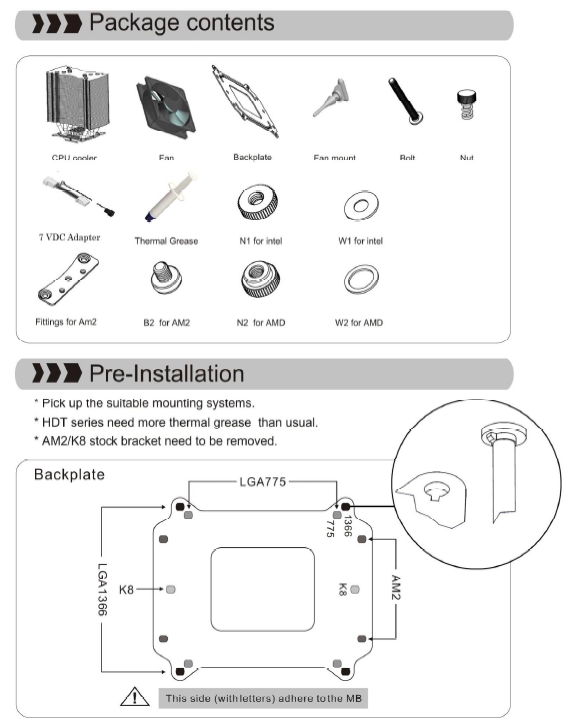
The installation kit is very straight forward to use and very intuitive but a manual is still provided
The installation mounting kit has compatibility for Intel LGA775/1366 and AMD AM2(+)/AM3/SKT 754/939/940. The Intel and AMD mounting kit come packaged separately to prevent any confusion. There is also a 4 pin to Molex converter . More details are provided on the installation page.
The back plate 4 sets of wholes labelled K8, 1366 and 775. The AM2(+)/3 label are missing
The back plate has pre-drilled hole for all the different socket installation, all clearly labelled on it. Each hole has a groove ensuring that when the bolt is inserted, it can lock into place.
Test Setup
CPU – Intel Core i7 920 – 4.0ghz
RAM – 6GB (3x2GB) OCZ platinum DDR3 1333mhz
Motherboard – Biostar T-Power x58
Graphics card – Gainward 896MB GTX260 216
Power Supply – Enermax Revolution 85+ 850W
Hard Drive – Samsung F1 320GB
Western Digital Caviar WD3200AAKS 320GB
Drivers – ForceWare 185.66
CPU Coolers:
Noctua NH-U12P SE1366
Thermolab Baram (with 2 Noctua NF-P12 fans)
CoolIT Domino A.L.C
Sunbeam Core Contact Freezer
Coolermaster Hyper 212 Plus including test with 2 Noctua NF-P12 fans
Alpenföhn Nordwand including test with 2 Noctua NF-P12 fans
Program Suite:
Core Temp 0.99.5
LinX stress Test
PC Wizard
How I tested:
Testing will be based on temperatures recorded by Coretemp and PC wizard after 20 passes of LinX stress test. The absolute temperatures recorded in the tables are averages of the 4 cores and the delta value provided for a fair comparison, taking into account ambient temperatures. The test will be run at stock speed and at an overclocked speed of 4ghz.
Installation
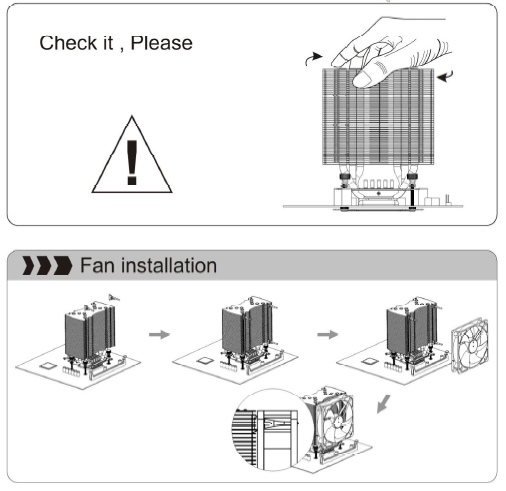
The installation is very straight forward and doesn’t take much time at all! The only “difficulty” was that the nut has to be screwed in by hand but it does not take too much effort at all, as long as you screw it until you cannot physically tighten it more by hand.
The fan installation on the other hand is ingenious. You may have noticed in the previous picture of the Nordwand that running down the front and back of the heatsink are 4 circular grooves. The rubber mounts provided can slide into them so that they are positioned perfectly with the fan mounting holes. Simply pull the rubber mounts through the fan hole and it will hold up securely with the added benefit of minimal vibration. To take out the fan, simply pull each corner one at a time and if needed, use a thin object to take the rubber mounts out of the heatsink grooves, should you have difficulty with them. 9 rubber mounts are provided in total allowing for 2 fans to be installed in a push/pull setup, one being a spare.
Results
CPU at 2.66GHZ
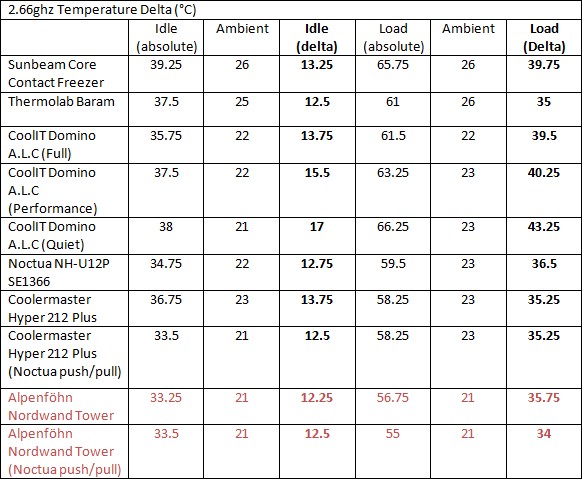
The Alpenföhn Nordwand’s initial performance test at stock speed on the CPU places it as one of the top tier heatsinks but not as the best. While offering the best performance at idle, it lags behind the Coolermaster Hyper 212 Plus by 0.5 degrees. Its closest competitor, the Thermolab Baram leads by 0.75 degrees but despite this, the Nordwand still outperforms the hugely popular Noctua/CoolIT and Sunbeam offerings. Once we change the setup to a push/pull one on the Alpenföhn Nordwand using the Noctua NF-P12s, it pulls ahead of all the competition taking a clear degree lead over the mighty Thermolab Baram which used the same fans. This suggests that the Nordwand is the most efficient heatsink when paired up with the same fan configurations.
CPU at 4GHZ
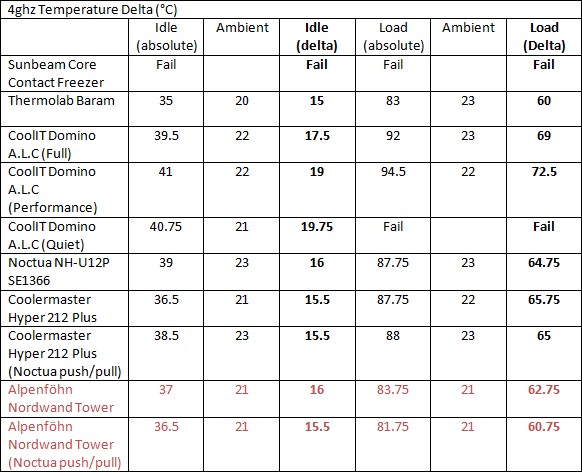
The Alpenföhn Nordwand’s performance is more pronounced with the overclocked i7. The regular setup is ahead of the Noctua NH-U12P which sports two fans and the push/pull setup is the second best performer on the charts, just 0.75 degrees shy of the Thermolab Baram. The idle temperatures are also very impressive but still do not match up to the Baram. The five heat pipes certainly puts the Alpenföhn in the same league as the Thermolab Baram but again that’s not enough to take its crown. Overall, it is still a brilliant cooler that unlike the Baram, does come with a fan!
Noise
Rated and operating at 1500 R.P.M, the Alpenföhn fan is a very good one that stays very quiet even under load, while still operating adequately. I could not hear it over my Scythe S-Flex case fans and the fact that it outperformed the Noctua NH-U12P is testament to the cooling potential of the fan. The fan itself uses a 4 pin connection, present on most motherboards and a Molex adapter is provided just in case. Since it is a PWM fan, its speed adjusts depending on the load and temperature so quiet operation is ensured when idling, whereby the fan will reduce its speed to 850 R.P.M. This is a very useful touch for those that require a quiet setup. The rubber mounting further dampens noise by reducing vibration.
Conclusion
I have to say that I have been thoroughly impressed by what Alpenföhn have offered with their Nordwand. It boasts clever and innovative features not found on most other coolers and if the stock fan isn\\\’t enough for you, it\\\’s built for expandability. From the small copper heatsink on the base to the closed fin design, Alpenföhn have put a lot of thought into their cooler and this comes from the years of experience building thermal solutions for the OEM market. I can see them making a breakthrough in the consumer market now as well with their other products, if the Nordwand is anything to go by. The best thing of all is the way the fans are mounted. Since they do not require wire clips, it is possible to install any 120mm fans and by that I mean the high R.P.M 38mm thick ones such as the Delta. The stock cooler is an excellent cooler on its own and it has a lot of untapped performance if better fans are to be used.Looking at the performance, the Alpenföhn Nordwand easily beats the Noctua NH-U12P, which is priced almost £15 more! So the decision is clear in that respect. However, our favourite cooler here still cannot be outperformed and that\\\’s the Thermolab Baram. Its more efficient heat pipe design helps dissipate heat over a greater surface area and as such remains our leader. The Alpenföhn Nordwand does have one big advantage though and that\\\’s compatibility for all major CPUs and socket types. LGA1156 for the Core i5/i7 is not present in the current model but the kit can be acquired for free by simply contacting Alpenföhn and future versions will have compatibility by default. This is brilliant customer service on their behalf and deserves praise.
Pros:
•Excellent performance both with stock fan and dual fans
•Innovative features
•Brilliant looks
•Fairly priced
•Compatibility with all major CPUs and socket types
•Very easy to install
•Excellent service
Cons:
•Does not beat the Thermolab Baram
The Alpenföhn Nordwand has become one of my favourite coolers and as such earns itself a very respectable Vortez Hardware Gold Award!
To discuss this product, please visit out forums

