







AMD’s highly anticipated Trinity APU has been put through its paces. Featuring the ‘Piledriver’ CPU cores and a revised Radeon HD7000 Series GPU can it deliver?
Product on Review: AMD A8-5600K APU
Manufacturer and Sponsor: AMD

Street Price: £80inc. VAT (GBP)
The latest line of A-Series APUs come laden with new features all aimed at delivering a seamless graphics rich experience at little inconvenience to the end user. Coming in with an updated ‘Northern Islands’ based Radeon HD 7000 series integrated GPU that uses the VLIW 4 architecture, Turbo Core 3.0 for both CPU and GPU, aimed to reduce power consumption while giving the user peak performance.
The biggest change is in the x86 architecture. Displacing the four K12 cores found in the Llano APUs we find four ‘Piledriver’ cores. ‘Piledriver’ is the direct successor to the ‘Bulldozer’ architecture and spells a new era for AMD and the direction that their future technology will take.
Today we are looking at the A8-5600K unlocked APU.
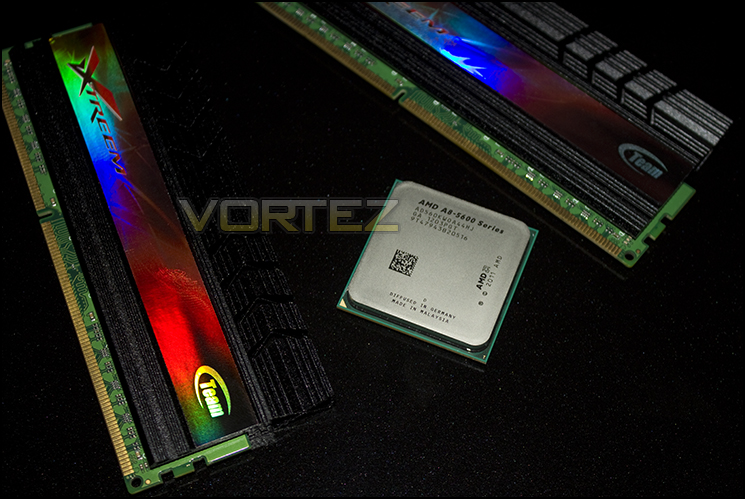
AMD’s Overview of the APU
Do more in less time with energy-efficient desktops. With AMD’s APU, a multicore CPU and discrete-level GPU on a single power-efficient chip, you get the visual performance you need for the best choice for digital entertainment and gaming. With even more compute performance, graphics are crisp, bright and smooth, and content is easy to share.
Features & Specifications
Specifications
Model Name: A8-5600K
Radeon™ Brand: HD 7560D
CPU Clock Speed: 3.6/3.9 GHz
CPU Cores on Die: 4 cores
TDP: 100W
Total L2 Cache: 4MB
Radeon™ Cores on Die: 256
GPU Clock Speed: 760 MHz
DDR3 Speed: 1866MHz
Instruction Set Extensions MMX(+) SSE (1,2,3,3S,4.1,4.2,4A) x86-64, AMD-V, AES, AVX, XOP, FMA4/3
Die size 246mm²
Lithography 32nm
Features
– AMD Eyefinity Technology – Immerse yourself in panoramic gaming and entertainment across up to four monitors with AMD Eyefinity Technology.
– AMD HD Media Accelerator – Experience HD video the way you should with accelerated conversion and smooth playback from AMD HD Media Accelerator.
– AMD Quick Stream Technology – Stop waiting for the buffer to catch up – get fast, smooth internet streaming with the powerful APU graphics with AMD Quick Stream Technology.
– AMD Steady Video Technology 2.0 – Vacation video shouldn’t make you dizzy – helping to eliminate shaking from home video is only one click away with AMD Steady Video Technology 2.0. Automatically stabilize home and Web video with advanced settings and one click control.
– AMD Perfect Picture HD – Images jump off the page and burst into life in vivid color with enhanced resolution and contrast of AMD Perfect Picture HD.
– AMD Radeon™ Dual Graphics – Push graphics and gaming performance to the extreme with the power of two – AMD Radeon™ Dual Graphics.
– AMD Radeon™ HD Graphics – Get everything you ever wanted out of your graphics – crisp & sharp photos, movies and games with the phenomenal discrete-level performance of AMD Radeon™ HD Graphics.
– AMD Turbo Core Technology 3.0 – Amazing performance when you’re pushing your system to the limits, with scaled back power consumption for everyday activities to help keep your system running cool & quiet.
– AMD Accelerated Video Converter – Take your tunes & movies with you – convert, sync and enjoy your video and music files quickly and easily with AMD Accelerated Video Converter.
AMD HD3D Technology – Become part of the 3D gaming and entertainment experience with cutting-edge AMD HD3D Technology.
AMD Internet Acceleration – Get your browsing done quickly with Web sites that load fast with AMD Internet Acceleration.
AMD App Acceleration – Speed up everyday applications with the power of more graphics cores and AMD App Acceleration.
Model Name: A8-5600K
Radeon™ Brand: HD 7560D
CPU Clock Speed: 3.6/3.9 GHz
CPU Cores on Die: 4 cores
TDP: 100W
Total L2 Cache: 4MB
Radeon™ Cores on Die: 256
GPU Clock Speed: 760 MHz
DDR3 Speed: 1866MHz
Instruction Set Extensions MMX(+) SSE (1,2,3,3S,4.1,4.2,4A) x86-64, AMD-V, AES, AVX, XOP, FMA4/3
Die size 246mm²
Lithography 32nm
Features
– AMD Eyefinity Technology – Immerse yourself in panoramic gaming and entertainment across up to four monitors with AMD Eyefinity Technology.
– AMD HD Media Accelerator – Experience HD video the way you should with accelerated conversion and smooth playback from AMD HD Media Accelerator.
– AMD Quick Stream Technology – Stop waiting for the buffer to catch up – get fast, smooth internet streaming with the powerful APU graphics with AMD Quick Stream Technology.
– AMD Steady Video Technology 2.0 – Vacation video shouldn’t make you dizzy – helping to eliminate shaking from home video is only one click away with AMD Steady Video Technology 2.0. Automatically stabilize home and Web video with advanced settings and one click control.
– AMD Perfect Picture HD – Images jump off the page and burst into life in vivid color with enhanced resolution and contrast of AMD Perfect Picture HD.
– AMD Radeon™ Dual Graphics – Push graphics and gaming performance to the extreme with the power of two – AMD Radeon™ Dual Graphics.
– AMD Radeon™ HD Graphics – Get everything you ever wanted out of your graphics – crisp & sharp photos, movies and games with the phenomenal discrete-level performance of AMD Radeon™ HD Graphics.
– AMD Turbo Core Technology 3.0 – Amazing performance when you’re pushing your system to the limits, with scaled back power consumption for everyday activities to help keep your system running cool & quiet.
– AMD Accelerated Video Converter – Take your tunes & movies with you – convert, sync and enjoy your video and music files quickly and easily with AMD Accelerated Video Converter.
AMD HD3D Technology – Become part of the 3D gaming and entertainment experience with cutting-edge AMD HD3D Technology.
AMD Internet Acceleration – Get your browsing done quickly with Web sites that load fast with AMD Internet Acceleration.
AMD App Acceleration – Speed up everyday applications with the power of more graphics cores and AMD App Acceleration.
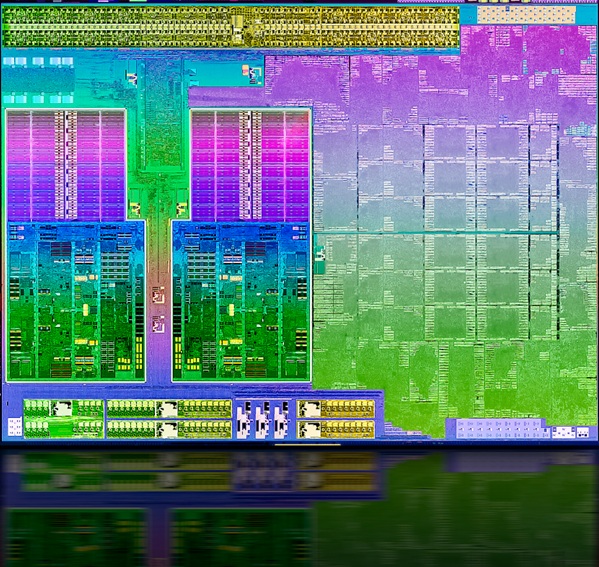
Trinity Die Shot
As Trinity is still on 32nm process, the die area has expanded a little over Llano to 246mm² but because of this AMD has been able to include technologies such as Eyefinity and the AMD HD Media Accelerator/Converter. Though we can also note a reduction in Radeon cores, the new architecture should prove more efficient and deliver capable performance.
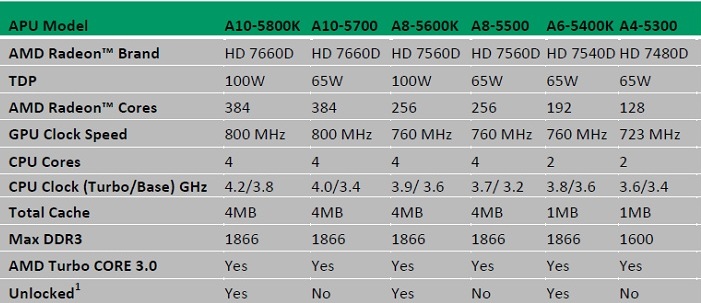
Desktop Trinity line up
The A8-5600K comes in with the CPU clocked at 3.6GHz with a turbo of up to 3.9 GHz, and the HD 7560D iGPU clocked up to 760MHz. These clocks are significantly higher than what we saw in Llano and is likely needed to help keep up the performance lost by the CPU architecture change (no miracles here), and having lower GPU cores. Regardless, with the new features that Trinity offers, if it can maintain and improve performance in the same power frame the general consumer wins.
Closer Look
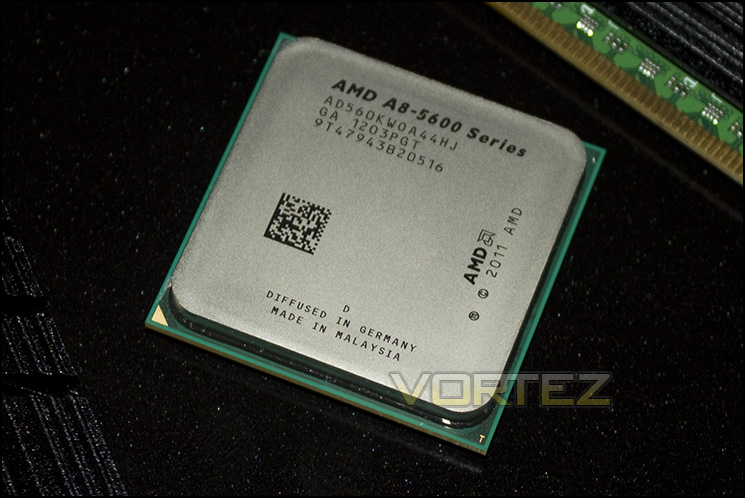
The obligatory HSS (Heat Spreader Shot), always nice to see a new addition to the family.
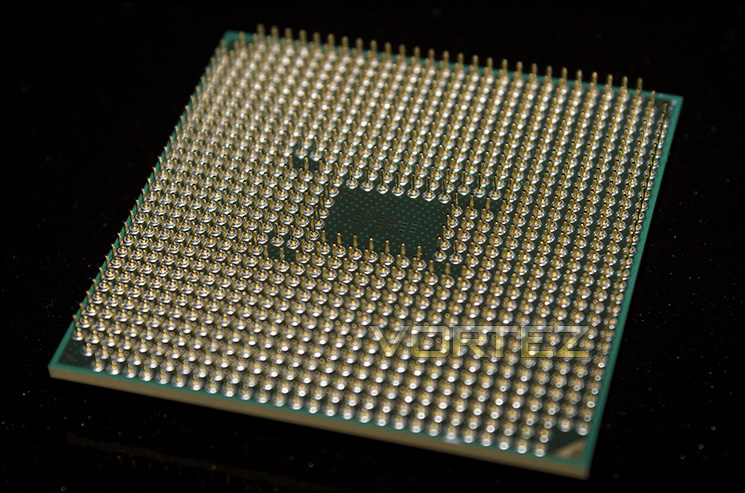
FM2 pin layout
While similar to FM1, the physical difference is enough to make the FM2 APU incompatible with the FM1 socket. New to the FM2 platform is the addition of the higher end A85X chipset.
Test Setup
A75 Setup
Motherboard – GIGABYTE GA-A75M-UD2H
RAM – Team Xtreem PC3 12800 DDR3 1600
HDD – Western Digital Caviar Blue 500GB 7200RPM SATAIII
Power Supply – NZXT Hale82 650W
Cooler – CoolerMaster Hyper 212+
Motherboard – GIGABYTE GA-A75M-UD2H
RAM – Team Xtreem PC3 12800 DDR3 1600
HDD – Western Digital Caviar Blue 500GB 7200RPM SATAIII
Power Supply – NZXT Hale82 650W
Cooler – CoolerMaster Hyper 212+
A85X Setup
Motherboard – ASUS F2A85M-PRO
RAM – Team Xtreem PC3 12800 DDR3 1600 Xtreem LV PC3 19200 DDR3 LV 2400
HDD – Western Digital Caviar Blue 500GB 7200RPM SATAIII
Power Supply – NZXT Hale82 650W
Cooler – CoolerMaster Hyper 212+
Motherboard – ASUS F2A85M-PRO
RAM – Team Xtreem PC3 12800 DDR3 1600 Xtreem LV PC3 19200 DDR3 LV 2400
HDD – Western Digital Caviar Blue 500GB 7200RPM SATAIII
Power Supply – NZXT Hale82 650W
Cooler – CoolerMaster Hyper 212+
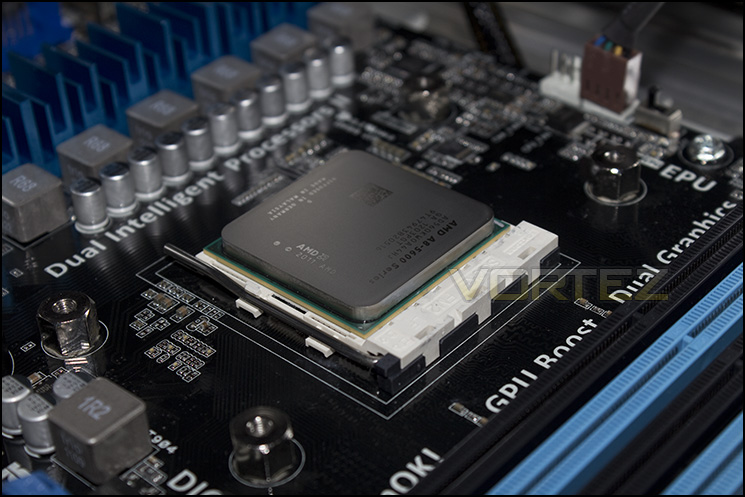
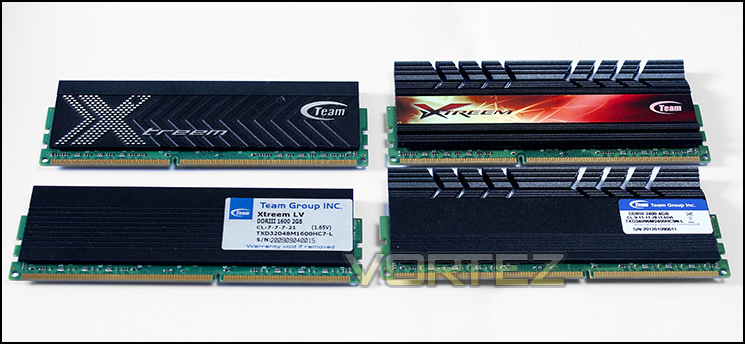
Out with the old, in with the new.
To help find the limit of the iGPU, we have changed the memory to the Team Xtreem LV 2400MHz so we are better equipped to feed the integrated HD 7000 Series graphics with more bandwidth.
APU Configurations
AMD A8-5600K @ 3.6/3.9GHz (100MHzx 36/39, 1333MHz 9-9-9-24)
@ RAM OC 1600MHz 9-9-9-24, 1866MHz 9-9-9-24, 2133MHz 10-10-10-28, 2400MHz 11-11-11-28
@ OC 4.5GHz (100MHz x45, 2400MHz 11-11-11-28) HD7560D @ 950MHz
AMD A8-3870K @ 3.0GHz (100MHz x 29, 1333MHz 9-9-9-24) @ OC 3.68GHz (115MHz x 32, 1840MHz 8-8-8-24)
HD 6550D integrated graphics (OC @ 920MHz)
AMD A8-3850 @ 2.9GHz (100MHz x 29, 1333MHz 9-9-9-24)
HD 6550D integrated graphics,
AMD A6-3650 @ 2.6GHz (100MHz x 26, 1333MHz 9-9-9-24)
HD 6530D integrated graphics,
AMD A4-3400 @ 2.7GHz (100MHz x 27, 1333MHz 9-9-9-24)
HD 6410D intergrated graphics,
Overclocking
Overclocking the A8-5600K is pretty simple due to being a Black Edition with an unlocked multiplier, my initial attempt of 4.3GHz breezed through and managed to make it to 4.5GHz fine with 1.55V. When it came to trying to overclock the GPU too it started to get fiddly. Alone the Radeon HD 7560D iGPU was stable for just over 1GHz but when combined with the 4.5GHz CPU OC the system wouldn’t remain stable until adding more volts to the CPU NB, boosting the CPU NB volts to 1.25V proved fruitful with the iGPU at 950MHz and I managed to bump the NB frequency to 2000MHz too.
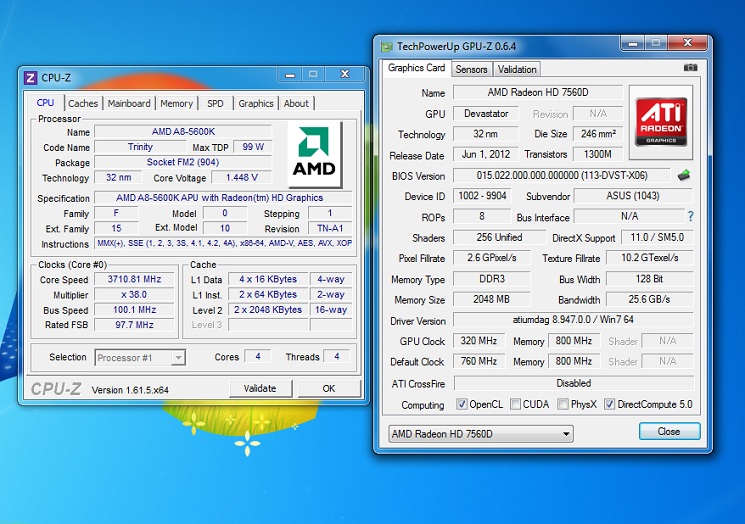
Turbo Core 3.0 doing its job at stock settings
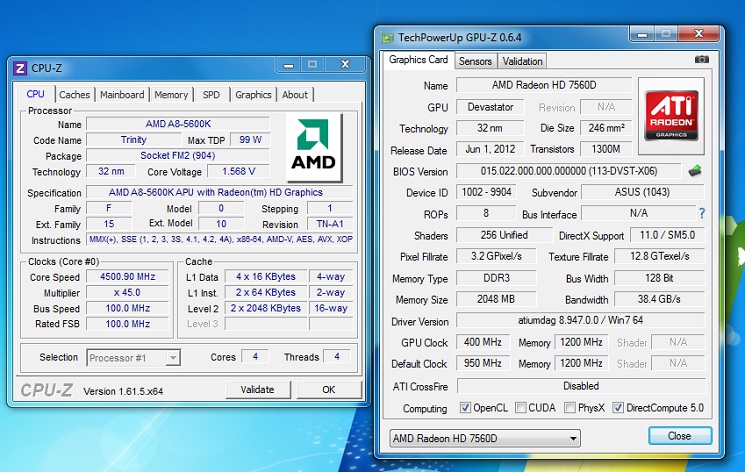
Final overclock settings @ 4.5GHz
Power Consumption
It’s interesting to note the power consumption across all motherboards because energy results can fluctuate between manufacturers due to the features and specifications that are integrated. First of all, for the idle tests the system is cold booted into Windows and no additional applications are executed – the watts are noted on the external energy monitor we use. Then the system is loaded with LinX 0.6.4 and MSI Kombustor simultainiously – watts are again monitored throughout the period of testing and the highest rated watts are then noted down. Below are the results of this energy test.
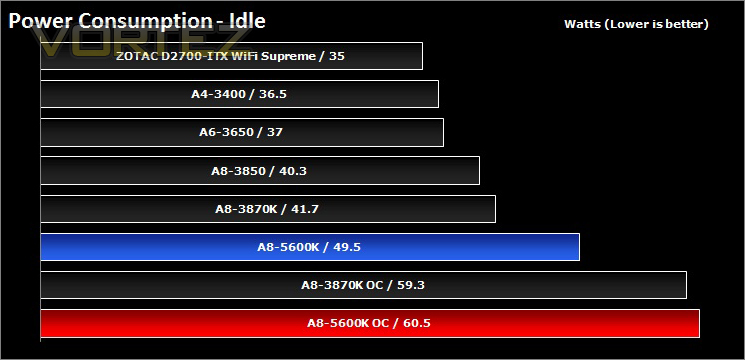
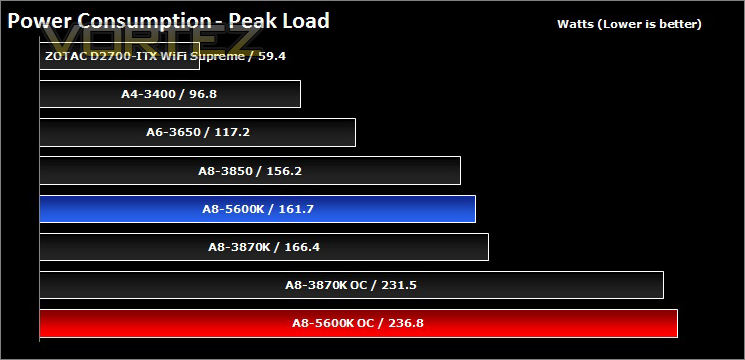
At idle, the FM2 platform used more power than the A8-3870K yet when loaded it is clear that the A8-5600K is in the same ballpark as the Llano A8. When overclocked the system draw is similar to that of the A8-3870K which would suggest that if the A8-5600K can match or out perform the flagship Llano, AMD have created a more efficient design with Trinity.
Synthetic Benchmarks: AIDA64
Memory Tests
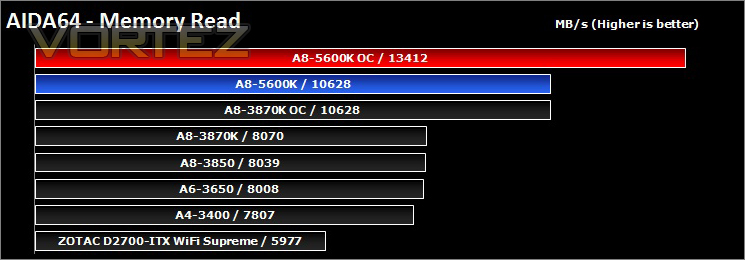
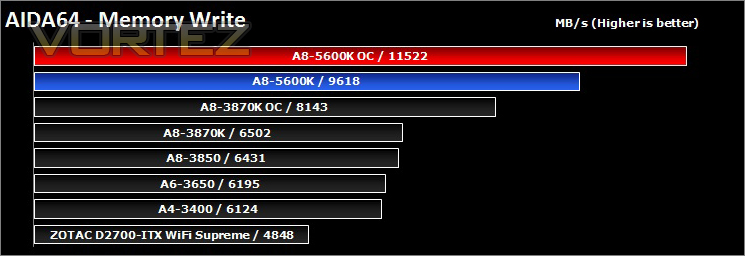
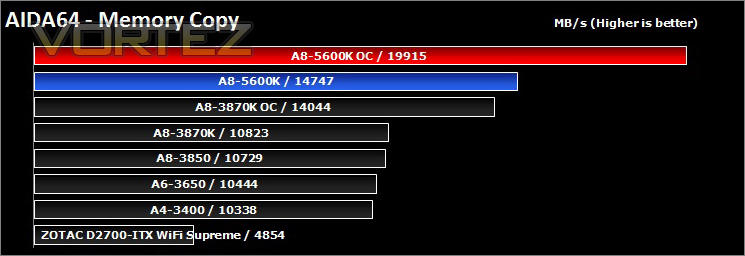
Memory bandwidth benchmarks (Memory Read, Memory Write, Memory Copy) measure the maximum achiveable memory data transfer bandwidth. The code behind these benchmark methods are written in Assembly and they are extremely optimized for every popular AMD and Intel processor core variants by utilizing the appropriate x86, MMX, 3DNow!, SSE, SSE2 or SSE4.1 instruction set extension.
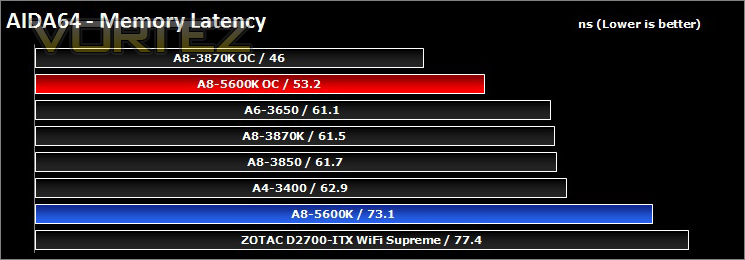
The Memory Latency benchmark measures the typical delay when the CPU reads data from system memory. Memory latency time means the penalty measured from the issuing of the read command until the data arrives to the integer registers of the CPU.
The Memory Latency benchmark measures the typical delay when the CPU reads data from system memory. Memory latency time means the penalty measured from the issuing of the read command until the data arrives to the integer registers of the CPU.
Huge memory bandwidth increase over Llano!
CPU Queen Benchmark
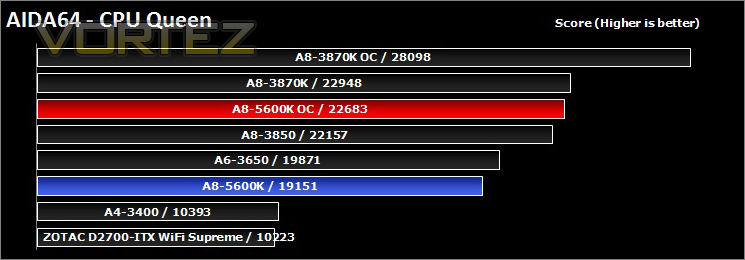
This simple integer benchmark focuses on the branch prediction capabilities and the misprediction penalties of the CPU. It finds the solutions for the classic “Queens problem” on a 10 by 10 sized chessboard. At the same clock speed theoretically the processor with the shorter pipeline and smaller misprediction penalties will attain higher benchmark scores. For example — with HyperThreading disabled — the Intel Northwood core processors get higher scores than the Intel Prescott core based ones due to the 20-step vs 31-step long pipeline. CPU Queen test uses integer MMX, SSE2 and SSSE3 optimizations.
CPU Queen reveals some of the short comings of the Piledriver Architecture.
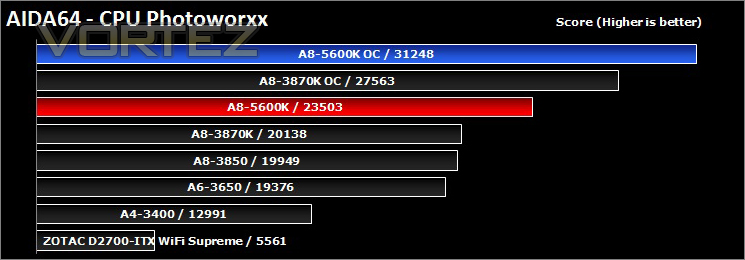
CPU Photoworxx Benchmark
This benchmark stresses the integer arithmetic and multiplication execution units of the CPU and also the memory subsystem. Due to the fact that this test performs high memory read/write traffic, it cannot effectively scale in situations where more than 2 processing threads used. For example, on a 8-way Pentium III Xeon system the 8 processing threads will be “fighting” over the memory, creating a serious bottleneck that would lead to as low scores as a 2-way or 4-way similar processor based system could achieve. CPU PhotoWorxx test uses only the basic x86 instructions, and it is HyperThreading, multi-processor (SMP) and multi-core (CMP) aware.
In polar respect in regards to the CPU Queen results, Integer performance is markedly improved.
CPU AES Benchmark
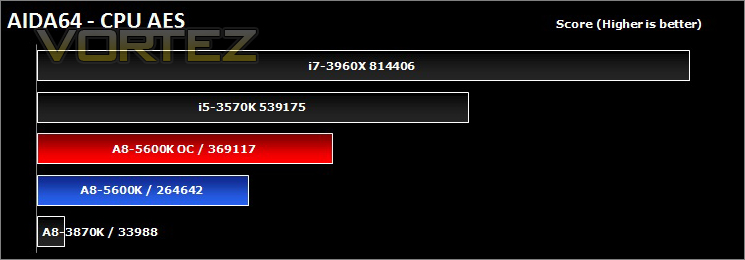
This benchmark measures CPU performance using AES (Advanced Encryption Standard) data encryption. In cryptography AES is a symmetric-key encryption standard. AES is used in several compression tools today, like 7z, RAR, WinZip, and also in disk encryption solutions like BitLocker, FileVault (Mac OS X), TrueCrypt.CPU AES test uses only the basic x86 instructions, and it’s hardware accelerated on VIA PadLock Security Engine capable VIA C3, VIA C7, VIA Nano and VIA QuadCore processors; and on Intel AES-NI instruction set extension capable processors. The test is HyperThreading, multi-processor (SMP) and multi-core (CMP) aware.
Like Bulldozer, Piledriver supports the AES Instruction set and has significant performance improvements in this area in regards to AMDs previous processors. A nice feature but not a scratch at Intel’s offerings.
FPU Mandel Benchmark
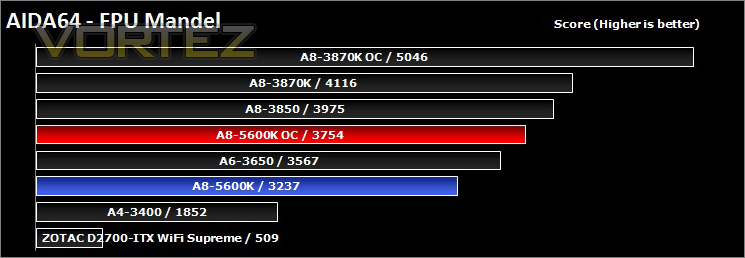
This benchmark measures the double precision (also known as 64-bit) floating-point performance through the computation of several frames of the popular “Mandelbrot” fractal. The code behind this benchmark method is written in Assembly, and it is extremely optimized for every popular AMD, Intel and VIA processor core variants by utilizing the appropriate x87, SSE2, AVX or FMA4 instruction set extension. FPU Mandel test is HyperThreading, multi-processor (SMP) and multi-core (CMP) aware.
Floating point performance has dropped compared to Llano, though may not be too much of an issue as the GPU portion is starting to take on more floating point operations.
Synthetic Benchmarks: x264 HD
Simply put, this test measures how fast your machine can encode a short, DVD quality MPEG-2 video clip into a high-quality x264 video clip. What’s x264, you ask? It’s more or less the next-generation Xvid/DivX codec. I think it’s ideal for a benchmark because the application (x264.exe) reports fairly accurate compression results (in frames per second) for each pass of the video encoding process, and it uses multi-core processors very efficiently.
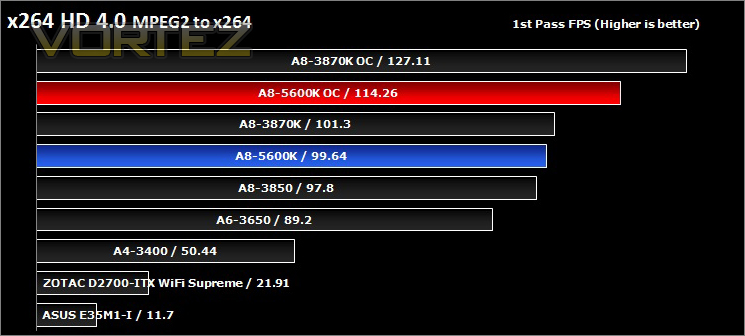
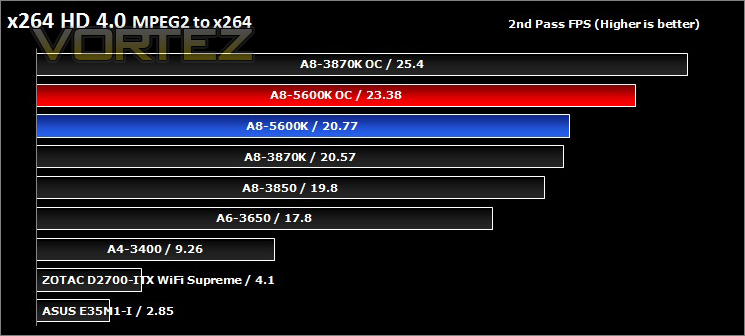
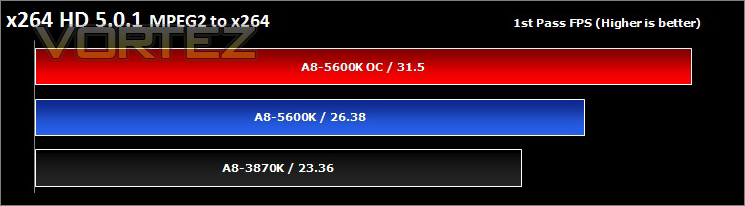
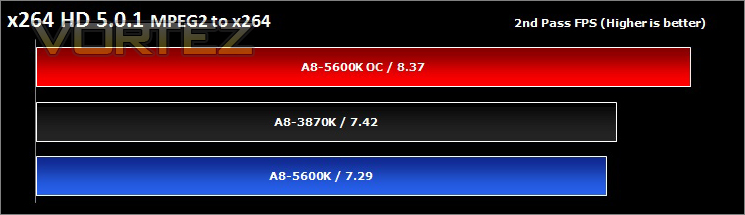
Using the latest edition of the x264 HD benchmark, the PC encodes a high quality x264 1080p movie clip and we can see that in the first pass, the A8-5600K performs marginally better than the A8-3870K, a role reversal when compared to the older edition of this benchmark.
Synthetic Benchmarks: Cinebench 11.5
CPU Rendering
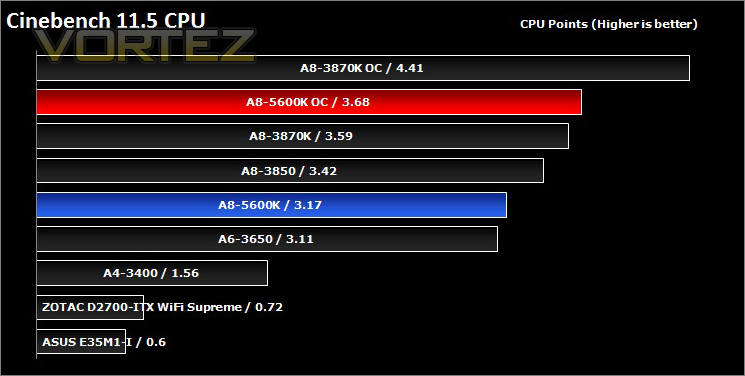
CINEBENCH can measure systems with up to 64 processor threads. This test scene contains approximately 2,000 objects which in turn contain more than 300,000 polygons in total, and uses sharp and blurred reflections, area lights, shadows, procedural shaders, antialiasing, and much more. The result is displayed in points (pts). The higher the number, the faster your processor.
Here we see poor rendering performance in comparision to Llano, weaker floating point operations vs stronger integer operations tend to be the bill of the day.
Open GL Graphics Rendering
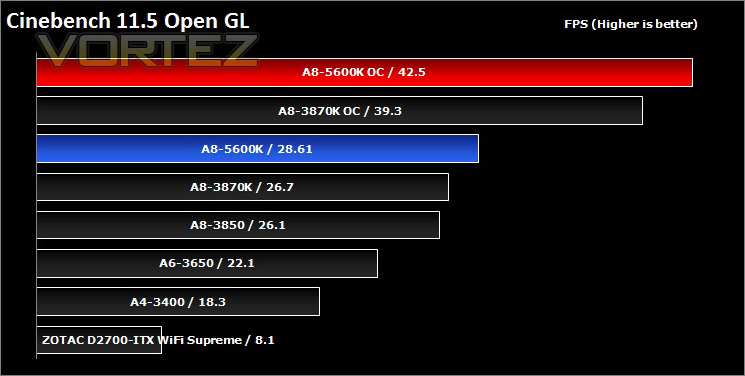
This procedure uses a complex 3D scene depicting a car chase (by renderbaron) which measures the performance of your graphics card in OpenGL mode. The performance depends on various factors, such as the GPU processor on your hardware, but also on the drivers used. The graphics card has to display a huge amount of geometry (nearly 1 million polygons) and textures, as well as a variety of effects, such as environments, bump maps, transparency, lighting and more to evaluate the performance across different disciplines and give a good average overview of the capabilities of your graphics hardware.
OpenGL performance of the Radeon HD 7560D is up with a good showing here.
Synthetic Benchmarks: SiSoftware SANDRA 2012
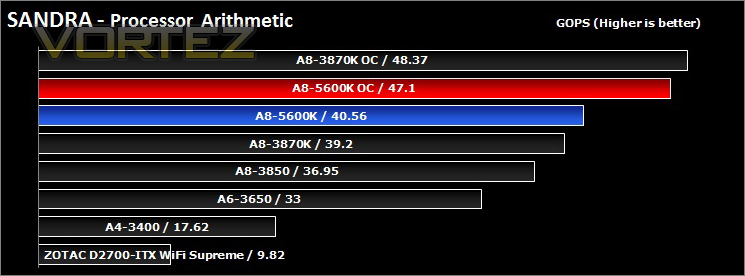
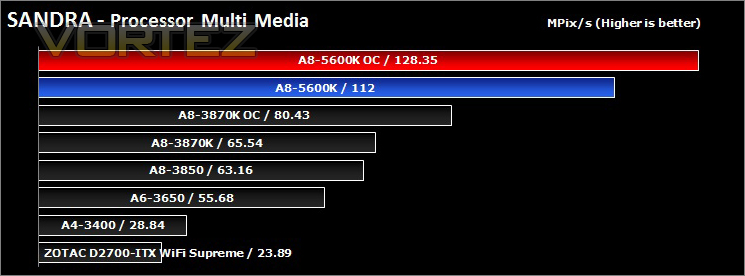
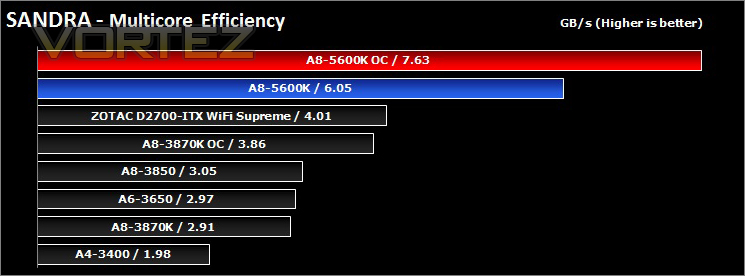
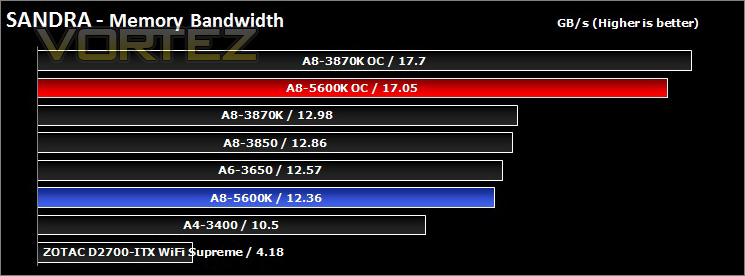
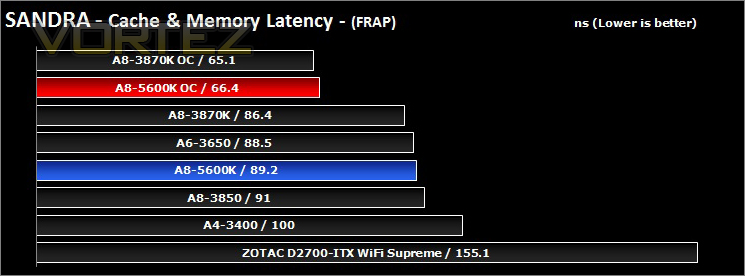
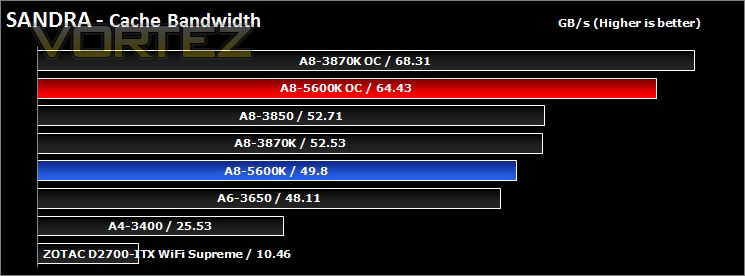
SANDRA isn’t always a benchmark that is included in hardware reviews but I believe it shouldn’t be ignored. SANDRA provides a vigorous package that tests your system in a rather large array of benchmarks. There are many aspects of benchmark that can be executed. We will be considering – CPU, memory and GPGPU tests.
In Sandra we can see good general performance improvements in comparison to Llano, specifically in the multicore efficiency.
Synthetic Benchmarks: SiSoftware SANDRA 2012 cont…
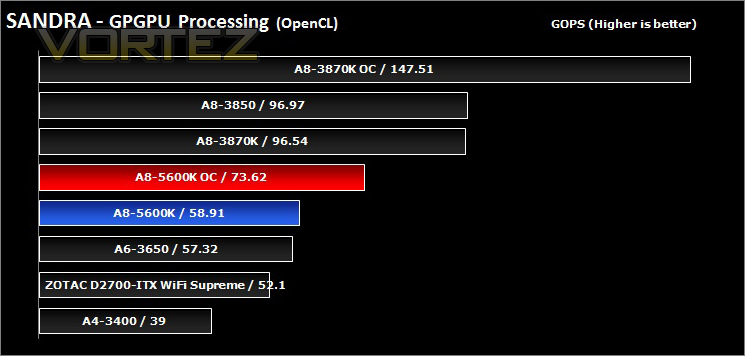
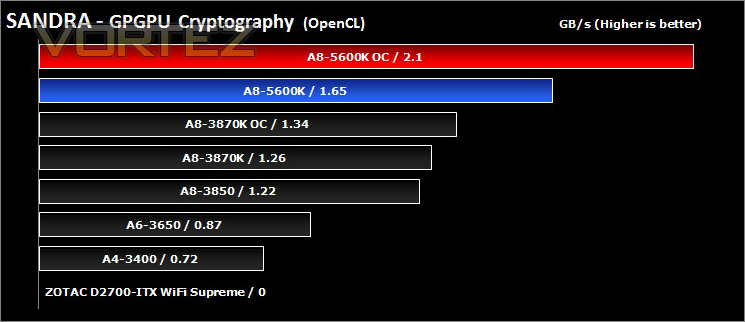
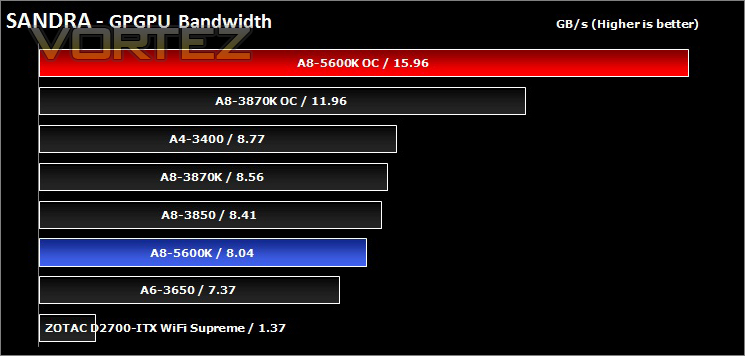
In the GPGPU benches, we can see that pure parallel processing performance is reduced due to lack of Radeon cores, (256 vs 320/400) but we see that the HD 7560D has better efficiency and performance per core in the cryptography bench when compared to the HD 6550D. We can see the extra bandwidth provided by the fast 2400MHz memory too in the OC results for the GPGPU bandwidth, not directly caused by the APU but its nice to know it can be used!
Synthetic Benchmarks: 3DMark Vantage & 3DMark 11
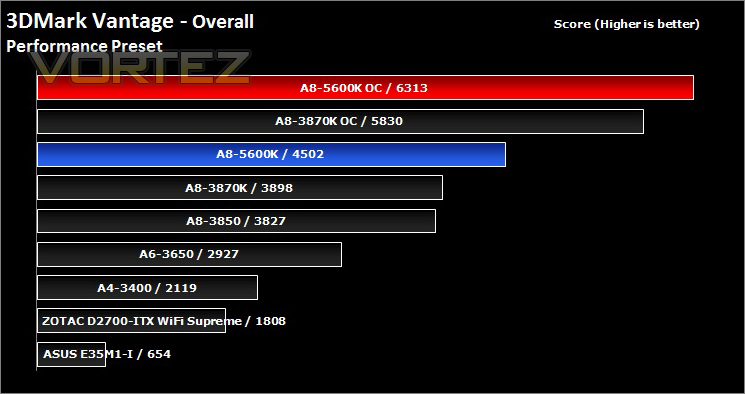
3DMark Vantage
3DMark Vantage is the industry standard performance benchmark for DirectX 10 gaming PCs. It includes two graphics tests, two CPU tests and six feature tests. Trusted by gamers worldwide to give accurate and unbiased results, 3DMark Vantage is the best way to consistently and reliably test DirectX 10 under game-like loads.
3DMark 11
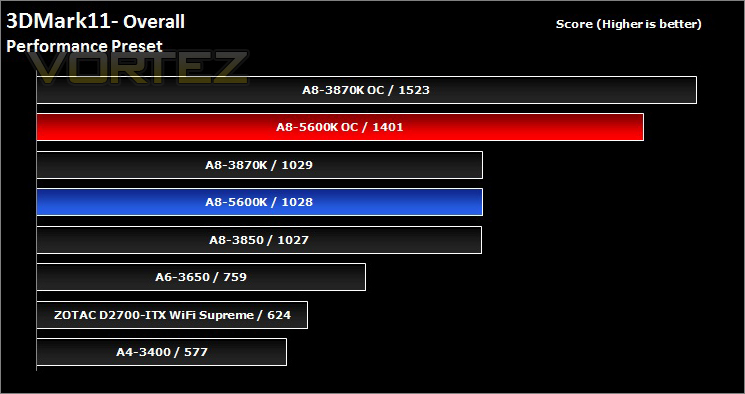
Designed to measure your PC’s gaming performance 3DMark 11 makes extensive use of all the new features in DirectX 11 including tessellation, compute shaders and multi-threading. Trusted by gamers worldwide to give accurate and unbiased results, 3DMark 11 is the best way to consistently and reliably test DirectX 11 under game-like loads.
Synthetic Benchmarks: PCMark 7 & UNIGINE Heaven 3.0
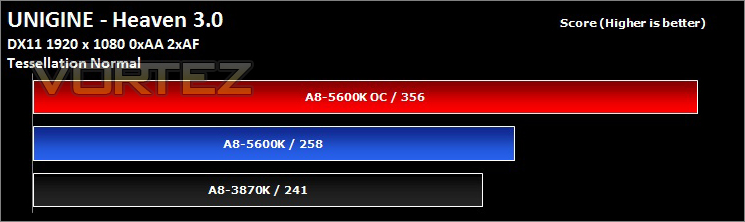
UNIGINE Heaven 3.0
Unigine’s benchmark is to showcase the benefits of DX 11 and the use of tessellation as opposed to normal rendering techniques. The demo has impressive visuals that give an insight into what we can expect from gaming in the future.
PCMark 7
PCMark 7 is a tool provided by FutureMark that tests the PCs ability in general office and everyday use. It produces a number that reflects the all-round performance of the PC and is useful to compare between differing setups. For more information, visit the FutureMark website.
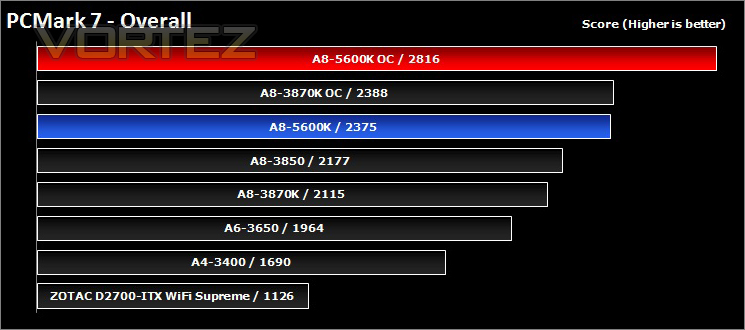
Impressive that the A8-5600K matches the overclocked A8-3870K in PCMark 7 at stock speed!
Game Benchmarks: AVP, Deus Ex:HR, Shogun 2
Alien Vs. Predator
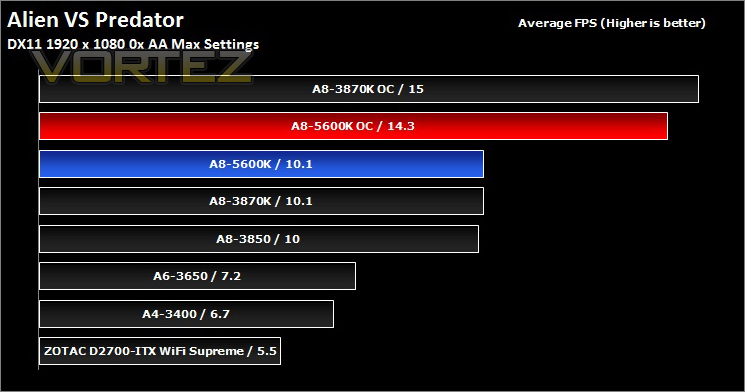
Spawned from the popular Alien and Predator franchises, Rebellion have collaborated to bring the legendary war to us through the medium of a first-person shooter. The game forces you to hunt, prey and most importantly survive in the swamp colony of Freya’s prospect as a Predator, Alien or Marine. The stunning visuals add to the sense of dread and terror that we have become so accustomed to seeing with the series.
The stand-alone Alien VS Predator benchmark tool was used for testing here. All the settings were set to very high and Tessellation was applied. The average FPS was recorded at the end.
The stand-alone Alien VS Predator benchmark tool was used for testing here. All the settings were set to very high and Tessellation was applied. The average FPS was recorded at the end.
Deus Ex: Human Revolution
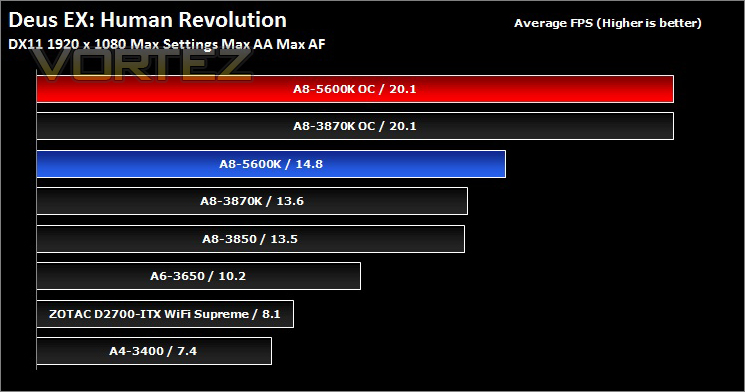
You play Adam Jensen, an ex-SWAT specialist who’s been handpicked to oversee the defensive needs of one of America’s most experimental biotechnology firms. Your job is to safeguard company secrets, but when a black ops team breaks in and kills the very scientists you were hired to protect, everything you thought you knew about your job changes.
Shogun 2
In the darkest age of Japan, endless war leaves a country divided. It is the middle of the 16th Century in Feudal Japan. The country, once ruled by a unified government, is now split into many warring clans. Ten legendary warlords strive for supremacy as conspiracies and conflicts wither the empire. Only one will rise above all to win the heart of a nation as the new shogun…The others will die by his sword.
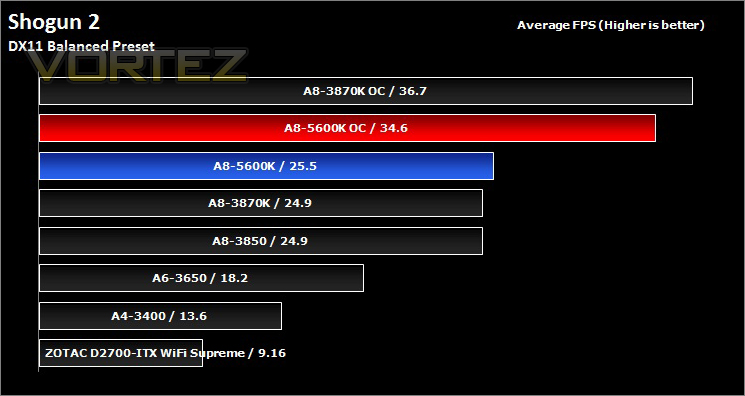
Game Benchmarks: TESV, DiRT Showdown, Sleeping Dogs
TESV: Skyrim
The Empire of Tamriel is on the edge. The High King of Skyrim has
been murdered. Alliances form as claims to the throne are made. In the midst of this conflict, a far more dangerous, ancient evil is awakened. Dragons, long lost to the passages of the Elder Scrolls, have returned to Tamriel. The future of Skyrim, even the Empire itself, hangs in the balance as they wait for the prophesized Dragonborn to come; a hero born with the power of The Voice, and the only one who can stand amongst the dragons.
been murdered. Alliances form as claims to the throne are made. In the midst of this conflict, a far more dangerous, ancient evil is awakened. Dragons, long lost to the passages of the Elder Scrolls, have returned to Tamriel. The future of Skyrim, even the Empire itself, hangs in the balance as they wait for the prophesized Dragonborn to come; a hero born with the power of The Voice, and the only one who can stand amongst the dragons.
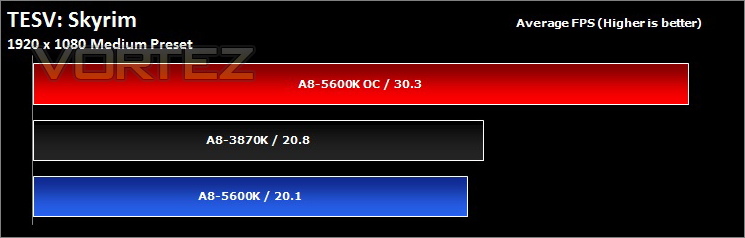
DiRT Showdown
DiRT Showdown is the new arcade racing game from the team that brought you the award-winning DiRT series, uncaged in 2012. Pick up and play controls combine with electrifying events, frenzied crowds and stunning graphics to deliver high octane, dive in and drive thrills from event one. DiRT Showdown comes with phenomenal graphical performance, bone-jarring damage, and social online and split-screen multiplayer as standard. Welcome to DiRT Showdown – a new world of driving delirium.
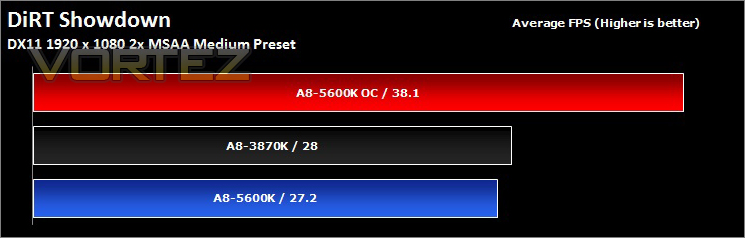
Sleeping Dogs
Welcome to Hong Kong, a vibrant neon city teeming with life, whose exotic locations and busy streets hide one of the most powerful and dangerous criminal organizations in the world: the Triads. You play the role of Wei Shen, an undercover cop trying to take down the Triads from the inside out. You’ll have to prove yourself worthy as you fight your way up the organization, taking part in brutal criminal activities without blowing your cover. Torn between your loyalty to the badge and a criminal code of honor, you will risk everything as the lines between truth, loyalty and justice become permanently blurred.
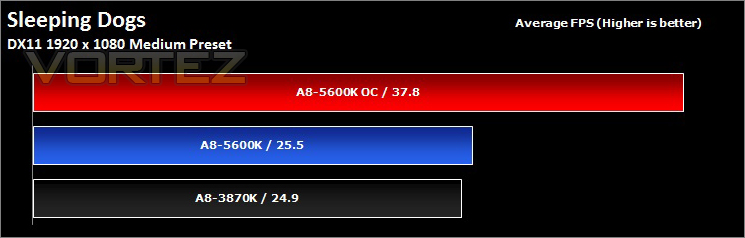
Other Observations: Ram OC
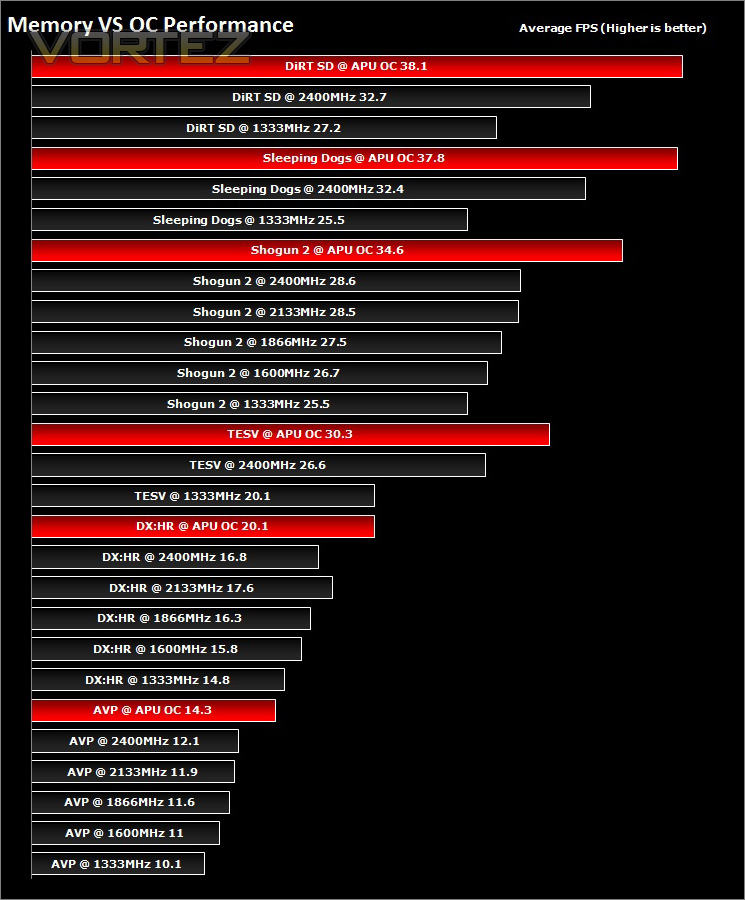
By overclocking the memory we can unleash the full potential of the integrated graphics which may be bottlenecked by relatively slow and restrictive memory bandwidth. Using the Team Xtreem 2400MHz memory we can see that the HD 7560D reaches it’s full potential around the 2133MHz speed and that in the case of Deus EX:HR, the 2400MHz speed was even detrimental to the performance. An average performance increase of 21% in FPS between memory speeds of 1333MHz-2400MHz with most of that achieved by the time we were using 2133MHz is nothing to be sniffed at especially as faster, higher performance memory (1866-2133MHz) is becoming more readily available. Our overclock performance gives an extra 40% FPS on average which is impressive considering most of our game benchmarks are at 1920×1080 resolution. It is likely that the A10’s HD 7660D with 384 Radeon cores may benefit more from the larger memory bandwidth.
Conclusion
When comparing the A8-5600K to the previous generation, there are some new worthwhile features, such as Eyefinity and the AMD HD Media Accelerator. There are vast improvements that can be seen, especially in the CPU core scaling and memory bandwidth and the new iGPU with just 256 cores keeps pace with the 400 cores of the HD 6550D proving how efficient and robust the new architecture is.
Overall the performance was a little underwhelming in a ‘seen it all before’ sense, but looking at it more from a media/HTPC side, Trinity seems to offer almost everything one could need and the user experience was seamless and smooth throughout as to hold up that bar of mainstream user expectations. When compared to the Intel offerings, Trinity really hammers home the point that a strong GPU is essential to a modern computing experience and the A8-5600K has spades full of performance that allows for casual gaming at decent settings. Extra performance can be had with faster memory and overclocking which with the right motherboard is fairly simple to do. Another consideration is that more motherboards are starting to adopt Lucid Virtu MVP, which is particularly useful as you will have the ability to use the decent iGPU alongside any discrete graphics card and it really adds to the longevity and value of the APU.
At time of writing this chip costs around £80inc VAT and there is little to fault it at this price point. Power use isn’t anything extreme and is suited to low power applications. Performance has been a little bit of a sideways increase in some aspects, focusing on the GPU compared to the competition, AMD are winning, yet that is no excuse to sweep the CPU dust under the rug. Making an informed choice on which CPU/APU is ideal for ones computing needs is important.
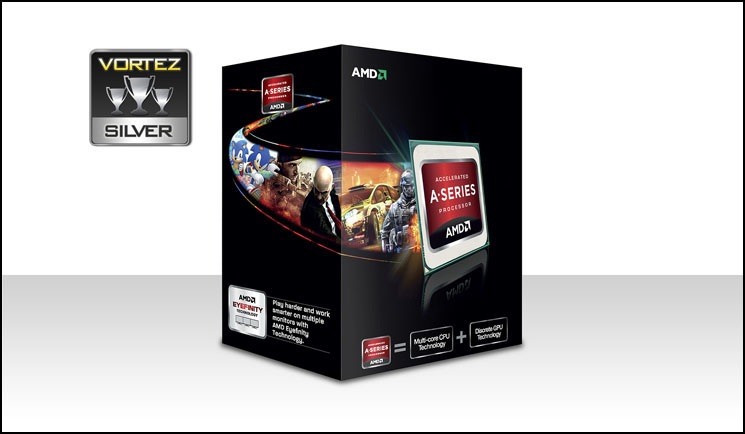
That all said, AMD have released a new APU that delivers new features and generally improved performance that is worthy of consideration, for those reasons the A8-5600K has been awarded with the Vortez Silver.
Pros.
+ Discrete class integrated graphics
+ Overclocking potential on CPU + GPU
+ AMD HD Media Acceleration
Cons.
– Can be out performed by predecessor
+ Discrete class integrated graphics
+ Overclocking potential on CPU + GPU
+ AMD HD Media Acceleration
Cons.
– Can be out performed by predecessor

Click here for an explanation of our awards at Vortez.net. Thanks to AMD for providing today’s review sample.


