The fastest Athlon yet hits the FM2+ platform; by doing without the integrated GPU as found in the A-Series APUs, AMD provide better value for gamers.

Product on Review: AMD Athlon X4 880K
Manufacturer & Sponsor: AMD
Street Price: £79.99 GBP / $95 USD
In the realm of desktop processors it is no secret that the AMD gears have slowed down, cautiously preparing the up and coming ‘Zen’ microarchitecture. In the mean time, AMD remind us that those gears have not stopped with a small wave of refreshed processors with higher stock frequencies. Naturally this comes with a more mature and reliable fabrication process. Alongside the higher clocked A10-7890K APU they released the Athlon X4 880K, the highest clocked Athlon processor to date. Out the box speeds sit at a reasonable (for current AMD architecture) 4/4.2 GHz, and being a K series CPU, one would be correct in assuming that it comes with an unlocked multiplier.
The Athlon x4 880K does not have an integrated GPU, whether it is designed that way or if it is in fact a cut down APU with the GPU disabled is one for people to ponder over. This is the reason why the Athlon x4 series represents better value for gamers seeking to use a discrete GPU, saving of £55/$70 over the similarly clocked APU. That would of course be a pretty penny extra towards a GPU of choice. Adding to the overall package, the 880K (95W TDP) is lumped with the 125W ‘Near Silent Thermal Solution’ which is pretty much a ‘Wraith’ cooler without the shroud and LED logo. Nice!
Overview by AMD
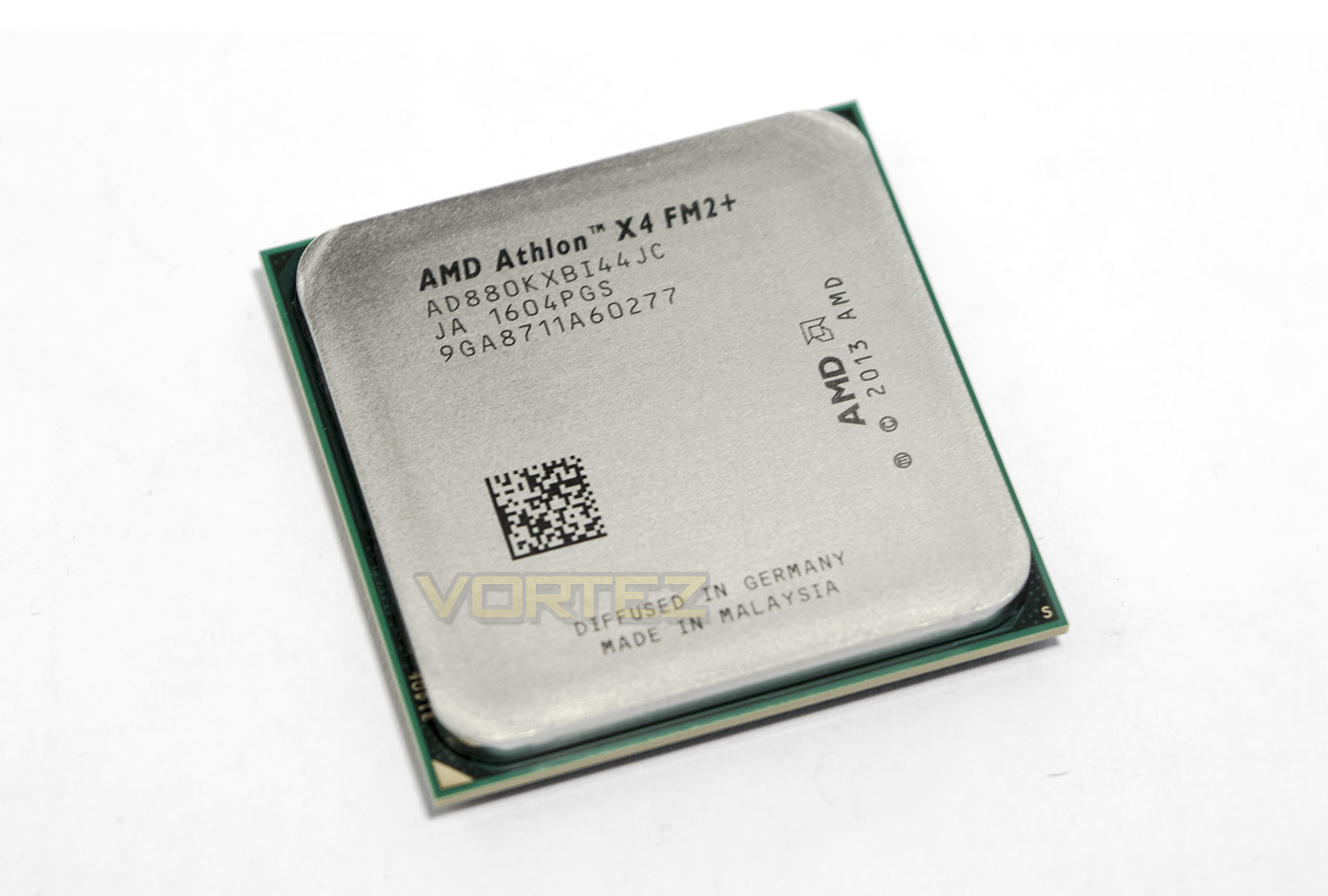
The new Athlon™ X4 880K is the fastest multi-core Athlon™ processor ever made, boasting a 4.2 GHz maximum turbo frequency and an unlocked clock multiplier. Paired with the new near-silent 125W AMD Thermal Solution – featuring the same capable hardware and performance of the Wraith Cooler, without the illuminated shroud – this processor delivers high multi-core performance that can deliver extremely high frame rates in some of the most played and popular online games, capable of providing smooth performance at 1440p and 4K when paired with a capable graphics card.
Technical Specifications
Total L1 Cache: 256 KB
Total L2 Cache: 4 MB
Unlocked: Yes
CMOS: 28nm
Package: FM2+
Thermal Solution: Near Silent 125W
# of CPU Cores: 4
Base Clock Speed: 4 GHz
Max Turbo Core Speed: 4.2 GHz
Max Temps: 72.40° C
TDP: 95 W
Max Memory Speed: 2,133 MHz
Memory Interface: DDR3
Memory Channels: 2
AES Support: Yes
FMA4: Yes
AVX: Yes
AMD Virtualization: Yes
Total L2 Cache: 4 MB
Unlocked: Yes
CMOS: 28nm
Package: FM2+
Thermal Solution: Near Silent 125W
# of CPU Cores: 4
Base Clock Speed: 4 GHz
Max Turbo Core Speed: 4.2 GHz
Max Temps: 72.40° C
TDP: 95 W
Max Memory Speed: 2,133 MHz
Memory Interface: DDR3
Memory Channels: 2
AES Support: Yes
FMA4: Yes
AVX: Yes
AMD Virtualization: Yes
Product & Bundle
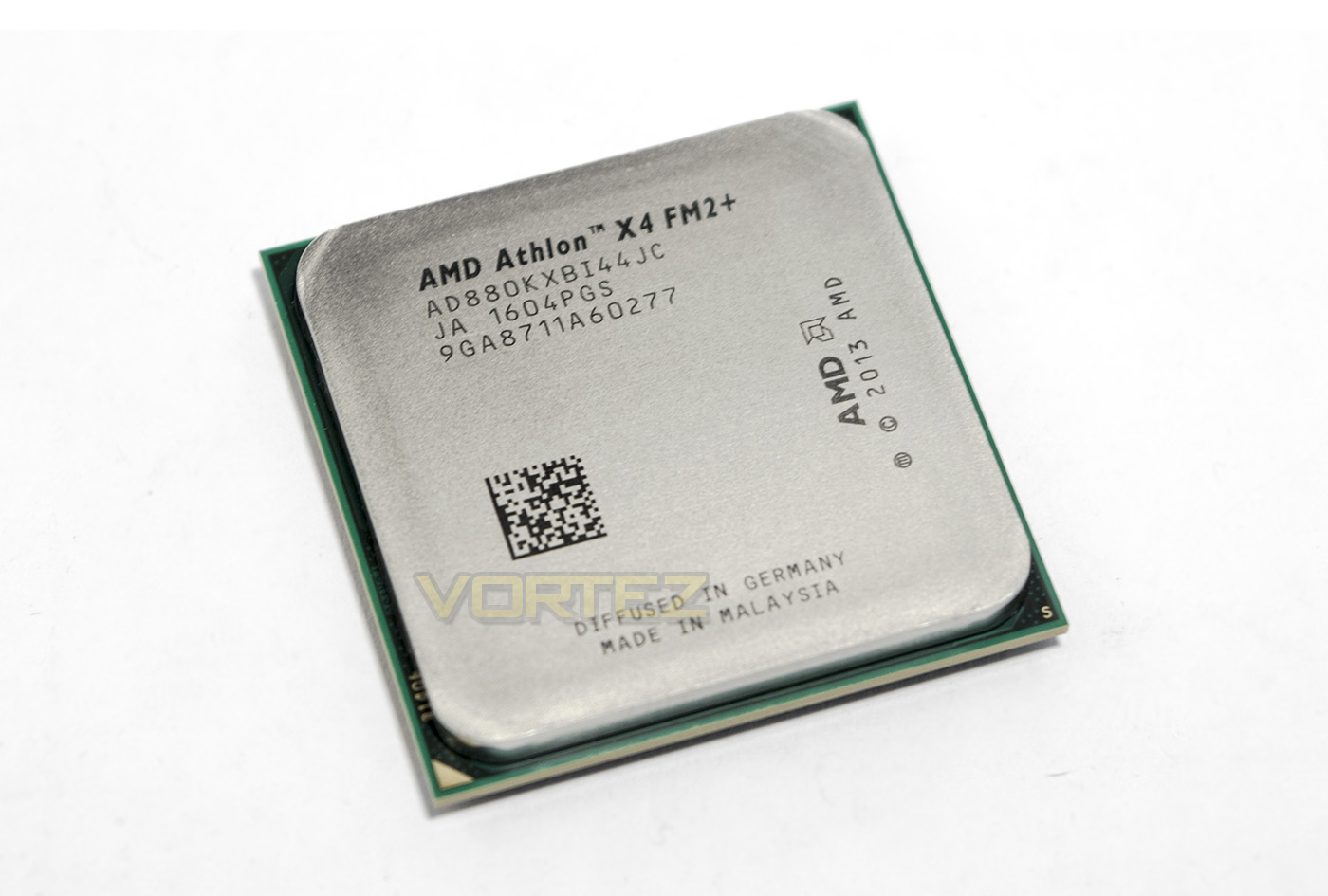
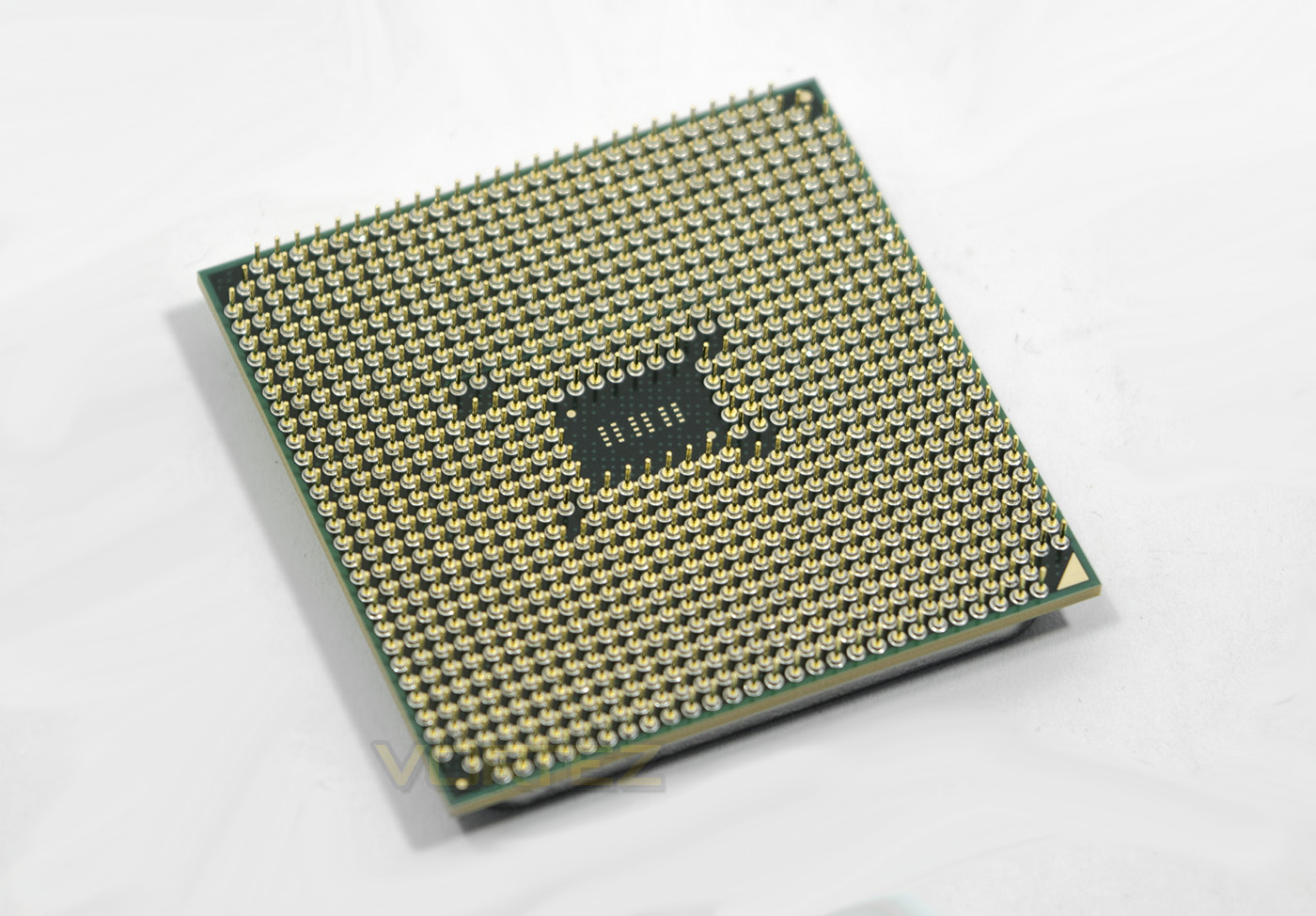
The 880K fits in with the rest of the AMD chips with the large IHS printed with its model number. The pin layout is of course for the FM2+ socket.
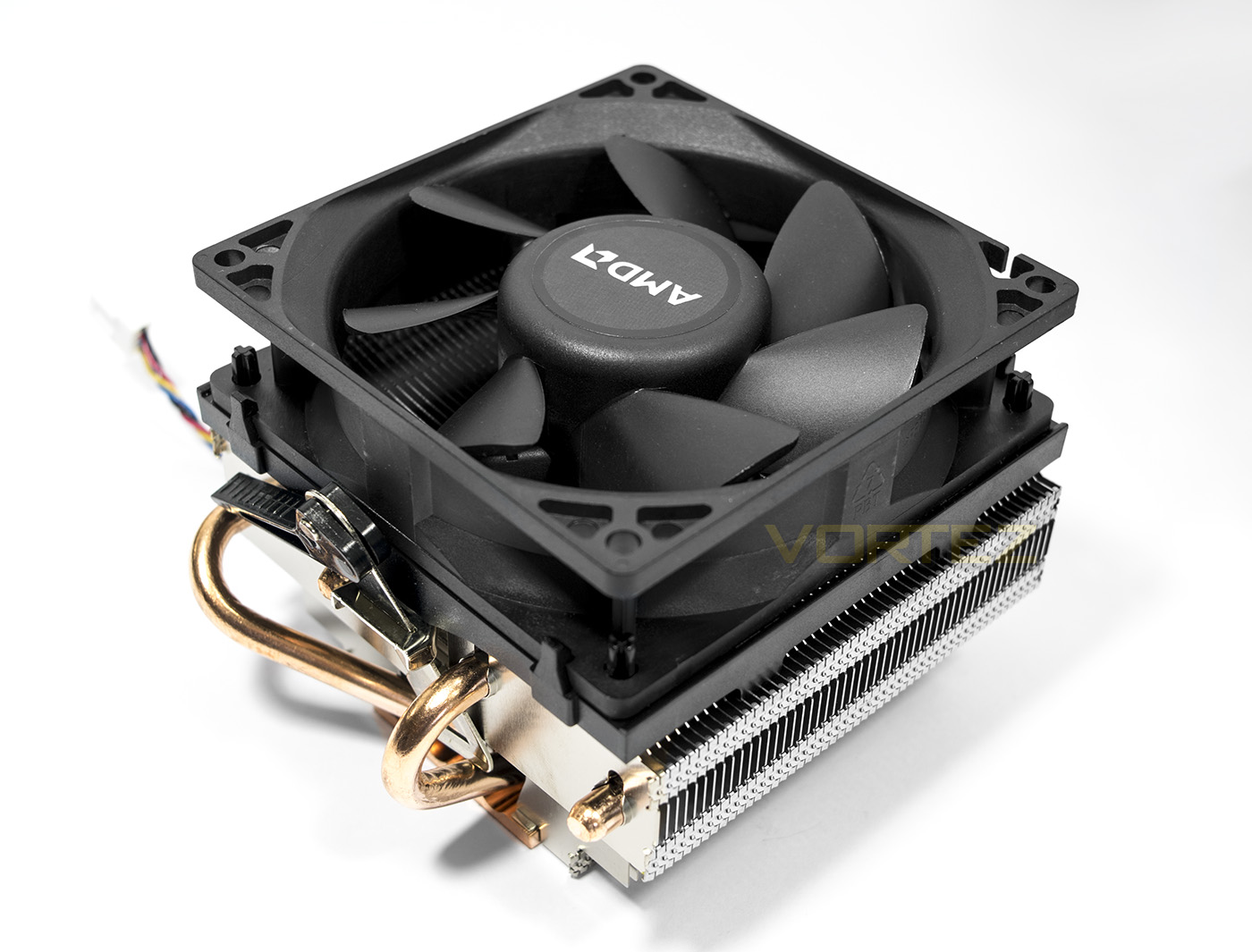
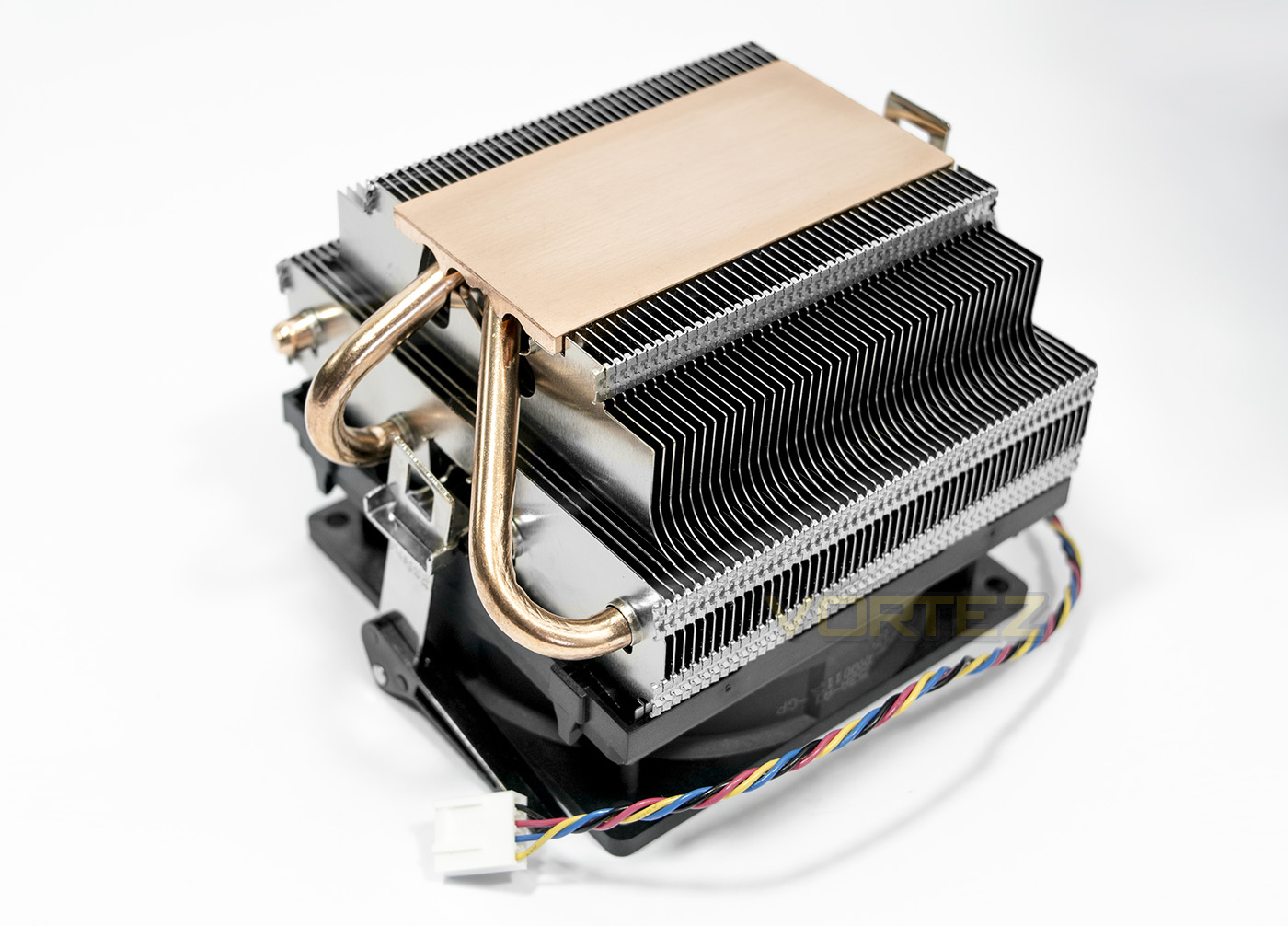
The included Near-Silent Thermal Solution heatsink is large, heavy, with a copper base and four heatpipes. The sheer size of it may make it unusable on some ITX motherboards considering it covers an area about 112×127 mm around the socket, I have tested the Wraith cooler, which seems to be the same heatsink block, on various ITX motherboards and the biggest issue is how close the DIMMs are placed to the socket, so you may want to consider this when purchasing an ITX motherboard.
Test Setup, Methodology & Overclocking
Test SetupCPU AMD Athlon X4 880K, A10-7850K, A8-7650K, FX-8370, FX-8350
Cooling AMD WRAITH/near silent Thermal solution
Motherboard GIGABYTE G1-A88X Sniper
Memory AMD RADEON 2x 8GB DDR3 2400MHz
Graphics GIGABYTE AMD R9 280X
Storage HYPERX 3K 240GB
PSU NZXT HALE 650W
Cooling AMD WRAITH/near silent Thermal solution
Motherboard GIGABYTE G1-A88X Sniper
Memory AMD RADEON 2x 8GB DDR3 2400MHz
Graphics GIGABYTE AMD R9 280X
Storage HYPERX 3K 240GB
PSU NZXT HALE 650W
Benchmarks
Cinebench R15 – CPU Score
x264 HD 4.0 – 1st and 2nd pass encoding
SiSoftware SANDRA 2014 – CPU & Memory benchmarks
AIDA64 – CPU benchmarks
PCMark 8 – Home Suite
3DMark FireStrike – DX11 3D Benchmark
Games – Tomb Raider, THIEF
x264 HD 4.0 – 1st and 2nd pass encoding
SiSoftware SANDRA 2014 – CPU & Memory benchmarks
AIDA64 – CPU benchmarks
PCMark 8 – Home Suite
3DMark FireStrike – DX11 3D Benchmark
Games – Tomb Raider, THIEF
Other Software
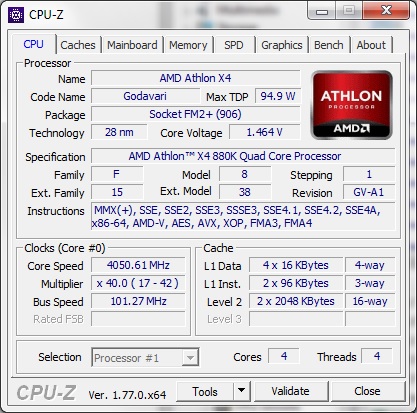
CPU Specification Monitoring: CPU-Z
System Monitoring: AMD Overdrive, HWMonitor
System Monitoring: AMD Overdrive, HWMonitor
Overclocking
Overclocking the 880K will be a breeze for most people depending on your motherboard. Using the unlocked multiplier to bump clock speeds will generally be the best bet for most, though you could play around with the turbo speeds also. The 880K had no problem booting in at 4.5GHz and 4.6GHz (multiplier of x46). Overclocking via the base clock will result in various other system changes and may result in ‘banding’ for other connected clocks such as the PCIe lanes. Though don’t let this put you off from changing the Base Clock frequency. The Northbridge frequency is something worth looking at also, bumping it to 2000/2200MHz over the base 1800MHz could help improve performance with memory intensive operations.
A downside I discovered while playing with the Athlon chip is that it is rather HOT. I even swapped out the bundled cooler for the Noctua NH-U12S and the temperatures were still concerning. Sitting at 46 degrees stock and 57 degrees overclocked. At any OC setting benchmarks were subject to heavy throttling as temperatures soared to 83 degrees and that was only in Cinebench! (Maximum rated is 73.5) (the resulting score was a heavily throttled 214, nearly 100 pts less than it should be). So it would be fair to say that the overclocking potential is certainly there but the cooling required for a supposed 95W TDP CPU may be disproportionately larger/more expensive for optimal results.
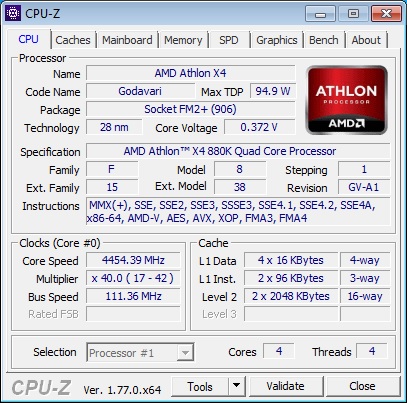
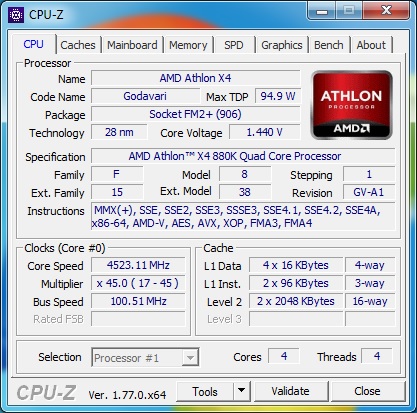
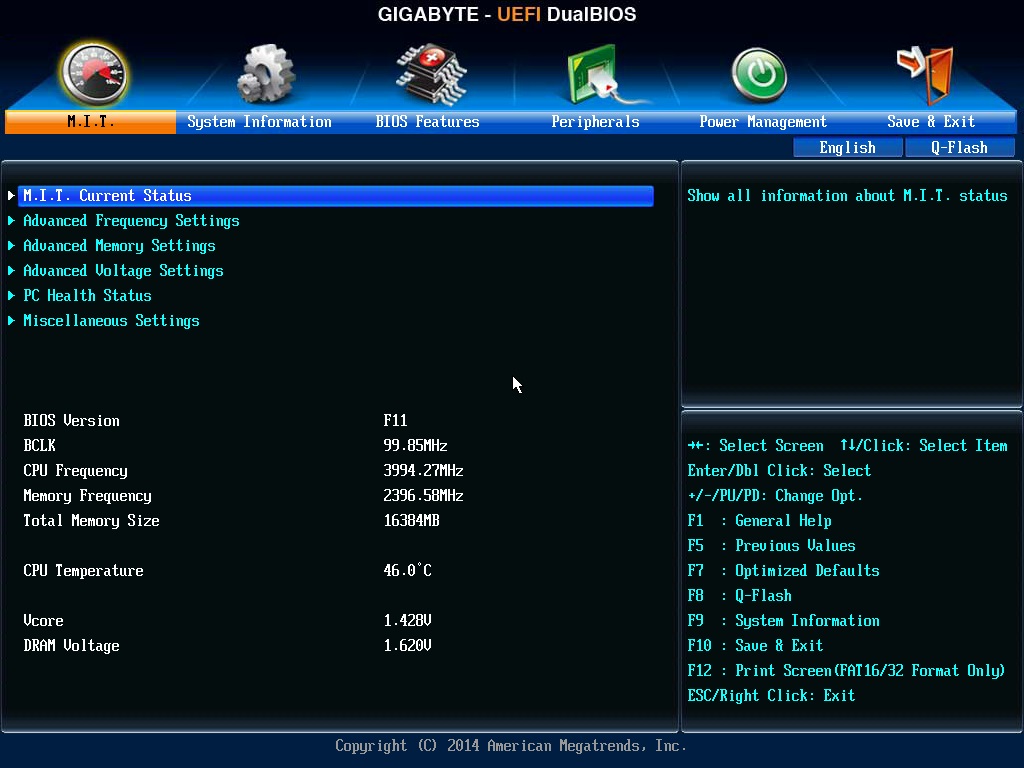
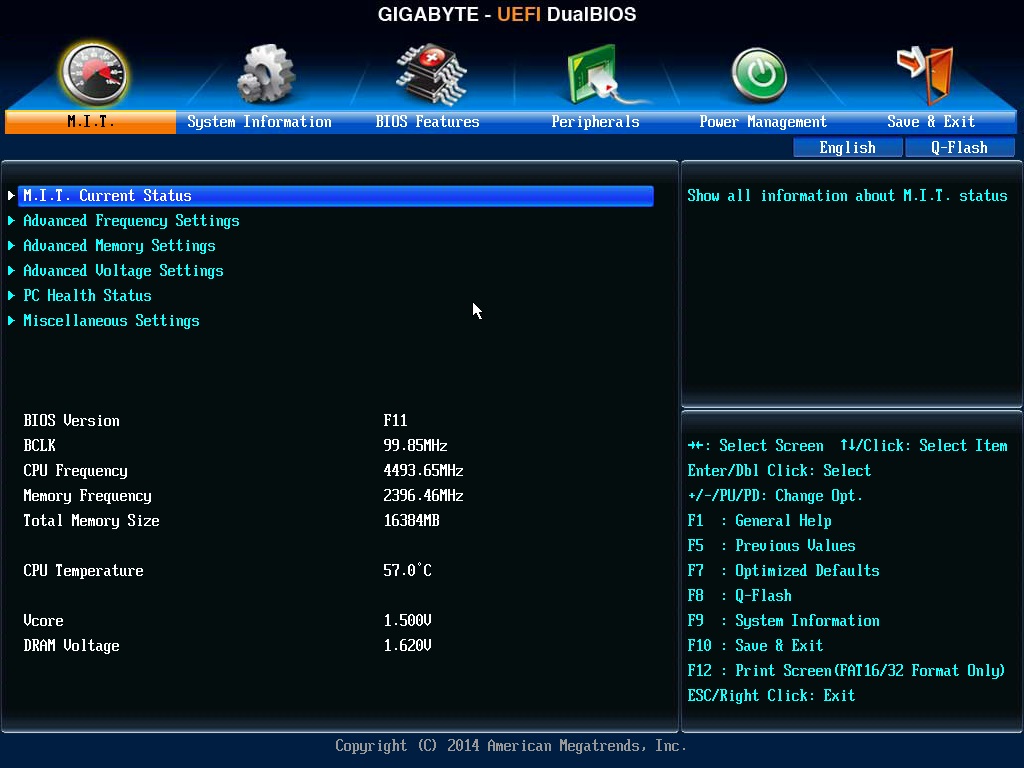
Sitting in BIOS you can see the difference in temperatures between stock and overclock settings.
Benchmarks: Power Consumption
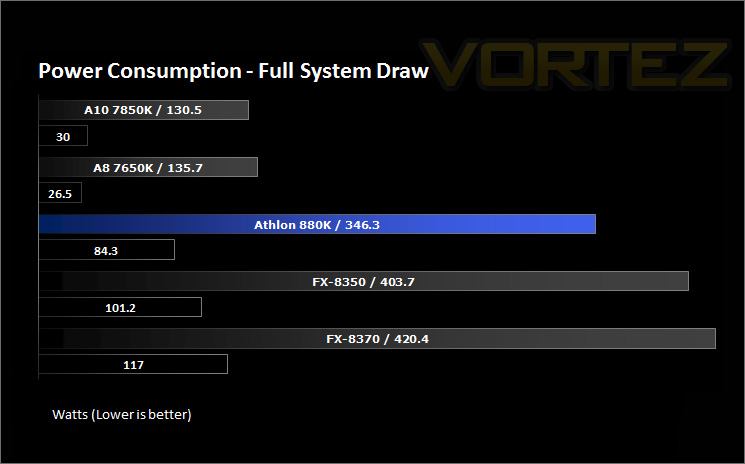
It’s interesting to note the power consumption across all motherboards. Energy results can fluctuate between manufacturers and chipsets due to the features and specifications that are integrated. First of all, for the idle tests the system is cold booted into Windows and no additional applications are executed – the watts are noted on the external energy monitor we use and then the system is loaded with 3DMark FireStrike – watts are again monitored for the duration of the test and the highest rated wattage result is then noted down. Below are the results of this energy test.
Despite being strapped with a power hungry GPU, the 880K saps a noticeable amount less power than the FX chips at both idle and load, and would be reasonable to assume that the max power use of the CPU itself is inline with its APU siblings when we consider that the GPU itself is responsible for around 250W draw.
Benchmarks: X264 HD
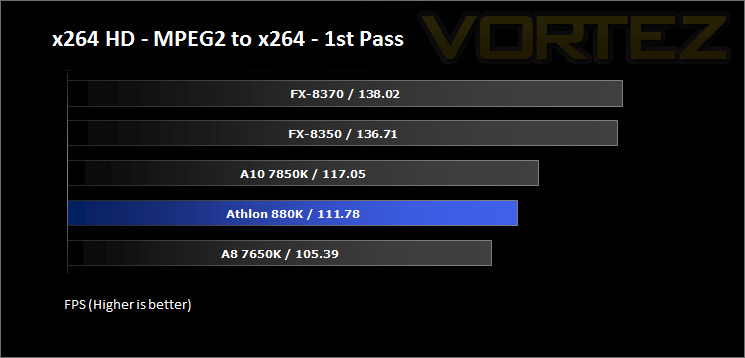
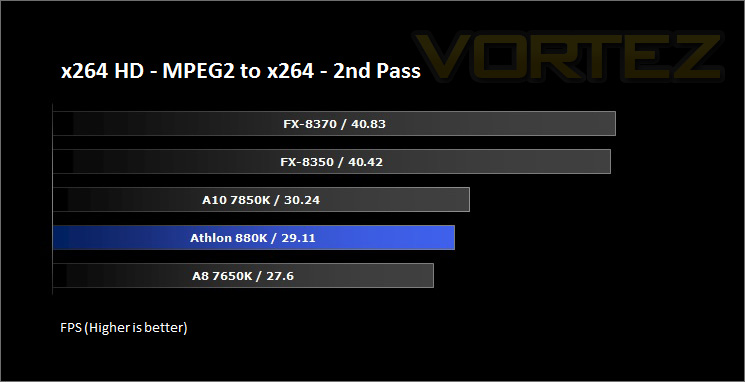
Simply put, this test measures how fast your machine can encode a short, DVD quality MPEG-2 video clip into a high-quality x264 video clip. What’s x264, you ask? It’s more or less the next-generation Xvid/DivX codec. I think it’s ideal for a benchmark because the application (x264.exe) reports fairly accurate compression results (in frames per second) for each pass of the video encoding process, and it uses multi-core processors very efficiently.
Benchmarks: AIDA64
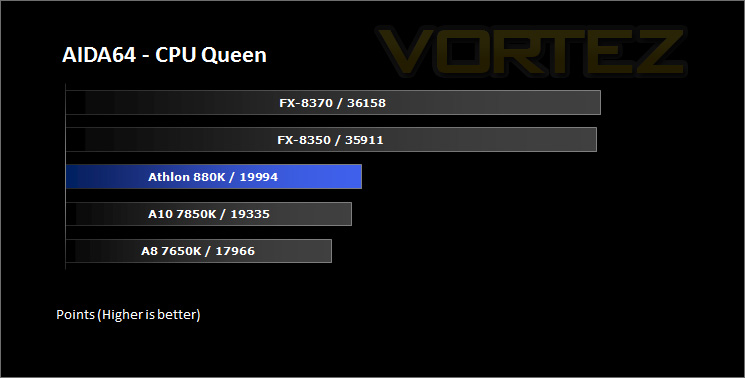
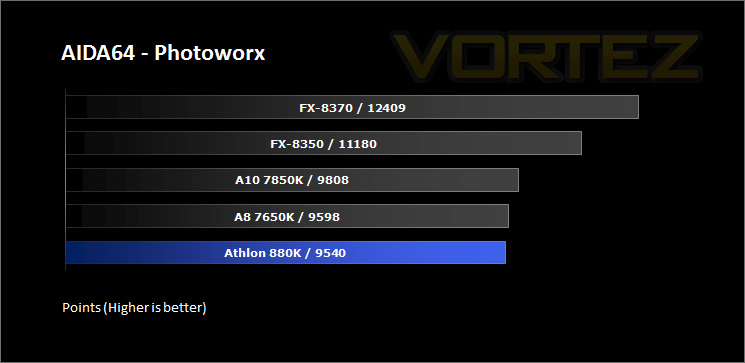
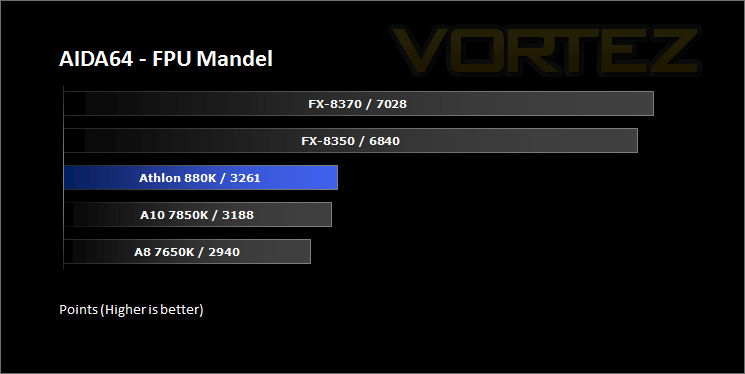
AIDA64 Product PageThis simple integer benchmark focuses on the branch prediction capabilities and the misprediction penalties of the CPU. It finds the solutions for the classic “Queens problem” on a 10 by 10 sized chessboard. At the same clock speed theoretically the processor with the shorter pipeline and smaller misprediction penalties will attain higher benchmark scores. For example — with HyperThreading disabled — the Intel Northwood core processors get higher scores than the Intel Prescott core based ones due to the 20-step vs 31-step long pipeline. CPU Queen test uses integer MMX, SSE2 and SSSE3 optimizations.
The 880K matches the A10 7850K, and sometimes edges it out a little due to its slightly higher base frequency.
Benchmarks: Cinebench R15
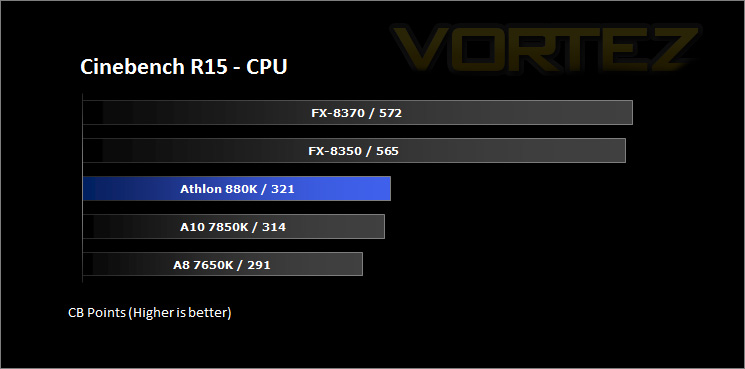
CINEBENCH is a real-world cross platform test suite that evaluates your computer’s performance capabilities. CINEBENCH is based on MAXON’s award-winning animation software CINEMA 4D, which is used extensively by studios and production houses worldwide for 3D content creation. MAXON software has been used in blockbuster movies such as Iron Man 3, Oblivion, Life of Pi or Prometheus and many more.
As expected, the slightly higher frequency of the Athlon x4 880K edges ahead of the A10-7850K, in this CPU test.
Benchmarks: SiSoftware SANDRA
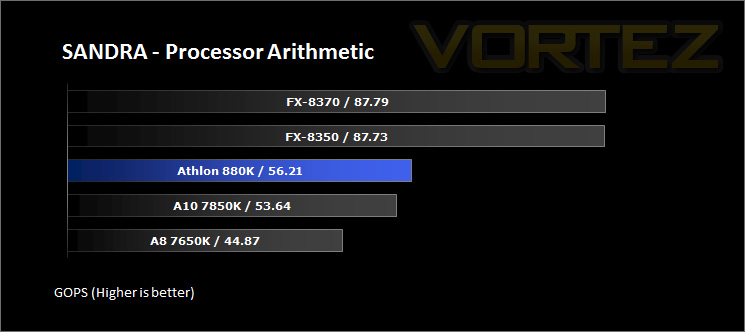
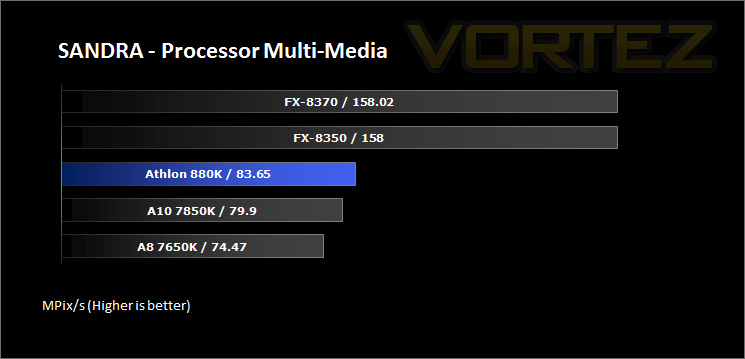
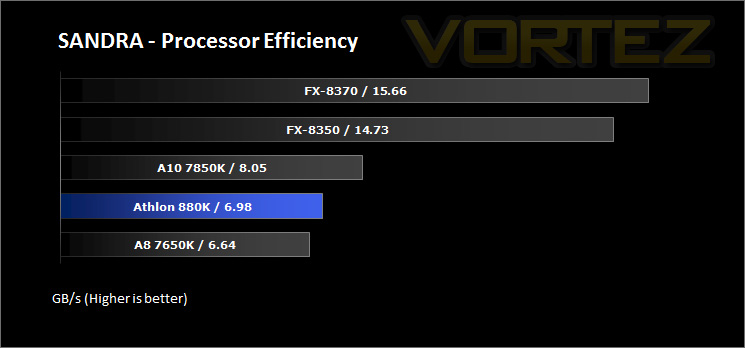
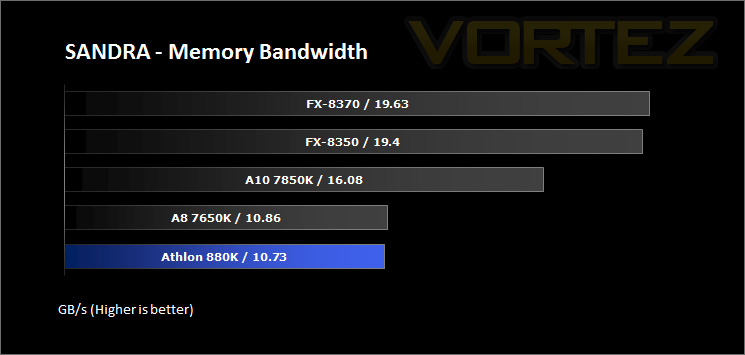
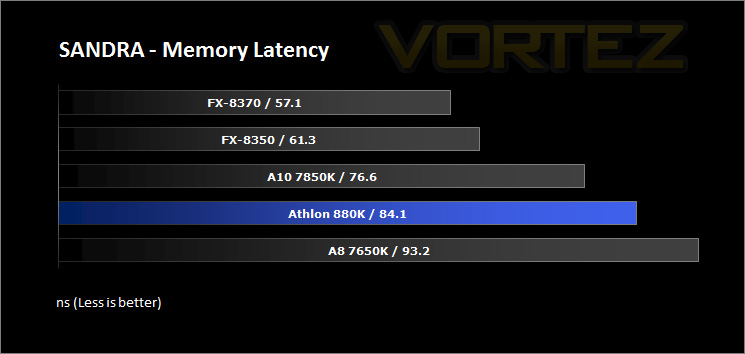
SANDRA isn’t always a benchmark that is included in hardware reviews but I believe it shouldn’t be ignored. SANDRA provides a vigorous package that tests your system in a rather large array of benchmarks. There are many aspects of benchmark that can be executed. We will be considering – CPU and memory tests.
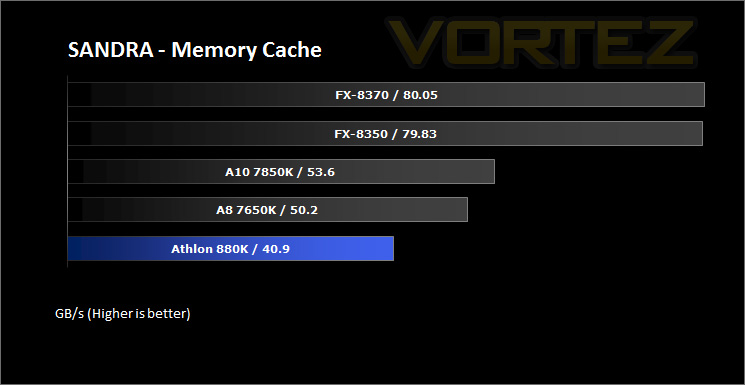
The 880K lags a little in regards to memory tests, but the higher clock speeds edge it up to around 65% the performance of the FX chips, showing their inefficiency considering they have twice the cores and higher frequencies.
Benchmarks: 3DMark
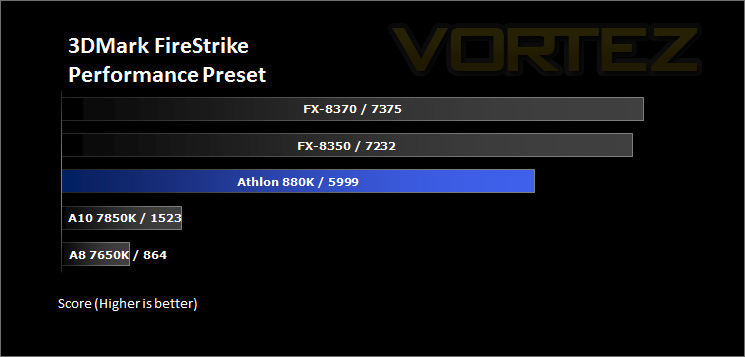
3DMark FireStrike Product PageFire Strike is our new showcase DirectX 11 benchmark designed for high-performance gaming PCs. It is our most ambitious and technical benchmark ever, featuring real-time graphics rendered with detail and complexity far beyond what is found in other benchmarks and games today. Fire Strike will only be available in the Windows editions of 3DMark initially.
Though the Athlon clearly has the advantage with a discrete GPU over the APUs, its performance isn’t far off the FX-chips with the same GPU.
Benchmarks: PCMark 8
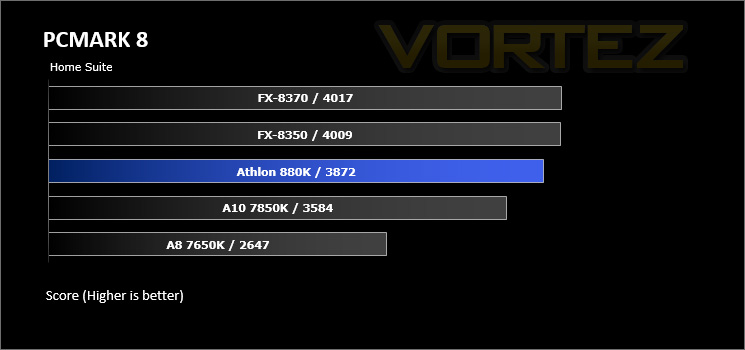
PCMark 8 combines performance benchmarking with battery life measurement and includes tests based on popular Adobe and Microsoft applications. Whether you are looking for long battery life, or maximum power, PCMark 8 will help you find the devices that offer the perfect combination of efficiency and performance for your needs. It’s the complete PC performance benchmark for home and business.
PCMark8 shows an interesting story for general home PC use, with the Athlon and FX chips barely benefiting from the discrete GPU over the APU in day to day tasks.
Benchmarks: Tomb Raider & THIEF
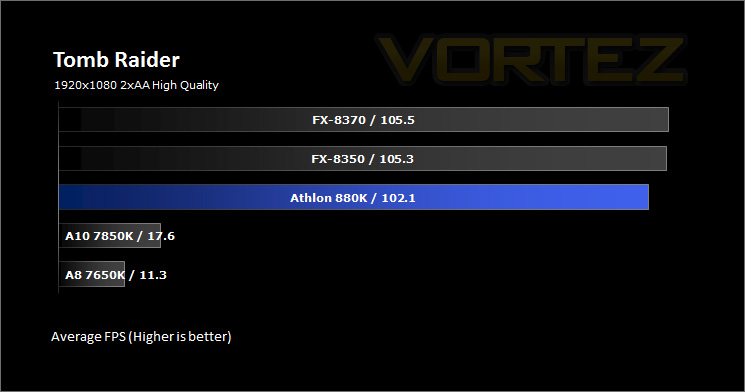
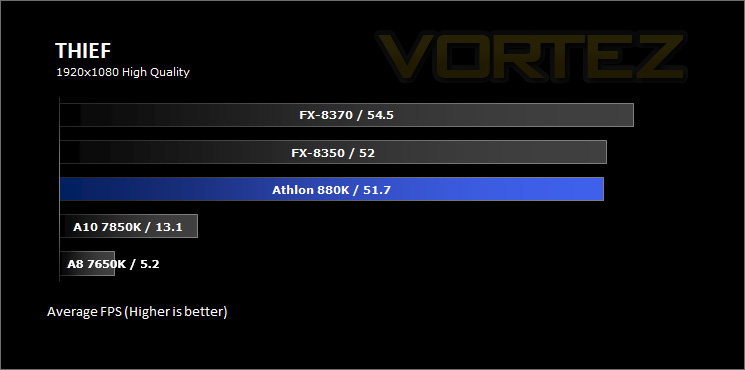
It’s important for us to perform a number of game benchmarks as well as the synthetic tests because gamers will want to know if there are any significant benefits. So here we have two popular and recent gaming titles which feature a dedicated benchmark tool within them to display results.
Gaming shows the true benefits of the cheaper Athlon x4 880K, keeping pace with the FX chips. Though it is likely that some games may benefit more from the additional cores, gaming is still largely a 4core+ region, with some games, (like Far Cry 4) not able to run with a dual core, limiting budget gaming systems from the Intel camp running with Pentium processors.
Conclusion
The fastest Athlon to date keeps pace with the FX CPUs in gaming for half the price, at least in our testing. We did some other less reliable tests that reflect a similar trend with gaming sessions in DOTA 2, CS:GO and No Man’s Sky, and it would be fair to say that the Athlon x4 880K is capable at least of driving the upper mid-range graphics cards available right now. Baring that in mind, the saving made by opting for the 880K (and the generally lower cost/higher quality FM2+ motherboards) over competing CPUs/ platforms, is significant enough to make the budget stretch between choosing a GTX 970 and GTX 1060 at current prices.
There is no escaping the age of current AMD platforms and CPU architecture and their lamentable raw performance. Though this doesn’t mean that the platform is redundant at all, especially for the sensible, value seeking gamer that wants pure gaming potential. Paired with a mid-range discrete graphics card, the AMD Athlon x4 880K represents good bang-for-buck considering it is capable of keeping pace in games with significantly pricier CPUs. Despite appearing to readily overclock, it is held back a little by its high temperatures and throttling so may not be quite the ideal chip for those wanting to find a free boost in performance, though experienced/enthusiast overclockers will readily take to the challenge to find its limitations.
If you are looking to build an all-rounder home PC system or HTPC, the Athlon may not be the best choice over competing offerings, as displayed in the PCMark8 tests compared to the APUs. Though for outright gaming it is hard to ignore the Athlon x4 880K and its bundled cooler. Some will argue that an Intel system will generally be the better option, but that will cost that little extra, especially to get a quad core/ 4 thread CPU, enough to make the difference in your choice of GPU when sticking to a budget.
The fastest Athlon to date represents superb value for gamers, freeing up more of that precious budget for a higher quality graphics card.
Pros
+ Solid gaming performance
+ 4 cores
+ Good quality, quiet cooler included
+ Easy to overclock
+ Price
Cons
– Seems to run a little hot
+ Solid gaming performance
+ 4 cores
+ Good quality, quiet cooler included
+ Easy to overclock
+ Price
Cons
– Seems to run a little hot
Click here for an explanation of our awards at Vortez.net.