



AMD stay active by refreshing their current stable of FX-Series processors, we see price cuts and an introduction of low power variants, could you be tempted?

Product on Review: AMD FX-8370e
Manufacturer and Sponsor: AMD
Street Price: £145inc. VAT/ $199 USD
Amidst the tick-tock of Intel releases, AMD slash prices on their 8 core FX-Series processors. Huge price cuts have been made to the likes of the FX-9xxx series while we see the introduction of various new SKUs that offer marginally improved performance within the same TDP as previous models. Of the latest released, we see two models coming with the energy efficient ‘e’ moniker.
Today we take a look at the FX-8370e, which has a 95W TDP and features a base/turbo frequency of 3.3/4.3 GHz. Considering that power use is one of the primary concerns for some, these ‘e’ series processors will make for a slightly more tempting purchase over other models. Groans may be made by some at the lack of progression because these chips are based on the aging ‘Piledriver’ core, still, this stirring allows AMD to make face. Let’s put it to the test.
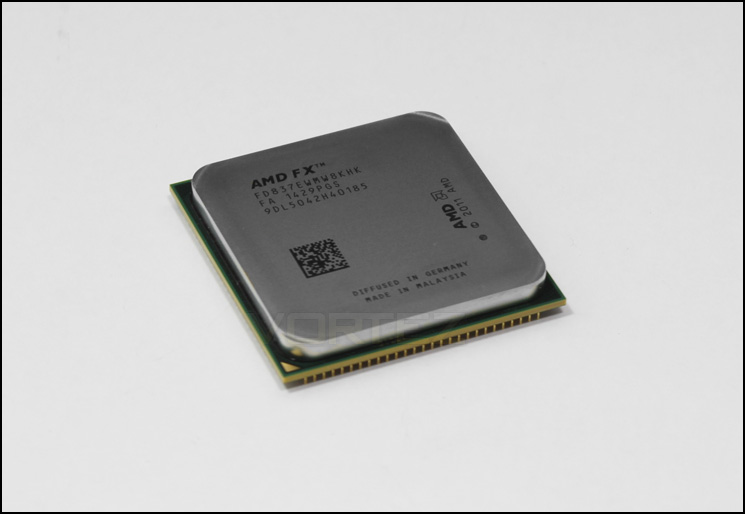
AMD’s Overview of the FX Processors
AMD FX Processors
We call it the new AMD FX 8-Core Processor Black Edition and it’s unlocked for your overclocking pleasure. Experience unmatched multitasking and pure core performance with the industry’s first 32nm 8-core desktop processor. Get the speed you crave with AMD Turbo CORE Technology to push your core frequencies to the limit when you need it most. Go beyond the limits of maximum speed with easy-to-use AMD OverDrive™ technology and AMD Catalyst™ Control Center™ software suites. But the best part of all? You’ll get all this impressive performance at an unbelievable price. You’ll be asking yourself “what competition?” in no time.
We call it the new AMD FX 8-Core Processor Black Edition and it’s unlocked for your overclocking pleasure. Experience unmatched multitasking and pure core performance with the industry’s first 32nm 8-core desktop processor. Get the speed you crave with AMD Turbo CORE Technology to push your core frequencies to the limit when you need it most. Go beyond the limits of maximum speed with easy-to-use AMD OverDrive™ technology and AMD Catalyst™ Control Center™ software suites. But the best part of all? You’ll get all this impressive performance at an unbelievable price. You’ll be asking yourself “what competition?” in no time.
Specifications & Features
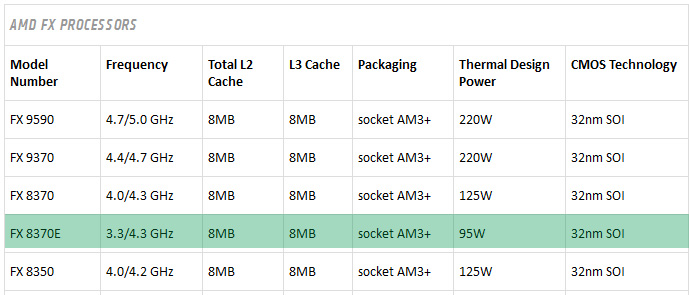
In regards to features and specifications, the FX-8370e remains similar to previous models, with exception to the wider turbo and stronger thermal controls. Making the ‘e’ model stay within the lower power bracket, while providing the performance necessary. This will mean it is unlikely that you will see more than two or four cores running at the maximum of 4.3 GHz, however, it is good to know it has the GO when required.
Test Setup
990FX Setup
Motherboard – ASRock Fatal1ty 990FX Killer
RAM – AMD Radeon R9 Memory kit DDR3 2400
GPU – GIGABYTE Windforce R9 280X
SSD – Kingston Hyper X 3K 240GB
Power Supply – NZXT Hale82 650W
Cooler – Noctua NH D14
Motherboard – ASRock Fatal1ty 990FX Killer
RAM – AMD Radeon R9 Memory kit DDR3 2400
GPU – GIGABYTE Windforce R9 280X
SSD – Kingston Hyper X 3K 240GB
Power Supply – NZXT Hale82 650W
Cooler – Noctua NH D14

FX-8370e @ 3.3/4.3 GHz (200 MHz x 16.5/21.5, 2400 MHz 11-12-12-31)
OC @ 4.715 GHz (205 MHz x 23, 2450 MHz 11-12-12-31)
Overclocking
Overclocking the FX processors is always exciting and fun, with the right cooling you could get benchmark runs over 5 GHz, with 4.7 GHz obtainable with some high end coolers. That in mind, when you are throwing 1.4 volts through this 8 core monster, you are likely going to be seeing some high temperatures, even with the likes of the Noctua NH-D14 we hit a whopping temperature of 81°C.Cool n quiet
Turbo Engage
Our OC result
Power Consumption
It’s interesting to note the power consumption across all motherboards because energy results can fluctuate between manufacturers due to the features and specifications that are integrated. First of all, for the idle tests the system is cold booted into Windows and no additional applications are executed – the watts are noted on the external energy monitor we use. Then the system is loaded with LinX 0.6.4 – watts are again monitored throughout the period of testing and the highest rated watts are then noted down. Below are the results of this energy test.
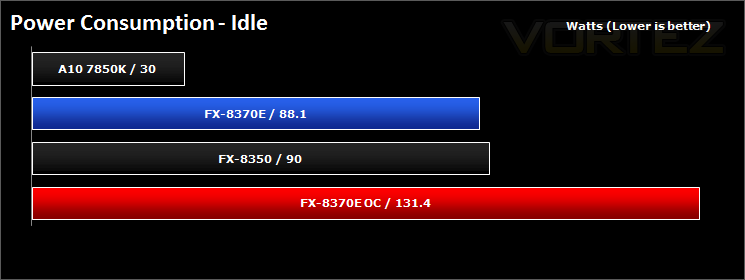
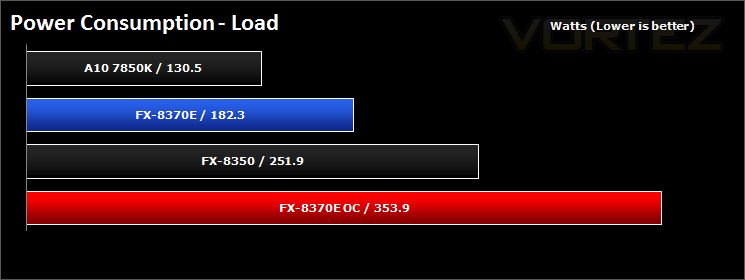
While the idle power draw remains fairly high, the FX-8370e saves 27% on power draw in comparison to the FX-8350.
Synthetic Benchmarks: AIDA64
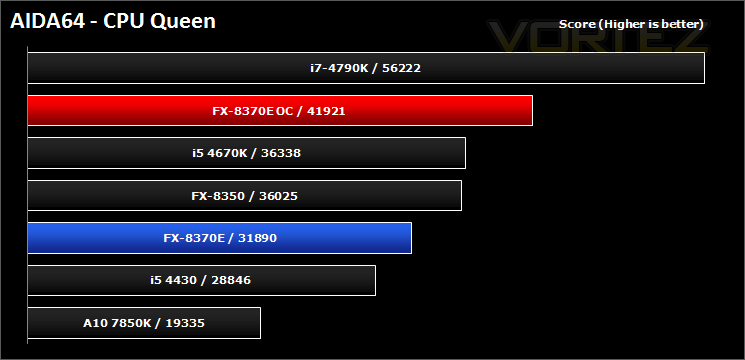
CPU Queen BenchmarkThis simple integer benchmark focuses on the branch prediction capabilities and the misprediction penalties of the CPU. It finds the solutions for the classic “Queens problem” on a 10 by 10 sized chessboard. At the same clock speed theoretically the processor with the shorter pipeline and smaller misprediction penalties will attain higher benchmark scores. For example — with HyperThreading disabled — the Intel Northwood core processors get higher scores than the Intel Prescott core based ones due to the 20-step vs 31-step long pipeline. CPU Queen test uses integer MMX, SSE2 and SSSE3 optimizations.
CPU Photoworxx Benchmark
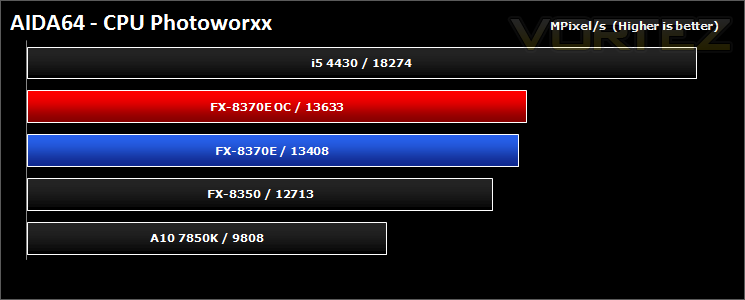
This benchmark stresses the integer arithmetic and multiplication execution units of the CPU and also the memory subsystem. Due to the fact that this test performs high memory read/write traffic, it cannot effectively scale in situations where more than 2 processing threads used. For example, on a 8-way Pentium III Xeon system the 8 processing threads will be “fighting” over the memory, creating a serious bottleneck that would lead to as low scores as a 2-way or 4-way similar processor based system could achieve. CPU PhotoWorxx test uses only the basic x86 instructions, and it is HyperThreading, multi-processor (SMP) and multi-core (CMP) aware.
FPU Mandel Benchmark
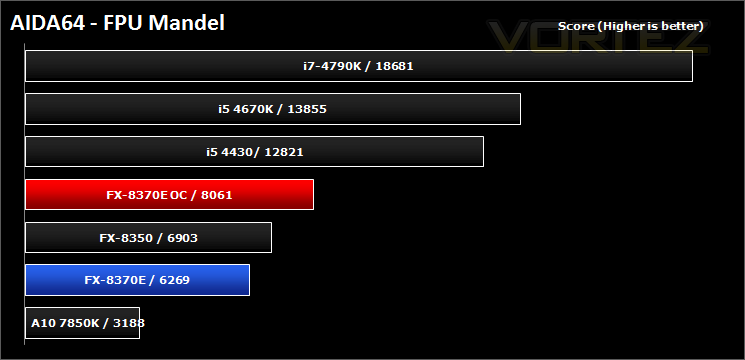
This benchmark measures the double precision (also known as 64-bit) floating-point performance through the computation of several frames of the popular “Mandelbrot” fractal. The code behind this benchmark method is written in Assembly, and it is extremely optimized for every popular AMD, Intel and VIA processor core variants by utilizing the appropriate x87, SSE2, AVX or FMA4 instruction set extension. FPU Mandel test is HyperThreading, multi-processor (SMP) and multi-core (CMP) aware.
Synthetic Benchmarks: x264 HD
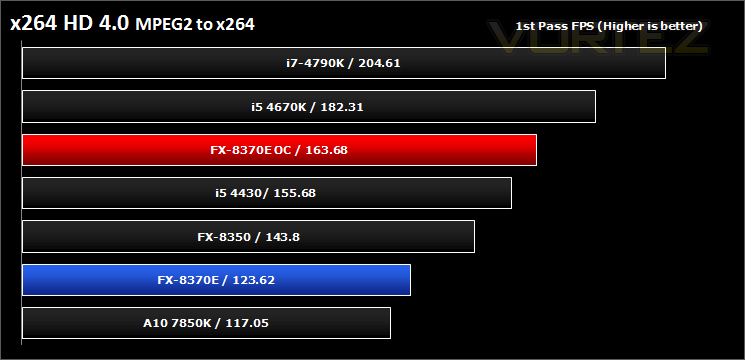
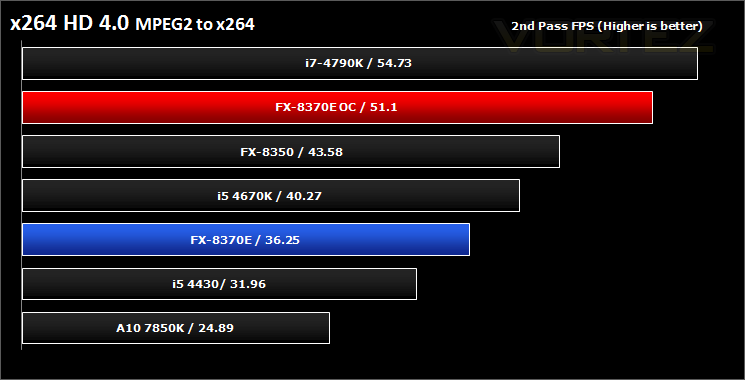
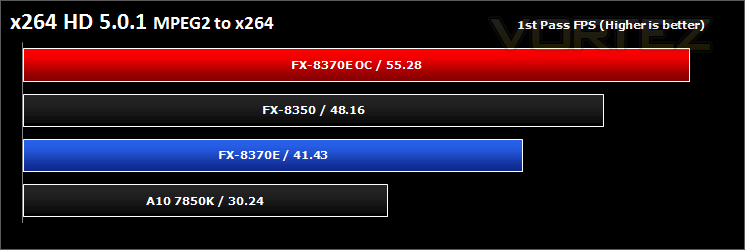
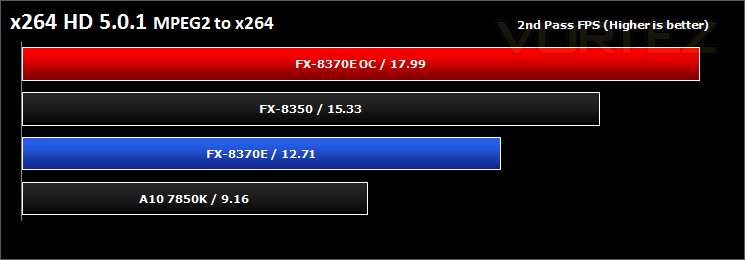
Simply put, this test measures how fast your machine can encode a short, DVD quality MPEG-2 video clip into a high-quality x264 video clip. What’s x264, you ask? It’s more or less the next-generation Xvid/DivX codec. I think it’s ideal for a benchmark because the application (x264.exe) reports fairly accurate compression results (in frames per second) for each pass of the video encoding process, and it uses multi-core processors very efficiently.
Synthetic Benchmarks: SiSoftware SANDRA
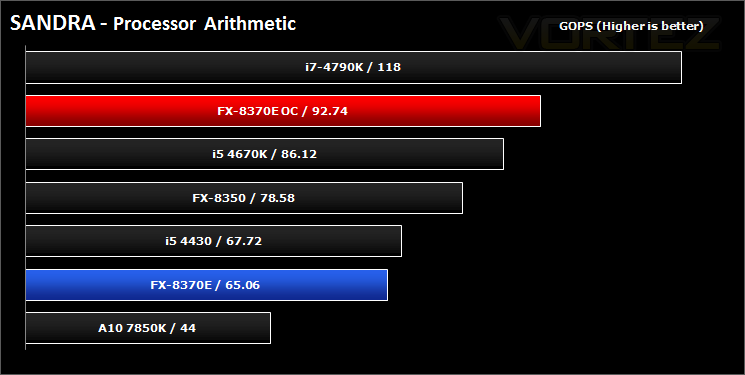
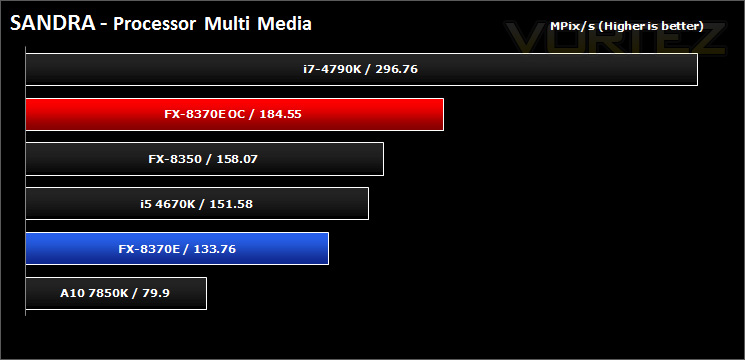
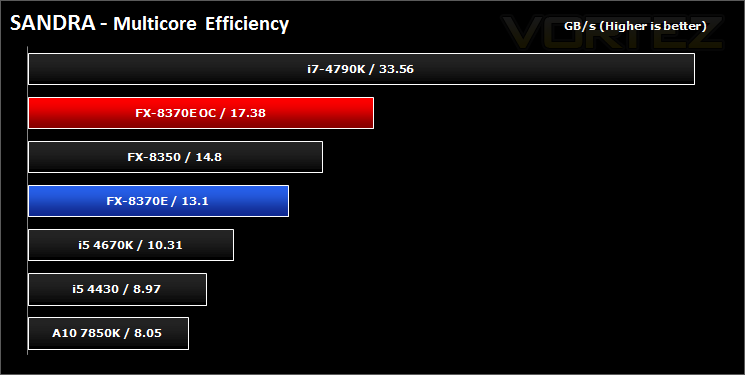
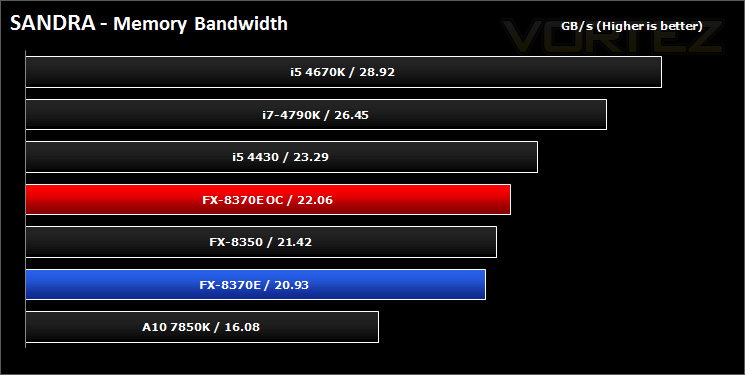
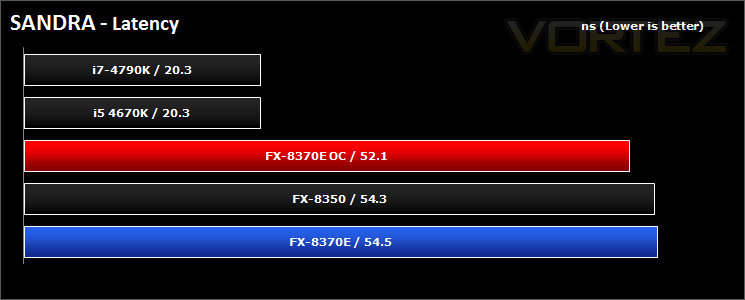
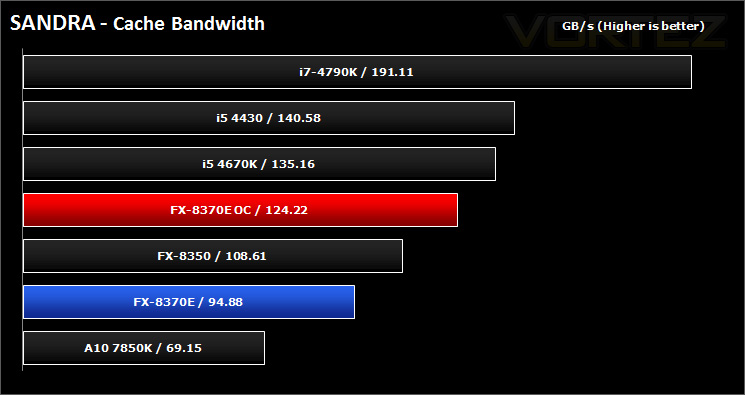
SANDRA isn’t always a benchmark that is included in hardware reviews but I believe it shouldn’t be ignored. SANDRA provides a vigorous package that tests your system in a rather large array of benchmarks. There are many aspects of benchmark that can be executed. We will be considering – CPU, memory and GPGPU tests.
Synthetic Benchmarks: Cinebench 11.5 & R15
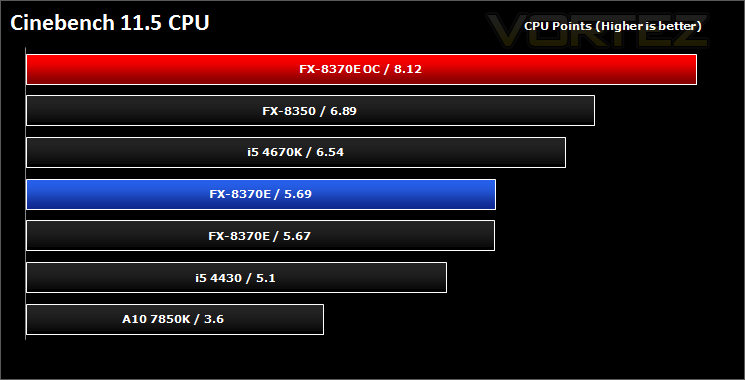
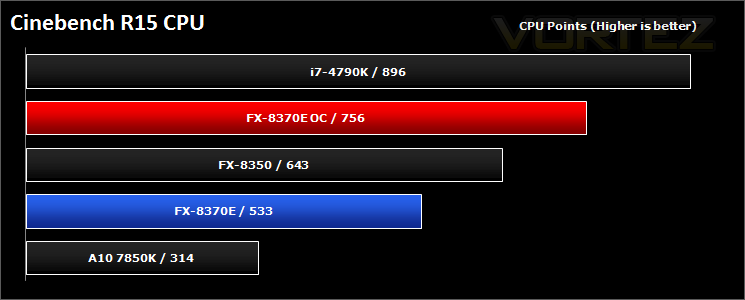
CPU RenderingCINEBENCH can measure systems with up to 64 processor threads. This test scene contains approximately 2,000 objects which in turn contain more than 300,000 polygons in total, and uses sharp and blurred reflections, area lights, shadows, procedural shaders, antialiasing, and much more. The result is displayed in points (pts). The higher the number, the faster your processor.
Synthetic Benchmarks: 3DMark – Fire Strike
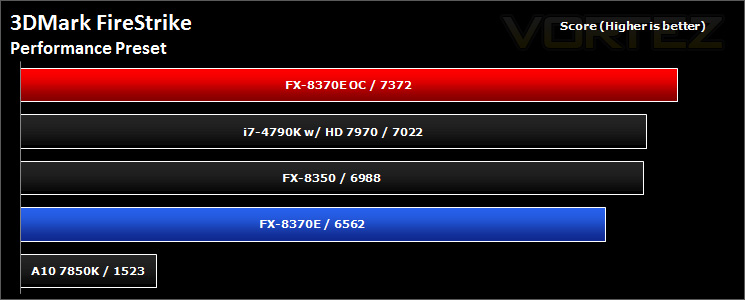
3DMark – Fire StrikeFire Strike is our new showcase DirectX 11 benchmark designed for high-performance gaming PCs. It is our most ambitious and technical benchmark ever, featuring real-time graphics rendered with detail and complexity far beyond what is found in other benchmarks and games today. Fire Strike will only be available in the Windows editions of 3DMark initially.
Game Benchmarks: Tomb Raider, Thief, DOTA 2
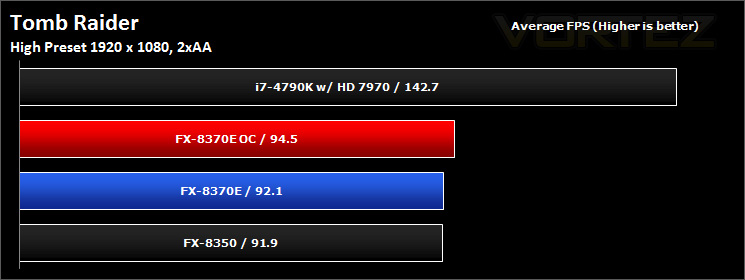
Tomb RaiderTomb Raider explores the intense and gritty origin story of Lara Croft and her ascent from a frightened young woman to a hardened survivor. Armed only with raw instincts and the ability to push beyond the limits of human endurance, Lara must fight to unravel the dark history of a forgotten island to escape its relentless hold.
Thief
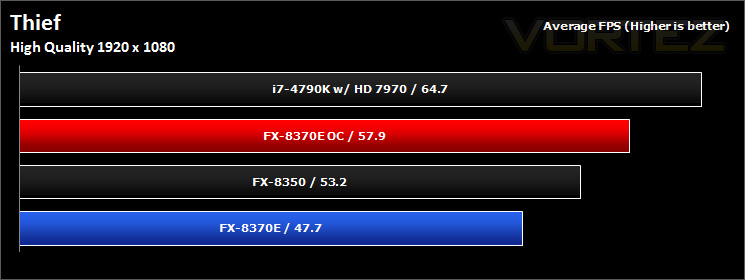
Garrett, the Master Thief, steps out of the shadows into the City. In this treacherous place, where the Baron’s Watch spreads a rising tide of fear and oppression, his skills are the only things he can trust. Even the most cautious citizens and their best-guarded possessions are not safe from his reach.
As an uprising emerges, Garrett finds himself entangled in growing layers of conflict. Lead by Orion, the voice of the people, the tyrannized citizens will do everything they can to claim back the City from the Baron’s grasp. The revolution is inevitable. If Garrett doesn’t get involved, the streets will run red with blood and the City will tear itself apart.
As an uprising emerges, Garrett finds himself entangled in growing layers of conflict. Lead by Orion, the voice of the people, the tyrannized citizens will do everything they can to claim back the City from the Baron’s grasp. The revolution is inevitable. If Garrett doesn’t get involved, the streets will run red with blood and the City will tear itself apart.
DOTA 2
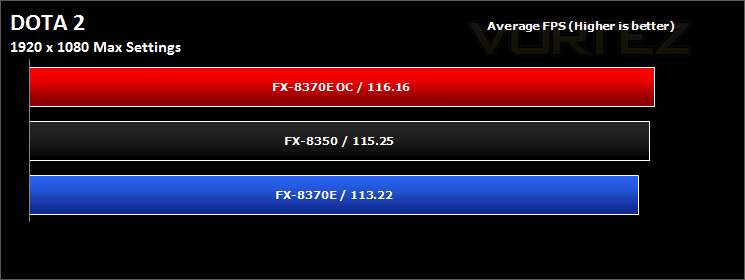
Dota is a competitive game of action and strategy, played both professionally and casually by millions of passionate fans worldwide. Players pick from a pool of over a hundred heroes, forming two teams of five players. Radiant heroes then battle their Dire counterparts to control a gorgeous fantasy landscape, waging campaigns of cunning, stealth, and outright warfare.
Irresistably colorful on the surface, Dota is a game of infinite depth and complexity. Every hero has an array of skills and abilities that combine with the skills of their allies in unexpected ways, to ensure that no game is ever remotely alike. This is one of the reasons that the Dota phenomenon has continued to grow.
Irresistably colorful on the surface, Dota is a game of infinite depth and complexity. Every hero has an array of skills and abilities that combine with the skills of their allies in unexpected ways, to ensure that no game is ever remotely alike. This is one of the reasons that the Dota phenomenon has continued to grow.
Conclusion
Underclocking is not dead it seems, and with a clever, wide turbo which allows the FX-8370e to remain within its TDP, there is only a small performance drop relative to the FX-3850, which can consume a fair bit more power. Though, due to the 95W TDP limitation, the turbo may sometimes hinder performance depending on how many cores are in use creating a fairly strange situation. As with the FX-Series in general, the 8 cores can provide some excellent price/performance especially in multi-threaded applications, this could make a desirable choice for those who are considering a system in the realms of content creation and editing.
In consideration to the current hardware offerings, it would be a poor option if ‘high end gaming’ was your agenda, while it will certainly be capable, compared to the competition the dated Piledriver cores are starting to lag behind and would be better served up in a mid-range system where gaming and content creation was the need. This is why AMD have recommended ideal pairing of system components (R9 280X/990FX) to get a competitive system at a competitive price. The power draw relative to its current siblings may appear lower, realistically, it is just a fancy control feature that you could manually set up in the BIOS if you had the patience. When looking at the market as a whole, the FX chips are still power hungry, especially when compared to current Intel chips or even AMDs own Kaveri. Though the FX-8370e does enough to rouse attention, most will overlook it as there isn’t anything new to see. Still using 32nm and still using Piledriver cores and no real performance gain.
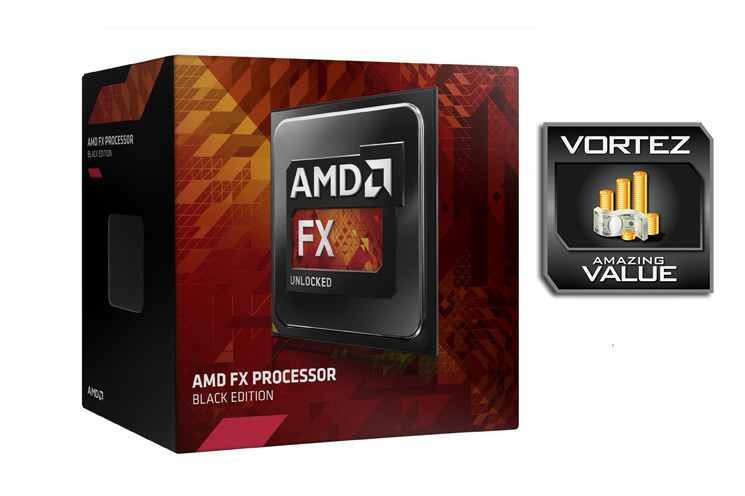
In regards to the future of AMDs ‘enthusiast’ or ‘high end’ platform, there are many question marks and despite a promising future in regards to their APUs, this FX refresh remains an uninteresting venture that serves only as a reminder that this platform still exists. Despite the short comings, there are legitimate price to performance factors that are worth weighing up, to which if you are looking, the FX-8370e may be the pick of the bunch due to its out-the-box power saving features, yet enjoys the same ability to hit the top clocks when you want to play around with the unlocked multipliers and increase the clock speeds. For the reasons listed, we present the FX-8370e our Amazing Value Award.
For mega-multitasking, some may find it difficult to resist the allure of 8 cores for a great price!
Pros.
+ 8 Cores
+ Fun and easy to overclock
+ Relatively lower power/ small performance drop
+ Great price/performance
Cons.
– Not Steamroller
– Not as efficient as other options
+ 8 Cores
+ Fun and easy to overclock
+ Relatively lower power/ small performance drop
+ Great price/performance
Cons.
– Not Steamroller
– Not as efficient as other options

Click here for an explanation of our awards at Vortez.net. Thanks to AMD for providing today’s review sample.


