







With a host of new features, new cooling design and core improvements we take an in-depth look at AMD’s latest graphics card – The HD7970 3GB codenamed ‘Tahiti’.

Product on Review: AMD HD7970
Manufacturer and Sponsor: AMD
Street Price: £480-500 inc VAT
With the NDA brought forward a couple of weeks, just in time for the festive season we can reveal not just a brief overview of the product but a full, in-depth review of the HD7970. With any new highly anticipated product launch, especially graphics cards, there is speculation galore regarding the products performance. I have seen estimations and ‘leaked’ bar charts suggesting the HD7970 to be a GTX580 killer, while others claim its performance is little better than its forbear, the HD6970. There is some truth to one of those statements while the other is wildly inaccurate. You will have to read the full review to find out which is which!
It’s been a year almost to the day (15/12/2010) since the Caymen XT equipped HD6970 hit the shelves and with the festive season almost underway, we see the replacement HD7970 featuring AMD’s latest flagship sliver of silicon, the Tahiti GPU core processor. As we will see throughout the review, the new core is not the only improvement over it’s older brother so without further delay, let’s take a look at the specifications of the new graphics card and give you a full breakdown of the new Tahiti core.
Here’s what AMD has to say about their latest creation:
AMD has a tradition of releasing highly competitive graphics processing units. In late 2010 AMD changed the graphics product market by releasing its highly competitive single GPU graphics product series; AMD Radeon™ HD 6800 and AMD Radeon™ HD 6900 series graphics. Then at the beginning of 2011 AMD released the world’s fastest graphics card* – The AMD Radeon™ HD 6990. Building upon the success of these series, AMD is proud to present its newest AMD Radeon™ HD 7000 series graphics and it’s new single GPU graphics card behemoth, the AMD Radeon™ HD 7970.
Specification
The HD7900 series will feature the new Tahiti core which is the successor to the Caymen core of the HD6900 family. The Caymen core was based on a 40nm manufacturing process so it is fair to say that perhaps the biggest improvement to the Tahiti core is the reduction to 28nm process. This has enabled AMD to cram 4.31 billion (4,312,711,873) transistors into the new HD7970 core as opposed to the 2.64 billion on the HD6970 Caymen XT.
Comprising of what AMD calls ‘Graphics Core Next (GCN)’ architecture which is optimised for heterogeneous computing, the new Tahiti core has upto 32 CU’s (compute units) with dual geometry engines along with 8 back-ends comprising of 32 colour ROPs per clock and 128 Z/Stencil ROPs per clock. Each CU has a Vector unit and Scaler Co-Processor and can execute instructions from multiple kernels.
The VLIW4 SIMD has evolved to the GCN quad SIMD which equates to similar computational power yet grants better performance, threading and simplification. The GCN also has a new Cache hierarchy with 16KB instruction Cache and32KB Scaler Cache shared between 4 CU’s. The L2 Cache is accessible by each CU with it’s own separate process to ensure coherency. These changes increase the GFLOPs by 140%.
Tesselation on the Tahiti core is also enhanced by increased Vertex re-use off-core which theoretically at least, means the 7900 series has 4 times the throughput of the 69XX series. The are improved ansioscopic filtering algorithms too which come at no performance cost allegedly. These new algorithm improvement will allow the use of Forward Rendering with 1000’s of potential light sources and will also mean MSAA can be rendered easily.
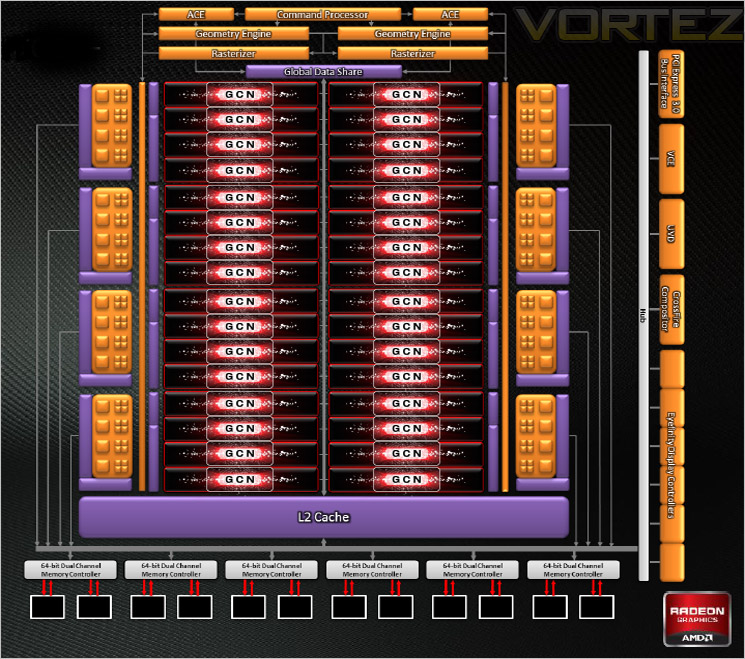
Looking at the schematics above, we can identify the bulk of the GPU is taken up with the 32 CU’s. Above these are the geometry engines. To the left and right are the 8 Render back-ends, 4 each side. There’s 768KB of L2 cache along with 6x64bit dual channel memory controllers making a 384-bit GDDR5 memory interface capable of delivering up to 264GB/sec. All of technology coupled together is transferred through a fully compatible PCI Express 3.0 x16 bus interface. Have no fear though because the cards are backwards compatible with PCIe 2.0.
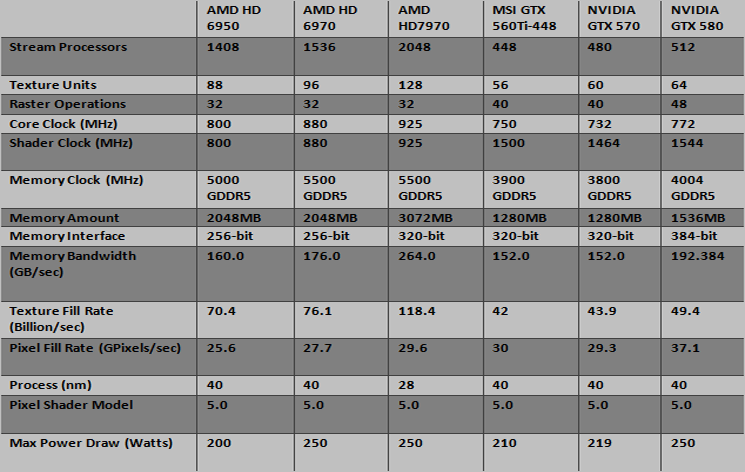
Comparing the HD7970 against it’s closest competitor, the GTX580, the AMD card has 4x more processors twice as many texture units but less ROPs. No change with AMD clockspeeds being higher than the green team and with the HD7970 being clocked to a blistering 925MHz I worry about how much is left in the bank to allow us any worthwhile overclocking. As usual, we will investigate this later in the review in the overclocking section. A big change for the AMD card is the leap towards a 320-bit memory interface which AMD have traditionally played second fiddle to NVIDIA. The texture fill rate which has always been a strong point for AMD is increased to a mind boggling 118.4 billion/sec compared to the GTX580’s miserly 49.4 while the HD7970 trails slightly in the pixel fill rate stakes ever so slightly. AMD have fired a warning shot across NVIDIA’s bow too with a huge 3GB of GDDR5 which should put paid to any difficulties running this card at high resolutions with filters applied.
On paper then, it appears AMD have been squireling away to create a graphics card behemoth capable of besting NVIDIA’s flagship single core GPU. I have little doubt that it would be faster but AMD would do well to keep an eye on the horizon as traditionally, the pendulum swings from one manufacturer to the other in a very short time. For now though, AMD have manufactured a card that is by far the most powerful card on test, on paper at least. We have seen many times in the past though that specifications mean very little if the GPU runs like a 3 legged donkey, how this transpires today we will see later in the benchmarks tests…
Features
**Note**The HD7970 feature list is a little thin on the ground but here’s what we have managed to formulate thus far. This list will be updated as more information becomes available.
AMD CrossFire™ Technology
The AMD Radeon™ HD 7970 GPU supports AMD CrossFire™ Technology and provides excellent multi GPU scaling. With the introduction of the AMD Radeon™ HD 6900 Series Graphics, AMD began delivering improved AMD CrossFire™ Technology scaling when using two GPUs. AMD is proud to continue to offer that amazing performance with its newest AMD Radeon™ HD 7000 series graphics products.
AMD Eyefinity Technology
AMD Eyefinity Technology provides advanced multiple monitor technology enabling an incredibly immersive graphic and computing experience with innovative display capabilities, supporting massive desktop workspaces and super-high resolution gaming environments. AMD Eyefinity technology with DisplayPort connectivity enables a single GPU to support up to six independent display outputs simultaneously, depending on the OEM implementation.
AMD Eyefinity technology works with games that support non-standard aspect ratios, which is required for panning across multiple displays. To enable more than two displays, one of two cases must be satisfied:
1) Additional panels with native DisplayPort™ connectors are used;
2) Certified DisplayPort™ adapters to convert your monitor’s native input to your cards
DisplayPort™ or Mini-DisplayPort™ connector(s) are used.
With the introduction and wide availability of DisplayPort™ to single-link DVI dongles, option 2 above is a low cost way to convert a set of already-owned monitors into an AMD Eyefinity technology ready display configuration.
Unlike a similar multi monitor gaming solution offered by NVIDIA, AMD Eyefinity technology does not require two graphics cards to work. Therefore, AMD offers a multi monitor gaming solution with potential for a lower setup cost. A single AMD Radeon™ 7970 GPUs can employ AMD Eyefinity technology and AMD CrossFire™ technology to provide an outstanding multi monitor gaming experience. The following chart shows the AMD Radeon™ HD 7970 graphics in a dual AMD CrossFire™ configuration versus the NVIDIA SLI GTX 580 in three monitor gaming scenario’s.
Improved Tessellation
The latest iteration of architecture in the AMD Radeon™ HD 7970 GPU features a brand new Generation of Tesselator (Gen 9) in its Geometry Engine. This features optimizations such as; Increased vertex re-use, Off-chip buffering improvements and larger parameter caches. This helps Improve performance at all tessellation factors at up to 4x the throughput of AMD Radeon™ HD 6900 series graphics (Gen 8 ).
AMD HD3D Technology
AMD HD3D Technology is supported by an advanced and open ecosystem that, in conjunction with specific AMD hardware and software technologies, enables 3D display capabilities for many PC applications and experiences.
Your PC has evolved, offering unprecedented amount of games, photos and movies for you to play, watch, design, create, share and download in 3D. With the arrival of the latest in 3D technology you can now enjoy an enhanced visual experience on Stereo 3D-capable desktops and notebooks powered by AMD HD3D Technology.
HDMI 1.4a
More bandwith than standard HDMI allows full implementation of 60Hz Stereo 3D. Standard HDMI ports do not have adequate bandwidth for more than 3D 1080p at 24fps.
Ultra-high resolution (4k Panels)
– Current implementations currently use 4*DVI or 2*DP 1.1, which is expensive and unwieldy.
– AMD will move to a single-connector output for 4k via DP 1.2 HBR2 and HDMI 1.4a 3GHz mode.
AMD Quad Buffer SDK
– Native 3D support for Developers.
– functions with Dx9, 10 and 11
– Native support scheduled for Windows 8
Nearly 600 games support AMD’s implementation of 3D either natively or through middleware partners. Also support for many 3D displays already on the market including Samsung and LG’s proprietry implementation.
Video Codec Engine (VCE)
– H.264 HD Encoder
– Power efficient
– faster than realtime 1080p @ 60 FPS
– Variable Compression Quality
– Multiple Input Options:- (1) Frame Buffer, (2) GPU Display. (2) is useful for wireless displays.
AMD ZeroCore Power
When a discrete GPU is in a static screen state it works to minimize idle power by enabling a host of active power saving functions including (but not limited to); clock gating, power gating, memory compression, and a host of other features. However, GPUs with AMD’s exclusive ZeroCore Power technology can take energy savings to entirely new heights by completely powering down the core GPU while the rest of the system remains active.
Nearly all PCs can be configured to turn off their displays after a long period of inactivity. This is known as the long idle state; where the screen is blanked but the rest of the system remains in an active and working power state (ACPI G0/S0). As soon as the system goes into long idle state and applications are not actively changing the screen contents, the GPU enters the ZeroCore power state. In the ZeroCore power state, the GPU core (including the 3D engine / compute units, multimedia and audio engines, displays, memory interfaces, etc.) is completely powered down.
However, one cannot simply remove the GPU and its associated device context completely; particularly when it is the only GPU in the system as is the case in many enthusiast platforms. The operating system and SBIOS must still be aware that a GPU is still present in the system. For this reason, the ZeroCore Power state maintains a very small bus control block to ensure that GPU context is still visible to the operating system and SBIOS. The ZeroCore power state also manages the power sequencing of the GPU to ensure that the power up/down mechanism is self-contained and independent of the rest of the system.

The enablement of the ZeroCore Power feature is controlled by the driver. The driver monitors the display contents and allows the GPU to enter the ZeroCore Power in the condition that the GPU enters long idle and subsequent work requests are no longer being submitted to the engine. If any applications update the screen contents, ZeroCore Power technology can periodically wake the GPU to update the framebuffer contents and put the GPU back into the ZeroCore Power state. Furthermore, applications such as Windows 7 desktop gadgets are architected to minimize activity and save power in the long idle state. These applications are active during screen-on mode to display dynamic content such as weather, RSS feeds, stock symbols, system status, etc. but also have the intelligence to suspend any updates and activity when the system enters long idle. These applications will not wake the GPU from the ZeroCore Power state in long idle.
AMD ZeroCore Power technology delivers tremendous energy savings. Many PCs remain in the long idle state for a variety of use cases that are highly relevant to everyday consumers, enthusiasts and professionals. In ZeroCore Power mode, users can still enjoy non-graphics activities such as file serving/streaming, motherboard audio and music, and remote access while the GPU core is essentially powered off.
ZeroCore Power technology also scales with AMD CrossFire™ technology. With an AMD CrossFire platform, all non-primary GPUs are in the ZeroCore Power state when not in use. For AMD CrossFire workloads, the driver will engage the non-primary GPUs to deliver full performance on-demand. The primary GPU can also enter the ZeroCore Power state during long idle as well. This delivers scalable benefits for the enthusiast. First, it effectively removes the power increase for users of AMD CrossFire under idle and light (single GPU) workloads. Second, it removes the noise penalty multiGPU users have always had to endure since the GPU fans are off in ZeroCore Power mode.
Nearly all PCs can be configured to turn off their displays after a long period of inactivity. This is known as the long idle state; where the screen is blanked but the rest of the system remains in an active and working power state (ACPI G0/S0). As soon as the system goes into long idle state and applications are not actively changing the screen contents, the GPU enters the ZeroCore power state. In the ZeroCore power state, the GPU core (including the 3D engine / compute units, multimedia and audio engines, displays, memory interfaces, etc.) is completely powered down.
However, one cannot simply remove the GPU and its associated device context completely; particularly when it is the only GPU in the system as is the case in many enthusiast platforms. The operating system and SBIOS must still be aware that a GPU is still present in the system. For this reason, the ZeroCore Power state maintains a very small bus control block to ensure that GPU context is still visible to the operating system and SBIOS. The ZeroCore power state also manages the power sequencing of the GPU to ensure that the power up/down mechanism is self-contained and independent of the rest of the system.
The enablement of the ZeroCore Power feature is controlled by the driver. The driver monitors the display contents and allows the GPU to enter the ZeroCore Power in the condition that the GPU enters long idle and subsequent work requests are no longer being submitted to the engine. If any applications update the screen contents, ZeroCore Power technology can periodically wake the GPU to update the framebuffer contents and put the GPU back into the ZeroCore Power state. Furthermore, applications such as Windows 7 desktop gadgets are architected to minimize activity and save power in the long idle state. These applications are active during screen-on mode to display dynamic content such as weather, RSS feeds, stock symbols, system status, etc. but also have the intelligence to suspend any updates and activity when the system enters long idle. These applications will not wake the GPU from the ZeroCore Power state in long idle.
AMD ZeroCore Power technology delivers tremendous energy savings. Many PCs remain in the long idle state for a variety of use cases that are highly relevant to everyday consumers, enthusiasts and professionals. In ZeroCore Power mode, users can still enjoy non-graphics activities such as file serving/streaming, motherboard audio and music, and remote access while the GPU core is essentially powered off.
ZeroCore Power technology also scales with AMD CrossFire™ technology. With an AMD CrossFire platform, all non-primary GPUs are in the ZeroCore Power state when not in use. For AMD CrossFire workloads, the driver will engage the non-primary GPUs to deliver full performance on-demand. The primary GPU can also enter the ZeroCore Power state during long idle as well. This delivers scalable benefits for the enthusiast. First, it effectively removes the power increase for users of AMD CrossFire under idle and light (single GPU) workloads. Second, it removes the noise penalty multiGPU users have always had to endure since the GPU fans are off in ZeroCore Power mode.
First Look
HD7970 Front
At first glance the HD7970 looks identical to the reference HD6970. Perhaps the biggest difference in looks is that card’s cooler is gloss black rather than the matt we are accustomed to. I was hoping AMD had revised the cooling design as the 5000/6000 series were notoriously loud but looking at the cards exterior, very little has changed save for the moulded, glossy finish.
HD7970 Back
Flipping the card over we see that AMD have kept the black PCB which matches the overall looks perfectly. The cooler is attached by 12 screws and a further 4 spring load screws hold the backplate to the GPU.
HD7970 Side
The card measures 27cm long which is par for the course as far as high end cards go. The moulded finish to the card continues along the side with red plastic inserts.
HD7970 Perspective
Here you can see that rather than being the rectangular monolithic graphics card design we are familiar with, the new design is very curved yet looks strangely familiar…
Hero or Villain?
I don’t know if AMD took the cooling design from the 1966 Batmobile but the similarities are there for all to see! Joking aside, I think the new design, while hardly revolutionary looks very neat and tidy and if it performs half as good as the Batmobile it will be deemed heroic!
HD7970 Intake
The end of the card has two cut-outs for the air intake which the fan will then push over the main heatsink hidden beneath the cooling shroud.
HD7970 Backplate
The I/O area has twin mini-DisplayPorts 1.2 along with an HDMI 1.4a port and a single DVI port capable of resolutions upto 2560×1600 along with Eyefinity support.
HD7970 PCIe Power
The card uses a 6 pin and 8 pin PCIe power ports and while there is no concrete information available regarding PSU requirements, I would be extremely surprised if anything more than a 600W PSU was required. As always though, a quality branded PSU such as Corsair is recommended for optimum, reliable performance.
HD7970 Crossfire tabs
Like it’s forbear, the HD6970, the HD7970 has dual Crossfire tabs which will allow multiple GPU configurations.
HD7970 BIOS Switch
Yet another nod to the past is the Dual BIOS switch. At stock, both BIOS’s on the card are identical however, having a backup BIOS means you can update and perhaps tweak one BIOS with higher clockspeeds, voltages and fan profiles while leaving the remaining BIOS as a back-up should htings go wrong. This is a great feature to have as it will save many people from turning their expensive graphics card into an ornamental door stop.
Let’s take a closer look at the card by removing the cooler and investigating that innards in all their naked glory…
Closer Look
HD7970 Cooler
Removing the cooler was more involved than the 6000 series due to the number of screws but with slight of hand and a raised pulse the cooler thankfully came away after gentle persuasion. The shroud comes in two parts, the plastic shell and main frame heatsink which serves to hold the vapor chamber and the fan assembly. The memory is cooled via individual thermal sticky pads while the VRM has a more traditional ‘grey’ TIM pad.
HD7970 Heatsink
The heatsink itself is a combination of a copper vapor chamber and aluminium longitudinal finned heatsink leading from front to back. From the picture above, air would be sucked in from both the vents nearest the fan end along with the fan itself. The cool air would then be passed through the heatsink and exhausted to the rear of the card.
HD7970 Fan
The fan is identical to previous incarnation and is VERY loud when running at 100%. Thankfully, the fan never got anywhere near this speed during testing and rarely budged above 40% which surprisingly was relatively quiet. Overall, the new cooling design looks very good. ‘Custom cooler’ quiet it isn’t but it’s a definite improvement, at least in terms of volume over previous versions.
HD7970 Naked
Immediately noticeable on the HD7970 is the partial integrated heatspreader. This is a new move from AMD who traditionally have never shielded their GPU’s. Unlike NVIDIA who use a full cover heatspreader to protect the delicate silicon beneath AMD have added a frame while still leaving the core exposed. Despite my own experience, I have killed a few cards by ‘nibbling’ the core with waterblocks which trust me is soul destroying so to see AMD afford some protection for clumsy folk like me is fantastic.
Surrounding the core are 12 x 256MB modules of GDDR5 from Hynix and to the right the 5+1 phase design.
HD7970 VRM
The VRM consists of Coiltronics ferrite core lo profile surface mount inductors (1007R3-R15) and solid caps which should ensure a smooth, efficient and reliable power delivery.
HD7970 ‘CHiL’ Regulator
The VRM discussed above is managed by the CHiL 8228G controller but save for AMD’s own overdrive utility allowing power control from -20% to +20% our favourite overclocking utility, MSI’s afterburner would not allow voltage adjustments at this time. I would expect this to change in later revisons though thanks to the inclusion of the CHiL controller.
HD7970 GDDR5 Memory
The memory used on the HD7970 hails from HYNIX which is great news as HYNIX memory usually grants good overclocking results. The product number of the memory IC’s is H5GQ2H24MFR R0C which is rated at 6GBps at 1.6v.
HD7970 Paste application Regulator
AMD recommended that we did not replace the paste of the HD7970 stating instead that the cooling properties would be affected and that replacement was unnecessary. However, looking at the picture above I don’t believe this particualr card had the best contact with the vapour chamber. We did however do as AMD suggest and tested the card in ‘stock’ form. Replacing the TIM with MX-4 saw a load temp decrease of 2c idle and 5c load so despite AMD’s claims, I may be tempted to replace the paste should you feel confident and competent in doing so.
HD7970 ‘Tahiti’ Core
Finally we reach the beating heart of the AMD HD7970, the GPU core codenamed Tahiti. Unlike older AMD/ATI cores, there were no markings whatsoever on the silicon itself with the product information instead being found on the IHS frame.
That pretty much rounds off the discussion of the card so let’s take a look at the test setup we will be using today…
Test Setup
With the latest Intel chipset release we decided to update our ageing X58 setup to the new X79 chipset. Not only that but we will be using the flagship Core i7-3960X Extreme Edition processor clocked to 4.5GHz to ensure we have no CPU bottlenecks. With 16GB of ram on board there should be minimal paging so the benchmarks we run today will hopefully give a true reflection of the graphics card’s performance.Some of the components for our test bench were kindly donated by CORSAIR who provided the majority of components without whom we would not have been able to bring you this review so a big thanks to them.
Graphics cards on test:
AMD HD7970 3072MB GDDR5
MSI GTX560Ti-448 Twin Frozr III 1280MB GDDR5
NVIDIA GTX570 1280MB GDDR5
MSI GTX560Ti-384 Twin Frozr III 2GB GDDR5
For this review we will be using the very latest CAT 11.12 drivers.
Motherboard: ASRock X79 Extreme4-M
CPU: Intel Core i7-3960X Extreme Edition
RAM – 16GB (4x4GB) Corsair Vengeance (Red) DDR3 @ 1866MHz 9-10-9-27
Power Supply – Corsair TX750M 750W
Hard Drive – Hitachi SATA II 250GB
Samsung F3 1TB
Cooler – Corsair H100
Benchmarks
We have also updated our range of benchmarks to include the following games which will give the graphics cards a challenge and sort the wheat from the chaff. Each benchmark will be run at both stock and maximum overclock settings and utilise 1920×1080 and 2560×1600 resolutions along with AA at various levels (application dependent):
Battlefield 3
Crysis 2
Crysis Warhead
Metro 2033
Batman: Arkham City
Elder Scrolls: Skyrim
DiRT 3
Futuremark 3DMark 2011
Unigine: Heaven 2.5
Crysis 2
Crysis Warhead
Metro 2033
Batman: Arkham City
Elder Scrolls: Skyrim
DiRT 3
Futuremark 3DMark 2011
Unigine: Heaven 2.5
Let’s see how today’s test sample performed…
Overclocking
For the purposes of this section it is worth noting that with no prior experience of clocking the new GPU family we are entering into territories unknown. AMD stated that and overclock reaching 1GHz was feasible so we entered the overclocking arena cautiously but optimistic of a good overclocking experience with the HD7970.
Above you can see that the card is stock clocked at an impressive 925MHz on the core with the 3GB of memory at 1375MHz (5500 effective).
Because Afterburner 2.20 Beta 9 would not allow voltage adjustments on the card we decided on using AMD’s own Overdrive utility. Going straight for the jugular, we cranked up the power control setting to 20% and maxxed out the core frequency. Amazingly the card was not phased by this ridiculous clockspeed of not 1GHz but 1125MHz!! Thinking some trickery was going on here as I expected the card to lock-up at such frequencies, I ran a number of stressful benchmarks, actually trying to crash the card but regardless of what I threw at it, it was rock solid stable. Undeterred in my quest to de-stabilise the card I began upping the memory frequency. Knowing the theoretical maximum was 6GBps, I went for a touch higher and finally the card started to show signs of instability. Lowering the frequency back towards the 1500MHz (6GBps effective) and the card once again became stable.
The HD7970 then is an overclockers dream and with better supported software and a few gentle BIOS tweaks, I have little doubt that this clockspeed will be easily surpassed. It really is that good!
Temperature & Power Consumption
AMD were making some big noises about both the cooling improvements and power consumption of the 7000 series cards but as with any new product, some words have to be taken with a pinch of salt.
The temp of the card was nothing outstanding but it is certainly an improvement over the HD6970 which thankfully should mean the fan speed should be kept under control and thus the noise of the card. Most impressive was the temperature of the card as at idle it was one of the coolest on test, testament to the Zero PowerCore feature.
As expected, under load conditions the HD7970 was the hungriest card on test. Not excessively so and perhaps due to the competition above it appears more thirsty than it actually is. Impressing once again was the Zero PowerCore technology which meant it was among the least hungry cards on test at both idle and overclocked states.
With both the cooling and power consumption figures impressing the one area I expected the card to fall down was the acoustics. Surprisingly, the card was near silent throughout the testing with the fan rarely rising above 40%, even when stressed with 30 mins of Furmark! Of course, manually setting the fan to 100% turned the card into a screaming banshee but as stated, it is extremely unlikely you will ever reach those limits as with the huge overclock in place, temps never exceeded 83c.
So far so good then but the real test is yet to come – the Vortez benchmark suite…
Battlefield 3
Battlefield 3 leaps ahead of its time with the power of Frostbite™ 2, the next instalment of DICE’s cutting-edge game engine. This state-of-the-art technology is the foundation on which Battlefield 3 is built, delivering enhanced visual quality, a grand sense of scale, massive destruction, dynamic audio and incredibly lifelike character animations. As bullets whiz by, walls crumble, and explosions throw you to the ground, the battlefield feels more alive and interactive than ever before. In Battlefield 3, players step into the role of the elite U.S. Marines where they will experience heart-pounding missions across diverse locations including Paris, Tehran and New York.
Average and minimum frames per second were measured using Fraps during the parking lot scene on Operation Sword Breaker. High and Ultra presets were loaded at both resolutions.
Crysis 2
Crysis Warhead
Following the success of Crysis, the stand alone expansion “Warhead” was hotly anticipated to bring more game play, more weapons, improved visuals whilst maintaining better performance, the latter being what gamers wanted most. After all how many people upgraded their rigs just to play this game… In the game, you play as the upbeat Brit Sergeant “Psycho” Sykes, chasing down a Korean nuclear warhead. Throw in some ice shooting aliens and we’re bound to have a great game. It sure delivered.Testing was done using Framebuffer’s Crysis Warhead benchmarking tool. The tests were configured to DirectX 10 at Enthusiast levels. Each test on the Ambush map was looped three times from which the average FPS was recorded.
Metro 2033
Based on the novel by the same name, Metro 2033 is a first person shooter with elements of survival horror. As Artyom, you trawl through the mutant infested metro systems of post-apocalyptic Moscow. The game delivers presents a grim ambience that reflects on the overall atmosphere of the underground setting. Metro 2033 uses the setting as a back drop to showcase some of the best visuals of any games out now, making it the ideal benchmark for those looking for the best graphics card.The bundled benchmarking tool was used on Metro 2033, configuring the settings to High and making use of DirectX 11. The frontline scene was looped 3 times for each configuration. The average FPS was recorded at the end.
The Elder Scrolls V: Skyrim
Skyrim is not a direct successor to the very popular Oblivion. Instead it takes place 200 years after the events of Oblivion. The non-linear playing that made the Elder Scrolls such a popular series does however make a return along with the beautiful scenery the encompasses the world of Skyrim.
Average and minimum frames per second were measured using Fraps during the drop down passage to Riverwood. V-sync was disabled to allow fluctuating (higher the 60) FPS for these runs. It is however recommended that v-sync is left enabled during normal gameplay due to the games dynamics.
Batman: Arkham City
Batman: Arkham City builds upon the intense, atmospheric foundation of Batman: Arkham Asylum, sending players soaring into Arkham City, the new maximum security “home” for all of Gotham City’s thugs, gangsters and insane criminal masterminds. Set inside the heavily fortified walls of a sprawling district in the heart of Gotham City, this highly anticipated sequel introduces a brand-new story that draws together a new all-star cast of classic characters and murderous villains from the Batman universe, as well as a vast range of new and enhanced gameplay features to deliver the ultimate experience as the Dark Knight.
The results below were obtained from the builtin benchmark utility from the game. All the settings were set to
DiRT 3
As players race to elevate their global standing, DiRT 3 is back delivering mud, sweat and gears world over: from the intense weather-beaten rally stages of Europe, Africa and the US, to executing performance driving showcases and career challenges where car control is pushed to spectacular limits.The in-game benchmarking tool was used to test performance. All the display settings were set to the maximum available and DirectX 11 was applied. The average FPS was recorded at the end.
Futuremark: 3DMark 2011
3DMark 11 is the latest version of the world’s most popular benchmark. Designed to measure your PC’s gaming performance 3DMark 11 makes extensive use of all the new features in DirectX 11 including tessellation, compute shaders and multi-threading. The benchmark was run in both Performance and Extreme presets.Unigine: Heaven 2.5
Heaven Benchmark is a DirectX 11 GPU benchmark based on advanced Unigine™ engine from Unigine Corp. It reveals the enchanting magic of floating islands with a tiny village hidden in the cloudy skies. Interactive mode provides emerging experience of exploring the intricate world of steampunk.Conclusion
So there we have it. AMD have made some great leaps today. Not only are they the first to the GPU scene with 28nm archetecture but they have implemented some neat little features, an improved cooling design and best of all, very impressive overclocking abilities.
The new Tahiti core is clearly a force to be reckoned with and while no doubt NVIDIA have some tricks of their own to unveil, presently a GTX580 is redundant. The HD7950 will also be based on the same core, most likely with a reduction in CU’s and clockspeeds however if the performance of the HD7970 is anything to go by, the HD7950 will also be a hell of a card. IT is expected that lower end 7000 series cards will be based on the older Caymen core so this is where you should perhaps look for the best bang-per-buck as at an expected price of £480-500 for a Powercolor version, the HD7970 is anything but cheap. Top performance however is rarely bought on a budget and so while the price of the card is criminally expensive, for the latest high-end technology it is to be expected. I would have liked to have seen the HD7970 aimed closer to reference GTX580 prices as this would truly make it on everyones belated Christmas list, especially those looking for the best performing single core card. However, at £500 I feel many will keep a tight rein on those purse strings and wait to see what the green time has to offer before splashing out the cash.
The HD7970 is a phenomenal card and impresses in almost every area save for the price. I particularly like the zero PowerCore feature which means I can happily leave my PC on all night while streaming/downloading safe in the knowledge my GPU is not gobbling up power. When GPU power is needed though, the card will instantaneously jump to life and grant you extreme framerates even at the highest resolutions thanks to the huge 3GB of GDDR5 which all but eliminates current VRAM limitations. Have more than one monitor? No problem. Will full Eyefinity compatibility (and indeed Eyefinity 2.0 due in Q2 2012 with future driver revisions), you have a card that not only performs extremely well today but also offers plenty of future proofing with the card also being DX11.1 (Windows 8 ) and PCIe 3.0 ready.
To conclude then the card is expensive. There’s no getting away from that fact and any component costing this much is going to take serious consideration before reaching for the credit card. If you are a fan of the red team and here’s where your loyalty lays, then I see no reason not to thoroughly recommend what is a very impressive piece of kit. If however you prefer to sit on the fence until you see what both sides have to offer then no words of wisdom will persuade you to go for this product. You may be wise to wait, or foolish to believe that waiting is a good strategy as the HD7970 is awesome in it’s own right. Sure NVIDIA may release an even faster card (likely costing more money) but for the time you spend sitting on the proverbial fence will be wasted when everything you need is right here, right now with the AMD HD7970.
Pros:
+ Amazing GPU core overclocking
+ Good memory overclocking
+ Good cooling
+ Great performance especially at High-res
+ Quiet (when fan below 40%)
+ Good looking design
+ Black PCB
Cons:
– Expensive
– Loud fan above 40%, deafening at 100%
– Only one DVI port
+ Amazing GPU core overclocking
+ Good memory overclocking
+ Good cooling
+ Great performance especially at High-res
+ Quiet (when fan below 40%)
+ Good looking design
+ Black PCB
Cons:
– Expensive
– Loud fan above 40%, deafening at 100%
– Only one DVI port


Click here for an explanation of our awards at Vortez.net. Thanks to AMD for providing today’s review sample.


