


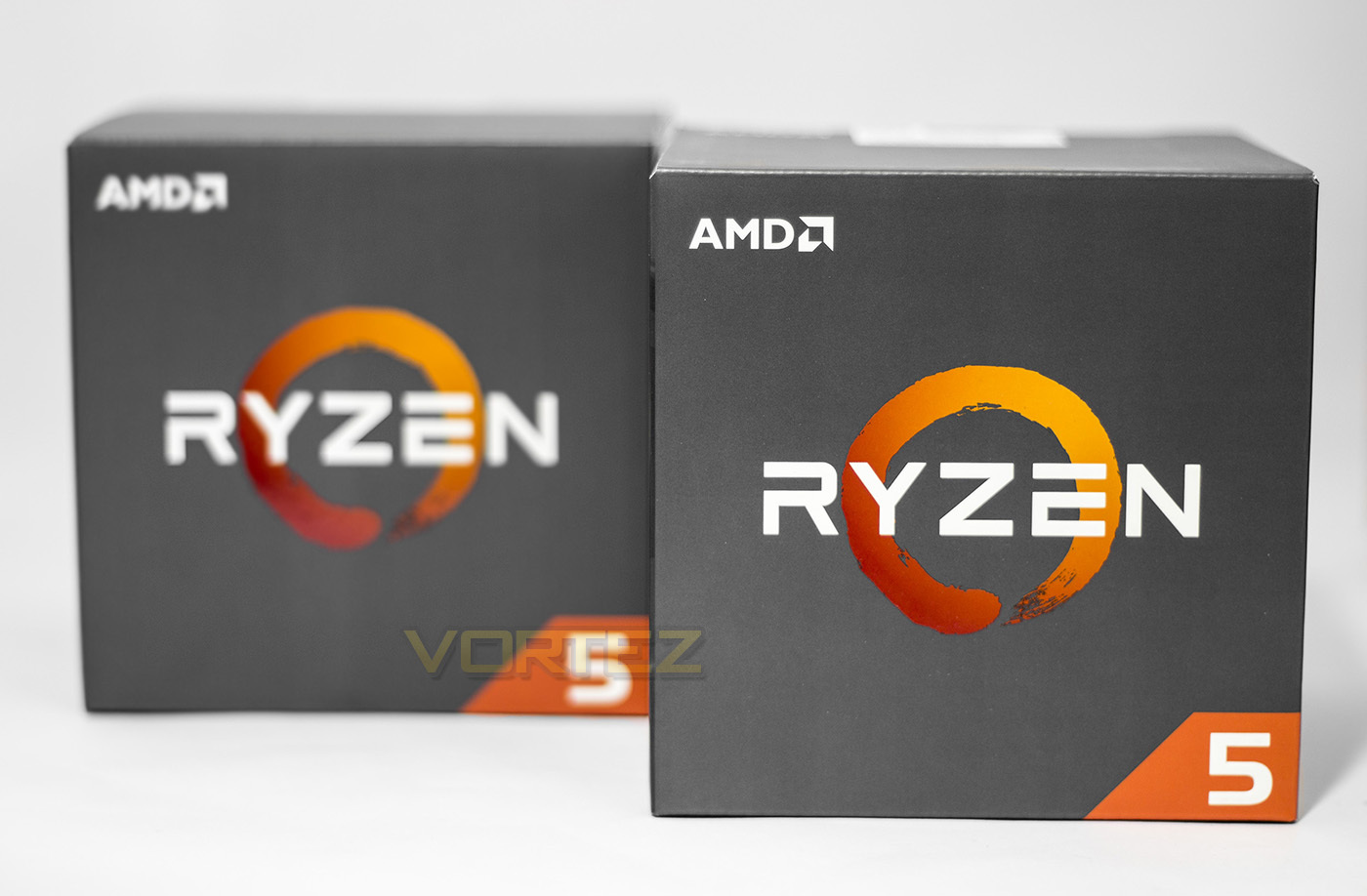
Following the release of Ryzen 7, AMD now aim to blow the market apart with Ryzen 5. There are 4C/8T and 6C/12T parts on offer, that promise disruptive price-to-performance for gamers and creators.

Product on Review: Ryzen 5 1400 and Ryzen 5 1600
Manufacturer: AMD
MSRP: R5 1400- UK: £169, US: $169
R5 1600- UK: £219, US: $219
AMD have had a rather mixed, but successful review with the release of Ryzen 7; the synopsis being ‘95% of the performance at 50% of the price’. Though without backlash from a gaming community that expected ‘more’. This likely stemmed from the fact that Ryzen 7 is an enthusiast/prosumer chip aimed for high-end creation and workflow, while gaming is still rather reliant on fast quad-core CPUs.
Ryzen 5 follows in the footsteps of Ryzen 7, offering a range of 4core/8thread and 6core/12thread parts that promises to give the mainstream consumers, content creators and gamers excellent performance and highly competitive prices. Today we are looking at the Ryzen 5 line up from the bottom up, the cheapest available CPU is the 1400, which is a 4c/8t CPU clocked at 3.2GHz with a turbo to 3.4GHz, as well as the Ryzen 1600 which is a similarly clocked 6c/12t CPU with a turbo to 3.6GHz.
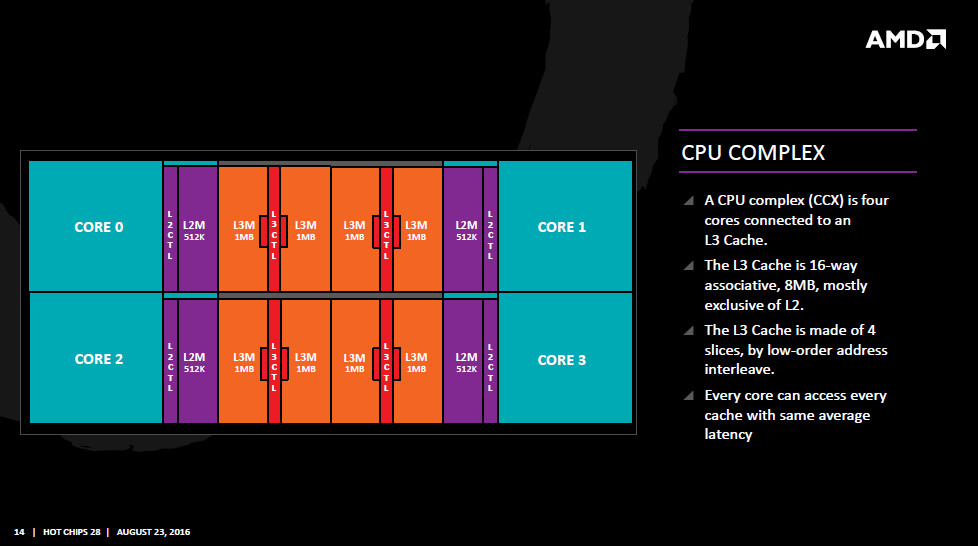
Other models include the 1500X priced at £189/$189, which is clocked at 3.5/3.7GHz, along with the flagship 6c/12t 1600X which is clocked at 3.6/4GHz. It is worth noting that the 1500X, though it is still a 4c/8t part, it features 16MB L3 cache rather than just 8MB as featured on the 1400. This suggests that the differences lie in that the 1400 has just one CCX active, while the 1500X utilises two cores from each of the two available CCX. As with the 1500X, the 1600/X also features 16MB of L3 cache, sow e can assume that it has two active CCX components, but one of the CCX has two disabled CPU cores, creating a 6core/12thread part.
AMD on Ryzen
With end users at the heart of everything AMD does, the new Ryzen 5 processors feature the powerful and efficient “Zen” architecture in 6-core,12-thread as well as 4-core, 8-thread options, to deliver enhanced performance, immersive experiences and high performance innovation to gamers and consumers worldwide with a price range of $169 to $249 USD SEP.
“Ryzen will ultimately bring innovation and competition to virtually every segment of the PC market, and Ryzen 5is the next big step on that journey, designed to achieve new levels of compute performance for millions of PC users,” said Jim Anderson, senior vice president and general manager, Computing and Graphics Group, AMD. “AMD reinvigorated the high-performance desktop market with Ryzen 7 earlier this month, and AMD Ryzen 5 now brings the power and efficiency of the “Zen” core to users in the highly popular sub-$300 segment of the market.”
“Ryzen will ultimately bring innovation and competition to virtually every segment of the PC market, and Ryzen 5is the next big step on that journey, designed to achieve new levels of compute performance for millions of PC users,” said Jim Anderson, senior vice president and general manager, Computing and Graphics Group, AMD. “AMD reinvigorated the high-performance desktop market with Ryzen 7 earlier this month, and AMD Ryzen 5 now brings the power and efficiency of the “Zen” core to users in the highly popular sub-$300 segment of the market.”
Technical Specifications
The Ryzen 5 line up
Specifications
Model: Ryzen 5 1400
# of CPU Cores: 4
# of Threads: 8
Base Clock Speed: 3.2GHz
Max Turbo Core Speed: 3.4GHz
Total L1 Cache: 384KB
Total L2 Cache: 2MB
Total L3 Cache: 8MB
Unlocked: Yes
Package: AM4
Thermal Solution: Wraith Stealth
Default TDP: 65W
Memory
Memory Interface: DDR4
Memory Channels: 2
Key Features
Supported Technologies
“Zen” Core Architecture
AMD SenseMI Technology
AMD Ryzen Master Utility
AES
AVX
FMA4
Virtualization
Model: Ryzen 5 1600
# of CPU Cores: 6
# of Threads: 12
Base Clock Speed: 3.2GHz
Max Turbo Core Speed: 3.6GHz
Total L1 Cache: 876KB
Total L2 Cache: 3MB
Total L3 Cache: 16MB
Unlocked: Yes
Package: AM4
Thermal Solution: Wraith Spire
Default TDP: 65W
Memory
Memory Interface: DDR4
Memory Channels: 2
Key Features
Supported Technologies
“Zen” Core Architecture
AMD SenseMI Technology
AMD Ryzen Master Utility
AES
AVX
FMA4
Virtualization
Model: Ryzen 5 1400
# of CPU Cores: 4
# of Threads: 8
Base Clock Speed: 3.2GHz
Max Turbo Core Speed: 3.4GHz
Total L1 Cache: 384KB
Total L2 Cache: 2MB
Total L3 Cache: 8MB
Unlocked: Yes
Package: AM4
Thermal Solution: Wraith Stealth
Default TDP: 65W
Memory
Memory Interface: DDR4
Memory Channels: 2
Key Features
Supported Technologies
“Zen” Core Architecture
AMD SenseMI Technology
AMD Ryzen Master Utility
AES
AVX
FMA4
Virtualization
Model: Ryzen 5 1600
# of CPU Cores: 6
# of Threads: 12
Base Clock Speed: 3.2GHz
Max Turbo Core Speed: 3.6GHz
Total L1 Cache: 876KB
Total L2 Cache: 3MB
Total L3 Cache: 16MB
Unlocked: Yes
Package: AM4
Thermal Solution: Wraith Spire
Default TDP: 65W
Memory
Memory Interface: DDR4
Memory Channels: 2
Key Features
Supported Technologies
“Zen” Core Architecture
AMD SenseMI Technology
AMD Ryzen Master Utility
AES
AVX
FMA4
Virtualization
For more information about Ryzen 7 and the platform features, Click Here.
Test Setup & Testing
CPUs being tested
AMD Ryzen 5 1400 (3.2GHz) Summit Ridge
AMD Ryzen 5 1400 (4.05GHz Overclocked)
AMD Ryzen 5 1600 (3.2GHz) Summit Ridge
AMD Ryzen 5 1600 (3.95GHz Overclocked)
Test Setup
Cooling Noctua NH-U12S SE-AM4
Motherboard GIGABYTE GA-AX370-GAMING 5
Memory 16GB Corsair Vengeance LPX 3000MHz
Graphics Radeon RX 480 8GB
Storage Corsair Force LE 480GB
PSU Corsair RM 750X 80 Plus Gold Certified PSU
Compared against
AMD Ryzen 7 1700 (3.0GHz) Summit Ridge
AMD Ryzen 7 1700X (3.4GHz) Summit Ridge
AMD Ryzen 7 1800X 3.6GHz) Summit Ridge
AMD FX-8350 (4.0GHz) PileDriver
Intel Core i5-7700K (4.2GHz) Kaby Lake
Intel Core i5-7600K (3.8GHz) Kaby Lake
Intel Core i7-6950X (3.0GHz) Broadwell-E
Intel Core 7-6900K (3.2GHz) Broadwell-E
Intel Core i7-5960X (3.0GHz) Haswell-E
Intel Core i7-6700K (4GHz) Skylake
AMD Ryzen 5 1400 (3.2GHz) Summit Ridge
AMD Ryzen 5 1400 (4.05GHz Overclocked)
AMD Ryzen 5 1600 (3.2GHz) Summit Ridge
AMD Ryzen 5 1600 (3.95GHz Overclocked)
Test Setup
Cooling Noctua NH-U12S SE-AM4
Motherboard GIGABYTE GA-AX370-GAMING 5
Memory 16GB Corsair Vengeance LPX 3000MHz
Graphics Radeon RX 480 8GB
Storage Corsair Force LE 480GB
PSU Corsair RM 750X 80 Plus Gold Certified PSU
Compared against
AMD Ryzen 7 1700 (3.0GHz) Summit Ridge
AMD Ryzen 7 1700X (3.4GHz) Summit Ridge
AMD Ryzen 7 1800X 3.6GHz) Summit Ridge
AMD FX-8350 (4.0GHz) PileDriver
Intel Core i5-7700K (4.2GHz) Kaby Lake
Intel Core i5-7600K (3.8GHz) Kaby Lake
Intel Core i7-6950X (3.0GHz) Broadwell-E
Intel Core 7-6900K (3.2GHz) Broadwell-E
Intel Core i7-5960X (3.0GHz) Haswell-E
Intel Core i7-6700K (4GHz) Skylake
Benchmarks
Cinebench R15 – CPU/OpenGL Score
x264 HD 4.0 – 1st and 2nd pass encoding
SiSoftware SANDRA – CPU & Memory benchmarks
POV-RAY – CPU benchmarks
TrueCrypt – CPU benchmarks
AIDA64 – CPU benchmarks & Memory
PCMark 8 – Creative & Photoshop
3DMark FireStrike – 3D Benchmark
Games – Rise of the Tomb Raider & Total War: WARHAMMER
x264 HD 4.0 – 1st and 2nd pass encoding
SiSoftware SANDRA – CPU & Memory benchmarks
POV-RAY – CPU benchmarks
TrueCrypt – CPU benchmarks
AIDA64 – CPU benchmarks & Memory
PCMark 8 – Creative & Photoshop
3DMark FireStrike – 3D Benchmark
Games – Rise of the Tomb Raider & Total War: WARHAMMER
Other Software
Temperature Analysis: Aida64/Ryzen Master
Stress Testing Software: AIDA64 Stability Test
CPU Specification Monitoring: CPU-Z
Performance Monitoring: MSI Afterburner
Stress Testing Software: AIDA64 Stability Test
CPU Specification Monitoring: CPU-Z
Performance Monitoring: MSI Afterburner
Temperatures & Overclocking
Inside the box, you would be forgiven for expecting to see the lovely new RGB LED Wraith cooler, however, those are limited to just Ryzen 7. Though you can expect the same low-noise cooling performance as the RGB models. The R5 1400 and 1600 are both 65W TDP parts, though the 1600 will likely put out, or have the potential to put out more heat due to the additional active CCX, for this reason we find the 1400 shipping with the low profile Wraith Stealth cooler, and the 1600 with the Wraith Spire cooler.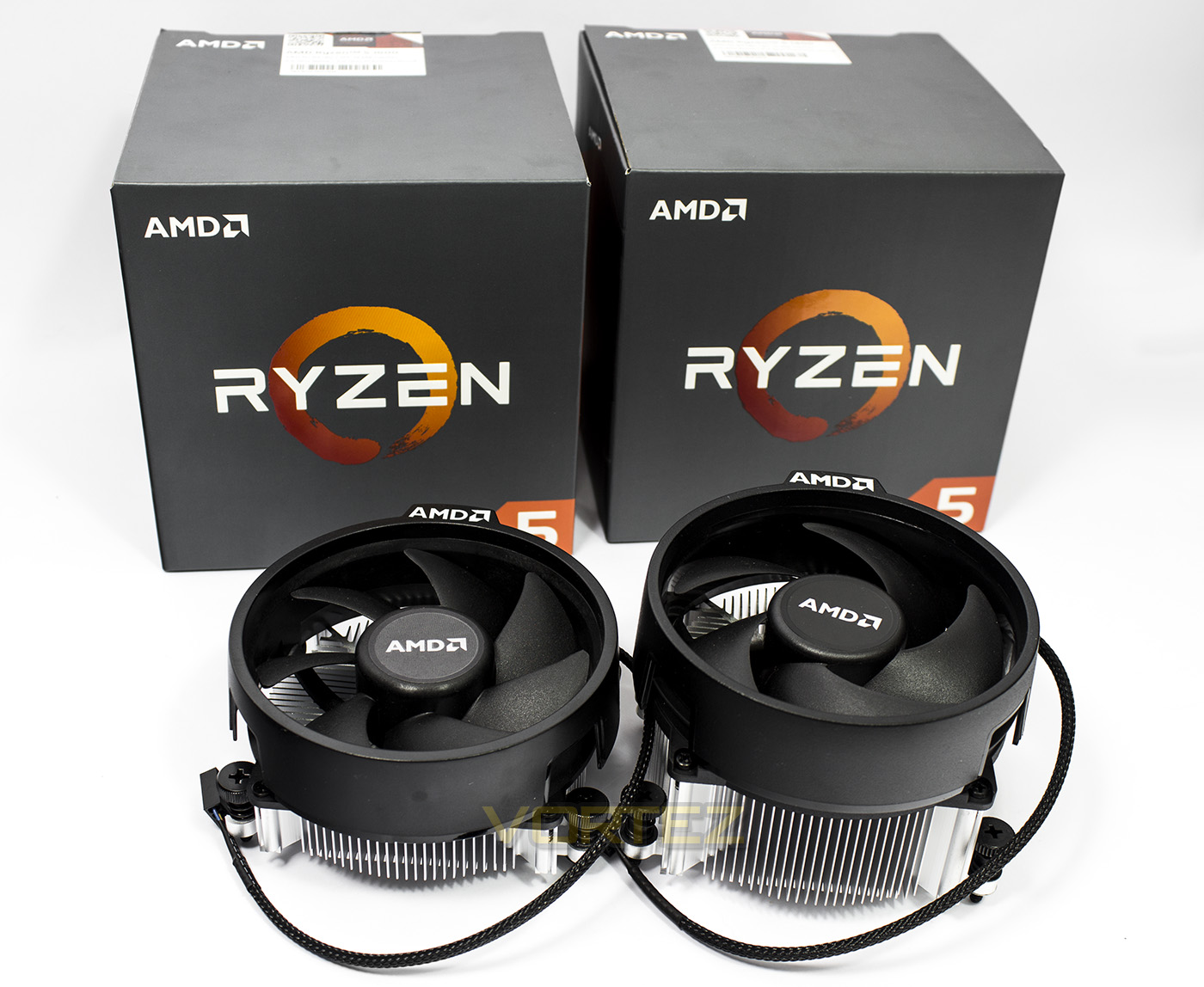
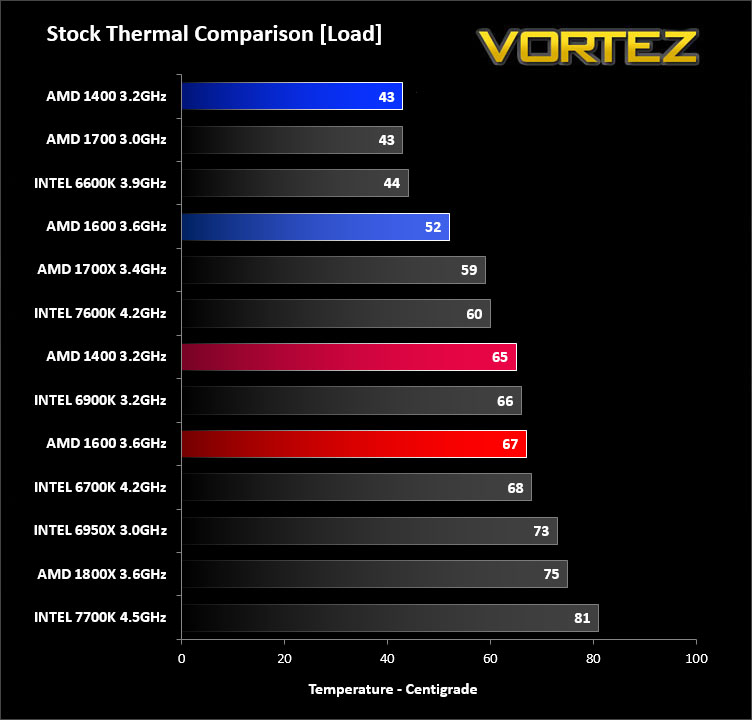
Under our Noctua NH-U12S, there is a distinct difference in thermal performance between the 4c/8t and 6c/12t parts, especially at stock frequencies.
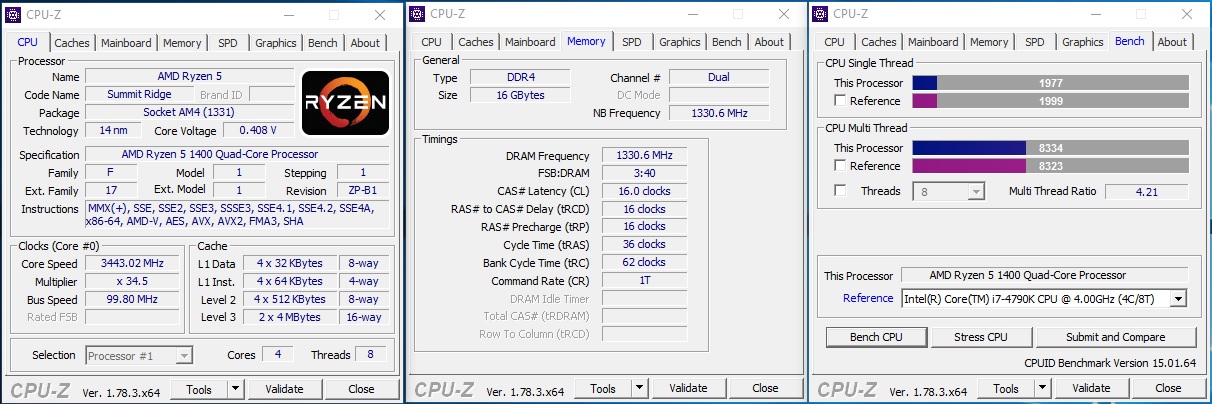
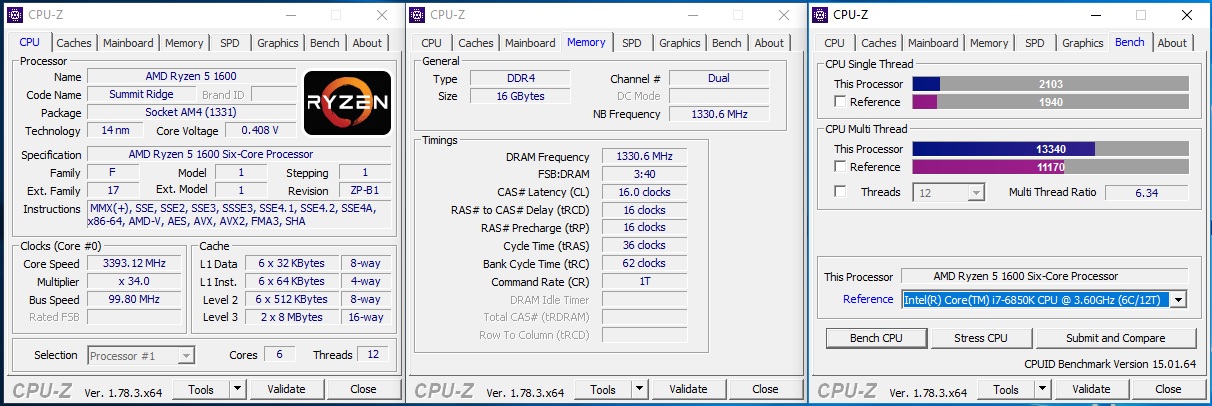
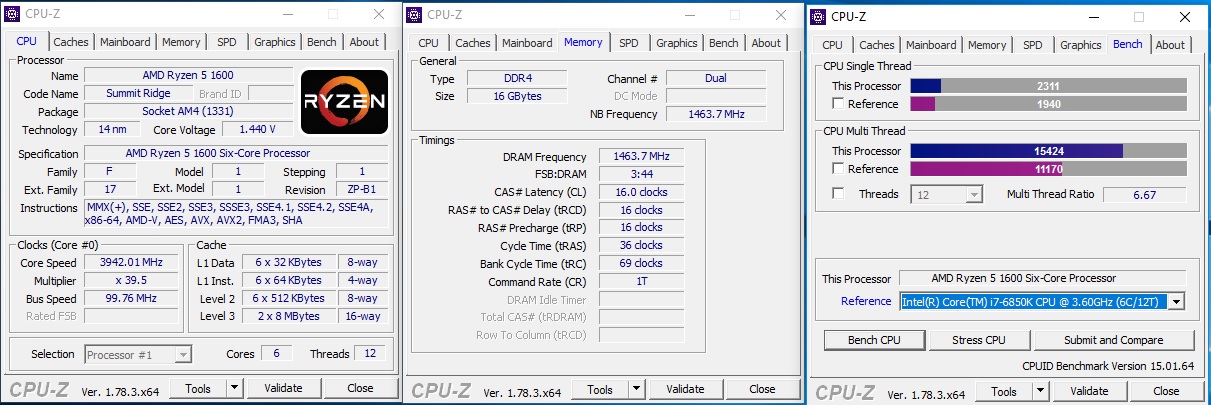
The 1400 is a low clocked quad-core CPU but if our experience of overclocking Ryzen remains true, we should be able to reach 4GHz with around 1.41V. In our previous outings with overclocking Ryzen, we tended to be a little overzealous with the voltages, and it turns out that some may load in at with less volts, though as always, each chip will be different and always stick within your thermal envelope. That being said, the 1400 was happy to hit 4.05Ghz stable with no fuss.
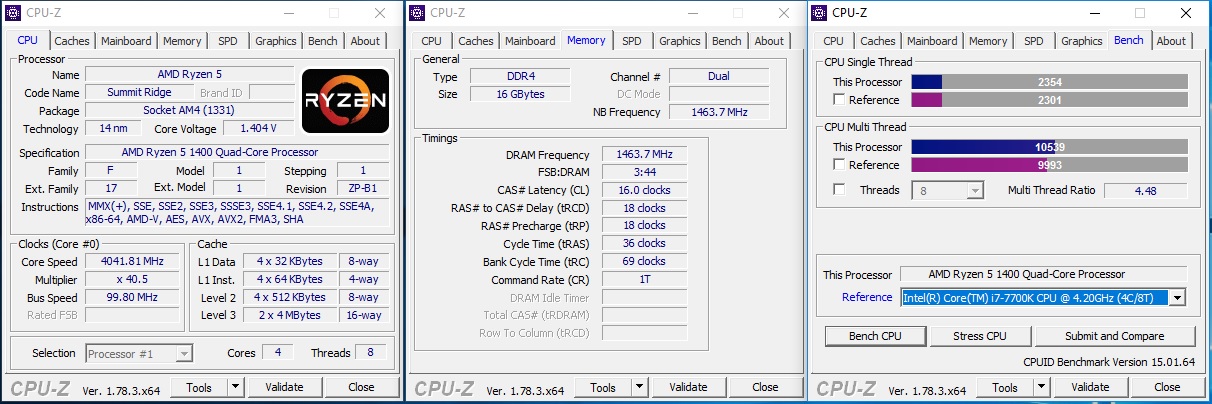
The 1600 however was a different story, using the same guideline voltage, we couldn’t get over 4GHz stable at all, even though we managed to boot in at 4.1GHz, we had to back it down all the way to 3.95GHz to find any semblance of stability. This is likely due to being a lower binned part of the 1600X, or simply, the disabled cores are damaged. That being said, considering that the 1600 has two CCX, it is likely that Ryzen 5 is made up completely of recycled Ryzen 7 parts. This could potentially mean that motherboard makers could dabble with unlocking additional cores again, but so early to release, it is almost entirely likely that the majority of them are faulty. That being said, a 6c/12t CPU at 3.95GHz is still going to provide a significant boost over stock performance, it will just mean that enthusiast overclockers that want to aim for the best performance will likely be better off going for the higher binned 1600X CPU.
Power Consumption
It’s interesting to note the power consumption across all processors. Although they are using a combination of different motherboard chipsets, energy results can fluctuate between manufacturers due to the features and specifications that are integrated. First of all, for the idle tests the system is cold booted into Windows and no additional applications are executed – the watts are noted on the external energy monitor we use and then the system is loaded with 3DMark FireStrike – watts are again monitored for the duration of the test and the highest rated wattage result is then noted down. Below are the results of this energy test.
Ray Tracing Performance – POV-Ray 3.7
Persistence of Vision Raytracer’s PovRay is a free and open source 3D animator application with versions for computers with different operating systems.
This product allows users to build their custom 3D worlds with excellent quality despite their computer’s hardware. It has adjustable options for levels of radiance, refraction, and reflection. Calculation time may vary depending on the computer model, but PovRay can adapt to many computer builds, and is supported by the open source community.
This product allows users to build their custom 3D worlds with excellent quality despite their computer’s hardware. It has adjustable options for levels of radiance, refraction, and reflection. Calculation time may vary depending on the computer model, but PovRay can adapt to many computer builds, and is supported by the open source community.
AES Encryption Performance – TrueCrypt 7.1a
TrueCrypt is a discontinued source-available freeware utility used for on-the-fly encryption (OTFE). It can create a virtual encrypted disk within a file or encrypt a partition or (under Microsoft Windows except Windows 8 with GPT) the entire storage device (pre-boot authentication).
Encoding Performance – X264 HD
Simply put, this test measures how fast your machine can encode a short, DVD quality MPEG-2 video clip into a high-quality x264 video clip. What’s x264, you ask? It’s more or less the next-generation Xvid/DivX codec. I think it’s ideal for a benchmark because the application (x264.exe) reports fairly accurate compression results (in frames per second) for each pass of the video encoding process, and it uses multi-core processors very efficiently.
Processing Features Performance – AIDA64
AIDA64 Product PageThis simple integer benchmark focuses on the branch prediction capabilities and the misprediction penalties of the CPU. It finds the solutions for the classic “Queens problem” on a 10 by 10 sized chessboard. At the same clock speed theoretically the processor with the shorter pipeline and smaller misprediction penalties will attain higher benchmark scores. For example — with HyperThreading disabled — the Intel Northwood core processors get higher scores than the Intel Prescott core based ones due to the 20-step vs 31-step long pipeline. CPU Queen test uses integer MMX, SSE2 and SSSE3 optimizations.
Memory Transfer Performance – AIDA64
AIDA64 Product PageMemory bandwidth benchmarks (Memory Read, Memory Write, Memory Copy) measure the maximum achiveable memory data transfer bandwidth. The code behind these benchmark methods are written in Assembly and they are extremely optimized for every popular AMD, Intel and VIA processor core variants by utilizing the appropriate x86/x64, x87, MMX, MMX+, 3DNow!, SSE, SSE2, SSE4.1, AVX, and AVX2 instruction set extension.
The Memory Latency benchmark measures the typical delay when the CPU reads data from system memory. Memory latency time means the penalty measured from the issuing of the read command until the data arrives to the integer registers of the CPU.
The Memory Latency benchmark measures the typical delay when the CPU reads data from system memory. Memory latency time means the penalty measured from the issuing of the read command until the data arrives to the integer registers of the CPU.
Processing Power Performance – Cinebench R15
CINEBENCH can measure systems with up to 64 processor threads. This test scene contains approximately 2,000 objects which in turn contain more than 300,000 polygons in total, and uses sharp and blurred reflections, area lights, shadows, procedural shaders, antialiasing, and much more. The result is displayed in points (pts). The higher the number, the faster your processor.
Bandwidth Performance – SiSoftware SANDRA
SANDRA isn’t always a benchmark that is included in hardware reviews but I believe it shouldn’t be ignored. SANDRA provides a vigorous package that tests your system in a rather large array of benchmarks. There are many aspects of benchmark that can be executed. We will be considering – CPU and memory tests.
Image Editing Performance – PCMark 8 Photoshop
PCMark 8 Product Page Developed in partnership with Benchmark Development Program members Acer, AMD, Condusiv Technologies, Dell, HGST, HP, Intel, Microsoft, NVIDIA, Samsung, SanDisk, Seagate and Western Digital, PCMark 8 is the latest version in FutureMark’s popular series of PC benchmarking tools. Improving on previous releases, PCMark 8 includes new tests using popular applications from Adobe and Microsoft.
Overall System Performance – PCMark 8
PCMark 8 Product Page Developed in partnership with Benchmark Development Program members Acer, AMD, Condusiv Technologies, Dell, HGST, HP, Intel, Microsoft, NVIDIA, Samsung, SanDisk, Seagate and Western Digital, PCMark 8 is the latest version in FutureMark’s popular series of PC benchmarking tools. Improving on previous releases, PCMark 8 includes new tests using popular applications from Adobe and Microsoft.
VR Performance – VRMark
VRMark Product PageVRMark includes two VR benchmark tests that run on your monitor, no headset required, or on a connected HMD. At the end of each test, you’ll see whether your PC is VR ready, and if not, how far it falls short.
3D Performance – 3DMark FireStrike
3DMark FireStrike Product PageFire Strike is our new showcase DirectX 11 benchmark designed for high-performance gaming PCs. It is our most ambitious and technical benchmark ever, featuring real-time graphics rendered with detail and complexity far beyond what is found in other benchmarks and games today. Fire Strike will only be available in the Windows editions of 3DMark initially.
Gaming Performance – Rise of the Tomb Raider & Total War: WARHAMMER
It’s important for us to perform a number of game benchmarks as well as the synthetic tests because gamers will want to know if there are any significant benefits. So here we have two recent gaming titles.
Conclusion
In our testing, the Ryzen 5 1400 holds its own against the i5 7600K for the most part, and often trades blows with the i7 7700K. It is at this point where it is worth mentioning that it is priced to compete against the i5 7400. AMD clearly was not lying when they say ‘disruptive’ price to performance. As the 1400 is also a low clocked/low power CPU that will also run relatively cool and quietly, some may be surprised by the grunt that it has, though those that will overclock it may will reap the largest rewards in terms of value.The 1600 too has its place, perfectly marring the performance between Intel’s mainstream and extreme platforms , with thanks to those additional CPU cores. Considering that it is priced to compete against the i5 7600K, you are getting 2c/4t extra over the cost of Intel’s offering, and with cores that have a marginal difference in actual performance.
After playing with the 1600 in overclocking, it is likely a lower binned version of the 1600X, which means enthusiast overclockers looking to get the most out of the Ryzen 6c/12t part will likely want to look at the 1600X, however, for the mainstream, the 1600 offers fantastic value as a 6c/12t chip that it has access to the full 16MB L3 cache as with Ryzen 7, and it can still be overclocked to give a very reasonable boost in performance which for most people, won’t be worth spending out the additional $50 for the 1600X.
The biggest downside to the Ryzen 5 line up is that they have Ryzen 7 components onboard, which means that it shares the same power envelope, thus having a slightly reduced performance per-watt when compared to Ryzen 7. This also means that when compared to Intel’s offerings, AMD have lost die-space that would otherwise house an integrated graphics processing unit (iGPU). Arguably, this level of performance is targeting the mainstream, being gamers, content creators, and the every user, but ever since Intel and AMD have started shipping CPUS with iGPUs, many have found them convenient fallback when there is a problem with their discrete graphics card. This, along with the fact that AMD didn’t include those sexy RGB Wraith coolers with Ryzen 5, does detract a little from the value-Added aspect of Ryzen 5; though not enough to undermine the outright disruption that Ryzen 5 will deliver to the Blue camp.
Ryzen 5 bring AMD back into the game as they deliver high-performance multi-threaded computing at prices that will be a major disruption to the competition.
Pros
+ Highly competitive performance
+ Well rounded platform cost
+ Easy to overclock
+ Sense MI technologies
+ Delivers more cores to the mainstream
Cons
– Ryzen 5 doesn’t ship with RGB cooler
– Same power envelope as Ryzen 7
– No iGPU
+ Highly competitive performance
+ Well rounded platform cost
+ Easy to overclock
+ Sense MI technologies
+ Delivers more cores to the mainstream
Cons
– Ryzen 5 doesn’t ship with RGB cooler
– Same power envelope as Ryzen 7
– No iGPU
Click here for an explanation of our awards at Vortez.net.