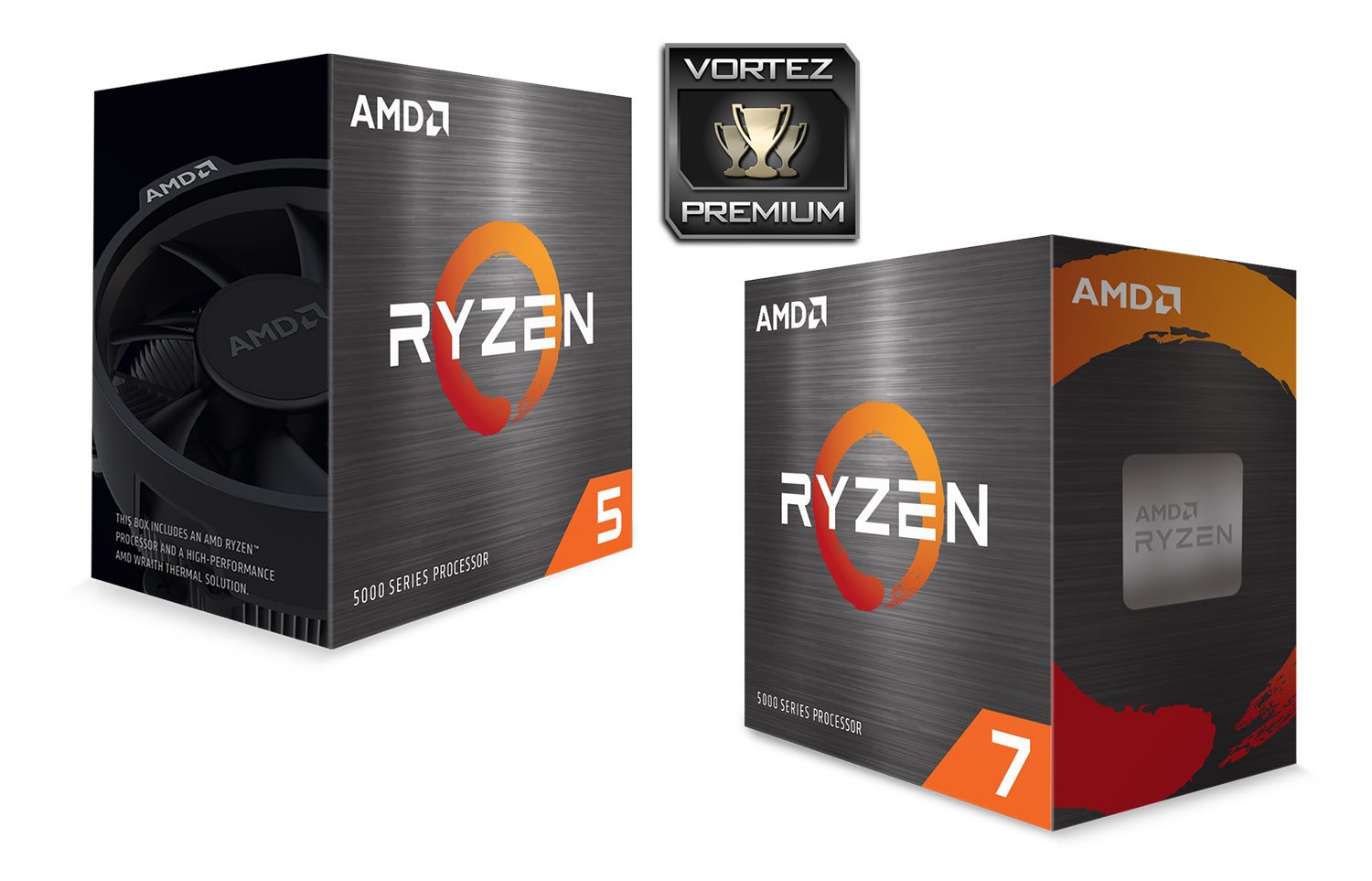
The much-anticipated AMD Zen 3 Vermeer CPUs are finally here! We take the Ryzen 5 5600X and Ryzen 7 5800X processors for a spin to see how they compare to previous generations.

Product on Review: Ryzen 5 5600X | Ryzen 7 5800X
Manufacturer: AMD
Street Price:
5600X: $299 USD | £275 GBP | $469 AUD
5800X: $449 USD | £420 GBP | $700 AUD
The progression of AMD’s Ryzen CPU line from Q1 2017 launch through to today has been a breath of fresh air flowing through the desktop PC market. From upsetting the ‘core count status-quo’ to introducing PCIe 4.0, successive generations have been credited with turning around the fortunes of AMD and meaningfully uplifting the competitiveness of mainstream desktops. The first generation made Ryzen relevant, the third generation seriously eroded their competition’s dominant position. Now it’s time for the fourth generation to make an impact.
AMD’s Ryzen 5000-series is based on the brand new Zen 3 architecture that debuts with this range of products. A substantial evolution over Zen 2 rather than more minor iteration, in time the architecture should arrive in the server, HEDT and APU categories. Desktops, however, are getting it first.
That being said, the range won’t satisfy the whole gamut of desktop system markets just yet however. It will launch with just four SKUs, broadly catering to gaming, performance and enthusiast segments from $300 USD to $750 USD (£250 to £750). More mainstream and budget-oriented builds aren’t in the frame for Zen 3 just yet, but older mid-range Zen 2 processors should serve as an ample stop-gap.
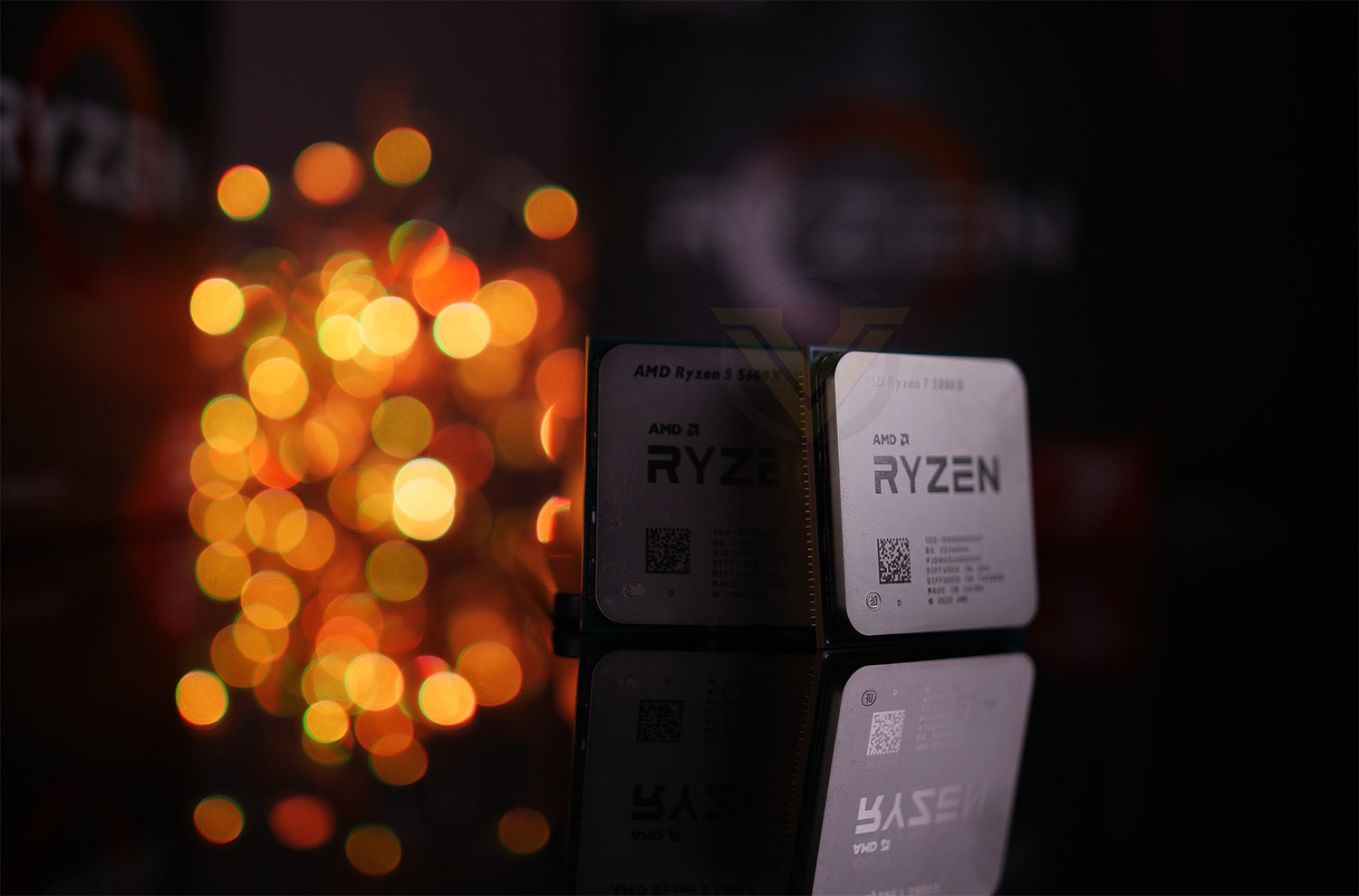
A large reason for bringing it to the desktop first has to be the mature hardware already available for which the 5000-series will be a near drop-in upgrade. These processors continue the legacy of the AM4 socket, and will be compatible at launch with the huge selection of 500-series motherboards that have been available since July 2019. Furthermore, selected members of the 400-series will also be receiving a UEFI BIOS update to unlock Ryzen 5000-series support (expected in January in many cases).
The Ryzen 5 5600X, Ryzen 7 5800X, Ryzen 9 5900X and Ryzen 9 3950X each occupy a similar position in the stack as their predecessors from the 3000-series. While there are plenty of changes under the hood, the specification sheet will bear many similarities with those of the Ryzen 3000-series for desktops.
Sixteen cores continues to be the flagship implementation, and the x600X, x800X and x9x0X SKUs will each have the same number of cores from one generation to the next. Base and boost clock speeds differ slightly and the headline cache values are unchanged, but don’t let that fool you – AMD are projecting yet another step-change in performance without the need for more cores on the processor.
Central to that is a marked improvement in Instructions per Clock (IPC). AMD believe that they have nailed double-digit percentage improvements in this key metric (in the region of 19% averaged over a broad array of workloads), reversing the status quo when it comes to game performance in the process. Intel’s Core architecture has for almost a decade enjoyed a near-unrivalled lead in this arena, so AMD taking the crown here as well as in workhorse productivity applications would complete a dramatic reversal in the status of the two manufacturers.
Today’s review will take you through the Ryzen 5 5600X and Ryzen 7 5800X. Equipped with six and eight cores and supporting twelve and sixteen independent threads respectively, they will form the backbone of the gaming and entry level enthusiast performance classes as the 5000-series launches.
The projected improvements in performance are counterbalanced however by an increase in cost. AMD are launching these CPUs with an MSRP of $299 and $449 USD, a $50 increase over their 3000-series counterparts that’s also reflected higher in the stack. That will bite deepest at the most affordable end of the market, where customer budgets are tightest.
But we are getting ahead of ourselves. Overcoming Intel’s 10th Generation ‘Comet Lake’ range will be a far from trivial matter even before you take into account that range’s atypically competitive pricing. AMD might have a process and technological lead, but application-specific and overall performance dominance is still to be determined.
AMD on their Ryzen 5000 Series Processors:
When you have the world’s most advanced processor architecture for gamers and content creators, the possibilities are endless. Whether you are playing the latest games, designing the next skyscraper, or crunching data, you need a powerful processor that can handle it all—and more. Hands down, the AMD Ryzen™ 5000 Series desktop processors set the bar for gamers and artists alike.
Technical Specifications
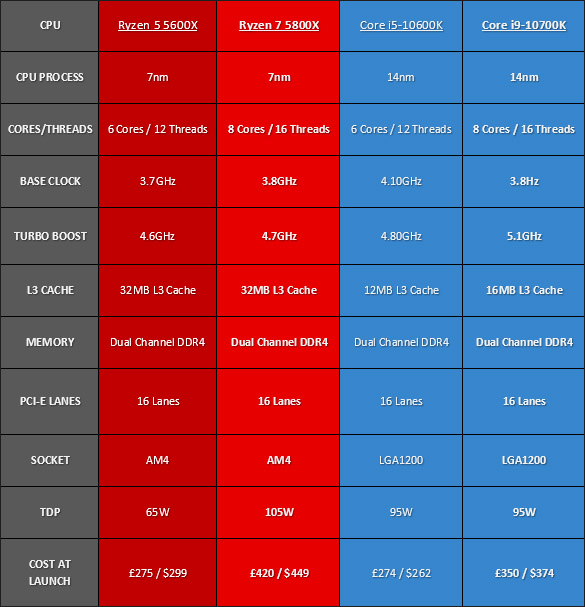
Below are the headline specifications of the processors reviewed today:
AMD Ryzen 5 5600X
– 1 CCD, 6 Physical CPU Cores, 12 threads, supporting SMT.
– 3.70 GHz GHz Base Clock, 4.6 GHz Boost
– 35MB Cache (32MB L3, 512KB L2 per core)
– Socket AM4
– Fully Unlocked Multiplier
– 128GB DDR4-3200 support
– 24 PCI-Express 4.0 lanes – Up to 1×16, 2×8 + 1×4; 1×4 reserved for chipset
– 65W TDP
– 95C TjMAX
– Includes Wraith Stealth Cooler (Retail package)
– 3.70 GHz GHz Base Clock, 4.6 GHz Boost
– 35MB Cache (32MB L3, 512KB L2 per core)
– Socket AM4
– Fully Unlocked Multiplier
– 128GB DDR4-3200 support
– 24 PCI-Express 4.0 lanes – Up to 1×16, 2×8 + 1×4; 1×4 reserved for chipset
– 65W TDP
– 95C TjMAX
– Includes Wraith Stealth Cooler (Retail package)
AMD Ryzen 7 5800X
– 1 CCD, 8 Physical CPU Cores, 12 threads, supporting SMT.
– 3.80 GHz GHz Base Clock, 4.7 GHz Boost
– 36MB Cache (32MB L3, 512KB L2 per core)
– Socket AM4
– Fully Unlocked Multiplier
– 128GB DDR4-3200 support
– 24 PCI-Express 4.0 lanes – Up to 1×16, 2×8 + 1×4; 1×4 reserved for chipset
– 105W TDP
– 90C TjMAX
– 3.80 GHz GHz Base Clock, 4.7 GHz Boost
– 36MB Cache (32MB L3, 512KB L2 per core)
– Socket AM4
– Fully Unlocked Multiplier
– 128GB DDR4-3200 support
– 24 PCI-Express 4.0 lanes – Up to 1×16, 2×8 + 1×4; 1×4 reserved for chipset
– 105W TDP
– 90C TjMAX
SMT SUPPORT
Each AMD Ryzen 5000-series launched today incorporates native support for Simultaneous Multi-threading. Roughly analogous to Intel’s Hyperthreading technology, SMT allows the processor to process two independent compute threads simultaneously on a single CPU core, sharing hardware resources where appropriate. Overall CPU performance therefore scales exceptionally with highly threaded tasks and operational scenarios.Features – 7nm and AM4 Return
MANUFACTURING NODE
The Ryzen 3000-series made history as the first mainstream desktop processor to transition to TSMC’s 7nm manufacturing process, utilising the improvements it offered in terms of smaller die size and lower power requirements for CPU Core Dies (CCD) while maintaining a 12nm package for the larger IO die (on which sits the memory controller and other IO functions).Ryzen 5000-series processors are similar. The 7nm process involved is a more mature one, though AMD fall short of calling it 7nm+, so it should offer more consistent yields and binning opportunities for high performance parts. The IO die meanwhile is identical to that utilised in the ‘Matisse’ 3000-series processors, utilising the same 12nm process for the sake of consistency.
While it is common for manufacturers to increase power limits in order to squeeze new performance from each subsequent generation, AMD have instead maintained the TDP criteria from Zen 2 to Zen 3 at stock. Perf/watt improvements therefore are a direct result of performance-based architectural improvements rather than boosting power limits.
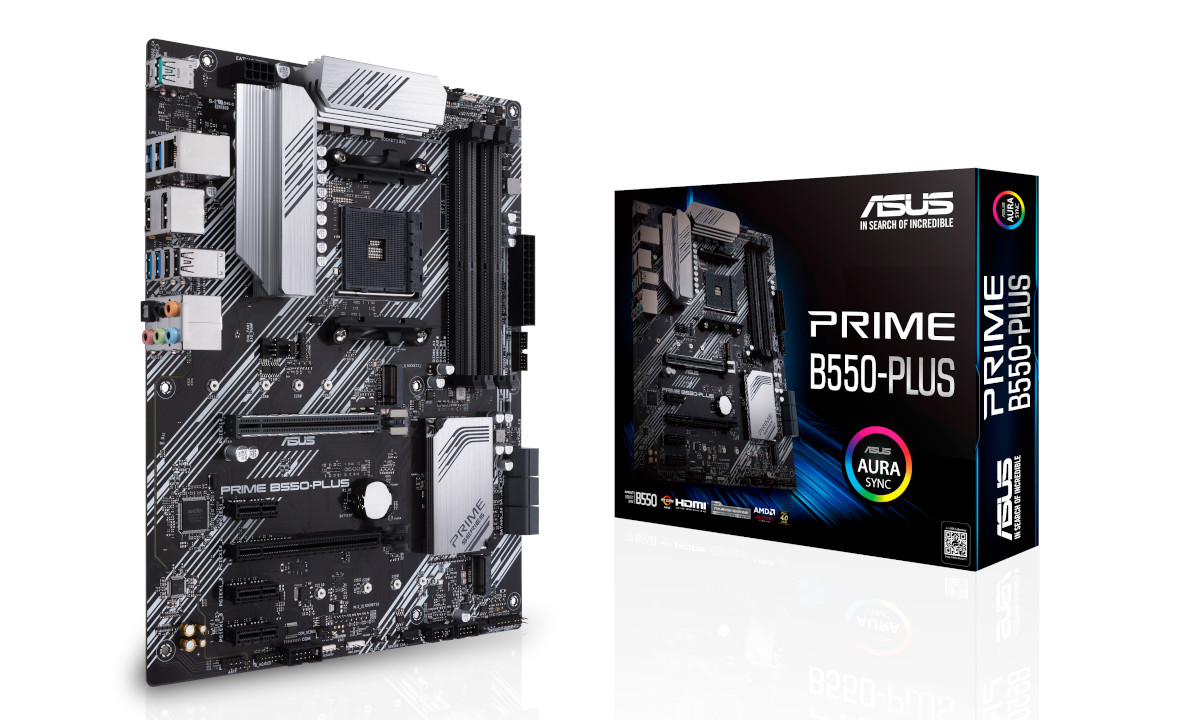
Current 500-series motherboards are compatible with Ryzen 5000-series processors when updated to an appropriate BIOS
SOCKET PARITY & MOTHERBOARD COMPATIBILITY
A large contributor to Ryzen’s success has been the continuity offered by Socket AM4 and backwards/forwards compatibility across updated motherboard generations. This outing is nonetheless likely to be the final hurrah for AM4 prior to transitioning to a new socket and DDR5 memory, and you always want to send them off by making a statement.The Ryzen 5000-series is compatible straight out of the box with 500-series motherboards on sale right now, comprising all X570, B550 and A520 models. 500-series models already in the hands of end-users require an AGESA 1.0.8.0 UEFI BIOS or newer, for which there was wide-spread release in August/September after an initial May rollout. If in doubt, update to your latest release prior to installation of the new CPU.
Just like the Ryzen 3000-series before it, Ryzen 5000-series CPUs will be compatible with the prior motherboard generation… eventually. 400-series BIOS updates are in development now and beta releases should be available in January 2021 across a wide range of both B450 and X470 models; early adopters will therefore need to leverage a 500-series board. PCIe 4.0 restrictions according to motherboard chipset will also remain in place.
No changes to upper TDP limits and stock memory support means there shouldn’t be any new issues with specific CPU/Motherboard combinations due to weak power delivery systems at stock speeds. In-situ processor updates therefore could be made more affordable than a typical whole-system upgrade.
CHIPLETS RETURN
Ryzen 5000-series CPUs inherit many of the physical characteristics from the 3000-series. As well as an AM4-compatible interposer, each processor features one or two 7nm Core Complex Dies (CCD) and a single 12nm IO Die (IOD). The IOD is unchanged from the 3000-series, whereas the CCD has undergone significant updates.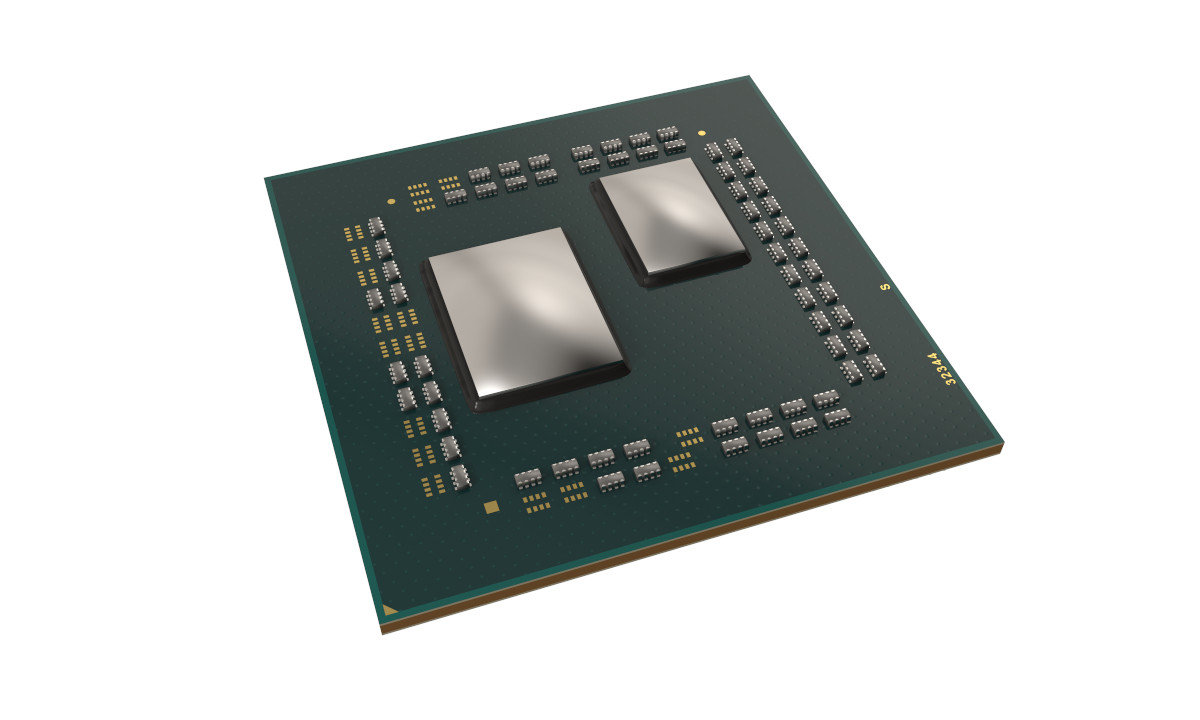
Ryzen 5000-series processor with IOD and single CCD chiplets
As with the previous generation, Chiplets allow AMD to aggressively bin their dies and allocate the best performing ones accordingly. It’s for that reason that clock speeds increase as we go up the range, and only the 105W power envelope of the dual-CCD 5950X appears to restrict its base clock.
Selectively disabling sub-standard cores allows AMD to use more of the dies that would otherwise not make the grade, both in the 5600X (a single 6-core CCD) and 5900X (two 6-core CCDs). By getting more from each manufactured wafer coming out of TSMC they’re able to keep prices relatively low, even considering the benefits of small die areas compared Intel’s monolithic 10th Generation desktop CPUs.
Features – A High Level Look at Zen 3
EXPANDING THE CCX WITH ZEN 3
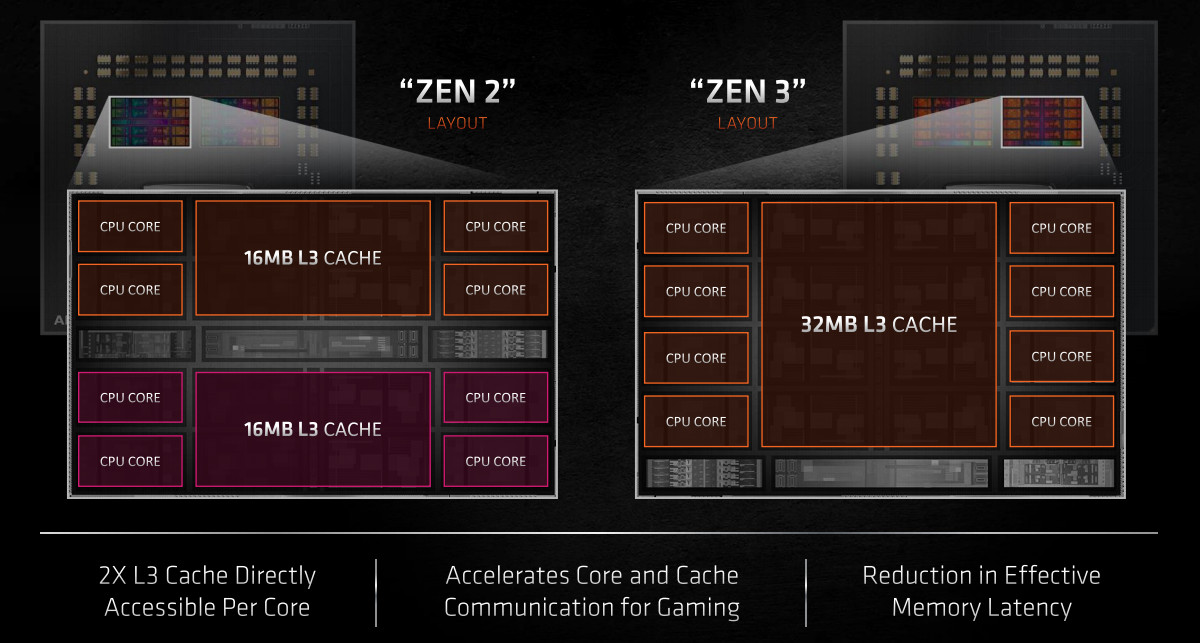
Zen and Zen 2 were designed around a module known as a CPU/Core Complex (or CCX) which featured four CPU cores, each with private L1 and L2 cache, and a shared pool of L3 cache. Up to two CCX’s would be active on a single processor die, and data in one CCX L3 cache pool could be accessed by the other CCX across the ‘infinity fabric’ pathways at speeds tied to memory clocks.
Cross-CCX cache querying, and the latency it introduced, was one of the highlighted weaknesses of Zen modular design. It was partially mitigated by the massively increased L3 cache present in Zen 2’s chiplet implementation (which was primarily intended to mitigate against increased memory latency), but that was sidestepping the problem somewhat.
Zen 3 redesigns the CCX by expanding up to 8 cores, each with the same allocation of L1 and L2 cache, and allowing all 32MB L3 Cache to be shared by the cores at the same latency. Hopping between CCX’s now need only occur when hopping between CCD’s, a factor that’s also irrelevant for the 6- and 8-core 5600X and 5800X.
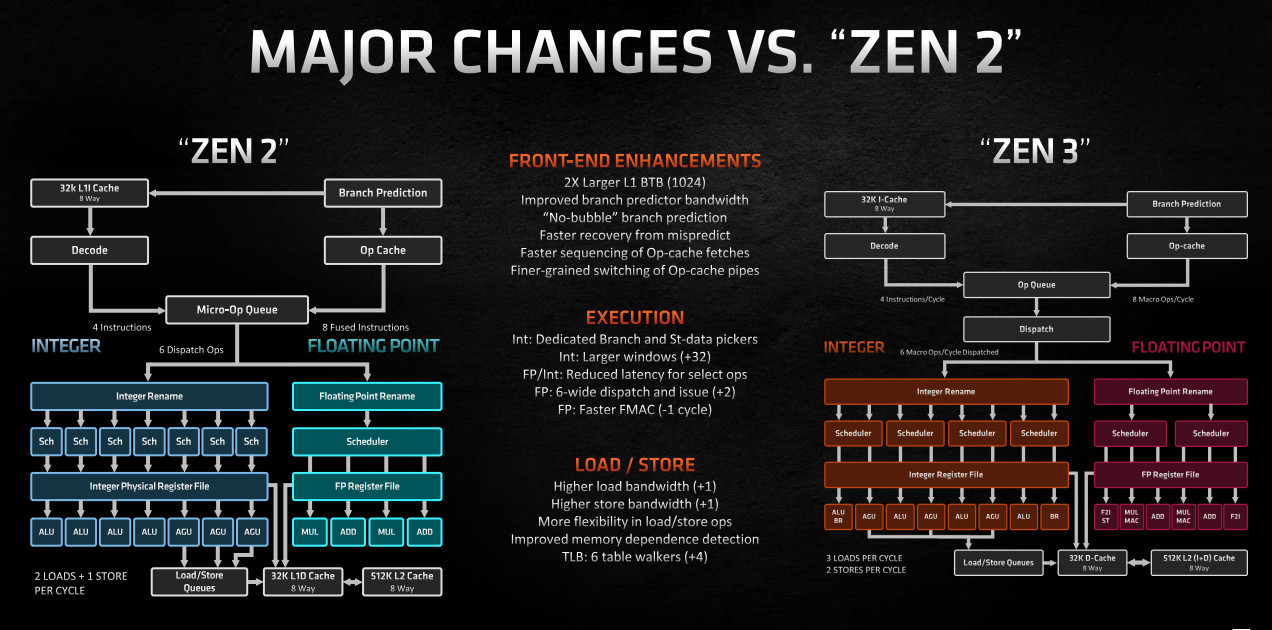
This is far from the only change introduced with the Zen 3 architecture – AMD are keen to emphasise that gaining large IPC margins requires heavy revision from the front to the back of the CPU – but it’s the most stark.
BROAD ARCHITECTURAL IMPROVEMENTS
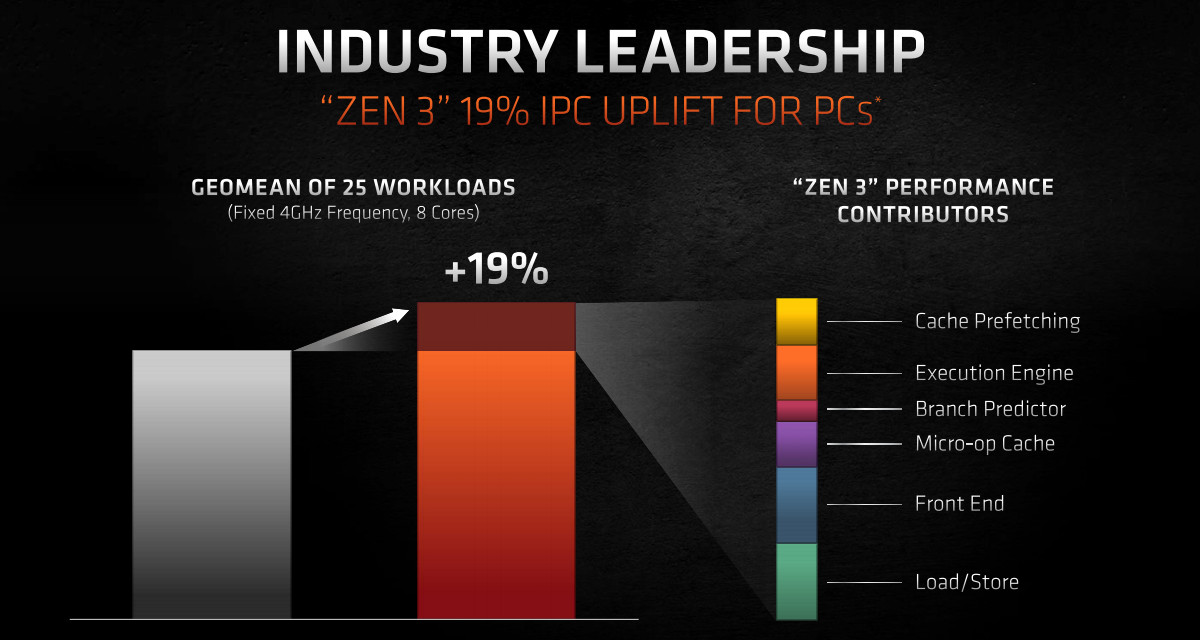
AMD claim an averaged 19% IPC uplift with Zen 3 compared to Zen 2, but no single development led to this improvement. Instead, a combination of aspects of the Zen processing pipeline have been overhauled to push the CPU this far, each contributing in significant ways.These improvements are highly technical but can be placed under three broad banners:
– Front-End Enhancements encompassing an enhanced Branch Predictor and operation caches
– advances in Execution, with lower latency and faster unit operation
– Load/Store improvements, particularly higher overall bandwidth
– advances in Execution, with lower latency and faster unit operation
– Load/Store improvements, particularly higher overall bandwidth
Zen 3 began with the goal of delivering performance leadership across all aspects of desktop computing. Multi-core performance was already licked thanks to the strong SMT implementation and a 16-core flagship SKU, but Zen 2 still trailed in lightly threaded tasks that relied on IPC and raw clock speed, particularly gaming.
So it’s telling that although that 19% headline improvement to IPC is impressive by itself, many of the gains are concentrated in gaming workloads particularly. In this subset of workloads the benefits could be as high as 39% at appropriate rendering resolutions, resolutions that tax the CPU without bottlenecking on the GPU (typically 1080p).
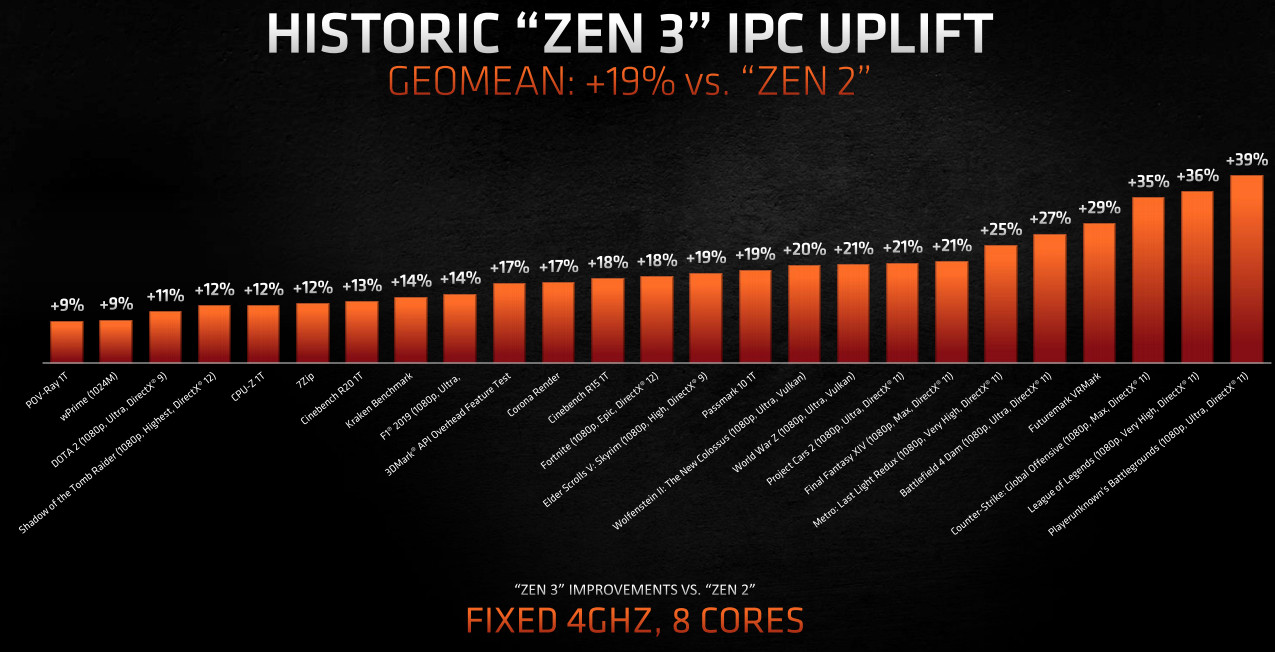
Preliminary testing also indicates that Zen 3 gains further from a faster (i.e. RTX 30-series) GPU than its competition, but the selection of results available with this relatively new system configuration is limited at this time.
MEMORY CONTROLLER
The Ryzen 5000-series IO Die (IOD) is identical to the IOD of the 3000-series, and so the general principles learned remain unchanged. DDR4 3200 is still the recommended memory to pair with the processors prior to entering an overclocked state, and the default relationships between DRAM Memory (memclk), Unified Memory Controller (UMC) and Infinity Fabric (fclk) clocks still operates in a 1:1:1 ratio.The maximum memory capacity is 128GB DDR4 (4x32GB), and EEC memory is supported but remains unqualified on the mainstream platform. EEC support will therefore vary on a motherboard by motherboard basis.
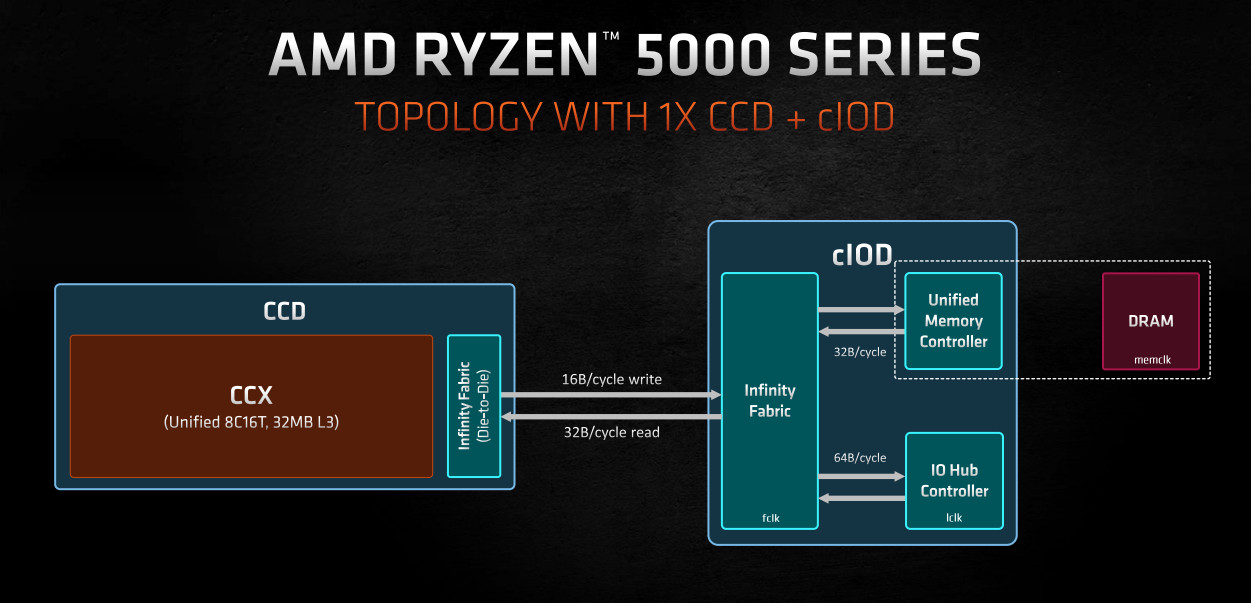
Under overclocked conditions the memory clock can be increased in 33MHz increments beyond the spec of the memory controller, with memclk and UMC remaining in lockstep. It is possible however to shift the fclk ratio to 1:2, stepping it down to half the UMC clock and thereby potentially increasing system stability at higher memclk/UMC. Optimum operation is typically when in a 1:1:1 ratio however.
The Ryzen 3000-series was generally understood to hit a memory overclocking sweet spot of ~3800MHz DDR4, after which the infinity fabric ratio would need to be stepped down. AMD project that the equivalent 5000-series sweet-spot is ~4000MHz, no-doubt pleasing memory manufacturers the world over. Achieving this isn’t guaranteed, and may require the latest launch BIOSes on 500-series motherboards.
Features – Overclocking & PCIe 4.0 Support
OVERCLOCKING
AMD’s Ryzen platform continues to be exceptionally open for overclocking no matter your combination of components if paired with a B or X-series motherboard. Each CPU is fully unlocked in terms of multiplier, memory clock, infinity clock and VID/Vcore, and the tools available through BIOS are typically limited only by their motherboard partners’ implementations. Only A520 boards lock down the processor to any real extent.That being said, AMD’s binning process tends to not leave much raw CPU performance on the table, so overclockers may find they reach the limits of the silicon earlier than Intel’s competing platform. It’s in these cases where the breadth of tweaking tools available really shines, particularly by raising memory speed alongside the infinity fabric clocks.
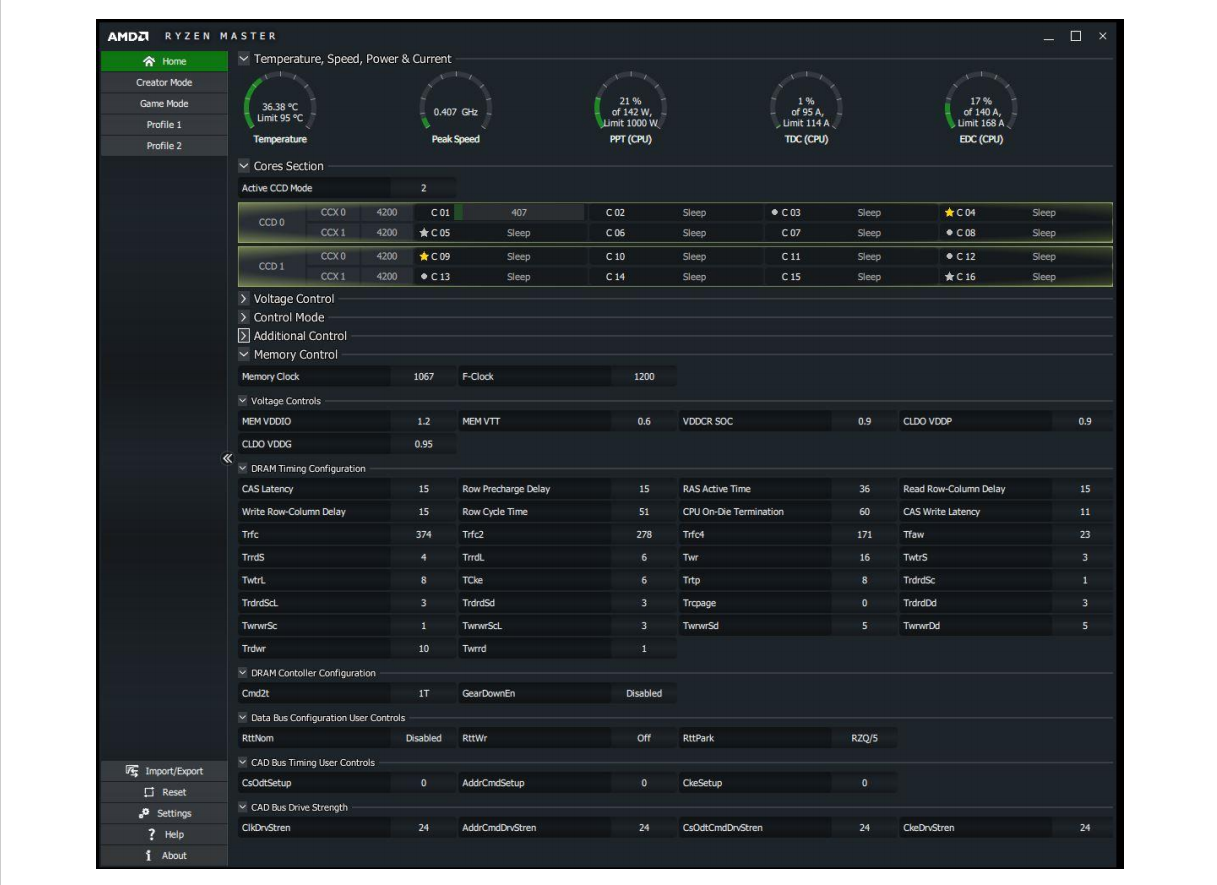
New look Ryzen Master UI
An overhauled version of the Ryzen Master utility now exposes a range of key configuration options from power states through to DRAM timing control that experienced users can take advantage of to tweak performance and stability. Cores are also grouped in a topological manner that relates to their physical location, making it just a touch easier to ‘grok’. Ryzen 5000-series CPUs support overclocking the entire package or on a per CCX/CCD basis, but do not support individual core overclocking.
The Ryzen 2000-series introduced Precision Boost 2, an algorithm through which the CPU can dynamically and opportunistically overclock from its base clock speed. Multiple sensor readings including voltages, temperatures and load are all taken into consideration in its assessment. PB2 was revised in the 3000-series, and relative to that baseline the newest boosting algorithm has been extended to reach even higher maximum operating frequencies at the same core count (as reflected in the processor specifications).
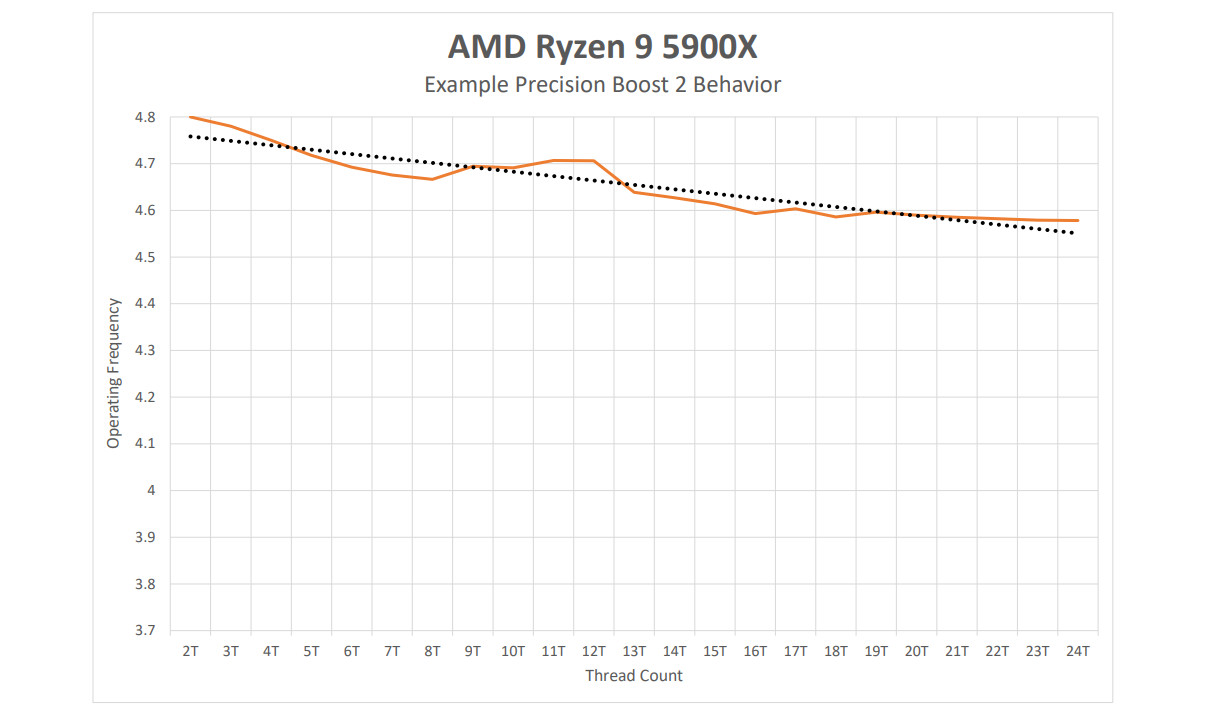
The highest operating frequencies are achieved when the CPU has workloads that are lightly threaded and only occupy a single core. More highly threaded workloads achieve a lower maximum PB2 overclock, but that clock speed is still well over the base clock.
For reference, typical core operating voltages have remained unchanged in the transition from Zen 2 to Zen 3, and will vary between 0.2 and 1.5V at stock under a range of typical loads. TjMax for the 65W 5600X is listed at 95C, whereas the 105W SKUs each have a reference TjMax of 90C. At stock AMD expect the processor to operate at up to this temperature (managed by on-board systems) when paired with entry-level cooling solutions, and up to around 80C utilising high-end AIO or dual-tower performance air cooling.
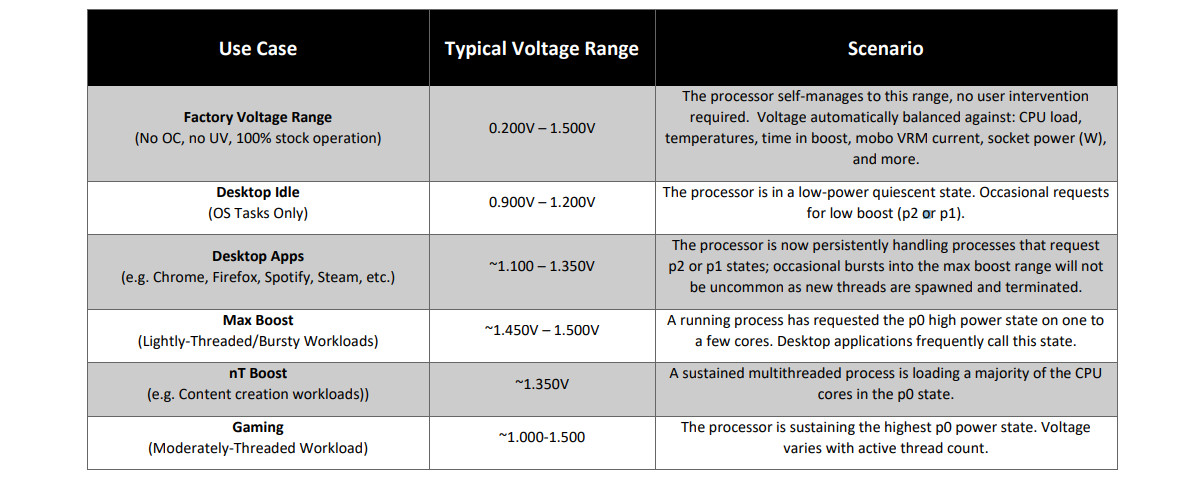
Typical Operating Voltages at Stock
Operating alongside the automatic overclocking features is a new Performance and Energy Slider for Windows 10 desktop PCs. When installed the slider will adjust the threshold at which the Precision Boost 2 algorithm will hit a p0/high performance power state. A central position corresponds to typical Windows ‘Balanced’ power plan behaviour, whereas the left-most position is less responsive to short-term high p-state requests. This functionality will be available with the AMD Chipset Driver 02.10.13.408 and is added as a Windows Provisional Package.
PCIE4.0
A combination of the 5000-series processors and 500-series motherboards continues the PCIe 4.0 support structure of the 3000-series. The processor range offers up to 24 PCIe 4.0 lanes that is apportioned according to the motherboard chipset and attached components.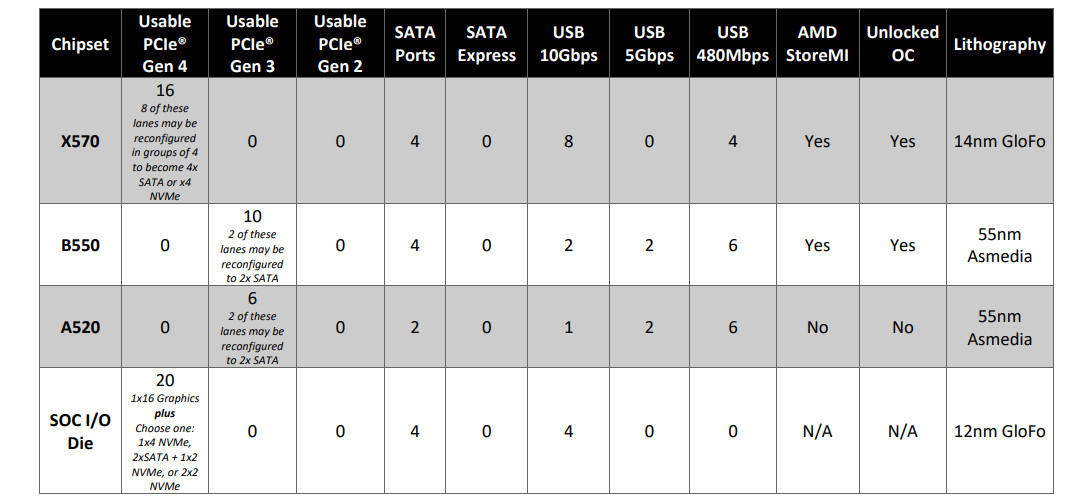
PCIe 4.0 x16 graphics support is present on both X570 and B550 motherboards, potentially subdivided to dual x8 lanes for multi-GPU configurations. Four additional lanes are divvied up to SoC storage, either as a single 4-lane NVMe slot, two 2-lane NVMe slots or two SATA connectors. A520 does not take advantage of the processor’s PCIe 4.0 capabilities.
The final four off-CPU lanes are reserved for the connection with the motherboard chipset. X570’s chipset link is across four PCIe 4.0 lanes, whereas the B550 link utilises four lanes running at PCIe 3.0 speeds. As a consequence the X570 chipset can offer a further 16 PCIe 4.0 lanes specifically for more high performance storage options and PCIe peripherals, making it the platform of choice for content creators over a B550 solution.
One further advantage of X570 over B550 is a biasing towards 10Gbps USB (USB 3.2×2) over slower speeds. The X570 platform can be configured with up to eight USB 3.2×2 ports, whereas B550 is typically limited to two of these ports and two more USB 3.1 ports for 5Gbps connectivity.
COOLER SUPPORT
The AM4 mounting specification hasn’t changed for this new series of processors, so the processors are compatible with the huge range of AM4 CPU coolers currently on the market. Performance under dynamic overclocking conditions is likely to very according to the cooling solution used, so it will pay dividends to invest in a high performance design from a manufacturer that favours long-term support.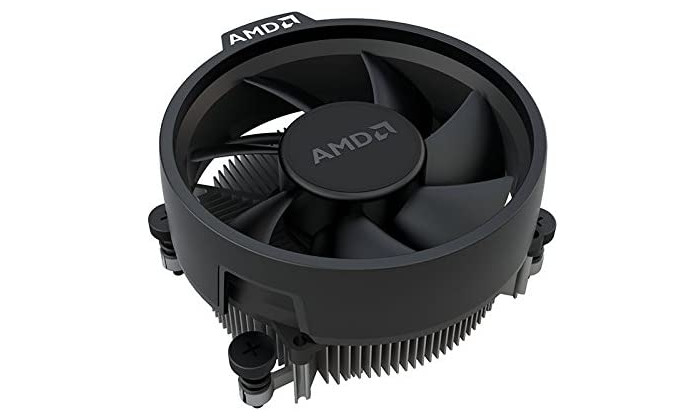
AMD’s Wraith Stealth AM4 CPU Cooler for processors up to 65W TDP
AMD will no longer be bundling their boxed coolers with the Ryzen 7 and 9 series processors, citing the realistic expectation that end-users would prefer to configure their own cooling solution. The 5600X will however include the AMD Wraith Stealth cooler when sold as a retail PIB, a model that will be sufficient for this 65W processor under stock settings.
Test Setup & Testing
For the purpose of testing both Ryzen 5000 Series Processors we used the ASUS ROG Crosshair VIII Hero since it is placed as a high-end motherboard, this should give us the capabilities of showing the true potential for both models.
CPUs being tested
AMD Ryzen 7 5800X (4.7GHz)AMD Ryzen 5 5600X (4.6GHz)
TEST SETUP
Cooling Corsair Hydro Series H110iMotherboard ASUS ROG Crosshair VIII Hero
Memory 32GB Corsair Vengeance LPX 3000MHz
Graphics Radeon RX 480 8GB
Storage Intel S3500 128GB
PSU Corsair RM 1000 80 Plus Gold Certified PSU
Monitor AOC U2879VF
BENCHMARKS
Cinebench R15/R20 – CPU/OpenGL Scorex264 HD 4.0 – 1st and 2nd pass encoding
SiSoftware SANDRA – CPU & Memory benchmarks
POV-RAY – CPU benchmarks
TrueCrypt – CPU benchmarks
AIDA64 – CPU benchmarks & Memory
PCMark 8 – Home Suite & Photoshop
3DMark FireStrike – 3D Benchmark
Games – Rise of the Tomb Raider & Total War: WARHAMMER
OTHER SOFTWARE
Temperature Analysis: CoreTempStress Testing Software: AIDA64 Stability Test
CPU Specification Monitoring: CPU-Z
Temperatures & Overclocking
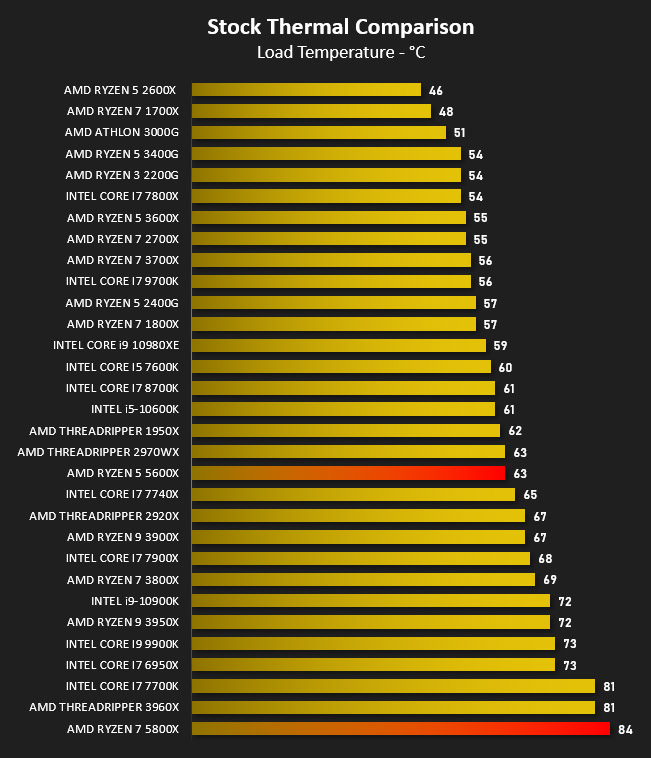
Below are the temperatures for each of the CPUs – without any overclock applied. We’ve also compared to previously released AMD and Intel counterparts (which we’ve also benchmarked against on the subsequent pages too):
OVERCLOCKING
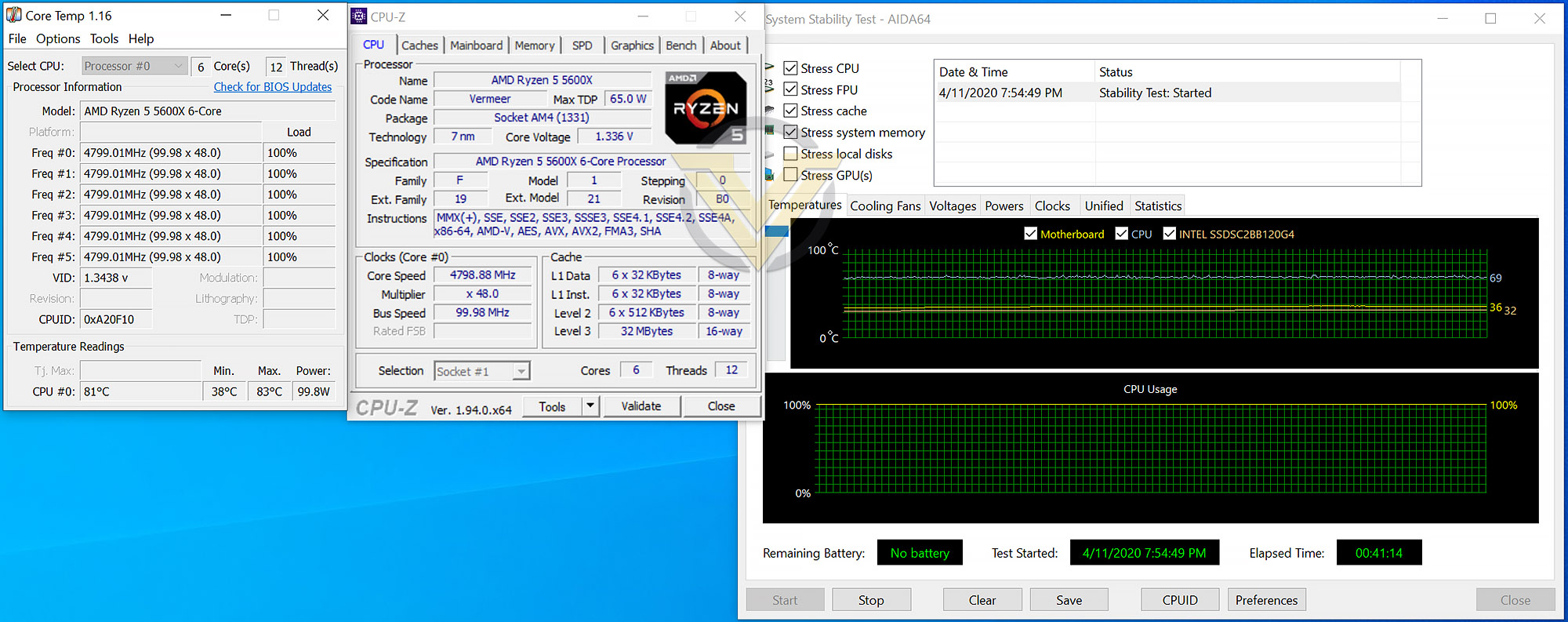
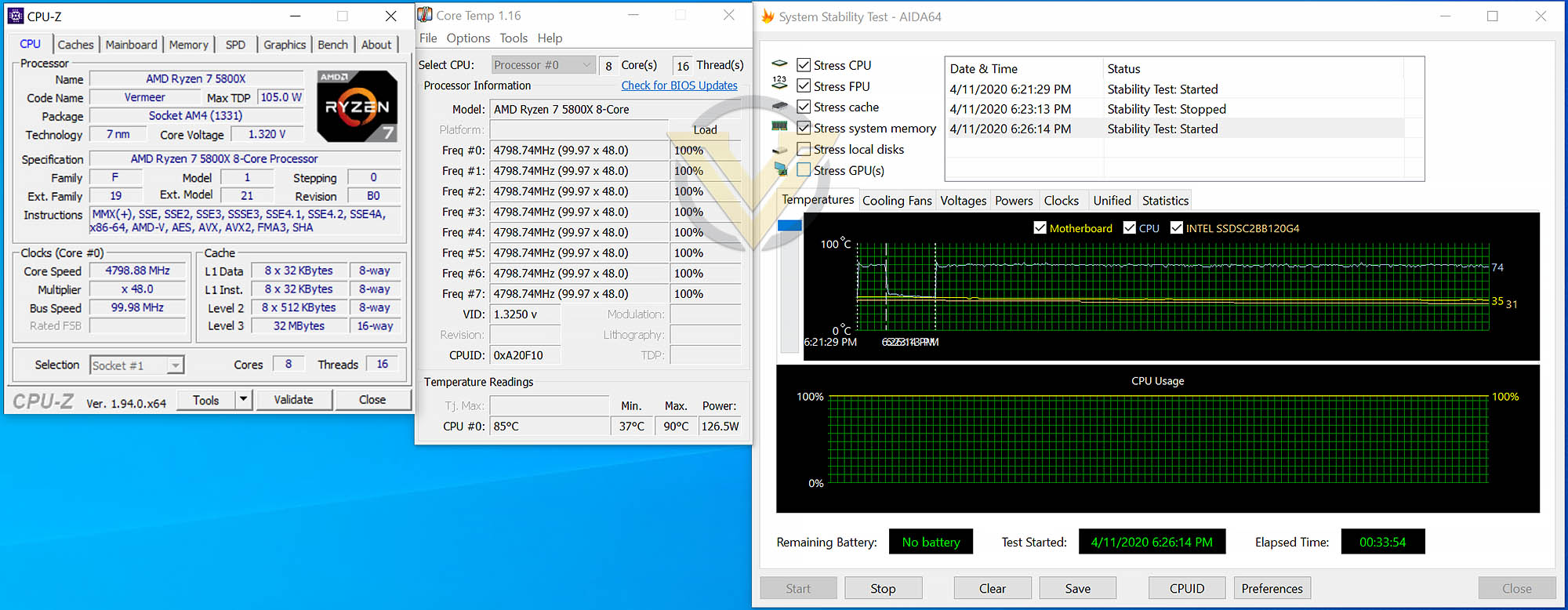
Moving to the overclocking phase of our review, the goal is to see how far each processor is able to shift, above its stock frequency. In the past, our milestone is to try and take the CPU clock speed over the 5GHz barrier but this isn’t always possibe.Oddly enough, both processors halted at the same clockspeed frequency, not shifting beyond 4.8GHz, regardless of any modification to the advance settings within the BIOS of our Crosshair VIII Hero. No amount of voltage would allow us to gain stability over that 4.8GHz mark.
We would have liked to see those parameters lifted but it seems to reached the limit. The 5600X required just 1.33v and the 5800X 1.35v to achieve 4.8GHz.
Power Consumption
It’s interesting to note the power consumption across all processors. Although they are using a combination of different motherboard chipsets, energy results can fluctuate between manufacturers due to the features and specifications that are integrated. First of all, for the idle tests the system is cold booted into Windows and no additional applications are executed – the watts are noted on the external energy monitor we use and then the system is loaded with 3DMark FireStrike – watts are again monitored for the duration of the test and the highest rated wattage result is then noted down. Below are the results of this energy test.
Ray Tracing Performance – POV-Ray 3.7
Persistence of Vision Raytracer’s PovRay is a free and open source 3D animator application with versions for computers with different operating systems.
This product allows users to build their custom 3D worlds with excellent quality despite their computer’s hardware. It has adjustable options for levels of radiance, refraction, and reflection. Calculation time may vary depending on the computer model, but PovRay can adapt to many computer builds, and is supported by the open source community.
This product allows users to build their custom 3D worlds with excellent quality despite their computer’s hardware. It has adjustable options for levels of radiance, refraction, and reflection. Calculation time may vary depending on the computer model, but PovRay can adapt to many computer builds, and is supported by the open source community.
AES Encryption Performance – TrueCrypt 7.1a
TrueCrypt is a discontinued source-available freeware utility used for on-the-fly encryption (OTFE). It can create a virtual encrypted disk within a file or encrypt a partition or (under Microsoft Windows except Windows 8 with GPT) the entire storage device (pre-boot authentication).
Encoding Performance – X264 HD
Simply put, this test measures how fast your machine can encode a short, DVD quality MPEG-2 video clip into a high-quality x264 video clip. What’s x264, you ask? It’s more or less the next-generation Xvid/DivX codec. I think it’s ideal for a benchmark because the application (x264.exe) reports fairly accurate compression results (in frames per second) for each pass of the video encoding process, and it uses multi-core processors very efficiently.
x264 HD gives results for 2 passes when compressing an MPEG-2 clip into x264. It presents 4 separate results for each pass giving a total of 8 – all results are given in FPS. For each pass I have averaged out the results.
Processing Features Performance – AIDA64
AIDA64 Product Page
This simple integer benchmark focuses on the branch prediction capabilities and the misprediction penalties of the CPU. It finds the solutions for the classic “Queens problem” on a 10 by 10 sized chessboard. At the same clock speed theoretically the processor with the shorter pipeline and smaller misprediction penalties will attain higher benchmark scores. For example — with HyperThreading disabled — the Intel Northwood core processors get higher scores than the Intel Prescott core based ones due to the 20-step vs 31-step long pipeline. CPU Queen test uses integer MMX, SSE2 and SSSE3 optimizations.
Memory Transfer Performance – AIDA64
AIDA64 Product Page
This simple integer benchmark focuses on the branch prediction capabilities and the misprediction penalties of the CPU. It finds the solutions for the classic “Queens problem” on a 10 by 10 sized chessboard. At the same clock speed theoretically the processor with the shorter pipeline and smaller misprediction penalties will attain higher benchmark scores. For example — with HyperThreading disabled — the Intel Northwood core processors get higher scores than the Intel Prescott core based ones due to the 20-step vs 31-step long pipeline. CPU Queen test uses integer MMX, SSE2 and SSSE3 optimizations.
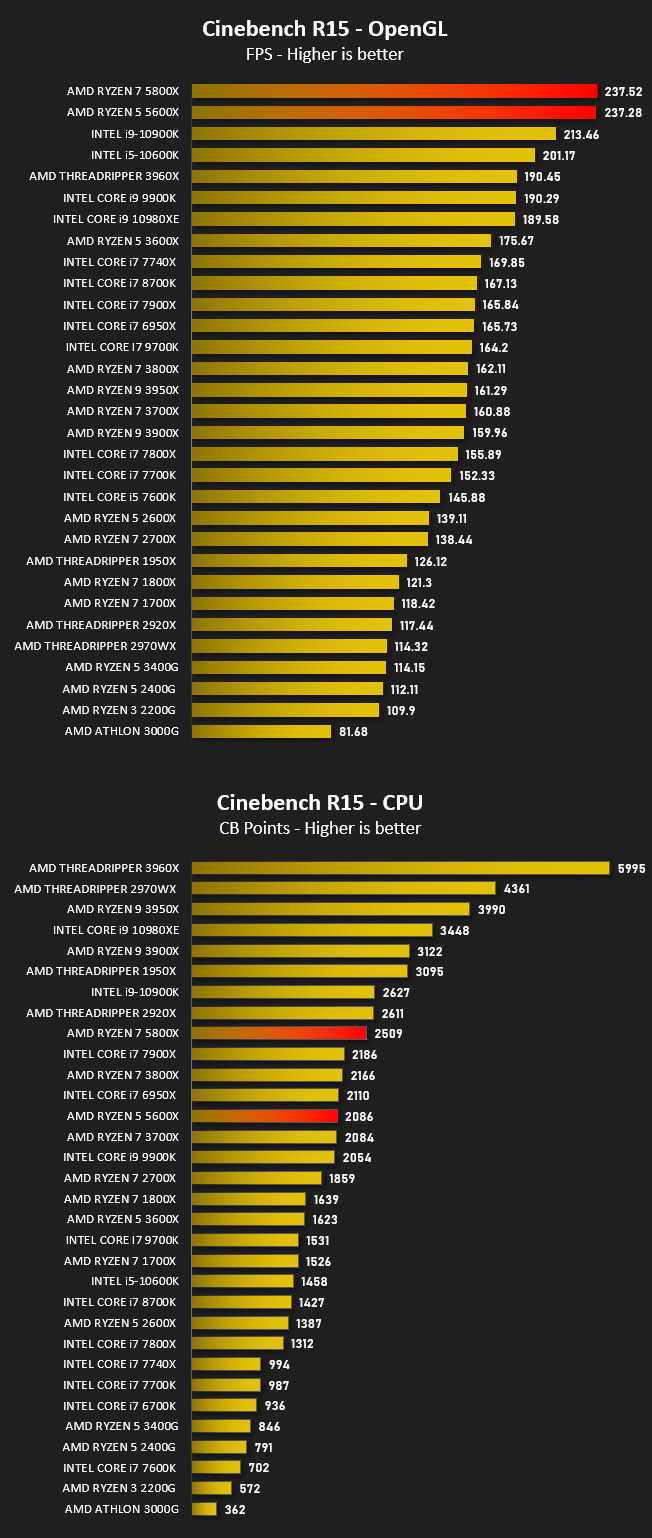
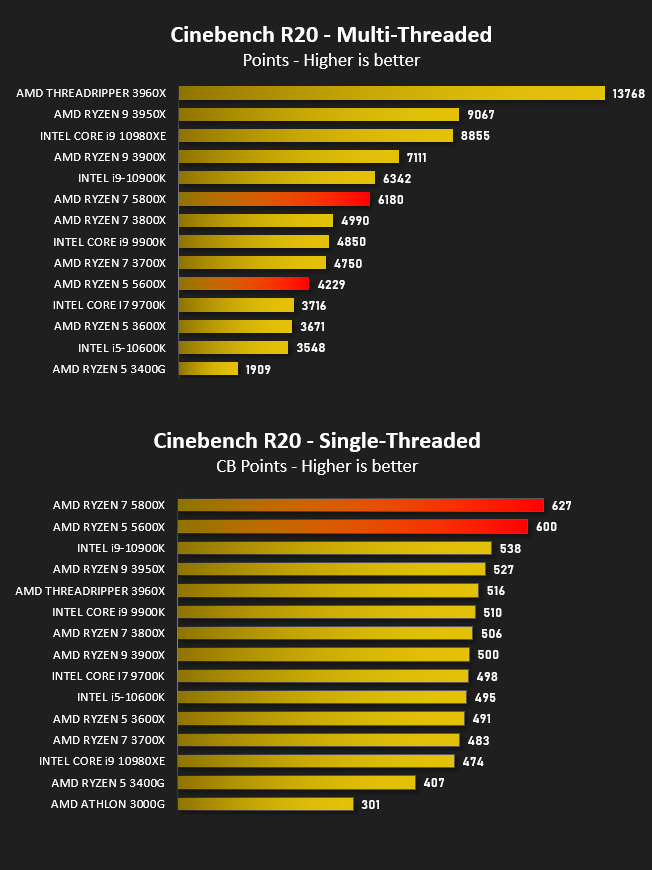
Processing Power Performance – Cinebench R15 & R20
CINEBENCH can measure systems with up to 64 processor threads. This test scene contains approximately 2,000 objects which in turn contain more than 300,000 polygons in total, and uses sharp and blurred reflections, area lights, shadows, procedural shaders, antialiasing, and much more. The result is displayed in points (pts). The higher the number, the faster your processor.
Bandwidth Performance – SiSoftware SANDRA
3DMark 11 Product PageSANDRA isn’t always a benchmark that is included in hardware reviews but I believe it shouldn’t be ignored. SANDRA provides a vigorous package that tests your system in a rather large array of benchmarks. There are many aspects of benchmark that can be executed. We will be considering – CPU and memory tests.
Image Editing Performance – PCMark 8 Photoshop
PCMark 8 Product Page
Developed in partnership with Benchmark Development Program members Acer, AMD, Condusiv Technologies, Dell, HGST, HP, Intel, Microsoft, NVIDIA, Samsung, SanDisk, Seagate and Western Digital, PCMark 8 is the latest version in FutureMark’s popular series of PC benchmarking tools. Improving on previous releases, PCMark 8 includes new tests using popular applications from Adobe and Microsoft.
Overall System Performance – PCMark 10
PCMark 10 Product Page Developed in partnership with Benchmark Development Program members Acer, AMD, Condusiv Technologies, Dell, HGST, HP, Intel, Microsoft, NVIDIA, Samsung, SanDisk, Seagate and Western Digital, PCMark 10 is the latest version in FutureMark’s popular series of PC benchmarking tools. Improving on previous releases, PCMark 10 includes new tests using popular applications from Adobe and Microsoft.
VR Performance – VRMark
VRMark Product PageVRMark includes two VR benchmark tests that run on your monitor, no headset required, or on a connected HMD. At the end of each test, you’ll see whether your PC is VR ready, and if not, how far it falls short.
3D Performance – 3DMARK FireStrike & TimeSpy
3DMark FireStrike Product PageFire Strike is our new showcase DirectX 11 benchmark designed for high-performance gaming PCs. It is our most ambitious and technical benchmark ever, featuring real-time graphics rendered with detail and complexity far beyond what is found in other benchmarks and games today. Fire Strike will only be available in the Windows editions of 3DMark initially.

Gaming Performance – Tomb Raider & Total War: WARHAMMER
It’s important for us to perform a number of game benchmarks as well as the synthetic tests because gamers will want to know if there are any significant benefits. So here we have two recent gaming titles benchmarked with a Radeon RX 480 installed.
Conclusion
Two very capable processors have been presented before us today in the AMD Ryzen 5 5600X and Ryzen 7 5800X. AMD has clearly amplified their Zen architecture, and as we hinted at earlier, this isn’t merely a subtle iteration but rather a significant overhaul. Fundamental to the 5000-Series is higher IPC gains, improved efficiency, a boost in clock speeds and redesigned cache structure. Each play an important role in the success of today’s unveiling.
The multi-core battle within the mainstream segment has been raging for a number of years now and, in releasing the Ryzen 5000-Series, AMD are giving no quarter. Regarded as perhaps the mid-range option, the Ryzen 5 5600X boasts 6 cores and 12 threads with clock speeds soaring up to 4.6GHz; that’s no mean feat for a CPU in its class. The 5800X is likewise another mid-range part; not quite within the realms of the high-end yet it still boasts a whopping 8 cores and 16 threads with clock speeds reaching 4.7GHz. In the past, AMD has favoured multi-core finesse over clockspeed when compared to rival Intel parts, but they seem to be offering a better blend of the two in this latest generation.
Overall we found the performance on offer by both Ryzen 5000-Series processors to be a huge leap forwards in terms of real-world and synthetic gains. On the preceding pages you can see how well both chips do, with the Ryzen 7 5800X in particular pulling away from the competition where it matters most.
A milestone of 5GHz has been the gold standard of operating frequencies for countless generations, on both sides of the aisle. Intel’s 10th Gen CPUs now hover in this vicinity out-of-the-box with their boost clocks but AMD aren’t quite there yet. For a manual overclocking viewpoint we always try to push our review samples to see if 5GHz is attainable. Unfortunately both of our CPUs were only able to ascend to 4.8GHz; no amount of voltage increase would entice the boost to reach that glorious 5GHz.
Lining yourself up for a new AMD 5000-Series CPU will largely come down to the platform you’re using. A primary benefit with this new set of processors is that we’re still using AM4 and the X570 chipset. If you’re already comfortable with a Ryzen 3rd Gen model you may not feel the need to upgrade, however there are definitely benefits, as we’ve highlighted. The units we’ve tested today arrive at a cost of: 5600X: $299 USD | £275 GBP | $469 AUD and 5800X: $449 USD | £420 GBP | $700 AUD. AMD are asking slightly more this time round, but we feel they are offering more than Intel for the mainstream segment – PCIe 4.0 support is one such element which has its appeal.
AMD’s Ryzen 5 5600X and Ryzen 7 5800X are both excellent processors which represent the progess AMD has made since the early days of Zen, back in 2017.
Pros
+ Significant performance boost from last gen.
+ Offers excellent overall single/multi thread performance
+ PCIe 4.0 ready
+ Great power efficiency
+ Does not require new platform/chipset
Cons
– Still trailing Intel on Turbo Boost clock
– Little overclocking headroom
+ Significant performance boost from last gen.
+ Offers excellent overall single/multi thread performance
+ PCIe 4.0 ready
+ Great power efficiency
+ Does not require new platform/chipset
Cons
– Still trailing Intel on Turbo Boost clock
– Little overclocking headroom
Click here for an explanation of our awards at Vortez.net.
Stay connected with the Vortez Social Media pages:
Join in with the discussions on Discord