AMD unveils their latest addition to the processor lineup with their own 3D V-Cache, courtesy of the Ryzen 7 7800X3D – boasting a blazing 5.0GHz clock speed.

Product on Review: Ryzen 7 7800X3D
Manufacturer: AMD
MSRP: US: $449 (excl Tax)
Almost a year ago AMD shook up the gaming CPU landscape like never before by integrating a brand new technology into one very special Ryzen 5000-series processor. The 5800X3D launched was the first processor to incorporate AMD’s 3D V-CACHE technology that incorporates a high capacity stack of cache memory on top of the CPU die, and it was an immediate game changer.
Ryzen was catapulted from productivity powerhouse to performance kings on the back of these fat stacks of cache. While the benefits weren’t universal, this large intermediate cache – backstopping the already sizeable L3 cache on single-CCD Ryzen CPUs – greatly improved gaming and pushed them ahead of their bitter rivals at Intel.
It stayed at the top of the pile for months, acting as the true last hurrah for Socket AM4 and a platform that had changed AMD’s fortunes since the dark days of Bulldozer.
Then along came the next generation of CPUs complete with new sockets, architectures, TDP thresholds and cutting edge technologies. Yet still the 5800X3D held its own despite fewer cores, lower power demands, and little if any overclocking headroom. Larger cache is often viewed as a blunt (and expensive) instrument for improving processor performance, but it’s clearly mightily effective.
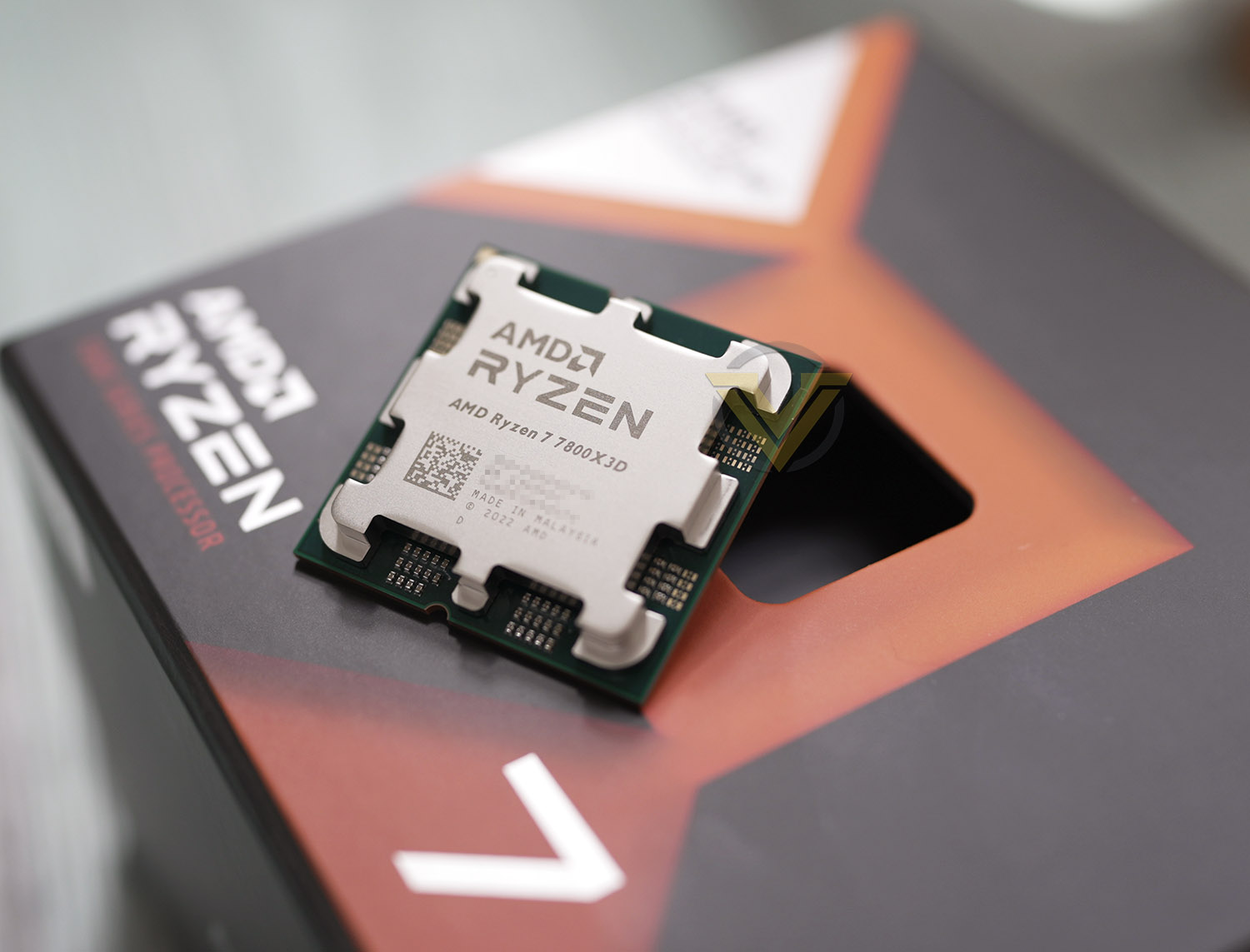
When AMD launched the Ryzen 7000-series at the tail end of last year they immediately made it clear that 3D V-CACHE would be coming to the processor family, but wouldn’t be there on day one. Last month they finally unveiled the Ryzen 9 7950X3D to a distinctly mixed reception, due in part to both the price and thread scheduling issues that made 3D V-CACHE difficult to leverage to its full potential. Today’s review CPU, the Ryzen 7 7800X3D, aims to sidestep the latter pitfall altogether.
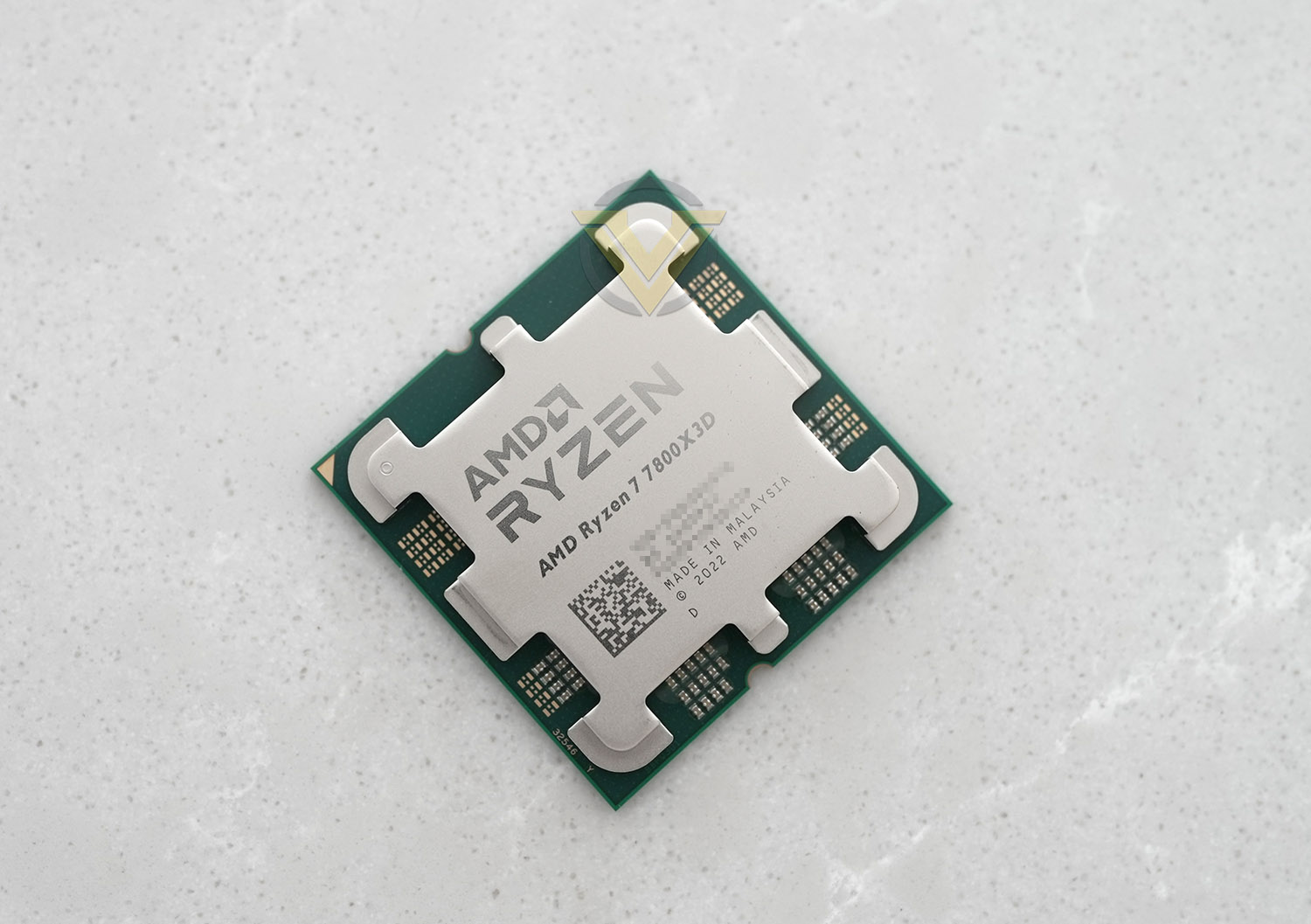
AMD’s 7800X3D is an 8-Core Zen 4-based processor compatible with the AM5 socket and AMD 600-series motherboards. At 4.2GHz and 5GHz respectively its base and boost frequencies may be relatively modest compared to the standard Ryzen 7 7700X (itself an 8c/16t processor) but the new chip boasts 64MB of additional L3 cache to put the total to 96MB. Otherwise it is almost identical to its older counterpart, and likely will remain the entry-point into the X3D range.
Higher expectations are reflected in the pricing of this processor. It’s pegged at an MSRP of US$449, $50 more than the 7700X and a full $130 higher than Intel’s gaming ‘bang for your buck’ candidate the Core i5-13600K.
Overall system costs do however benefit from a more mature motherboard ecosystem than the 7000-series launch range, with relatively affordable B650-series chipsets hovering at around US$200-250 with good features and build quality. DDR5 memory has also come down tremendously in price as 32GB DDR5 kits can be purchased below $120 (and 16GB kits well below $100). It won’t necessarily be the basis of a true budget system, but affordability is no longer a joke concept.
Competition is stiff from both old and new processors alike, and even the now-veteran 5800X3D is still waiting in the wings for a slip-up from the new hope. How it will do remains to be seen.
Test Setup & Testing
For the purpose of testing the 7800X3D we used the X670E AORUS MASTER since it is placed as a high-end motherboard, this should give us the capabilities of showing the true potential of this chip.
CPU being tested
AMD Ryzen 7 7800X3DTEST SETUP
Cooling CORSAIR H150i ELITE LCDMotherboard X670E AORUS MASTER
Memory 64GB CORSAIR Dominator Platinum RGB 5200MHz DDR5
Graphics ZOTAC RTX 3070 Ti HOLO Extreme
Storage CORSAIR Force LX 512GB SSD
PSU Corsair RM 1000 80 Plus Gold Certified PSU
Monitor AOC U2879VF
BENCHMARKS
Cinebench R23 – Single/Multi-core CPU Renderingx264 HD 4.0 – 1st and 2nd pass encoding
SiSoftware SANDRA – CPU & Memory benchmarks
POV-RAY – CPU Ray Tracing
TrueCrypt – CPU Encryption Read/Write
AIDA64 – CPU benchmarks & Memory
PCMARK 10 – CPU Productivity
Davinci Resolve – Puget Benchmark
Blender – Classroom Benchmark
Games – Assassin’s Creed Odyssey & Total War: WARHAMMER II
OTHER SOFTWARE
Temperature Analysis: CoreTempStress Testing Software: AIDA64 Stability Test
CPU Specification Monitoring: CPU-Z
Temperatures
Below are the temperatures for each of the CPUs – without any overclock applied. We’ve also compared to previously released AMD and Intel counterparts (which we’ve also benchmarked against on the subsequent pages too):
Power Consumption
It’s interesting to note the power consumption across all processors. Although they are using a combination of different motherboard chipsets, energy results can fluctuate between manufacturers due to the features and specifications that are integrated. First of all, for the idle tests the system is cold booted into Windows and no additional applications are executed – the watts are noted on the external energy monitor we use and then the system is loaded with 3DMark FireStrike – watts are again monitored for the duration of the test and the highest rated wattage result is then noted down. Below are the results of this energy test.
Ray Tracing Performance – POV-Ray 3.7
Persistence of Vision Raytracer’s PovRay is a free and open source 3D animator application with versions for computers with different operating systems.
This product allows users to build their custom 3D worlds with excellent quality despite their computer’s hardware. It has adjustable options for levels of radiance, refraction, and reflection. Calculation time may vary depending on the computer model, but PovRay can adapt to many computer builds, and is supported by the open source community.
This product allows users to build their custom 3D worlds with excellent quality despite their computer’s hardware. It has adjustable options for levels of radiance, refraction, and reflection. Calculation time may vary depending on the computer model, but PovRay can adapt to many computer builds, and is supported by the open source community.
AES Encryption Performance – TrueCrypt 7.1a
TrueCrypt is a discontinued source-available freeware utility used for on-the-fly encryption (OTFE). It can create a virtual encrypted disk within a file or encrypt a partition or (under Microsoft Windows except Windows 8 with GPT) the entire storage device (pre-boot authentication).
Encoding Performance – X264 HD
Simply put, this test measures how fast your machine can encode a short, DVD quality MPEG-2 video clip into a high-quality x264 video clip. What’s x264, you ask? It’s more or less the next-generation Xvid/DivX codec. I think it’s ideal for a benchmark because the application (x264.exe) reports fairly accurate compression results (in frames per second) for each pass of the video encoding process, and it uses multi-core processors very efficiently.
x264 HD gives results for 2 passes when compressing an MPEG-2 clip into x264. It presents 4 separate results for each pass giving a total of 8 – all results are given in FPS. For each pass I have averaged out the results.
Processing Features Performance – AIDA64
AIDA64 Product Page
This simple integer benchmark focuses on the branch prediction capabilities and the misprediction penalties of the CPU. It finds the solutions for the classic “Queens problem” on a 10 by 10 sized chessboard. At the same clock speed theoretically the processor with the shorter pipeline and smaller misprediction penalties will attain higher benchmark scores. For example — with HyperThreading disabled — the Intel Northwood core processors get higher scores than the Intel Prescott core based ones due to the 20-step vs 31-step long pipeline. CPU Queen test uses integer MMX, SSE2 and SSSE3 optimizations.
Memory Transfer Performance – AIDA64
AIDA64 Product Page
This simple integer benchmark focuses on the branch prediction capabilities and the misprediction penalties of the CPU. It finds the solutions for the classic “Queens problem” on a 10 by 10 sized chessboard. At the same clock speed theoretically the processor with the shorter pipeline and smaller misprediction penalties will attain higher benchmark scores. For example — with HyperThreading disabled — the Intel Northwood core processors get higher scores than the Intel Prescott core based ones due to the 20-step vs 31-step long pipeline. CPU Queen test uses integer MMX, SSE2 and SSSE3 optimizations.
Processing Power Performance – Cinebench R23
CINEBENCH can measure systems with up to 64 processor threads. This test scene contains approximately 2,000 objects which in turn contain more than 300,000 polygons in total, and uses sharp and blurred reflections, area lights, shadows, procedural shaders, antialiasing, and much more. The result is displayed in points (pts). The higher the number, the faster your processor.
Bandwidth Performance – SiSoftware SANDRA
SiSoftware Product PageSANDRA isn’t always a benchmark that is included in hardware reviews but I believe it shouldn’t be ignored. SANDRA provides a vigorous package that tests your system in a rather large array of benchmarks. There are many aspects of benchmark that can be executed. We will be considering – CPU and memory tests.
Overall System Performance – PCMark 10
PCMark 10 Product Page
Developed in partnership with Benchmark Development Program members Acer, AMD, Condusiv Technologies, Dell, HGST, HP, Intel, Microsoft, NVIDIA, Samsung, SanDisk, Seagate and Western Digital, PCMark 10 is the latest version in FutureMark’s popular series of PC benchmarking tools. Improving on previous releases, PCMark 10 includes new tests using popular applications from Adobe and Microsoft.
4K Editing Performance – DaVinci Resolve PugetBench
DaVinci Resolve is not only an industry-standard coloring tool, but also includes features for video editing, VFX, and more. While we also have benchmarks for Premiere Pro, After Effects, and other creative applications, every application will utilize the hardware in a computer in very different and unique ways which can make it extremely difficult to determine exactly what hardware will give the end user the best possible performance.
Rendering Performance – Blender
Blender is a free and open-source 3D computer graphics software toolset used for creating animated films, visual effects, art, 3D printed models, motion graphics, interactive 3D applications, virtual reality, and computer games. Blender’s features include 3D modeling, UV unwrapping, texturing, raster graphics editing, rigging and skinning, fluid and smoke simulation, particle simulation, soft body simulation, sculpting, animating, match moving, rendering, motion graphics, video editing, and compositing.
Please note: Blender has recently been updated and the metric for results has changed with the new update, rendering our historical benchmarks void – hence why we have less results for this benchmark, taking on the new samples per minute metric.
Gaming Performance – AC: Odyssey & Total War: WARHAMMER II
It’s important for us to perform a number of game benchmarks as well as the synthetic tests because gamers will want to know if there are any significant benefits. So here we have two recent gaming titles benchmarked with the RTX 3070 Ti. Both gaming titles are CPU-intensive – AC Odyssey is the last AC title in the series to be CPU-bound. Valhalla uses DX12 API.
Conclusion
AMD’s brand-new CPU will be in stores soon but is it appropriate as the beating heart of your next desktop system? That’s a difficult question to answer.
You’d be forgiven for glancing out the results and coming to the conclusions that the Ryzen 7 7800X3D was a solid if unremarkable mid-range performer, but contextually each result points to a CPU punching above its weight class in key areas.
In some single- or lightly-threaded benchmarks for instance, those with a workload that can exploit the chip’s oversized L3 Cache, the chip performs admirably. Older games and scenarios where GPU bottlenecks are eliminated will in particular be able to take advantage of this feature, but loaded 4K gaming workloads won’t see the same benefit.
On the other hand, in some specific single-threaded workloads the 7800X3D could best be described as mediocre, hampered by relatively low operating frequencies. Cinebench R23 is an obvious, and not lone, example.
Perhaps the most astonishing result however was power efficiency, where our load test simply didn’t push the power or thermal limits of the CPU in the slightest. Irrespective of whether there’s more thermal or voltage headroom which could be realised into better performance under specific load conditions, lower power draw of this magnitude will translate into significant cost of ownership savings over time. Even if gaming is the predominant use case.
In most multi-threaded benchmarks the chip punches well above its weight, elevating it above ‘average’ in the middle tier. In some, such as the synthetic broad use-case test of PCMark 10 or Davinci Resolve’s Puget Benchmark, it excels and is almost, but not quite, top of the pile.
In principle, the 7800X3D is ideal for gaming at low resolutions but high frame rates, particularly approaching or surpassing 240fps at 1080p. The gap should close as resolution and thus GPU load increases, but it should stay in the elite tier except in a true minority of titles. Mixed workloads involved with content creation, or regular light workloads punctuated by a need for brief bursts of performance, would also be appropriate so long as there are few major time constraints (for example where high rendering speed is essential to your overall daily throughput).
Above all else, the Ryzen 7 7800X3D highlights the fact that more cache is not a panacea. Core count, operating frequency, boost curves and underlying architecture also have a significant impact on overall performance that shouldn’t be discounted. Ongoing discussions regarding thread scheduling on the 7950X3D, where it’s difficult for the OS to project core or CCD affinity to threads that can utilise the cache effectively, prove that. But where it’s done well and clears those hurdles, such as in the 7800X3D, the result can be something special.
At an MSRP of US$449 the Ryzen 7 7800X3D reflects the price premium of modern day CPUs, but the results show that you’re not being short-changed. Great power efficiency and low temperatures will peak the interest of the more discerning owner, but great gaming performance and solid mixed workload metrics make it probably the strongest all-round CPU in AMD’s current lineup.
Pros
+ Great gaming results
+ Better than average mix workload result
+ Exceptional power efficiency
+ Better temperatures than those previously seen on AMD’s Ryzen 7000-series
+ AMD’s AM5 desktop platform has become significantly more affordable since launch
Cons
– Still relatively expensive
– Unlikely to have much overclocking headroom.
– Low operating frequencies lead to it falling behind in a minority of benchmarks.
+ Great gaming results
+ Better than average mix workload result
+ Exceptional power efficiency
+ Better temperatures than those previously seen on AMD’s Ryzen 7000-series
+ AMD’s AM5 desktop platform has become significantly more affordable since launch
Cons
– Still relatively expensive
– Unlikely to have much overclocking headroom.
– Low operating frequencies lead to it falling behind in a minority of benchmarks.
Click here for an explanation of our awards at Vortez.net.
Stay connected with the Vortez Social Media pages:
Join in with the discussions on Discord