The pinnacle of AMD’s Zen2 architecture, at least in the AM4 format, is the 16-core, 32-thread behemoth codenamed the AMD Ryzen 9 3950X. Today we take a look and show you just what it’s capable of.

Product on Review: AMD Ryzen 9 3950X
Manufacturer: AMD
Street Price: GBP £749.99 / USD $749.99 / AUS $1199
The start of July saw the launch of AMD’s 3rd generation Ryzen processors based on the 7nm Zen2 architecture. The crème of the crop at the time was the AMD Ryzen 9 3900X with 12 cores and 24 threads, but more was promised, much more.
Bringing the Ryzen 9 3950X to market hasn’t been plain sailing for AMD. Significant setbacks in the production delayed shipments from September to November, and even then, only a limited quantity were available at launch, but that’s more than likely down to the sheer popularity these Zen2 processors have posed; TSMC’s fabrication plants can’t cope with the demand. A blessing and a curse, we think.
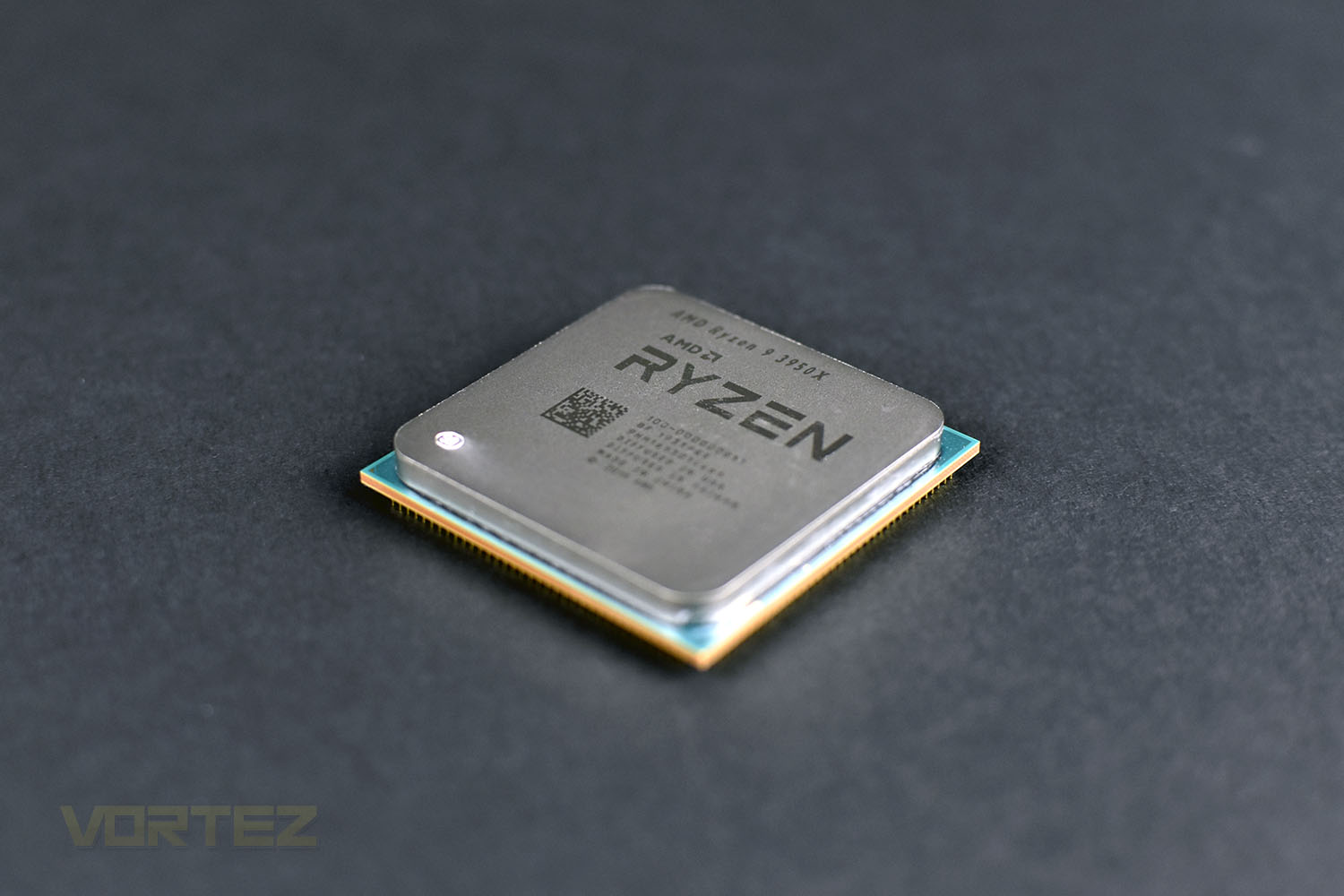
The 3950X is the full-fat option of the 3rd Generation Ryzen processors, utilising all 8 cores in two CCDs, for a total of 16 cores; add SMT enhancement to that and you’ll need to take your socks off to count all 32 of the threads. Despite the enormous core-count, AMD have managed to shoe-horn the 3950X inside a 105W TDP, with a 3.5GHz Base Clock and a mesmerizingly high 4.7GHz Maximum Boost Clock.
Utilising both CCDs fully, there’s a whopping 72MB of L2+L3 cache, helping to increase performance. The 3950X also offers full support for the PCI-E 4.0 specification, with double the bandwidth of 3.0, SSDs and GPUs can now utilise the increased speeds.
Pricing, as you might suspect, isn’t what most people would call cheap, at £749/$749/$1199 (UK/US/AUS) but this is about as good as it gets in the consumer space. If you have heavy computational requirements or just want the best you can buy, pay close attention to the following pages.
AMD on Zen 2:
Technical Specifications
# of CPU Cores: 16
# of Threads: 32
Max Boost Clock: 4.7GHz
Base Clock: 3.5GHz
Thermal Solution: Wraith Prism with RGB LED
PCI Express Version: 4.0 x16
CMOS: TSMC 7nm FinFET
Package: AM4
Total L2 Cache: 8MB
Total L3 Cache: 64MB
TDP: 105W
Zen 2 Explained
AMD Ryzen 3000-series CPUsDeveloped under the codenamed ‘Matisse’, AMD’s Ryzen 3000-series succeeds the ‘Pinnacle Ridge’ 2000-series CPUs for desktop and is the first consumer design to incorporate the Zen 2 microarchitecture. Unlike Zen+’s refresh of the prior family based on a slightly more efficient manufacturing process, Zen 2 is an substantial update to the CPU core and radical new approach to chip design as a whole.
Two aspects of Zen 2 are integral to the new CPU design: TSMC’s 7nm lithographic process, and a ‘chiplet’ ethos which does beyond even Threadripper’s parameters. In tandem they offer better chip manufacturing yields, higher operating frequencies, better price competitiveness and more cores while maintain CPU socket continuity.
The Matisse CPU – Flexible Design for Desktop
A Matisse CPU is comprised of two or optionally three ‘chiplet’ dies that between them cover all the bases of a conventional CPU SoC. There are two main classes of Zen 2 chiplet: the Core Chiplet die (CCD), and the IO Chiplet die (cIOD); each Matisse CPU may have up to two CCDs and will always have one cIOD.
The CCD is manufactured using TSMC’s 7nm process and is identical to the core chiplet found in Rome, the Zen 2 workstation CPU. This allows for great economies of scale and efficient binning to make the very best use out of every die manufactured and maintain affordability, despite 7nm being on the cutting edge of lithographic technology.
Core Chiplet functionality, i.e. the CPU Cores and Cache Structures, benefits significantly from the transition to 7nm; CPU operating frequency and voltages tend to scale better as the manufacturing process reduces in size. The same is not true for other aspects of the CPU, namely memory, PCI-Express and other I/O controllers which gain relatively little from a die shrink.
In contrast, the cIOD is manufactured at GlobalFoundries on their 12nm process incorporates the dual-channel memory controller, PCIe signalling and SoC functionality. Due to the different requirements of desktop and workstation platforms (particularly memory channels, PCIe lanes and sheer number of connected CCDs) they differ significantly from the equivalent chiplet on Rome.
Communication between CCD and cIOD is across a GMI link, a development of AMD’s Infinity Fabric technology. Now on a clock domain decoupled from memory clock speeds, it’s also more stable at higher frequencies.
Updates to the Zen CCX in Zen 2
Almost every aspect of the Zen core architecture has been improved, augmented or buffed to a mirror shine with Zen 2. Each change has been driven by a requirement to increase IPC and reduce latency metrics, two key relative weaknesses of the Zen architecture prior to Matisse.
Key Changes:
– New Tagged Geometric (TAGE) branch predictor
– Larger Branch Target Buffers
– Larger 1K indirect target array
Decode Process incorporates Op cache improvements to increase effective throughput
– Doubled capacity to 4K infused Instructions
Floating Point Unit (FPU) Point & Load Store doubled to 256b, mul latency improved
– Native support for AVX2 256b instructions
Improved many aspects of Integer Execution, including SMT fairness
Broad Cache updates:
– Double L1 Cache Load/Store bandwidth to 32B/clk
– L3 Cache size doubled
Zen 2 carries forward AMD’s Simultaneous Multithreading approach to processing two threads per physical CPU core. It proved to be a very efficient approach in Zen/Zen+, and benefits from other improved aspects of the Zen 2 architecture.
The first major departure from Zen is a doubling of L3 Cache to 4MB per core/16MB per Core Complex (CCX). This larger cache mitigates physical memory latency deficiencies in the architecture and more generally serves to significantly improve Instructions Per Clock (IPC). CCX L3 Cache is shared across all active cores in the CCX, while L2 and L1 remain exclusive to their associated core.
We’ve previously discussed AMD’s enlarged L3 Cache, dubbed ‘GameCache’, here.
Each CPU core now also has double the L1 Cache load/store bandwidth, serving to eek out further IPC improvements alongside deeper queues and larger Op caches. Fetch and Pretech techniques have also been tweaked in an attempt to reduce overall misprediction rates.
Despite the increase in L3 Cache size, physically the Zen 2 CCX is 47% smaller than the Zen CCX at just 31mm^2 (72mm^2 per CCD), representing the huge density improvement offered by 7nm production. Two of these quad-core CCX’s are on each Core Chiplet Die, although individual cores may be disabled depending on the SKU.
Thanks to a more beefy Floating Point Unit, Zen 2 also now natively supports AVX2 256bit instructions. These workloads are important for certain rendering, video encode/decode and cryptographic applications, and are yet another weakness that the latest generation attempts to smooth out.
In a general sense, the new Zen 2 CPU Core and Core Complex is beefier and more complex. While ostensibly new, it’s also maturation of Zen that applies lessons learned directly to the new architectural approach in a comprehensive manner. It’s difficult to imagine, for instance, that it would have been possible to manufacture a 16-core monolithic chip with 72MB Cache on even 7nm economically.
Matisse cIOD – Memory and More
Zen 2’s cIOD is a critical component of the Matisse CPU design that may get lost in a focus naturally skewed towards the CCD. Larger than the CCD and built on 12nm, it takes care of the vast array of Memory and IO requirements of the Matisse SoC.
Default dual-channel DDR4 memory support now extends to DDR4-3200 (from DDR4-2933) in capacities up to 128GB (from 64GB). Reported memory overclocks have reached far beyond this point, necessitating the introduction of a Memory : Infinity Fabric clock speed ratio rather than maintaining a tight coupling to the two clock domains. An effective upper limit of almost 1870MHz to Infinity Fabric stable operating speeds means that an automatic 1:2 ratio kicks in above DDR4-3733MT/s, stepping down the IF/GMI link speeds to 1/2 of memory. DDR4-3733 has been described as a ‘sweet spot’ for Ryzen 3000-series memory overclocking, i.e. a point at which memory and GMI link combine to the lowest latencies while remaining stable.
In principle, these changes could make Ryzen 3000-series immensely popular chips for enthusiasts and overclockers. Zen CPUs have always been sensitive to memory and IF speeds, each of which meaningfully improved benchmark results when their competition’s performance responsiveness to memory clock was relatively low by comparison. Pushing these clocks higher and tweaking the GMI/IF frequency to maximise stability would be a welcome outlet for expertise slightly undermined by the quality of dynamic core overclocking now available on CPUs by default.
PCI-Express 4.0 support is derived from the cIOD, as are other SoC features. The standard doubles the effective bandwidth to almost 2GB/sec per lane while maintaining backwards compatibility with legacy PCIe devices. The chip as a whole offers 16 PCIe 4.0 lanes for discrete graphics, four lanes for NVMe storage, and four lanes for connection between CPU and Chipset (which itself will offer improved functionality with PCIe 4.0 peripheral devices). Four native USB 3.1 10 Gbps ports are also available from the cIOD, bolstered by more from the chipset on most desktop motherboards. The platform as a whole offers yet more PCIe 4.0 Lanes muxed off from the motherboard chipset for additional high-speed NVMe storage or other functionality.
Differences between 7nm and 12nm manufacturing and packaging techniques meant that AMD needed to take an idiosyncratic approach to bringing together Matisse. Even PCIe 4.0’s more stringent signalling and hence material requirements had an impact on the physical aspects of the chip. Maintaining backwards compatiblity with Socket AM4 imposed more hurdles to overcome.
For all the benefits of a chiplet design, the Matisse CPU remains exceptionally complex due to signal pathing, mounting differences between 7nm and 12nm chiplets, a new 12-layer substrate, and far tighter tolerances than were in place for Zen and Zen+.
Zen 2 Explained (Continued)
The Ryzen 3000-series Lineup
AMD are launching the Ryzen 3000-series with seven processors, two of which are APUs based on the Zen+ architecture. Of the five Zen 2 ‘Matisse’ processors, just one incorporates more than one CCD and hence more than eight cores.
Nonetheless, the Ryzen 3000-series launch range pushes through the 8-core limit for mainstream desktop CPUs which has been in place since the debut of Ryzen in 2017. From today they shall venture into a domain previously exclusive to workstation CPUs: offering up to 12 cores across two partially active CCDs, the sort of specification which until recently would require a HEDT system with CPU starting from $649.
However the Ryzen 9 3900X sitting at the top of the launch range isn’t the flagship. That honour is reserved for the Ryzen 9 3950X, a CPU that has two fully enabled CCDs to support 16 cores/ 32 threads, which will be available later this summer.
The Ryzen 3000-series Zen+ APUs now serve as quad-core entry-level parts, and 6 core/12 thread configurations becomes the new base level for Zen 2 chips. AMD’s updated range is therefore much more streamlined than the competition, but we should bear in mind that for the time being 2000-series CPUs remain on the market to serve the role of more affordable desktop models for performance-oriented users.
An aggressive system for binning dies also means that CPU operating frequencies get higher as you go up the range, despite also increasing the core count. The cream of the crop are held back for the Ryzen 9 3950X which is clocked at up to 4.7GHz (under Precision Boost 2 dynamic overclock modes) while base frequencies favour lower core count processors to ensure the >8-core models don’t breach their 105W TDP specification.
This should also mean that there’s scope for conventional core overclocking on the mid-range Ryzen 5 and 7 parts, particularly the 65W Ryzen 7 3700X which is described as the ‘sweet spot’ SKU due to its restrained out-the-box operating frequencies.
AMD have stated that, although not listed in press releases and other marketing material prior to the launch, non-X variants of each of the high performance CPUs will likely be available to OEMs and System Integrators via standard channels. Only the Ryzen 5 3600 will be sold through standard retail channels directly to consumers.
A Chip To Shake Up The Component Market
Although AMD are the clearest winners of a major uptake in their new platform, two associated sectors are also poised to benefit from advances in the capabilities of desktop CPUs.
The most obvious is storage, specifically NVMe SSD storage. Next-generation Ryzen doubles the available bandwidth for NVMe devices to approach 8GB/s thanks to the adoption of the latest PCI-Express 4.0 standard, and that comes at a time when PCIe 3.0 x4 has started to bite as a bottleneck to SSD bandwidth. Manufacturers such as Corsair and GIGABYTE, taking advantage of new NAND controller technologies, are already following through with plans to release drives that exhibit performance metrics surpassing PCI-Express 3.0 limitations.
That being said, official PCI-Express 4.0 support only extends to Ryzen 3000-series CPUs combined with X570 motherboards. Older 400-series motherboards, even those with updated BIOSes, won’t officially support the new standard and AMD have explicitly stated that those sold at retail will not support the new standard even with a 3000-series CPU installed. They cite the tighter signalling tolerances of PCIe 4.0 and inability to validate the standard across the legacy Socket AM4 motherboard ecosystem, but some manufacturers may offer beta BIOSes (as-is, with no hard guarantees) on certain 400-series SKUs. Uptake of PCIe 4.0 might be slower than some might hope.
A less expected beneficiary perhaps is the humble DDR4 DRAM market. Marginal real-world performance gains on the Intel desktop platforms over the years meant that faster speed memory was a difficult sell in a consumer market already squeeze by DRAM pricing. While AMD Ryzen performance did scale well, stability above DDR4-3000/3200 wasn’t always as good as it needed to be (particularly in first generation Ryzen).
Without wanting to pre-empt review conclusions, the Ryzen 3000-series could offer a DRAM upgrade avenue up to DDR-3600 CL16 and beyond that’s been sorely needed by performance and gaming-oriented brands. And this in turn could serve to make slower DRAM for mainstream consumer more price-competitive.
At the very least, Ryzen 3000-series CPUs are likely to spike demand for DDR4-3200 to DDR4-3600 memory, which is no bad thing.
—
CPU Socket Continuity With AM4
At a time when Intel seemingly released a new platform every year without backwards compatibility, AMD’s pledge to support and maintain Socket AM4 from 2016 through to at least 2020 has been a key pillar in their strategy and underdog popularity. Zen 2/Ryzen 3000-series CPUs don’t deviate from this pledge, but the limitations of older designs have certainly begun to stretch it.
At a base level the entirely of the Ryzen 3000-series is supported on the Socket AM4 B350/X370/B450/X470 motherboard ecosystem after a BIOS update. It’s therefore possible to perform an in-place CPU upgrade without immediate need to also replace the motherboard for a premium-priced X570 design. Indeed, X470/B450 will continue to be sold – with updated BIOSes preinstalled – alongside the new platform for the time being.
It’s not all rainbows and sunshine however. PCI-Express 4.0 support won’t be filtered back to pre-500-series ‘boards; as a rule A320 motherboards will not support 3000-series CPUs; and the update process won’t necessarily be a smooth proposition. Fundamentally, this may mean that while backwards compatibly does stretch back a long way, users will need to replace both CPU and motherboard with the latest models to really take advantage of the platform’s swathe of features.
Feature Continuity
Advanced features available throughout the Ryzen 2000-series return in the 3000-series, some of which are expanded upon in the latest generation of chips.
Manual Overclocking
Each Ryzen 3000-series CPU continues to be fully unlocked from the outset. All Ryzen 3000-series compatible motherboards will be capable of the full gamut of overclocking, but power limitations of more budget-oriented models (especially if using a >8 core model) should be respected.
Ryzen Master overclocking software is expanded in scope, incorporating support for DRAM timing control and tweaking Precision Boost Overdrive. Purists may still prefer UEFI BIOS menus but more casual overclockers and those more interested in what’s going on under the hood will appreciate the addition.
Some motherboard manufacturers are also experimenting with allowing users to set their Infinity Fabric clock directly. We’re not sure how well supported this feature will be as the platform matures, or even if it’s of any real value, but we mention it for completeness.
Precision Boost
Dynamic Overclocking in the form of Precision Boost 2 and Precision Boost Overdrive are present in Ryzen 3000, pushing core clock speeds higher for longer thanks to high quality sensor data. Precision Boost advancements were a key update to Zen+ CPUs as they brought better multi-core performance when under load without the need for additional end-user action.
Better cooling means spending longer at Fmax under Precision Boost (the maximum frequency defined by your PB settings). PBO meanwhile will increase Fmax (which can now also be tweaked in software) while preserving the PB curve (i.e. the lower Fmax offests for when 2, 3, 4 etc. cores are active). Improvements in Windows 10’s May 2019 update and the AMDS Chipset drivers also mean that frequency adjustments can occur at a higher rate than before, making dynamic overclocking more… dynamic.
Cooling
Ryzen 3000-series and X570 motherboards utilise Socket AM4 with similar clearance specifications as prior generations. As a result you should be able to utilise any cooler compatible with previous 400-series or 300-series Socket AM4 motherboard, although it should be noted that the high core count models do have a higher TDP.
Retail editions of Ryzen 7 and Ryzen 9 CPUs are bundled with AMD’s Wraith Prism cooler, a model rated for the up to 105W TDP requirement of the Ryzen 9 3900X that’s particularly good quality for an included cooler. Its’ lighting also supports RGB lighting systems from other peripheral and component manufacturers. You are free however to use your own cooler if preferred.
Packaging & Product
At first glance, the 3950X packaging might look perfectly normal, with the silver mesh design and bright orange Enso circle, but what if we told you there’s no included cooler? That’s a big box for a small processor.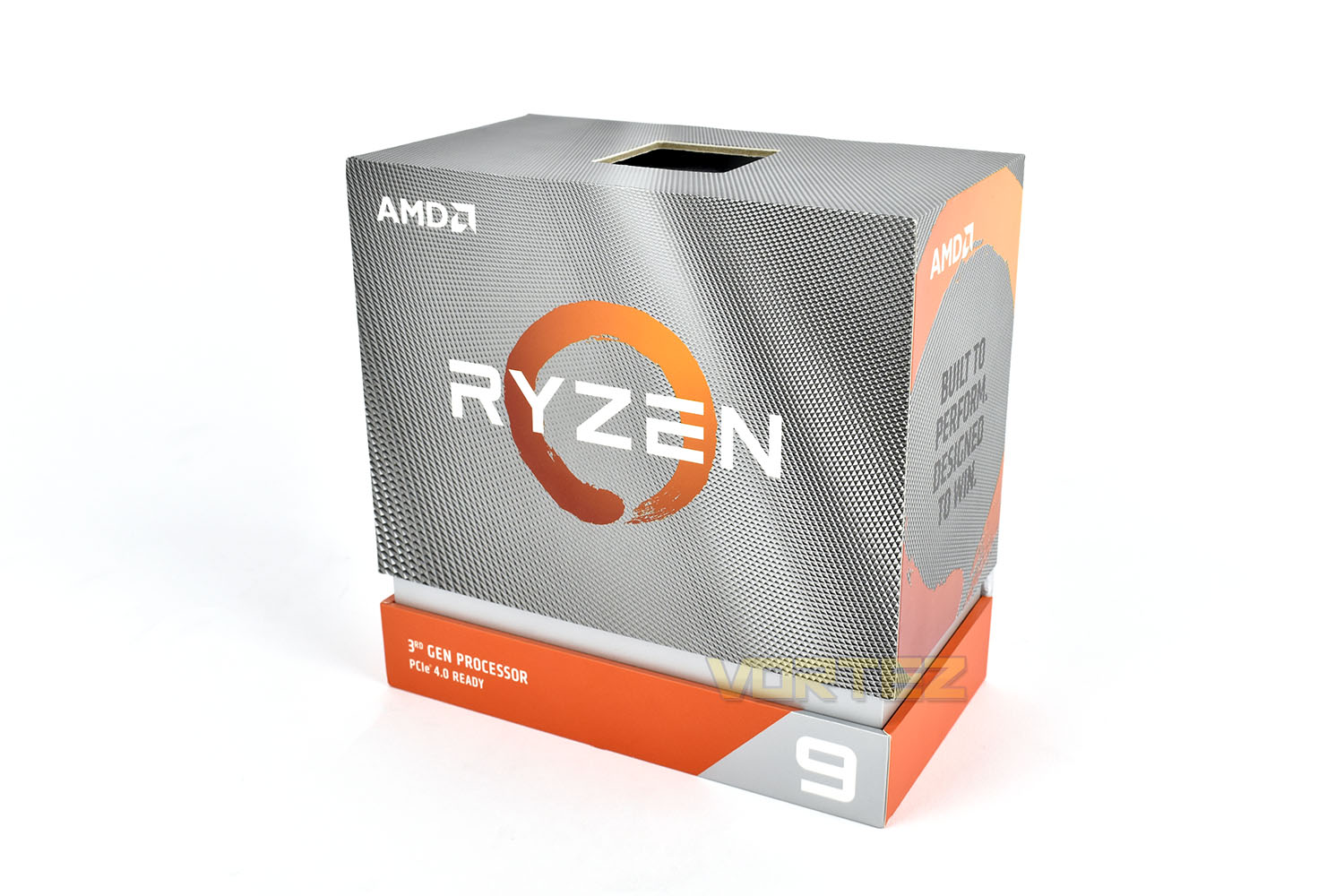
The CPU comes with a small information notice and a Ryzen 9 case sticker. The notice mentions compatibility problems that you may face due to BIOS updates and different AM4 chipsets.
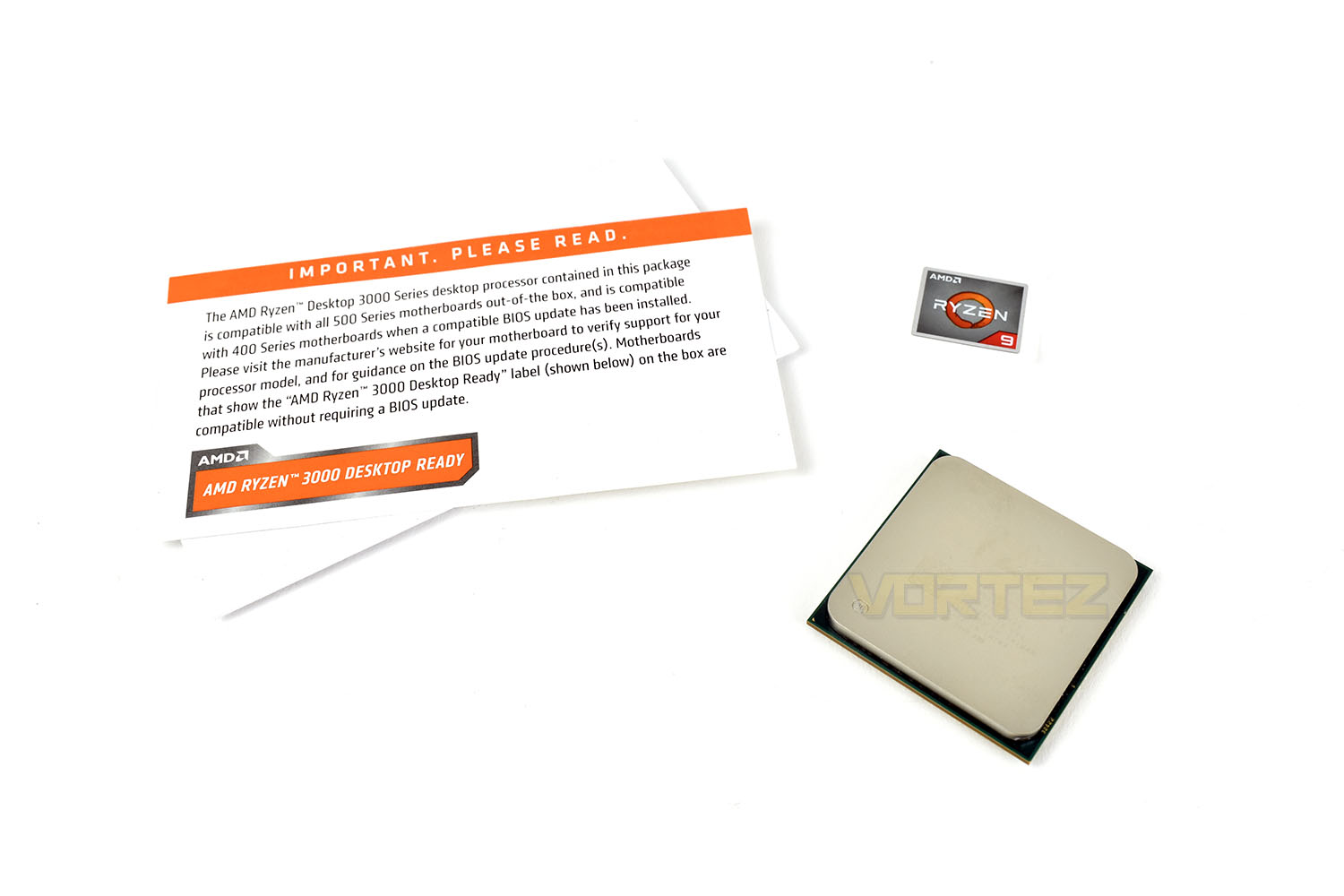
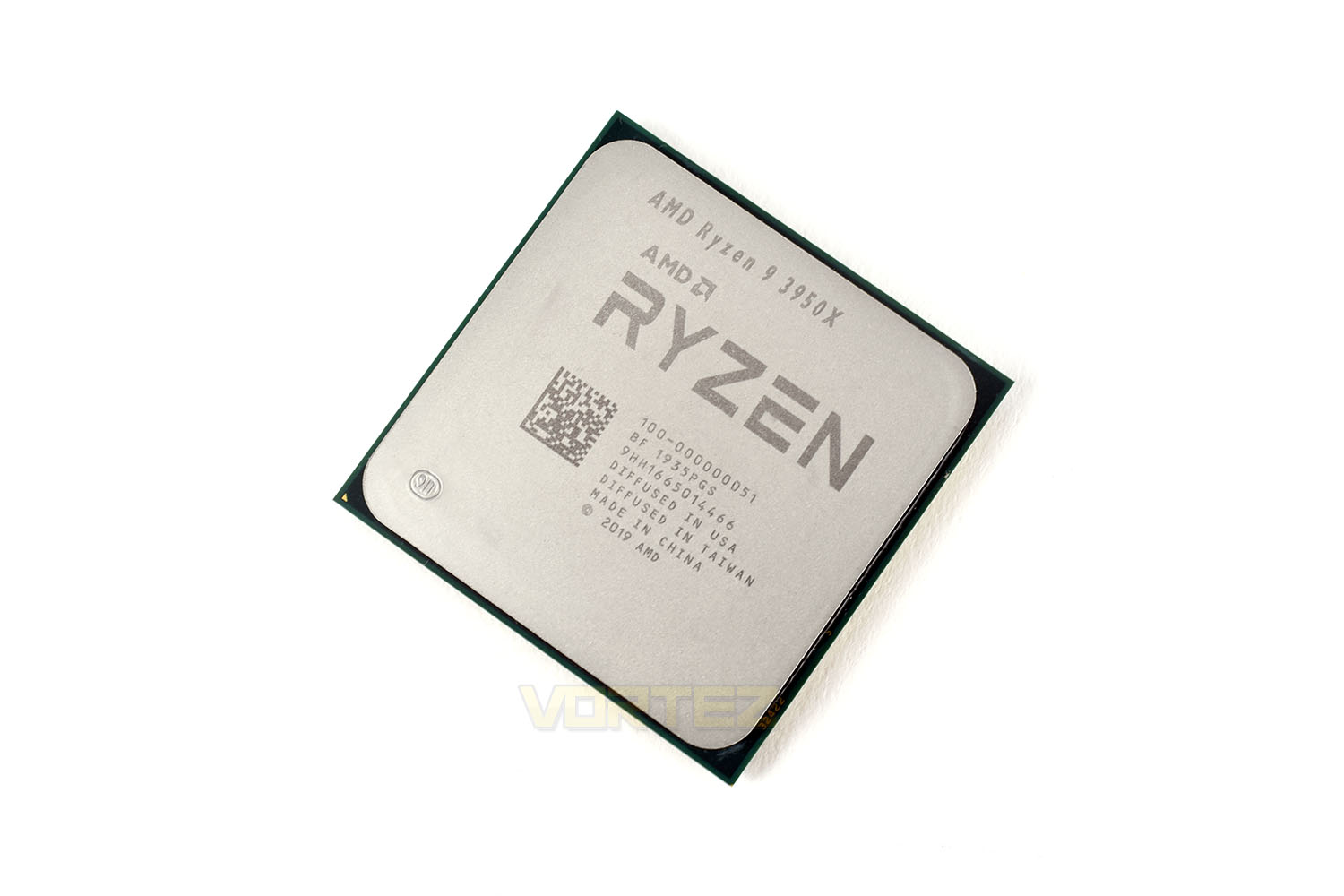
Thanks to AMD’s forwards thinking, the 3950X still fits into an identical package as all of the other AM4 CPUs, as you can see below.
Test Setup & Software
For the purpose of testing AMD Ryzen 9 3950X we used the MSI Prestige X570 Creation – this motherboard is a strong offering and provides us with a good platform to analyse performance.CPU being tested
AMD Ryzen 9 3950X (3.5GHz – 4.7GHz Boost) Zen 2
TEST SETUP
Cooling be quiet! Dark Rock 4
Motherboard MSI Prestige X570 Creation
Memory 32GB Corsair Vengeance LPX 3000MHz
Graphics Radeon RX 480 8GB
Storage Corsair LX 512GB SSD
PSU Corsair RM 1000 80 Plus Gold Certified PSU
BENCHMARKS
Cinebench R15 – CPU/OpenGL Score
x264 HD 4.0 – 1st and 2nd pass encoding
SiSoftware SANDRA – CPU & Memory benchmarks
POV-RAY – CPU benchmarks
TrueCrypt – CPU benchmarks
AIDA64 – CPU benchmarks & Memory
PCMark 8 – Creative & Photoshop
PCMark 10 – Extended
3DMark FireStrike – 3D Benchmark
3DMark TimeSpy – 3D Benchmark
Games – Rise of the Tomb Raider & Total War: WARHAMMER
OTHER SOFTWARE
Temperature Analysis: Core Temp
Stress Testing Software: AIDA64 Stability Test
CPU Specification Monitoring: CPU-Z
Temperatures
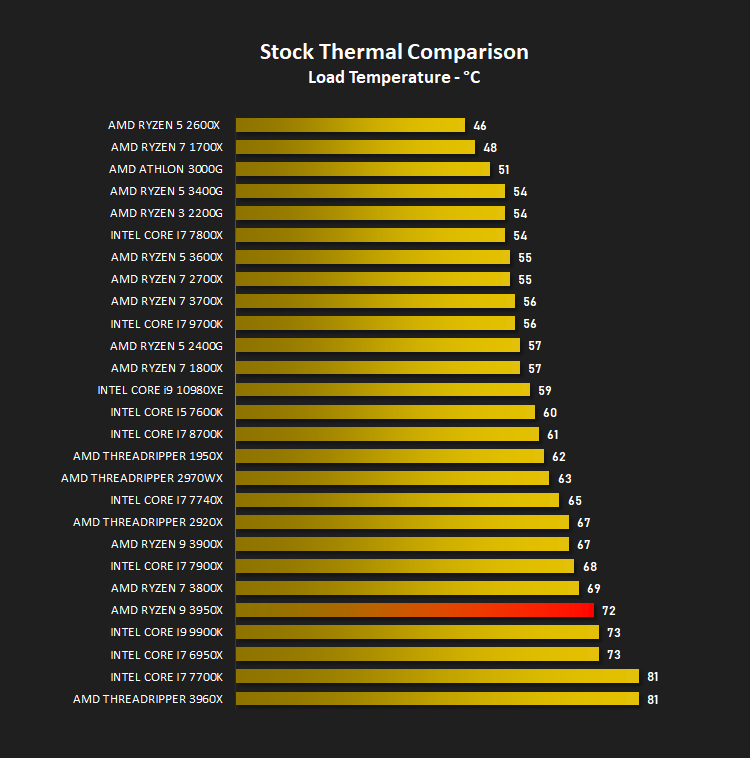
Temperatures:To measure temperatures we run the CPU at its stock clock speeds and hit it with an AIDA64 Stability Test load for 20 minutes.
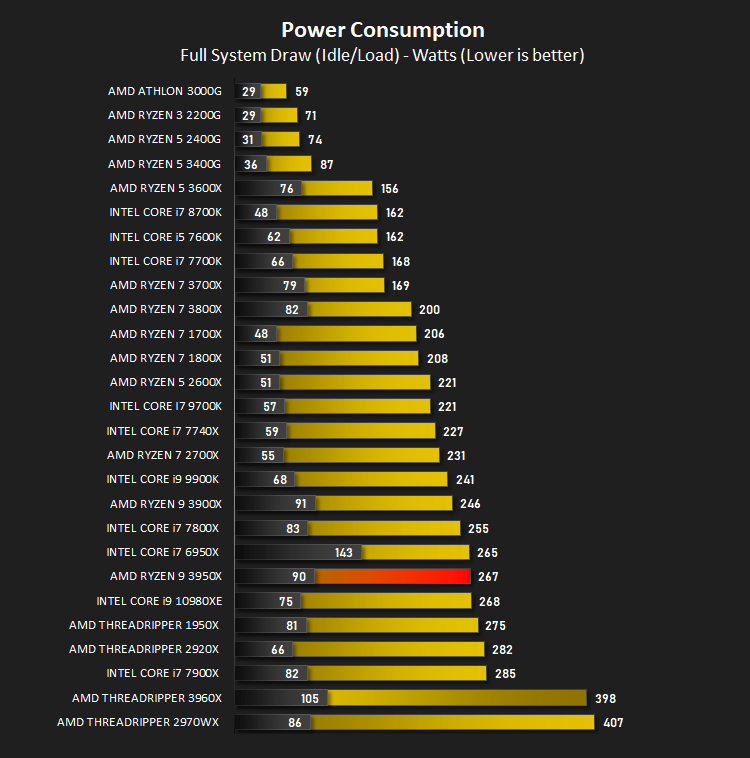
Benchmarks: Power Consumption
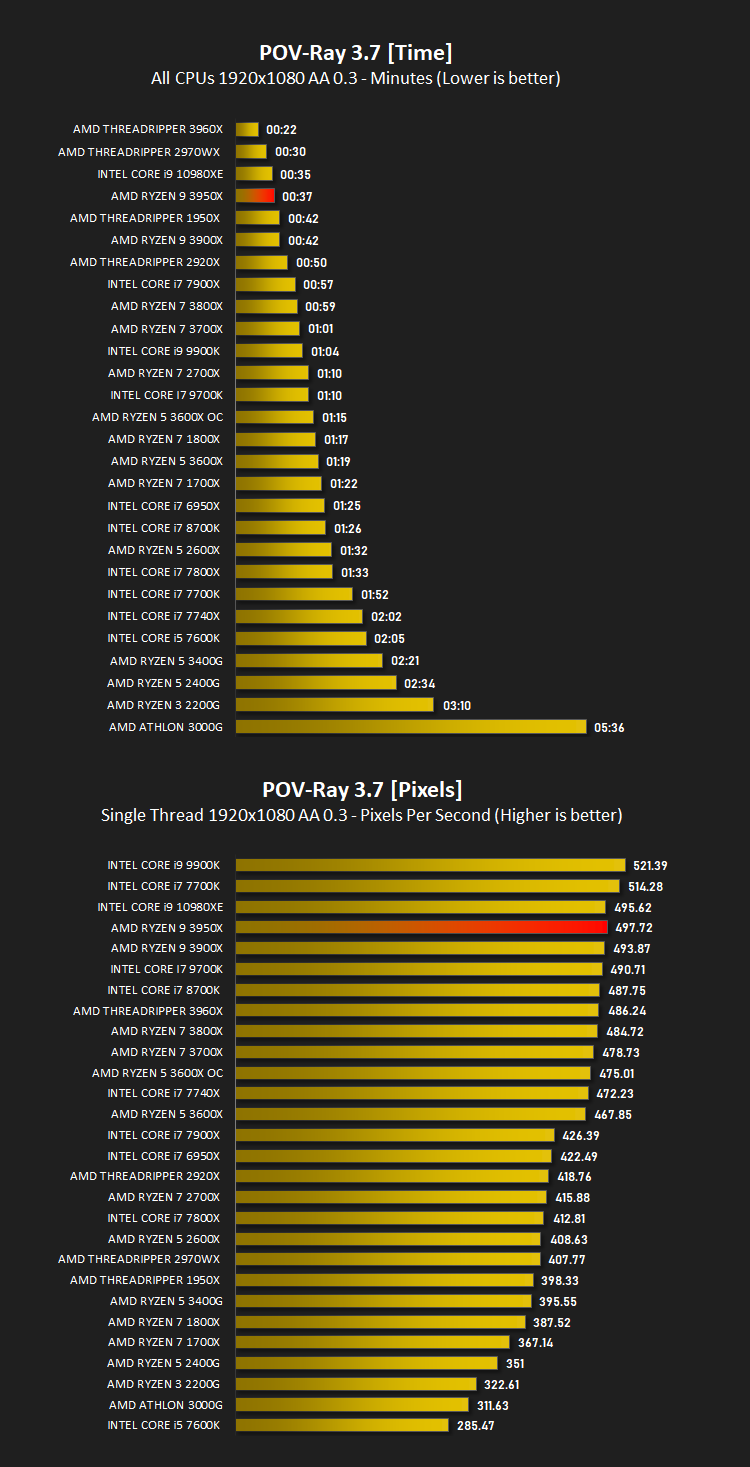
Ray Tracing Performance – POV-Ray 3.7
This product allows users to build their custom 3D worlds with excellent quality despite their computer’s hardware. It has adjustable options for levels of radiance, refraction, and reflection. Calculation time may vary depending on the computer model, but PovRay can adapt to many computer builds, and is supported by the open source community.
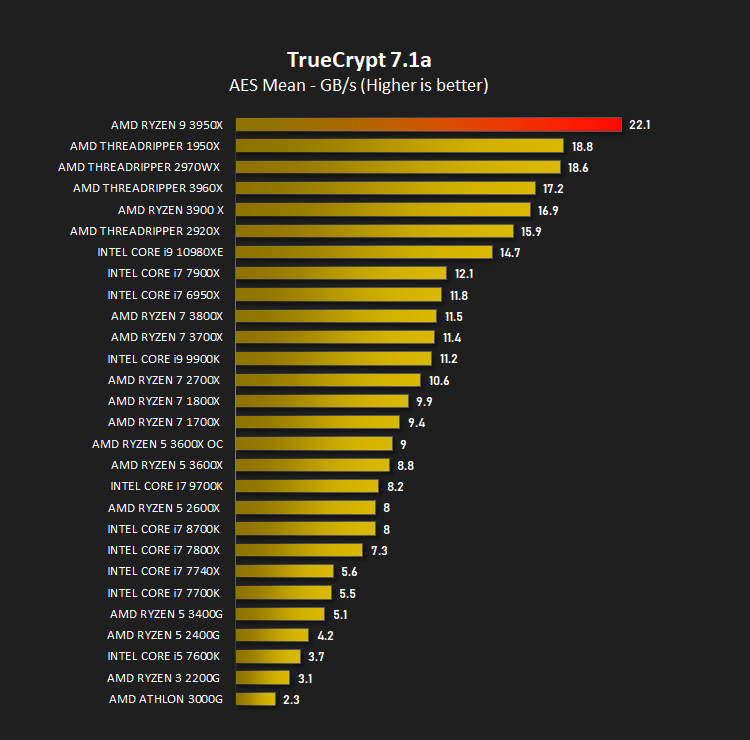
AES Encryption Performance – TrueCrypt 7.1a
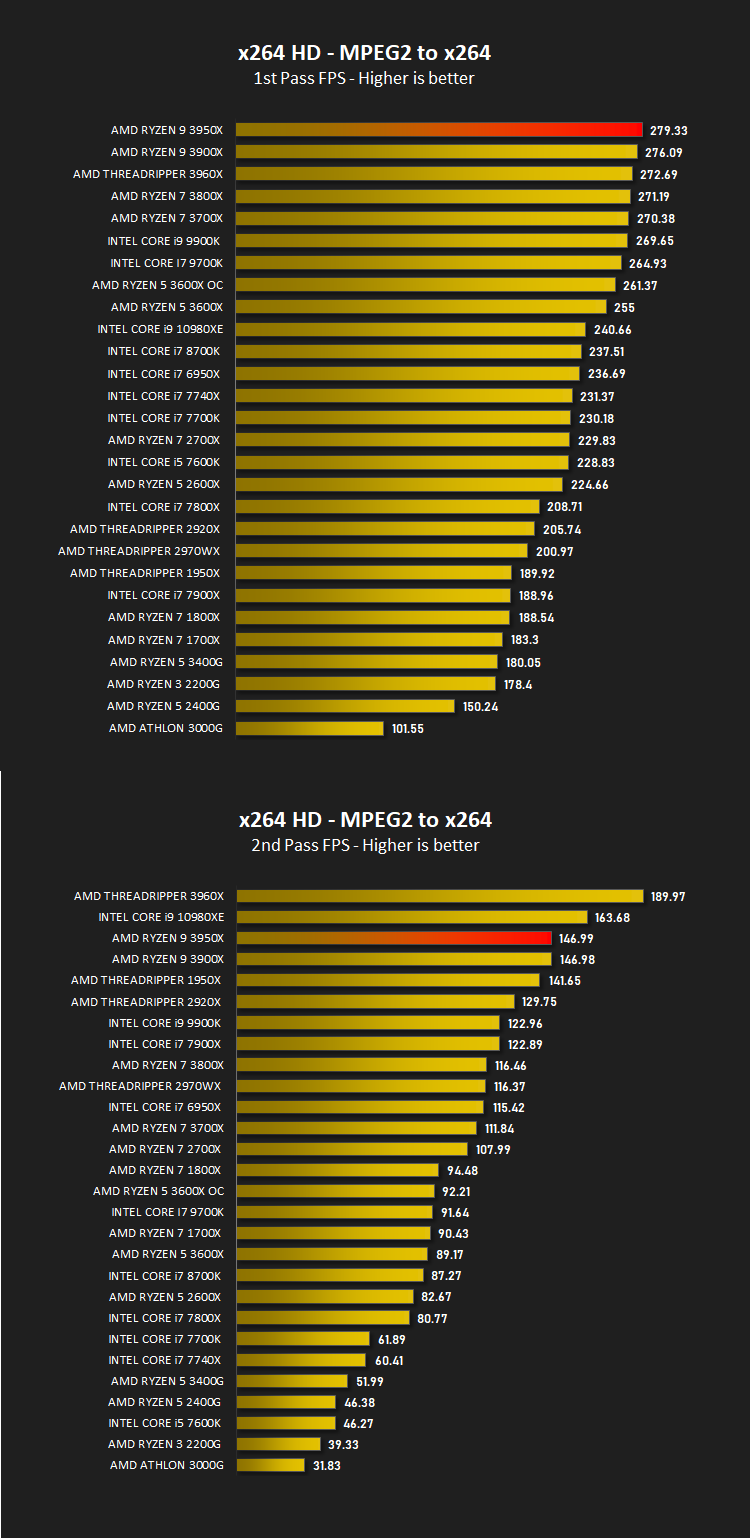
Encoding Performance – x264 HD
Processing Features Performance – AIDA64
AIDA64 Product Page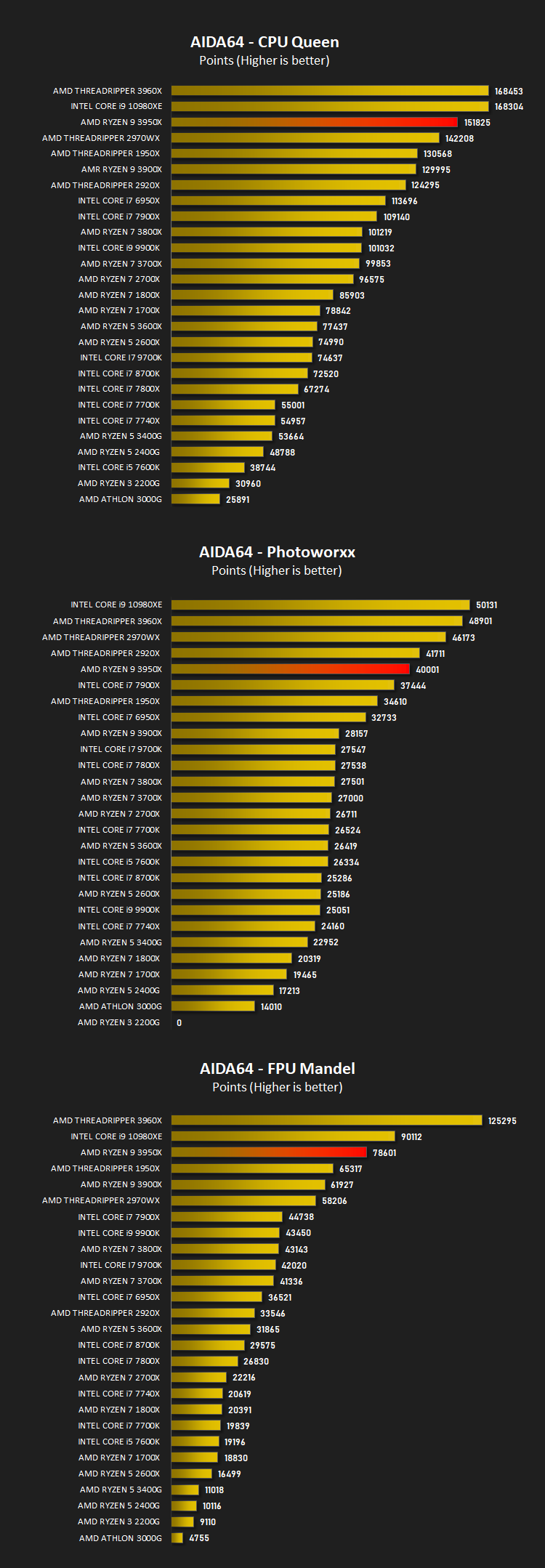
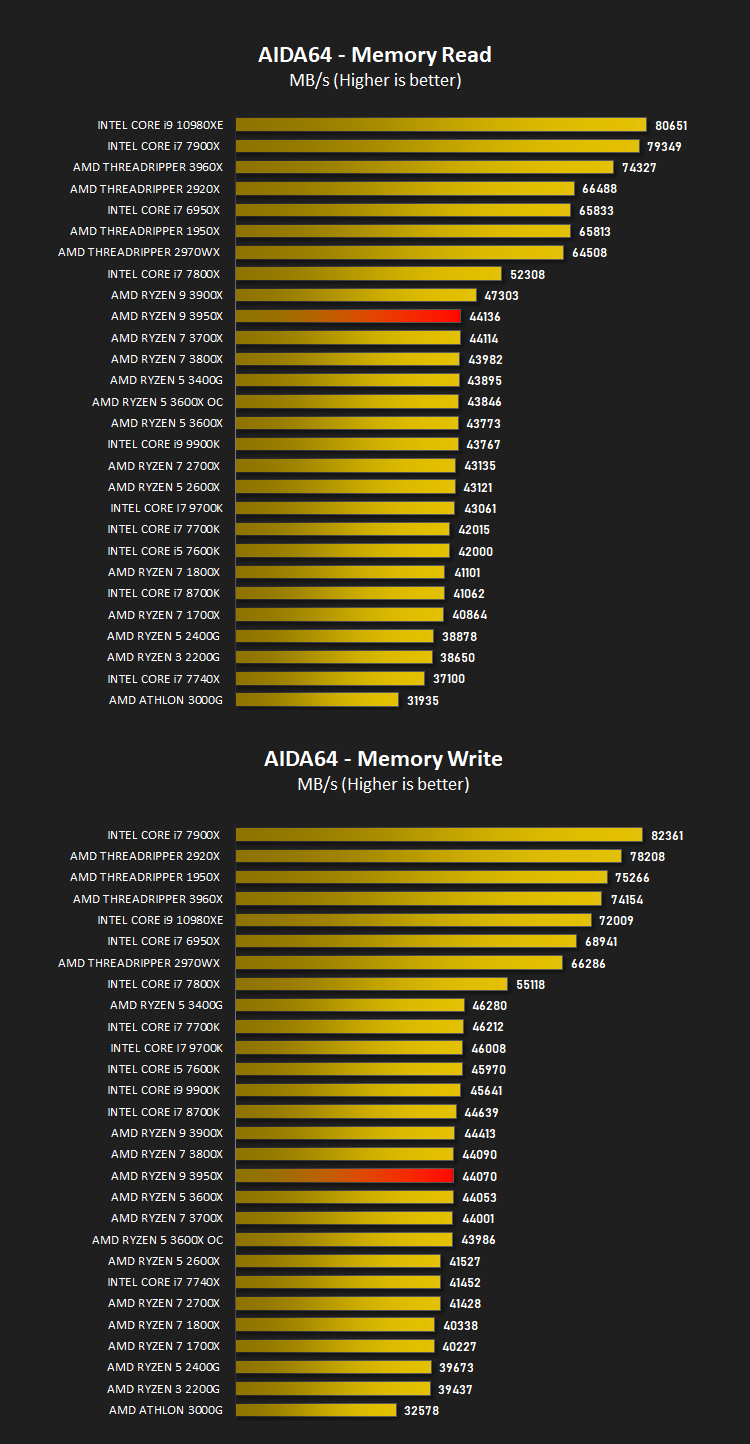
Memory Transfer Performance – AIDA64
AIDA64 Product PageThe Memory Latency benchmark measures the typical delay when the CPU reads data from system memory. Memory latency time means the penalty measured from the issuing of the read command until the data arrives to the integer registers of the CPU.
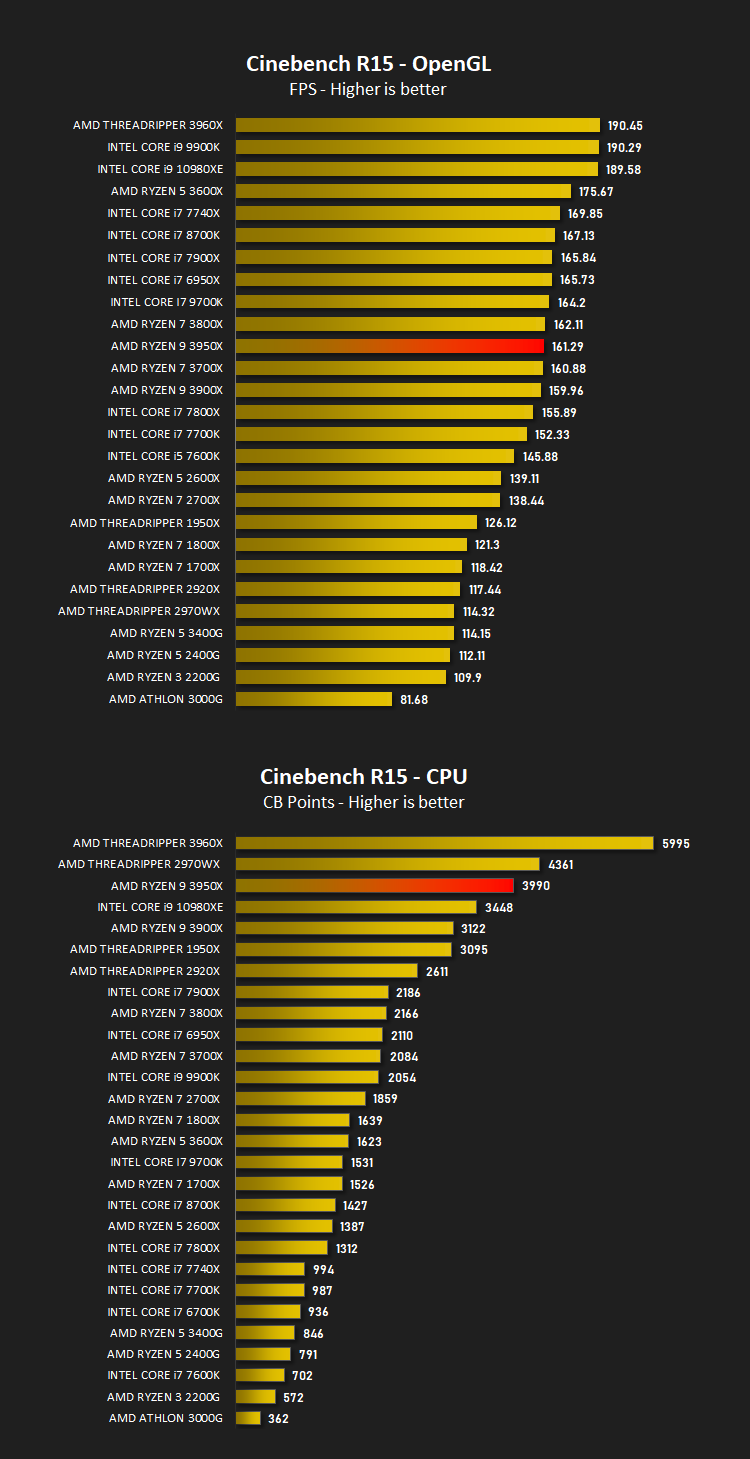
Processing Power Performance – Cinebench R15
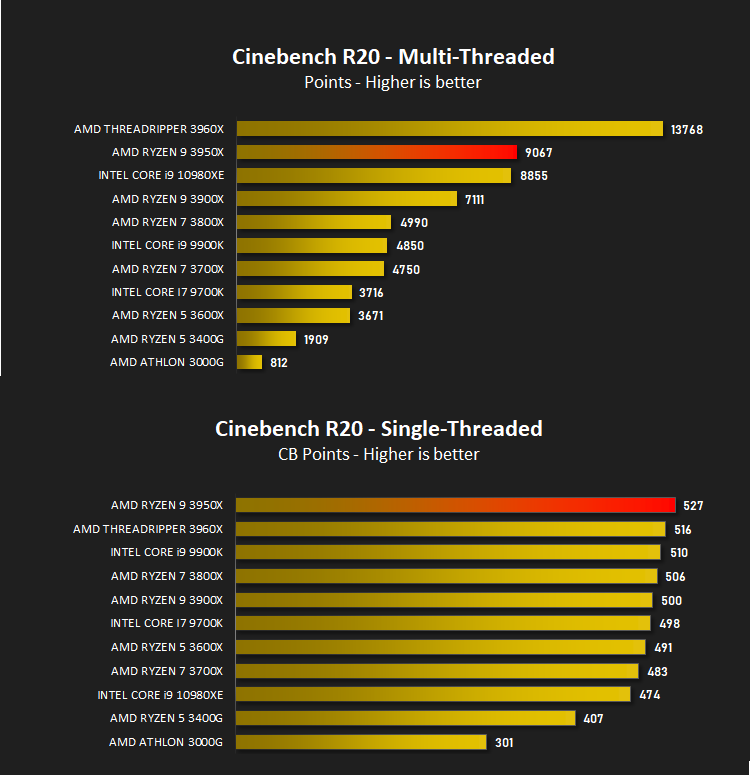
Processing Power Performance – Cinebench R20
Bandwidth Performance – SiSoftware SANDRA
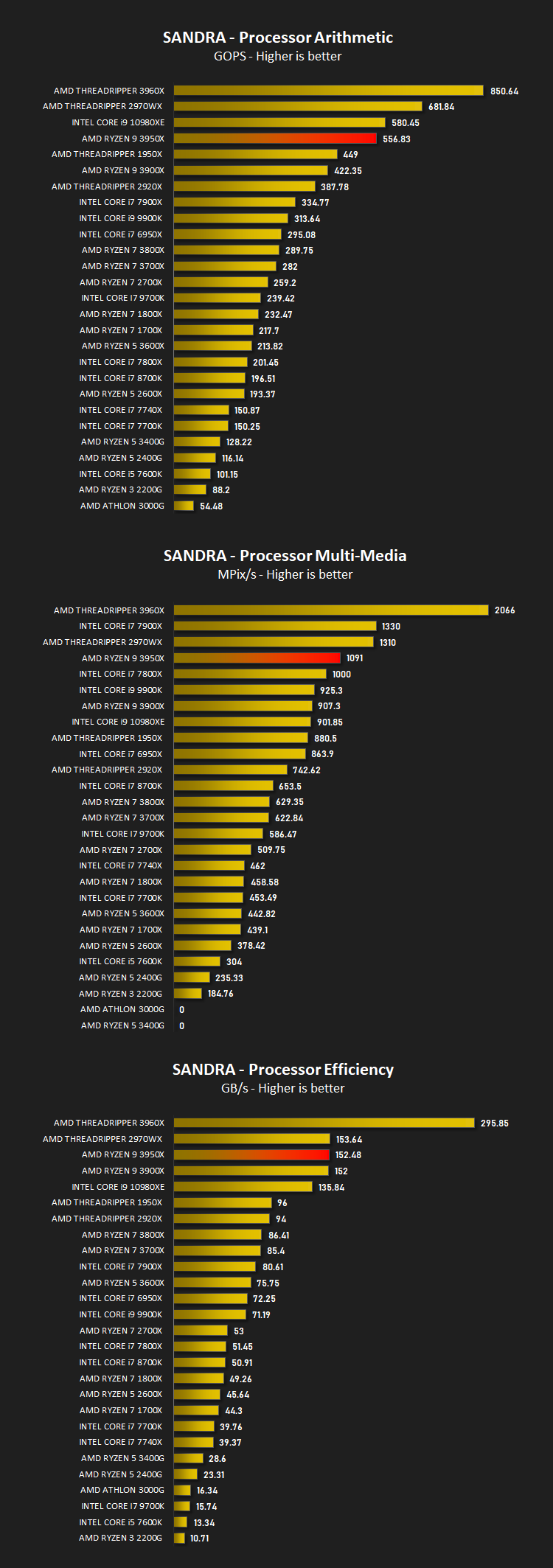
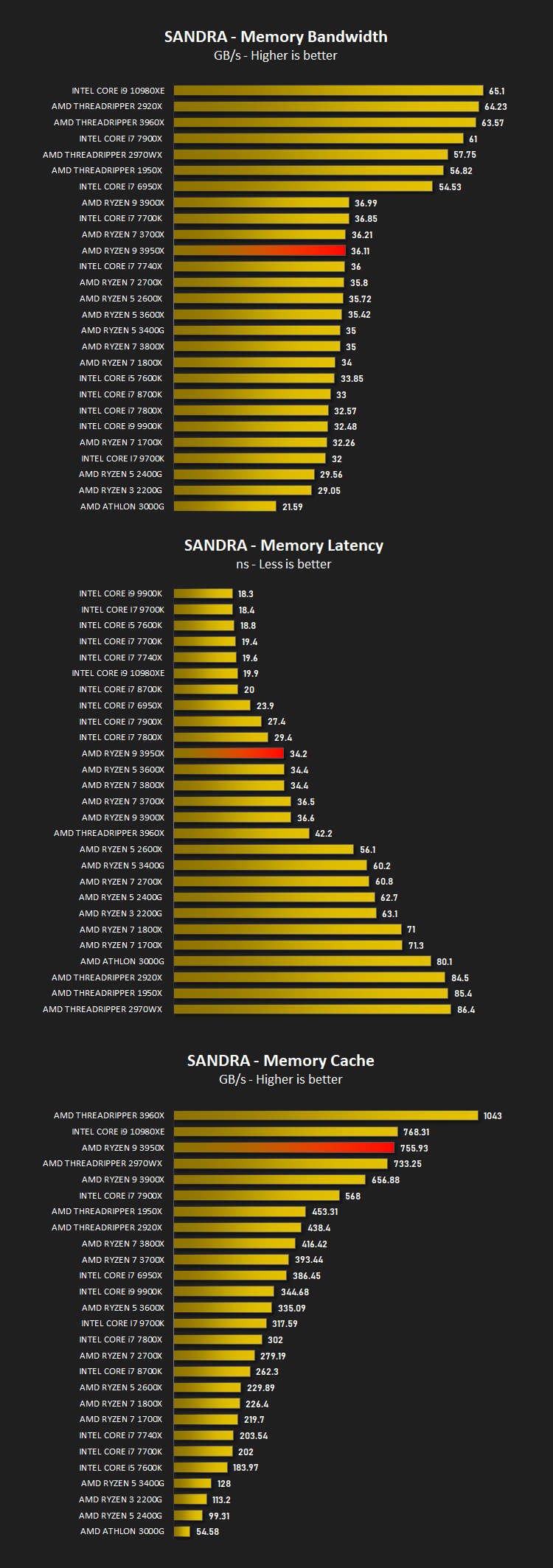
Image Editing Performance – PCMark 8 Photoshop
PCMark 8 Product Page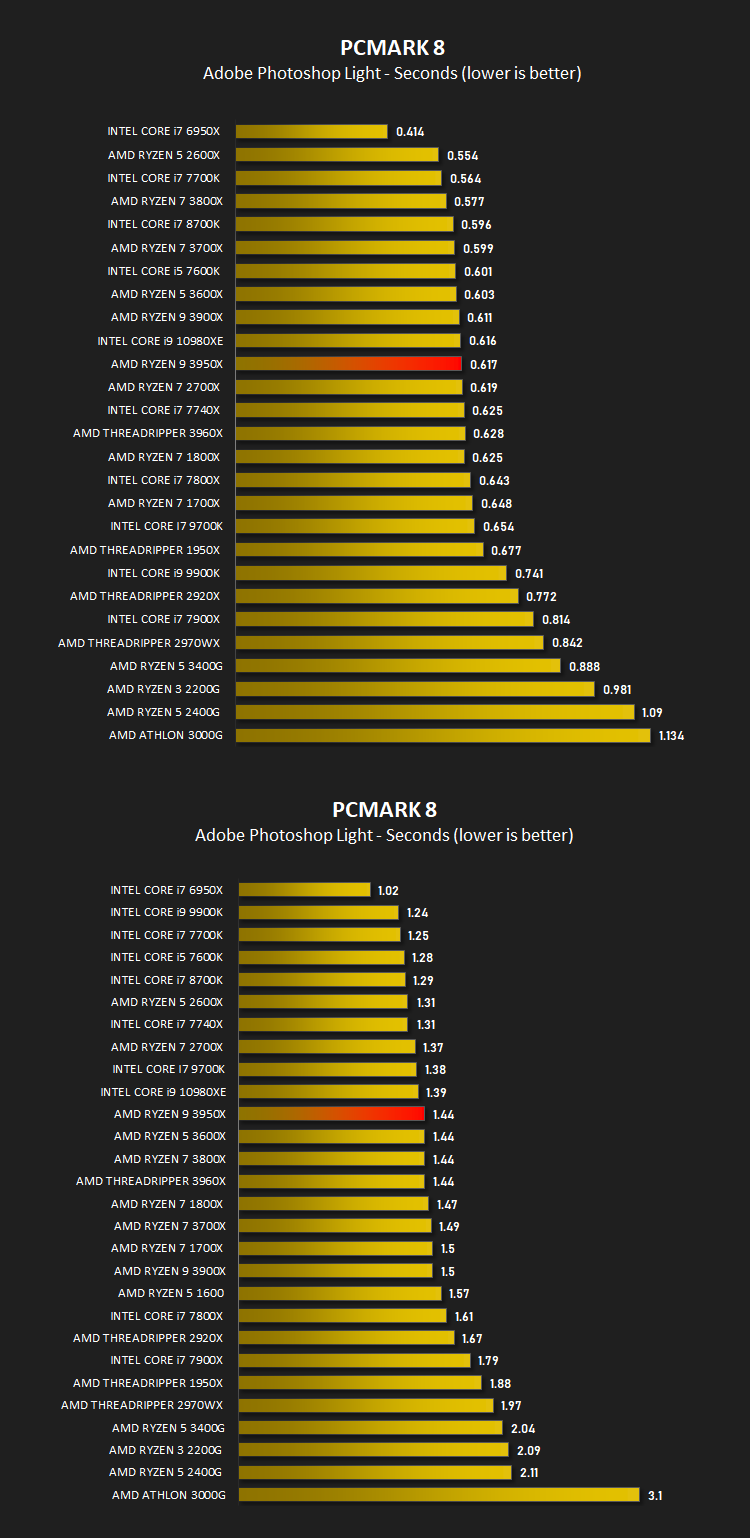
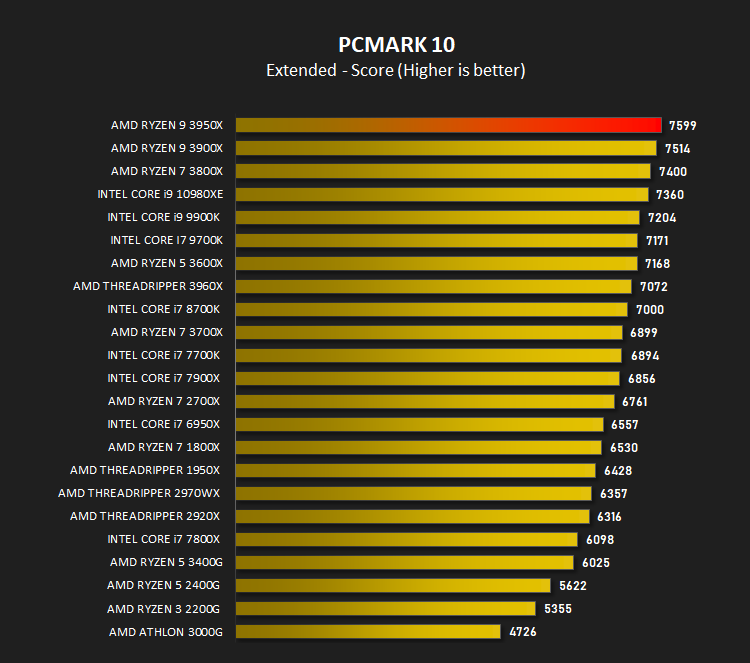
Overall System Performance – PCMark 10
PCMark 10 features a comprehensive set of tests that cover the wide variety of tasks performed in the modern workplace. With a range of performance tests, custom run options, and the new Battery Life Profile, PCMark 10 is the complete PC benchmark for the modern office.
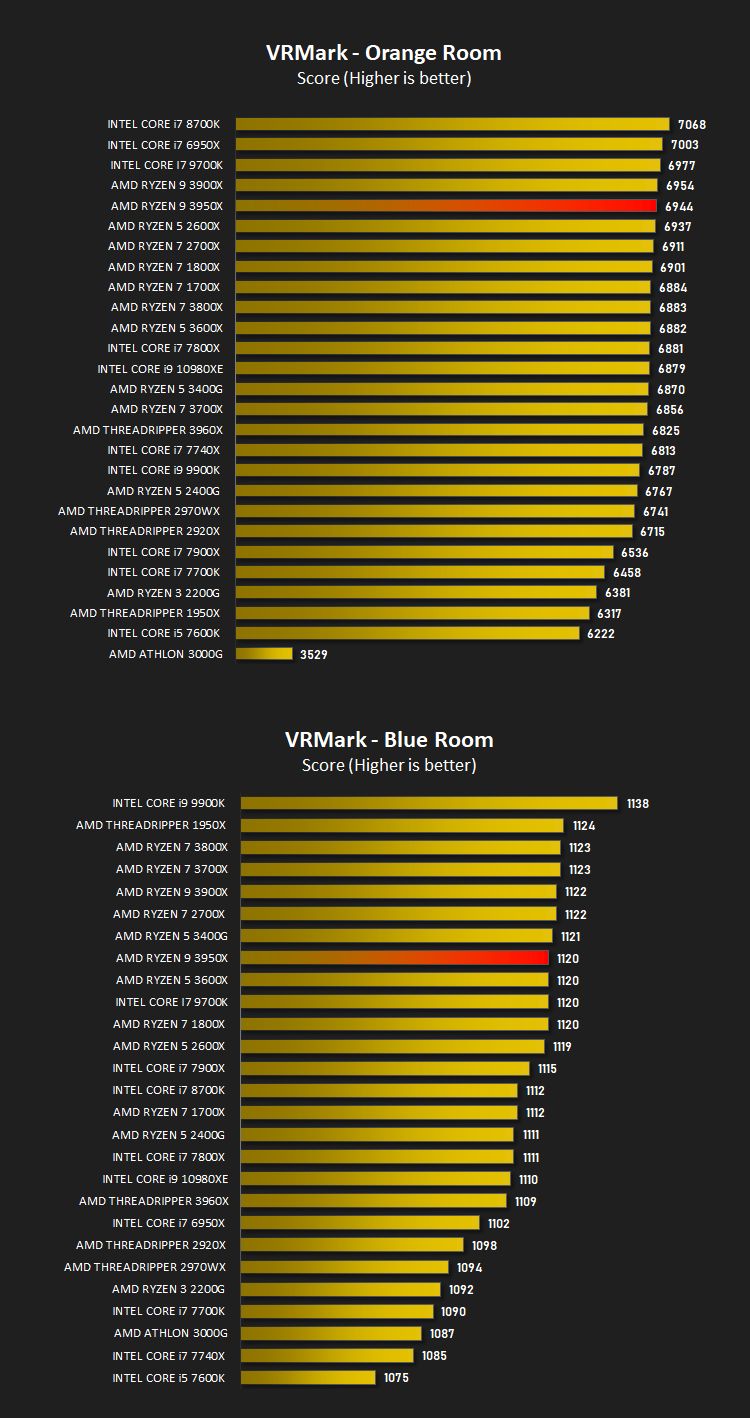
VR Performance – VRMark
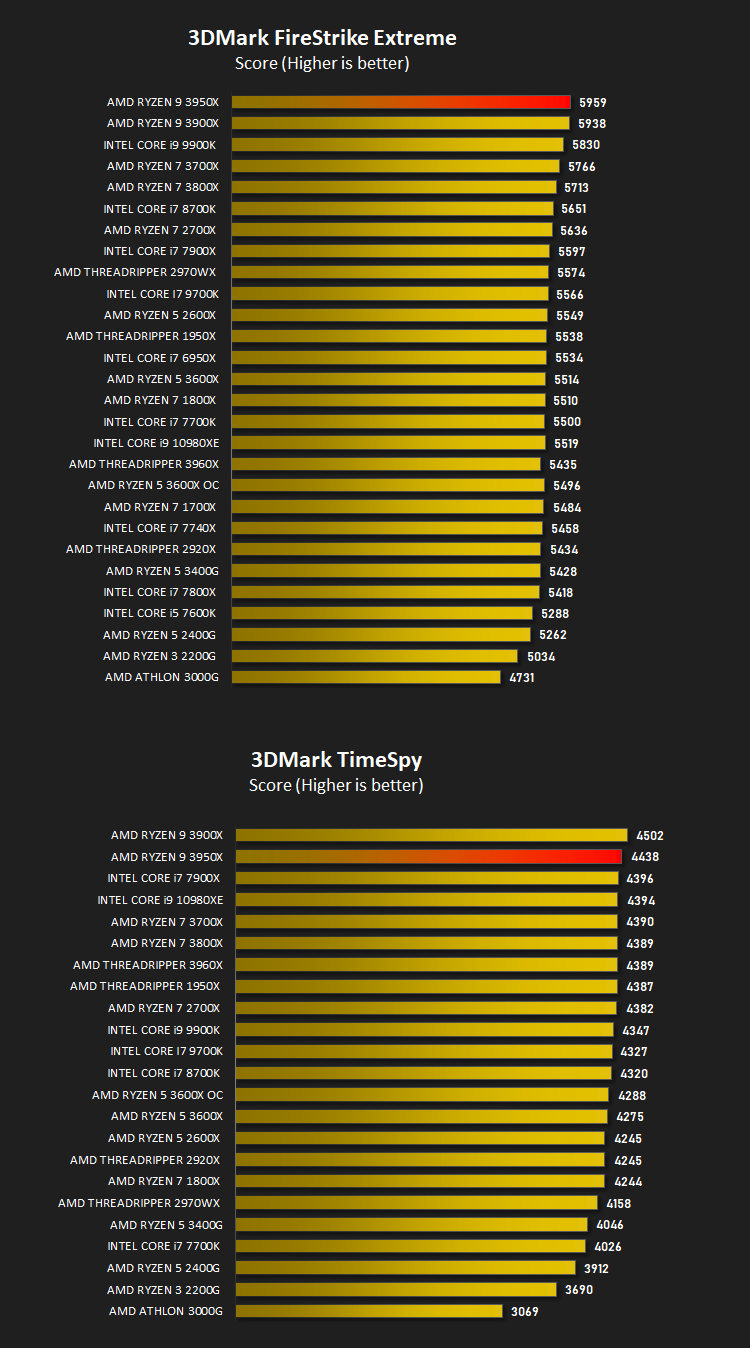
3D Performance – 3DMark
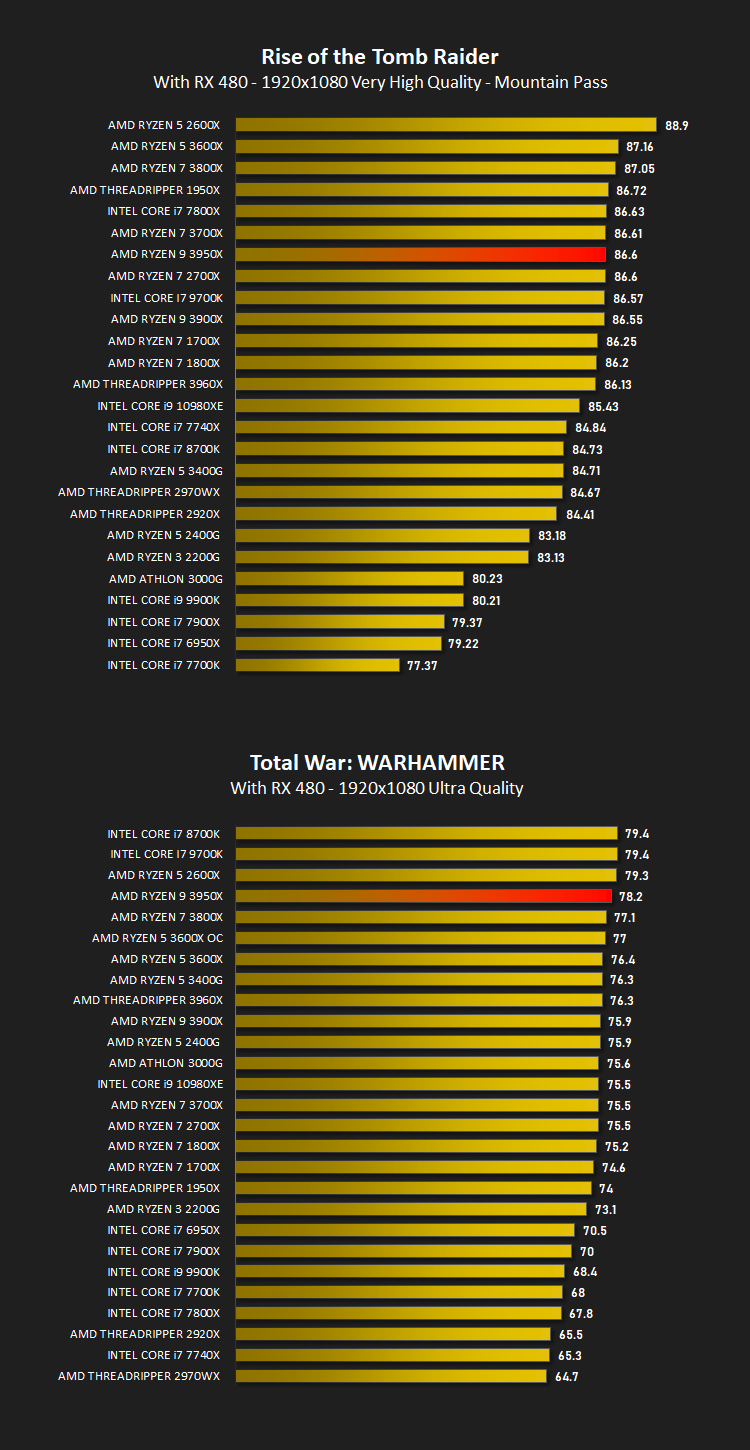
Gaming Performance – Tomb Raider & Total War: WARHAMMER
Conclusion
When AMD promised the 3950X in July, we waited patiently but with a real sense of anticipation; the jump from quad-core to octa-core took far too long in the consumer space, but to then jump from 8 to 16 cores in the space of two years is massively impressive and, quite frankly, way overdue at the same time.For the longest time, those with the biggest computational demands have had to fork out incredible sums of money for HEDT setups that can power through tasks with ease; but with the 3950X, AMD have struck an excellent balance between the two, with a 4.7GHz Boost Clock and 16 full-fat Zen2 cores for the best of both worlds.
Of course, the £749 price-tag is by no means cheap, particularly if you’re more accustom to purchasing something like the 3600X or 3700X, where prices are typically sub-£300, but compared to the HEDT solutions from both Intel and AMD, the 3950X offers an incredibly value-orientated option to the masses.
Furthering the value proposition, if you aren’t too bothered about PCI-E 4.0 or WiFi 6 (AX), an X470 motherboard can help to bring the price into a favourable position, just ensure you purchase something a little higher-end than you’d perhaps drop a 3600X into. Of course, the 3950X is supported by a budget X470 or even B450 motherboard but you’d be pushing the VRMs capabilities with a processor of this kind.
Having said that, we’d recommend not to pair this with anything other than an X570, because missing out on the performance gains offered by the PCI-E 4.0 bandwidth, as well as improved VRM support, and often the increased cooling offered by board-wide heatpipes, will help to extract every ounce of performance from this behemoth of a processor.
Thermals and power were somewhat in line with what we expected from this processor, with the 3950X going no higher than 72°C on our Corsair H150i Pro RGB cooling loop with a balanced profile enabled within the Corsair iCUE software. However, do also bear in mind, AMD recently updated their Ryzen Master software to enable you to ‘step-down’ your CPU’s TDP rating by one rung on the ladder, equating to a 105W TDP to 65W TDP. Think about that for a second, 32 computing threads running at a 65W TDP rating. Of course you do lose some performance at the top end but overall, if you needed to keep things cool and quiet, it’s entirely possible.
Overall, AMD have given Intel something to think about, they’re absolutely wiping the floor with the best that they can offer at the moment, and even getting very close on gaming performance despite Intel’s 5.0GHz all-core speeds on the 9900KS. Give developers a few years to catch up, especially with Sony and Microsoft rumoured to be utilising Zen2 in their upcoming console launches, and we should see the increased core counts of these processors to really begin to shine within the gaming market.
32 processing threads, a whopping 72MB of cache, PCI-E 4.0 support, reasonable cooling demands and a relatively value-orientated price make the 3950X incredibly easy to recommend, providing you’ll use all of the power. The 3700X would do you just as well otherwise, at half the price.
+ Absolutely mind-blowing performance from 32 threads
+ Reasonable AIO cooling loops will handle this without issue
+ Strong multi and single threaded performance
+ PCI-E 4.0 support
+ 105W TDP
+ Compatible with a B450 motherboard for £100.
+ Can be clocked down to 65W TDP
Cons
– The 3700X might be just as good based on your usage
– Not a true replacement for HEDT if you need the additional PCI-E or Memory lanes
– No cooler included
Click here for an explanation of our awards at Vortez.net.
Stay connected with the Vortez Social Media pages:
Join in with the discussions on Discord