More cores and more threads – AMD’s 2nd Generation Ryzen Threadripper CPUs are under the spotlight in the form of two HEDT processors: 2920X & 2970WX (12c/24t and 24c/48t).
Editors: Tim Harmer/David Mitchelson

Product on Review: Threadripper 2920X & 2970WX
Manufacturer: AMD
Street Price:
2920X: £589 GBP – $649 USD – $999 AUD
2970WX: £1189 GBP – $1229 USD – $1999 AUD
In 2017 AMD lit a fire under the High End Desktop Platform segment with the launch of Ryzen Threadripper. No longer did we top-out at 10 cores per CPU on a prosumer platform (the limit of Broadwell-E); suddenly as many as 16 were available, and very aggressively priced too by comparison. Not bad for a debut entrant.
This year AMD are totally upending the segment with the release of their 2nd Generation Threadripper platform. Motherboards remain largely unchanged, but the CPU itself as much as doubles the potential core count to thirty two. And thanks to AMD’s Simultaneous Multithreading technology, that’s support for up-to 64 independent threads.
Threadripper’s refresh was precipitated by TSMC’s phasing in of their 12nm manufacturing node. While still a derivative of the 14nm process rather than a fully-fledged node shrink (which we’ll see with 7nm in 2019), the 12nm process improves power efficiency and allows for higher clock speeds. Ryzen’s refresh improved clock speeds by ~10%, and it’s the same ballpark for 2nd Gen Threadripper.
Including the 32-core, 64-thread flagship Threadripper 2990WX, four SKUs comprise the refreshed lineup, and we’re looking at two today.
The first is AMD’s Ryzen Threadripper 2920X, a 12-core, 24-thread model that’s ostensibly similar to the 1st Gen. 1920X. Modifications to AMD’s Precision Boost technology means that its headline (non-XFR) Turbo mode now reaches 4.3GHz from 4.0GHz and will maintain a higher clock speed across all cores for longer.
With the phasing out at an 8-core model from the Threadripper lineup there is now clear water between AMD’s mainstream Ryzen desktop platform and Ryzen Threadripper. This also more clearly delineates the category of user AMD expect to invest in either platform: Ryzen is for mainstream users and gamers; whereas Threadripper is for enthusiasts, prosumers and professionals.
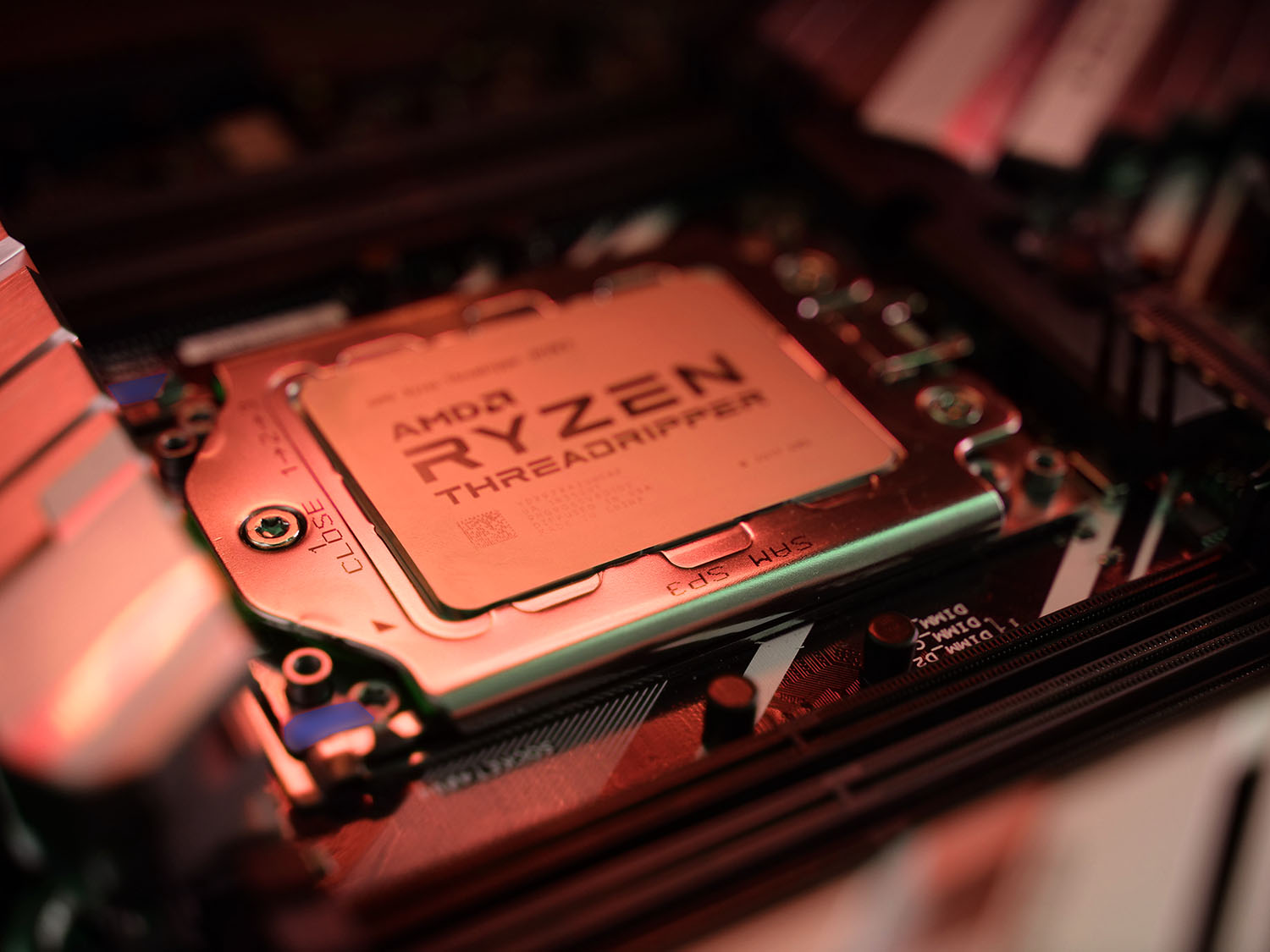
The second CPU is the Ryzen Threadripper 2970WX, but it has no real equivalent in the 1st generation lineup. Incorporating 24 cores and SMT for 48-threads, there is no directly comparable chip in the 1st Generation Threadripper lineup (which topped out at 16 cores). Indeed, it boasts a higher core count than even the Intel Skylake-X Core i9 flagship. In essence, it capitalises on the major strength of AMD’s Zen architecture – i.e. core scaling – without compromising too far on core frequencies.
In terms of market positioning, the MSRP of AMD’s Threadripper 2970WX sits neatly between Intel’s Skylake-X Core i9-9940X ($1389 14-core) & Core i9-9920X ($1189 12-core). Meanwhile, the 2920X sits a touch above the Core i7-9800X ($589 8-core), but is over $200 cheaper than the i9-9820X (10-core).
Despite higher core counts new technologies, there has been no major re-working of the TR4 socket or motherboard chipset. The CPUs are backwards-compatible with existing X399 motherboards (following a BIOS update), while the previous generation is forwards-compatible with new X399 motherboards released since the refresh. That keeps platform costs down, a welcome change for the HEDT segment.
So, with Second Generation Threadripper’s impressive credentials laid out, it’s time to take a closer look at those chips.
Tech. Specifications
RYZEN THREADRIPPER 2920X
Lithography: TSMC 12nm
Architecture: AMD Zen+
Socket: TR4 (LGA-4094)
Cores: 12
Threads: 24
Active Dies: 2; 6 cores per die
L2 Cache: 6MB (512KB per core)
L3 Cache: 32MB
Base Frequency: 3.5 GHz
Boost Frequency: 4.3 GHz
Memory: Quad-Channel DDR4 (DDR4-2933+)
PCI-Express: 64 Lanes (PCIe 3.0)
TDP: 180W
Architecture: AMD Zen+
Socket: TR4 (LGA-4094)
Cores: 12
Threads: 24
Active Dies: 2; 6 cores per die
L2 Cache: 6MB (512KB per core)
L3 Cache: 32MB
Base Frequency: 3.5 GHz
Boost Frequency: 4.3 GHz
Memory: Quad-Channel DDR4 (DDR4-2933+)
PCI-Express: 64 Lanes (PCIe 3.0)
TDP: 180W
—
RYZEN THREADRIPPER 2970WX
Lithography: TSMC 12nm
Architecture: AMD Zen+
Socket: TR4 (LGA-4094)
Cores: 24
Threads: 48
Active Dies: 4; 6 cores per die
L2 Cache: 12MB (512KB per core)
L3 Cache: 64MB
Base Frequency: 3 GHz
Boost Frequency: 4.2 GHz
Memory: Quad-Channel DDR4 (DDR4-2933+)
PCI-Express: 64 Lanes (PCIe 3.0)
TDP: 250W
Architecture: AMD Zen+
Socket: TR4 (LGA-4094)
Cores: 24
Threads: 48
Active Dies: 4; 6 cores per die
L2 Cache: 12MB (512KB per core)
L3 Cache: 64MB
Base Frequency: 3 GHz
Boost Frequency: 4.2 GHz
Memory: Quad-Channel DDR4 (DDR4-2933+)
PCI-Express: 64 Lanes (PCIe 3.0)
TDP: 250W
Features
THREADRIPPER ARCHITECTURE
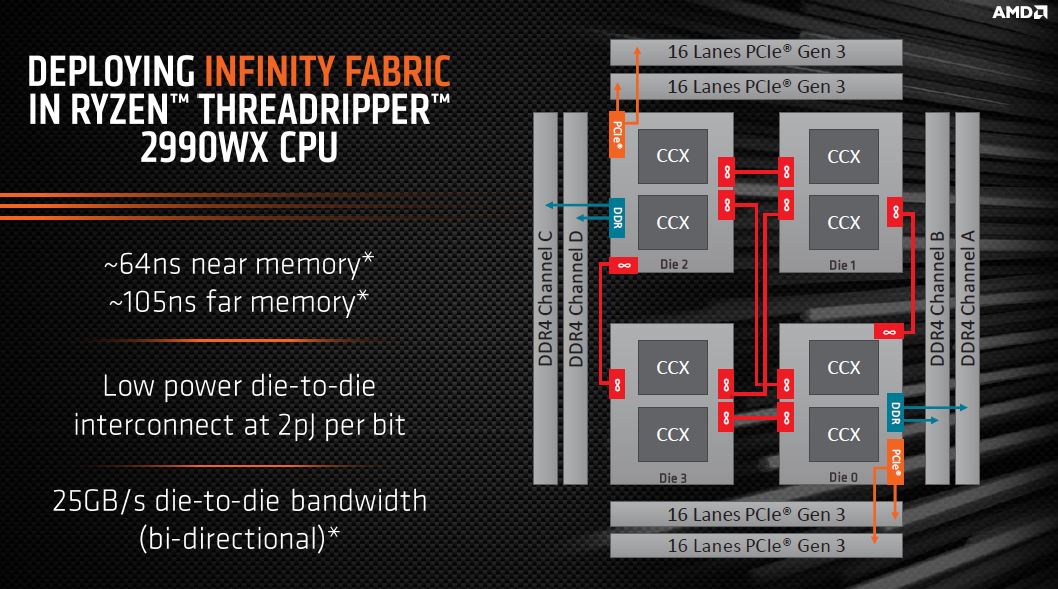
As is well known by know, AMD’s Threadripper CPUs take form through a very idiosyncratic layout. Nonetheless, the DNA of their desktop Ryzen line continues to run through the HEDT platform.Each Threadripper CPU incorporates four discrete dies, rather than utilising a single monolithic core. Each die is very similar to that found in a desktop Ryzen CPU, incorporating two Core Complex (CCX) modules with four cores each. It’s this structure which gives Zen its enviable scalability, without levying the costs of transitioning to a single monolithic die with huge core numbers (as in Intel Skylake-X).
The ‘glue’ which holds all this together is known as Infinity Fabric. This high bandwidth, low-latency I/O channel runs at the speed of DRAM and allows cores to communicate not only between CCX’s, but also between dies.
First Generation Threadripper had four dies per package, but two were disabled. As a result a maximum of 16 cores were available on the flagship, as well as quad-channel DDR4 memory (thanks to each active die also having its own memory controller). This design meant that mechanically a Threadripper CPU would be much more stable – the oversized heatspreader would be supported by four dies rather than the two, allowing for more secure heatsink mounting and more inherent rigidity.
The same package design and similar socket has also been used in AMD’s EPYC server CPUs. The difference here is that EPYC processors incorporate up to four fully active dies rather than just the two, as well as eight-channel DDR4 memory support and 128 PCI-Express 3.0 lanes.
That being said, what’s new with 2nd Generation Threadripper?
UP TO FOUR ENABLED DIES
Like their EPYC cousins, the new Threadripper CPUs with more than 16 cores have all four dies enabled, rather than just two. Like EPYC, as many as 32-cores are available to the platform, rather than just 16. And just like the first generation, the use of smaller dies connected by Infinity Fabric has lower associated costs and higher yields than a single large die with the same number of cores.Despite featuring four enabled dies, certain features remain exclusive to EPYC. The most obvious is memory support. 2nd Gen. Threadripper remains a quad-channel platform, and two dies have had their memory access routed through the others which are directly connected to system memory.
The flagship Threadripper 2990WX has all eight processing cores active per die, giving it a total of 32 cores and support for 64 threads. In contrast the 2970WX has six cores enabled per die (three per CCX) for a total of 24 cores and 48 threads. Nonetheless the 2970WX still has access to the entire L3 cache available on the CPU – 64MB, just as much as the 2990WX.
TSMC 12NM MANUFACTURING PROCESS
Like 2nd Generation Ryzen, Threadripper’s refreshed CPU lineup are manufactured using TSMC’s 12nm FinFET process. This has allowed AMD to push up core clock speeds relative to the first generation, as shown by an increase of 300MHz in the maximum (non-XFR) boost frequency of the 12-core 2920X relative to the 1920X. The TDP envelope of these new counterparts to the previous generation have remained the same, so no new exotic cooling is necessary.This transition to 12nm is particularly important for the high core count processors. These CPUs run relatively high clock-speeds compared to the server/enterprise EPYC chips, primarily to maintain strong performance in gaming (a key use-case for Threadripper, but not so for EPYC). Even on 12nm, the TDP envelope of the 2990WX is 250W; any higher and even high-end air cooling may not have been suitable.
It’s not all about power efficiency. Improved transistor packing has reduced the L1, L2 and L3 cache latencies by ~ 13%, 34% and 16% respectively, an aspect that will have implications no matter the workload.
PERFORMANCE BOOST 2
AMD Performance Boost was introduced with first generation Ryzen as a means of controlling per-core frequencies beyond the base level. Boost frequencies had an upper cap, but operating frequencies at any given time were controlled through the PB algorithm which analysed workloads across the CPU package. Optimum Performance Boost frequencies kicked in when up to two cores were under heavy load; this pair of cores were boosted to a high frequency, other cores remained at the base level.Inherited from 2nd Generation Ryzen, Performance Boost 2 more rigorously governs the operating frequency of the CPU depending on the load each core is under and sensor data collected through AMD SenseMI. This implementation is far more aggressive than the initial iteration, holding the clocks higher for longer under heavier multi-core workloads. Plus, it goes one step further.
While Performance Boost pushed two cores to the maximum boost frequency when only those two were under heavy load, Performance Boost 2 will boost raise the frequency on every core that is under load even if more than two are being taxed. Not only is it therefore more appropriate for strongly multi-threaded workloads (for example video rendering), it doesn’t penalise workloads where few cores are under load (such as gaming).
Quick Look
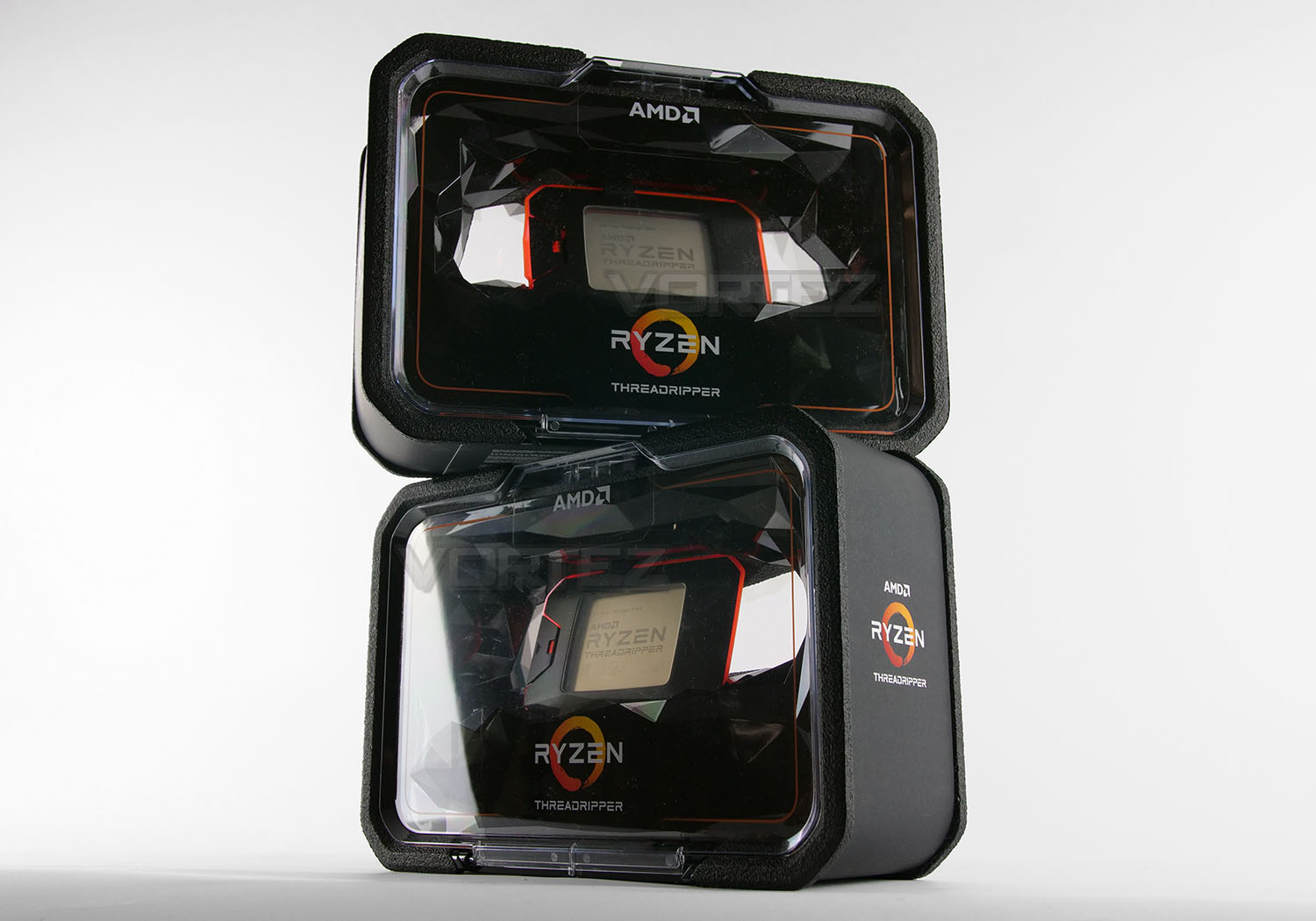
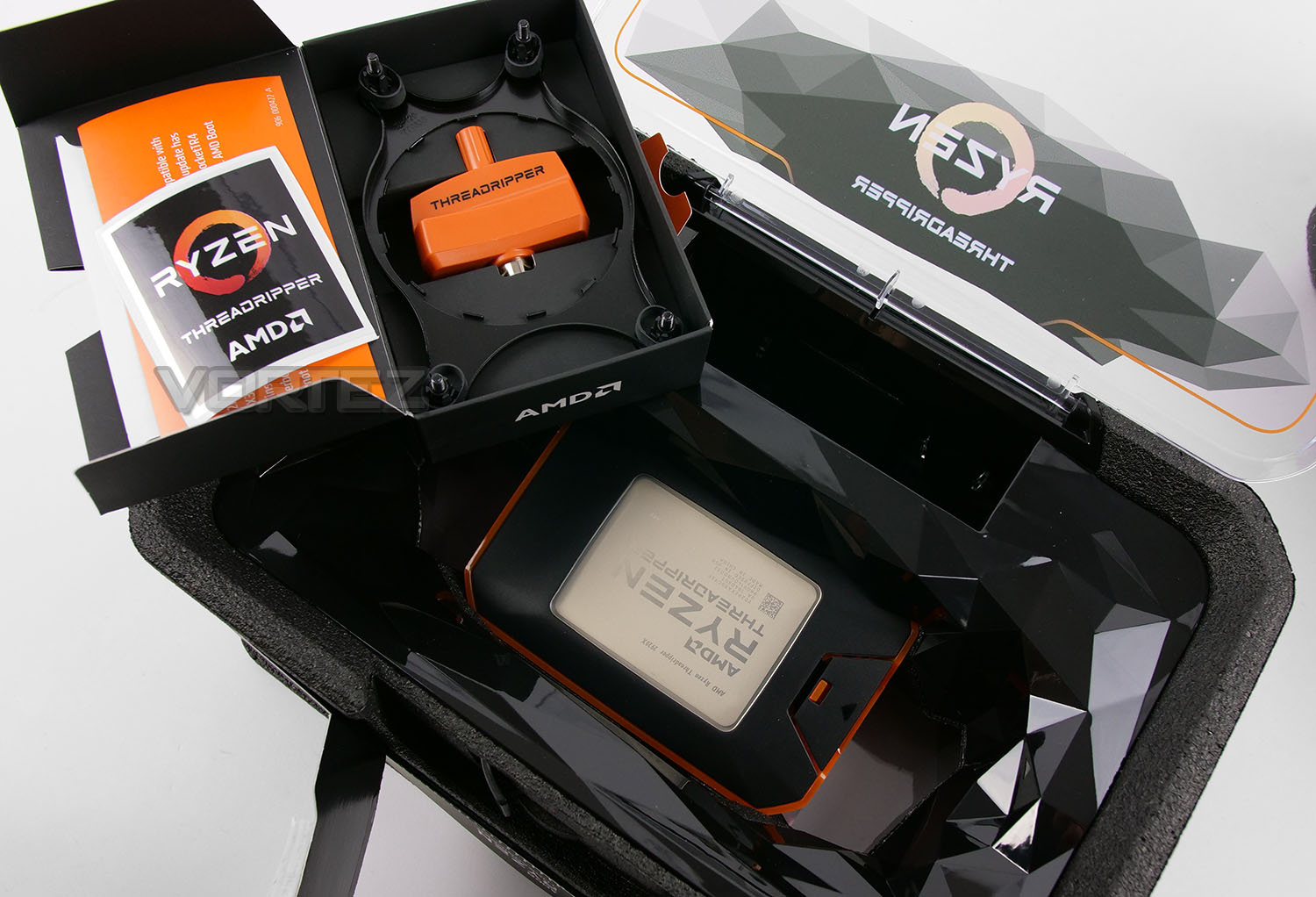
A quick glimpse of the packaging reveals that the second generation of AMD Ryzen Threadripper is no average CPU. AMD has redesigned the packaging yet it still remains quite a spectacle.
Within, each of the CPUs is concealed within a plastic case/container and there is a mounting bracket for Asetek liquid coolers and a torx screwdriver which is required to access the TR4 socket on the X399 motherboard.
When using the mounting bracket – be sure to verify whether the intended cooler will sufficiently cover the entirety of the CPU. Certain manufacturers, have designed TR4-specific solutions in order to effectively cool these CPUs – Noctua are one such brand which offer a number of heatsinks designed for this platform, one of them being the NH-U14S TR4-SP3 which we used for this review.
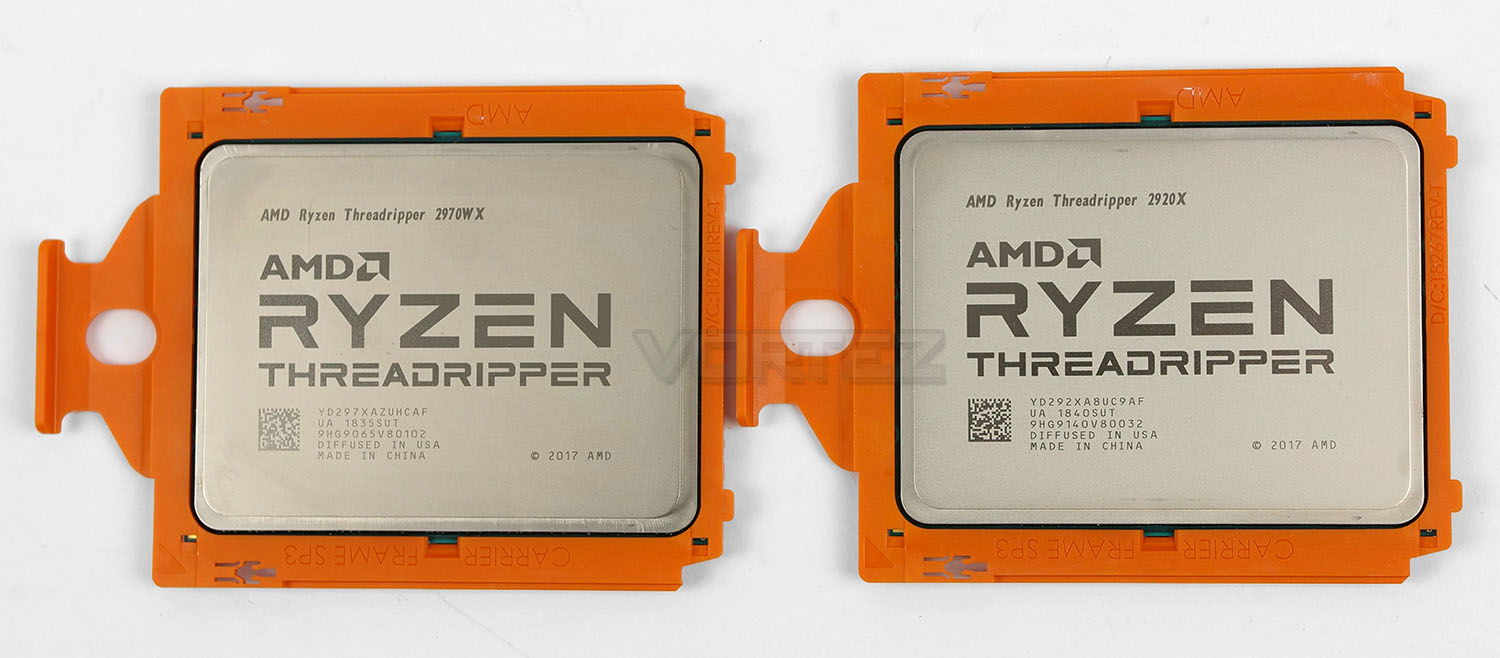
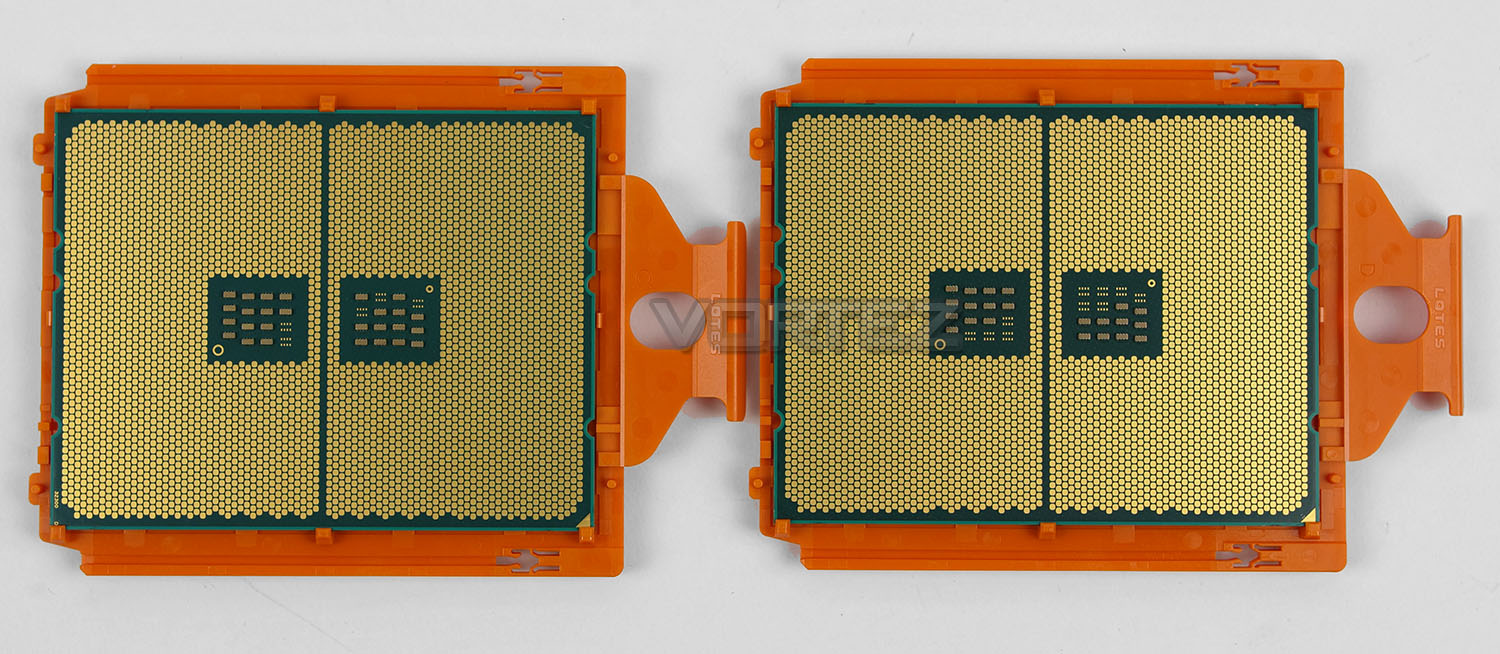
Each CPU sits within a rention clip – something we saw with the original Threadripper Series. This clip works in conjunction with TR4. The sheer magnitude of either CPU is only fully appreciated in the flesh, both processors retain the gigantic size we were introduced to little over 18 months ago. We should note that the heatspreaders on these chips are soldered.
Test Setup & Testing
CPUs TESTED
Ryzen Threadripper 2920X (12-core, 24-thread)Ryzen Threadripper 2970WX (24-core, 48-thread)
TEST SETUP
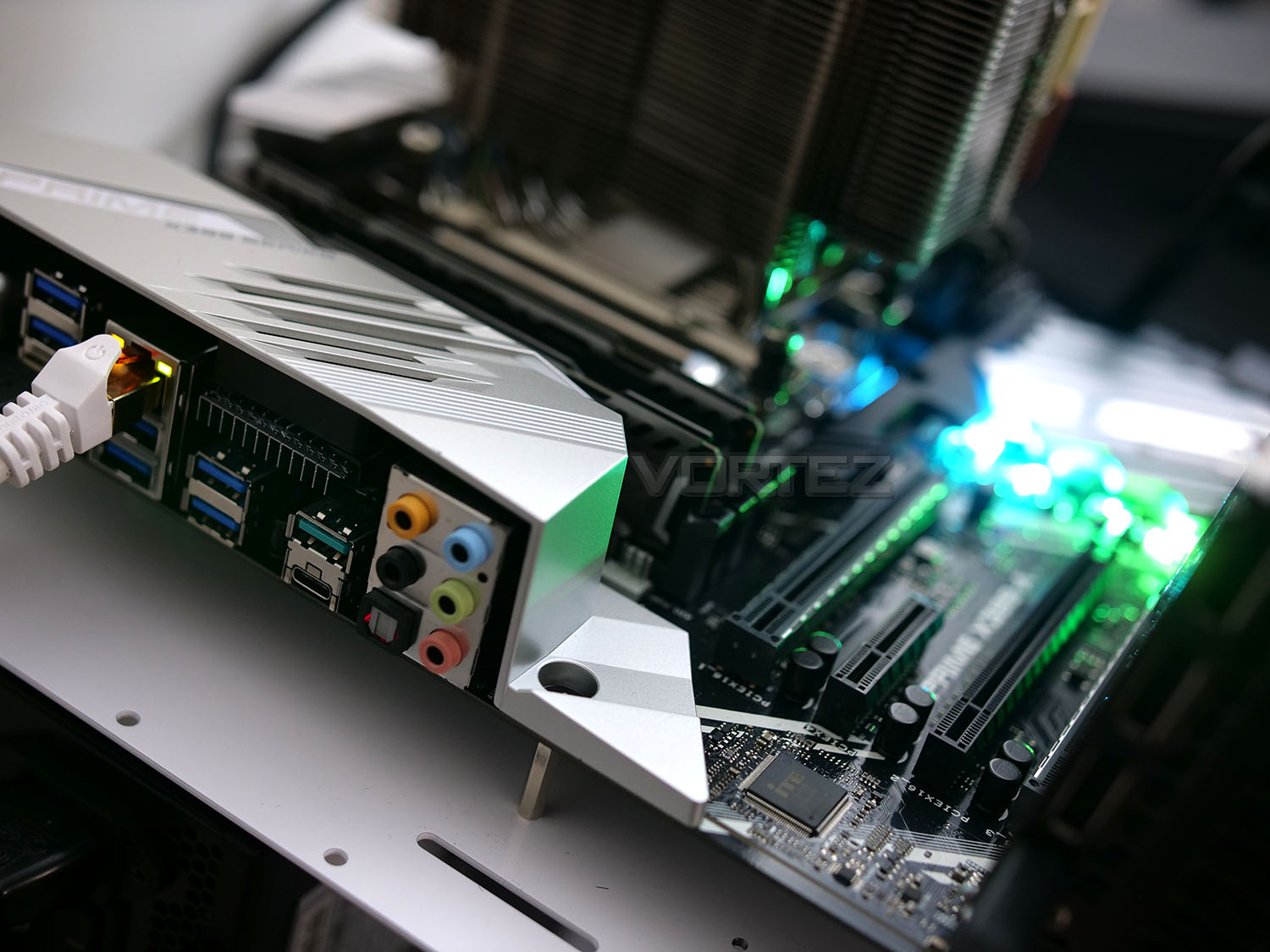
Cooling Noctua NH-U14S TR4-SP3Motherboard ASUS PRIME X399-A
Memory 32GB Corsair Vengeance LPX 3000MHz
Graphics Radeon RX 480 8GB
Storage Kingston HyperX 240GB
PSU Corsair RMx 1000 80 Plus Gold Certified PSU
Monitor AOC U2879VF
Capture Device AVermedia Live Gamer Ultra
COMPARED AGAINST
AMD Ryzen 5 1400 (3.2GHz) Summit RidgeAMD Ryzen 3 2200G (3.5/3.7GHz) Raven Ridge
AMD Ryzen 5 2400G (3.6GHz/3.9GHz) Raven Ridge
AMD Ryzen 3 1200 (3.1/3.4GHz) Summit Ridge
AMD Ryzen 3 1300X (3.4/3.7GHz) Summit Ridge
AMD Ryzen 5 1400 (3.2GHz) Summit Ridge
AMD Ryzen 5 1600 (3.2GHz) Summit Ridge
AMD Ryzen 7 1700 (3.0GHz) Summit Ridge
AMD Ryzen 7 1700X (3.4GHz) Summit Ridge
AMD Ryzen 7 1800X 3.6GHz) Summit Ridge
AMD FX-8350 (4.0GHz) PileDriver
Intel Core i9-9900K (4.5GHz) Coffee Lake-S
Intel Core i7-8700K (4.5GHz) Coffee Lake
Intel Core i7-7900X (3.3GHz) Skylake-X
Intel Core i7-7800X (3.5GHz) Skylake-X
Intel Core i5-7700K (4.2GHz) Kaby Lake
Intel Core i7-6950X (3.0GHz) Broadwell-E
Intel Core 7-6900K (3.2GHz) Broadwell-E
BENCHMARKS
Cinebench R15 – CPU/OpenGL Scorex264 HD 4.0 – 1st and 2nd pass encoding
SiSoftware SANDRA – CPU & Memory benchmarks
POV-RAY – CPU benchmarks
TrueCrypt – CPU benchmarks
AIDA64 – CPU benchmarks & Memory
PCMark 8 – Home Suite & Photoshop
3DMark FireStrike – 3D Benchmark
Games – Rise of the Tomb Raider & Total War: WARHAMMER
OTHER SOFTWARE
Temperature Analysis: RealTempStress Testing Software: AIDA64 Stability Test
CPU Specification Monitoring: CPU-Z
Performance Monitoring: MSI Afterburner
Temperatures & Overclocking
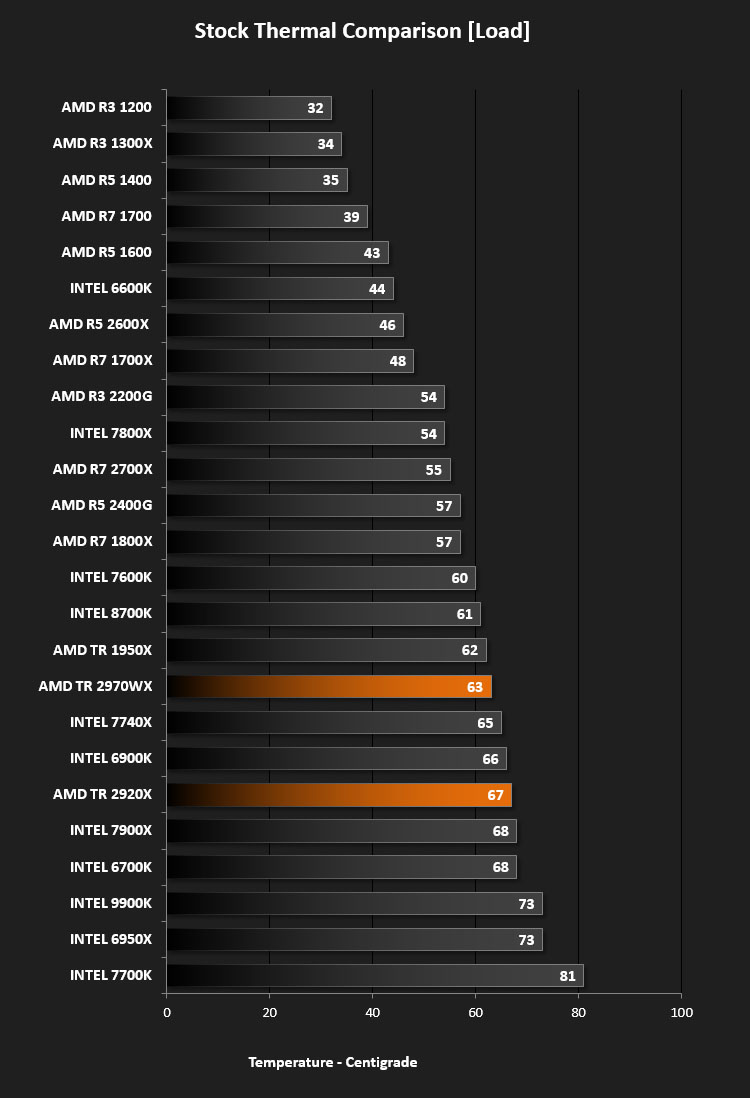
Below are the temperatures for each of the CPUs – without any overclock applied. We’ve also compared to previously released AMD Ryzen chips as well as the former Kaby Lake, Broadwell-E and Skylake counterparts (which we’ve also benchmarked against on the subsequent pages too):
OVERCLOCKING
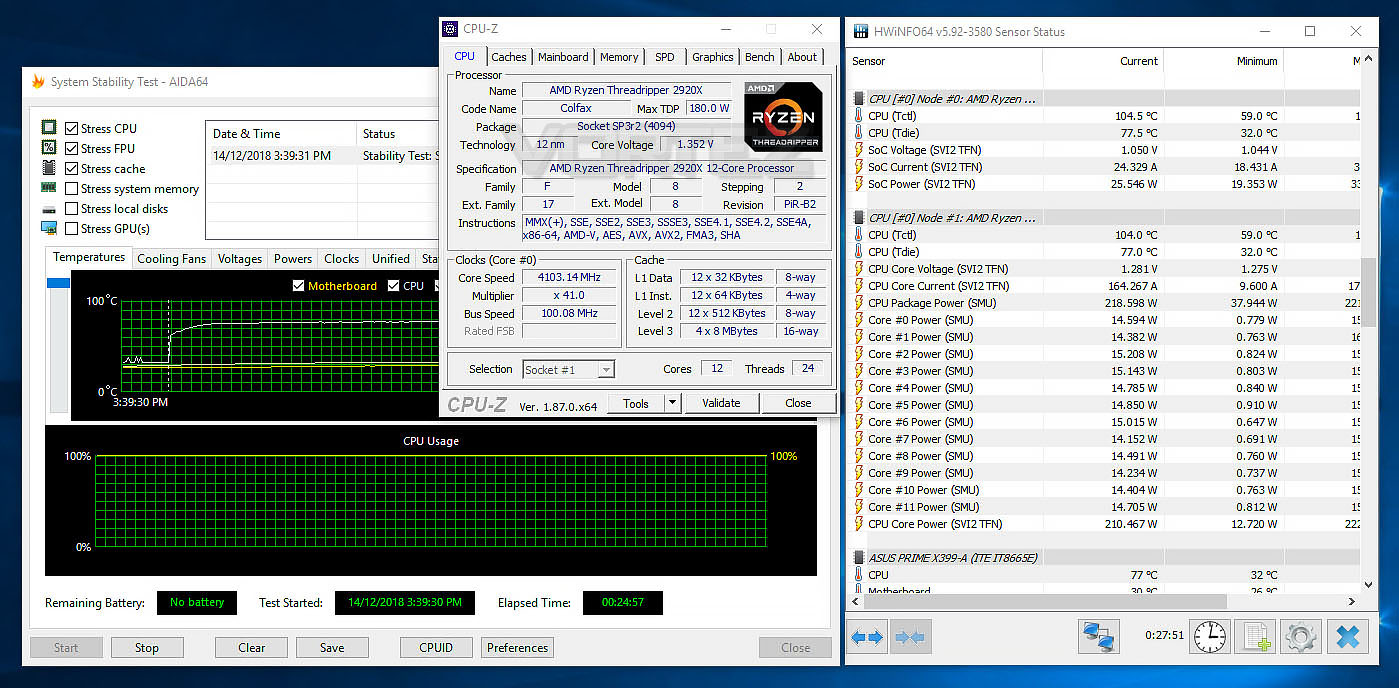
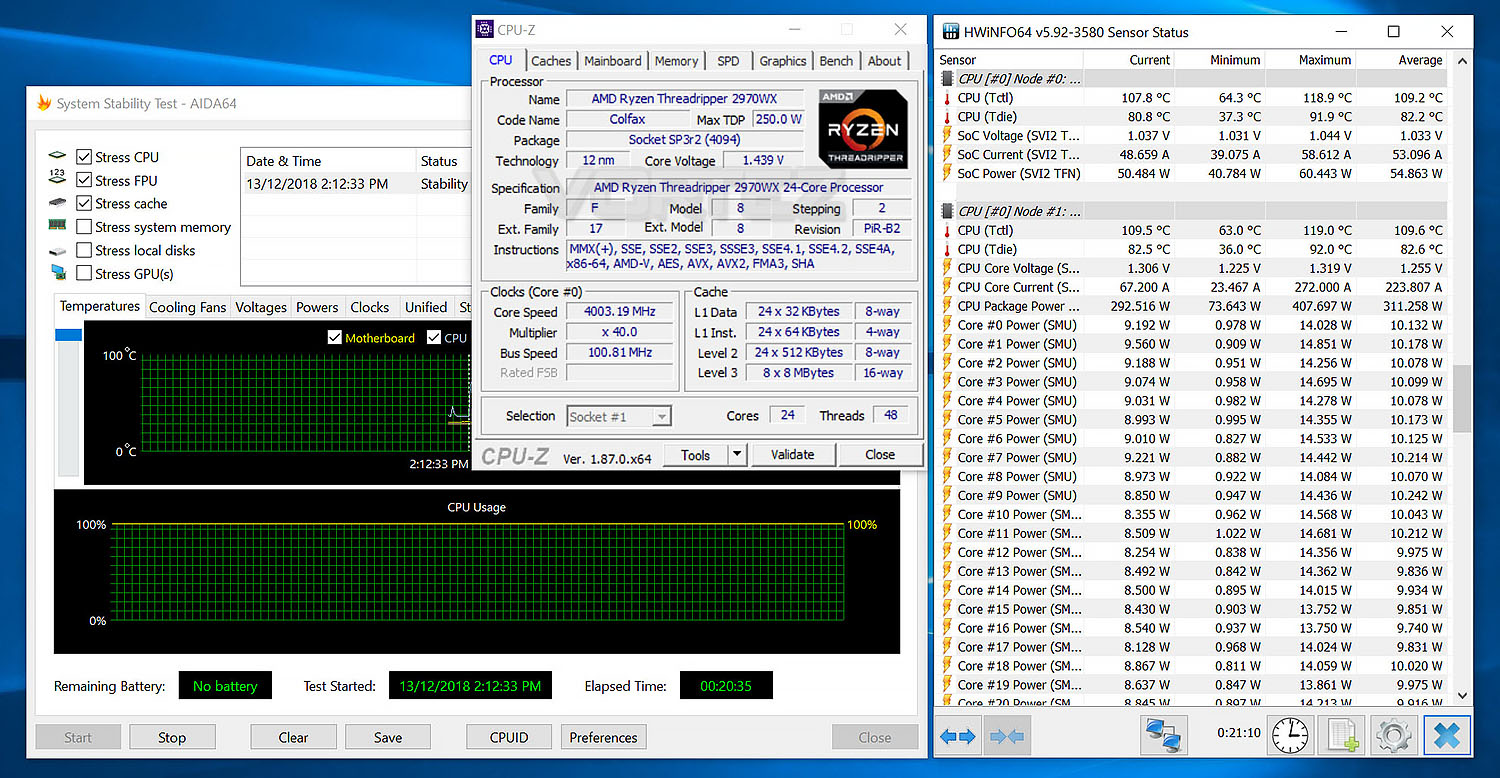
Our best achievement saw us reach 4.1GHz with the 2920X and 4.0GHz with the 2970WX – impressively up from the 3.5GHz and 3GHz base clocks. The 2970WX required more voltage medication compared to the 2920X – 1.32v vs 1.38v respectively.In this review we’ve benchmarked both CPUs at stock and overclocked settings – giving you a good indication as to the benefits of using this sort of overclock in synthetic benchmarks and day-to-day tasks.
Power Consumption
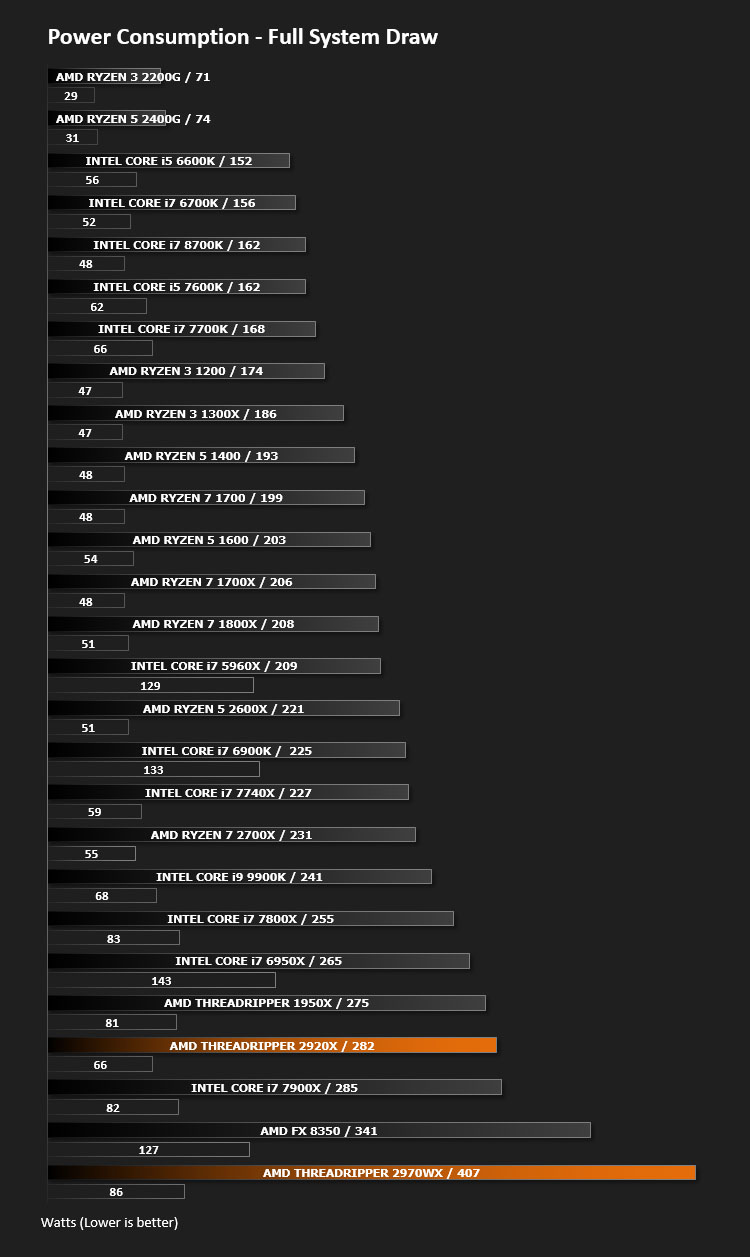
It’s interesting to note the power consumption across all processors. Although they are using a combination of different motherboard chipsets, energy results can fluctuate between manufacturers due to the features and specifications that are integrated. First of all, for the idle tests the system is cold booted into Windows and no additional applications are executed – the watts are noted on the external energy monitor we use and then the system is loaded with 3DMark FireStrike – watts are again monitored for the duration of the test and the highest rated wattage result is then noted down. Below are the results of this energy test.
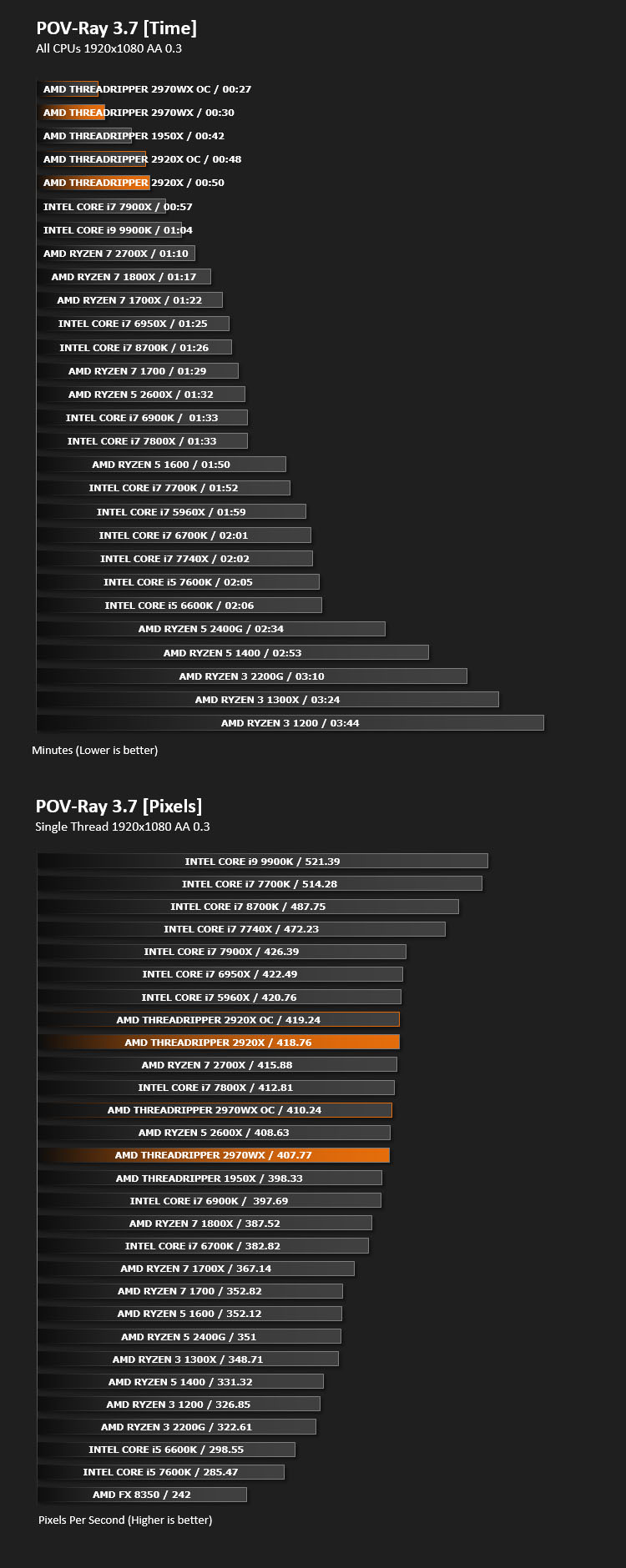
Ray Tracing Performance – POV-Ray 3.7
Persistence of Vision Raytracer’s PovRay is a free and open source 3D animator application with versions for computers with different operating systems.
This product allows users to build their custom 3D worlds with excellent quality despite their computer’s hardware. It has adjustable options for levels of radiance, refraction, and reflection. Calculation time may vary depending on the computer model, but PovRay can adapt to many computer builds, and is supported by the open source community.
This product allows users to build their custom 3D worlds with excellent quality despite their computer’s hardware. It has adjustable options for levels of radiance, refraction, and reflection. Calculation time may vary depending on the computer model, but PovRay can adapt to many computer builds, and is supported by the open source community.
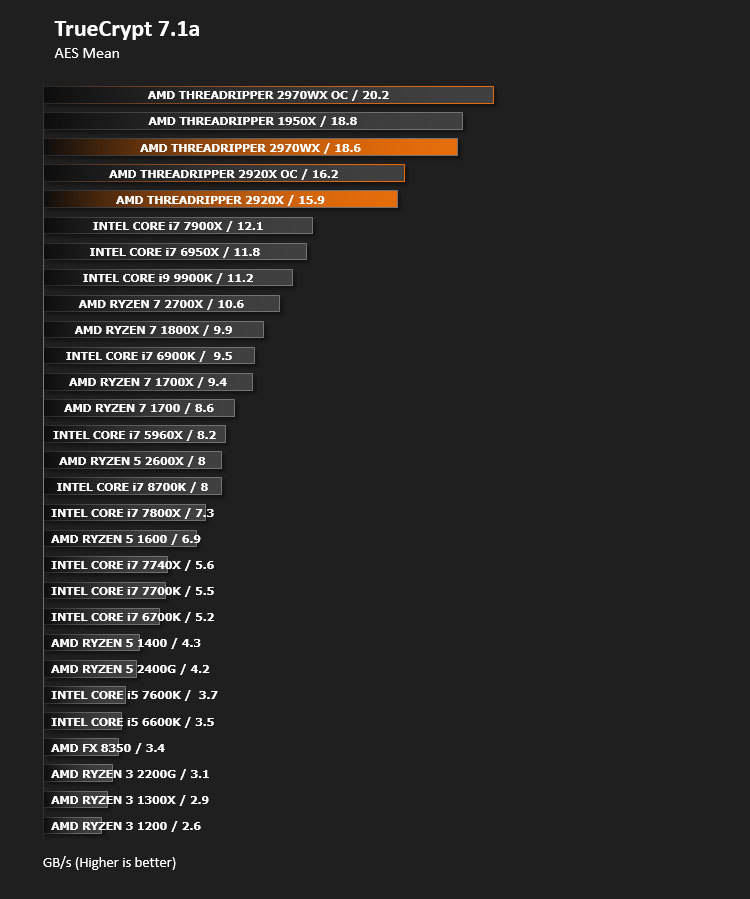
AES Encryption Performance – TrueCrypt 7.1a
TrueCrypt is a discontinued source-available freeware utility used for on-the-fly encryption (OTFE). It can create a virtual encrypted disk within a file or encrypt a partition or (under Microsoft Windows except Windows 8 with GPT) the entire storage device (pre-boot authentication).
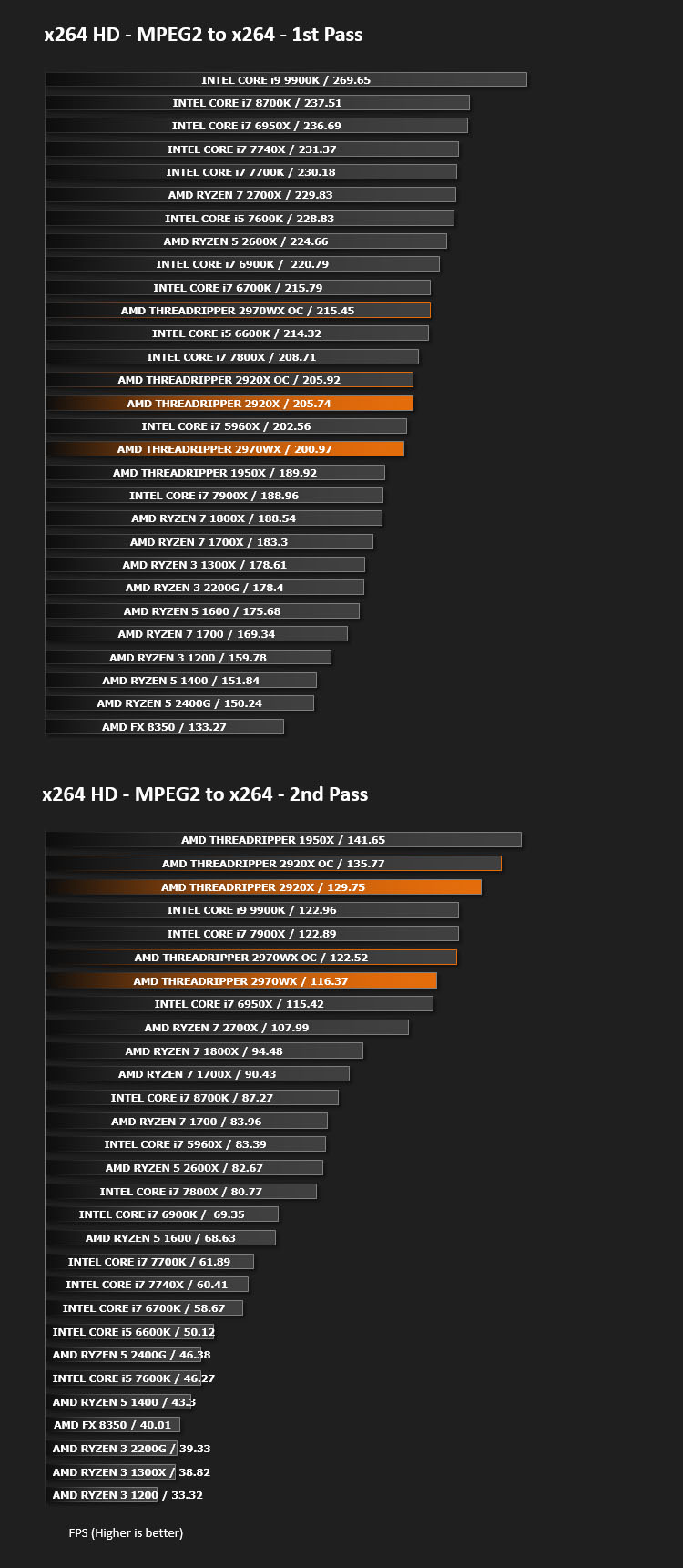
Encoding Performance – X264 HD
Simply put, this test measures how fast your machine can encode a short, DVD quality MPEG-2 video clip into a high-quality x264 video clip. What’s x264, you ask? It’s more or less the next-generation Xvid/DivX codec. I think it’s ideal for a benchmark because the application (x264.exe) reports fairly accurate compression results (in frames per second) for each pass of the video encoding process, and it uses multi-core processors very efficiently.
x264 HD gives results for 2 passes when compressing an MPEG-2 clip into x264. It presents 4 separate results for each pass giving a total of 8 – all results are given in FPS. For each pass I have averaged out the results.
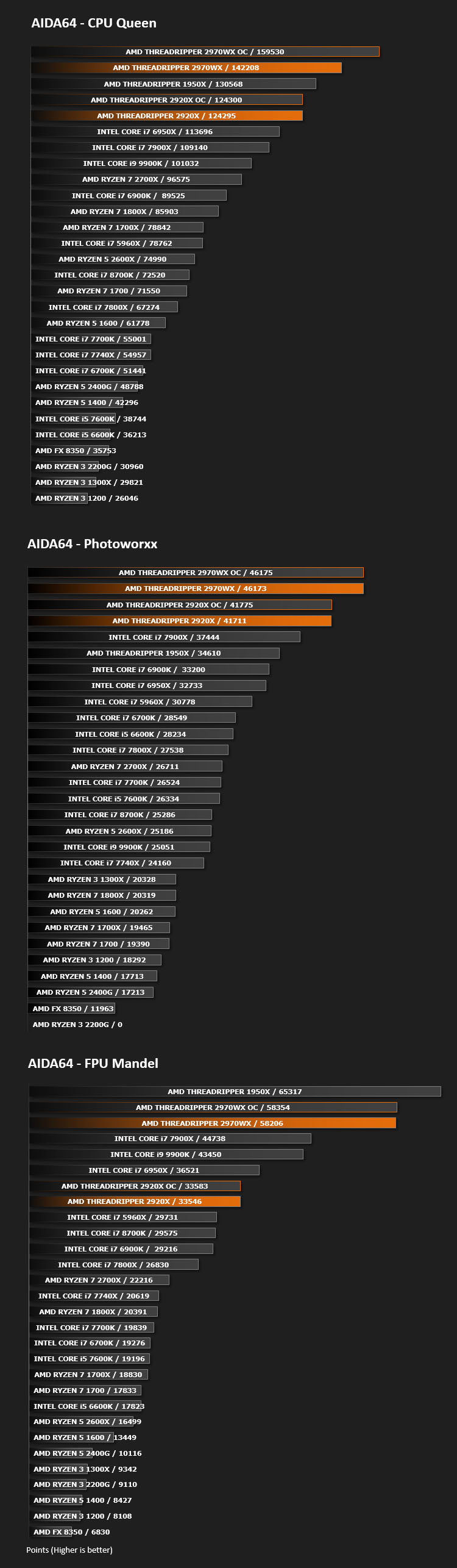
Processing Features Performance – AIDA64
AIDA64 Product Page
This simple integer benchmark focuses on the branch prediction capabilities and the misprediction penalties of the CPU. It finds the solutions for the classic “Queens problem” on a 10 by 10 sized chessboard. At the same clock speed theoretically the processor with the shorter pipeline and smaller misprediction penalties will attain higher benchmark scores. For example — with HyperThreading disabled — the Intel Northwood core processors get higher scores than the Intel Prescott core based ones due to the 20-step vs 31-step long pipeline. CPU Queen test uses integer MMX, SSE2 and SSSE3 optimizations.
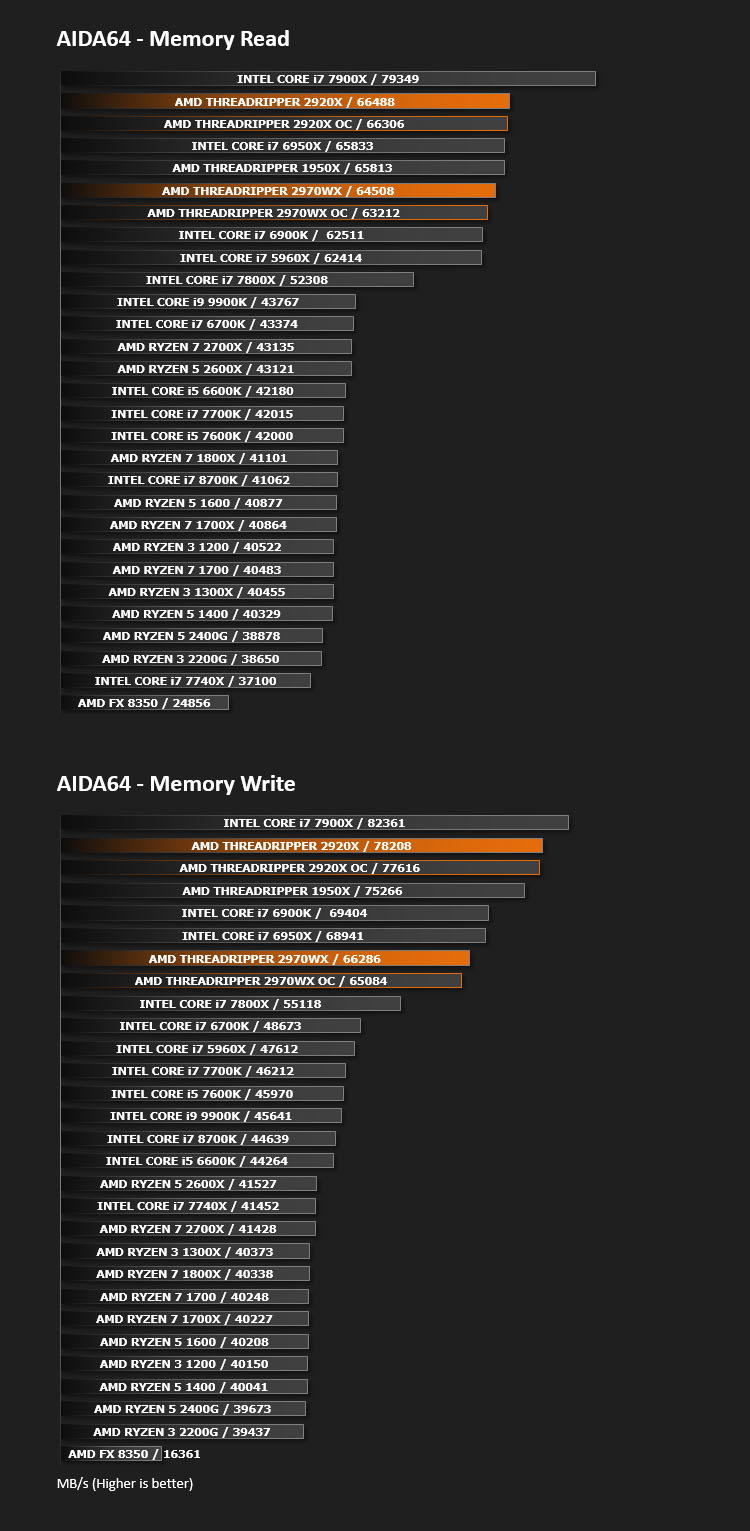
Memory Transfer Performance – AIDA64
AIDA64 Product Page
This simple integer benchmark focuses on the branch prediction capabilities and the misprediction penalties of the CPU. It finds the solutions for the classic “Queens problem” on a 10 by 10 sized chessboard. At the same clock speed theoretically the processor with the shorter pipeline and smaller misprediction penalties will attain higher benchmark scores. For example — with HyperThreading disabled — the Intel Northwood core processors get higher scores than the Intel Prescott core based ones due to the 20-step vs 31-step long pipeline. CPU Queen test uses integer MMX, SSE2 and SSSE3 optimizations.
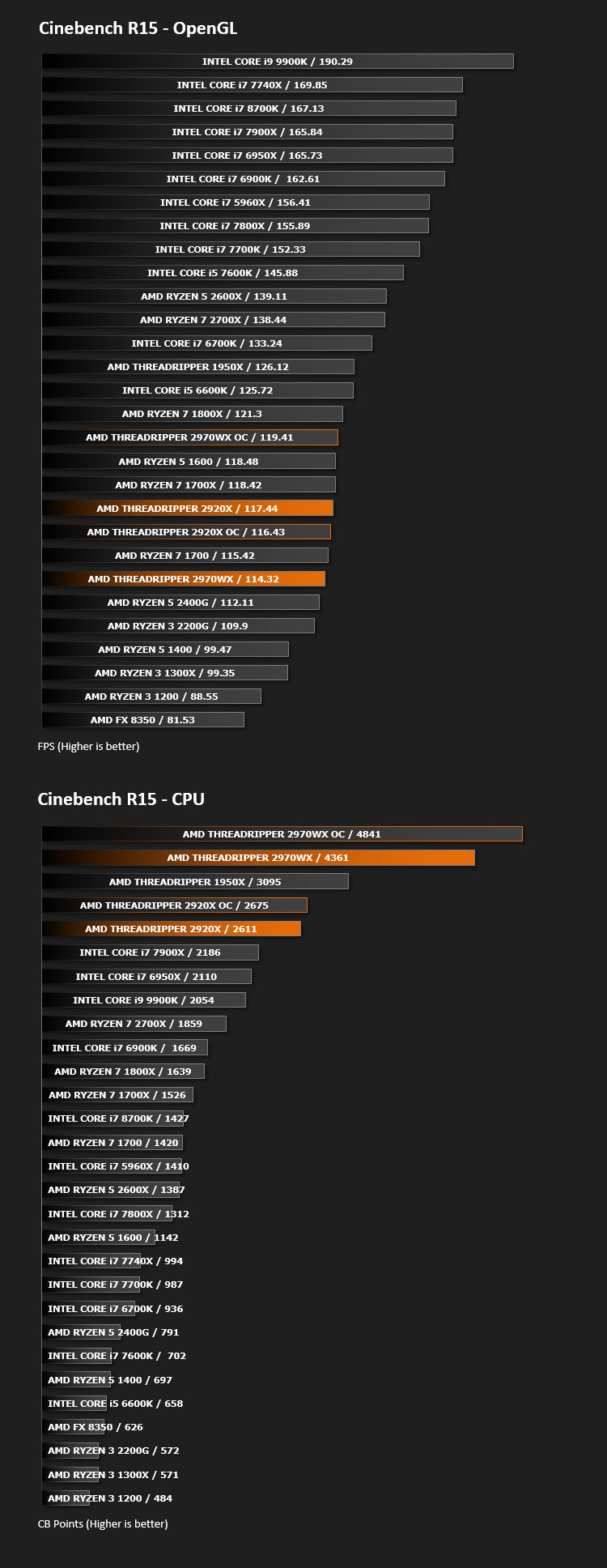
Processing Power Performance – Cinebench R15
CINEBENCH can measure systems with up to 64 processor threads. This test scene contains approximately 2,000 objects which in turn contain more than 300,000 polygons in total, and uses sharp and blurred reflections, area lights, shadows, procedural shaders, antialiasing, and much more. The result is displayed in points (pts). The higher the number, the faster your processor.
Bandwidth Performance – SiSoftware SANDRA
SANDRA isn’t always a benchmark that is included in hardware reviews but I believe it shouldn’t be ignored. SANDRA provides a vigorous package that tests your system in a rather large array of benchmarks. There are many aspects of benchmark that can be executed. We will be considering – CPU and memory tests.

Image Editing Performance – PCMark 8 Photoshop
PCMark 8 Product Page
Developed in partnership with Benchmark Development Program members Acer, AMD, Condusiv Technologies, Dell, HGST, HP, Intel, Microsoft, NVIDIA, Samsung, SanDisk, Seagate and Western Digital, PCMark 8 is the latest version in FutureMark’s popular series of PC benchmarking tools. Improving on previous releases, PCMark 8 includes new tests using popular applications from Adobe and Microsoft.

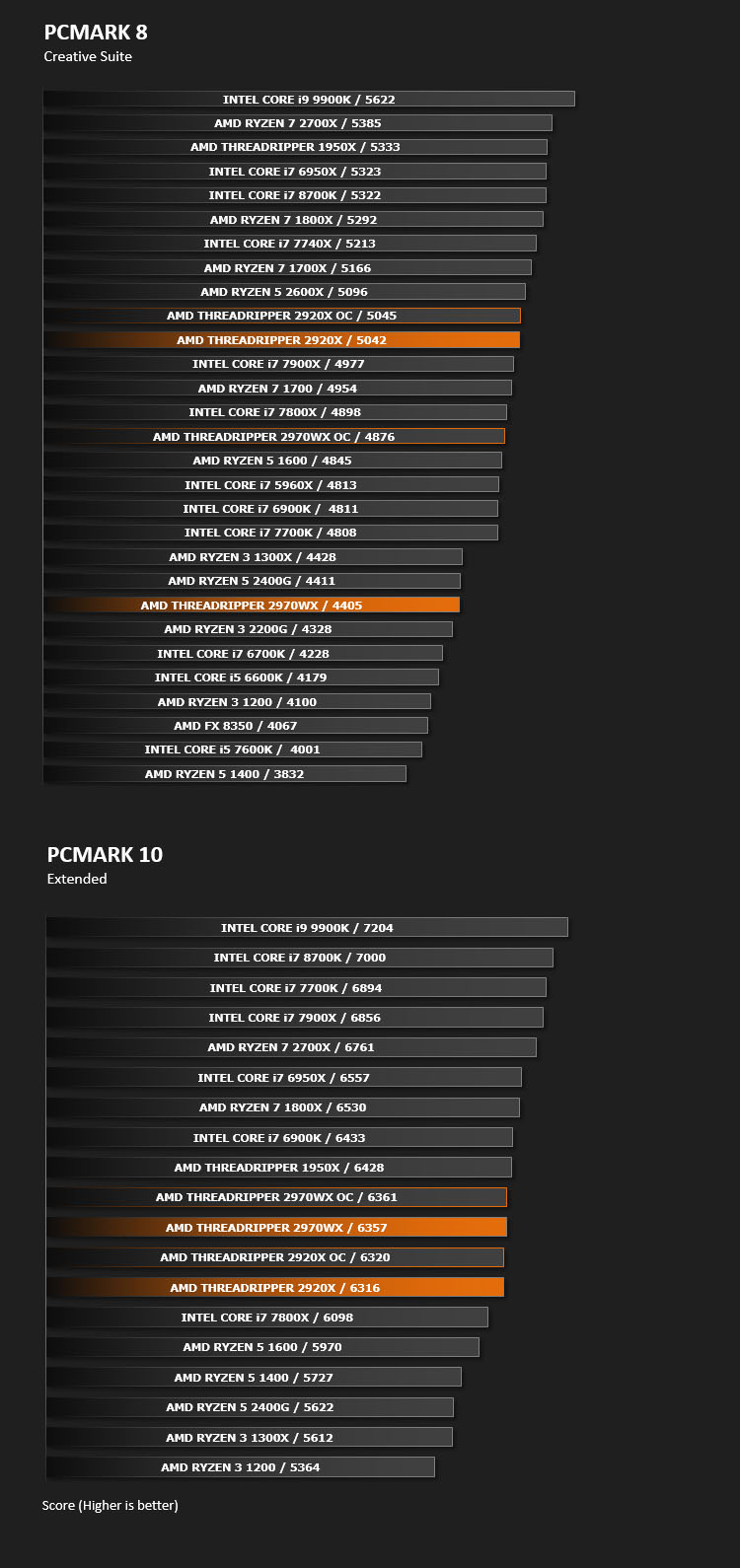
Overall System Performance – PCMark 8
PCMark 8 Product Page
Developed in partnership with Benchmark Development Program members Acer, AMD, Condusiv Technologies, Dell, HGST, HP, Intel, Microsoft, NVIDIA, Samsung, SanDisk, Seagate and Western Digital, PCMark 8 is the latest version in FutureMark’s popular series of PC benchmarking tools. Improving on previous releases, PCMark 8 includes new tests using popular applications from Adobe and Microsoft.
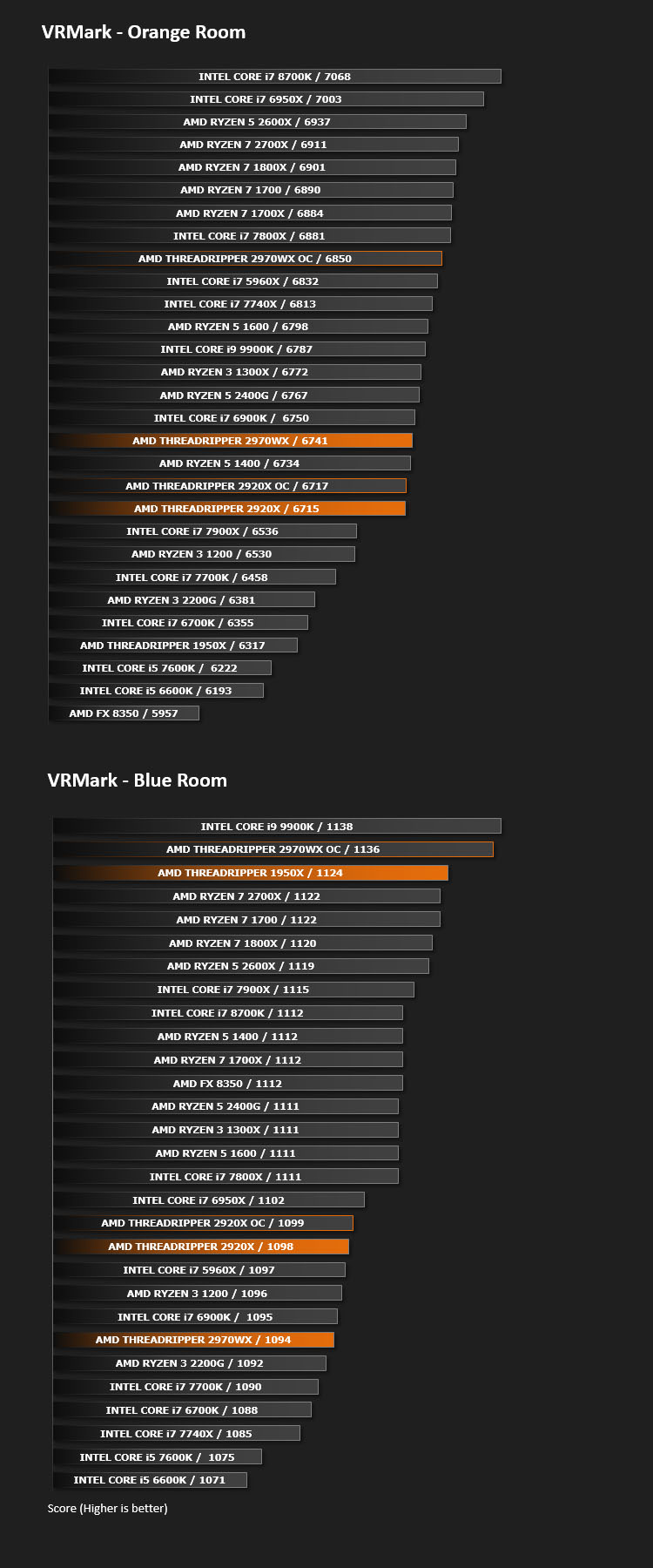
VR Performance – VRMark
VRMark Product Page
VRMark includes two VR benchmark tests that run on your monitor, no headset required, or on a connected HMD. At the end of each test, you’ll see whether your PC is VR ready, and if not, how far it falls short.
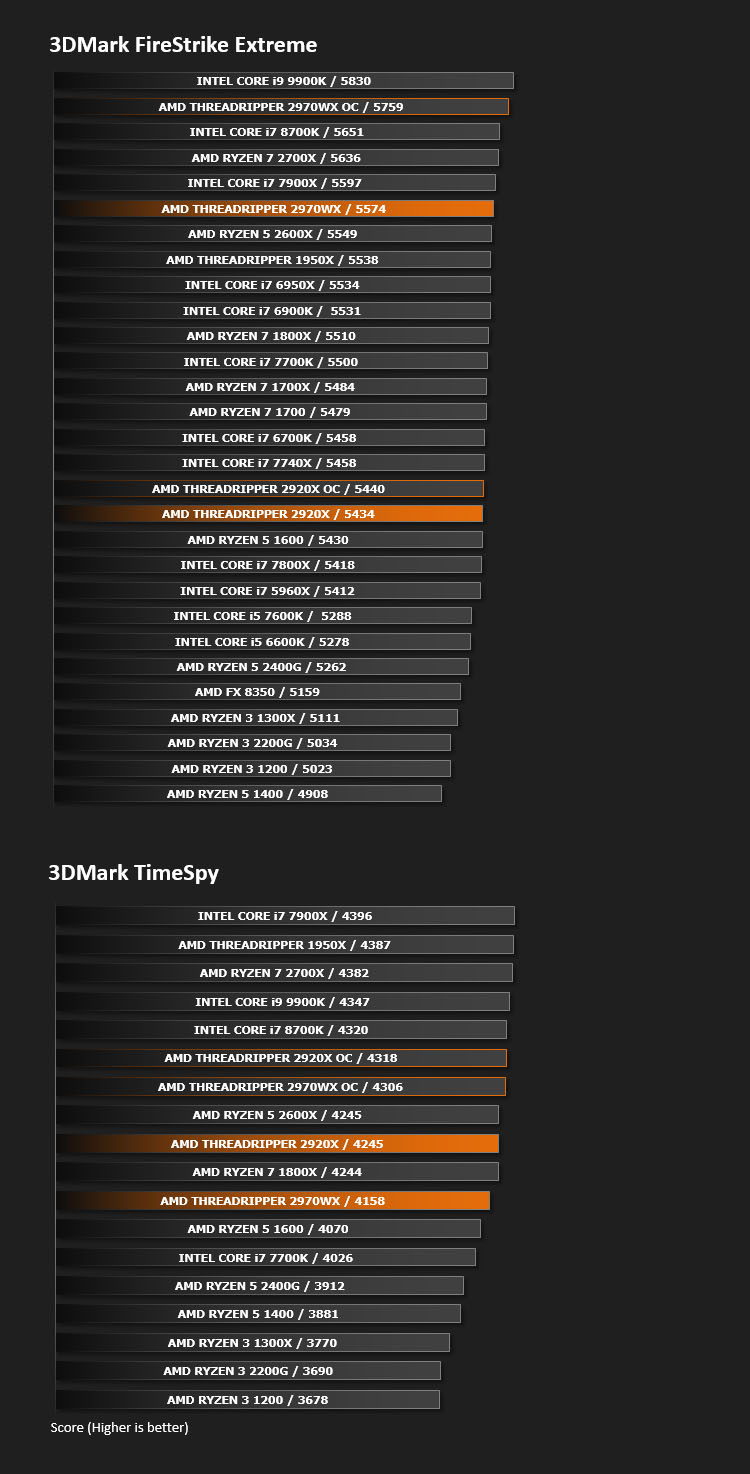
3D Performance – 3DMARK FireStrike
3DMark FireStrike Product Page
Fire Strike is our new showcase DirectX 11 benchmark designed for high-performance gaming PCs. It is our most ambitious and technical benchmark ever, featuring real-time graphics rendered with detail and complexity far beyond what is found in other benchmarks and games today. Fire Strike will only be available in the Windows editions of 3DMark initially.
Haswell handles FireStrike well but the gulf between the CPUs in the graphics test in particular shows little difference whilst the overall score gives marginal gains over previous generations.
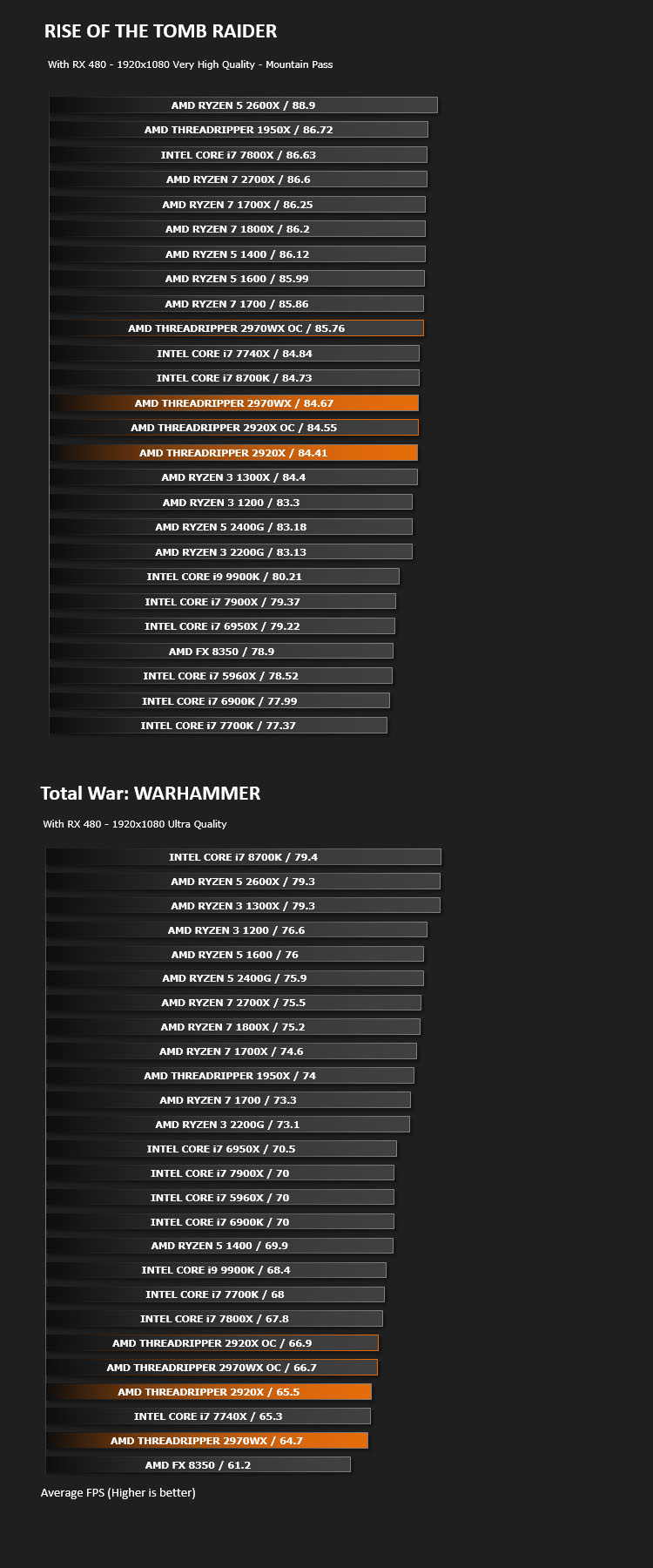
Gaming Performance – Tomb Raider & Total War: WARHAMMER
It’s important for us to perform a number of game benchmarks as well as the synthetic tests because gamers will want to know if there are any significant benefits. So here we have two recent gaming titles benchmarked with a Radeon RX 480 installed.
Conclusion
The more we ruminate on the Threadripper project, the more impressed we become with what AMD have achieved. Taking the basic building blocks of the desktop Ryzen and scaling it up to a HEDT platform that rivals workstation performance and features is astounding, and deserves credit for that alone. But how about these two specific examples of the refreshed range?
Comparing these two models – the Threadripper 2970WX and 2920X – is a case study in proper part selection for your use case. In many instances performance is quite similar, notably in lightly-threaded benchmarks which aren’t particularly sensitive to clock speed, but otherwise they can wildly diverge.
Just as the choice between the two for CPU rendering is clear – those twenty-four cores are just too tempting to ignore – so gaming is more closely fought. We judge that the 2970WX is a perfectly capable processor for gaming, but performance similar to the 2920X means that the additional cores are going to waste. One exception however might be VR, if the VRMark results are anything to go by.
Mix up the workloads, or focus on a specific segment that leverages the 2970WX, and AMD’s larger Threadipper swiftly takes the lead. That’s not just versus other AMD CPUs mind you, but the entire HEDT field. Using a high core count Threadripper CPU for gaming, streaming and encoding simultaneously is very much the sort of use case we have in mind for the 2970WX, but it’s the flexibility and enormous headroom that will probably be its biggest selling-point.
It’s not all positive however. Total system power draw is high under load, particularly for the 2970WX, and while temperatures are well under control with our Noctua NH-U12S TR4 (an air cooler specifically designed for Threadripper CPUs) both factors may mandate a particularly robust PSU and cooling solution (the latter of which would ideally support Socket TR4 natively). That should be expected to a certain extent as the 24-core system is effectively running four Ryzen 2600X CPUs at one.
While we’re pleased that 2nd Generation Threadripper retains a great all-core overclocking capability, the results achieved often didn’t measure up to the scale to which frequency was raised. Performance Boost 2 is the culprit here; the smart feature intelligently boosts all-core frequencies by default without needing to get your hands dirty in the BIOS. You can squeeze a little more performance from the CPU in some cases by overclocking (although that trend is reversed in one or two instances where max single/dual core boost is higher than our configured all-core overclock), but so good is the feature that you might as well leave it to defaults unless you’re a true enthusiast.
By the same token, if you’re open to overclocking 1st Generation Threadripper remains a compelling alternative until your demands exceed the 16-core limitation. Transitioning to 12nm has clearly been a benefit to the platform, but the next major technological step isn’t with us just yet and so benefits are marginal. Certainly upgrading a current Threadripper system to the second generation, but at the same core count, isn’t a recommendation.
We should also mention that an effective retiring of the 8-core Threadripper model means that there’s now clear water between the mainstream Ryzen and Ryzen Threadripper in terms of multi-core capability and platform price, a state of affairs that we welcome. Muddying the picture with a sub-standard entry level to the HEDT platform does no one any favours, least of all consumers.
And finally, hats off to AMD for viewing their own platform through a critical lens. Dynamic Local Mode is an example of a technology developed by a team that knows their platform has more to offer, isn’t ashamed of overcoming weaknesses, and pushing the performance fix out to every affected consumer.
So to sum up, AMD’s Threadripper remains a platform to be reckoned with into its second generation. More cores, and more cores per dollar/pound spent, will have enthusiasts and ‘prosumer’ content creators queuing up for the 24-core 2970WX at a very reasonable £1160. Meanwhile the 2920X is an excellent entry level point that balances the needs of gamers and content creators on a tighter budget looking for a little more heft. And even as their competition seeks to respond with higher core count CPUs of their own, AMD stand aloft in unrivaled multi-core performance for the High End Desktop segment.
Pros
+ Premium packaging
+ Able to cope with big workloads
+ Ideal for intense content creation
+ Significant improvements made since 1st Gen.
+ A better value option over Intel HEDT
+ Easy to overclock
Cons
– TR4 specific coolers required
– Big on power consumption
+ Premium packaging
+ Able to cope with big workloads
+ Ideal for intense content creation
+ Significant improvements made since 1st Gen.
+ A better value option over Intel HEDT
+ Easy to overclock
Cons
– TR4 specific coolers required
– Big on power consumption
Click here for an explanation of our awards at Vortez.net.
Stay connected with the Vortez Social Media pages:
Join in with the discussions on Discord