







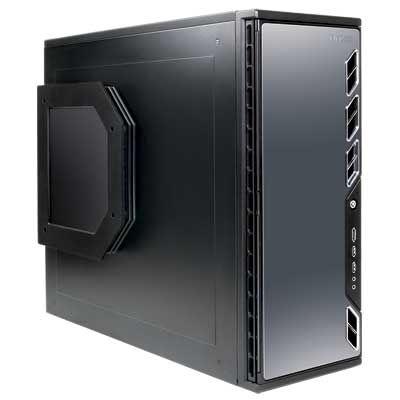
Up today we have Antec’s flagship enclosure from their ‘Performance One’ series – the P193 Advanced Mid Tower Case.
Antec are a well known and highly regarded silent performance case, cooling and PSU company. Having owned the original P180 i have very high hopes for the ‘Performance One’ ranges new flagship case the incredibly imposing P193 Advanced Mid Tower Case.
First up – a little info from the company itself…

Antec, Inc. is the global leader in high-performance computer components and accessories for the gaming, PC upgrade and Do-It-Yourself markets. Founded in 1986, Antec is recognized as a pioneer in the industry and has maintained its position as a worldwide market leader and international provider of quiet, efficient and innovative products. Antec has also achieved great success in the distribution channel, meeting the demands of quality-conscious system builders, VARs and integrators.
Antec’s offering of enclosures includes a wide range of cases, such as its advanced Performance One Series, economical New Solution Series and VERIS family of media components designed for the home theater PC market. Antec’s products also include front line power supplies, such as its premium Signature Series, powerful TruePower Quattro Series and EarthWatts, one of the most environmentally friendly power supplies available. PC gamers are an increasingly significant consumer of performance components, and many Antec products are designed for the gaming demographic, like the premier gamer enclosure: the Nine Hundred. Antec also offers a line of computer accessories comprising many original products, including its patented LED fans and notebook cooling solutions.
Antec is headquartered in Fremont, California, with additional offices in Rotterdam, The Netherlands, as well as in the UK, Germany, France, Spain, Italy, China and Taiwan. The company’s products are sold in more than 40 countries throughout the world. Please visit www.antec.com for more information.
Specifications:
Certification:
– ROHS Complient
– Antec Quality 3 Year Warranty
Features:
Dual chamber design isolates heat and noise:
the power supply resides in a separate chamber to isolate heat and reduce system noise
No power supply included
Power supply option:
comes with a power supply mounting adapter to mount either a standard size power supply or Antec’s exclusive CP Series power supply
Innovative two-layer, sound-deadening side panels (steel, polycarbonate) and three-layer front door (aluminium, plastic, aluminium) dampen noise and ensure Quiet Computing™
11 drive bays
– External 4 x 5.25″; 1 x 3.5″
– Internal 6 x 3.5″ for HDD
Cooling system:
– 1 rear (standard) 120mm x 25mm exhaust TriCool™ fan
– 2 top (standard) 140mm x 25mm exhaust TriCool™ fan
– 1 lower front chamber (optional) 120mm fan for HDD
– 1 side (standard) 200mm fan for dual graphics cards
– 1 upper front (optional) 120mm fan for HDD
– 1 middle (optional) 120mm fan for graphic cards
Cable organizers behind motherboard tray minimize cable clutter
Front-mounted ports provide convenient connections:
– 2 x USB 2.0
– 1 x eSATA
– Audio In and Out (HDA and AC 97 compatible)
Double hinged door opens up to 270°
7 expansion slots
0.8mm cold rolled steel chassis for durability
Compatible Motherboards: Mini-ITX, microATX, Standard ATX and Extended ATX
Net weight: 35.8 lbs / 16.25 kg
Gross weigh: 41.7 lbs / 18.9 kg
Case dimensions:
– 20.25″ (H) x 8.1″ (W) x 23.25″ (D)
– Actual clearance needed for width is 9.5″ due to the side panel fan
– 51.4 cm (H) x 20.5 cm (W) x 59 cm (D)
Package dimensions:
– 13.25″ (H) x 25.8″ (W) x 28.75″ (D)
– 33.7 cm (H) x 65.5 cm (W) x 73 cm (D)
What’s new in the P193:
– Front door vents, as well as wider vents along the door frame, improve airflow into the chassis.
– Filters and filter doors are integrated as one unit. The doors themselves have been modified to provide greater airflow, resulting in cooler system temperatures.
– Drive bay covers are vented and include air filters to provide better airflow.
– Lower chamber fan is now located in front of the hard drive cage, allowing for installation of longer PSUs as well as easier cable routing between the lower HD cage and the power supply.
– The Big Boy 200™, a 200mm fan, is moved outward to give more clearance for taller heatsinks. Externally removable washable air filter allows for easier maintenance.
Exterior:
As far as computer cases go I can safely say that the P193 arrived in the largest packaging box i have ever seen. The overall design is very attractive showing a front and 3/4 view of the case within. Each end of the case contains the technical specs of the case in a selection of different languages.


Once opened i was greeted by the monolith that is the P193 cradled within its foam supports. The case itself was completely surrounded by a plastic bag and a basic instruction sheet, cable guide and certificate for Antec’s Quality 3 Year Warranty were contained in a zip bag.


It’s nice to see that the case is so well packed as something this large (and heavy) could be easily damaged in transit.
When i’d defoamed and debagged all that was left to remove was a large plastic protective sheet on the P193’s door.


Considering the P193’s door first i can see that it is very similar to my old P180. It opens 270 degrees to sit neatly against the side panel which is very useful since most tend to flap around in the way. The front panel section that is visible regardless of an open or closed door contains headphone and mic plugs, a couple of USB sockets, an ESATA connection (an addition over the original P180) and the door lock.

Behind the door we see four 5.25″ bays and a single 3.5″ bay straddled by two 120mm intake holes. All of these installation points and the fan intakes are fully filtered by the blanking plates so any incoming air doesn’t instantly fill the case with dust. A very useful feature and (as far as the drive bays are concerned) an improvement over the P180’s original design. The drives themselves are installed using Antec’s rail system which allows the system builder to simply slide the drive into the bay where it clicks into place. Removal is just as easy too!


Exterior continued:
Moving round to the side of the case you can’t help but notice the imposing view of Antec’s ‘Big Boy 200mm’ fan cover. It contains the fan itself along with a removable filter to aid cleaning. It’s position (essentially hanging outside the case) allows for the larger heatsinks we see today. A clever move since i have seen similar competitor designs with side fans mounted internally – although they allow for a sleeker case profile they do restrict internal space limiting hardware choice somewhat.


Around the back we see a fairly standard Antec ‘Performance One’ style layout including the speed controlled Antec tri-cool 120mm fan.

Compared to my P180 the inclusion of external fan control speed switches is excellent and makes tailoring airflow to noise a much simpler prospect. Watercooling installers will also welcome the tube outlets too – a feature sorely lacking in the original P180. The most interesting point to focus on is the PSU mount hole. This case has been designed with the intention of accepting Antec’s new CP PSU’s which are a larger form factor than standard ATX PSU’s. Although there’s no guarantee this standard will be adopted by other manufacturers just yet it’s nice to see it there none the less… just in case.


Up top we see another ‘Performance One’ addition – the top mounted fan – this time multiplied by two and increased in size. These dual 140mm tri-cool fans should provide very impressive exhaust airflow which should result in good temps.


Taking a look at the base of the case (not very interesting i’ll agree!) you can see the P193’s feet – yes they might not be the most glamorous or technically interesting aspect but i think the fact that Antec chose to use ultra soft silicone feet is a really nice touch. It should stop the case transferring any noisy vibrations to the desk or floor it is placed on.

Lastly i can comment on the constriction and quality of the outer skin of the P193. Of course the actual construction of the panels is listed in the technical details earlier in the review but what wasn’t listed was that the P193’s side panels do not use plastic mounts. The panels are much heavier and more robust than the old P180’s so i assume they need a little more support – hence the choice of metal. My concern with the old P180 was that the plastic clips would fail over repeated use but the P193 panels are built like a tank. I’m sure i could open the case up a few times a day over a good few weeks and it would be absolutely fine. Thumbscrews are used here too so yet another thumbs up from me. Very impressive indeed!
Interior:
Internally (once the parts box is removed) the layout is very familiar indeed – it’s just the scale that’s changed! The P193 will take motherboards ranging from the tiny ITX form factor all the way up to Extended ATX so all you skulltrail users out there can rest assured this case will accommodate it.


All the edges in the case are rounded so the chances of cuts and scrapes are greatly reduced. It should be a pleasure to work in since a great deal of my time is usually spent worrying about snagging wires, scratching components and cutting myself during installs and repairs. There are also strips of foam to stop the doors rattling against the case.

The P193 uses the standard Performance One Dual chamber design which separates the PSU and four HDD’s in the lower chamber from the upper main compartment containing the motherboard, graphics, optical drives and space for two more HDD’s. Below is an image of the case with both cages removed.

The HDD cages use an identical mounting mechanism to the older P180 design. Thumbscrews hold the unit in place and once removed allow the cage to slide out for the installation of the drives. The upper cage can hold two drives in a set of mini slide in trays containing silicone mounts to isolate the drive from the case. The lower cage can accommodate four drives – due to the greater concentration of drives in this lower cage it does not have space for the slide in tray system in the upper cage. It instead uses the same silicone mounts to install the drives directly to the cage.


Another nice feature carried forward from the P180 is the inclusion of a parts compartment on the rear of the upper cage. This is a handy space to keep essential additional screws, standoffs, spare silicone mounts and fan mounts safe and close at hand. Very tidy.

In front of the cages there are 120mm brackets to allow the installation of additional fans – indeed, one updated feature not present in the P180 is the ability to install a fan on the rear of the HDD cage. For example if you were able to install your HDD’s in the lower chamber you could install a 120mm fan at the rear of the upper HDD cage which would blow cool air over installed GPU’s, audio or any other expansion cards… nice!

So far so good – the P193 has addressed both performance cooling needs and silence. But what about ease of use. I’ve already mentioned the thumbscrews which certainly help a lot… and i’ve also commented on the ability to slide optical drives and HDD’s in and out with ease. These are of course major plus points but assuming you do put a high end system in with a couple of GPU’s, a variety of HDDs and optical drives… what about all those cables!

The P193 has that base covered too – a combination of shuttered passages between the chambers and cable routes behind the motherboard tray (with cable ties set up and ready to go) means that you can be quite confident even the most involved install won’t turn into spaghetti junction.

The remaining parts supplied in the parts box consist of screws, all the rails you’ll ever need, the fan mounts and a clever VGA support for additional security when mounting large high performance VGA cards.

To be honest, i’m itching to try an install just to see how easy it is.
Installation:
First up i tried the optical drive- it’s a simple matter of screwing two of the supplied brackets to the side of the drive. Once secure you simply slide it into place until it ‘clicks’ home – it’s that easy.

Unfortunately i didn’t have a 3.5″ drive to install but the installation method is ultimately identical to the optical drive above so i’d imagine it would be just as wonderfully straight forward.
Next up (and seriously ahead of schedule) is the HDD. Depending on which cage you choose the installation differs very slightly. For the upper tray you remove your choice of the two slide in trays and use the strange broad headed philips screws – you screw through the silicone mounts holes and secure it to the HDD. Once done simply slide the tray into the cage until it ‘clicks’ then slide the cage into the case and secure with the thumb screw. For the lower tray you simply secure the HDD directly to the cage using the same broad headed philips screws screwed through the silicone mounts. Once you’ve installed all the drives you want slide the cage into the lower section of the case and once again secure it with the thumbscrew.


The ATX motherboard install was very straightforward, which is something i don’t normally say. The additional space provided by the E-ATX form factor of the case meant that there was simply acres of room available for the board. Also, this space combined with the rounded case edges i mentioned earlier meant i didn’t snag, scratch, cut or scrape anything!

Last but not least came the power supply install. It was fairly straightforward too. Antec have given you the option to mount it either upside down or upright. This is useful as one orientation may allow better airflow to the PSU and/or better cable management. In fact, if i hadn’t been able to rotate the Tagan PSU i installed the main 24pin ATX power cable could not have taken the tidy (behind the motherboard tray) route Antec had intended. The only issue i had regarded the length of the captive 4pin Molex and 8pin 12v supply cables for the motherboard – i simply could not route them any other way. It’s not the P193’s fault but it is an issue that could arise with a design such as this since most PSU’s seem to be designed assuming they will sit above the motherboard and not below it.

As you can see the final install is pretty tidy – what surprised me was that i didn’t really have to try. The P193 almost forced my hand regarding cable routing even providing cable straps to secure any flapping wiring. Due to this ease of install i also found the process very quick – i think the full install took around 15 minutes.


Testing and conclusion:
Test setup:Processor: Intel e6600 @ 3GHz
Motherboard: Intel Badaxe II P975
CPU Cooler: Thermalright XP90-C
Optical Drive: NEC Optiarc DVDRW
Graphics: Inno3D 7800GT 256MB PCI-e
Hard Disk: Samsung Spinpoint 320GB
PSU: Tagan Piperock BZ 900W PSU
I left the PC to idle until the temperature stabilised (usually 10-15 minutes) and then took a reading. Load temperatures were generated using OCCT\\\’s CPU stress test which loaded the CPU until the temperature plateaued.
Results:
As you can see the P193 offered improved temperatures regardless of fanspeed – an impressive result.
Sound:
In operation the P193 was an almost silent operator – at full pelt the fans did become a little intrusive but since the cooling performance of the fans at their medium and low settings was so good high will probably never be needed.
Conclusion:
The P193 has impressed me greatly and priced at around £130 represents a considerably competitive product. It happily competes with every similarly priced competitor at all levels – indeed when it comes to silent performance enclosures the P193 is a very hard act to follow.
Add to this the fact that \\\’in my honest opinion\\\’ all the weaknesses that the original P180 possessed have been addressed and improved in the P193. It\\\’s spacious, quiet, hard waring, well made and easy to use.
So, if you\\\’re in the market for an exceptional enclosure to contain a high end system quietly then i would honestly say that you should start right here! The Antec P193 is a great case.
Vortez Hardware would like to thank Antec for supplying the P193 for review. Discuss this review at our forum.
