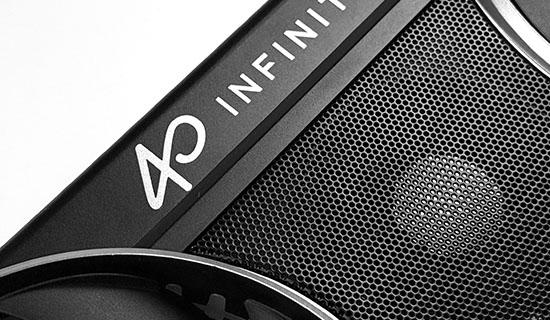

Featuring the WINDFORCE HYPERBURST cooling system, the new RTX 5070 Ti INFINITY might just be one of the most unique models on the market.

Product on Review: RTX 5070 Ti INFINITY
Manufacturer: GIGABYTE
Street Price: USD 1350 | GBP 1100 | AUD 2250
The RTX 5070 Ti has established itself as an interesting option for those looking to step up into high-end 1440p gaming, while still having enough grunt to tackle 4K. As the market has become increasingly crowded with custom graphics card designs, manufacturers have had to find new ways of making their models stand out. Enter AORUS with the RTX 5070 Ti INFINITY, a rather distinctive take on NVIDIA’s GPU that certainly looks like it has come from somewhere in the future.
AORUS has given the INFINITY a very distinctive visual identity, combining a dark colour scheme with angular shapes, flowing contours and a series of layered surfaces across the cooler. The overall design is intended to give the card a futuristic, almost mechanical appearance, while the INFINITY branding hints at something a little more ambitious than your average RTX 5070 Ti. It is certainly an interesting proposition for anyone who wants their graphics card to make a statement rather than simply disappear inside a case.

Of course, the design isn’t just about aesthetics. At the heart of the INFINITY is a substantial cooling solution, built around a triple-fan arrangement and AORUS’ unusual double flow-through cooler design. The card also features a factory overclock, RGB lighting and the sort of substantial heatsink you’d expect from a graphics card designed to keep a high-performance GPU running cool under load. On paper, at least, AORUS appears to have thrown plenty at the INFINITY to differentiate it from the growing number of RTX 5070 Ti models available.
But how does all of this translate into real-world performance? To find out, we have put the AORUS RTX 5070 Ti INFINITY through our usual testing suite, comparing it against a selection of other graphics cards across a range of games. Alongside the written review, we have also produced a video review taking a closer look at the INFINITY, including its design, features, cooling solution and gaming performance.
Technical Specifications
Graphics Processing
RTX 5070 Ti (GB203)
GPU clock
2670 MHz
Stream Processors
4096
Memory Clock
28 Gbps
Memory Size
16GB
Memory Type
GDDR7
Memory Bus
256 bit
Card Bus
PCI-E 5.0
Card size
L=330 W=145 H=65 mm
Recommended PSU
750W
Power Connectors
12-pin
Output
DisplayPort 2.1a *2
HDMI 2.1b *2
Accessories
Quick guide
Warranty registration
1x 12V-2×6 to 3x PCIe 8pin adapter
AORUS metal sticker
VGA holder Kit
Magnetic backplate cover
Closer Look Video Review
For this review we’ve also created a YouTube video which highlights all of the key features. Watch AORUS RTX 5070 Ti INFINITY or click below:
Test Setup & Methodology
HOW WE TEST GRAPHICS CARDS
Testing a graphics card is an extremely lengthy process. We sometimes see reviews where a graphics card has been tested using out of date equipment, out of date games and even out of date drivers. While the latter can be excused due to the sheer amount of driver updates making a thorough review impossible we will however notify the reader when we have used a different driver to the normal for example a pre-release driver. For the most part however we will always use the same hardware and latest drivers so this does certainly need to be taken into consideration when viewing our testing results. Each game and benchmark is tested times with the lowest and highest scores omitted out of the 5 results and the average then taken from the three remaining to give us our final result for each resolution and setting used.HARDWARE
In Q1 2025 we decided to upgrade our test system to the very latest AMD X870E platform with the renowned AMD Ryzen 7 9800X3D – currently regarded as one of the best gaming CPUs to date. AMD’s platform is one of the most popular choices for gamers and by using such a configuration, we can hopefully showcase to our readership what they can expect.This new platform provides us with the very latest technology and standards to be able to accurately report back on performance of modern graphics cards.
Graphics Cards on test:
MSI VENTUS 2X OC RTX 4060 TI
ASUS PRIME RTX 4070 SUPER
INNO3D RTX 4080 SUPER X3
PNY RTX 4090 XLR8 VERTO EPIC-X
ASUS PRIME RTX 5060 OC
GIGABYTE RTX 5070 TI EAGLE OC ICE
AORUS RTX 5070 Ti INFINITY
GIGABYTE RTX 5080 GAMING OC
GIGABYTE RTX 5080 AERO OC SFF
AORUS RTX 5090 MASTER
GIGABYTE RX 7700 XT GAMING OC
POWERCOLOR RED DEVIL RX 7800 XT
POWERCOLOR HELLHOUND RX 7900 GRE
XFX MERC 310 RX 7900 XTX
POWERCOLOR REAPER RX 9060 XT
POWERCOLOR HELLHOUND RX 9070
AORUS RX 9070 XT Elite
Special thanks go to MSI and Corsair for providing the hardware configuration for our graphics card reviews:
Motherboard: MSI X870E CARBON WIFI
CPU: AMD Ryzen 7 9800X3D
RAM – 32GB HyperX FURY Renegade 7600MHz
Power Supply – Corsair RM1000X
Hard Drive – Samsung 990 PRO
Cooler – Corsair iCue Link Titan 360 RX LCD
CPU: AMD Ryzen 7 9800X3D
RAM – 32GB HyperX FURY Renegade 7600MHz
Power Supply – Corsair RM1000X
Hard Drive – Samsung 990 PRO
Cooler – Corsair iCue Link Titan 360 RX LCD
BENCHMARKS
If you are a regular reader of our reviews you will know we like to test the latest hardware with the latest games and benchmarks on the market. Here are the games we’ve chosen:S.T.A.L.K.E.R. 2
Indiana Jones and the Great Circle
Black Myth: Wukong
Silent Hill 2 Remake
TEKKEN 8
Horizon Forbidden West
Indiana Jones and the Great Circle
Black Myth: Wukong
Silent Hill 2 Remake
TEKKEN 8
Horizon Forbidden West
To capture framerates we use CapFrameX.
Other benchmark tools have been included to give a broad overview of performance and these include:
PugetBench for Davinci Resolve
ProCyon AI Image Generation
ProCyon Video Editing
3DMark SpeedWay
3DMark Nomad
Let’s see how today’s graphics card performed…
Power, Temperatures, Acoustics
To test for power consumption, we take a measurement from the plug socket. It is important to note that the figures below represent total system power use and not just the GPU. The CPU was always in a fixed state so did not affect the additional power load when the GPU was placed under 100% load using AIDA64 stability test (GPU Only) which was ran for 20 minutes at which point a load reading was taken. Idle readings were taken 5 minutes after system boot to ensure any background services and applications had loaded.
TEMPERATURE
To test temperatures we measured idle temperatures after booting windows, letting all applications finish loading and ran a few benchmarks. Once the benchmarks were complete we left the card to reach a cooling plateau where we then took the idle temperatures. For the load tests we use GPU-Z and have this running throughout all of our benchmarks, and then report back on the maximum temperatures at the end of this exhaustive session.ACOUSTICS
For the purpose of testing audio levels we have the NDI KC-3300 sound level meter. During the temperature recording above, while in Black Myth Wukong benchmark we monitored the audio and the results are found below. All graphics cards are tested in their out of the box state (auto).PugetBench for Davinci Resolve
PugetBench for DaVinci Resolve runs on top of your installed copy of Resolve, providing benchmark data directly from the application. Our benchmarks are designed in partnership with hardware and software industry leaders, as well as end users and influencers who use DaVinci Resolve daily, to ensure that they are representative of real-world workflows.
Procyon AI Image Generation
The Procyon AI Image Generation Benchmark provides a consistent, accurate, and understandable workload for measuring the inference performance of on-device AI accelerators. This benchmark was developed in partnership with multiple key industry members to ensure it produces fair and comparable results across all supported hardware.
Procyon Video Editing Benchmark
Procyon benchmarks use real applications to test performance whenever possible. The Procyon Video Editing Benchmark uses Adobe Premiere Pro in a typical video editing workflow.3DMark Speed Way
3DMark Speed Way is a DirectX 12 Ultimate benchmark for gaming PCs running Windows 10 and 11. Speed Way’s engine is assembled to demonstrate the new features DirectX 12 Ultimate brings to raytraced gaming. Speed Way uses DirectX Raytracing tier 1.1 for real-time global illumination and real-time raytraced reflections, coupled with new DirectX 12 Ultimate performance optimizations like Mesh Shaders.
3DMark Steel Nomad
Steel Nomad uses graphics technologies just like your favorite new game titles to give you a good idea of how your system will run the latest heavy PC games without ray tracing. Succeeding the massively popular 3DMark Time Spy benchmark, Steel Nomad runs at a 4k resolution and adds new graphics technologies like volumetric skies and procedural grass.
S.T.A.L.K.E.R 2
S.T.A.L.K.E.R. 2: Heart of Chornobyl is a 2024 first-person shooter, survival horror video game developed and published by GSC Game World. It is the fourth main game released in the S.T.A.L.K.E.R. video game series, as well as the first S.T.A.L.K.E.R. game in 15 years since the release of Call of Pripyat in 2009.
Silent Hill 2 Remake
Silent Hill 2 is a 2024 survival horror game developed by Bloober Team and published by Konami Digital Entertainment. It is a remake of the 2001 video game Silent Hill 2, originally developed by Team Silent, a group within Konami Computer Entertainment Tokyo.
Indiana Jones and the Great Circle
Indiana Jones and the Great Circle is a 2024 action-adventure game developed by MachineGames and published by Bethesda Softworks. It is based on the Indiana Jones franchise and features an original narrative that draws from the film series.
Black Myth: Wukong
Black Myth: Wukong is a 2024 action role-playing game developed and published by Game Science. The game is inspired by the classical Chinese novel Journey to the West.
TEKKEN 8
Tekken 8 is a 2024 fighting game developed by Bandai Namco Studios and Arika and published by Bandai Namco Entertainment. It is the eighth main installment in the Tekken series and the first one to debut on home systems instead of arcades.
Conclusion
The AORUS RTX 5070 Ti INFINITY is certainly an interesting take on NVIDIA’s RTX 5070 Ti, and one that manages to stand out in what is becoming an increasingly crowded market. With its distinctive design, unusual cooling solution and excellent overall performance, this is far from being just another RTX 5070 Ti with a slightly different shroud. In fact, our testing puts it among the fastest RTX 5070 Ti cards we have looked at, making it an excellent option for both high-refresh-rate 1440p gaming and those wanting to make the jump into 4K.
Cooling is another area where the INFINITY performs particularly well. The substantial cooler does an excellent job of keeping temperatures under control, while also managing to do so without generating excessive noise. This is particularly important on a card of this performance level, and the INFINITY manages to strike a very good balance between thermal performance and acoustics. The RGB implementation is also a nice touch, adding some visual flair without overwhelming the overall design, and there is a good level of connectivity too, with two HDMI 2.1b outputs and two DisplayPort 2.1a connections.

Perhaps the biggest attraction, however, is the design itself. AORUS has clearly taken a different approach with the INFINITY, and the result is a graphics card that looks considerably more distinctive than the typical RTX 5070 Ti. Whether you like the futuristic, industrial styling will ultimately come down to personal preference, but there is no denying that this is a card designed to stand out. It is also worth remembering that differences in frame rates between competing RTX 5070 Ti models are generally fairly small, so factors such as cooling, acoustics and aesthetics become increasingly important when choosing between them.
The problem for the INFINITY is its price. With entry-level RTX 5070 Ti cards available for around $900 in the US, the INFINITY carries a substantial $400 premium. That puts it firmly into the more expensive end of the non-water-cooled RTX 5070 Ti market, and it means that the buyer is paying a significant amount extra for the design, cooling and overall package rather than a dramatic increase in gaming performance. The shroud itself also doesn’t quite deliver the premium feel we would expect from a card commanding such a price, with the use of plastic being a little disappointing.
Ultimately, the AORUS RTX 5070 Ti INFINITY is a very capable graphics card that gets far more right than it gets wrong. It offers excellent 1440p and 4K performance, superb cooling, quiet operation, attractive RGB lighting and a genuinely unique appearance, while also ranking among the fastest RTX 5070 Ti cards we’ve tested. The $400 premium is certainly difficult to ignore, particularly when the additional performance over cheaper models is relatively modest, but if you are looking for an RTX 5070 Ti that combines strong performance with a distinctive design and exceptional cooling, the INFINITY makes a compelling… albeit expensive proposition.
Pros
+ One of the fastest RTX 5070 Ti cards
+ Unique looking design
+ RGB lighting looks great
+ Superb cooling performance
+ Operates quietly
+ Features 2x HDMI 2.1b and 2x DP 2.1a
Cons
– Carries a $400 premium over baseline
– Shroud doesn’t feel premium
+ One of the fastest RTX 5070 Ti cards
+ Unique looking design
+ RGB lighting looks great
+ Superb cooling performance
+ Operates quietly
+ Features 2x HDMI 2.1b and 2x DP 2.1a
Cons
– Carries a $400 premium over baseline
– Shroud doesn’t feel premium
Click here for an explanation of our awards at Vortez.net.
Stay connected with the Vortez Social Media pages:
Join in with the discussions on Discord