Here we look at a mid-range offering from ASRock, facilitating your upgrade to AMD’s 3rd Generation Ryzen processors and the X570 chipset through a clever balance of features and cost-saving.

Product on Review: ASRock X570 Steel Legend
Manufacturer: ASRock
Street Price: GBP £199.49 / USD $209.99 / AUS $382.99
ASRock’s motherboard team set about rounding out their X570 offerings from the get go, with ample different options available on launch day, one of which is the ASRock X570 Steel Legend that we’ll look at in-depth today.
ASRock’s Steel Legend range has usually sat somewhere between the budget and enthusiast sectors, aiming to strike that, often difficult to find, balance between too few features and prohibitive pricing. The pricing aspect, they appear to have covered reasonably well, so we can focus on the features within the review.
The AMD X570 chipset was released in tandem with AMD’s Ryzen 3000-series processors and are designed to work hand-in-hand with both the 2nd Gen. and 3rd Gen. Ryzen CPUs. New to the X570 chipset is the PCI-E 4.0 interface, doubling the speed of the previous generation to allow a new wave of ultra-fast storage and additional bandwidth for graphics cards and other intensive components.
Formidable onboard audio, a pair of M.2 NVME 4.0 slots, extensive VRM with associated cooling, a snowy camo’ design, Thunberbolt 3 support and all of ASRock’s expertise thrown in, the Steel Legend aims to please the masses but let’s take a closer look and see what’s what.
ASRock on the X570 Steel Legend:
Steel Legend represents the philosophical state of rock-solid durability and irresistible aesthetics. Built around most demanding specs and features, the Steel Legend series aims at daily users and mainstream enthusiasts! Providing a strong array of materials/components to ensure a stable and reliable performance. A motherboard that fulfills every task – with style!
Technical Specifications
Unique Feature
ASRock USB 3.2 Gen2
– ASRock USB 3.2 Gen2 Type-A Port (10 Gb/s)
– ASRock USB 3.2 Gen2 Type-C Port (10 Gb/s)
ASRock Super Alloy
– XXL Aluminum Alloy Heatsink
– Premium 60A Power Choke
– 50A Dr.MOS
– Premium Memory Alloy Choke (Reduces 70% core loss compared to iron powder choke)
– Combo Caps (Nichicon 12K Black Caps)
– Nichicon 12K Black Caps (100% Japan made high quality conductive polymer capacitors)
– I/O Armor
– Matte Black PCB
– High Density Glass Fabric PCB
– 2oz Copper PCB
ASRock Steel Slot Gen4
ASRock Full Coverage M.2 Heatsink
ASRock Hyper M.2 (PCIe Gen4x4 & SATA3)
ASRock Ultra USB Power
ASRock POST Status Checker (PSC)
ASRock Full Spike Protection (for all USB, Audio, LAN Ports)
ASRock Live Update & APP Shop
CPU
– Supports AMD AM4 socket Ryzen™ 2000 and 3000 series processors
– Intersil Digital PWM
– 10 Power Phase design
Chipset
– AMD X570
Memory
– Dual Channel DDR4 Memory Technology
– 4 x DDR4 DIMM Slots
– AMD Ryzen series CPUs (Matisse) support DDR4 4666+(OC) / 4400(OC) / 4300(OC) / 4266(OC) / 4200(OC) / 4133(OC) / 4000(OC) / 3866(OC) / 3800(OC) / 3733(OC) / 3600(OC) / 3466(OC) / 3200/2933/2667/2400/2133 ECC & non-ECC, un-buffered memory*
– AMD Ryzen series CPUs (Pinnacle Ridge) support DDR4 3600+(OC) / 3466(OC) / 3200(OC) / 2933/2667/2400/2133 ECC & non-ECC, un-buffered memory*
– AMD Ryzen series CPUs (Picasso) support DDR4 3466+(OC) / 3200(OC) / 2933/2667/2400/2133 non-ECC, un-buffered memory*
– Max. capacity of system memory: 128GB**
– 15μ Gold Contact in DIMM Slots
BIOS
– 256Mb AMI UEFI Legal BIOS with GUI support
– Supports “Plug and Play”
– ACPI 5.1 compliance wake up events
– Supports jumperfree
– SMBIOS 2.3 support
– CPU, CPU VDDCR_SOC, DRAM, VPPM, PREM VDD_CLDO, PERM VDDCR_SOC, +1.8V, VDDP Voltage Multi-adjustment
Graphics
– Integrated AMD Radeon™ Vega Series Graphics in Ryzen Series APU*
– DirectX 12, Pixel Shader 5.0
– Shared memory default 2GB. Max Shared memory supports up to 16GB.**
– Dual graphics output: support HDMI and DisplayPort 1.2 ports by independent display controllers
– Supports HDMI 2.0 with max. resolution up to 4K x 2K (4096×2160) @ 60Hz
– Supports DisplayPort 1.2 with max. resolution up to 4K x 2K (4096×2160) @ 60Hz
– Supports Auto Lip Sync, Deep Color (12bpc), xvYCC and HBR (High Bit Rate Audio) with HDMI 2.0 Ports (Compliant HDMI monitor is required)
– Supports HDR (High Dynamic Range) with HDMI 2.0
– Supports HDCP 2.2 with HDMI 2.0 and DisplayPort 1.2 Ports
– Supports 4K Ultra HD (UHD) playback with HDMI 2.0 and DisplayPort 1.2 Ports
– Supports Microsoft® PlayReady
Audio
– 7.1 CH HD Audio with Content Protection (Realtek ALC1220 Audio Codec)
– Premium Blu-ray Audio support
– Supports Surge Protection
– Supports Purity Sound™ 4
– Nichicon Fine Gold Series Audio Caps
– NE5532 Premium Headset Amplifier for Front Panel Audio Connector (Supports up to 600 Ohm headsets)
– Pure Power-In
– Direct Drive Technology
– PCB isolate shielding
– Impedance Sensing on Rear Out port
– Individual PCB Layers for R/L Audio Channel
– Gold Audio Jacks
– 15μ Gold Audio Connector
LAN
– Gigabit LAN 10/100/1000 Mb/s
– GigaLAN Intel® I211AT
– Supports Wake-On-LAN
– Supports Lightning/ESD Protection
– Supports Energy Efficient Ethernet 802.3az
– Supports PXE
Slots
AMD Ryzen series CPUs (Matisse)
– 2 x PCI Express 4.0 x16 Slots (single at x16 (PCIE1); dual at x16 (PCIE1) / x4 (PCIE4))*
AMD Ryzen series CPUs (Pinnacle Ridge)
– 2 x PCI Express 3.0 x16 Slots (single at x16 (PCIE1); dual at x16 (PCIE1) / x4 (PCIE4))*
AMD Ryzen series CPUs (Picasso)
– 2 x PCI Express 3.0 x16 Slots (single at x8 (PCIE1); dual at x8 (PCIE1) / x4 (PCIE4))*
– 3 x PCI Express 4.0 x1 Slots
– Supports AMD Quad CrossFireX™ and CrossFireX™
– 1 x M.2 Socket (Key E), supports type 2230 WiFi/BT module
– 15μ Gold Contact in VGA PCIe Slot (PCIE1)
*Supports NVMe SSD as boot disks
Storage
– 8 x SATA3 6.0 Gb/s Connectors, support RAID (RAID 0, RAID 1 and RAID 10), NCQ, AHCI and Hot Plug
– 1 x Hyper M.2 Socket (M2_1), supports M Key type 2230/2242/2260/2280 M.2 PCI Express module up to Gen4x4 (64 Gb/s) (with Matisse) or Gen3x4 (32 Gb/s) (with Pinnacle Ridge and Picasso)*
– 1 x Hyper M.2 Socket (M2_2), supports M Key type 2230/2242/2260/2280/22110 M.2 SATA3 6.0 Gb/s module and M.2 PCI Express module up to Gen4x4 (64 Gb/s)*
*Supports NVMe SSD as boot disks
Supports ASRock U.2 Kit
Connector
– 1 x SPI TPM Header
– 1 x Power LED and Speaker Header
– 1 x AMD Fan LED Header*
– 1 x RGB LED Header**
– 1 x Addressable LED Header***
– 1 x CPU Fan Connector (4-pin)****
– 1 x CPU/Water Pump Fan Connector (4-pin) (Smart Fan Speed Control)*****
– 4 x Chassis/Water Pump Fan Connectors (4-pin) (Smart Fan Speed Control)******
– 1 x 24 pin ATX Power Connector
– 1 x 8 pin 12V Power Connector
– 1 x 4 pin 12V Power Connector
– 1 x Front Panel Audio Connector (15μ Gold Audio Connector)
– 1 x AMD LED Fan USB Header
– 1 x Thunderbolt™ AIC Connector (5-pin) (Supports ASRock Thunderbolt™ 3 AIC Card R2.0 only)
– 2 x USB 2.0 Headers (Support 4 USB 2.0 ports) (Supports ESD Protection)
– 2 x USB 3.2 Gen1 Headers (Support 4 USB 3.2 Gen1 ports) (Supports ESD Protection)
*The AMD Fan LED Header is compatible with a regular RGB LED stripe.
The AMD Fan LED Header supports LED strips of maximum load of 3A (36W) and length up to 2.5M.
CPU_FAN2/WP, CHA_FAN1/WP, CHA_FAN2/WP, CHA_FAN3/WP and CHA_FAN4/WP can auto detect if 3-pin or 4-pin fan is in use.
Rear Panel I/O
– 2 x Antenna Ports (on I/O Panel Shield)
– 1 x PS/2 Mouse/Keyboard Port
– 1 x HDMI Port
– 1 x DisplayPort 1.2
– 1 x Optical SPDIF Out Port
– 1 x USB 3.2 Gen2 Type-A Port (10 Gb/s) (Supports ESD Protection)
– 1 x USB 3.2 Gen2 Type-C Port (10 Gb/s) (Supports ESD Protection)
– 6 x USB 3.2 Gen1 Ports (Supports ESD Protection)*
– 1 x RJ-45 LAN Port with LED (ACT/LINK LED and SPEED LED)
– HD Audio Jacks: Rear Speaker / Central / Bass / Line in / Front Speaker / Microphone (Gold Audio Jacks)
*Ultra USB Power is supported on USB3_56 ports.
ACPI wake-up function is not supported on USB3_56 ports.
Software and UEFI
Software
– ASRock Polychrome SYNC
– ASRock XFast LAN
UEFI
– ASRock Full HD UEFI
– ASRock Instant Flash
Support CD
– Drivers, Utilities, AntiVirus Software (Trial Version), Google Chrome Browser and Toolbar
Accessories
– Quick Installation Guide, Support CD
– 4 x SATA Data Cables
– 3 x Screws for M.2 Sockets
– 2 x Standoffs for M.2 Sockets
Hardware Monitor
– Temperature Sensing: CPU, CPU/Water Pump, Chassis, Chassis/Water Pump Fans
– Fan Tachometer: CPU, CPU/Water Pump, Chassis, Chassis/Water Pump Fans
– Quiet Fan (Auto adjust chassis fan speed by CPU temperature): CPU, CPU/Water Pump, Chassis, Chassis/Water Pump Fans
– Fan Multi-Speed Control: CPU, CPU/Water Pump, Chassis, Chassis/Water Pump Fans
– Voltage monitoring: +12V, +5V, +3.3V, CPU Vcore, CPU VDDCR_SOC, DRAM, VPPM, PREM VDDCR_SOC, +1.8V, VDDP
Form Factor
– ATX Form Factor: 12.0-in x 9.6-in, 30.5 cm x 24.4 cm
– 2oz Copper PCB
OS
– Microsoft® Windows® 10 64-bit
Certifications
– FCC, CE
– ErP/EuP ready (ErP/EuP ready power supply is required)
ASRock USB 3.2 Gen2
– ASRock USB 3.2 Gen2 Type-A Port (10 Gb/s)
– ASRock USB 3.2 Gen2 Type-C Port (10 Gb/s)
ASRock Super Alloy
– XXL Aluminum Alloy Heatsink
– Premium 60A Power Choke
– 50A Dr.MOS
– Premium Memory Alloy Choke (Reduces 70% core loss compared to iron powder choke)
– Combo Caps (Nichicon 12K Black Caps)
– Nichicon 12K Black Caps (100% Japan made high quality conductive polymer capacitors)
– I/O Armor
– Matte Black PCB
– High Density Glass Fabric PCB
– 2oz Copper PCB
ASRock Steel Slot Gen4
ASRock Full Coverage M.2 Heatsink
ASRock Hyper M.2 (PCIe Gen4x4 & SATA3)
ASRock Ultra USB Power
ASRock POST Status Checker (PSC)
ASRock Full Spike Protection (for all USB, Audio, LAN Ports)
ASRock Live Update & APP Shop
CPU
– Supports AMD AM4 socket Ryzen™ 2000 and 3000 series processors
– Intersil Digital PWM
– 10 Power Phase design
Chipset
– AMD X570
Memory
– Dual Channel DDR4 Memory Technology
– 4 x DDR4 DIMM Slots
– AMD Ryzen series CPUs (Matisse) support DDR4 4666+(OC) / 4400(OC) / 4300(OC) / 4266(OC) / 4200(OC) / 4133(OC) / 4000(OC) / 3866(OC) / 3800(OC) / 3733(OC) / 3600(OC) / 3466(OC) / 3200/2933/2667/2400/2133 ECC & non-ECC, un-buffered memory*
– AMD Ryzen series CPUs (Pinnacle Ridge) support DDR4 3600+(OC) / 3466(OC) / 3200(OC) / 2933/2667/2400/2133 ECC & non-ECC, un-buffered memory*
– AMD Ryzen series CPUs (Picasso) support DDR4 3466+(OC) / 3200(OC) / 2933/2667/2400/2133 non-ECC, un-buffered memory*
– Max. capacity of system memory: 128GB**
– 15μ Gold Contact in DIMM Slots
BIOS
– 256Mb AMI UEFI Legal BIOS with GUI support
– Supports “Plug and Play”
– ACPI 5.1 compliance wake up events
– Supports jumperfree
– SMBIOS 2.3 support
– CPU, CPU VDDCR_SOC, DRAM, VPPM, PREM VDD_CLDO, PERM VDDCR_SOC, +1.8V, VDDP Voltage Multi-adjustment
Graphics
– Integrated AMD Radeon™ Vega Series Graphics in Ryzen Series APU*
– DirectX 12, Pixel Shader 5.0
– Shared memory default 2GB. Max Shared memory supports up to 16GB.**
– Dual graphics output: support HDMI and DisplayPort 1.2 ports by independent display controllers
– Supports HDMI 2.0 with max. resolution up to 4K x 2K (4096×2160) @ 60Hz
– Supports DisplayPort 1.2 with max. resolution up to 4K x 2K (4096×2160) @ 60Hz
– Supports Auto Lip Sync, Deep Color (12bpc), xvYCC and HBR (High Bit Rate Audio) with HDMI 2.0 Ports (Compliant HDMI monitor is required)
– Supports HDR (High Dynamic Range) with HDMI 2.0
– Supports HDCP 2.2 with HDMI 2.0 and DisplayPort 1.2 Ports
– Supports 4K Ultra HD (UHD) playback with HDMI 2.0 and DisplayPort 1.2 Ports
– Supports Microsoft® PlayReady
Audio
– 7.1 CH HD Audio with Content Protection (Realtek ALC1220 Audio Codec)
– Premium Blu-ray Audio support
– Supports Surge Protection
– Supports Purity Sound™ 4
– Nichicon Fine Gold Series Audio Caps
– NE5532 Premium Headset Amplifier for Front Panel Audio Connector (Supports up to 600 Ohm headsets)
– Pure Power-In
– Direct Drive Technology
– PCB isolate shielding
– Impedance Sensing on Rear Out port
– Individual PCB Layers for R/L Audio Channel
– Gold Audio Jacks
– 15μ Gold Audio Connector
LAN
– Gigabit LAN 10/100/1000 Mb/s
– GigaLAN Intel® I211AT
– Supports Wake-On-LAN
– Supports Lightning/ESD Protection
– Supports Energy Efficient Ethernet 802.3az
– Supports PXE
Slots
AMD Ryzen series CPUs (Matisse)
– 2 x PCI Express 4.0 x16 Slots (single at x16 (PCIE1); dual at x16 (PCIE1) / x4 (PCIE4))*
AMD Ryzen series CPUs (Pinnacle Ridge)
– 2 x PCI Express 3.0 x16 Slots (single at x16 (PCIE1); dual at x16 (PCIE1) / x4 (PCIE4))*
AMD Ryzen series CPUs (Picasso)
– 2 x PCI Express 3.0 x16 Slots (single at x8 (PCIE1); dual at x8 (PCIE1) / x4 (PCIE4))*
– 3 x PCI Express 4.0 x1 Slots
– Supports AMD Quad CrossFireX™ and CrossFireX™
– 1 x M.2 Socket (Key E), supports type 2230 WiFi/BT module
– 15μ Gold Contact in VGA PCIe Slot (PCIE1)
*Supports NVMe SSD as boot disks
Storage
– 8 x SATA3 6.0 Gb/s Connectors, support RAID (RAID 0, RAID 1 and RAID 10), NCQ, AHCI and Hot Plug
– 1 x Hyper M.2 Socket (M2_1), supports M Key type 2230/2242/2260/2280 M.2 PCI Express module up to Gen4x4 (64 Gb/s) (with Matisse) or Gen3x4 (32 Gb/s) (with Pinnacle Ridge and Picasso)*
– 1 x Hyper M.2 Socket (M2_2), supports M Key type 2230/2242/2260/2280/22110 M.2 SATA3 6.0 Gb/s module and M.2 PCI Express module up to Gen4x4 (64 Gb/s)*
*Supports NVMe SSD as boot disks
Supports ASRock U.2 Kit
Connector
– 1 x SPI TPM Header
– 1 x Power LED and Speaker Header
– 1 x AMD Fan LED Header*
– 1 x RGB LED Header**
– 1 x Addressable LED Header***
– 1 x CPU Fan Connector (4-pin)****
– 1 x CPU/Water Pump Fan Connector (4-pin) (Smart Fan Speed Control)*****
– 4 x Chassis/Water Pump Fan Connectors (4-pin) (Smart Fan Speed Control)******
– 1 x 24 pin ATX Power Connector
– 1 x 8 pin 12V Power Connector
– 1 x 4 pin 12V Power Connector
– 1 x Front Panel Audio Connector (15μ Gold Audio Connector)
– 1 x AMD LED Fan USB Header
– 1 x Thunderbolt™ AIC Connector (5-pin) (Supports ASRock Thunderbolt™ 3 AIC Card R2.0 only)
– 2 x USB 2.0 Headers (Support 4 USB 2.0 ports) (Supports ESD Protection)
– 2 x USB 3.2 Gen1 Headers (Support 4 USB 3.2 Gen1 ports) (Supports ESD Protection)
*The AMD Fan LED Header is compatible with a regular RGB LED stripe.
The AMD Fan LED Header supports LED strips of maximum load of 3A (36W) and length up to 2.5M.
CPU_FAN2/WP, CHA_FAN1/WP, CHA_FAN2/WP, CHA_FAN3/WP and CHA_FAN4/WP can auto detect if 3-pin or 4-pin fan is in use.
Rear Panel I/O
– 2 x Antenna Ports (on I/O Panel Shield)
– 1 x PS/2 Mouse/Keyboard Port
– 1 x HDMI Port
– 1 x DisplayPort 1.2
– 1 x Optical SPDIF Out Port
– 1 x USB 3.2 Gen2 Type-A Port (10 Gb/s) (Supports ESD Protection)
– 1 x USB 3.2 Gen2 Type-C Port (10 Gb/s) (Supports ESD Protection)
– 6 x USB 3.2 Gen1 Ports (Supports ESD Protection)*
– 1 x RJ-45 LAN Port with LED (ACT/LINK LED and SPEED LED)
– HD Audio Jacks: Rear Speaker / Central / Bass / Line in / Front Speaker / Microphone (Gold Audio Jacks)
*Ultra USB Power is supported on USB3_56 ports.
ACPI wake-up function is not supported on USB3_56 ports.
Software and UEFI
Software
– ASRock Polychrome SYNC
– ASRock XFast LAN
UEFI
– ASRock Full HD UEFI
– ASRock Instant Flash
Support CD
– Drivers, Utilities, AntiVirus Software (Trial Version), Google Chrome Browser and Toolbar
Accessories
– Quick Installation Guide, Support CD
– 4 x SATA Data Cables
– 3 x Screws for M.2 Sockets
– 2 x Standoffs for M.2 Sockets
Hardware Monitor
– Temperature Sensing: CPU, CPU/Water Pump, Chassis, Chassis/Water Pump Fans
– Fan Tachometer: CPU, CPU/Water Pump, Chassis, Chassis/Water Pump Fans
– Quiet Fan (Auto adjust chassis fan speed by CPU temperature): CPU, CPU/Water Pump, Chassis, Chassis/Water Pump Fans
– Fan Multi-Speed Control: CPU, CPU/Water Pump, Chassis, Chassis/Water Pump Fans
– Voltage monitoring: +12V, +5V, +3.3V, CPU Vcore, CPU VDDCR_SOC, DRAM, VPPM, PREM VDDCR_SOC, +1.8V, VDDP
Form Factor
– ATX Form Factor: 12.0-in x 9.6-in, 30.5 cm x 24.4 cm
– 2oz Copper PCB
OS
– Microsoft® Windows® 10 64-bit
Certifications
– FCC, CE
– ErP/EuP ready (ErP/EuP ready power supply is required)
Packaging & Bundle
Sporting a brushed steel front with the urban camouflage design in the corners, the Steel Legend box looks great. There’s a few logos in the bottom-right to show what you can expect.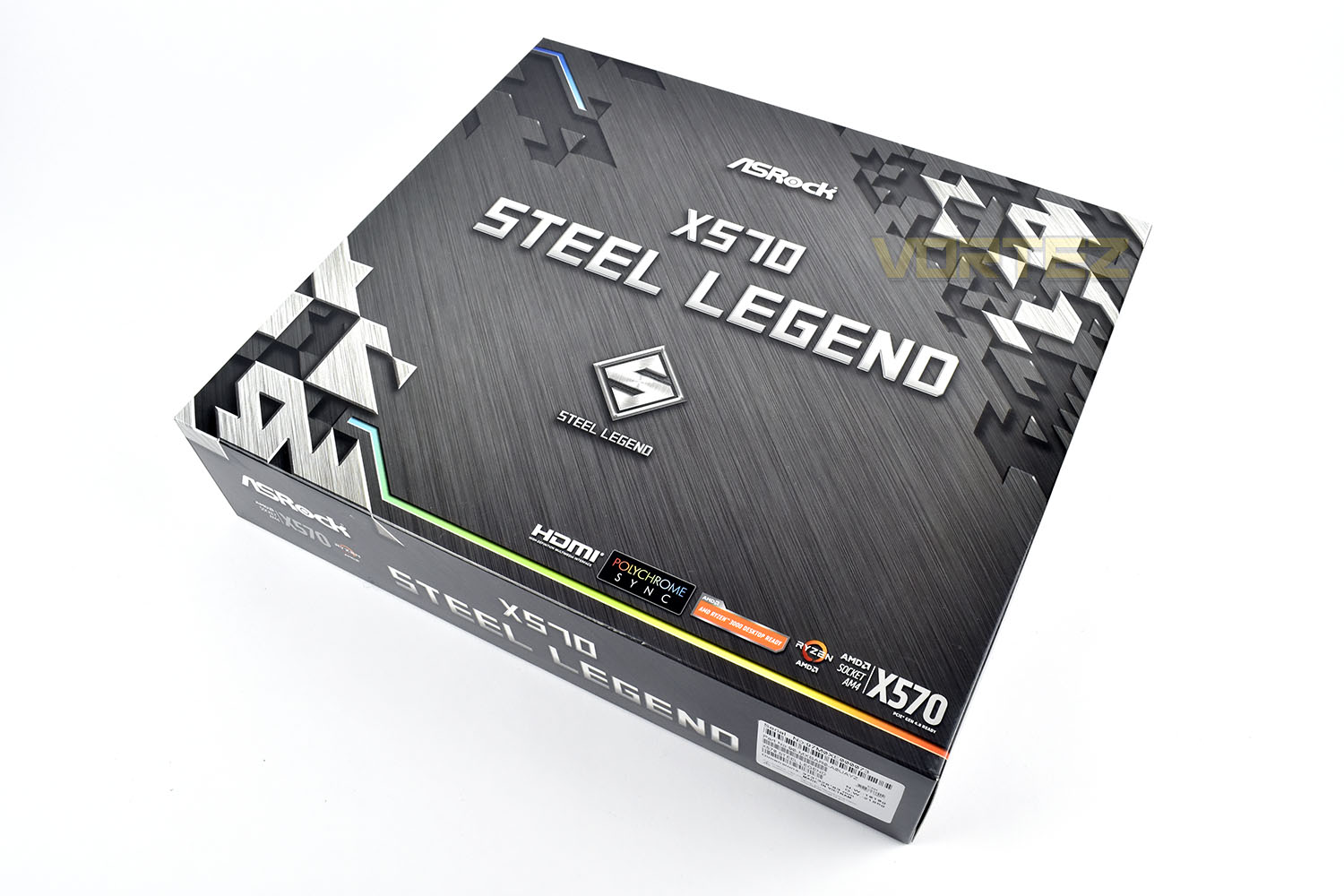
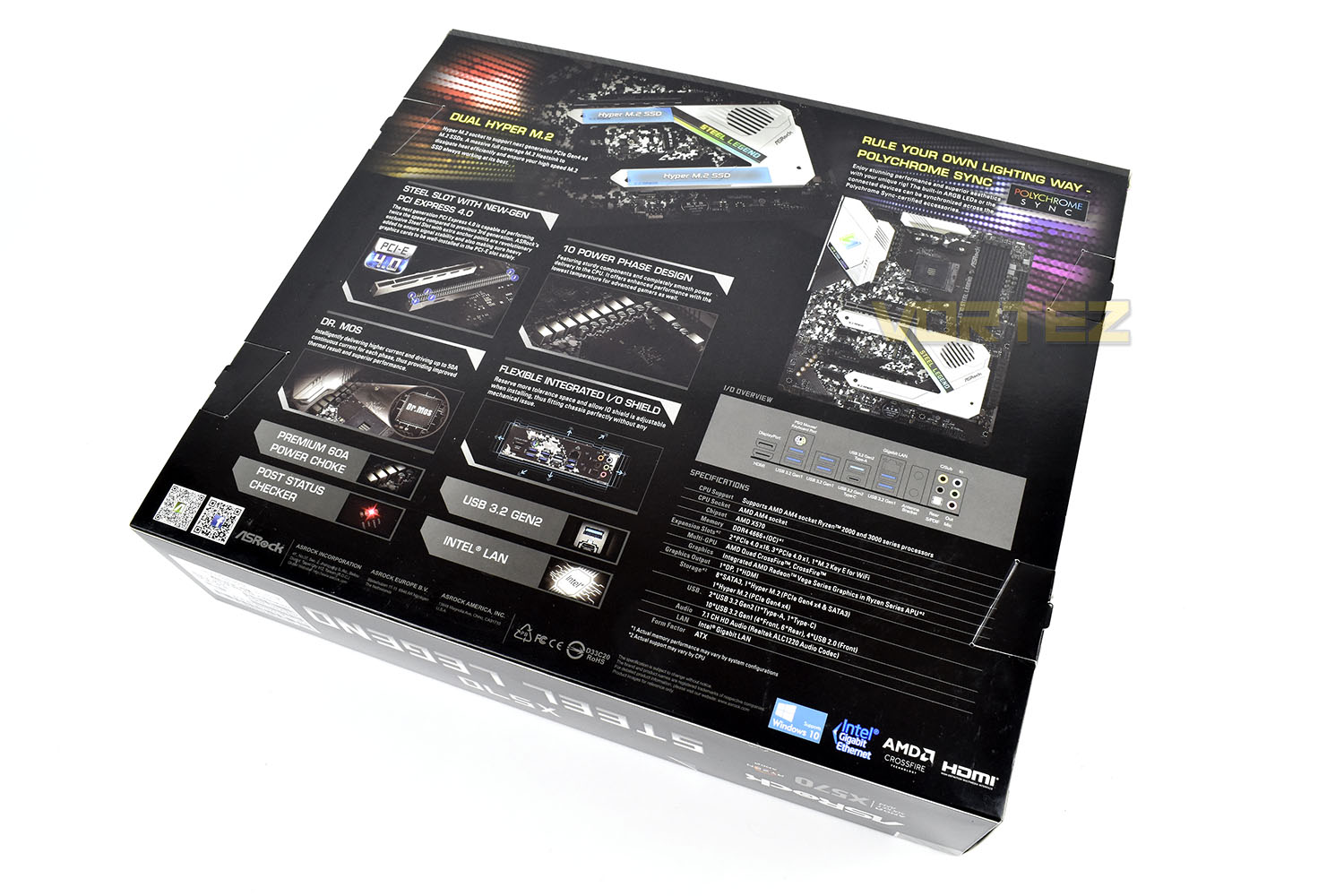
On the reverse is a great deal more information with specifications tables, diagrams of the rear I/O and annotated images of the Steel Legend’s most impressive features.
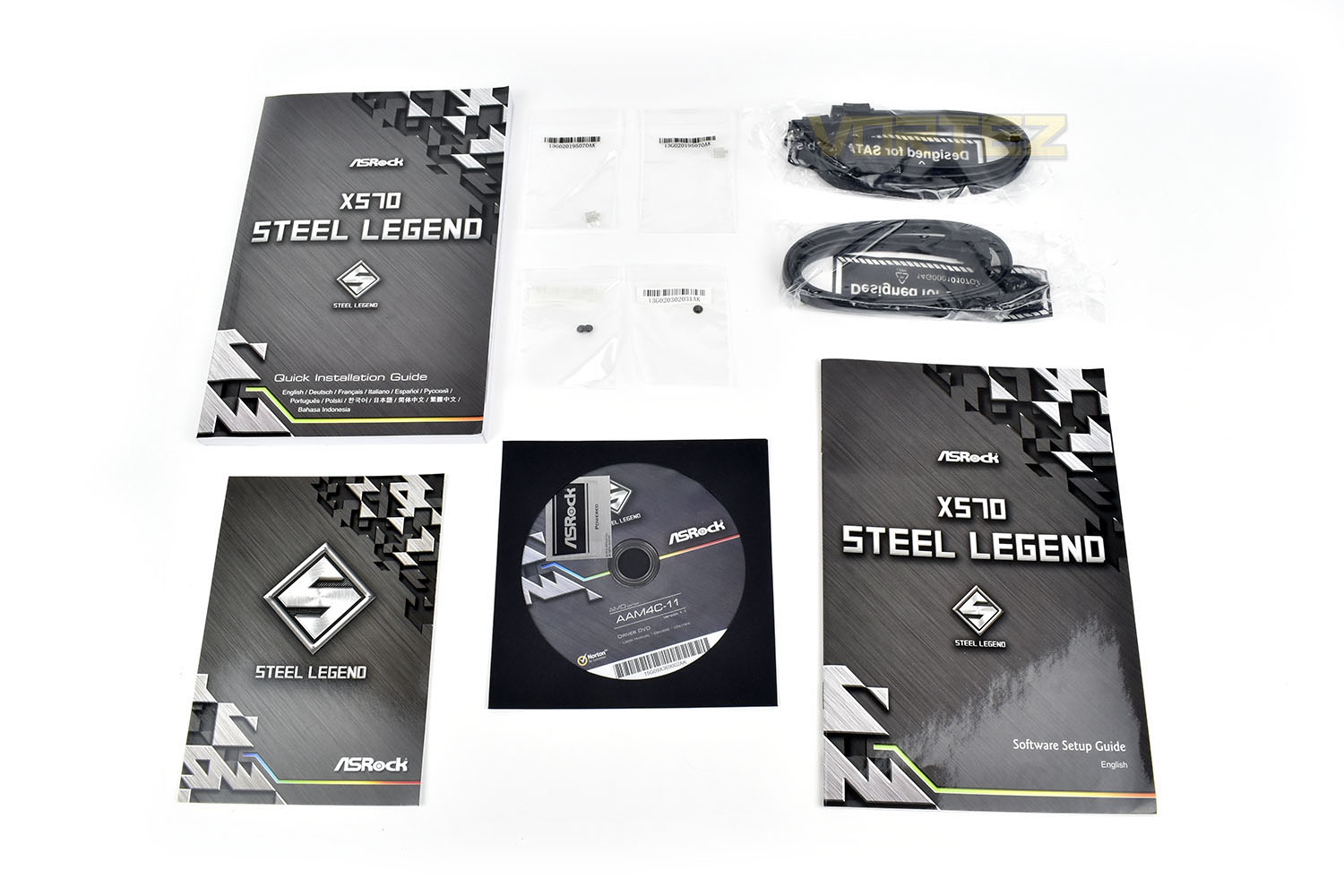
Bundled in with your new motherboard are a couple of setup guides, M.2 risers and screws, SATA cables, a software CD, case sticker and a postcard from ASRock.
Closer Look
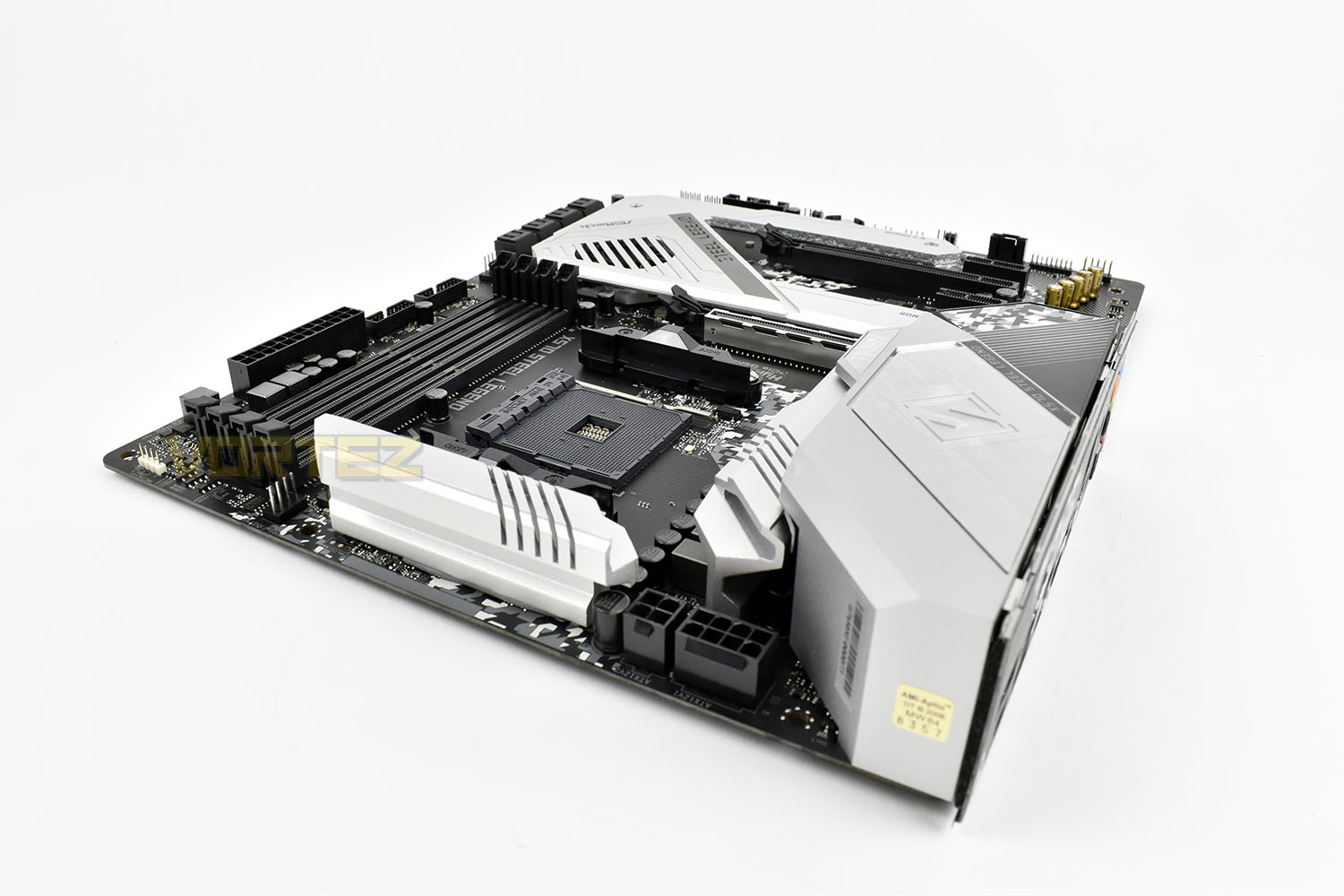
Now to take a look at the motherboard itself. The urban camouflage style with black, silver and white components looks fantastic and if paired with a bunch of the now-available white components, should look great as a complete build. The X570 Steel Legend conforms to the 305mm x 244mm ATX form factor.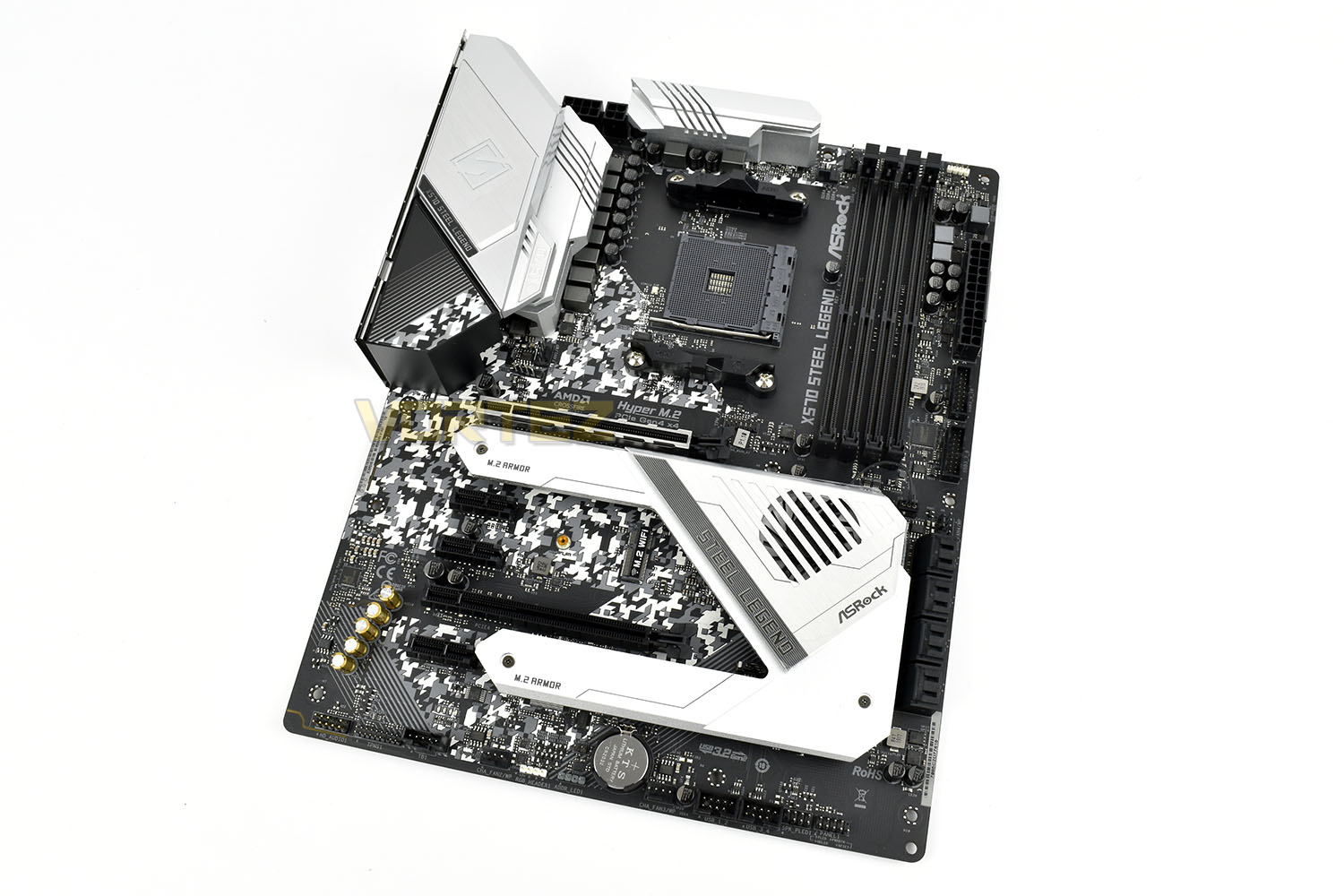
ASRock have opted for an 8+4 power connector arrangement to feed a 10-phase power design with Dr. MOS power staging and premium 60A power chokes, which should be ample for the 3900X and incoming 3950X, if you wish to opt for either of those.
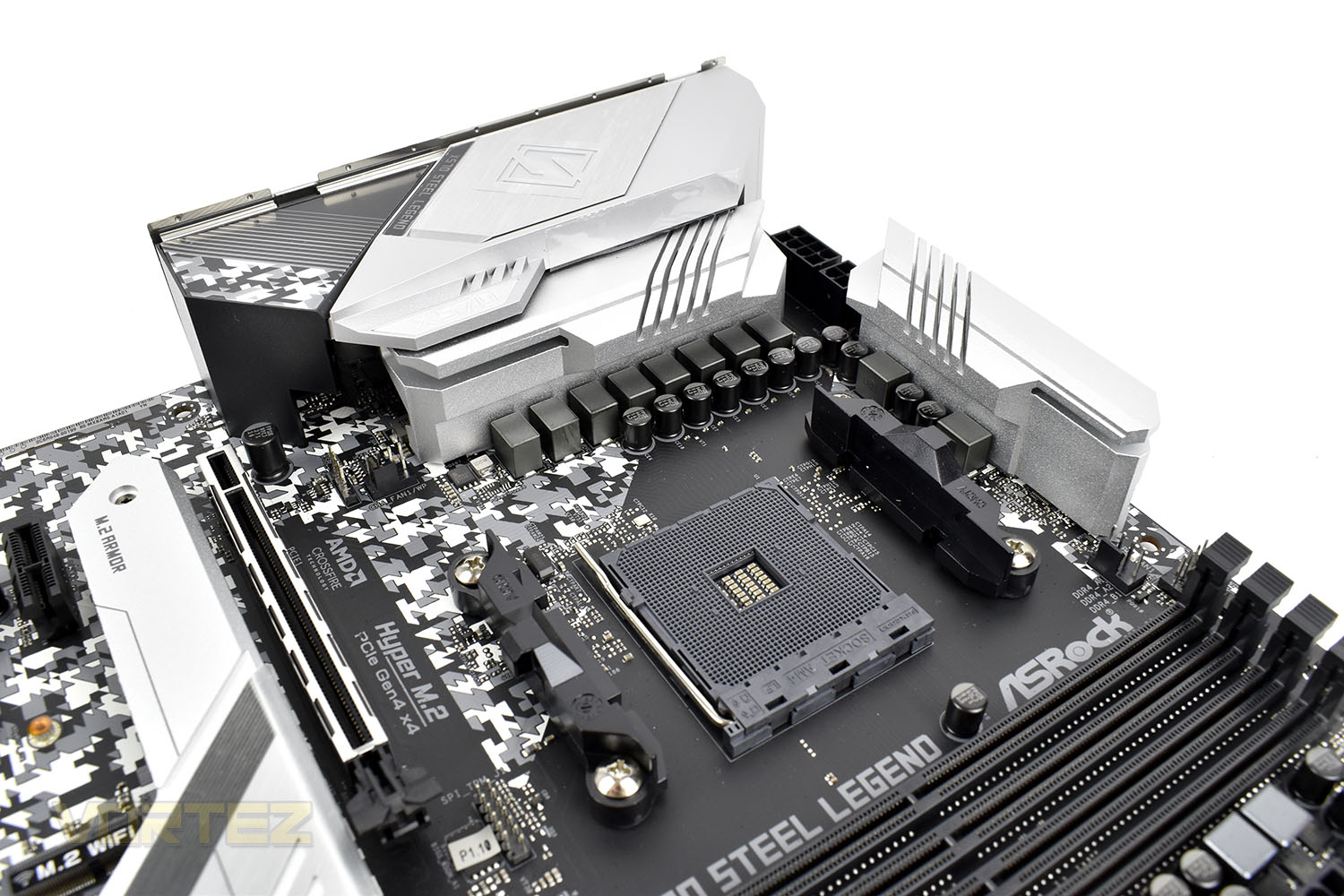
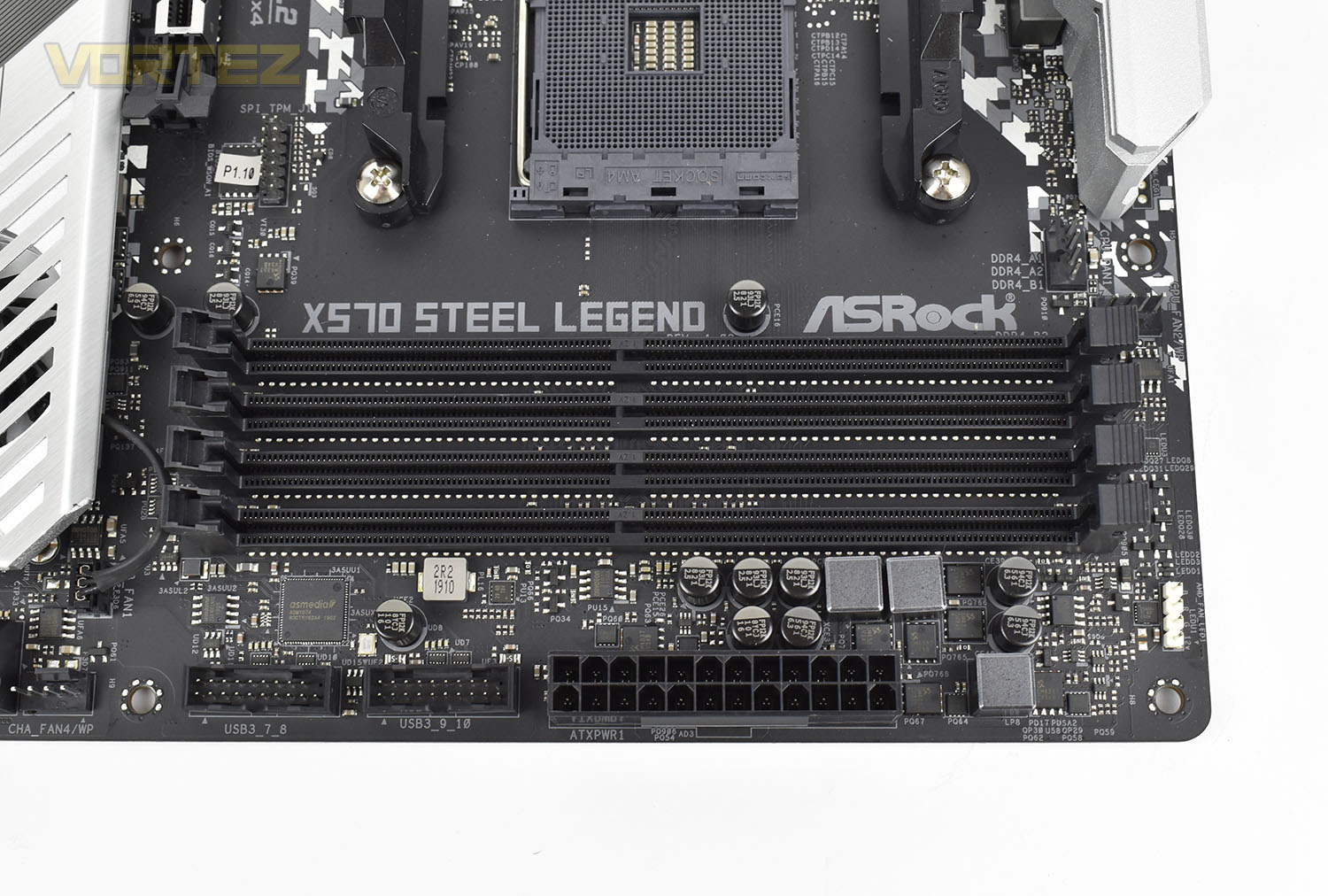
To the right of the AM4 socket is a quartet of DIMM slots which can take advantage of the latest 32GB modules for a total of 128GB with support for frequencies up to 4666MHz.
Along the right edge there’s a pair of USB 3.0 front headers.
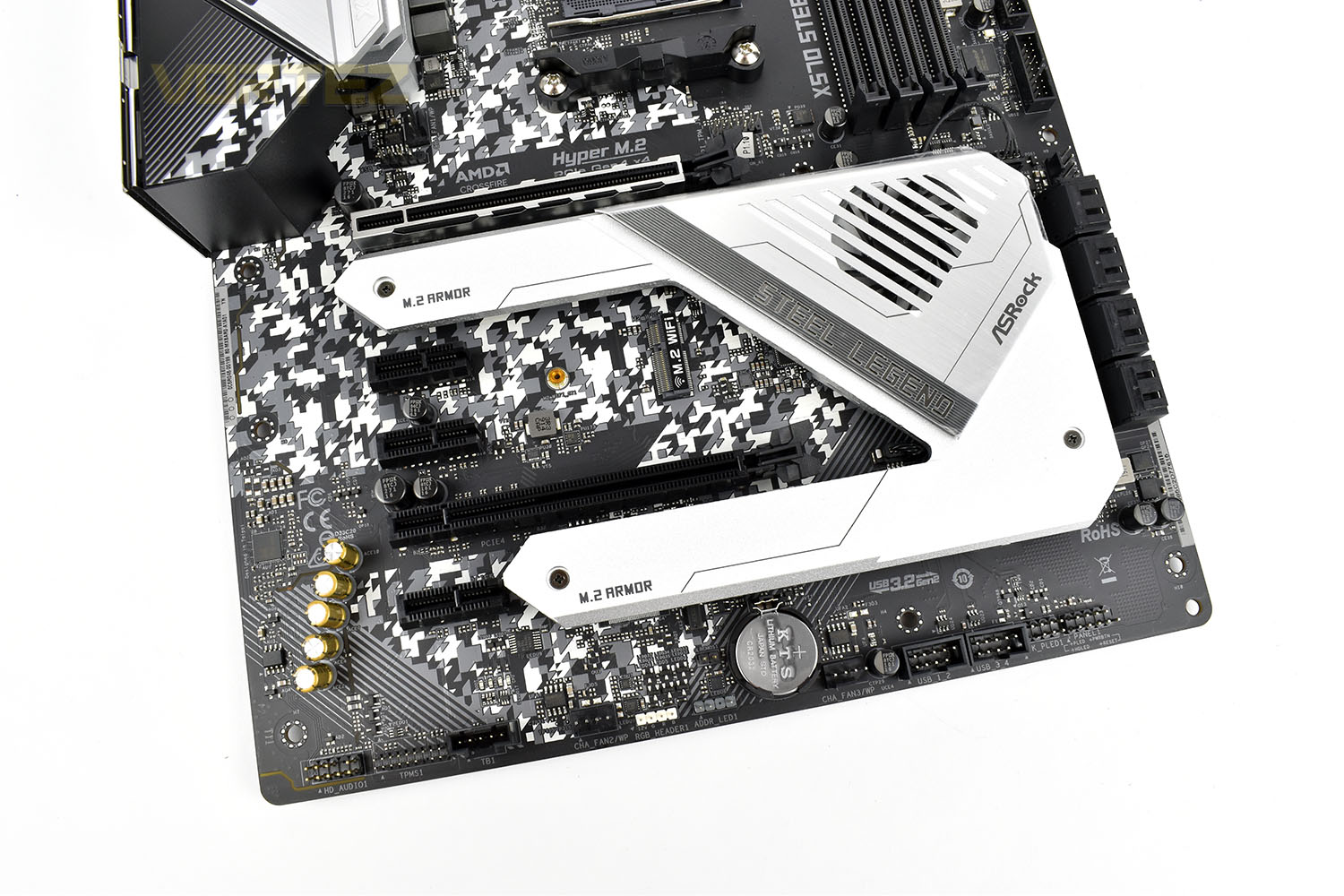
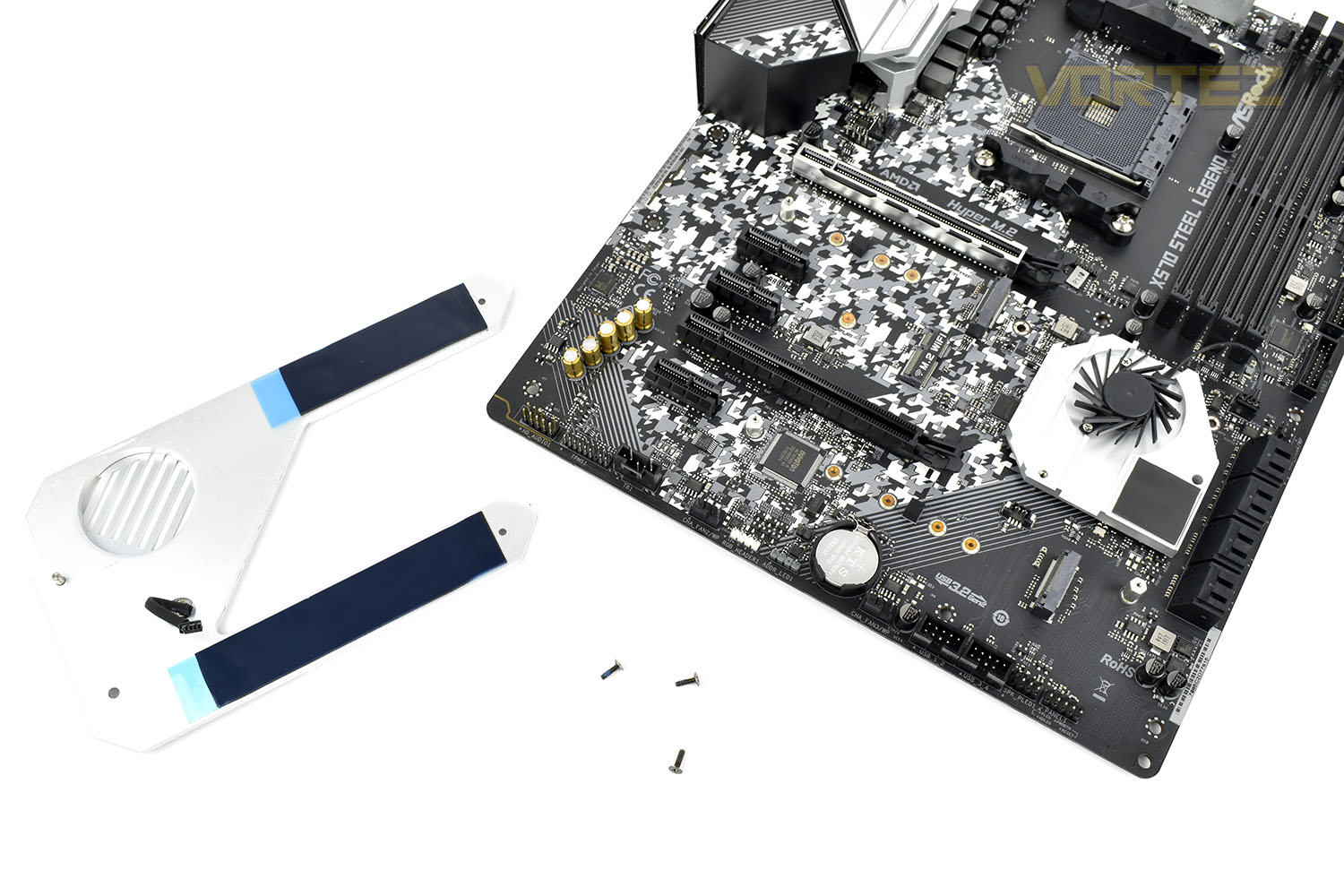
The bottom end of the motherboard is dominated by a large white/silver heatsink with an attached 40mm fan, something that has become synonymous of the X570 chipset. The heatsink has to be removed with the three small black screws to install an SSD into either of the two M.2 NVMe 4.0 slots.
Along with the M.2 ports are a trio of PCI-E 4.0 x1 slots and a pair of PCI-E 4.0 x16 slots, one of which is steel armoured for increased strength and resistance against shearing/warping.
Further to that, there’s an M.2 WiFi connection for a 42/20 card, available from around £15 in the UK. Further provisions have been made for this which we’ll show you on the rear I/O.
With the M.2/FCH heatsink removed, one big issue becomes evident, as well as a smaller one. The heatsink is made up of one piece of cast aluminium so any M.2 NVMe SSD that you choose must arrive without its own heatsink, or at least be easily removeable. Both of the NVMe 4.0 SSDs currently on the market have a pre-installed heatsink so make of that what you like.
The smaller of the two problems is, ASRock have equipped the FCH ‘heatsink’ with a fan but there’s nothing close to resembling an array of fins to help with thermal transfer so the effectiveness of that fan might be questionable.
Closer Look (Continued)
The typical inclusion of SATA ports is six, but ASRock, as we’ve seen on a few of their motherboards, like to include 8 or 10. With the Steel Legend, you’ll get 8 to play with in a 90° arrangement.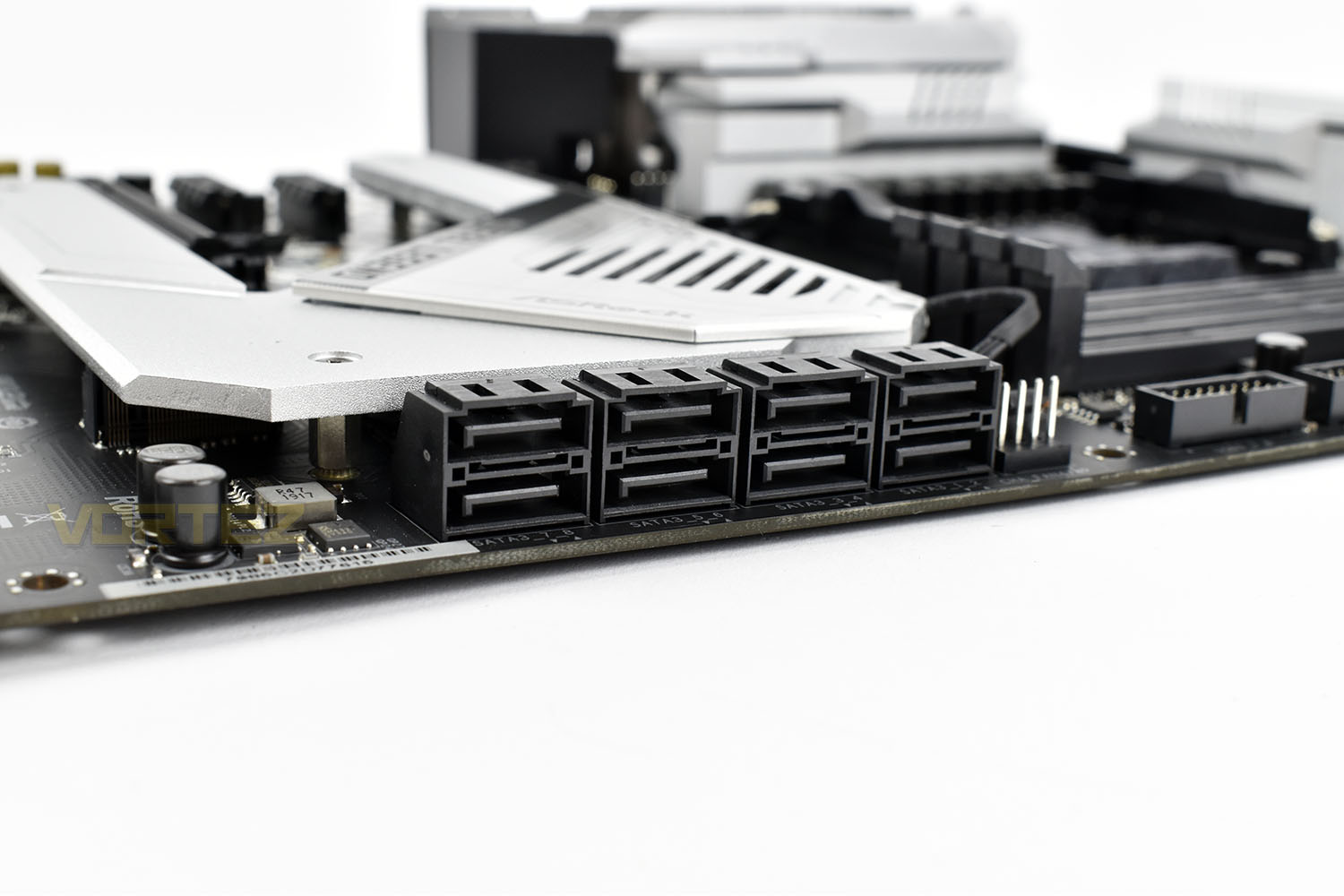
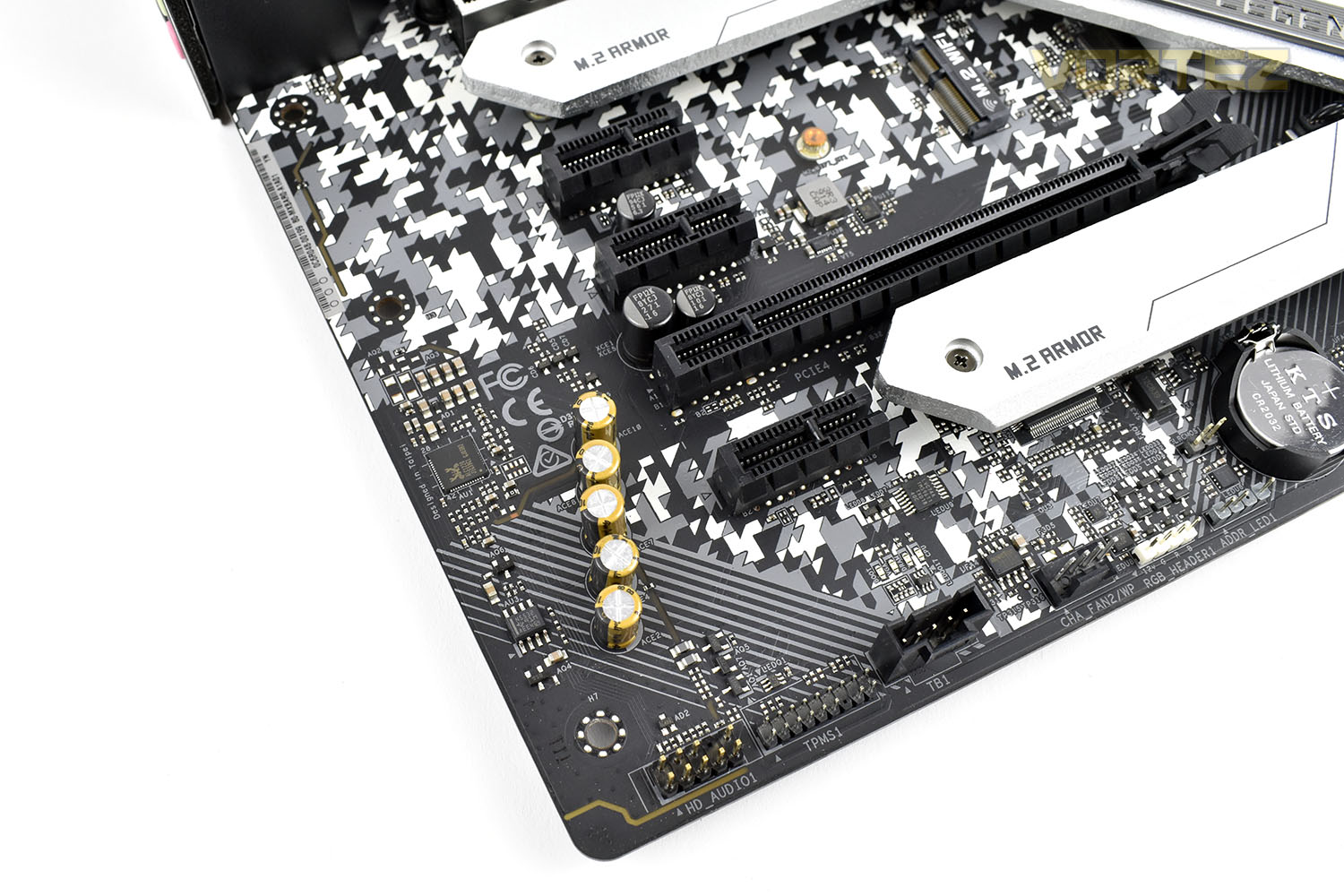
In a small, isolated section of the motherboard in the bottom-left, where the isolation helps to reduce any interference from nearby components, is the onboard audio solution. ASRock have used the Purity Sound 4 audio combination using the Realtek ALC1220 audio codec.
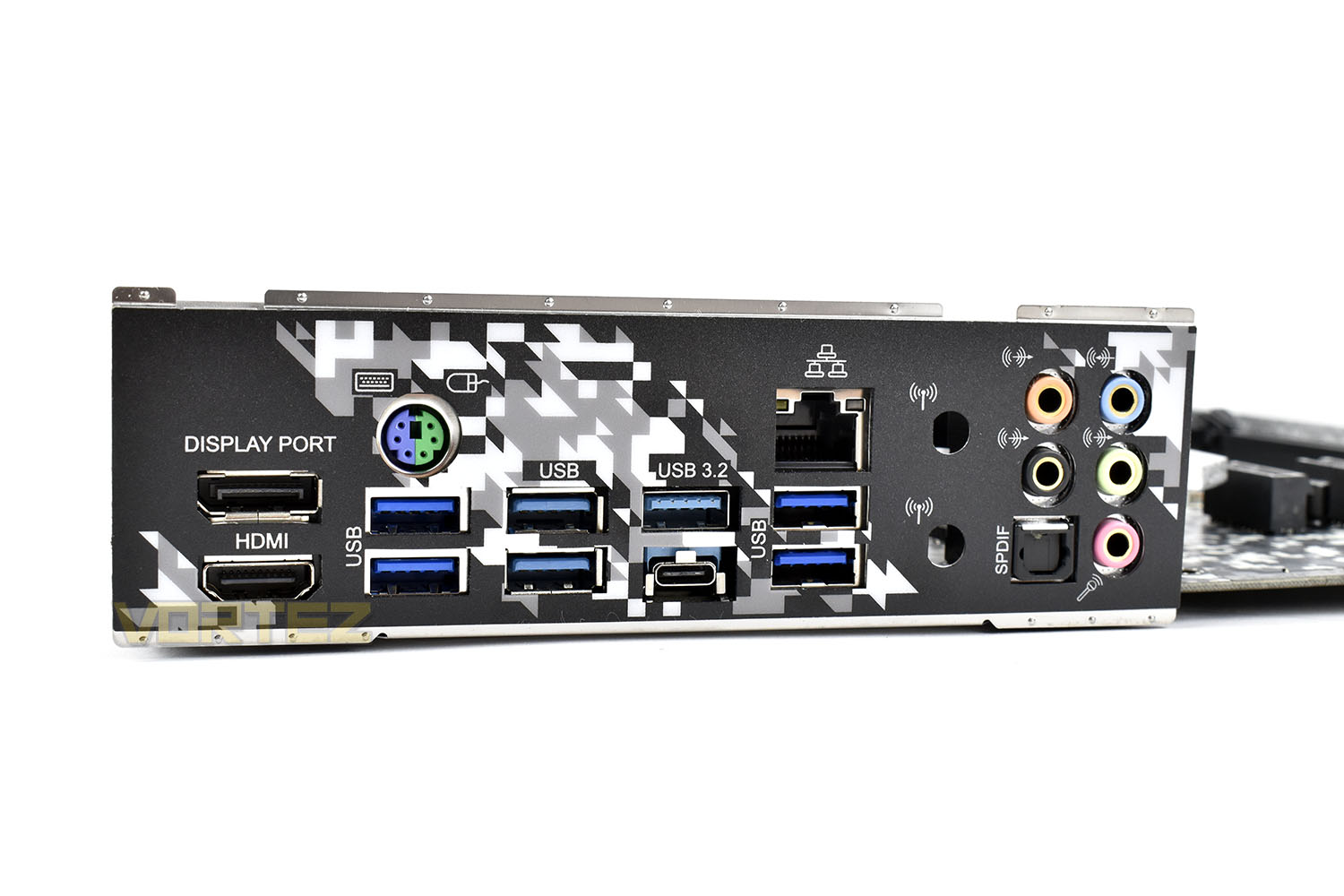
Finally moving round to the rear I/O, with it’s integrated I/O shield to save you from forgetting to install it, we find this is very reasonably equipped for a mid-range motherboard at this price-point.
Starting from the left, we get the following:
– 1 x HDMI Port
– 1 x DisplayPort 1.2
– 1 x PS/2 Mouse/Keyboard Port
– 1 x USB 3.2 Gen2 Type-A Port (10 Gb/s) (Supports ESD Protection)
– 1 x USB 3.2 Gen2 Type-C Port (10 Gb/s) (Supports ESD Protection)
– 6 x USB 3.2 Gen1 Ports (Supports ESD Protection)*
– 1 x RJ-45 LAN Port with LED (ACT/LINK LED and SPEED LED)
– 1 x Optical SPDIF Out Port
– HD Audio Jacks: Rear Speaker / Central / Bass / Line in / Front Speaker / Microphone (Gold Audio Jacks)
We also mentioned the M.2 WiFi slot on the motherboard. ASRock have cut out a pair of antenna slots for cards with antenna cables, instead of using up a PCI-E slot on the case.
BIOS
The ASRock UEFI BIOS follows the same brushed steel styling which is a nice touch, a far cry from the very basic offerings from only a few years ago. The landing page shows you the current version and the installed processor and RAM.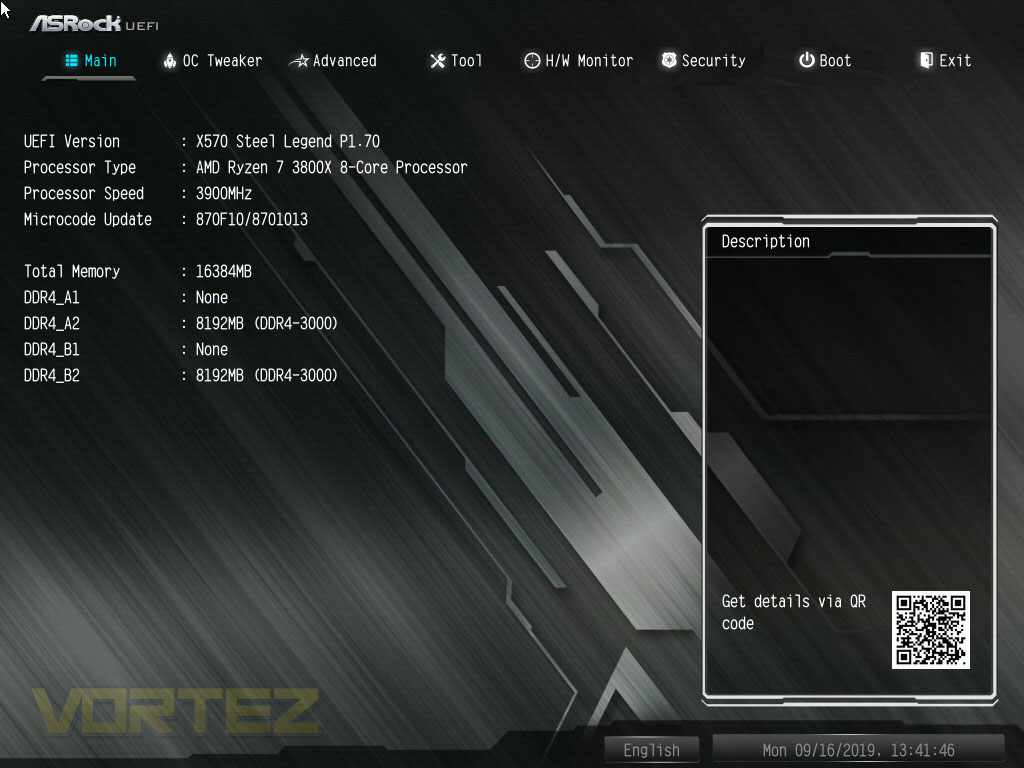
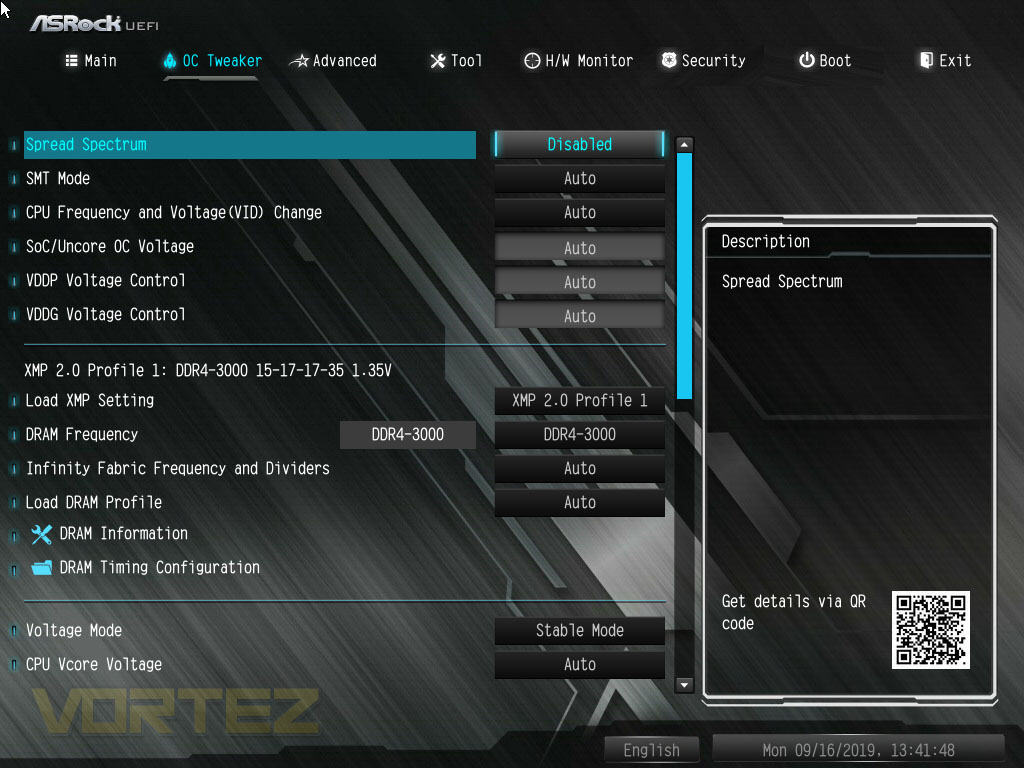
Moving onto the following tab, OC Tweaker, we can adjust the CPU and RAM settings here, as well as enabling the XMP profile for our Corsair memory kit.
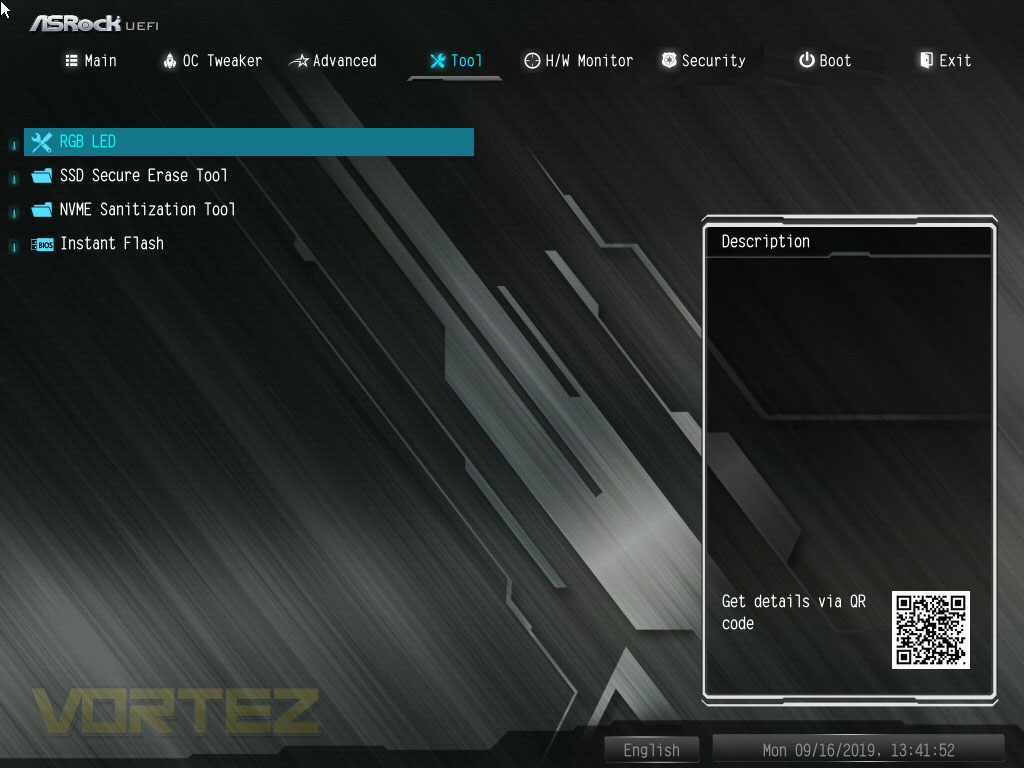
In the Tool tab, there’s the ability to alter the RGB lighting at a basic level and the Instant Flash is used to update the BIOS to the most recent versions.
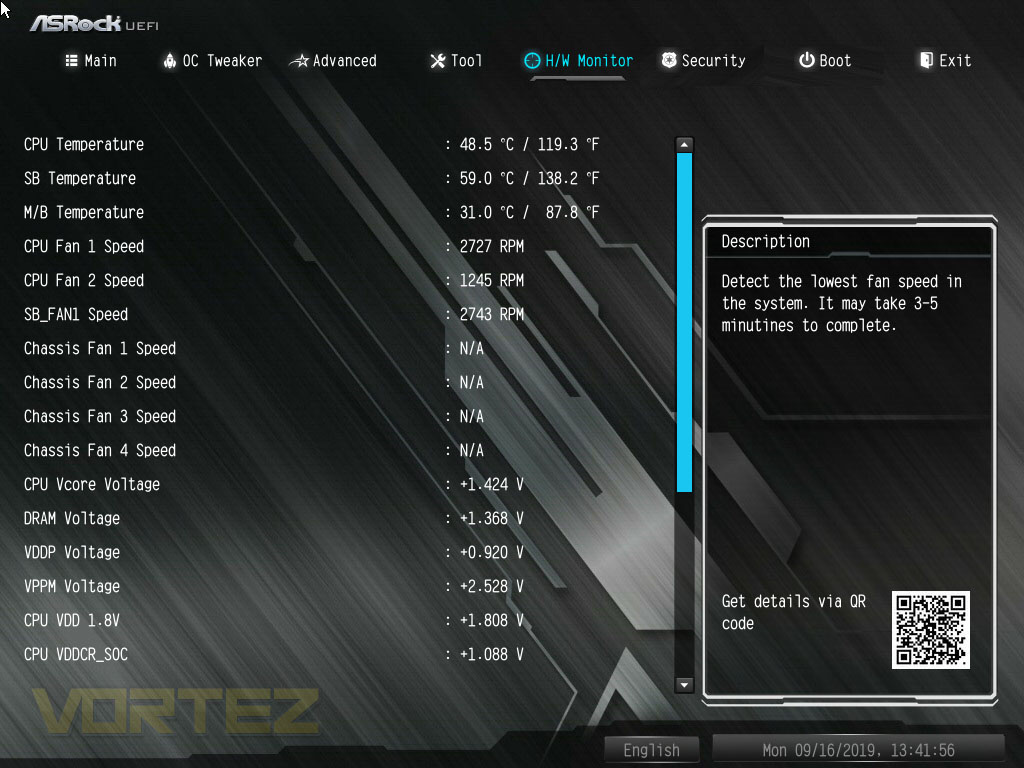
If you have any concerns regarding temperatures, voltages or fan speed, the H/W Monitor tab gives a very detailed breakdown of all of this.
Test Setup & Software
BIOS Version Tested: 1.70 – 14/8/2019Test Setup
CPU AMD Ryzen 7 3700X
Cooling Corsair H150i Pro RGB – Balanced Profile
Motherboard
Memory 16GB Corsair Vengeance LPX 3200MHz @ 3000MHz @ 15-17-17-38-58
Graphics AMD Radeon RX 480 8GB
Storage Corsair Force LE 480GB
PSU Corsair RM750X 80 Plus Gold Certified PSU
Cooling Corsair H150i Pro RGB – Balanced Profile
Motherboard
Memory 16GB Corsair Vengeance LPX 3200MHz @ 3000MHz @ 15-17-17-38-58
Graphics AMD Radeon RX 480 8GB
Storage Corsair Force LE 480GB
PSU Corsair RM750X 80 Plus Gold Certified PSU
Benchmarks
Cinebench R20 – CPU Score
SiSoftware SANDRA – CPU & Memory benchmarks
POV-RAY – CPU benchmarks
TrueCrypt – CPU benchmarks
AIDA64 – CPU benchmarks & Memory
PCMark 8 Photoshop
PC Mark 10 Extended Test
3DMark – FireStrike Extreme & TimeSpy
Games – Rise of the Tomb Raider & Total War: WARHAMMER
SiSoftware SANDRA – CPU & Memory benchmarks
POV-RAY – CPU benchmarks
TrueCrypt – CPU benchmarks
AIDA64 – CPU benchmarks & Memory
PCMark 8 Photoshop
PC Mark 10 Extended Test
3DMark – FireStrike Extreme & TimeSpy
Games – Rise of the Tomb Raider & Total War: WARHAMMER
Other Software
Temperature Analysis: Aida64 & Ryzen Master
Stress Testing Software: AIDA64 Stability Test
CPU Specification Monitoring: CPU-Z
Performance Monitoring: MSI Afterburner
Stress Testing Software: AIDA64 Stability Test
CPU Specification Monitoring: CPU-Z
Performance Monitoring: MSI Afterburner
Benchmarks: Power Consumption
It’s interesting to note the power consumption across all motherboards. Although they are using the X570 chipset, energy results can fluctuate between manufacturers due to the features and specifications that are integrated. First of all, for the idle tests the system is cold booted into Windows and no additional applications are executed – the watts are noted on the external energy monitor we use and then the system is loaded with 3DMark FireStrike – watts are again monitored for the duration of the test and the highest rated wattage result is then noted down. Below are the results of this energy test.
Ray Tracing Performance – POV-Ray 3.7
Persistence of Vision Raytracer’s PovRay is a free and open source 3D animator application with versions for computers with different operating systems.
This product allows users to build their custom 3D worlds with excellent quality despite their computer’s hardware. It has adjustable options for levels of radiance, refraction, and reflection. Calculation time may vary depending on the computer model, but PovRay can adapt to many computer builds, and is supported by the open source community.
This product allows users to build their custom 3D worlds with excellent quality despite their computer’s hardware. It has adjustable options for levels of radiance, refraction, and reflection. Calculation time may vary depending on the computer model, but PovRay can adapt to many computer builds, and is supported by the open source community.
AES Encryption Performance – TrueCrypt 7.1a
TrueCrypt is a discontinued source-available freeware utility used for on-the-fly encryption (OTFE). It can create a virtual encrypted disk within a file or encrypt a partition or (under Microsoft Windows except Windows 8 with GPT) the entire storage device (pre-boot authentication).
Processing Features Performance – AIDA64
AIDA64 Product PageThis simple integer benchmark focuses on the branch prediction capabilities and the misprediction penalties of the CPU. It finds the solutions for the classic “Queens problem” on a 10 by 10 sized chessboard. At the same clock speed theoretically the processor with the shorter pipeline and smaller misprediction penalties will attain higher benchmark scores. For example — with HyperThreading disabled — the Intel Northwood core processors get higher scores than the Intel Prescott core based ones due to the 20-step vs 31-step long pipeline. CPU Queen test uses integer MMX, SSE2 and SSSE3 optimizations.
Memory Transfer Performance – AIDA64
AIDA64 Product PageMemory bandwidth benchmarks (Memory Read, Memory Write, Memory Copy) measure the maximum achiveable memory data transfer bandwidth. The code behind these benchmark methods are written in Assembly and they are extremely optimized for every popular AMD, Intel and VIA processor core variants by utilizing the appropriate x86/x64, x87, MMX, MMX+, 3DNow!, SSE, SSE2, SSE4.1, AVX, and AVX2 instruction set extension.
The Memory Latency benchmark measures the typical delay when the CPU reads data from system memory. Memory latency time means the penalty measured from the issuing of the read command until the data arrives to the integer registers of the CPU.
The Memory Latency benchmark measures the typical delay when the CPU reads data from system memory. Memory latency time means the penalty measured from the issuing of the read command until the data arrives to the integer registers of the CPU.
Processing Power Performance – Cinebench R20
Cinebench is a real-world cross-platform test suite that evaluates your computer’s hardware capabilities. Improvements to Cinebench Release 20 reflect the overall advancements to CPU and rendering technology in recent years, providing a more accurate measurement of Cinema 4D’s ability to take advantage of multiple CPU cores and modern processor features available to the average user.
Bandwidth Performance – SiSoftware SANDRA
SANDRA isn’t always a benchmark that is included in hardware reviews but I believe it shouldn’t be ignored. SANDRA provides a vigorous package that tests your system in a rather large array of benchmarks. There are many aspects of benchmark that can be executed. We will be considering – CPU and memory tests.
Image Editing Performance – PCMark 8 Photoshop
PCMark 8 Product Page Developed in partnership with Benchmark Development Program members Acer, AMD, Condusiv Technologies, Dell, HGST, HP, Intel, Microsoft, NVIDIA, Samsung, SanDisk, Seagate and Western Digital, PCMark 8 is the latest version in FutureMark’s popular series of PC benchmarking tools. Improving on previous releases, PCMark 8 includes new tests using popular applications from Adobe and Microsoft.
Overall System Performance – PCMark 10
PCMark 10 is the latest version in our series of industry standard PC benchmarks. Updated for Windows 10 with new and improved workloads, PCMark 10 is also faster and easier to use.
PCMark 10 features a comprehensive set of tests that cover the wide variety of tasks performed in the modern workplace. With a range of performance tests, custom run options, and the new Battery Life Profile, PCMark 10 is the complete PC benchmark for the modern office.
PCMark 10 features a comprehensive set of tests that cover the wide variety of tasks performed in the modern workplace. With a range of performance tests, custom run options, and the new Battery Life Profile, PCMark 10 is the complete PC benchmark for the modern office.
VR Performance – VRMark
VRMark Product PageVRMark includes two VR benchmark tests that run on your monitor, no headset required, or on a connected HMD. At the end of each test, you’ll see whether your PC is VR ready, and if not, how far it falls short.
3D Performance – 3DMark
3DMark FireStrike Product PageFire Strike is our new showcase DirectX 11 benchmark designed for high-performance gaming PCs. It is our most ambitious and technical benchmark ever, featuring real-time graphics rendered with detail and complexity far beyond what is found in other benchmarks and games today. Fire Strike will only be available in the Windows editions of 3DMark initially.
Gaming Performance – Rise of the Tomb Raider & Total War: WARHAMMER
It’s important for us to perform a number of game benchmarks as well as the synthetic tests because gamers will want to know if there are any significant benefits. So here we have two recent gaming titles.
Conclusion
The aesthetics of the board are a little more obvious than some other offerings, particularly with the bright silver and white sections that would stand out, but saying that, if you paired it up with some white fans, a white RAM kit and a black/white GPU, it could end up looking fantastic.Including eight SATA 3.0 ports and a pair of M.2 slots gives the option to add plenty of storage, and thanks to the PCI-E 4.0 specification, incredibly fast NVMe SSDs can be used. However, the large M.2/FCH heatsink, due to its one-piece design, won’t be suitable for either of the currently-available PCI-E 4.0 compatible SSDs because of their integrated heatsinks.
Helping to reduce costs, ASRock have removed features that some users may not need, such as WiFi, Thunderbolt 3 and U.2 support, but that’s not to say they haven’t provisioned the possible installation of those things. WiFi can be added for roughly £20 in the UK and similar elsewhere in the world, with the rear I/O shield having pre-punched holes for antennas. You can also add Thunderbolt 3 via an ASRock add-in card via the onboard header and U.2 drives are supported via an adaptor, if you happen to need such support. Of course, it would be nice for those things to be standard but it would inevitably increase the base price of the product.
Build quality also appears to be another area where corners have been cut, so to speak. For instance, the cast aluminium heatsinks on the board are of a poor quality, with clear evidence of the casting techniques that could’ve been cleaned up and made more presentable. Of course, that won’t affect their performance in any way so it would be entirely cosmetic.
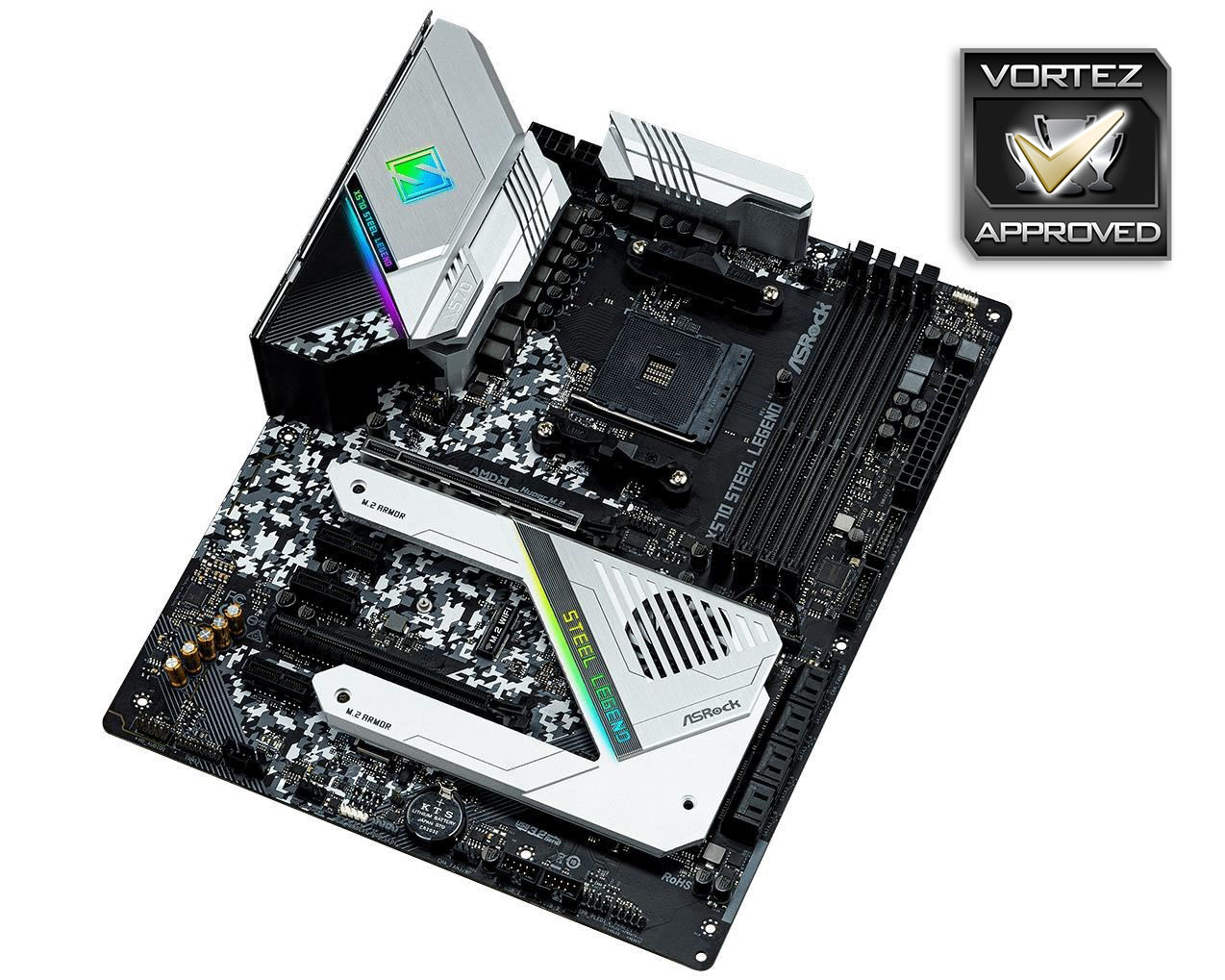
As an entire product, the X570 Steel Legend is well-rounded and offers good value for money paired with all the baseline performance of more expensive solutions.
Pros
+ Keeps up with more expensive options in all performance tests
+ Frugal on power
+ Eight SATA 3.0 ports
+ Good value for money
+ Attractive design
Neutral
+- No WiFi
Cons
– No front USB 3.1 header
– NVMe SSDs with heatsinks are unusable
– Evidence of poor build quality
+ Keeps up with more expensive options in all performance tests
+ Frugal on power
+ Eight SATA 3.0 ports
+ Good value for money
+ Attractive design
Neutral
+- No WiFi
Cons
– No front USB 3.1 header
– NVMe SSDs with heatsinks are unusable
– Evidence of poor build quality
Click here for an explanation of our awards at Vortez.net.
Stay connected with the Vortez Social Media pages:
Join in with the discussions on Discord