







Although small in size, Gene is packed with features for a compact computer system. We test this M-ATX Intel Z97 motherboard with Intel Core i7-4790K.

Product on Review: Maximus VII Gene
Manufacturer & Sponsor: ASUS
Street Price: £157 GBP / $209 USD
In our new venture with Intel’s Z97 chipset and Devil’s Canyon we delve into the world of the Republic of Gamers Series for a look at the new Maximus VII Gene.
In the M-ATX arena the Gene motherboards throughout the preceding generations have always been the very best of what you can get with a smaller form factor. You typically get all of the features from the bigger Republic of Gamers (ROG) motherboards but on a smaller PCB and usually at a smaller price-tag, meaning this is perfect for building a compact system.
Maximus VII Gene is packed with style, innovation and premium components. Although this motherboard is generally aimed at the gamer, it should appeal to other groups including enthusiasts and system builders. Will the size of this motherboard hinder its performance and overall verdict?
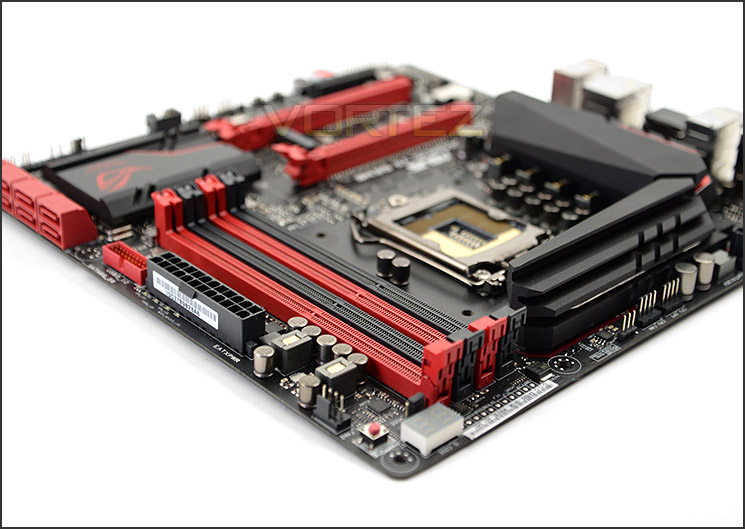
About ASUS
ASUS is a worldwide top-three consumer notebook vendor and maker of the world’s best-selling, most award-winning, motherboards. A leading enterprise in the new digital era, ASUS designs and manufactures products that perfectly meet the needs of today’s digital home and office, with a broad portfolio that includes motherboards, graphics cards, optical drives, displays, desktop and all-in-one PCs, notebooks, netbooks, servers, multimedia devices, wireless solutions, networking devices, tablets and smartphones. Driven by innovation and committed to quality, ASUS won 4,256 awards in 2013 and is widely credited with revolutionizing the PC industry with its Eee PC™. ASUS has more than 13,600 employees around the globe with a world-class R & D team of 4,500 engineers. Company revenue for 2013 was approximately US$14 billion.
Technical Specifications
CPU
Intel® Socket 1150 for the 5th/New 4th/4th Generation Core™ i7/Core™ i5/Core™ i3/Pentium®/Celeron® Processors
Supports Intel® 22 nm CPU
Supports Intel® Turbo Boost Technology 2.0
Chipset
Intel® Z97
Memory
4 x DIMM, Max. 32GB, DDR3 3300(O.C.)/3200(O.C.)/3100(O.C.)/3000(O.C.)/2933(O.C.)/2800(O.C.)/2666(O.C.)/
2600(O.C.)/2500(O.C.)/2400(O.C.)/2200(O.C.)/2133(O.C.)/2000(O.C.)/1866(O.C.)/1800(O.C.)/1600/1333 MHz Non-ECC, Un-buffered Memory
Dual Channel Memory Architecture
Supports Intel® Extreme Memory Profile (XMP)
Graphic
Integrated Graphics Processor- Intel® HD Graphics support
– Supports HDMI with max. resolution 4096 x 2160 @ 24 Hz / 2560 x 1600 @ 60 Hz
Supports Intel® InTru™ 3D, Quick Sync Video, Clear Video HD Technology, Insider™
Multi-GPU Support
Supports NVIDIA® Quad-GPU SLI™ Technology
Supports AMD Quad-GPU CrossFireX™ Technology
Expansion Slots
2 x PCIe 3.0/2.0 x16 (x16 or dual x8)
1 x PCIe 2.0 x4 *1
1 x mini-PCIe 2.0 x1
Storage
Intel® Z97 chipset :
6 x SATA 6Gb/s port(s), red
Support Raid 0, 1, 5, 10
Supports Intel® Smart Response Technology, Intel® Rapid Start Technology, Intel® Smart Connect Technology *2
1 x M.2 Socket 3, with M Key, type 2260/2280 storage devices support (PCIE mode)
ASMedia® ASM1061 controller : *3
2 x SATA 6Gb/s port(s), red
LAN
Intel® I218V, 1 x Gigabit LAN Controller(s), featuring GAMEFIRST III
Intel® LAN- Dual interconnect between the Integrated LAN controller and Physical Layer (PHY)
Anti-surge LANGuard
Audio
ROG SupremeFX Impact II 8-Channel High Definition Audio CODEC *4
– Supports : Jack-detection, Multi-streaming, Front Panel Jack-retasking
Audio Feature :
– SupremeFX Shielding™ Technology
– ELNA premium audio capacitors
– Blu-ray audio layer Content Protection
– DTS Connect
– Optical S/PDIF out port(s) at back panel
– Sonic SoundStage
– Sonic SenseAmp
– Sonic Studio
– Sonic Radar II
USB Ports
Intel® Z97 chipset : *5
4 x USB 3.0 port(s) (2 at back panel, blue, 2 at mid-board)
Intel® Z97 chipset : *6
7 x USB 2.0 port(s) (4 at back panel, black, 3 at mid-board)
ASMedia® USB 3.0 controller :
2 x USB 3.0 port(s) (2 at back panel, blue)
ROG Exclusive Features
Extreme Engine Digi+ III :
– 8 + 2 phase power design
– NexFET™ Power Block MOSFET
– 60A Ferrite Chokes
– 10K Black Metallic Capacitors
ProbeIt
KeyBot
– CPU Level Up
– XMP
– Direct Key
UEFI BIOS features :
– GPU.DIMM Post
– Tweakers’ Paradise
– ROG SSD Secure Erase
– Graphic Card Information Preview
ROG RAMDisk
GameFirst III
Extreme Tweaker
Special Features
5-Way Optimization by Dual Intelligent Processors 5
Gamer’s Guardian:
– ESD Guards on LAN, Audio, KBMS and USB3.0/2.0 ports
– DRAM Overcurrent Protection
– 10K Black Metallic Capacitors
– Stainless Steel Back I/O
ASUS Exclusive Features :
– USB BIOS Flashback
– MemOK!
– AI Suite 3
– Ai Charger+
– USB Charger+
– USB 3.0 Boost
– Disk Unlocker
ASUS EZ DIY :
– ASUS O.C. Profile
– ASUS CrashFree BIOS 3
– ASUS EZ Flash 2
– ASUS USB BIOS Flashback
– Push Notice
ASUS Q-Design :
– ASUS Q-Shield
– ASUS Q-Code
– ASUS Q-LED (CPU, DRAM, VGA, Boot Device LED)
– ASUS Q-Slot
– ASUS Q-DIMM
– ASUS Q-Connector
Overclocking Protection :
– ASUS C.P.R.(CPU Parameter Recall)
Media Streamer
Operating System Support
Windows® 8.1
Windows® 8
Windows® 7
Back I/O Ports
1 x PS/2 keyboard/mouse combo port(s)
1 x HDMI
1 x LAN (RJ45) port(s)
4 x USB 3.0 (blue)
4 x USB 2.0 (one port can be switched to ROG Connect)
1 x Optical S/PDIF out
3 x Audio jack(s)
1 x Clear CMOS button(s)
1 x ROG Connect On/ Off switch(es)
Internal I/O Ports
1 x USB 3.0 connector(s) support(s) additional 2 USB 3.0 port(s)
3 x USB 2.0 connector(s) support(s) additional 5 USB 2.0 port(s)
1 x M.2 Socket 3 for M Key, type 2260/2280 devices
1 x TPM header
8 x SATA 6Gb/s connector(s)
1 x CPU Fan connector(s) (1 x 4 -pin)
1 x CPU OPT Fan connector(s) (1 x 4 -pin)
3 x Chassis Fan connector(s) (3 x 4 -pin)
1 x 24-pin EATX Power connector(s)
1 x 8-pin ATX 12V Power connector(s)
1 x Front panel audio connector(s) (AAFP)
1 x System panel(s) (Q-Connector)
1 x MemOK! button(s)
10 x ProbeIt Measurement Points
1 x Thermal sensor connector(s)
1 x LN2 Mode header(s)
1 x Power-on button(s)
1 x Reset button(s)
1 x ROG extension (ROG_EXT) header(s)
1 x KeyBot Button
1 x Sonic SoundStage Button
Accessories
User’s manual
I/O Shield
6 x SATA 6Gb/s cable(s)
1 x SLI bridge(s)
1 x Q-connector(s) (2 in 1)
1 x 12 in 1 ROG Cable Label(s)
1 x ROG Door Hanger(s)
BIOS
64Mb UEFI AMI BIOS, PnP, DMI2.7, WfM2.0, SM BIOS 2.7, ACPI5.0a, Multi-Language BIOS
Manageability
WfM 2.0, DMI 2.7, WOL by PME, PXE
Support Disc
Drivers
ROG GameFirst III
ROG RAMDisk
ROG CPU-Z
ROG Mem TweakIt
Kaspersky® Anti-Virus
DAEMON Tools Pro Standard
ASUS WebStorage
Home Cloud
ASUS Utilities
Form Factor
mATX Form Factor
9.6 inch x 9.6 inch ( 24.4 cm x 24.4 cm )
Intel® Socket 1150 for the 5th/New 4th/4th Generation Core™ i7/Core™ i5/Core™ i3/Pentium®/Celeron® Processors
Supports Intel® 22 nm CPU
Supports Intel® Turbo Boost Technology 2.0
Chipset
Intel® Z97
Memory
4 x DIMM, Max. 32GB, DDR3 3300(O.C.)/3200(O.C.)/3100(O.C.)/3000(O.C.)/2933(O.C.)/2800(O.C.)/2666(O.C.)/
2600(O.C.)/2500(O.C.)/2400(O.C.)/2200(O.C.)/2133(O.C.)/2000(O.C.)/1866(O.C.)/1800(O.C.)/1600/1333 MHz Non-ECC, Un-buffered Memory
Dual Channel Memory Architecture
Supports Intel® Extreme Memory Profile (XMP)
Graphic
Integrated Graphics Processor- Intel® HD Graphics support
– Supports HDMI with max. resolution 4096 x 2160 @ 24 Hz / 2560 x 1600 @ 60 Hz
Supports Intel® InTru™ 3D, Quick Sync Video, Clear Video HD Technology, Insider™
Multi-GPU Support
Supports NVIDIA® Quad-GPU SLI™ Technology
Supports AMD Quad-GPU CrossFireX™ Technology
Expansion Slots
2 x PCIe 3.0/2.0 x16 (x16 or dual x8)
1 x PCIe 2.0 x4 *1
1 x mini-PCIe 2.0 x1
Storage
Intel® Z97 chipset :
6 x SATA 6Gb/s port(s), red
Support Raid 0, 1, 5, 10
Supports Intel® Smart Response Technology, Intel® Rapid Start Technology, Intel® Smart Connect Technology *2
1 x M.2 Socket 3, with M Key, type 2260/2280 storage devices support (PCIE mode)
ASMedia® ASM1061 controller : *3
2 x SATA 6Gb/s port(s), red
LAN
Intel® I218V, 1 x Gigabit LAN Controller(s), featuring GAMEFIRST III
Intel® LAN- Dual interconnect between the Integrated LAN controller and Physical Layer (PHY)
Anti-surge LANGuard
Audio
ROG SupremeFX Impact II 8-Channel High Definition Audio CODEC *4
– Supports : Jack-detection, Multi-streaming, Front Panel Jack-retasking
Audio Feature :
– SupremeFX Shielding™ Technology
– ELNA premium audio capacitors
– Blu-ray audio layer Content Protection
– DTS Connect
– Optical S/PDIF out port(s) at back panel
– Sonic SoundStage
– Sonic SenseAmp
– Sonic Studio
– Sonic Radar II
USB Ports
Intel® Z97 chipset : *5
4 x USB 3.0 port(s) (2 at back panel, blue, 2 at mid-board)
Intel® Z97 chipset : *6
7 x USB 2.0 port(s) (4 at back panel, black, 3 at mid-board)
ASMedia® USB 3.0 controller :
2 x USB 3.0 port(s) (2 at back panel, blue)
ROG Exclusive Features
Extreme Engine Digi+ III :
– 8 + 2 phase power design
– NexFET™ Power Block MOSFET
– 60A Ferrite Chokes
– 10K Black Metallic Capacitors
ProbeIt
KeyBot
– CPU Level Up
– XMP
– Direct Key
UEFI BIOS features :
– GPU.DIMM Post
– Tweakers’ Paradise
– ROG SSD Secure Erase
– Graphic Card Information Preview
ROG RAMDisk
GameFirst III
Extreme Tweaker
Special Features
5-Way Optimization by Dual Intelligent Processors 5
Gamer’s Guardian:
– ESD Guards on LAN, Audio, KBMS and USB3.0/2.0 ports
– DRAM Overcurrent Protection
– 10K Black Metallic Capacitors
– Stainless Steel Back I/O
ASUS Exclusive Features :
– USB BIOS Flashback
– MemOK!
– AI Suite 3
– Ai Charger+
– USB Charger+
– USB 3.0 Boost
– Disk Unlocker
ASUS EZ DIY :
– ASUS O.C. Profile
– ASUS CrashFree BIOS 3
– ASUS EZ Flash 2
– ASUS USB BIOS Flashback
– Push Notice
ASUS Q-Design :
– ASUS Q-Shield
– ASUS Q-Code
– ASUS Q-LED (CPU, DRAM, VGA, Boot Device LED)
– ASUS Q-Slot
– ASUS Q-DIMM
– ASUS Q-Connector
Overclocking Protection :
– ASUS C.P.R.(CPU Parameter Recall)
Media Streamer
Operating System Support
Windows® 8.1
Windows® 8
Windows® 7
Back I/O Ports
1 x PS/2 keyboard/mouse combo port(s)
1 x HDMI
1 x LAN (RJ45) port(s)
4 x USB 3.0 (blue)
4 x USB 2.0 (one port can be switched to ROG Connect)
1 x Optical S/PDIF out
3 x Audio jack(s)
1 x Clear CMOS button(s)
1 x ROG Connect On/ Off switch(es)
Internal I/O Ports
1 x USB 3.0 connector(s) support(s) additional 2 USB 3.0 port(s)
3 x USB 2.0 connector(s) support(s) additional 5 USB 2.0 port(s)
1 x M.2 Socket 3 for M Key, type 2260/2280 devices
1 x TPM header
8 x SATA 6Gb/s connector(s)
1 x CPU Fan connector(s) (1 x 4 -pin)
1 x CPU OPT Fan connector(s) (1 x 4 -pin)
3 x Chassis Fan connector(s) (3 x 4 -pin)
1 x 24-pin EATX Power connector(s)
1 x 8-pin ATX 12V Power connector(s)
1 x Front panel audio connector(s) (AAFP)
1 x System panel(s) (Q-Connector)
1 x MemOK! button(s)
10 x ProbeIt Measurement Points
1 x Thermal sensor connector(s)
1 x LN2 Mode header(s)
1 x Power-on button(s)
1 x Reset button(s)
1 x ROG extension (ROG_EXT) header(s)
1 x KeyBot Button
1 x Sonic SoundStage Button
Accessories
User’s manual
I/O Shield
6 x SATA 6Gb/s cable(s)
1 x SLI bridge(s)
1 x Q-connector(s) (2 in 1)
1 x 12 in 1 ROG Cable Label(s)
1 x ROG Door Hanger(s)
BIOS
64Mb UEFI AMI BIOS, PnP, DMI2.7, WfM2.0, SM BIOS 2.7, ACPI5.0a, Multi-Language BIOS
Manageability
WfM 2.0, DMI 2.7, WOL by PME, PXE
Support Disc
Drivers
ROG GameFirst III
ROG RAMDisk
ROG CPU-Z
ROG Mem TweakIt
Kaspersky® Anti-Virus
DAEMON Tools Pro Standard
ASUS WebStorage
Home Cloud
ASUS Utilities
Form Factor
mATX Form Factor
9.6 inch x 9.6 inch ( 24.4 cm x 24.4 cm )
Packaging & First Look
Packaging for Gene
In keeping with the rest of the Republic of Gamers motherboards, Gene arrives in a small, red box. This box has a list of supporting features on the front and on the reverse the technical specifications can be explored.
Inside, the bundled accessories and motherboard are contained within a tray.
An assortment of bundled accessories
Inside the box ASUS ROG include a number of items which include the following:
• User’s manual
• I/O Shield
• 6 x SATA 6Gb/s cable(s)
• 1 x SLI bridge(s)
• 1 x Q-connector(s) (2 in 1)
• 1 x 12 in 1 ROG Cable Label(s)
• 1 x ROG Door Hanger(s)
For a full unboxing on Gene, check our video review.
An overview of Maximus VII Gene
Unveiling Gene, we have an attractive looking motherboard which as traditional would have it, adopts the black and red theme that ROG fans adore. As with the other VII boards, Gene features a matt black PCB and is very appealing to the eye. For such a small motherboard it has a surprising number of features which we will explore on the subsequent pages.
Gene conforms to the M-ATX form factor and therefore has some features from the bigger sized ROG boards omitted.
Closer Look
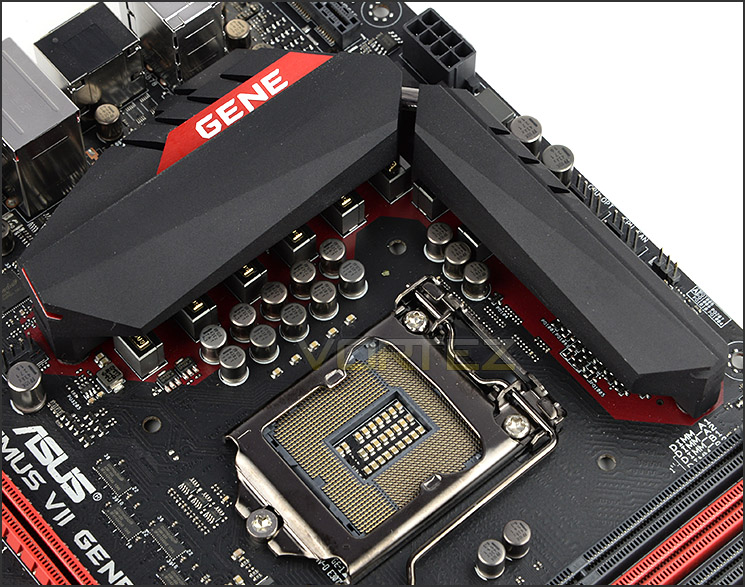
Digi+ 8-Phase VRM design
Gene uses an 8+2 Phase power design via Digi+3. Around the socket ROG has placed 60A ferrite chokes and 10K black metallic capacitors.
Over the MOSFETs sit two large and distinct heatsinks which are interconnected by a copper heatpipe. Just behind the heatsinks resides an 8-pin CPU power socket and as becoming customary now – there are two designated CPU fan headers for flagship air coolers and ALCs.
Gene uses Socket 1150 and supports Intel’s 4th and 5th Generation Processors.
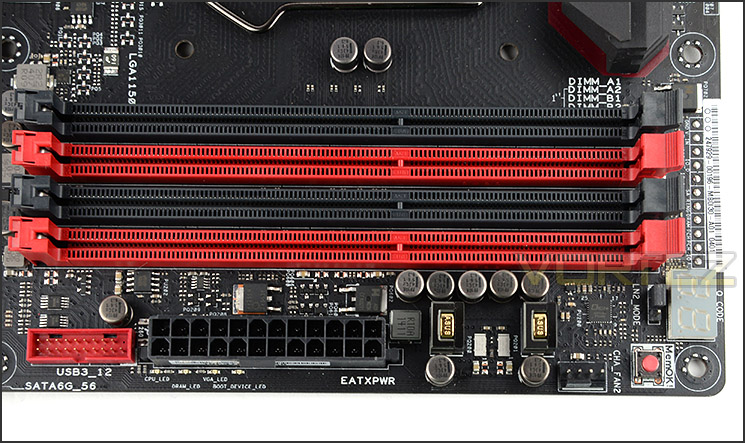
Dual-Channel DDR3 slots
Moving on there are 4x DDR3 DIMM slots which can accommodate up to 32GB of memory and 3300 (OC).
Also in the memory region are a number of advanced features – MemOK! makes an appearance and is now regarded as an integral ASUS feature, MemOK! ensures memory compatibility and a successful boot up. Probelt runs along the edge allowing you to accurately read voltages and LED debug is also present for diagnosing any issues on POST.
ROG has placed a USB 3.0 header near to the memory slots and 24-pin ATX socket. This supplies USB 3.0 functionality for the front panel.
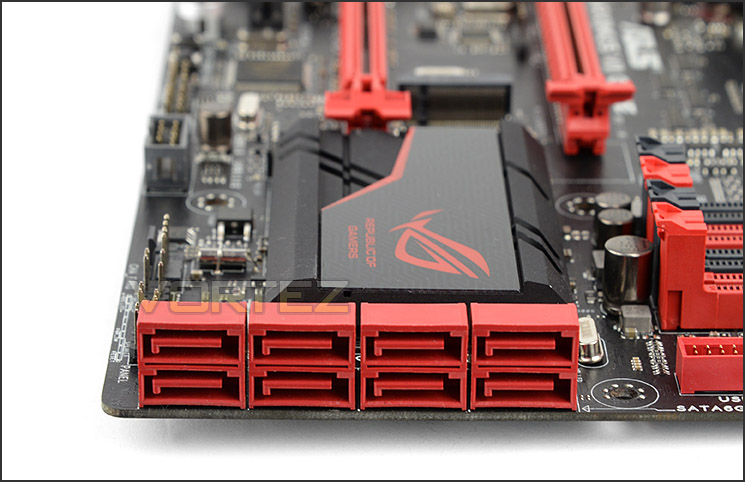
Generous amount of SATA III ports
Most partner Z97 boards are combining SATA, SATA Express and M.2 for storage but for the ROG line we have just SATA and M.2. Even, so ASUS have given this small motherboard a remarkable number of ports – up to eight SATA III 6GB/s.
NVIDIA SLI or AMD CrossfireX support
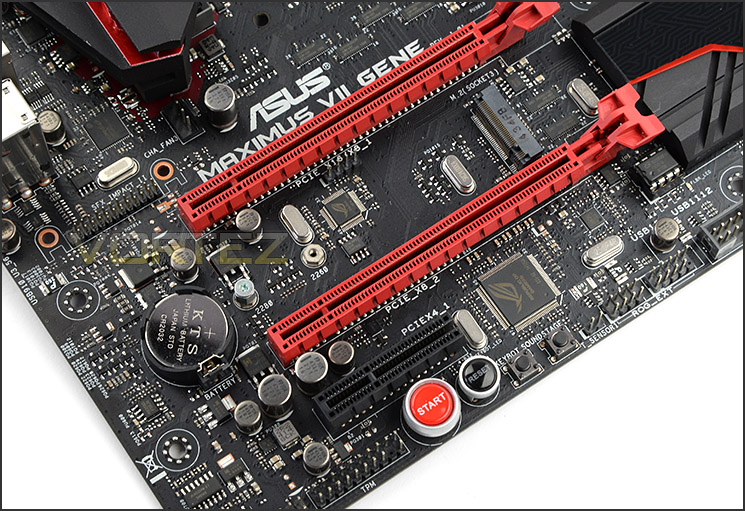
Gene has just three PCI Express slots due to the overall size of the motherboard. The slots include:
• 2 x PCIe 3.0/2.0 x16 (x16 top slot or dual x8)
• 1 x PCIe 2.0 x4
Since there are two X16 slots, NVIDIA SLI and AMD CrossfireX are both supported. If a single card configuration is being used the top slot is the best slot to use as this operates at x16 but if two cards are installed this will drop to x8.
In between the PCI Express slots, ASUS have placed a M.2 slot for SSD storage. This slot can accommodate type 2260/2280 drives.
Underneath the x4 slot ASUS have placed onboard power and reset buttons to make tie motherboard easier to use on a test bench.
At the bottom of the board is a button called KeyBot. This button allows you to assign macros and functions to a standard USB keyboard. By plugging the keyboard in and pressing this button, the microprocessor on the reverse initiates and allows a variety of commands to be applied via proprietary software which is included. This kind of feature is very useful for users who do not have access to a keyboard with macro functionality built-in.
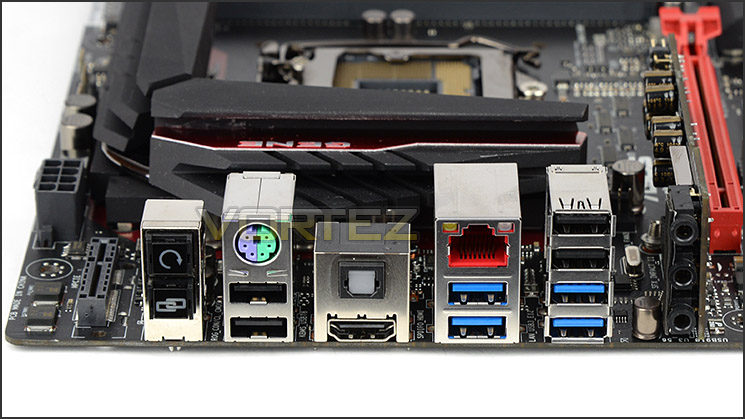
The rear IO panel on Gene
Finally, we come to the rear IO panel on Gene. Additional to the usual plethora of USB and other ports, ASUS have included a mini-PCIe 2.0 x1 slot and a set of pins for the SupremeFX audio module. Here is a full list of the available ports:
• 1x Mini-PCIe 2.0 x1
• 1 x PS/2 keyboard/mouse combo port(s)
• 1 x HDMI
• 1 x LAN (RJ45) port(s)
• 4 x USB 3.0 (blue)
• 4 x USB 2.0 (one port can be switched to ROG Connect)
• 1 x Optical S/PDIF out
• 3 x Audio jack(s)
• 1 x Clear CMOS button(s)
• 1 x ROG Connect On/ Off switch(es)
ASUS ROG 9 Series Features
https://vortez.ivtest.isolly.com/wp-content/uploads/2026/08/news_teaser-4959-razer-blade-pro-fullhd-teaser.jpg />
ASUS continue the next generation of Intel motherboards where they left off with Z87, bring a series of proprietary solutions to diverse requirements such as overclocking, fan control and on-board audio. The main thrust is through what they call ‘5-Way Optimisation’, which is all about providing tools to consumers with often different expertise such that they can exploit the motherboard with a minimal learning curve.
5-Way Optimisation
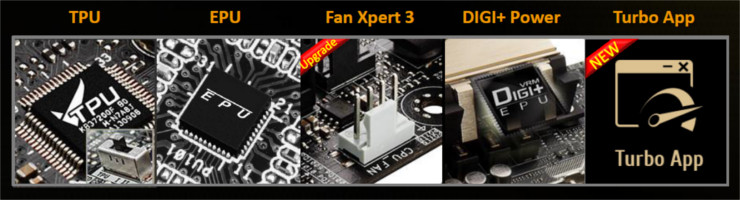
This feature in the latest generation of boards builds on the previous designs which integrated TPU, EPU and DIGI+ Power. Under the new umbrella feature ASUS also bring Fan Expert 3 – the successor to Fan Expert 2 – and the brand new Turbo App, both for intermediate to advanced users.
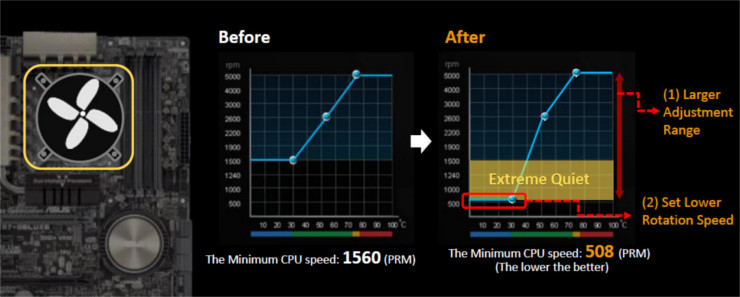
Fan Expert 3 allows the creation of individual fan profiles for any and every system fan, be they DC or PWM, utilising data from multiple onboard thermal sensors – VRM, CPU, PCH and Motherboard (as well as an external header on some models). ASUS has also discovered a means of increasing the RPM range of most PWM fans specifically at the lower end, allowing very low-noise operation without the risk of stalling.
Rounding out the optimisations is the new Turbo App, a software suite primarily intended for gamers. Through the App you can allocate system resources to specific applications, prioritising for instance a game whilst throttling other background processes. The Turbo App also includes the software overclocking tools which can be tailored to specific processes, accessing a little more oomph on demand.
Complementing the Turbo App is Turbo LAN, and additional utility through which you can reduce network latency by setting priorities for applications. The effect should be most pronounced when downloading heavily in combination with playing an online title, although as always this will depend on network conditions. If you’re on a capped internet tariff the built-in bandwidth meter will be a boon too.
It should be noted that any Turbo App dynamic overclocking settings will override Intel’s Turbo Boost, and isn’t yet able to dynamically down-clock the CPU or DRAM when the system isn’t being stressed. That feature may be implemented in due course, but for now ASUS have prioritised energy saving through the EPU and chipset features.
https://vortez.ivtest.isolly.com/wp-content/uploads/2026/08/news_teaser-4962-creative-omni-speaker-teaser.jpg />
All of the five key optimisation tools mentioned above can be accessed with just one click in software, making the process as straightforward as you could want, but nonetheless unlocks additional tools for those who can get to grips with everything the board is capable of.
Crystal Sound 2
Iterating on the original Crystal Sound, the new revision more effectively isolates left and right audio channels through dedicated PCB layers, shielding, and an EMI cover. Premium component selection will also improve sound quality, not least through the use of Japanese Capacitors and a de-pop circuit unique to ASUS boards.
On the software side ASUS are also improving the UI and including dts Connect and dts UltraPC II, which is intended to tailor the output audio to the speaker type utilised. In essence, although ASUS utilises a relatively standard Realtek CODEC, they’re engineering the board to produce the very best sound such chips are capable of.
Updated UEFI Bios Improvements
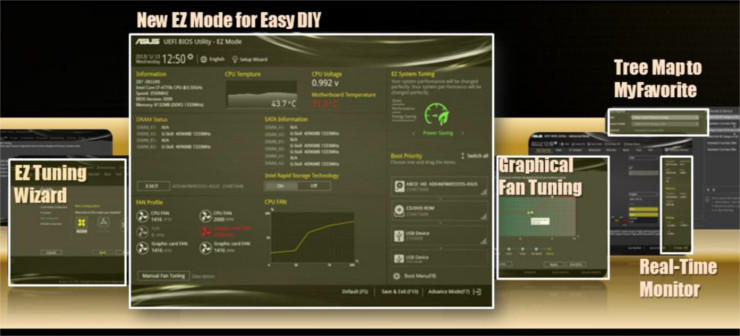
Rounding out the hardware-specific improvements are some subtle changes to the UEFI BIOS. ASUS’s implementation now includes both an EZ MODE for easy DIY system setup and an EZ Tuning Wizard to guide inexperienced users through the process of tweaking UEFI BIOS settings. Fan control also gets a refreshed graphical UI, now integrating system fan control into the BIOS and also allowing the creation of fan profiles for ASUS GPUs.
Additional Features
As with Z87 ASUS are stating that Thunderbolt 2 PCIe adaptor cards will be compatible with the next generation of boards including the one shown. A true niche interface, it’s still of great value to those who make use of extremely fast external storage or other external devices which will tax the 20GB/s interface.
ASUS Homecloud is an application which allows you to utilise your system as a personal cloud server, making available audio and video for streaming and file access. It also allows some remote system control from mobile devices, although naturally there will be some limitations on the level of access these devices will have.
ASUS Z97 ROG BIOS Video Tour
Below is a video tour showing the interface of ASUS ROG UEFI BIOS and the options which are available. As you can see, movement is very smooth and the overall look is refined and professional. Advanced tweaking and customisation options are available:
Test Setup, Methodology & Overclocking
Test Setup
CPU Intel Core i7-4790K (Devil’s Canyon)
Cooling Corsair Hydro Series H105
Motherboard ASUS Maximus VII Gene
Memory 16GB Corsair Vengeance Pro 2800MHz CL12 DDR3
Graphics XFX R7970 Black Edition
Storage Corsair Neutron GTX 480GB
PSU Corsair HX1050 80 Plus Gold Certified PSU
Cooling Corsair Hydro Series H105
Motherboard ASUS Maximus VII Gene
Memory 16GB Corsair Vengeance Pro 2800MHz CL12 DDR3
Graphics XFX R7970 Black Edition
Storage Corsair Neutron GTX 480GB
PSU Corsair HX1050 80 Plus Gold Certified PSU
Benchmarks
Cinebench R15 – CPU/OpenGL Score
x264 HD 4.0 – 1st and 2nd pass encoding
SiSoftware SANDRA 2014 – CPU & Memory benchmarks
AIDA64 – CPU benchmarks
PCMark 8 – Home Suite
3DMark FireStrike – DX11 3D Benchmark
Games – Tomb Raider, THIEF
x264 HD 4.0 – 1st and 2nd pass encoding
SiSoftware SANDRA 2014 – CPU & Memory benchmarks
AIDA64 – CPU benchmarks
PCMark 8 – Home Suite
3DMark FireStrike – DX11 3D Benchmark
Games – Tomb Raider, THIEF
Other Software
Temperature Analysis: Core Temp
Stress Testing Software: LinX
CPU Specification Monitoring: CPU-Z
Stress Testing Software: LinX
CPU Specification Monitoring: CPU-Z
** All benchmark tests have now been re-run using Intel Core i7-4790K **
Overclocking
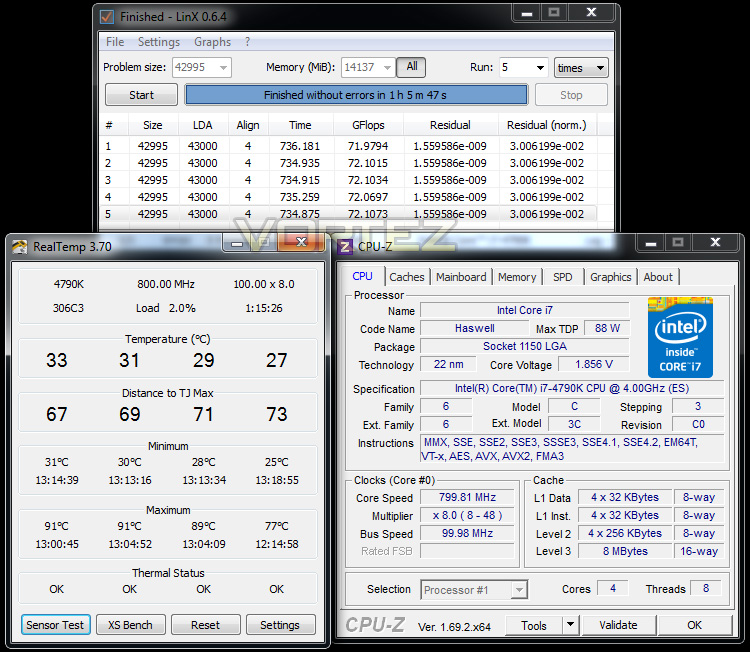
Since the introduction of Z87 back in 2013, there has been a return to BCLK overclocking. This type of functionality ensures flexibility for Overclockers compared to previous generations were the BCLK was locked to 100MHz and only the ratio could be adjusted. As many of you will know, Haswell CPUs get very hot with little voltage increase therefore the flexibility and headroom for overclocking can be limited. For all testing we are now using the Intel Core i7-4790K (Devil’s Canyon).
Since 4.8GHz is the maximum overclock for 4790K our investigation takes us to trying to achieve this with Gene. Although Gene required a bump in Core Voltage to 1.43v, it did accomplish 4.8GHz. This is an impressive result for such a small motherboard which primarily targets the gamer, rather than the overclocker.
Benchmarks: Power Consumption
It’s interesting to note the power consumption across all motherboards. Although they are using Z97 chipsets, energy results can fluctuate between manufacturers due to the features and specifications that are integrated. First of all, for the idle tests the system is cold booted into Windows and no additional applications are executed – the watts are noted on the external energy monitor we use and then the system is loaded with 3DMark FireStrike – watts are again monitored for the duration of the test and the highest rated wattage result is then noted down. Below are the results of this energy test.
Benchmarks: X264 HD
Simply put, this test measures how fast your machine can encode a short, DVD quality MPEG-2 video clip into a high-quality x264 video clip. What’s x264, you ask? It’s more or less the next-generation Xvid/DivX codec. I think it’s ideal for a benchmark because the application (x264.exe) reports fairly accurate compression results (in frames per second) for each pass of the video encoding process, and it uses multi-core processors very efficiently.
Benchmarks: AIDA64
AIDA64 Product PageThis simple integer benchmark focuses on the branch prediction capabilities and the misprediction penalties of the CPU. It finds the solutions for the classic “Queens problem” on a 10 by 10 sized chessboard. At the same clock speed theoretically the processor with the shorter pipeline and smaller misprediction penalties will attain higher benchmark scores. For example — with HyperThreading disabled — the Intel Northwood core processors get higher scores than the Intel Prescott core based ones due to the 20-step vs 31-step long pipeline. CPU Queen test uses integer MMX, SSE2 and SSSE3 optimizations.
Benchmarks: Cinebench
CINEBENCH is a real-world cross platform test suite that evaluates your computer’s performance capabilities. CINEBENCH is based on MAXON’s animation software CINEMA 4D 3D content creation.
Benchmarks: SiSoftware SANDRA
SANDRA isn’t always a benchmark that is included in hardware reviews but I believe it shouldn’t be ignored. SANDRA provides a vigorous package that tests your system in a rather large array of benchmarks. There are many aspects of benchmark that can be executed. We will be considering – CPU and memory tests.
Benchmarks: 3DMark
3DMark FireStrike Product PageFire Strike is our new showcase DirectX 11 benchmark designed for high-performance gaming PCs. It is our most ambitious and technical benchmark ever, featuring real-time graphics rendered with detail and complexity far beyond what is found in other benchmarks and games today. Fire Strike will only be available in the Windows editions of 3DMark initially.
Benchmarks: PCMark 8
PCMark 8 combines performance benchmarking with battery life measurement and includes tests based on popular Adobe and Microsoft applications. Whether you are looking for long battery life, or maximum power, PCMark 8 will help you find the devices that offer the perfect combination of efficiency and performance for your needs. It’s the complete PC performance benchmark for home and business.
Benchmarks: Tomb Raider & THIEF
It’s important for us to perform a number of game benchmarks as well as the synthetic tests because gamers will want to know if there are any significant benefits. So here we have two popular and recent gaming titles which feature a dedicated benchmark tool within them to display results.
Conclusion
Having already looked at a variety of Intel Z97 motherboards, today’s review is the first one featuring the new Devil’s Canyon CPU – Core i7-4790K and also the first M-ATX form factor offering.
Maximus VI Gene is undoubtedly a mini-powerhouse. Its visual aesthetics are in keeping with the ROG series, to which enthusiast and gamer alike simply adore. For such a condensed layout, it’d be understandable to believe you are missing out, but this isn’t so – this motherboard actually arrives with more features than you would expect.
Aside from the usual, customary Intel Z97 attributes, Gene has ROG specific features which set this motherboard apart from others which might be on the short list. ASUS has given Gene onboard probelt, keybot and a handy, interchangeable SupremeFX audio module to name just a few. Casting a quick glance over the motherboard reveals a number of premium components too, such as 60A ferrite chokes and 10K black solid CAPs.
Throughout our benchmark testing Gene demonstrated persistence and even managed to achieve the maximum overclock for our chip – 4.8GHz. Furthermore, the task of performing an overclock is just so simple thanks to the intuitive UEFI BIOS. Novice users can enter the BIOS make changes and take advantage of features as can advanced users too – the audience isn’t specific but all groups are catered for thanks to user friendly GUI.
At a cost of £157 GBP / $209 USD, Gene represents decent value for money considering what’s on offer in terms of the entire package and features. Those who are seeking to house a feature-rich system within the confines of a smaller case will struggle to argue with the price of Gene. It goes without saying this motherboard will look silly within a full-sized case, or even a mid-tower so if you are planning to build in one of these cases it’s better to turn to the bigger brothers within the series – Ranger and Hero.
Maximus VII Gene is the ideal companion for a condensed, M-ATX computer chassis. Although small in size, this motherboard is big on features – refusing to compromise on anything, especially not the performance.
VIDEO REVIEW – VORTEZ TV
Pros
+ Delightful visual appearance
+ Packed with features
+ Lots of storage options
+ Great performance
+ Includes M.2 support
+ Brilliant overclocker
+ Clean & easy to use BIOS
+ Good value
Cons
– Lacks SATA Express
+ Delightful visual appearance
+ Packed with features
+ Lots of storage options
+ Great performance
+ Includes M.2 support
+ Brilliant overclocker
+ Clean & easy to use BIOS
+ Good value
Cons
– Lacks SATA Express

Click here for an explanation of our awards at Vortez.net.


