The ROG Impact Mini-ITX motherboard sees its third installment – featuring the Intel Z170 chipset and options for both gamers and enthusiasts.

Product on Review: Maximus VIII Impact Motherboard
Manufacturer & Sponsor: ASUS
Street Price: £187 GBP / $238 USD
Back in 2013 the ASUS Republic of Gamers team brought us their first Mini-ITX based motherboard under the Intel Z87 chipset. Since then we’ve seen the Maximus Impact pass through another two generations. Their first attempt was mightily impressive and last year’s Maximus VII Impact built on the success of the debut – today we are to look at the third instalment to see what improvements have been made and to observe whether the ROG team has made even more refinements.
Maximus VIII Impact is ASUS’ latest Intel Z170 motherboard bearing the Mini-ITX form factor. This board is designed to target both the enthusiast and gamer who favour compact system configurations. Although small in size, Impact is packed with innovative features which can be found on full-sized ROG motherboards. Impact contains an all-digital power design, comes with a premium audio solution, advanced overclocking features and even a case fan extension card – proving that size, really doesn’t matter.
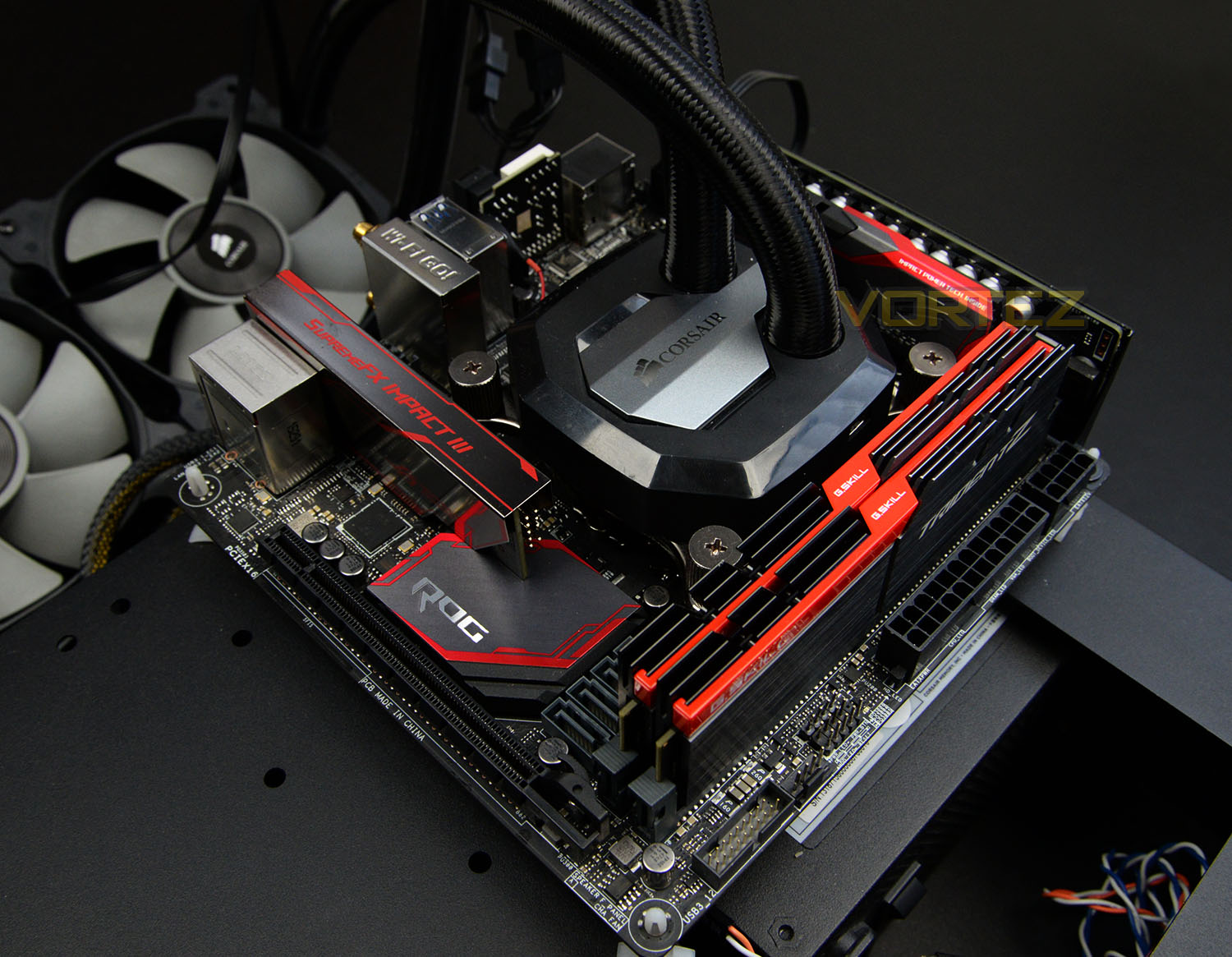
ASUS on their Maximus VIII Impact
For almost a decade, Republic of Gamers (ROG) has delivered exemplary design and performance to thrill the world’s best gamers and PC enthusiasts. But our work has only just begun. With our pimped, pumped and packed Maximus VIII Z170-series motherboards, competitors be warned, gamers get set and enthusiasts prepare to push your limits — ROG is ready to accept all challenges!.
Technical Specifications
Below are the technical specifications concerning the Maximus VIII Impact, taken directly from the ASUS website:
CPU
Intel® Socket 1151 for 6th Generation Core™ i7/Core™ i5/Core™ i3/Pentium®/Celeron® Processors
Supports Intel® 14 nm CPU
Supports Intel® Turbo Boost Technology 2.0
Chipset
Intel® Z170
Memory
2 x DIMM, Max. 32GB, DDR4 4133(O.C.)/4000(O.C.)/3866(O.C.)/3800(O.C.)/3733(O.C.)/
3600(O.C.)/3500(O.C.)/3466(O.C.)/3400(O.C.)/3333(O.C.)/3300(O.C.)/
3200(O.C.)/3000(O.C.)/2800(O.C.)/2666(O.C.)/2400(O.C.)/2133 MHz Non-ECC, Un-buffered Memory
Dual Channel Memory Architecture
Supports Intel® Extreme Memory Profile (XMP)
Graphic
Integrated Graphics Processor- Intel® HD Graphics support
– Supports HDMI with max. resolution 4096 x 2160 @ 24 Hz
Supports Intel® InTru™ 3D, Quick Sync Video, Clear Video HD Technology, Insider™
Expansion Slots
1 x PCIe 3.0/2.0 x16 (x16 mode, black)
Storage
Intel® Z170 chipset :
1 x U.2 port, black,
4 x SATA 6Gb/s port(s), gray,
Support Raid 0, 1, 5, 10
Intel® Rapid Storage Technology supports*1
Supports Intel® Smart Response Technology*1
LAN
Intel® I219V, 1 x Gigabit LAN Controller(s), GameFirst technology
Intel® LAN- Dual interconnect between the Integrated LAN controller and Physical Layer (PHY)
Anti-surge LANGuard
Wireless Data Network
Wi-Fi 802.11 a/b/g/n/ac
Supports dual band frequency 2.4/5 GHz
Supports MU-MIMO
Bluetooth
Bluetooth V4.1
Audio
ROG SupremeFX Impact III 5.1-channel High Definition Audio CODEC
– Supports : Jack-detection, Multi-streaming, Front Panel Jack-retasking
– SupremeFX Shielding Technology
– ESS® ES9023P DAC: dB SNR, dB THD+N (Max. kHz/ -bit)
– 2VRMS Headphone Amp into (32-600Ohms)
– Front panel audio connector (AAFP)
Audio Feature :
– Gold-plated jacks
– DTS Connect
– Optical S/PDIF out port(s) at back panel
– Sonic SenseAmp
– Sonic Studio II
– Sonic Radar II
USB Ports
Intel® Z170 chipset :
6 x USB 3.0 port(s) (4 at back panel, blue, 2 at mid-board)
Intel® USB 3.1 controller :
1 x USB 3.1 port(s) (1 at back panel, black, Type-C)
Intel® USB 3.1 controller :
1 x USB 3.1 port(s) (1 at back panel, red, Type-A)
Overclocking Features
Slow Mode
ROG RAMCache
Overwolf
SupremeFX Impact III
Start Button
Reset Button
LN2 Mode
Operating System Support
Windows® 10 , 64bit
Windows® 8.1 , 64bit
Windows® 7 , 32bit/64bit
Back I/O Ports
1 x HDMI
1 x LAN (RJ45) port(s)
1 x USB 3.1 (black)Type-C
1 x USB 3.1 (red)Type-A
4 x USB 3.0 (blue)
1 x Optical S/PDIF out
3 x Audio jack(s)
1 x Clear CMOS button(s)
2 x Wi-Fi antenna port(s)
1 x USB BIOS Flashback Button(s)
1 x Q-Code LED
1 x Start Button
1 x Reset Button
Internal I/O
1 x U.2 port
1 x USB 3.0 connector(s) support(s) additional 2 USB 3.0 port(s)
4 x SATA 6Gb/s connector(s)
1 x CPU Fan connector(s) (4 -pin)
1 x Chassis Fan connector(s) (4 -pin)
1 x 24-pin EATX Power connector(s)
1 x 8-pin ATX 12V Power connector(s)
1 x Front panel audio connector(s) (AAFP)*2
1 x System panel(s)
1 x ProbeIt Measurement Points
1 x Thermal sensor connector(s)
1 x 5-pin EXT_FAN(Extension Fan) connector
1 x LN2 Mode jumper(s)
1 x SupremeFX Impact II connector(s)
1 x Slow Mode jumper(s)
1 x SupremeFX Impact III connector
1 x M.2 socket pre-installed with a Wi-Fi/Bluetooth module
1 x System panel connector
Accessories
User’s manual
ASUS Q-Shield
4 x SATA 6Gb/s cable(s)
1 x CPU installation tool
1 x Supporting DVD
1 x ASUS 2T2R dual band Wi-Fi moving antennas (Wi-Fi 802.11a/b/g/n/ac compliant)
1 x Fan Extension Card (3 x 4-pin fan out)
1 x Fan Extension card screw pack
1 x 12 in 1 ROG Cable Label(s)
ROG Fan Label
1 x 5-pin to 5-pin cable
1 x Panel cable
1 x Thermistor cable(s)
BIOS
1 x 128 Mb Flash ROM, UEFI AMI BIOS, PnP, DMI3.0, WfM2.0, SM BIOS 3.0, ACPI 5.0, Multi-language BIOS, ASUS EZ Flash 3, CrashFree BIOS 3, F11 EZ Tuning Wizard, F6 Qfan Control, F3 My Favorites, F9 Quick Note, Last Modified log, F12 PrintScreen, F3 Shortcut functions and ASUS DRAM SPD (Serial Presence Detect) memory information.
Form Factor
Mini ITX Form Factor
6.7 inch x 6.7 inch ( 17 cm x 17 cm )
Intel® Socket 1151 for 6th Generation Core™ i7/Core™ i5/Core™ i3/Pentium®/Celeron® Processors
Supports Intel® 14 nm CPU
Supports Intel® Turbo Boost Technology 2.0
Chipset
Intel® Z170
Memory
2 x DIMM, Max. 32GB, DDR4 4133(O.C.)/4000(O.C.)/3866(O.C.)/3800(O.C.)/3733(O.C.)/
3600(O.C.)/3500(O.C.)/3466(O.C.)/3400(O.C.)/3333(O.C.)/3300(O.C.)/
3200(O.C.)/3000(O.C.)/2800(O.C.)/2666(O.C.)/2400(O.C.)/2133 MHz Non-ECC, Un-buffered Memory
Dual Channel Memory Architecture
Supports Intel® Extreme Memory Profile (XMP)
Graphic
Integrated Graphics Processor- Intel® HD Graphics support
– Supports HDMI with max. resolution 4096 x 2160 @ 24 Hz
Supports Intel® InTru™ 3D, Quick Sync Video, Clear Video HD Technology, Insider™
Expansion Slots
1 x PCIe 3.0/2.0 x16 (x16 mode, black)
Storage
Intel® Z170 chipset :
1 x U.2 port, black,
4 x SATA 6Gb/s port(s), gray,
Support Raid 0, 1, 5, 10
Intel® Rapid Storage Technology supports*1
Supports Intel® Smart Response Technology*1
LAN
Intel® I219V, 1 x Gigabit LAN Controller(s), GameFirst technology
Intel® LAN- Dual interconnect between the Integrated LAN controller and Physical Layer (PHY)
Anti-surge LANGuard
Wireless Data Network
Wi-Fi 802.11 a/b/g/n/ac
Supports dual band frequency 2.4/5 GHz
Supports MU-MIMO
Bluetooth
Bluetooth V4.1
Audio
ROG SupremeFX Impact III 5.1-channel High Definition Audio CODEC
– Supports : Jack-detection, Multi-streaming, Front Panel Jack-retasking
– SupremeFX Shielding Technology
– ESS® ES9023P DAC: dB SNR, dB THD+N (Max. kHz/ -bit)
– 2VRMS Headphone Amp into (32-600Ohms)
– Front panel audio connector (AAFP)
Audio Feature :
– Gold-plated jacks
– DTS Connect
– Optical S/PDIF out port(s) at back panel
– Sonic SenseAmp
– Sonic Studio II
– Sonic Radar II
USB Ports
Intel® Z170 chipset :
6 x USB 3.0 port(s) (4 at back panel, blue, 2 at mid-board)
Intel® USB 3.1 controller :
1 x USB 3.1 port(s) (1 at back panel, black, Type-C)
Intel® USB 3.1 controller :
1 x USB 3.1 port(s) (1 at back panel, red, Type-A)
Overclocking Features
Slow Mode
ROG RAMCache
Overwolf
SupremeFX Impact III
Start Button
Reset Button
LN2 Mode
Operating System Support
Windows® 10 , 64bit
Windows® 8.1 , 64bit
Windows® 7 , 32bit/64bit
Back I/O Ports
1 x HDMI
1 x LAN (RJ45) port(s)
1 x USB 3.1 (black)Type-C
1 x USB 3.1 (red)Type-A
4 x USB 3.0 (blue)
1 x Optical S/PDIF out
3 x Audio jack(s)
1 x Clear CMOS button(s)
2 x Wi-Fi antenna port(s)
1 x USB BIOS Flashback Button(s)
1 x Q-Code LED
1 x Start Button
1 x Reset Button
Internal I/O
1 x U.2 port
1 x USB 3.0 connector(s) support(s) additional 2 USB 3.0 port(s)
4 x SATA 6Gb/s connector(s)
1 x CPU Fan connector(s) (4 -pin)
1 x Chassis Fan connector(s) (4 -pin)
1 x 24-pin EATX Power connector(s)
1 x 8-pin ATX 12V Power connector(s)
1 x Front panel audio connector(s) (AAFP)*2
1 x System panel(s)
1 x ProbeIt Measurement Points
1 x Thermal sensor connector(s)
1 x 5-pin EXT_FAN(Extension Fan) connector
1 x LN2 Mode jumper(s)
1 x SupremeFX Impact II connector(s)
1 x Slow Mode jumper(s)
1 x SupremeFX Impact III connector
1 x M.2 socket pre-installed with a Wi-Fi/Bluetooth module
1 x System panel connector
Accessories
User’s manual
ASUS Q-Shield
4 x SATA 6Gb/s cable(s)
1 x CPU installation tool
1 x Supporting DVD
1 x ASUS 2T2R dual band Wi-Fi moving antennas (Wi-Fi 802.11a/b/g/n/ac compliant)
1 x Fan Extension Card (3 x 4-pin fan out)
1 x Fan Extension card screw pack
1 x 12 in 1 ROG Cable Label(s)
ROG Fan Label
1 x 5-pin to 5-pin cable
1 x Panel cable
1 x Thermistor cable(s)
BIOS
1 x 128 Mb Flash ROM, UEFI AMI BIOS, PnP, DMI3.0, WfM2.0, SM BIOS 3.0, ACPI 5.0, Multi-language BIOS, ASUS EZ Flash 3, CrashFree BIOS 3, F11 EZ Tuning Wizard, F6 Qfan Control, F3 My Favorites, F9 Quick Note, Last Modified log, F12 PrintScreen, F3 Shortcut functions and ASUS DRAM SPD (Serial Presence Detect) memory information.
Form Factor
Mini ITX Form Factor
6.7 inch x 6.7 inch ( 17 cm x 17 cm )
Unboxing & Closer Look
For this review we’ve produced a video which reveals the packaging, bundle and a close, detailed overview of the motherboard. Please check out the video below for a comprehensive look at the feature-set:
Intel Z170 Features
Intel’s initial release schedule for Skylake was planned well in advance, long before Microsoft officially announced the launch date of Windows 10. Most of August was set aside for conferences and seminars including the Intel Developers Forum in San Francisco, all with the aim of taking the wraps off and going deep into the technology within this new CPU architecture. Unfortunately bringing forward the release date of ‘K-series’ SKUs has meant that they’re unable to furnish detailed technical info to reviewers and members of the press, and won’t be releasing this information until IDF. The following is information which has been released thus far.
Developed under the codename Sunrise Point, Intel’s 100-series chipset is designed to operate hand-in-hand with an Intel ‘Skylake’ 6th Generation core processor. It utilises an LGA 1151 socket, underscoring the fact that neither CPU nor motherboard are backwards compatible with any of the previous generation hardware. As a result Sunrise Point is free to add additional features not present in x90-series and earlier chipsets.
Memory and Overclocking
Most notably from a consumer perspective Sunrise Point is the first Intel mainstream computing platform to be compatible with DDR4, and most Z170 and H170 designs are indeed likely to feature this memory technology rather than continue with DDR3L (a memory spec which Skylake CPUs can also handle). Default support is at DDR4-2133, however speeds above this are possible if a Z170 motherboard and K-Series CPU are used in tandem. One year on from the release of Haswell-E DDR4 pricing is quickly becoming more bearable, and so whilst it’s an additional expense to swallow compared with Haswell/Z97 it may not be quite the price premium you expect.
With Skylake Intel are, for the first time in many generations of Core architectures, once again re-enabling fine grade overclocking of memory at the Base Clock (BCLK) level. The PCI subsystem clock is now independent of BCLK, allowing for robust overclocking support which dispenses with coarse ratios in favour of a MHz by MHz stepping to far higher levels. Pre-launch testing by board partners have ascertained that stable BCLK’s of up to 400MHz are possible (with a stepping down of CPU multiplier), a far cry from even last year’s Haswell Refresh.
It should be noted that overclocking support has also been improved through greater control over individual CPU voltage inputs. Haswell made use of a Fully Integrated Voltage Regulator on the CPU itself; in essence, the motherboard supplied one input voltage and the FIVR divided this into individual on-board component inputs. With Skylake/Z170 the motherboard chipset controls each of these voltages individually, allowing direct adjustment for greater stability where necessary. This could theoretically be a great boon to enthusiast overclockers eager to get every last smidgen of performance out of a system.
Chipset and PCH Features
As we noted in our review of the two launched Skylake CPUs, up to 16 PCI-Express 3.0 lanes exist as a direct low-latency connection between CPU and 3rd party hardware such as graphics cards. These can operate in a 1×16 lane, 2×8 lane or 1×8 lane and 2×4 lane setup for multi-GPU configurations depending on the hardware implementation chosen by the board partners, but aren’t sufficient alone to support additional hardware options such as PCI-Express storage. The Platform Controller Hub therefore provides additional PCI-Express lanes to peripheral controllers.
In contrast to Intel’s 9-series motherboards Sunrise Point can supply up to an additional 20 PCI-Express 3.0 lanes, potentially resulting in double the bandwidth compared with the 20 PCIe 2.0 lanes of the previous generation. These new lanes augment the chipset storage options, most notably in respect to PCIe storage with many designs now featuring multiple next-generation storage options rather than a singular M.2 or SATA-Express port. Whilst not the low-latency connection you require for effective graphics processing, they will be more than suitable for new high-speed storage options including RAID for PCI-Express thanks to an upgraded DMI connection between PCH and CPU.
Further augmenting the platform’s storage capabilities is the adoption of new Intel Rapid Storage Technology protocols allowing PCI-Express storage to be used as caching drives for slower media. Potentially still a niche technology, the stark benefits of next-generation SSDs over mechanical drives as well as future SSDs could be just the breakthrough Intel RST needs to capture mainstream adoption.
In an additional change from the 9-series motherboards support has been added for up to 10 native USB 3.0 ports and 14 USB 2.0 ports, with a maximum of 16 ports in some combination thereof. It should be noted that so far as we can tell USB 3.1 isn’t actually native to the Sunrise Point chipset. Implementation is up to motherboard vendors through 3rd party controllers, and it’s to their credit that many have adopted the new high-speed standard without any fuss. For some both USB 3.1 Type-A and Type-C connectors are available, with Type-C the most common otherwise.
Those who make use of on-board CPU graphics can now enjoy support for up to three digital display outputs, or make use of the Intel 530 Graphics capabilities in tandem with discrete graphics. Microsoft Windows 10 (via DirectX 12) includes new options which allow disparate graphics hardware to be used in tandem, making best use of processing power where possible. Even without this, the transcoding capabilities of Intel QuickSync make it a tempting proposition for fast and efficient h.265 encoding and decoding, even if your discrete graphics hardware is formidable.
With unchanged support for six conventional SATA III storage ports, Intel 10/100/1000Mbps Ethernet, Intel Audio options and comprehensive UEFI BIOS options, Sunrise Point (and by extension all Z170 motherboards) are choc-full of features. That’s not to say that there aren’t some omissions – lack of native USB 3.1 support being the most obvious, whilst native U.2 connectors are a premium feature supplied by board partners – but as a whole the platform is a significant step forward overall.
Test Setup & Methodology
Test Setup
CPU Intel Core i7-6700K
Cooling Corsair H100i GTX
Motherboard ASUS Maximus VIII Impact
Memory 16GB Corsair Vengeance LPX 3200MHz
Graphics XFX R7970 Black Edition
Storage OCZ Vector 180
PSU Corsair HX1050 80 Plus Gold Certified PSU
Cooling Corsair H100i GTX
Motherboard ASUS Maximus VIII Impact
Memory 16GB Corsair Vengeance LPX 3200MHz
Graphics XFX R7970 Black Edition
Storage OCZ Vector 180
PSU Corsair HX1050 80 Plus Gold Certified PSU
Benchmarks
Cinebench R15 – CPU/OpenGL Score
x264 HD 4.0 – 1st and 2nd pass encoding
SiSoftware SANDRA 2014 – CPU & Memory benchmarks
AIDA64 – CPU benchmarks
PCMark 8 – Home Suite
3DMark FireStrike – DX11 3D Benchmark
Games – Tomb Raider, THIEF
x264 HD 4.0 – 1st and 2nd pass encoding
SiSoftware SANDRA 2014 – CPU & Memory benchmarks
AIDA64 – CPU benchmarks
PCMark 8 – Home Suite
3DMark FireStrike – DX11 3D Benchmark
Games – Tomb Raider, THIEF
Other Software
Temperature Analysis: Real Temp
Stress Testing Software: AIDA64 Stability Test
CPU Specification Monitoring: CPU-Z
Stress Testing Software: AIDA64 Stability Test
CPU Specification Monitoring: CPU-Z
Overclocking
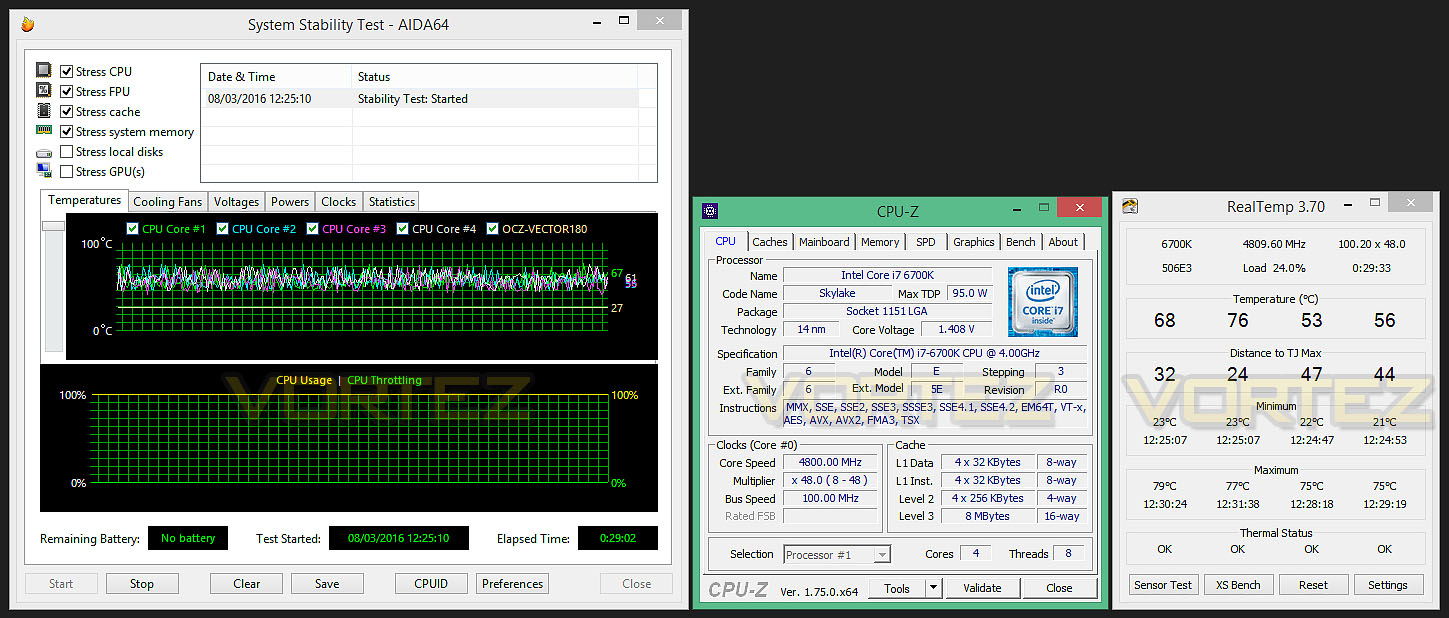
Overclocking with Skylake is now fully flexible since we can adjust many variables including BCLK and ratio/multiplier.
Our current milestone is 4.8GHz with the Intel Core i7-6700K and we’re happy to report that Impact was able to hit this mark easily. To attain this milestone we required 1.38 CPU voltage and 100×48.
Benchmarks: Power Consumption
It’s interesting to note the power consumption across all motherboards. Although they are using the Z170 chipset, energy results can fluctuate between manufacturers due to the features and specifications that are integrated. First of all, for the idle tests the system is cold booted into Windows and no additional applications are executed – the watts are noted on the external energy monitor we use and then the system is loaded with 3DMark FireStrike – watts are again monitored for the duration of the test and the highest rated wattage result is then noted down. Below are the results of this energy test.
Benchmarks: X264 HD
Simply put, this test measures how fast your machine can encode a short, DVD quality MPEG-2 video clip into a high-quality x264 video clip. What’s x264, you ask? It’s more or less the next-generation Xvid/DivX codec. I think it’s ideal for a benchmark because the application (x264.exe) reports fairly accurate compression results (in frames per second) for each pass of the video encoding process, and it uses multi-core processors very efficiently.
Benchmarks: AIDA64
AIDA64 Product PageThis simple integer benchmark focuses on the branch prediction capabilities and the misprediction penalties of the CPU. It finds the solutions for the classic “Queens problem” on a 10 by 10 sized chessboard. At the same clock speed theoretically the processor with the shorter pipeline and smaller misprediction penalties will attain higher benchmark scores. For example — with HyperThreading disabled — the Intel Northwood core processors get higher scores than the Intel Prescott core based ones due to the 20-step vs 31-step long pipeline. CPU Queen test uses integer MMX, SSE2 and SSSE3 optimizations.
Benchmarks: Cinebench R15
CINEBENCH is a real-world cross platform test suite that evaluates your computer’s performance capabilities. CINEBENCH is based on MAXON’s award-winning animation software CINEMA 4D, which is used extensively by studios and production houses worldwide for 3D content creation. MAXON software has been used in blockbuster movies such as Iron Man 3, Oblivion, Life of Pi or Prometheus and many more.
Benchmarks: SiSoftware SANDRA
SANDRA isn’t always a benchmark that is included in hardware reviews but we believe it shouldn’t be ignored. SANDRA provides a vigorous package that tests your system in a rather large array of benchmarks. There are many aspects of benchmark that can be executed. We will be considering – CPU and memory tests.
Benchmarks: 3DMark
3DMark FireStrike Product PageFire Strike is our new showcase DirectX 11 benchmark designed for high-performance gaming PCs. It is our most ambitious and technical benchmark ever, featuring real-time graphics rendered with detail and complexity far beyond what is found in other benchmarks and games today. Fire Strike will only be available in the Windows editions of 3DMark initially.
Benchmarks: PCMark 8
PCMark 8 combines performance benchmarking with battery life measurement and includes tests based on popular Adobe and Microsoft applications. Whether you are looking for long battery life, or maximum power, PCMark 8 will help you find the devices that offer the perfect combination of efficiency and performance for your needs. It’s the complete PC performance benchmark for home and business.
Benchmarks: Tomb Raider & THIEF
It’s important for us to perform a number of game benchmarks as well as the synthetic tests because gamers will want to know if there are any significant benefits. So here we have two popular and recent gaming titles which feature a dedicated benchmark tool within them to display results.
Conclusion
Demand for Mini-ITX motherboards has increased significantly over the past few years as enthusiasts trade the larger ATX form factor in order to utilise a compact system configuration. Although there are Mini-ITX Intel Z170 motherboards out there, manufacturers do have a tendency to compromise on features due to size constraints, whereas ASUS has been able to still deliver their well-known, trademark features in today’s fine example.
Although much of the motherboard will be concealed by components once the system has been built, Impact adopts the finesse seen on other ROG Z170 motherboards. The PCB uses a matt black finish while slots, ports, lanes and the heatsinks also use black too. Unlike previous generations of ROG motherboards, there is very little red seen across the motherboard.
In the Mini-ITX segment, Impact’s feature-set will likely set it apart from other options. This motherboard is packed with features which both gamers and enthusiasts will find useful. Although there is no space on the actual board itself for management buttons, ASUS has used initiative and designed Impact to have a designated area on the rear IO for such usage. Impact also features a U.2 port which most brands are steering clear of since its still early days for this standard. But with that being said, having such an option on the motherboard will still future-proof a configuration anyway.
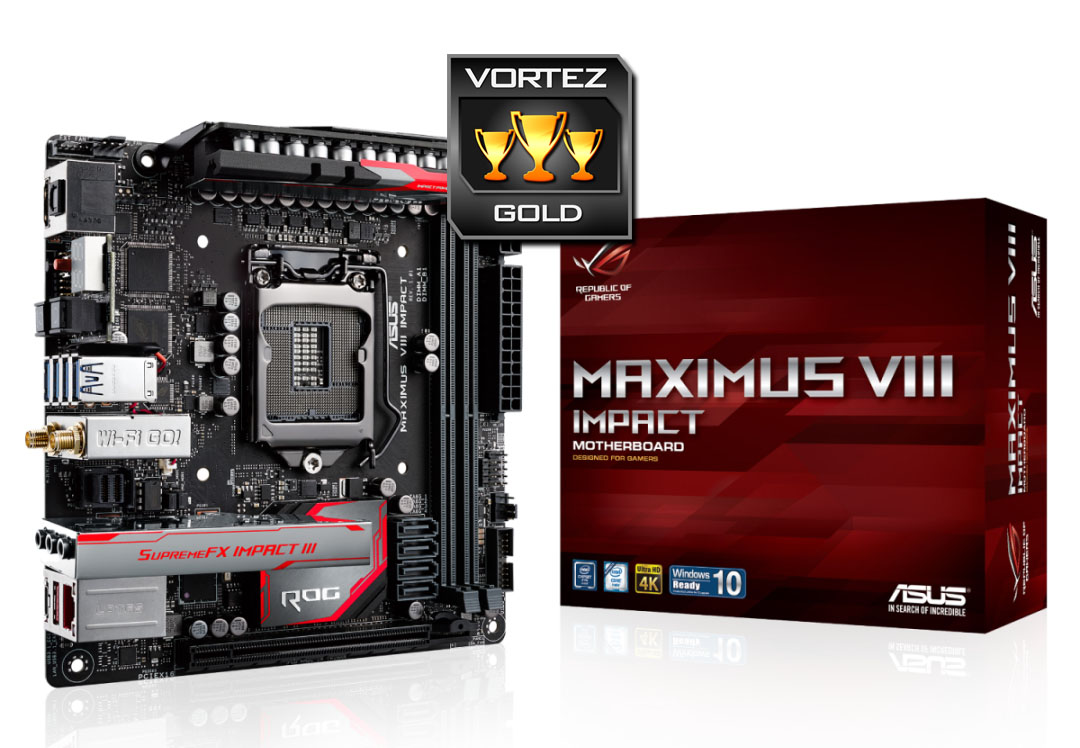
Throughout our series of tests Impact dealt with the varied benchmarks very well indeed. This motherboard might be small, but it still packs a punch! The other aspect which is especially encouraging is how well Impact overclocks. Our current milestone with the Intel Z170 chipset and our trusty Intel Core i7-6700K, is 4.8GHz – Impact managed to reach this mark with ease and we have high hopes that this motherboard can take another CPU even further.
Our only real gripe with Impact is the lack of M.2 support on the motherboard. Adding such a feature would prove rather beneficial given the increasing number of drives hitting the market at attractive price-points.
Being priced at £187 GBP / $238 USD, Impact is quite a pricey investment for those wanting to downsize but it’s important to keep in mind all of the included features, bundled accessories and a generous 3-year warranty.
ASUS has proven why they dominate the Mini-ITX sector; the Maximus VIII Impact crams almost every conceivable feature into a small workspace and doesn’t shy away from offering the very best features for users planning a move to Intel Skylake.
VIDEO REVIEW – VORTEZ TV
Pros
+ Attractive to the eye
+ Great use of space
+ Strong feature-set
+ Excellent performance
+ Overclocks very well
+ Includes U.2 support
+ Comes with 3-years warranty
Cons
– Lacks M.2 support
– Pricey
+ Attractive to the eye
+ Great use of space
+ Strong feature-set
+ Excellent performance
+ Overclocks very well
+ Includes U.2 support
+ Comes with 3-years warranty
Cons
– Lacks M.2 support
– Pricey
Click here for an explanation of our awards at Vortez.net.