ASUS are renowned for their cutting edge designs and this can be seen in the STRIX 7.1 gaming headset. With 5 drivers in each side, can this deliver the ultimate gaming experience?

Product on Review: ASUS STRIX 7.1
Manufacturer & Sponsor: ASUS
Street Price: £150
There are many great choices of headsets out there that can take your gaming experiences to the next level of immersion that your favourite games all deserve. This market can be particularly challenging where performance, usability and original design can be just as important as each other and then it has to be at a desirable price point. ASUS being ASUS, in their ever evolving innovative development plans, managed to mash an avian predator to create an original line of gaming products… enter STRIX.
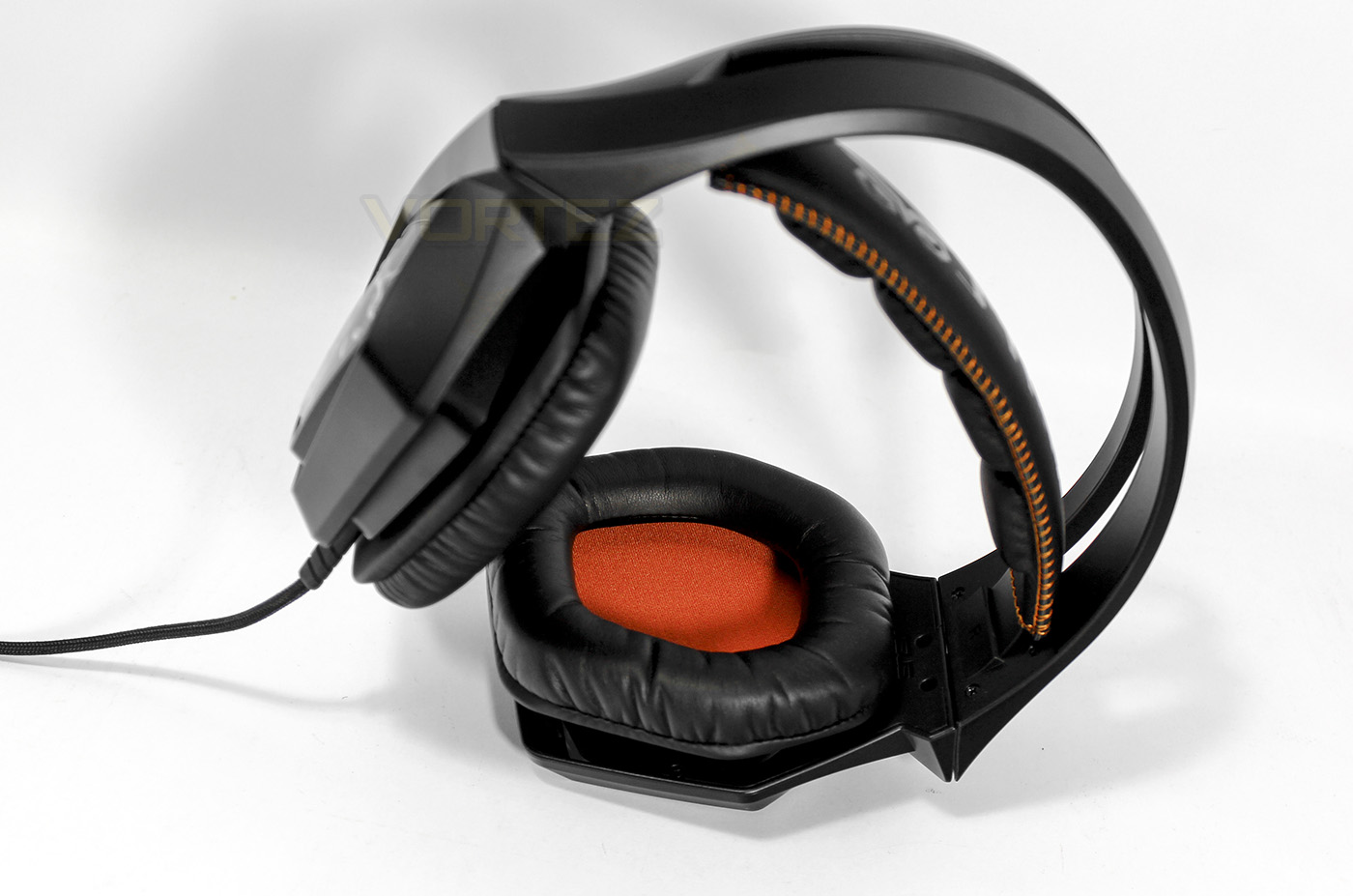
The STRIX headset is a suspension design with some funky angles to the frame while on each earcup there is a glowing eye that, when folded flat, looks like the STRIX cyber owl staring at you, kudos for original design. The STRIX 7.1 represents the pricier surround option which has Crammed in a total of 10 drivers, 2x 40mm drivers, a 30mm driver and 2x 20mm on each side making the STRIX 7.1 geared to provide real rendering of 7.1 surround sound. To help control this headset ASUS have also included a USB audio station which has a fair few tricks up its sleeve too!
Overview by ASUS
Strix 7.1 is a superior true 7.1 surround gaming headset engineered with 10 powerful discrete neodymium-magnet drivers, full-size hexagonal ear cushions (130mm across at the widest point) and stylish static and breathing lighting effects. It is accompanied by a driver-free USB audio station that features loads of audio controls and sound effects. Strix 7.1 provides an unrivaled audio experience with punchy and immersive sound. Every gunshot and footstep is reproduced with accurate positioning and stunning clarity, bringing the battlefield to life.
Technical Specifications
General Info
Compatibility: PC, MAC
Connector: USB
Headphones
Driver diameter : Front : 40 mm, Subwoofer : 40 mm, Center : 30 mm, Side : 20 mm, Rear : 20 mm
Driver material : Neodymium magnet
Impedance: 32 Ohm ± % @ Hz
Frequency Response (headphones): 20 ~ 20000 Hz
Microphone
Microphone boom: Uni-directional
Frequency Response: 50 ~ 16000 Hz
Sensitivity : -40 dB
General Info
Cable: Braided fibre cable (headset cable 1.5M + USB cable 1.5M = 3M (Max.)
Cable Length: 3 meter
Weight: 450 g
Accessories
Detachable microphone
USB cable
Quick start guide
USB audio station
HDMI-to-3.5mm speaker splitter cable
Warranty Note
Audio station
ENC performance: >90% environmental noise cancellation
Power: USB powered
Features: Headphone amplifier, stereo mode, environmental noise cancellation, game audio spectrum profiles
Speaker output: speaker jack with HDMI-to-3.5mm speaker splitter cable included
Compatibility: PC, MAC
Connector: USB
Headphones
Driver diameter : Front : 40 mm, Subwoofer : 40 mm, Center : 30 mm, Side : 20 mm, Rear : 20 mm
Driver material : Neodymium magnet
Impedance: 32 Ohm ± % @ Hz
Frequency Response (headphones): 20 ~ 20000 Hz
Microphone
Microphone boom: Uni-directional
Frequency Response: 50 ~ 16000 Hz
Sensitivity : -40 dB
General Info
Cable: Braided fibre cable (headset cable 1.5M + USB cable 1.5M = 3M (Max.)
Cable Length: 3 meter
Weight: 450 g
Accessories
Detachable microphone
USB cable
Quick start guide
USB audio station
HDMI-to-3.5mm speaker splitter cable
Warranty Note
Audio station
ENC performance: >90% environmental noise cancellation
Power: USB powered
Features: Headphone amplifier, stereo mode, environmental noise cancellation, game audio spectrum profiles
Speaker output: speaker jack with HDMI-to-3.5mm speaker splitter cable included
Packaging & Bundle
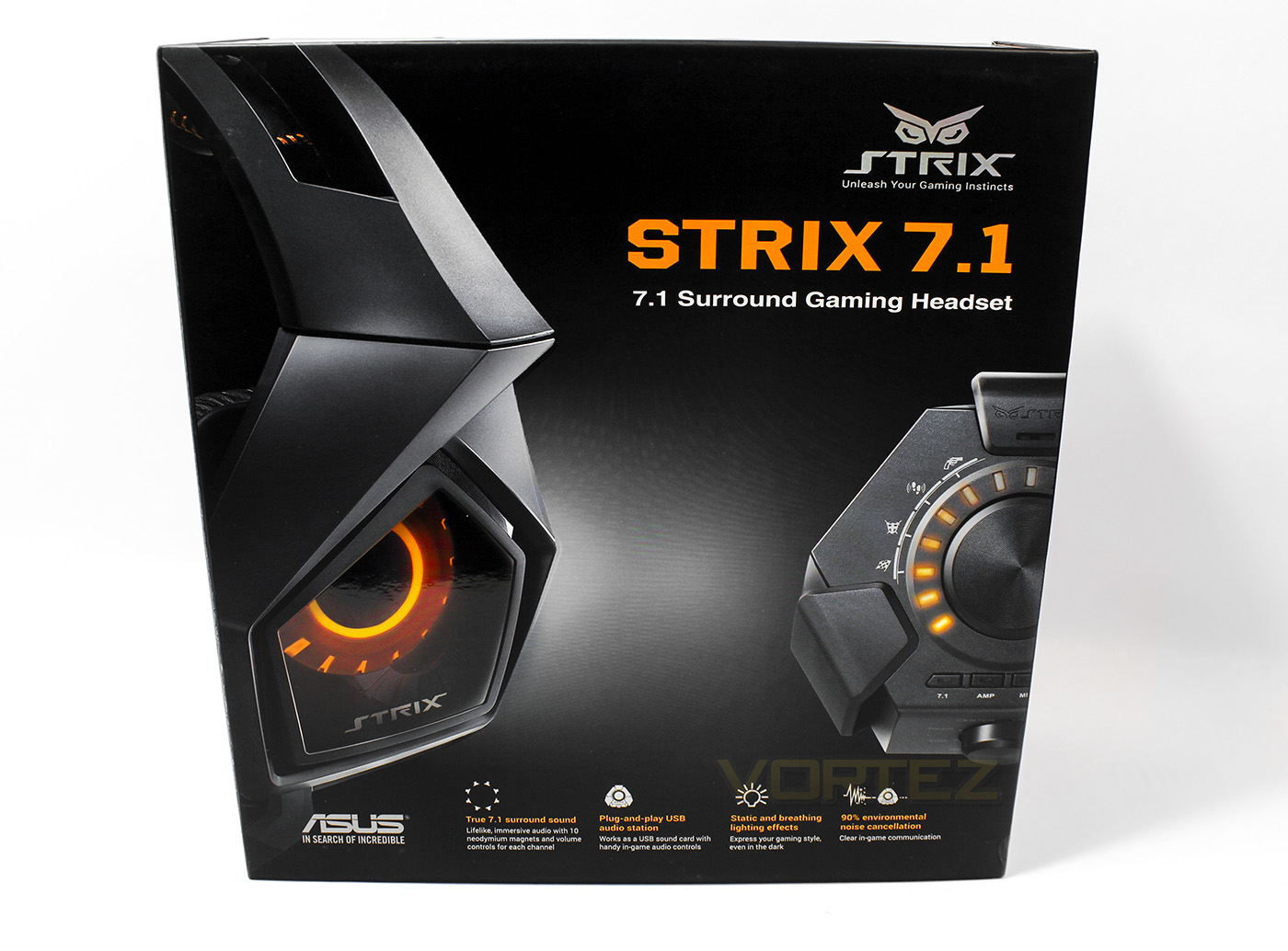
The front of the packaging sets the tone with a side profile of the headset mimicking the owl concept. The overall first impression is very ‘gamer’ yet manages to show original thought, class and quality.
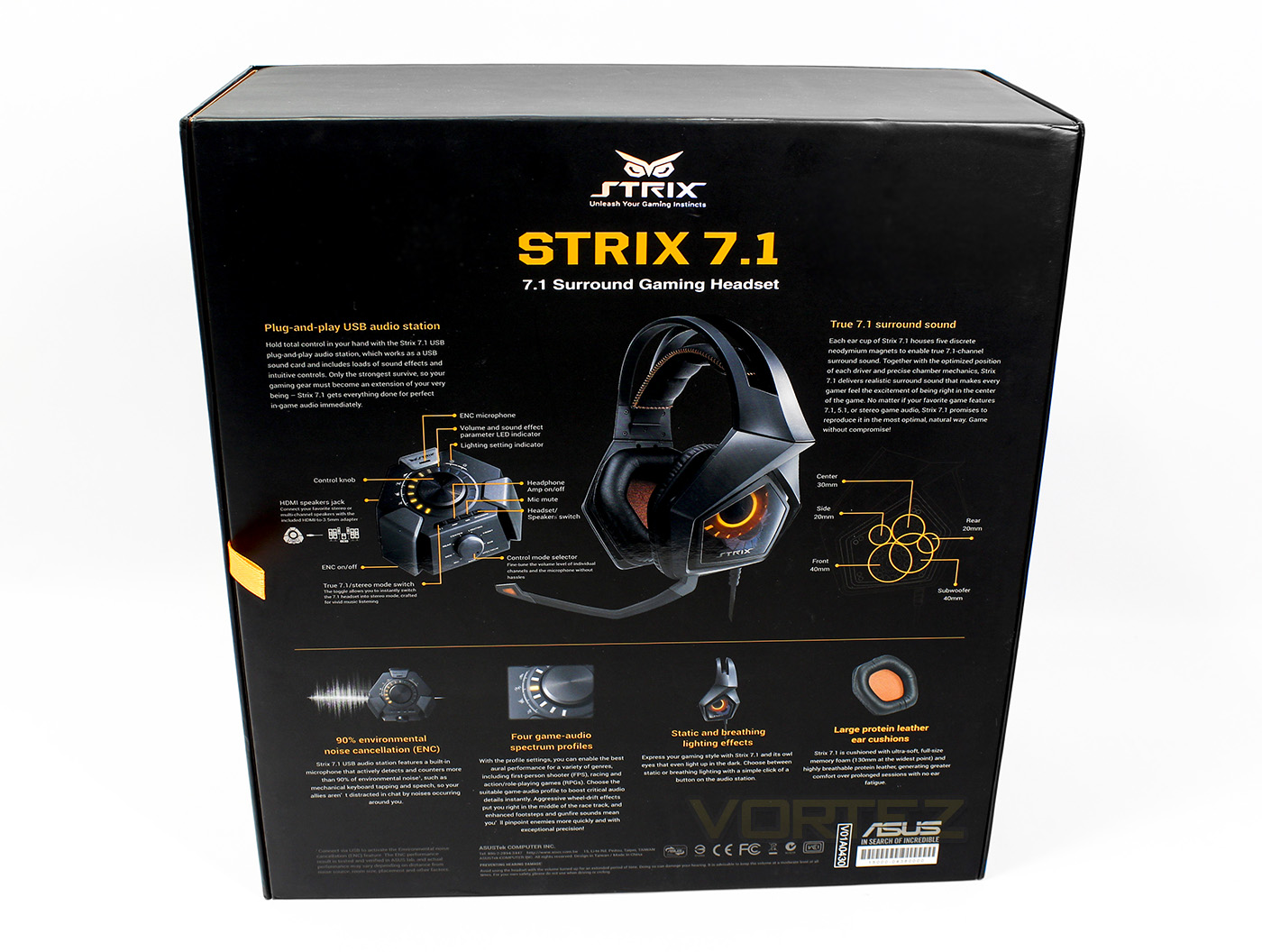
At the back there is information about the audio station and its feature as well as a diagram of the driver layout inside the earcups.
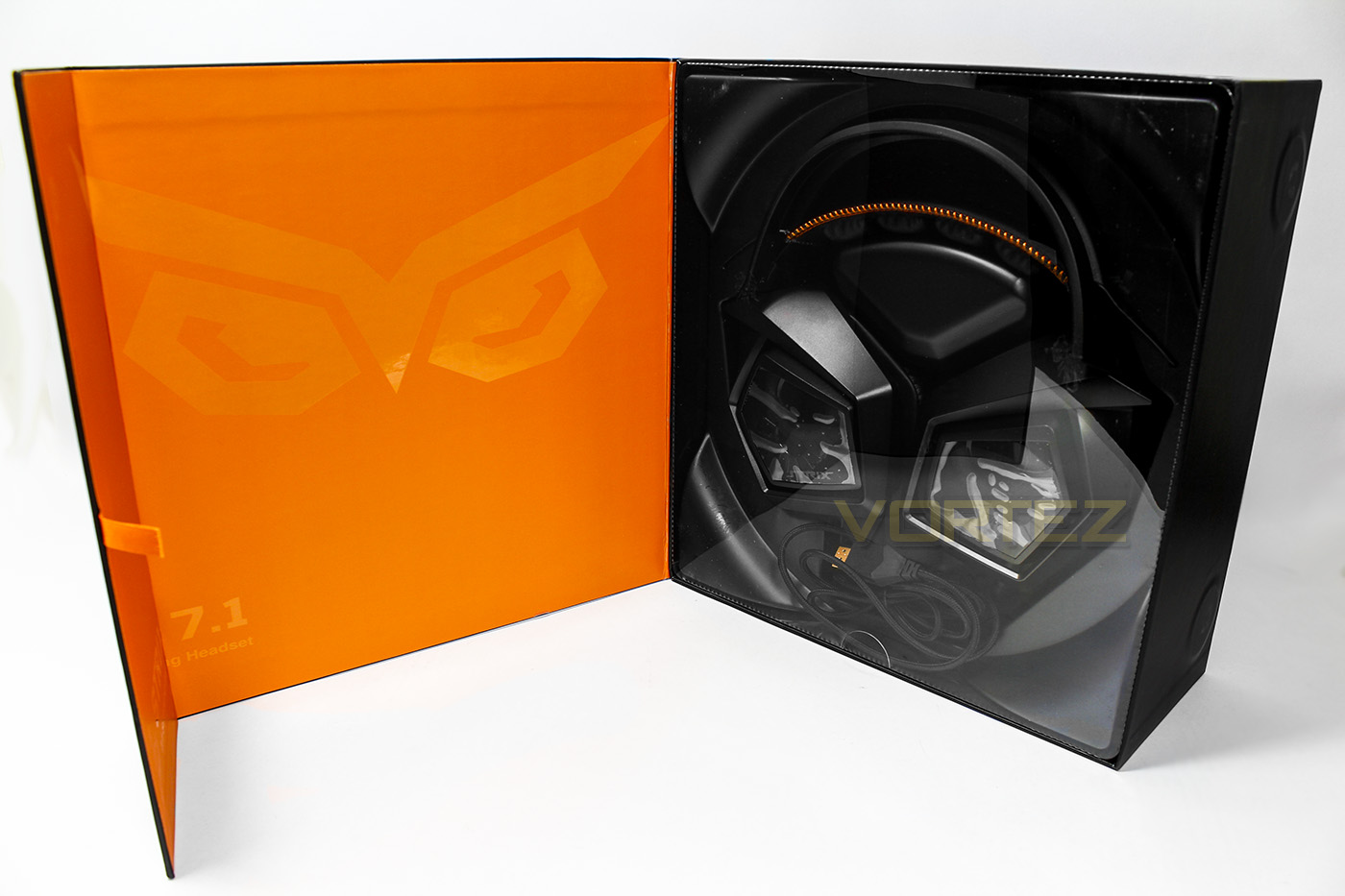
The box can be opened up to see the headset inside, the accessories reside underneath the headset.
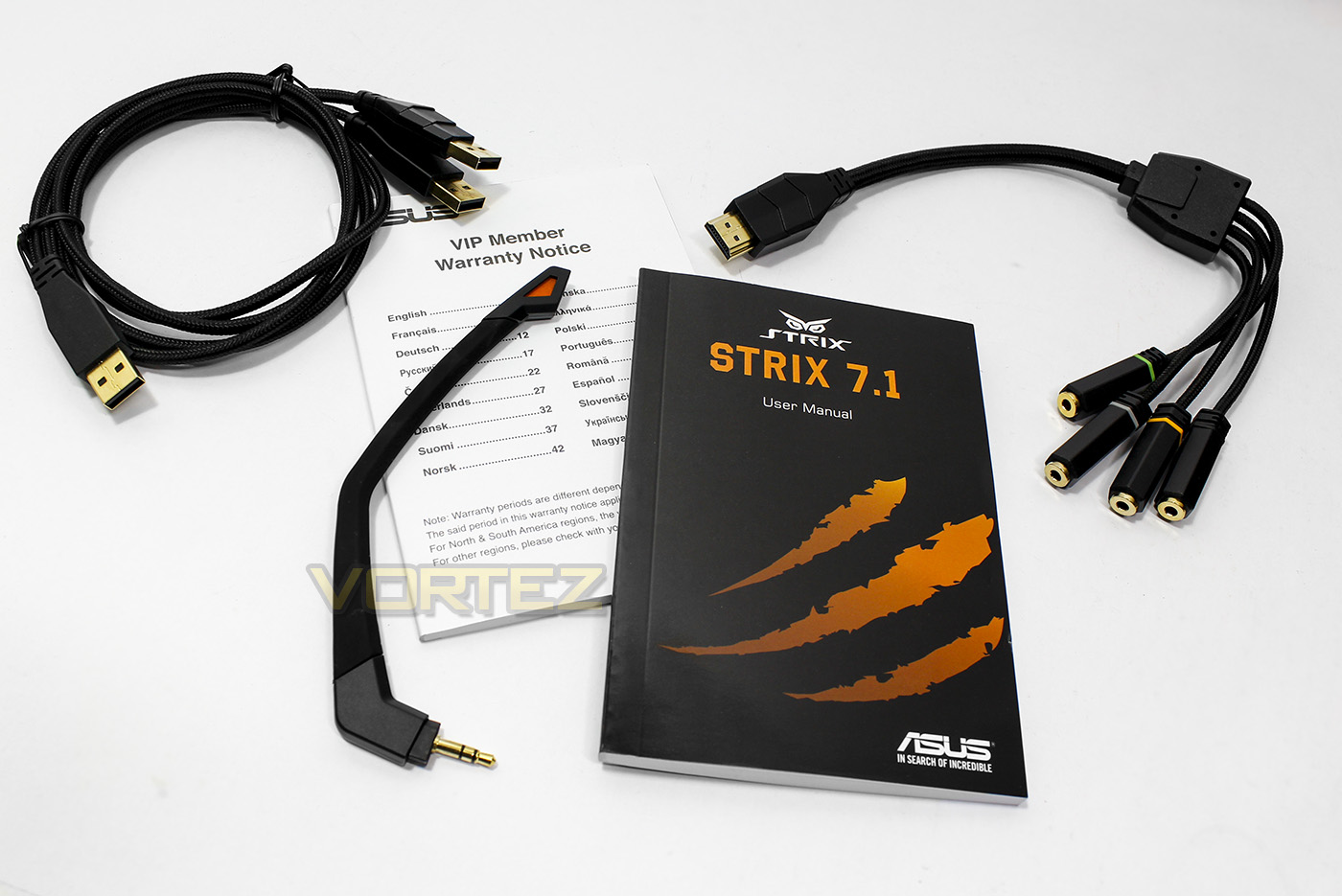
Inside we get a huge multi language manual, a USB to 2x USB cable, HDMI to 4x 3.5mm jacks as well as the removeable microphone boom.
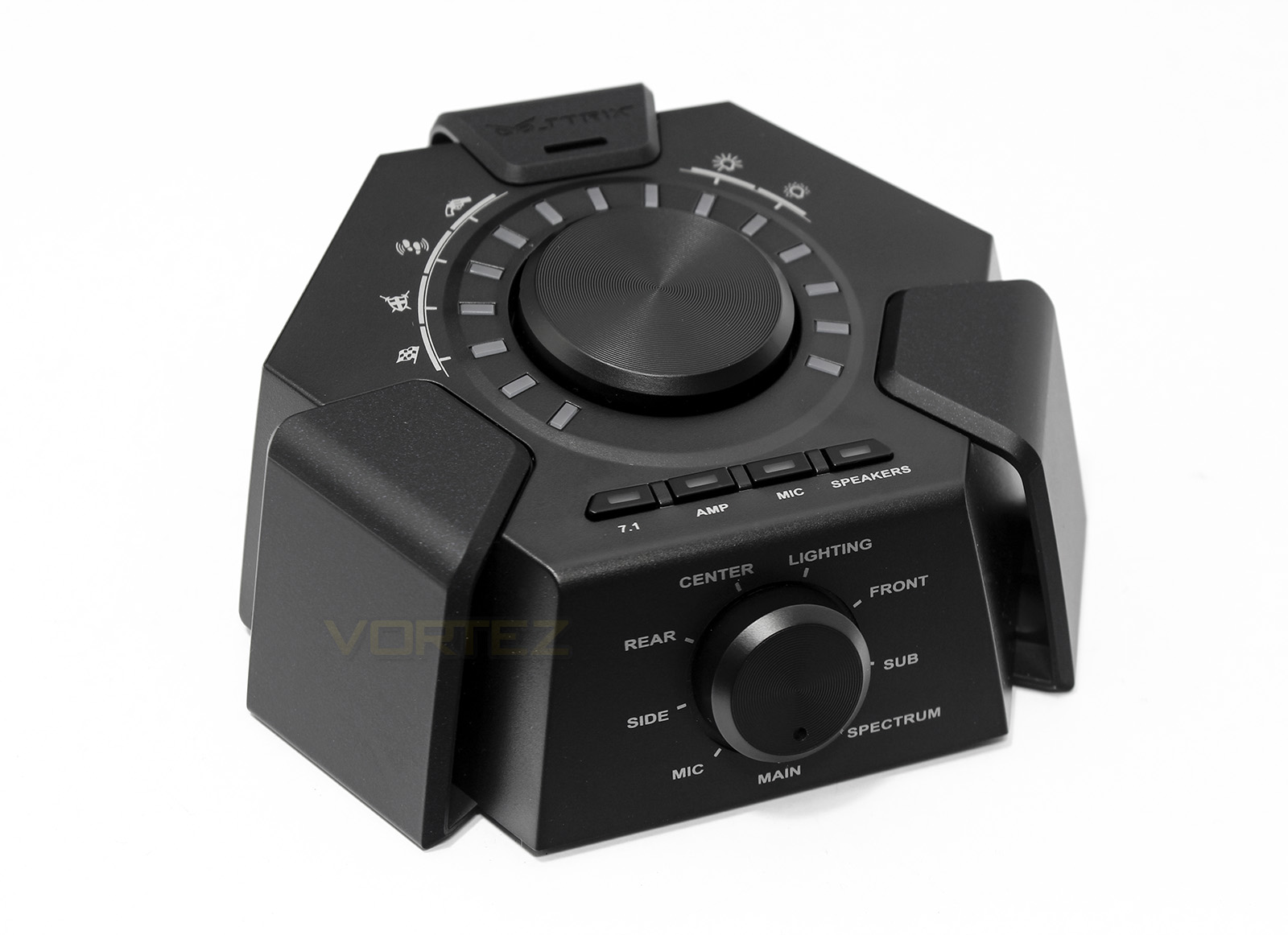
The audio station looks fairly complicated, with a mode dial at the front and control dial on top. Unlike previous solutions we have seen in the past, it is good to see that this is completely seperated from cables.
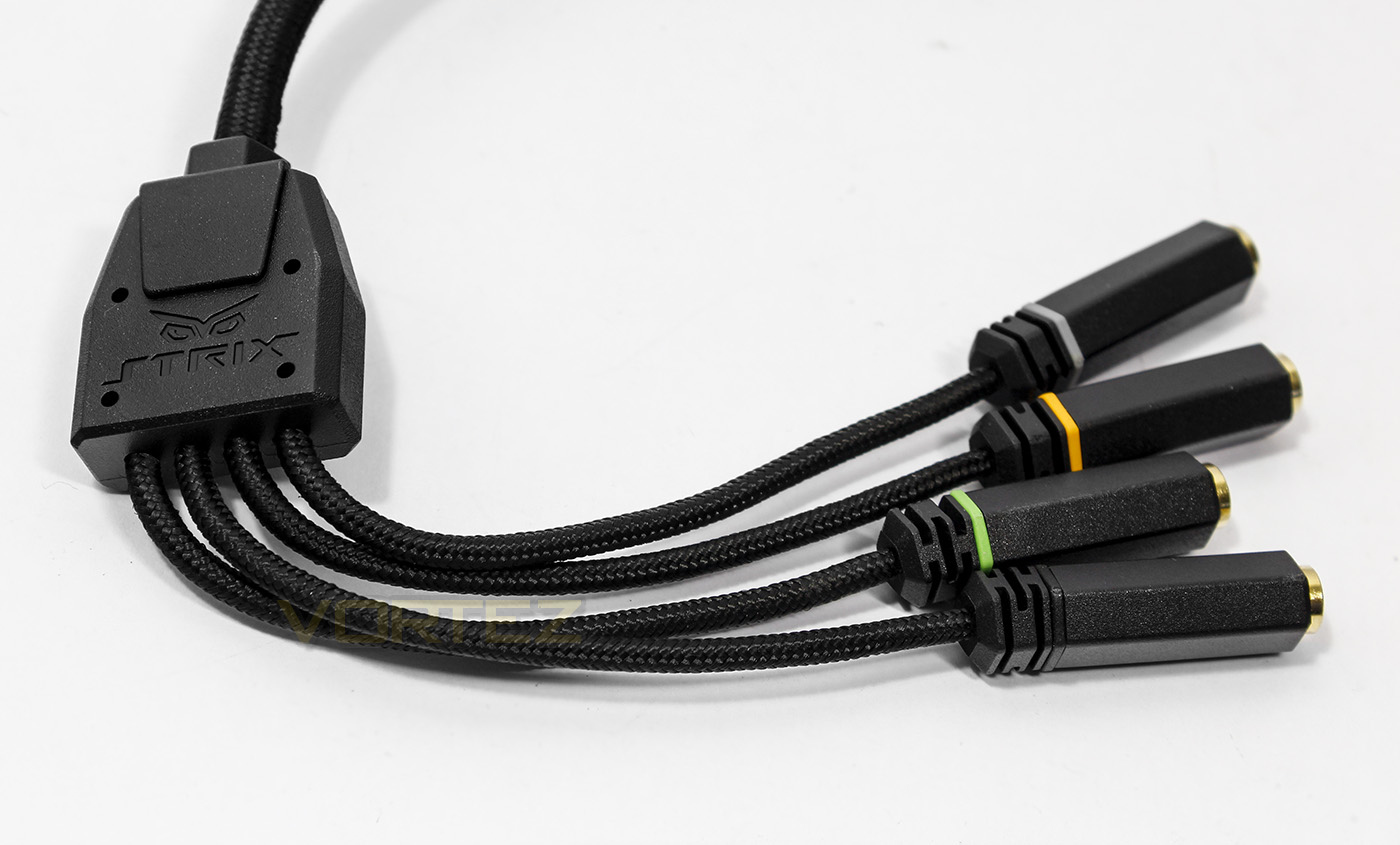
The cables are all customised with the STRIX branding and are braided.
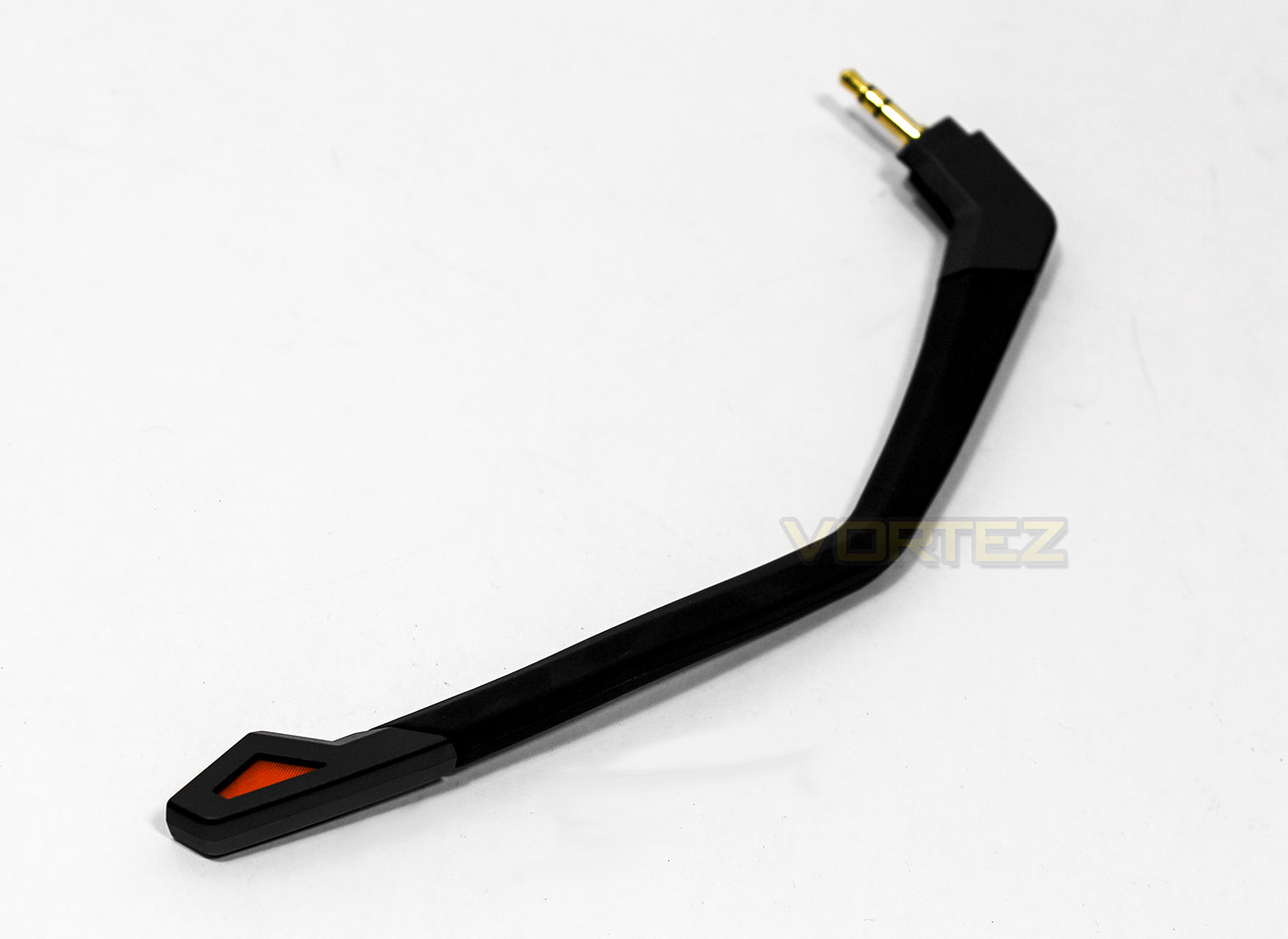
The removeable microphone boom is flexible and can easily be bent to desired position. The tip is covered with an orange mesh which keeps in tone with the rest of the design.
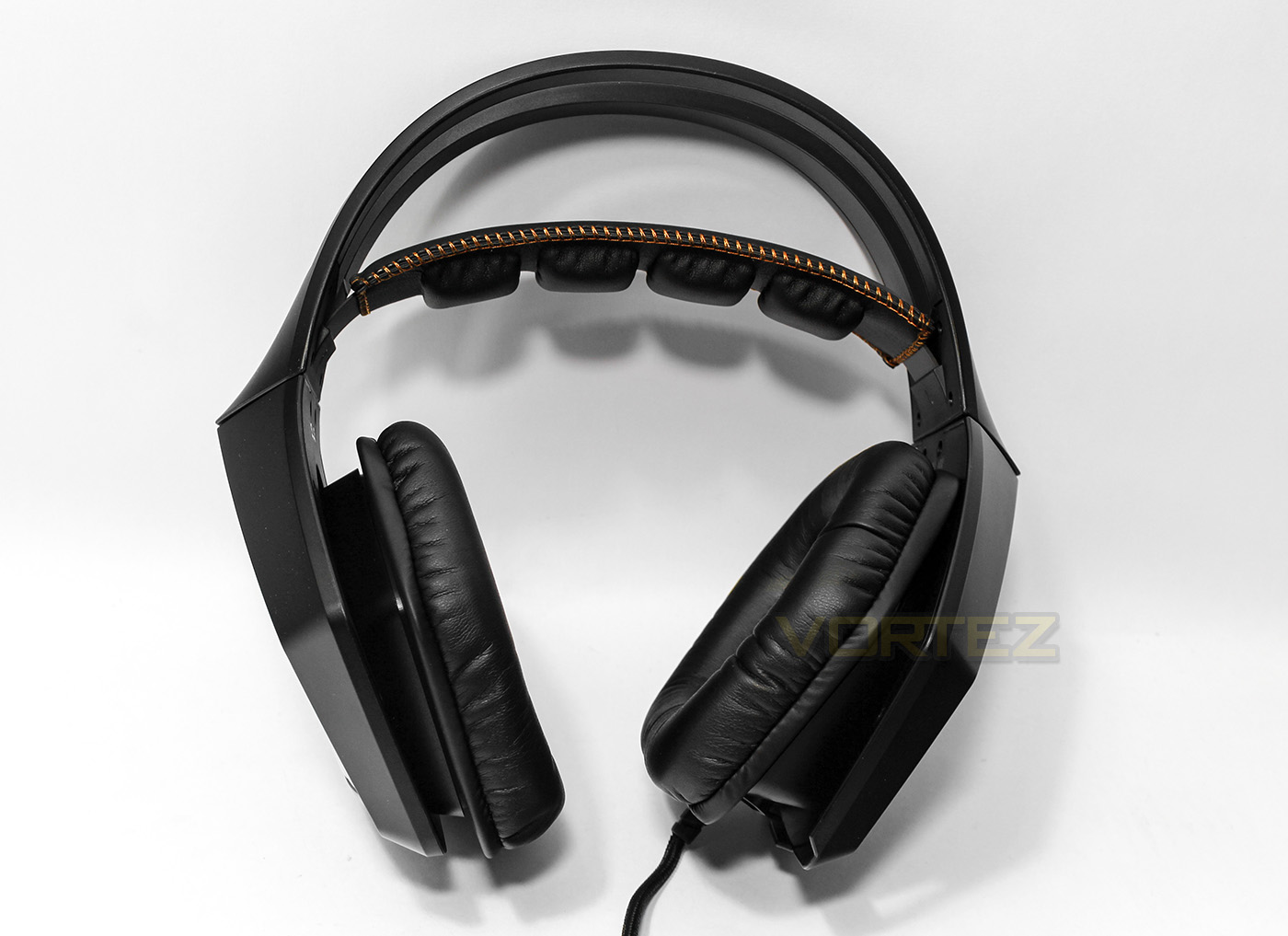
The STRIX 7.1 headset.
Closer Look
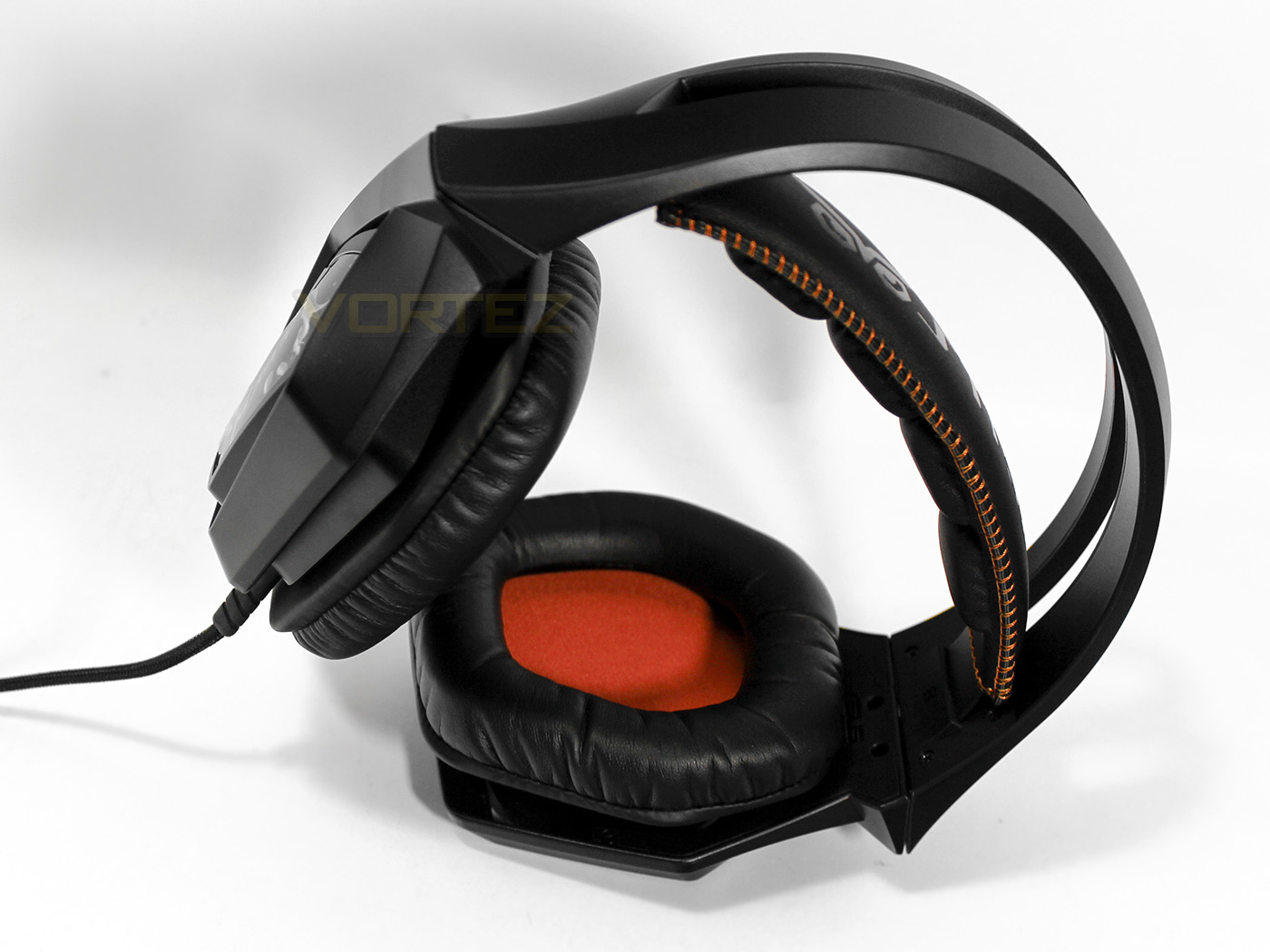
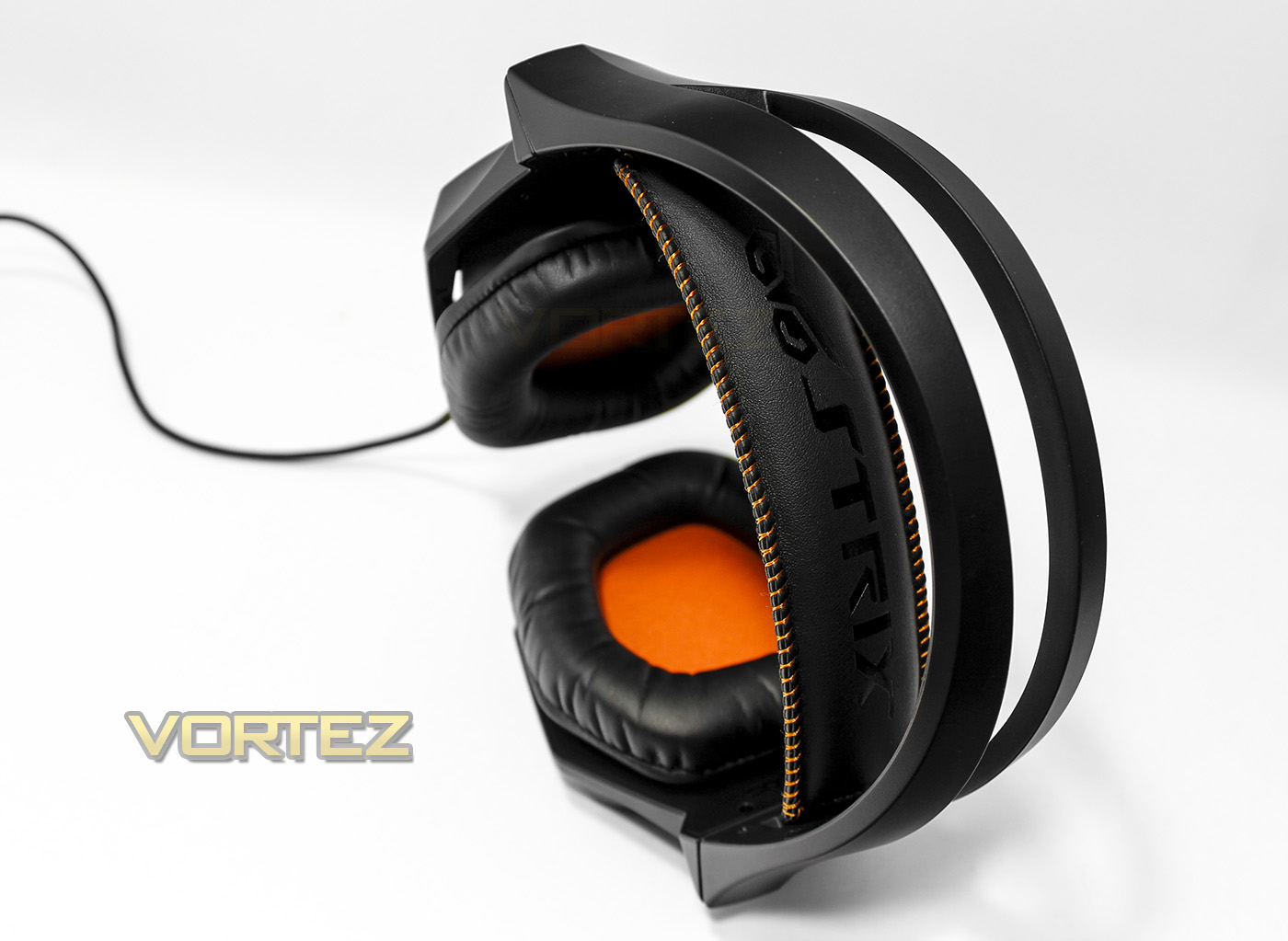
The headband easily adjusts to size due to the suspension design. It is a shame that the cable is hardlined into the headset but at least we have partial modularity.
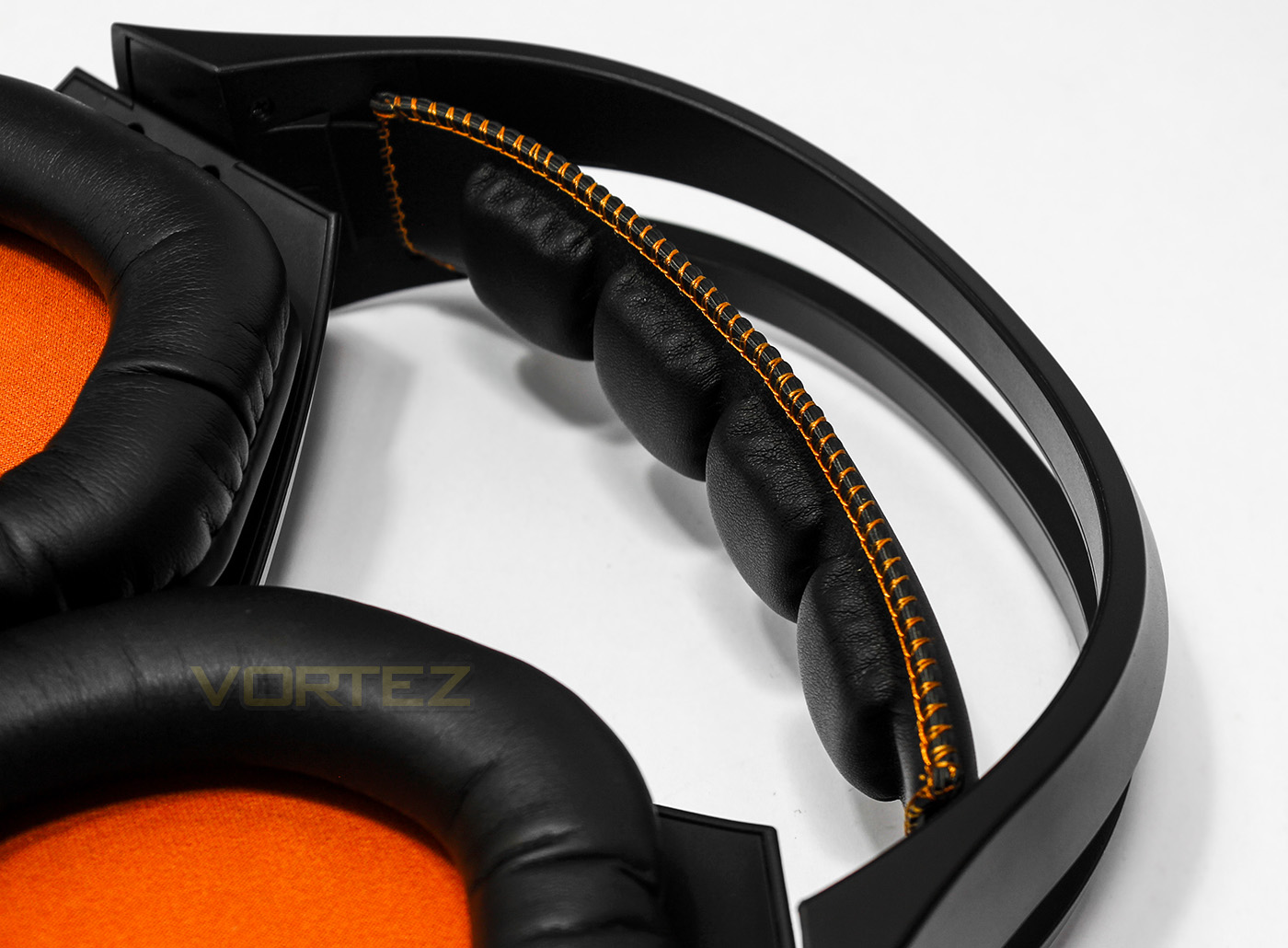
The headband is soft leather with vibrant orange stitching and contains four squishy cushioning pads for comfort.
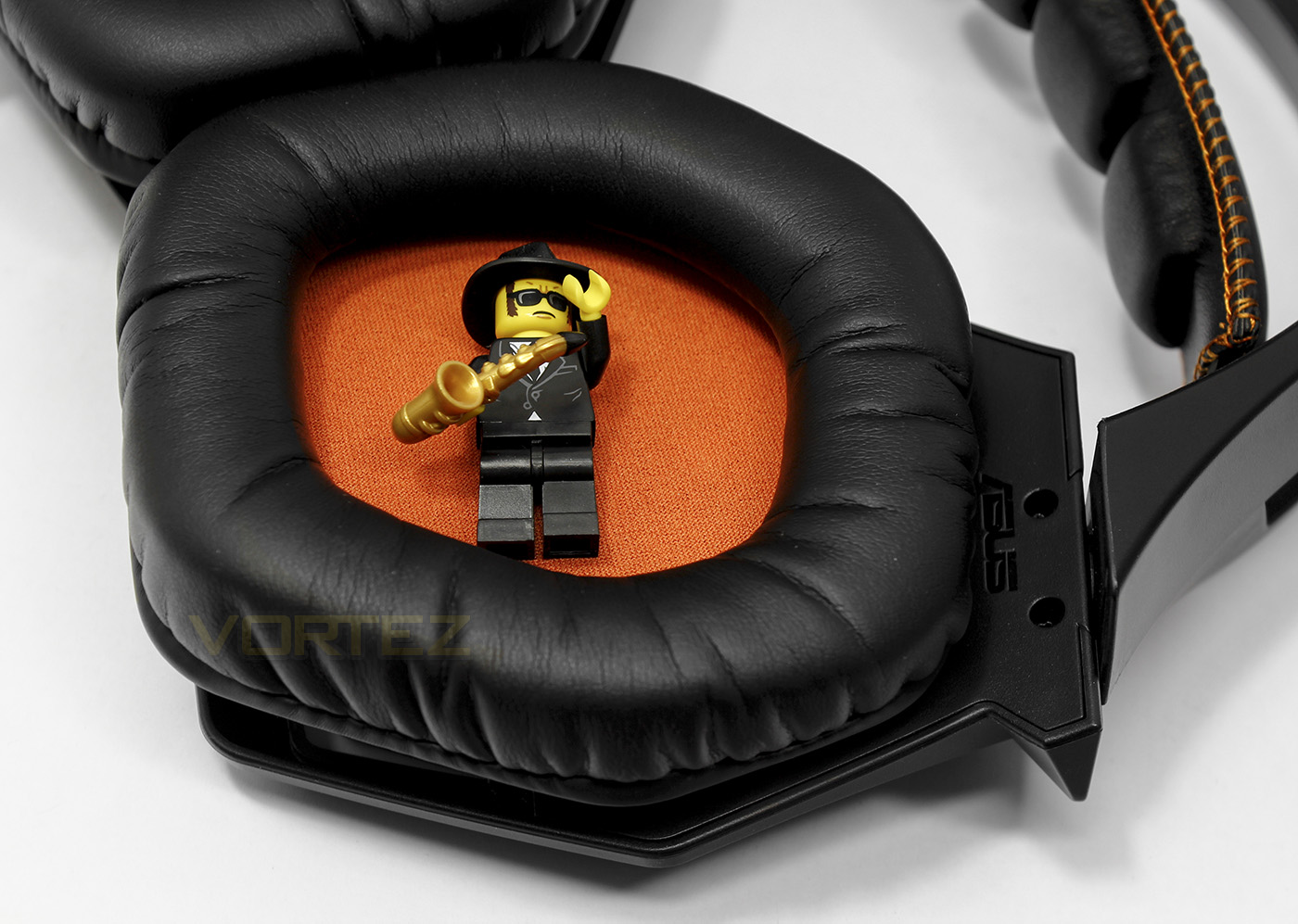
The earcups are huge and should be accommodating enough for the majority of peoples ear size.
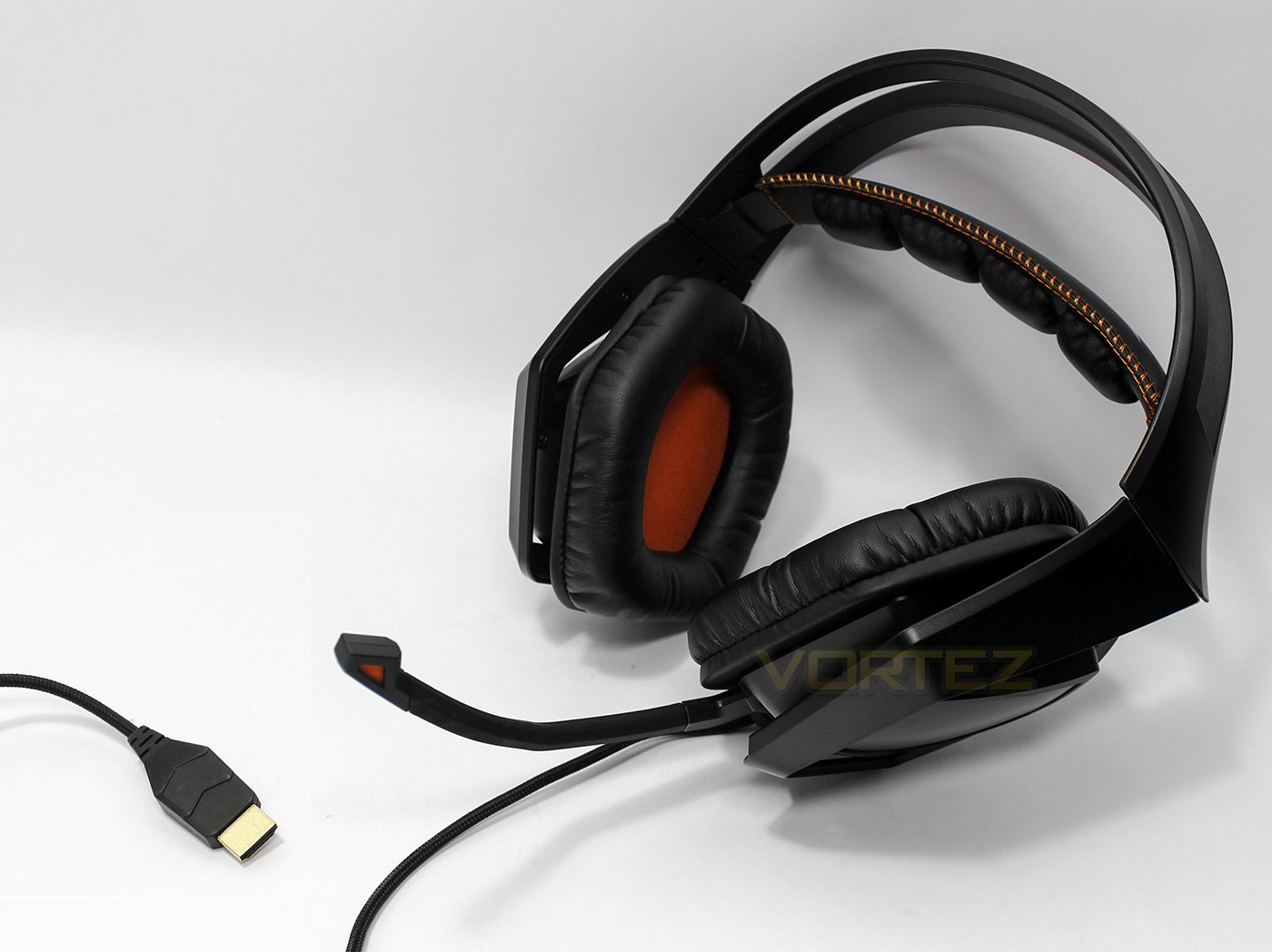
The microphone boom plugs into the left side earcup, it is also worth nothing that the STRIX 7.1 uses HDMI interface to transfer the data for the 8 audio channels.
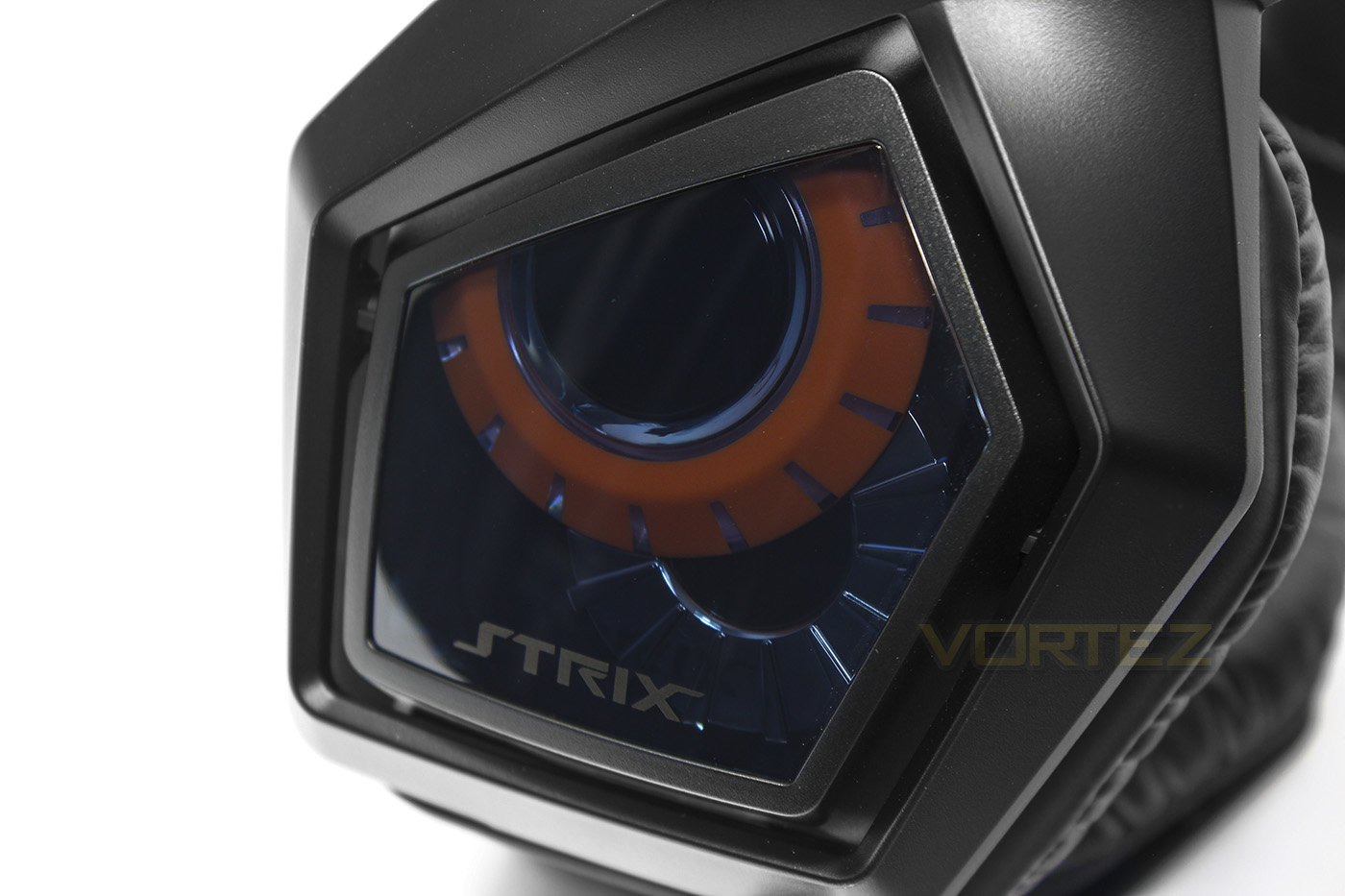
Side of the earcup
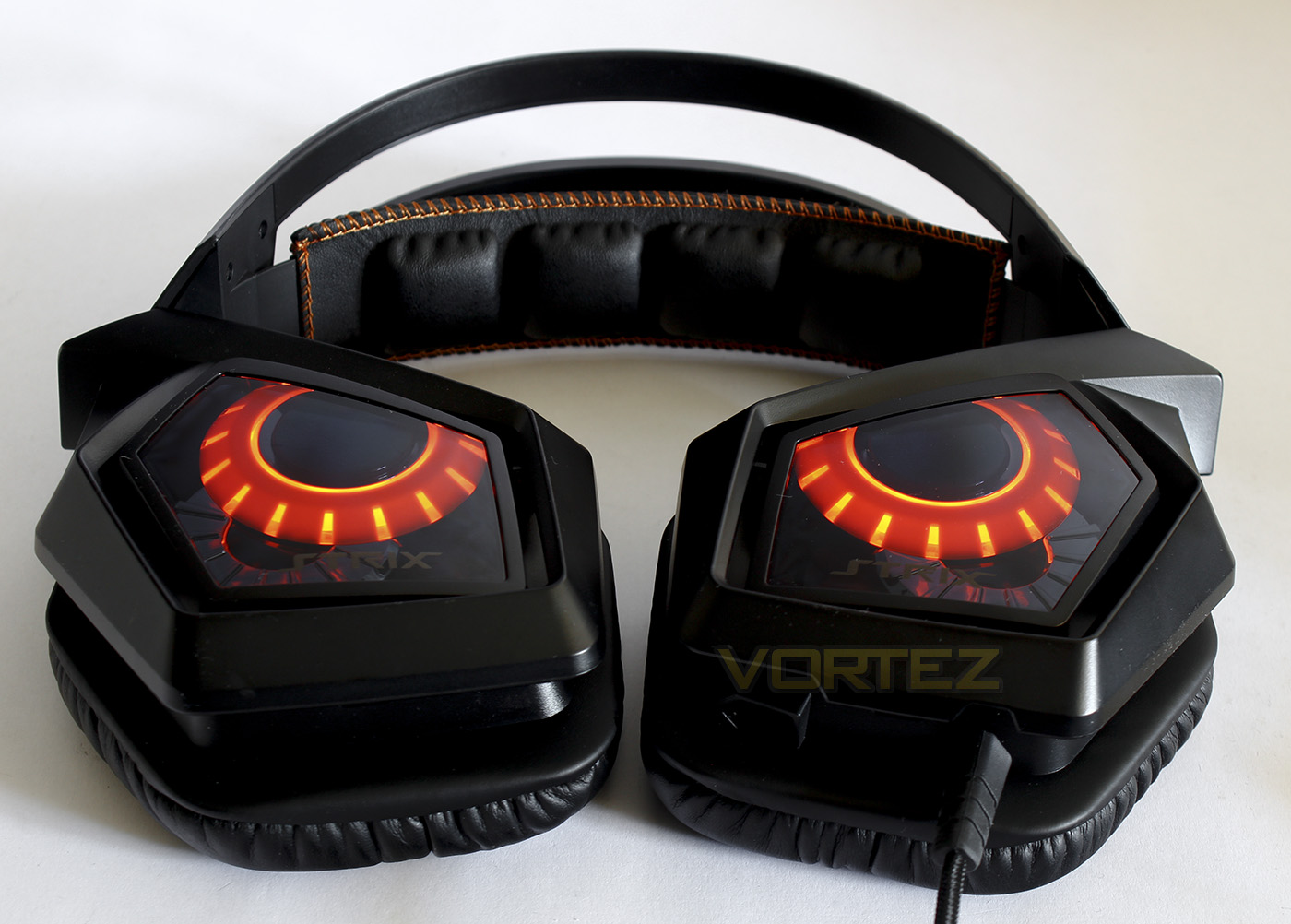
Lit up and folded we get the STRIX owl looking at us. Lighting is available in on or pulsing, unfortunately there is no off or alternate colours but the design is striking and certainly original.
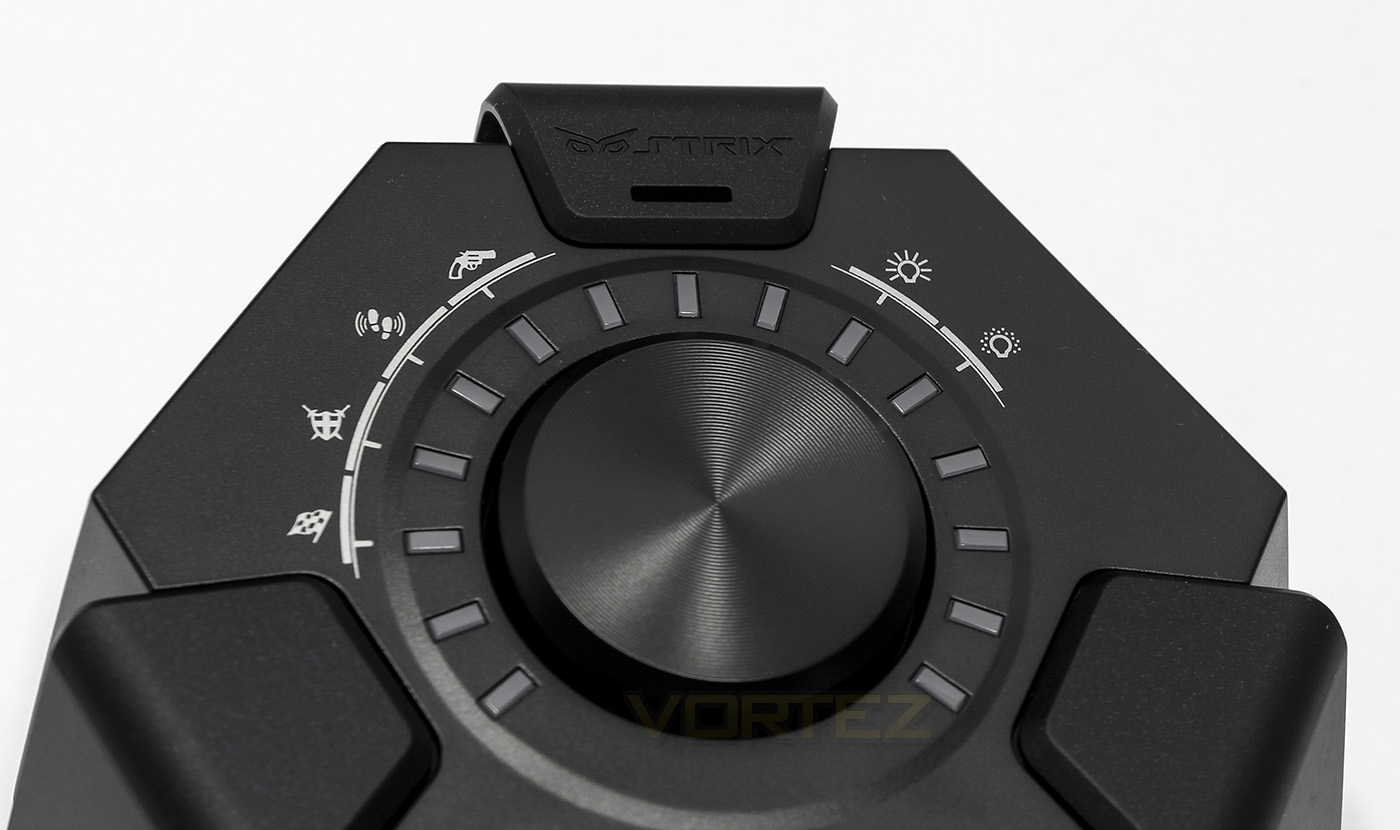
The audio station features various controls to choose from, including preset audio configurations for racing, RPG, footsteps and gunshot priorities, lighting settings as well as featuring an environmental noise cancelling (ENC) microphone which can be enabled by a small switch on the underside of the audio station.
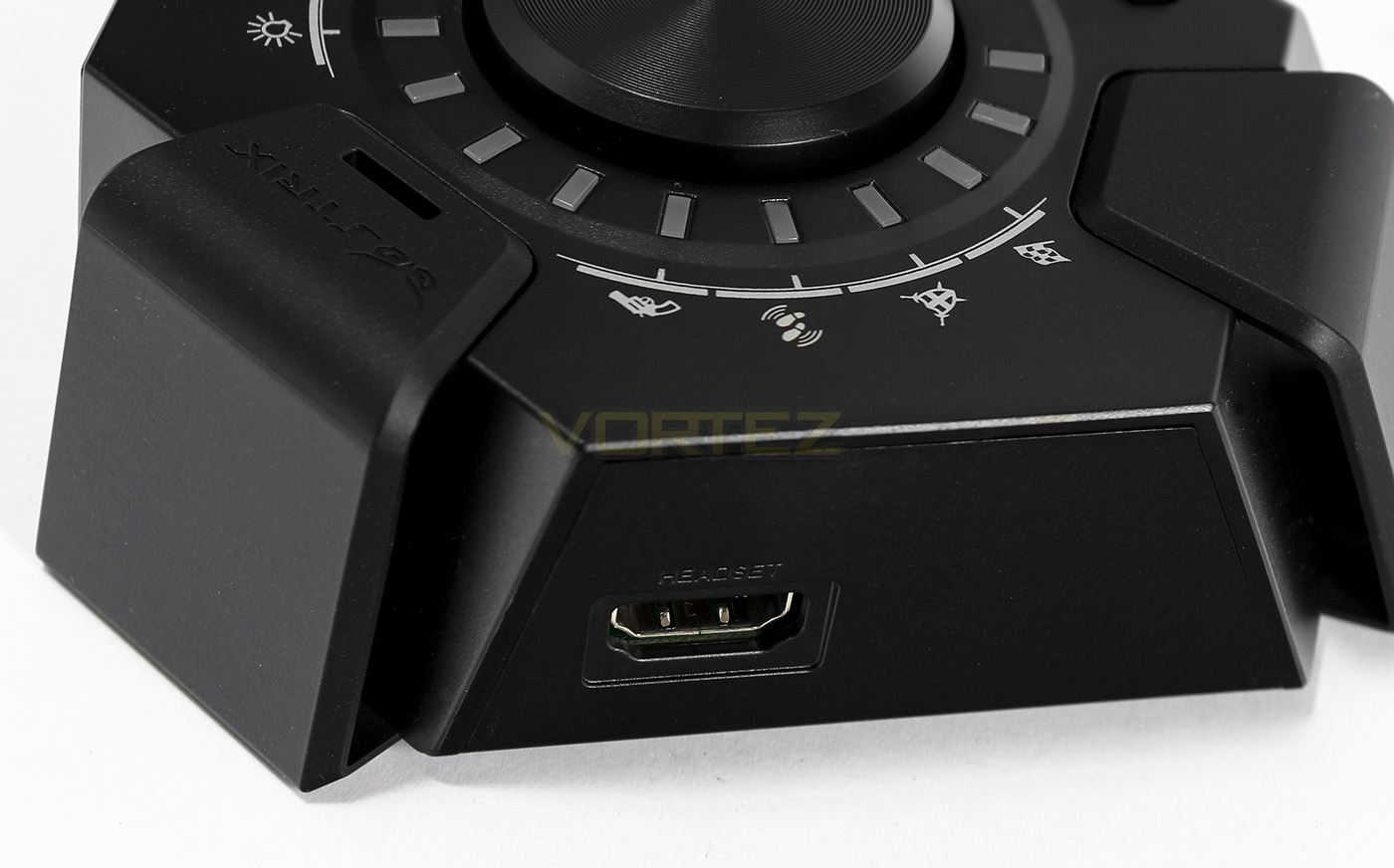
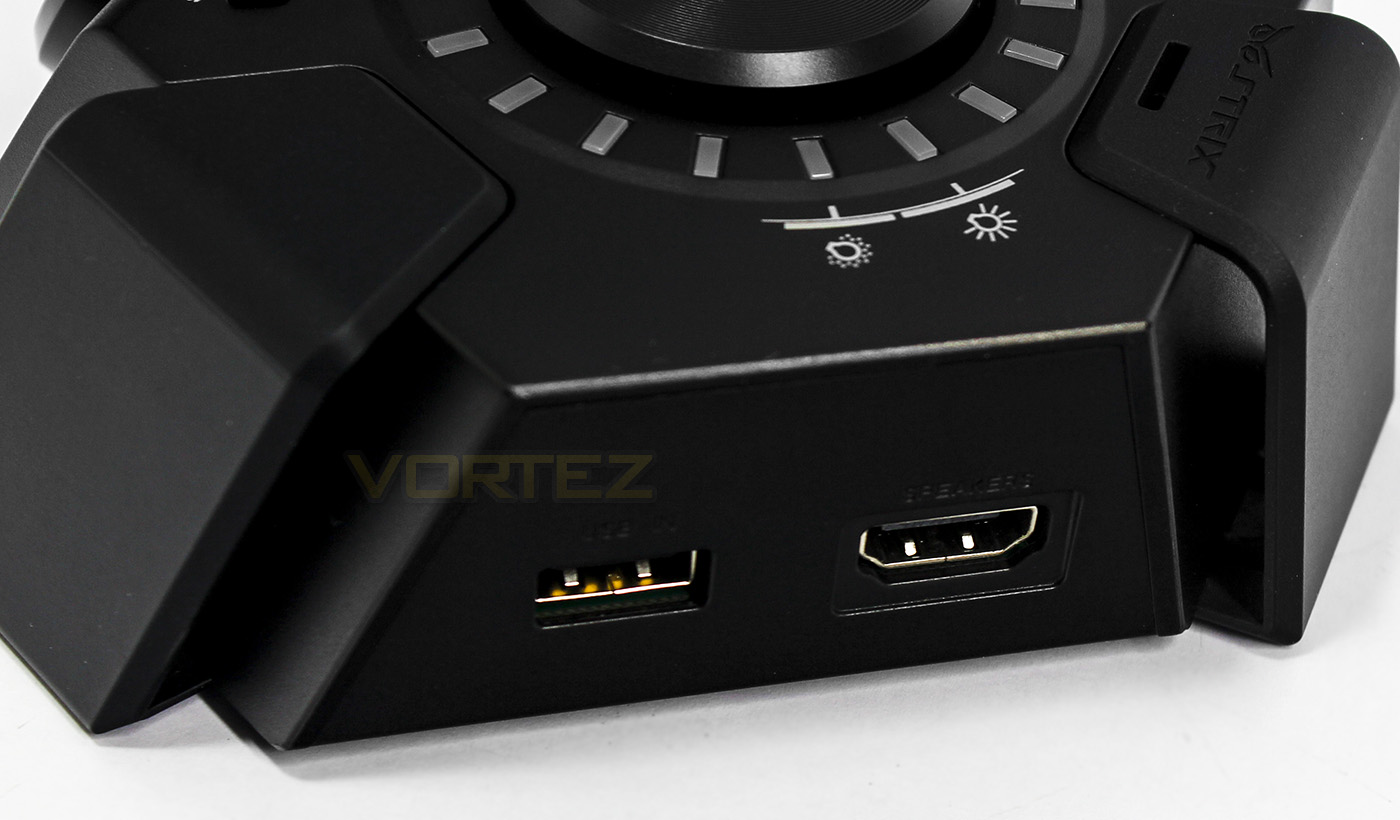
Around the audio station we find the USB input and a HDMI output for both the STRIX headset and for some speakers.
Performance Testing
Setup, Design & Observations
The setup of the STRIX 7.1 headset was very easy due to the plug n play audio station, simply requiring 2x 2.0 USB ports from your PC/MAC to power up then a moment for your system to register the proprietary drivers. The functions of the audio station take a little getting used to, so reading the manual is advisable. The front dial controls the ‘mode’ while the top dial changes the function, so if set to ‘main’ the top dial alters the master volume, or you can press the top dial to mute the volume. There are functions for each audio channel, microphone, preset audio spectrum profiles and lighting mode. There is also a row of 4 buttons on the audio station that allow on the fly controls, including toggling between 7.1 and stereo modes, activating the headphone amp, muting the microphone, or swapping output source to the speakers which can be setup via the included HDMI – 3.5mm jack cable.
On wearing the STRIX headset the first thing noted was that the clamp strength seemed to be a little strong, though with the leather earpads and headband doing their thing, the comfort was good and didn’t us cause any problems, though this could be exacerbated if you are on the larger side.
Multimedia
The downside to using the STRIX 7.1 in stereo mode was that you can no longer control each audio channel, combined with the plug and play drivers there was no real way to change the audio signature (without resorting to using one of the audio presets which are not ideal for music listening). Though by default the audio quality has a deep and rich bass with clear separation in the mids and highs. Some may find the maximum volume a little low without the use of the headphone amp switched on though some may prefer it to be louder still. Overall, listening to various music genres using the stereo mode was enjoyable, though this is not entirely the best means to test a 7.1 surround headset.
Playing a bit of Metro: Last Light, the STRIX 7.1 gave an eerie sense of direction as mutants run around you or picking up distant conversation. There is also a surprising difference between the claustrophobic environments and the open vastness of the surface. Testing it out in various other games, we take a look at the preset spectrum profiles. The gunshot mode certainly added some beef to gunshots by seemingly overpowering the bass, in contrast to the footstep mode which weakens the bass, allowing for better identification of footsteps. These profiles seem to be preset equaliser settings that skew the audio signature enough to sound ‘strange’, requiring a little getting used to. Though the presets seem to be a necessary addition when you consider that there is no supplied software in which a manual equaliser could be included.
In our testing, the directional/ spatial awareness aspect tended to seem pretty flat compared to the ROCCAT Kave 5.1 XTD and undecidedly better than a good virtual 7.1/ stereo surround solution. Though the separation in audio frequencies due to all those drivers did help with picking out and identifying sounds clearly without the addition of that hazy wash of static that many virtual solutions often tend to add. This again was similar when watching various movies (5.1 source is rendered as 5.1 in the headset), the soundstage seemed fairly limited and didnt give that impressive ‘headturning’ impression. Though this did not stop the STRIX 7.1 from providing and impressive experience, it does seem a little counter productive towards its selling point as a ‘real surround headset’.
Microphone
The microphone was said to sound good and ‘natural’, however it did pick up a fair bit of background noise. Enabling the ENC on the audio station, there was a sharp reduction in background noises including almost entirely canceling the sound of me running my fingers back and forth over my keyboard as well as muting mouse clicks.
Conclusion
The ASUS STRIX 7.1 headset with its original design stands firmly against the competition at this price point. It notably picks up on a few opportunities missed by the ROCCAT Kave XTD Digital. The headset, though not completely modular, is detatched from the audio station come USB soundcard/ headphone amp. To further the usefulness of the audio station, it includes good ENC technology helping it block out annoying background noises, making it well worth using.
Some are not entirely convinced of surround sound over stereo surround rendering in a headset. Though, with its 10 drivers,the STRIX 7.1 handles this very well and can provide an enhanced directional awareness and clarity that gamers will love.
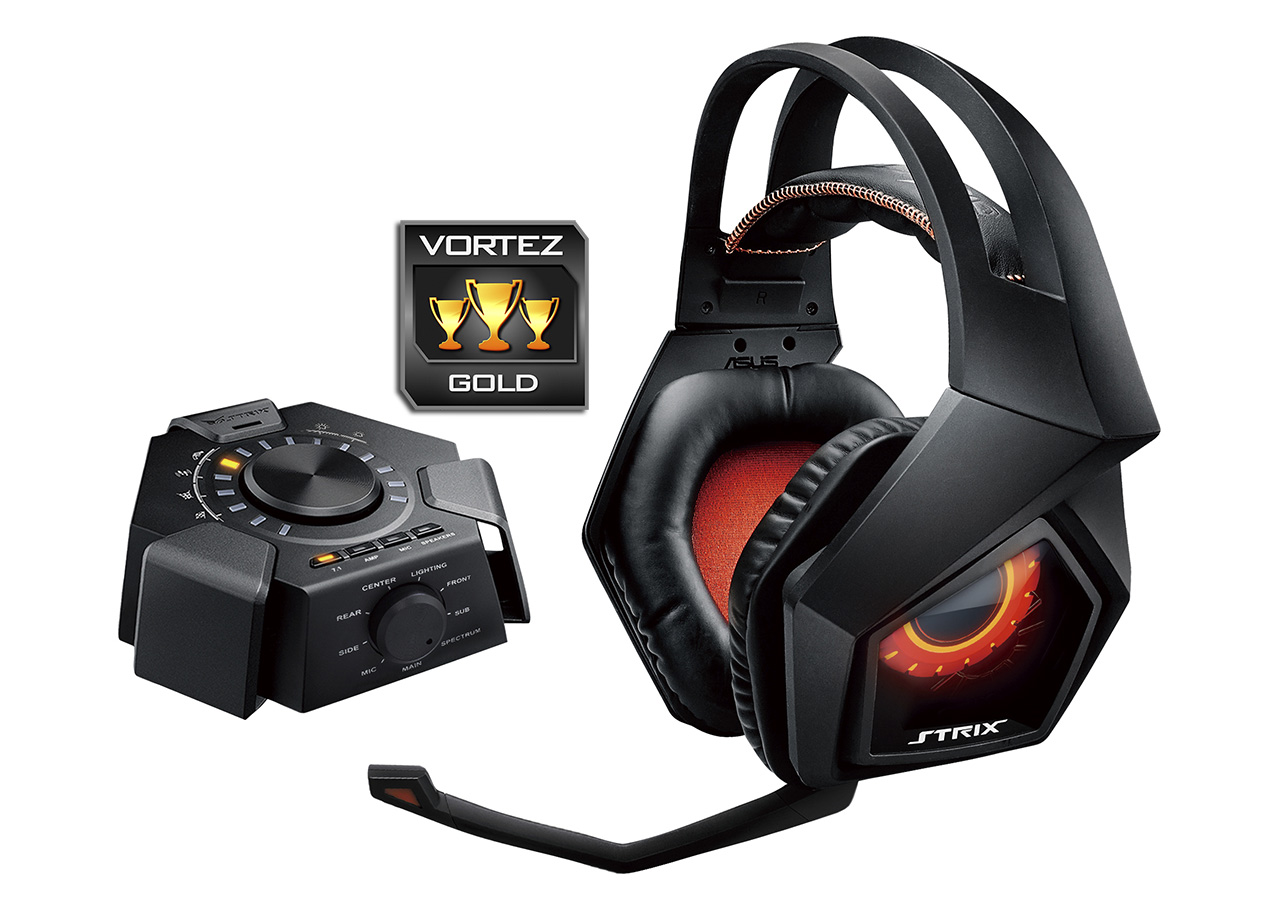
As far as design goes, the ASUS STRIX headset certainly stands out, though some may find its clamp strength a little too strong. Some may find that its 10 drivers may take its toll over time due to placing the STRIX 7.1 at a relatively massive 450g, that is 120g heavier than the ROCCAT Kave XTD design. The suspension design and soft padding work well to keep comfort in check, though some may find fatigue an issue. Another consideration is the overall sound quality doesn’t really match its price tag and its surround performance could arguably be matched by a virtual 7.1 solution. However, the cluster of drivers are good at catching all those fine details and with a little tweaking, the STRIX 7.1 will serve as a powerful tool for gamers. Those who are not convinced by the benefit of ‘real’ surround headsets will be happy to point out that there are some fantastic sounding stereo headsets available for less than half the price, but for those who demand nothing less, the loss of ‘true’ surround sound rendering isn’t worth giving up and the STRIX 7.1 is a fine headset in its own right.
Finally, it is worth mentioning that there are no drivers to download and install. This means there isn’t quite the control available that some may wish for, though this arguably works in favour for the STRIX 7.1 as it provides a hassle free and simple setup. All things considered, the STRIX 7.1 gaming headset renders true 7.1 surround sound, looks awesome and is filled with charm. If you are one willing to pay the premium for a surround gaming headset there is little to dislike about the STRIX 7.1.
The ASUS STRIX 7.1 provides you with an extra pair of eyes and ears, fully immersing you in true 7.1 surround sound.
Pros.
+ Real 7.1 channel rendering
+ Aggressive gamer aesthetic/ lighting
+ Easy to setup
+ Audio station
+ Good all round audio
+ Good environmental noise cancelling solution
Mediocre
+- Surround experience
Cons.
– Price
– Plug n Play drivers only
+ Real 7.1 channel rendering
+ Aggressive gamer aesthetic/ lighting
+ Easy to setup
+ Audio station
+ Good all round audio
+ Good environmental noise cancelling solution
Mediocre
+- Surround experience
Cons.
– Price
– Plug n Play drivers only

Click here for an explanation of our awards at Vortez.net.