The STRIX RAID DLX soundcard is the top offering of the STRIX line-up, promising a 124dB SNR for audiophile grade HiFi sound and on-the-fly in-game audio adjustments.

Product on Review: ASUS STRIX RAID DLX
Manufacturer: ASUS
Street Price: UK: £149.99, US: $219.99
Of all the products in the STRIX series, a soundcard touches on the most relevant of all attributes one would associate with its avian name. The STRIX series of soundcards come in three flavours, the STRIX SOAR, the STRIX RAID PRO and the flagship the RAID DLX. The SOAR comes in with 116dB SNR seems to be the standalone product of the RAID PRO, both using the ESS SABRE9006A, though the SOAR does away with the desktop control box to provide extra value to the end user. The RAID DLX comes with an improved SNR (Signal-to-Noise ratio) utilising the ESS SABRE9016, thus is the top bird in the parliament.
There are various features promised by the STRIX soundcards which will be universal throughout, such as high fidelity audio for rich and immersive gaming. The PRO and the RAID DLX come with the control box and boxlink cable with the RAID function that allows on-the fly audio adjustments. Further more, the Sonic Studio software used by the STRIX soundcards displays all the controls and features on a single page for quick access.
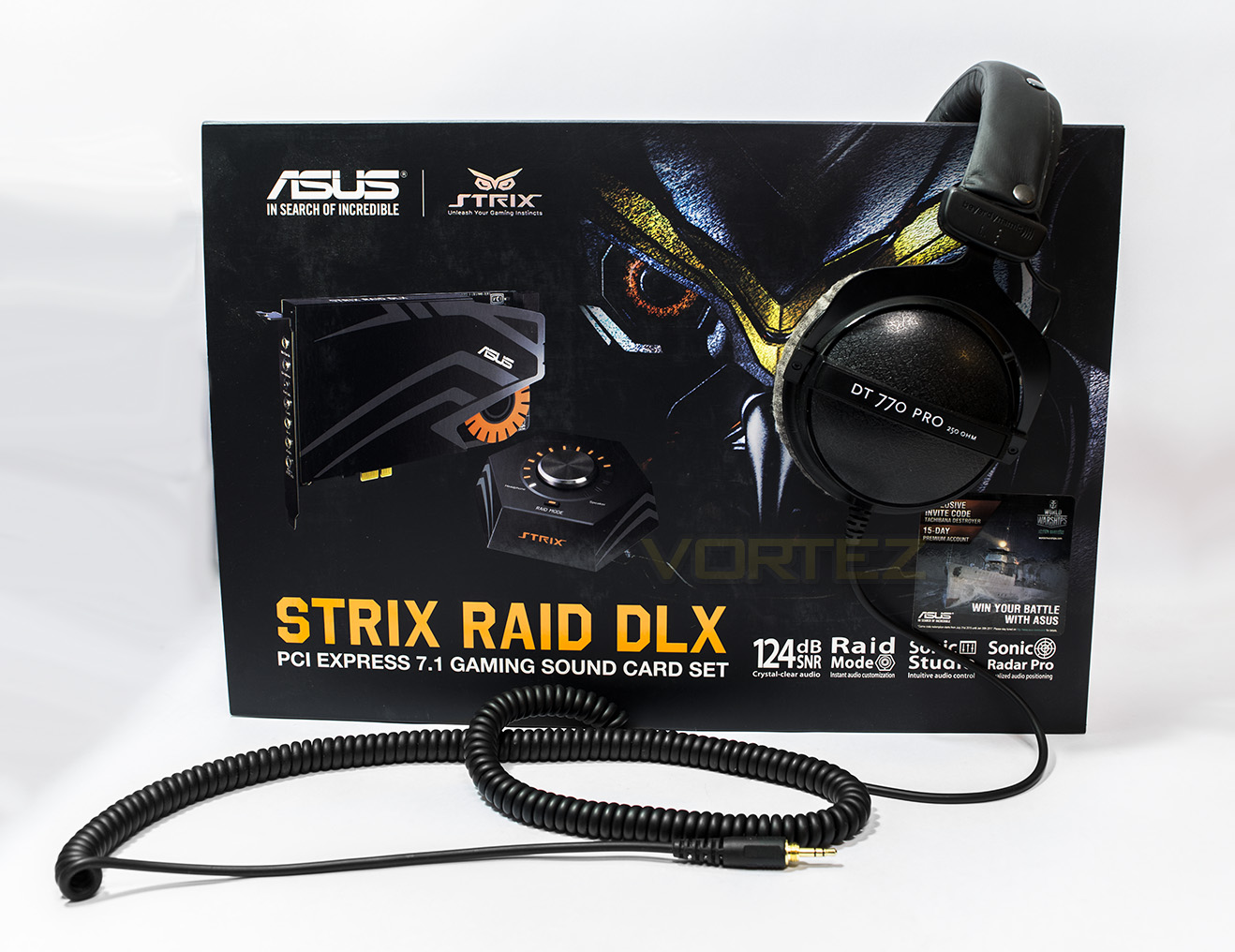
Overview by ASUS
Strix Raid DLX is a premium sound card set built with audiophile-grade components to satisfy gamers who demand ultimate audio performance. Strix Raid DLX features rich, immersive, and clear sound with an incredible 124dB signal-to-noise ratio (SNR), and a 600ohm headphone amplifier for deep, tight bass. The simple yet powerful Sonic Studio sound utility and control box provides complete sound card control and allows instant in-game audio adjustments.
Technical Specifications
Audio Interface
PCI Express
Audio Performance
Output Signal-to-Noise Ratio (A-Weighted) (Front-out): 124 dB
Output Signal-to-Noise Ratio (A-Weighted) (Headphone-out): 124 dB
Input Signal-to-Noise Ratio (A-Weighted): 117 dB
Output THD+N at 1kHz (Front-out): 0.0009 %(-107 dB)
Output THD+N at 1kHz (Headphone-out): 0.0009 %(-107 dB)
Input THD+N at 1kHz: 0.000316 %(-110 dB)
Frequency Response (-3dB, 24bit/96KHz input): 10 Hz to 48 KHz
Output/Input Full-Scale Voltage : Line output (RCA, 3.5) : 2 Vrms (5.65 Vp-p)
Chipset
Audio Processor :C-Media USB2.0 6632AX High-Definition Sound Processor (Max. 384KHz / 24bit)
Digital-to-analog Converter(DAC)
ESS SABRE9016 Premier 8 Channel Audio DAC
Sample Rate and Resolution
Analog Playback Sample Rate and Resolution: 44.1K/48K/88.2K/96K/176.4K/192KHz @ 16bit/24bit
Analog Recording Sample Rate and Resolution: 44.1K/48K/88.2K/96K/176.4K/192KHz @ 16bit/24bit
S/PDIF Digital Output: 44.1K/48K/96K/192KHz @ 16bit/24bit
ASIO 2.0 Driver Support: 44.1K/48K/96K/192KHz @ 16bit/24bit with very low latency
Connectivity
Analog Output
5 x 3.5 mm jack (1/8″ ) (Headphone out /Front out/Side out/Center-Subwoofer out/Rear out)
Analog Input
1 x 3.5 mm jack (1/8″ ) (Line-in/ Mic-in combo)
Digital
1 x S/PDIF out ((combo with side out))
1 x Box Link
Special Features
Sonic Studio
Operating System
Windows® 10 , 32bit/64bit
Windows® 8.1 , 32bit/64bit
Windows® 8 , 32bit/64bit
Windows® 7 SP1, 32bit/64bit
Accessories
Control box x 1
S/PDIF optical adaptors x 1
Driver CD x 1
Quick start guide x 1
Box link cable x 1
Dimensions
190 x 130 x 22 mm ( L x W x H )
PCI Express
Audio Performance
Output Signal-to-Noise Ratio (A-Weighted) (Front-out): 124 dB
Output Signal-to-Noise Ratio (A-Weighted) (Headphone-out): 124 dB
Input Signal-to-Noise Ratio (A-Weighted): 117 dB
Output THD+N at 1kHz (Front-out): 0.0009 %(-107 dB)
Output THD+N at 1kHz (Headphone-out): 0.0009 %(-107 dB)
Input THD+N at 1kHz: 0.000316 %(-110 dB)
Frequency Response (-3dB, 24bit/96KHz input): 10 Hz to 48 KHz
Output/Input Full-Scale Voltage : Line output (RCA, 3.5) : 2 Vrms (5.65 Vp-p)
Chipset
Audio Processor :C-Media USB2.0 6632AX High-Definition Sound Processor (Max. 384KHz / 24bit)
Digital-to-analog Converter(DAC)
ESS SABRE9016 Premier 8 Channel Audio DAC
Sample Rate and Resolution
Analog Playback Sample Rate and Resolution: 44.1K/48K/88.2K/96K/176.4K/192KHz @ 16bit/24bit
Analog Recording Sample Rate and Resolution: 44.1K/48K/88.2K/96K/176.4K/192KHz @ 16bit/24bit
S/PDIF Digital Output: 44.1K/48K/96K/192KHz @ 16bit/24bit
ASIO 2.0 Driver Support: 44.1K/48K/96K/192KHz @ 16bit/24bit with very low latency
Connectivity
Analog Output
5 x 3.5 mm jack (1/8″ ) (Headphone out /Front out/Side out/Center-Subwoofer out/Rear out)
Analog Input
1 x 3.5 mm jack (1/8″ ) (Line-in/ Mic-in combo)
Digital
1 x S/PDIF out ((combo with side out))
1 x Box Link
Special Features
Sonic Studio
Operating System
Windows® 10 , 32bit/64bit
Windows® 8.1 , 32bit/64bit
Windows® 8 , 32bit/64bit
Windows® 7 SP1, 32bit/64bit
Accessories
Control box x 1
S/PDIF optical adaptors x 1
Driver CD x 1
Quick start guide x 1
Box link cable x 1
Dimensions
190 x 130 x 22 mm ( L x W x H )
Packaging & Bundle
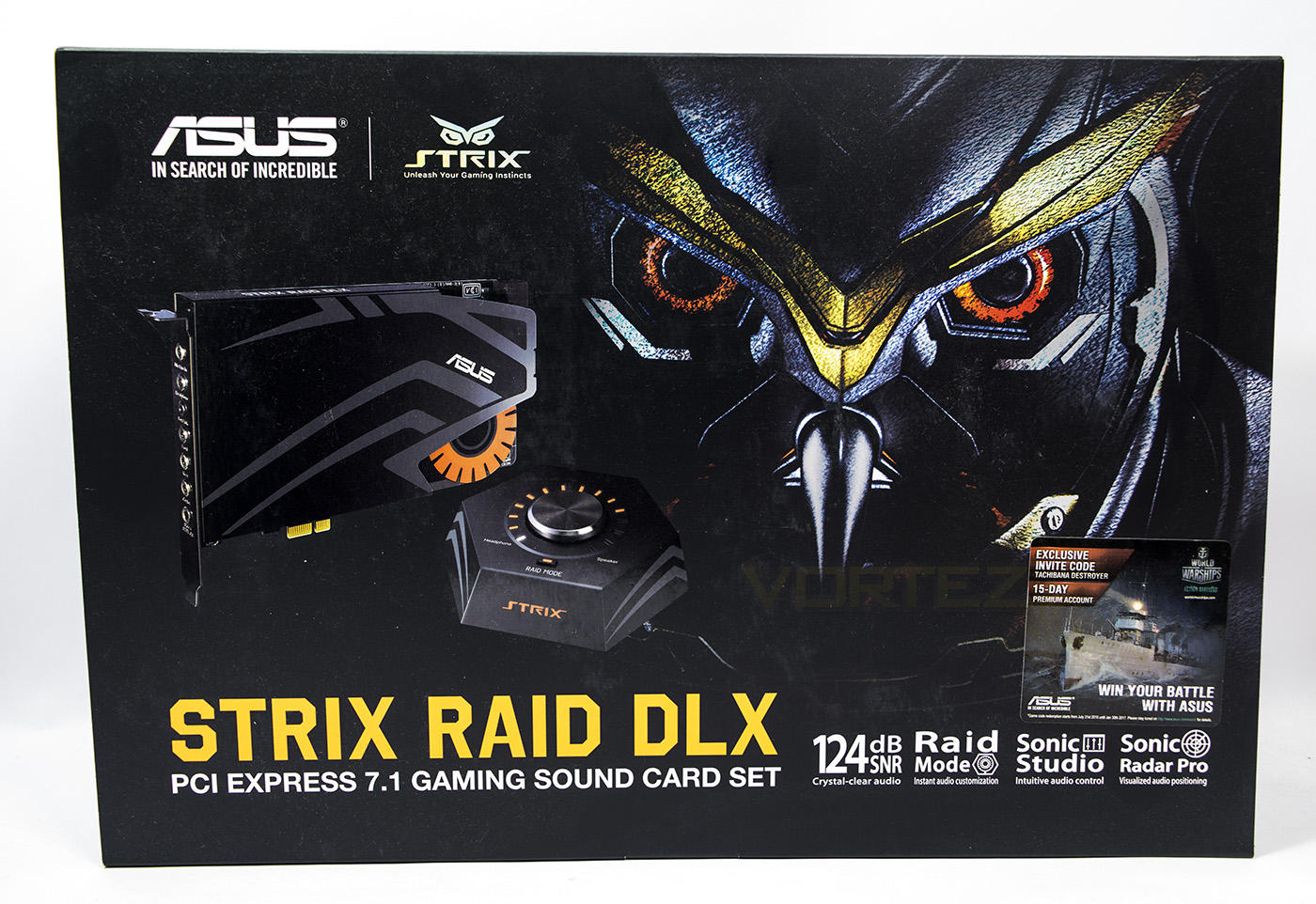
The front packaging is very ASUS and the giant mecha owl gives a clear indication that it is part of the STRIX series.
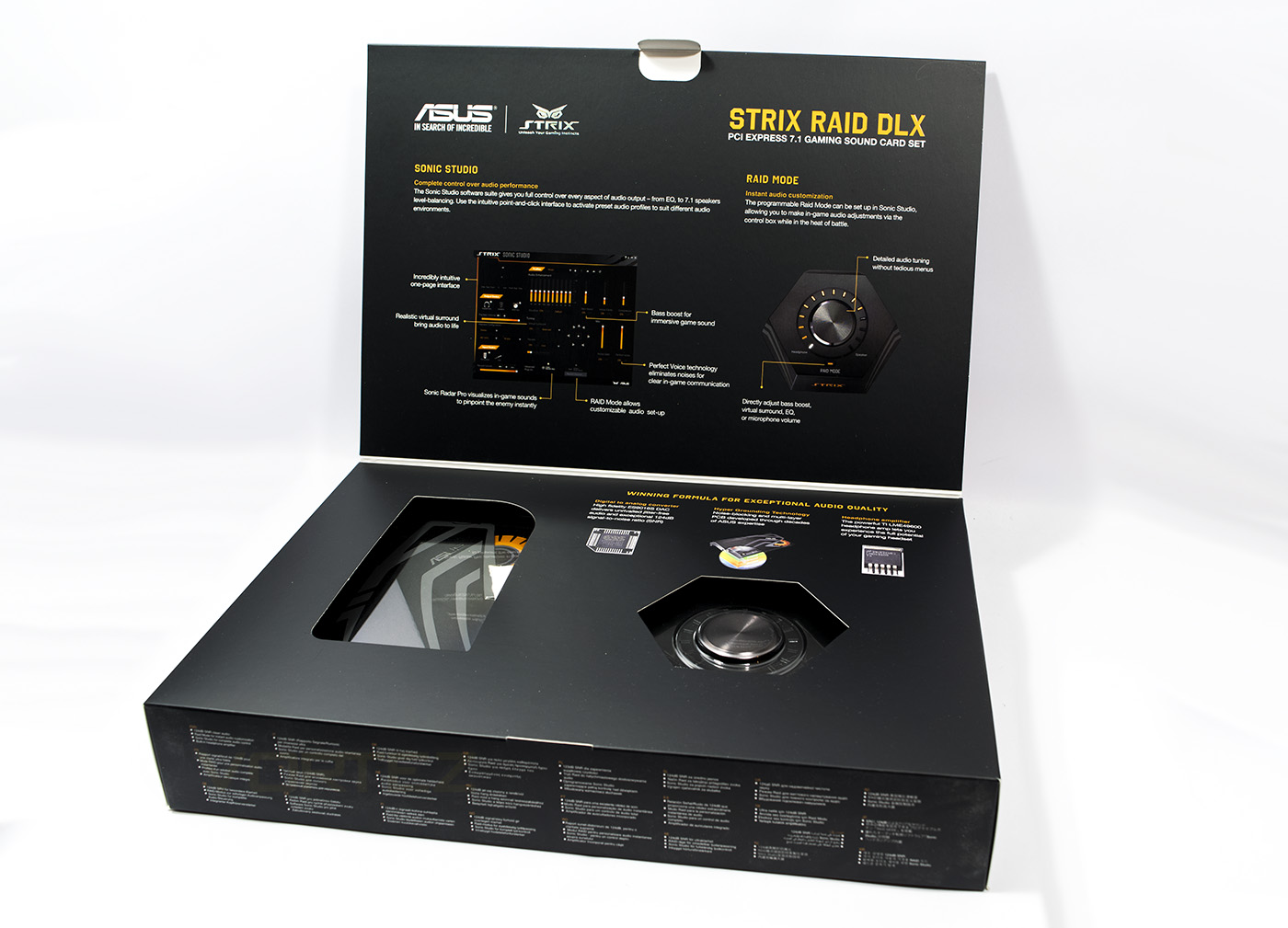
Opened up we get a sneak peak of the soundcard and the control box. On the inside cover there is information about the Sonic Studio software and RAID mode.
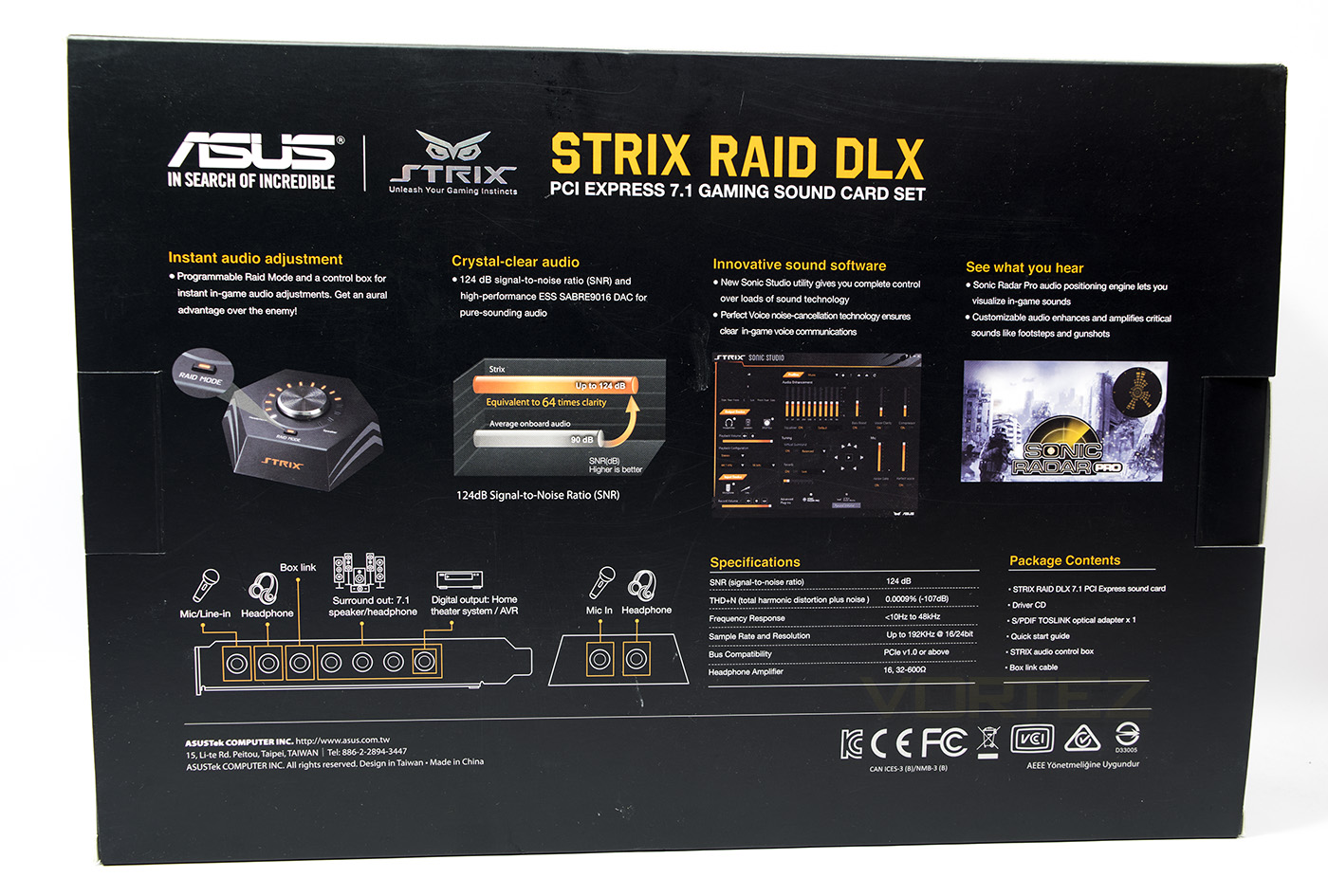
AT the back there is more information about various features, a diagram of the input/output as well as the detailed specification and box contents.
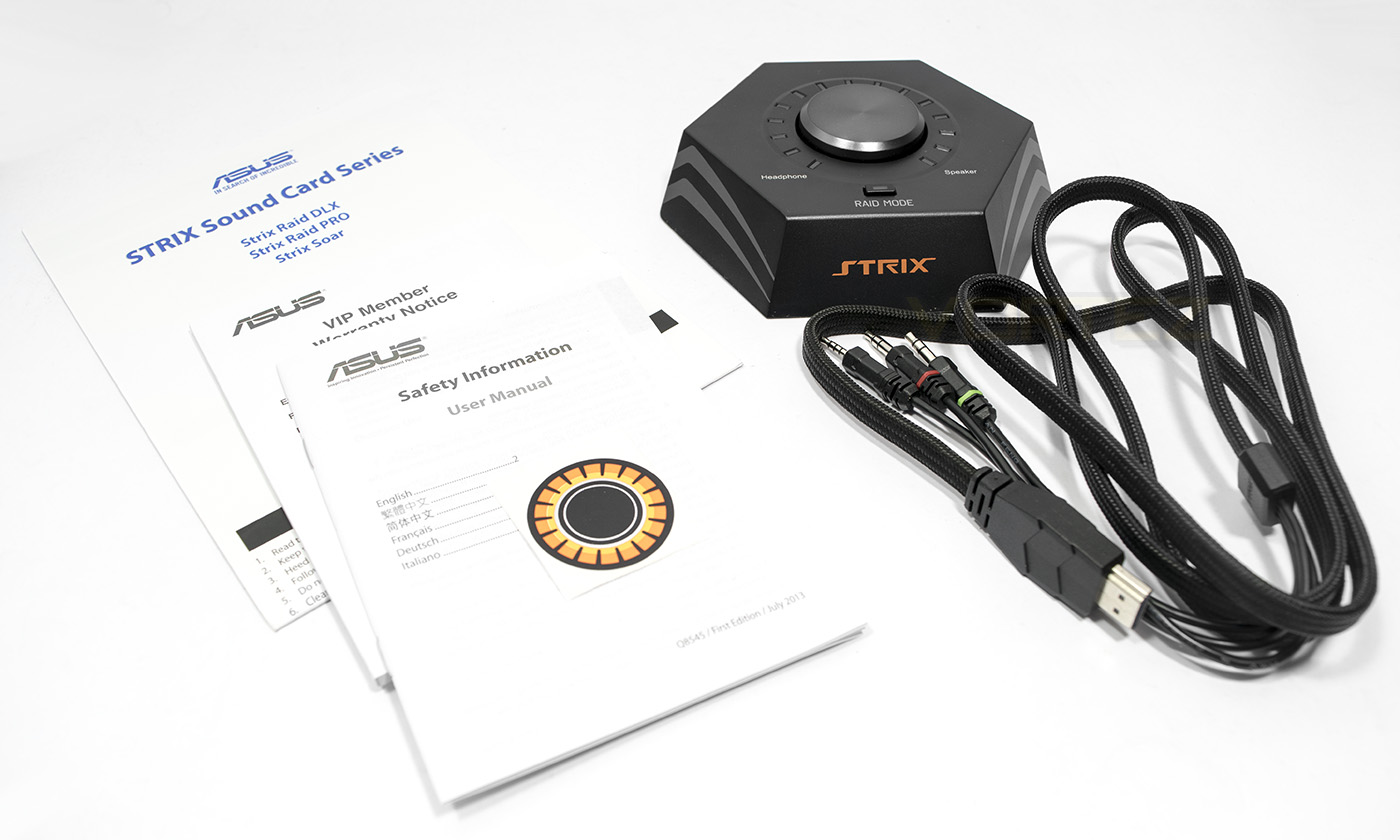
Inside the box we get the quick start guide and warranty information, a case sticker, the control box, and the box link cable. There is also an optical adaptor included, but seems to be missing here.
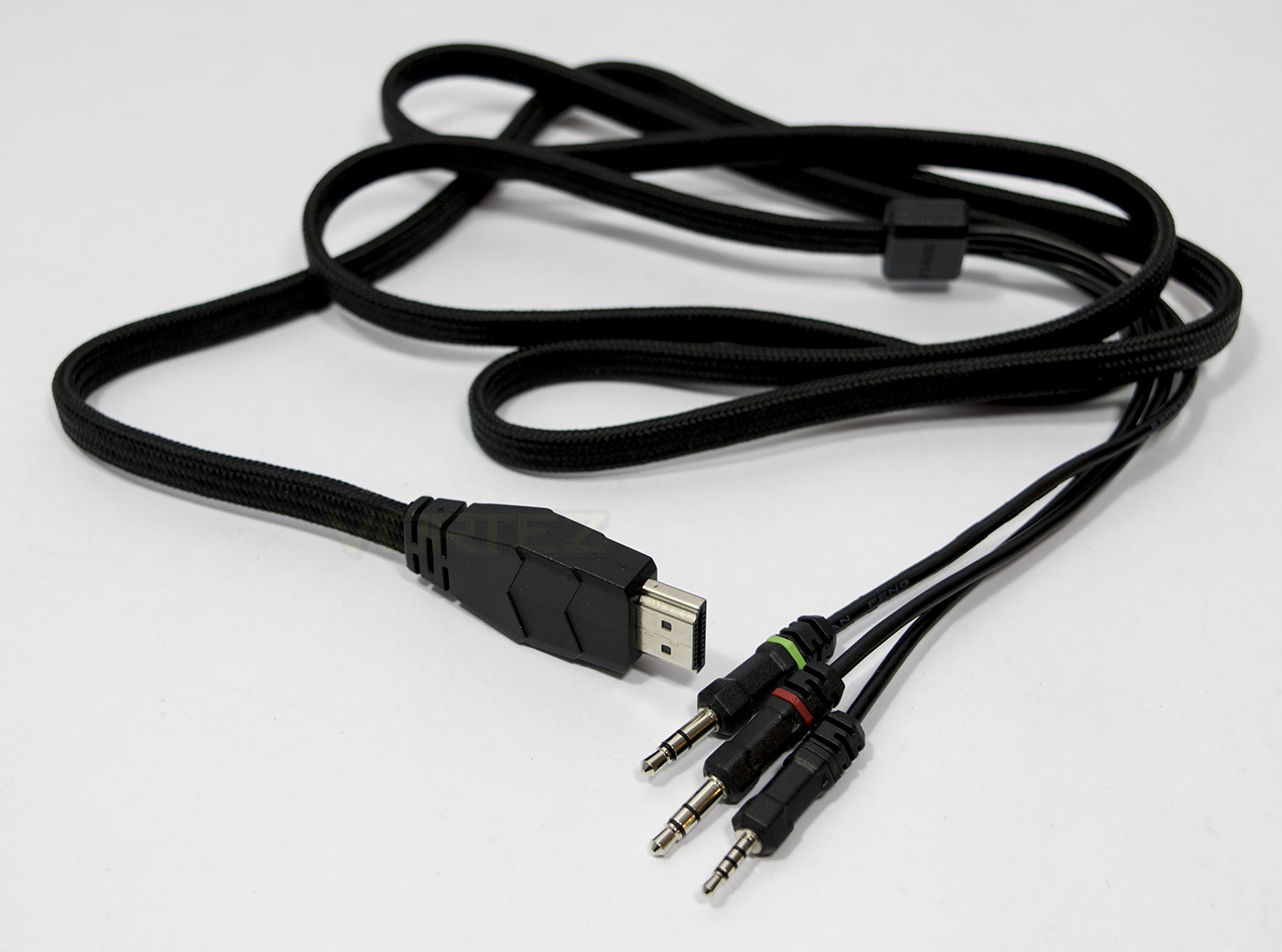
The box link cable is around 1.2m long, ideal for desktop use and is braided.
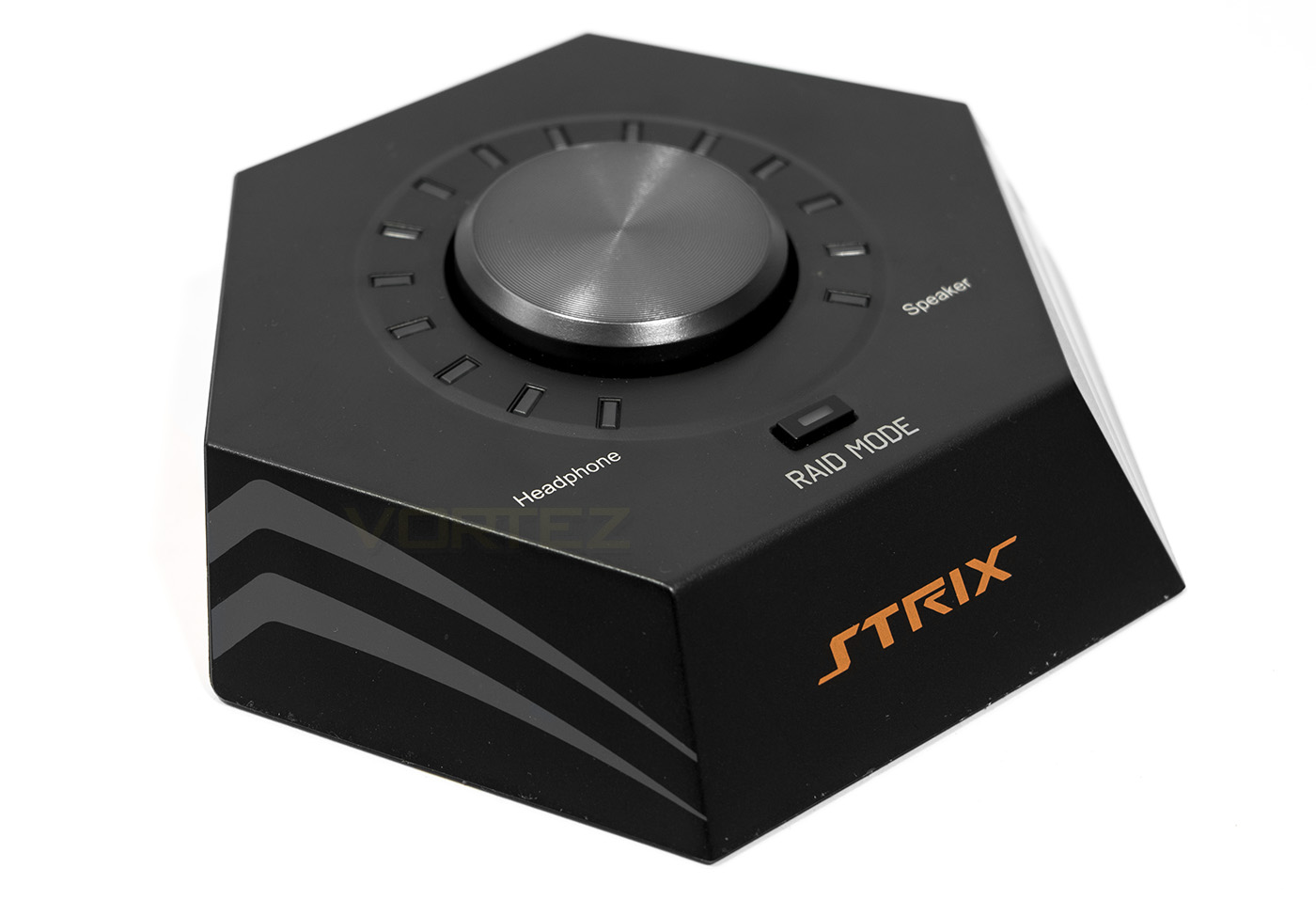
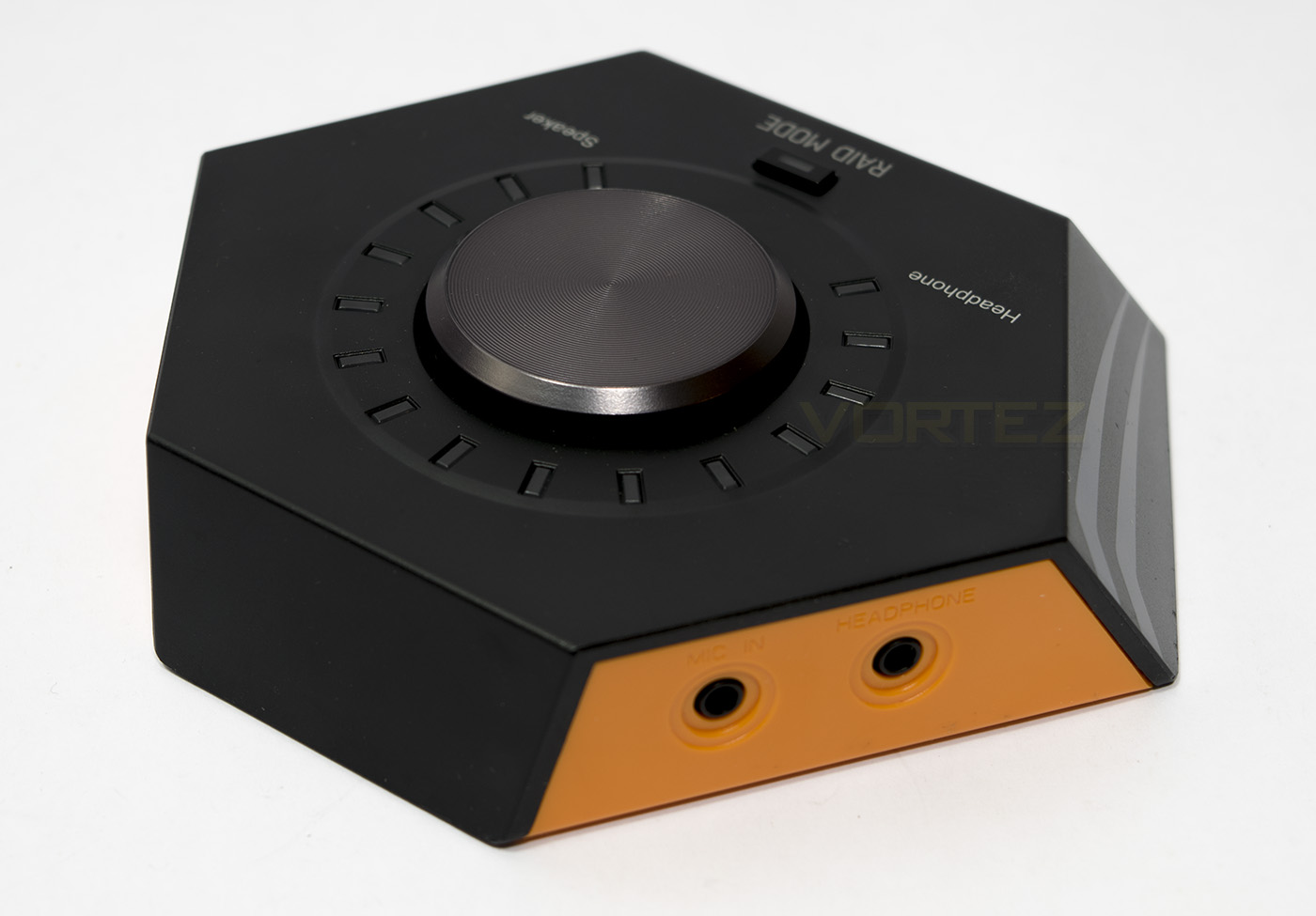
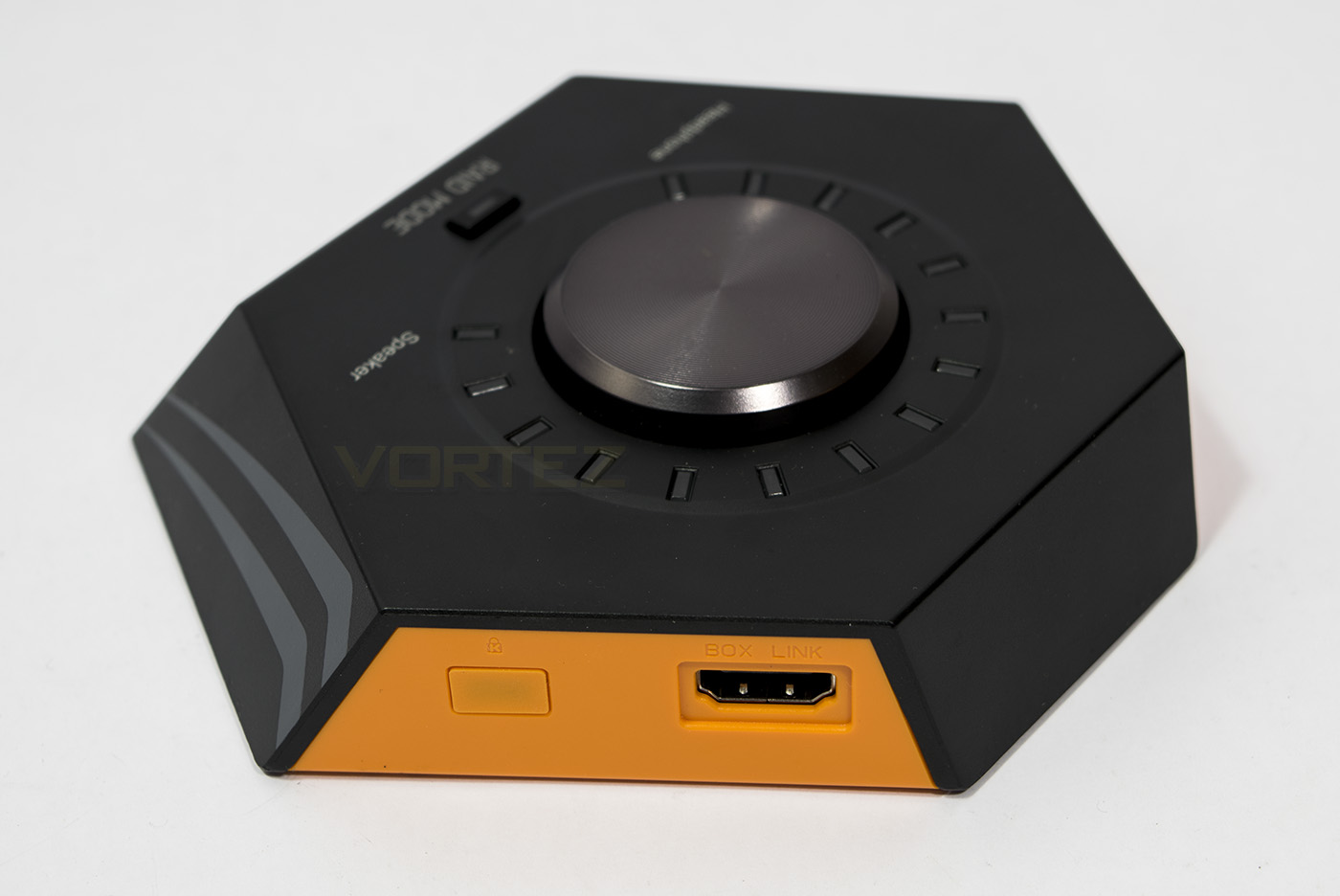
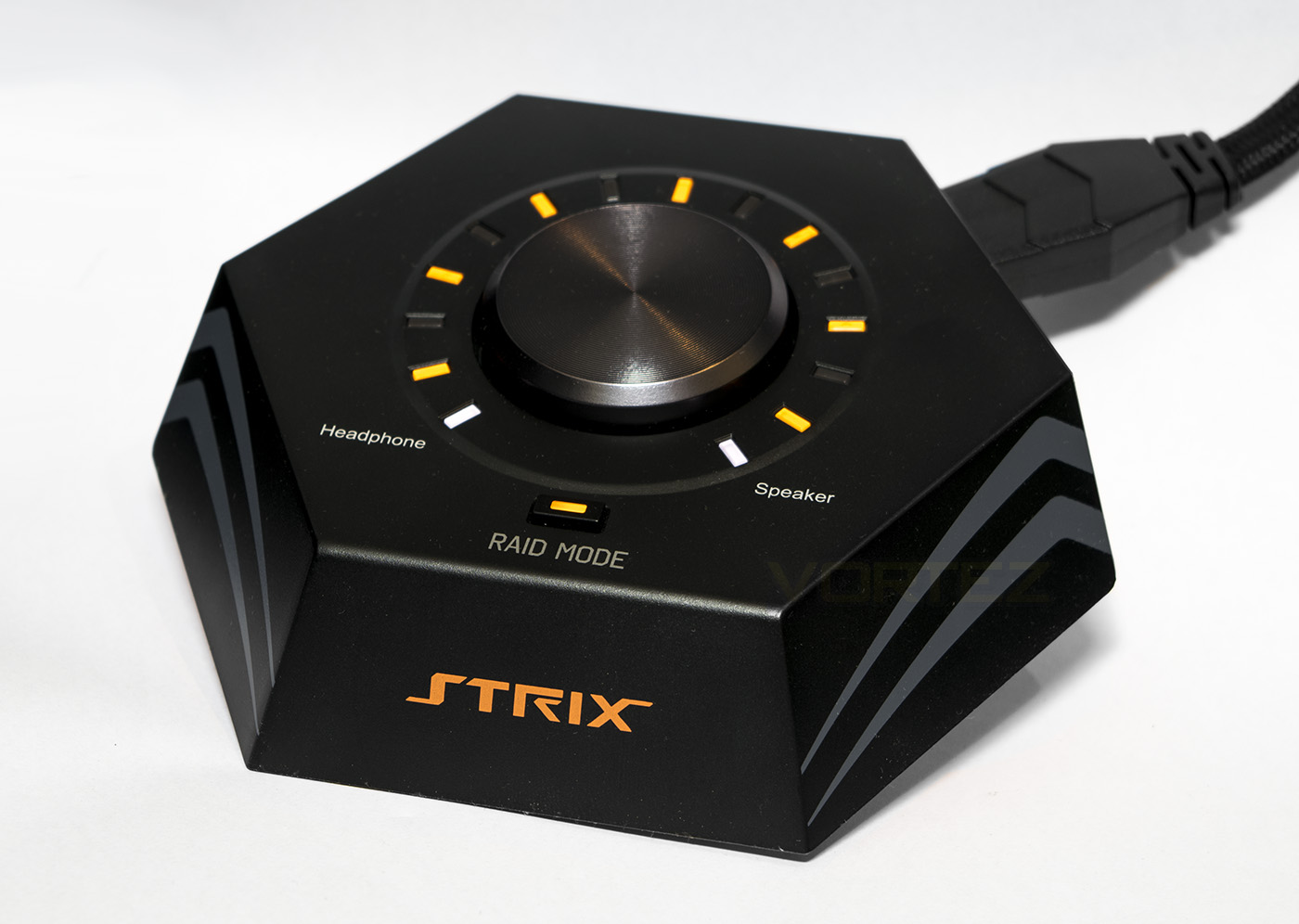
It seems no matter which product you go with from the STRIX series, you are likely to run into some octagonal desktop control box donning the black and orange theme. It is connected to the boxlink cable via HDMI which is then plugged into the headset/microphone and boxlink ports. The control box has a RAID mode, which specifically, acts like a dual function that can be pre-selected in the Sonic Studio software, for example, if you have it set to control microphone volume, when enabled, the dial will then adjust microphone volume.
Closer Look
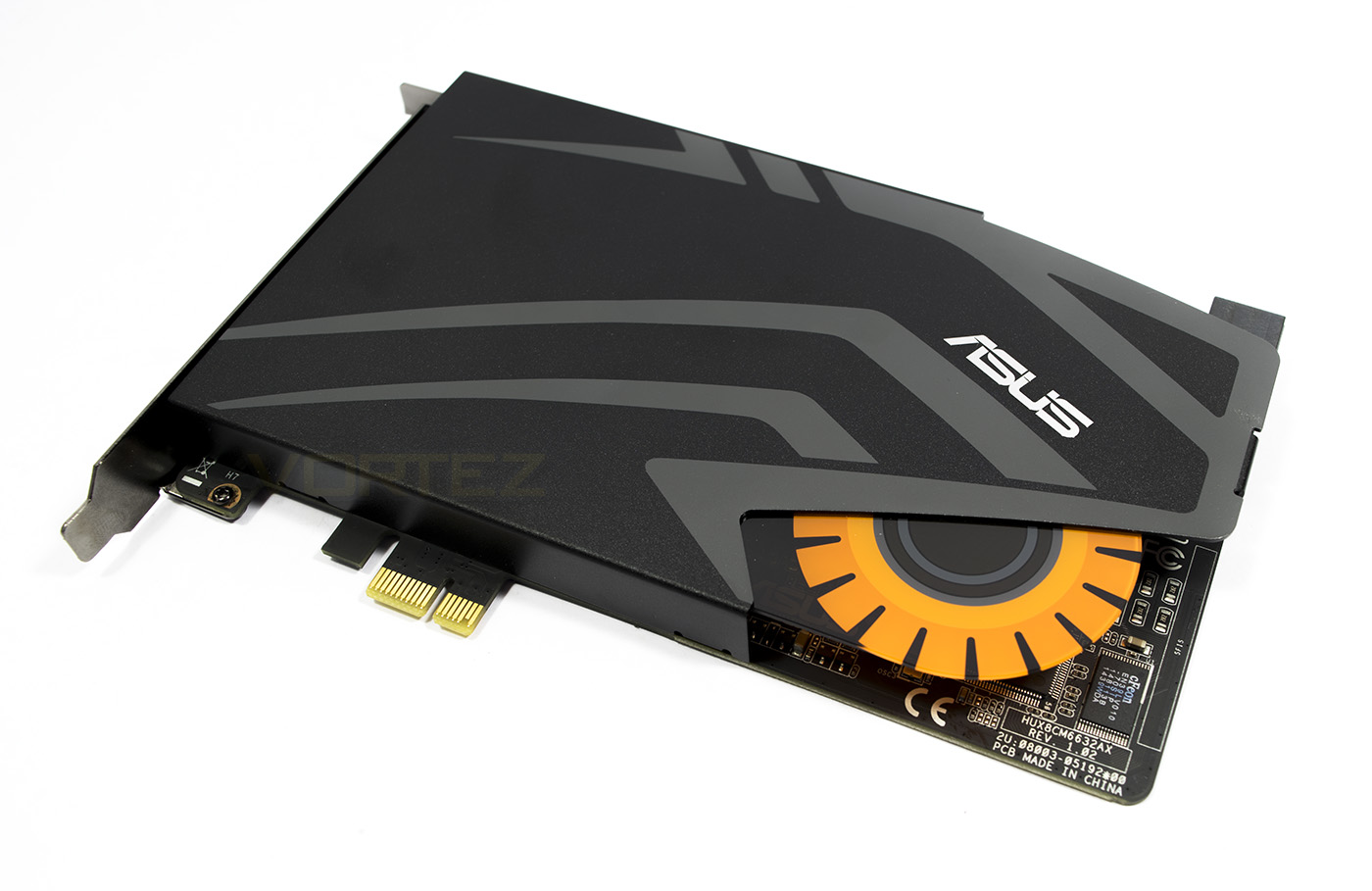
Visually, the EMI shield is fairly plain with a small cut-out for the acrylic STRIX eye which is positioned above an orange LED to add an attractive glow, however trying to capture this effect on anything other than a horizontal test bench is highly impractical.
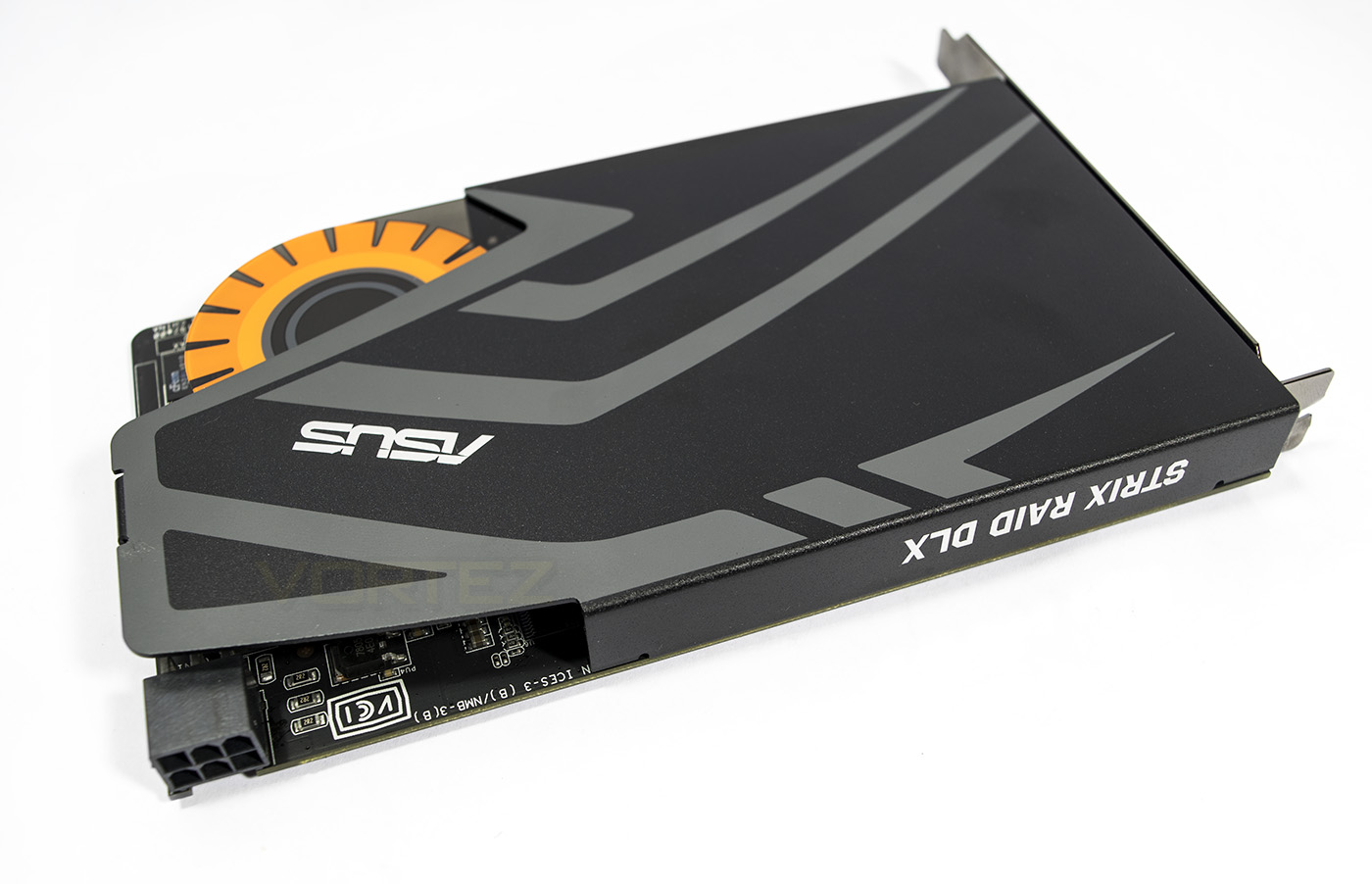
Not as flashy as the Phoebus which has blue and red LEDs behind its name, the STRIX RAID DLX identifies itself with some etched letters. In the opposite corner there is a 6-pin PCIe power connector.
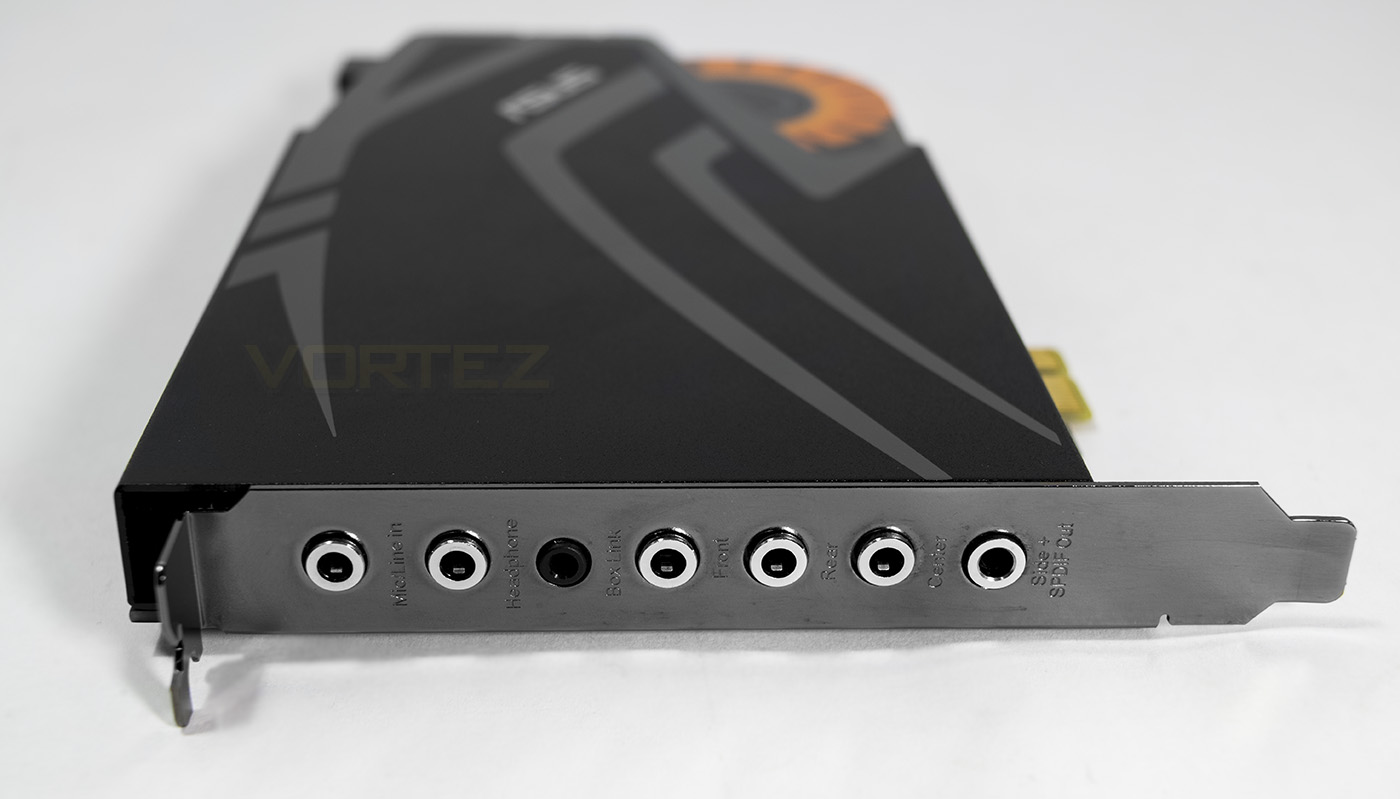
Input/output options, Microphone/line in, headphone, box link, front, rear, centre/sub, side/SPDIF out.
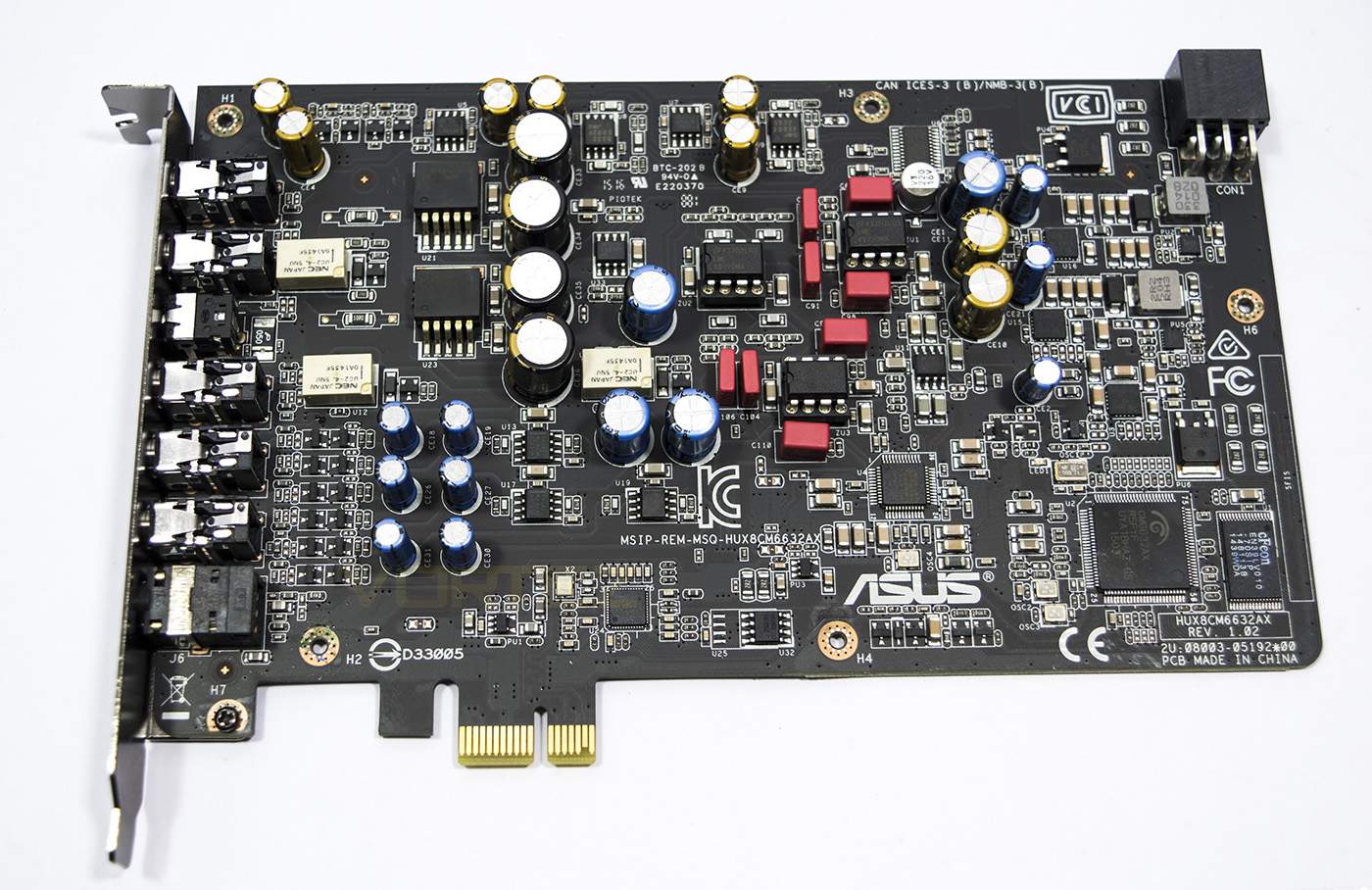
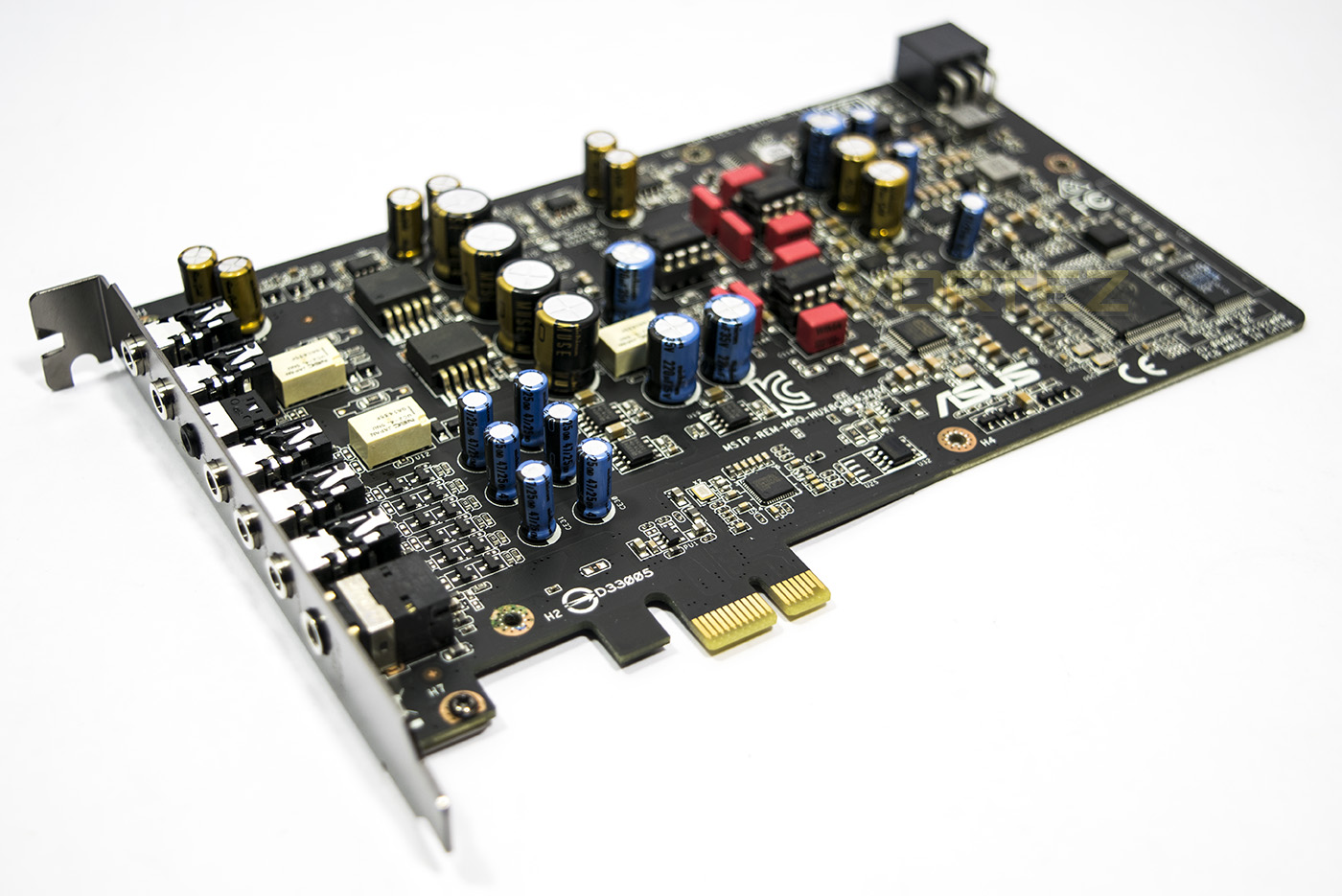
After removing the EMI shield we can see the components included on the STRIX RAID DLX, including the use of Nichicon capacitors, WIMA polymer film capacitors and the single solid state cap. From here it is also easy to see that three of the op-amps are socketed, and so can be easily replaced should anyone wish to do so.
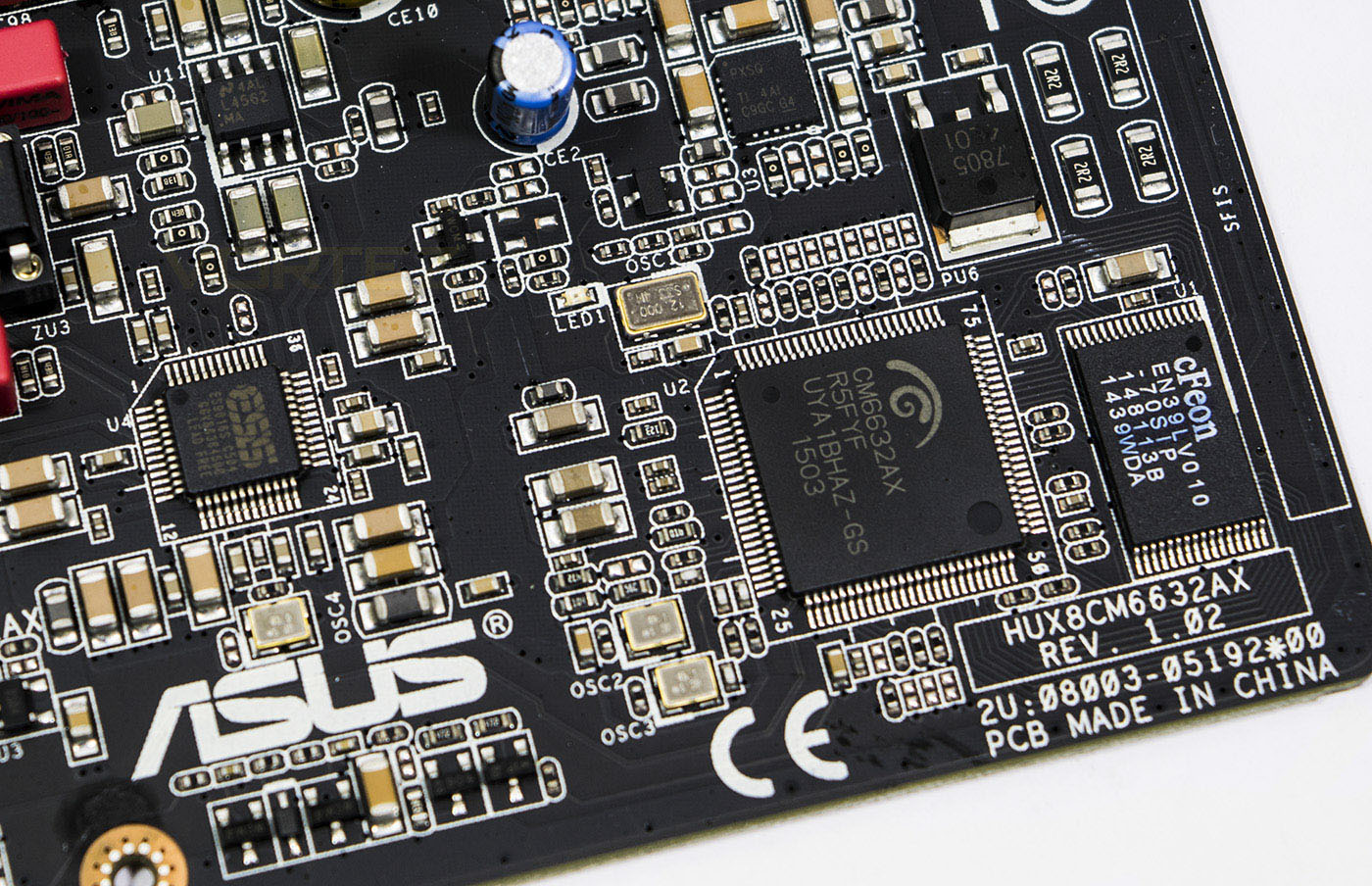
The audio processor doing the work is the CM 6632AX, which, interestingly is a USB 2.0 audio processor that supports 24bit/ 192Hz high definition playback over a maximum of 10 channels. To the left you will see the ESS 9016S DAC, and on the right is the system memory.
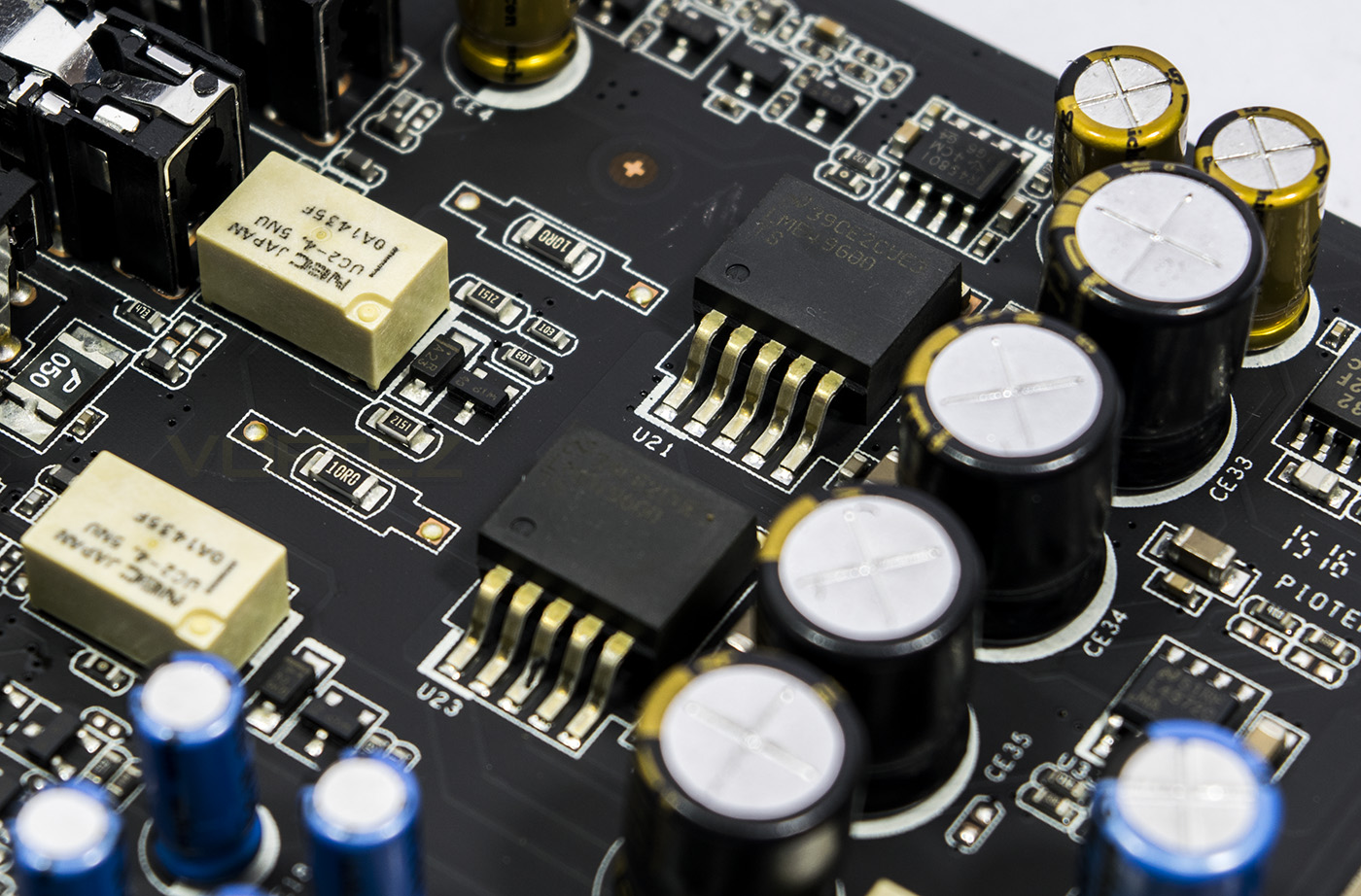
Here there are a pair of LME 49600 op-amps working for the headphone, each controls a single channel (left/right) and are unfortunately not socketed for easy replacement. However these are well known and liked so can be trusted to give high quality audio.
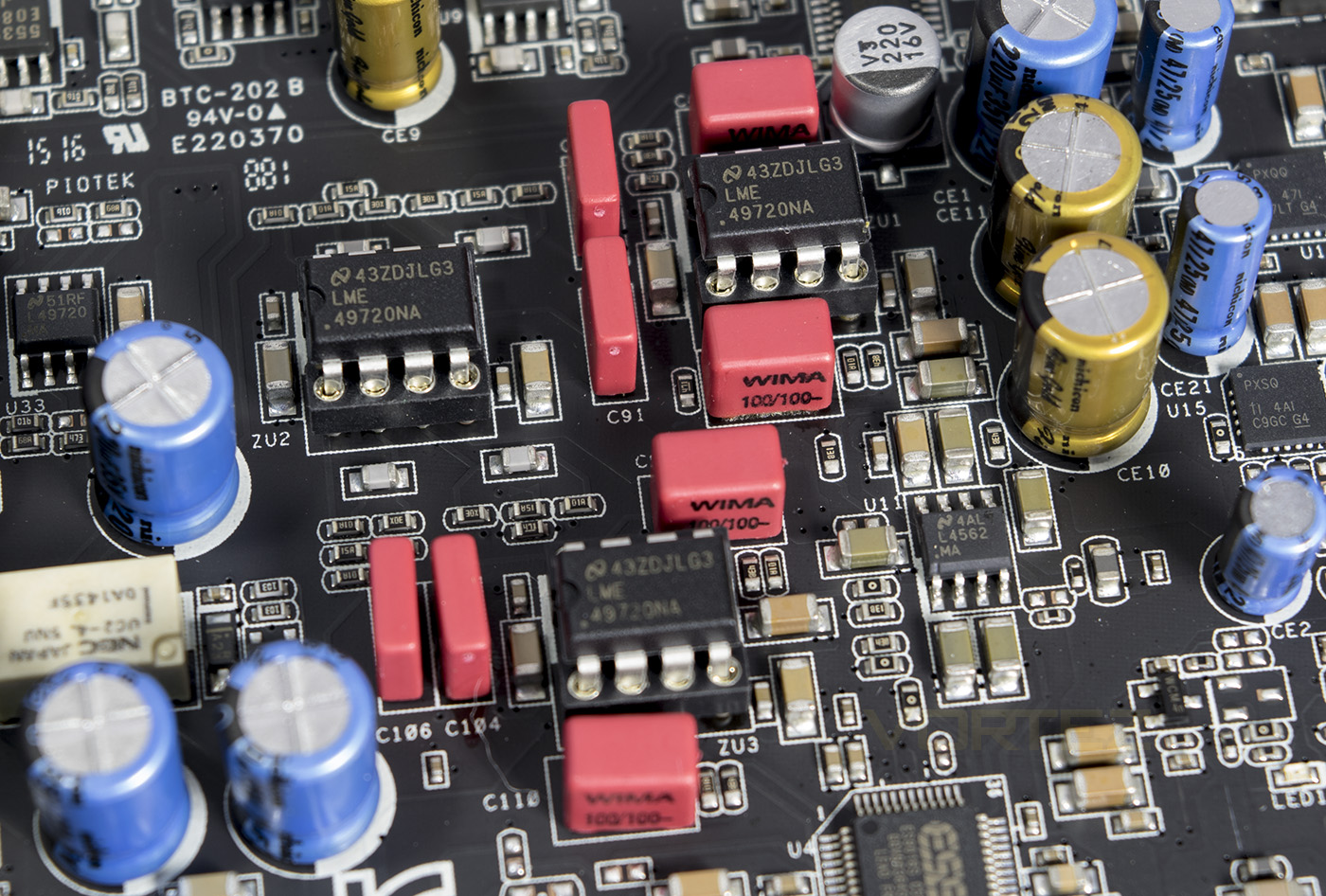
The three removable op-amps are LME 49720NA, another good choice by ASUS as these are well liked op-amps by many audiophiles. Each control a dual channel input and are supported by quality polymer film capacitors.
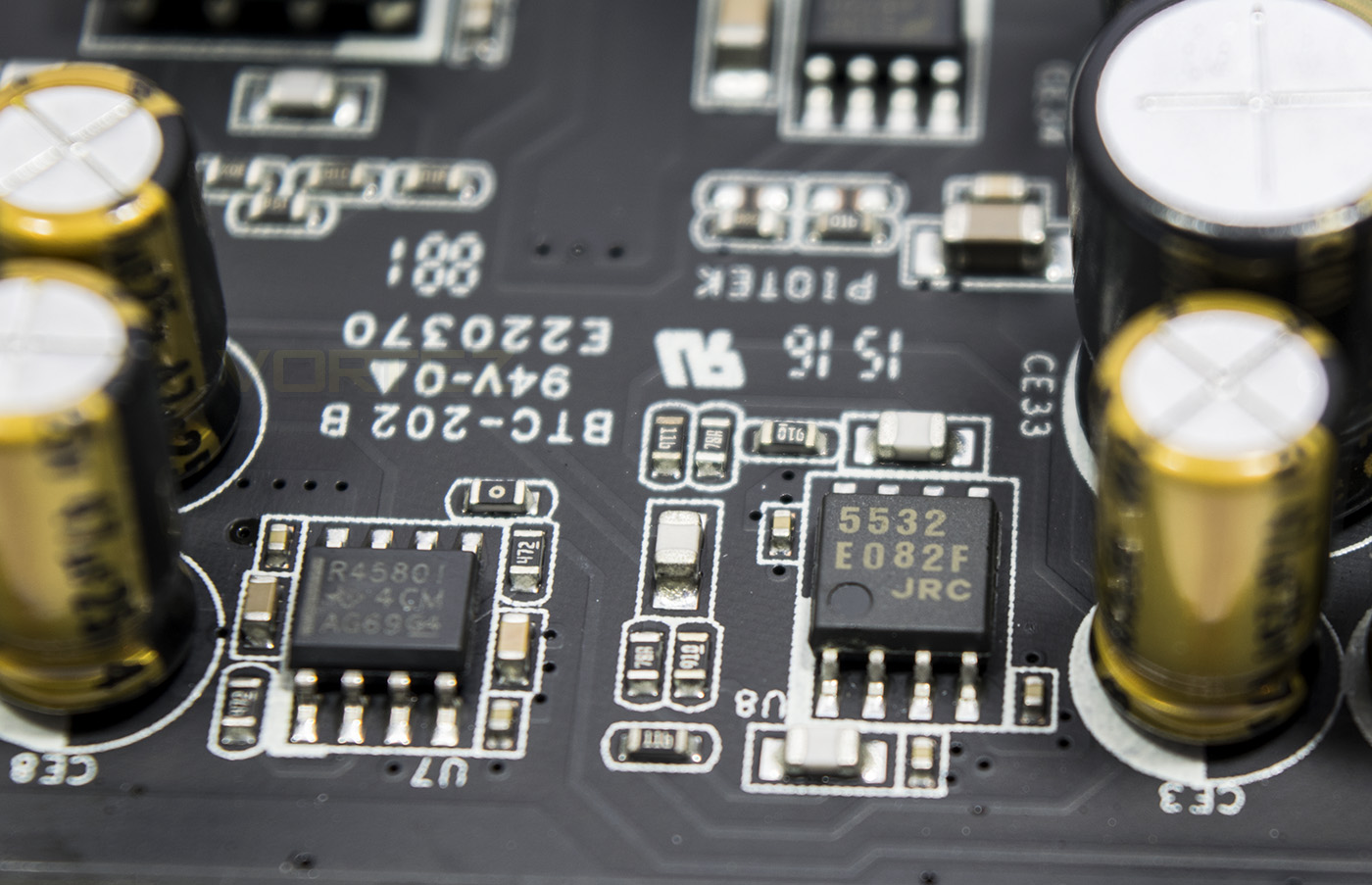
This low noise op-amp (JRC 5532) is likely handling the microhone/line in.
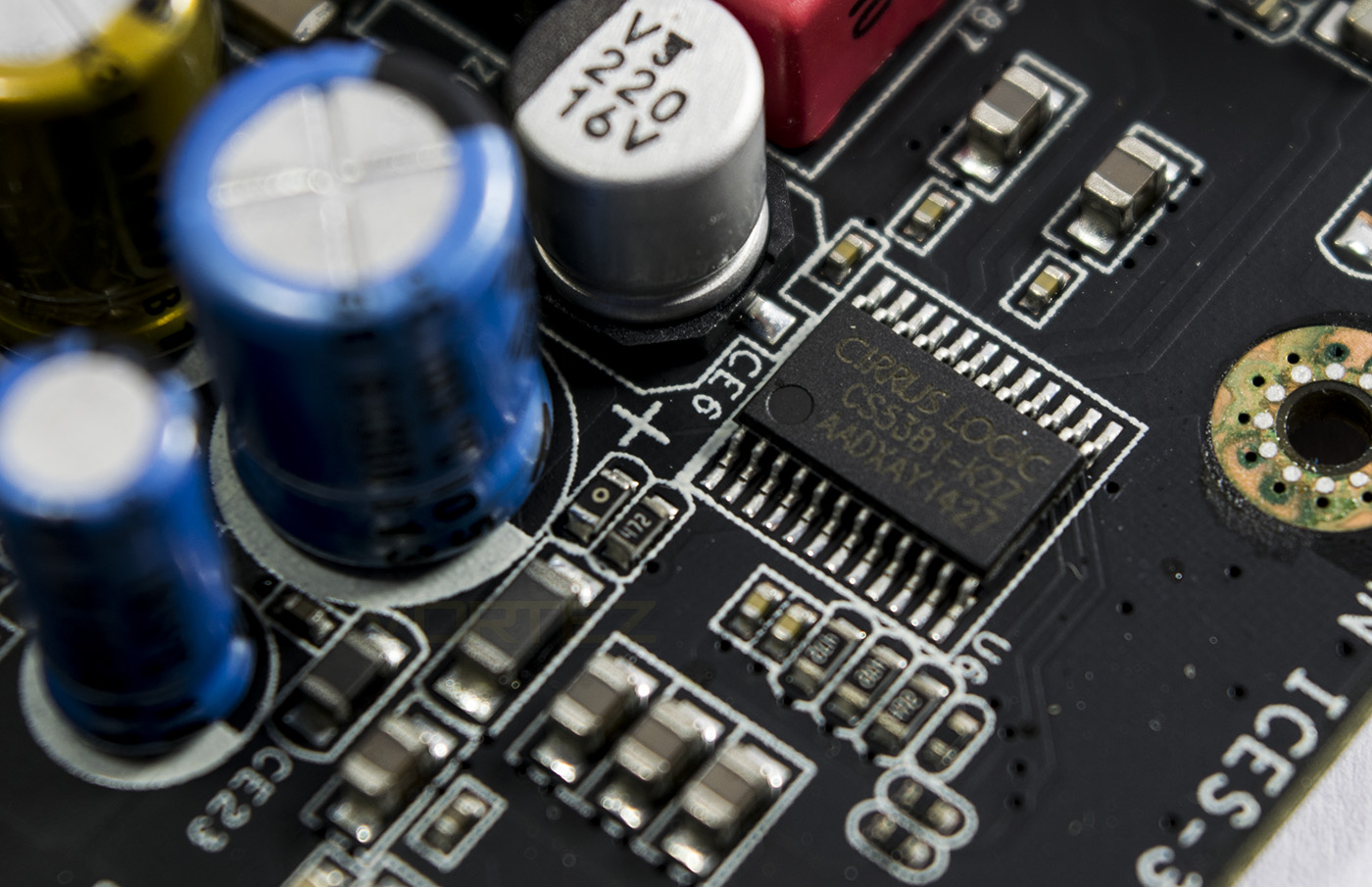
The Cirrus Logic CS5381-KZZ analogue to digital converter (ADC)
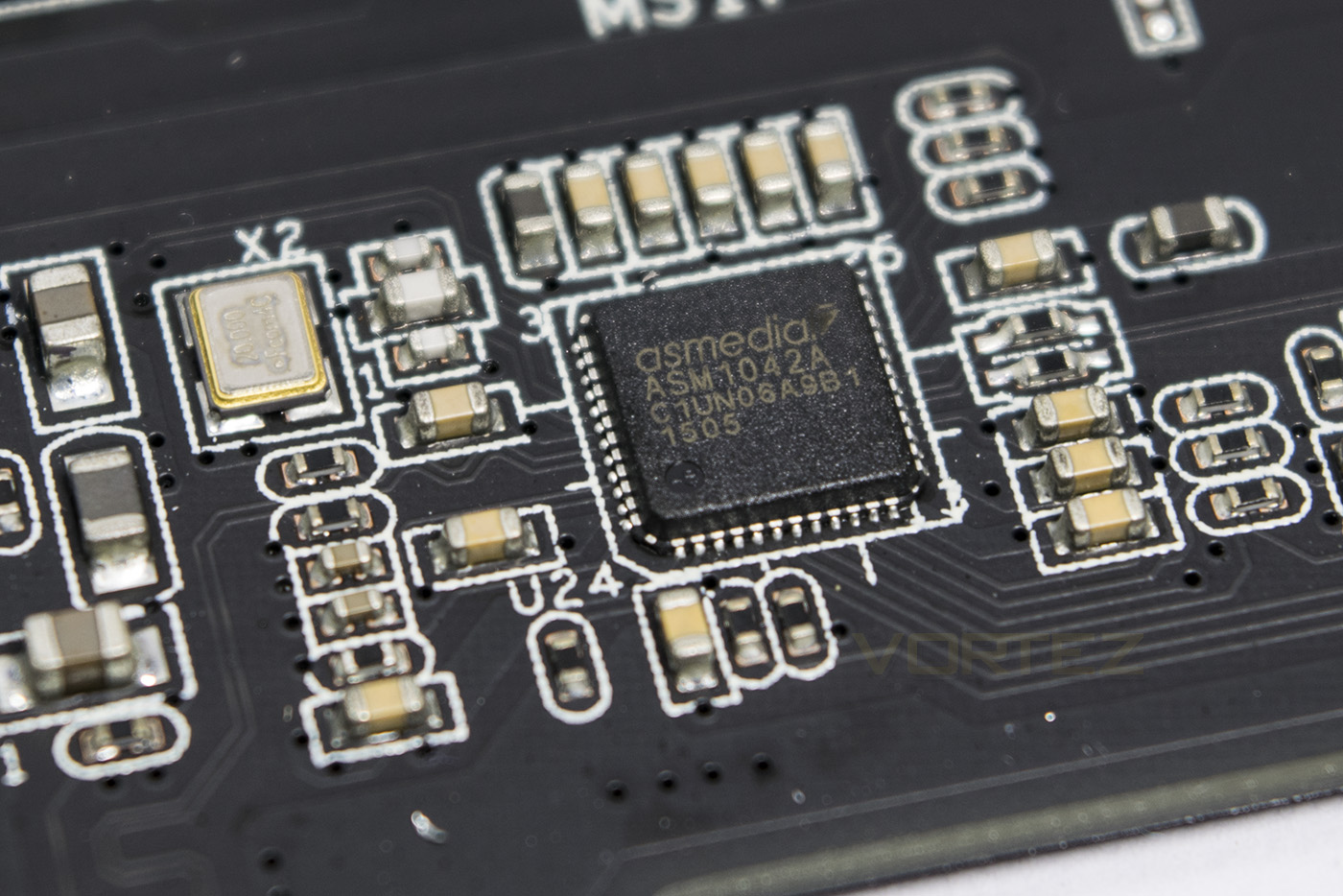
The PCIe controller is actually a PCIe-USB 3.0 bridge, which makes sense as the audio processor is a USB 2.0 based. These seems like a strange choice as that would mean that audio signals may actually be routed through your system via its USB circuitry, which is an arse about face way of doing things.
Software
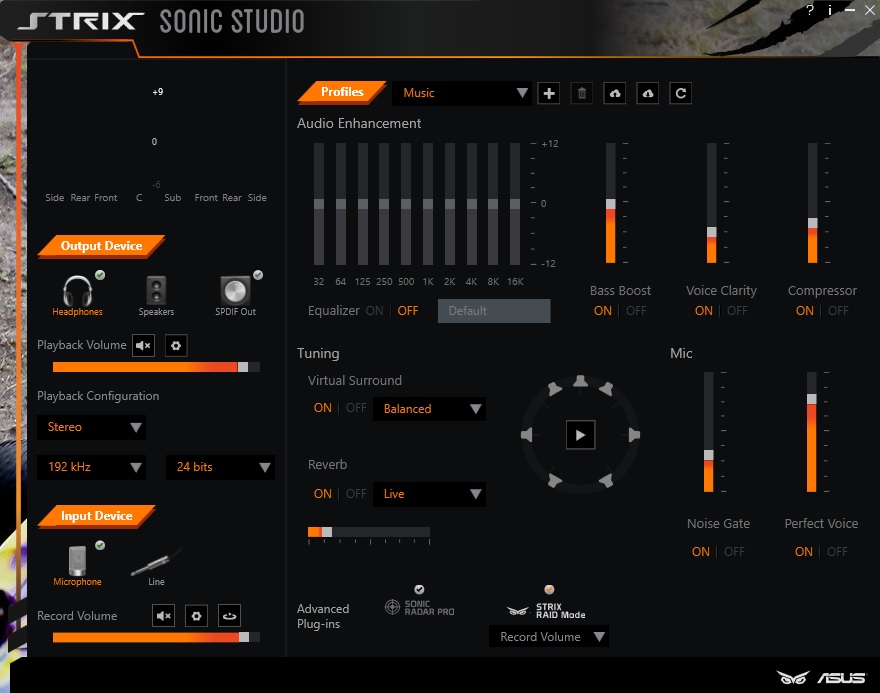
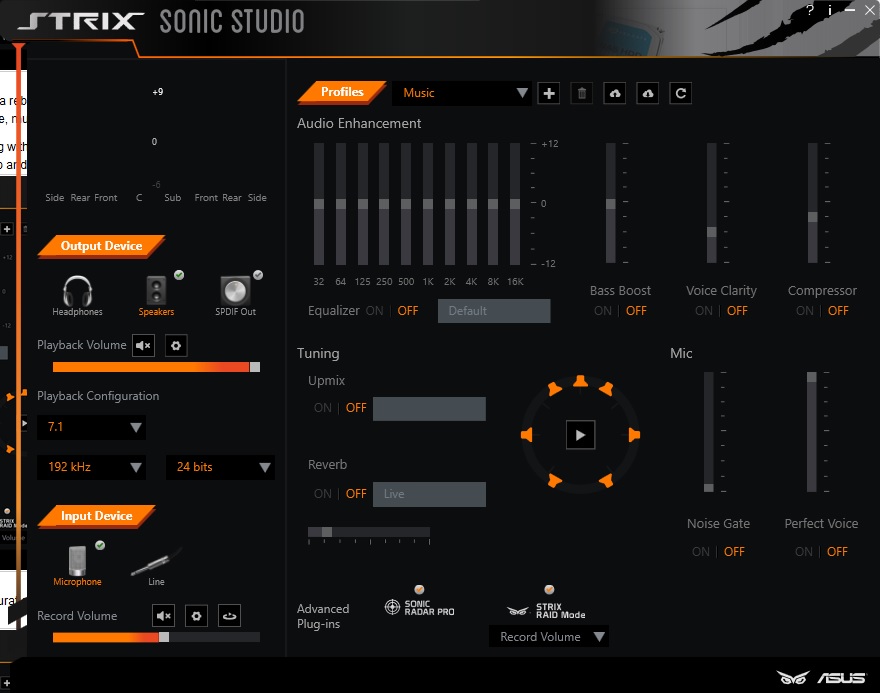
The Sonic Studio software is fairly quick and simple to navigate due it its single page design, eliminating any long winded navigation of various tabs or use of right clicking to find other options. When using a headset, you can enable the virtual surround mode, or when using a surround sound speaker set, you can turn on the upmix mode to enable a stereo source to use all available speakers which is handy for music playback. There are various options included to allow users to customise their audio output to cater towards their own preference. The RAID mode control is a dropdown menu seen at the bottom of the page with a list of options.
The downside to this software is, there is no selectable gain control even though it is touted for use with headphones of up to 600 ohm impedance, making this claim rather sketchy. There is also no control for bass frequency crossover, which could be fairly important for some with subwoofers of specific requirements. * (UPDATE:You can edit the gain within the software by right clicking on the headphone icon.)
Performance Testing
RightMark Audio AnalyzerRMAA suite is designed for testing quality of analog and digital paths of any audio devices, be it a sound card, an MP3 player, a consumer CD/DVD player or an acoustic set. The results are obtained by playing and recording test signals passed through the tested audio path by means of frequency analysis algorithms. A more common mark is also provided for those unfamiliar with measured technical parameters.
Understanding the limitations of a test is something that should be addressed in regards to giving an accurate portrayal. RMAA is a useful tool but testing has many variables thus results are only comparable under similar set standards and parameters and shouldn’t be compared directly to other results that may have been obtained under different testing conditions. Remember that audio preference too is subjective and numbers do not always tell the full story.
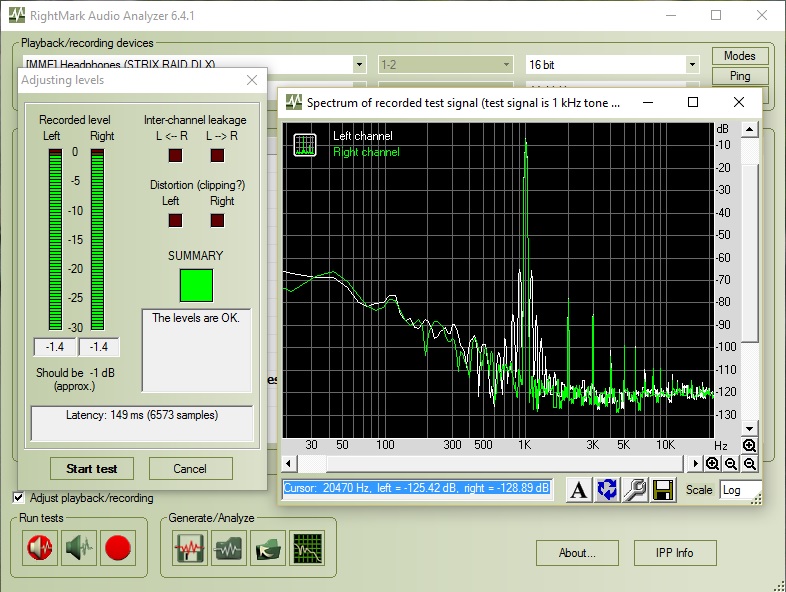
In this test I compare the STRIX RAID DLX against the competent ALC 1150, a high definition audio codec that is used in many premium motherboard solutions, by using the backloop method. To do this, the stereo/front audio out is directly connected to the microphone/line in port where the RightMark tests are then played and recorded.
Frequency response: Closer to 0 = Better
Noise: Lower = Better
Dynamic Range: Greater difference = Better
Total Harmonic Distortion (THD): lower = Better
Intermodular distortion (IMD): Lower = Better
Stereo Crosstalk: Lower = Better
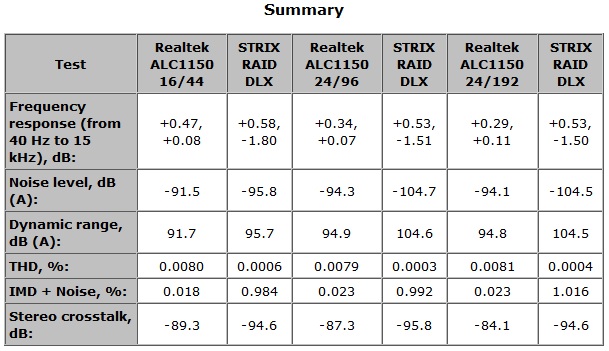
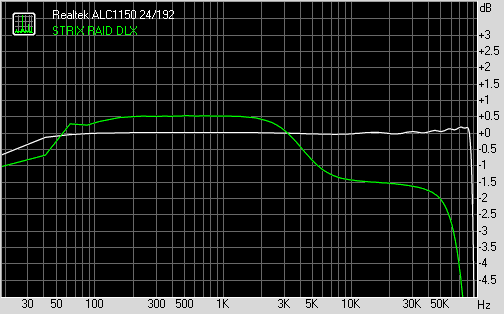
Here we see an interesting frequency responce from the STRIX RAID DLX, one would normally expect something to be as flat as possible, instead we see a peak between 50Hz-3KHz.
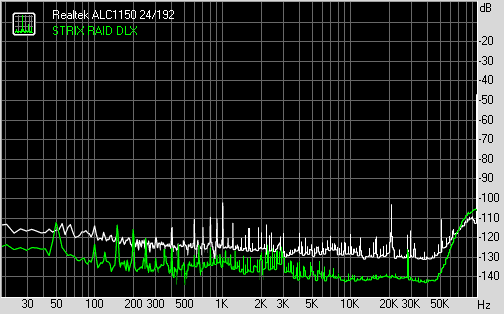
The STRIX RAID DLX offers better noise control.
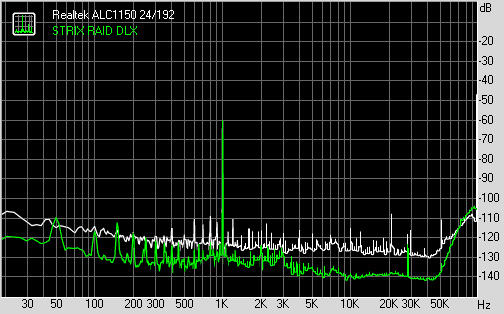
The ASUS STRIX RAID DLX shows off a greater dynamic range than the Realtek ALC 1150
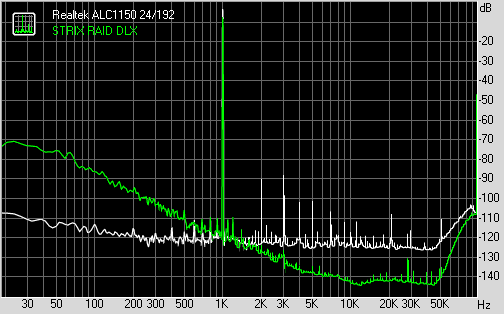
The harmonic distortion tells another strange story when compared to the integrated solution. Though the numbers suggest excellent control of the THD, something strange is certainly happening.
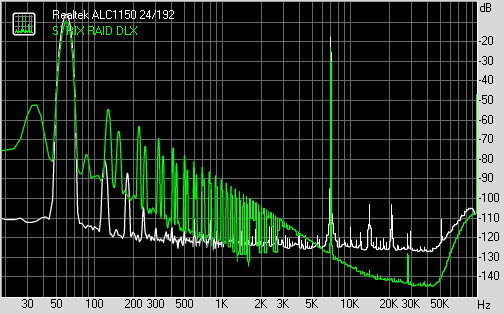
Following a similar trend to the THD and the frequency response.
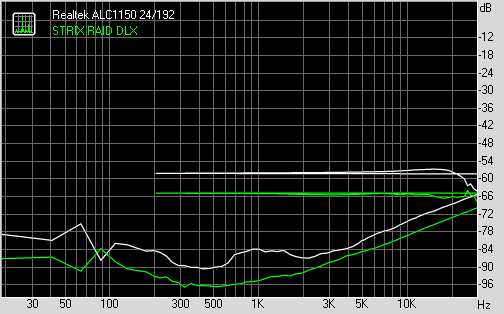
The Stereo crosstalk returns to normality and shows some good results for the STRIX RAID DLX.
Performance Testing: Continued…
Setup, Design & Observations
Inserting the STRIX RAID DLX into your system takes a little more work than what you would have to go through if you used an external solution, which basically means having to open up your case and find a free PCIe 1x lane, or greater, for it to be plugged into. Once installed you can then plug in the included control box and any speakers or headphones you with to use with this device. You will then need to head on over to ASUS’ website to locate the driver download.
The control box is fairly easy to use, rotate dial for volume, turn on the RAID button to adjust whichever option you have selected in the Sonic Studio which is microphone volume by default. If you wish to toggle between headphones, speakers or SPDIF, just press the dial down and it will jump between them. When toggling between headphones and speakers there is an audible ‘tick’ noise, similar to what we have experienced with a few other soundcards and is nothing to be concerned about.
The orange glow from inside the case is rather dull and localised which is a shame because for the price and being part of the STRIX series it does little to add to the aesthetic of your system should one be going down the route of a complete STRIX setup.
Multi-Media
Headphones
Running with the Creative SoundBlasterX H5, which is a 32 ohm gaming headset. Instantly there was a low level background squeal/hiss which I had not experienced with this headset before which has since been used with the integrated ALC 1150 and Creative SB ZxR in my main system, a second system using a different integrated ALC 1150 solution, a friends system running with a Creative SB Z sound card, and this low level interference was not present anywhere else.
This interference could be the root of the strange graphs seen in our RMAA tests. It wasn’t until later in the day after I was going about some daily things when I noticed that this noise dipped and altered patterns when I plugged/unplugged things into my USB ports on my system. This is rather interesting as we have already identified that the audio processor is actually one created for a USB 2.0 system and that the PCIe controller is actually a PCIe – USB 3.0 controller. This find suggests that the interference is caused by a ground loop. This interference was subtle, but very noticeable with no audio being played. Another potential source for this interference could also be due to the power. LME 49600 opamps are known for requiring a fair bit of juice compared to other solutions so any other devices plugged into your rig sapping power from the USB ports may cause similar interference.
To test these things I tried 3x other headsets I had at hand, including the Logitech G633 (39 ohm), the OZONE Blast 4HX (50 ohm) and finally with our Beyerdynamics DT770 PRO 250 ohm. The interference was present in the G633, less so in the Blast 4HX and non-existent with the DT770. So it would seem that there was a scaling decline which would suggest that it could be something to do with the power flow and how the STRIX RAID DLX drives headphones.
Despite this interference, our subjective music listening revealed that the ASUS STRIX RAID DLX sounded fantastic, giving excellent character and separation with the right amount of warmth at the low end, which the highs were crystal clear. The STRIX RAID DLX didn’t drive the DT770 PRO 250 ohm as well as one would expect, offering a maximum volume at a level one would consider to be ‘comfortable but could be louder’. Despite that, the STRIX RAID DLX revealed the character of the DT770 PRO to an extent that left the gaming headsets in the dust, proving that the STRIX RAID DLX certainly does have some very good audio wizardry behind it.
In games the virtual surround worked surprisingly well, giving a nice wide open soundstage, though this came at the cost of a slightly weaker bass.
Speakers
The STRIX RAID DLX supports up to 7.1 surround and thus gave be the opportunity to test out my Microlab Solo 9C + Logitech X540 combo which I was particularly pleased with. Firstly I am happy to say that there was no background hiss or interference to be reported. The audio quality again sounded great, clarifying minute nuances and details that are often overlooked.
Other
The microphone pick-up is incredibly loud with the STRIX RAID DLX and so you will need to reduce the microphone volume a fair bit to compensate. The perfect voice mode seemed to help a little, but created a slight echo which to some sounded strange. The noise gate function removed all background noise and clarified vocal pickup very well… with the exception that it also created a playback lag. This made subtle sounds, sound strange, specifically insinuating S sounds. With the noise gate feature turned on words like ‘sausage’ would not even be heard.
Conclusion
Gamers will love the premium audio quality of the STRIX RAID DLX that provides crystal clear music playback and rich immersive audio in game (a nod towards the impressive virtual surround mode). The included control box provides convenient access to the headphone/microphone ports and volume control while the RAID function allows for further on-the-fly audio adjustments. The Sonic Studio software too deserves a mention due to its convenient layout and instant access to all features at a glance.
ASUS tend to be particularly astute with their audio products and this shows when you consider the component selection made for the STRIX RAID DLX, though there are a few considerations that make us scratch our heads however. Firstly is the use of a USB audio processor and the PCIe – USB controller. This is undoubtedly linked to the interference we observed in some way. Despite that, the DT770 PRO 250 ohm didn’t experience any background noise and proved how fantastic the ASUS STRIX RAID DLX could sound; with the minor problem that the STRIX RAID DLX didn’t do the best job of driving them. This doesn’t seem too great when ASUS tout that this soundcard is capable of driving 600 ohm headsets. There is not even a gain control to be seen within the Sonic Studio software. Arguably, this is a relatively insignificant point when you consider that the STRIX RAID DLX primarily targets gamers that are unlikely to pair it with top end audiophile headphones, so it will happily drive the majority of cans that it will be paired with. Then again, to counter this, one could ask why would they choose to use trusted audiophile grade components along with the highly acclaimed ESS SABRE 9016 chip if they make a butchers of the circuitry.
Another note would be that at £140-150, the STRIX RAID DLX is considerably more expensive than the STRIX RAID PRO by around £40-50. This is quite a steep incline when you consider that the primary difference is the ESS SABRE 9006A versus the ESS SABRE 9016. Then again the price difference is a whopping £70-80 over the SOAR which appears to be similar to the PRO, simply excluding the control box. Thus the STRIX RAID DLX seems to represent relatively poor value. This is especially true when you consider that it is sandwiched between the Phoebus Solo (£95) and the Creative SB ZxR (currently around £165). So the STRIX RAID DLX may struggle to find the gamer that will overlook other available options and fail to entice the gamer looking to upgrade.
In its own right, despite the previously mentioned considerations, the STRIX RAID DLX sounds epically good and users can be sure that this soundcard will deliver that powerful and immersive experience they seek.
Inside the STRIX RAID DLX, ASUS have wrapped up a collection of high quality audio components that ensure an excellent high fidelity experience in your games, movies and music.
Pros.
+ Premium high fidelity audio
+ 7.1 channel audio
+ Great virtual surround mode
+ Uses the ESS SABRE 9016 DAC
+ Easy to use Sonic Studio software
+ Included control box + RAID function
Cons.
– Large mark-up in price compared the the STRIX RAID PRO
– Not necessarily better than the Phoebus
– Potential for ground loop interference
+ Premium high fidelity audio
+ 7.1 channel audio
+ Great virtual surround mode
+ Uses the ESS SABRE 9016 DAC
+ Easy to use Sonic Studio software
+ Included control box + RAID function
Cons.
– Large mark-up in price compared the the STRIX RAID PRO
– Not necessarily better than the Phoebus
– Potential for ground loop interference
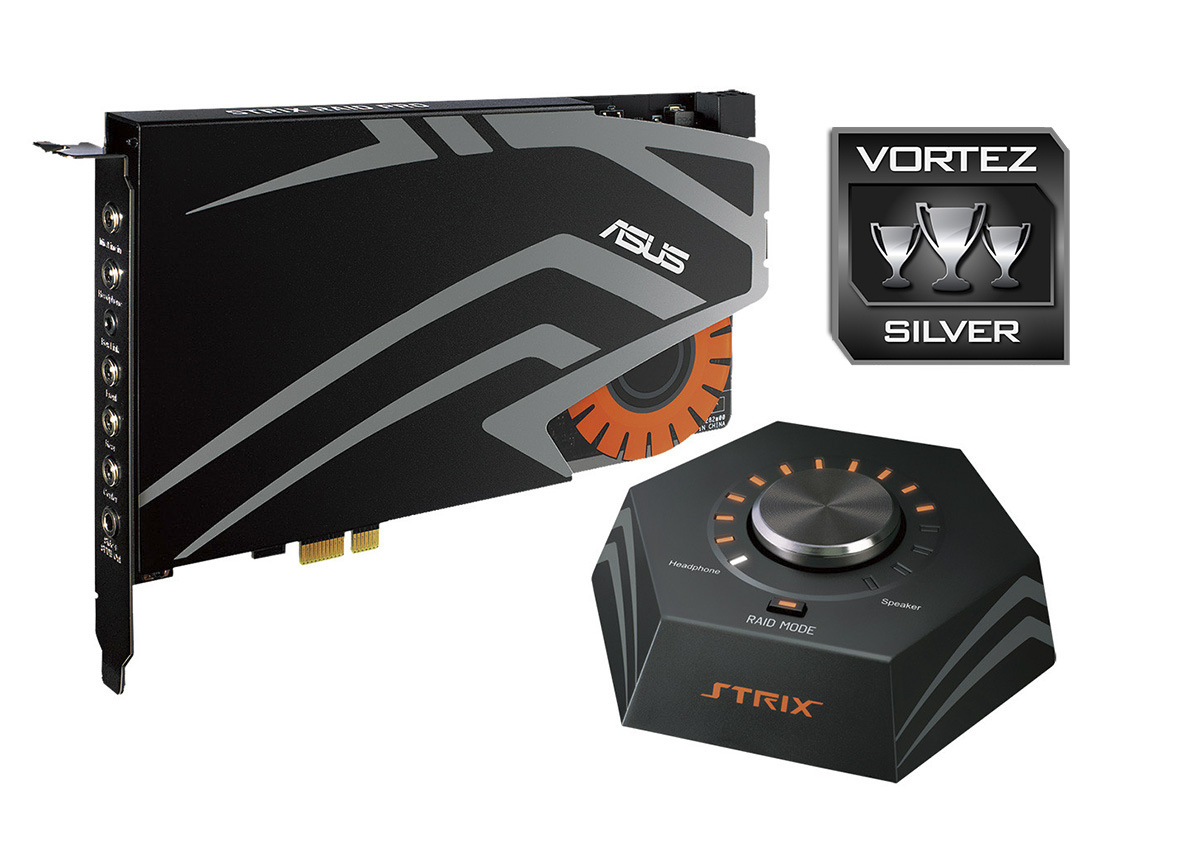
Click here for an explanation of our awards at Vortez.net.