In our first partner graphics card review for NVIDIA Ampere, we take a detailed look at the new ASUS TUF Gaming RTX 3080 OC. Should you be considering it? TUF-RTX3080-O10G-GAMING

Product on Review: TUF RTX 3080 OC
Manufacturer: ASUS
Street Price: USD $750 | AUD $1489 | GBP £750
NVIDIA’s 2nd generation RTX architecture codenamed “Ampere” was unveiled to consumers on September 1. Extensive adjustments to a variety of elements such as RT cores, Tensor cores and shader units are just a few of the improvements, along with the support for the very latest GDDR6X which boasts double the throughput of GDDR6, with memory bandwidth operating at an impressive 19Gbps – a joint development between NVIDIA and Micron.
Of NVIDIA’s flock, the RTX-30 Series is also the first to embrace PCIe 4.0, which for the moment is only available via AMD motherboards/platforms. Since NVIDIA and AMD graphics card series now utilise such a standard, we’ve recently upgraded our GPU test system to the AMD X570 platform, along with AMD Ryzen Gen 3, so we’re now ‘bang up to date’.
For countless years we’ve worked closely with NVIDIA and have reviewed various generations of their graphics cards for day 1 launch but unfortunately this time round, we weren’t afforded such a privilege, hence the lack of Founders Edition coverage.
In the weeks that followed ASUS has stepped in and kindly sent over one of their new RTX 30-series models, so we’d like to express a huge thanks to the team!
In the spotlight today is the ASUS TUF RTX 3080 OC, a graphics card featuring the very latest GA-102 ampere GPU. The team at ASUS has applied a factory OC , nudging up the frequency of the GPU Boost Clock by 100MHz. This TUF model also arrives with the renowned Max Contact thermal solution and a triple helping of axial-tech cooling fans.
Should you have this RTX 3080 on your radar? Read on to find out!
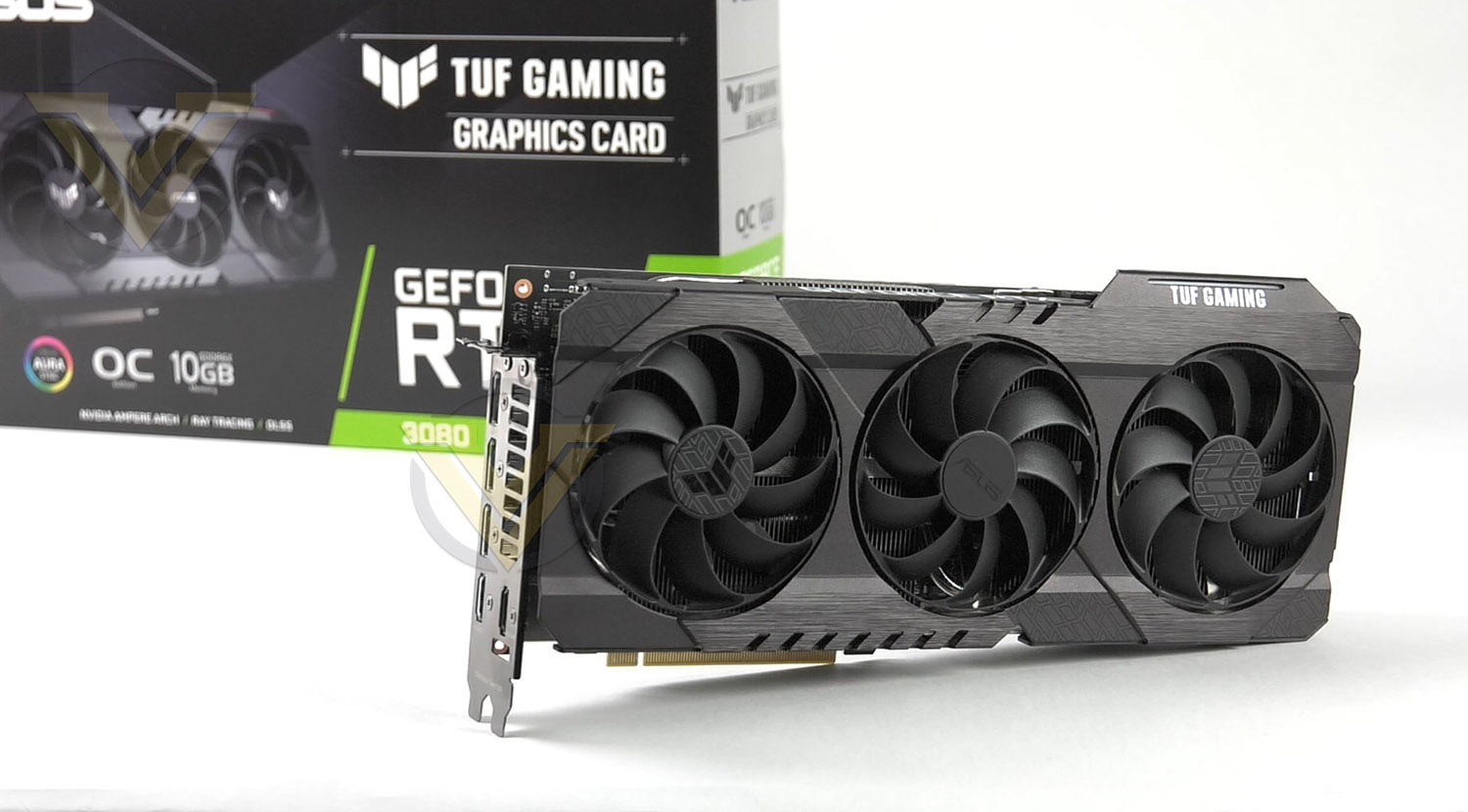
ASUS on their TUF RTX 3080
The TUF Gaming GeForce RTX™ 3080 has been stripped down and built back up to provide more robust power and cooling. A new all-metal shroud houses three powerful axial-tech fans that utilize durable dual ball fan bearings. Fan rotation has been optimized for reduced turbulence, and a stop mode brings all three fans to a halt at low temps. Beneath, independent heatsinks for the GPU and memory keep thermals under tight control. Additional features, including TUF components, Auto-Extreme Technology, a new GPU bracket, and a backplate vent make the TUF a proper powerhouse. For builders looking for a new “old faithful”, this card has your back.
Technical Specifications
Below are the technical specifications surrounding TUF RTX 3080 OC supplied directly by ASUS:
GPU
GA102
Stream Processor
8704
Video Memory
10GB GDDR6X
Memory Bus
320-bit
Engine Clock Boost
1785MHz
Memory Clock
19000MHz Effective
PCI Express
4.0
Display Outputs
3x DisplayPort 1.4
2x HDMI 2.1
Recommended Power Supply
750W
DirectX
12 API feature level 12_2
OpenGL
4.6
Cooling
Triple-fan
Slot Size
2.7
Supported OS
Windows 10
Card Length
299 x 126 x 51cm
GA102
Stream Processor
8704
Video Memory
10GB GDDR6X
Memory Bus
320-bit
Engine Clock Boost
1785MHz
Memory Clock
19000MHz Effective
PCI Express
4.0
Display Outputs
3x DisplayPort 1.4
2x HDMI 2.1
Recommended Power Supply
750W
DirectX
12 API feature level 12_2
OpenGL
4.6
Cooling
Triple-fan
Slot Size
2.7
Supported OS
Windows 10
Card Length
299 x 126 x 51cm
Closer Look Video Review
For this review we’ve produced a video of TUF RTX 3080 OC. In this video we go into great detail about this graphics card, walking you through all of the features and detaching the cooler for a look at the thermal solution and innards. View the video here or watch below:
Test Setup & Methodology
HOW WE TEST GRAPHICS CARDS
Testing a graphics card is an extremely lengthy process. We sometimes see reviews where a graphics card has been tested using out of date equipment, out of date games and even out of date drivers. While the latter can be excused due to the sheer amount of driver updates making a thorough review impossible we will however notify the reader when we have used a different driver to the normal for example a pre-release driver. For the most part however we will always use the same hardware and latest drivers so this does certainly need to be taken into consideration when viewing our testing results. Each game and benchmark is tested times with the lowest and highest scores omitted out of the 5 results and the average then taken from the three remaining to give us our final result for each resolution and setting used.HARDWARE
In Q3 2020 we decided to move on from our Intel X99-based graphics card test system to embrace AMD Ryzen Gen3. The basis for this was quite simple, AMD’s platform is one of the most popular choices for gamers and by using such a configuration, we can hopefully showcase to our readership what they can expect. In the past we’ve used HEDT platforms and while this does indeed align itself to the bleeding edge for a computer system, it doesn’t reflect what most gamers will be using.With NVIDIA and AMD now using PCIe 4.0 for their bus interface on graphics cards, AMD Ryzen Gen3 and the X570 chipset are well-equipped to test appropriately.
Graphics Cards on test:
AMD RX 5700
AMD RX 5700 XT
NVIDIA RTX 2060
NVIDIA RTX 2060 SUPER
NVIDIA RTX 2070 SUPER
NVIDIA RTX 2080 SUPER
NVIDIA RTX 2080 Ti
Special thanks go to AMD, MSI, Corsair, Noctua and AverMedia for providing the hardware configuration for our graphics card reviews:
Motherboard: MSI PRESTIGE X570 CREATION
CPU: AMD Ryzen 7 3800X
RAM – 16GB (2x8GB) Corsair LPX Vengeance DDR4 @ 3000MHz
Power Supply – CORSAIR HX1050
Hard Drive – Samsung 830 EVO 250GB + Crucial MX300 2TB
Cooler – CORSAIR Hydro Series™ H150i Pro 360mm Extreme Performance Liquid CPU Cooler
Capture Card – Avermedia Live Gamer Extreme 2
CPU: AMD Ryzen 7 3800X
RAM – 16GB (2x8GB) Corsair LPX Vengeance DDR4 @ 3000MHz
Power Supply – CORSAIR HX1050
Hard Drive – Samsung 830 EVO 250GB + Crucial MX300 2TB
Cooler – CORSAIR Hydro Series™ H150i Pro 360mm Extreme Performance Liquid CPU Cooler
Capture Card – Avermedia Live Gamer Extreme 2
BENCHMARKS
If you are a regular reader of our reviews you will know we like to test the latest hardware with the latest games and benchmarks on the market. Here are the games we’ve chosen:Horizon Zero Dawn
Control
Shadow of the Tomb Raider
F1 2020
A Total War Saga: Troy
Control
Shadow of the Tomb Raider
F1 2020
A Total War Saga: Troy
To capture framerates we use a combination of in-game benchmark tools and FRAPS.
We also take into consideration the benchmarkers out there so have included three of the more popular synthetic benchmarks available:
3DMark Time Spy
3DMark Port Royal
Unigine: SuperPosition
3DMark Port Royal
Unigine: SuperPosition
In light of the new RTX and DLSS features, we have also added in some tests to cover this tech to provide some analysis, showcasing what users can expect with/without such a feature enabled. For this we are using:
3DMark DLSS
Control – RTX Off/RTX On
Control – RTX Off/RTX On
Let’s see how today’s graphics card performed…
Power, Temperatures, Acoustics
To test for power consumption, we take a measurement from the plug socket. It is important to note that the figures below represent total system power use and not just the GPU. The CPU was always in a fixed state so did not affect the additional power load when the GPU was placed under 100% load using AIDA64 stability test (GPU Only) which was ran for 20 minutes at which point a load reading was taken. Idle readings were taken 5 minutes after system boot to ensure any background services and applications had loaded.
TEMPERATURE
To test temperatures we measured idle temperatures after booting windows, letting all applications finish loading and ran a few benchmarks. Once the benchmarks were complete we left the card to reach a cooling plateau where we then took the idle temperatures. For the load tests we set Unigine SuperPosition running in game mode continuously for ~30 minutes and recorded the peak/maximum GPU temperature.ACOUSTICS
For the purpose of testing audio levels we have the NDI KC-3300 sound level meter. During the temperature recording above, while in Unigine SuperPosition gamemode we monitored the audio and the results are found below. All graphics cards are tested in their out of the box state (auto).DX12: 3DMark Time Spy
Download your copy nowWith its pure DirectX 12 engine, which supports new API features like asynchronous compute, explicit multi-adapter, and multi-threading, 3DMark Time Spy is the ideal benchmark for testing the DirectX 12 performance of the latest graphics cards.
DX12: 3DMark Port Royal
Download your copy now3DMark Port Royal is the world’s first dedicated real-time ray tracing benchmark for gamers. You can use Port Royal to test and compare the real-time ray tracing performance of any graphics card that supports Microsoft DirectX Raytracing. As well as benchmarking performance, 3DMark Port Royal provides a realistic and practical example of what to expect from ray tracing in upcoming games.
DX11: Unigine SuperPosition
Superposition is a new-generation benchmark tailored for testing reliability and performance of the latest GPUs. Top-notch visuals, support for VR-devices and an interactive mode with mini-games — the list of features built into Superposition could go on and on.
DX12: Horizon Zero Dawn
Horizon Zero Dawn is an action role-playing game developed by Guerrilla Games and published by Sony Interactive Entertainment. The plot follows Aloy, a hunter in a world overrun by machines, who sets out to uncover her past
DX12: Control
Control Ultimate Edition contains the main game and all previously released Expansions (“The Foundation” and “AWE"
 in one great value package. Winner of over 80 awards, Control is a visually stunning third-person action-adventure that will keep you on the edge of your seat.
DX12: Shadow of the Tomb Raider
Shadow of the Tomb Raider is an action-adventure video game developed by Eidos Montréal in conjunction with Crystal Dynamics and published by Square Enix. It continues the narrative from the 2013 game Tomb Raider and its sequel Rise of the Tomb Raider, and is the twelfth mainline entry in the Tomb Raider series.
DX12: F1 2020
F1® 2020 allows you to create your F1® team for the very first time and race alongside the official teams and drivers. Alternatively, challenge your friends in new split-screen with casual race options for more relaxed racing. Compete on 22 circuits, with current and classic content.
DX12: A Total War Saga: TROY
A Total War Saga: TROY is the first in the award-winning strategy series to focus on the Bronze-Age Mediterranean and the legendary twenty-year conflict between the kingdoms of Troy and Mycenaean Greece, known as the Trojan War.
Overall Performance
Here we take a look at the overall performance of the graphics card. This figure is determined by finding the average FPS across all of the settings used in a particular benchmark(game) to give us an overall value.
Value For Money
We make a simple calculation for this set of results. For each game we add all of the resulting FPS totals together and then divide by the four sets to give us an overall performance figure. While the figures alone do not give you an accurate picture of how the card will perform in any given scenario, they do tell you, when averaged, which GPU is the more capable across all of the benchmarks and settings tested.
Please note: we’ve used GBP for currency but since this is relative – regardless of which currency you use, this will give you a good indication of value for money.
DLSS Analysis: 3DMark DLSS
Deep Learning Super Sampling (DLSS) is an NVIDIA RTX technology that uses the power of deep learning and AI to improve game performance while maintaining visual quality.
RTX Analysis: Control
Control is an action-adventure video game title which has the ability to take advantage of real-time ray tracing. For this test we ran the game in 1440p with Ultra Detail set. Under the settings we enable RTX and assign the preset as “High”. Below are the results with RTX On and RTX Off.
Conclusion
Should you upgrade to NVIDIA’s RTX 3080 and more specifically, the ASUS TUF RTX 3080 OC? Well, that will largely depend on your current configuration, but we believe what ASUS presents is a solid representation of an excellent graphics card for this series.
While those with an RTX 20 Series GPU may not see a monumental performance boost, it will still be fairly significant. It is those who completely skipped the first phase of RTX that will benefit the most. Those looking to retire the GTX 1080 Ti will see spectacular improvements by stepping up to the new RTX 3080 and this time round, it won’t cost as much!
We really like what ASUS has done with the TUF RTX 3080 OC, both in the styling department and thermal design. The shroud gracing the externals of the card makes use of metal, giving it a superb finish and a durable outer shell. Underneath that shroud there is a gargantuan double-heatsink with triple axial tech cooling fans, this killer combo contributes to low-noise and low-temperatures. ASUS has gone further by equipping the GDDR6X chips with their very own heatsinks, to help alleviate heat.
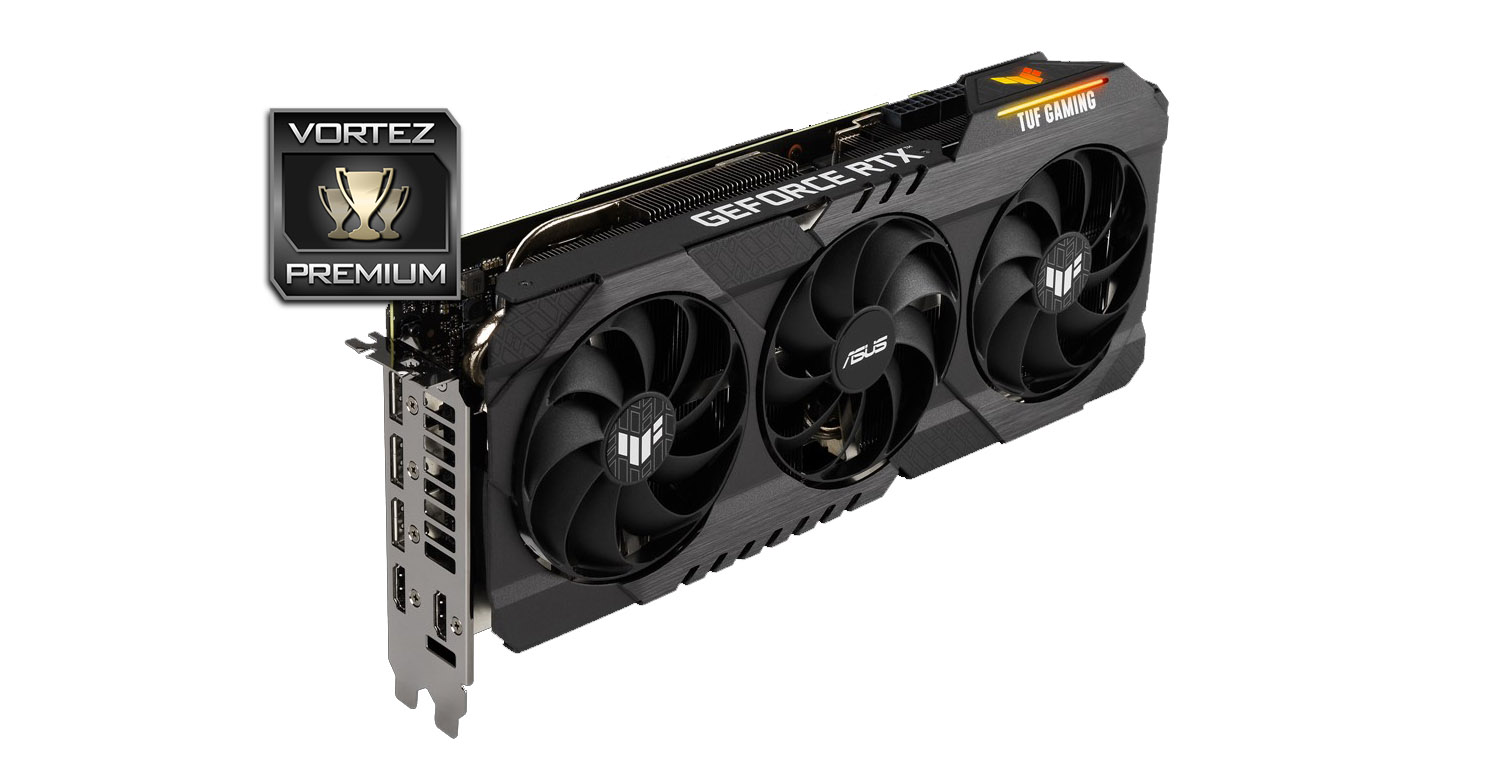
The memory on the TUF RTX 3080 OC has been left at the default NVIDIA frequencies which is somewhat disappointing, however the GPU clock has been given a generous factory overclock, seeing it modified 100MHz+. By shifting this particular attribute gamers can benefit from some extra fps in-game.
It should be highlighted that the RTX 3080 really comes into its own at resolutions above 1440p, when detail presets are intended to be maxed out and when a high-refresh monitor is being used. The provided horsepower and HDMI 2.1 paves for the way for gaming at 4K 120Hz – something which is steadily gaining popularity.
Of the varying RTX 3080s on the market the TUF RTX 3080 OC is grouped with some of the more affordable models and is priced at: USD $750 | AUD $1489 | GBP £750. This is backed by a solid, 3 year warranty which adds in some peace of mind.
The ASUS TUF RTX 3080 OC should not be overlooked. It carries an adept thermal solution and is well equipped to provide solid performance.
Pros
+ Clean aesthetics with subtle RGB
+ Excellent build quality
+ Factory overclock to GPU
+ Zero decibel technology
+ Low-noise under load
+ Tops out at just 60C
+ Dual-Bios switch for lower noise
+ Excellent performance in the latest games
+ Supports 4K 120Hz
Cons
– Power hungry
– Large
– Heavy
– No memory overclock
+ Clean aesthetics with subtle RGB
+ Excellent build quality
+ Factory overclock to GPU
+ Zero decibel technology
+ Low-noise under load
+ Tops out at just 60C
+ Dual-Bios switch for lower noise
+ Excellent performance in the latest games
+ Supports 4K 120Hz
Cons
– Power hungry
– Large
– Heavy
– No memory overclock
Click here for an explanation of our awards at Vortez.net.
Stay connected with the Vortez Social Media pages:
Join in with the discussions on Discord