



With the recent release of the Catalyst 10.4 suite, let’s see what ATI brings to the table.
There’s a common belief amongst early adopters of new hardware, especially graphics cards, that performance will improve over time thanks to continuous driver updates. It’s certainly a belief that manufacturers have tried to uphold themselves by constantly claiming performance improvements in their latest drivers. In many cases, their claims are correct since SLI and CrossfireX technologies are heavily reliant on software implementations and drivers undergo optimisations to take full potential of the hardware. Even with single card configurations, both Nvidia and ATI often claim major boosts of more than 10%, which is a figure that can often differentiate two separate cards (GTX295 vs HD5870). If those numbers are correct, it could essentially mean that relative performance differences between cards will vary over time and this has some interesting implications.
Let’s take the GTX295 vs HD5870 as an example. Upon release, many reviews including ours here at Vortez found that the GTX295 still offered a 10% lead over ATI’s HD5870. Driver updates in this case would put the HD5870 on an equal stand with the Nvidia card, thereby changing the way we recommend cards. Of course, those two cards are from different generations but if we cast our minds back to the GTX260 vs HD4870 days, it became much harder to recommend one card over the other. In fact it was thanks to driver updates (known as the Big Bang II) that the GTX260 became competitive again after the initial release of the HD4870. This example demonstrates that driver updates can change the way we view and thus recommend graphics cards. It can also mean that reviews using older drivers become obsolete since they do not take into account those performance gains and users/readers have to be wary of this.
The other problem is that users can then become too reliant on driver updates and thus judge their purchase on the hope that there will be potential performance gains in the future. One such example was the release of the HD2900XT. Although ATI had built up much hype with their latest technology, they were unable to compete with the already released 8800GTX. Early adopters of the card were hopeful that drivers would bring further optimisations and fix the lack lustre Anti-Aliasing performance but in the end, Nvidia still reigned champion.
So we’ve seen driver updates being able to change the “game” and in other scenarios they didn’t deliver what people were hoping for. The idea that drivers can have such an impact on performance and people’s attitude to hardware makes it an excellent marketing tool for manufacturers which takes me back to my first point. Do their claims really translate to real world performance boosts?
Today, I will have hold a comparison between the Catalyst 9.10 drivers and ATI’s latest 10.4 drivers. The latter was the first to bring full GPU support to the 58xx series of cards so the latest drivers should show some improvements.
Test Setup
CPU – Intel Core i7 920 – 4GHzRAM – 6GB (3x2GB) OCZ platinum DDR3 1333MHz
Motherboard – Biostar T-Power x58
Power Supply – Enermax Revolution 85+ 850W
Cooling – Corsair H50
Hard Drive – Samsung F1 320GB
Western Digital Caviar WD3200AAKS 320GB
Graphics cards
ASUS EAH5870 1024MB – ATI Catalyst 9.10 Win 7 x64
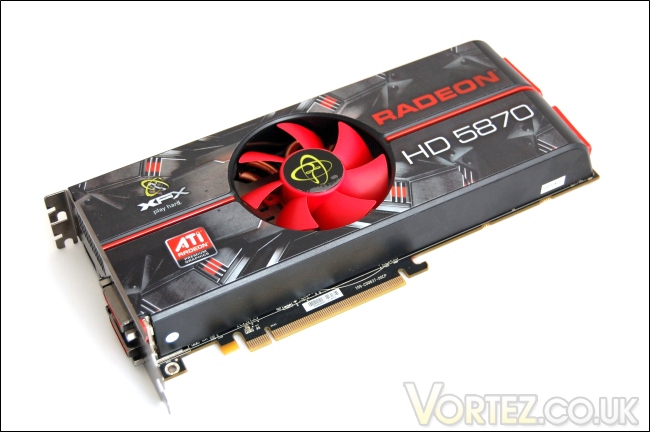
XFX 5870 1024MB – ATI Catalyst 10.4Win 7 x64
Benchmark Suite
Crysis Warhead using the FRAMEBUFFER Crysis benchmark tool
Far Cry 2
Resident Evil 5
Street Fighter IV
Unreal Tournament 3 using the HOC Bench tool
Enemy Territories Quake Wars using the HOC Bench tool
GTA IV
3DMark 06
3DMark Vantage
Unigine DX 11 Benchmark
Crysis Warhead
Following the success of Crysis, the stand alone expansion “Warhead” was hotly anticipated to bring more game play, more weapons, improved visuals whilst maintaining better performance, the latter being what gamers wanted most. After all how many people upgraded their rigs just to play this game… In the game, you play as the upbeat Brit Sergeant “Psycho” Sykes, chasing down a Korean nuclear warhead. Throw in some ice shooting aliens and we’re bound to have a great game. It sure delivered.
We can immediately see some improvements from the new drivers in Crysis Warhead. Catalyst driver 10.3, which is hailed as the driver that unlocked the full potential of the HD5000 series of cards claimed performance improvements of up to 6% in Crysis Warhead. In our tests, we see a boost ranging from 3-6.5% in the average FPS proving ATI’s claim even in the latest 10.4 drivers. A slight increase in the minimum FPS also ensures a smoother gameplay. Not too shabby for a driver update.
Far Cry 2
One of the most hyped games of 2008, Far Cry 2 had some big shoes to fill. It was built to be the next best thing since well… Far Cry I suppose. Combining an open-world game play with highly detailed graphics, physics and AI, what more could we possibly want? The game puts us in the body of a malaria inflicted mercenary hunting down the “Jackal” in the heart of Africa, in a bid to stop an ongoing conflict between two rival factions. The storyline can be hard to follow sometimes but I’m no game reviewer, so let’s concentrate on the graphics and performance. After all, we all need to know if our hardware will be able to handle the scorching savannah burning at the hands of our flamethrowers.
Again the updated drivers claimed an increase of up to 6% on Far Cry 2 using the HD5000 series of cards. Our results show that the increase was only by about 3% on all the settings tested. Nonetheless, a free increase in performance is always welcomed. The increase depicted in the minimum FPS results also reflect that observed for the average FPS, providing a slightly smoother gameplay experience.
Resident Evil 5 & Street Fighter IV
Resident Evil 5Resident Evil 5 is the sequel to the Resident Evil series, exploring the life of main protagonist, Chris Redfield. You play as either Chris Redfield or Sheva Alomar in an African desert area in Kijuju. In true Resident Evil fashion, your main objective is to investigate a terrorist bio-organic weapon threat whilst killing infected “Majinis” on your way.
Looking at the results, it’s very clear that the new drivers provide better performance. According to ATI, the 10.3 driver update was meant to bring an increase of up to 5% to the HD5000 cards. In reality, it was closer to 3% which still stands by ATI’s claim.
Street Fighter IV
Street Fighter is back in its 4th iteration and its bigger and better than ever. Combining fluid, fast based sparring with stunning artistic visuals, the game delivers tremendous game play. Be reacquainted with some of the most popular characters in video game history while you battle your way to the top, be it with Ryu or the mighty Bison. The game might be frustratingly hard in some cases but there’s nothing like the satisfaction of K.O’ing your opponent with a well stringed death bringing combo.
No performance boost was advertised for Street Fighter IV on the latest drivers so it comes as a pleasant surprise to see otherwise in the results. The improvement mirrors that observed in Resident Evil 5 at around 3%. For unknown reasons, the game plays better at the higher 1920×1200 resolution which we have found to ring true in other past reviews as well.
Unreal Tournament 3 & Enemy Territory: Quake Wars
Unreal Tournament 3Built around the unreal 3 engine, Unreal Tournament is all about mindless fast paced shooting, decapitation with a plethora of game modes to so in. Not much else can be said really except that it promises hours of enjoyment on multiplier whether it be against bots, your friends at a LAN or online. It was one of the more popular games out there to adopt PhysX in the form of partially destructible maps, tornadoes and hail.
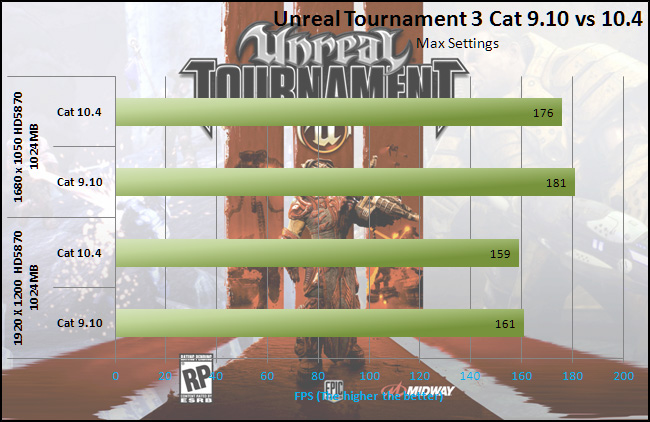
Unreal Tournament shows no improvement at all. In fact there’s a slight FPS drop but with such good results anyway, a less than 3% decrease is not significant enough to warrant skipping the latest driver updates.
Enemy Territories Quake Wars
Earth is struck once again by Extra-Terrestrials, this time in the form of the Strogg. In the game you play as either the humans, defending the their beloved planets, or the Stroggs, attempting to invade with their arsenal of futuristic weapons. The games has vast open battlefields with an enormous array of vehicles and weapons at your disposable promising fast paced strategic battles.
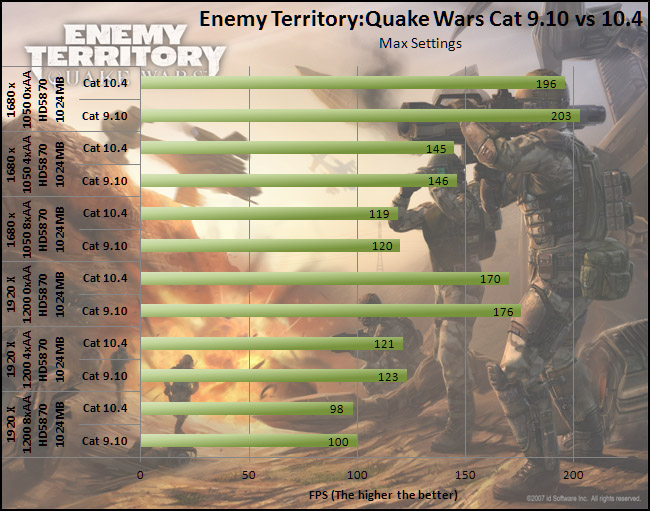
Yet again there’s a slight drop in performance observed which isn’t in tune with ATI’s claim of an increase of up to 5% on Enemy Territory. It’s not a notable drop but one nonetheless considering that we expect improvements over time through driver updates and not the opposite.
Grand Theft Auto 4
GTA IV follows a whole series of highly successful predecessors and this one is no exception. You play as Nico Bellic, fresh off the boat from Russia, seeking to live the American dream. But Liberty has far more sinister plans for you as you delve quickly into the criminal underworld to make a living and survive. Hours of game play later, it still retains its flare to guarantee that you go back to it at every opportunity.
Grand Theft Auto 4 shows no real difference with both sets of drivers and furthermore increasing the amount of detail didn’t even impact the performance given that the game was not memory limited at those settings.
3DMark 06 & Vantage
3DMark 06
Futuremark has been the testing ground for enthusiasts ever since their first release in 1999! While 2006 is long gone, it’s still very popular amongst benchers.
If there is one benchmark that has always been used to judge driver optimisation, it is 3DMark06. Nowadays, it can be considered an obsolete test with the advent of 3DMark Vantage and the fact that it has become severely CPU limited but it is still a test conducted by many due to its popularity. Here we see a slight performance drop with the latest drivers compared to those at the initial launch of the HD5800 cards. This drop is less that 1% suggesting that ATI haven’t optimised their cards further for the old benchmark.
3DMark Vantage
This latest benchmark suite from Futuremark introduces DX 10 & PhysX support. Despite being on the verge of DX 11 games arriving, Vantage is still the chosen benchmark amongst enthusiasts these days.
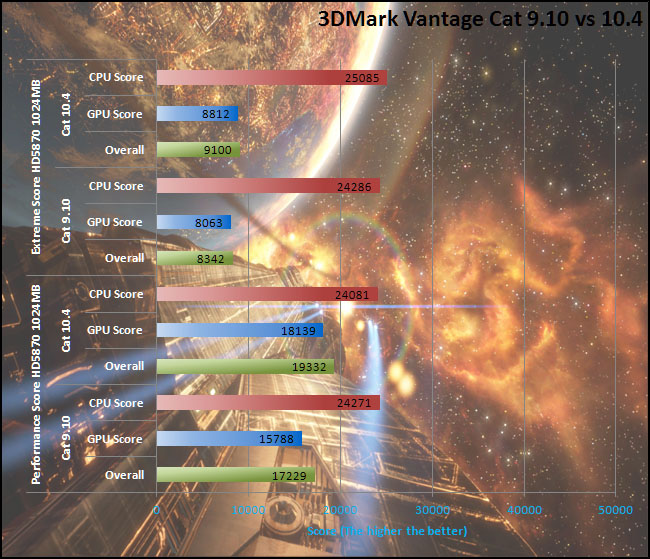
There has always been a degree of controversy with the Futuremark benchmarks in that manufacturers, including both ATI and Nvidia, purposefully optimise their drivers for those tests while not delivering any gains in other games. Some even claim the use of trickery through lower image quality to bring those improvements. Whatever the reason may be, ATI claimed overall scores would increase by up to 4% on their 10.3 Catalyst drivers. In our results, the overall scores increased by up to 12% compared to the original set of drivers. With the CPU scores remaining almost static, we can see that the gains are from the GPU. Any bencher out there will no doubt welcome these excellent improvements regardless of what some may infer about image quality. Personally, I saw no such problems and put the gains solely down to better optimisation of drivers.
Unigine DX 11 Benchmark
Unigine’s benchmark is to showcase the benefits of DX11 and the use of tessellation as opposed to normal rendering techniques. The demo has impressive visuals that give an insight into what we can expect from gaming in the future.
Tessellation and DX11 performance are two aspects of the new HD5000 series of cards that ATI have heavily promoted. Back in early November when we reviewed the ASUS EAH5870 on the 9.10 drivers, Windows 7 had only just been released and DX11 was still in its infancy in terms of support amongst developers. So it comes as no surprise that the latest drivers from ATI show some improvement in that department. The 10.3 drivers promised improvements of up to 5%. In DX10, we see an increase of around 4% with the latest 1.4 drivers and in DX11 with tessellation turned on, there’s an 11% increase! The fact that we see a bigger improvement in the DX11 tests suggests optimisations have been done to the tessellation engine and to the overall DX11 capabilities.
Conclusion
The Catalyst 10.3 drivers were hailed to be the drivers that fully unlocked the potential of the HD5000 series. Of course, the sceptics in the community believed that ATI were holding back performance on purpose waiting till Nvidia launched their Fermi graphics cards to deliver another blow to them. But for the most part, the performance improvements ATI claimed were fairly conservative with only DIRT 2 advertised as gaining a massive 20% boost. Unfortunately I didn’t run the DIRT 2 benchmarks on the older drivers for comparisons.
Looking at our results though, we see a general improvement with the latest 10.4 drivers, which has retained the performance increase from the 10.3 drivers. On the whole it ranged from 3-6% in Far Cry 2, Crysis Warhead, Street Fighter IV and Resident Evil 5. There was a slight drop in Quake Wars and Unreal Tournament but this wasn’t significant at all, given the already high FPS. 3DMark Vantage and the Unigine demo also saw a rise in performance. The most important observation was the fact that the DX11 benchmark showed some impressive gains suggesting that ATI have been optimising the DX11 performance and their tessellation engine.
So there we have it, ATI have done a tremendous job to constantly extract performance from the cards. Of course, I have to emphasise that the HD5800 series of cards delivered excellent results even at launch and the performance we see today is a welcomed bonus. Their dedication to release monthly drivers also has to be commended for the effort that goes into doing so. Most importantly however, drivers are not merely tools to occasionally raise performance in games but they ensure compatibility with all the latest software as well as issue bug fixes. After all, that is their primary function and what we see in terms of FPS gains should be considered an additional benefit.