




Can the top-down CPU cooler SR TopFlow handle the heat of Intel’s Sandy Bridge-E? It’s time to find out if this be quiet! cooler is up to the task.

Product on Review: Shadow Rock TopFlow
Manufacturer and Sponsor: be quiet!
Street Price: Approx. £35(at time of review)
In the arena of the CPU cooler the obvious factor to lower is CPU temperature but with the plethora of dual-tower CPU coolers that currently populate the market size can be a concern for those with less space inside their computer chassis and so this makes way for the top-down CPU cooler. Top-down CPU coolers also called C-type offer a low-profile uniform to counter the problem of clearance and today we will be taking a look at one such product.
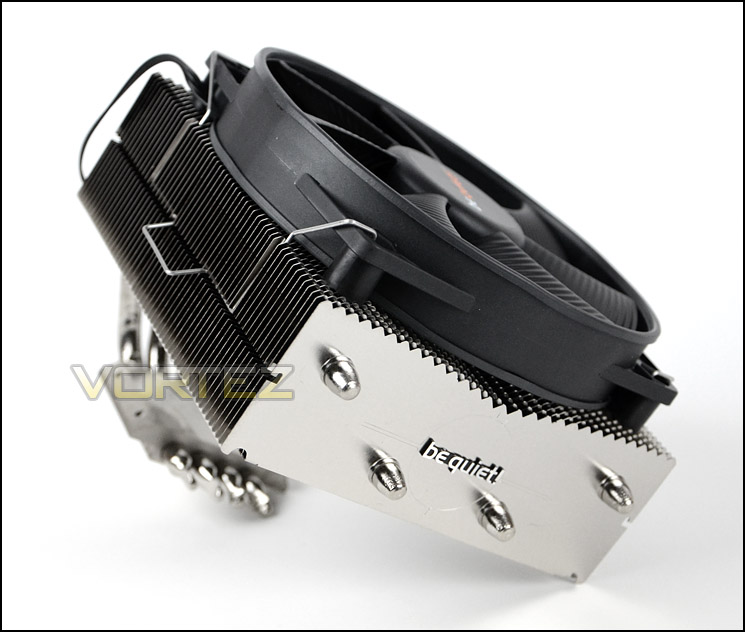
In the spotlight today is be quiet!’s Shadow Rock TopFlow CPU cooler which as its name implies is a top-down option. Its strengths lie in the low-profile dimensions and silence. TopFlow is equipped with a Shadow Wings 135mm PWM cooling fan which is capable of up to 1500RPM and promises to deliver on build quality, affordability and other areas too but can we expect impressive thermal performance? Let’s find out…
be quiet! on Shadow Rock TopFlow
Shadow Rock TopFlow is a low profile CPU cooler with high cooling performance of up to 160W TDP and very quiet operation.
Four wide 8mm heatpipes enable the high heat transference of the space saving cooler. be quiet!’s oversized 135mm Shadow Wing PWM-fan provides the CPU plus surrounding components with plenty of cool air with minimal noise.
Even at high fan speed, the Shadow Rock TopFlow guarantees a low noise of a mere 23.5 dB(A) and a high life span of 200,000 hours. The cooler supports all modern sockets of AMD and Intel and comes with a versatile mounting system.
Four wide 8mm heatpipes enable the high heat transference of the space saving cooler. be quiet!’s oversized 135mm Shadow Wing PWM-fan provides the CPU plus surrounding components with plenty of cool air with minimal noise.
Even at high fan speed, the Shadow Rock TopFlow guarantees a low noise of a mere 23.5 dB(A) and a high life span of 200,000 hours. The cooler supports all modern sockets of AMD and Intel and comes with a versatile mounting system.
Technical Specifications
Main Specifications
Overall dimensions without mounting material (L x W x H), (mm)
171 x 137 x 126
Total weight (kg)
0.65
TDP (W)
160
Socket compatibility
Intel: LGA 2011 / 775 / 1155 / 1156 / 1366 / 1150 / AMD: AM2(+) , AM3(+) / 754 / 939 / 940 / FM1 / FM2
Fan model, number
Shadow Wings PWM 135mm with Anti vibration fan fixing
Overall noise level (dB(A)) @ 900/1250/100% (rpm)
9.60 / 15.9 / 24.4
Heatsink Specifications
Dimensions (L x W x D), (mm)
171 x 137 x 100
Number of fins
53
Fin material
Aluminium
Base material
Copper
CPU contact surface
CNC machined
Heatpipe number, Diameter (mm)
4 / 8
Surface treatment
Nickel plated
Fan Specifications
Fan dimensions (mm)
135 x 135 x 25
Speed @ 100% PWM (rpm)
1500
Air flow @ 12V (cfm, m3/h)
66.8 / 113.6
Air pressure @ 12V (mm H2O)
2.10
Bearing type
Rifle
Rated voltage (V)
12
Input current (A)
0.22
Input power (W)
3
Connector
4-pin PWM
Cable length (mm)
200
Lifespan (h / 25°C)
200.000
Overall dimensions without mounting material (L x W x H), (mm)
171 x 137 x 126
Total weight (kg)
0.65
TDP (W)
160
Socket compatibility
Intel: LGA 2011 / 775 / 1155 / 1156 / 1366 / 1150 / AMD: AM2(+) , AM3(+) / 754 / 939 / 940 / FM1 / FM2
Fan model, number
Shadow Wings PWM 135mm with Anti vibration fan fixing
Overall noise level (dB(A)) @ 900/1250/100% (rpm)
9.60 / 15.9 / 24.4
Heatsink Specifications
Dimensions (L x W x D), (mm)
171 x 137 x 100
Number of fins
53
Fin material
Aluminium
Base material
Copper
CPU contact surface
CNC machined
Heatpipe number, Diameter (mm)
4 / 8
Surface treatment
Nickel plated
Fan Specifications
Fan dimensions (mm)
135 x 135 x 25
Speed @ 100% PWM (rpm)
1500
Air flow @ 12V (cfm, m3/h)
66.8 / 113.6
Air pressure @ 12V (mm H2O)
2.10
Bearing type
Rifle
Rated voltage (V)
12
Input current (A)
0.22
Input power (W)
3
Connector
4-pin PWM
Cable length (mm)
200
Lifespan (h / 25°C)
200.000
Packaging, Bundle & Fans
TopFlow is packaged inside an eye-catching box which is indicative of be quiet! there are various stylish depictions of the cooler to entice the consumer in and fundamental features are also there for those wanting to know the important facts about this product. The side lists the technical specifications and an assortment of awards which have been achieved – testament to TopFlow’s success as a valued cooling product.
Inside, the cooler and its components are securely packaged with foam cushioning and care has been taken to section off installation items for guidance.
Eye-catching packaging for TopFlow
Opening up the included box found within the packaging reveals the accessories bundle. Inside this bundle are various brackets and components for different socket types, an instructions guide, backplate and thermal paste. TopFlow is designed to fit the following sockets: Intel LGA 2011 / 775 / 1155 / 1156 / 1366 / 1150 / AMD AM2(+) , AM3(+) / 754 / 939 / 940 / FM1 / FM2.
The bundle with various parts for different socket types
Also included with TopFlow is a single Shadow Wings 135mm PWM cooling fan and some clips to attach the fan to the heatsink. This cooling fan is capable of up to 1500RPM. In each corner be quiet! have attached anti-vibration rubber pads to correspond with heatsink installation. These can be removed to reveal mounting holes as you would typically find on a fan.
This fan has a 4-pin PWM connector which is plugged into a fan header on the motherboard.
Shadow Wings 135mm PWM fan
Anti-vibration pads in each corner
Closer Look
TopFlow, as its name suggests is a CPU cooler which is a top-down style heatsink as opposed to a tower design which is much more common. A top-down type CPU cooler provides a distinct compromise for better clearance since it is lower profile. With the heatsink width being significantly thinner this means less heatpipes pass through the fins and thus performance is likely to be lower than a dual-tower cooler. TopFlow’s heatsink design means that when the cooling fan is attached airflow will be directed towards the motherboard and chipset.
TopFlow heatsink is 171mm x 137mm x 100mm (L x W x D) in phycial dimensions and uses a total of 53 aluminium fins which are nickel plated.
A top-down style of heatsink
53 aluminium, nickel plated fins
The fins which make-up the heatsink are jagged and stacked in close proximity. Their alignment profile are not flat as you would expect with a cooling intended to be attached but rather towards the centre they bow into a valley shape.
Through the stack run four heatpipes which are eight mm in diameter. These heatpipes run to a copper baseplate which as the picture below shows is partly reflective with a mirror type finish.
The profile of aluminium fins
Copper baseplate with reflective finish
Attaching the fan to the TopFlow heatink is very easy. The fan clips simply slot into the grooves which run along the edge and provide a rather secure method of fixing the fan to the product.
Fan clips securely fix cooling fan to heatsink
Installation Process
In order to demonstrate the installation process for TopFlow we are installing the cooler on the Intel LGA2011 socket.
The first step for the installation on this socket (as we have found with many other coolers) is to apply four double sided screws to the mounting holes found on the outer edge of the socket. Once this has been done its then time to attach the mounting brackets to each side of the heatsink baseplate. This is accomplished by applying two screws on either side, the brackets must be placed in the orientation as per below picture. After the brackets are fixed onto the heatsink the final step is to apply thermal paste, place the heatsink over the CPU and tighten the four bolts with provided spanner.
There are a variety of orientations you can select but it is advisable to have the top of the heatpipes facing the top of the motherboard so that when everything is inside the computer chassis the heat rises to the top of the case. Having the cooler facing the opposite direction can significantly affect temperatures, in a negative way.
Although this method requires more time to complete compared to other CPU cooler installations it is one that instills confidence and is reliable.

Installed – Memory Clearance
With TopFlow now installed we have a good idea of how this CPU cooler looks on an ATX motherboard. With TopFlow being a top-down style cooler there is less height, more clearance for memory but some space is taken off the width of the motherboard. Not all CPU coolers have a pleasant physical appearance but TopFlow has this as one of its strengths – it looks pleasing to the eye and co-ordinates well with other computer hardware.
Shadow Rock TopFlow installed without cooling fan
Shadow Rock TopFlow installed with Shadow Wings 135mm PWM cooling fan
Due to the heatsink sitting slightly higher than a tower-style cooler there is additional clearance to be taken advantage of. As you can see below standard low-profile memory has copious amounts of clearance. Total clearance here is approximately 6cm which is more than enough for some of the tallest memory kits out there such as Corsair Vengeance which is 5cm. So certainly on this front, the TopFlow has clearance in its favour.
Test Setup & Methodology
Test System
CPU – Intel Core i7-3930K (3.6GHz)
Motherboard – GIGABYTE X79-UP4
Memory – 8GB Corsair Vengeance LP 1600MHz CL9
Graphics – Sapphire Radeon HD 6850 1GB
PSU – NZXT Hale90 650W
Hard Drive – Kingston HyperX 240GB SATA III SSD
Case – Corsair Carbide 500R White
Motherboard – GIGABYTE X79-UP4
Memory – 8GB Corsair Vengeance LP 1600MHz CL9
Graphics – Sapphire Radeon HD 6850 1GB
PSU – NZXT Hale90 650W
Hard Drive – Kingston HyperX 240GB SATA III SSD
Case – Corsair Carbide 500R White
CPU Coolers
Alpenföhn Matterhorn Pure(120mm Wingboost: 300-1200RPM)
Alpenföhn K2 (120mm Wingboost: 500-1500RPM, 140mm Wingboost: 300-1100RPM)
Alpenföhn Gotthard (140mm Wingboost: 300-1100RPM)
Noctua NH-D14 (120mm NF-P12 PWM + 140mm NF-P14 PWM: up to 1200RPM)
Thermalright SilverArrow SB-E Extreme (Dual TY-143 fans – 600-2500RPM)
Corsair Hydro H100 (Dual 120mm fans – low: 1300RPM, mid: 2000RPM, high: 2600RPM Push Config)
SilverStone HE01 (140mm PWM fan – 500RPM-1200RPM – 500RPM-2000RPM)
be quiet! Dark Rock Pro 2 (135mm + 120mm PWM Fans – up to 1500RPM and 1700RPM)
Thermaltake Water 2.0 Pro (Dual 120mm PWM fans – up to 2000RPM)
Corsair Hydro Series H100i (Dual 120mm fans – up to 2700RPM Push Config)
Shadow Rock TopFlow (1x 135mm PWM fan – up to 1500RPM)
Program Suite
Real Temp – Maximum temperature analysis
LinX 0.6.4 – Applies thorough stress test to CPU
CPU-Z – Confirmation of CPU frequency/voltage
AIDA64 Extreme Edition – Confirmation of temperatures/fan speeds
Testing methodology
Testing will be based on temperatures recorded by Real Temp after 20 passes of LinX stress test. The maximum absolute temperatures will be recorded after the test and averaged over the 6 cores. The delta is then calculated by subtracting the ambient temperature recorded near the intake fans from the average temperature calculated. Tests are conducted with the Intel i7 3930K at its default 3.6GHz stock speed and overclocked to 4.6GHz @ 1.42V. The tests are done inside the Corsair Carbide 500R chassis to simulate real world conditions. To keep the tests standardised we are using Noctua’s NT-H1 thermal paste on all coolers.
CPU coolers are reviewed as they come out of the box – with their factory cooling fans, as the manufacturer intended and as the consumer expects.
Additional tests include a passive test where the cooling fans are taken away from the heatsink and a comparison between the cooler used with stock thermal paste against our Noctua NT-H1 paste.
A kind thank you to Noctua for supplying us with NT-H1 thermal compound.
Results – Stock Performance
Thermal performance with top-down style coolers is always going to be trailing dual-tower style but the TopFlow actually demonstrates some impressive results. With the fan operating at 800RPM (53%) TopFlow beats our previously tested Alpenfohn Gotthard – the only other top-down cooler we have tested. At 800RPM the fan is barely even noticeable.
Results – Overclocked Performance
Once an overclock has been applied to the CPU the TopFlow unfortunately falls away from being as effective. The gulf between it and the other dual-tower coolers is now quite big. Top-down coolers are known for struggling when the CPU is under a significant overclock. Through this test the fan moved up to 1500RPM (100%). The fan is more noticeable on this occasion but is by no means disruptive.
Results – Passive Performance
We’ve tested with the included PWM cooling fan to show the performance available out of the box but now it’s time to see how the heatsink design holds up to testing without the assistance of a cooling fan. This test relies purely on design and quality of components. As you can see from the results, TopFlow falls behind all of our previously tested coolers showing that this cooler relies quite heavily on the included cooling fan.
Results – Chipset Cooling Performance
With TopFlow being a top-down design cooler it has the potential to deliver lower chipset temperatures for the motherboard because the fan blows down onto this component. For this test we compared TopFlow to a popular tower design CPU cooler – Noctua NH-D14 and the other previously reviewed top-down cooler Alpenfohn Gotthard. As you can see from the results there is some quite an improvement on the chipset temperatures and an advantage with our be quiet! cooler. Stock fan speed is 800RPM whilst overclock is 1500RPM.
Results – Thermal Paste Comparison
Most CPU coolers come accompanied with thermal paste provided by the manufacturer. For our CPU cooling tests we use Noctua’s NT-H1, so to offer up some interesting analysis we test the thermal paste which comes packaged with TopFlow to see which gives the best results during stock and overclocked performance.
The difference between the paste bundled with the be quiet! cooler and Noctua NT-H1 is nominal and comes fairly close in the head-to-head.
Conclusion
In our first review for be quiet! we found the Dark Rock Pro 2 to be an excellent product, can the same be said of the Shadow Rock TopFlow?
It certainly can. TopFlow is an exceptional top-down CPU cooler which has good build quality along with a secure mounting system which can be relied upon. When used on the Intel Sandy Bridge-E platform stock performance is very competitive, nearing that of respectable dual-tower coolers. Unfortunately when the frequency is nudged up to a substantial overclock the gap in temperature increases and TopFlow falls behind.
During normal operation the Shadow Wings 135mm PWM cooling fan is quiet at 800RPM (53%) and presents no annoyances, at 1500RPM (100%) the fan is noticeable but is by no means a disruption so the noise levels emitted from TopFlow’s cooling fan is testament to its silence which will please those who demand silence.
Priced at a mere £35 the Shadow Rock TopFlow is one of the most affordable top-down solutions, other rival options are positioned £10-15 more making our cooler under review a likely option for enthusiasts with less space inside their computer chassis.
Shadow Rock TopFlow is an impressive top-down CPU cooler which delivers on build quality, visual appearance, silence and even affordability. If you are looking for a good CPU cooler and require something which is low-profile then the TopFlow should be considered for the short-list.
Pros
+ Pleasing to the eye
+ Good build quality
+ Quiet cooling fan
+ Secure mounting system
+ Affordable
Cons
– Not ideal for substantial overclocks
+ Pleasing to the eye
+ Good build quality
+ Quiet cooling fan
+ Secure mounting system
+ Affordable
Cons
– Not ideal for substantial overclocks

Click here for an explanation of our awards at Vortez.net.


