







Were we enraptured by the latest instalment to one of the most critically acclaimed video game franchises of all time? Read on to find out…

Title: BioShock Infinite
Developer: Irrational Games
Publisher: 2k Games
Platform: PC, XBOX 360, Playstation 3
Genre: First Person Shooter
Price: £35 MSRP
Approx Completion Time: 12 hours
Review Sponsor: AMD
Minimum Specifications:
Operating System: Windows Vista Service Pack 2 32-bit
CPU: Intel Core 2 DUO 2.4 GHz / AMD Athlon X2 2.7 GHZ
System Memory (RAM): 2GB
Video Card: 512 MB VRAM, DirectX10 Compatible ATI Radeon 3870 / NVIDIA 8800 GT
Hard Disk Space: 20GB
Other Requirements: Steam, DirectX Compatible Sound
CPU: Intel Core 2 DUO 2.4 GHz / AMD Athlon X2 2.7 GHZ
System Memory (RAM): 2GB
Video Card: 512 MB VRAM, DirectX10 Compatible ATI Radeon 3870 / NVIDIA 8800 GT
Hard Disk Space: 20GB
Other Requirements: Steam, DirectX Compatible Sound
Recommended:
Operating System: Windows 7 Service Pack 1 64-bit
CPU: Quad Core Processor
System Memory (RAM): 4GB
Video Card: 1GB VRAM, DirectX11 Compatible Card, ATI Radeon HD6950 / NVIDIA GTX 560
Hard Disk Space: 30GB
CPU: Quad Core Processor
System Memory (RAM): 4GB
Video Card: 1GB VRAM, DirectX11 Compatible Card, ATI Radeon HD6950 / NVIDIA GTX 560
Hard Disk Space: 30GB
This review contains mild spoilers from the first hour of gameplay.
BioShock was a markee title in the relatively early days of the XBOX 360, spawning commentary on the growing narrative maturity of the First Person Shooter genre, as well as one outright sequel in BioShock 2. For a new generation of gamers it provided an interactive experience where the storytelling and gameplay where equally strong parts of a cohesive whole, whilst also taking on the twin undertakings of a compelling plot which also fed back into your in-game actions. Whilst not strictly novel, the execution set it above the vast majority of contemporary titles. BioShock Infinite therefore has big boots to fill.
The Setting: Columbia – America’s Greatest City.
For the first time eschewing the post-War under-sea world of Rapture, Infinite takes place in an alternate 1912, where the historical ideal of American Exceptionalism has driven advanced technological innovation out of which the floating city of Columbia was born. The light and day contrasts between Columbia and Rapture set both a visual and temporal distinction from the original franchise titles, generating the impression that it serves as a spiritual rather than logical successor.
Columbia is named for the personification of America popularised at the turn of the 20th Century, and represents something of an idealised society from that time. As with Rapture, the city’s aesthetic and layout both conforms to the logical restrictions of such a setting and informs the motivations of its creation – where Rapture was a libertarian enclave divorced from the world, Columbia is a theocratic, corporatist city-state which sets itself above the rest of the world. Even the means of travel to the city, ascension, speaks to this; an implicit sense of superiority pervades the city customs in a way which becomes brutally evident very swiftly.
Rapture was a fallen city long before the protagonist – Jack – arrived, but Columbia is still in the bloom of health with little indication of the cataclysmic times to come. Over time the story becomes progressively darker and more despairing, such that the atmosphere becomes palpably oppressive in a way that is reflected in the colour pallet and tone of content. Watching the city evolve as you progress in your mission is a huge part of what will make BioShock Infinite an experience which will sit with you long after the game ends.

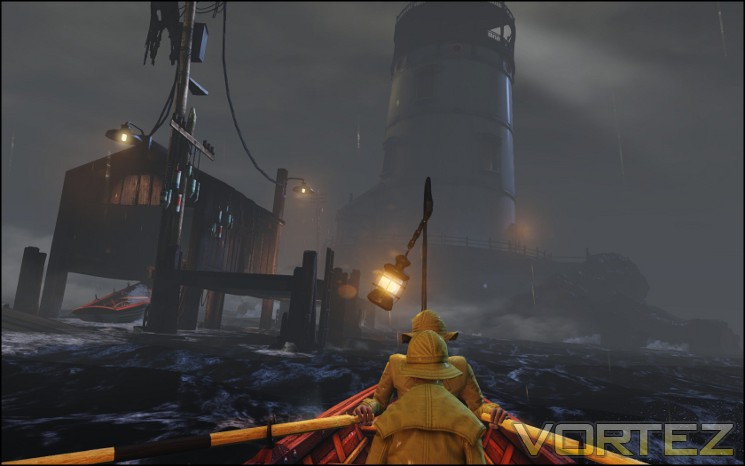
From the start you take the role of former New York PI Booker DeWitt as he is rowed to a lighthouse just off the coast of Maine in the US. It’s dark and murky when you’re handed a case containing a gun, key and photograph that gives you your primary purpose: ‘Bring us the girl and wipe away the debt’. Irrational are canny writers – immediately you’re left wondering who the girl and what sort of debt Booker incurred in order to require this task; left unsaid is ‘Us’, presumable that is your companions in the boat. As to the role the girl plays, we only have a photo and handwritten scrawl to go on. The girl is Elizabeth, whom we discover is daughter of the spiritual figurehead and President of Columbia, but we don’t know why she could be so important as to be worth the debt.
Less than 2 minutes in and Infinite could have you hooked simply on unravelling this mystery.
Like the weather around him Booker’s history is equally murky. We begin with very little of his backstory save that he was involved in the Battle of Wounded Knee/Wounded Knee Massacre, although it swiftly becomes clear that combat, and not people skills, are his forte. From the get-go DeWitt is somewhat more than the silent protagonist of games past, fulfilling an active role more akin to Dead Space’s Issac Clarke than BioShock’s Jack.
Here we’d normally explore the plot a little more, but in this case would spoil far too much of the game. Instead, we’ll discuss the characters and where they fit at the beginning of the narrative.
A Strong Cast of Characters To Drive The Story
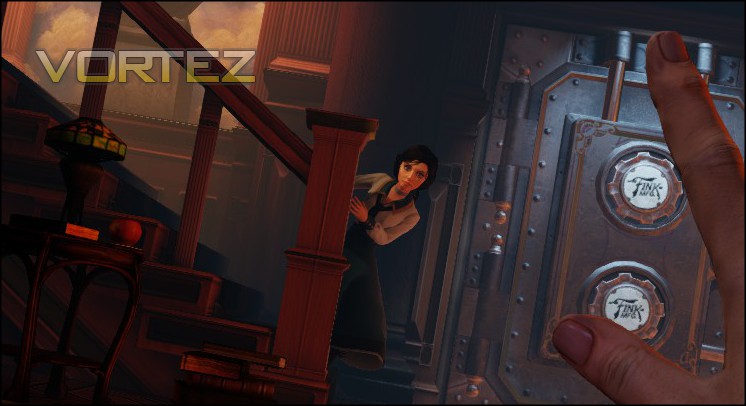
We experience Columbia through DeWitt’s interactions with it, and there are none more important than those with Elizabeth. In a very real sense this is her story, her coming of age if you will, and her character development is central to the work. When first encountered she is a prisoner, a bird in a gilt cage which has never seen the light of day. Even so she is knowledgeable, having a grounding in science and a natural talent for lockpicking, and possesses an odd gift: the ability to bend space-time to her will, opening tears in the fabric of reality. It’s not clear how she learned to do this, but it may provide useful. Elizabeth serves the dual-role of guide and conscience in BioShock Infinite and is a major departure from the status-quo in video game storytelling purely because she’s a partner with agency of her own rather than a disembodied voice calling out over the radio.
Over the course of time Booker and Elizabeth relationship grows and evolves as they rely on each other to further their own goals – goals which are often in conflict as she soon comes to understand that Booker has a debt which cannot be repaid by taking her globe-trotting – and one of the strongest narratives tools Irrational have implemented is how Elizabeth’s demeanour and appearance changes. A recent example for comparison may be to the Lara Croft characterisation in Tomb Raider (2013) whose appearance develops around the body-breaking experiences of her fight for survival; in Infinite Elizabeth’s evolution is far more subtle, but all the more powerful for that. She begins very much as a youthful, exuberant girl and ends… well you’ll have to play for yourself to find out, but the change is performed with an excellent understanding and recreation of human body-language.
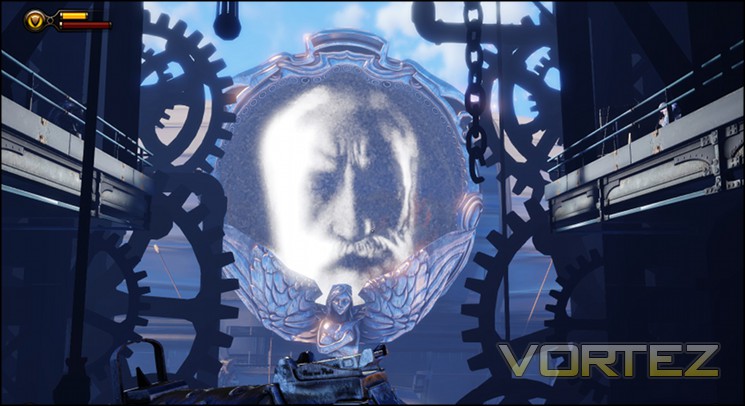
During the Victorian era spiritualism was a popular fad of the upper-middle classes and gave rise to many movements which, to varying degrees, claimed powers not of this world. Cast in this mould is the character of Zachary Hale Comstock – figurehead of Columbia, self-styled Prophet, Elizabeth’s father and primary antagonist – but with one key difference from the charlatans of old: through means mystical or technological he has tapped into powers beyond the understanding of the time.
Comstock claims to have founded his faith on the basis of an angelic visitation decades ago and has organised a quasi-religious following centred on principles espoused by three of America’s Founding Fathers: Washington, embodying strength of arms; Franklin who represents innovation; and Jefferson, a rule of law figurehead. Out of this, and the wealth he gained from it, Columbia was born with a thriving middle-class and repressed underclass. Whether by accident or design a cult of personality has grown around this Prophet, his martyred wife and their daughter (symbolically represented as the Lamb); connotations of both innocence and sacrifice are intentional.
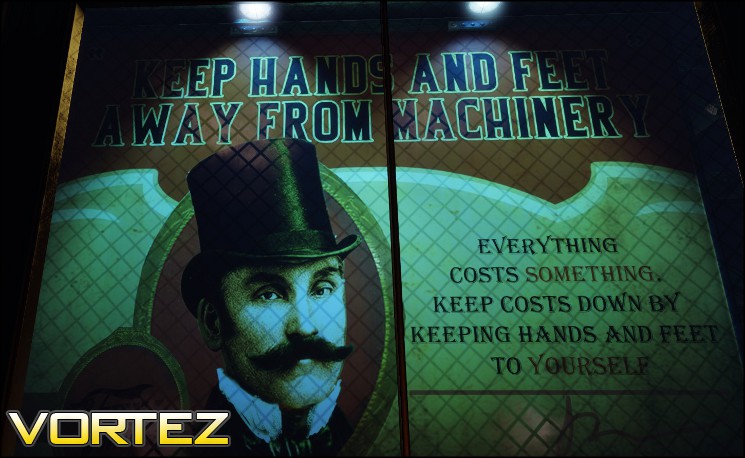
It takes more than one man to implement such a grand vision. Jeremiah Fink is Comstock’s major partner and another city founder, taking the position of defacto head industrialist of Columbia and overall responsibility for many of the innovations which make the city-state advanced and powerful. It was his company which develop the Vigors, chemical augmentations for the common man with ample funds, and maintain the Skyway as a primary means of travelling between the floating city blocks.
Supporting roles are afforded to Doctor Lutece – the scientific mastermind responsible for the creation of Columbia – and the Vox Populi faction led by Daisy Fitzroy, towards whom the city Founders are mutually antagonistic. Uncovering their role in the events, and where possible gaining their support, will be crucial to Elizabeth and DeWitt’s ultimate fate.
Early on these cast members are presented as simple archetypes representing the conflicting ideologies of the time. As the game is fleshed your understanding will shift considerably as knowledge you gain paints them as much more than merely black and white, much like that of Atlas in the original title.
Voxophones

BioShock heavily featured brief voice clips in the form of Audio Diaries to progress the story and layer knowledge of the game world and its inhabitants. BioShock Infinite’s analogous device is the Voxophone, a self-contained audio recorder and player upon which the inhabitants of Columbia have imprinted snippets of their thoughts, feelings and day-to-day activities. Voxophones are found throughout the game, often in closed off or secret areas, and in many respects are your primary reward for exploration. They can be revisited at any time through the in-game menu, where location information is also stored.
The most enlightening recordings are those of Dr. Lutece, the scientist who has a role in the genesis of Columbia in much the same way that Dr. Tenenbaum played her part with Rapture. Uncovering her story is crucial to arraigning all the other knowledge in some sort of context, although it will turn out to be something of a mind twister.
The Kinetoscope
Kinetoscopes are historical newsreels of Columbia’s history, formulated as propaganda similar to cinematic vignettes presented during World War One. As a narrative device they’re full of flavour, but aren’t quite as important for the plot as providing context for the (often abhorrent) beliefs of the inhabitants of what might at first have appeared to be an enlightened city. More generally, they show Columbia’s influence in some of the major events in the pre-war years, including the Boxer Rebellion which would ultimately lead to the city’s secession from the United States.
You’ll see them dotted around the game, most often concentrated in tourist hotspots or where they’re necessary for ‘educational’ purposes.
Complementary Graphics
Test System
CPU: Intel Core i5 2300
Memory: 8GB (2 x 4GB) GSkill DDR3
GPU: ZOTAC GTX 480 @ Stock
OS: Windows 7
OS HDD: 64GB Kingston v100+ SSD
Steam Folder HDD: 500GB Samsung 7200RPM HDD
Monitor Resolution: 1680*1050
Memory: 8GB (2 x 4GB) GSkill DDR3
GPU: ZOTAC GTX 480 @ Stock
OS: Windows 7
OS HDD: 64GB Kingston v100+ SSD
Steam Folder HDD: 500GB Samsung 7200RPM HDD
Monitor Resolution: 1680*1050
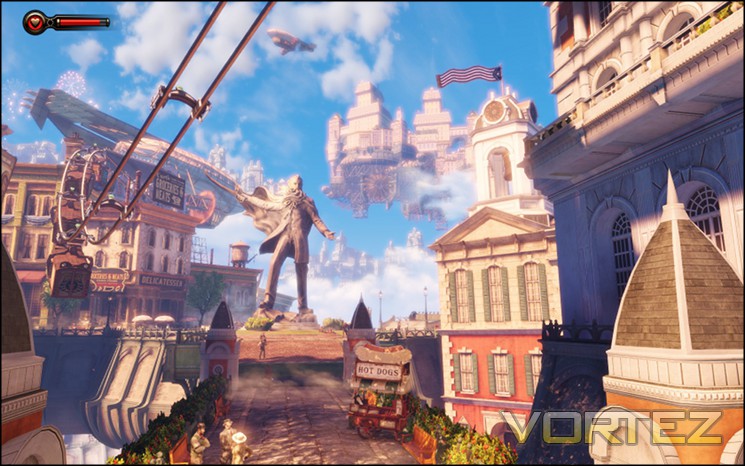
BioShock Infinite has been implemented through the use of Unreal Engine 3, the same engine at the heart of other industry-leading titles such as Arkham City, Dishonoured and Mass Effect 3. It’s well known for graphical capability – especially in Windows OS environments where it can take advantage of the benefits brought by DirectX 11 – but relies on the art direction to set a title ahead of the pack. It is in this regard that BioShock Infinite shines.
Every in-game frame is gorgeous: you could literally take a screenshot almost anywhere, print it out and have a poster-quality image. Where this most stands out is the city of Columbia itself, but we should also single out Elizabeth’s wonderfully animated character model which has fine attention to detail. Other character models, the Handyman for instance, are good too; however Elizabeth sets a gold standard which is difficult to see replicated elsewhere.
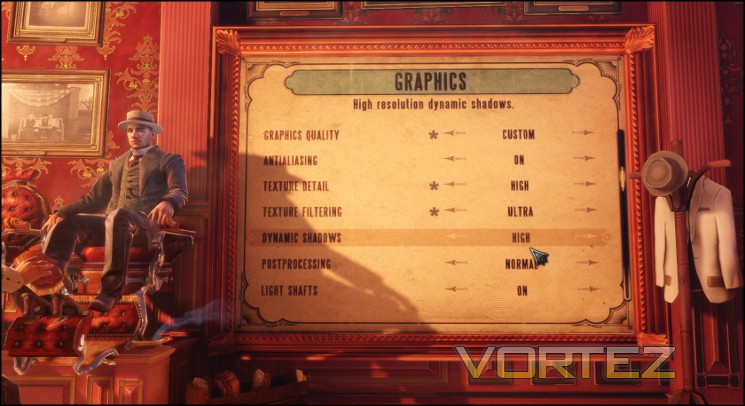
It’s not clear which platform the game was developed for, but one worry PC gamers often have with titles co-released on consoles is that their version will be poorly optimised or lack most of the options standard to PC first person shooters. It’s with some relief therefore that we can report of a pretty extensive set of graphical options which allows for fairly coarse performance refinement. Setting the Graphics Level to Custom in the Options Menu unlocks ten different graphical options including Texture Detail and Field of View adjustment; AA and AO settings are unfortunately simple on and off (although drivers often allow you to force levels of AA), and so configuring the game for both high IQ and high performance based on your own rig’s capabilities will be quite difficult.
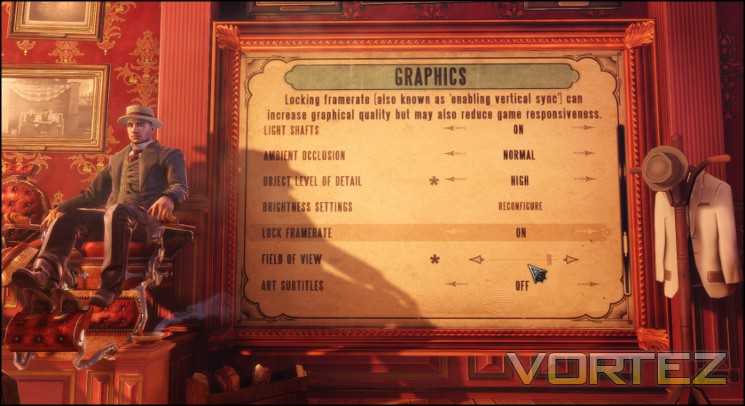
The high quality graphics come at a cost however. Running the game on our test system saw a slowdown at the highest custom image quality during particularly intense combat scenarios. As a matter of course you’ll want to run the game at close to 60FPS and should tailor settings to achieve that; reducing dynamic shadows will generally have the most impact on improving FPS without sacrificing too much image quality.
One oversight is the lack of a gun size control, which is especially disappointing given how much of the screen the gun can take up depending on your screen resolution and FoV. That said, give it time and there may be tweaks in the cards for those who really want to optimise their experience. Those running marginally underpowered NVIDIA systems will be able to take advantage of the GeForce Experience App for settings tweaks, whilst both AMD and NVIDIA card owners should ensure that they’re running the latest drivers to gain the most from their graphics hardware.
BioShock Infinite isn’t the most configurable title we’ve seen in the past year – both Tomb Raider and the Borderlands 2 easily surpass it – but there’s just enough there to counter arguments that it’s a poor console port.
General Gameplay
So, we’ve noted that Bioshock Infinite is an amazing looking game with outstanding art direction and plenty of graphic options to tailor to your system, but that’s only one face of the video game coin. The other is gameplay, and as a first person shooter we already have preconceived notions of what to expect from the get-go, so lets explore how reasonable those notions are.
First off lets acknowledge that there are no save slots and every save that the game performs happens at automatic points throughout. This will in many respects be the biggest bugbear for PC gamers, but as a consequence gameplay tends to flow naturally without the need for save points or frequent quick-saves. Quickload/quicksave also undermines difficulty, a factor that we’re sure Irrational had in mind when they made the decision to disallow them, but it does mean that you can autosave just before a big battle without the proper weapons equipped or ammo recharged, leading to an insurmountably difficult encounter.
When loading a game we were given access to the previous five checkpoints, generally amounting to around 60 minutes of gameplay. This should allow you to return to a point where you can stock up on health/ammunition with some foreknowledge of the tricky encounters to come, but not enough to Mulligan upgrades. Creating a new game in any difficulty will wipe all previous progress too, so if you’re playing on a shared PC you might want to take it in turns.
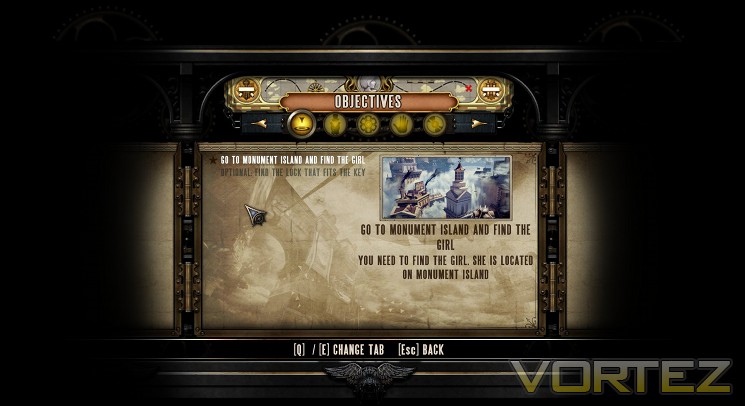
The in-game menu provides a quick summary of the current quest
In terms of basic game mechanics there’s nothing new under the sun. You’re directed through the game with a very simple questing machanic, aided by a directional arrow which paints the ground when you wish it to. Optional quests also exist but are few and far between, generally providing pointers towards uncovering a particular secret or cache of items.
Health is your base resource, and is replenished by consuming medkits or eating food (though in the latter instance very small amounts). There is also a ‘shield’ feature unlocked early in the game which is shown as a yellow bar in the UI, and regenerates mid-combat if you go for a short time without being hit. Interestingly for a game of this type, and a departure from the original BioShock, there is no means to store medkits for later use, meaning that if you fall low on health your priority will be getting out of the firefight rather than tanking the damage whilst chugging health pots.
Your other major resource is Salt, which takes the place of EVE in BioShock as the resource for your powers (AKA Vigors); your max salt is fixed at 100, but incremental upgrades can increase your efficiency in using these powers. Both Health and Salt can be regenerated at a Dollar Bill vending machine at a small cost.
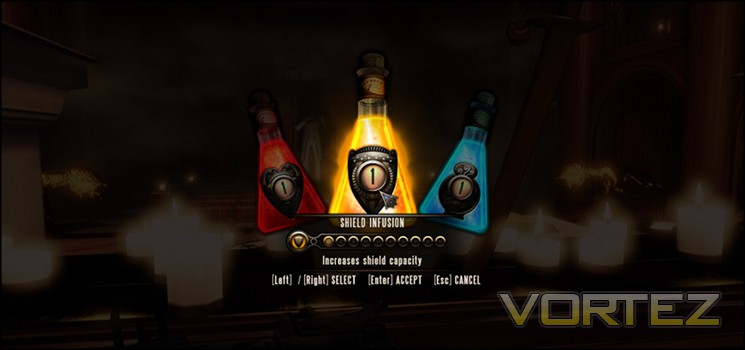
When you pick up an infusion you’ll be given the choice of attribute to improve
These upgrades are called Infusions, and take the form of a luminescent flask of liquid which can improve either your Max Health, Max Shield or Salt. They appear throughout the world, often in secret areas but sometimes out in the open, and when picked up prompt you for a decision. Note however that you don’t get the take back your decision, it’s permanent and irrevocable.
Elizabeth, Ally Till The Last
Though many of your battles Elizabeth will be a near constant companion, but not the sort of companion who needs your protection. She can take care of herself whilst aiding you in combat by providing medkits, salt and even ammunition which she scavenges throughout the course of your adventures. In some set-piece locations she will also provide you with a tactical advantage by generating cover, a stack of medkits, or even a turret through the tear mechanic. If you die in combat, it is Elizabeth who will return you to life.
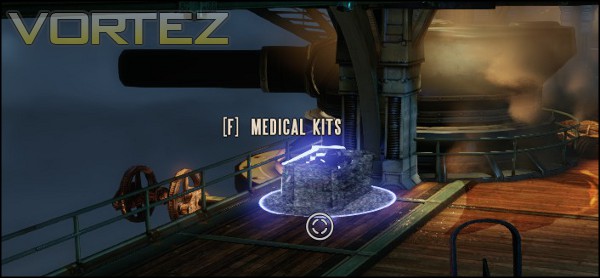
A tear revealing medkits when opened. Most encounters allow you to cycle between one of three tears.
Throughout the game world you will also come across locked doors or safes which let Elizabeth demonstrate her lockpicking skills. You’ll need to provide the lockpicks (an scaling number dependant on the difficulty of the lock) but thanks to her will have access to more cash, advanced weapons, ammo and the most valuable reward of all: Voxophones. Truly, there will be no post-mortem of the game discussing how she ‘doesn’t pull her weight.’
Enemies and overall difficulty
It is said that you will know the measure of a man by the quality of his enemies, and so we move to the human tools of the antagonists. Your first roadblocks are of the ostensibly human variety, composed of the general police and militia force which patrol Columbia against the threat posed by the Vox Populi. Later you will encounter individuals powered by Vigors such as the fearsome Firemen, before eventually being set against the twisted technological monsters. One such reoccurring creation is the Handyman, an awful melding of flesh and machine which has one weak point and a lifetime of rage, whilst the Mechanised Patriot clockwork gear will remorselessly power its search for your blood.
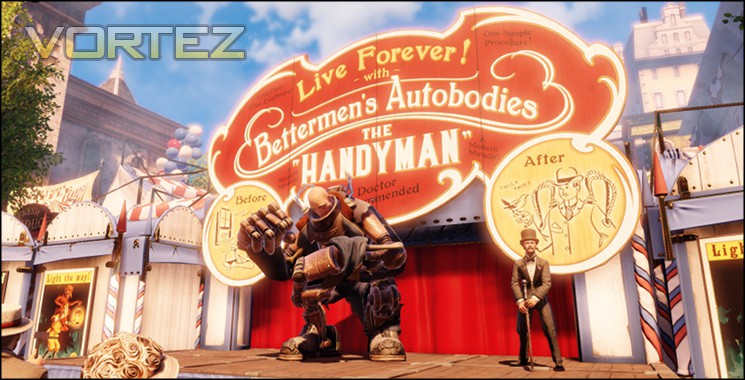
The Handymen are tragic figures but no-less dangerous
Though normal human foes pose no real challenge, empowered humanoids and mechanised constructs will appear to be bullet sponges throughout most of the game, resisting massive punishment from both projectile and explosive weapons. In the main this doesn’t pose much more than a time issue, but the final battle’s difficultly spike is huge mainly thanks to this feature. Armoured humans pose a similar problem, with little opportunity to sit back and take them out from afar.
Ameliorating the impact of autosaves is the option to change difficulty at any time in Easy, Medium and Hard modes. It’s not ideal, but can allow you to tweak your chances of getting past a particularly troublesome fight without the need to cheat or lose substantial progress. We’d suggest that you start out on Hard difficulty to prevent you from picking up any bad habits and force you to take to the air on Skylines early on, standing you in good stead later in the game.
Once you have completed a playthrough the 1999 Mode will be unlocked. This additional difficulty setting increases enemy health and damage whilst also reducing the ammo available as well as your own hardiness. Furthermore, the cash death penalty is increased and if you fail to meet the cash requirements you’ll return to your previous checkpoint. Once you start you will be unable to change to a previous difficulty, so make sure you’re ready for this challenge.
Equipment and Combat
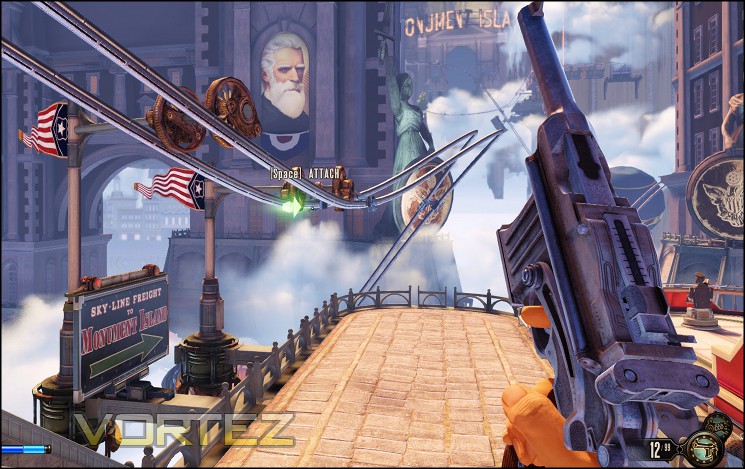
Mastering Skylines is one component of success in combat
BioShock Infinite follows a tried and tested formula of introducing combat gradually, building to a much more frenetic pace as play progresses. Combat sections don’t begin until a good half an hour into the game, but when it does it’s perfectly timed to coincide with a tension-filled situation that you won’t quite have the time to dwell on. Suddenly you’re surrounded by unarmed police, but with only a melee weapon to your name it will be a jarring battle. The tempo moves up a notch soon after when the friendly police drop a pistol… how nice of them.
Later in the game the option to use Skylines as part of your combat strategy becomes appealing and adds a level of dynamism in what could otherwise be quite a formulaic experience. Being slightly more evasive and the use of dismount takedowns and will be integral to victory, but be aware that at higher difficulties enemies will also take to the skies to defeat you.
The default controls for your skills and abilities are quite poor and benefit from being rebound immediately: right-click to aim down sights and a mouse thumb button for casting the active Vigor suited us well enough, but your preference may vary. Start experimenting before the difficulty begins to ramp up, and ensure that mouse acceleration is disabled.
Weapons

The tools at your disposal for this title will remind you of BioShock, although the first departure to note is that both your weapon and power (i.e. Vigor) can be used simultaneously. A wide selection of weapons ranging from melee through to mortar launcher – split between red and blue types – are available. Although red weapons – utilised by the Vox Populi faction- only become available roughly half way through the game it would incorrect to assume that they were flat out better than the blue Founders firearms. If melee specialisation is your thing you’re given the option to execute enemies for a ludicrously over the top kill, but it’s hardly worth it unless you revel in this sort of grizzly animation and specialise accordingly.
A retrograde step Irrational have implemented, perhaps more down to narrative rather than gameplay reasons, is a restriction to only two equippable weapons at any one time. When progressing through the game this swiftly becomes apparent as your chief limitation, doubly so given that vending machines sell ammunition but not the weapons themselves. Each weapon also has a number of weapon-specific upgrades to purchase which could improve damage, clip size or reload speed, whilst during combat you can improve accuracy by aiming down sights at the expense of movement speed.
Weapon upgrades/augmentations are purchased from a Minuteman’s Armory vending machine, with three or four available per weapon, but the cost for each upgrade is quite prohibitive and requires specialising with a few weapons in order to be most effective. Unfortunately there is no way to tell in advance which weapon ammo will be plentiful in an encounter before-hand, and Elizabeth doesn’t provide ammo often enough to be a reliable source through an encounter. The fact that Founder and Vox Populi weapons overlap in strengths but use separate ammo makes you realise that you could cut the number of weapons in half and lose nothing in terms of gameplay, and that’s without adding an alt-fire component.
As a consequence gunplay is by far the weakest aspect of the game: the two-weapon restriction begins to chafe very early on, and is obviously a crutch for the designers when it comes to difficulty ramping and an effort to force combining Vigor effects. The final battle in particular is made difficult purely from by this limitation where otherwise simply unloading all your accumulated magazines in enemies would see an easy win. Of course BioShock Infinite isn’t a full-on FPS so it’s not the setback that it was in Duke Nukem Forever, but it does end up being the single greatest frustration in play.
Vigors

Vigors are roughly analogous to Plasmids from the original BioShock but with variation on the range of effects and your access to them. They can be mostly split into three overlapping sub-groups – Damage, Utility and Control – and for the first time almost all have a secondary effect subtly changing how they’re used in combat. Each can also be upgraded in Veni Vidi Vigor vending machines to strengthen the primary or secondary effect in order to increase their potency with no downside apart from the cost. They’re fuelled by Salt rather than EVE, a resource which you find in plentiful quantities through the game but will be depleted swiftly if you’re profligate with your Vigor use.
The game UI has two quickslots for Vigors, allowing you to choose any two and swap between them during or out of combat. Unlike BioShock however changing which are active is as simple as pressing 1 through 8 rather than needing to visit a Gatherer Garden (a BioShock I vending machine), meaning that for all intents and purposes you can swap to any Vigor at any time. This functionality will be crucial at higher difficulties where the effectiveness of some Vigors is limited against certain enemies and chaining effects together is especially important.
Vigors are either found through exploration or dropped by specific NPCs on death; if you already have it then the drop will restore an amount of salt instead. Here is a short sample of some of the eight available through the course of the game, either as quest objectives or rewards.
Possession:- Allows you to possess an enemy NPC or mechanism to fight on your side for a short time. Use against vending machines will spit out their silver coins but not reduce the cost of items sold.
Devils Kiss:- A fire projectile which will damage enemy NPCs and a small area around them. The secondary effect is an explosive trap triggered on proximity.
Murder of Crows:- Summon a flock of crows which will stun a biological enemy and deal damage over time. The alt effect is a trap causing a similar stun and damage when triggered.
Shock Jockey:- Fires lightning which damages and stuns targets, though stun duration reduces with enemy power. It can also be used to power machinery in Columbia.
Devils Kiss:- A fire projectile which will damage enemy NPCs and a small area around them. The secondary effect is an explosive trap triggered on proximity.
Murder of Crows:- Summon a flock of crows which will stun a biological enemy and deal damage over time. The alt effect is a trap causing a similar stun and damage when triggered.
Shock Jockey:- Fires lightning which damages and stuns targets, though stun duration reduces with enemy power. It can also be used to power machinery in Columbia.
Initially pretty inefficient, the use of Infusions and purchasing upgrades makes them more viable in longer encounters; you’ll need to judge where you spend your Infusions carefully but spending them on Salt will rarely be unwise. In most cases the effects aren’t flashy, but they can become far more powerful than your weapons once upgraded.
Gear
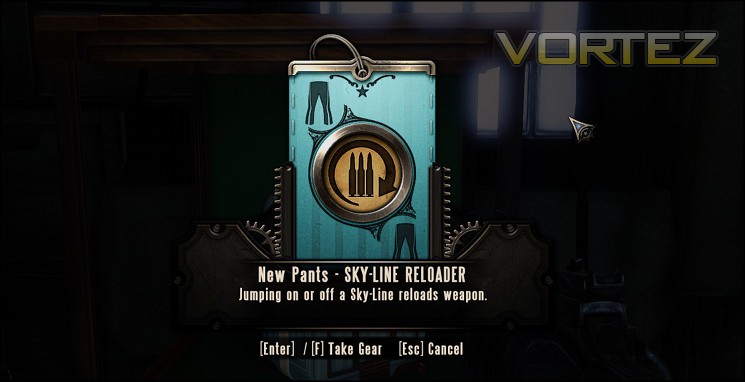
Gear are pieces of equipment (clothing flavour-wise) which confer passive bonuses in combat, and are similar to the Tonics of BioShock. Four different slots are available and may add such bonuses as Vigor effect chaining, bonus damage whilst aiming down sights at the expense of damage when hip-firing, or even limited invulnerability. Gear isn’t difficult to find – you’ll see a few in most game zones after the first hour of gameplay – but searching out secrets will also uncover rarer drops with more exotic effects.
The effects are broadly equal but often very situational. For example, effects which trigger on mounting or dismounting from a Skyline will not be much use in indoor combat, whilst those which augment Vigors you rarely use will be less valuable than many alternatives. Juggling these to tailor your loadout to the situation will often mean the difference between a scraped win and embarrassing defeat.
One or two Gears are clearly more powerful than others, but don’t always spawn on a play-through. This may cause some difficulty on the hardest settings where health is at a premium, but won’t be an issue on medium so long as you’re not too gung-ho in your playstyle.
Concluding Thoughts

BioShock Infinite will for years be discussed in the same breath as Half Life 2, the original Bioshock and other touchstones of the genre which have defined a sub-set of first person titles that built on a strong narrative, and rightly so. The first moments as you breach the clouds and feast your eyes on Columbia are spine-tinglingly good and exploration reveals that the city is exceptionally well realised. Little touches like city blocks needing to dock, complete with schedule, or a barge with a barbershop quartet are a joy to behold. The care and attention Irrational paid in the construction of the setting should be held up as a standard of excellence.
The world is so well constructed that discussing the characters would seem like an afterthought if not so well written. Elizabeth in particular leaps off the screen as a character with hopes, dreams and a particular innocence expressed by a cheerful demeanour, a demeanour which slowly erodes as violence appears to be her and DeWitt’s only effective tools. She is however no dead weight in combat, as the game is happy to notify you she doesn’t need leading or protecting, at a stroke eliminating what could have been the games’ Achilles Heel.
Just like its franchise predecessors, BioShock Infinite does not shy away from social commentary. Whilst BioShock built the world of Rapture from the seabed up as a Libertarian playground which lost sight of its humanity, Columbia is also a deeply flawed paradise with a brutal underbelly shocking to modern sensibilities. Around 30 minutes in reality hits you square in the face and you’re left reeling as you realise the implications, a reaction which only great works of storytelling can achieve.
For all the effusive praise however, Bioshock Infinite is far from a perfect game. The highly linear story, although excellent in its own right, will disappoint those who were expecting a deeper morality system than Bioshock I & II and got none at all. Thanks to uninspired weaponry combat is also not as electric as it could be, with the Vigors just about elevating it to a level above ‘Skyrim with rocket launchers’. That makes sense from the point of view of the story, but it also serves to show how much gaming has lost in the intervening years. Widespread invisible walls also dog your every attempt at exploration, such that even though you’re not saved from a plunge to gravity-defined death waist-high desks still defeat your attempts at traversal. There’s little opportunity to break off the beaten track and explore, although that which there is rewards you mightily with juicy Voxophone recordings detailing more of the events preceding the game.
For $60/£35 you’ll be granted an excellent 13 hours of dense story, twisting plot and appealing gameplay. It leaves you emotionally drained, replete and in no need for more. You’re not left disappointed in a hasty ending, or confused by a story which throughout its twists and turns is as complete as a Mobius Strip. More than that, it looks gorgeous and rewards those who have invested in their gaming rigs without making those with a more budget conscious system feel like they have come off second best.
BioShock Infinite will finish the year being a great contender for Game Of The Year for its awesome narrative alone, and if another takes this title then we’re in for an enormously rich 2013. Whilst titles of previous years have had more engaging gameplay, few have come close to the deep story-telling which prompts uncomfortable insights and an ever burgeoning feeling of dread. Irrational also have single-player DLC planned for the coming months; we have no idea what that could bring given that the main story was concluded so effectively.

If you like teasing your way through a story, making predictions as you go that delight you when they come up short, Play This Game. If you enjoy games from an artistic perspective, crafted by designers with a panache for unique aesthetics, Play This Game. If you enjoy gameplay which rewards tactical nous in its gun-based combat, Play This Game. And if you want to reward the creators of a game which will be held up as a standard for years, Play This Game.
Seriously.
Our thanks to AMD for sponsoring this review. You can purchase the PC edition from Steam or as part of the AMD Never Settle Reloaded graphics bundle.

Click here for an explanation of our awards at Vortez.net.


