




Today we take a look at the royalAce, a super overclocked, custom cooled HD7970 graphics card from Club 3D. Can it fend off the latest cards from NVIDIA?
Product on Review: HD7970 royalAce

Manufacturer and Sponsor: Club 3D
Street Price: £338.54 inc VAT (at time of review)
In today’s climate it would be easy to dismiss the AMD HD7970 in favour of a product from the ‘other’ side however, with recent advancements in the Catalyst driver suite, the HD7970 has become a serious force to be reckoned with. It had reclaimed the performance crown from the mighty NVIDIA GTX680 and was declared the best card on the market save for the dual GPU solutions from both red and green teams. Fast forward a few months and the GTX TITAN was released however due to the cost, the HD7970 was still seen as the safe bet. In recent weeks however, the HD7970 has two new competitors vying for top spot, the GTX770 and GTX780.
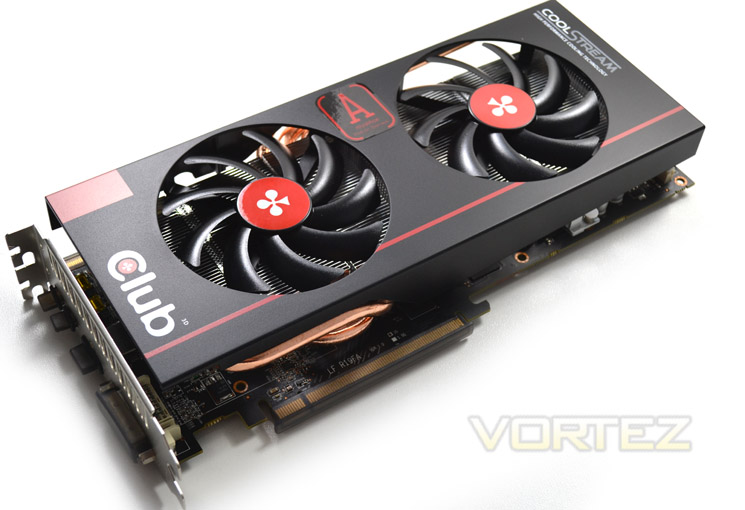
A member of the Poker Series of cards. The Poker Series is Club 3D’s naming scheme depending on the speed and cooling of the graphics cards: royalQueen, royalKing and the royalAce which we have today. There is also a royalKnight which is a dual card solution. We will try to resist making corny word associations to poker throughout the review but we also apologise if we slip up from time to time!
So, will the HD7970 with fresh new Cat 13.6 drivers, a factory overclock and a custom cooling design be enough to stave off the new threats from the green team? Read on to find out…
Club 3D
Club 3D is the European market leader and pioneer of a total solution for graphics cards based in Amsterdam, The Netherlands. Our product range has been extended to include a broad range of switching power supplies, USB graphics adapters, cables and adapters, digital sound cards and an extensive line of notebook bags and accessories. With 16 years of experience, we have consistently provided innovative, reliable, high-quality products and services and excellent customer care.
It is the mission of Club3D to provide the best solution to its partners and enthusiast market. Our friendly, flexible, focus, fast and fun approach helps build a lasting relationship with and achieving the highest satisfaction for our customers.
It is the mission of Club3D to provide the best solution to its partners and enthusiast market. Our friendly, flexible, focus, fast and fun approach helps build a lasting relationship with and achieving the highest satisfaction for our customers.
Specification
The HD7900 series features the Tahiti core which is the successor to the Caymen core of the HD6900 family. The Caymen core was based on a 40nm manufacturing process so it is fair to say that perhaps the biggest improvement to the Tahiti core is the reduction to 28nm process. This has enabled AMD to cram 4.31 billion (4,312,711,873) transistors into the new HD7970 core as opposed to the 2.64 billion on the HD6970 Caymen XT.
Comprising of what AMD calls ‘Graphics Core Next (GCN)’ archetecture which is optimised for heterogeneous computing, the new Tahiti core has upto 32 CU’s (compute units) with dual geometry engines along with 8 back-ends comprising of 32 colour ROPs per clock and 128 Z/Stencil ROPs per clock. Each CU has a Vector unit and Scaler Co-Processor and can execute instructions from multiple kernels.
The VLIW4 SIMD has evolved to the GCN quad SIMD which equates to similar computational power yet grants better performance, threading and simplification. The GCN also has a new Cache hierarchy with 16KB instruction Cache and32KB Scaler Cache shared between 4 CU’s. The L2 Cache is accessible by each CU with it’s own separate process to ensure coherency. These changes increase the GFLOPs by 140%.
Tesselation on the Tahiti core is also enhanced by increased Vertex re-use off-core which theoretically at least, means the 7900 series has 4 times the throughput of the 69XX series. The are improved ansioscopic filtering algorithms too which come at no performance cost allegedly. These new algorithm improvement will allow the use of Forward Rendering with 1000’s of potential light sources and will also mean MSAA can be rendered easily.
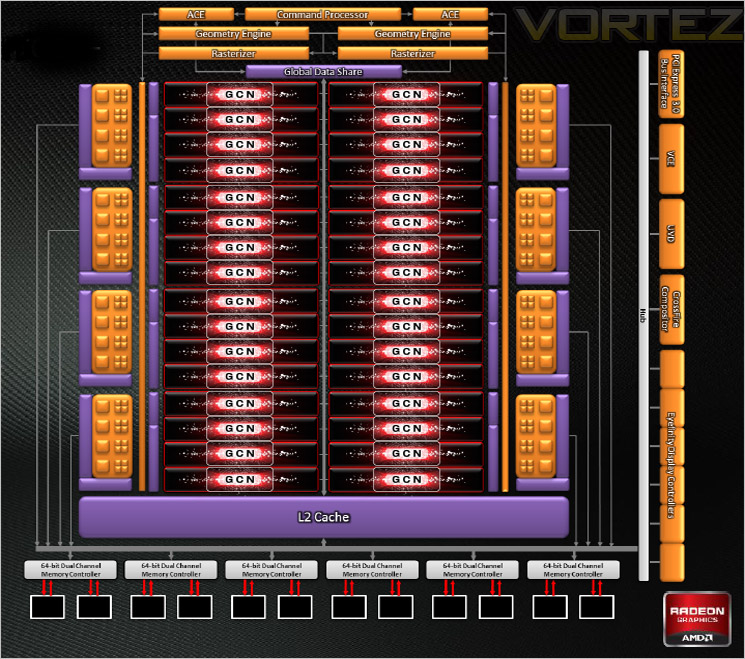
Looking at the schematics above, we can identify the bulk of the GPU is taken up with the 32 CU’s. Above these are the geometry engines. To the left and right are the 8 Render back-ends, 4 each side. There’s 768KB of L2 cache along with 6x64bit dual channel memory controllers making a 384-bit GDDR5 memory interface capable of delivering up to 264GB/sec. All of technology coupled together is transferred through a fully compatible PCI Express 3.0 x16 bus interface. Have no fear though because the cards are backwards compatible with PCIe 2.0.
Model
Product Name: Radeon HD 7970 royalAce
Product Series: Radeon HD 7000
Item Code: CGAX-7977SO
EAN Code: 8717249411185
Interface
Bus Interface: PCI Express 3.0
Chipset
GPU Chipset: Tahiti XT2
GPU Clock: 1050 MHz
Boost clock: 1100 MHz
Stream Processors: 2048
Multi-GPU
Multi-GPU: Quad CrossFire Ready
Memory
Memory Size: 3072MB
Memory Interface: 384BIT
Memory Type: GDDR5
Memory Clock: 6000 MHz (4x1500MHz)
Cooling
Cooling Type: Active
TDP
Idle: 15W
Idle ZCP mode enabled: 3W
Maximum load: 250W
3D API
DirectX version: 11.1
OpenGL version: 4.2
OpenCL version: 1.2
Dimensions
Slot Width: 2 Slots
Profile: Standard profile
Card Size: 268 x 122 x 36 mm
Weight
Card Weight: 698 grams
Output Configuration
DVI: 1x Dual-Link DVI-I
HDMI: 1x version 1.4a
Mini DisplayPort: 2x version 1.2
HDCP ready: YES
RAMDAC: 400MHz
Maximum Resolution analog: 2048×1536 (via Dual-Link DVI to VGA adapter)
Maximum Resolution Single-Link DVI: 1920×1200
Maximum Resolution Dual-Link DVI: 2560×1600
Maximum Resolution HDMI 1.4a: 4096×3112
Maximum Resolution Mini DP 1.2: 4096×2160
Maximum Outputs Simultaneously: 4
In the package
Club 3D Radeon HD 7970 royalAce graphic card
Club 3D CrossFireX bridge (CAC-CB) interconnect cable
Club 3D knob hanger
Driver & E-Manual CD
Quick install guide
Product Name: Radeon HD 7970 royalAce
Product Series: Radeon HD 7000
Item Code: CGAX-7977SO
EAN Code: 8717249411185
Interface
Bus Interface: PCI Express 3.0
Chipset
GPU Chipset: Tahiti XT2
GPU Clock: 1050 MHz
Boost clock: 1100 MHz
Stream Processors: 2048
Multi-GPU
Multi-GPU: Quad CrossFire Ready
Memory
Memory Size: 3072MB
Memory Interface: 384BIT
Memory Type: GDDR5
Memory Clock: 6000 MHz (4x1500MHz)
Cooling
Cooling Type: Active
TDP
Idle: 15W
Idle ZCP mode enabled: 3W
Maximum load: 250W
3D API
DirectX version: 11.1
OpenGL version: 4.2
OpenCL version: 1.2
Dimensions
Slot Width: 2 Slots
Profile: Standard profile
Card Size: 268 x 122 x 36 mm
Weight
Card Weight: 698 grams
Output Configuration
DVI: 1x Dual-Link DVI-I
HDMI: 1x version 1.4a
Mini DisplayPort: 2x version 1.2
HDCP ready: YES
RAMDAC: 400MHz
Maximum Resolution analog: 2048×1536 (via Dual-Link DVI to VGA adapter)
Maximum Resolution Single-Link DVI: 1920×1200
Maximum Resolution Dual-Link DVI: 2560×1600
Maximum Resolution HDMI 1.4a: 4096×3112
Maximum Resolution Mini DP 1.2: 4096×2160
Maximum Outputs Simultaneously: 4
In the package
Club 3D Radeon HD 7970 royalAce graphic card
Club 3D CrossFireX bridge (CAC-CB) interconnect cable
Club 3D knob hanger
Driver & E-Manual CD
Quick install guide
Features
Super Overclock
Extreme Gamers require Extreme performance. The PokerSeries royalAce GPU’s has been cherry-picked for extreme performance. Club 3D has developed a custom PCB to accommodate faster speeds and thermal dissipation. At 50MHz faster than the reference clock of 1000MHz, you will be running faster, efficient and more reliable out of the box without you having to do anything at all. You can be assured that the royalAce series won’t let you down.
Club 3D CoolStream
If you expect above average performance of your Graphics card, Club 3D CoolStream High Performance Cooling Technology is just the kind of high performance that you have been looking for.
Club 3D royalAce features high performance heatpipes that keeps the components cool and outperforms standard cooling solutions. Paired with a unique fan blade design it increases airflow while reducing noise. The result is a dramatic increase of performance for your gaming and multimedia experience.
AMD CrossFire™ Technology
The AMD Radeon™ HD 7950 GPU supports AMD CrossFire™ Technology and provides excellent multi GPU scaling. With the introduction of the AMD Radeon™ HD 6900 Series Graphics, AMD began delivering improved AMD CrossFire™ Technology scaling when using two GPUs. AMD is proud to continue to offer that amazing performance with its newest AMD Radeon™ HD 7000 series graphics products.
AMD Eyefinity 2 Technology
EYEFINITY 2.0
Eyefinity™ 2.0 technology features all-new support for Stereo 3D, universal bezel compensation and brand new display configurations which allows the user to configure custom resolutions and the ability to relocate the Windows task bar to an arbitrary screen.
Improved Tessellation
The latest iteration of architecture in the AMD Radeon™ HD 7970 GPU features a brand new Generation of Tesselator (Gen 9) in its Geometry Engine. This features optimizations such as; Increased vertex re-use, Off-chip buffering improvements and larger parameter caches. This helps Improve performance at all tessellation factors at up to 4x the throughput of AMD Radeon™ HD 6900 series graphics (Gen 8 ).
AMD HD3D Technology
AMD HD3D Technology is supported by an advanced and open ecosystem that, in conjunction with specific AMD hardware and software technologies, enables 3D display capabilities for many PC applications and experiences.
Your PC has evolved, offering unprecedented amount of games, photos and movies for you to play, watch, design, create, share and download in 3D. With the arrival of the latest in 3D technology you can now enjoy an enhanced visual experience on Stereo 3D-capable desktops and notebooks powered by AMD HD3D Technology.
HDMI 1.4a
More bandwith than standard HDMI allows full implementation of 60Hz Stereo 3D. Standard HDMI ports do not have adequate bandwidth for more than 3D 1080p at 24fps.
Ultra-high resolution (4k Panels)
– Current implementations currently use 4*DVI or 2*DP 1.1, which is expensive and unwieldy.
– AMD will move to a single-connector output for 4k via DP 1.2 HBR2 and HDMI 1.4a 3GHz mode.
AMD Quad Buffer SDK
– Native 3D support for Developers.
– functions with Dx9, 10 and 11
– Native support scheduled for Windows 8
Nearly 600 games support AMD’s implementation of 3D either natively or through middleware partners. Also support for many 3D displays already on the market including Samsung and LG’s proprietry implementation.
Video Codec Engine (VCE)
– H.264 HD Encoder
– Power efficient
– faster than realtime 1080p @ 60 FPS
– Variable Compression Quality
– Multiple Input Options:- (1) Frame Buffer, (2) GPU Display. (2) is useful for wireless displays.
Extreme Gamers require Extreme performance. The PokerSeries royalAce GPU’s has been cherry-picked for extreme performance. Club 3D has developed a custom PCB to accommodate faster speeds and thermal dissipation. At 50MHz faster than the reference clock of 1000MHz, you will be running faster, efficient and more reliable out of the box without you having to do anything at all. You can be assured that the royalAce series won’t let you down.
Club 3D CoolStream
If you expect above average performance of your Graphics card, Club 3D CoolStream High Performance Cooling Technology is just the kind of high performance that you have been looking for.
Club 3D royalAce features high performance heatpipes that keeps the components cool and outperforms standard cooling solutions. Paired with a unique fan blade design it increases airflow while reducing noise. The result is a dramatic increase of performance for your gaming and multimedia experience.
AMD CrossFire™ Technology
The AMD Radeon™ HD 7950 GPU supports AMD CrossFire™ Technology and provides excellent multi GPU scaling. With the introduction of the AMD Radeon™ HD 6900 Series Graphics, AMD began delivering improved AMD CrossFire™ Technology scaling when using two GPUs. AMD is proud to continue to offer that amazing performance with its newest AMD Radeon™ HD 7000 series graphics products.
AMD Eyefinity 2 Technology
EYEFINITY 2.0
Eyefinity™ 2.0 technology features all-new support for Stereo 3D, universal bezel compensation and brand new display configurations which allows the user to configure custom resolutions and the ability to relocate the Windows task bar to an arbitrary screen.
Improved Tessellation
The latest iteration of architecture in the AMD Radeon™ HD 7970 GPU features a brand new Generation of Tesselator (Gen 9) in its Geometry Engine. This features optimizations such as; Increased vertex re-use, Off-chip buffering improvements and larger parameter caches. This helps Improve performance at all tessellation factors at up to 4x the throughput of AMD Radeon™ HD 6900 series graphics (Gen 8 ).
AMD HD3D Technology
AMD HD3D Technology is supported by an advanced and open ecosystem that, in conjunction with specific AMD hardware and software technologies, enables 3D display capabilities for many PC applications and experiences.
Your PC has evolved, offering unprecedented amount of games, photos and movies for you to play, watch, design, create, share and download in 3D. With the arrival of the latest in 3D technology you can now enjoy an enhanced visual experience on Stereo 3D-capable desktops and notebooks powered by AMD HD3D Technology.
HDMI 1.4a
More bandwith than standard HDMI allows full implementation of 60Hz Stereo 3D. Standard HDMI ports do not have adequate bandwidth for more than 3D 1080p at 24fps.
Ultra-high resolution (4k Panels)
– Current implementations currently use 4*DVI or 2*DP 1.1, which is expensive and unwieldy.
– AMD will move to a single-connector output for 4k via DP 1.2 HBR2 and HDMI 1.4a 3GHz mode.
AMD Quad Buffer SDK
– Native 3D support for Developers.
– functions with Dx9, 10 and 11
– Native support scheduled for Windows 8
Nearly 600 games support AMD’s implementation of 3D either natively or through middleware partners. Also support for many 3D displays already on the market including Samsung and LG’s proprietry implementation.
Video Codec Engine (VCE)
– H.264 HD Encoder
– Power efficient
– faster than realtime 1080p @ 60 FPS
– Variable Compression Quality
– Multiple Input Options:- (1) Frame Buffer, (2) GPU Display. (2) is useful for wireless displays.
AMD Zerocore Power
When a discrete GPU is in a static screen state it works to minimize idle power by enabling a host of active power saving functions including (but not limited to); clock gating, power gating, memory compression, and a host of other features. However, GPUs with AMD’s exclusive ZeroCore Power technology can take energy savings to entirely new heights by completely powering down the core GPU while the rest of the system remains active.
Nearly all PCs can be configured to turn off their displays after a long period of inactivity. This is known as the long idle state; where the screen is blanked but the rest of the system remains in an active and working power state (ACPI G0/S0). As soon as the system goes into long idle state and applications are not actively changing the screen contents, the GPU enters the ZeroCore power state. In the ZeroCore power state, the GPU core (including the 3D engine / compute units, multimedia and audio engines, displays, memory interfaces, etc.) is completely powered down.
However, one cannot simply remove the GPU and its associated device context completely; particularly when it is the only GPU in the system as is the case in many enthusiast platforms. The operating system and SBIOS must still be aware that a GPU is still present in the system. For this reason, the ZeroCore Power state maintains a very small bus control block to ensure that GPU context is still visible to the operating system and SBIOS. The ZeroCore power state also manages the power sequencing of the GPU to ensure that the power up/down mechanism is self-contained and independent of the rest of the system.

The enablement of the ZeroCore Power feature is controlled by the driver. The driver monitors the display contents and allows the GPU to enter the ZeroCore Power in the condition that the GPU enters long idle and subsequent work requests are no longer being submitted to the engine. If any applications update the screen contents, ZeroCore Power technology can periodically wake the GPU to update the framebuffer contents and put the GPU back into the ZeroCore Power state. Furthermore, applications such as Windows 7 desktop gadgets are architected to minimize activity and save power in the long idle state. These applications are active during screen-on mode to display dynamic content such as weather, RSS feeds, stock symbols, system status, etc. but also have the intelligence to suspend any updates and activity when the system enters long idle. These applications will not wake the GPU from the ZeroCore Power state in long idle.
AMD ZeroCore Power technology delivers tremendous energy savings. Many PCs remain in the long idle state for a variety of use cases that are highly relevant to everyday consumers, enthusiasts and professionals. In ZeroCore Power mode, users can still enjoy non-graphics activities such as file serving/streaming, motherboard audio and music, and remote access while the GPU core is essentially powered off.
ZeroCore Power technology also scales with AMD CrossFire™ technology. With an AMD CrossFire platform, all non-primary GPUs are in the ZeroCore Power state when not in use. For AMD CrossFire workloads, the driver will engage the non-primary GPUs to deliver full performance on-demand. The primary GPU can also enter the ZeroCore Power state during long idle as well. This delivers scalable benefits for the enthusiast. First, it effectively removes the power increase for users of AMD CrossFire under idle and light (single GPU) workloads. Second, it removes the noise penalty multiGPU users have always had to endure since the GPU fans are off in ZeroCore Power mode.
Nearly all PCs can be configured to turn off their displays after a long period of inactivity. This is known as the long idle state; where the screen is blanked but the rest of the system remains in an active and working power state (ACPI G0/S0). As soon as the system goes into long idle state and applications are not actively changing the screen contents, the GPU enters the ZeroCore power state. In the ZeroCore power state, the GPU core (including the 3D engine / compute units, multimedia and audio engines, displays, memory interfaces, etc.) is completely powered down.
However, one cannot simply remove the GPU and its associated device context completely; particularly when it is the only GPU in the system as is the case in many enthusiast platforms. The operating system and SBIOS must still be aware that a GPU is still present in the system. For this reason, the ZeroCore Power state maintains a very small bus control block to ensure that GPU context is still visible to the operating system and SBIOS. The ZeroCore power state also manages the power sequencing of the GPU to ensure that the power up/down mechanism is self-contained and independent of the rest of the system.
The enablement of the ZeroCore Power feature is controlled by the driver. The driver monitors the display contents and allows the GPU to enter the ZeroCore Power in the condition that the GPU enters long idle and subsequent work requests are no longer being submitted to the engine. If any applications update the screen contents, ZeroCore Power technology can periodically wake the GPU to update the framebuffer contents and put the GPU back into the ZeroCore Power state. Furthermore, applications such as Windows 7 desktop gadgets are architected to minimize activity and save power in the long idle state. These applications are active during screen-on mode to display dynamic content such as weather, RSS feeds, stock symbols, system status, etc. but also have the intelligence to suspend any updates and activity when the system enters long idle. These applications will not wake the GPU from the ZeroCore Power state in long idle.
AMD ZeroCore Power technology delivers tremendous energy savings. Many PCs remain in the long idle state for a variety of use cases that are highly relevant to everyday consumers, enthusiasts and professionals. In ZeroCore Power mode, users can still enjoy non-graphics activities such as file serving/streaming, motherboard audio and music, and remote access while the GPU core is essentially powered off.
ZeroCore Power technology also scales with AMD CrossFire™ technology. With an AMD CrossFire platform, all non-primary GPUs are in the ZeroCore Power state when not in use. For AMD CrossFire workloads, the driver will engage the non-primary GPUs to deliver full performance on-demand. The primary GPU can also enter the ZeroCore Power state during long idle as well. This delivers scalable benefits for the enthusiast. First, it effectively removes the power increase for users of AMD CrossFire under idle and light (single GPU) workloads. Second, it removes the noise penalty multiGPU users have always had to endure since the GPU fans are off in ZeroCore Power mode.
Packaging & Accessories
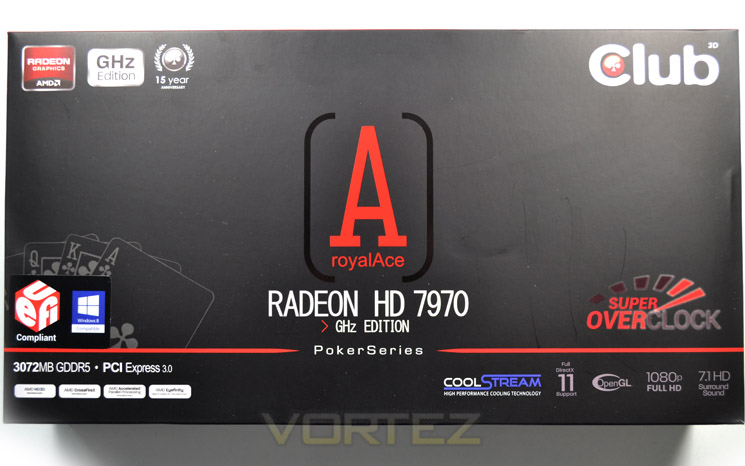
The front of the packaging of the Club 3D royalAce HD7970 is dominated with a capital ‘A’ signifying this is a royalAce product. To the bottom right we also see that the card is factory overclocked although at this stage there is no indication of how much the card is ‘super overclocked’. Beneath this we see further features of the card including coolstream, Club 3D’s custom cooling design. The overall design is discreet and certainly not in your face like some packages we see. We like it.
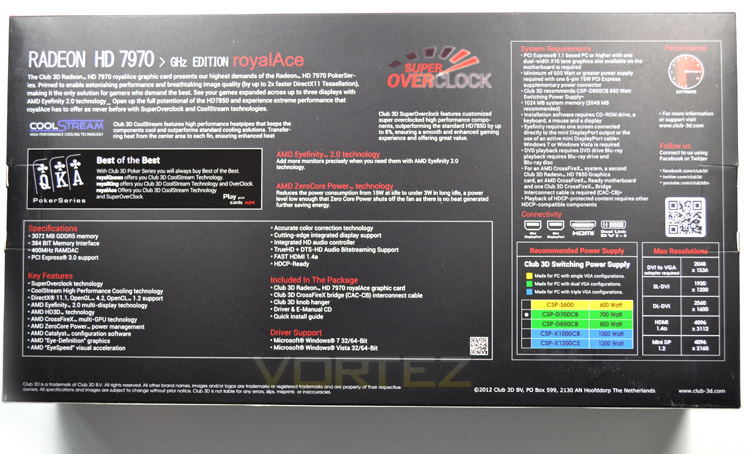
Flipping the box over we find an explanation of the ‘royal’ tag. Club 3D also go into more detail regarding the main features of the card, specification and PC requirements. We were puzzled why Club 3D recommended an 850W PSU in the system requirements section, yet in a separate area they recommend a 750W. Our own findings state that a 700W PSU would be more than ample to run a moderate system including this GPU.
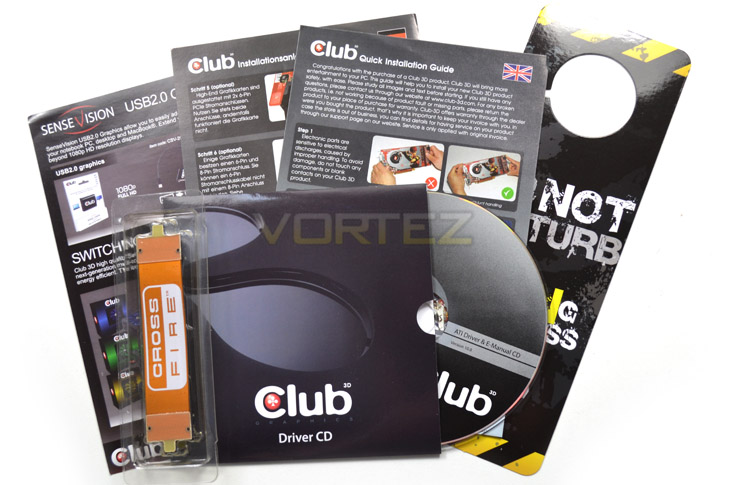
The accessories included with the package include multi-language installation instructions, a novel ‘do not disturb’ door hanger, Crossfire bridge and driver CD. Notable by it’s omission is the obligatory DVI-VGA adaptor included with most GPU packages.
First Look
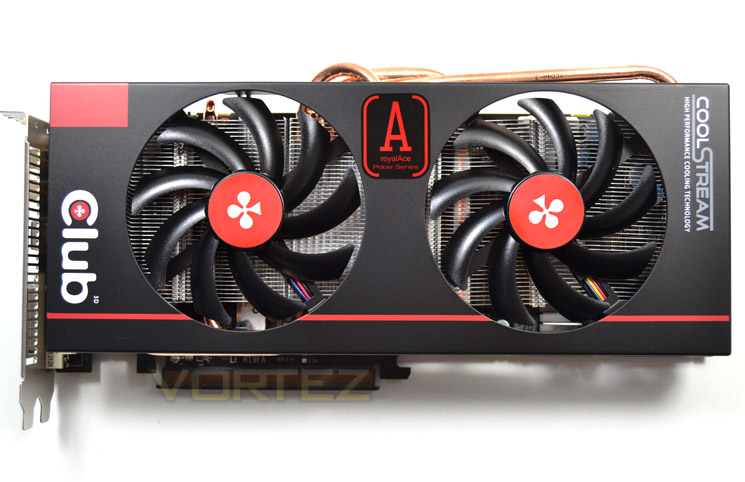
From a birds eye view the card looks great. Black and red is hardly individual but as it is the standard scheme for AMD Radeon cards and also Club 3D, it makes sense to use this colour scheme which also happens to work well.
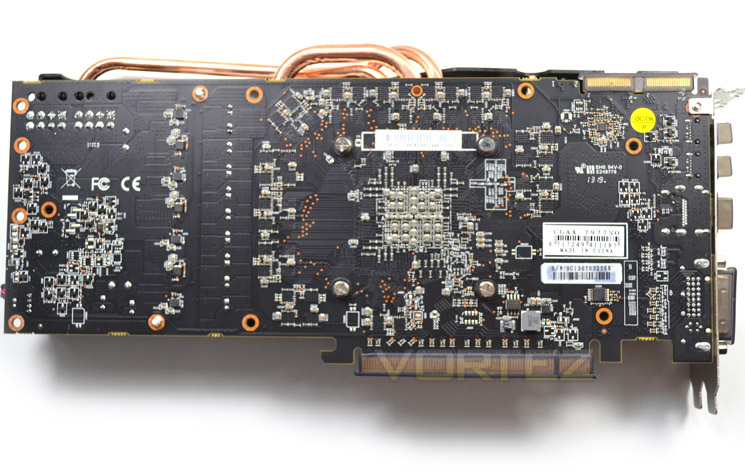
The rear of the card is silk screened in our favour colour – matt black meaning the card will perfectly match most PC systems aesthetically. Club 3D have used smoked black, plastic protectors on the Crossfire Tabs, main gold finger along with the I/O area. We do like it when manufacturers go that extra yard and items such as this should be standard on high end cards – sadly as we know this isn'[t always the case and leaves an expensive investments open to static shock.
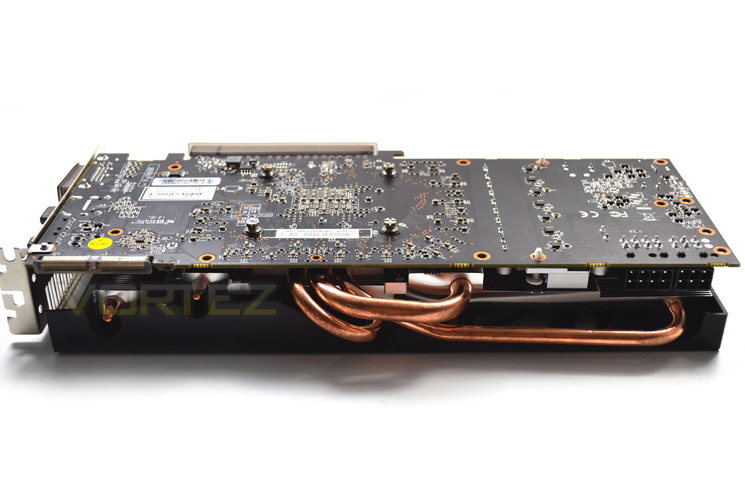
From a side view, we can see that the main shroud is not a fully cover unit meaning much of the hot air dissipated from the Tahiti core will be pumped out into your case so good case cooling will be required.
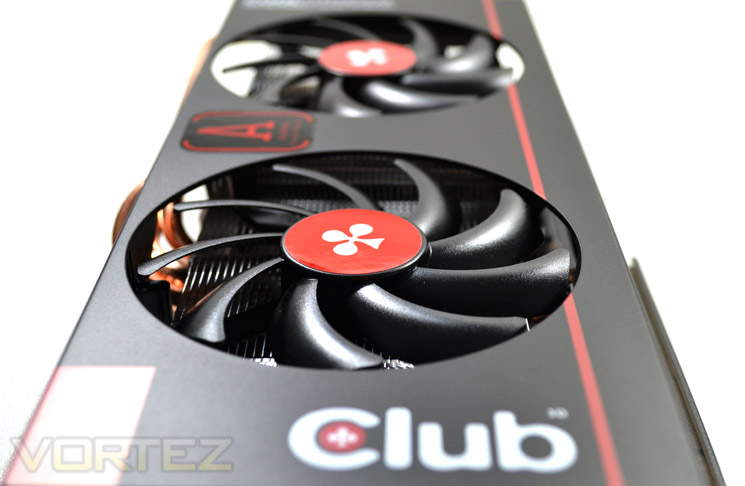
The card measures 268 x 122 x 36 mm which in real terms means its a little on the plump side, overhanging a standard ATX motherboard by just under 2cm. It’s girth is also accentuated by those copper heatpipes but they do not stretch our further than the power ports with cables attached.
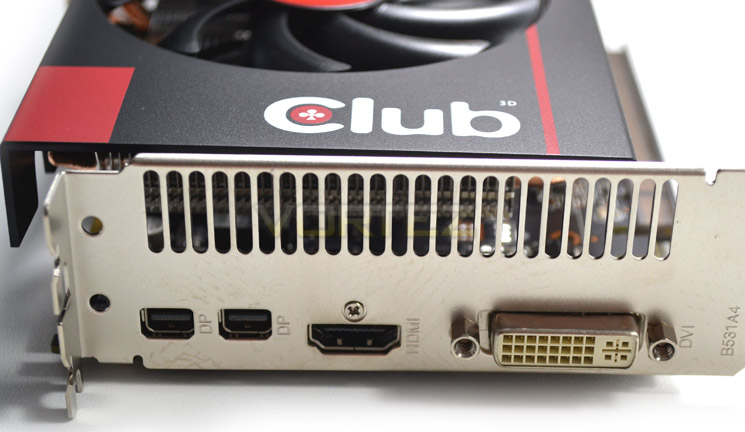
The Input/Output area features a dual link DVI-I, HDMI 1.4a and twin DP 1.2 ports, all of which support AMD’s Eyefininty 2.0 (four screens maximum).
Closer Look
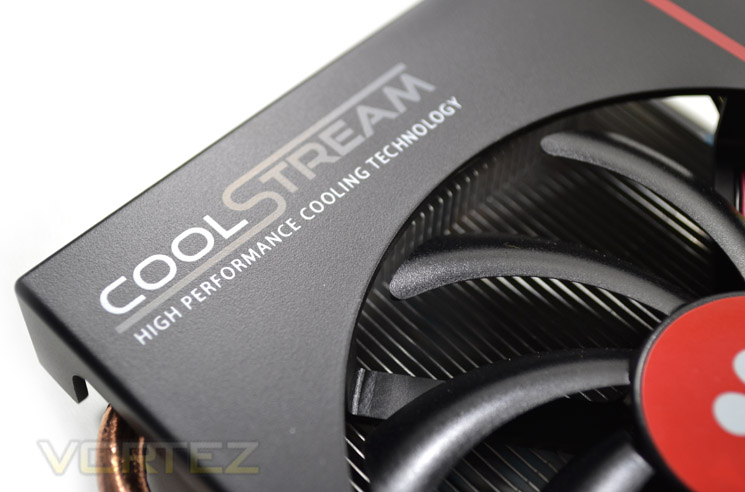
The card has some neat little accents that neither destroy the look of the card nor detract from the red/black theme. Club 3D’s cooling solution is called CoolStream which is shown on the cooler itself. We will look at the cooler in greater detail on the next page but it is very similar to other designs on the market.
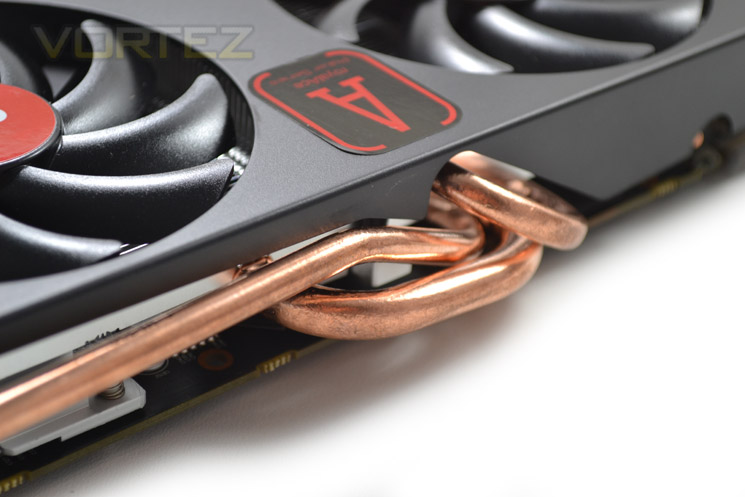
Part of the CoolStream design are the 5 copper heatpipes, 3 of them sprouting out from the side opposite to the PCIe slot. While we do like the look of heatpipes in that they signify power, we felt that having plain copper instead of going that extra yard and coating them with nickel/chrome had a detrimental effect on the visuals.
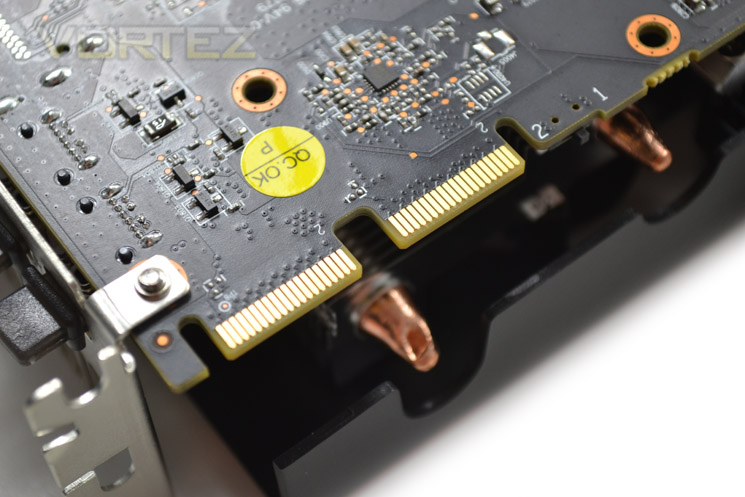
Having two Crossfire tabs, the HD7970 as we know is multi card compatible meaning 4 cards from the same family could conceivably be matched up for some extreme Crossfire X performance!
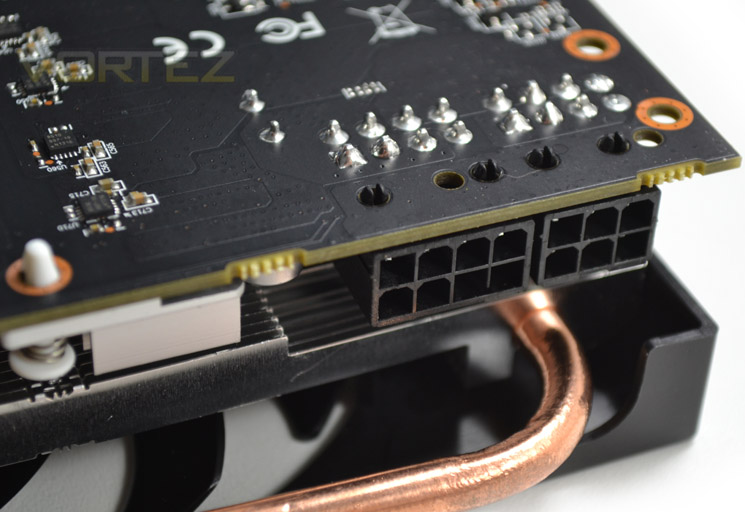
The power ports, like most high end cards require both 8+6 pin power cables. There are no MOLEX adaptors included in the package so you will need to ensure your PSU has both of these cables available, which given that Club 3D recommend up to an 850W PSU, we would be surprised if a modern PSU of this rating did not have these available.
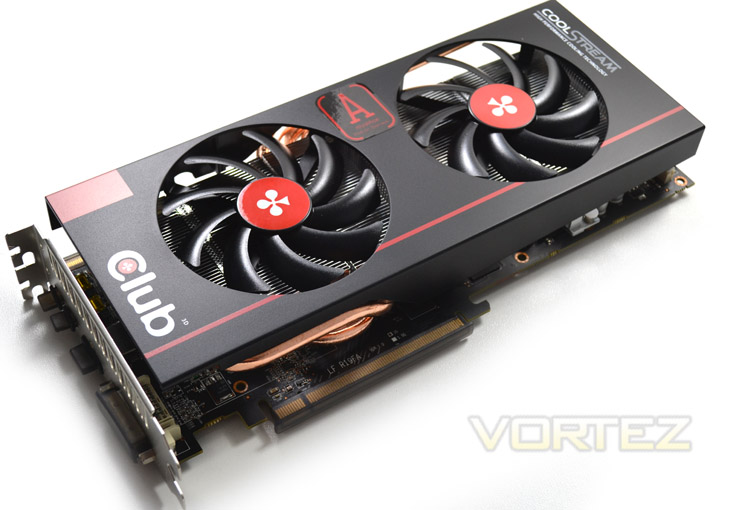
Overall the card looks great. Surprisingly, it also weighs very little in comparison to many high end cards on the market tipping the scales at lightweight 698 grams. Considering that a reference design weighs 1111g, this is some diet that Club 3D have put the HD7970 on!
Let see where that fat has been trimmed away as we remove the cooler and take a look at the internals…
Detailed Look
Club 3D have opted to place a foiled sticker over one of the GPU retention screws. This means removing the cooler would invalidate the warranty of the card which is a shame because many enthusiasts like to use there own thermal interface material to draw every last degree of cooling performance from the card.
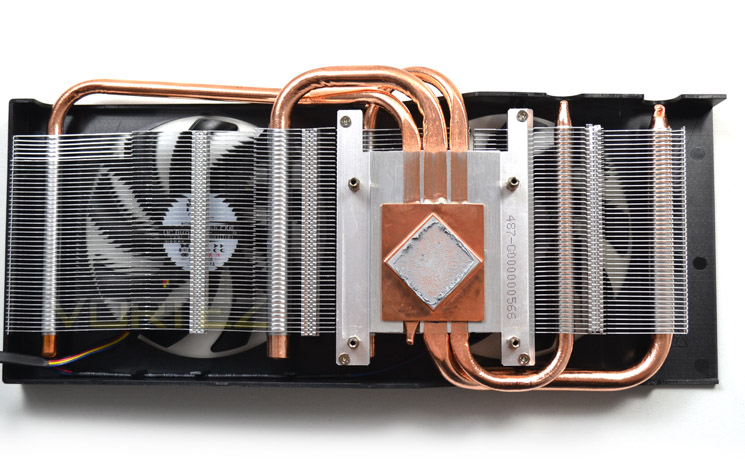
Removing the cooler was however very easy with just four screws holding the CoolSteam cooler in place. The TIM used was adequate, if a little dry in consistency but it was well mounted meaning you should not need to remove the cooler other than to apply your own preferred brand of TIM. Sadly, the cooler does not make any direct contact to the memory chips meaning these are simply cooled passively.
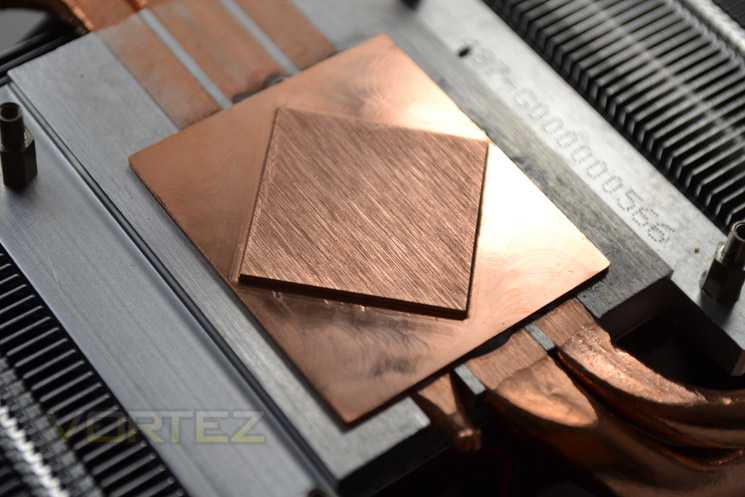
The three heatpipes are flattened and soldered at the baseplate which is a full copper affair meaning maximum heat dissipation without efficiency loss through different metals. The heatpipes stretch across the aluminium finned array which is longitudinal to direct heat out of the rear vent. As previously stated though, much of this heat will escape into the case environment as the unit is not fully enclosed.
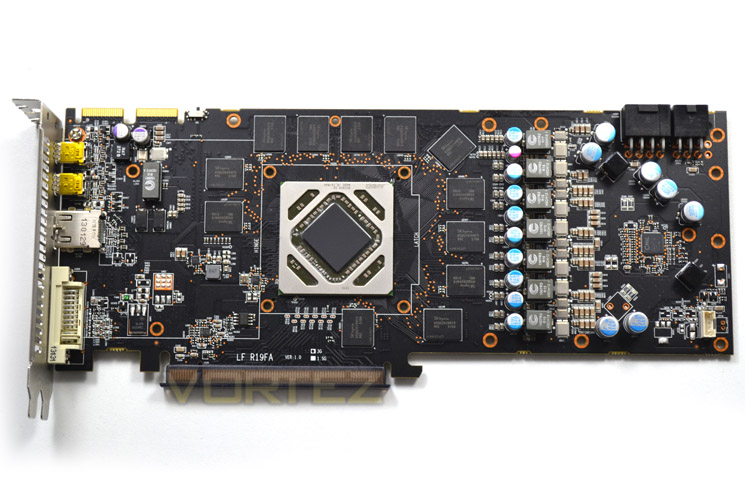
The 12 memory chips surround the main core with the VRM situated closest to the power powers which appears to be the most efficient design, keeping the noise of the power furthest from the core and closest to the power ports.
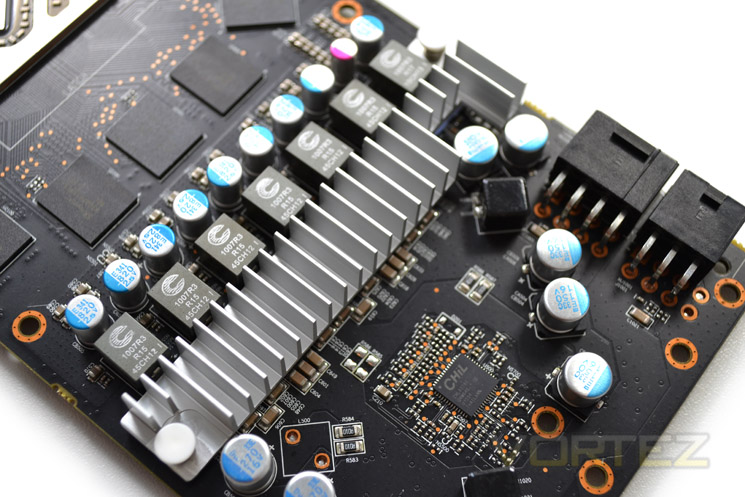
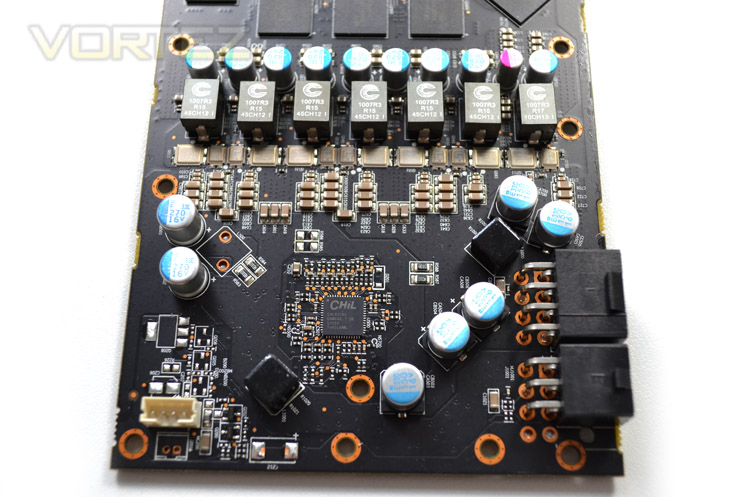
The VRM has its own heatsink which is good to see given the amount of heat the HD7970 VRM kicks out. The card features a 7+1 power phase design and uses solid capacitors throughout.
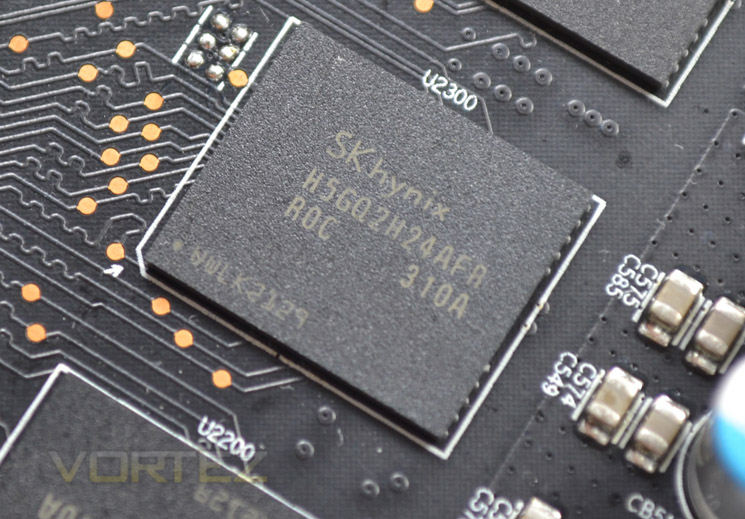
The memory hails from Hynix and carries the product code H5GQ2H24AFR which we know is high performance memory from our previous reviews.
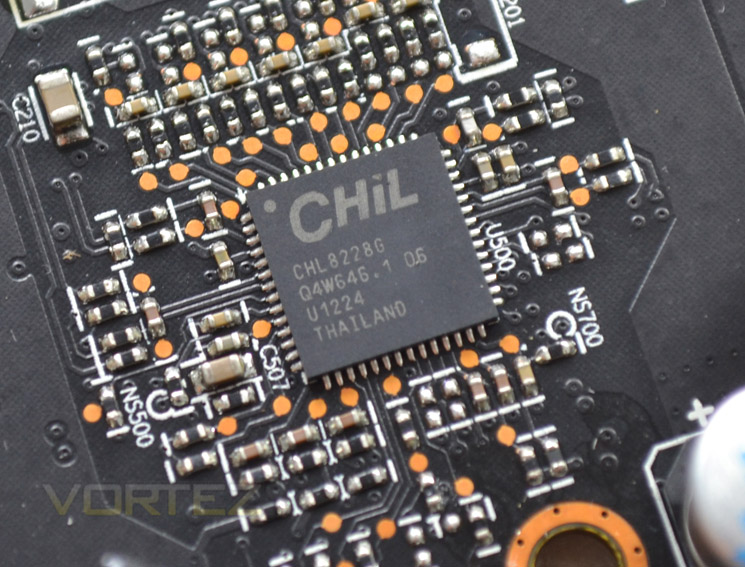
Taking care of voltage and clockspeed adjustment is the CHiL 8228G IC.
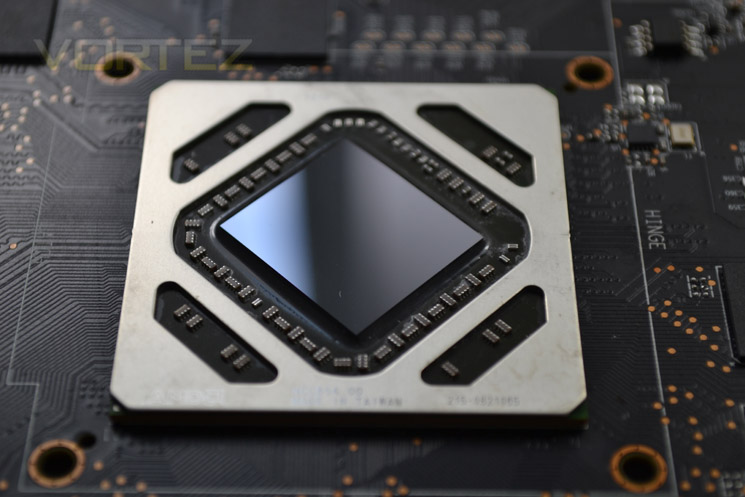
Finally we reach the beating heart of the royalAce HD7970 – the Tahiti XT2 core (GHz edition). Club 3D have opted to stick with the 1100MHz clockspeed and the voltage is rated at 1.020V, compared to 1.175V of the Tahiti XT found on reference design models. So not only is it faster, it is also much more efficient.
Time to put this card to the test…
Test Setup
How we test graphics cardsTesting a graphics card is an extremely lengthy process. We sometimes see reviews where a graphic card has been tested using out of date equipment, out of date games and out of date drivers. While the latter can be excused due to the sheer amount of driver updates making a thorough review impossible we will however notify the reader when we have used a different driver to the normal for example a pre-release driver. For the most part however we will always use the same hardware and where possible the same drivers unless a newer driver rectifies an issue we have encountered or significantly improves performance to such an extent that continuing with an outdated driver is not feasible.
We have also seen the emergence of frame time analysis. We covered this in a separate article here: GPU Reviews: Why Frame Time Analysis is important so we won’t go into the reasoning again but to summarise, our testing comprises both FPS testing and perhaps arguably more importantly, frame time analysis. We also look at overall performance by equating averages across the games and finally before concluding our review we take a look at value for money.
HardwareWith the latest Intel chipset release we decided to update our ageing X58 setup to the new X79 chipset. Not only that but we will be using the flagship Core i7-3960X Extreme Edition processor clocked to 4.5GHz to ensure we have no CPU bottlenecks. With 16GB of ram on board there should be minimal paging so the benchmarks we run today will hopefully give a true reflection of the graphics card’s performance.
High End Graphics cards on test:
Club 3D HD7970 royalAce 3GB GDDR5
Catalyst 13.6 (beta) *New Release Driver*Gainward Phantom GTX 770 2GB GDDR5 (Forceware 320.18)
NVIDIA GeForce GTX 770 2GB GDDR5 (Forceware 320.18)
NVIDIA GeForce GTX 780 3GB GDDR5 (Forceware 320.18)
NVIDIA GeForce GTX 690 4GB GDDR5 (Forceware 314.22)
NVIDIA GeForce GTX TITAN 6GB GDDR5 (Forceware 314.22)
NVIDIA GeForce GTX TITAN SLI 12GB(2x6GB) GDDR5 (Forceware 314.22)
NVIDIA GTX680 2GB GDDR5 (Forceware 314.22)
AMD HD7970 3GB GDDR5 (AMD CAT 13.3 beta)
Motherboard: ASUS P9X79 Pro
CPU: Intel Core i7-3960X Extreme Edition @ 4.5GHz
RAM – 16GB (4x4GB) Corsair Vengeance (Red) DDR3 @ 1866MHz 9-10-9-27
Power Supply – Thortech Thunderbolt Plus 1200W
Hard Drive – Kingston HyperX 240GB
Cooler – Corsair H100
CPU: Intel Core i7-3960X Extreme Edition @ 4.5GHz
RAM – 16GB (4x4GB) Corsair Vengeance (Red) DDR3 @ 1866MHz 9-10-9-27
Power Supply – Thortech Thunderbolt Plus 1200W
Hard Drive – Kingston HyperX 240GB
Cooler – Corsair H100
Benchmarks
If you are a regular reader of our reviews you will know we like to test the latest hardware with the latest games and benchmarks on the market. Here are the games we have chosen:
Battlefield 3
Crysis 3
Far Cry 3
BioShock Infinite
DiRT: Showdown
The Elder Scrolls: Skyrim
Crysis 3
Far Cry 3
BioShock Infinite
DiRT: Showdown
The Elder Scrolls: Skyrim
We also take into consideration the benchmarkers out there so have included 3 of the more popular synthetic benchmarks available:
Unigine: Valley
Unigine: Heaven 4
Futuremark 3DMark Firestrike
Unigine: Heaven 4
Futuremark 3DMark Firestrike
Let’s see how today’s graphics card performed…
Temperature, Acoustics and Power Consumption
Power Consumption
To test for power consumption we use the included iPower Meter found with our Thortech PSU. As system load figures obviously differ from idle it is extremely difficult to get an accurate figure of system draw and then simply take this figure away from the overall amount because each game will generate varying levels of CPU and hard drive activity. Dynamic power adjustments which fluctuate in game will also affect accurate power figures thus rendering any such power consumption calculations redundant at worst and approximate at best.
We will therefore take our system readings averaged over a benchmark run of Tessmark (100% load) and after 20 minutes of being idle in Windows 7. These can then be used as a comparison to other graphics cards to determine how much more or less power you can expect a GPU to consume.
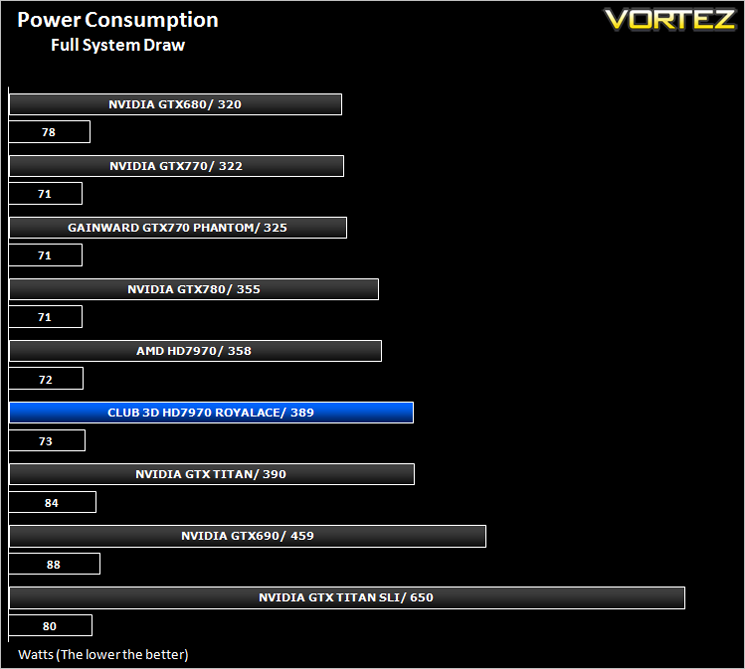
Despite having a reduced voltage requirement for the TX2 Tahiti core, the Club 3D card still consumed a large amount of power which meant it fell behind both the GTX770 and GTX780 in terms of power consumption.
Temperature
To test temperatures we measured idle temperatures after booting windows, letting all applications finish loading and ran a few benchmarks. Once the benchmarks were complete we left the card to reach a cooling plateau where we then took the idle temperatures. For the load tests, we would normally run Furmark for 20 minutes, taking the absolute maximum temperature attained however we found that this throttled the card and resulted in spurious results. So we set Heaven running continuously for 20 minutes and used this as a temperature result as the card did not throttle with this application.
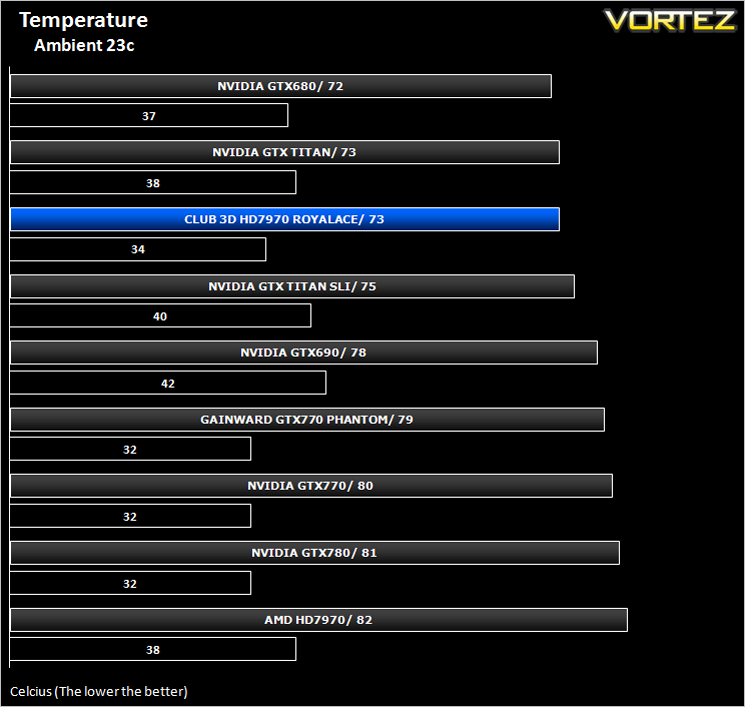
The good nes is that the CoolStream cooler appears to be quite efficient at dissipating the heat, topping out at 73c.
Acoustics
Sadly, that’s where the good news ends as the noise is apparent under normal operating conditions. Worse still there is an irritating capacitor squeal when the card is put under load which coupled with the fan noise makes for a not quite uncomfortable but certainly noticeable experience. This is surprising as the cooler looks to be very similar to other designs on the market which are very quiet.
Let’s see how the card performs in our suite of benchmarks…
Futuremark 3DMark Fire Strike
Fire Strike is the new showcase DirectX 11 benchmark designed for high-performance gaming PCs. It is Futuremark’s most ambitious and technical benchmark ever, featuring real-time graphics rendered with detail and complexity far beyond what is found in other benchmarks and games today.
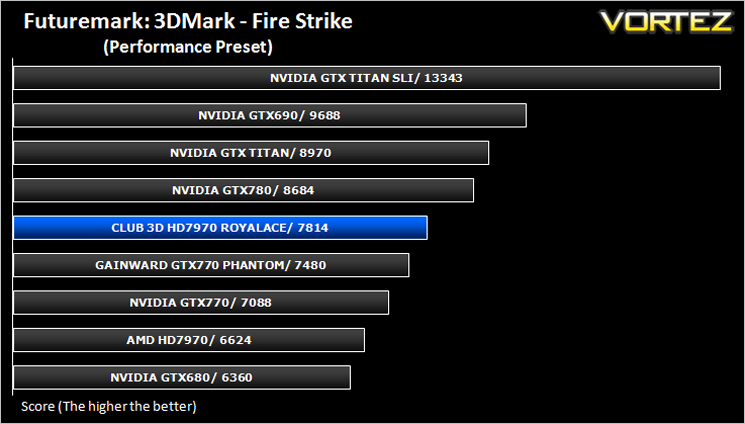
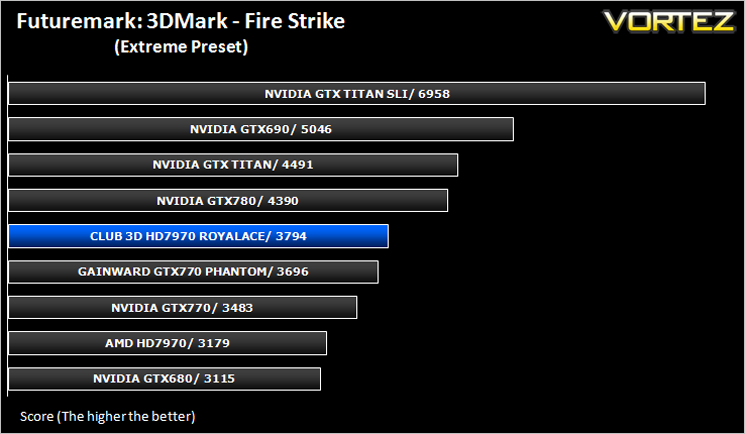
Unigine: Heaven 4 (Synthetic)
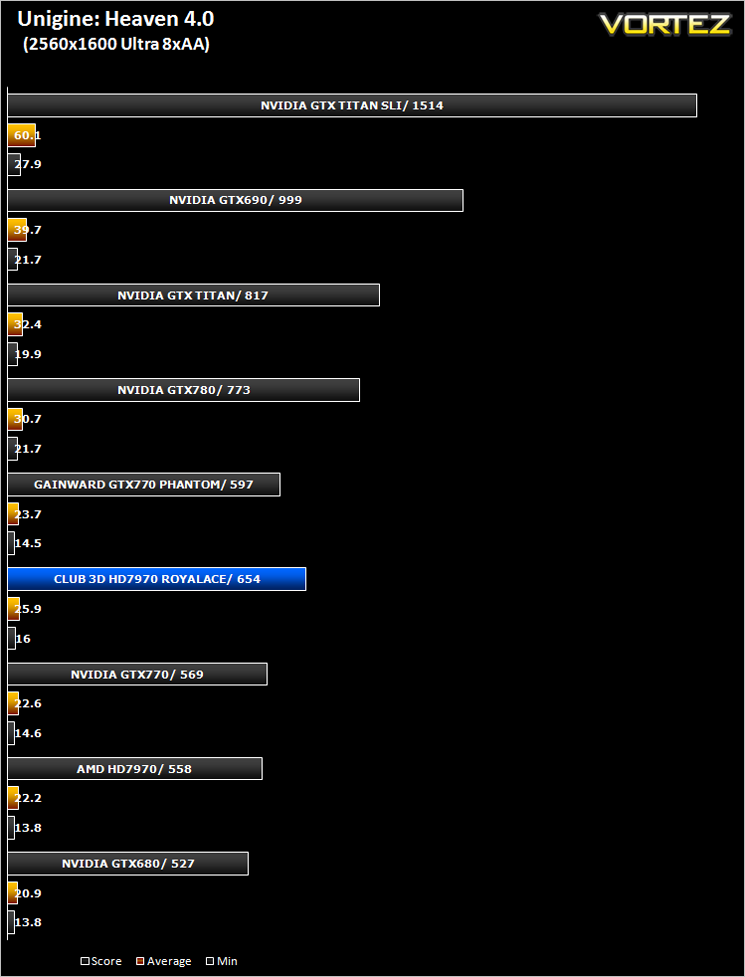
Heaven Benchmark with its current version 4.0 is a GPU-intensive benchmark that hammers graphics cards to the limits. This powerful tool can be effectively used to determine the stability of a GPU under extremely stressful conditions, as well as check the cooling system’s potential under maximum heat output. It provides completely unbiased results and generates true in-game rendering workloads across all platforms.
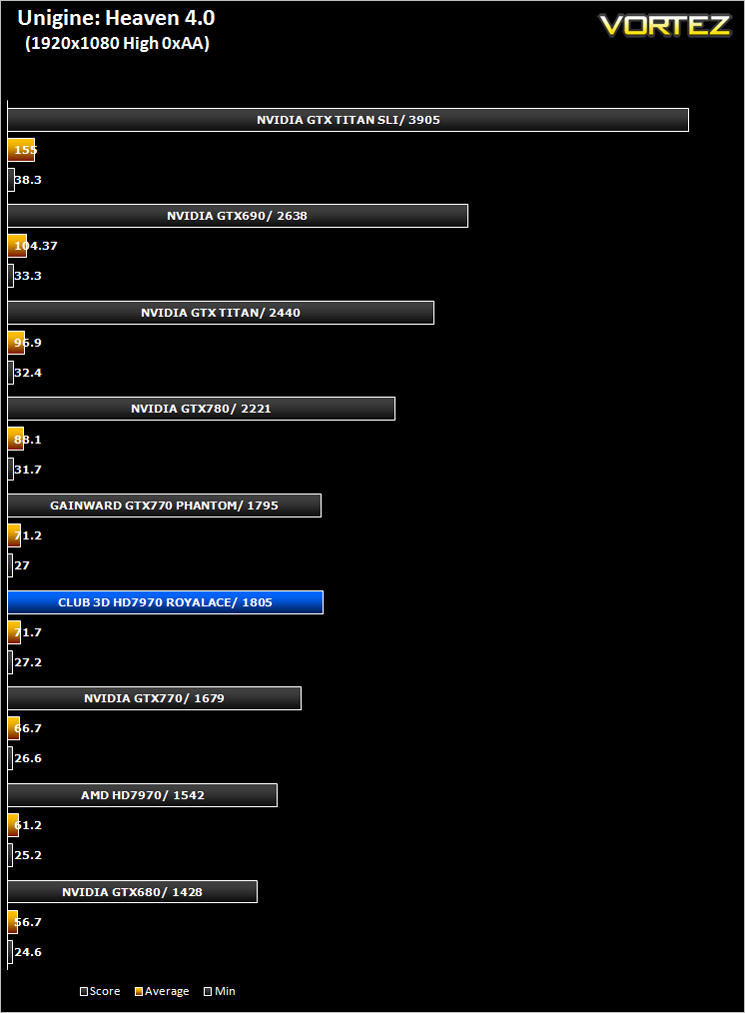
Unigine: Valley (Synthetic)
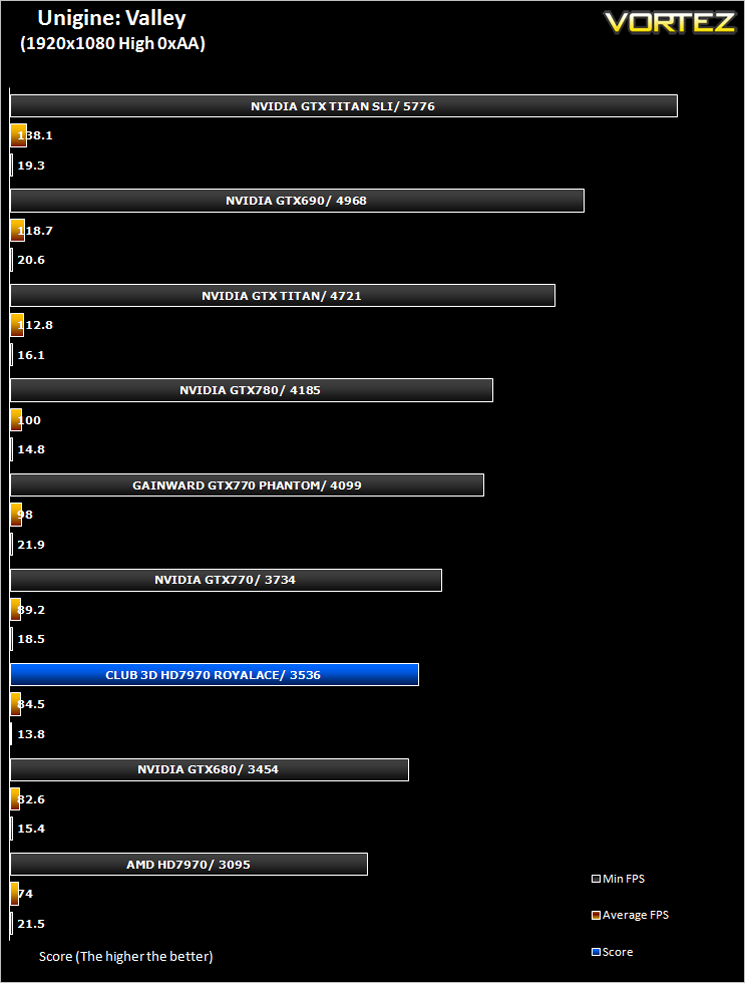
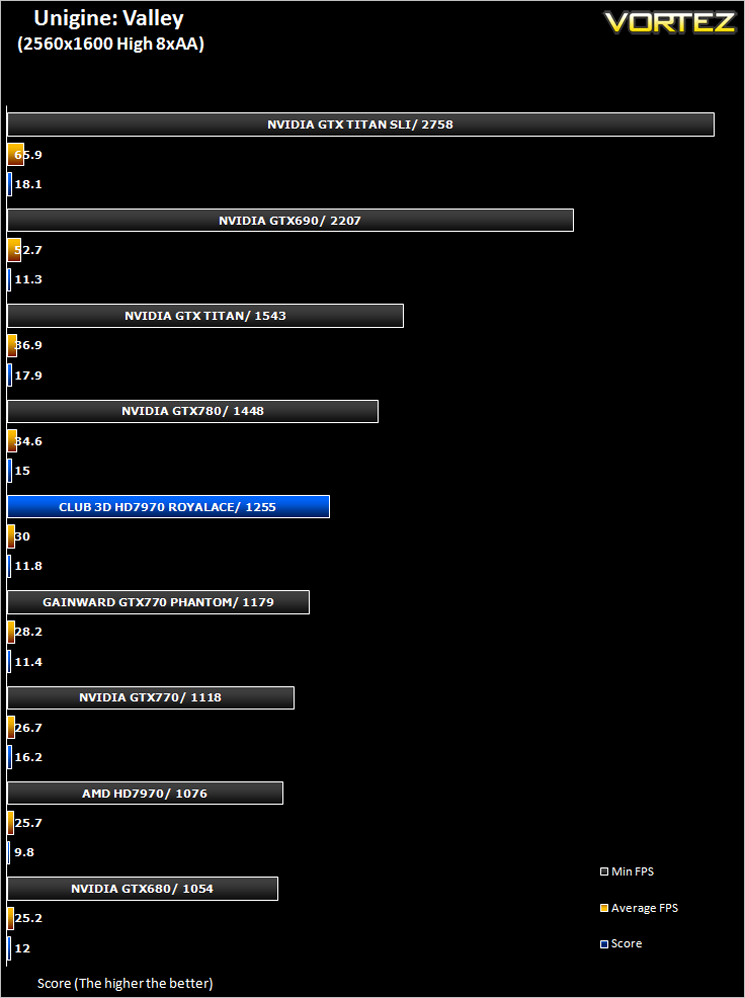
Valley Benchmark is a new GPU stress-testing tool from the developers of the very popular and highly acclaimed Heaven Benchmark. The forest-covered valley surrounded by vast mountains amazes with its scale from a bird’s-eye view and is extremely detailed down to every leaf and flower petal. This non-synthetic benchmark powered by the state-of-the art UNIGINE Engine showcases a comprehensive set of cutting-edge graphics technologies with a dynamic environment and fully interactive modes available to the end user.
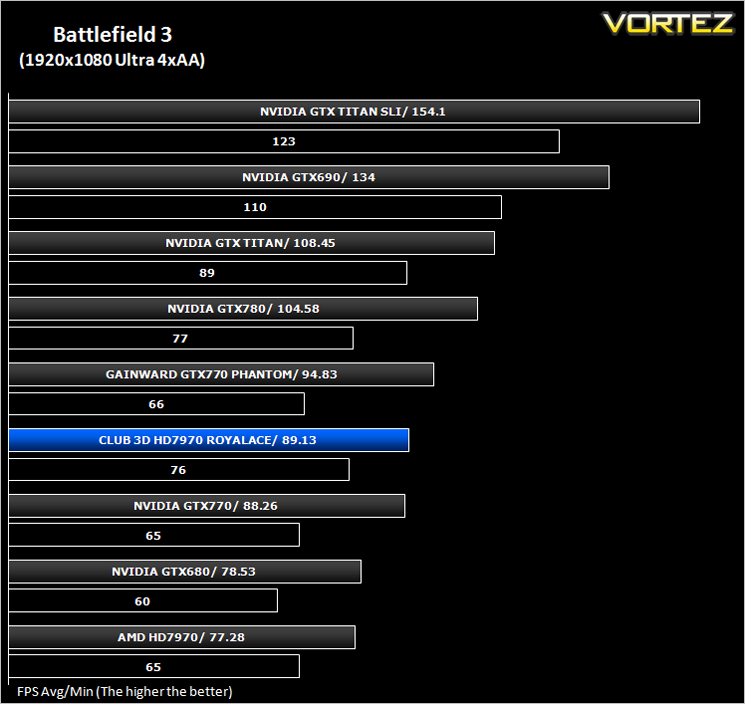
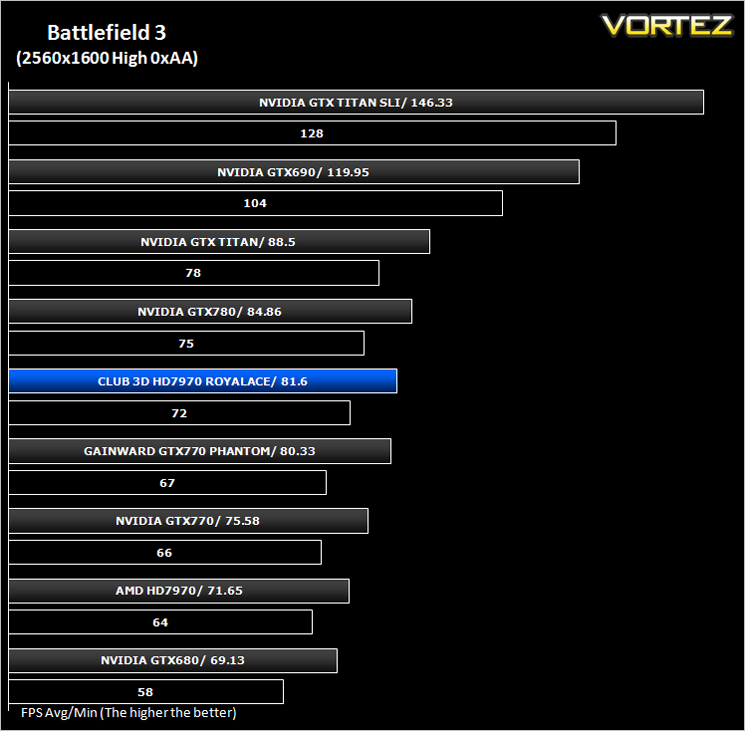
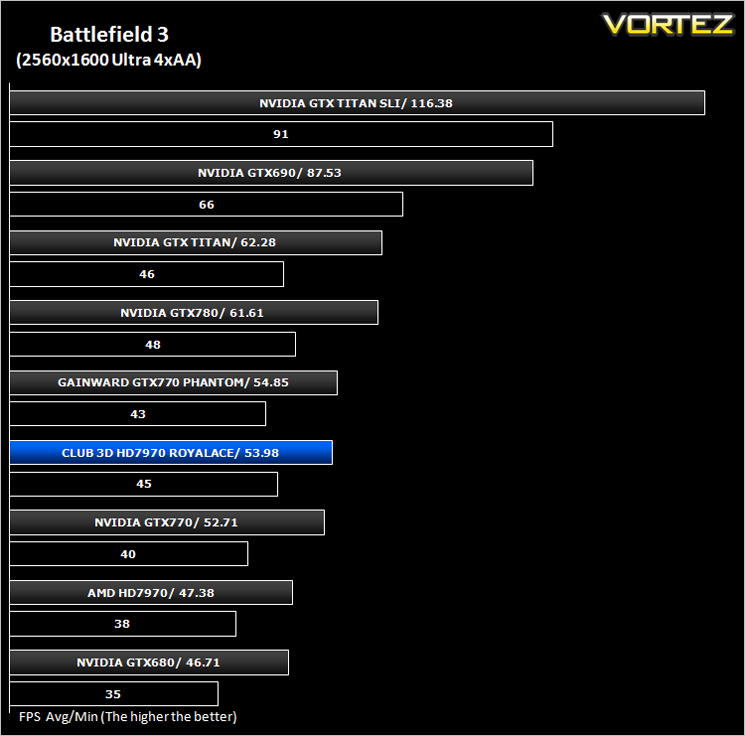
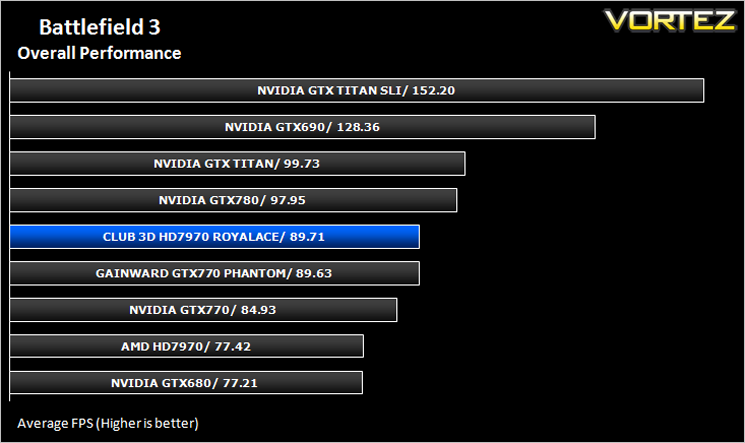
Battlefield 3 (FPS)
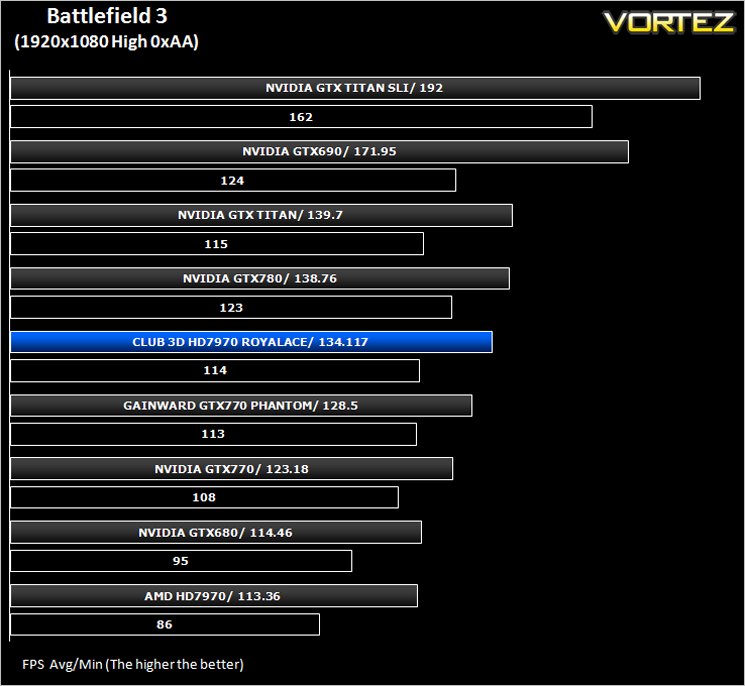
Battlefield 3 leaps ahead of its time with the power of Frostbite™ 2, the next installment of DICE’s cutting-edge game engine. This state-of-the-art technology is the foundation on which Battlefield 3 is built, delivering enhanced visual quality, a grand sense of scale, massive destruction, dynamic audio and incredibly lifelike character animations. As bullets whiz by, walls crumble, and explosions throw you to the ground, the battlefield feels more alive and interactive than ever before. In Battlefield 3, players step into the role of the elite U.S. Marines where they will experience heart-pounding missions across diverse locations including Paris, Tehran and New York.
Average and minimum frames per second were measured using Fraps during the parking lot scene on Operation Sword Breaker. High and Ultra presets were loaded at both resolutions.
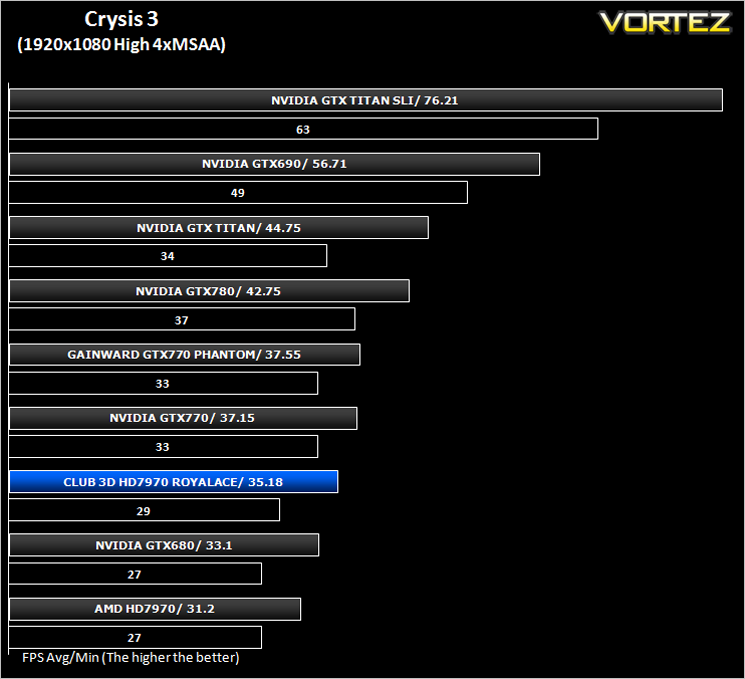
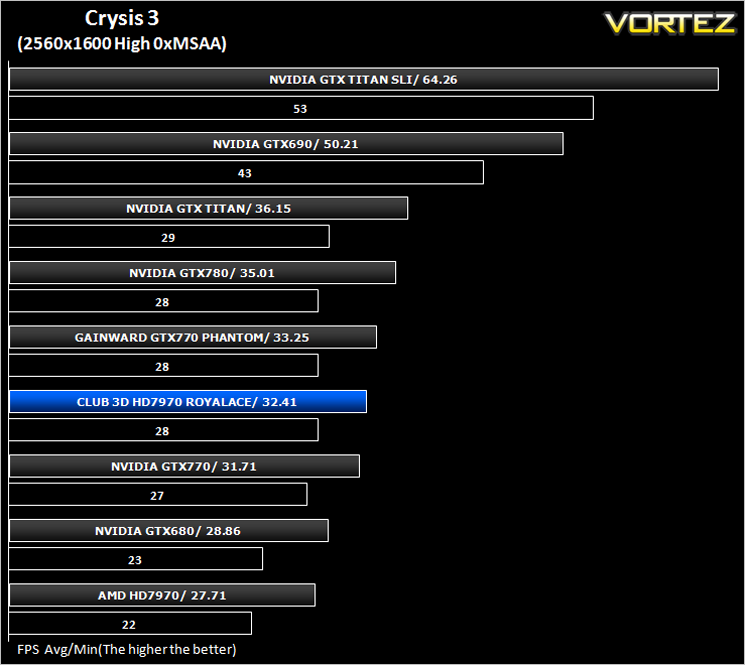
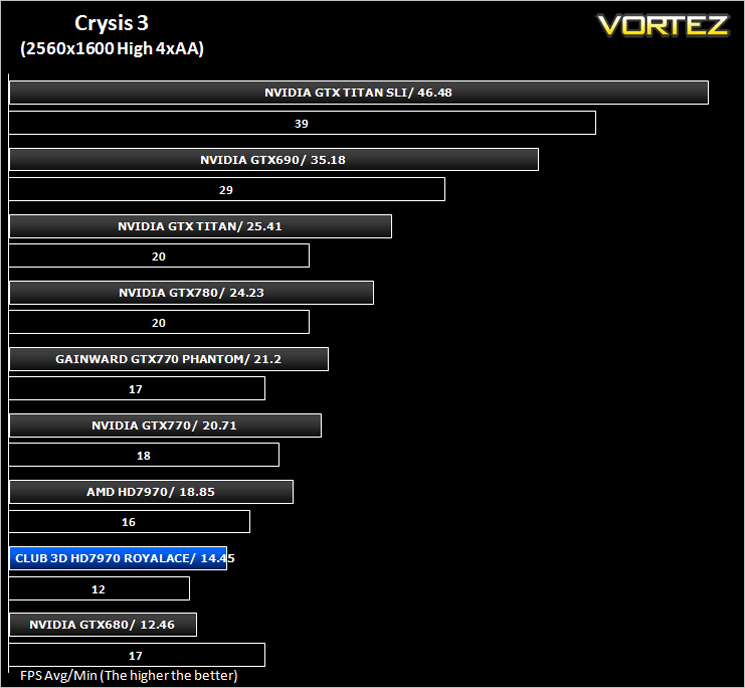
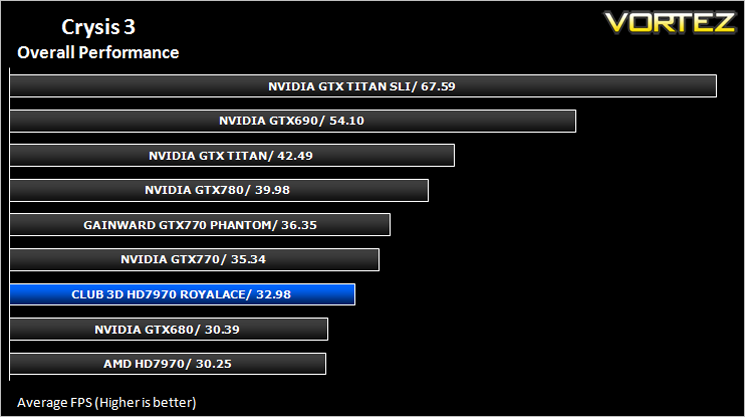
Crysis 3 (FPS)
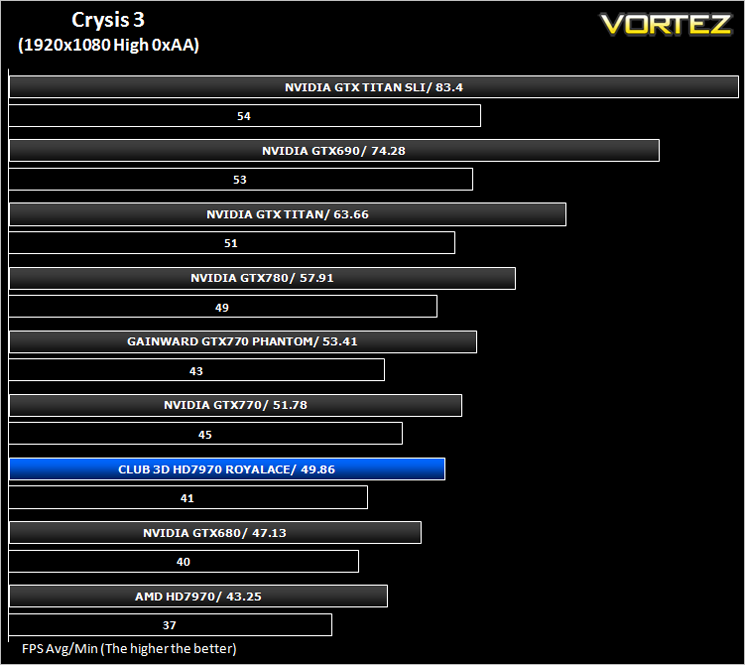
Crysis 3 from Electronic Arts is the fourth instalment of the Crysis franchise and sequel to Crysis 2. It uses the CryEngine 3 gaming engine which is perhaps the most advanced gaming engine to date and therefore the most demanding. The meme ‘Can it run Crysis’ has never been so apparent…
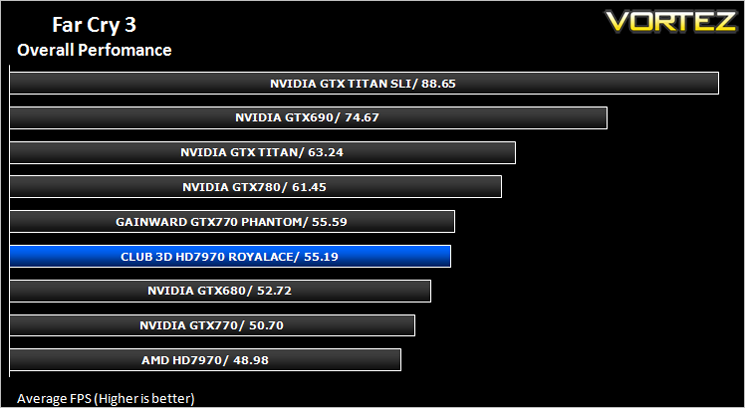
Far Cry 3 (FPS)
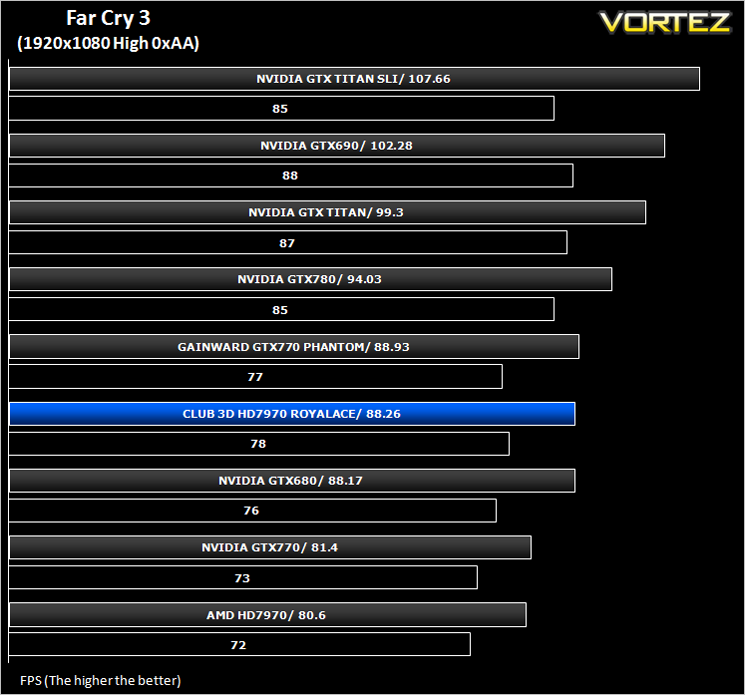
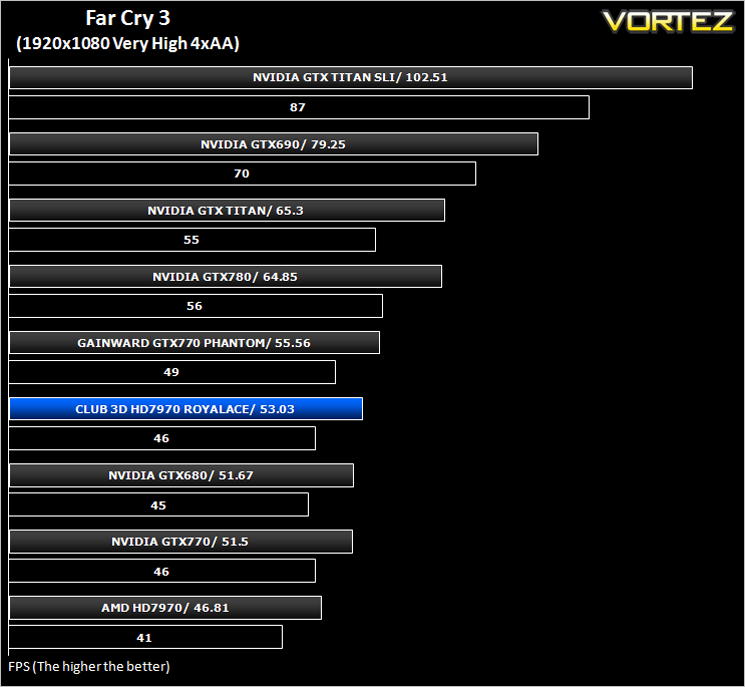
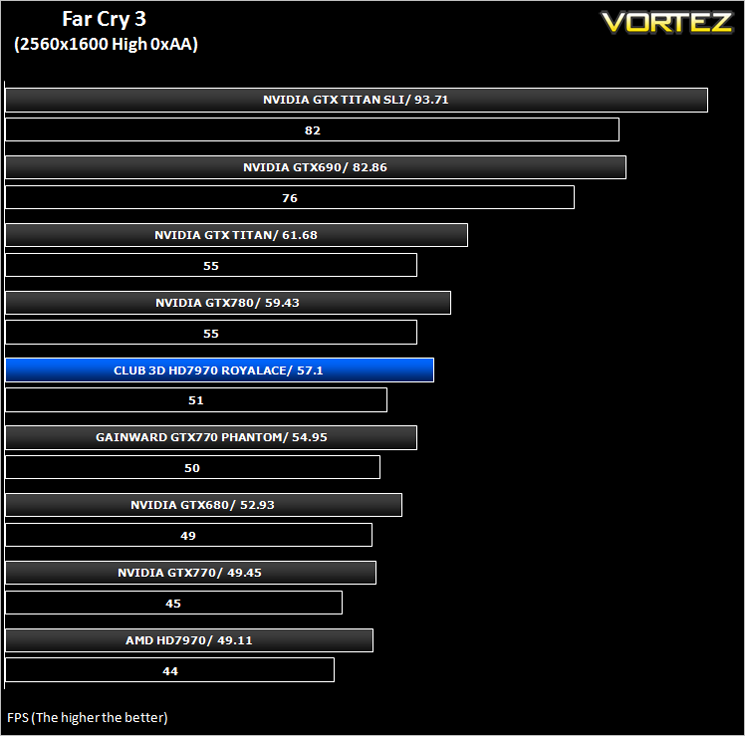
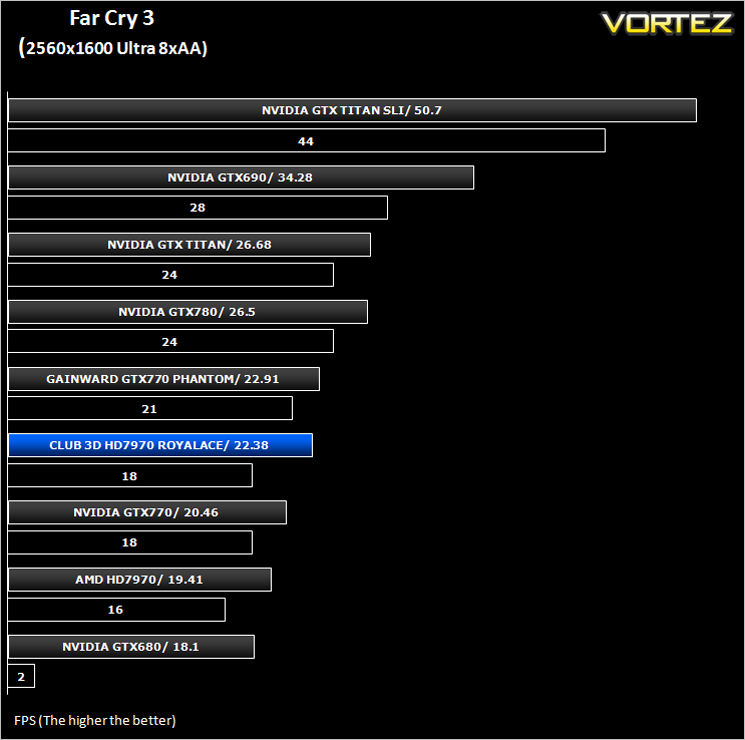
Far Cry 3 is a tropical survival shooter video game from Ubisoft Montreal and Massive studios. It’s open world design has similar traits to it’s forbear Far Cry 2 but it does it all so much better. With stunning visuals and settings to bring a PC to it’s knee’s, this game is so much more than the ‘just another console port’ it was reported to be.
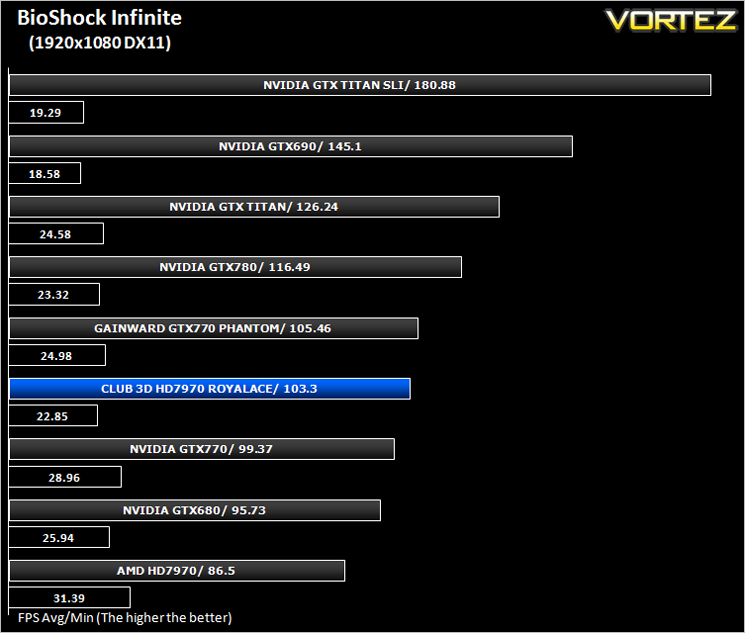
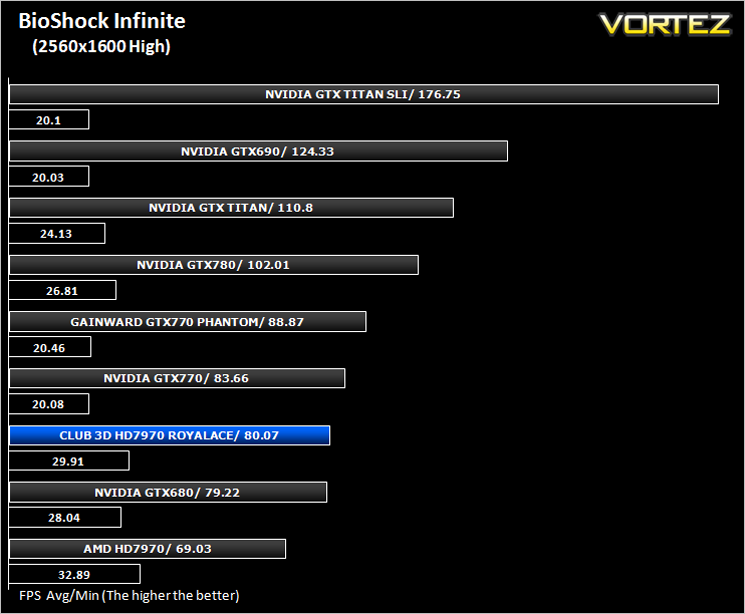
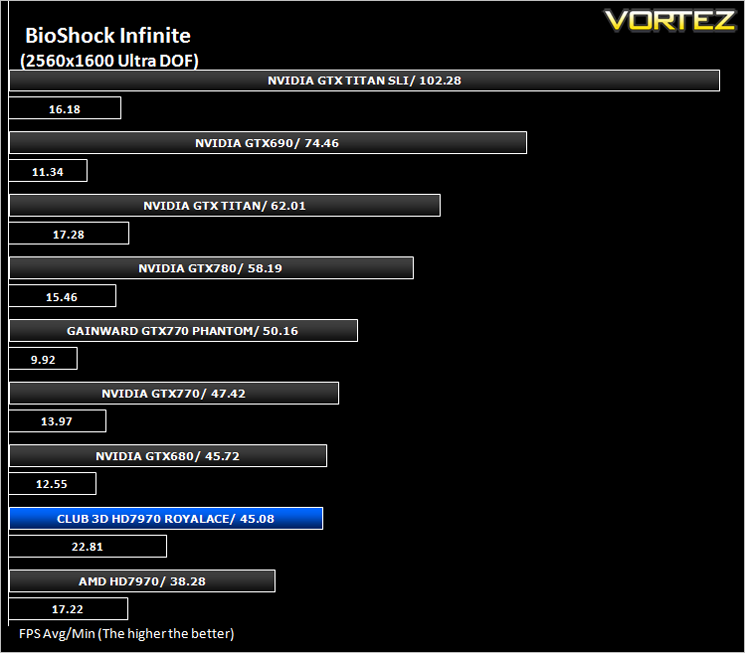
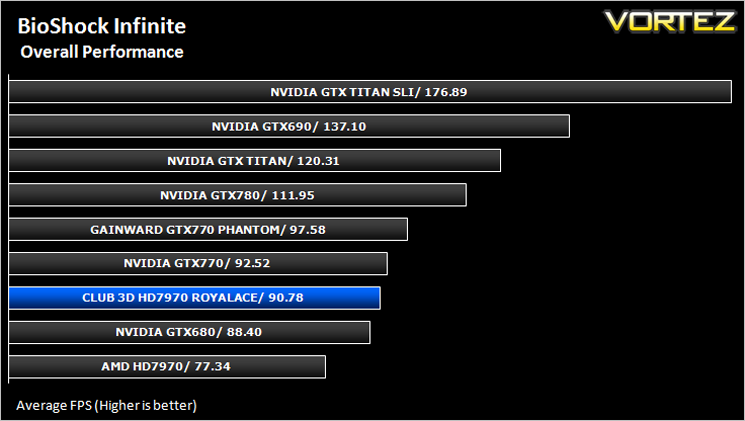
BioShock Infinite (FPS)
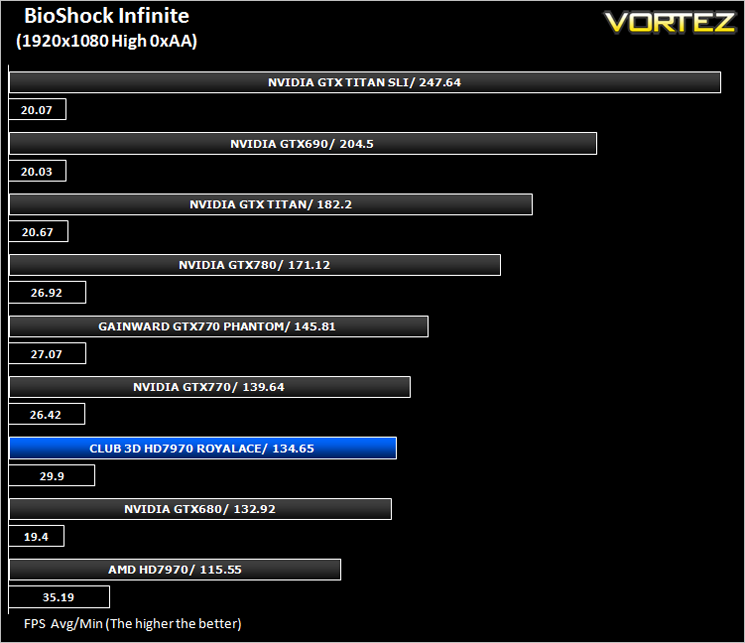
Set in 1912 during the growth of American exceptionalism, BioShock Infinite is a thrid person shooter developed by Irrational games and published by 2K Games. It is the third instalment of the BioShock franchise. the game utilises the Unreal Engine 3, modifying it with their own lighting engine to present a visually stunning experience like no other.
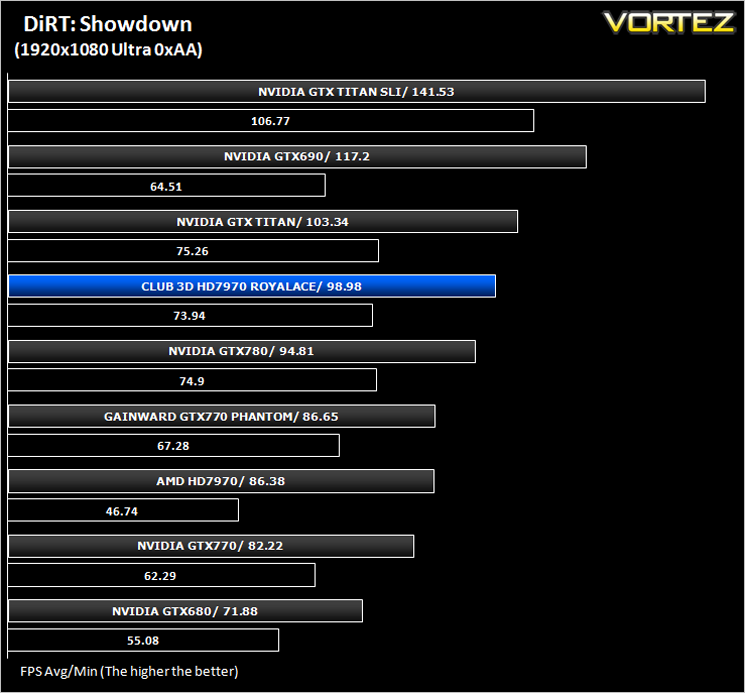
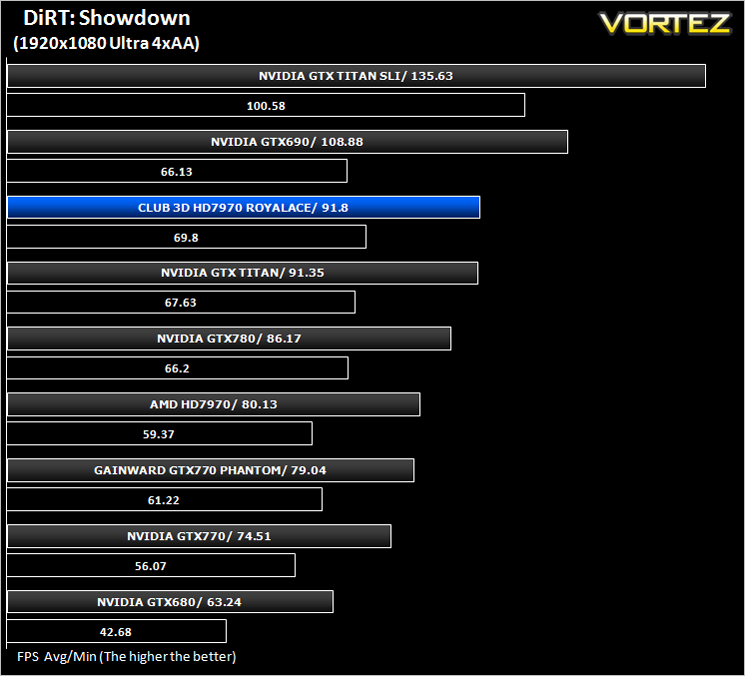
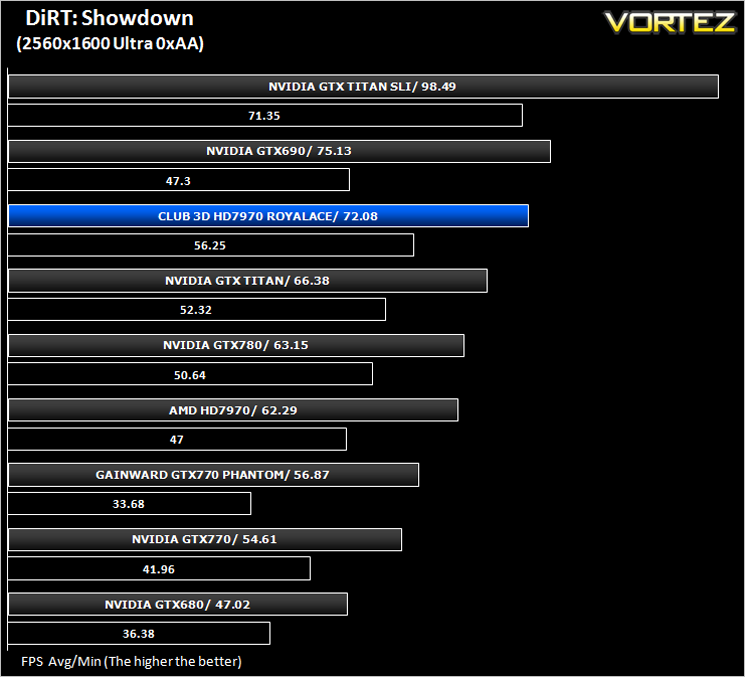
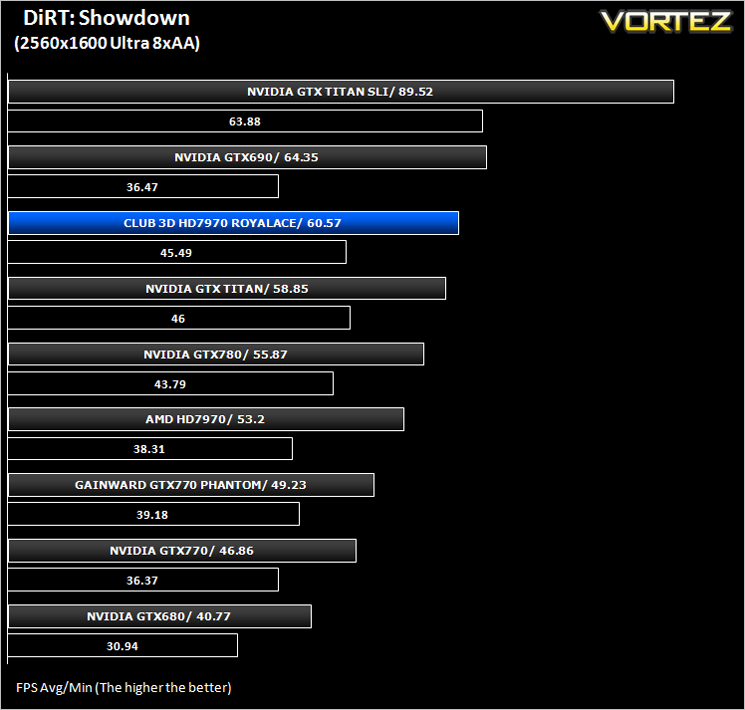
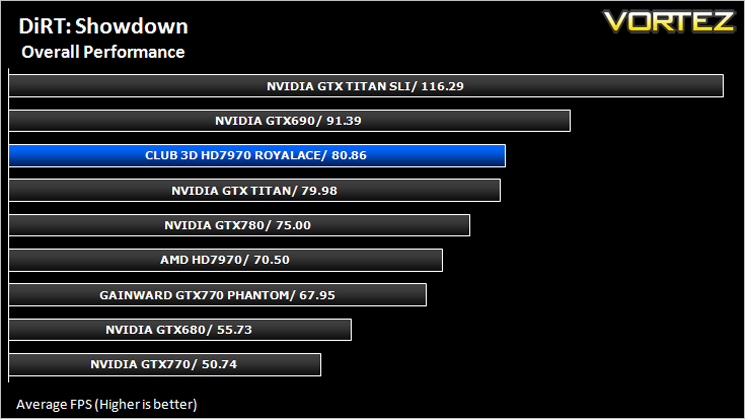
DiRT: Showdown (FPS)
DiRT Showdown is the new arcade racing game from the team that brought you the award-winning DiRT series, uncaged in 2012. Pick up and play controls combine with electrifying events, frenzied crowds and stunning graphics to deliver high octane, dive in and drive thrills from event one.
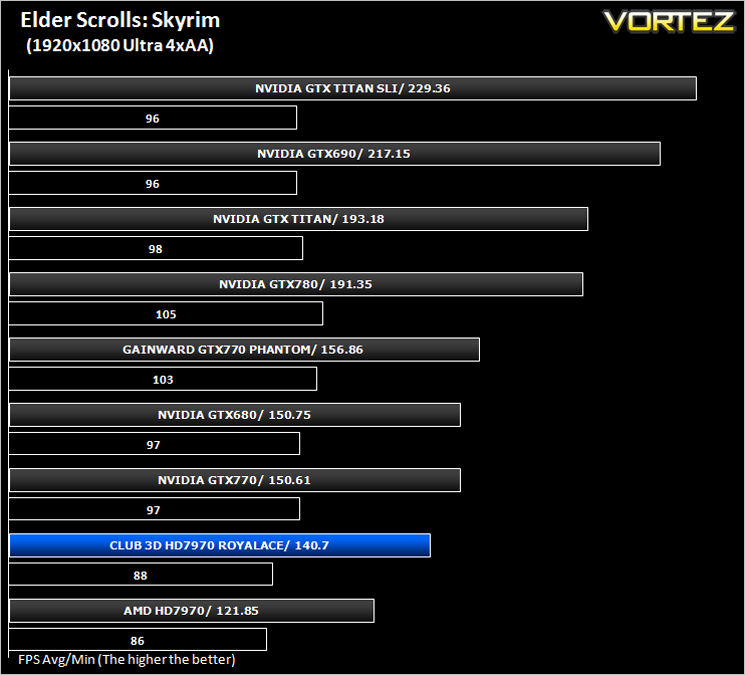
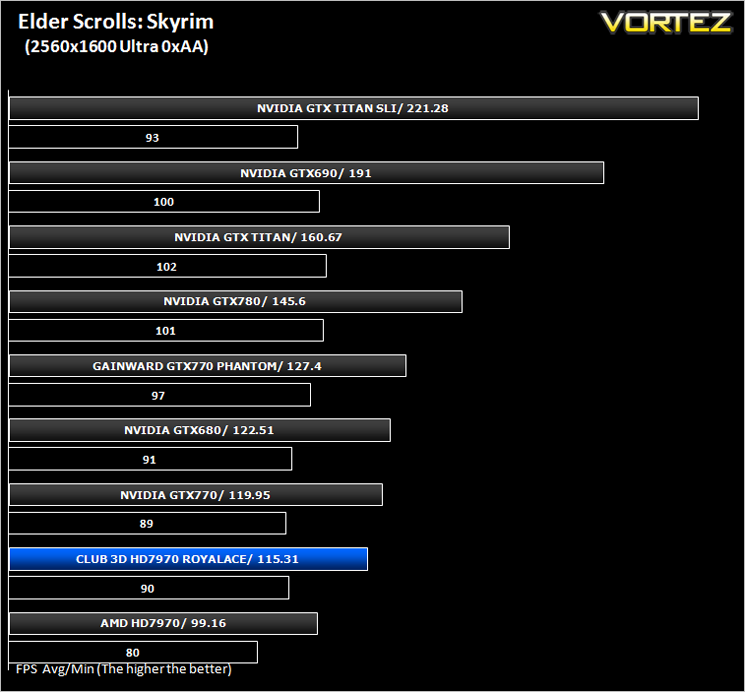
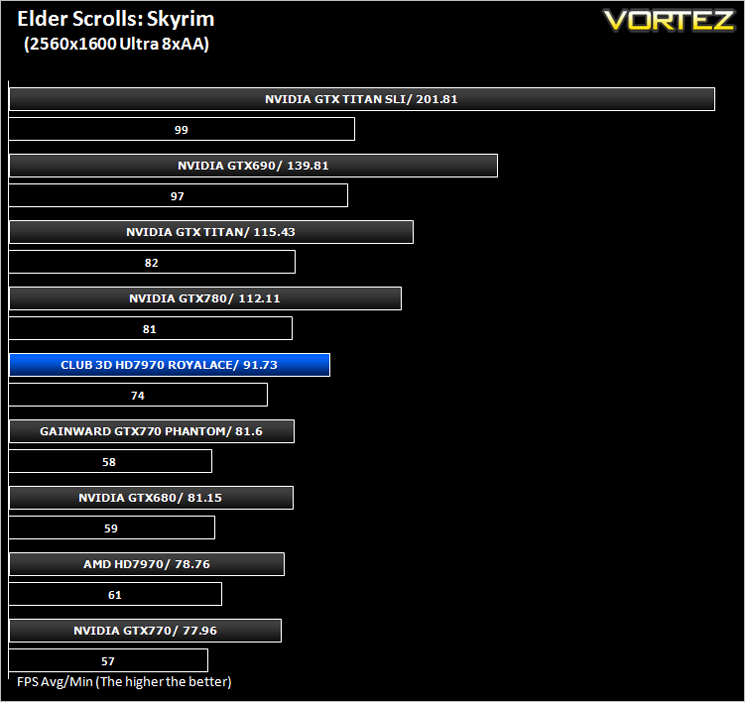
The Elder Scrolls: Skyrim (FPS)
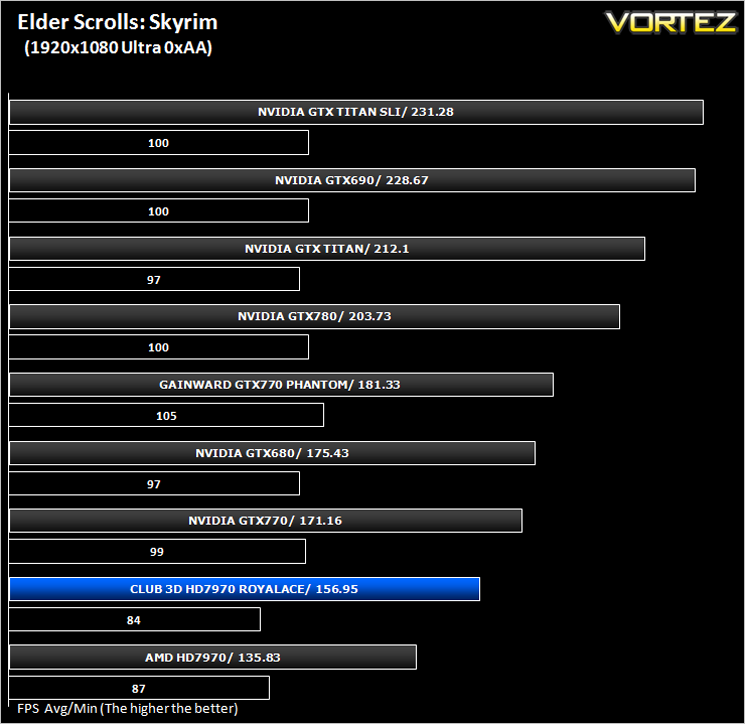
Skyrim is not a direct successor to the very popular Oblivion. Instead it takes place 200 years after the events of Oblivion. The non-linear playing that made the Elder Scrolls such a popular series does however make a return along with the beautiful scenery the encompasses the world of Skyrim.
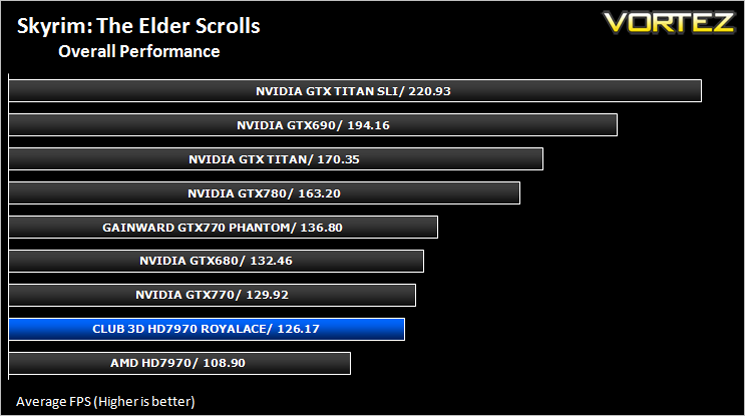
Average and minimum frames per second were measured using Fraps during the drop down passage to Riverwood. V-sync was disabled to allow fluctuating (higher the 60) FPS for these runs. It is however recommended that v-sync is left enabled during normal gameplay due to the games dynamics.
Overall Performance (FPS)
We make a simple calculation for this set of results. For each game we add all of the resulting FPS totals together and then divide by the four sets to give us an overall performance figure. While the figures alone do not give you an accurate picture of how the card will perform in any given scenario, they do tell you, when averaged, which GPU is the more capable across all of the benchmarks and settings tested.
Value For Money
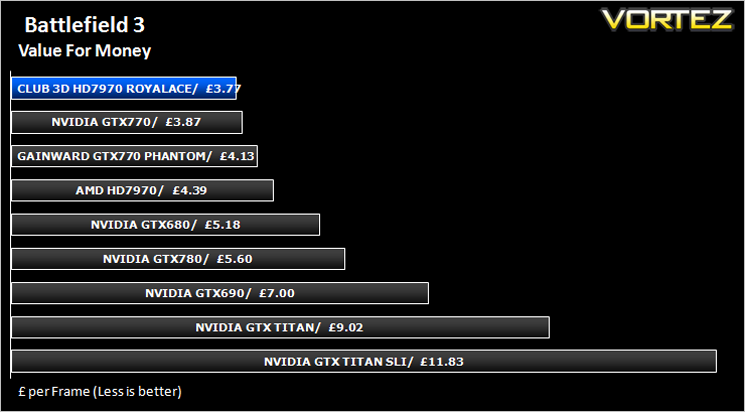
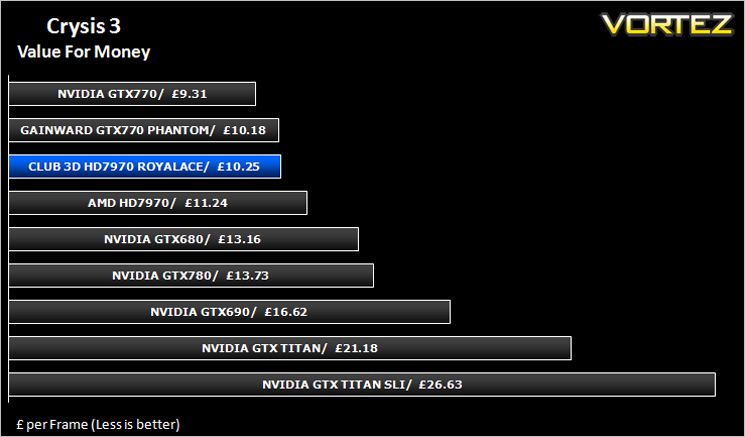
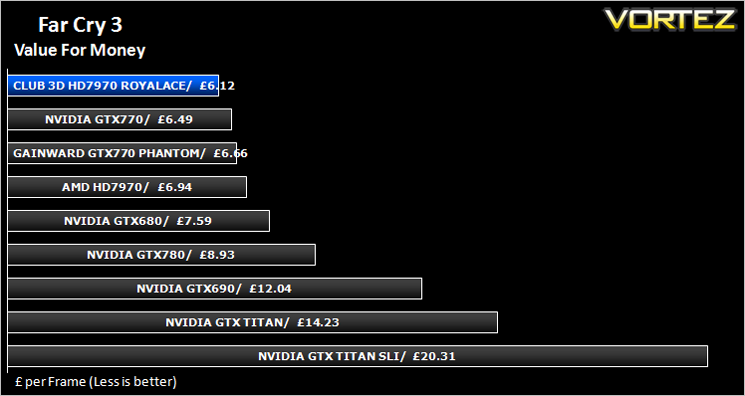
For those on a budget, this is perhaps the most important section of a graphics card review. For everyone else it will certainly make you think twice before calling the bank manager for an overdraft request. We calculate Value for money by taking the cost of the product and then dividing that figure by the overall performance figure which gives us a result in the guise of £ per frame – in effect how much every frame per second will cost you.
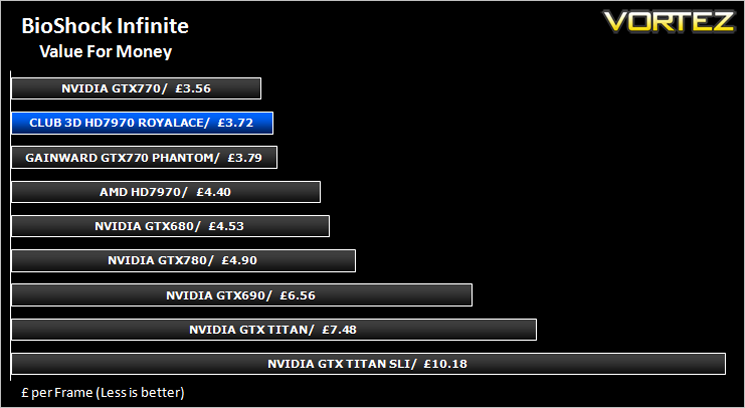
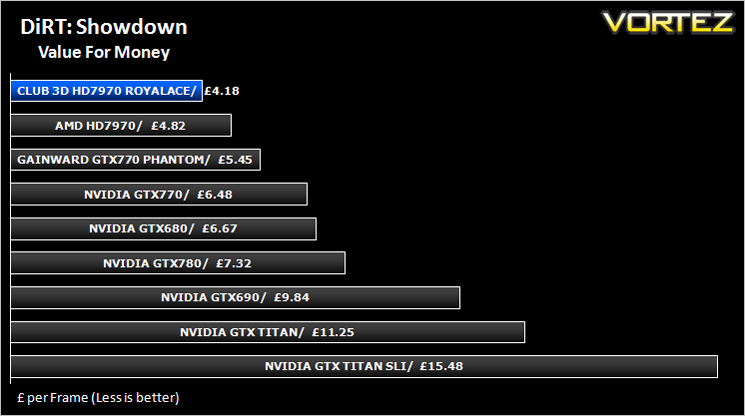
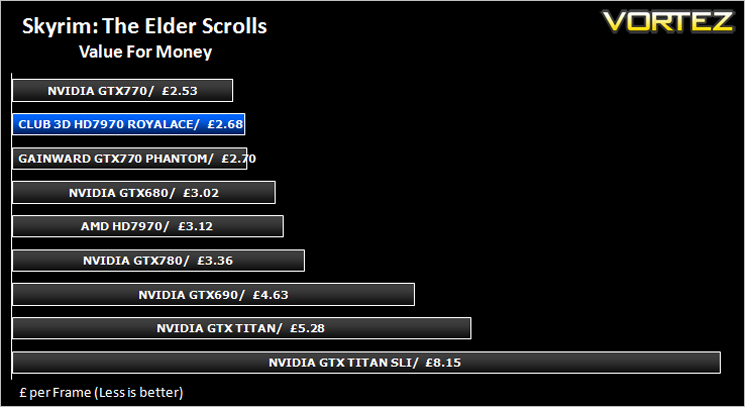
Gaming Experience (Frame Time Analysis)
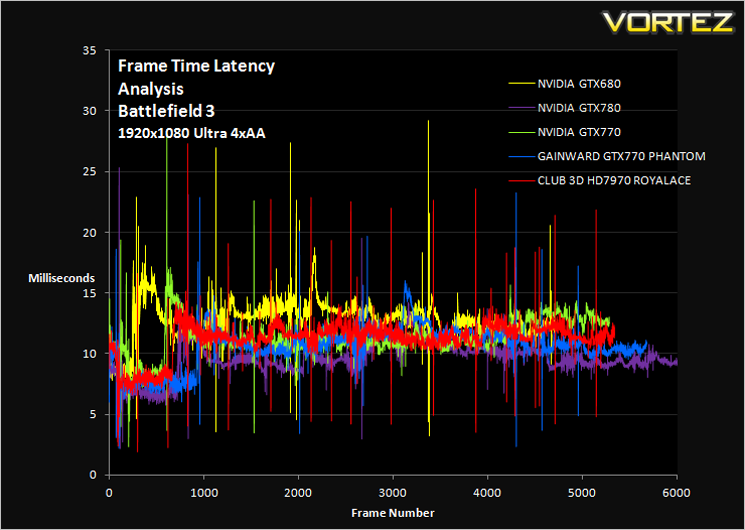
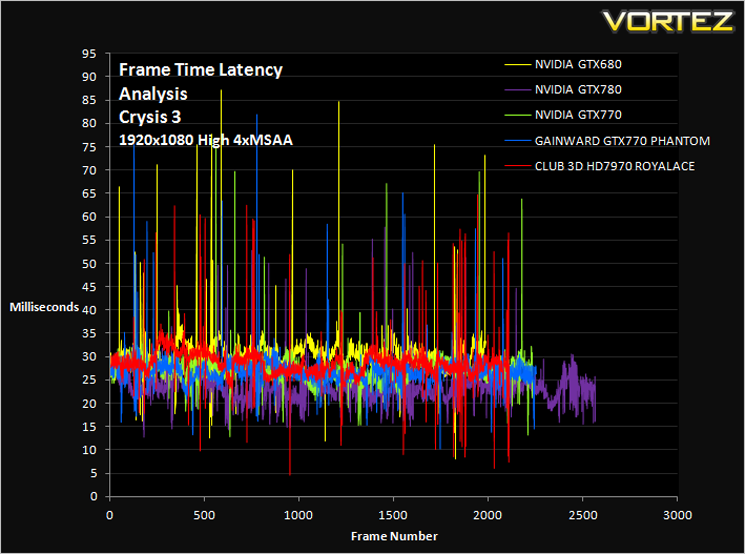
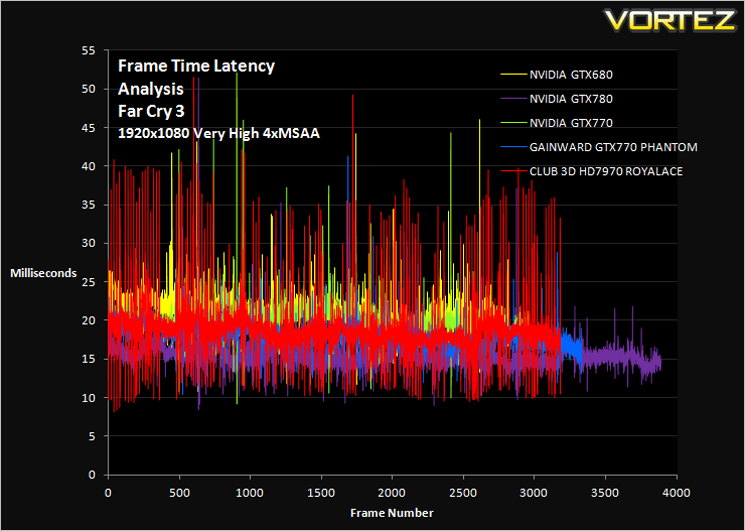
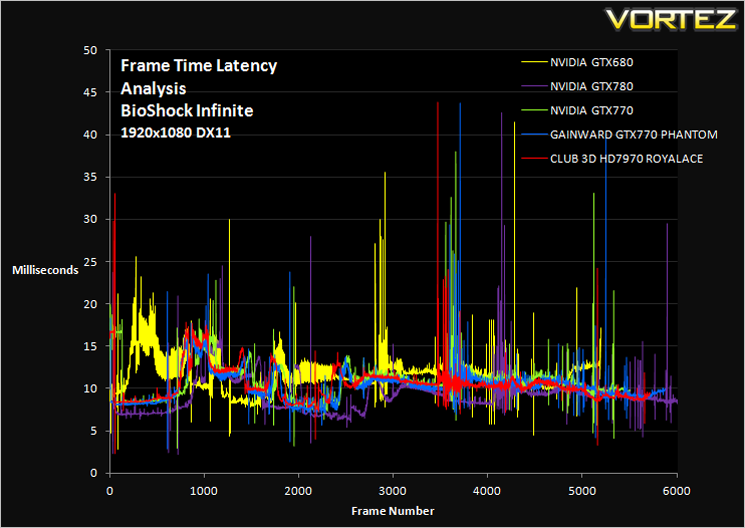
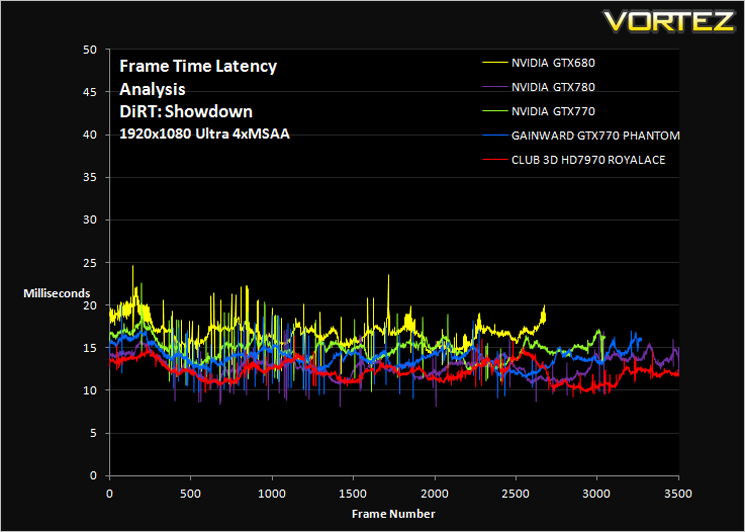
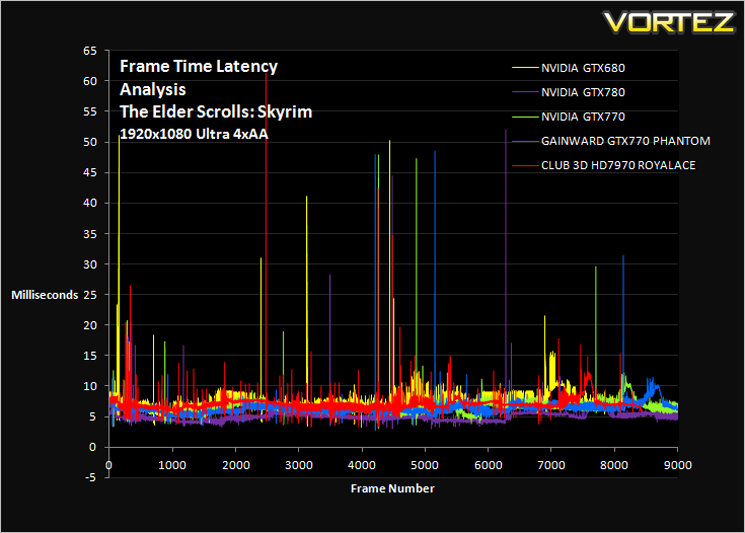
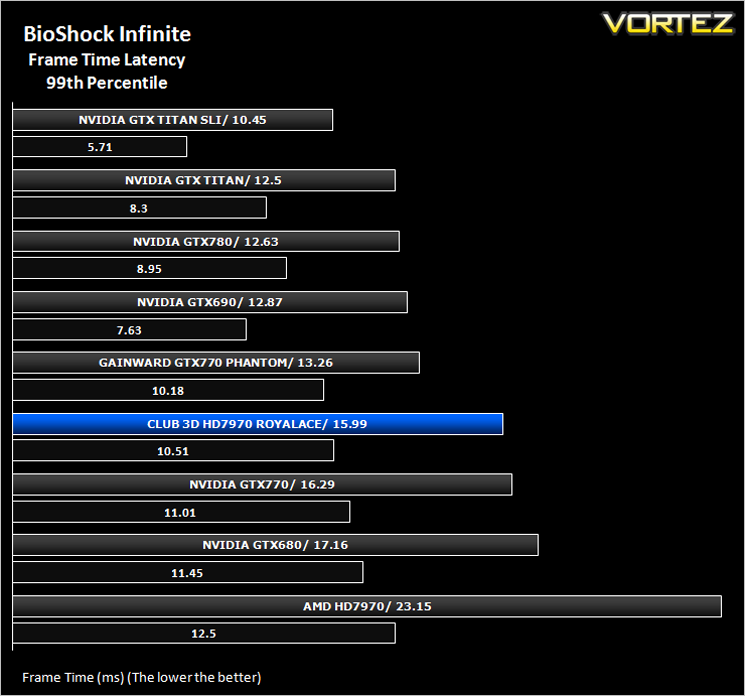
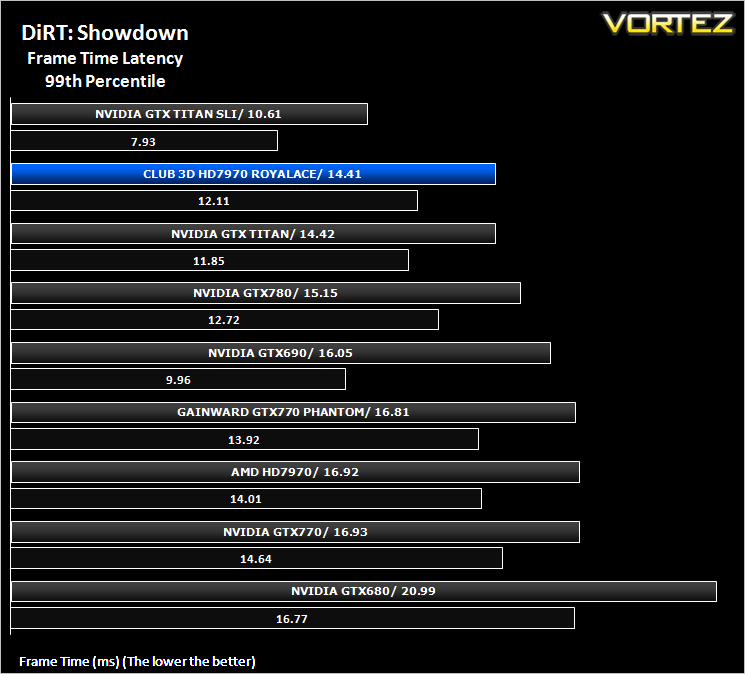
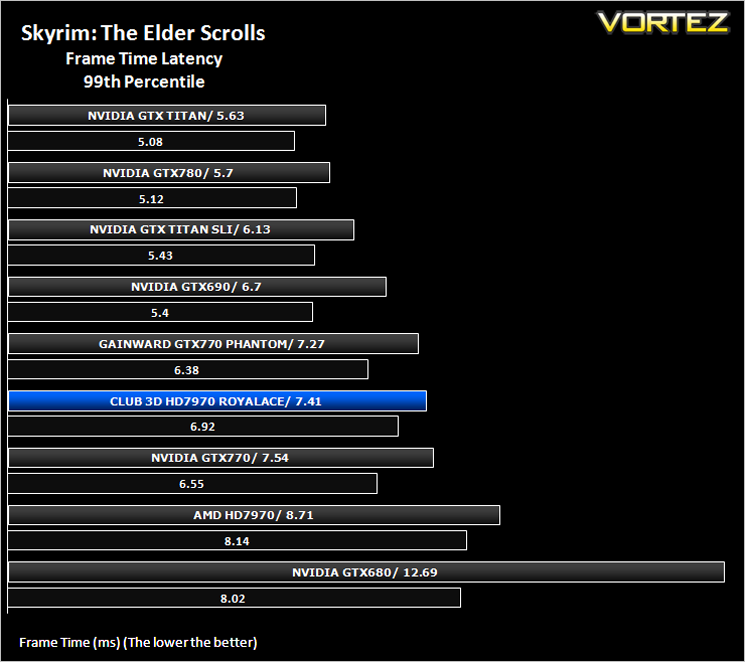
Gaming experience is what we like to refer to as the Layman’s term for Frame Time analysis. Frame time analysis is in its most basic sense how smooth your gameplay will be. Ever had a powerful card rendering at 100FPS with ease for it to stall for a split second before resuming? This is what Frame Time Analysis shows us: The peaks during an otherwise smooth gaming experience. This is presented to you in two ways, by showing you a line graph of a 60 second FTA capture using FRAPS and then by deducing the average and 99th percentile response times.
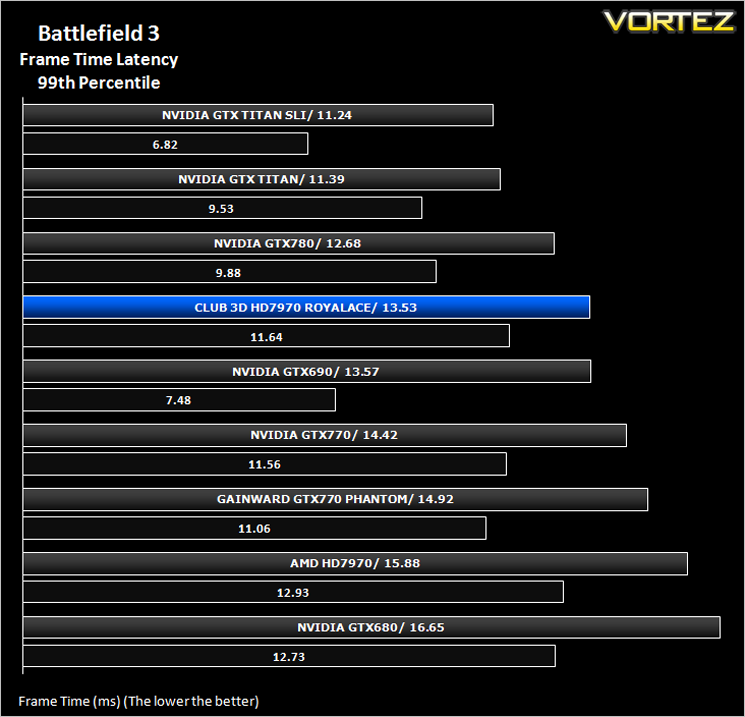
Some claim this should be the way graphics cards are tested and we won’t argue here because there is little point in having a card which churns out an average 100FPS if it has micro stutters lasting 50ms (GPU response time) which spoils the fluidity of the game.
Some claim this should be the way graphics cards are tested and we won’t argue here because there is little point in having a card which churns out an average 100FPS if it has micro stutters lasting 50ms (GPU response time) which spoils the fluidity of the game.
Comment
The graphs above may appear very daunting however, what you want to see is a smooth line (not fuzzy) with very few peaks and troughs. While you are unlikely to notice peaks and troughs below 30ms, any peak above 30ms may be seen as a stutter during gameplay. This will however depend greatly on your own perceptions.
Average and 99th Percentile response times (Frame Time Analysis)
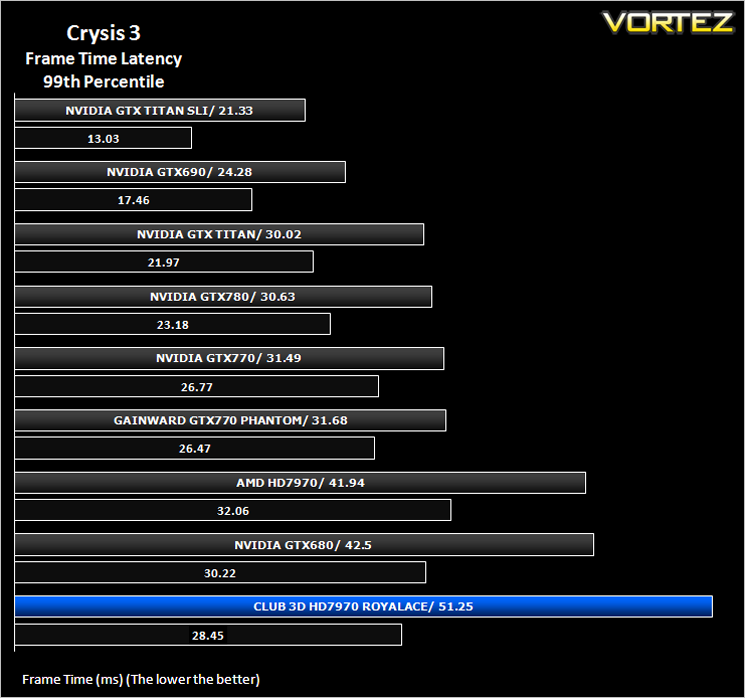
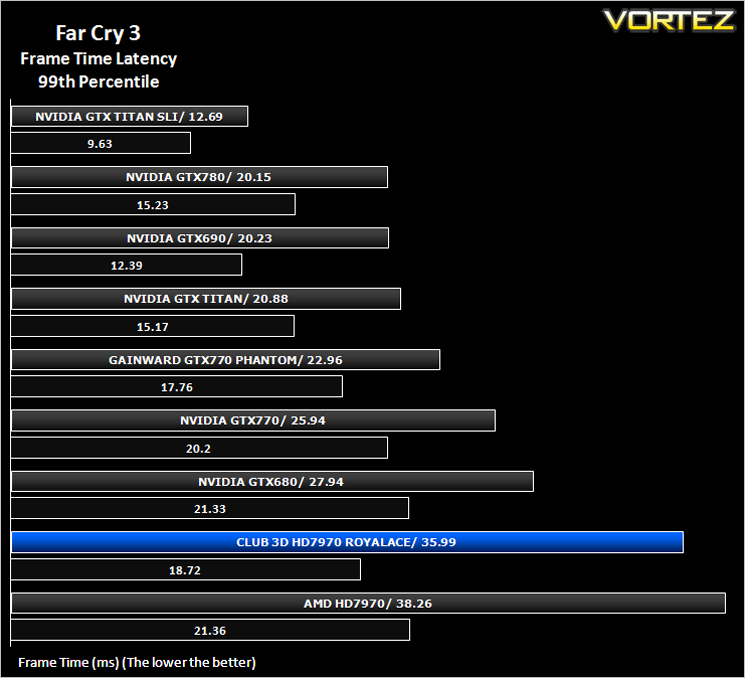
Here we take a look at both average (black) and 99th Percentile (coloured) response times of the graphics cards. It is highly unlikely a user will notice any micro stutter (also incorrectly referred to as lag but the effect can be interpreted to be similar) at anything below 30ms but every gamers perception differs.
Overclocking
For overclocking our ATI cards we will be using Sapphire’s TRIXX tool as this gives us all of the options we require.
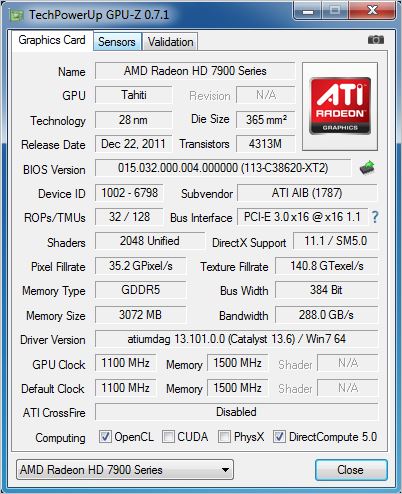
Above is a screenshot of GPU-Z showing the reference speeds and reference boost clocks
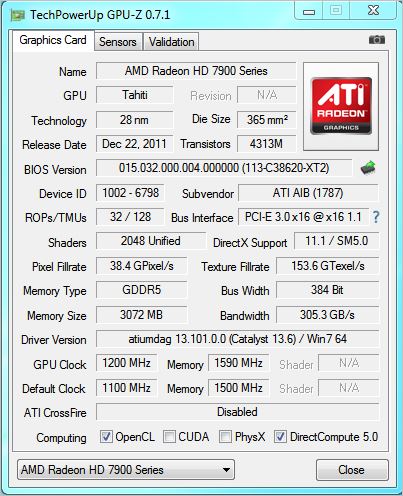
Above is a screenshot of the actual overclock we achieved via TRIXX. With the voltage slider maxxed out we manager a further 100MHz on top of the stock 1100Mhz which isn’t too bad at all. We also managed 90Mhz on the memory resulting in a 6360Mhz GDDR5 effective clockspeed.
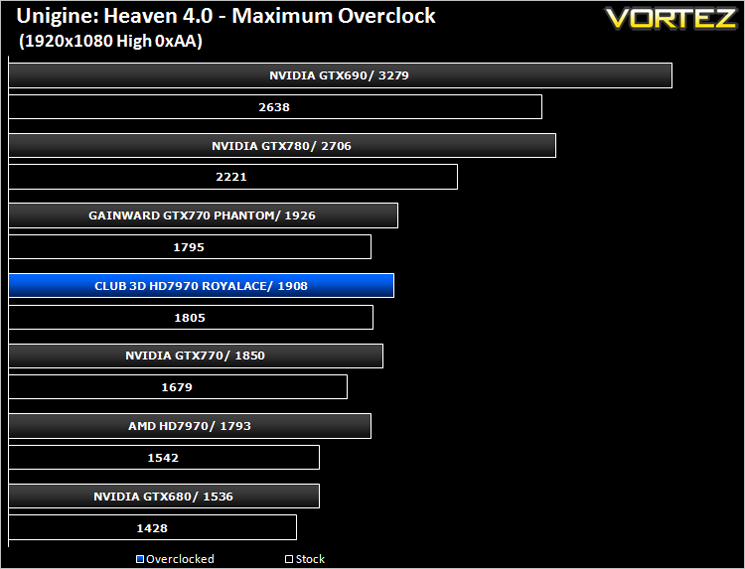
These overclocks gave the card over a 100 points boost in Unigine Heaven 4 which should be enough to see it rise up the league tables on many overclocking enthusiast forums.
Conclusion
The Club 3D royalAce is a damn fine card of that there can be no arguing. It’s main problem though is that the latest cards from NVIDIA have put the HD7970 in the shade. We dearly wanted the royalAce to claw back some lost ground however as our results have shown, the GTX780 and perhaps even the GTX770 which is more or less an overclocked GTX680 in disguise, surpass the royalAce HD7970. Sadly, this put the Club 3D card in a difficult position. Clearly, this is not Club 3D’s fault however with AMD clinging to past glories, NVIDIA have been squireling away and released some new awesome cards, pushing the envelope and raising the bar even higher which unfortunately, even with it’s ‘super overclock’, the royalAce cannot equal. While today’s sample may have had a very slight edge in raw FPS, the GTX770 still had the upper hand when comparing gaming experience.
This isn’t to say the royalAce is a bad card, it isn’t. If you are a fan of the red team then we say go buy it because you won’t be disappointed. As far as HD7970’s go, this is one of the best. It is very fast, powerful and can handle any game out there with relative ease. There are a few caveats to add to this without comparing it to NVIDIA cards.
Firstly, with regard to outright performance, the raw FPS figures are as you would expect very good. There are some problems, perhaps due to the on-going driver issues, with regard to frame time response rates. Crysis 3 and Far Cry 3 show some pretty poor results which means that you may see or at least feel some jerkiness in your gameplay should you opt for this card, especially at higher resolutions with additional filtering applied. While this is true of most graphics cards given the demand these games place on them, the HD7970 seems to perform worse than most. Were this not bad enough, the card is also not the quietest we have had through our doors. The fan noise is bearable but worse is the capacitor squeal which is clearly noticeable and can begin to grate on you after long periods of gaming. IF you have a moderate to loud case fan setup you won’t hear the cards fans and maybe not even the squeal but should we have to rely on other components to drown out the drone of the cards fans or the high pitched whine – we think not.
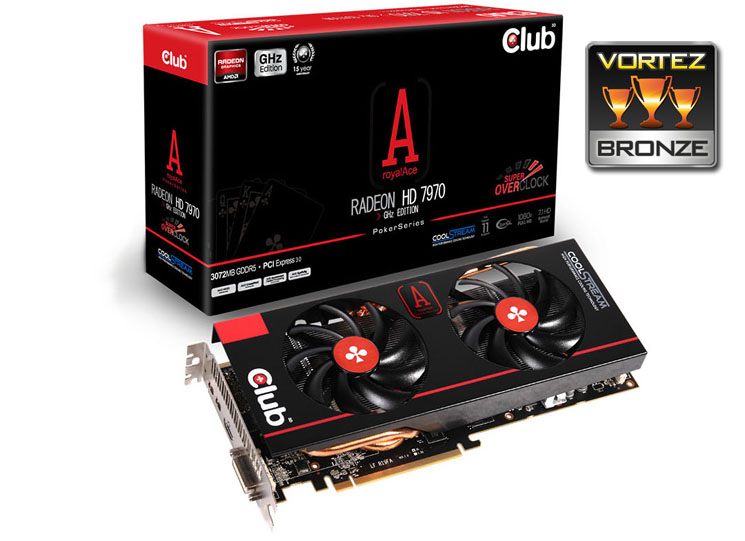
The cost of the royalAce is comparable to other custom cooled HD7970’s available at around the £338 mark however, at this price you are firmly in the same territory as the GTX770 which as our tests confirmed, appears to be the better performing card. So unless you must have an AMD GPU, the GTX770 may be the better buy even if it is re-hashed ‘old tech’. When you consider the HD7970 is now 18 months old, Club 3D have done the best they can with a card that is getting long in the tooth. We therefore look forward to what they can do with the 8000 family of GPUs rumoured to be released in Q4 2013. For now though, the royalAce is the only Ace in the pack if that pack of cards carries the AMD label.
To summarise:
If you are averse to the new cards from NVIDIA then the Club 3D royalAce HD7970 makes for a suitable alternative but if you have no allegiance, we would find it hard to recommend this card over a GTX770/780.
Pros
+ Lightweight
+ Good FPS performance
+ Fair price point
Cons
– Poor Frame Times in demanding games
– Noisy under load
– Warranty Void with Heatsink removal
+ Lightweight
+ Good FPS performance
+ Fair price point
Cons
– Poor Frame Times in demanding games
– Noisy under load
– Warranty Void with Heatsink removal

Click here for an explanation of our awards at Vortez.net.


