NVIDIA’s new mid-range RTX 40 Series GPU is here under the guise of Colourful’s NB EX-V. Aka BAttle Axe. Is it a graphics card worth considering?

Product on Review: RTX 4070 NB EX-V Graphics Card
Manufacturer: Colorful
Street Price: USD $1400
GPU Series MSRP:
US: $599.99
UK: £589.99 (inc. V.A.T.)
AUS: $1090 (inc. Tax)
NVIDIA’s GeForce RTX 40-series has dominated the desktop GPU market since its launch last year, complete with important new technologies and blockbuster performance. The RTX 4070 is their latest release, bringing the acclaimed Ada Lovelace architecture to the true mid-tier in their historically fan-favourite x70 class of cards. Today we’re looking at an edition from Chinese manufacturer Colorful, stalwart of the Asia-Pacific region, and other models from a host of NVIDIA’s partners are also available worldwide to take home at the time of writing.
The current market seems poised to latch on to a true price-performance GPU king should they appear, one that can soothe the ache of an inflation-affected wallet and satisfy the needs of today’s mixed gaming landscape. We’ll get to the former in a bit, but the latter in particular is being partially addressed by the inclusion of 12GB of GDDR6X VRAM as standard on the new RTX 4070. While stories persist of new titles in significant need of optimisation, particularly when leveraging ray traced lighting effects, the previous limitation of 8GB on the 3070/2070 seemed foolhardy even for 1080p/Ultra gaming in 2023 and beyond.
The RTX 40-series also brings with it DLSS 3.0. This much-discussed technology leverages Ada hardware capabilities to insert interpolated frames generated by a deep learning neural network, boosting perceived frame rates and also operating in tandem with the upscaling aspect of DLSS. Its aim is to make computationally expensive (esp. ray-traced) environments more than merely playable at high resolutions and scene complexities, even if it introduces a modicum of latency.
Utilising DLSS 3.0 NVIDIA claims that the RTX 4070 boasts higher fps figures than even the burly RTX 3090, silicon that’s limited to DLSS 2.1. However, the technology still requires implementation at the game engine level and so isn’t available for all titles. It’s for this reason that direct comparisons with the RTX 30-series and other GPUs in marketing material came in for some criticism in the pre-launch window.
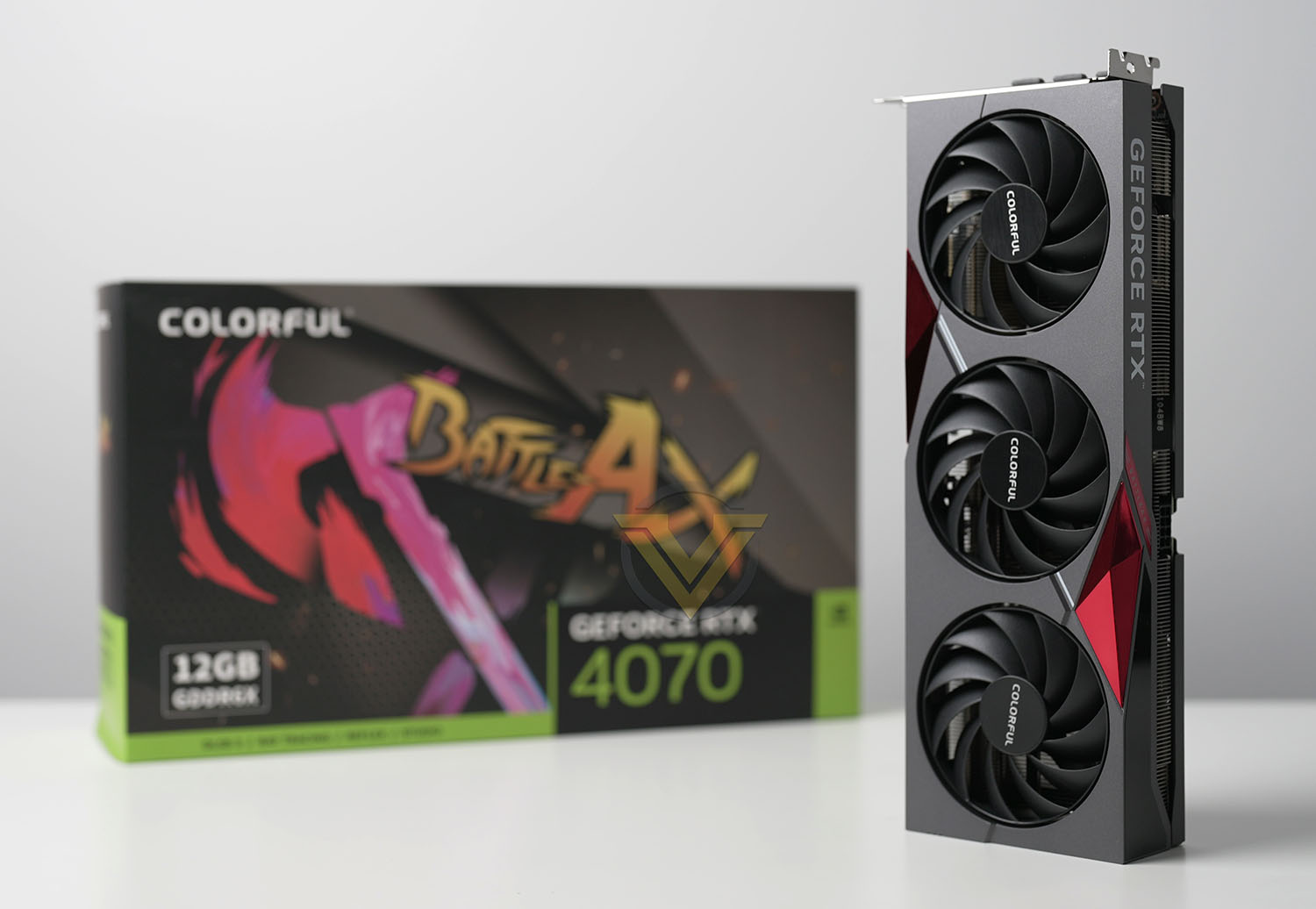
Colorful meanwhile are a manufacturer with some pedigree in the Asia-Pacific region. They enjoy a diverse component lineup including motherboard, GPU, memory and even storage. Consumers looking for conventional air-cooled graphics card designs are catered to by the mainline Colorful lineup, and more premium solutions including AIO water-cooled models are available through their sibling iGame series.
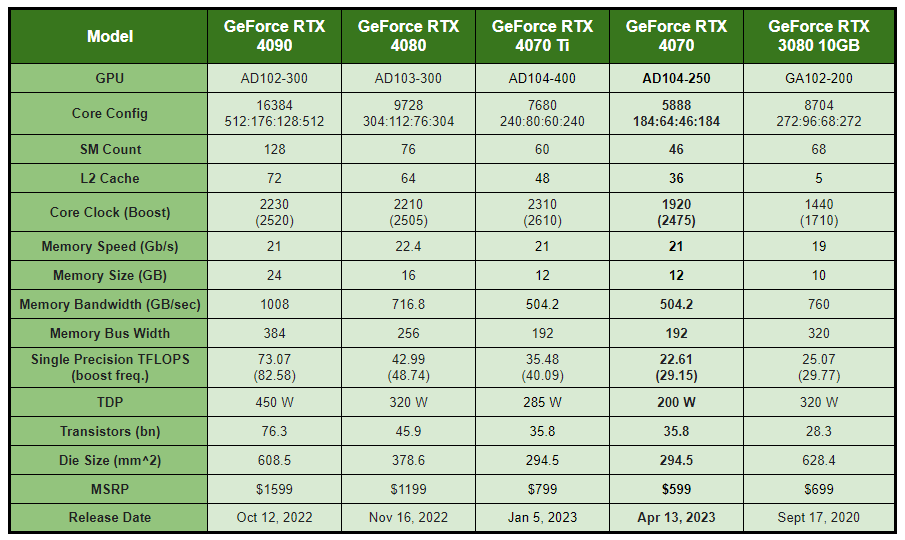
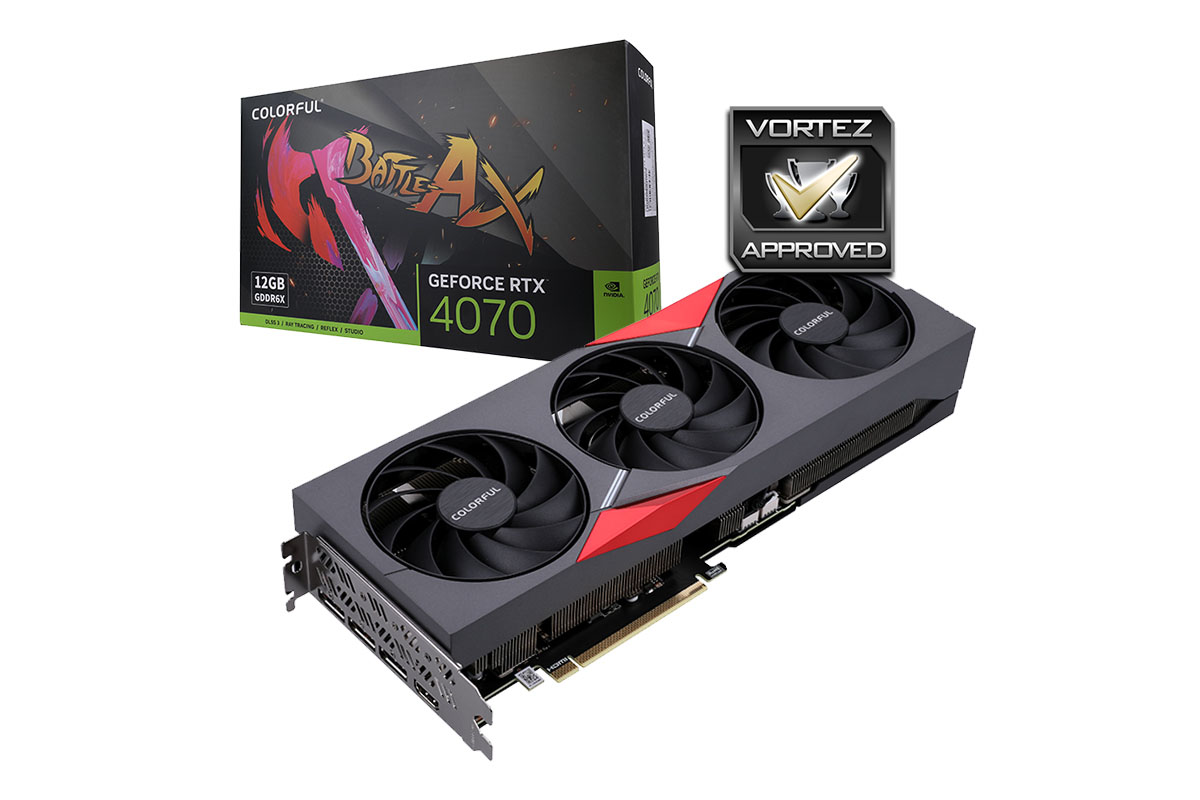
The RTX 4070 NB EX-V boasts specifications exactly in line with references parameters: a 5888 CUDA core based on the Ada Lovelace architecture with a base clock of 1.92GHz, boosting to 2.48GHz, and 12GB of GDDR6X VRAM through a 192-bit memory bus. Where it takes some initiative is the cooling solution; a triple axial fan design pushing air through a >2-slot cooler is more than you might expect for an x70-series card, particularly one at a TDP of only 200W, but such a design may allow it to run more quietly than would otherwise be the case.
In contrast to other members of the RTX 40-series, a TDP of 200W probably won’t mean an immediate PSU upgrade is also necessary. Like-for-like replacement of a x70-series card only pushes the rated TDP up 25W (from 175W on the RTX 2070), although transient loads are likely to be higher. It is notable that the card leverages the new 12+4-pin 12V PCIe Gen 5 connector standard which is only native to the newest PSUs, although Colorful do provide an adapter for the majority of consumers who require it.
By far the most controversial aspect of the RTX 4070’s launch has been its MSRP. For models close to the ‘reference’ specification NVIDIA have laid out a price of $599 in the United States, £589 (inc. V.A.T.) in the UK and $1099 AUD (inc. Tax) in Australia, which is US$100 more than the RTX 3070 and 2070 before it. That’s a bitter pill to swallow at a time when the cost of living is increasing and GPU manufacturers have been complaining of cratering sales in the consumer segment. It’s perhaps unsurprising therefore that pricing has been extremely volatile in the weeks since launch, with many models available significantly below MSRP or bundling in additional value that sweetens the deal to the point of being in line with historic x70-series pricing.
So, with Colorful’s RTX 4070 NB EX-V as a representative example of the series, let’s see how well it compares to both the plethora of options in the market and those already in hands of gamers worldwide.
About Colorful
Established in 1995, Colorful is a brand with a 20+ year history. It is a comprehensive company that holds the largest share in the Chinese graphics card market, integrating independent development, production, and sales. Also, it is a strategic partner of NVIDIA, AMD, and INTEL in China.
Technical Specifications & Features
Below are the technical specifications surrounding the EX-V:
Technical Specifications
Chip Series:- GeForce RTX 4070
Product Series:- Colorful Series
GPU Code Name:- AD104
Manufacturing Process:- TSMC 4N (4nm equivalent)
CUDA Cores:- 5888
Core Clock:
• Base:1920Mhz
• Boost:2475Mhz
Memory Clock :- 21Gbps
Memory Size:- 12GB
Memory Bus Width:- 192bit
Memory Type:- GDDR6X
Memory Bandwidth:- 504GB/s
Power Connector:- 8pin
Power Supply:- 8+2
TDP:- 200W
Display Ports:- 3 x DP+HDMI
Heat Pipe Number/Spec:- 2 x 6mm diameter
Auto Stop Technology :- Y
Recommended PSU:- 650W and above
DirectX:- DirectX 12 Ultimate
NVIDIA Technology Support:
– NVIDIA DLSS 3, NVIDIA G-SYNC, 3rd Gen Ray Tracing Cores
Thickness:- >2 slot
Product Dimensions:- 325*134*53.8mm
Product Weight:- 1.16kg
Product Series:- Colorful Series
GPU Code Name:- AD104
Manufacturing Process:- TSMC 4N (4nm equivalent)
CUDA Cores:- 5888
Core Clock:
• Base:1920Mhz
• Boost:2475Mhz
Memory Clock :- 21Gbps
Memory Size:- 12GB
Memory Bus Width:- 192bit
Memory Type:- GDDR6X
Memory Bandwidth:- 504GB/s
Power Connector:- 8pin
Power Supply:- 8+2
TDP:- 200W
Display Ports:- 3 x DP+HDMI
Heat Pipe Number/Spec:- 2 x 6mm diameter
Auto Stop Technology :- Y
Recommended PSU:- 650W and above
DirectX:- DirectX 12 Ultimate
NVIDIA Technology Support:
– NVIDIA DLSS 3, NVIDIA G-SYNC, 3rd Gen Ray Tracing Cores
Thickness:- >2 slot
Product Dimensions:- 325*134*53.8mm
Product Weight:- 1.16kg
Features
NVIDIA’s Ada Lovelace architecture leverages TSMC’s latest 4N (4nm) lithographic process, allowing greater dense transistor arrangement and greater power efficiency. The ADA-104 at the heart of the RTX 4070 is a slimmed-down version that is used by the RTX 4070 Ti, sporting 56 fewer Shader Modules and thus 30% fewer CUDA cores. That’s a significant gap in performance expectation even before accounting for lower operating frequencies.Partially redeeming the RTX 4070 is the inclusion of 12GB of GDDR6X memory, accessed via a 192-bit bus. This is the same memory architecture as the RTX 4070 Ti, and should help to maintain performance as resolutions and image quality settings creep up. The latest games have started to exceed the 8GB and even 10GB VRAM pools of older mid-to-high tier GPUs, even at relatively benign resolutions, which makes this factor in the card’s design terrifically important for today’s gaming ecosystem.
NVIDIA’s RTX 40-series cards also incorporate their full suite of RTX technologies, most notably DLSS 3.0. The feature, which is currently exclusive to the 40-series, processes frame data from the game engine through a neural network to create an interpolated frame between two fully rendered, a sort of ‘best guess’ of what the frame should look like before the next is rendered. In addition, this DLSS model can also perform the same upscaling process as DLSS 2.0 etc., increasing baseline frame rates by rendering at lower resolutions. The result is significantly higher frame rates than native rendering, with the addition of latency and some degradation in image quality (although NVIDIA will claim that this is nearly indistinguishable to the naked eye).
The RTX 40-series also incorporates NVIDIA’s latest NVENC video encoding engine, now capable of real-time AV1 rendering. This process, which is still awaiting adoption by Twitch.tv but available on other platforms including Youtube, is significantly more efficient than H.264 with no perceptible loss in quality. Once adopted it will allow higher quality streams to be broadcast at similar bit rates, reducing artifacting and offering a better overall experience to the viewer.
Real-time hybrid ray-tracing has been the major feather in the GeForce RTX stable of GPUs but, with the release of the RTX 40-series and further developments in rendering technology, their latest graphics cards are now capable of full ray traced illumination through what they’ve dubbed ‘Overdrive Mode’. Debuting recently as part of a Cyberpunk 2077 update, Overdrive Mode gaming at 60fps might be just out of reach of the RTX 4070 in the RPG, but it’s an exciting advance nonetheless.
Closer Look
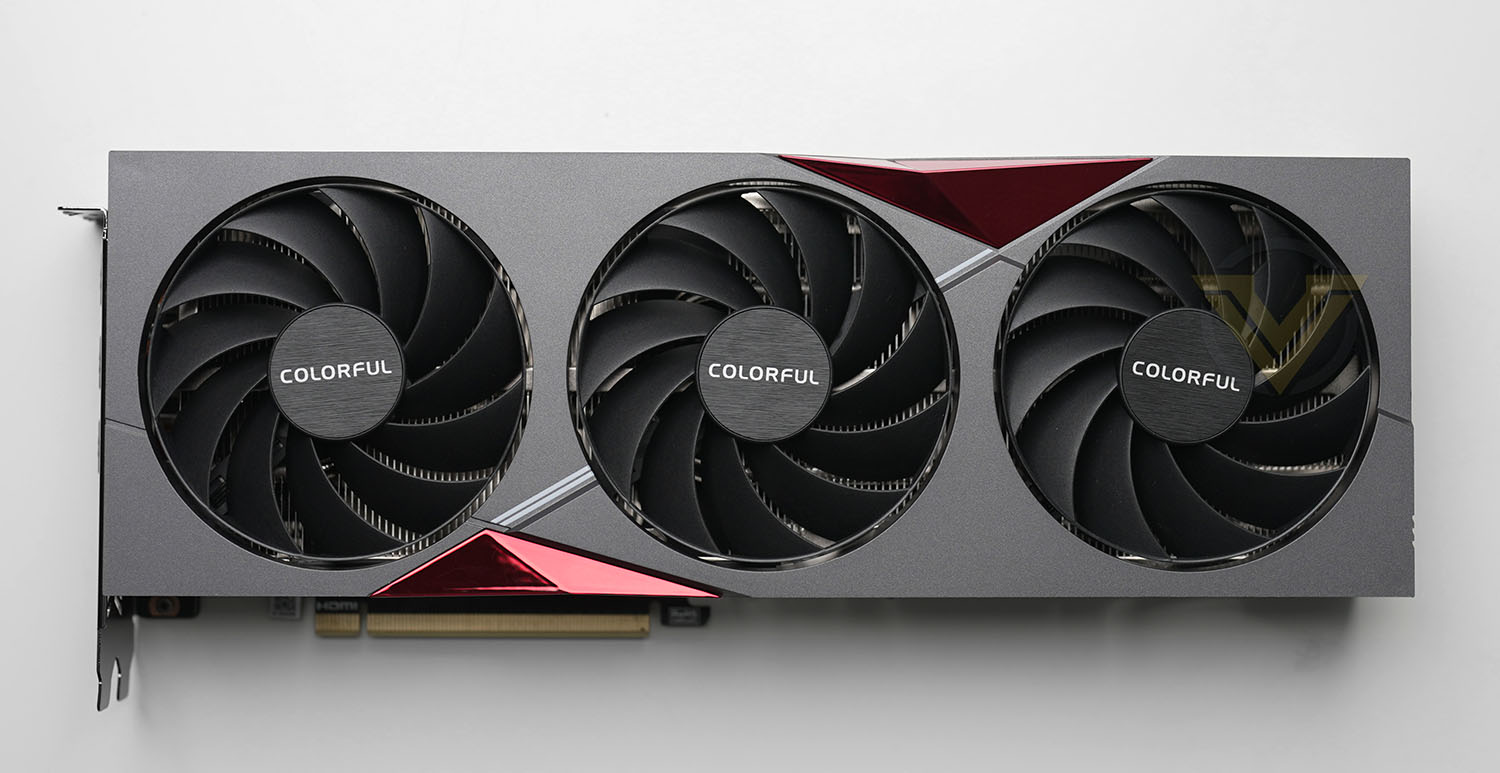
The EX-V is a fairly simple looking graphics card which is by no means over-engineered in its visual aesthetic. It boasts a shroud which combines red and gunmetal grey and should look great as part of any computer set up.
This GPU uses a triple fan configuration. These fans are 90mm and use dual ball bearing. Underneath the fans we have a large dual-heatsink which makes use of 2x 6mm thermal pipes
The overall dimensions for our card are: 325 x 134 x 53.8 mm. So, the EX-V isn’t too large by todays standards and will comfortably fit into most configurations or chassis.
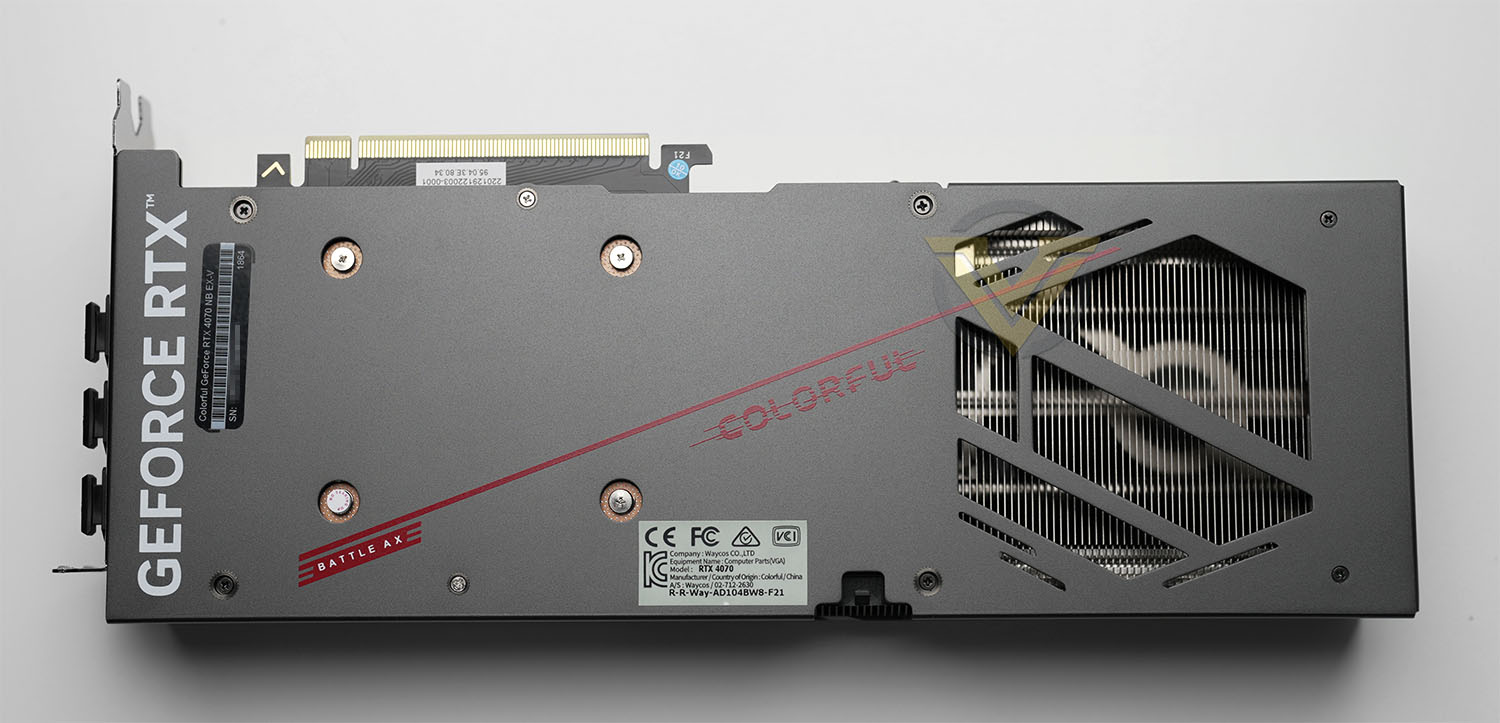
The backside of EX-V features a metal backplate which helps with rigidity and also has a large cut-out which allows airflow to pass through from the cooling fan on the other side.
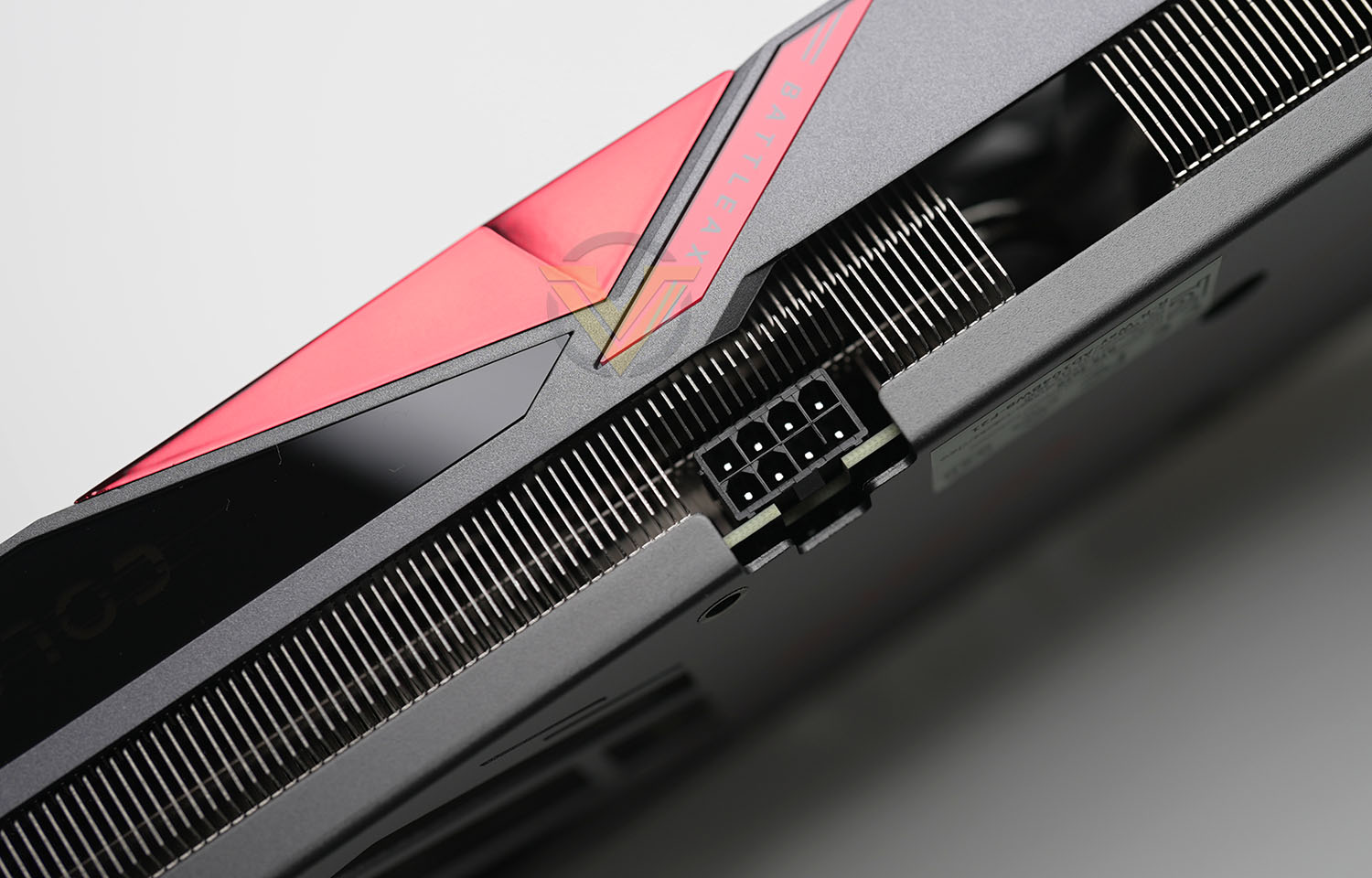
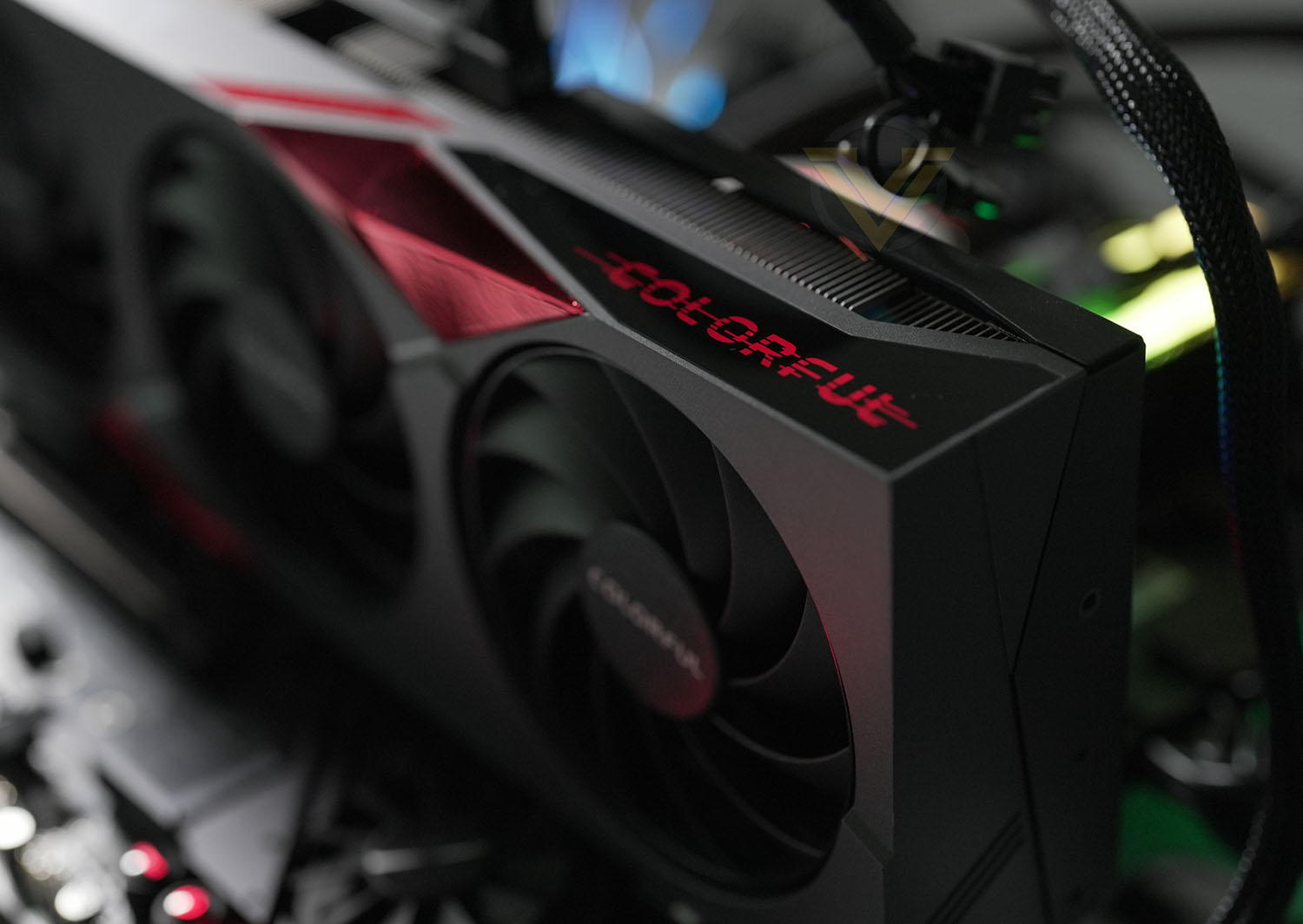
This card features a single 8-pin PCI Express and has a recommended wattage of 650W. On this edge of the card we have the only real aspect which is RGB lit, the lighting has been kept to a minimum on this card which will suit many people. The lighting can be modified using iGame Center software – adjustments to the effect and colour are all available.
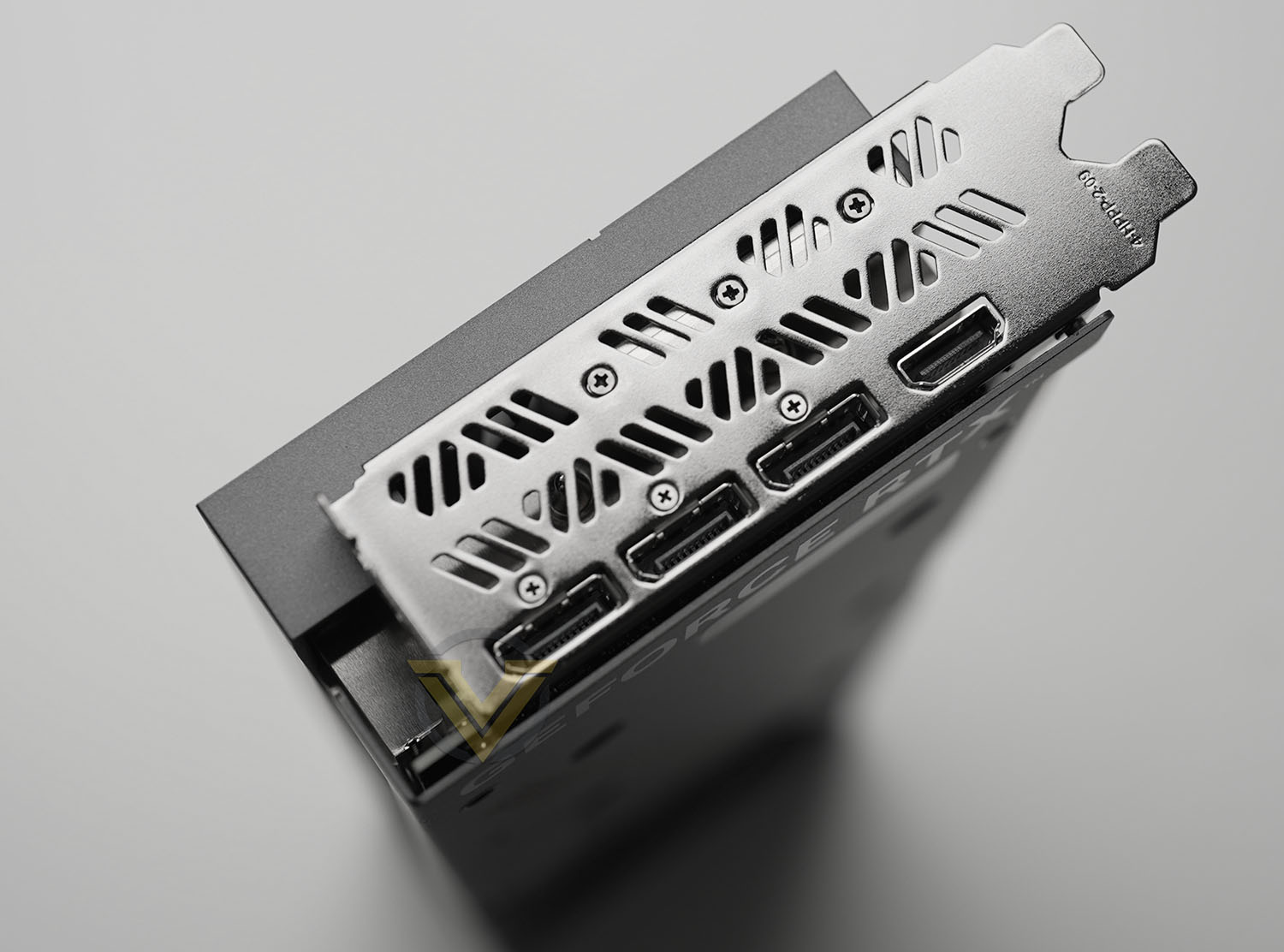
On the rear IO panel there are a total of four video outputs – 3x DisplayPort 1.4 and 1x HDMI 2.1. So if you need additional display support, it will have to come by way of DP.
Out of the box, EX-V does not come with a factory overclock, so the GPU clock boost sits at 2475MHz. Memory sits at the reference settings of 21 Gbps. We would have liked to see the an elevated GPU clock boost, and it’s a shame we don’t have a modification from the reference settings.
Test Setup & Methodology
HOW WE TEST GRAPHICS CARDS
Testing a graphics card is an extremely lengthy process. We sometimes see reviews where a graphics card has been tested using out of date equipment, out of date games and even out of date drivers. While the latter can be excused due to the sheer amount of driver updates making a thorough review impossible we will however notify the reader when we have used a different driver to the normal for example a pre-release driver. For the most part however we will always use the same hardware and latest drivers so this does certainly need to be taken into consideration when viewing our testing results. Each game and benchmark is tested times with the lowest and highest scores omitted out of the 5 results and the average then taken from the three remaining to give us our final result for each resolution and setting used.HARDWARE
In Q3 2020 we decided to move on from our Intel X99-based graphics card test system to embrace AMD Ryzen Gen3. The basis for this was quite simple, AMD’s platform is one of the most popular choices for gamers and by using such a configuration, we can hopefully showcase to our readership what they can expect. In the past we’ve used HEDT platforms and while this does indeed align itself to the bleeding edge for a computer system, it doesn’t reflect what most gamers will be using.With NVIDIA and AMD now using PCIe 4.0 for their bus interface on graphics cards, AMD Ryzen Gen3 and the X570 chipset are well-equipped to test appropriately.
Graphics Cards on test:
AMD RX 5700
AMD RX 5700 XT
AMD RX 6800
XFX MERC 319 RX 6800 XT
Sapphire 7900 XT Nitro+
NVIDIA RTX 2060
NVIDIA RTX 2060 SUPER
NVIDIA RTX 2070 SUPER
NVIDIA RTX 2080 SUPER
NVIDIA RTX 2080 Ti
ZOTAC RTX 3060 Ti Twin Edge OC
GIGABYTE RTX 3070 GAMING OC
Colorful iGame RTX 3070 Advanced OC-V
Colorful iGame RTX 3070 Ti Advanced OC-V
ASUS TUF RTX 3080 OC
AORUS RTX 3080 Master
ASUS ROG STRIX RTX 3090 OC
Inno3D RTX 4070 Ti X3 OC
AORUS RTX 4080 MASTER
ASUS TUF RTX 4090 OC
Special thanks go to AMD, MSI, Corsair, Noctua and AverMedia for providing the hardware configuration for our graphics card reviews:
Motherboard: MSI PRESTIGE X570 CREATION
CPU: AMD Ryzen 7 3800X
RAM – 16GB (2x8GB) Corsair LPX Vengeance DDR4 @ 3000MHz
Power Supply – CORSAIR HX1050
Hard Drive – Samsung 830 EVO 250GB + Crucial MX300 2TB
Cooler – CORSAIR Hydro Series™ H150i Pro 360mm Extreme Performance Liquid CPU Cooler
Capture Card – Avermedia Live Gamer Extreme 2
CPU: AMD Ryzen 7 3800X
RAM – 16GB (2x8GB) Corsair LPX Vengeance DDR4 @ 3000MHz
Power Supply – CORSAIR HX1050
Hard Drive – Samsung 830 EVO 250GB + Crucial MX300 2TB
Cooler – CORSAIR Hydro Series™ H150i Pro 360mm Extreme Performance Liquid CPU Cooler
Capture Card – Avermedia Live Gamer Extreme 2
BENCHMARKS
If you are a regular reader of our reviews you will know we like to test the latest hardware with the latest games and benchmarks on the market. Here are the games we’ve chosen:Horizon Zero Dawn
Control
Shadow of the Tomb Raider
F1 2020
A Total War Saga: Troy
Control
Shadow of the Tomb Raider
F1 2020
A Total War Saga: Troy
To capture framerates we use a combination of in-game benchmark tools and FRAPS.
We also take into consideration the benchmarkers out there so have included three of the more popular synthetic benchmarks available:
3DMark Time Spy
3DMark Port Royal
Unigine: SuperPosition
3DMark Port Royal
Unigine: SuperPosition
In light of the new RTX and DLSS features, we have also added in some tests to cover this tech to provide some analysis, showcasing what users can expect with/without such a feature enabled. For this we are using:
3DMark DLSS
Control – RT Off/RT On
Control – RT Off/RT On
Let’s see how today’s graphics card performed…
Power, Temperatures, Acoustics
To test for power consumption, we take a measurement from the plug socket. It is important to note that the figures below represent total system power use and not just the GPU. The CPU was always in a fixed state so did not affect the additional power load when the GPU was placed under 100% load using AIDA64 stability test (GPU Only) which was ran for 20 minutes at which point a load reading was taken. Idle readings were taken 5 minutes after system boot to ensure any background services and applications had loaded.
TEMPERATURE
To test temperatures we measured idle temperatures after booting windows, letting all applications finish loading and ran a few benchmarks. Once the benchmarks were complete we left the card to reach a cooling plateau where we then took the idle temperatures. For the load tests we set Unigine SuperPosition running in game mode continuously for ~30 minutes and recorded the peak/maximum GPU temperature.ACOUSTICS
For the purpose of testing audio levels we have the NDI KC-3300 sound level meter. During the temperature recording above, while in Unigine SuperPosition gamemode we monitored the audio and the results are found below. All graphics cards are tested in their out of the box state (auto).DX12: 3DMark Time Spy
Download your copy nowWith its pure DirectX 12 engine, which supports new API features like asynchronous compute, explicit multi-adapter, and multi-threading, 3DMark Time Spy is the ideal benchmark for testing the DirectX 12 performance of the latest graphics cards.
DX12: 3DMark Port Royal
Download your copy now3DMark Port Royal is the world’s first dedicated real-time ray tracing benchmark for gamers. You can use Port Royal to test and compare the real-time ray tracing performance of any graphics card that supports Microsoft DirectX Raytracing. As well as benchmarking performance, 3DMark Port Royal provides a realistic and practical example of what to expect from ray tracing in upcoming games.
DX11: Unigine SuperPosition
Superposition is a new-generation benchmark tailored for testing reliability and performance of the latest GPUs. Top-notch visuals, support for VR-devices and an interactive mode with mini-games — the list of features built into Superposition could go on and on.
DX12: Horizon Zero Dawn
Horizon Zero Dawn is an action role-playing game developed by Guerrilla Games and published by Sony Interactive Entertainment. The plot follows Aloy, a hunter in a world overrun by machines, who sets out to uncover her past
DX12: Control
Control Ultimate Edition contains the main game and all previously released Expansions (“The Foundation” and “AWE"
 in one great value package. Winner of over 80 awards, Control is a visually stunning third-person action-adventure that will keep you on the edge of your seat.
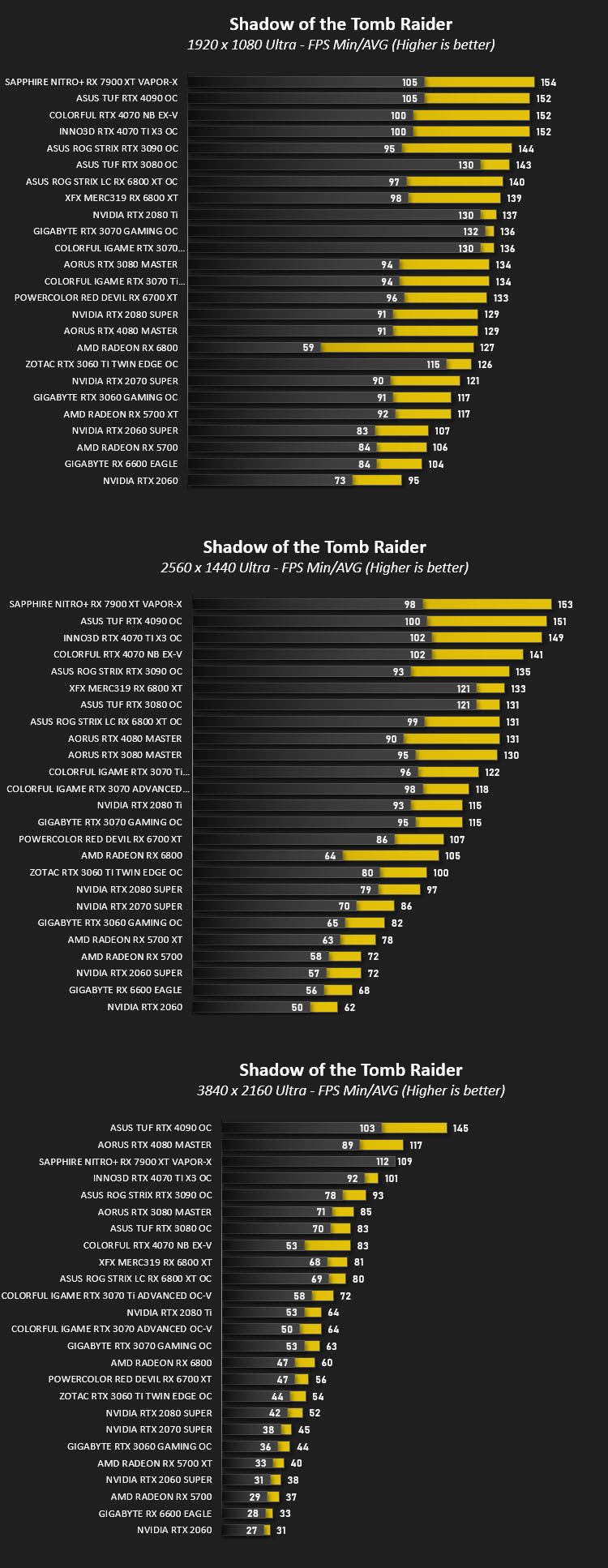
DX12: Shadow of the Tomb Raider
Shadow of the Tomb Raider is an action-adventure video game developed by Eidos Montréal in conjunction with Crystal Dynamics and published by Square Enix. It continues the narrative from the 2013 game Tomb Raider and its sequel Rise of the Tomb Raider, and is the twelfth mainline entry in the Tomb Raider series.
DX12: F1 2020
F1® 2020 allows you to create your F1® team for the very first time and race alongside the official teams and drivers. Alternatively, challenge your friends in new split-screen with casual race options for more relaxed racing. Compete on 22 circuits, with current and classic content.
DX12: A Total War Saga: TROY
A Total War Saga: TROY is the first in the award-winning strategy series to focus on the Bronze-Age Mediterranean and the legendary twenty-year conflict between the kingdoms of Troy and Mycenaean Greece, known as the Trojan War.
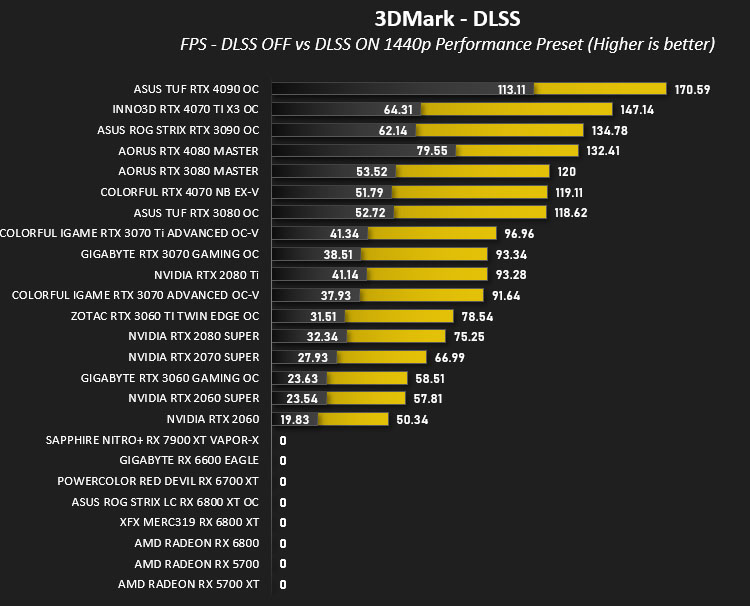
DLSS Analysis: 3DMark DLSS
Deep Learning Super Sampling (DLSS) is an NVIDIA RTX technology that uses the power of deep learning and AI to improve game performance while maintaining visual quality.
Ray Tracing Analysis: Control
Control is an action-adventure video game title which has the ability to take advantage of real-time ray tracing. For this test we ran the game in 1440p with Ultra Detail set. Under the settings we enable Ray Tracingand assign the preset as “High”. Below are the results with RT On and RT Off.
Conclusion
When assessing the quality and value of a graphics card it’s important to cut through the frustration and noise of the market to give an informed and justified opinion, and the market hasn’t been this divisive since cryptocurrency miners were vacuuming up almost every performance GPU under the sun. At least then consumers could point to the miners as having the lion’s share of the blame for high prices; today it’s GPU manufacturers and their partners who face their ire as gamers lament that PC gaming is becoming increasingly unaffordable. Everyone needs a big win that cultivates some level of positivity, but can NVIDIA’s GeForce RTX 4070 be the next GTX 970? In a word: No. But it’s close.
A pithy summation would be as follows: the GeForce RTX 4070 is RTX 3080 10GB performance for 3070Ti money. Moreover, that would be worryingly apt if initial pricing had held firm. Few models would have been available at the $589 MSRP, the vast majority selling for well over $650 instead. Swift price cuts on the back of weak demand at launch saw many partner SKUs selling well below the MSRP, with some retailers also leveraging cashback and voucher deals to get the card out of the door. There was a certain whiff of desperation about the whole debacle, an odour that barely dissipated in the intervening weeks.
Those hoping for the sort of generational leap from 30-series to 40-series as exhibited from 20-30 will be disappointed. Whereas the RTX 3070 ate the 2080Ti for breakfast in many scenarios, the RTX 4070 is merely nip and tuck with the 3080 10GB a full 30 months after the latter’s release. The two can barely be separated in synthetic tests, while in-game the new card is surpassed by its antecedent chiefly when resolutions push past 1440p.
Results underscore the reality that, despite boasting 12GB of GDDR6X VRAM, it’s still primarily a 1440p class of card. With the exception of games equipped to support DLSS 3.0 it’s simply not 4K gaming hardware, but will satisfy the majority who play at 1080p/1440p with high (>60) GSYNC’d frame rates.
We should also raise the huge performance disparity between the RTX 4070 and its Ti counterpart that’s inferred by the large step down in SM count. Where we might have expected a half-tier differential, the RTX 4070 Ti is in many instances performing far closer to the RTX 4080 than its junior sibling. This poses a problem for ‘premium’ RTX 4070’s that encroach on the MSRP of the 4070Ti, and further explains the downward price pressure on the more affordable card.
Power efficiency is really where the new architecture and manufacturing process node bears fruit. This card is considerably less thirsty than the RTX 3080 under typical gaming loads, reducing average consumption by as much as a third. If you’re a fan of long gaming sessions, and live in one of the many nations with historically high energy prices, then it’s absolutely an aspect of the card you should factor into your purchasing decisions.
This particular example, the Colorful RTX 4070 NB EX-V, is a solid if unremarkable entrant in the range. It benefits significantly from the oversized triple-fan cooler for both idle and load temperatures – even if it is a little more difficult to accommodate inside standard chassis than many of its peers would be – but its aesthetics are close to a ‘no frills’ experience. Ironically it’s anything but colourful – you get some red highlighting and an illuminated logo, but that’s about it. Terrific if you have a relatively restrained red/black system colour-scheme or little interest in how the card looks, but perhaps disappointing for those who expect more bling for their money.
It’s clear who should be eyeing up the RTX 4070 as a potential upgrade. The RTX 3070 and 3080 are too close to the new card, but any GPU in the 20-series and older would see a meaningful improvement in gaming experience by transitioning to this new GPU. Similarly, those with AMD GPUs from the RX 5000-series would benefit greatly, while the 6000-series have held up well enough. Indeed, price-dropped RX 6950 cards in certain regions might pose something of a problem for the RTX 4070 if the user predominantly plays only very lightly ray-traced games.
The continued development of DLSS as an AI-upscaling technology swings the pendulum back towards NVIDIA. DLSS 3.0 is a powerful tool for gaming outside of the cutting-edge competitive scene (where the additional latency is too bitter of a pill to swallow) that will serve to paper over the cracks of poor developer optimisation or gaming at resolutions that are beyond the conventional capabilities of the GPU. If VRAM requirements continue to increase at even 1080p among the next generation of games then upscaling technologies within the mid-tier will become ever-more important in the next few years.
Other technologies that leverage the unique architectural capabilities of NVIDIA’s hardware, such as real-time AV1 encoding or AI-enhanced in-browser video upscaling, are more niche but potentially even more important for those who fit within that niche. It’s frustrating that some of these technologies are being restricted to premium GPUs, where they would make the largest impact in the ‘affordable’ mainstream.
NVIDIA’s GeForce RTX 4070 is a compromise design that could have been compromised by a heavy-handed MSRP. Performance is on-par with the RTX 3080 10GB, while power efficiency enjoys a strong generational improvement. Prime targets will be those upgrading from the RTX 20-series and AMD’s RX 5000-series or older, and deals pushing the series below its $589 / £589 / AUS$1090 make it much more compelling that it would be otherwise. Colorful’s RTX 4070 NB EX-V is a fine member of the series if it can be found near to the series MSRP thanks to a well-specced cooling solution, but limited availability outside of Asia-Pacific makes it more indicative of the series overall rather than a card to aspire to.
Pros
+ Attractive design
+ Minimal LED lighting
+ Excellent cooling performance
+ Low-noise operation
+ Zero decibel technology
Cons
– Pricey for a 1440p card
+ Attractive design
+ Minimal LED lighting
+ Excellent cooling performance
+ Low-noise operation
+ Zero decibel technology
Cons
– Pricey for a 1440p card
Click here for an explanation of our awards at Vortez.net.
Stay connected with the Vortez Social Media pages:
Join in with the discussions on Discord