




Cooler Master is introducing a new kind of bearing to the world of computer fans: their “Fourth Generation”. Today we will explore two new POM bearing fans.

Product on Review: Jetflo 120 PWM Fan
Manufacturer and Sponsor: Cooler Master
Street Prices: £9.99-11.99 UK, $14.99-16.99 US
Cooler Master is introducing a new kind of bearing to the world of computer fans: their “Fourth Generation” bearing, made of POM — polyoxymethylene. This bearing promises smooth running and long life at a low price. Cooler Master began their innovation by replacing the bearing of an old standby, the Sickle Flow fan, and calling it the Sickle Flow X. With this first of the POM bearings introduced, Cooler Master did not change anything else about the fan. Having taken this step, Cooler Master then produced the Jetflo, an entirely new fan. This fan comes with several innovations that Cooler Master advertises, and two very important features they say little about!
Today we will explore both fans, taking them apart and looking at those bearings. We will also examine the performance of both fans.
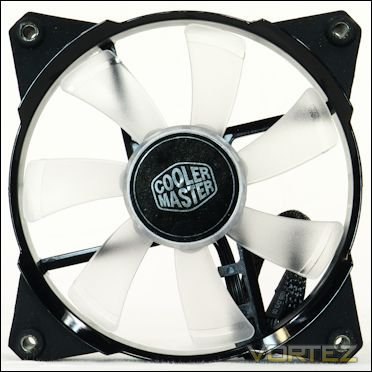
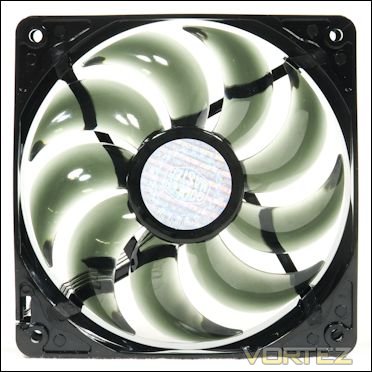
Cooler Master has been with us more than 20 years, selling heatsinks, fans, cases and accessories. They have explored many possibilities over the years, including these fans. The Sickle Flow X is a prototype fan. You can find specimens on sale in varying packages at various places here and there. The Jetflo is a full-fledged product in production and marketed for sale all around the world. Cooler Master says this about their Jetflo fan:
JetFlo 120 was created to be a single, no compromise solution to cooling computer systems. Designers and engineers focused on “Performance”, “Style”, and “Silence” as core principles that should be tuned and brought to the forefront of the JetFlo 120 experience.
(From the Cooler Master Jetflo product page.)
Jetflo Features and Technical Specifications
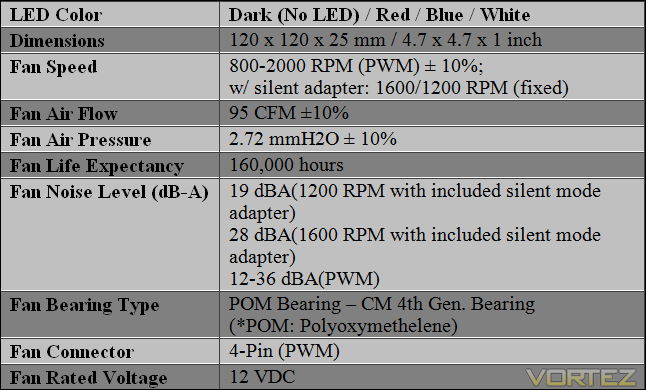
From the Cooler Master Jetflo product page:Jetflo Features
• Rubber pads with steel threads to absorb vibrations and noise
• 95 CFM from advanced blade design that produces excellent performance
• Silent and long life POM bearing (*POM: Polyoxymethelene)
• Includes two silent mode adapters to fix the fan speed at 1600 RPM (28 dBA) or 1200 RPM (19 dBA)
• Smart Fan Engine:
• High efficiency motor
• Low starting voltage
• Fan-jam protection
• Auto-resume after blade obstructions are cleared
• Dust & water resistant
• Polarity proof
• Red, Blue, or White smooth LED lights provide freedom of choice to users
• 95 CFM from advanced blade design that produces excellent performance
• Silent and long life POM bearing (*POM: Polyoxymethelene)
• Includes two silent mode adapters to fix the fan speed at 1600 RPM (28 dBA) or 1200 RPM (19 dBA)
• Smart Fan Engine:
• High efficiency motor
• Low starting voltage
• Fan-jam protection
• Auto-resume after blade obstructions are cleared
• Dust & water resistant
• Polarity proof
• Red, Blue, or White smooth LED lights provide freedom of choice to users
Jetflo Specifications
Sickle Flow Features and Technical Specifications
From Cooler Master’s Product Page on the Sickle Flow, Cooler Master says this about their Sickle Flow fans:R4 series fans offer a unity of maximum rotational speed and optimum airflow. Using a unique long-life sleeve bearing fan, the R4 series offers long life rating of 50,000 hours. R4 series fans perform at a maximum of 69CFM at 2000RPM. These R4 series are available in red, green, blue LED and dark smoke (no LED).
• Up to 69CFM (maximum RPM)
• 19 dB-A silent application for CPU cooling.
• RoHS compliance for protecting the environment
• Recommended for V10, V8, Hyper 212, Hyper Z600, Gemini, Cosmos, Cosmos S, HAF 932, HAF 922, CM Storm Scout and Sniper.
• 50,000 long life hours.
• Up to 69CFM (maximum RPM)
• 19 dB-A silent application for CPU cooling.
• RoHS compliance for protecting the environment
• Recommended for V10, V8, Hyper 212, Hyper Z600, Gemini, Cosmos, Cosmos S, HAF 932, HAF 922, CM Storm Scout and Sniper.
• 50,000 long life hours.
But we are looking at an evolution of Sickle Flow fans — they are Sickle Flow X. They have a POM bearing, which has a 160,000-hour life. The specs remain the same:
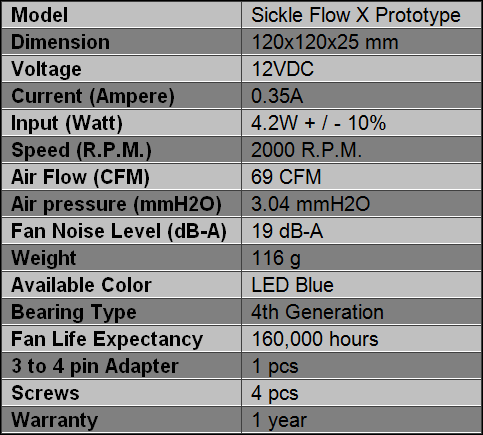
The Sickle Flow X fans arrived with the same accessories noted above: a standard Molex-to-fan adapter and a bag of screws.
Last year when we tested fans on a heatsink, the Sickle Flow did fairly well. One thing that was not emphasized then: these fans purr. They make a pleasant sound.
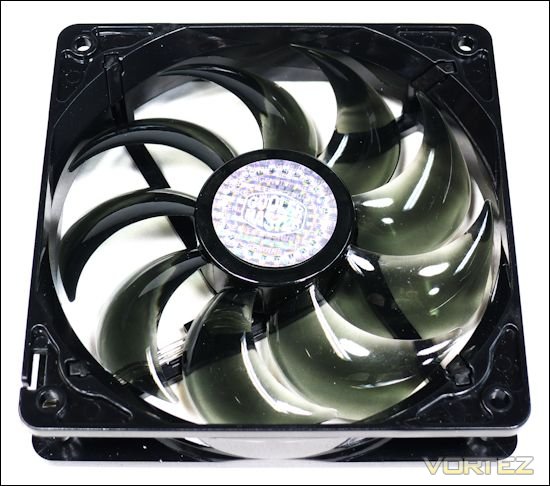
Packaging and Bundled Accessories
The prototype Sickle Flow X arrived in standard boxes showing the product to be found inside along with specs and marketing.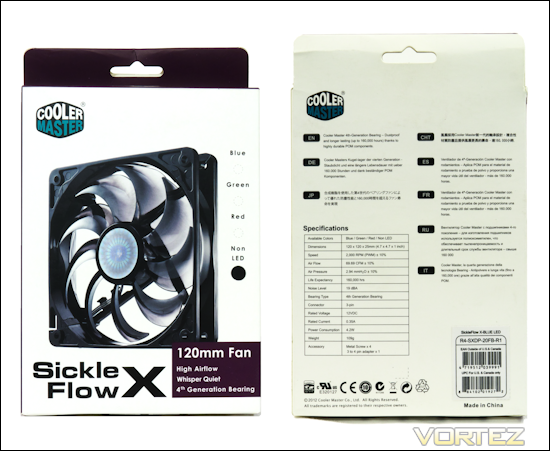
The Cooler Master Jetflo arrived in dark boxes that were otherwise similar.
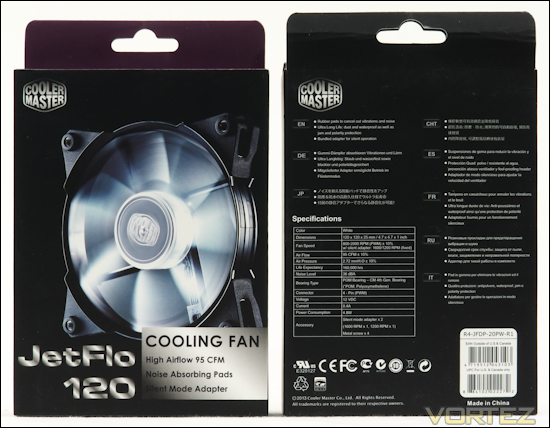
But these boxes opened out to give a peekaboo preview of the fan, and to provide the prospective purchaser with highlights of the fan’s features.
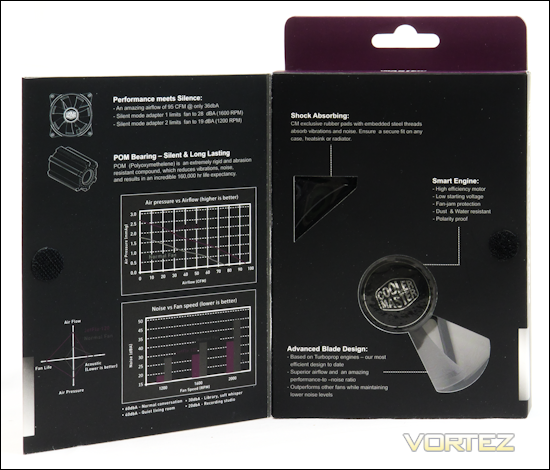
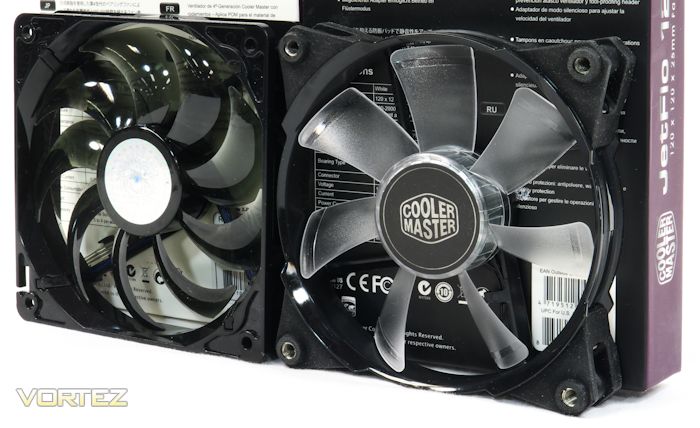
Cooler Master provides the Sickle Flow X with standard fan screws and an adapter that allows the fan to be powered by a four-pin “Molex” connector. The Jetflo, however, comes with more interesting accessories – two fully-labeled low-speed adapters and four machine screws. Note that the adapters do not carry PWM wires, though they are sized for PWM plugs. Jetflos are PWM fans, after all.
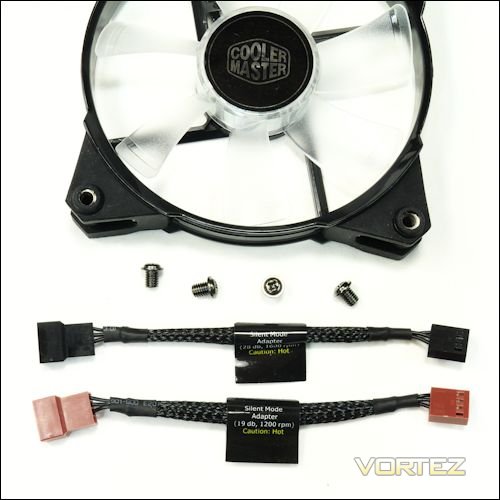
A close look at the new 4th Generation bearings
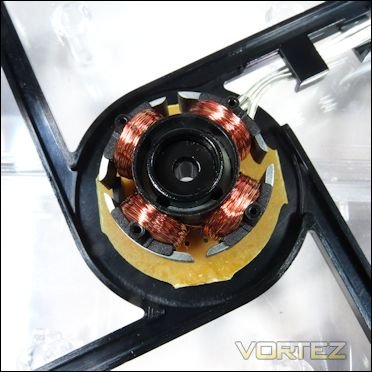
Cooler Master provided extra fans specifically to be torn apart so their bearings could be inspected. Your intrepid editor did exactly that. Below is a pair of pictures that show a copper sleeve bearing from a standard Sickle Flow on the left, and the POM bearing from a Sickle Flow X on the right.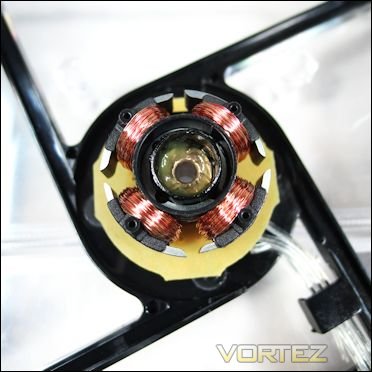
The Jetflo bearing is more sophisticated. In this picture, adapted from a drawing by Cooler Master, the orange is the POM part.
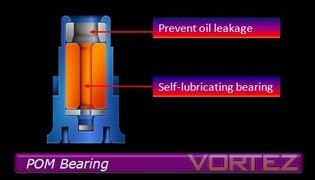
Nice drawing. As built, the black POM cylinder is hidden in a brass shell. The parts are press-fitted, and the whole bearing assembly is made of bits that are unaffected by water and dust.
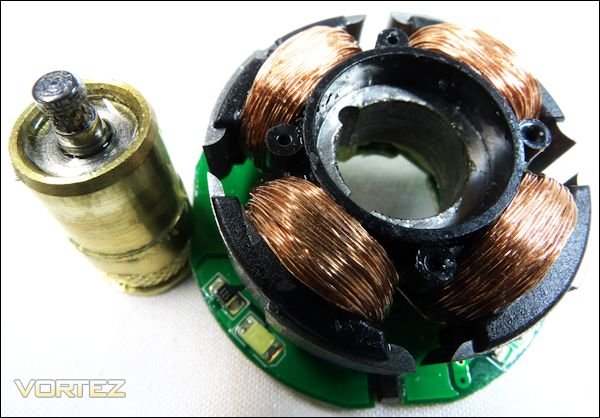
Jetflo POM bearing next to its motor
Jetflo Close Up
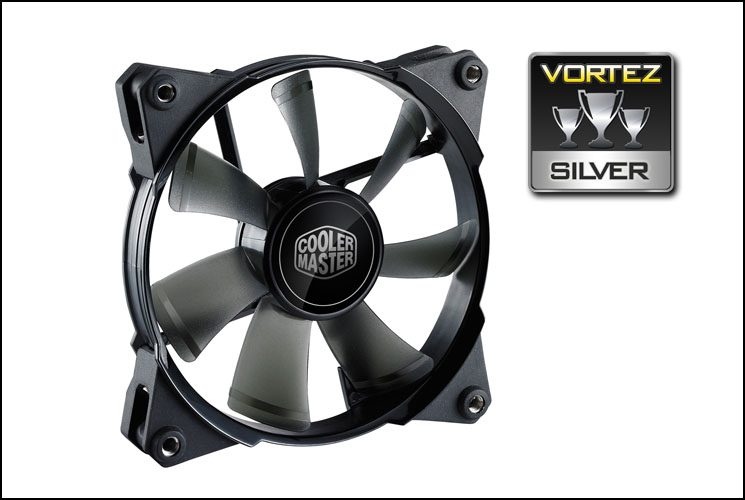
The Cooler Master Jetflo has several features that bear a close look. The exhaust face of the fan reveals the shape of the fan blades, and their color-free translucence. Working outward, the frame is flared at the corners, but cut away on the sides where it might come in contact with another surface. Clearly, care was taken to avoid vibration being conducted from the fan to whatever it might touch.The corners of the fan are rubber, with holes that go straight through. The exhaust sides of the corners are contoured to hold the fan free of any surface it is attached to.
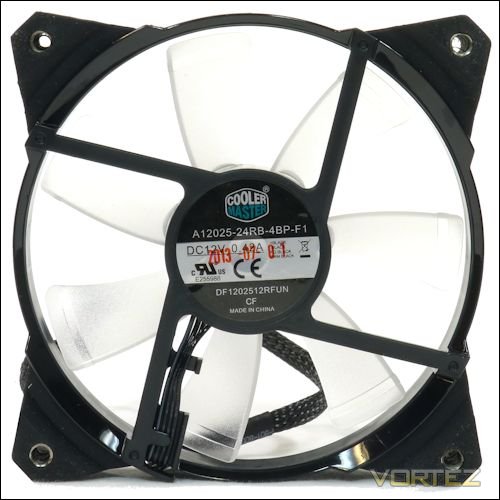
Jetflos screw holes allow attachment to a radiator. On the intake side, rather than contouring the shape of the corners, the screw holes begin on a nub elevated enough to keep the Jetflo clear of touching on the intake side.
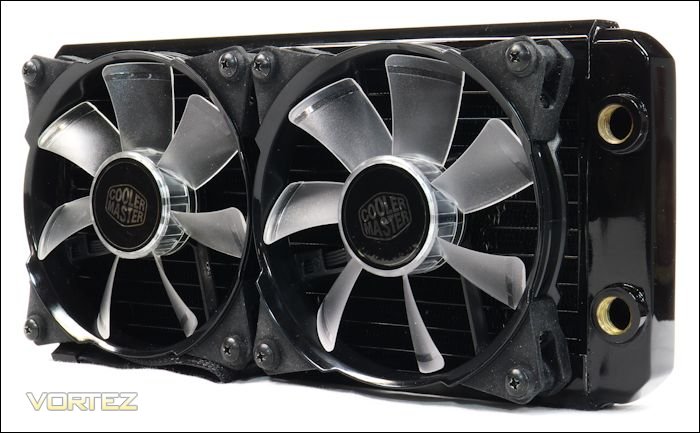
Jetflos attached to rad with M4 machine screws
Testing Setup
Cooler Master provided seven Jetflos – one for tearing apart and six for testing. They sent five Sickle Flow X fans, one of which was destroyed to examine its POM bearing. CM also sent along a standard Sickle Flow to have its bearing exposed. The results presented here are the averages of four Sickle Flow X fans and six Jetflos.The fans were tested first in free air, with their RPM noted and their noise measured from 10cm with a Tenma 72-942, which can measure SPL accurately down to 30 dB(A). The SPL was adjusted for distance to the equivalent of 1 meter.
Each fan blew into a sealed box. The box captured all of each fan’s output, no matter how broadly spread. Blowing into the sealed box allowed the air to mix, so the dead spot caused by the hub was gone. Because what goes in must come out, the entire output of each fan exited through a circular opening which had a diameter of 115mm, the area swept by a fan with a 120mm frame.
The output of each fan was measured in cubic feet per minute. Yes, this is not metric but CFM is an industry standard allowing comparisons between fans and fan types. An Extech AN100 anemometer kept track of the output of each fan by averaging ten measurements. Each fan type was then averaged – four Sickle Flow X’s, six Jetflos, and at least two each of the comparison fans.
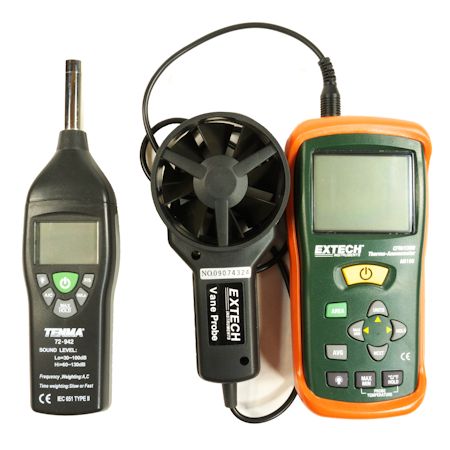
Each Jetflo fan was tested at 12 Volts, with its two adapters, at 7 Volts and at 5 Volts. The Voltages were chosen because they could be supplied to the fans without using a fan controller. Various fan controllers can introduce noise into a running fan, so to remove that possibility the three fixed Voltages were used. Unfortunately, providing 7 Volts to a fan means that speed cannot be obtained from the motherboard, so RPM data was not known. However, each Jetflow invariably ran faster at 7 Volts than it did with its 1200 RPM adapter.
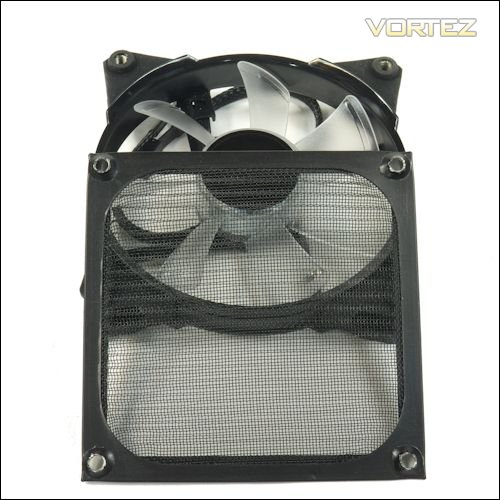
The Jetflos, the Sickle Flows and the Sickle Flow X’s were tested without obstructions, with a dust filter, and mounted on a radiator. The rad was a Black Ice GT Stealth 240, with 30 fins per inch – a challenge for any fan.
The comparison fans were mostly the San Ace “Silent” series. They were chosen because they are designed to produce a relatively high static pressure, important in a fan used on a rad. The San Aces are expensive, high end industrial fans, guaranteed to beat their specifications no matter how much variance occurred in the manufacture. Four pairs of these fans, spanning a nominal range from 1500 to 2700 RPM, provided a mighty challenge for the Jetflo. A pair of Silverstone Air Penetrators was used to cover the low end of the spectrum for relatively high static pressure fans.
Results of Testing
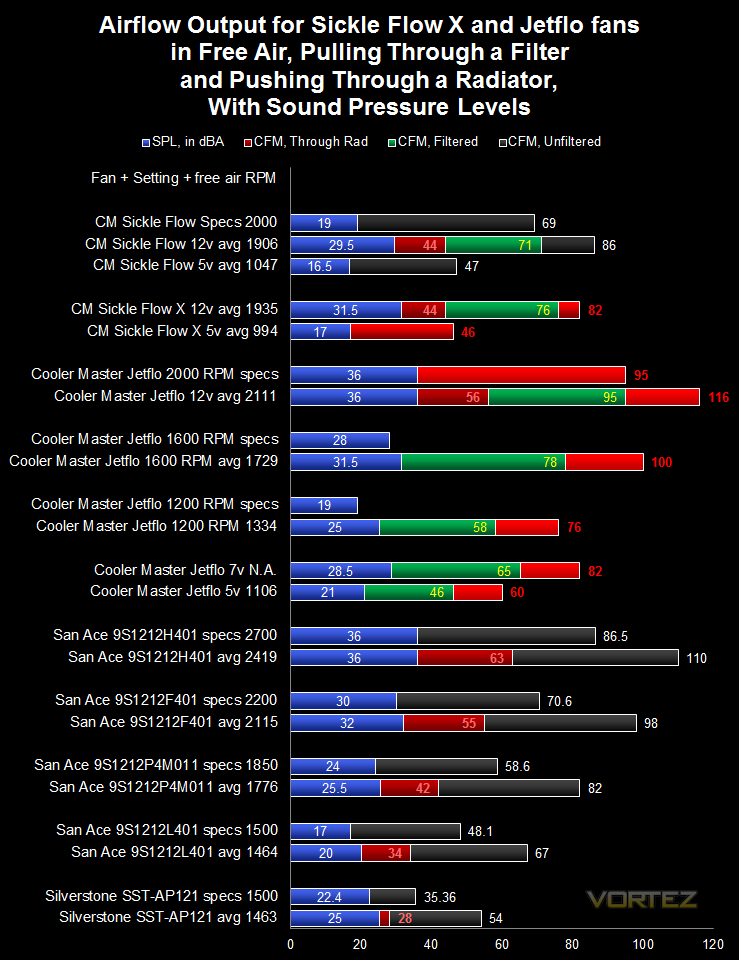
The table below presents the results of testing Sickle Flow, Sickle Flow X and Jetflo fans, along with comparators. To the left of the central line, each row presents the manufacturer, the model name and other information such as nominal fan speed. The final number is the average of the speeds of that model fan in free air, in RPM.On the graph side, the bars in blue represent the average of the sound pressure levels in dBA. The portions of the bar in dark red show the output pushed through the radiator. The portions in green show how much air each model fan pulled through the filter. And the longest part of the bars – bright red in tested fans, black in comparators – shows the amount of unobstructed airflow.
Overall, while fans tested previously met their specifications, the fans shown here all exceeded them. In fact, the Cooler Master fans met their unimpeded specs while working behind the filter.
One important aspect you will not see in graphs: the Jetflo PWM circuits are silent.
That’s right: there is no PWM clicking in these Cooler Master fans.
The rubber corners of the Jetflo fans were tested in a primitive fashion. The fan was held to a metal surface, first with the corner contacting the metal, then the frame. The frame-to-metal contact was significantly louder. Clearly, the rubber corner was doing its job.
Conclusion
All said, the Cooler Master fans did well today. The Cooler Master Jetflo and Sickle Flow X outdid their specifications. The Jetflos matched their free-air specifications when pulling behind a filter. The Sickle Flow X exceeded their free-air specs behind a filter. There are plenty of fans out there that only just match their specs in this very same testing system, but the Cooler Master fans are better than that. Compared with the best fans one could throw at them, they did well.
Conclusion — Jetflo
One unexpected benefit of these fans is the silence of their circuitry. One could expect the non-PWM Sickle Flow X to be silent, given its heritage and its construction. But the Jetflo is a PWM fan. Traditionally PWM fans click, a little or a lot. The Jetflos clicked not at all. Let us hope Cooler Master will put these silent circuits in all their PWM fans.
The sound pressure level when the noise-reducing adapters were applied was above Cooler Master specifications. This could be because the fans were going faster than specified. Given that users are looking for quiet when they apply these adapters, perhaps increasing the resistors slightly would bring down the fan speed, and hence bring down the noise. But still, these are not noisy fans.
Further reducing the noise of these fans are the cutaway frames and the rubber corners. Cooler Master doesn’t make much noise about these features, but they really do work as designed — they reduce vibration and vibration noise.
Pros (Jetflo)
+ POM bearings
+ PWM speed control
+ Silent PWM circuitry – no clicking
+ Output exceeds specifications
+ Noise level meets specification at full speed
+ Strong airflow through filters
+ Strong airflow through a restrictive radiator
+ Rubber corners greatly reduce vibration
Cons
– Noisier than specs with reduced-speed adapters.
+ POM bearings
+ PWM speed control
+ Silent PWM circuitry – no clicking
+ Output exceeds specifications
+ Noise level meets specification at full speed
+ Strong airflow through filters
+ Strong airflow through a restrictive radiator
+ Rubber corners greatly reduce vibration
Cons
– Noisier than specs with reduced-speed adapters.
Conclusion – Sickle Flow X
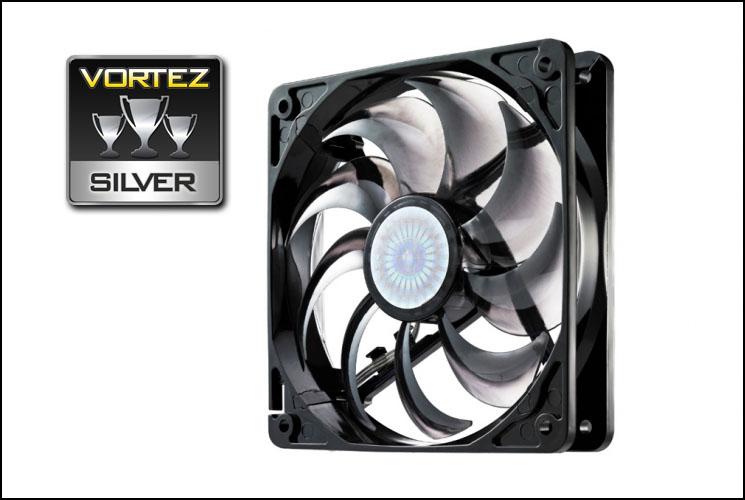
The Sickle Flow X fans are prototypes. This seems surprising, since they came in retail boxes printed especially for them. The Sickle Flow blade shape has a gentle slope, a moderately broad chord and a highly swept leading edge. Given these features, one would expect the Sickle Flow to produce a fairly good static pressure fairly quietly, making it a good fan for radiators as well as heatsinks and cases. It does that, and has sold well for years – one of the Sickle Flows in this test dates from mid-2008!
Occasionally users complain about the Sickle Flow’s sleeve bearing. It is sealed, but it is still a sleeve. This is where the Sickle Flow X represents a significant improvement. The POM bearing is rated for 160,000 hours – more than 18 years. While there are no definite plans to release this gem, we can hope that Cooler Master will decide to put the Sickle Flow X on the market. As with all Sickle Flows, they purr, and they sound quieter than their measured SPL.
Pros (Sickle Flow X)
+ Smooth sound
+ POM bearings
+ Exceed output specifications
+ Strong airflow through filters
+ Strong airflow through even a restrictive radiator
+ The cost will be only moderate if brought to market
Cons
– Still a prototype
+ Smooth sound
+ POM bearings
+ Exceed output specifications
+ Strong airflow through filters
+ Strong airflow through even a restrictive radiator
+ The cost will be only moderate if brought to market
Cons
– Still a prototype

Click here for an explanation of our awards at Vortez.net.


