This review looks at the Corsair ML Pro Series of magnetically levitated fans, in 120mm and 140mm sizes, with and without LED lighting.

Product on Review: Corsair ML Pro PWM Fans
Manufacturer and Sponsor: Corsair
Street Price:
ML120 Pro non-LED £19.99
ML120 Pro LED £19.99
ML140 Pro non-LED £19.99
ML140 Pro LED £21.98
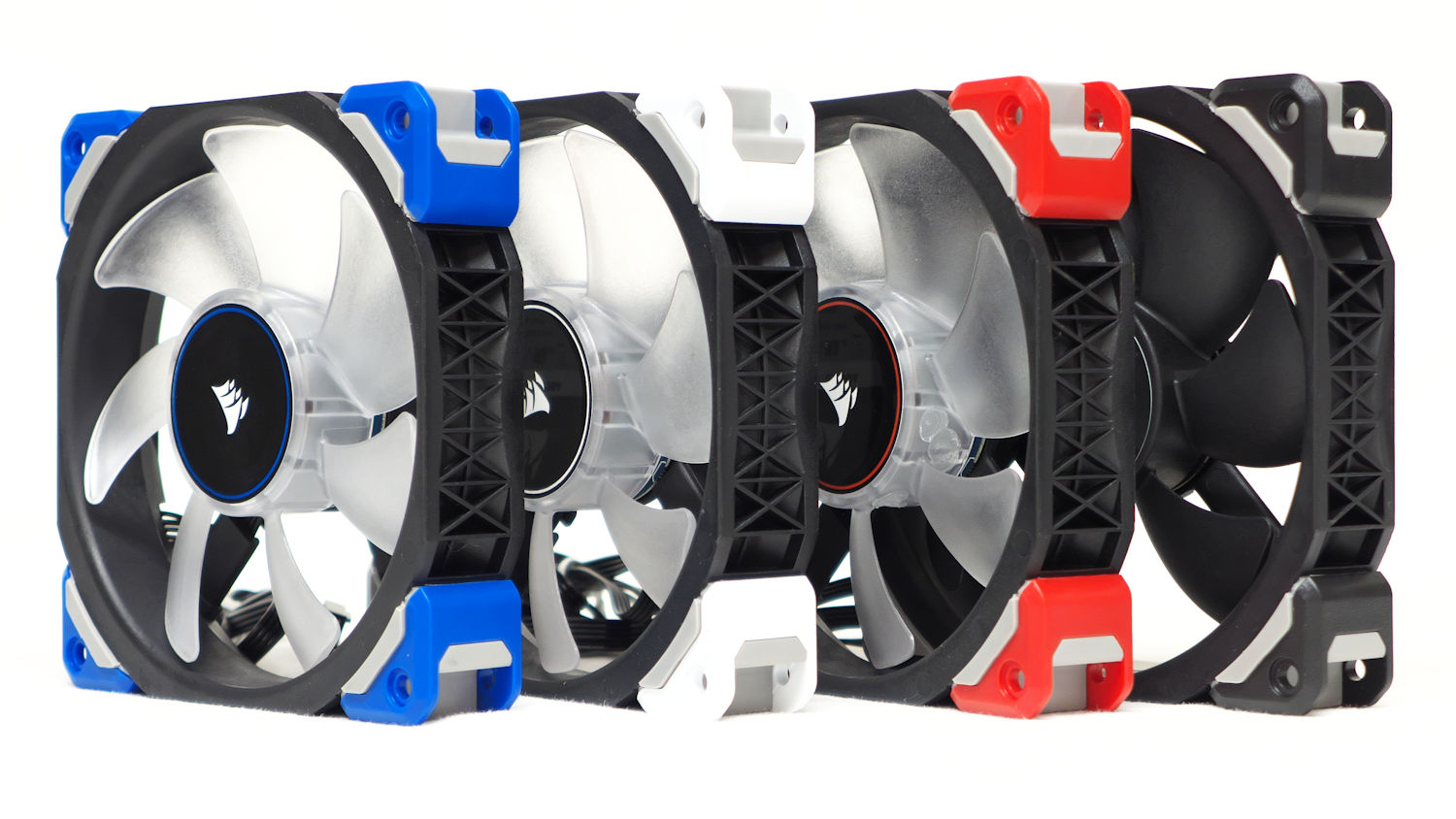
Corsair has finally released their ML series of PWM fans, in 120mm and 140mm. What makes these fans different is their bearings. They use magnetic levitation. In theory, these fans should never wear out. Both sizes have square frames, so they will fit handily on radiators. You can also use them as replacement fans for all in one coolers. Here we shall review Corsair’s new ML Pro series.
Corsair began its life as a seller of memory, more than 20 years ago – and what were you doing in 1994? Unlike so many companies that have changed their names, Corsair packages still come from Corsair Memory. Today, of course, Corsair is now well known for its quality cases, power supplies, coolers, peripherals, SSDs, memory – and oh yes, fans.
Here is what Corsair says of their newest entries, the ML series:
The ML Series fans deliver unrivaled high-end and low-noise performance by utilizing magnetic levitation technology and custom rotor designs. The innovative designs provides both high static pressure and high air flow.
• Harnesses magnetic levitation technology to provide higher performance at lower now levels, and a longer lifespan
• Our custom rotor design delivers the perfect balance between high static pressure and high airflow for exceptional performance in any PC cooling application
• Choosing between quiet operation and absolute performance is a thing of the past with a massive PWM control range (400 – 2,400 RPM for ML120, and 400 – 2,000 RPM for ML140)
• Anti-vibration rubber dampers deliver quiet operation at higher speeds
• Customize your build with replaceable corners (available separately)
• New LED lighting effect that radiates from the fan hub provides a subtle yet striking look
• Harnesses magnetic levitation technology to provide higher performance at lower now levels, and a longer lifespan
• Our custom rotor design delivers the perfect balance between high static pressure and high airflow for exceptional performance in any PC cooling application
• Choosing between quiet operation and absolute performance is a thing of the past with a massive PWM control range (400 – 2,400 RPM for ML120, and 400 – 2,000 RPM for ML140)
• Anti-vibration rubber dampers deliver quiet operation at higher speeds
• Customize your build with replaceable corners (available separately)
• New LED lighting effect that radiates from the fan hub provides a subtle yet striking look
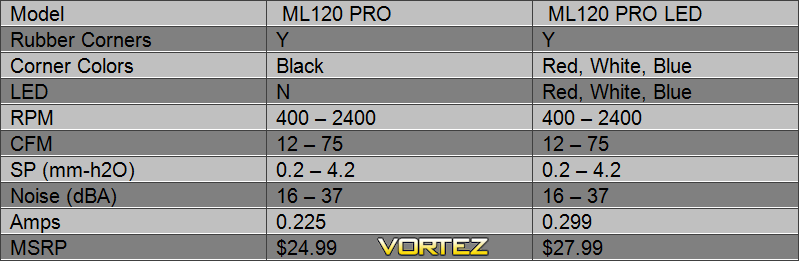
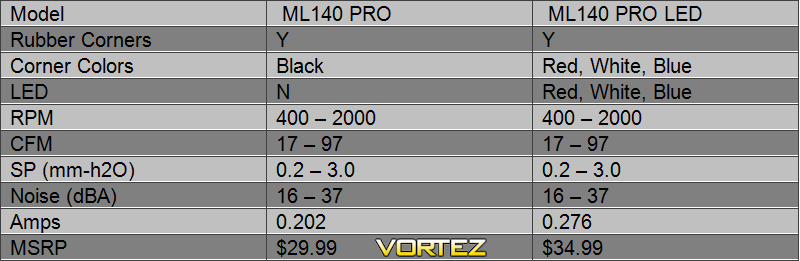
Technical Specifications
Packaging & Bundle
Down below you see the front sides of the ML120 Pro, from the Black (no LED) to the White to the Blue. The ML120 Pro LED Red box has been turned to show the obverse side. The boxes for the ML140 Pro are similar.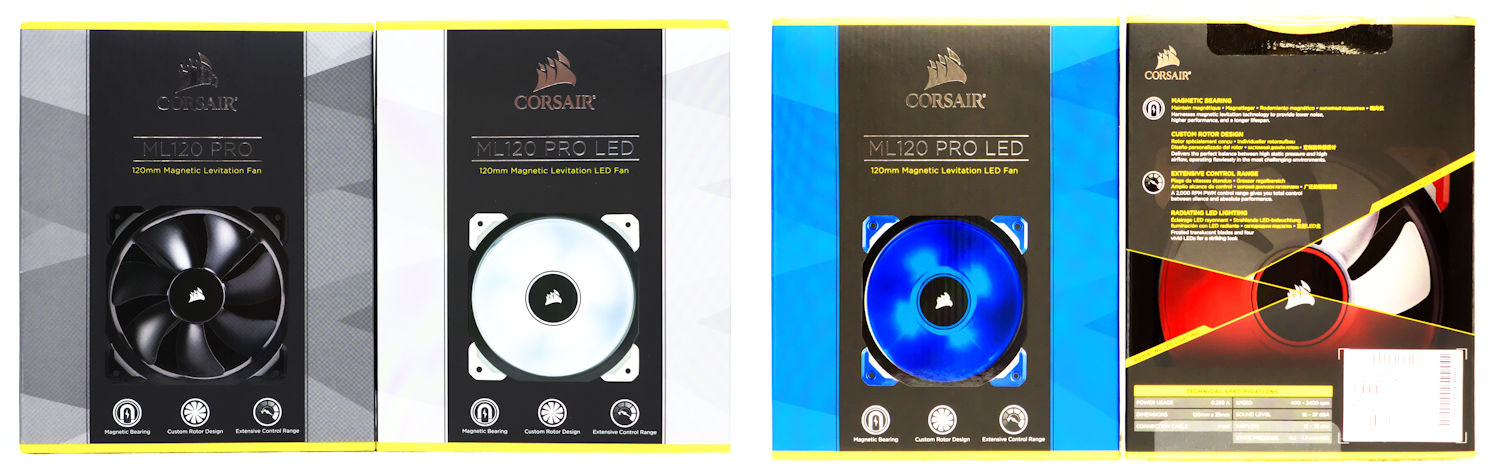
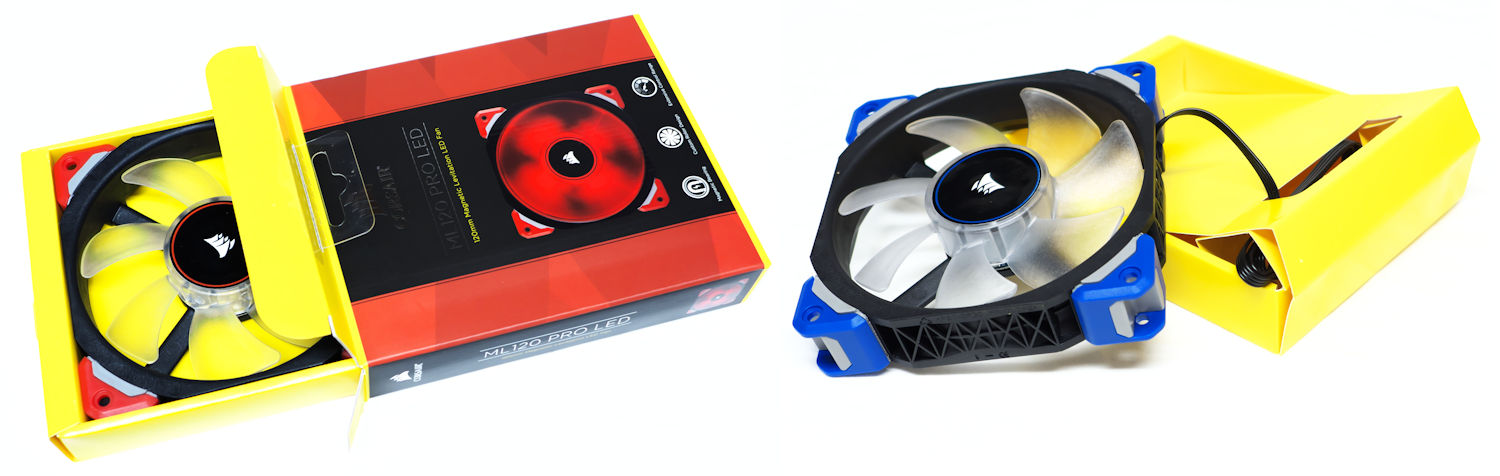
These are classy fans. Both the ML120 Pro and the ML140 Pro slide out on trays, but only the ML120 Pro are shown here.
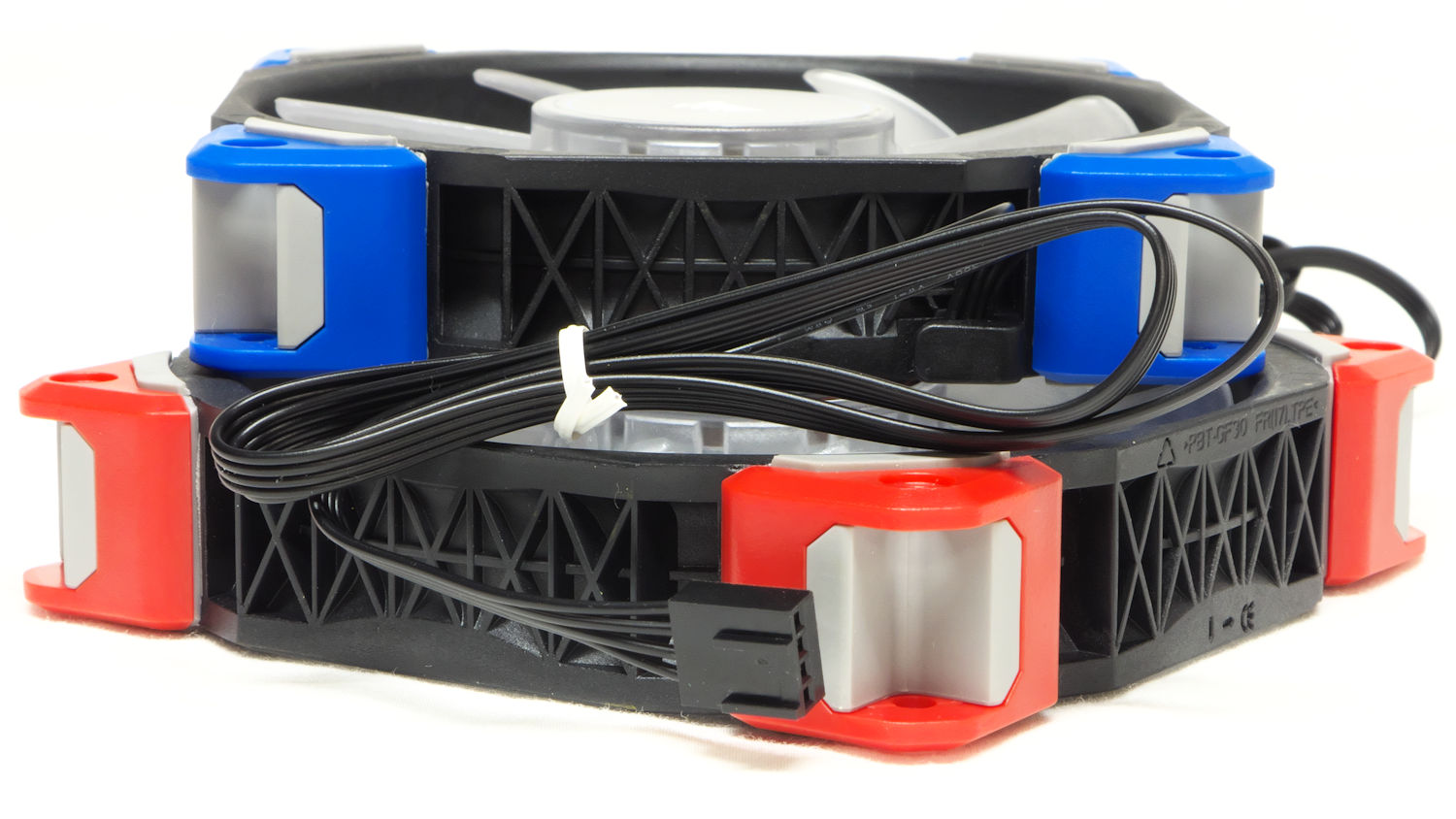
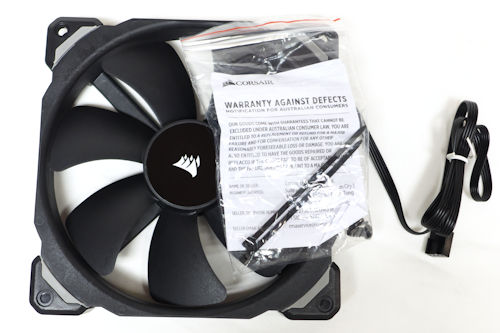
Here is an ML140 Pro with its accessory bag. The bag includes an Australian warranty, two zipties and four standard case mounting screws. Note that the corners are in fact removable, and that the rubber cores go a long way toward suppressing fan vibration.
Closer Look
For our first closeup of the ML Pro, let us look at a pair of non-LED ML120 Pro fans. On the left we see the intake side with its Corsair logo prominently in the center. No words. On the right we see the exhaust side, and again the Logo, but no name.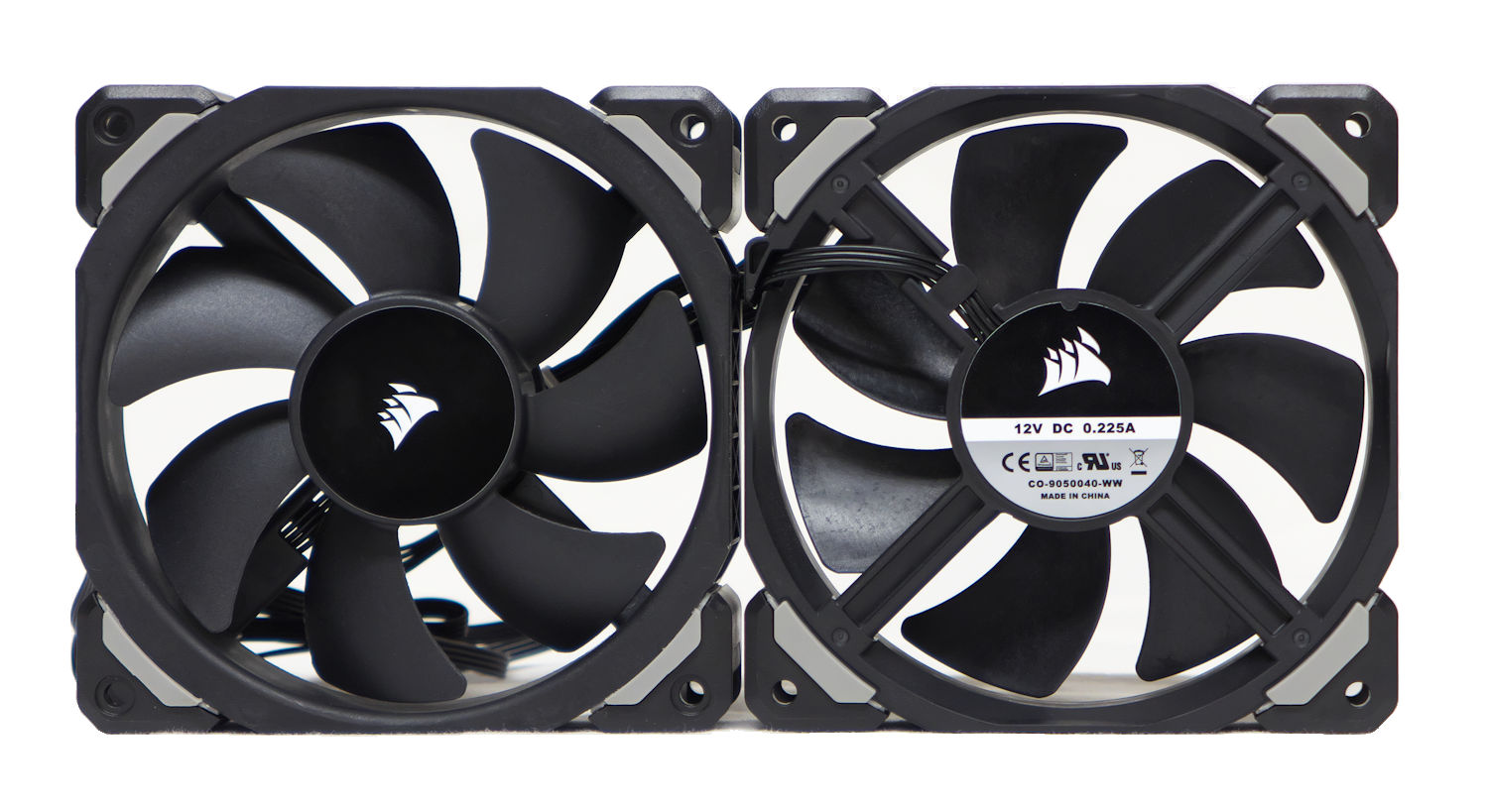
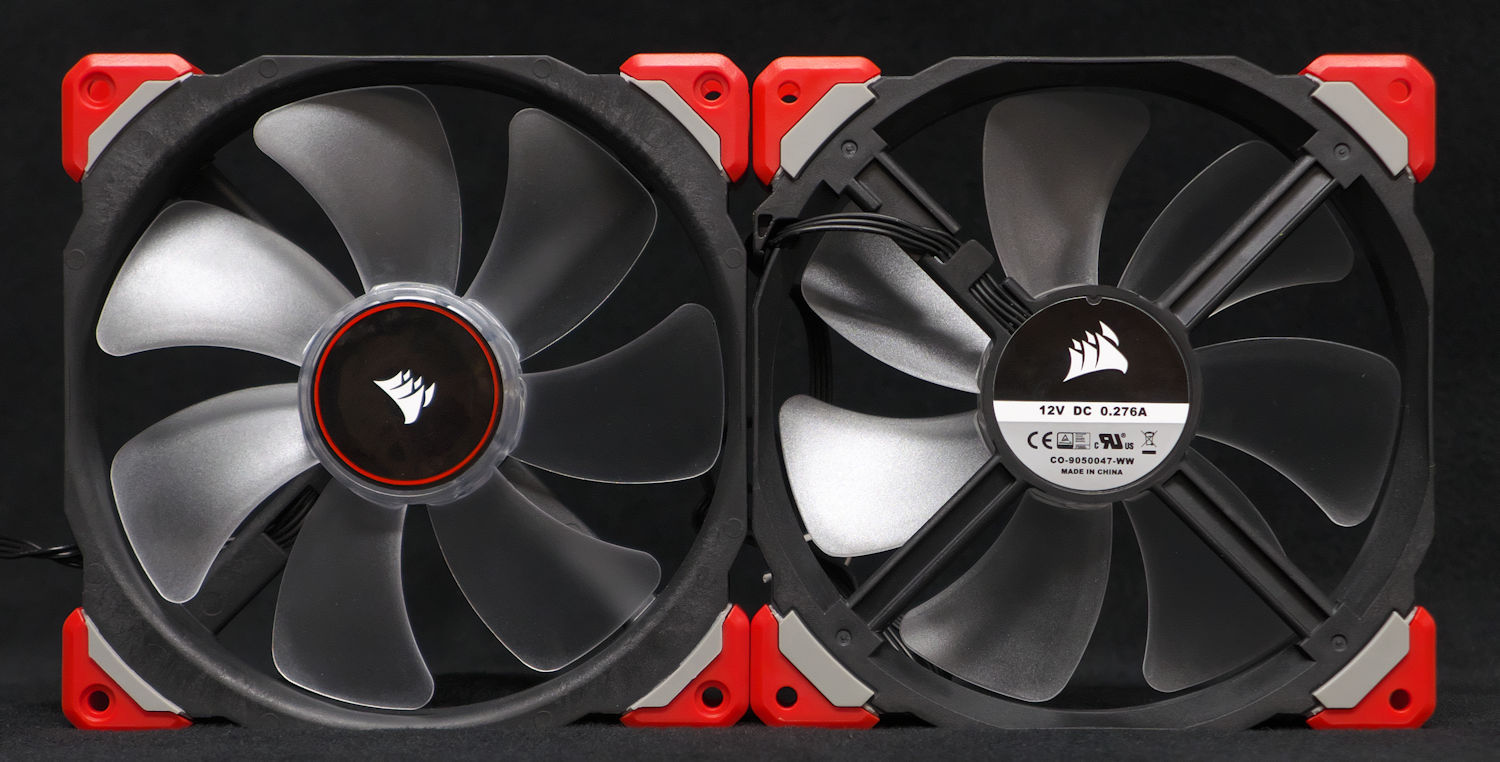
For their LED fans, Corsair gives us translucent impellers with frosted blades. This will allow the centrally-mounted LEDs to illuminate the blades as they spin. Here we see the intake and exhaust sides of a pair of ML140 PRO Red LED fans. Again, the rubber pieces sandwiched between the corners and the frame act as vibration absorbers, quieting the fans.
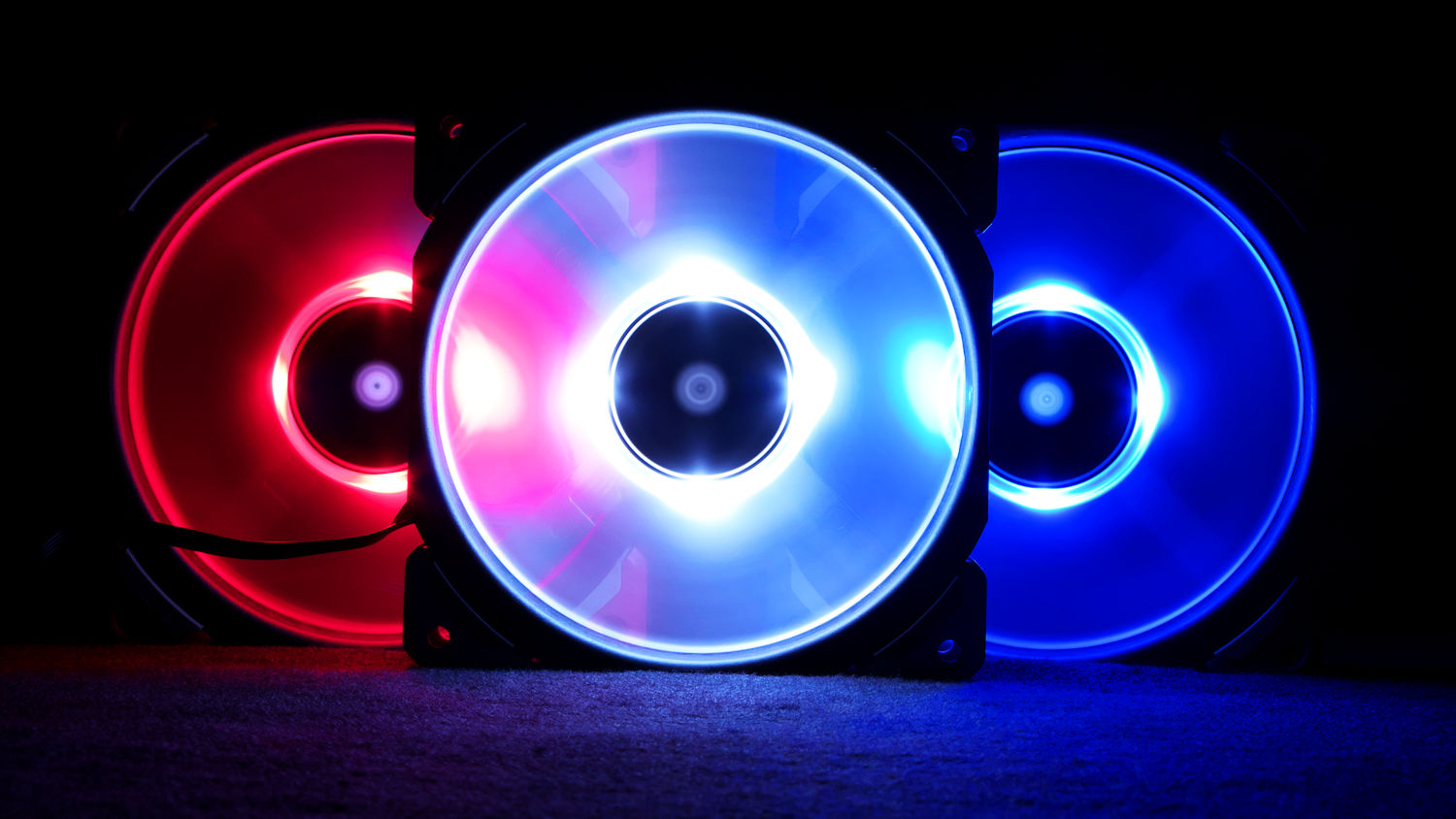
Do centrally-mounted LEDs work? Look at these ML120 PRO LED fans:
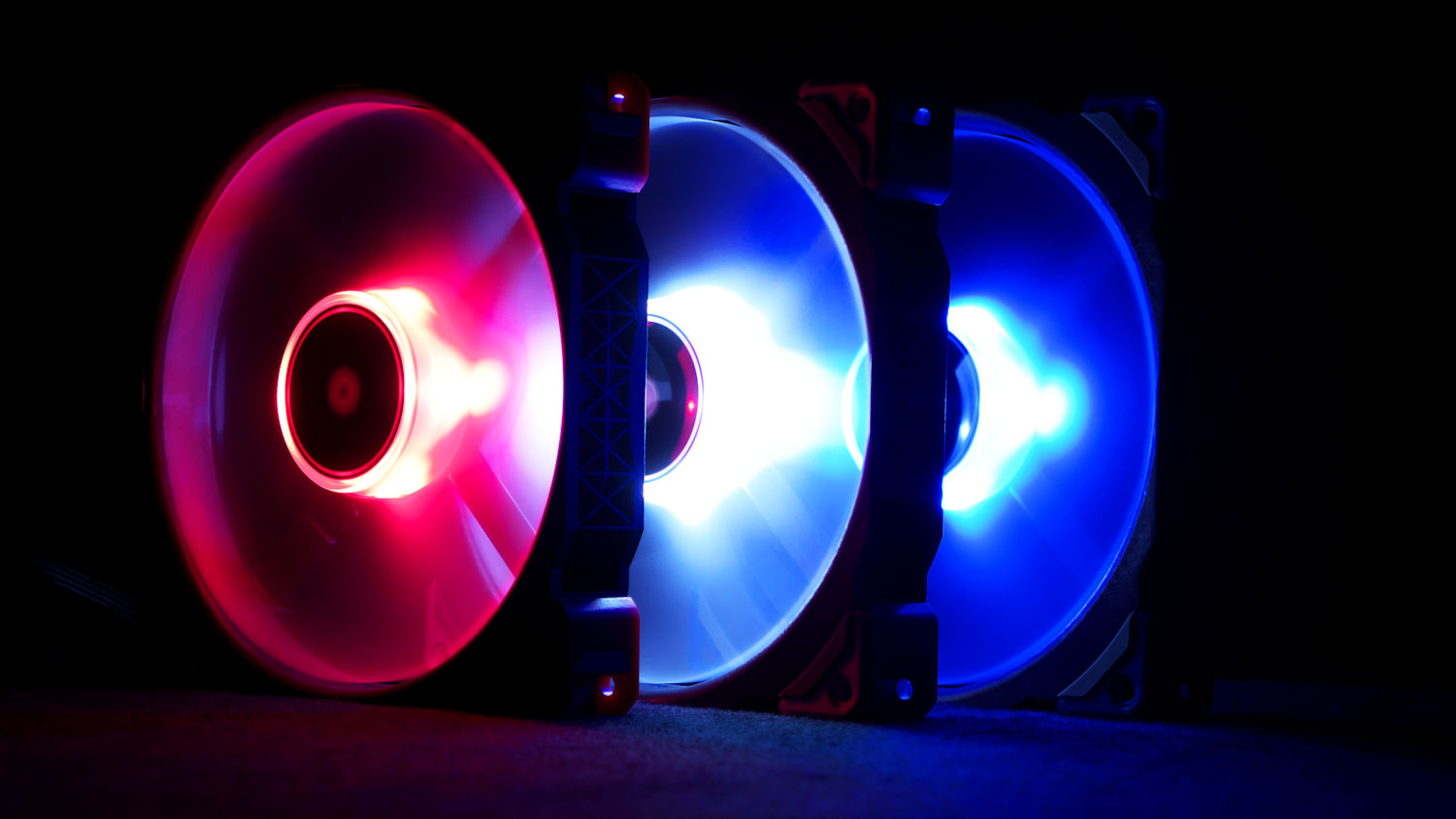
And here are ML140 PRO LED fans:
Test Setup
Normally we like to see two fans of each model to review, so that if something is wrong with a fan, we can go ahead with the review, using its mate. We anticipated receiving four fans – two 120mm and two 140mm. Instead, Corsair indeed sent two of each model of these fans. If you have been keeping track, there are four models of each fan for each of the two sizes. At two fans per model, that makes sixteen fans (!).We tested each fan. To record a fan’s RPM, it was placed on a freestanding mount. The sound pressure level was noted with a Tenma 72-942 at a distance of 10cm, which was adjusted to the industry standard 1m.
The air output of each fan was noted with an Extech AN100 anemometer which was at the rear of a cubic 200mm measurement box. The fan was either mounted to a 30 FPI (fin per inch) radiator or to the box itself. The AN100 averages the airflow, in this case 10 measurements per test run. All the fans you see were compared with each other using the same SPL meter and the same anemometer. The importance here is the relative measurements.
Because the fans ran reasonably close together, we were able to get the average output of eight fans at 120mm, and eight fans at 140mm. Having so many fans at each size meant that we were not at the mercy of industrial variation. Below is an ML120 mounted on a 30 FPI radiator, with the anemometer mounted behind it.
Results of Testing
Remembering from the table of specifications, the ML120 should put out 75 CFM while making 37 dB doing so.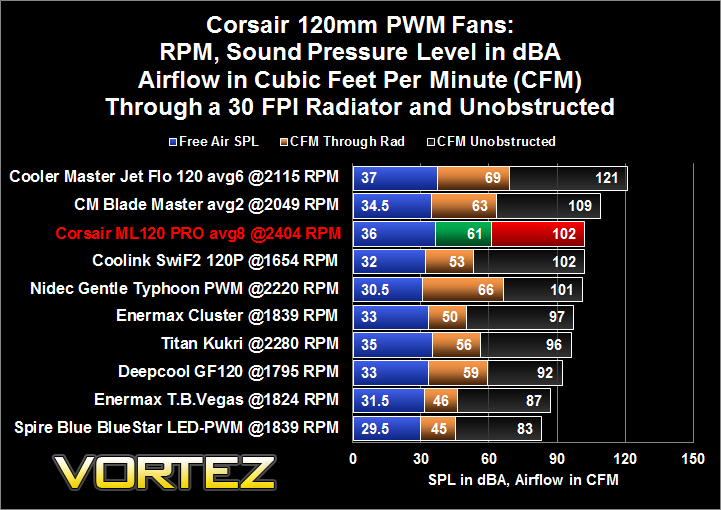
Here we see that the ML120 puts out a lot more air than spec, and still does not exceed its stated SPL. Further, the eight ML120 fans averaged 61 CFM through a restrictive 30 FPI rad. Not bad.
The ML140 is specified as producing 97 CFM awhile making no more than 37 dB of noise. The eight ML140s definitely accomplished that.
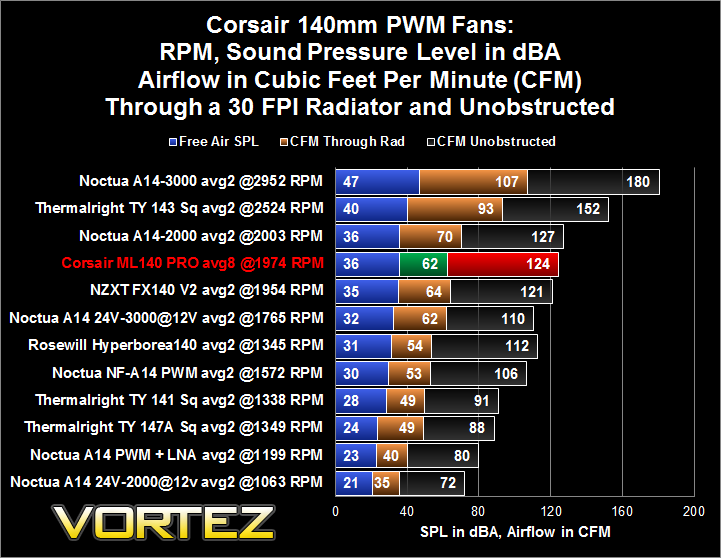
Again, the eight ML140 fans averaged more than 60 CFM through a tight rad. More: when the fans were put in pull position, and air was measured as it entered the box, the eight fans averaged 72.8 CFM. That is, a user will gain 10 CFM by turning these fans over from push to pull. Something to think about.
You might also wonder how well these fans respond to PWM signals from a motherboard. So we tested all the fans at 10% increments, from 1% to 100% of PWM signal.
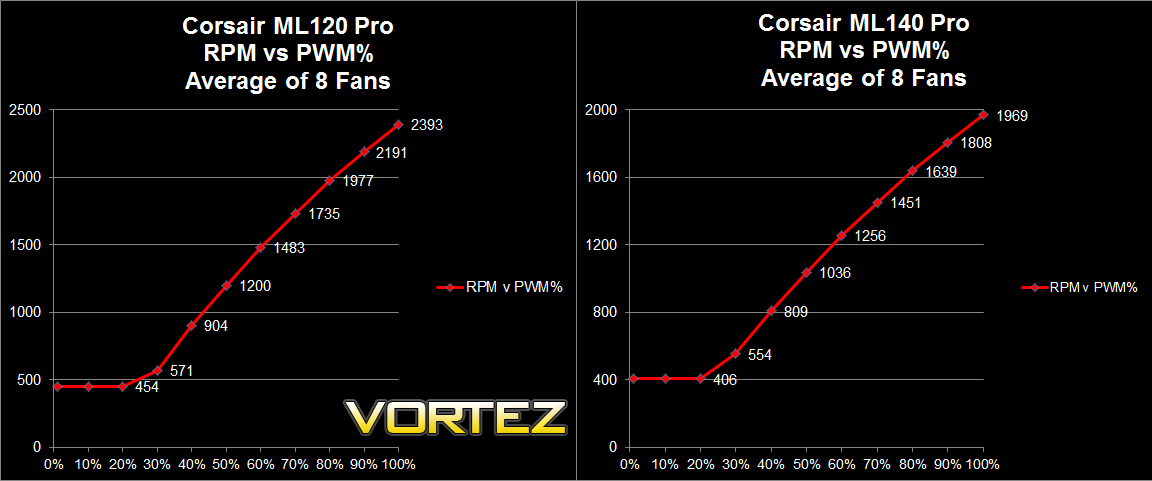
As you can see, both sets of fans ran flat for a time, then steadily increased as the duty % of the PWM signal was increased.
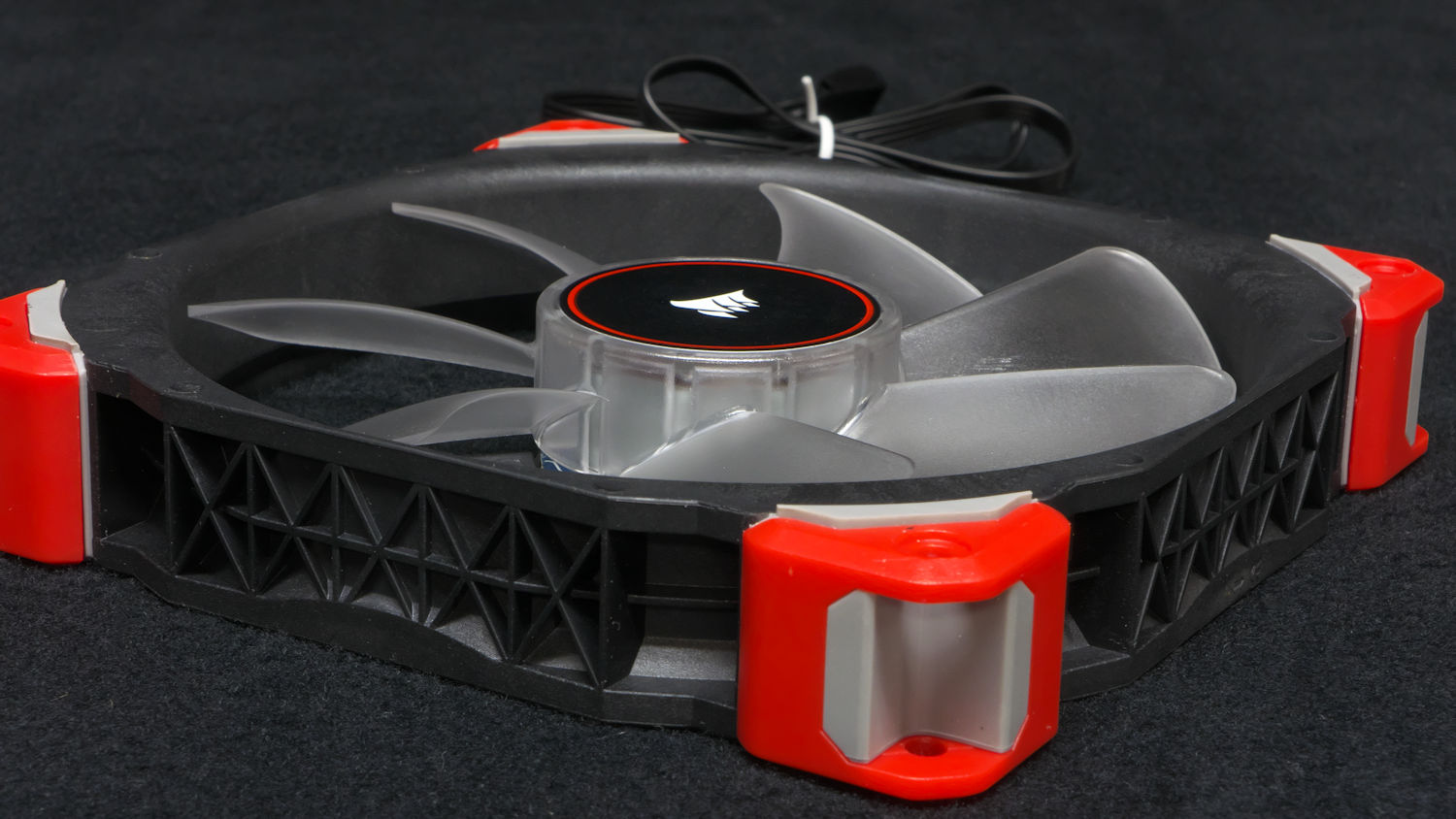
The noise made by the ML Pro fans do not get transmitted to what they are attached to. They don’t sound as loud as they measure.
Silent bearings in fans are usually variations on the sleeve bearing, a design prone to wearing out. As Magnetically Levitated bearings, these are inherently not likely to wear out. Corsair ML fans should last a long time.
Conclusions
Corsair ML Pro fans are centered around their Magnetic Levitation bearings. Ball bearings make noise you can hear. The prototypical quiet bearing is the sleeve bearing — at the beginning of its life. As they age, the sleeve bearing and its derivative sealed bearings begin to wear out. If you have handled a lot of fans you have seen some of them leak. Magnetic Levitation solves all of that.The Corsair ML Pro fans are gorgeous. The boxes are pretty. And when you pull them open, they speak to color and elegance. Once they had the ML bearings in hand, somebody spent a lot of time getting the aesthetics right. Even so, the corner caps can be removed and replaced with the color of the user’s choice. The ML series is newly introduced, but Corsair has promised replacement corner caps. One wonders what colors we will see.
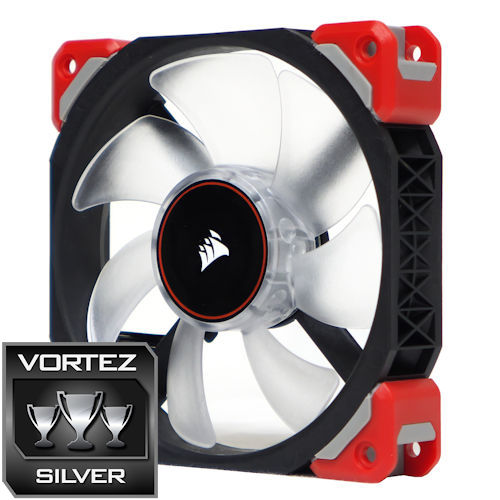
As you have seen, the LED version of Corsair’s ML Pro fans produce shining beacons in the dark, sprucing up their computers, no matter what lighting there is outside.
Since Corsair ML Pro are PWM fans, they rotate at variable speeds, and then only as fast as you need them. They are quiet at idle — you won’t hear a fan rotating under 500 rpm. Further, PWM fans can draw their current from the motherboard, or directly from the PSU through what are called ‘PWM Splitters’. Take your pick.
The rubber corners not only cradle bolts that slide through them to attach to radiators, but the cushioning effect means that noise will be suppressed when you mount these on a case.
All in all, these are premium fans for elegant locations. For the level of performance that the ML series presents, along with their beauty, these fans will receive the Vortez Silver award.
Pros
+ Magnetically Levitated, so the bearings don’t wear out.
+ The Magnetic Levitation bearings run silently.
+ The LEDs provide pleasant illumination on LED fans.
+ PWM control only spins the fans up when they are needed.
+ No louder than specified.
+ The rubber cushions at the corners dampen noise.
+ The ML Pro series produce more CFM than specified.
Cons
– These are expensive fans.
+ Magnetically Levitated, so the bearings don’t wear out.
+ The Magnetic Levitation bearings run silently.
+ The LEDs provide pleasant illumination on LED fans.
+ PWM control only spins the fans up when they are needed.
+ No louder than specified.
+ The rubber cushions at the corners dampen noise.
+ The ML Pro series produce more CFM than specified.
Cons
– These are expensive fans.