A new premium USB HD quality audio system designed with audiophile grade quality components.
Product on Review: Creative Sound Blaster X-Fi HD (USB)
Manufacturer and Sponsor: Creative
MSRP: £89

It’d be fair to say that Creative have been fairly quiet with regards to sound card releases over the past few years. The most recent sound card being the X-Fi Fatal1ty series, For audiophiles the X-Fi Extreme product-line has been a popular choice, so in one sense you can understand why Creative haven’t needed to be concerned – this range has been very successful.
In September Creative announced the release of a brand new series of sound card coming under the HD classification, because Creative have been fairly dormant in this division this makes for very interesting news. It’s good to see them launching new audio products onto the market, and in particular sound cards. So today, I will be taking a look at the X-Fi HD. There are two versions of this sound card, one is installed onto the motherboard and the other resides on your desk being USB. I will be reviewing the latter.
Creative’s Take:
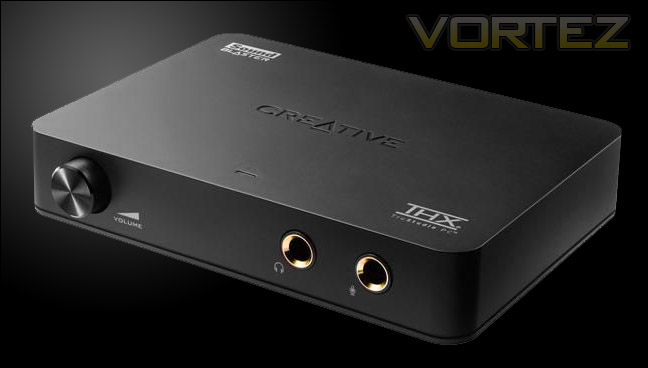
USB Sound Blaster X-Fi HD is an audiophile-grade sound system with premium connectivity for your Notebook or PC.
The front panel includes a conveniently located 1/4” microphone input and 1/4” headphone jack with a studio quality headphone amp and volume control. The rear panel features optical I/O, gold-plated stereo RCA I/O plus an integrated phono preamp for direct recording of your vinyl collection from your turntable.
The bundled Media Toolbox software lets you record, convert, enhance and organize your digital music files easily while THX TruStudio Pro technology brings you the same great audio experience found in live performances, films, and recording studios.
The front panel includes a conveniently located 1/4” microphone input and 1/4” headphone jack with a studio quality headphone amp and volume control. The rear panel features optical I/O, gold-plated stereo RCA I/O plus an integrated phono preamp for direct recording of your vinyl collection from your turntable.
The bundled Media Toolbox software lets you record, convert, enhance and organize your digital music files easily while THX TruStudio Pro technology brings you the same great audio experience found in live performances, films, and recording studios.
Specifications
Playback
24-bit Digital-to-Analog conversion of digital sources in 24-bit with sampling rate of up to 96 kHz without audio monitoring.
Recording
24-bit Analog-to-Digital conversion of analog sources in 24-bit with sampling rates up to 96 kHz without audio monitoring.
Signal-to-Noise Ratio Front Channel Out/Headphone: 114 dB (20kHz Low-pass filter, A-Weighted)
Audio Technology:
THX TruStudio Pro
Connectivity
* Microphone input (1/4” jack)
* Headphone output (1/4″ jack)
* Line in / Phono in* (2 x RCA jacks)
* Line out (2x RCA jacks)
* Optical SPDIF input and output (2 x optical connectors)
* Equipped with RIAA EQ (Equalization), which allows recording from a turntable directly without a pre-amp.
Interface
USB 2.0
Closer look
The X-Fi HD comes in a very attractive looking box that does well to show off the product. On the front there are indicators showing the components used, technologies included and application of use. On the side and back of the box Creative go further into the features and in particular on the side show a diagram of the ports, giving users a list of suggested applications. The X-Fi HD has includes functionality across a wide spectrum of devices. Further down the page we will consider such devices.
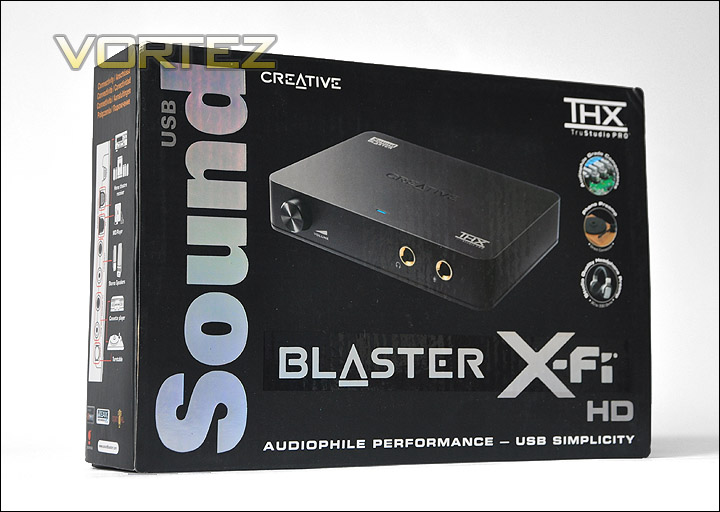
The X-Fi HD packaging, bold and attention grabbing
Inside the packaging, included you receive the following: Sound Blaster X-Fi HD, 1/4″ to 3.5mm converter, USB cable, quick start leaflet, installation CD with bundled software. The software bundled is very comprehensive, providing the end user with a means to tinker with every feature known to the X-Fi HD. Below is a list of the included applications on the disc:
* Creative Media Toolbox (Full version)
* Creative Console Launcher (Unicode)
* Entertainment Console
* Creative Audio Console / Audio Control Panel
* Creative Volume Panel
* Creative Software Auto Update
* Creative Sound Blaster Properties x32 (Windows Vista only)
* Creative Sound Blaster Properties x64
* Creative Information System
* Online Registration Client
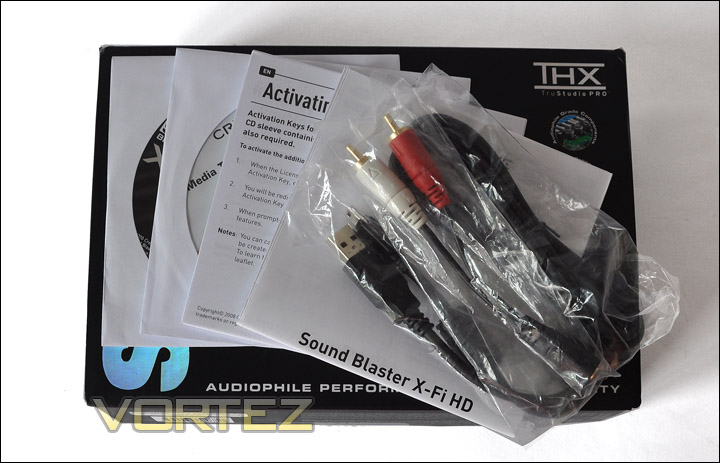
Inside, the bundle featuring drivers, software, USB cable, cable converter
Out of the packaging the X-Fi has a strong impression right away. For such a small device it is certainly gutsy in character. Looking over the top of this USB device, you can see the Creative logo engraved in the centre, sound blaster and THX certified logos are also present in each corner with an LED power indicator placed towards the front.
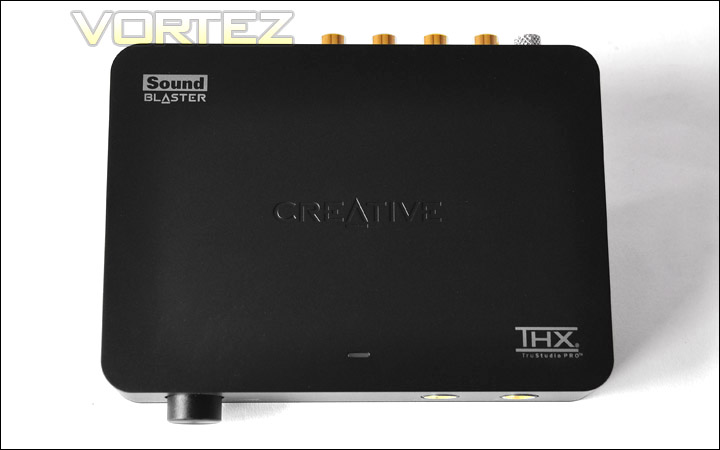
The X-Fi HD from an aerial view
Casting our eyes on the front of the X-Fi HD, surprisingly there are 1/4″ ports for the headphone and microphone output. So if you are a gamer, or quite possibly not a gamer the headset/headphones you use cannot be used directly into this unit. You will need to use the conversion cable. Creative are limiting its usage by just offering 1/4″ support, especially as the converter only allows for a single 3.5mm cable to be plugged in. So its headphones or microphone. Not both.
Further along there is a nicely crafted volume control knob. This knob has no cut-off at start or stop – it will turn infinitely.
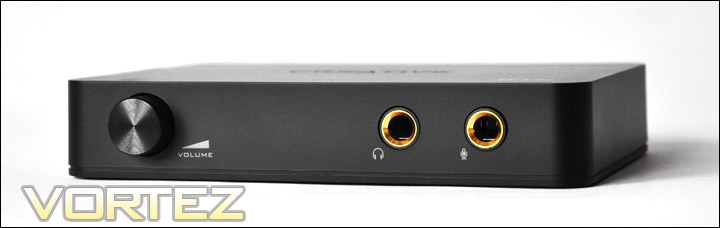
The front of the X-Fi HD with 1/4″ output
Around the back of the X-Fi HD there are a number of ports. From left to right we have GND port for connecting to a turntable. Immediately next to this port are phono ports – Line in/Line out this could be used for linking to a cassette player unit. Again there are a further phono ports, this time line out and this could be used for a set of speakers (only when used with the conversion cable, 3.5mm does not fit here) next up we have the optical input and output ports typically used for home theatre setups and then lastly the USB socket that must be used in order for the X-Fi HD to have power. So if you want to use any of these deivces with the X-Fi HD you will need to have this plugged into another USB enabled device – typically a computer. Subsequently a wide assortment of devices can be plugged into the X-Fi HD, thus offering a lot of functionality. It’s just a shame there are no 3.5mm ports.
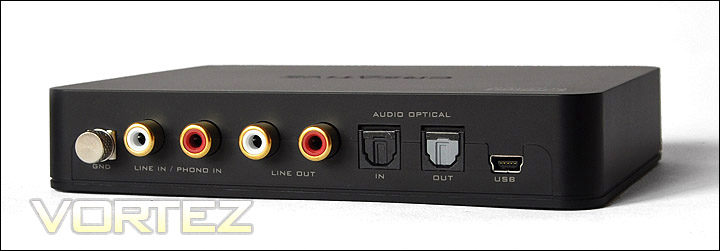
The rear of the X-Fi HD, showing all the available input/output ports
Testing
Unlike other products in different categories the performance of audio can be quite hard to determine. Contrasting our other testing methodologies for audio, I will be adding RightMark Audio Analyzer to the testing process.
RightMark Audio Analyzer is designed for testing quality of analogue and digital paths of any audio devices, be it a sound card, an MP3 player, a consumer CD/DVD player or an acoustic set. Testing is accomplished by playing the test signals and recording them after they pass through the testing chain.
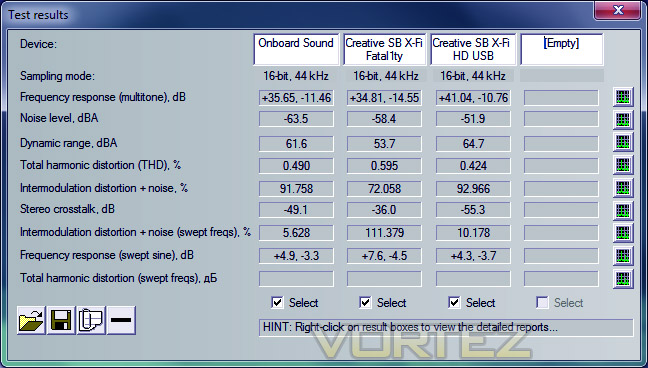
The results of onboard audio, X-Fi Fatal1ty, X-Fi HD in RightMark Audio Analyzer
Frequency response is a measure of the outputted audio’s range. Rightmark’s Audio Analyzer measures both channels of a stereo output and gives their tolerance in dB. As can be seen in the table on the left channel the X-Fi HD was the furthest out by 5.65dB. Testing the right channel, the X-Fi HD was the best, beating onboard by less than a dB and the Fatal1ty by nearly 4dB.
Noise level and Dynamic Range performance are both below average – HD USB being worst of set
THD is high compared to normal, but < 1% is considered high fidelity and inaudible to the human ear the best out of the 3 devices tested is the X-Fi HD.
Gaming, Movies and Music
The above benchmarking results may not mean anything to you but most users will want to know what the audio feedback is like compared to onboard audio within games, movies and music.
Creative are strong foes to beat when it comes to 3D audio. THX TrueStudio Pro and Crystalizer play important roles within the X-Fi HD. Games that support EAX will combine well with this sound card, I can confirm that over the standard onboard sound that I get with the ASUS Rampage III Formula the X-Fi HD is far superior. You may think that the Rampage III Formula comes with a SupremeFX X-Fi anyway but in reality, underneath the cover is a Realtek chip running an X-Fi codec. Sound, effects and music within the titles I tested (Medal of Honor Beta, Battlefield Bad Company 2 and Call of Duty Modern Warfare 2) were very crisp, precise and clearly impressive.
Movies and music are obviously at the very pinnacle of Creative’s intentions with the X-Fi HD. Once again, within this category of audio I wasn’t disappointed. X-Fi HD sounds absolutely awesome on a surround sound system – bass has been tightened, giving a lovely crisp finish to a variety of tones. The bundled software allows you to indulge in many options within THX TruStudio Pro and EAX. I would recommend taking a look at the software and fine tuning a few elements so that you can enhance the tones coming out of all channels – although this isn’t a requirement. Audio straight out of the box is very impressive.
Combine the X-Fi HD with a BDROM and you have a phenomenal setup ready to take you right into the movie.
Below you can see the options available by either the console or through control panel in windows (both give you access to the same options).
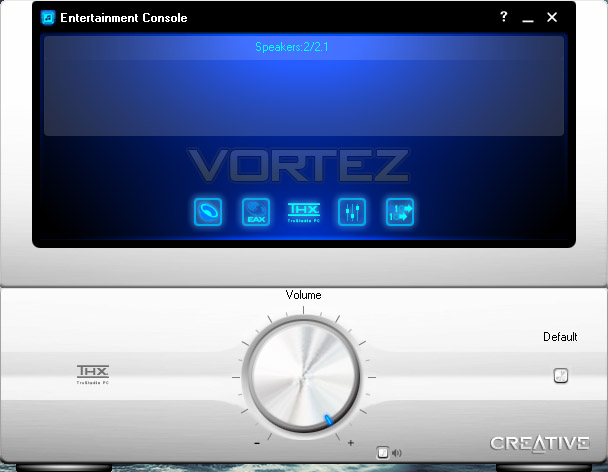
The console GUI giving you access to options like EAX and TruStudio Pro
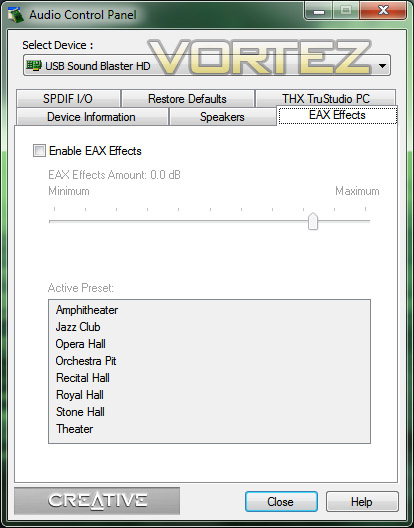
EAX options available within Windows
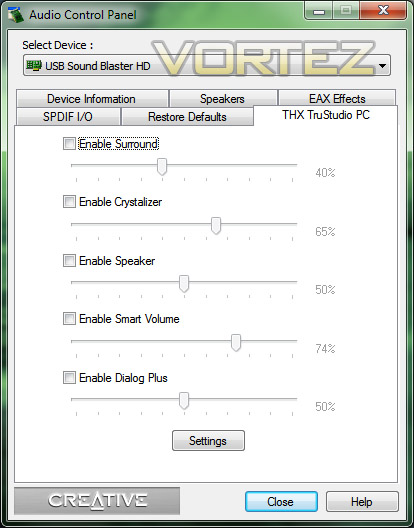
THX options available within windows
Conclusion
The definition of a an audiophile is someone who seeks high-quality audio reproduction via the use of non-mass produced high-end audio electronics. Creative claim the X-Fi HD offers audiophile performance but with USB simplicity and that claim is certainly true.
Behind the X-Fi HD you have a high-quality device that is very capable and all you need is a spare USB port. The X-Fi product line has always had attached to it high respect, being regarded as a range of premium audio solutions incorporating THD and signal clarity. The real push with X-Fi HD is the integrated THX TruStudio Pro, this has a dialog enhancer which creates virtualised surround sound channels. EAX and X-Fi Crystalizer add audio fidelity allowing you to significantly enhance the audio coming through your speakers. Looking into things a little deeper you can discover that the dialog enhancer purifies speech and voice tones for audio tracks and movies ensuring they are even clearer.
Bundled with the X-Fi HD is a fairly impressive software suite. The Media Toolbox is included, allowing you to edit, organise and backup all manner of audio files. There is of course the console too, which gives you access to the all important THX options.

You will be aware that the X-Fi HD isn’t just designed for gamers, movie addicts or music lovers it has a far wider audience. If we are to believe that this is designed for the audiophile then the ports to the front and rear of this device should clearly allow for multiple devices to sync with the X-Fi HD, and there is. In fact this product is designed for those with home theatre setups, those who really do love their audio. The lack of 3.5″ reveals this. It isn’t really a device designed solely for gamers, although it does work extremely well in this environment too. The inclusion of the 3.5mm adapter does allow you to use headphones or speakers with the X-Fi HD but sadly, you can only use one device with the adapter so if you are using a headset for example, the headphones can be used but if the microphone is also 3.5mm there is nothing to plug it into.
At £89 the X-Fi HD is positioned within the high-end audio sound card region, being the cheapest high-end offering compared to the likes of ASUS. This price represents a good value for such a versatile audio product.
Pros
+ Multiple applications
+ Extremely precise, clear audio
+ Good assortment of software
+ Enhances movies experience
Cons
– Lack of native 3.5mm support
– Only one 3.5mm device can be used
+ Multiple applications
+ Extremely precise, clear audio
+ Good assortment of software
+ Enhances movies experience
Cons
– Lack of native 3.5mm support
– Only one 3.5mm device can be used