Crucial’s latest SSD is their first consumer drive to feature Micron’s 3D TLC NAND, a development designed to improve durability and drive capacities.

Product On Review: Limited Edition 750GB MX300 SSD
Manufacturer & Sponsor: Crucial/Micron
MSRP: $199.99
Current UK Street Price: ~£165 (inc. V.A.T.)
By any measure Micron Technology Inc., Crucial Technology‘s parent company, is a semiconductor giant. As one of the top five semiconductor manufacturers in the world, with an estimated $16bn revenue in 2014, it’s no surprise that they’re intimately involved with cutting edge research and development in the industry. A focus on DRAM and NAND has meant that their products reside in countless computing systems around the world as both RAM and flash storage, whilst as a leader in new memory technologies they’re advancing the performance frontier through GDDR5X and, in cooperation with Intel via their IM Flash Technologies joint venture, 3D XPoint non-volatile memory.
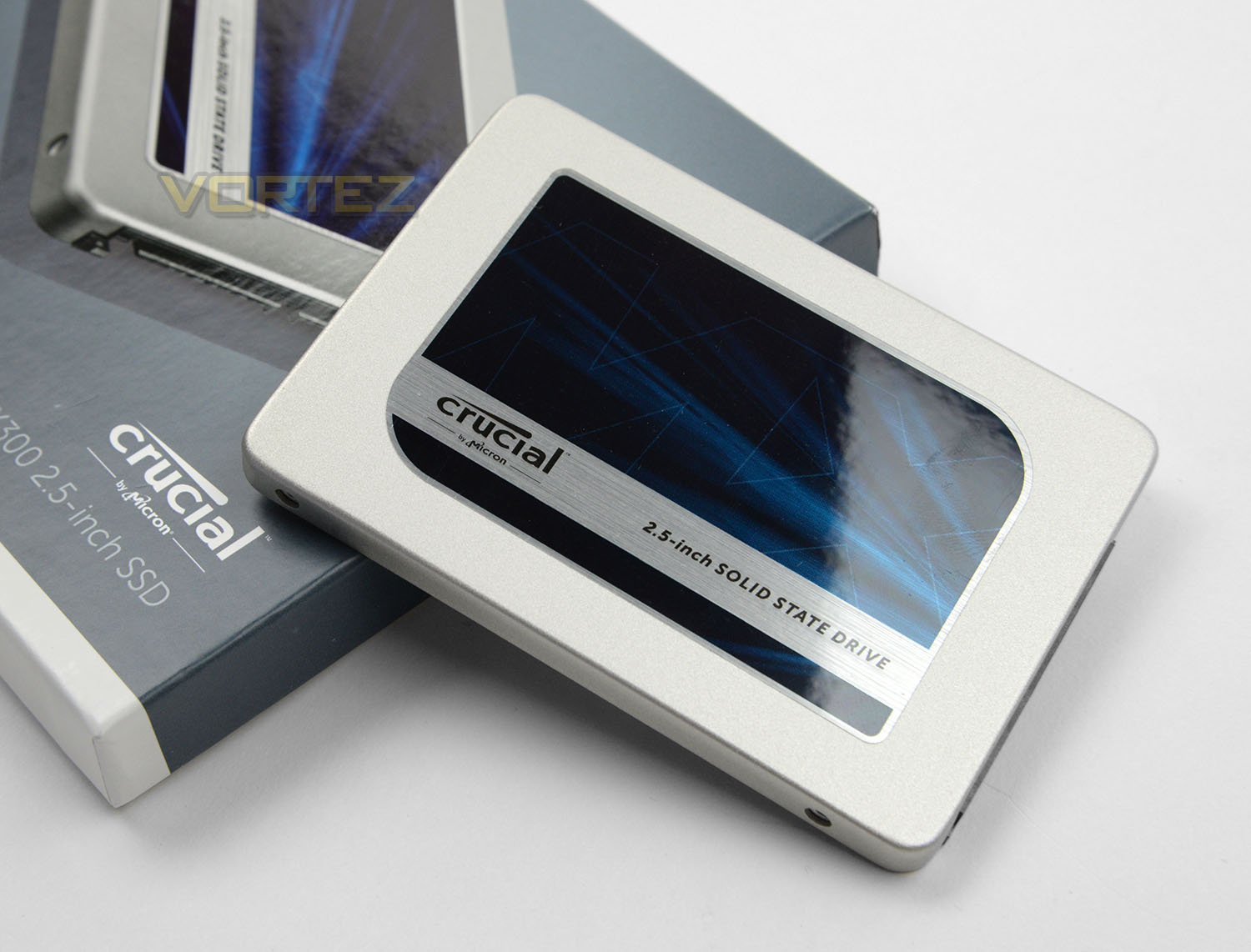
Micron’s consumer DRAM and SSDs are marketed and sold under the Crucial brand. Perhaps not quite as flashy as other brands on the market, they’ve been providing consumers with system memory for decades and Solid State Drives for a considerable time too. Back when SSDs were first entering the consumer market at the enthusiast point Crucial were one of the few to avoid the almost ubiquitous Sandforce storage controller, instead opting for Marvell with a custom firmware. They’ve remained in the market ever since, offering performance and budget options for 2.5” SATA and mSATA form factors.
Today sees the official launch of their newest SSD in the MX series, the Limited Edition MX300 750GB. As the debut outing for Micron’s own 3D TLC NAND, the MX300 offers high-performance SATA III storage with high write durability, ensuring that performance-oriented consumer applications are catered to in a manner which doesn’t break the literal or proverbial bank. At just £165 in the UK it’s aggressively priced to offer great value presupposing the performance holds up.
Whilst the 750GB model is to be released in relatively limited quantity, news coming out of Computex2016 indicated that 250GB, 500GB and 1TB will follow in Q3 2016. A huge 2TB capacity model could see availability in the final quarter of the year sating the needs of gamers with huge Steam libraries and no patience for uninstalling or relocating old games.
Features
NAND:- Micron 3D TLC NAND
Form factor:- 2.5 inches, 7mm thick (7 – 9.5mm spacer included)
Interface:- SATA III (6Gbps)
Controller:- Marvell 88SS1074
Sequential read:- Up to 530MB / Sec
Sequential write:- Up to 510MB / Sec
4K random read:- Maximum 92,000IOPS
4K random write:- Maximum 83,000IOPS
Mean time to failure (MTTF):- 1.5 million hours
Capacity:- 750GB
Endurance:- 220TB Total Bytes Written
Encryption: Hardware AES 256-bit encryption
Form factor:- 2.5 inches, 7mm thick (7 – 9.5mm spacer included)
Interface:- SATA III (6Gbps)
Controller:- Marvell 88SS1074
Sequential read:- Up to 530MB / Sec
Sequential write:- Up to 510MB / Sec
4K random read:- Maximum 92,000IOPS
4K random write:- Maximum 83,000IOPS
Mean time to failure (MTTF):- 1.5 million hours
Capacity:- 750GB
Endurance:- 220TB Total Bytes Written
Encryption: Hardware AES 256-bit encryption
Advanced Features
– Redundant Array of Independent NAND
– Multistep Data Integrity Algorithm
– Adaptive Thermal Protection
– Power Loss Protection
– Data Path Protection
– Active Garbage Collection
– TRIM Support
– Self-Monitoring and Reporting Technology (SMART)
– Error Correction Code (ECC)
– Device Sleep Support
– Multistep Data Integrity Algorithm
– Adaptive Thermal Protection
– Power Loss Protection
– Data Path Protection
– Active Garbage Collection
– TRIM Support
– Self-Monitoring and Reporting Technology (SMART)
– Error Correction Code (ECC)
– Device Sleep Support
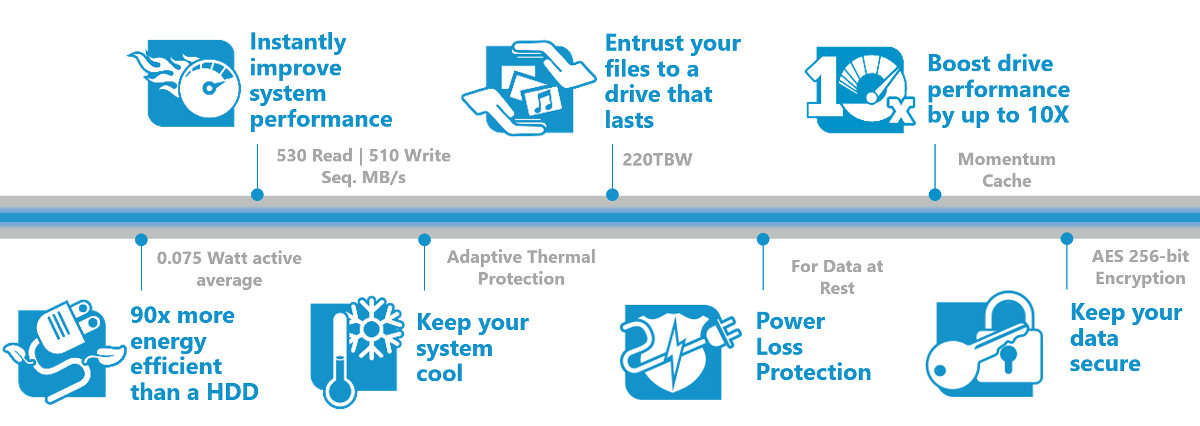
On-paper performance, perhaps unsurprisingly, nudges the now-common SATA III limits after encoding overhead is taken into account. It’s no wonder therefore that performance-class SATA drives have focussed on 4k random read/write IOPS in an effort to squeeze out an advantage, but the MX300 may disappoint slightly in this regard.
Once again on paper, raw read speeds and both 4k random read/write IOPs are edged out by the previous generation MX200. The inclusion of Dynamic Write Acceleration may provide real-world parity, but generally the MX300 will need to prove itself in the frame of cost-effectiveness and long-term durability.
Micron 3D TLC NAND
Recently there has been a mini-revolution in SSD NAND: the 3D Revolution. Realising the limits of 2D planar NAND – i.e. worsening reliability as the lithography decreases in size due in part to escaped electrons – semiconductor manufacturers have invested considerable resources into transitioning to their own proprietary 3D NAND technology. Both Samsung and Toshiba have debuted their own 3D NAND technologies, and now Micron are ready to implement theirs in consumer-class storage.
Micron in partnership with Intel are the first to implement floating gate technology in 3D NAND, a technique with well understood ramifications compared to the newer Charge Trap Flash employed by Samsung in their 3D ‘V-NAND’. This first generation of Micron 3D NAND drives are designed to optimise both capacity and cost compared to their planar antecedents, and are incorporated in consumer SSDs alongside other controller and algorithmic improvements.
Scaling for 3D NAND is vertical rather than horizontal, meaning that there is more room to manoeuvre with respect to larger (and hence more reliable) lithographic processes. The MX300 3D NAND technology uses cells stacked in 32 layers for a total size of 384Gb (Gigabits) per die in its TLC configuration.
Additional Proprietary Features
Dynamic Write Acceleration is a feature that uses an adaptable pool of high-speed, single-level cell (SLC) NAND flash memory to improve the speed of MLC-based drives (like the MX300) without the added cost of more expensive SLC-based drives.
Exclusive Data Defense technology is one of the many layers of data protection included with the Crucial MX300 SSD. This technology minimizes data corruption as it’s moved onto the components, ensuring that the invaluable files or documents you have on your computer are reliably stored on the drive.
Exclusive Data Defense technology is one of the many layers of data protection included with the Crucial MX300 SSD. This technology minimizes data corruption as it’s moved onto the components, ensuring that the invaluable files or documents you have on your computer are reliably stored on the drive.
Firmware Updates
In common with most SSD manufacturers Crucial offers firmware updates for all of their drive, improving performance or fixing bugs as and when they’re unearthed. Typically Crucial have a very fast turn-around time from bug notification to a fix being issued, and they can be found at http://uk.crucial.com/gbr/en/support-ssd-firmware.
Support
We’re not typically effusive over support but we should mention that Crucial offer a 3 year limit warranty with a centre of operations in the UK for UK consumers. Should an issue occur that warrants a manufacturer RMA consumers can enjoy short turn-around times and low shipping costs compared to support services based on the Continent.
Packaging, Bundle & Closer Look
Retail models of the Crucial MX300 will arrive in a fairly compact packs similar to that of their previous SSD releases, rather than the blister packs you might see for low-cost/value drives. The fact that it’s a Limited Edition 750GB model is clear to see, as is the form factor. Pretty good start so far.
Package Contents:
• BX200 SSD inside an anti-static bag
• 7mm to 9.5mm spacer
• Data migration software key (Acronis True Image HD)
In addition to the drive Crucial also provide a 7mm to 9.5mm spacer (for compatibility requirements in certain laptop models and desktop chassis) and a license key for Acronis True Image HD. Acronis True Image HD will allow you to more easily transfer your system files from your older drive to the MX300, although in general we advise performing a fresh OS install if possible.
Crucial once again utilises a part-plastic, part-metal design for their SSD’s housing, ensuring both low cost and decent durability. Technical information necessary for RMAs and other support enquiries is located on the reverse. As you can clearly see, the MX300 is a SATA data and power part with ports in standard locations for an SSD of this size.
Test Setup and Methodology
Our test system is formatted and a fresh version of Windows 7 is installed with just drives in place – no additional applications. Windows is then updated to the latest release and the drivers are installed. Included in the list of benchmarks are the following applications:Benchmarks
Anvil Pro
AS SSD
ATTO Disk Benchmark v2.46
Futuremark PCMark 8
AS SSD
ATTO Disk Benchmark v2.46
Futuremark PCMark 8
Test system
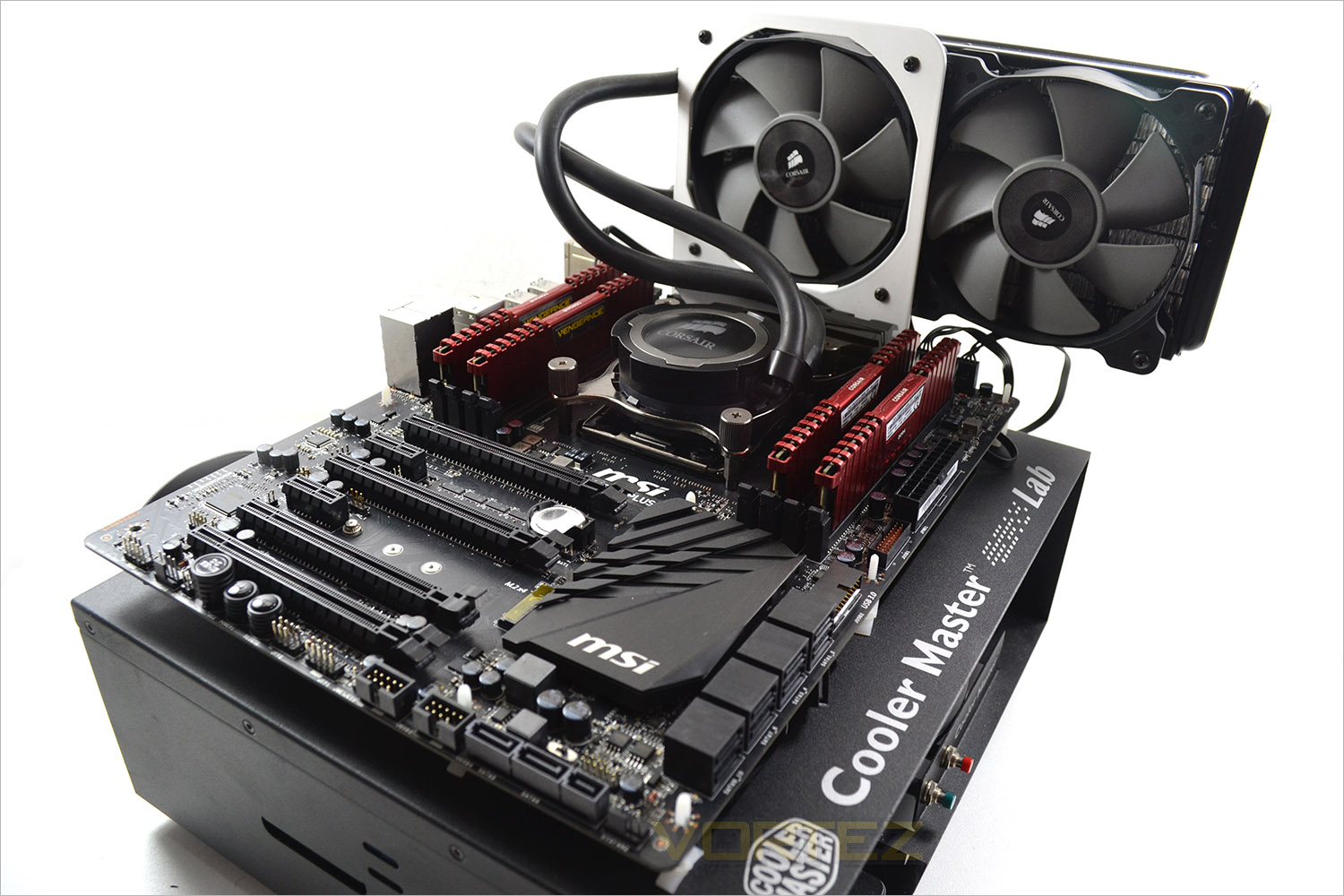
CPU Intel Core-i7 5960X
Motherboard MSI X99S – SLI
Graphics PALIT NVIDIA GTX 760
Memory 16GB Corsair Vengeance Pro (2666MHz) CL15
HDD
– Crucial MX300 Limited Edition 750GB (SATA 6Gbps)
– Crucial BX200 960GB (SATA 6Gbps)
– Samsung 950 Pro NVMe 256GB (M.2 NVMe)
– OCZ Vector 180 240GB (SATA 6Gbps)
– Crucial MX200 1TB (SATA 6Gbps)
– Corsair Force LX 256GB (SATA 6Gbps)
PSU Corsair HX1050 Gold
OS Microsoft Windows 7 Professional 64-Bit
Motherboard MSI X99S – SLI
Graphics PALIT NVIDIA GTX 760
Memory 16GB Corsair Vengeance Pro (2666MHz) CL15
HDD
– Crucial MX300 Limited Edition 750GB (SATA 6Gbps)
– Crucial BX200 960GB (SATA 6Gbps)
– Samsung 950 Pro NVMe 256GB (M.2 NVMe)
– OCZ Vector 180 240GB (SATA 6Gbps)
– Crucial MX200 1TB (SATA 6Gbps)
– Corsair Force LX 256GB (SATA 6Gbps)
PSU Corsair HX1050 Gold
OS Microsoft Windows 7 Professional 64-Bit
Benchmarks: Anvil Pro
Anvil Pro from Anvil Storage utilities is one of the most popular storage benchmarking utilities today thanks to the large suit of tests available. You can test pretty much anything from Read/write Speed to IOPs with many variables to tweak allowing you to get either a single or host of results to compare with other likeminded enthusiasts. In our test we ran the standard suite 5 times, subtracting both the highest and lowest scores and determined the final result from the average of the remaining three results.
Somewhat bizarrely, the MX300 suffers from relatively poor Sequential Read results in the Anvil benchmark suite, but rebounds in both Sequential Write and IOPs (QD4). That’s not expected, and we’re curious to see if the result is replicated in other benchmarks.
Benchmark: AS SSD
AS SSD Benchmark is a straightforward tool for measuring the speed of your SSD drive.
Simply launch the program, choose your drive, click Start, and it’ll test your SSD’s read and write speed in a variety of ways, delivering a score for each when it’s done. And if that’s not enough, there are also additional file copy and compression-related benchmarks available from the Tools menu. (The author’s support page is German only, but if you need further English explanations then there’s a thread on the program at the OCZ Technology forum.).
Simply launch the program, choose your drive, click Start, and it’ll test your SSD’s read and write speed in a variety of ways, delivering a score for each when it’s done. And if that’s not enough, there are also additional file copy and compression-related benchmarks available from the Tools menu. (The author’s support page is German only, but if you need further English explanations then there’s a thread on the program at the OCZ Technology forum.).
Once again, Sequential Read performance relatively low compared to other SATA 6Gbps performance drives, and is bested even by Crucial’s own BX200 and MX200. Sequential Write however flips the script, with the MX300 appearing to be one of the faster drives. This dynamic mimics the Corsair Force LX, which utilises a Silicon Motion SM2246EN controller.
Benchmarks: ATTO
The ATTO Disk Benchmark performance measurement tool is compatible with Microsoft Windows. Measure your storage systems performance with various transfer sizes and test lengths for reads and writes. Several options are available to customize your performance measurement including queue depth, overlapped I/O and even a comparison mode with the option to run continuously. Use ATTO Disk Benchmark to test any manufacturers RAID controllers, storage controllers, host adapters, hard drives and SSD drives and notice that ATTO products will consistently provide the highest level of performance to your storage.
Deja vu hits once again in the ATTO 1,024 benchmark, with relatively poor Read performance but good Write levels. We should stress here that the average user probably wouldn’t notice a difference in day-to-day use, but it specific heavy use cases could be impacted.
Benchmarks: PCMark 8
Use the PCMark 8 Storage benchmark to test the performance of SSDs, HDDs and hybrid drives with traces recorded from Adobe Creative Suite, Microsoft Office and a selection of popular games. You can test the system drive or any other recognised storage device, including local external drives. Unlike synthetic storage tests, the PCMark 8 Storage benchmark highlights real-world performance differences between storage devices.
The PCMark 8 utility is the MX300’s most promising result, indicating great storage bandwidth and overall ‘score’. PC Mark 8 attempts to test ‘real world’ performance levels within a synthetic and reproducible benchmark, but it value is determined by how closely the prospective users workload matches up with their selection of Office tasks and games. It may, for instance, not reflect database crunching or other heavy workloads.
Benchmark: AIDA64
This simple integer benchmark focuses on the branch prediction capabilities and the misprediction penalties of the CPU. It finds the solutions for the classic “Queens problem” on a 10 by 10 sized chessboard. At the same clock speed theoretically the processor with the shorter pipeline and smaller misprediction penalties will attain higher benchmark scores. For example — with HyperThreading disabled — the Intel Northwood core processors get higher scores than the Intel Prescott core based ones due to the 20-step vs 31-step long pipeline. CPU Queen test uses integer MMX, SSE2 and SSSE3 optimizations.
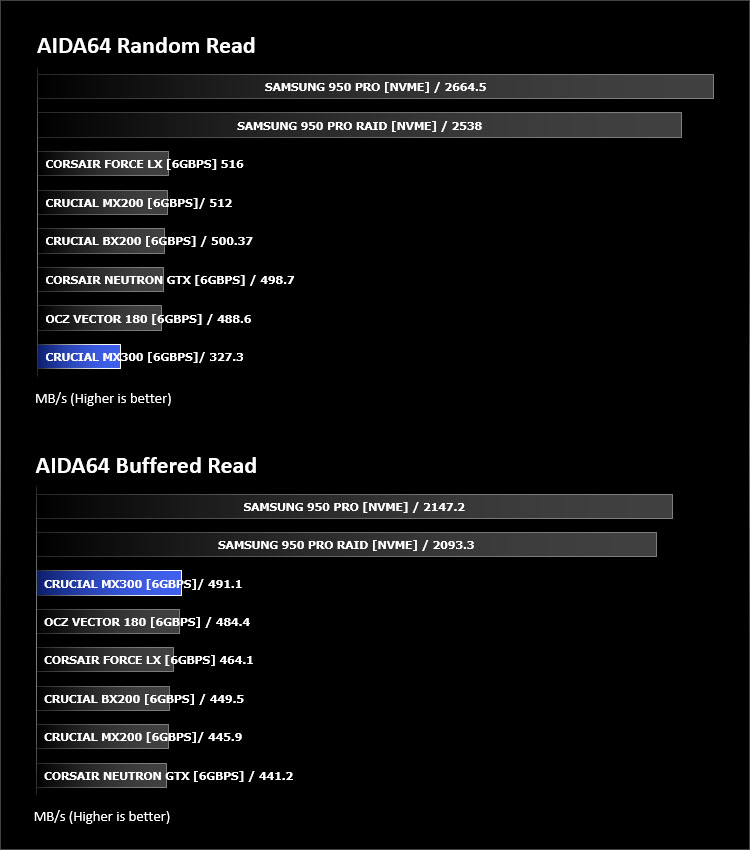
As you might expect the NVMe-class Samsung 950 Pro dominates in this particular test, but even compared to other SATA 6Gbps drives the MX300 takes a precipitous hit to its Random Read scores.
The MX300 bounces back in Random Writes, leading the pack of SATA 6Gbps behind the substancially more expensive NVMe counterparts.
Conclusion
With both Samsung and Toshiba releasing their specific implementation of 3D NAND earlier this year it was only a matter of time before Micron joined them, and in the long term these developments should prove to be a boon for consumers as they offer better value and long-term durability. The question is if Micron’s debut 3D NAND product can live up to the performance expectations of the MX brand.
The picture on the performance front is decidedly mixed. Throughout we saw Random and Sequential Read scores substantially below par compared with competing 2.5″ SSDs – including Crucial’s own value-oriented BX200 drive – and yet Random and Sequential Writes were generally ahead of the curve. This is most clear in our AIDA64 results, but also makes an appearance in other synthetic benchmarks. Only PCMark 8 bucks the trend, indicating exemplary performance in ‘real-world’ situations that the tool has been built to emulate.
It’s no secret that Crucial delayed the launch of the MX300 after early indications of poor performance ahead of an expected launch last month, and we wouldn’t be surprised to see post-launch firmware updates for the MX300 to address this relatively inexplicable weakness.
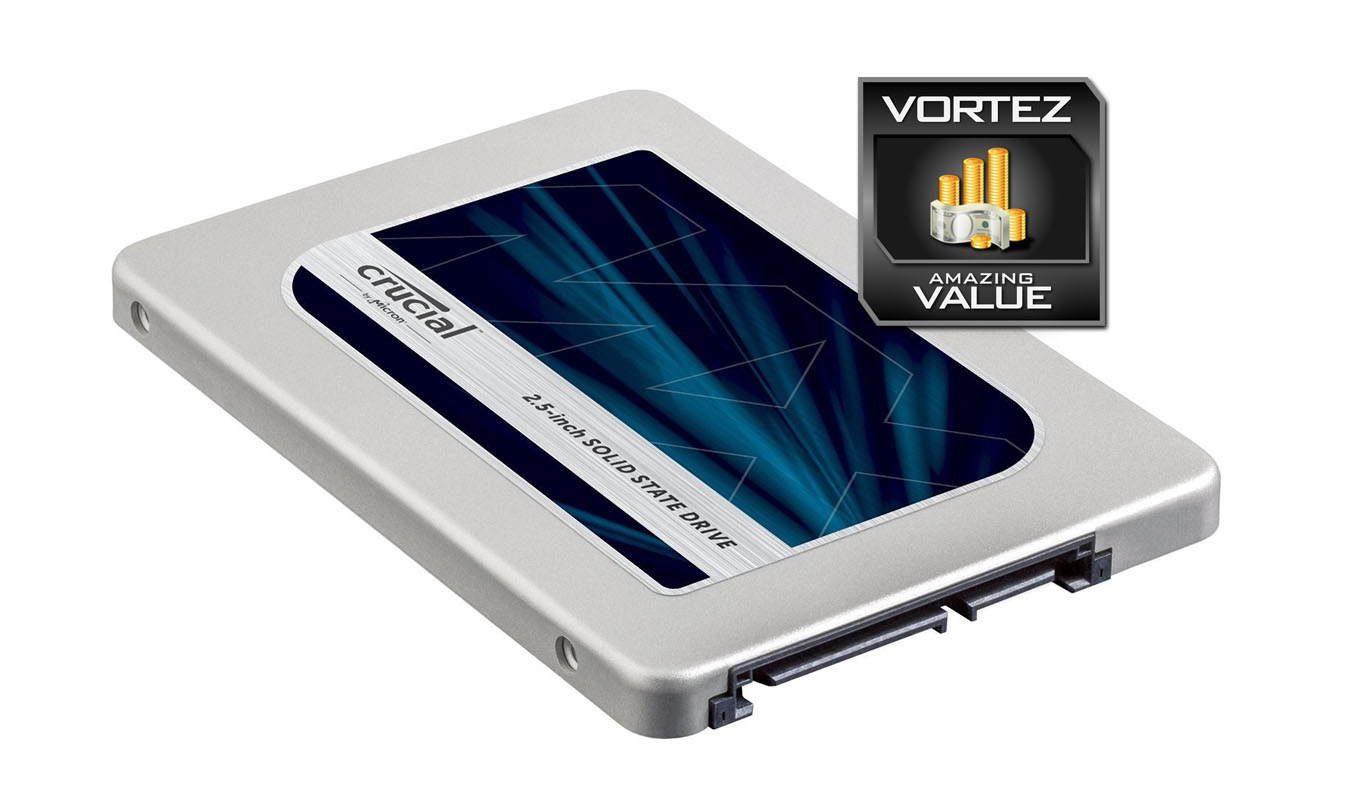
The other part of the equation for storage is value for money, and it’s here where the MX300 sees a large boost to its profile. Coming in at an MSRP of $199.99, and available for a touch less than £165 inc. V.A.T. in the UK, it’s by far one of the more affordable high-capacity SSDs currently on the market. Despite the introduction of new 3D NAND technology from Micron it achieves its chief aim of making this storage more affordable, and whets the appetite ahead of an anticipated 2TB version later this year. Presupposing improved write durability in the transition to 3D NAND, something that’s beyond a launch review test lineup, the MX300 is well placed in the market.
Crucial’s MX300 is a good value proposition with great write speed for a SATA III SSD, but poor read speeds. Crucial’s record for firmware updates is a good one and so we would expect lingering problems to be addressed, but at this time we can only commend the drive based on solid value for money on a GB/£ basis.
Pros:
– Ubiquitous form factor
– Good Sequential & Random Write scores
– Good value for money for capacious SSD storage
– Micron 3D NAND should offer better long-term write durability
– Promising technology for still higher capacity SSDs
Cons
– Poor Random & Sequential Read scores
– Ubiquitous form factor
– Good Sequential & Random Write scores
– Good value for money for capacious SSD storage
– Micron 3D NAND should offer better long-term write durability
– Promising technology for still higher capacity SSDs
Cons
– Poor Random & Sequential Read scores
Click here for an explanation of our awards at Vortez.net.