EPOS returns with a new wired gaming headset lacking the Sennheiser name but advertising crystal-clear audio and a studio-quality microphone. But does it live up to the hype, and it’s pedigree?

Product On Review: H3 Onyx Black Wired Gaming Headset
Manufacturer: EPOS
MSRP: £109 inc. V.A.T.
Some brands are new to the game, others have decades of pedigree in design to draw from. It’s rare to find one that fulfils both criteria but EPOS is just such a brand.
The company evolved out of a longstanding relationship between Sennheiser Electronic and Demant, leading to the effective end of the Sennheiser name in consumer audio. EPOS would retain the old Sennseiser Communications hardware portfolio – now maintained under the legacy EPOS|Sennheiser banner – but also develop new products under their own direction sold under their name alone.
Sennheiser was a legendary name in consumer audio, offering not only high quality premium and enthusiast solutions that leverage professional-grade know-how, but also a wide range of mainstream headsets and more with excellent audio at respectable costs. EPOS therefore have a lot to live up to.
We were deeply impressed with the GAME ZERO headset in June 2020, and more recently came to appreciate the strengths of the GTW 270 Hybrid wireless earbuds. Today we’re treating our ears to the H3, a stereo gaming headset for PC and Console that slips in under £110 and aims to offer premium audio output and crisp microphone pickup in a comfortable lightweight package.
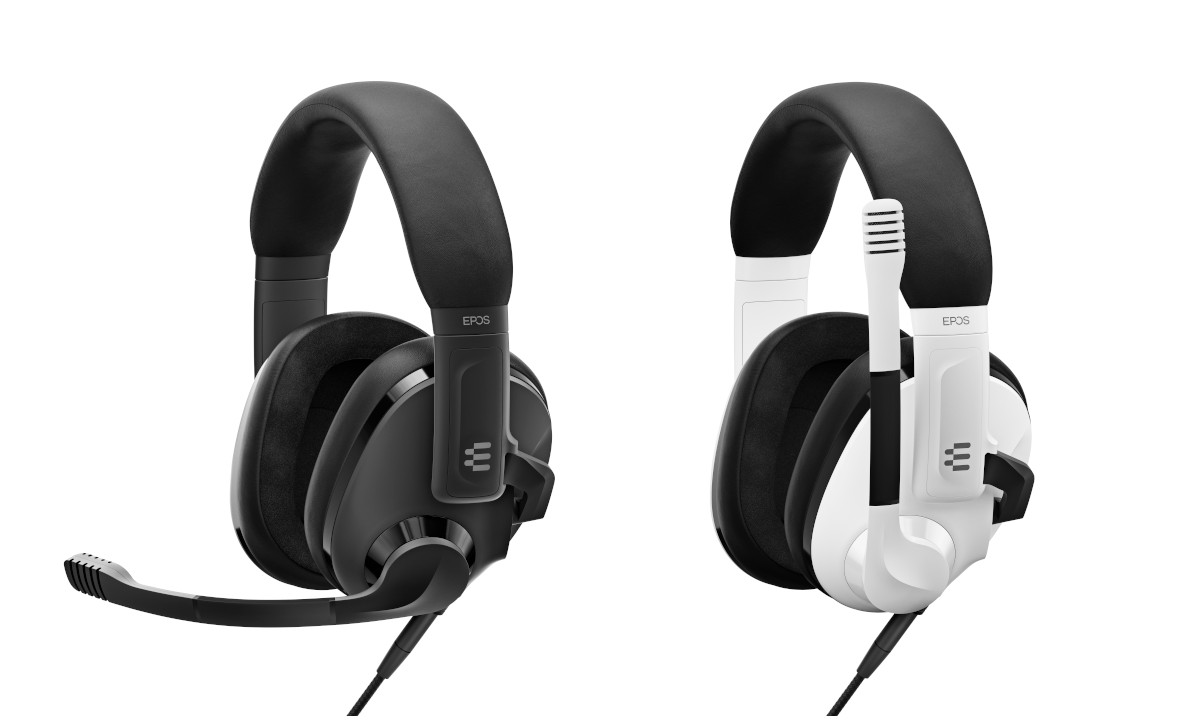
The EPOS H3 in Onyx Black (left) and Ghost White (right)
In form the H3 headset is familiar. Attached to a spring-steel band are two closed-back ear cups, featuring an articulated microphone on one and integrated volume dial on the other. A detachable cable connects headset to audio source, with a choice of cables appropriate for PC, XBOX, Playstation and Nintendo Switch. But primarily there is a clear emphasis placed on comfort thanks to lightweight construction and plush cushioning throughout. From a broad overview therefore it’s ticking the right boxes.
Of course, EPOS will not have it all their own way. The space between £90 and £110 is packed with high quality headsets from Razer, Corsair and Steelseries, each with a brand reach that (for now) goes beyond that of EPOS. And awaiting any slip-up are HyperX’s suite of Cloud headsets, including their well-respected Revolver model. Resting on their laurels and past successes certainly won’t be an option.
The EPOS H3, in Their Own Words:
The EPOS H3 is now available in Onyx Black and Ghost White color variants via eposaudio.com/gaming and from select retailers at a suggested retail price of £109.
Technical Specifications
Models:- Onyx Black, Ghost White
Weight:- 278g (no cable)
Ear coupling:- Around ear
Transducer principle:- Dynamic, closed
Connector plugs:- 2 x 3.5mm / 1 x 3.5mm (GSA 30 PC Cable/GSA 30 Console cable)
Cable length:- 2m (GSA 30 PC Cable), 1.4m (GSA 30 Console Cable)
Compatibility:- PC, Mac OSX, PS4, PS5, Xbox One, Xbox Series X, Switch and consoles with 3.5mm jack input
Warranty:- 2 years
Headphones
Frequency response:- 10 – 30,000 Hz
Impedance:- 20 Ohm
Sound pressure level:- 124 dB SPL @ 1 kHz, 1V RMS
Microphone
Frequency Response:- 10 – 18,000 Hz
Pick-up Pattern:- Bidirectional
Sensitivity:- -47 dBV/PA
Exploded view of the H3 internal components
Packaging and Bundle
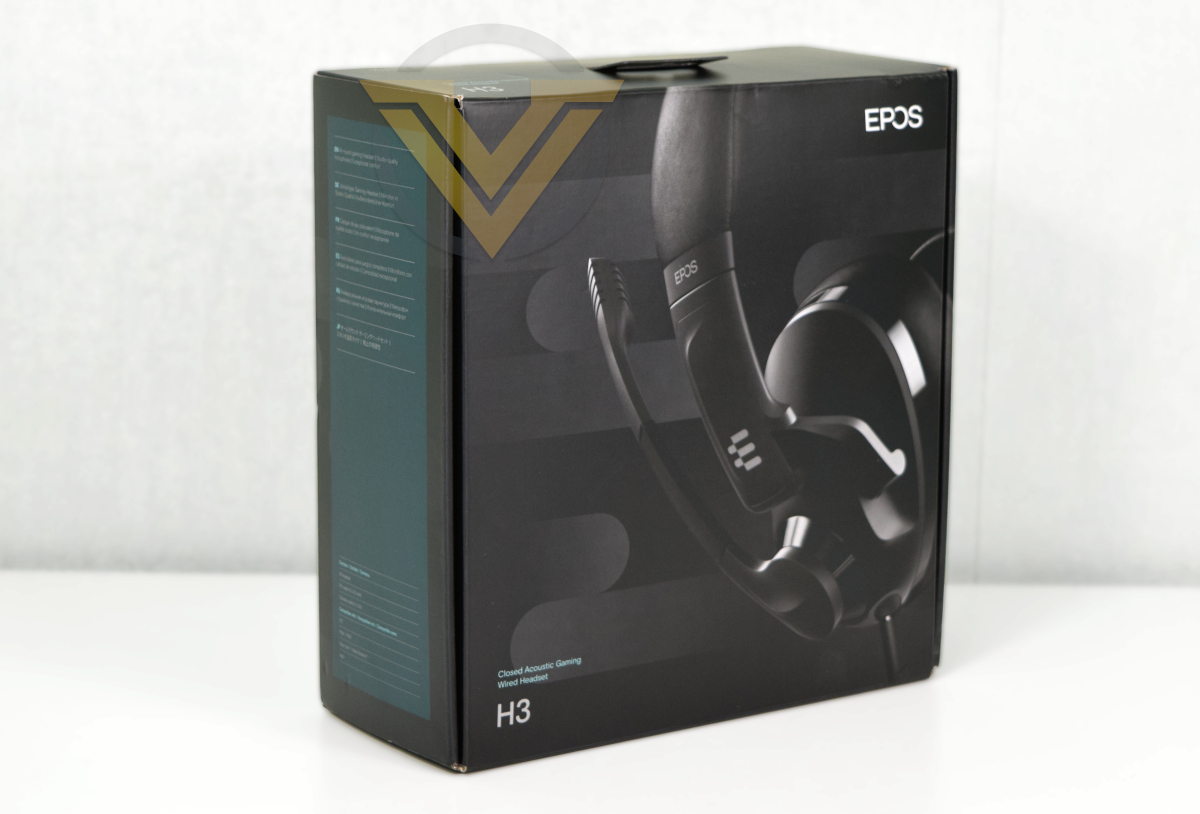
EPOS are trying hard to be understated with the H3, packaging it in an all-black box that turns its back on the bright colour convention of gaming headsets. You do however get a side-shot of the headset, presenting both the microphone and left ear cup, of this not particularly discreet gaming peripheral.
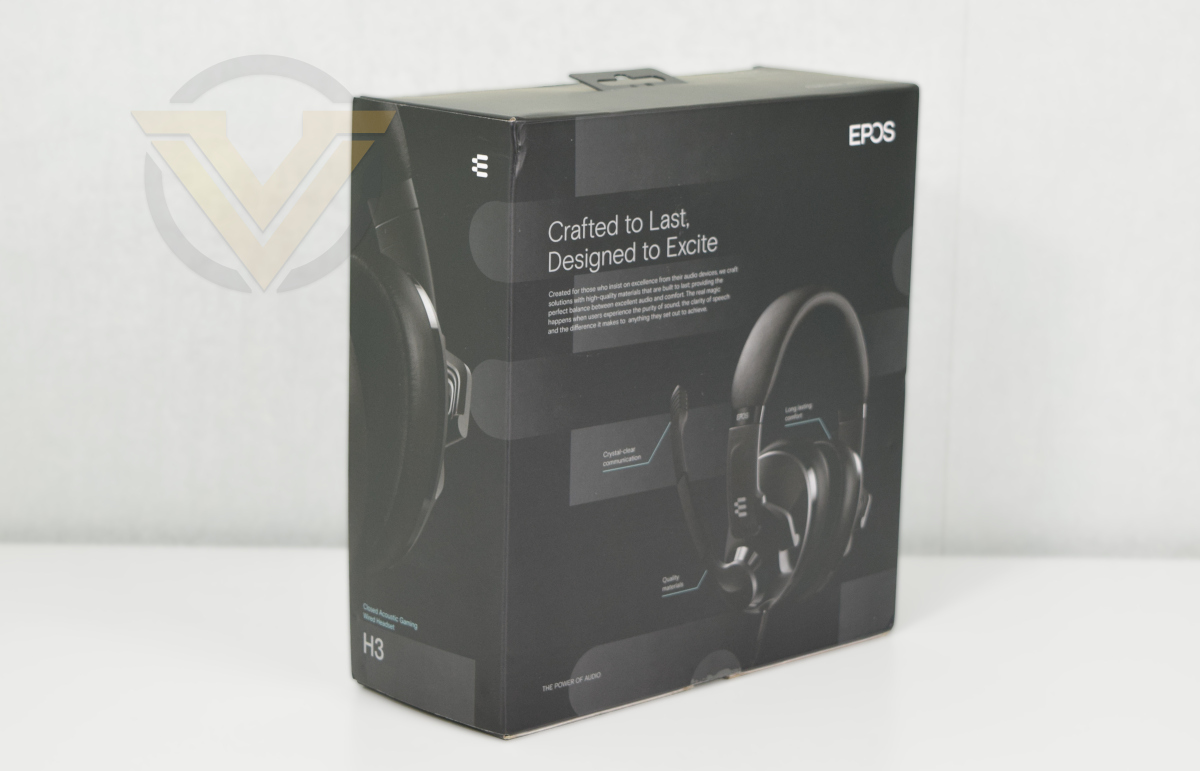
The packaging rear showcases the H3’s primary features: articulated microphone, thick ear pads and quality materials. It also fails to mention any technical details for the headset, including critical aspects such as compatibility information.
In fact, no-where on the exterior does the H3 break down the more technical information we would expect from a product in this market segment. While a surprise and disappointment, this could be a) pre-production packaging, or b) reflective of the fact that purchases are likely to be made online, where all the necessary info can be accessible in a more digestible form.
It does however have a QR code printed on the side that redirects to the product page.
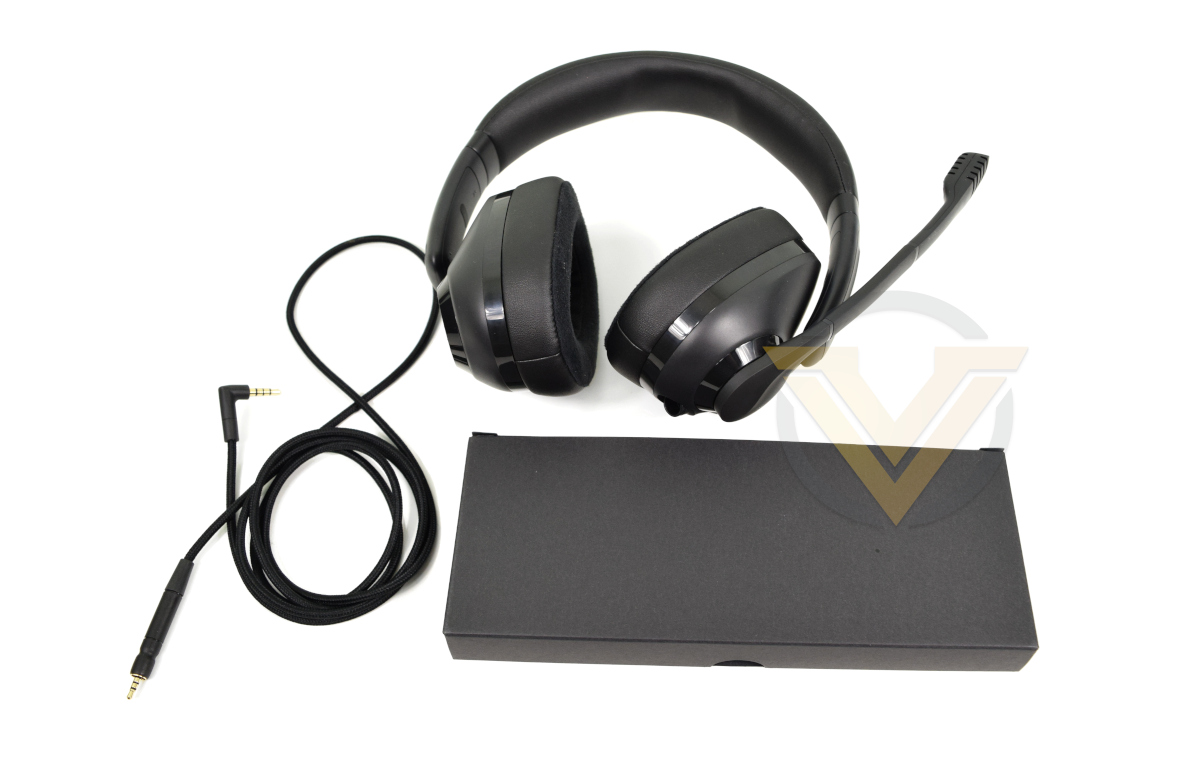
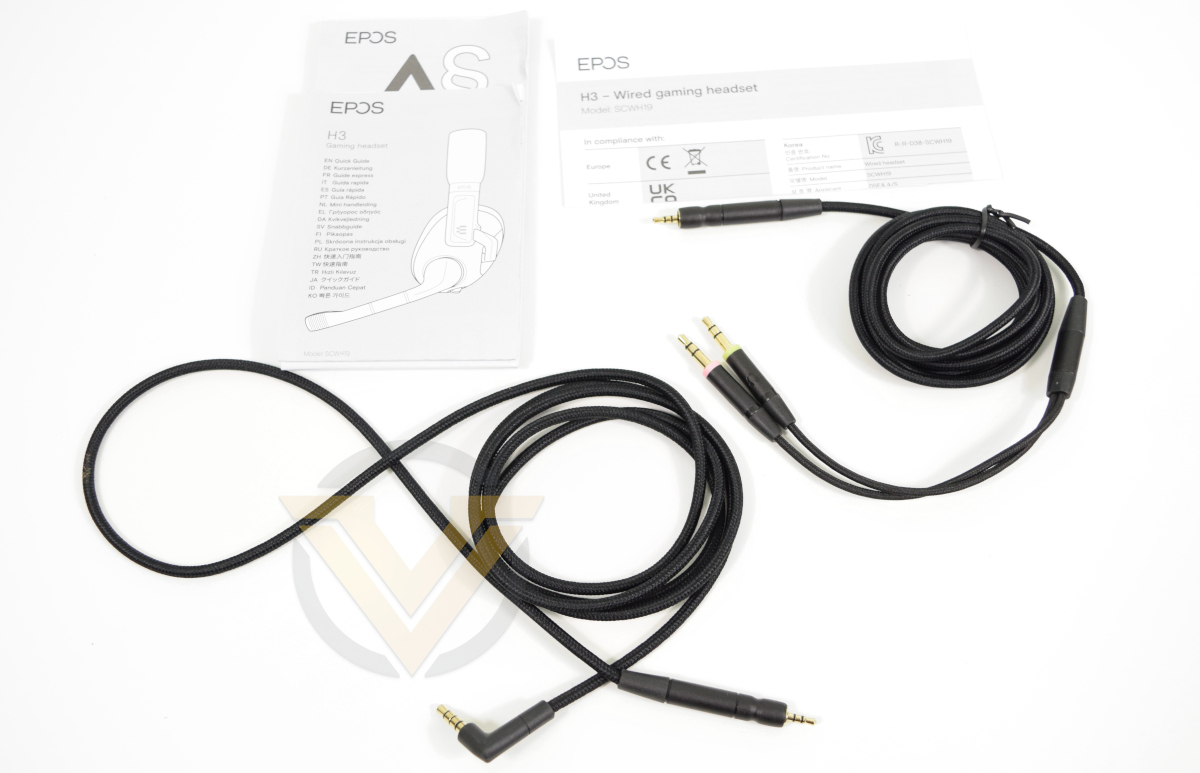
The H3 headset bundle is a modest one. It includes the headset itself, PC audio cable (with dual 3.5mm headphone and microphone jacks), Console audio cable (with 4-pole combined 3.5mm jack) and the usual paperwork consisting of warranty info and quick-start guide. Both cables are braided for greater long-term durability. The accessories and paperwork are packed away in a smaller box, preventing unintentional damage, and the headset itself sits within a foam recess.
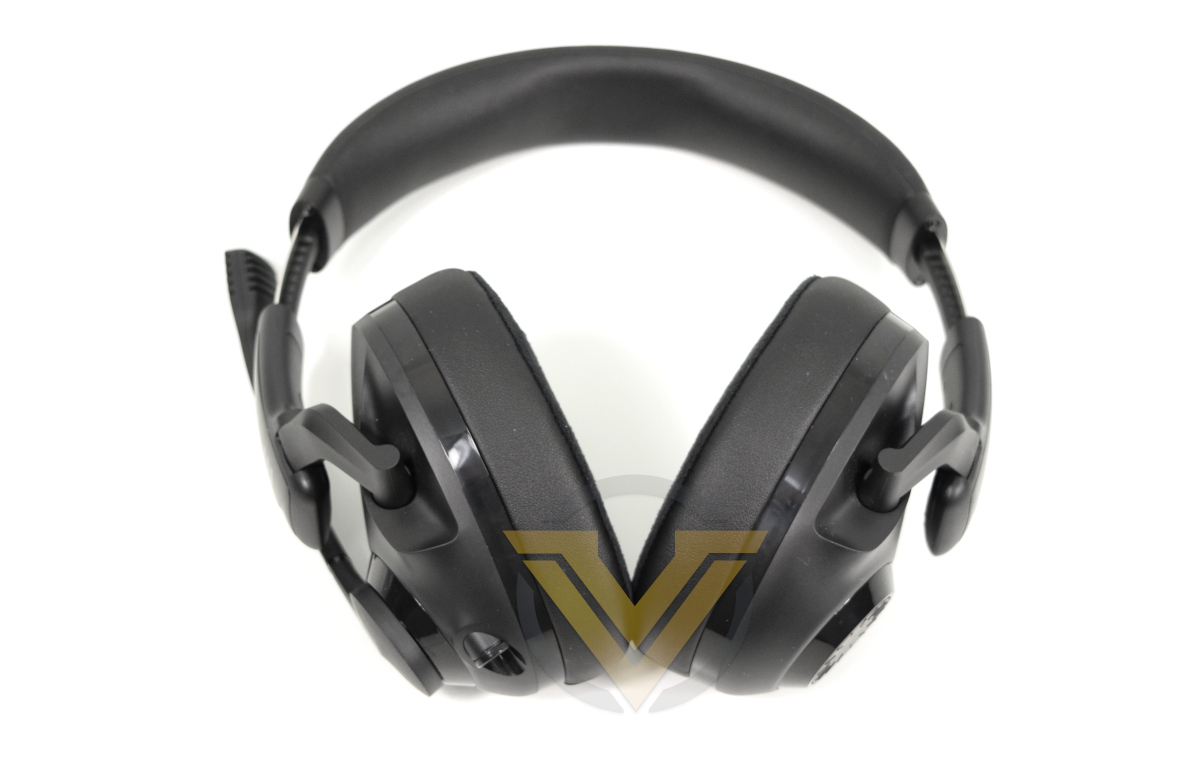
At first glance the H3 is rather conventional, but don’t be fooled; this headset has a few tricks up its sleeve.
Overall, it’s a nice unboxing treat without being over the top and the level of protection afforded the headset should be plenty to keep it out of trouble during shipping. Our only concern is that the foam insert isn’t necessarily the most environmentally friendly of packaging materials.
Closer Look
One of the more obvious non-standard features of the H3 is the arm that attaches the headband to the ear cup. On headsets within this price range it is usual to have one or two points of connection such that the cup can rotate about a single axis, helping it conform to the contours of your head. The arm on the H3 has two joints, offering limited freedom on two axes rather than one that should allow the cup to conform even more closely to your head.
The left-hand cup houses both the integrated microphone – which is neither removable nor replaceable by the user – and the audio cable socket. This socket is for a deeply recessed 2.5mm jack and will be incompatible with cables not on EPOS’s list of recommendations.
The microphone articulates down to a fair bit below the horizontal with a stiff action, making it unlikely to slip out of place when in use. There’s an audible click when it is active (about 30 degrees down from the vertical), so you can mute it simply by raising it up to the top. The middle section of the arm has some flexibility, giving the microphone limited pose-ability.
The cup itself is also angled from the horizontal, orienting the opening in the foam ear pad to be more suitable to the majority of ears.
The headset band is reinforced with steel, ensuring some flexibility in its support. The cups can be pulled down the headband up to 4cm on either side, with the band itself detailing ‘levels’ which you can make a note of and re-use once you’ve found your preferred setting.
The right-hand cup appears bare at first glance but in fact houses a rotary dial volume control. This control doesn’t affect microphone volume, just the speakers.
A thick foam pad is attached to both cups that isn’t of uniform construction. The surface of the pad that can be seen when worn is a faux leather, attached to which is a suede-like material. The inner lining is a breathable fabric that should help to minimise sweat build-up. Memory-foam fills the interior, while a rigid plastic base keeps it attached to the ear cup via a series of clips. These foam pads can be removed to clean and are replaceable in the long run.
EPOS have dispensed with the black/red livery of the GAME ZERO in favour of a slightly more professional black with grey tones, while a predominantly white ‘Ghost White’ version is also available (shown below). They also haven’t strewn the H3 with RGB lighting or other excesses common to gaming headsets today, making it quite the catch for those who want to eschew the garish ‘gamer aesthetic’.
Performance
To begin, the EPOS H3 requires no special software or hardware to use. Simply plug it into a spare set of 3.5mm audio ports (on a chassis front panel for convenience sake, or a dedicated DAC if your setup is more high-grade) and use straight away. Tweaking EQ levels will require 3rd party software tools but, given the state of some software bundled with otherwise excellent audio hardware, you’ll probably find it to be more of a boon rather than drawback.
In contrast to some other headsets the first striking feature present on the H3 was the headband, but not because of how it looked. Reinforcement for this section of the headset can be exceptionally stiff on some models, in many instances forcefully squeezing your ears (and the arms of any spectacles) into the sides of your head, but that wasn’t the case with the H3. We’d be lying if we said that wasn’t an immediate relief.
The lack of compressive force keeping the headset in place also means that it’s relatively easy to shake the headset off, so it’s best to hold off on the headbanging movements if not the headbanging tunes.
Each ear pad sits comfortably, enclosing the majority of the ear and gently matching the contours around each. Larger ears may just reach the fabric surface inside the >2cm cavity which covers the speakers, but the pressure on them should be quite low. We found that it sat comfortably around the main outer ear and on top of the lobe.
We’ve not experienced sufficient lightweight headsets to make a strong qualitative judgement on the H3’s lightweight credentials, but it’s certainly not so light that you’d forget it’s even there, which is a hallmark of some truly light wireless headphones. It is however considerably lighter than many gaming competitors despite an integrated microphone, which makes longer gaming sessions far more bearable.
The audio output by the H3 is good, but didn’t blow our socks off. Our subjective experience was that it had a slightly narrowed sound stage that emphasised mid-tones and higher frequencies over a meaty punchy bass. Stealthy games, with subtle sound design (see: Dishonored) offered the best match; high-octane titles with bass-heavy soundtracks and booming explosions (such as DOOM Eternal) didn’t resonate in the same way. You still get those tones, but they don’t quite rock your jaw to the extent they might. High hat notes also weren’t quite as sharp as you might expect, almost sounding like they had very slight distortion.
There is a beneficial trade-off however. Vocals, particularly voice comms, cut through ambient in-game music clearly and crisply rather than getting drowned out in the mush of background bass and reverb. This aspect of the headset will be critical in its viability for multiplayer gaming, which can run the gamut of quiet FPS round combat to the busy soundscape of an MMO raid encounter.
The headphones had clearly audible and consistent responses in a frequency sweep from 20Hz to 13kHz; higher frequencies may sadly be beyond my poor ears capability to hear as they’re now deep into their 30’s. Stereo separation was good, making in-game audio suitably directional.
Another experiential positive was that we experienced no low-frequency noise from the headset when simply on, which can be an annoying characteristic of some headsets. You can however still hear the cable rubbing against your arm/clothing (as vibrations travelling through the socket), a problem that hasn’t been solved in this model.
One curious discovery was that the integrated volume dial didn’t actually mute the headset audio at its minimum setting. Nor did it even limit output to ‘barely audible’ levels. It’s just enough to help you hear someone speaking to you in your immediate environment (i.e. your room) while still keeping track of in-game sound/music.
Speaking of your immediate environment, sound isolation on the H3 is excellent. Even when belting out music at levels uncomfortable to hear it’s effectively inaudible over ambient sound (from case fans for instance) from 1m away.
Microphone
EPOS make the bold claim that the H3 is equipped with a studio-quality microphone. Without such a microphone to hand we instead compared it to our trusty RODE NT-USB, a discrete microphone we’ve used in the past for video review voice-overs.
The microphone was angled to be just in front of the mouth. Boost levels were set to +10dB in Windows 10 audio settings, and recorded volume was set to maximum in Audacity, the free-to-download audio capture software used in this test.
In general voice clarity is good, exhibiting only a little to the compression effect common to headset microphones. ‘S’s and ‘P’s don’t hiss and pop aggressively when speaking at normal volumes, from which we infer that it has particularly good filtering for an integrated microphone.
Typing on a mechanical keyboard, despite being somewhat suppressed, was still clearly audible through the microphone. More low-level environmental sound was less audible, particularly case fan noise and street noises. In-game audio also didn’t bleed into the microphone response.
Although well outside of the normal testing procedures, we did notice some strange audio artefacts when raising the microphone arm to its ‘off’ position. We couldn’t tease out exactly what was causing it, but would caution not to up the gain too high on this headset just in case these artefacts are transmitted over comms.
Conclusion
The trend of high quality EPOS audio hardware continues with the H3, a gaming headset that rivals any within the same price window and may pose problems for some models higher in price but lower in value. While not by any means revolutionising the market, each aspect is competently and confidently implemented for an overall design that slightly emphasises comfort over audio reproduction.
Default equalisation biases a little towards the higher ranges, trading off a thumping bass response in favour of better clarity for high and mid tones. That’s important for multiplayer gaming for many reasons, but particularly in cutting through immersive game sound with clear person-to-person comms.
One criticism however is the amount of noise transmitted through the cable rubbing and banging against other objects and surfaces. It can be distractingly loud, particularly compared to more subtle sounds, and very much detracts from the overall experience whether gaming or simply listening to music.
Speaking of comms, the microphone EPOS implemented is a creditable addition to the H3. While the telltale compression of a headset microphone is still present, it’s much less aggressive in this instance and so your voice comes through exceptionally clearly. We’re not quite sure it comes through as truly ‘studio quality’ as described in the marketing, but it’s certainly a cut above the usual fare even at the upper bounds of the £90-£110 price point. Third party equalisation tools can, of course, also be used to generate a richer sound if desired.
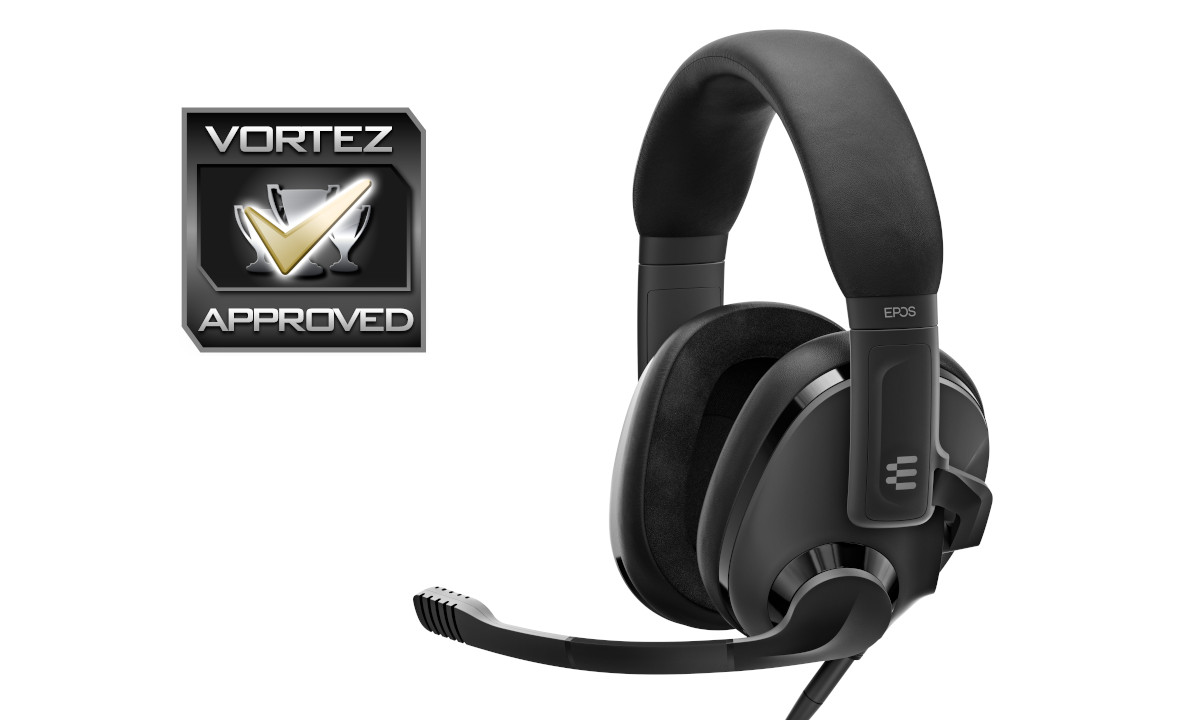
The H3 is also one of the more comfortable headsets we’ve come across, and not just because of the cups’ plush oversized foam pads. EPOS have designed an articulation for the cups that gives it an additional degree of freedom, helping the headset conform to the shape of your head just a little better. Furthermore, it weighs in at just 278g, over 100g less than some competing designs.
Another factor in the positive overall review is that some components can be replaced as necessary. The microphone is integrated, but both ear pads and cables can be bought separately as replacements if required by heavy use.
And finally, those with games consoles will be able to also take advantage of the option of dual 3.5mm headphone/mic jacks or a single 4-pole 3.5mm headset jack depending on the console used. It’s a simple addition that’s oftentimes overlooked by headset manufacturers chasing lower costs.
The EPOS H3 is another design that’s a credit to their growing range of headsets, and one formally separates itself from its Senneheiser past without losing out on quality. Comfortable and with very good audio microphone quality, it’s definitely one to look out for at an MSRP of £109.
+ Comfortable
+ Lightweight
+ Good audio output
+ Great microphone
+ Selection of connectors
+ Console and PC compatible
+ Replaceable cable and ear pads
Cons:
– Not premium, but not inexpensive
– Noise transmitted through cable + housing when rubbing against clothes/other objects
– Lack base punch
Stay connected with Vortez social media pages: