Equipped with a custom design, Gainward give the GTX 1060 their Phoenix Golden Sample treatment; utilising a dual-fan cooler and factory overclock.

Product on Review: GTX 1060 Phoenix GS
Manufacturer & Sponsor: Gainward
Street Price: UK: £299.99 GBP / US: $280
Gainward was founded in Taipei, Taiwan all the way back in 1984 and became an NVIDIA partner in 2001; proving they are no stranger to the manufacturing of computer products and more specifically graphics card technology.
Following on from the myriad of NVIDIA 10-series launches, Gainward has been on-hand to provide gamers with their take on this fresh lineup of GeForce GTX graphics cards and today we’ll be exploring the delights of their newly released GTX 1060 Phoenix Golden Sample.
In the spotlight today is the GTX 1060 Phoenix GS. Gainward’s Golden Sample cards have been the mainstay through many generations and are representative of the brands best offering. The graphics card we’ll be looking at today features a custom design with a dual-cooling fan configuration, as well as a factory overclock taking the GPU to just 7.5% over the reference settings. Will a tame overclock to the GPU and a reluctance of any memory overclock still deliver good results? Let’s find out!
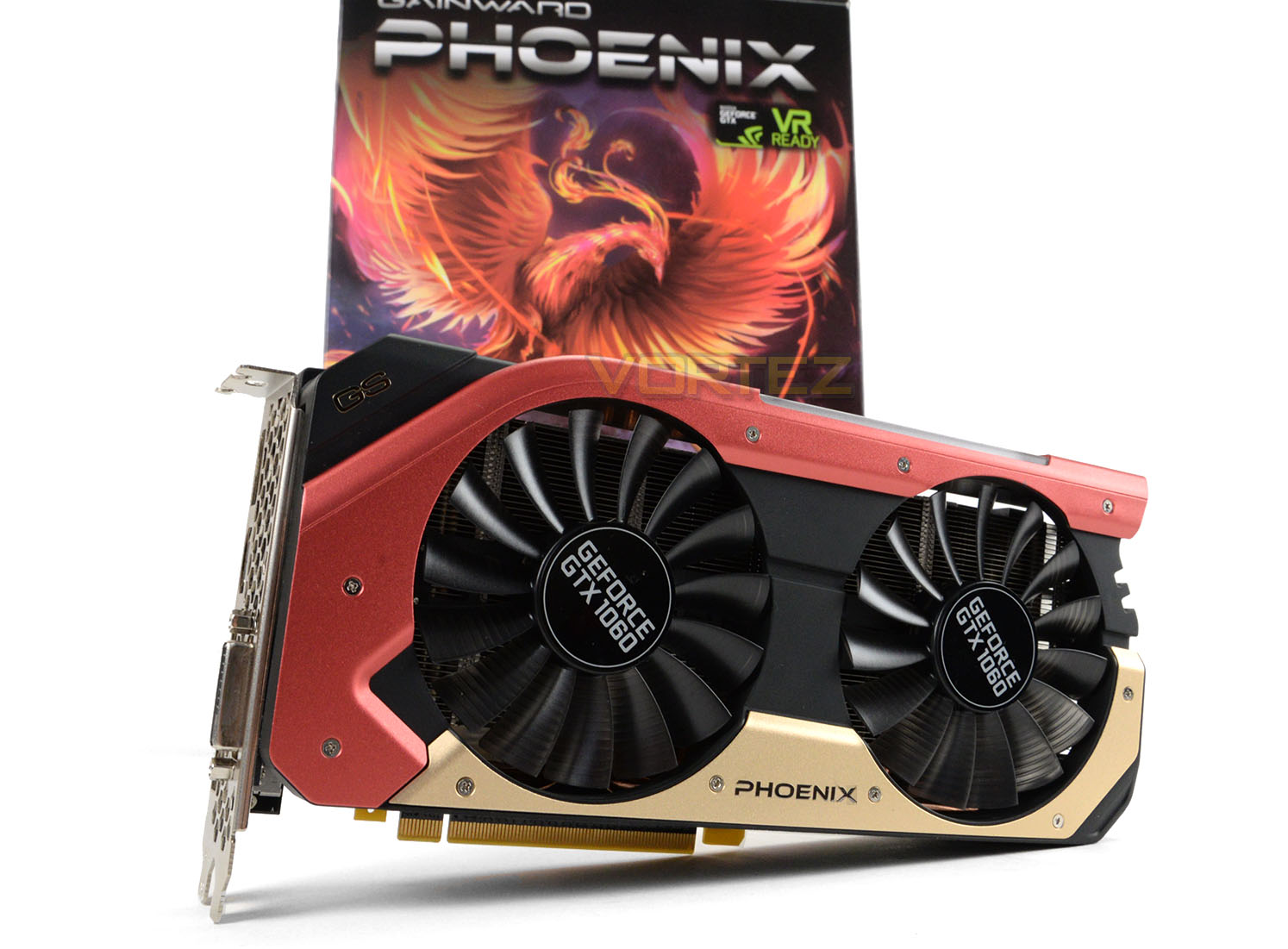
Gainward on their GTX 1060 Phoenix GS
The Golden Sample 1060 is Gainward’s top Phoenix 1060 card. It boasts higher base and boost speeds then previous versions as well as bonus features, and as is standard on Gainward 1060s it is compact with clever game enhancing technologies. Despite this GTX 1060’s speeds being set above prior versions it is still capable of being pushed even further through overclocking. This card is great for users who like to benchmark or simply enjoy seeing every little detail in crisp condition.
Technical Specifications
Below are the technical specifications supplied by Gainward:Chipset
GeForce GTX 1060
Digital max resolution
7680×4320
Core Clock
Base: 1620MHz
Boost: 1847MHz
Memory Clock
8.0 Gbps
Process Technology
16 nm
CUDA Cores
1280
Memory Size
6GB GDDR5
Memory Bus
192-bit
Card Bus
PCI-E 3.0
Memory Type
GDDR5
DirectX
12
OpenGL
4.5
PCB Form
ATX
Multi-view
4
I/O
1x Dual-link DVI-I
1x HDMI 2.0
3x Display Port 1.4
Suggested Power requirement
400W (8-pin external power connector)
Card Size
248mm x 123mm
GeForce GTX 1060
Digital max resolution
7680×4320
Core Clock
Base: 1620MHz
Boost: 1847MHz
Memory Clock
8.0 Gbps
Process Technology
16 nm
CUDA Cores
1280
Memory Size
6GB GDDR5
Memory Bus
192-bit
Card Bus
PCI-E 3.0
Memory Type
GDDR5
DirectX
12
OpenGL
4.5
PCB Form
ATX
Multi-view
4
I/O
1x Dual-link DVI-I
1x HDMI 2.0
3x Display Port 1.4
Suggested Power requirement
400W (8-pin external power connector)
Card Size
248mm x 123mm
Packaging & Bundle
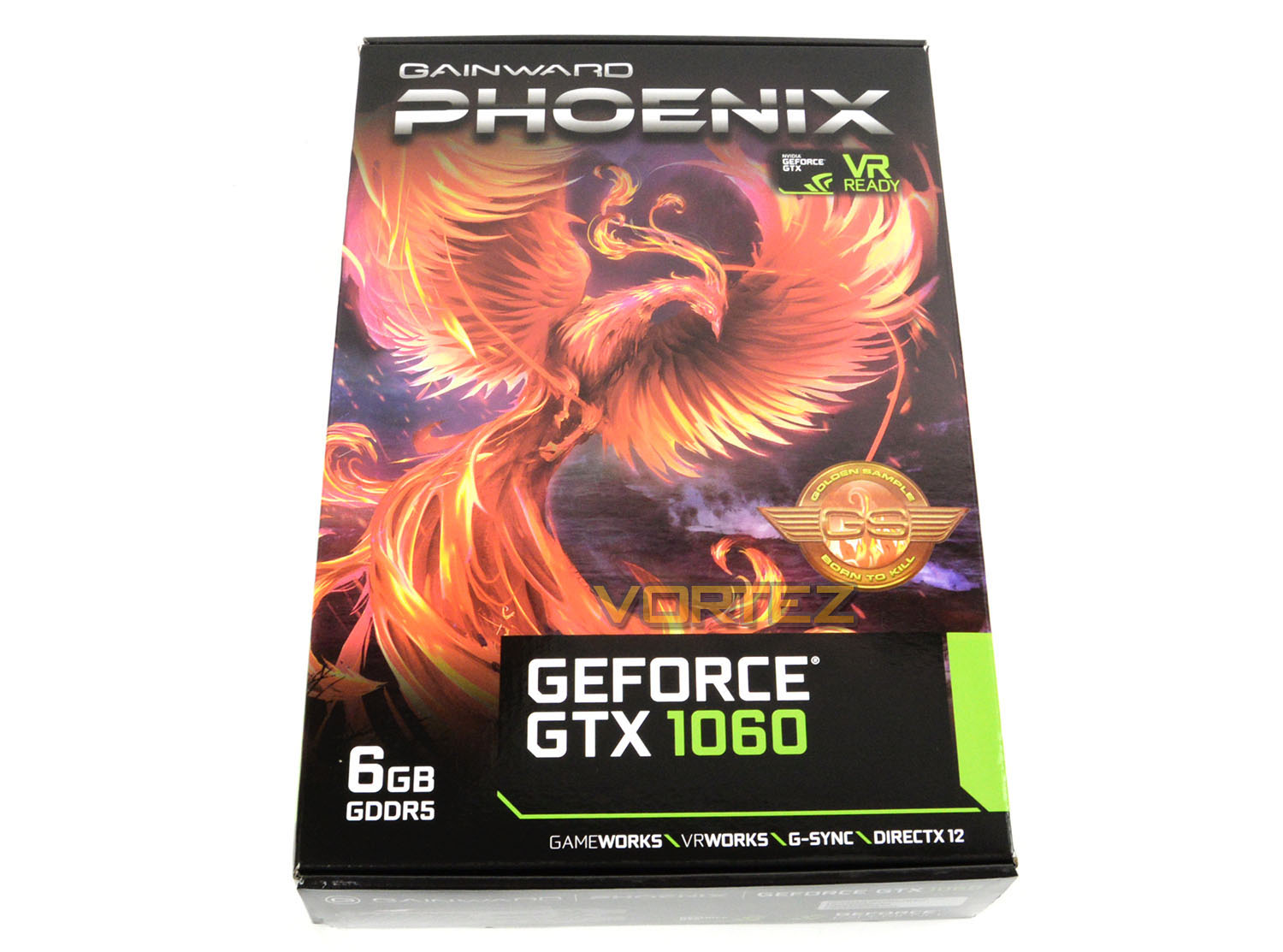
Since we’re dealing with Gainward’s Phoenix product line, our graphics card comes packaged with the respective livery. The front features some impressive Phoenix artwork while over on the reverse there is a break-down of the integral features, including the technical specifications.
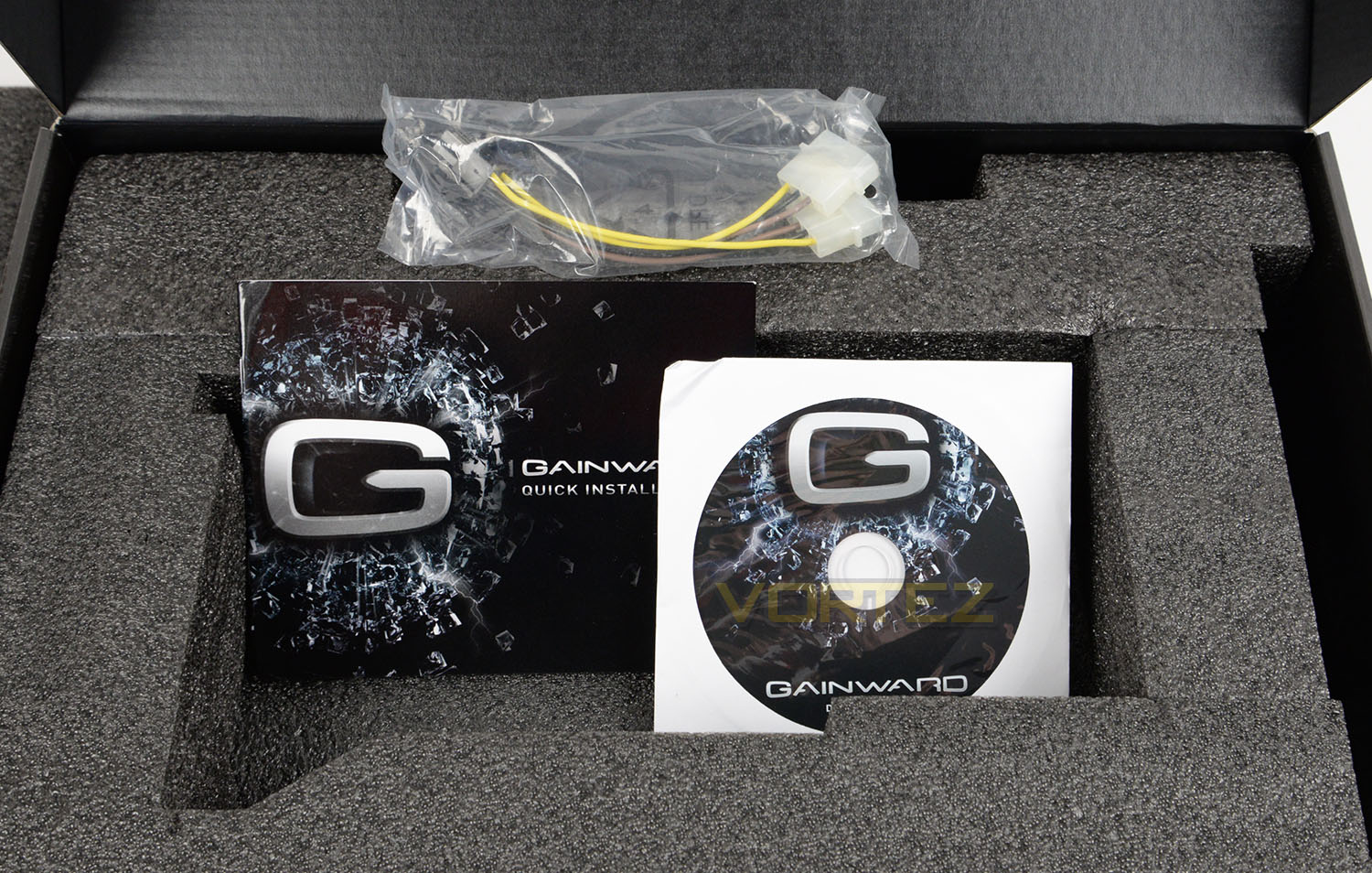
Inside, there is an inner box which contains the card within an anti-static bag and the accessories. The card is encased with some foam padding and there is a small assortment of bundled items. They are as follows:
• Driver/Software CD
• 1x Power Cables – Y-cable (6-pin to dual Molex)
• Installation Guide
Closer Look (With Cooler)
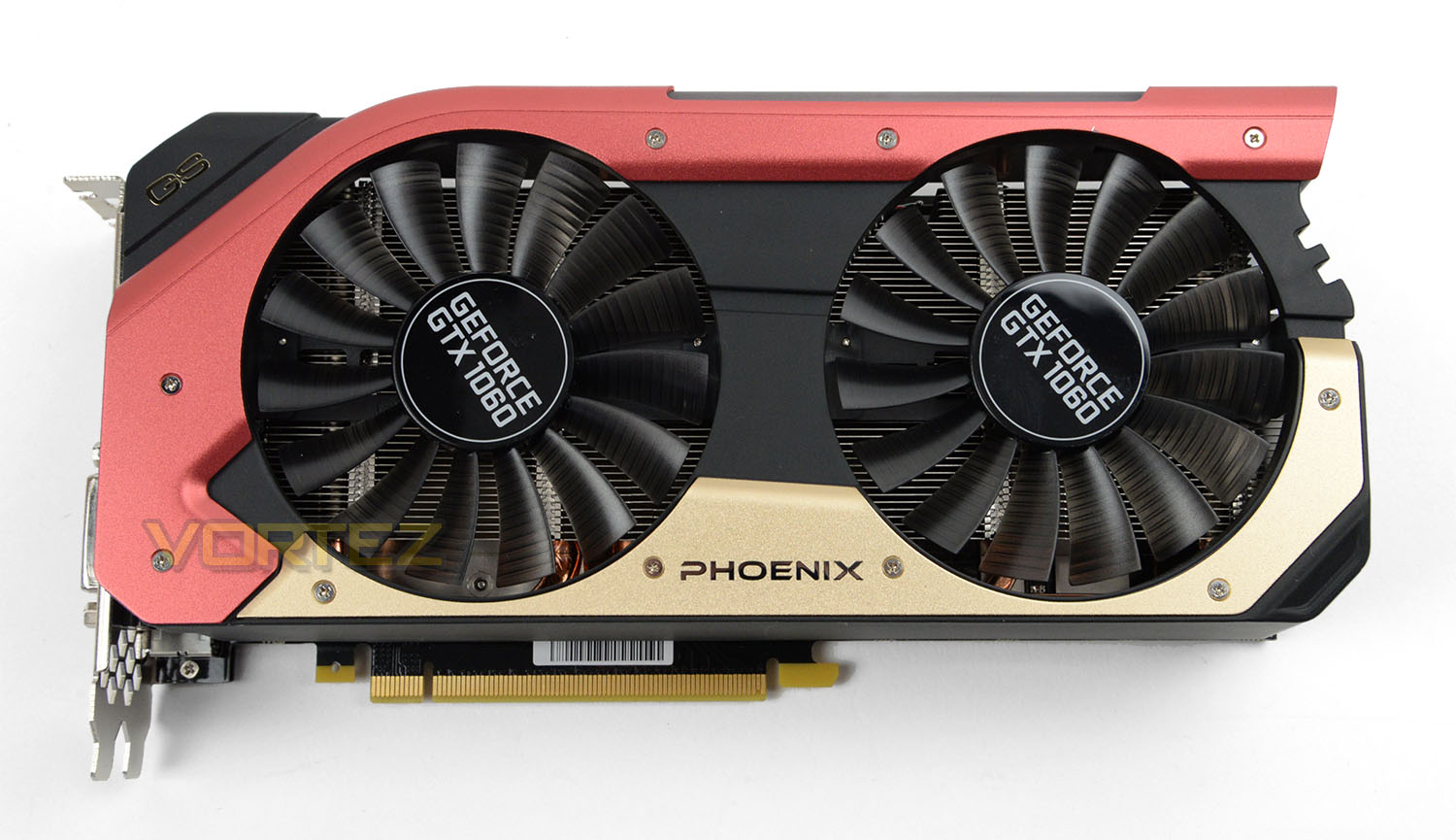
The basis for GTX 1060 Phoenix GS is their dual-fan cooling solution. This cooler surrounds the PCB and internal components and is the first thing which takes the attention.
Overall the design with its metal shroud looks stylish and is very distinct; rather than opting for a neutral theme Gainward has chosen to differentiate with a red/gold design which certainly stands out from the spate lineup of black/silver aesthetics we see from other vendors.
The actual size of this graphics card is: 248 x 123 mm, which is smaller than other GTX 1060s – meaning this card is likely to comfortably fit inside most computer cases.
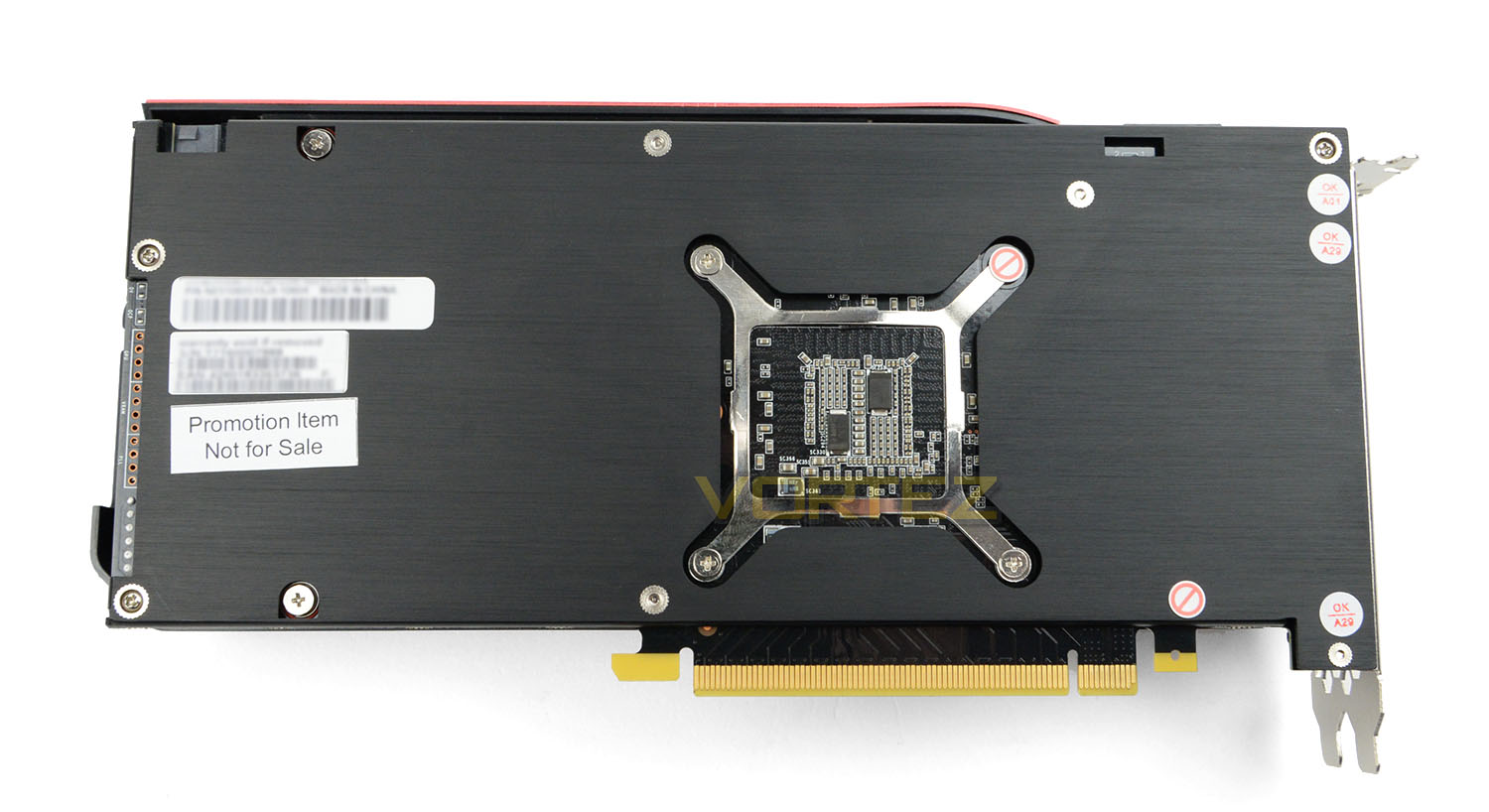
Flipping the card over, on the reverse we have a large steel backplate which protects the components on our graphics card and also prevents it from flexing or bending. Having such a feature on a graphics card is encouraging as it provides rigidity and prevents potential damage.
Gainward also provide a cut-out towards the top of this backplate where they have placed a dual-BIOS switch. This switch allows the user to choose between two different BIOS – so if a manual overclock goes pear shaped there is still an option to recover.
Note: removing the cooler will void the warranty – stickers cover the screws.
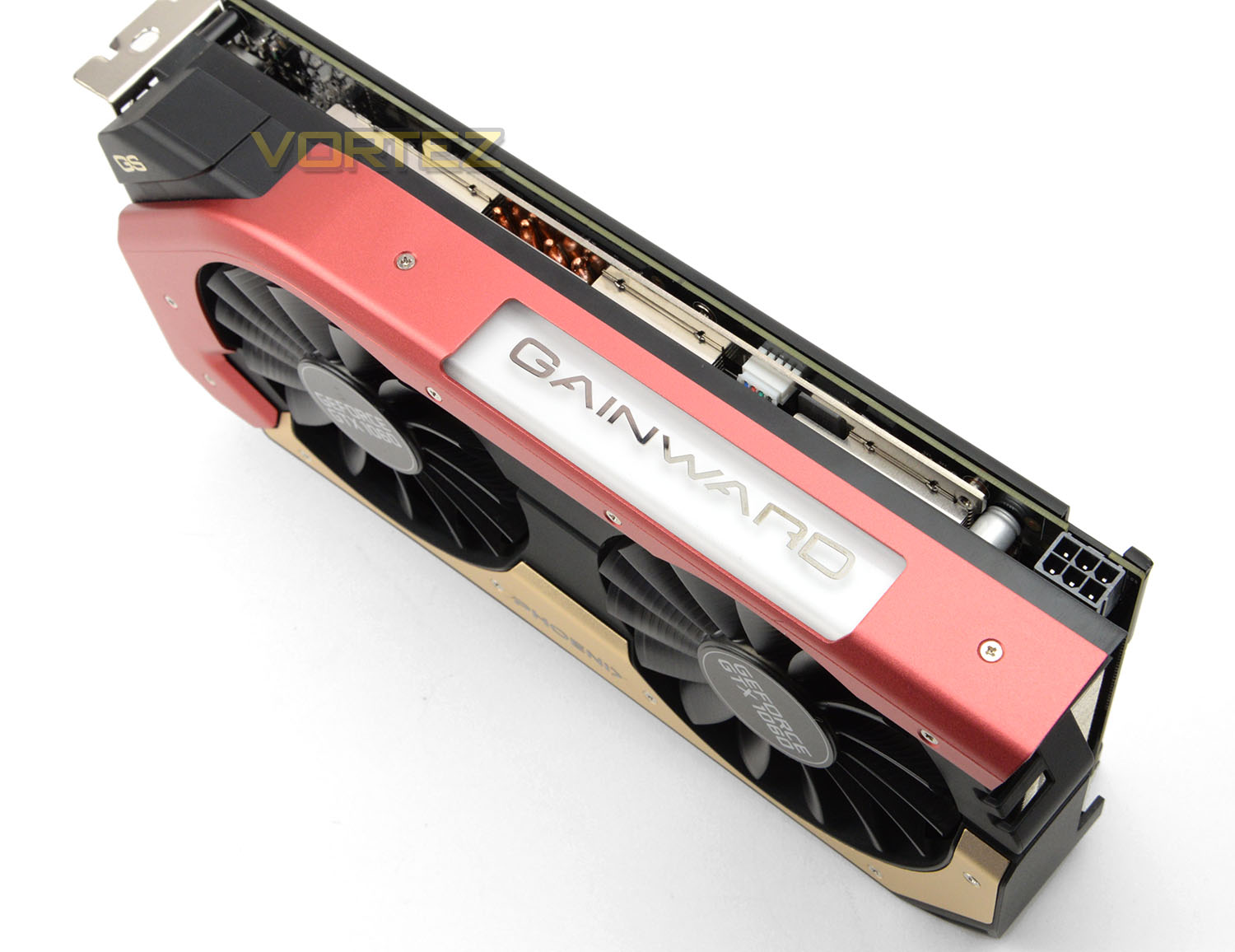
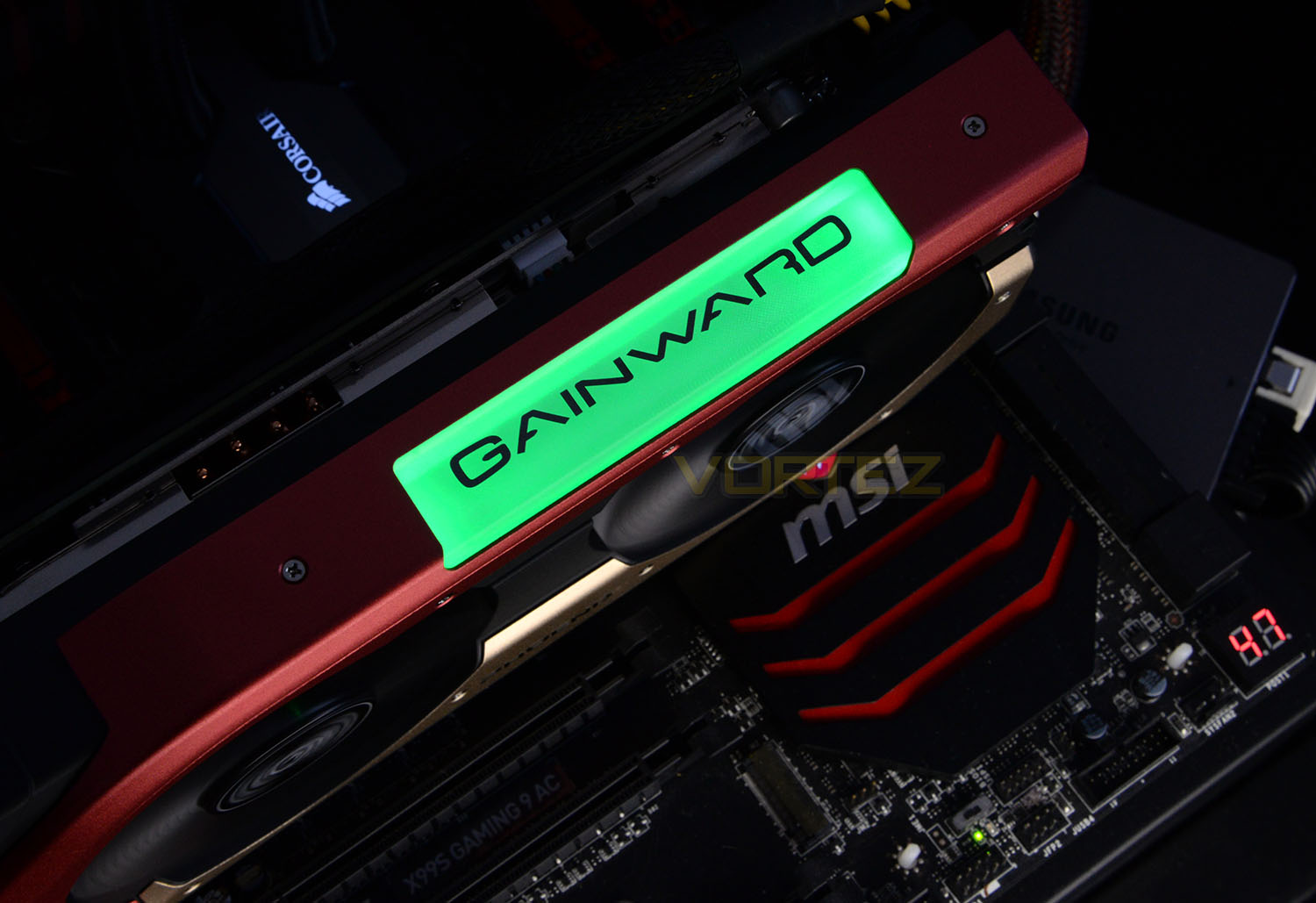
Phoenix GS arrive with a large LED strip which provides lighting to add some ambience to your system. This strip (which features the Gainward logo) have its colour modified via the ExperTool app. Different effects can be applied and if desired the LED can be disabled.
As the GTX 1060 has no SLI functionality our Phoenix GS also lacks this feature, so it isn’t possible to pair up with other GTX 1060s.
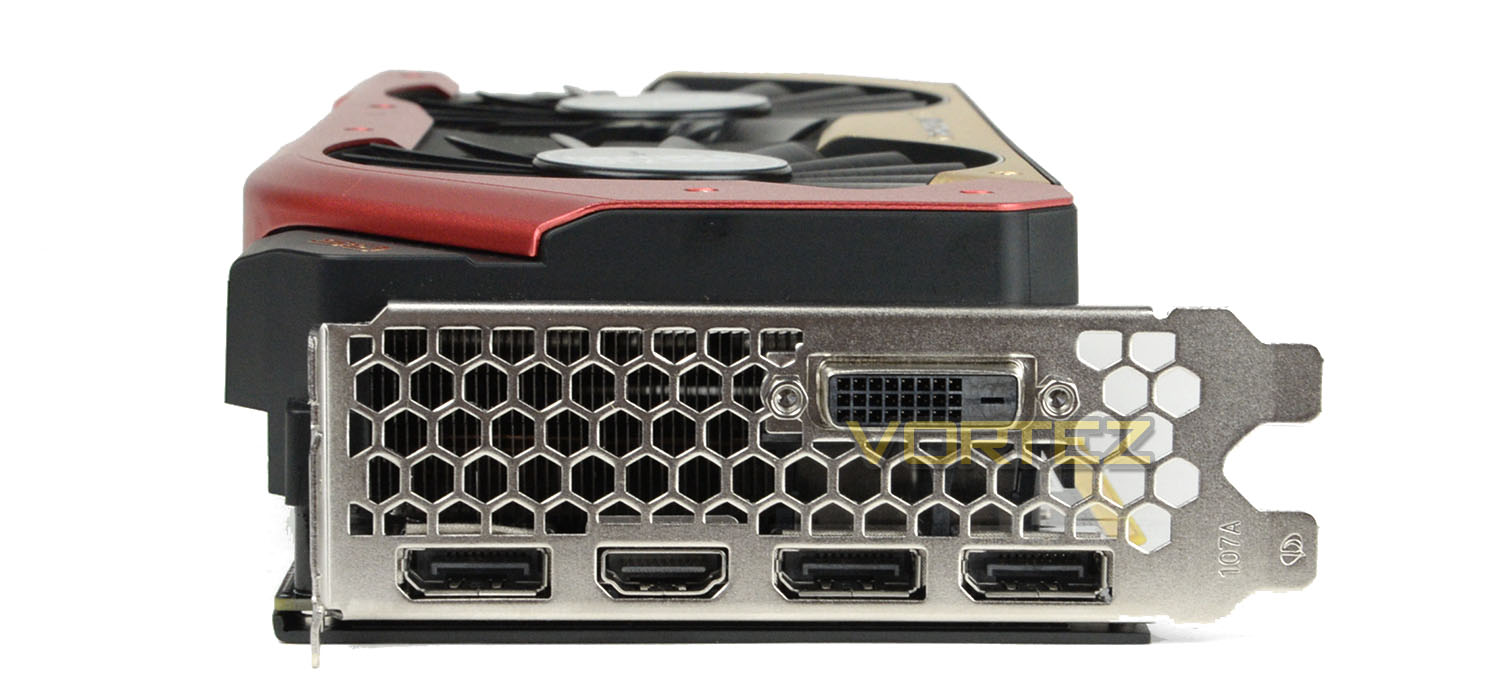
Taking a look at the rear IO section of our graphics card, there are a nice selection of ports to choose from. They are as follows:
• 1x DVI-I port (Up to 2K)
• 3x DisplayPort 1.4 (8K @ 60Hz)
• 1x HDMI 2.0 port (4K @ 60 Hz)
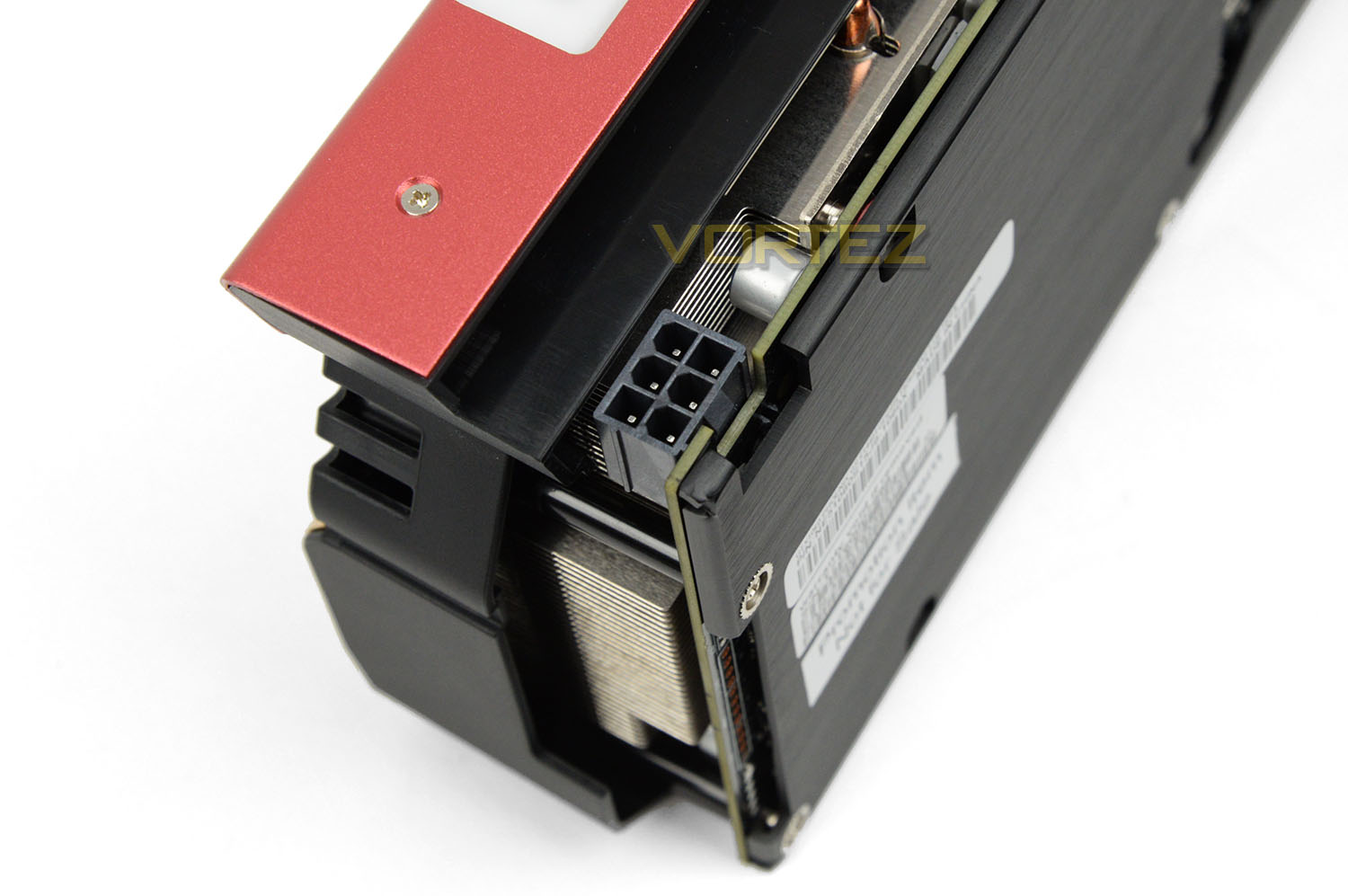
In a similar vein to the reference NVIDIA GTX 1060 FE, the Phoenix GS requires a single 6-pin connection and just 400W for the minimum specification on the PSU. This is great news for those with lower powered power supplies that still want to take advantage of mid-range graphics delivery.
Over the page we’ll take a closer look at the cooling solution and PCB.
Closer Look (Without Cooler)
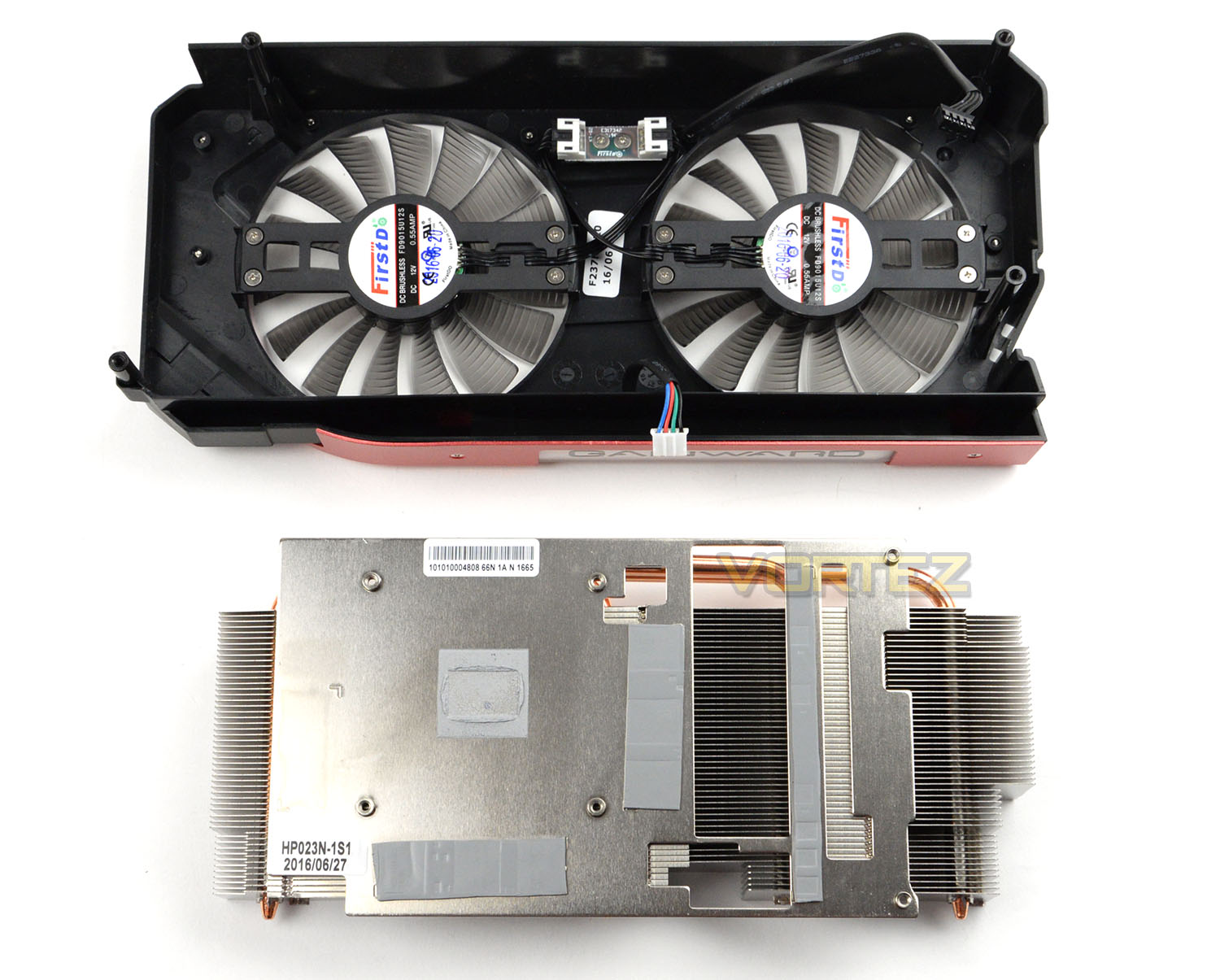
After detaching a number of screws, the cooling solution lifts off the PCB of the graphics card, giving us a closer look at two significant parts. The heatsink and cooling fans.
The cooling fans used on Phoenix GS are FirstD branded and connect directly to the PCB via a single connector. The heatsink utilises four copper heatpipes which blend into a large aluminium heatsink – the GPU makes direct contact with this heatsink and thermal pads cover the memory/VRMs.
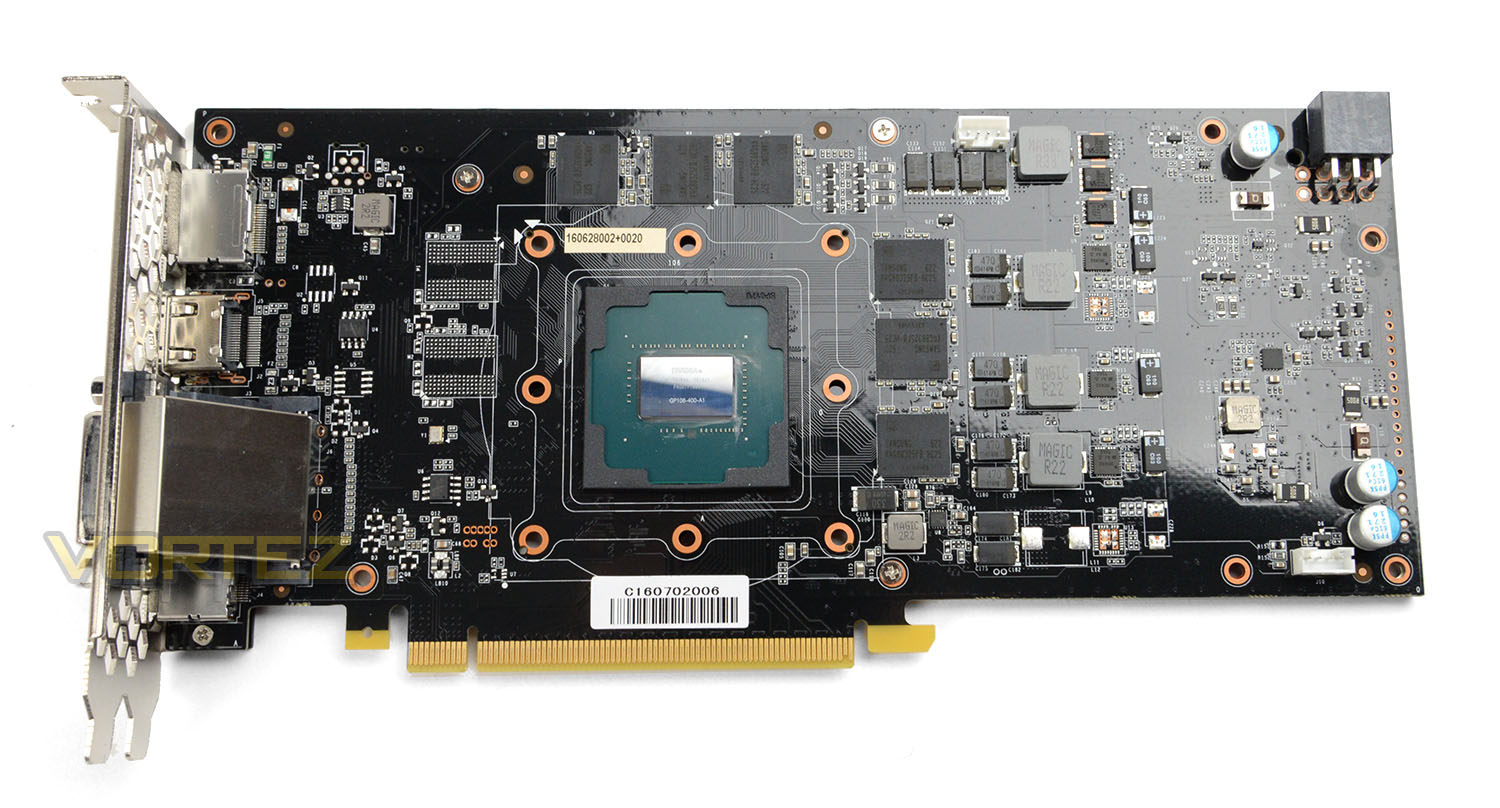
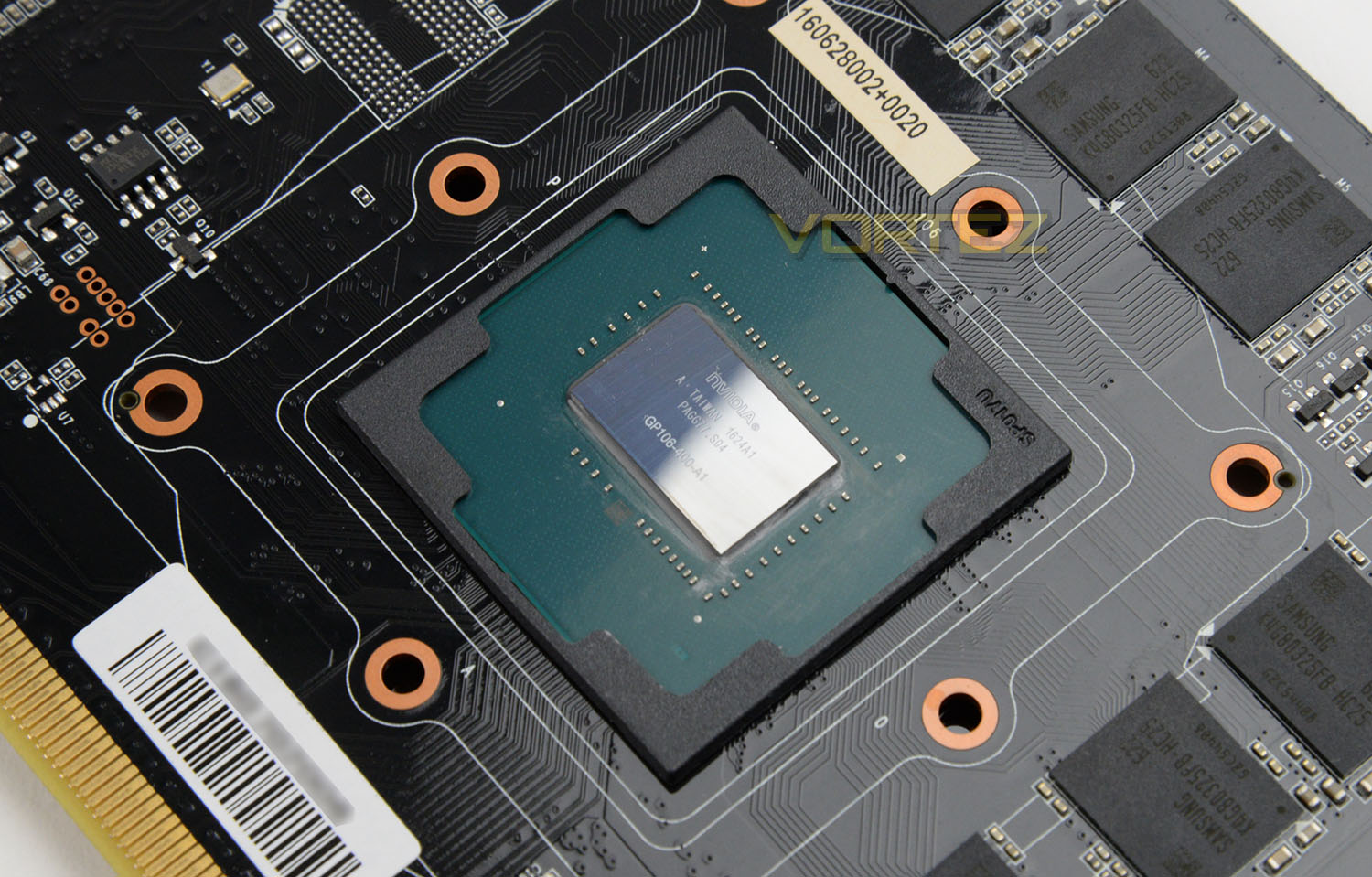
Having detached the cooler we can also now clearly see the inner workings of the Phoenix GS. This PCB is larger than the reference design and the inclusion of key components such as VRMs and phases on the right-side identifies a custom design.
The driving force behind the GTX 1060 is of course the GP106 GPU which uses Pascal architecture and is 22nm. Gainward has applied a 7.5% applied to this GPU compared to the NVIDIA reference design and over the page we’ll be testing this graphics card out to see how significant this modification makes.
Test Setup & Methodology
How we test graphics cards
Testing a graphics card is an extremely lengthy process. We sometimes see reviews where a graphics card has been tested using out of date equipment, out of date games and even out of date drivers. While the latter can be excused due to the sheer amount of driver updates making a thorough review impossible we will however notify the reader when we have used a different driver to the normal for example a pre-release driver. For the most part however we will always use the same hardware and latest drivers so this does certainly need to be taken into consideration when viewing our testing results. Each game and benchmark is tested times with the lowest and highest scores omitted out of the 5 results and the average then taken from the three remaining to give us our final result for each resolution and setting used.
Hardware
Taking Intel’s High-End Desktop platform, our hardware utilises the Intel X99 chipset. Combined with this we use the Intel Core i7-5960X Extreme Edition processor clocked to a realistic and achievable 4GHz to ensure we have no CPU bottlenecks. With 16GB (4x4GB) of DDR4 at 2666MHz and a 750GB SSD there should be minimal paging so the benchmarks we run today will hopefully give a true reflection of the graphics card’s performance.
High End Graphics Cards on test:
ZOTAC GTX 1080 AMP! Extreme (NVIDIA 368.81)
ASUS STRIX GTX 1080 (NVIDIA 368.81)
Gainward GTX 1070 Phoenix Golden Sample (NVIDIA 368.81)
MSI GTX 1060 Gaming X (NVIDIA 368.64)
Gainward GTX 1060 Phoenix Golden Sample (NVIDIA 368.64)
NVIDIA GTX 1060 (NVIDIA 368.64)
NVIDIA GTX 980Ti OC (NVIDIA 368.81)
NVIDIA GTX 980 (NVIDIA 368.81)
NVIDIA GTX 970 (NVIDIA 368.81)
AMD Radeon RX 480 CrossFire (Crimson 16.7.2)
AMD Radeon RX 480 (Crimson 16.7.2)
XFX R9 FURY (Crimson 16.7.2)
AMD Radeon R9 390X (Crimson 16.7.2)
Special thanks go to Intel, Corsair, MSI and AOC for providing the extreme spec components used for our test bench:
Motherboard: MSI X99S GAMING 9 AC
CPU: Intel Core i7-5960X Extreme Edition @ 4GHz
RAM – 16GB (4x4GB) Corsair LPX Vengeance (Red) DDR3 @ 2666MHz 16-17-17-35 C1
Power Supply – CORSAIR HX1050
Hard Drive – Samsung 840 EVO 750GB
Cooler – CORSAIR Hydro Series™ H105 240mm Extreme Performance Liquid CPU Cooler
Monitor – AOC 28″ 4K U2879VF
Capture Card – Razer Ripjaw
CPU: Intel Core i7-5960X Extreme Edition @ 4GHz
RAM – 16GB (4x4GB) Corsair LPX Vengeance (Red) DDR3 @ 2666MHz 16-17-17-35 C1
Power Supply – CORSAIR HX1050
Hard Drive – Samsung 840 EVO 750GB
Cooler – CORSAIR Hydro Series™ H105 240mm Extreme Performance Liquid CPU Cooler
Monitor – AOC 28″ 4K U2879VF
Capture Card – Razer Ripjaw
Benchmarks
If you are a regular reader of our reviews you will know we like to test the latest hardware with the latest games and benchmarks on the market. Here are the games we’ve chosen:
DOOM (OpenGL 4.5 & Vulkan)
Total War: Warhammer
Rise of the Tomb Raider
HITMAN
DiRT Rally
Total War: Warhammer
Rise of the Tomb Raider
HITMAN
DiRT Rally
To capture framerates we use a combination of in-game benchmark tools, FRAPS and PresentMon.
We also take into consideration the benchmarkers out there so have included three of the more popular synthetic benchmarks available:
Unigine: Valley
Unigine: Heaven 4
Futuremark 3DMark Firestrike
Futuremark 3DMark Time Spy
Unigine: Heaven 4
Futuremark 3DMark Firestrike
Futuremark 3DMark Time Spy
Let’s see how today’s graphics card performed…
Power, Temperatures, Acoustics
To test for power consumption, we take a measurement from the plug socket. It is important to note that the figures below represent total system power use and not just the GPU. The CPU was always in a fixed state (4GHz overclock) so did not affect the additional power load when the GPU was placed under 100% load using Heaven 4.0 which was ran for 20 minutes at which point a load reading was taken. Idle readings were taken 5 minutes after system boot to ensure any background services and applications had loaded.
Temperature
To test temperatures we measured idle temperatures after booting windows, letting all applications finish loading and ran a few benchmarks. Once the benchmarks were complete we left the card to reach a cooling plateau where we then took the idle temperatures. For the load tests we set Heaven 4.0 running continuously for ~30 minutes recorded the peak/maximum GPU temperature.
Acoustics
The cooler which is attached to the Phoenix GS is quiet, even under full load. Noise levels can be regarded as low and undisruptive.
Overclocking
To overclock the GTX 1060 Phoenix GS we used MSI Afterburner Tool (4.3.0 Beta 4) since it gives extensive options for modifying the GPU and memory clock.
Overclocking the card was easy and we managed to boost the GPU and memory clock beyond the factory overclock applied by MSI. Our result took the GPU clock up to 1719MHz (1935MHz Boost) and modifying the memory clock up to 2102MHz. Pushing the card a little further meant we were able to receive a higher score in Unigine Heaven 4.0 which is shown below.
This is certainly a significant increase; therefore, others should be able to take advantage of a slight performance increase – without taking having a colossal effect on temperatures.
DX12: 3DMark Time Spy
With its pure DirectX 12 engine, which supports new API features like asynchronous compute, explicit multi-adapter, and multi-threading, 3DMark Time Spy is the ideal benchmark for testing the DirectX 12 performance of the latest graphics cards.
DX11: 3DMark FireStrike
Fire Strike is the new showcase DirectX 11 benchmark designed for high-performance gaming PCs. It is Futuremark’s most ambitious and technical benchmark ever, featuring real-time graphics rendered with detail and complexity far beyond what is found in other benchmarks and games today.
DX11: Unigine Heaven 4.0
Heaven Benchmark with its current version 4.0 is a GPU-intensive benchmark that hammers graphics cards to the limits. This powerful tool can be effectively used to determine the stability of a GPU under extremely stressful conditions, as well as check the cooling system’s potential under maximum heat output. It provides completely unbiased results and generates true in-game rendering workloads across all platforms.
DX11: Unigine Valley
Valley Benchmark is a new GPU stress-testing tool from the developers of the very popular and highly acclaimed Heaven Benchmark. The forest-covered valley surrounded by vast mountains amazes with its scale from a bird’s-eye view and is extremely detailed down to every leaf and flower petal. This non-synthetic benchmark powered by the state-of-the art UNIGINE Engine showcases a comprehensive set of cutting-edge graphics technologies with a dynamic environment and fully interactive modes available to the end user.
DX12: DOOM OpenGL 4.5
By default DOOM utilises an OpenGL 4.5 renderer, and is one of relatively few Windows PC titles to not use DirectX 12. It tests how well NVIDIA and AMD’s GPUs deal with a less mainstream approach, especially in regards to driver optimisations, and like all of id titles stretches graphics quality to the limit.
DX12: DOOM Vulkan
id have also released an optional Vulkan rendering path for DOOM. This API is a development of AMD’s Mantle low level which has been taken on board by the Kronos Group for implementation as the next generation of Open graphics APIs. Like DirectX 12 Vulkan is capable of Asynchronous Compute in specific configurations.
DX12: Total War: WARHAMMER
Total War: WARHAMMER is a pseudo Real-Time Strategy title which leverages DirectX 12 to render huge numbers of complex units on screen at any one time.
DX12: Rise of the Tomb Raider
Square Enix’s Rise of the Tomb Raider is the sequel to 2013’s Tomb Raider reboot. An enormously challenging title graphically, the developers also released an optional DirectX 12 render path for Windows 10 users. Although it has undergone a number of iterations this rendering pathway notably doesn’t currently utilise the full capabilities of DirectX 12.
DX12: HITMAN
Yet another DirectX 12 title, 2016’s Hitman from Square Enix and developer IO Interactive has a more robust DirectX 12 implementation than Rise of the Tomb Raider. We’ve tested at a full range of resultions, from 1080p through to 4K, which provides a look at the impact of GPU speed and memory utilisation.
DX11: DiRT Rally
Overall Performance
Here we take a look at the overall performance of the graphics card. This figure is determined by finding the average FPS across all of the settings used in a particular benchmark(game) to give us an overall value.
Value For Money
We make a simple calculation for this set of results. For each game we add all of the resulting FPS totals together and then divide by the four sets to give us an overall performance figure. While the figures alone do not give you an accurate picture of how the card will perform in any given scenario, they do tell you, when averaged, which GPU is the more capable across all of the benchmarks and settings tested.
Conclusion
Having already reviewed the NVIDIA GTX 1060 FE and a custom design from MSI, the standard has been set. So how do Gainward’s efforts in the Phoenix GS shape up?
Well, the GTX 1060 Phoenix GS has plenty of positive points we can expand on. While the physical design may not be suited to every user’s theme, we’re pleased to see Gainward diversifying with styling which is quite a departure from the aesthetic trends set by other graphics vendors.
The attached cooler on the Phoenix GS delivers impressive thermals and low-noise – against the competition this cooler design achieved great results, without needing an additional fan like other GTX 1060s. It’s also pleasing to see Phoenix GS appearing as the most efficient graphics card in our current lineup of testing cards; proving how efficient this card and its design really is. Such lower power consumption therefore means that end users needn’t worry about buying in a high-wattage PSU for this mid-range graphics card.
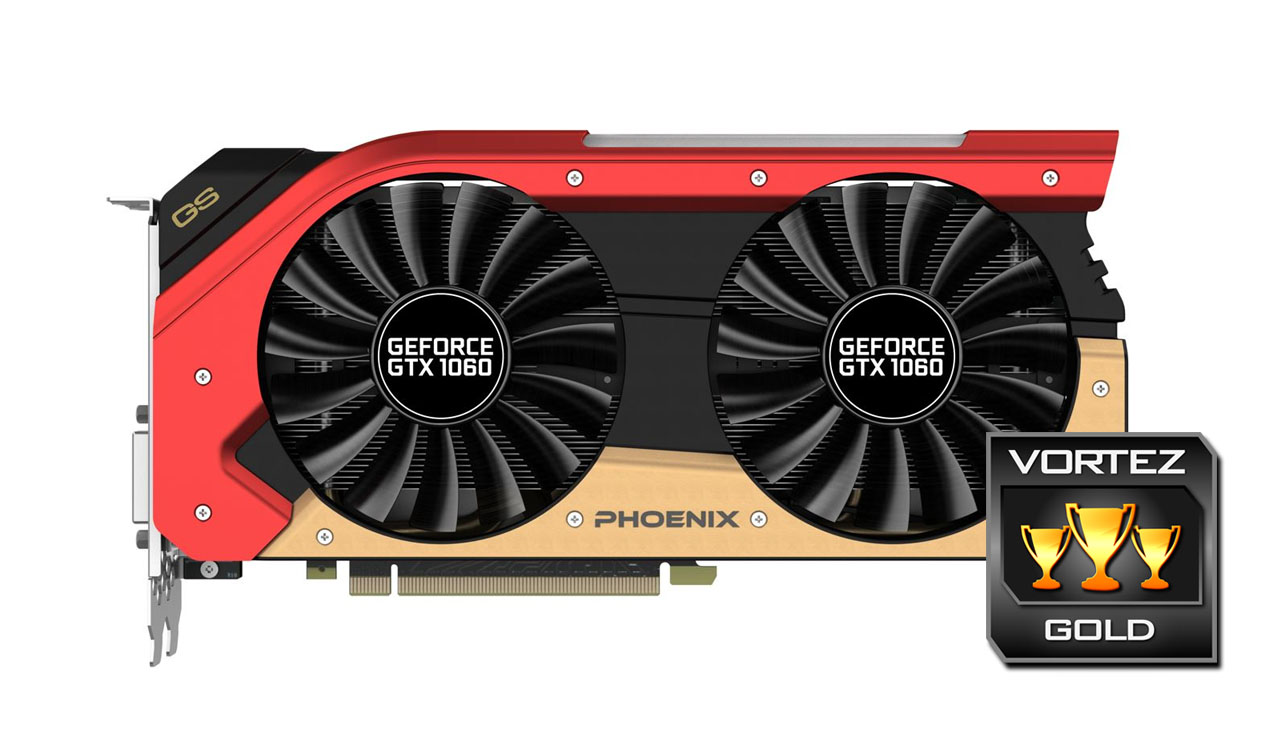
In the gaming arena Phoenix GS offers good performance in DX11 and DX12 title, 1080p being the ideal resolution for this card. Ideally, for the cost we’d have liked to see a bump in the memory clock speed, which has been left untouched from its default transfer rate. The GPU has been given a conservative factory overclock but again, this could well have been nudged up slightly more to achieve even greater results in terms in the 3D performance.
Phoenix GS is slightly more expensive compared to the Founders Edition but we do have a factory overclock and a rather capable cooling solution. This card is priced at £299 GBP / $280 USD and also arrives with a 2 year warranty for peace of mind.
Gainward presents an appealing solution for those wanting a piece of the GTX 1060 action. Phoenix GS achieves low-noise, low-temperatures and delivers on performance too!
Pros
+ Distinct aesthetics
+ Customisable LED lighting
+ Comes with factory overclock
+ Low-noise
+ Effective cooling
+ Overclocks even further
+ Good performance
+ DirectX 12 ready
+ 2 year warranty
Cons
– Marginal performance gains over Founders Edition
– No memory overclock
+ Distinct aesthetics
+ Customisable LED lighting
+ Comes with factory overclock
+ Low-noise
+ Effective cooling
+ Overclocks even further
+ Good performance
+ DirectX 12 ready
+ 2 year warranty
Cons
– Marginal performance gains over Founders Edition
– No memory overclock
Click here for an explanation of our awards at Vortez.net.