Gigabyte are on their Global Tech Tour and kindly sent us an invitation to attend their event in London.
Last week, an email popped into our inbox inviting us to attend a presentation on some new products Gigabyte will be unveiling in the next month. With the prospect of free food and freebies, it was hard to decline such an invitation. On arrival, after much puzzling over the actual location of the Hotel (Thanks Google maps for showing me the wrong place), we were finally greeted by Andrzej, the Gigabyte representative. On the side of the entrance, a nicely laid out table showcased what we were here to see.
Gigabyte have always been synonymous to quality products boasting a plethora of innovative features and we only have to look at our recent Gigabyte GA-X58A-UD3R review to realise how much they pack into their products. This is despite the motherboard being a mainstream offering as opposed to the most high end UD9 motherboard. Unique solutions such as the Ultra Durable 3 concept, phase power switching and their usage of quality components have prompted many users to opt for their products over the competition. So when Gigabyte revealed their upcoming plans, we were more than excited to see what they had in store for consumers and most importantly, enthusiasts and gamers.

Their main focus at the presentation was on upcoming graphics cards. In the past, Gigabyte haven’t been as vocal on this department as other Tier 1 manufacturers such as ASUS and MSI. Lately, the latter two have been very successful at offering enthusiasts graphics cards geared for overclocking thanks to excellent implementation of custom coolers and the ability to overvolt. This time, it was Gigabyte’s turn to show their engineering prowess and this came in the form of their ‘SOC’ range of graphics cards, SOC being an acronym for ‘Super Overclocked’. In partnership with Nvidia, the products they had on show included a custom designed Fermi based GTX470, GTX480 and the highly popular GTX460. The event was part of Gigabyte’s global tech tour. For more information about their goals, check their dedicated site.
Technology has moved beyond machines and circuitry. It is the foundation of modern life and has become an integral part of how we learn, share, and create with others in an interconnected world.
With over 20 years of manufacturing knowledge, GIGABYTE thrives on delivering the latest technology to users around the globe. We develop, test, and manufacture a wide range of products following strict quality and environmental control standards.
Our reputation as a pioneer in motherboard innovation has allowed us to diversify our product range to include graphics cards, notebooks, desktop PCs, PC components, cellular phones, server and data centre solutions, and more.
Spirit of Innovation
GIGABYTE was founded in 1986 in a small lab by four young engineers passionate to make their mark on the industry. GIGABYTE remains dedicated to the core belief of improving the lives of our users by manufacturing products that are high-performing, reliable, and of excellent quality. Here are some of GIGABYTE’s innovation highlights:
-USB 3.0
-Ultra Durable Technology
-GPU Gauntlet sorting
-Docking Netbook
The unique features Gigabyte wanted to demonstrate at the presentation included:
-GPU Gauntlet Sorting
-Ultra Durable VGA+
-Windforce cooling design
-OC Guru Graphics Tuner
So turn over to the next page for some exclusive photos and information.
The boxes were empty…
Gigabyte SOC GTX470: GV-N470SO-13I
The first graphics card they had on display was the Super Overclocked edition of the GTX470. With a stock clock speed of 700/3348MHz, it is being marketed as the fastest GTX470 in the world, 12% better than standard cards. Looking at other manufacturers’ offerings, I don’t doubt that for a second. It’s no mystery that Nvidia’s GF100 core runs very hot. It may be the most powerful GPU to date but even on release, it was plagued with thermal issues and consequently reference design coolers were loud to compensate for the high temperatures. Further injury was the core’s high power consumption. Gigabyte have realised that those negative points made people deviate away from Nvidia’s high end Fermi cards and have thus tried to resolve the issue.
Specifications
| •NVIDIA GeForce GTX 470 SOC Edition •Overclock: Core/Mem clock: 700/ 3348 MHz •GIGABYTE WINDFORCETM 3X Cooling Design •12 Power Phase •GPU GauntletTM Sorting Technology •Ultra Durable VGA+ High Quality Components •Voltage Read Point •OC Guru-graphics card smart tuner •12% performance better than generic GTX 470!! •18% temperature lower than generic GTX 470!! •17% power consumption lower than generic GTX 470!! •Microsoft DirectX 11 and OpenGL 3.2 support •Support NVIDIA PhysX, CUDA, 3D Vision, and Pure Video HD Technology |
Gigabyte Windforce 3X
The GV-N470SO-13I
Their method of resolving the problem includes better use of components, a more efficient design, cherry picked cores and a superior cooler. The most notable feature on first look is the tri-fan cooler design dubbed Windforce 3X. As you can guess, the ‘3X’ is representative of the three 80mm ultra-quiet PWM fans on board.
The Windforce 3X cooler
The metal shroud also has an angular profile that angles the two side fans to face outwards. The picture depicts this more clearly. The design is meant to improve airflow by reducing turbulence. Another key advantage is that the profile of the aluminium heatsink can be raised on the sides for greater dissipation surface area. The base uses a Vapour Chamber for more efficient heat transfer and this is further enhances by the 3 copper heat pipes. The fins are also inclined and can be found in three different orientations: parallel inclined, mirroring inclined and 3D inclined, the latter being the design used on the SOC GTX470.
Demonstration
Here’s a demonstration of what users can expect:
And another of the cooler in action (They were certainly keen in showing us videos of it multiple times):
The result is not only 3x the airflow performance of the single fanned reference cooler but 18% cooler operation. Thankfully this is not at the expense of noise. Gigabyte were quick to point at that their fans were much quieter than the reference fan for a given speed. Whilst the stock fan operates between 34.8-46 dB from 2000-3000RPM, the Windforce fans operate between 22-38 dB at the same speed.
Ultra Durable VGA+
Ultra Durable is a term we have come accustomed to seeing on many Gigabyte products. This time, the feature has made its way to their graphics card range. The concept encompasses their usage of high quality components to increase performance at no detriment to longevity and reliability. As such, we can expect to see the customary 2oz copper PCB which lowers impedance by 50% compared to traditional manufacturing processes, thereby improving energy efficiency and durability. More specific to the graphics card, it uses Tier 1 Samsung memory chips that have undergone testing prior to installation. Other additions to look out for are the Ferrite Chokes and Low RDS (on) MOSFET that form part of the 12 phase PWM power circuitry. There all contribute to a much more overclockable graphics card.
GTX470 VS GTX480
When I looked at the GA-X58A-UD3R motherboard, I briefly touched on the Dynamic Power Phase implementation in order to reduce power consumption. The SOC graphics cards boast an impressive 12 phase PWM design but often the card will be idling and thus waste power. To alleviate the problem, the card will smartly switch off phases based on usage. Whilst idling in 2D mode, only 2 phases will be active, increasing to 6 active phases in 3D. During intense gaming sessions or benchmarking, all 12 phases will be active to handle smooth power delivery.
NEC Proadlizers
Another nifty addition is the exclusive use of proadlizers. Traditionally, high end parts use Japanese solid capacitors as a mark of superior electronic conductivity but Gigabyte have instead gone for the flat capacitors to ensure even more stable power delivery. The striking design resembles ICs rather than normal capacitors and those particular ones have been manufactured by NEC. Gigabyte claim that one proadlizer is enough but for good measure, they have included 5 pieces on their GTX470. The capacitors provide current capacity of up to 5000microFarads and extremely low ESL/ESR for super overclocking ability. Low noise ensures stable power delivery without voltage spikes that
The Ultra Durable VGA+ design lowers power consumption by 17% compared to the reference card (226W VS 272W), quite an achievement given the criticism GF100 received on release.
Gigabyte SOC GTX470: GV-N470SO-13I (Continued)
GPU Gauntlet Sorting
Cherry picking is no secret when selecting the best components. Manufacturers do it all the time to sort out the best cores, in this case GPUs. These cores tend to undergo various stress tests to make sure they can sustain high loads and temperatures and if successful, they are pre-overclocked and sold on. Not surprisingly, the end products often command a higher price point. Gigabyte have dubbed their cherry picking sorting process as GPU Gauntlet, to represent the special imaginary gauntlet used to carefully select the GPUs off the production line (as illustrated by one of Gigabyte’s representative).
The SOC cards undergo the same process. Gigabyte uses proprietary database analysis tools to investigate GPU core, shader and memory clock speeds. Cores that don’t meet pre-defined clocks fail the initial SOC selection and get used on reference boards instead. Those that do pass are then put to the test in Furmark and 3DMark to determine the highest clock speeds and optimal temperatures. Successful cores are then factory overclocked at an optimal stability point for a perfect balance between frequency, temperature and power consumption. The result is that the SOC GTX470 is clocked at 700/3348MHz from the standard 607/3348MHz clock speed, for an immediate 12% performance advantage. The beauty of GPU Gauntlet is that the final selected speed is in fact much lower than the maximum speed (the maximum point is a claimed 780MHz), where power consumption and temperature become prevalent issues, so there is still a lot of headroom on top of the already high pre-overclocked, hence the term Super Overclocked.
OC GURU
There has been growing emphasis on software overclocking tools in the past year with MSI now bundling their excellent Afterburner applications with their high end graphics cards and ASUS doing similarly with their Smart Doctor software. The benefits are numerous since they allow over volting on compatible graphics cards without the risks of hardware modifications. The problem is that all the programs end up doing the same thing so Gigabyte have tried to differentiate theirs with more features.
OC GURU presents users a friendly interface which greets them with the ability to alter the clock and memory speed using sliders. On the SOC cards, both the GPU core voltage and memory voltage can be tweaked. Subsequently, the settings can be saved on up to 5 profiles and these can be assigned to hot keys for on the fly overclocking during benchmarking or gaming sessions. The graphics card can be set to 3 modes, OC, Gaming and Green, with each providing up to 5 separate profiles.
Gigabyte are keen to show that power saving is a crucial aspect of their graphics cards, hence the ‘Green’ mode. Thanks to the PWM fans of the Windforce 3X cooler, they can be controlled manually for the best thermal/noise balance. The hardware monitor tab is also a useful addition akin to that on MSI’s Afterburner application. Phase power switching can also be monitored on OC GURU, with a tab showing how many phases are active during operation and how that translates to overall power saved.
Gigabyte SOC GTX480 + LN2
Gigabyte are also bringing the SOC feature to their flagship GTX480 graphics card. All the previous features we’ve discussed previously on the GV-N470SO-13I can be expected, i.e. the Windforce 3X cooler, the Ultra Durable VGA+ design, Gauntlet sorting and OC GURU. Although the clock speeds haven’t been finalised, a healthy pre-overclock will no doubt make its way to the released graphics card. Gigabyte only had the bare PCB on show so grabbing it whilst no one was looking was out of the question…
The GTX480
This particular GTX480 is much more than an SOC card. It sports a dual BIOS design that caters for LN2 users so the board can either be used in SOC mode, for gamers, or LN2 mode, aimed at enthusiasts. In the extreme LN2 mode, higher voltages are unlocked so overclockers have even more headroom over the default SOC mode. The latter is already superior to other competing board on the market so LN2 mode truly unlocks its potential. The feature is akin to LN2 mode on ROG motherboards we have reviewed here, meaning that the card will overcome cold bug issues when being cooled.
In SOC mode, the core voltage can be altered between 1.05V-1.1V and the memory voltage between 1.55V-1.6V. LN2 mode unlocks the maximum core voltage to 1.4V and the maximum memory voltage to 1.85V. Rather uniquely, the PCIe voltage can also be tweaked. All this can be done via the OC GURU application and Gigabyte are proud of the fact that users can safely rely on software instead hardware modifications.
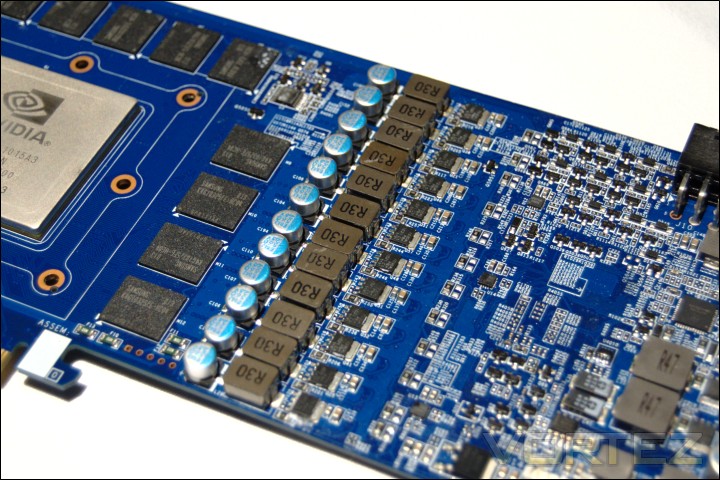
The Ferrite chokes and Samsung K4G10325FE-HC04 memory chips
The GTX480 variant also uses a 12 phase PWM design, as represented by the 12 ferrite chokes, with phase switching enabled to save power. The Samsung memory chips surrounding the GF100 core are rated at 0.40ns for an effective 5.0Gbps
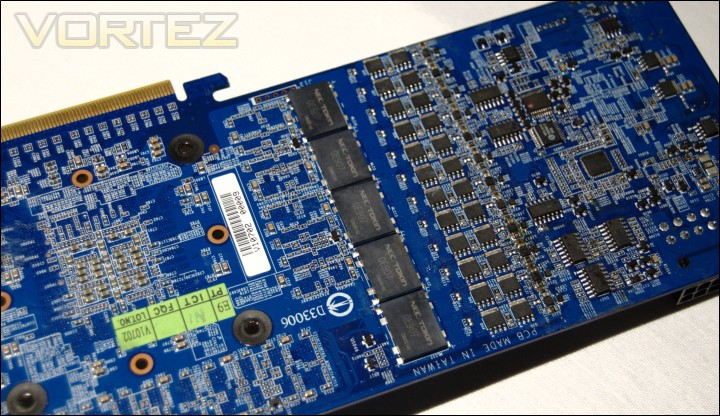
The NEC Proadlizers
On the back, the card also has 5 NEC proadlizer capacitors for stable power delivery.
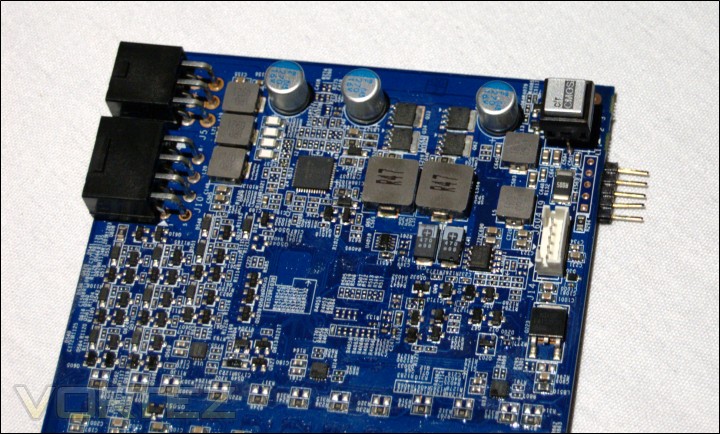
LN2 Mode
The GTX480 core is more power hungry than its smaller sibling, hence the requirement for the 6+8 pin PCIe power connectors. On the right are the clear CMOS key and voltage probe points. The CMOS key appears to change the card between the default SOC mode and the extreme LN2 mode. The voltage probe points can also be found on the SOC GTX470 but somewhat uniquely on the GTX480, there are 5 pins present for each probe point. Going from bottom to top, the read points are for the CPU-Core, GPU-I/O, Memory and PCIe, the last one being the ground point.
This card will have an October release but the price point hasn’t been confirmed yet. For the record breakers amongst us, Gigabyte are developing a “World Record” card with higher unlocked voltages for even more insane overclocking results! Unfortunately this card will not be available in retail and be reserved for special order.
Gigabyte OC GTX460: GV-N460OC-1GI
The GTX460 has quickly become one of the best-selling graphics cards currently on the market. Thanks to its affordable price and excellent performance, it has become a must for gamers looking for the best “bang for the buck” card. Gigabyte claim that their own GTX460 has become the best seller in the US, Germany and South Korea, key gaming markets. The company realise that this card will spend a lot of time inside computers found in Cyber Cafes or LAN rigs, so they have carefully customised their offering to cope with the intense wear and tear expected from such duties.
The GTX460s and GTX470
I won’t go into too much detail about the specifications because our previous GTX460 review covered most of technical aspects. The sole difference in specifications is the 715MHz core clock speed over the stock 675MHz. Instead, I will focus on the card’s unique features. In that sense, it is very similar to its SOC siblings albeit a cut down version. The board uses the Ultra Durable VGA concept for more efficient operation and stable power delivery through the use of 2oz copper PCB, Ferrite chokes, Low RDS (on) MOSFET, Japanese solid capacitors and tier 1 memory modules. The main difference between the VGA+ cards is the absence of the NEC proadlizers.
The custom cooler on the GTX460 is from the Windforce series and given the 2 fans present, it has been dubbed the Windforce X2. The distinctive fans feature a revolutionary Smart Dust-Reducing design. In its default configuration, both fans operate for maximum cooling performance but when cooling is already adequate, Smart Alternate mode switches on. In this mode, one fan speeds up to cool the GPU and simultaneously pushes any dust towards the other side of the card. Later on, the fan switches off and the second one speeds up to get rid of the dust. This alternating action ensures that dust doesn’t collect over time, a problem that plagues many gamers who tend not to maintain their hardware. The feature would also not be possible without the inclined dual fan design that effectively enhances airflow and heat dissipation by reducing turbulence. In addition, two copper heat pipes aid in heat transfer.
Here’s the cooler in action:
Closing Thoughts
Gigabyte are clearly aiming to diversify their range of high end components and the World Tour’s main focus was to try and raise attention on their upcoming graphics cards. The GTX460 has already been a major success so going by that, we can expect to see similar results with their GF100 based SOC cards. It has come to a point where the market is being saturated by the same card but from different manufacturers. Consumers want new innovative features with their graphics cards, whether it being a few bundled extras or custom designed coolers and a mere pre-overclock is often not enough. Gigabyte have taken heed of all these points and after careful thought have produced the parts we see here today. Having those unique features differentiates them from the competition and if their products live up to the claimed overclockability, lower noise and power draw, and high performance, then consumers will quickly welcome them. The upside is that Gigabyte already have a firm ground in the hardware department and a strong following on their motherboard range so it won’t be hard for them to gain a wider user base.